

Effectiveness of Balancing Everyday Life (BEL) versus standard occupational therapy for activity engagement and functioning among people with mental illness – a cluster RCT study
Open accessThe DOI matches its Crossref record; 55 of the 55 references it cites were found in a registry or an index.
Abstract
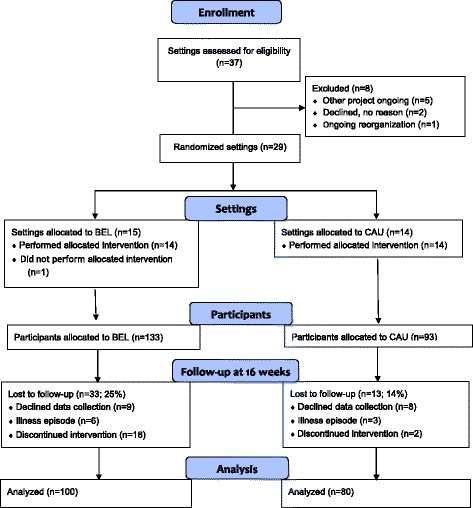
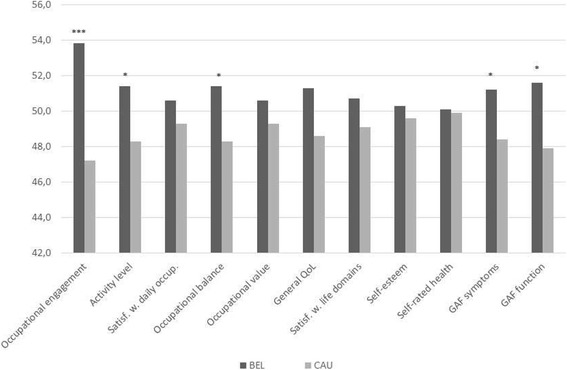
BACKGROUND: Many with a mental illness have an impoverished everyday life with few meaningful activities and a sedentary lifestyle. The study aim was to evaluate the effectiveness of the 16-week Balancing Everyday Life (BEL) program, compared to care as usual (CAU), for people with mental illness in specialized and community-based psychiatric services. The main outcomes concerned different aspects of subjectively evaluated everyday activities, in terms of the engagement and satisfaction they bring, balance among activities, and activity level. Secondary outcomes pertained to various facets of well-being and functioning. It was hypothesized that those who received the BEL intervention would improve more than the comparison group regarding activity, well-being and functioning outcomes. METHODS: BEL is a group and activity-based lifestyle intervention. CAU entailed active support, mainly standard occupational therapy. The BEL group included 133 participants and the CAU group 93. They completed self-report questionnaires targeting activity and well-being on three occasions - at baseline, after completed intervention (at 16 weeks) and at a six-month follow-up. A research assistant rated the participants' level of functioning and symptom severity on the same occasions. Non-parametric statistics were used since these instruments produced ordinal data. RESULTS: The BEL group improved more than the CAU group from baseline to 16 weeks on primary outcomes in terms of activity engagement (p < 0.001), activity level (p = 0.036) and activity balance (p < 0.042). The BEL group also improved more on the secondary outcomes of symptom severity (p < 0.018) and level of functioning (p < 0.046) from baseline to 16 weeks, but not on well-being. High intra-class correlations (0.12-0.22) indicated clustering effects for symptom severity and level of functioning. The group differences on activity engagement (p = 0.001) and activity level (p = 0.007) remained at the follow-up. The BEL group also improved their well-being (quality of life) more than the CAU group from baseline to the follow-up (p = 0.049). No differences were found at that time for activity balance, level of functioning and symptom severity. CONCLUSION: The BEL program was effective compared to CAU in terms of activity engagement. Their improvements were not, however, greater concerning other subjective perceptions, such as satisfaction with daily activities and self-rated health, and clustering effects lowered the dependability regarding findings of improvements on symptoms and functioning. Although the CAU group had "caught up" at the follow-up, the BEL group had improved more on general quality of life. BEL appeared to be important in shortening the time required for participants to develop their engagement in activity and in attaining improved quality of life in a follow-up perspective. TRIAL REGISTRATION: The study was registered with ClinicalTrial.gov. Reg. No. NCT02619318 .
Overview
The claims and statistics of this paper haven’t been checked yet.
Free: it reads the open-access text and checks the first 5 claims that cite a source we can check. Create a free account to check every claim.
Integrity signals
Registry
Cites
Statistics
Figures
Verification
Claims the paper makes
The claims and statistics of this paper haven’t been checked yet.
Free: it reads the open-access text and checks the first 5 claims that cite a source we can check. Create a free account to check every claim.
Claims other papers make about this one
Each is checked against this paper’s own text: does it say what the citing paper says it does?
The source backs part of the claim, not all of it — or backs it for a different population, condition or comparison.
In the citing paper
“Balancing Everyday Life (BEL) (47) is a manualized group-based lifestyle intervention designed for people using community-based mental health services. Developed by Swedish occupational therapists, it aims to facilitate engagement in desired activities identified by participants and support for personal recovery (47).”
From Contributions of a time use perspective in community mental health practice: a scoping review (2024) · cites this paper as [47]
Experimental — accuracy not yet measuredThe source backs part of the claim, not all of it — or backs it for a different population, condition or comparison.
In the citing paper
“The BEL has been evaluated in rigorous RCT studies that demonstrate it is effective in improving activity engagement, as represented in increased activity levels and more optimal activity balance, and improving personal recovery, clinical symptoms, psychosocial functioning and general quality of life (47, 68).”
From Contributions of a time use perspective in community mental health practice: a scoping review (2024) · cites this paper as [47]
Experimental — accuracy not yet measuredThe source backs part of the claim, not all of it — or backs it for a different population, condition or comparison.
In the citing paper
“All ten studies reported the time use interventions were facilitated by at least one occupational therapist; only P2P groups were co-facilitated with peer or lived experience workers. All reported facilitator training and regular briefings (47, 64, 65).”
From Contributions of a time use perspective in community mental health practice: a scoping review (2024) · cites this paper as [47]
Experimental — accuracy not yet measuredThe source backs part of the claim, not all of it — or backs it for a different population, condition or comparison.
In the citing paper
“The study had to include 128 participants, 64 in each group, to achieve a statistical power of 80% and a significance level of 5% and to detect a difference of 3 points corresponding to a moderate effect size, on the POES-S.”
From Meaningful Activities and Recovery (MA&R): a co-led peer occupational therapy intervention for people with psychiatric disabilities. Results from a randomized controlled trial (2023) · cites this paper as [24]
Experimental — accuracy not yet measuredThe cited source says what the claim attributes to it.
In the citing paper
“Ten studies reported the development and evaluation of time use interventions, including Action over Inertia (AOI) (62, 63), Balancing Everyday Life (BEL) (47) and the Pathway to Participation (P2P) program (64).”
From Contributions of a time use perspective in community mental health practice: a scoping review (2024) · cites this paper as [47]
8 more claims about this paper
Create a free account to see every claim other papers make about this one.
Self-check
Percentages, sums and reported differences re-computed from the paper’s own numbers.
The self-check needs the paper’s full text.
Citations
Cites
(1992) · PubMed · Cited by 33,716
Society and the Adolescent Self-Image
Rosenberg, M. (1965) · doi:10.1515/9781400876136 · Cited by 30,126
The MOS 36-ltem Short-Form Health Survey (SF-36): I. Conceptual Framework and Item Selection
Ware, J. E., & Sherbourne, C. D. (1992) · Medical Care · doi:10.1097/00005650-199206000-00002 · Cited by 30,033 · cited 1×
“Self-rated was also considered as an aspect of well-being and was assessed by using the first item of the MOS SF36 [38].”
MethodThe Global Assessment Scale: A Procedure for Measuring Overall Severity of Psychiatric Disturbance
Endicott, J. (1976) · Archives of General Psychiatry · doi:10.1001/archpsyc.1976.01770060086012 · Cited by 4,982 · cited 1×
“The Global Assessment of Functioning (GAF) scale [40] was used to assess the individual’s overall level of psychosocial functioning.”
MethodRecovery from mental illness: the guiding vision of the mental health service system in the 1990s
Anthony, W. A. (1993) · Psychosocial Rehabilitation Journal · doi:10.1037/h0095655 · Cited by 3,700 · cited 1×
“The BEL program also emphasizes personal recovery, which is defined as an individual process towards a meaningful and hopeful life, regardless of the absence or presence of symptoms [16].”
BackgroundWalker, E. R., McGee, R. E., & Druss, B. G. (2015) · JAMA Psychiatry · doi:10.1001/jamapsychiatry.2014.2502 · Cited by 2,976 · cited 1×
“Mental illness often results in consequences such as deteriorated quality of life [1, 2], an impoverished everyday life with few meaningful activities [3], reduced work capacity [4, 5] risks of physical health problems [6] and increased mortality [7].”
BackgroundVancampfort, D., Stubbs, B., Mitchell, A. J., De Hert, M., Wampers, M., Ward, P. B., Rosenbaum, S., & Correll, C. U. (2015) · World Psychiatry · doi:10.1002/wps.20252 · Cited by 1,271 · cited 1×
“Mental illness often results in consequences such as deteriorated quality of life [1, 2], an impoverished everyday life with few meaningful activities [3], reduced work capacity [4, 5] risks of physical health problems [6] and increased mortality [7].”
BackgroundDesign and Analysis of Group-Randomized Trials
Sonnad, S. (1999) · Medicine & Science in Sports & Exercise · doi:10.1097/00005768-199902000-00025 · Cited by 1,125
Design and Analysis of Group-Randomized Trials
Murray, D. M. (2007) · doi:10.1093/oso/9780195120363.001.0001 · Cited by 1,116
Application and Results of the Manchester Short Assessment of Quality of Life (Mansa)
Priebe, S., Huxley, P., Knight, S., & Evans, S. (1999) · International Journal of Social Psychiatry · doi:10.1177/002076409904500102 · Cited by 1,071 · cited 2×
“A Swedish MANSA version was used in the study.”
MethodBlinding in randomised trials: hiding who got what
Schulz, K. F., & Grimes, D. A. (2002) · The Lancet · doi:10.1016/s0140-6736(02)07816-9 · Cited by 952
Just one question: If one question works, why ask several?
Bowling, A. (2005) · Journal of Epidemiology and Community Health · doi:10.1136/jech.2004.021204 · Cited by 864
A solution to dependency: using multilevel analysis to accommodate nested data
Aarts, E., Verhage, M., Veenvliet, J. V., Dolan, C. V., & van der Sluis, S. (2014) · Nature Neuroscience · doi:10.1038/nn.3648 · Cited by 619 · cited 1×
“These findings are less dependable because of risk of Type I errors [50].”
BackgroundBurns, T., Catty, J., Becker, T., Drake, R. E., Fioritti, A., Knapp, M., Lauber, C., Rössler, W., Tomov, T., van Busschbach, J., et al. (2007) · The Lancet · doi:10.1016/s0140-6736(07)61516-5 · Cited by 613 · cited 3×
“Successful programs have in recent years been developed with respect to returning to or entering the employment market [4, 9].”
BackgroundSinclair, S. J., Blais, M. A., Gansler, D. A., Sandberg, E., Bistis, K., & LoCicero, A. (2010) · Evaluation & the Health Professions · doi:10.1177/0163278709356187 · Cited by 594 · cited 1×
“It has also shown good internal consistency reliability, and to be without floor and ceiling effects [37].”
BackgroundOccupational Science: The Evolving Discipline
Ludwig, F. M. (1997) · The American Journal of Occupational Therapy · doi:10.5014/ajot.51.10.934d · Cited by 466
Occupational Therapy for Independent-Living Older Adults: A Randomized Controlled Trial
Clark, F. (1997) · JAMA · doi:10.1001/jama.1997.03550160041036 · Cited by 455 · cited 2×
“The results from the two Lifestyle Redesign© projects indicated, however, that the intervention was effective in regards to a wide array of outcomes, including quality of life [8, 17].”
MethodClark, F., Jackson, J., Carlson, M., Chou, C.-P., Cherry, B. J., Jordan-Marsh, M., Knight, B. G., Mandel, D., Blanchard, J., Granger, D. A., et al. (2012) · Journal of Epidemiology and Community Health · doi:10.1136/jech.2009.099754 · Cited by 445 · cited 4×
“The results from the two Lifestyle Redesign© projects indicated, however, that the intervention was effective in regards to a wide array of outcomes, including quality of life [8, 17].”
BackgroundInfluentialThe concurrent validity of the Global Assessment of Functioning (GAF)
Startup, M., Jackson, M. C., & Bendix, S. (2002) · British Journal of Clinical Psychology · doi:10.1348/014466502760387533 · Cited by 366 · cited 1×
“Regarding psychometric testing, the GAF has demonstrated good inter-rater reliability after minimal training [43].”
MethodOccupational balance as used in occupational therapy: A concept analysis
Wagman, P., Håkansson, C., & Björklund, A. (2012) · Scandinavian Journal of Occupational Therapy · doi:10.3109/11038128.2011.596219 · Cited by 334 · cited 2×
“Activity balance is generally seen as the subjective perception of a satisfactory mix of everyday activities [13, 47], but the time allocation perspective on activity balance employed in the current study may be more at the doing end of a continuum of approaches to activity balance, which may vary from literally perfo…”
BackgroundValue Dimensions, Meaning, and Complexity in Human Occupation - A Tentative Structure for Analysis
Dennis Persson, L.-K. E. (2001) · Scandinavian Journal of Occupational Therapy · doi:10.1080/11038120119727 · Cited by 326 · cited 1×
“The questions target three different forms of activity value; concrete, symbolic and self-reward value, as proposed by Persson and colleagues [32].”
BackgroundValue Dimensions, Meaning, and Complexity in Human Occupation - A Tentative Structure for Analysis
Persson, D., Erlandsson, L.-K., Eklund, M., & Iwarsson, S. (2001) · Scandinavian Journal of Occupational Therapy · doi:10.1080/110381201300078447 · Cited by 326
Self-citationQuality of Life and Mental Health Services
Bridges, K., Huxley, D. P., Huxley, P., Mohamad, H., & Oliver, J. (2005) · Routledge eBooks · doi:10.4324/9780203977460 · Cited by 232
Björkman, T., & Svensson, B. (2005) · Nordic Journal of Psychiatry · doi:10.1080/08039480500213733 · Cited by 216 · cited 1×
“It has been psychometrically tested and has shown satisfactory properties in terms of adequate construct validity and good internal consistency [34].”
BackgroundQuality of life in mental disorders: challenges for research and clinical practice.
Katschnig, H. (2006) · Europe PMC (PubMed Central) · Cited by 174
Quality of Life and Mental Health Services
Denton, P. L. (1998) · The American Journal of Occupational Therapy · doi:10.5014/ajot.52.4.305a · Cited by 170
Eklund, M., Hansson, L., & Ahlqvist, C. (2004) · Community Mental Health Journal · doi:10.1023/b:comh.0000040659.19844.c2 · Cited by 146 · cited 1×
“5 points on the SDO between groups of people with mental illness who had varying structure to their everyday life [44].”
BackgroundSelf-citationTime use and occupational performance among persons with schizophrenia
Bejerholm, U., & Eklund, M. (2004) · Occupational Therapy in Mental Health · doi:10.1300/j004v20n01_02 · Cited by 142
Self-citationEklund, M., Orban, K., Argentzell, E., Bejerholm, U., Tjörnstrand, C., Erlandsson, L.-K., & Håkansson, C. (2017) · Scandinavian Journal of Occupational Therapy · doi:10.1080/11038128.2016.1224271 · Cited by 140 · cited 1×
“The activity balance questions included in SDO-OB reflect a time allocation perspective on activity balance [29] and ask whether the individual does too little, just enough or too much within four domains – work, leisure, home management and self-care.”
BackgroundSelf-citationIndividual placement and support in Sweden—A randomized controlled trial
Bejerholm, U., Areberg, C., Hofgren, C., Sandlund, M., & Rinaldi, M. (2015) · Nordic Journal of Psychiatry · doi:10.3109/08039488.2014.929739 · Cited by 138 · cited 1×
“Successful programs have in recent years been developed with respect to returning to or entering the employment market [4, 9].”
BackgroundSelf-citationAre GAF scores reliable in routine clinical use?
Vatnaland, T., Vatnaland, J., Friis, S., & Opjordsmoen, S. (2007) · Acta Psychiatrica Scandinavica · doi:10.1111/j.1600-0447.2006.00925.x · Cited by 137 · cited 1×
“The GAF scale ranges from 0 to 100 and indicates the severity in social, psychological and occupational functioning [41, 42].”
BackgroundPriebe, S., Reininghaus, U., McCabe, R., Burns, T., Eklund, M., Hansson, L. I., Junghan, U. M., Kallert, T. W., van Nieuwenhuizen, C., Ruggeri, M., et al. (2010) · Schizophrenia Research · doi:10.1016/j.schres.2009.12.020 · Cited by 129 · cited 1×
“Mental illness often results in consequences such as deteriorated quality of life [1, 2], an impoverished everyday life with few meaningful activities [3], reduced work capacity [4, 5] risks of physical health problems [6] and increased mortality [7].”
BackgroundSelf-citationZeman, F., Koller, M., Langguth, B., Landgrebe, M., & Tinnitus Research Initiative database study group (2014) · Health and Quality of Life Outcomes · doi:10.1186/1477-7525-12-7 · Cited by 128
Time use among people with psychiatric disabilities: implications for practice
Eklund, M., Leufstadius, C., & Bejerholm, U. (2009) · Psychiatric Rehabilitation Journal · doi:10.2975/32.3.2009.177.191 · Cited by 103 · cited 1×
“Mental illness often results in consequences such as deteriorated quality of life [1, 2], an impoverished everyday life with few meaningful activities [3], reduced work capacity [4, 5] risks of physical health problems [6] and increased mortality [7].”
BackgroundSelf-citationNagle, S., Cook, J. V., & Polatajko, H. J. (2002) · Journal of Occupational Science · doi:10.1080/14427591.2002.9686495 · Cited by 103 · cited 1×
“Mental illness often results in consequences such as deteriorated quality of life [1, 2], an impoverished everyday life with few meaningful activities [3], reduced work capacity [4, 5] risks of physical health problems [6] and increased mortality [7].”
BackgroundEngagement in occupations among men and women with schizophrenia
Bejerholm, U., & Eklund, M. (2006) · Occupational Therapy International · doi:10.1002/oti.210 · Cited by 97 · cited 1×
“The BEL program has a strong focus on accomplishing activity balance for the participants, defined as having a satisfying amount of and variation between activities [13], but also on other aspects of everyday activities, such as activity engagement [14] and valued and satisfying activities [15].”
BackgroundSelf-citationExperience of meaning in everyday occupations among unemployed people with severe mental illness
Argentzell, E., Håkansson, C., & Eklund, M. (2012) · Scandinavian Journal of Occupational Therapy · doi:10.3109/11038128.2010.540038 · Cited by 97
Self-citationBejerholm, U., Hansson, L., & Eklund, M. (2006) · British Journal of Occupational Therapy · doi:10.1177/030802260606900203 · Cited by 91
Self-citationEklund, M., & Erlandsson, L.-K. (2011) · Women & Health · doi:10.1080/03630242.2011.618215 · Cited by 82 · cited 3×
“It was evaluated in a quasi-experimental study and the ReDOTM was more effective than CAU for return to work [10], but findings regarding perceptions of quality of life were inconclusive [48].”
BackgroundMethodSelf-citationOccupational Value among Individuals with Long-Term Mental Illness
Eklund, M., Erlandsson, L.-K., & Persson, D. (2003) · Canadian Journal of Occupational Therapy · doi:10.1177/000841740307000504 · Cited by 82
Self-citationPerception of occupational balance by people with mental illness: A new methodology
Eklund, M., & Argentzell, E. (2016) · Scandinavian Journal of Occupational Therapy · doi:10.3109/11038128.2016.1143529 · Cited by 81 · cited 2×
“To address activity satisfaction and activity balance, the Swedish version of Satisfaction with Daily Occupations and Occupational Balance (SDO-OB) assessment [27] was used.”
BackgroundMethodSelf-citationEklund, M., Erlandsson, L.-K., Persson, D., & Hagell, P. (2009) · Scandinavian Journal of Occupational Therapy · doi:10.1080/11038120802596253 · Cited by 65 · cited 1×
“A revised 18item version, which was found to form a unidimensional scale that is suitable for people with mental illness [31], was used.”
Self-citationBejerholm, U., & Eklund, M. (2006) · Nordic Journal of Psychiatry · doi:10.1080/08039480600636239 · Cited by 57
Self-citationRitsner, M. S., & Awad, A. G. (2007) · Springer eBooks · doi:10.1007/978-1-4020-5779-3 · Cited by 57
Erlandsson, L.-K. (2013) · Occupational Therapy in Mental Health · doi:10.1080/0164212x.2013.761451 · Cited by 53 · cited 1×
“These are group-based occupational therapy programs, partly based on similar bearing principles that include mapping of the group participants’ activity history and current repertoire of everyday activities, identifying desired changes in those activities, and deciding about goals and strategies for how to accomplish…”
BackgroundMeaning in Life for People with Schizophrenia: Does it Include Occupation?
Eklund, M., Hermansson, A., & Håkansson, C. (2012) · Journal of Occupational Science · doi:10.1080/14427591.2011.605833 · Cited by 53
Self-citationTungström, S., Söderberg, P., & Armelius, B.-Å. (2005) · Psychiatric Services · doi:10.1176/appi.ps.56.4.439 · Cited by 51 · cited 1×
“The GAF scale ranges from 0 to 100 and indicates the severity in social, psychological and occupational functioning [41, 42].”
BackgroundEakman, A. M., & Eklund, M. (2012) · Journal of Occupational Science · doi:10.1080/14427591.2012.671762 · Cited by 49 · cited 1×
“The BEL program has a strong focus on accomplishing activity balance for the participants, defined as having a satisfying amount of and variation between activities [13], but also on other aspects of everyday activities, such as activity engagement [14] and valued and satisfying activities [15].”
BackgroundSelf-citationEklund, M., & Sandlund, M. (2011) · Community Mental Health Journal · doi:10.1007/s10597-011-9410-0 · Cited by 48 · cited 1×
“This procedure was validated in a previous study, showing an expected variation in psychopathology between different diagnostic groups [22].”
MethodSelf-citationEklund, M., & Erlandsson, L. (2013) · Work · doi:10.3233/wor-121524 · Cited by 40 · cited 1×
“It was evaluated in a quasi-experimental study and the ReDOTM was more effective than CAU for return to work [10], but findings regarding perceptions of quality of life were inconclusive [48].”
MethodSelf-citationBejerholm, U., & Lundgren-Nilsson, Å. (2015) · Health and Quality of Life Outcomes · doi:10.1186/s12955-015-0327-0 · Cited by 39 · cited 5×
“The POES consists of a diary that covers the past 24 h and has four columns; for the activity performed, the social context, the geographical context and reflections/feelings.”
MethodInfluentialEklund, M., Bäckström, M., & Eakman, A. M. (2014) · Health and Quality of Life Outcomes · doi:10.1186/s12955-014-0191-3 · Cited by 37 · cited 2×
“This instrument is based on the 13-item Satisfaction with Daily Occupations (SDO) scale, which has shown good psychometric proprieties when applied among people with mental illness [28].”
MethodSelf-citationThe Theory and Practice of Group Psychotherapy:
Yalom, I. D., & Crouch, E. C. (1990) · British Journal of Psychiatry · doi:10.1192/s0007125000062723 · Cited by 32
Psychometric testing of a self-report measure of engagement in productive occupations
Tjörnstrand, C., Bejerholm, U., & Eklund, M. (2013) · Canadian Journal of Occupational Therapy · doi:10.1177/0008417413481956 · Cited by 23 · cited 1×
“A self-report POES version limited to the productive hours of the day has shown good internal consistency, and a logical pattern of associations with occupational and functioning variables indicated construct validity [26].”
BackgroundSelf-citationRitsner, M. S., & Awad, A. G. (2007) · Cited by 16
Research works printed but not linked: 2
- WHO The ICD-10 classification of mental and behavioural disorders 1993 Geneva World Health Organization
- Burlingame GM MacKenzie KR Strauss B Lambert M Small-group treatment: evidence for effectiveness and mechanisms of change Bergin and Garfield’s handbook of psychotherapy and behavior change. 5 edn 2004 New York Wiley 647 696
Cited by
Recovery from schizophrenia: is it possible?
Vita, A., & Barlati, S. (2018) · Current Opinion in Psychiatry · doi:10.1097/yco.0000000000000407 · Cited by 187
Experiences of Using Weighted Blankets among Children with ADHD and Sleeping Difficulties
Lönn, M. E., Aili, K., Svedberg, P., Nygren, J., Jarbin, H., & Larsson, I. (2023) · Occupational Therapy International · doi:10.1155/2023/1945290 · Cited by 97
“Improving daily functioning and well-being by an improved ability to balance everyday life is common in occupational therapy practice [67].”
BackgroundOccupational therapy interventions in mental health: A literature review in search of evidence
Kirsh, B., Martin, L., Hultqvist, J., & Eklund, M. (2019) · Occupational Therapy in Mental Health · doi:10.1080/0164212x.2019.1588832 · Cited by 83
Self-citationLund, K., Argentzell, E., Leufstadius, C., Tjörnstrand, C., & Eklund, M. (2019) · Scandinavian Journal of Occupational Therapy · doi:10.1080/11038128.2017.1409266 · Cited by 56
“Part of the project is also a randomized controlled trial [46] comparing BEL participants and a control group receiving care as usual regarding activity engagement, functioning and well-being.”
BackgroundSelf-citationPsychometric evaluation of the Swedish version of Rosenberg’s self-esteem scale
Eklund, M., Bäckström, M., & Hansson, L. (2018) · Nordic Journal of Psychiatry · doi:10.1080/08039488.2018.1457177 · Cited by 52
Self-citation
Metadata
- Authors
- Eklund, M., Tjörnstrand, C., Sandlund, M., & Argentzell, E.
- Affiliations
- Lund University (SE)
- Umeå University (SE)
- Corresponding author
- Eklund, Mona
- Venue
- BMC Psychiatry
- Published
- 2017-11-09
- Volume
- 17
- Issue
- 1
- Pages
- 363-363
- ISSN
- 1471-244X (ISSN-L)
- PMC
- PMC5680821
- OpenAlex
- W2767718511
- Cited by
- 93
- References
- 55
- Citations by year
- 2026: 12 · 2025: 13 · 2024: 9 · 2023: 16 · 2022: 9 · 2021: 13 · 2020: 6 · 2019: 8 · 2018: 6 · 2017: 1
- FWCI
- 16.18
- Type
- journal article
- Language
- en
- Open access
- gold
- doi.org
- Licence
- cc-by
- Locations
- BMC Psychiatry (publishedVersion, cc-by)
- PubMed Central (publishedVersion, cc-by)
- PubMed (publishedVersion)
- DiVA at Umeå University (Umeå University) (submittedVersion, other-oa)
- DOAJ (DOAJ: Directory of Open Access Journals) (submittedVersion, cc-by-sa)
- Lund University Publications (Lund University) (submittedVersion)
- Funders
- Vetenskapsrådet (K2014-99X-20067-09-4)
- Topics
- Health Sciences › Health Professions › Occupational Therapy › Occupational Therapy Practice and Research
- Social Sciences › Psychology › Clinical Psychology › Psychiatric care and mental health services
- Health Sciences › Medicine › Psychiatry and Mental health › Schizophrenia research and treatment
- Keywords
- mental illness, activity engagement, everyday activities, occupational therapy, functioning, symptom severity, well-being, quality of life, sedentary lifestyle, group intervention, community mental health services, self-rated health, activity balance, activity level, cluster effect, intervention effectiveness, follow-up outcomes, level of functioning
- MeSH terms
- Adult, Mental Disorders, Female, Humans, Life Style, Male, Middle Aged, Occupational Therapy, Patient Participation, Quality of Life, Surveys and Questionnaires, Cluster Analysis, Treatment Outcome, Self Report
About these checks
Registry, retraction, Cites and statistics results are computed, not judged, with one exception: a printed reference that no index lists is read once by a model before it counts as a citation error. Claims are extracted by a model and kept only when their quote appears verbatim in the text; each cited source is then checked, with a model’s help, for whether it says what the claim relies on. Those verdicts can be wrong — read the claim’s quote and the cited source before relying on one.
Statistics and arithmetic are recomputed, not judged.
Confidence bands are shown only for fields calibrated on our annotated test set. None is calibrated yet, so no band is shown.
What counts as a claim ›How we measure confidence ›How we check this ›
Are you an author, or do you see a problem with this page? Request a review
Data sources
Bibliographic data: Semantic Scholar, OpenAlex, Crossref.
Contains information from the Semantic Scholar Academic Graph Datasets, made available under the ODC Attribution License (ODC-BY 1.0).
Semantic Scholar’s data is described in: Kinney, R., et al. (2023). The Semantic Scholar Open Data Platform. arXiv:2301.10140.
