

The effect of CBT and its modifications for relapse prevention in major depressive disorder: a systematic review and meta-analysis
Open accessThe DOI matches its Crossref record; 68 of the 69 references it cites were found in a registry or an index.
Abstract
The risk of relapse in major depressive disorder (MDD) is associated with high worldwide disease burden. Cognitive behavioral therapy (CBT) and its modifications might be effective in relapse prevention. The aim of this review was to evaluate the efficacy of these treatments for reducing relapse of MDD. The retrieval was performed in the databases of MEDLINE via Pubmed, EMBASE and PsycINFO via OVID, The Cochrane Library and four Chinese databases. Clinical trials registry platforms and references of relevant articles were retrieved as well. Hazard ratio (HR) and corresponding 95% confidence interval (CI) were used to pool evidences. A total of 16 eligible trials involving 1945 participants were included. In the first 12 months, CBT was more efficacious than control in reducing the risk of developing a new episode of depression for MDD patients in remission (HR:0.50, 95%CI:0.35–0.72, I 2 = 11%). Mindfulness-based cognitive therapy (MBCT) was more efficacious than control only among patients with 3 or more previous depressive episodes (HR:0.46, 95%CI:0.31–0.70, I 2 = 38%). Besides, compared with maintenance antidepressant medication (m-ADM), MBCT was a more effective intervention (HR:0.76, 95%CI:0.58–0.98, I 2 = 0%). These positive effects might be only maintained at two and nearly 6 years follow up for CBT. The use of CBT for MDD patients in remission might reduce risk of relapse. Besides, the effect of MBCT was moderated by number of prior episodes and MBCT might only be effective for MDD patients with 3 or more previous episodes. Further exploration for the influence of previous psychological intervention is required.
Overview
The claims and statistics of this paper haven’t been checked yet.
Free: it reads the open-access text and checks the first 5 claims that cite a source we can check. Create a free account to check every claim.
Integrity signals
Registry
Cites
Statistics
Figures


Verification
Claims the paper makes
The claims and statistics of this paper haven’t been checked yet.
Free: it reads the open-access text and checks the first 5 claims that cite a source we can check. Create a free account to check every claim.
Claims other papers make about this one
Each is checked against this paper’s own text: does it say what the citing paper says it does?
The source backs part of the claim, not all of it — or backs it for a different population, condition or comparison.
In the citing paper
“Further, for some mental health disorders, the positive effects of CBT may require years of follow-up treatment to be maintained [19].”
From Wearable devices for anxiety & depression: A scoping review (2023) · cites this paper as [19]
Experimental — accuracy not yet measuredThe source backs part of the claim, not all of it — or backs it for a different population, condition or comparison.
In the citing paper
“Specific forms of CBT and pharmacotherapy focused on relapse prevention have been found to significantly reduce relapse for eating, substance use, mood and anxiety disorders (246–255).”
From The integrated treatment of eating disorders, posttraumatic stress disorder, and psychiatric comorbidity: a commentary on the evolution of principles and guidelines (2023) · cites this paper as [255]
Experimental — accuracy not yet measuredThe cited source says what the claim attributes to it.
In the citing paper
“For example, it has not been consistently examined and reported whether relapse prevention interventions are more effective for patients who have received other interventions prior to the relapse prevention intervention [18, 44, 48].”
From Psychological interventions to prevent relapse in anxiety and depression: A systematic review and meta-analysis (2022) · cites this paper as [48]
The cited source says what the claim attributes to it.
In the citing paper
“Meta-analyses focusing on psychological relapse prevention interventions for depressive disorders indicate that these interventions are effective in preventing relapse, with reductions of 22–50% in relapse [18, 44–48].”
From Psychological interventions to prevent relapse in anxiety and depression: A systematic review and meta-analysis (2022) · cites this paper as [48]
The cited source says what the claim attributes to it.
In the citing paper
“Other meta-analyses mostly compared psychological interventions to ADM [44, 46, 48], and only one meta-analysis studied the additional effect of psychological interventions [50].”
From Psychological interventions to prevent relapse in anxiety and depression: A systematic review and meta-analysis (2022) · cites this paper as [48]
1 more claim about this paper
Create a free account to see every claim other papers make about this one.
Self-check
Percentages, sums and reported differences re-computed from the paper’s own numbers.
The self-check needs the paper’s full text.
Citations
Cites
Preferred Reporting Items for Systematic Reviews and Meta-Analyses: the PRISMA statement
Moher, D., Liberati, A., Tetzlaff, J., Altman, D. G., & for the PRISMA Group (2009) · BMJ · doi:10.1136/bmj.b2535 · Cited by 83,823
Preferred Reporting Items for Systematic Reviews and Meta-Analyses: The PRISMA Statement
Moher, D., Liberati, A., Tetzlaff, J., Altman, D. G., & The PRISMA Group (2009) · PLoS Medicine · doi:10.1371/journal.pmed.1000097 · Cited by 64,042 · cited 1×
“Methods Overall, our review was performed in line with the PRISMA statement [38, 39].”
MethodPreferred reporting items for systematic reviews and meta-analyses: the PRISMA Statement.
(2009) · PubMed Central · Cited by 44,859
Liberati, A., Altman, D. G., Tetzlaff, J., Mulrow, C., Gøtzsche, P. C., Ioannidis, J. P. A., Clarke, M., Devereaux, P. J., Kleijnen, J., & Moher, D. (2009) · PLoS Medicine · doi:10.1371/journal.pmed.1000100 · Cited by 28,164 · cited 1×
“Methods Overall, our review was performed in line with the PRISMA statement [38, 39].”
MethodWang, G., Ma, R., Qiao, G., Wada, K., Aizawa, Y., & Satoh, T. (2015) · Integrative Medicine International · doi:10.1159/000368408 · Cited by 18,657
Liberati, A., Altman, D. G., Tetzlaff, J., Mulrow, C., Gotzsche, P. C., Ioannidis, J. P. A., Clarke, M., Devereaux, P. J., Kleijnen, J., & Moher, D. (2009) · BMJ · doi:10.1136/bmj.b2700 · Cited by 17,648
Cognitive Therapy for Depression: (675542012-001)
(2012) · PsycEXTRA Dataset · doi:10.1037/e675542012-001 · Cited by 9,663
Practical methods for incorporating summary time-to-event data into meta-analysis.
Tierney, J. F., Stewart, L. A., Ghersi, D., Burdett, S., & Sydes, M. R. (2007) · Trials · doi:10.1186/1745-6215-8-16 · Cited by 6,208
Cognitive Therapy of Depression
HOLLON, S. D., & BECK, A. T. (1979) · Cognitive-Behavioral Interventions · doi:10.1016/b978-0-12-404480-7.50012-5 · Cited by 4,685
Responses to depression and their effects on the duration of depressive episodes
Nolen-Hoeksema, S. (1991) · Journal of Abnormal Psychology · doi:10.1037/0021-843x.100.4.569 · Cited by 4,529 · cited 1×
“MBCT could not only help patients to be more aware of negative thoughts in the period of potential relapse but also allow them to get rid of rumination after depression [30].”
Background(2001) · Cited by 3,666
Prevention of relapse/recurrence in major depression by mindfulness-based cognitive therapy.
Teasdale, J. D., Segal, Z. V., Williams, J. M. G., Ridgeway, V. A., Soulsby, J. M., & Lau, M. A. (2000) · Journal of Consulting and Clinical Psychology · doi:10.1037/0022-006x.68.4.615 · Cited by 3,236 · cited 8×
“[28], were largely identical in inclusion/exclusion criteria and treatment framework.”
BackgroundMethodInfluentialGrand challenges in global mental health
Collins, P. Y., Patel, V., Joestl, S. S., March, D., Insel, T. R., Daar, A. S., Bordin, I. A., Costello, E. J., Durkin, M., Fairburn, C., et al. (2011) · Nature · doi:10.1038/475027a · Cited by 2,043 · cited 2×
“These relapses are associated with considerable high cost to individual, family, and society [6, 11].”
BackgroundFrank, E. (1991) · Archives of General Psychiatry · doi:10.1001/archpsyc.1991.01810330075011 · Cited by 1,959 · cited 1×
“Partial remission is defined as persons whose depression do not meet the full remission criterion but who have clinical meaningful reductions in baseline, which refers to a HDRS-17 score<12 [40, 41].”
BackgroundThe global burden of mental disorders: An update from the WHO World Mental Health (WMH) surveys
Kessler, R. C., Aguilar-Gaxiola, S., Alonso, J., Chatterji, S., Lee, S., Ormel, J., Üstün, T. B., & Wang, P. S. (2009) · Epidemiologia e Psichiatria Sociale · doi:10.1017/s1121189x00001421 · Cited by 1,895 · cited 1×
“It is one of the leading causes of worldwide disability and is associated with approximate 16% lifetime prevalence rate [3, 4].”
BackgroundTransduction of psychosocial stress into the neurobiology of recurrent affective disorder
(1992) · American Journal of Psychiatry · doi:10.1176/ajp.149.8.999 · Cited by 1,848 · cited 1×
“For patients with higher numbers of episodes, less environmental stress is needed to motivate relapse [33]).”
BackgroundMa, S. H., & Teasdale, J. D. (2004) · Journal of Consulting and Clinical Psychology · doi:10.1037/0022-006x.72.1.31 · Cited by 1,390 · cited 6×
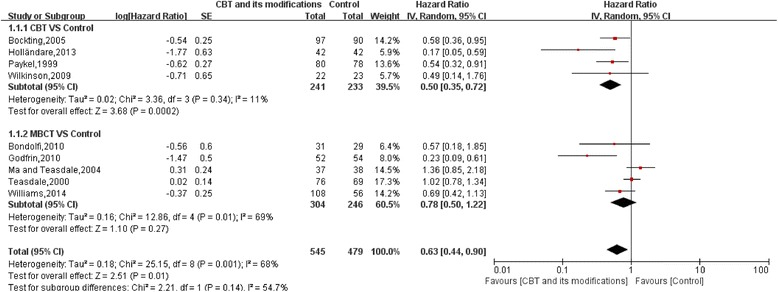
“MBCT VS Control Apart from two trials by Ma and Teasdale [32] and Teasdale et al.”
BackgroundMethodInfluentialMindfulness-Based Cognitive Therapy for Depression: A New Approach to Preventing Relapse
Morgan, D. (2003) · Psychotherapy Research · doi:10.1080/713869628 · Cited by 1,193
Relapse prevention with antidepressant drug treatment in depressive disorders: a systematic review
Geddes, J. R., Carney, S. M., Davies, C., Furukawa, T. A., Kupfer, D. J., Frank, E., & Goodwin, G. M. (2003) · The Lancet · doi:10.1016/s0140-6736(03)12599-8 · Cited by 945 · cited 1×
“might be sequential pharmacotherapy [12].”
Piet, J., & Hougaard, E. (2011) · Clinical Psychology Review · doi:10.1016/j.cpr.2011.05.002 · Cited by 807 · cited 3×
“So far, two meta-analyses have been performed to evaluate the relapse prevention effect of psychotherapy in patients with MDD in remission [35, 36].”
BackgroundResultMindfulness-based cognitive therapy to prevent relapse in recurrent depression.
Kuyken, W., Byford, S., Taylor, R. S., Watkins, E., Holden, E., White, K., Barrett, B., Byng, R., Evans, A., Mullan, E., et al. (2008) · Journal of Consulting and Clinical Psychology · doi:10.1037/a0013786 · Cited by 770 · cited 1×
“Godfrin,2010 [51] L L H H U L L Hollandare,2013 [52] L U H U L L L Kuyken,2008 [53] L L H L L L L Kuyken,2015 [27] L L H L L L L Ma and Teasdale,2004 [32] L L H L L H L”
BackgroundKendler, K. S., Thornton, L. M., & Gardner, C. O. (2000) · American Journal of Psychiatry · doi:10.1176/appi.ajp.157.8.1243 · Cited by 721 · cited 1×
“Following each new episode, the condition of depression becomes worse and risk of next relapse increases [7, 8].”
BackgroundPsychosocial Disability During the Long-term Course of Unipolar Major Depressive Disorder
Judd, L. L., Akiskal, H. S., Zeller, P. J., Paulus, M., Leon, A. C., Maser, J. D., Endicott, J., Coryell, W., Kunovac, J. L., Mueller, T. I., et al. (2000) · Archives of General Psychiatry · doi:10.1001/archpsyc.57.4.375 · Cited by 593 · cited 1×
“These relapses are associated with considerable high cost to individual, family, and society [6, 11].”
BackgroundHazard Ratio in Clinical Trials
Spruance, S. L., Reid, J. E., Grace, M., & Samore, M. (2004) · Antimicrobial Agents and Chemotherapy · doi:10.1128/aac.48.8.2787-2792.2004 · Cited by 547 · cited 1×
“This measure has the advantage of applying more available information of the trial, including the number of patients who fail to complete the trial and time of patients occurring event in the duration of follow-up [63].”
MethodPrevention of Recurrent Depression With Cognitive Behavioral Therapy: Preliminary Findings
Fava, G. A., Rafanelli, C., Grandi, S., Conti, S., & Belluardo, P. (1998) · Archives of General Psychiatry · doi:10.1001/archpsyc.55.9.816 · Cited by 491 · cited 4×
“(1998) [49] reported subjects with 3 or more previous MDD episodes.”
BackgroundMethodInfluential(2013) · Cited by 481
Enduring Effects for Cognitive Behavior Therapy in the Treatment of Depression and Anxiety
Hollon, S. D., Stewart, M. O., & Strunk, D. (2006) · Annual Review of Psychology · doi:10.1146/annurev.psych.57.102904.190044 · Cited by 466 · cited 1×
“The lasting effect may be attributed to the fact that these patients could either improve the cause of recurrent risk or understand many useful techniques to hold back the risk of relapse [23].”
Backgroundvan der Velden, A. M., Kuyken, W., Wattar, U., Crane, C., Pallesen, K. J., Dahlgaard, J., Fjorback, L. O., & Piet, J. (2015) · Clinical Psychology Review · doi:10.1016/j.cpr.2015.02.001 · Cited by 455 · cited 1×
“only investigated mechanism of MBCT in the treatment of recurrent MDD [37].”
BackgroundHow Should Remission From Depression Be Defined? The Depressed Patient’s Perspective
Zimmerman, M., McGlinchey, J. B., Posternak, M. A., Friedman, M., Attiullah, N., & Boerescu, D. (2006) · American Journal of Psychiatry · doi:10.1176/appi.ajp.163.1.148 · Cited by 431 · cited 1×
“Partial remission is defined as persons whose depression do not meet the full remission criterion but who have clinical meaningful reductions in baseline, which refers to a HDRS-17 score<12 [40, 41].”
BackgroundSegal, Z. V., Bieling, P., Young, T., MacQueen, G., Cooke, R., Martin, L., Bloch, R., & Levitan, R. D. (2010) · Archives of General Psychiatry · doi:10.1001/archgenpsychiatry.2010.168 · Cited by 429 · cited 2×
“Paykel,1999 [54] L L H L U H L Segal,2010 [55] L L H L U H L Stangier,2013 [56] L U H H H H L”
MethodWilliams, J. M. G., Crane, C., Barnhofer, T., Brennan, K., Duggan, D. S., Fennell, M. J. V., Hackmann, A., Krusche, A., Muse, K., Von Rohr, I. R., et al. (2014) · Journal of Consulting and Clinical Psychology · doi:10.1037/a0035036 · Cited by 420 · cited 3×
“Williams and colleagues [59] conducted a three arm trial (MBCT, cognitive psychological education and control).”
Background(2011) · Cited by 412
Six-Year Outcome of Cognitive Behavior Therapy for Prevention of Recurrent Depression
Fava, G. A., Ruini, C., Rafanelli, C., Finos, L., Conti, S., & Grandi, S. (2004) · American Journal of Psychiatry · doi:10.1176/ajp.161.10.1872 · Cited by 392 · cited 2×
“[48, 50] were followed-up for 6 years, which found that compared to control, CBT had a significant relapse prevention effect at 6-years follow-up (HR:0.”
BackgroundCognitive–behavioral treatment for depression: Relapse prevention.
Gortner, E. T., Gollan, J. K., Dobson, K. S., & Jacobson, N. S. (1998) · Journal of Consulting and Clinical Psychology · doi:10.1037/0022-006x.66.2.377 · Cited by 341 · cited 1×
“In addition, different from pharmacotherapy which might be invalid in the phase of discontinuation, psychotherapy brings with potential long-term benefit [22].”
BackgroundRelapse after recovery from unipolar depression: a critical review
Belsher, G., & Costello, C. G. (1988) · Psychological Bulletin · doi:10.1037/0033-2909.104.1.84 · Cited by 321 · cited 1×
“Following each new episode, the condition of depression becomes worse and risk of next relapse increases [7, 8].”
BackgroundAnderson, I. M., & Tomenson, B. M. (1995) · BMJ · doi:10.1136/bmj.310.6992.1433 · Cited by 306
Six-Year Outcome for Cognitive Behavioral Treatment of Residual Symptoms in Major Depression
Fava, G. A., Rafanelli, C., Grandi, S., Canestrari, R., & Morphy, M. A. (1998) · American Journal of Psychiatry · doi:10.1176/ajp.155.10.1443 · Cited by 299 · cited 3×
“[48, 50] were followed-up for 6 years, which found that compared to control, CBT had a significant relapse prevention effect at 6-years follow-up (HR:0.”
BackgroundMethodGodfrin, K. A., & van Heeringen, C. (2010) · Behaviour Research and Therapy · doi:10.1016/j.brat.2010.04.006 · Cited by 296 · cited 2×
“[51], it randomized 106 MDD patients in remission for at least 8 weeks to MBCT or control.”
BackgroundMethodA Randomized Trial of Relapse Prevention of Depression in Primary Care
Katon, W., Rutter, C., Ludman, E. J., Von Korff, M., Lin, E., Simon, G., Bush, T., Walker, E., & Unützer, J. (2001) · Archives of General Psychiatry · doi:10.1001/archpsyc.58.3.241 · Cited by 295 · cited 1×
“Researchers found that risk of relapse after experiencing one episode of major depression was 50%, after two was 80% and after three might be up to 90% [9, 10].”
BackgroundBockting, C. L., Hollon, S. D., Jarrett, R. B., Kuyken, W., & Dobson, K. (2015) · Clinical Psychology Review · doi:10.1016/j.cpr.2015.02.003 · Cited by 295 · cited 1×
“[61, 62], our findings was from qualification of “best evidence” by using quantitative metaanalysis approach, which could illustrate the reliability and size of preventive effect of intervention on reducing relapse rate.”
MethodCognitive behavioral treatment of residual symptoms in primary major depressive disorder
(1994) · American Journal of Psychiatry · doi:10.1176/ajp.151.9.1295 · Cited by 266 · cited 2×
“might Table 2 Risk of bias in included studies Study ID Random sequence generation Allocation concealment Blinding of participants and personnel Blinding of outcome assessment Incomplete outcome data Selective reporting Other sources of bias Bockting, 2005 [26] L L H L U H L Bockting,2009 [44] L L H L U H L Bondolfi,2…”
BackgroundMethodKessing, L. V., Hansen, M. G., Andersen, P. K., & Angst, J. (2004) · Acta Psychiatrica Scandinavica · doi:10.1046/j.1600-0447.2003.00266.x · Cited by 258 · cited 1×
“Researchers found that risk of relapse after experiencing one episode of major depression was 50%, after two was 80% and after three might be up to 90% [9, 10].”
BackgroundBockting, C. L. H., DELTA Study Group, Schene, A. H., Spinhoven, P., Koeter, M. W. J., Wouters, L. F., Huyser, J., & Kamphuis, J. H. (2005) · Journal of Consulting and Clinical Psychology · doi:10.1037/0022-006x.73.4.647 · Cited by 249 · cited 3×
“Apart from three trials which delivered CBT in the format of group [26, 57, 58], others delivered in the format of individual.”
BackgroundMethodRaue, P., Schulberg, H., Heo, M., Klimstra, S., & Bruce, M. (2009) · Psychiatric Services · doi:10.1176/appi.ps.60.3.337 · Cited by 228 · cited 1×
“In clinical practice, sequential pharmacotherapy is associated with high risk of noncompliance [17, 18] and psychotherapy is chosen with intense patient preference [19].”
BackgroundBondolfi, G., Jermann, F., der Linden, M. V., Gex-Fabry, M., Bizzini, L., Rouget, B. W., Myers-Arrazola, L., Gonzalez, C., Segal, Z., Aubry, J.-M., et al. (2010) · Journal of Affective Disorders · doi:10.1016/j.jad.2009.07.007 · Cited by 223 · cited 3×
“might Table 2 Risk of bias in included studies Study ID Random sequence generation Allocation concealment Blinding of participants and personnel Blinding of outcome assessment Incomplete outcome data Selective reporting Other sources of bias Bockting, 2005 [26] L L H L U H L Bockting,2009 [44] L L H L U H L Bondolfi,2…”
BackgroundStangier, U., Hilling, C., Heidenreich, T., Risch, A. K., Barocka, A., Schlösser, R., Kronfeld, K., Ruckes, C., Berger, H., Röschke, J., et al. (2013) · American Journal of Psychiatry · doi:10.1176/appi.ajp.2013.12060734 · Cited by 174 · cited 2×
“Paykel,1999 [54] L L H L U H L Segal,2010 [55] L L H L U H L Stangier,2013 [56] L U H H H H L”
BackgroundKocsis, J. H., Leon, A. C., Markowitz, J. C., Manber, R., Arnow, B., Klein, D. N., & Thase, M. E. (2009) · The Journal of Clinical Psychiatry · doi:10.4088/jcp.08m04371 · Cited by 173 · cited 2×
“Since preferences of patient and patient-specific clinical variations (such as preferences for particular psychotherapy in previous treatment and severity of every episode of depression) might moderate the effect of psychological interventions [20, 64], future researchers should notice that more flexible and available…”
BackgroundRelapse and recurrence prevention in depression: Current research and future prospects
Beshai, S., Dobson, K. S., Bockting, C. L. H., & Quigley, L. (2011) · Clinical Psychology Review · doi:10.1016/j.cpr.2011.09.003 · Cited by 165 · cited 1×
“[61, 62], our findings was from qualification of “best evidence” by using quantitative metaanalysis approach, which could illustrate the reliability and size of preventive effect of intervention on reducing relapse rate.”
MethodSimon, G. E., Von Korff, M., Rutter, C. M., & Peterson, D. A. (2001) · Archives of General Psychiatry · doi:10.1001/archpsyc.58.4.395 · Cited by 161 · cited 1×
“In clinical practice, sequential pharmacotherapy is associated with high risk of noncompliance [17, 18] and psychotherapy is chosen with intense patient preference [19].”
BackgroundCost-benefit analysis of drug treatment services: review of the literature
Cartwright, W. S. (2000) · The Journal of Mental Health Policy and Economics · doi:10.1002/1099-176x(200003)3:1<3::aid-mhp68>3.0.co;2-h · Cited by 160 · cited 1×
“Background Major depressive disorder (MDD) is one of the most common and prevalent mental disorders, which is characterized by low vigor, low mood, low self-confidence, and aversion to activity without a specific reason [1, 2].”
BackgroundDiscontinuing antidepressant treatment in major depression.
Viguera, A. C., Baldessarini, R. J., & Friedberg, J. (1998) · Harvard Review of Psychiatry · doi:10.3109/10673229809003578 · Cited by 145 · cited 1×
“In addition, even if the discontinuation reaction is gradual [15], patients who reluctant to continue pharmacotherapy are possible to relapse when discontinue the medicine [16].”
BackgroundReview: problems associated with long-term treatment with selective serotonin reuptake inhibitors
Moret, C., Isaac, M., & Briley, M. (2009) · Journal of Psychopharmacology · doi:10.1177/0269881108093582 · Cited by 135
Mergl, R., Henkel, V., Allgaier, A.-K., Kramer, D., Hautzinger, M., Kohnen, R., Coyne, J., & Hegerl, U. (2011) · Psychotherapy and Psychosomatics · doi:10.1159/000318772 · Cited by 126 · cited 1×
“Compared to unfavorable intervention, favorable intervention brings more positive results to patient [21].”
BackgroundMindfulness-based cognitive therapy: a promising new approach to preventing depressive relapse
Williams, J. M. G., & Kuyken, W. (2012) · British Journal of Psychiatry · doi:10.1192/bjp.bp.111.104745 · Cited by 126 · cited 1×
“It is a class-based skills training program and developed for increasing the ability of patients to prevent the recurrence of depression in the long term [29].”
BackgroundHistory of Cognitive-Behavioral Therapy in Youth
Benjamin, C. L., Puleo, C. M., Settipani, C. A., Brodman, D. M., Edmunds, J. M., Cummings, C. M., & Kendall, P. C. (2011) · Child and Adolescent Psychiatric Clinics of North America · doi:10.1016/j.chc.2011.01.011 · Cited by 120 · cited 1×
“Cognitive behavioral therapy (CBT) is one of the most frequently used psychosocial treatment for mental disorders, which targets at changing tactic of patients to cope problems in cognitions (such as belief and thought) and behaviors [24, 25].”
BackgroundFour-year outcome for cognitive behavioral treatment of residual symptoms in major depression
(1996) · American Journal of Psychiatry · doi:10.1176/ajp.153.7.945 · Cited by 120 · cited 2×
“might Table 2 Risk of bias in included studies Study ID Random sequence generation Allocation concealment Blinding of participants and personnel Blinding of outcome assessment Incomplete outcome data Selective reporting Other sources of bias Bockting, 2005 [26] L L H L U H L Bockting,2009 [44] L L H L U H L Bondolfi,2…”
BackgroundResultClarke, K., Mayo-Wilson, E., Kenny, J., & Pilling, S. (2015) · Clinical Psychology Review · doi:10.1016/j.cpr.2015.04.002 · Cited by 113 · cited 3×
“So far, two meta-analyses have been performed to evaluate the relapse prevention effect of psychotherapy in patients with MDD in remission [35, 36].”
BackgroundBockting, C. L. H., Spinhoven, P., Wouters, L. F., Koeter, M. W. J., Schene, A. H., & DELTA Study Group (2009) · The Journal of Clinical Psychiatry · doi:10.4088/jcp.08m04784blu · Cited by 113 · cited 1×
“might Table 2 Risk of bias in included studies Study ID Random sequence generation Allocation concealment Blinding of participants and personnel Blinding of outcome assessment Incomplete outcome data Selective reporting Other sources of bias Bockting, 2005 [26] L L H L U H L Bockting,2009 [44] L L H L U H L Bondolfi,2…”
BackgroundLittlewood, E., Duarte, A., Hewitt, C., Knowles, S., Palmer, S., Walker, S., Andersen, P., Araya, R., Barkham, M., Bower, P., et al. (2015) · Health Technology Assessment · doi:10.3310/hta191010 · Cited by 90
Adherence to continuation and maintenance antidepressant use in recurrent depression
ten Doesschate, M. C., Bockting, C. L. H., & Schene, A. H. (2009) · Journal of Affective Disorders · doi:10.1016/j.jad.2008.07.011 · Cited by 86 · cited 1×
“In clinical practice, sequential pharmacotherapy is associated with high risk of noncompliance [17, 18] and psychotherapy is chosen with intense patient preference [19].”
BackgroundKuyken, W., Hayes, R., Barrett, B., Byng, R., Dalgleish, T., Kessler, D., Lewis, G., Watkins, E., Morant, N., Taylor, R. S., et al. (2015) · Health Technology Assessment · doi:10.3310/hta19730 · Cited by 82 · cited 2×
“CBT and its modifications VS m-ADM MBCT VS m-ADM For this comparison, only one trial conducted for 24 months [27].”
BackgroundMethodCurcio, F., & Paccia, J. M. (1987) · Journal of Autism and Developmental Disorders · doi:10.1007/bf01487261 · Cited by 69
Teismann, T., von Brachel, R., Hanning, S., Grillenberger, M., Hebermehl, L., Hornstein, I., & Willutzki, U. (2014) · Psychotherapy Research · doi:10.1080/10503307.2013.821636 · Cited by 62 · cited 3×
“Apart from three trials which delivered CBT in the format of group [26, 57, 58], others delivered in the format of individual.”
BackgroundMethodTwo-year outcome of internet-based relapse prevention for partially remitted depression
Holländare, F., A. Anthony, S., Randestad, M., Tillfors, M., Carlbring, P., Andersson, G., & Engström, I. (2013) · Behaviour Research and Therapy · doi:10.1016/j.brat.2013.08.002 · Cited by 61 · cited 3×
“Godfrin,2010 [51] L L H H U L L Hollandare,2013 [52] L U H U L L L Kuyken,2008 [53] L L H L L L L Kuyken,2015 [27] L L H L L L L Ma and Teasdale,2004 [32] L L H L L H L”
BackgroundSystematic Overview of Drug Interactions with Antidepressant Medications
Nieuwstraten, C., Labiris, N. R., & Holbrook, A. (2006) · The Canadian Journal of Psychiatry · doi:10.1177/070674370605100506 · Cited by 56 · cited 1×
“But longterm use is associated with enormous side effects such as drug interaction [13, 14].”
BackgroundWilkinson, P., Alder, N., Juszczak, E., Matthews, H., Merritt, C., Montgomery, H., Howard, R., Macdonald, A., & Jacoby, R. (2009) · International Journal of Geriatric Psychiatry · doi:10.1002/gps.2076 · Cited by 36 · cited 3×
“Apart from three trials which delivered CBT in the format of group [26, 57, 58], others delivered in the format of individual.”
BackgroundMethodPrevention of Relapse in Residual Depression by Cognitive Therapy: A Controlled Trial
Paykel, E. S., Scott, J., Teasdale, J. D., Johnson, A. L., Garland, A., Moore, R., Jenaway, A., Cornwall, P. L., Hayhurst, H., Abbott, R., et al. (1999) · Archives of General Psychiatry · doi:10.1001/archpsyc.56.9.829 · Cited by 20 · cited 2×
“Paykel,1999 [54] L L H L U H L Segal,2010 [55] L L H L U H L Stangier,2013 [56] L U H H H H L”
Method(2011) · Medical Entomology and Zoology
Research works printed but not linked: 2
- World Health Organization Depression fact sheet 2014 Genewa WHO
- Gotlib IH Hammen CL Psychological aspects of depression: toward a cognitiveinterpersonal integration. Clinl Psychol Rev 1994 14 1 90
Cited by
Malhi, G. S., Bell, E., Bassett, D., Boyce, P., Bryant, R., Hazell, P., Hopwood, M., Lyndon, B., Mulder, R., Porter, R., et al. (2021) · Australian & New Zealand Journal of Psychiatry · doi:10.1177/0004867420979353 · Cited by 614
“A recent systematic review and meta-analysis focusing specifically on the effects of interventions (compared to controls) delivered when MDD patients were in remission concluded, (1) CBT is superior in protecting against relapse, (2) MBCT is also superior in protecting against relapse, but only among patients with 3 o…”
BackgroundMarx, W., Manger, S. H., Blencowe, M., Murray, G., Ho, F. Y.-Y., Lawn, S., Blumenthal, J. A., Schuch, F., Stubbs, B., Ruusunen, A., et al. (2023) · The World Journal of Biological Psychiatry · doi:10.1080/15622975.2022.2112074 · Cited by 179
Malhi, G. S., Bell, E., Singh, A., Bassett, D. L., Berk, M., Boyce, P. M., Bryant, R. A., Gitlin, M. J., Hamilton, A., Hazell, P., et al. (2020) · Bipolar Disorders · doi:10.1111/bdi.13035 · Cited by 131
Li, J.-M., Zhang, Y., Su, W.-J., Liu, L.-L., Gong, H., Peng, W., & Jiang, C.-L. (2018) · Psychiatry Research · doi:10.1016/j.psychres.2018.07.020 · Cited by 95
Vancampfort, D., Stubbs, B., Van Damme, T., Smith, L., Hallgren, M., Schuch, F., Deenik, J., Rosenbaum, S., Ashdown-Franks, G., Mugisha, J., et al. (2021) · Journal of Psychiatric Research · doi:10.1016/j.jpsychires.2020.12.048 · Cited by 99
Metadata
- Authors
- Zhang, Z., Zhang, L., Zhang, G., Jin, J., & Zheng, Z.
- Affiliations
- Sichuan University (CN)
- Fujian Medical University (CN)
- Corresponding author
- Zhang, Lingli
- Venue
- BMC Psychiatry
- Published
- 2018-02-23
- Volume
- 18
- Issue
- 1
- Pages
- 50-50
- ISSN
- 1471-244X (ISSN-L)
- PMC
- PMC6389220
- OpenAlex
- W2797781084
- Cited by
- 99
- References
- 69
- Citations by year
- 2026: 11 · 2025: 10 · 2024: 12 · 2023: 13 · 2022: 15 · 2021: 15 · 2020: 11 · 2019: 9 · 2018: 3
- FWCI
- 1.51
- Type
- journal article
- Language
- en
- Open access
- gold
- doi.org
- Licence
- cc-by
- Locations
- BMC Psychiatry (publishedVersion, cc-by)
- Europe PMC (PubMed Central) (publishedVersion, other-oa)
- PubMed Central (publishedVersion, cc-by)
- PubMed (publishedVersion)
- Funders
- National Natural Science Foundation of China (81373381)
- Topics
- Social Sciences › Psychology › Experimental and Cognitive Psychology › Anxiety, Depression, Psychometrics, Treatment, Cognitive Processes
- Health Sciences › Medicine › Pharmacology (medical) › Treatment of Major Depression
- Social Sciences › Psychology › Clinical Psychology › Psychotherapy Techniques and Applications
- Keywords
- major depressive disorder, relapse prevention, cognitive behavioral therapy, mindfulness-based cognitive therapy, remission, depression recurrence
- MeSH terms
- Antidepressive Agents, Clinical Trials as Topic, Combined Modality Therapy, Depressive Disorder, Major, Major Depressive Disorder, Humans, Recurrence, Registries, Cognitive Behavioral Therapy, Treatment Outcome, Secondary Prevention, Mindfulness
About these checks
Registry, retraction, Cites and statistics results are computed, not judged, with one exception: a printed reference that no index lists is read once by a model before it counts as a citation error. Claims are extracted by a model and kept only when their quote appears verbatim in the text; each cited source is then checked, with a model’s help, for whether it says what the claim relies on. Those verdicts can be wrong — read the claim’s quote and the cited source before relying on one.
Statistics and arithmetic are recomputed, not judged.
Confidence bands are shown only for fields calibrated on our annotated test set. None is calibrated yet, so no band is shown.
What counts as a claim ›How we measure confidence ›How we check this ›
Are you an author, or do you see a problem with this page? Request a review
Data sources
Bibliographic data: Semantic Scholar, OpenAlex, Crossref.
Contains information from the Semantic Scholar Academic Graph Datasets, made available under the ODC Attribution License (ODC-BY 1.0).
Semantic Scholar’s data is described in: Kinney, R., et al. (2023). The Semantic Scholar Open Data Platform. arXiv:2301.10140.
