

Enhanced Stress-Resilience Training (ESRT) for graduate-entry medical students: a randomised-controlled, mixed-method investigation
Open accessPublished version of a preprint
The DOI matches its Crossref record; 79 of the 80 references it cites were found in a registry or an index; 13 of the 22 sources its claims cite were checked for support.
Abstract
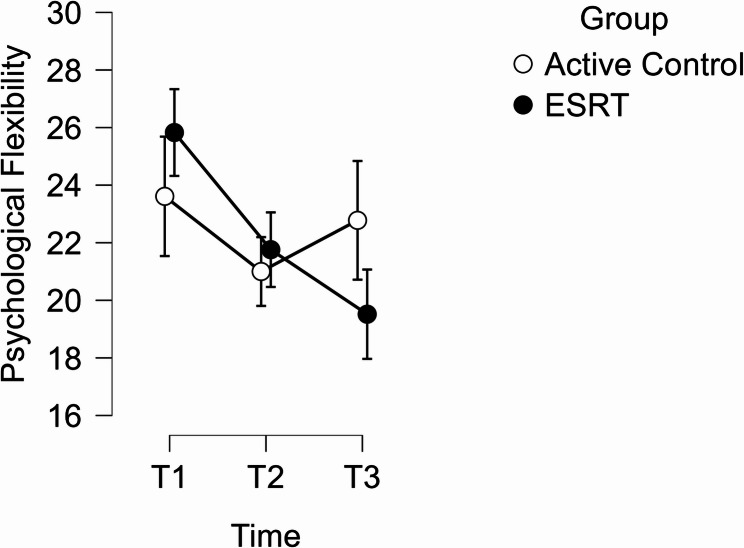
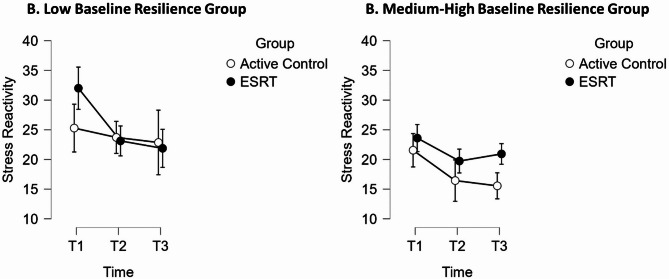
Background: Medical students face demanding academic requirements, fierce competition, self-doubt and financial concerns contributing to high rates of depression, anxiety, stress, sleep problems and burnout, highlighting a need for effective interventions. We explored an intervention called Enhanced Stress-Resilience Training (ESRT), a modified form of mindfulness training adapted for clinicians, that was applied to medical students for the first time. Methods: Graduate-entry medical students (N = 118) were randomised to ESRT or an active control condition as part of a registered trial (ISRCTN16324994). A 3 (Time: pre-, post-, and six-month follow-up) × 2 (Group: ESRT, control) mixed design was used to assess changes in psychological flexibility, resilience, and stress reactivity. Due to attrition (T3 n = 47), additional sensitivity analyses, including intention-to-treat and subgroup analyses based on baseline resilience, were conducted. Qualitative data from exit evaluations (n = 25), interviews (n = 12), and focus groups (n = 11) underwent reflexive thematic analysis to explore student experience and contextualise quantitative findings. Results: ESRT users demonstrated increased psychological flexibility scores at post-intervention (p =.001, d = 0.62) and six-months follow-up (p = < 0.001, d = 0.96), and these findings were confirmed in intention-to-treat analysis. Exploratory analyses revealed that those with low baseline resilience who underwent ESRT displayed increased resilience (p = < 0.001, d = 1.86) and decreased stress reactivity (p = < 0.001, d = 1.58) at the six-month follow-up. Qualitative findings highlighted high acceptability, perceived value, and a strong desire for curricular integration, while also revealing barriers to engagement, particularly time constraints. Conclusions: This study offers new evidence that ESRT may enhance psychological flexibility and resilience, and decrease stress reactivity, especially among more vulnerable students. Sustained effects and positive qualitative feedback suggest that curricular integration could improve feasibility and reach. © The Author(s) 2025.
Overview
CoChat Summary
## TL;DR
In this mixed-method randomised controlled study of graduate-entry medical students, ESRT improved psychological flexibility at post-intervention and 6-month follow-up, with stronger effects also seen for students with low baseline resilience. Qualitative data were broadly positive and suggested ESRT was acceptable, but time constraints and curricular overload were major barriers to engagement and supported calls for curricular integration.
## Key findings
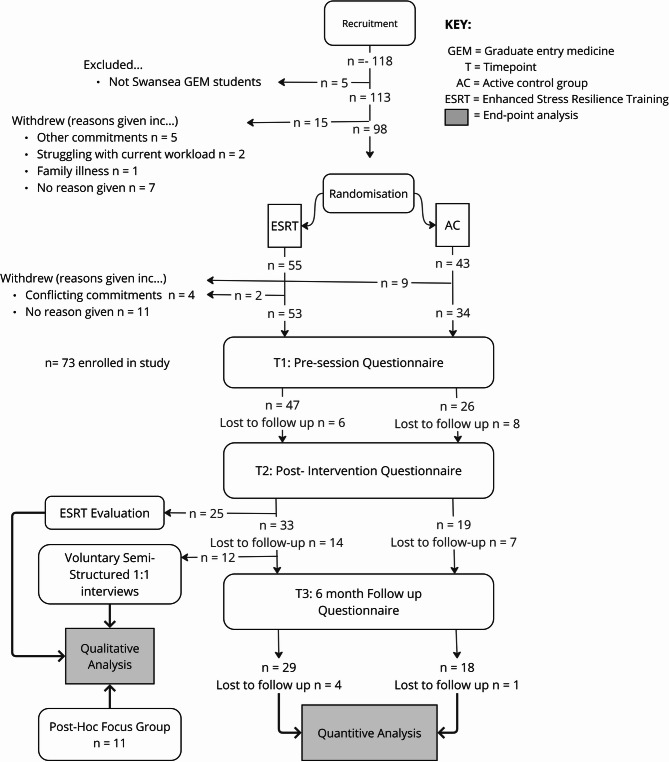
- Graduate-entry medical students were randomised to ESRT or active control; the final follow-up sample was n = 47 after 52% attrition from randomisation (n = 98).
- Psychological flexibility showed a significant time-by-group interaction: F(2, 90) = 6.30, p = .003, η²p = 0.123, BF10 = 18.18. In the ESRT group, scores improved by 4.07 points (15%) from T1 to T2 and by 6.31 points (24%) from T1 to T3; the authors report these effects were confirmed in ITT analysis.
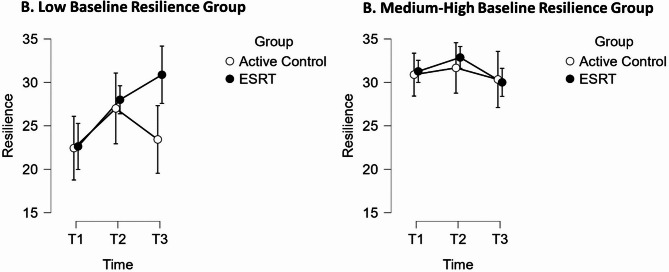
- For students with low baseline resilience, ESRT increased resilience at 6 months: p < .001, d = 1.86; it also decreased stress reactivity at 6 months: p < .001, d = 1.58.
- In the overall sample, resilience and stress reactivity did not show significant time-by-group interactions: resilience F(2, 74) = 0.68, p = .51, BF01 = 4.34; stress reactivity F(2, 90) = 0.24, p = .78, BF01 = 6.57.
- Qualitative analysis identified 6 themes, including “From scepticism to confidence in ESRT,” “ESRT enhanced stress management,” and “A call for integration,” with students highlighting acceptability and value but also time constraints.
## Methods
- Design: Registered randomised-controlled, mixed-method sequential explanatory study with a 3 (time: pre-, post-, 6-month follow-up) × 2 (group: ESRT vs active control) mixed design.
- Sample/data: Graduate-entry medical students from Swansea University; N = 118 enrolled, N = 98 randomised (55 ESRT, 43 control). Quantitative outcomes were collected at T1, T2, and T3; qualitative data came from exit evaluations (n = 25), interviews (n = 12), and focus groups (n = 11).
- Analysis: Quantitative outcomes were analysed with mixed-effects ANOVAs, plus intention-to-treat sensitivity analysis and post-hoc subgroup analyses based on baseline resilience. Qualitative data were analysed using reflexive thematic analysis and then integrated with quantitative findings via a joint display and triangulation protocol.
## Limitations
- The paper states the principal limitation was the reduced sample size and high attrition, with a 52% attrition rate from randomisation to follow-up; it also notes that time constraints and curricular overload undermined participation, especially among later-year students.
- The paper states that outcomes may be skewed toward students earlier in training or more inclined to engage in wellbeing initiatives.
- Evident from the text: the follow-up sample was small (T3 n = 47), and resilience analyses were further reduced by missing data (n = 8 missing CD-RISC 10 scores; sample size 39 for resilience), which limits precision and generalisability.
Model-written summary. Check it against the paper before relying on it.
Integrity signals
Registry
Cites
Statistics
Figures
Verification
Claims the paper makes
6 Valid · 0 Not valid · 2 Not checked · 76 Own results and interpretations
The cited sources support only part of this claim — read each source’s verdict below.
In the paper
“suggesting that the intervention supports students to engage with and manage feelings, thoughts, and emotions that could act as a useful tool for enhancing the quality of patient care [78, 79].”
§ Enhanced Stress-Resilience Training (ESRT) for graduate-entry medical students: a randomised-controlled, mixed-method investigation > Discussion Our findings provide the first evidence of the effectiveness of ESRT in graduate-entry medical students, complimenting findings reported in US- and UK-based surgical trainees [23, 30–32]. These findings provide important new evidence for a viable strategy to counter the growing mental health crisis facing such students [1]. Our findings also reinforce the cross-cultural generalisability of ESRT in a UK sample. ESRT was particularly effective at enhancing psychological flexibility, an effect verified by ITT sensitivity analysis and reiterated in qualitative self-reports, suggesting that the intervention supports students to engage with and manage feelings, thoughts, and emotions that could act as a useful tool for enhancing the quality of patient care [78, 79]. Furthermore, the observed change was sufficient to push baseline psychological flexibility scores (M = 25.83) below the critical range of 25–28 points associated with psychological distress, although further research is needed to confirm this [53, 80]. Recent research has identified a negative correlation between psychological flexibility and depression, anxiety, burnout, and post-traumatic stress disorder [81], suggesting that flexibility could play an important mediating role between ESRT and reduced PBS. Post-hoc quantitative analyses also revealed that ESRT was effective at increasing resilience and decreasing stress reactivity in those participants who began the intervention with low baseline resilience levels, providing preliminary evidence for the effectiveness of ESRT in vulnerable student populations. Crucially, those with low baseline resilience displayed improvements in resilience at the six-month follow-up. Qualitative themes highlighted the “relentless” pressure of medical training and a particularly difficult time during the pandemic, which may partially explain this delayed effect. Equally, the shift from scepticism to confidence in ESRT that we observed in our qualitative reports suggests that some participants may not have engaged deeply with the intervention initially, potentially dampening early effects. Yet, as students had more time to integrate the ESRT practices, their resilience levels showed significant improvements.
What the sources say
- Partly supportedcites [78] Palladino CL, Ange B, Richardson DS, Casillas R, Decker M, Gillies RA, House A, Rollock M, Salazar WH, Waller JL, Zeidan R, Stepleman L. Measuring psychological flexibility in medical students and residents: a psychometric analysis. Med Educ Online. 2013;18(1):20932. 10.3402/meo.v18i0.20932. 23948496 PMC3744841 sourceExperimental — accuracy not yet measured
The Introduction describes psychological flexibility as acknowledging thoughts and feelings while still acting compassionately toward patients, and the Abstract says it may have implications for patient-centered care. But this paper evaluates measures in medical students and residents; it does not show that an intervention helped those students manage their feelings or improved patient care. Its Discussion treats interventions as a potential avenue for further study. (LLM, conf=0.88)
- Not checked — no full text of the sourcecites [79] Garner EV, Golijani-Moghaddam N. Relationship between psychological flexibility and work-related quality of life for healthcare professionals: a systematic review and meta-analysis. J Context Behav Sci. 2021;21:98–112. 10.1016/j.jcbs.2021.06.007. source
hedgedstates a cause- Asserted: passes — The authors put it forward as true.
- Checkable: passes — It can be checked against evidence.
- Load-bearing: passes — The paper’s conclusions depend on it.
- Based: passes — The paper gives a reason why it holds.
- Partly supported
Every source the paper cites for this claim was checked and supports it.
In the paper
“Recent research has identified a negative correlation between psychological flexibility and depression, anxiety, burnout, and post-traumatic stress disorder [81]”
§ Enhanced Stress-Resilience Training (ESRT) for graduate-entry medical students: a randomised-controlled, mixed-method investigation > Discussion Our findings provide the first evidence of the effectiveness of ESRT in graduate-entry medical students, complimenting findings reported in US- and UK-based surgical trainees [23, 30–32]. These findings provide important new evidence for a viable strategy to counter the growing mental health crisis facing such students [1]. Our findings also reinforce the cross-cultural generalisability of ESRT in a UK sample. ESRT was particularly effective at enhancing psychological flexibility, an effect verified by ITT sensitivity analysis and reiterated in qualitative self-reports, suggesting that the intervention supports students to engage with and manage feelings, thoughts, and emotions that could act as a useful tool for enhancing the quality of patient care [78, 79]. Furthermore, the observed change was sufficient to push baseline psychological flexibility scores (M = 25.83) below the critical range of 25–28 points associated with psychological distress, although further research is needed to confirm this [53, 80]. Recent research has identified a negative correlation between psychological flexibility and depression, anxiety, burnout, and post-traumatic stress disorder [81], suggesting that flexibility could play an important mediating role between ESRT and reduced PBS. Post-hoc quantitative analyses also revealed that ESRT was effective at increasing resilience and decreasing stress reactivity in those participants who began the intervention with low baseline resilience levels, providing preliminary evidence for the effectiveness of ESRT in vulnerable student populations. Crucially, those with low baseline resilience displayed improvements in resilience at the six-month follow-up. Qualitative themes highlighted the “relentless” pressure of medical training and a particularly difficult time during the pandemic, which may partially explain this delayed effect. Equally, the shift from scepticism to confidence in ESRT that we observed in our qualitative reports suggests that some participants may not have engaged deeply with the intervention initially, potentially dampening early effects. Yet, as students had more time to integrate the ESRT practices, their resilience levels showed significant improvements.
What the sources say
- Supportedcites [81] Johns G, Waddington L, Samuel V. Prevalence and predictors of mental health outcomes in UK Doctors and final year medical students during the COVID-19 pandemic. J Affect Disord. 2022;311:267–75. 10.1016/j.jad.2022.05.024. 35569608 PMC9098653 source
The Discussion (‘Psychological predictors of poor mental health’; page unavailable) reports that greater psychological flexibility negatively predicted the study’s mental-health outcomes. The Results (‘Predictors of continuous scores’; page unavailable) identify associations with burnout subscales; the Abstract notes an exception for low personal achievement, one burnout subscale. Together, these support the broad claim of an inverse relationship with depression, anxiety, burnout and PTSD. (LLM, conf=0.88)
plainstates an association- Asserted: passes — The authors put it forward as true.
- Checkable: passes — It can be checked against evidence.
- Load-bearing: passes — The paper’s conclusions depend on it.
- Based: passes — The paper gives a reason why it holds.
- Supported
A result the paper reports from its own data — it cites no other source for it, so there is none to check. The quote shows it is in the paper.
In the paper
“A similar result was observed between T1 and T3, t (14) = −1.90, p = 1.00, d = 0.42 (95% CI: −0.39 to 1.22), BF01 = 0.80.”
§ Enhanced Stress-Resilience Training (ESRT) for graduate-entry medical students: a randomised-controlled, mixed-method investigation > Results > Quantitative findings
plain- Asserted: passes — The authors put it forward as true.
- Checkable: passes — It can be checked against evidence.
- Load-bearing: unclear — It is unclear whether the paper’s conclusions depend on it.
- Based: passes — The paper gives a reason why it holds.
A result the paper reports from its own data — it cites no other source for it, so there is none to check. The quote shows it is in the paper.
In the paper
“Subsequent t-tests revealed that participants with low baseline resilience scores who underwent ESRT exhibited no significant increase in resilience between T1 and T2, t (7) = 3.28, p =.11, d = 1.21 (95% CI: 0.18 to 2.60), BF01 = 0.03.”
§ Enhanced Stress-Resilience Training (ESRT) for graduate-entry medical students: a randomised-controlled, mixed-method investigation > Results > Quantitative findings
plainn = 15- Asserted: passes — The authors put it forward as true.
- Checkable: passes — It can be checked against evidence.
- Load-bearing: unclear — It is unclear whether the paper’s conclusions depend on it.
- Based: passes — The paper gives a reason why it holds.
A result the paper reports from its own data — it cites no other source for it, so there is none to check. The quote shows it is in the paper.
In the paper
“However, a significant increase was observed between T1 and T3, t (7) = 5.04, p = < 0.001, d = 1.86 (95% CI: 0.35 to 3.37), BF10 = 12.72.”
§ Enhanced Stress-Resilience Training (ESRT) for graduate-entry medical students: a randomised-controlled, mixed-method investigation > Results > Quantitative findings
plainstates a causen = 15- Asserted: passes — The authors put it forward as true.
- Checkable: passes — It can be checked against evidence.
- Load-bearing: passes — The paper’s conclusions depend on it.
- Based: passes — The paper gives a reason why it holds.
36 more claims
Create a free account to see all 84 claims and to verify the 5 references still open.
- It may state two separate claims as one. 33
- Probably not a substantial claim. 15
- The quote only partly states this claim. 1
Statistics that don’t add up
Each reported p-value recomputed from its test statistic and degrees of freedom, each partial η² from its F, and each ratio, mean difference or B printed with a p checked against its own confidence interval.
Rated minor: it would not touch a result — a value no result rests on, a p-value that stays on the same side of the significance level, or a conflict that is clerical, resolved elsewhere in the paper, or outside its own findings.
In the paper
“t (7) = −4.61, p =.001”
§ Enhanced Stress-Resilience Training (ESRT) for graduate-entry medical students: a randomised-controlled, mixed-method investigation > Results > Quantitative findings
Reported p = .001 · recomputed p = .002
Statistics recomputed
Every reported test result, recomputed from its test statistic and degrees of freedom. A result shows as not adding up only once an independent check has confirmed it.
- Doesn’t add upt(7) = -4.61reported p = .001 · recomputed p = .002
“t (7) = −4.61, p = .001”
- ConsistentF(2, 90) = 6.3reported p = .003 · recomputed p = .003
“F (2, 90) = 6.30, p = .003”
- Consistentt(28) = 4.11reported p = .001 · recomputed p < .001
“t (28) = 4.11, p = .001”
The paper prints p at a floor (such as p < .001)
- ConsistentF(1.69, 119.98) = 4.86reported p = .013 · recomputed p = .013
“F (1.69, 119.98) = 4.86, p = .013”
- Consistentt(46) = 4.01reported p = .001 · recomputed p < .001
“t (46) = 4.01, p = .001”
The paper prints p at a floor (such as p < .001)
10 more recomputed tests
Create a free account to see every test the Stats check recomputed.
Self-check
Percentages, sums and reported differences re-computed from the paper’s own numbers.
Each contradiction between two passages listed here was confirmed by an independent check.
Rated major: it would touch a result — a value a result rests on, reported and recomputed p-values on opposite sides of the significance level, two passages that conflict with no sign which is right, or a cited work retracted before this paper was published.
In the paper
§ Enhanced Stress-Resilience Training (ESRT) for graduate-entry medical students: a randomised-controlled, mixed-method investigation > Abstract > Methods
“Graduate-entry medical students (N = 118) were randomised to ESRT or an active control condition as part of a registered trial (ISRCTN16324994).”
§ Enhanced Stress-Resilience Training (ESRT) for graduate-entry medical students: a randomised-controlled, mixed-method investigation > Method > Design
“However, due to recruitment challenges and disruptions caused by the COVID-19 pandemic, only 118 participants were enrolled after which 98 participants were successfully randomised to group. Attrition further reduced the final sample at follow-up (T3) to 47 participants (Fig. 1).”
Citations
Cites
Statistical Power Analysis for the Behavioral Sciences
Cohen, J. (2013) · doi:10.4324/9780203771587 · Cited by 25,373
Reflecting on reflexive thematic analysis
Braun, V., & Clarke, V. (2019) · Qualitative Research in Sport, Exercise and Health · doi:10.1080/2159676x.2019.1628806 · Cited by 19,677 · cited 1×
“Transcripts and evaluation responses were anonymised and uploaded to NVivo to undergo a reflexive thematic analysis [70, 71].”
Mindfulness-based interventions in context: Past, present, and future
Kabat-Zinn, J. (2003) · Clinical Psychology: Science and Practice · doi:10.1093/clipsy.bpg016 · Cited by 8,615 · cited 1×
“Mindfulness-Based Stress Reduction (MBSR) [11, 12] and derived Mindfulness-Based Interventions (MBIs) [11, 13] have become popular strategies for driving these changes.”
What good are positive emotions?
Fredrickson, B. L. (1998) · Review of General Psychology · doi:10.1037/1089-2680.2.3.300 · Cited by 6,066 · cited 1×
“ESRT draws inspiration from the seminal ‘broaden and build’ model [27– 29], which suggests that positive emotions can expand an individual’s thought-action repertoire by developing psychological resources such as mindfulness, flexibility, and resilience.”
Thematic Analysis: A Practical Guide
Braun, V., & Clarke, V. (2022) · QMiP Bulletin · doi:10.53841/bpsqmip.2022.1.33.46 · Cited by 5,438
Bond, F. W., Hayes, S. C., Baer, R. A., Carpenter, K. M., Guenole, N., Orcutt, H. K., Waltz, T., & Zettle, R. D. (2011) · Behavior Therapy · doi:10.1016/j.beth.2011.03.007 · Cited by 3,950
Campbell‐Sills, L., & Stein, M. B. (2007) · Journal of Traumatic Stress · doi:10.1002/jts.20271 · Cited by 3,575
Using Mixed-Methods Sequential Explanatory Design: From Theory to Practice
Ivankova, N. V., Creswell, J. W., & Stick, S. L. (2006) · Field Methods · doi:10.1177/1525822x05282260 · Cited by 3,167 · cited 1×
“A mixed-method sequential explanatory design [51, 52] was adopted to extend quantitative findings, aligning with recent recommendations for best practice in health research informing public policy [48–50].”
Bayesian Cognitive Modeling: A Practical Course
Lee, M. D., & Wagenmakers, E.-J. (2014) · doi:10.1017/cbo9781139087759 · Cited by 1,795
Medical Student Education in the Time of COVID-19
Rose, S. (2020) · JAMA · doi:10.1001/jama.2020.5227 · Cited by 1,740 · cited 1×
“The rapid transition to remote learning disrupted clinical rotations [5, 6] and left students feeling underprepared for future clinical practice [7, 8].”
Bayesian inference for psychology. Part II: Example applications with JASP
Wagenmakers, E.-J., Love, J., Marsman, M., Jamil, T., Ly, A., Verhagen, J., Selker, R., Gronau, Q. F., Dropmann, D., Boutin, B., et al. (2018) · Psychonomic Bulletin & Review · doi:10.3758/s13423-017-1323-7 · Cited by 1,715
Happiness unpacked: Positive emotions increase life satisfaction by building resilience.
Cohn, M. A., Fredrickson, B. L., Brown, S. L., Mikels, J. A., & Conway, A. M. (2009) · Emotion · doi:10.1037/a0015952 · Cited by 1,713
Gu, J., Strauss, C., Bond, R., & Cavanagh, K. (2015) · Clinical Psychology Review · doi:10.1016/j.cpr.2015.01.006 · Cited by 1,712
(2013) · Cited by 1,351
The JASP guidelines for conducting and reporting a Bayesian analysis
van Doorn, J., van den Bergh, D., Böhm, U., Dablander, F., Derks, K., Draws, T., Etz, A., Evans, N. J., Gronau, Q. F., Haaf, J. M., et al. (2021) · Psychonomic Bulletin & Review · doi:10.3758/s13423-020-01798-5 · Cited by 1,114
Developing and Implementing a Triangulation Protocol for Qualitative Health Research
Farmer, T., Robinson, K., Elliott, S. J., & Eyles, J. (2006) · Qualitative Health Research · doi:10.1177/1049732305285708 · Cited by 997
What defines mindfulness-based programs? The warp and the weft
Crane, R. S., Brewer, J., Feldman, C., Kabat-Zinn, J., Santorelli, S., Williams, J. M. G., & Kuyken, W. (2017) · Psychological Medicine · doi:10.1017/s0033291716003317 · Cited by 868
Mixed-Methods Research: A Discussion on its Types, Challenges, and Criticisms
Dawadi, S., Shrestha, S., & Giri, R. A. (2021) · Journal of Practical Studies in Education · doi:10.46809/jpse.v2i2.20 · Cited by 796
Mindfulness-based interventions: an overall review
Zhang, D., Lee, E. K. P., Mak, E. C. W., Ho, C. Y., & Wong, S. Y. S. (2021) · British Medical Bulletin · doi:10.1093/bmb/ldab005 · Cited by 668 · cited 1×
“Mindfulness-Based Stress Reduction (MBSR) [11, 12] and derived Mindfulness-Based Interventions (MBIs) [11, 13] have become popular strategies for driving these changes.”
Relationship between nurse burnout, patient and organizational outcomes: Systematic review
Jun, J., Ojemeni, M. M., Kalamani, R., Tong, J., & Crecelius, M. L. (2021) · International Journal of Nursing Studies · doi:10.1016/j.ijnurstu.2021.103933 · Cited by 606 · cited 1×
“Such findings risk damaging the quality of patient care and patient safety [2, 3] highlighting an urgent need for effective interventions for service providers.”
Choi, B., Jegatheeswaran, L., Minocha, A., Alhilani, M., Nakhoul, M., & Mutengesa, E. (2020) · BMC Medical Education · doi:10.1186/s12909-020-02117-1 · Cited by 458
Using Nvivo for Data Analysis in Qualitative Research
AlYahmady, H. H., & Al Abri, S. S. (2013) · International Interdisciplinary Journal of Education · doi:10.12816/0002914 · Cited by 420
McConville, J., McAleer, R., & Hahne, A. (2017) · EXPLORE · doi:10.1016/j.explore.2016.10.002 · Cited by 336
Querstret, D., Morison, L., Dickinson, S., Cropley, M., & John, M. (2020) · International Journal of Stress Management · doi:10.1037/str0000165 · Cited by 315 · cited 1×
“Mindfulness-Based Stress Reduction (MBSR) [11, 12] and derived Mindfulness-Based Interventions (MBIs) [11, 13] have become popular strategies for driving these changes.”
Cherry, K. M., Hoeven, E. V., Patterson, T. S., & Lumley, M. N. (2021) · Clinical Psychology Review · doi:10.1016/j.cpr.2021.101973 · Cited by 267 · cited 1×
“Furthermore, the observed change was sufficient to push baseline psychological flexibility scores ( M = 25.83) below the critical range of 25–28 points associated with psychological distress, although further research is needed to confirm this [53, 80].”
InfluentialTowards the use of mixed methods inquiry as best practice in health outcomes research
On behalf of the International Society for Quality of Life Research (ISOQOL) Mixed Methods Special Interest Group (SIG), Regnault, A., Willgoss, T., & Barbic, S. (2018) · Journal of Patient-Reported Outcomes · doi:10.1186/s41687-018-0043-8 · Cited by 266
Scheepers, R. A., Boerebach, B. C. M., Arah, O. A., Heineman, M. J., & Lombarts, K. M. J. M. H. (2015) · International Journal of Behavioral Medicine · doi:10.1007/s12529-015-9473-3 · Cited by 266
The Transformational Effects of COVID-19 on Medical Education
Lucey, C. R., & Johnston, S. C. (2020) · JAMA · doi:10.1001/jama.2020.14136 · Cited by 240
deVibe, M., Bjørndal, A., Fattah, S., Dyrdal, G. M., Halland, E., & Tanner-Smith, E. E. (2017) · Campbell Systematic Reviews: Better Evidence for a Better World · doi:10.4073/csr.2017.11 · Cited by 198
Schlotz, W., Yim, I. S., Zoccola, P. M., Jansen, L., & Schulz, P. (2011) · Psychological Assessment · doi:10.1037/a0021148 · Cited by 194 · cited 1×
“Stress Reactivity was assessed via the Perceived Stress Reactivity Scale (PSRS) [44, 45, 58], which exhibits strong item homogeneity, test–retest reliability, and internal consistency (Cronbach’s alpha values primarily ranging from 0.70 to 0.80).”
Influential(2013) · Routledge eBooks · doi:10.4324/9781315008592 · Cited by 175
Schmalz, X., Biurrun Manresa, J., & Zhang, L. (2023) · Psychological Methods · doi:10.1037/met0000421 · Cited by 138
Lebares, C. C., Hershberger, A. O., Guvva, E. V., Desai, A., Mitchell, J., Shen, W., Reilly, L. M., Delucchi, K. L., O’Sullivan, P. S., Ascher, N. L., et al. (2018) · JAMA Surgery · doi:10.1001/jamasurg.2018.2734 · Cited by 134
Lebares, C. C., Guvva, E. V., Olaru, M., Sugrue, L. P., Staffaroni, A. M., Delucchi, K. L., Kramer, J. H., Ascher, N. L., & Harris, H. W. (2019) · JAMA Network Open · doi:10.1001/jamanetworkopen.2019.4108 · Cited by 131 · cited 4×
“…2.5 h sessions into 5 weekly one hour sessions, with content and delivery tailored to medical personnel, ESRT has been shown to improve executive functioning in US-based surgical trainees and to decrease burnout and physiological distress as measured through pro-inflammatory RNA levels [30].”
InfluentialRole of Resilience in Mindfulness Training for First Responders
Kaplan, J. B., Bergman, A. L., Christopher, M., Bowen, S., & Hunsinger, M. (2017) · Mindfulness · doi:10.1007/s12671-017-0713-2 · Cited by 130 · cited 1×
“Resilience refers to the ability to adapt to and recover from stressors, which partially mediates the relationship between mindfulness and burnout [39, 40] and depression [41], while mediating the relationship between MBIs and PBS reductions [42].”
Richards, D. A., Bazeley, P., Borglin, G., Craig, P., Emsley, R., Frost, J., Hill, J., Horwood, J. P., Hutchings, H. A., Jinks, C., et al. (2019) · BMJ Open · doi:10.1136/bmjopen-2019-032081 · Cited by 127
da Silva, C. C. G., Bolognani, C. V., Amorim, F. F., & Imoto, A. M. (2023) · Systematic Reviews · doi:10.1186/s13643-023-02244-y · Cited by 126
Mindfulness-Based Programs: Why, When, and How to Adapt?
Loucks, E. B., Crane, R. S., Sanghvi, M. A., Montero-Marin, J., Proulx, J., Brewer, J. A., & Kuyken, W. (2022) · Global Advances in Health and Medicine · doi:10.1177/21649561211068805 · Cited by 113
Stress Reactivity: What Pushes Us Higher, Faster, and Longer—and Why It Matters
Kiecolt‐Glaser, J. K., Renna, M. E., Shrout, M. R., & Madison, A. A. (2020) · Current Directions in Psychological Science · doi:10.1177/0963721420949521 · Cited by 113
Zhang, X., Jiang, X., Ni, P., Li, H., Li, C., Zhou, Q., Ou, Z., Guo, Y., & Cao, J. (2021) · International Journal of Mental Health Nursing · doi:10.1111/inm.12847 · Cited by 112 · cited 1×
“Resilience was assessed via the 10 item version of Connor-Davidson Resilience Scale (CD-RISC 10) [54–56].”
Critical realism and qualitative research in psychology
Willis, M. E. H. (2022) · Qualitative Research in Psychology · doi:10.1080/14780887.2022.2157782 · Cited by 106
Mental Health Among Medical Students During COVID-19: A Systematic Review and Meta-Analysis
Jia, Q., Qu, Y., Sun, H., Huo, H., Yin, H., & You, D. (2022) · Frontiers in Psychology · doi:10.3389/fpsyg.2022.846789 · Cited by 101
Picton, A., Greenfield, S., & Parry, J. M. (2022) · BMC Medical Education · doi:10.1186/s12909-022-03158-4 · Cited by 101
Mindfulness-based stress reduction for medical students: a narrative review
Polle, E., & Gair, J. (2021) · Canadian Medical Education Journal · doi:10.36834/cmej.68406 · Cited by 95
Pérez-Aranda, A., García-Campayo, J., Gude, F., Luciano, J. V., Feliu-Soler, A., González-Quintela, A., López-del-Hoyo, Y., & Montero-Marin, J. (2021) · International Journal of Clinical and Health Psychology · doi:10.1016/j.ijchp.2021.100229 · Cited by 92 · cited 1×
“Resilience refers to the ability to adapt to and recover from stressors, which partially mediates the relationship between mindfulness and burnout [39, 40] and depression [41], while mediating the relationship between MBIs and PBS reductions [42].”
Lebares, C. C., Coaston, T. N., Delucchi, K. L., Guvva, E. V., Shen, W. T., Staffaroni, A. M., Kramer, J. H., Epel, E. S., Hecht, F. M., Ascher, N. L., et al. (2021) · Annals of Surgery · doi:10.1097/sla.0000000000004145 · Cited by 81
Jahrami, H., AlKaabi, J., Trabelsi, K., Pandi-Perumal, S. R., Saif, Z., Seeman, M. V., & Vitiello, M. V. (2023) · Journal of Psychosomatic Research · doi:10.1016/j.jpsychores.2023.111479 · Cited by 72 · cited 2×
“These findings provide important new evidence for a viable strategy to counter the growing mental health crisis facing such students [1].”
Stanley, P. J., & Schutte, N. S. (2022) · New Ideas in Psychology · doi:10.1016/j.newideapsych.2022.100979 · Cited by 68
Medlicott, E., Phillips, A., Crane, C., Hinze, V., Taylor, L., Tickell, A., Montero-Marin, J., & Kuyken, W. (2021) · International Journal of Environmental Research and Public Health · doi:10.3390/ijerph18116023 · Cited by 67 · cited 1×
“Resilience refers to the ability to adapt to and recover from stressors, which partially mediates the relationship between mindfulness and burnout [39, 40] and depression [41], while mediating the relationship between MBIs and PBS reductions [42].”
Moore, S., Barbour, R., Ngo, H., Sinclair, C., Chambers, R., Auret, K., Hassed, C., & Playford, D. (2020) · BMC Medical Education · doi:10.1186/s12909-020-02015-6 · Cited by 65 · cited 1×
“However, implementation has been hindered by limited financial support, mental health stigma and concerns regarding the feasibility of such programmes for a student population who already struggle with time constraints and demanding curricula [19–21].”
The Sage Handbook of Mixed Methods Research Design
(2023) · doi:10.4135/9781529614572 · Cited by 59
Under the Knife: Medical Student Perceptions of Intimidation and Mistreatment
Stone, J. P., Charette, J. H., Mcphalen, D. F., & Temple‐Oberle, C. F. (2015) · Journal of surgical education · doi:10.1016/j.jsurg.2015.02.003 · Cited by 58
Measuring psychological flexibility in medical students and residents: a psychometric analysis
Palladino, C. L., Ange, B., Richardson, D. S., Casillas, R., Decker, M., Gillies, R. A., House, A., Rollock, M., Salazar, W. H., Waller, J. L., et al. (2013) · Medical Education Online · doi:10.3402/meo.v18i0.20932 · Cited by 51 · cited 1×
“…flexibility, an effect verified by ITT sensitivity analysis and reiterated in qualitative self-reports, suggesting that the intervention supports students to engage with and manage feelings, thoughts, and emotions that could act as a useful tool for enhancing the quality of patient care [78, 79].”
Enhanced stress-resilience training for surgical trainees
Luton, O. W., James, O. P., Mellor, K., Eley, C., Hopkins, L., Robinson, D. B. T., Lebares, C. C., Powell, A. G. M. T., Lewis, W. G., & Egan, R. J. (2021) · BJS Open · doi:10.1093/bjsopen/zrab054 · Cited by 44 · cited 3×
“Luton and colleagues [31] reported that the intervention generalised well to UK surgical trainees, observing reductions in stress and increased mindfulness.”
Key factors for implementing mindfulness-based burnout interventions in surgery
Lebares, C. C., Guvva, E. V., Desai, A., Herschberger, A., Ascher, N. L., Harris, H. W., & O’Sullivan, P. (2020) · The American Journal of Surgery · doi:10.1016/j.amjsurg.2019.10.025 · Cited by 43 · cited 2×
“Since ESRT has been iteratively adapted to navigate the unique culture and infrastructure of graduate-level surgical training [22], we suspected the programme would adapt well to graduate-entry medical students.”
Garner, E. V., & Golijani-Moghaddam, N. (2021) · Journal of Contextual Behavioral Science · doi:10.1016/j.jcbs.2021.06.007 · Cited by 41 · cited 1×
“…flexibility, an effect verified by ITT sensitivity analysis and reiterated in qualitative self-reports, suggesting that the intervention supports students to engage with and manage feelings, thoughts, and emotions that could act as a useful tool for enhancing the quality of patient care [78, 79].”
Blake, H., Mahmood, I., Dushi, G., Yıldırım, M., & Gay, E. (2021) · International Journal of Environmental Research and Public Health · doi:10.3390/ijerph182010647 · Cited by 40
Guo, J., Huang, X., Zheng, A., Chen, W., Lei, Z., Tang, C., Chen, H., Ma, H., & Li, X. (2022) · Frontiers in Psychiatry · doi:10.3389/fpsyt.2022.836956 · Cited by 38
UK medical students’ mental health during the COVID-19 pandemic: a qualitative interview study
Rich, A., Viney, R., Silkens, M., Griffin, A., & Medišauskaitė, A. (2023) · BMJ Open · doi:10.1136/bmjopen-2022-070528 · Cited by 34
Swails, J. L., Angus, S. V., Barone, M., Bienstock, J. L., Burk‐Rafel, J., Roett, M. A., & Hauer, K. E. (2022) · Academic Medicine · doi:10.1097/acm.0000000000005065 · Cited by 32
Jackson‐Gordon, R., & Clark, V. L. P. (2023) · Journal of Mixed Methods Research · doi:10.1177/15586898231179848 · Cited by 30
Mindfulness for Healthcare Providers: The Role of Non-Reactivity in Reducing Stress
Benzo, R. P., Anderson, P. M., Bronars, C., & Clark, M. (2018) · EXPLORE · doi:10.1016/j.explore.2018.03.008 · Cited by 29 · cited 1×
“Non-reactivity facilitated by mindfulness practice may underpin reductions in perceived stress [15] including among healthcare providers [46, 47].”
Harnessing Insights with NVivo
Tang, R. (2023) · Springer texts in education · doi:10.1007/978-3-031-04394-9_34 · Cited by 29
Denisse Zúñiga, P., Torres-Sahli, M., Rigotti, A., Nuria Pedrals, G., Echeverría, G., Padilla, O., Lagos, A., Peter McColl, C., Trucco, O., Marcela Cisternas, M., et al. (2021) · Mindfulness · doi:10.1007/s12671-021-01774-7 · Cited by 26
Johns, G., Waddington, L., & Samuel, V. (2022) · Journal of Affective Disorders · doi:10.1016/j.jad.2022.05.024 · Cited by 25 · cited 1×
“…has identified a negative correlation between psychological flexibility and depression, anxiety, burnout, and post-traumatic stress disorder [81], suggesting that flexibility could play an important mediating role between ESRT and reduced PBS. Post-hoc quantitative analyses also revealed…”
Mechanisms of Mindfulness: A Longitudinal Study of a Mindfulness-Based Stress Reduction Program
Davis, K. M., Wojcik, C. M., Baillie, A. J., Foley, E., Goddard, T., Lau, M. A., & Haigh, E. A. P. (2024) · Mindfulness · doi:10.1007/s12671-024-02359-w · Cited by 25 · cited 2×
“Non-reactivity facilitated by mindfulness practice may underpin reductions in perceived stress [15] including among healthcare providers [46, 47].”
Editorial: Best Practice Approaches for Mixed Methods Research in Psychological Science
Anguera, M. T., Blanco-Villaseñor, A., Jonsson, G. K., Losada, J. L., & Portell, M. (2020) · Frontiers in Psychology · doi:10.3389/fpsyg.2020.590131 · Cited by 24
Perfectionism, Prolonged Stress Reactivity, and Depression: A Two-Wave Cross-Lagged Analysis
Suh, H., Liou, P.-Y., Jeong, J., & Kim, S. Y. (2024) · Journal of Rational-Emotive & Cognitive-Behavior Therapy · doi:10.1007/s10942-022-00483-x · Cited by 16 · cited 2×
“Stress Reactivity was assessed via the Perceived Stress Reactivity Scale (PSRS) [44, 45, 58], which exhibits strong item homogeneity, test–retest reliability, and internal consistency (Cronbach’s alpha values primarily ranging from 0.70 to 0.80).”
InfluentialWeber, J., Heming, M., Apolinário-Hagen, J., Liszio, S., & Angerer, P. (2024) · Biological Psychology · doi:10.1016/j.biopsycho.2024.108762 · Cited by 16 · cited 2×
“Stress Reactivity was assessed via the Perceived Stress Reactivity Scale (PSRS) [44, 45, 58], which exhibits strong item homogeneity, test–retest reliability, and internal consistency (Cronbach’s alpha values primarily ranging from 0.70 to 0.80).”
InfluentialMatthias, C., Bu, C., Cohen, M., Jones, M. V., & Hearn, J. H. (2024) · BMC Medical Education · doi:10.1186/s12909-024-05810-7 · Cited by 15
Educational adaptation to clinical training during the COVID-19 pandemic: a process analysis
Dzara, K., Pusic, M. V., Carlile, N., Krupat, E., & Alexander, E. K. (2022) · BMC Medical Education · doi:10.1186/s12909-022-03237-6 · Cited by 14
Enhanced Stress Resilience Training for UK Surgical Trainees; Effect and Evolution Evaluated
Luton, O. W., James, O. P., Mellor, K., Eley, C., Hopkins, L., Robinson, D. B. T., Barlow, E., Lebares, C. C., Lewis, W. G., & Egan, R. J. (2023) · Journal of Surgical Education · doi:10.1016/j.jsurg.2023.07.017 · Cited by 13
Kavelaars, X., Mulder, J., & Kaptein, M. C. (2023) · BMC Medical Research Methodology · doi:10.1186/s12874-023-02034-z · Cited by 11
What medical students want from Mental Health Self-Help Resources: A focus group study
Edwin, J., Cornwall, J., & Plooy, K. D. (2024) · Mental Health & Prevention · doi:10.1016/j.mhp.2024.200353 · Cited by 10
Exploring resilience among hospital workers: a Bayesian approach
Uccella, L., Mascherona, I., Semini, S., & Uccella, S. (2024) · Frontiers in Public Health · doi:10.3389/fpubh.2024.1403721 · Cited by 9
Moore, S. J., Barbour, R., Ngo, H., et al. (2020) · Research Square · doi:10.21203/rs.2.13728/v2 · Cited by 8
Yang, L., Li, Z., Lei, Y., Liu, J., Zhang, R., Lei, W., & Rahman, A. A. (2024) · Heliyon · doi:10.1016/j.heliyon.2024.e35107 · Cited by 7
Creamer, E. G., & Edwards, C. D. (2022) · Methods in Psychology · doi:10.1016/j.metip.2022.100090 · Cited by 7 · cited 2×
“To contextual-ise our results, student testimonies regarding their experience of ESRT were gathered through exit evaluations, one-on-one interviews, and end-of-study focus groups using a mixed method approach to integrate quantitative and qualitative findings [48–50].”
Integration weeks: A novel way to build resilience in third year medical students
Kempf, H., & Hayton, A. (2022) · Medical Education · doi:10.1111/medu.14763 · Cited by 2
Enhanced Stress-Resilience Training (ESRT) for Graduate-Entry Medical Students
Sanders, L., & Kemp, A. H. (2024) · Open Science Framework · doi:10.17605/osf.io/f58ar · Cited by 1
Self-citation
Cited by
Cespedes-Londono, J. A., Sanchez-Sanchez, E., Ladino-Marin, E. V., Trompetero-González, A.-C., Tordecilla‐Sanders, A., Guerrero-Leon, S. J., Arango-Holguin, C., Zambrano-Ferreira, M., Camacho-Carvajal, T., Rosero-Chamorro, M. J., et al. (2025) · BMC Medical Education · doi:10.1186/s12909-025-08401-2 · Cited by 6
Ebert, D. D., Nestler, S., Franke, M., Baumeister, H., Herrero, R., Beierl, E. T., Zarski, A., Baños, R. M., Botella, C., Cuijpers, P. J., et al. (2026) · Research Square · doi:10.21203/rs.3.rs-10678575/v1
Díaz-Narváez, V. P., Reyes-Reyes, F., Reyes‐Reyes, A., Rod, J. E., Gamarra‐Moncayo, J., Bustos, O. E. H., & Gelvez, A. I. L. (2026) · Frontiers in Psychology · doi:10.3389/fpsyg.2026.1845073
Metadata
- Authors
- Sanders, L., Budd, G., Carter, L., Dave, U., & Kemp, A. H.
- Affiliations
- Swansea University (GB)
- University of California, San Francisco (US)
- Morriston Hospital (GB)
- Corresponding author
- Dave, Umakant
- Kemp, Andrew H.
- Venue
- BMC Medical Education
- Published
- 2025-09-02
- Volume
- 25
- Issue
- 1
- Pages
- 1242-1242
- ISSN
- 1472-6920 (ISSN-L)
- PMC
- PMC12403856
- OpenAlex
- W4413903308
- Semantic Scholar
- fa2fd027ed8fff6d43af2c943c1d098f0850562b
- Cited by
- 6
- References
- 78
- Citations by year
- 2026: 4 · 2025: 2
- FWCI
- 7.06
- Type
- journal article
- Language
- en
- Open access
- gold
- doi.org
- Licence
- cc-by
- creativecommons.org/licenses/by/4.0 (tdm)
- creativecommons.org/licenses/by/4.0 (vor)
- Locations
- BMC Medical Education (publishedVersion, cc-by)
- Research Square (acceptedVersion, cc-by)
- Europe PMC (PubMed Central) (publishedVersion, cc-by)
- PubMed (publishedVersion)
- PubMed Central (publishedVersion, cc-by)
- Cronfa (Swansea University) (submittedVersion, cc-by)
- DOAJ (DOAJ: Directory of Open Access Journals) (submittedVersion, cc-by-sa)
- Funders
- British Medical Association (105436)
- Topics
- Social Sciences › Psychology › Clinical Psychology › Mindfulness and Compassion Interventions
- Health Sciences › Health Professions › General Health Professions › Healthcare professionals’ stress and burnout
- Social Sciences › Psychology › Developmental and Educational Psychology › Student Stress and Coping
- Keywords
- mindfulness training, psychological flexibility, resilience, stress reactivity, mental health of medical students, burnout, anxiety and depression, sleep disorders, treatment acceptability, curriculum integration, barriers to engagement
- MeSH terms
- Coping Skills, Adaptation, Psychological, Adult, Female, Humans, Male, Stress, Psychological, Students, Medical, Resilience, Psychological, Young Adult, Mindfulness
About these checks
Registry, retraction, Cites and statistics results are computed, not judged, with one exception: a printed reference that no index lists is read once by a model before it counts as a citation error. Claims are extracted by a model and kept only when their quote appears verbatim in the text; each cited source is then checked, with a model’s help, for whether it says what the claim relies on. Those verdicts can be wrong — read the claim’s quote and the cited source before relying on one.
The claim verdicts this report counts are experimental: their accuracy is not yet measured.
A language model drew the claims from the paper on 2026-10-11, under version 3 of the claim definition (model deepseek-v4.1-flash, prompt extract-v3).
A second model labelled each claim on 2026-10-11 (model jev-1.13-20260917, definition revision gold-guideline-v0.2).
Cited sources are checked with a language model’s help (gpt-6-sol).
Statistics and arithmetic are recomputed, not judged.
Confidence bands are shown only for fields calibrated on our annotated test set. None is calibrated yet, so no band is shown.
What counts as a claim ›How we measure confidence ›How we check this ›
Are you an author, or do you see a problem with this page? Request a review
Data sources
Bibliographic data: Semantic Scholar, OpenAlex, Crossref.
Contains information from the Semantic Scholar Academic Graph Datasets, made available under the ODC Attribution License (ODC-BY 1.0).
Semantic Scholar’s data is described in: Kinney, R., et al. (2023). The Semantic Scholar Open Data Platform. arXiv:2301.10140.
