

The DOI matches its Crossref record; 68 of the 68 references it cites were found in a registry or an index; 7 of the 51 sources its claims cite were checked for support.
Effects of ketogenic diet on health outcomes: an umbrella review of meta-analyses of randomized clinical trials
Open accessAbstract
Background: Systematic reviews and meta-analyses of randomized clinical trials (RCTs) have reported the benefits of ketogenic diets (KD) in various participants such as patients with epilepsy and adults with overweight or obesity . Nevertheless, there has been little synthesis of the strength and quality of this evidence in aggregate. Methods: To grade the evidence from published meta-analyses of RCTs that assessed the association of KD, ketogenic low-carbohydrate high-fat diet (K-LCHF), and very low-calorie KD (VLCKD) with health outcomes, PubMed, EMBASE, Epistemonikos, and Cochrane database of systematic reviews were searched up to February 15, 2023. Meta-analyses of RCTs of KD were included. Meta-analyses were re-performed using a random-effects model. The quality of evidence per association provided in meta-analyses was rated by the GRADE (Grading of Recommendations, Assessment, Development, and Evaluations) criteria as high, moderate, low, and very low. Results: We included 17 meta-analyses comprising 68 RCTs (median [interquartile range, IQR] sample size of 42 [20–104] participants and follow-up period of 13 [8–36] weeks) and 115 unique associations. There were 51 statistically significant associations (44%) of which four associations were supported by high-quality evidence (reduced triglyceride ( n = 2), seizure frequency ( n = 1) and increased low-density lipoprotein cholesterol (LDL-C) ( n = 1)) and four associations supported by moderate-quality evidence (decrease in body weight, respiratory exchange ratio (RER), hemoglobin A 1c , and increased total cholesterol). The remaining associations were supported by very low (26 associations) to low (17 associations) quality evidence. In overweight or obese adults, VLCKD was significantly associated with improvement in anthropometric and cardiometabolic outcomes without worsening muscle mass, LDL-C, and total cholesterol. K-LCHF was associated with reduced body weight and body fat percentage, but also reduced muscle mass in healthy participants. Conclusions: This umbrella review found beneficial associations of KD supported by moderate to high-quality evidence on seizure and several cardiometabolic parameters. However, KD was associated with a clinically meaningful increase in LDL-C. Clinical trials with long-term follow-up are warranted to investigate whether the short-term effects of KD will translate to beneficial effects on clinical outcomes such as cardiovascular events and mortality.
Overview
AI snapshot
Written from the paper’s full text.
TL;DR
This umbrella review of 17 meta-analyses covering 68 RCTs and 115 unique associations found that ketogenic diets have beneficial associations supported by moderate- to high-quality evidence for seizure frequency and several cardiometabolic parameters, but also a clinically meaningful increase in LDL-C. Long-term trials are needed to determine whether short-term benefits translate into improved clinical outcomes such as cardiovascular events and mortality.
Key findings
- Among 115 unique associations, 51 (44%) were statistically significant; only 4 were supported by high-quality evidence: reduced triglyceride in adults with T2DM at 3 months (MD −18.36 mg/dL; 95% CI −24.24 to −12.49) and 12 months (MD −24.10 mg/dL; 95% CI −33.93 to −14.27), increased LDL-C at 12 months (MD 6.35 mg/dL; 95% CI 2.02 to 10.69), and seizure frequency reduction ≥50% from baseline in children/adolescents with refractory epilepsy (RR 5.11; 95% CI 3.18 to 8.21).
- Four statistically significant associations were supported by moderate-quality evidence: reduced HbA1c (MD −0.61%; 95% CI −0.82 to −0.40), reduced body weight with VLCKD (MD −9.33 kg; 95% CI −15.45 to −3.22), reduced respiratory exchange ratio with K-LCHF in athletes (SMD −2.66; 95% CI −3.77 to −1.54), and increased total cholesterol with K-LCHF in athletes (MD 1.32 mg/dL; 95% CI 0.64 to 1.99).
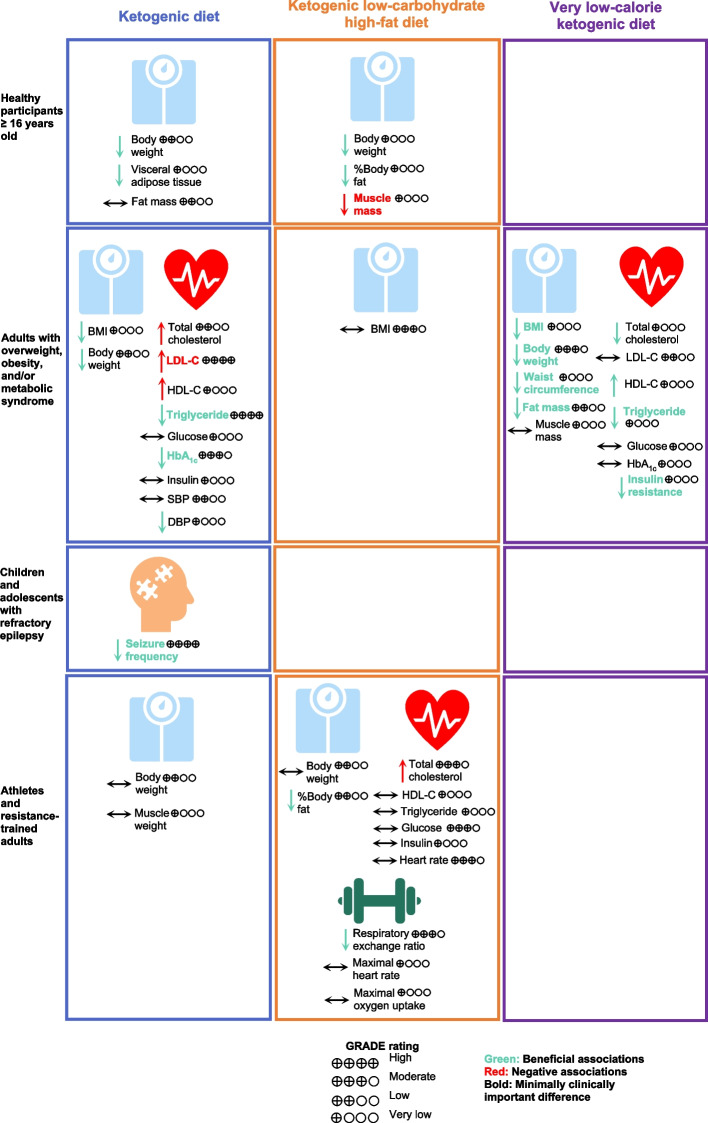
- In healthy participants, K-LCHF for 3–12 weeks reduced body weight by 3.68 kg (95% CI −4.45 to −2.90) but also reduced muscle mass by 1.27 kg (95% CI −1.83 to −0.70; MCID threshold 1.10 kg). In overweight or obese adults, VLCKD improved anthropometric and cardiometabolic outcomes without worsening muscle mass, LDL-C, or total cholesterol.
- Most associations were rated very low (66/115, 57%) or low (36/115, 31%) quality; among statistically significant associations, 26 were very low, 17 low, 4 moderate, and 4 high quality.
Methods
- Umbrella review of published meta-analyses of RCTs assessing any type of ketogenic diet (KD, K-LCHF, VLCKD, MAD) against any comparator for any health outcome; PubMed, EMBASE, Epistemonikos, and Cochrane Database of Systematic Reviews were searched from inception to February 15, 2023.
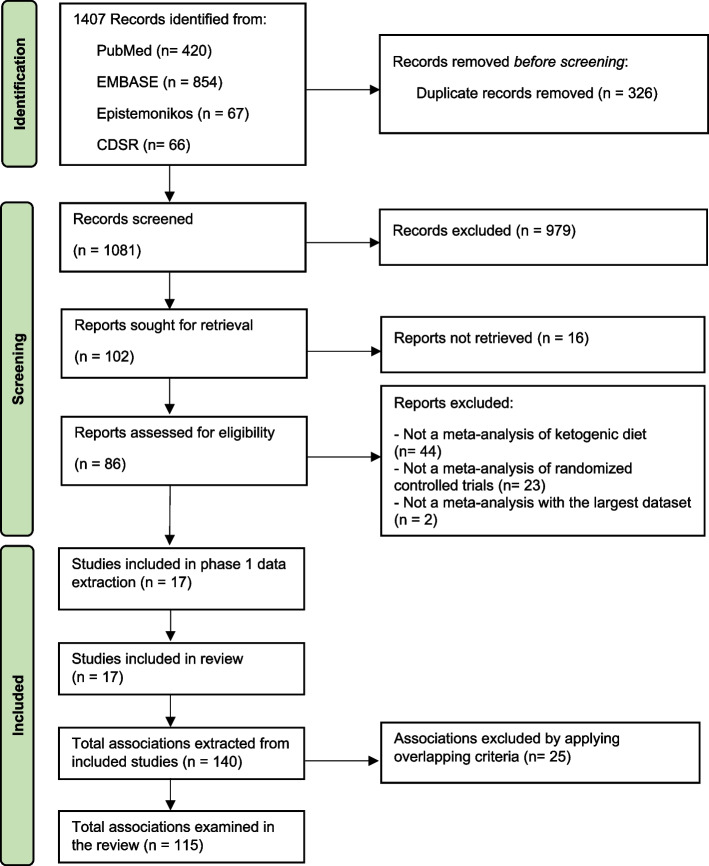
- Included 17 meta-analyses comprising 68 unique RCTs (median [IQR] sample size 42 [20–104] participants; median follow-up 13 [8–36] weeks) and 115 unique associations.
- Meta-analyses were re-performed using random-effects models; evidence per association was graded with GRADE, meta-analysis quality with AMSTAR-2, and sensitivity analyses excluded small studies (<25th percentile) and high-risk-of-bias RCTs.
Limitations
- Stated: the review was confined to published meta-analyses, so outcomes and populations not covered by existing meta-analyses could not be assessed; most included meta-analyses were rated AMSTAR-2 critically low confidence; dose–response analysis was not possible due to insufficient carbohydrate intake details; most RCTs had small samples and short follow-up; adherence likely decreased and carbohydrate intake increased over trials, so the precise degree of ketosis contributing to benefits is uncertain.
- Evident from the text: most associations were downgraded because of serious imprecision, large heterogeneity, and indirectness from mixed interventions and comparators; most outcomes were surrogate measures, and RCTs were limited to selected populations such as overweight/obesity, T2DM, cancer, athletes, and refractory epilepsy.
Model-written summary. Check it against the paper before relying on it.
Integrity signals
Registry
Cites
Statistics
Figures
Verification
Claims the paper makes
25 Own result · 20 Not checked yet · 10 Own method · 7 No basis given · 4 Own interpretation · 2 Partly supported · 1 Mixed support · accuracy not yet measured
The cited sources support only part of this claim — read each source’s verdict below.
In the paper
“In healthy participants, K-LCHF for 3–12 weeks could reduce body weight by 3.68 kg (95% CI, -4.45 to -2.90) but also significantly reduced muscle mass by 1.27 kg (95% CI, -1.83 to -0.70, MCID threshold 1.10 kg) [14, 26, 38].”
§ Effects of ketogenic diet on health outcomes: an umbrella review of meta-analyses of randomized clinical trials > Results > Description and summary of associations
What the sources say
- Partly supportedcites [14] Goldenberg JZ, Day A, Brinkworth GD, Sato J, Yamada S, Jönsson T, et al. Efficacy and safety of low and very low carbohydrate diets for type 2 diabetes remission: systematic review and meta-analysis of published and unpublished randomized trial data. BMJ. 2021;372:m4743. sourceExperimental — accuracy not yet measured
The Results report greater weight loss with low-carbohydrate diets, but the estimate is −3.46 kg at six months in patients with type 2 diabetes, not −3.68 kg over 3–12 weeks in healthy participants. Neither the Results nor the Discussion passages report the claimed 1.27 kg muscle-mass reduction or its MCID; the Discussion describes the review’s outcomes as markers of diabetes remission, adverse events, and related cardiometabolic outcomes. Page numbers were not available in our copy. (LLM, conf=0.83)
- Partly supportedcites [26] Heymsfield SB, Gonzalez MC, Shen W, Redman L, Thomas D. Weight loss composition is one-fourth fat-free mass: a critical review and critique of this widely cited rule. Obes Rev. 2014;15(4):310–21. sourceExperimental — accuracy not yet measured
The ‘Non-diet fat-free mass effects—With Diet’ section (page unavailable) reports skeletal-muscle loss of about 1–2 kg in sedentary diet-only groups, supporting the general point that dieting can reduce muscle mass. It does not establish that K-LCHF over 3–12 weeks caused a 1.27 kg reduction in healthy participants, or report the stated confidence interval or MCID threshold. (LLM, conf=0.78)
- Not checked yetcites [38] Ashtary-Larky D, Bagheri R, Asbaghi O, Tinsley GM, Kooti W, Abbasnezhad A, et al. Effects of resistance training combined with a ketogenic diet on body composition: a systematic review and meta-analysis. Crit Rev Food Sci Nutr. 2022;62(21):5717–32. source
hedgeddirect- Asserted: passes — The authors put it forward as true.
- Checkable: passes — It can be checked against evidence.
- Load-bearing: passes — The paper’s conclusions depend on it.
- Based: passes — The paper gives a reason why it holds.
- Partly supported
The cited sources support only part of this claim — read each source’s verdict below.
In the paper
“K-LCHF for 11–24 weeks was associated with increased total cholesterol in athletes compared with regular diet (MD, 1.32 mg/dL; 95% CI, 0.64 to 1.99) [14, 17].”
§ Effects of ketogenic diet on health outcomes: an umbrella review of meta-analyses of randomized clinical trials > Results > Description and summary of associations
What the sources say
- Could not verifycites [14] Goldenberg JZ, Day A, Brinkworth GD, Sato J, Yamada S, Jönsson T, et al. Efficacy and safety of low and very low carbohydrate diets for type 2 diabetes remission: systematic review and meta-analysis of published and unpublished randomized trial data. BMJ. 2021;372:m4743. sourceExperimental — accuracy not yet measured
The Results (Table 3; page not provided) report total-cholesterol outcomes for people with type 2 diabetes, not athletes. A search for athletes, the 11–24-week duration, and the stated effect estimate found no passage addressing the claimed athlete comparison. The diabetes findings cannot establish or refute that athlete-specific result. (LLM, conf=0.76)
- Partly supportedcites [17] Lee HS, Lee J. Influences of ketogenic diet on body fat percentage, respiratory exchange rate, and total cholesterol in athletes: a systematic review and meta-analysis. Int J Environ Res Public Health. 2021;18(6):2912. sourceExperimental — accuracy not yet measured
The Discussion reports increased total cholesterol in athletes on ketogenic diets compared with controls. Results §3.3 gives 1.32 (95% CI 0.64–1.99), but Methods §2.2 identifies this as a standardized mean difference, not a mean difference in mg/dL. The paper does not specify 11–24 weeks for this cholesterol result; its Results describe diet durations across the included studies as 1–24 weeks. Results §3.3 also calls the cholesterol change a reduction, contrary to the Discussion. (LLM, conf=0.88)
plaincorrelational- Asserted: passes — The authors put it forward as true.
- Checkable: passes — It can be checked against evidence.
- Load-bearing: unclear — It is unclear whether the paper’s conclusions depend on it.
- Based: passes — The paper gives a reason why it holds.
- Could not verify
A result the paper reports from its own data — it cites no other source for it, so there is none to check. The quote shows it is in the paper.
In the paper
“These meta-analyses comprised 68 unique RCTs with a median (interquartile range, IQR) sample size per RCT of 42 (20–104) participants and a median (IQR) follow-up period of 13 (8–36) weeks.”
- Also stated in: § Results · plain
“We included 17 meta-analyses comprising 68 RCTs (median [interquartile range, IQR] sample size of 42 [20–104] participants and follow-up period of 13 [8–36] weeks) and 115 unique associations.”
§ Effects of ketogenic diet on health outcomes: an umbrella review of meta-analyses of randomized clinical trials > Results
plain- Asserted: passes — The authors put it forward as true.
- Checkable: passes — It can be checked against evidence.
- Load-bearing: unclear — It is unclear whether the paper’s conclusions depend on it.
- Based: passes — The paper gives a reason why it holds.
- Also stated in: § Results · plain
A result the paper reports from its own data — it cites no other source for it, so there is none to check. The quote shows it is in the paper.
In the paper
“We identified 115 unique associations of KD with health outcomes (Additional file 2: Table S5).”
- Also stated in: § Results · plain
“and 115 unique associations.”
§ Effects of ketogenic diet on health outcomes: an umbrella review of meta-analyses of randomized clinical trials > Results > Description and summary of associations
plain- Asserted: passes — The authors put it forward as true.
- Checkable: passes — It can be checked against evidence.
- Load-bearing: unclear — It is unclear whether the paper’s conclusions depend on it.
- Based: passes — The paper gives a reason why it holds.
- Also stated in: § Results · plain
A result the paper reports from its own data — it cites no other source for it, so there is none to check. The quote shows it is in the paper.
In the paper
“These meta-analyses comprised 68 unique RCTs with a median (interquartile range, IQR) sample size per RCT of 42 (20–104) participants and a median (IQR) follow-up period of 13 (8–36) weeks.”
§ Effects of ketogenic diet on health outcomes: an umbrella review of meta-analyses of randomized clinical trials > Results
plain- Asserted: passes — The authors put it forward as true.
- Checkable: passes — It can be checked against evidence.
- Load-bearing: unclear — It is unclear whether the paper’s conclusions depend on it.
- Based: passes — The paper gives a reason why it holds.
None of the sources cited for this claim have been checked yet.
In the paper
“Seventeen meta-analyses were included (Fig. 1 and Additional file 2: Table S3) [1, 2, 15–17, 34–45].”
- Also stated in: § Results · plain
“We included 17 meta-analyses comprising 68 RCTs (median [interquartile range, IQR] sample size of 42 [20–104] participants and follow-up period of 13 [8–36] weeks) and 115 unique associations.”
§ Effects of ketogenic diet on health outcomes: an umbrella review of meta-analyses of randomized clinical trials > Results
What the sources say
- Not checked yetcites [1] Bueno NB, de Melo IS, de Oliveira SL, da Rocha Ataide T. Very-low-carbohydrate ketogenic diet v. low-fat diet for long-term weight loss: a meta-analysis of randomised controlled trials. Br J Nutr. 2013;110(7):1178–87. source
- Not checked yetcites [2] Choi YJ, Jeon SM, Shin S. Impact of a ketogenic diet on metabolic parameters in patients with obesity or overweight and with or without type 2 diabetes: a meta-analysis of randomized controlled trials. Nutrients. 2020;12(7):2005. source
- Not checked yetcites [15] Castellana M, Conte E, Cignarelli A, Perrini S, Giustina A, Giovanella L, et al. Efficacy and safety of very low calorie ketogenic diet (VLCKD) in patients with overweight and obesity: a systematic review and meta-analysis. Rev Endocr Metab Disord. 2020;21(1):5–16. source
- Not checked yetcites [16] Sourbron J, Klinkenberg S, van Kuijk SMJ, Lagae L, Lambrechts D, Braakman HMH, et al. Ketogenic diet for the treatment of pediatric epilepsy: review and meta-analysis. Childs Nerv Syst. 2020;36(6):1099–109. source
- Not checked yetcites [17] Lee HS, Lee J. Influences of ketogenic diet on body fat percentage, respiratory exchange rate, and total cholesterol in athletes: a systematic review and meta-analysis. Int J Environ Res Public Health. 2021;18(6):2912. source
- Not checked yetcites [34] Sainsbury E, Kizirian NV, Partridge SR, Gill T, Colagiuri S, Gibson AA. Effect of dietary carbohydrate restriction on glycemic control in adults with diabetes: a systematic review and meta-analysis. Diabetes Res Clin Pract. 2018;139:239–52. source
- Not checked yetcites [35] Rafiullah M, Musambil M, David SK. Effect of a very low-carbohydrate ketogenic diet vs recommended diets in patients with type 2 diabetes: a meta-analysis. Nutr Rev. 2022;80(3):488–502. source
- Not checked yetcites [36] Alarim RA, Alasmre FA, Alotaibi HA, Alshehri MA, Hussain SA. Effects of the ketogenic diet on glycemic control in diabetic patients: meta-analysis of clinical trials. Cureus. 2020;12(10):e10796.
- Not checked yetcites [37] Amini MR, Aminianfar A, Naghshi S, Larijani B, Esmaillzadeh A. The effect of ketogenic diet on body composition and anthropometric measures: A systematic review and meta-analysis of randomized controlled trials. Crit Rev Food Sci Nutr. 2022;62(13):3644–57. source
- Not checked yetcites [38] Ashtary-Larky D, Bagheri R, Asbaghi O, Tinsley GM, Kooti W, Abbasnezhad A, et al. Effects of resistance training combined with a ketogenic diet on body composition: a systematic review and meta-analysis. Crit Rev Food Sci Nutr. 2022;62(21):5717–32. source
plain- Asserted: passes — The authors put it forward as true.
- Checkable: passes — It can be checked against evidence.
- Load-bearing: passes — The paper’s conclusions depend on it.
- Based: passes — The paper gives a reason why it holds.
- Also stated in: § Results · plain
A result the paper reports from its own data — it cites no other source for it, so there is none to check. The quote shows it is in the paper.
In the paper
“Most associations were rated as low and very low evidence according to the GRADE criteria because of serious imprecision and large heterogeneity in findings, and indirectness due to a mix of different interventions and comparators.”
§ Effects of ketogenic diet on health outcomes: an umbrella review of meta-analyses of randomized clinical trials > Discussion
plaincorrelational- Asserted: passes — The authors put it forward as true.
- Checkable: passes — It can be checked against evidence.
- Load-bearing: passes — The paper’s conclusions depend on it.
- Based: passes — The paper gives a reason why it holds.
A result the paper reports from its own data — it cites no other source for it, so there is none to check. The quote shows it is in the paper.
In the paper
“Our findings, however, demonstrated differences in the level of associations with type of KD.”
§ Effects of ketogenic diet on health outcomes: an umbrella review of meta-analyses of randomized clinical trials > Discussion
boostedcorrelational- Asserted: passes — The authors put it forward as true.
- Checkable: passes — It can be checked against evidence.
- Load-bearing: passes — The paper’s conclusions depend on it.
- Based: passes — The paper gives a reason why it holds.
A result the paper reports from its own data — it cites no other source for it, so there is none to check. The quote shows it is in the paper.
In the paper
“We identified 115 associations of KD with a wide range of outcomes.”
§ Effects of ketogenic diet on health outcomes: an umbrella review of meta-analyses of randomized clinical trials > Discussion
plaincorrelational- Asserted: passes — The authors put it forward as true.
- Checkable: passes — It can be checked against evidence.
- Load-bearing: unclear — It is unclear whether the paper’s conclusions depend on it.
- Based: passes — The paper gives a reason why it holds.
None of the sources cited for this claim have been checked yet.
In the paper
“In adults with overweight or obesity and/or metabolic syndrome, VLCKD for 4–6 weeks demonstrated a clinically meaningful weight loss of 9.33 kg (95% CI, -15.45 to -3.22, MCID threshold 4.40 kg) [14, 15].”
§ Effects of ketogenic diet on health outcomes: an umbrella review of meta-analyses of randomized clinical trials > Results > Description and summary of associations
What the sources say
- Not checked yetcites [14] Goldenberg JZ, Day A, Brinkworth GD, Sato J, Yamada S, Jönsson T, et al. Efficacy and safety of low and very low carbohydrate diets for type 2 diabetes remission: systematic review and meta-analysis of published and unpublished randomized trial data. BMJ. 2021;372:m4743. source
- Not checked yetcites [15] Castellana M, Conte E, Cignarelli A, Perrini S, Giustina A, Giovanella L, et al. Efficacy and safety of very low calorie ketogenic diet (VLCKD) in patients with overweight and obesity: a systematic review and meta-analysis. Rev Endocr Metab Disord. 2020;21(1):5–16. source
boosteddirect- Asserted: passes — The authors put it forward as true.
- Checkable: passes — It can be checked against evidence.
- Load-bearing: passes — The paper’s conclusions depend on it.
- Based: passes — The paper gives a reason why it holds.
- Probably not a substantial claim. 14
- It may state two separate claims as one. 16
Some cited sources support this claim and some don’t — read each source’s verdict below.
In the paper
“When more than 1 meta-analysis was available for the same research question, we selected the meta-analysis with the largest data set [19–21].”
§ Effects of ketogenic diet on health outcomes: an umbrella review of meta-analyses of randomized clinical trials > Methods > Search strategy and eligibility criteria
What the sources say
- Supportedcites [19] Dragioti E, Solmi M, Favaro A, Fusar-Poli P, Dazzan P, Thompson T, et al. Association of antidepressant use with adverse health outcomes: a systematic umbrella review. JAMA Psychiat. 2019;76(12):1241–55. source
In Search Strategy and Selection Criteria (page not provided), the paper says that when meta-analyses overlapped on the same outcome, antidepressant type, and clinical or population setting, it assessed only the one with the largest data set. This supports the cited selection rule. (LLM, conf=0.94)
- Supportedcites [20] Patikorn C, Roubal K, Veettil SK, Chandran V, Pham T, Lee YY, et al. Intermittent Fasting and Obesity-Related Health Outcomes: An Umbrella Review of Meta-analyses of Randomized Clinical Trials. JAMA Netw Open. 2021;4(12):e2139558-e. source
The Methods section, under Search Strategy and Eligibility Criteria, states that when more than one meta-analysis addressed the same research question, the authors selected the one with the largest data set. This directly matches the attributed selection rule. (LLM, conf=0.95)
- Disputedcites [21] Theodoratou E, Tzoulaki I, Zgaga L, Ioannidis JP. Vitamin D and multiple health outcomes: umbrella review of systematic reviews and meta-analyses of observational studies and randomised trials. BMJ. 2014;348: g2035. sourceExperimental — accuracy not yet measured
The Methods (Data analysis; page unavailable) describe handling multiple meta-analyses for the same vitamin D biomarker–outcome pair. For observational studies, the authors say they retained the most recent meta-analysis with eligible data, not the one with the largest data set. (LLM, conf=0.87)
Checked by a reasoning model — may be wrong.
plain- Asserted: passes — The authors put it forward as true.
- Checkable: passes — It can be checked against evidence.
- Load-bearing: passes — The paper’s conclusions depend on it.
- Based: passes — The paper gives a reason why it holds.
Probably not a substantial claim.
- Supported
A result the paper reports from its own data — it cites no other source for it, so there is none to check. The quote shows it is in the paper.
In the paper
“The quality of meta-analyses assessed using AMSTAR-2 found that none were rated as high confidence, 2 (12%) as moderate confidence, 2 (12%) as low confidence, and 13 (76.0%) as critically low confidence (Table 1 and Additional file 2: Table S4).”
§ Effects of ketogenic diet on health outcomes: an umbrella review of meta-analyses of randomized clinical trials > Results
plain- Asserted: passes — The authors put it forward as true.
- Checkable: passes — It can be checked against evidence.
- Load-bearing: passes — The paper’s conclusions depend on it.
- Based: passes — The paper gives a reason why it holds.
It may state two separate claims as one.
A result the paper reports from its own data — it cites no other source for it, so there is none to check. The quote shows it is in the paper.
In the paper
“These meta-analyses comprised 68 unique RCTs with a median (interquartile range, IQR) sample size per RCT of 42 (20–104) participants and a median (IQR) follow-up period of 13 (8–36) weeks.”
§ Effects of ketogenic diet on health outcomes: an umbrella review of meta-analyses of randomized clinical trials > Results
plain- Asserted: passes — The authors put it forward as true.
- Checkable: passes — It can be checked against evidence.
- Load-bearing: fails — The paper’s conclusions may not depend on it.
- Based: passes — The paper gives a reason why it holds.
Probably not a substantial claim. The paper’s conclusions may not depend on it.
A result the paper reports from its own data — it cites no other source for it, so there is none to check. The quote shows it is in the paper.
In the paper
“The median (IQR) number of studies per association was 3 [4–6], and the median (IQR) sample size was 244 (127–430) participants.”
§ Effects of ketogenic diet on health outcomes: an umbrella review of meta-analyses of randomized clinical trials > Results > Description and summary of associations
plain- Asserted: passes — The authors put it forward as true.
- Checkable: passes — It can be checked against evidence.
- Load-bearing: fails — The paper’s conclusions may not depend on it.
- Based: passes — The paper gives a reason why it holds.
Probably not a substantial claim. The paper’s conclusions may not depend on it.
In the paper
“VLCKD for 3–96 weeks led to a clinically meaningful improvement in BMI, body weight, waist circumference, triglyceride, fat mass, and insulin resistance, while preserving muscle mass [42].”
§ Effects of ketogenic diet on health outcomes: an umbrella review of meta-analyses of randomized clinical trials > Results > Description and summary of associations
What the sources say
- Not checked yetcites [42] Muscogiuri G, El Ghoch M, Colao A, Hassapidou M, Yumuk V, Busetto L. European guidelines for obesity management in adults with a very low-calorie ketogenic diet: a systematic review and meta-analysis. Obes Facts. 2021;14(2):222–45. source
plaindirect- Asserted: passes — The authors put it forward as true.
- Checkable: passes — It can be checked against evidence.
- Load-bearing: passes — The paper’s conclusions depend on it.
- Based: passes — The paper gives a reason why it holds.
It may state two separate claims as one.
A result the paper reports from its own data — it cites no other source for it, so there is none to check. The quote shows it is in the paper.
In the paper
“K-LCHF was associated with reduced body weight and body fat percentage, but also reduced muscle mass in healthy participants.”
§ Effects of ketogenic diet on health outcomes: an umbrella review of meta-analyses of randomized clinical trials > Abstract > Results
plaincorrelational- Asserted: passes — The authors put it forward as true.
- Checkable: passes — It can be checked against evidence.
- Load-bearing: passes — The paper’s conclusions depend on it.
- Based: passes — The paper gives a reason why it holds.
It may state two separate claims as one.
A result the paper reports from its own data — it cites no other source for it, so there is none to check. The quote shows it is in the paper.
In the paper
“Using GRADE, 115 associations were supported by very low strength of evidence (n = 66, 57%), with the remaining being low (n = 36, 31%), moderate (n = 9, 8%), and high quality of evidence (n = 4, 3%) (Additional file 2: Table S5).”
§ Effects of ketogenic diet on health outcomes: an umbrella review of meta-analyses of randomized clinical trials > Results > Description and summary of associations
plain- Asserted: passes — The authors put it forward as true.
- Checkable: passes — It can be checked against evidence.
- Load-bearing: passes — The paper’s conclusions depend on it.
- Based: passes — The paper gives a reason why it holds.
It may state two separate claims as one.
A result the paper reports from its own data — it cites no other source for it, so there is none to check. The quote shows it is in the paper.
In the paper
“In overweight or obese adults, VLCKD was significantly associated with improvement in anthropometric and cardiometabolic outcomes without worsening muscle mass, LDL-C, and total cholesterol.”
§ Effects of ketogenic diet on health outcomes: an umbrella review of meta-analyses of randomized clinical trials > Abstract > Results
plaincorrelational- Asserted: passes — The authors put it forward as true.
- Checkable: passes — It can be checked against evidence.
- Load-bearing: passes — The paper’s conclusions depend on it.
- Based: passes — The paper gives a reason why it holds.
It may state two separate claims as one.
A result the paper reports from its own data — it cites no other source for it, so there is none to check. The quote shows it is in the paper.
In the paper
“The median (IQR) number of studies per association was 3 [4–6], and the median (IQR) sample size was 244 (127–430) participants.”
§ Effects of ketogenic diet on health outcomes: an umbrella review of meta-analyses of randomized clinical trials > Results > Description and summary of associations
plain- Asserted: passes — The authors put it forward as true.
- Checkable: passes — It can be checked against evidence.
- Load-bearing: fails — The paper’s conclusions may not depend on it.
- Based: passes — The paper gives a reason why it holds.
Probably not a substantial claim. The paper’s conclusions may not depend on it.
None of the sources cited for this claim have been checked yet.
In the paper
“On the one hand, VLCKD is very effective in producing weight loss while preserving muscle mass in adults with overweight or obesity, with specific benefits on anthropometric and cardiometabolic parameters [15, 42].”
§ Effects of ketogenic diet on health outcomes: an umbrella review of meta-analyses of randomized clinical trials > Discussion
What the sources say
- Not checked yetcites [15] Castellana M, Conte E, Cignarelli A, Perrini S, Giustina A, Giovanella L, et al. Efficacy and safety of very low calorie ketogenic diet (VLCKD) in patients with overweight and obesity: a systematic review and meta-analysis. Rev Endocr Metab Disord. 2020;21(1):5–16. source
- Not checked yetcites [42] Muscogiuri G, El Ghoch M, Colao A, Hassapidou M, Yumuk V, Busetto L. European guidelines for obesity management in adults with a very low-calorie ketogenic diet: a systematic review and meta-analysis. Obes Facts. 2021;14(2):222–45. source
boosteddirect- Asserted: passes — The authors put it forward as true.
- Checkable: passes — It can be checked against evidence.
- Load-bearing: passes — The paper’s conclusions depend on it.
- Based: passes — The paper gives a reason why it holds.
It may state two separate claims as one.
The paper states this without a source or data behind it here, so there is nothing to check it against. The quote shows it is in the paper.
In the paper
“In adults, KD was associated with improved anthropometric measures, cardiometabolic parameters, and exercise performance.”
§ Effects of ketogenic diet on health outcomes: an umbrella review of meta-analyses of randomized clinical trials > Discussion
plaincorrelational- Asserted: passes — The authors put it forward as true.
- Checkable: passes — It can be checked against evidence.
- Load-bearing: passes — The paper’s conclusions depend on it.
- Based: passes — The paper gives a reason why it holds.
It may state two separate claims as one.
In the paper
“Our findings demonstrated that KD could induce a rapid weight loss in the initial phase of 6 months, after which time further weight loss was hardly achieved [35].”
§ Effects of ketogenic diet on health outcomes: an umbrella review of meta-analyses of randomized clinical trials > Discussion
What the sources say
- Not checked yetcites [35] Rafiullah M, Musambil M, David SK. Effect of a very low-carbohydrate ketogenic diet vs recommended diets in patients with type 2 diabetes: a meta-analysis. Nutr Rev. 2022;80(3):488–502. source
boostedconditional- Asserted: passes — The authors put it forward as true.
- Checkable: passes — It can be checked against evidence.
- Load-bearing: passes — The paper’s conclusions depend on it.
- Based: passes — The paper gives a reason why it holds.
It may state two separate claims as one.
The paper states this without a source or data behind it here, so there is nothing to check it against. The quote shows it is in the paper.
In the paper
“Beneficial associations of practicing KD were supported by moderate- to high-quality evidence, including weight loss, lower triglyceride levels, decreased HbA1c, RER, and decreased seizure frequency.”
§ Effects of ketogenic diet on health outcomes: an umbrella review of meta-analyses of randomized clinical trials > Conclusions
plaincorrelational- Asserted: passes — The authors put it forward as true.
- Checkable: passes — It can be checked against evidence.
- Load-bearing: passes — The paper’s conclusions depend on it.
- Based: passes — The paper gives a reason why it holds.
It may state two separate claims as one.
In the paper
“With regards to KD effects on lipid profiles, our results demonstrate an effective reduction in serum triglyceride levels with 3 months of lowered dietary carbohydrate intake, with even further reduction by month 12 [35].”
§ Effects of ketogenic diet on health outcomes: an umbrella review of meta-analyses of randomized clinical trials > Discussion
What the sources say
- Not checked yetcites [35] Rafiullah M, Musambil M, David SK. Effect of a very low-carbohydrate ketogenic diet vs recommended diets in patients with type 2 diabetes: a meta-analysis. Nutr Rev. 2022;80(3):488–502. source
boosteddirect- Asserted: passes — The authors put it forward as true.
- Checkable: passes — It can be checked against evidence.
- Load-bearing: passes — The paper’s conclusions depend on it.
- Based: passes — The paper gives a reason why it holds.
It may state two separate claims as one.
None of the sources cited for this claim have been checked yet.
In the paper
“Furthermore, weight loss induced by KD is relatively modest and appears comparable to other dietary interventions that are effective for short-term weight loss, e.g., intermittent fastingand Mediterranean diet [55–57].”
§ Effects of ketogenic diet on health outcomes: an umbrella review of meta-analyses of randomized clinical trials > Discussion
What the sources say
- Not checked yetcites [55] O’Neill B, Raggi P. The ketogenic diet: Pros and cons. Atherosclerosis. 2020;292:119–26. source
- Not checked yetcites [56] Freire R. Scientific evidence of diets for weight loss: different macronutrient composition, intermittent fasting, and popular diets. Nutrition. 2020;69: 110549. source
- Not checked yetcites [57] Becker A, Gaballa D, Roslin M, Gianos E, Kane J. Novel nutritional and dietary approaches to weight loss for the prevention of cardiovascular disease: ketogenic diet, intermittent fasting, and bariatric surgery. Curr Cardiol Rep. 2021;23(7):1–9. source
hedgeddirect- Asserted: passes — The authors put it forward as true.
- Checkable: passes — It can be checked against evidence.
- Load-bearing: passes — The paper’s conclusions depend on it.
- Based: passes — The paper gives a reason why it holds.
It may state two separate claims as one.
A result the paper reports from its own data — it cites no other source for it, so there is none to check. The quote shows it is in the paper.
In the paper
“Though our aggregate results also confirm an increase in LDL-C and total cholesterol with KD and K-LCHF, respectively, it is important to note that an increase in either of these levels does not necessarily signify a potentially deleterious cardiovascular end-point.”
§ Effects of ketogenic diet on health outcomes: an umbrella review of meta-analyses of randomized clinical trials > Discussion
boosteddirect- Asserted: passes — The authors put it forward as true.
- Checkable: passes — It can be checked against evidence.
- Load-bearing: passes — The paper’s conclusions depend on it.
- Based: passes — The paper gives a reason why it holds.
It may state two separate claims as one.
What the paper did — it cites no source for this, so there is none to check. The quote shows it is in the paper.
In the paper
“We searched PubMed, EMBASE, Epistemonikos, and the Cochrane database of systematic reviews (CDSR) from the database inception to February 15, 2023 (Additional file 2: Table S2).”
- Also stated in: § Methods · plain
“PubMed, EMBASE, Epistemonikos, and Cochrane database of systematic reviews were searched up to February 15, 2023.”
§ Effects of ketogenic diet on health outcomes: an umbrella review of meta-analyses of randomized clinical trials > Methods > Search strategy and eligibility criteria
plain- Asserted: passes — The authors put it forward as true.
- Checkable: passes — It can be checked against evidence.
- Load-bearing: passes — The paper’s conclusions depend on it.
- Based: passes — The paper gives a reason why it holds.
Probably not a substantial claim.
- Also stated in: § Methods · plain
What the paper did — it cites no source for this, so there is none to check. The quote shows it is in the paper.
In the paper
“The protocol of this study was registered with PROSPERO (CRD42022334717).”
§ Effects of ketogenic diet on health outcomes: an umbrella review of meta-analyses of randomized clinical trials > Methods
plain- Asserted: passes — The authors put it forward as true.
- Checkable: passes — It can be checked against evidence.
- Load-bearing: fails — The paper’s conclusions may not depend on it.
- Based: passes — The paper gives a reason why it holds.
Probably not a substantial claim. The paper’s conclusions may not depend on it.
In the paper
“We reported following the 2020 Preferred Reporting Items for Systematic Reviews and Meta-analyses (PRISMA) (Additional file 1) [18].”
§ Effects of ketogenic diet on health outcomes: an umbrella review of meta-analyses of randomized clinical trials > Methods
What the sources say
- Not checked yetcites [18] Page MJ, McKenzie JE, Bossuyt PM, Boutron I, Hoffmann TC, Mulrow CD, et al. The PRISMA 2020 statement: an updated guideline for reporting systematic reviews. BMJ. 2021;372:n71. source
plain- Asserted: passes — The authors put it forward as true.
- Checkable: passes — It can be checked against evidence.
- Load-bearing: fails — The paper’s conclusions may not depend on it.
- Based: passes — The paper gives a reason why it holds.
Probably not a substantial claim. The paper’s conclusions may not depend on it.
What the paper did — it cites no source for this, so there is none to check. The quote shows it is in the paper.
In the paper
“Two reviewers (CP and PS) independently performed data extraction and quality assessment (Additional file 2: Method S1).”
§ Effects of ketogenic diet on health outcomes: an umbrella review of meta-analyses of randomized clinical trials > Methods > Data extraction and quality assessment
plain- Asserted: passes — The authors put it forward as true.
- Checkable: passes — It can be checked against evidence.
- Load-bearing: fails — The paper’s conclusions may not depend on it.
- Based: passes — The paper gives a reason why it holds.
Probably not a substantial claim. The paper’s conclusions may not depend on it.
In the paper
“We assessed the quality of evidence per association by applying the GRADE criteria (Grading of Recommendations, Assessment, Development, and Evaluations) in five domains, including (1) risk of bias in the individual studies, (2) inconsistency, (3) indirectness, (4) imprecision, and (5) publication bias [31].”
§ Effects of ketogenic diet on health outcomes: an umbrella review of meta-analyses of randomized clinical trials > Methods > Data synthesis
What the sources say
- Not checked yetcites [31] Langendam MW, Akl EA, Dahm P, Glasziou P, Guyatt G, Schünemann HJ. Assessing and presenting summaries of evidence in cochrane reviews. Syst Rev. 2013;2(1):81. source
plain- Asserted: passes — The authors put it forward as true.
- Checkable: passes — It can be checked against evidence.
- Load-bearing: passes — The paper’s conclusions depend on it.
- Based: passes — The paper gives a reason why it holds.
Probably not a substantial claim.
In the paper
“We used AMSTAR- 2 -A Measurement Tool to Assess Systematic Reviews- to grade the quality of meta-analyses as high, moderate, low, or critically low by assessing the following elements, research question, a priori protocol, search, study selection, data extraction, quality assessment, data analysis, interpretation, heterogeneity, publication bias, source of funding, conflict of interest [22].”
§ Effects of ketogenic diet on health outcomes: an umbrella review of meta-analyses of randomized clinical trials > Methods > Data extraction and quality assessment
What the sources say
- Not checked yetcites [22] Shea BJ, Reeves BC, Wells G, Thuku M, Hamel C, Moran J, et al. AMSTAR 2: a critical appraisal tool for systematic reviews that include randomised or non-randomised studies of healthcare interventions, or both. BMJ. 2017;358:j4008. source
plain- Asserted: passes — The authors put it forward as true.
- Checkable: passes — It can be checked against evidence.
- Load-bearing: passes — The paper’s conclusions depend on it.
- Based: passes — The paper gives a reason why it holds.
Probably not a substantial claim.
What the paper did — it cites no source for this, so there is none to check. The quote shows it is in the paper.
In the paper
“Study selection was independently performed in EndNote by two reviewers (C.P. and PS).”
§ Effects of ketogenic diet on health outcomes: an umbrella review of meta-analyses of randomized clinical trials > Methods > Search strategy and eligibility criteria
plain- Asserted: passes — The authors put it forward as true.
- Checkable: passes — It can be checked against evidence.
- Load-bearing: fails — The paper’s conclusions may not depend on it.
- Based: passes — The paper gives a reason why it holds.
Probably not a substantial claim. The paper’s conclusions may not depend on it.
What the paper did — it cites no source for this, so there is none to check. The quote shows it is in the paper.
In the paper
“Any discrepancies were resolved by discussion with the third reviewer (SKV).”
§ Effects of ketogenic diet on health outcomes: an umbrella review of meta-analyses of randomized clinical trials > Methods > Search strategy and eligibility criteria
plain- Asserted: passes — The authors put it forward as true.
- Checkable: passes — It can be checked against evidence.
- Load-bearing: fails — The paper’s conclusions may not depend on it.
- Based: passes — The paper gives a reason why it holds.
Probably not a substantial claim. The paper’s conclusions may not depend on it.
None of the sources cited for this claim have been checked yet.
In the paper
“Sensitivity analyses were performed by excluding small-size studies (< 25th percentile) [32] and excluding primary studies having a high risk of bias rated by the Cochrane’s risk of bias 2 tool (RoB 2) for RCTs from the identified associations [19–21, 33].”
§ Effects of ketogenic diet on health outcomes: an umbrella review of meta-analyses of randomized clinical trials > Methods > Sensitivity analyses
What the sources say
- Not checked yetcites [32] Dechartres A, Altman DG, Trinquart L, Boutron I, Ravaud P. Association between analytic strategy and estimates of treatment outcomes in meta-analyses. JAMA. 2014;312(6):623–30. source
- Not checked yetcites [19] Dragioti E, Solmi M, Favaro A, Fusar-Poli P, Dazzan P, Thompson T, et al. Association of antidepressant use with adverse health outcomes: a systematic umbrella review. JAMA Psychiat. 2019;76(12):1241–55. source
- Not checked yetcites [20] Patikorn C, Roubal K, Veettil SK, Chandran V, Pham T, Lee YY, et al. Intermittent Fasting and Obesity-Related Health Outcomes: An Umbrella Review of Meta-analyses of Randomized Clinical Trials. JAMA Netw Open. 2021;4(12):e2139558-e. source
- Not checked yetcites [21] Theodoratou E, Tzoulaki I, Zgaga L, Ioannidis JP. Vitamin D and multiple health outcomes: umbrella review of systematic reviews and meta-analyses of observational studies and randomised trials. BMJ. 2014;348: g2035. source
- Not checked yetcites [33] Sterne JA, Savović J, Page MJ, Elbers RG, Blencowe NS, Boutron I, et al. RoB 2: a revised tool for assessing risk of bias in randomised trials. BMJ. 2019;366:l4898. source
plain- Asserted: passes — The authors put it forward as true.
- Checkable: passes — It can be checked against evidence.
- Load-bearing: passes — The paper’s conclusions depend on it.
- Based: passes — The paper gives a reason why it holds.
Probably not a substantial claim. It may state two separate claims as one.
What the paper did — it cites no source for this, so there is none to check. The quote shows it is in the paper.
In the paper
“Sensitivity analyses were performed to provide additional evidence from high-quality RCTs, which further increased the reliability of results.”
§ Effects of ketogenic diet on health outcomes: an umbrella review of meta-analyses of randomized clinical trials > Discussion
plaindirect- Asserted: passes — The authors put it forward as true.
- Checkable: passes — It can be checked against evidence.
- Load-bearing: unclear — It is unclear whether the paper’s conclusions depend on it.
- Based: passes — The paper gives a reason why it holds.
It may state two separate claims as one.
What the paper did — it cites no source for this, so there is none to check. The quote shows it is in the paper.
In the paper
“Fourthly, most RCTs of KD were limited to a relatively small number of participants with a short-term follow-up period, which limited our assessment of sustained beneficial effects after stopping KD.”
§ Effects of ketogenic diet on health outcomes: an umbrella review of meta-analyses of randomized clinical trials > Discussion > Limitations
plaindirect- Asserted: passes — The authors put it forward as true.
- Checkable: passes — It can be checked against evidence.
- Load-bearing: unclear — It is unclear whether the paper’s conclusions depend on it.
- Based: passes — The paper gives a reason why it holds.
It may state two separate claims as one.
A conclusion the paper draws from its own results — it cites no other source for it, so there is none to check. The quote shows it is in the paper.
In the paper
“However, these domains unlikely affected our findings.”
§ Effects of ketogenic diet on health outcomes: an umbrella review of meta-analyses of randomized clinical trials > Discussion > Limitations
hedged- Asserted: passes — The authors put it forward as true.
- Checkable: passes — It can be checked against evidence.
- Load-bearing: passes — The paper’s conclusions depend on it.
- Based: fails — The paper may give no reason why it holds.
Probably not a substantial claim. The paper may give no reason why it holds.
In the paper
“Our observed aggregate effect of KD on cholesterol levels does not account for the difference in LDL particle size, nor does it distinguish the sources of dietary fat, which can also be a significant effector of LDL particle size distribution and metabolism [66].”
§ Effects of ketogenic diet on health outcomes: an umbrella review of meta-analyses of randomized clinical trials > Discussion
What the sources say
- Not checked yetcites [66] Dreon DM, Fernstrom HA, Campos H, Blanche P, Williams PT, Krauss RM. Change in dietary saturated fat intake is correlated with change in mass of large low-density-lipoprotein particles in men. Am J Clin Nutr. 1998;67(5):828–36. source
plain- Asserted: passes — The authors put it forward as true.
- Checkable: passes — It can be checked against evidence.
- Load-bearing: unclear — It is unclear whether the paper’s conclusions depend on it.
- Based: passes — The paper gives a reason why it holds.
It may state two separate claims as one.
The paper relies on this without support.
There has been little synthesis of the strength and quality of evidence from meta-analyses of RCTs of KD in aggregate.
“Nevertheless, there has been little synthesis of the strength and quality of this evidence in aggregate.”
“To date, there has been little synthesis of the strength and quality of this evidence in aggregate.”
Claims other papers make about this one
Each is checked against this paper’s own text: does it say what the citing paper says it does?
The cited source says what the claim attributes to it.
In the citing paper
“Our findings support recent umbrella reviews and meta-analyses, which report triglyceride reduction and LDL-C increases with the KD [30, 31].”
From Ketogenic diet-induced changes in adult lipid metabolism: a comprehensive systematic review and meta-regression of randomized controlled trials (2026) · cites this paper as [30]
The cited source says what the claim attributes to it.
In the citing paper
“Recent umbrella reviews (quantitative reviews containing multiple meta-analyses) have reported that KDs tend to increase low-density lipoprotein (LDL) cholesterol [168,169].”
From International Society of Sports Nutrition position stand: diets for body weight reduction (2026) · cites this paper as [169]
Self-check
Percentages, sums and reported differences re-computed from the paper’s own numbers.
Each contradiction between two passages listed here was confirmed by an independent check.
Rated minor: it would not touch a result — a value no result rests on, a p-value that stays on the same side of the significance level, or a conflict that is clerical, resolved elsewhere in the paper, or outside its own findings.
In the paper
§ Effects of ketogenic diet on health outcomes: an umbrella review of meta-analyses of randomized clinical trials > Results
“| Castellana et al. 2020 [15] | T2DM adults with overweight or obesity | VLCKD | LCD | 1–2 months | 13 | 801 | Body weight | Low |”
§ Effects of ketogenic diet on health outcomes: an umbrella review of meta-analyses of randomized clinical trials > Results > Description and summary of associations
“| VLCKD | 4–6 weeks | LFD or RD | 2 (n = 142) |”
Rated minor: it would not touch a result — a value no result rests on, a p-value that stays on the same side of the significance level, or a conflict that is clerical, resolved elsewhere in the paper, or outside its own findings.
In the paper
§ Effects of ketogenic diet on health outcomes: an umbrella review of meta-analyses of randomized clinical trials > Results > Description and summary of associations
“The median (IQR) number of studies per association was 3 [4–6]”
§ Effects of ketogenic diet on health outcomes: an umbrella review of meta-analyses of randomized clinical trials > Results > Description and summary of associations
“3 [4–6]”
Rated minor: it would not touch a result — a value no result rests on, a p-value that stays on the same side of the significance level, or a conflict that is clerical, resolved elsewhere in the paper, or outside its own findings.
In the paper
§ Effects of ketogenic diet on health outcomes: an umbrella review of meta-analyses of randomized clinical trials > Results
“| Lee et al. 2021 [17] | Athletes | KD | RD | 2–24 weeks | 8 | 158 |”
§ Effects of ketogenic diet on health outcomes: an umbrella review of meta-analyses of randomized clinical trials > Results > Description and summary of associations
“| Lee et al. 2021 [17] | Total cholesterol, mg/dL | Athletes | K-LCHF | 11–24 weeks | RD |”
Rated minor: it would not touch a result — a value no result rests on, a p-value that stays on the same side of the significance level, or a conflict that is clerical, resolved elsewhere in the paper, or outside its own findings.
In the paper
§ Effects of ketogenic diet on health outcomes: an umbrella review of meta-analyses of randomized clinical trials > Results > Description and summary of associations
“VLCKD for 3–96 weeks led to a clinically meaningful improvement in BMI, body weight, waist circumference, triglyceride, fat mass, and insulin resistance, while preserving muscle mass [42].”
§ Effects of ketogenic diet on health outcomes: an umbrella review of meta-analyses of randomized clinical trials > Results
“| Muscogiuri et al. 2021 [42] | Adults with overweight or obesity | VLCKD | LCD | 2–4 weeks | 15 | 835 |”
Citations
Cites
The PRISMA 2020 statement: An updated guideline for reporting systematic reviews
Page, M. J., McKenzie, J. E., Bossuyt, P. M., Boutron, I., Hoffmann, T. C., Mulrow, C. D., Shamseer, L., Tetzlaff, J. M., Akl, E. A., Brennan, S. E., et al. (2021) · BMJ · doi:10.1136/bmj.n71 · Cited by 108,283
Bias in meta-analysis detected by a simple, graphical test
Egger, M., Smith, G. D., Schneider, M., & Minder, C. (1997) · BMJ · doi:10.1136/bmj.315.7109.629 · Cited by 56,722
Meta-analysis in clinical trials
DerSimonian, R., & Laird, N. (1986) · Controlled Clinical Trials · doi:10.1016/0197-2456(86)90046-2 · Cited by 39,552
RoB 2: a revised tool for assessing risk of bias in randomised trials
Sterne, J. A. C., Savović, J., Page, M. J., Elbers, R. G., Blencowe, N. S., Boutron, I., Cates, C. J., Cheng, H.-Y., Corbett, M. S., Eldridge, S. M., et al. (2019) · BMJ · doi:10.1136/bmj.l4898 · Cited by 34,787
Shea, B. J., Reeves, B. C., Wells, G., Thuku, M., Hamel, C., Moran, J., Moher, D., Tugwell, P., Welch, V., Kristjansson, E., et al. (2017) · BMJ · doi:10.1136/bmj.j4008 · Cited by 10,636
A Re-Evaluation of Random-Effects Meta-Analysis
Higgins, J. P. T., Thompson, S. G., & Spiegelhalter, D. J. (2009) · Journal of the Royal Statistical Society Series A: Statistics in Society · doi:10.1111/j.1467-985x.2008.00552.x · Cited by 2,569
Weight Loss with a Low-Carbohydrate, Mediterranean, or Low-Fat Diet
Shai, I., Schwarzfuchs, D., Henkin, Y., Shahar, D. R., Witkow, S., Greenberg, I., Golan, R., Fraser, D., Bolotin, A., Vardi, H., et al. (2008) · New England Journal of Medicine · doi:10.1056/nejmoa0708681 · Cited by 2,143
Suppression of Oxidative Stress by β-Hydroxybutyrate, an Endogenous Histone Deacetylase Inhibitor
Shimazu, T., Hirschey, M. D., Newman, J., He, W., Shirakawa, K., Le Moan, N., Grueter, C. A., Lim, H., Saunders, L. R., Stevens, R. D., et al. (2013) · Science · doi:10.1126/science.1227166 · Cited by 1,777
Lamarche, B., Tchernof, A., Moorjani, S., Cantin, B., Dagenais, G. R., Lupien, P. J., & Despre´s, J.-P. (1997) · Circulation · doi:10.1161/01.cir.95.1.69 · Cited by 1,077
The Gut Microbiota Mediates the Anti-Seizure Effects of the Ketogenic Diet
Olson, C. A., Vuong, H. E., Yano, J. M., Liang, Q. Y., Nusbaum, D. J., & Hsiao, E. Y. (2018) · Cell · doi:10.1016/j.cell.2018.04.027 · Cited by 1,057
Gardner, C. D., Kiazand, A., Alhassan, S., Kim, S., Stafford, R. S., Balise, R. R., Kraemer, H. C., & King, A. C. (2007) · JAMA · doi:10.1001/jama.297.9.969 · Cited by 1,051
Theodoratou, E., Tzoulaki, I., Zgaga, L., & Ioannidis, J. P. A. (2014) · BMJ · doi:10.1136/bmj.g2035 · Cited by 956
Beyond weight loss: a review of the therapeutic uses of very-low-carbohydrate (ketogenic) diets
Paoli, A., Rubini, A., Volek, J. S., & Grimaldi, K. A. (2013) · European Journal of Clinical Nutrition · doi:10.1038/ejcn.2013.116 · Cited by 885
Bueno, N. B., de Melo, I. S. V., de Oliveira, S. L., & da Rocha Ataide, T. (2013) · British Journal of Nutrition · doi:10.1017/s0007114513000548 · Cited by 778 · cited 5×
“Overall beneficial outcomes associated with KD were BMI [37, 42], body weight [1, 2, 35–37, 41], waist circumference [37, 42], fat mass [37, 42], body fat percentage [38, 40], visceral adipose tissue [37], triglyceride [1, 2, 36, 42], HDL-C [1, 2, 42], HbA1c [2, 34, 35], HOMA-IR [2, 42], DBP [1], seizure frequency red…”
BackgroundInfluentialKossoff, E. H., Zupec‐Kania, B. A., Auvin, S., Ballaban‐Gil, K. R., Christina Bergqvist, A. G., Blackford, R., Buchhalter, J. R., Caraballo, R. H., Cross, J. H., Dahlin, M. G., et al. (2018) · Epilepsia Open · doi:10.1002/epi4.12225 · Cited by 768
Mitochondrial biogenesis in the anticonvulsant mechanism of the ketogenic diet
Bough, K. J., Wetherington, J. P., Hassel, B., Paré, J., Gawryluk, J. W., Greene, J. G., Shaw, R. N., Smith, Y., Geiger, J. D., & Dingledine, R. J. (2006) · Annals of Neurology · doi:10.1002/ana.20899 · Cited by 605
Anticonvulsant Mechanisms of the Ketogenic Diet
Bough, K. J., & Rho, J. M. (2007) · Epilepsia · doi:10.1111/j.1528-1167.2007.00915.x · Cited by 523
Garriga-Canut, M., Schoenike, B. A., Qazi, R., Bergendahl, K., Daley, T. J., Pfender, R. M., Morrison, J. F., Ockuly, J. C., Stafstrom, C. E., Sutula, T. P., et al. (2006) · Nature Neuroscience · doi:10.1038/nn1791 · Cited by 446
Goldenberg, J. Z., Day, A., Brinkworth, G. D., Sato, J., Yamada, S., Jönsson, T., Beardsley, J., Johnson, J. A., Thabane, L., & Johnston, B. C. (2021) · BMJ · doi:10.1136/bmj.m4743 · Cited by 428 · cited 4×
“5%) [14, 35], (2) VLCKD for 4–6 weeks was associated with reduced body weight in T2DM adults with overweight or obesity compared with a low-fat diet or regular diet (MD, -9.”
BackgroundInfluentialZhu, H., Bi, D., Zhang, Y., Kong, C., Du, J., Wu, X., Wei, Q., & Qin, H. (2022) · Signal Transduction and Targeted Therapy · doi:10.1038/s41392-021-00831-w · Cited by 412
Kirkpatrick, C. F., Bolick, J. P., Kris-Etherton, P. M., Sikand, G., Aspry, K. E., Soffer, D. E., Willard, K.-E., & Maki, K. C. (2019) · Journal of Clinical Lipidology · doi:10.1016/j.jacl.2019.08.003 · Cited by 390
A Modified Atkins Diet Is Effective for the Treatment of Intractable Pediatric Epilepsy
Kossoff, E. H., McGrogan, J. R., Bluml, R. M., Pillas, D. J., Rubenstein, J. E., & Vining, E. P. G. (2006) · Epilepsia · doi:10.1111/j.1528-1167.2006.00438.x · Cited by 371
Heymsfield, S. B., Gonzalez, M. C. C., Shen, W., Redman, L., & Thomas, D. (2014) · Obesity Reviews · doi:10.1111/obr.12143 · Cited by 350
Ketogenic diet for the treatment of refractory epilepsy in children: A systematic review of efficacy
Lefevre, F., & Aronson, N. (2000) · Pediatrics · doi:10.1542/peds.105.4.e46 · Cited by 331
Patikorn, C., Roubal, K., Veettil, S. K., Chandran, V., Pham, T., Lee, Y. Y., Giovannucci, E. L., Varady, K. A., & Chaiyakunapruk, N. (2021) · JAMA Network Open · doi:10.1001/jamanetworkopen.2021.39558 · Cited by 298
Self-citationMuscogiuri, G., El Ghoch, M., Colao, A., Hassapidou, M., Yumuk, V., Busetto, L., & Obesity Management Task Force (OMTF) of the European Association for the Study of Obesity (EASO) (2021) · Obesity Facts · doi:10.1159/000515381 · Cited by 289
Assessing and presenting summaries of evidence in Cochrane Reviews
Langendam, M. W., Akl, E. A., Dahm, P., Glasziou, P., Guyatt, G., & Schünemann, H. J. (2013) · Systematic Reviews · doi:10.1186/2046-4053-2-81 · Cited by 282
Sainsbury, E., Kizirian, N. V., Partridge, S. R., Gill, T., Colagiuri, S., & Gibson, A. A. (2018) · Diabetes Research and Clinical Practice · doi:10.1016/j.diabres.2018.02.026 · Cited by 268
Freire, R. (2020) · Nutrition · doi:10.1016/j.nut.2019.07.001 · Cited by 262
Castellana, M., Conte, E., Cignarelli, A., Perrini, S., Giustina, A., Giovanella, L., Giorgino, F., & Trimboli, P. (2020) · Reviews in Endocrine and Metabolic Disorders · doi:10.1007/s11154-019-09514-y · Cited by 249
Yuan, X., Wang, J., Yang, S., Gao, M., Cao, L., Li, X., Hong, D., Tian, S., & Sun, C. (2020) · Nutrition & Diabetes · doi:10.1038/s41387-020-00142-z · Cited by 240
Nutritional ketosis for weight management and reversal of metabolic syndrome
Gershuni, V. M., Yan, S. L., & Medici, V. (2018) · Current Nutrition Reports · doi:10.1007/s13668-018-0235-0 · Cited by 239
Association Between Analytic Strategy and Estimates of Treatment Outcomes in Meta-analyses
Dechartres, A., Altman, D. G., Trinquart, L., Boutron, I., & Ravaud, P. (2014) · JAMA · doi:10.1001/jama.2014.8166 · Cited by 233
Ketogenic diets and chronic disease: weighing the benefits against the risks
Crosby, L., Davis, B., Joshi, S., Jardine, M., Paul, J., Neola, M., & Barnard, N. D. (2021) · Frontiers in Nutrition · doi:10.3389/fnut.2021.702802 · Cited by 229
The ketogenic diet: Pros and cons
O'Neill, B., & Raggi, P. (2020) · Atherosclerosis · doi:10.1016/j.atherosclerosis.2019.11.021 · Cited by 219
Association of Antidepressant Use With Adverse Health Outcomes: A Systematic Umbrella Review
Dragioti, E., Solmi, M., Favaro, A., Fusar-Poli, P., Dazzan, P., Thompson, T., Stubbs, B., Firth, J., Fornaro, M., Tsartsalis, D., et al. (2019) · JAMA Psychiatry · doi:10.1001/jamapsychiatry.2019.2859 · Cited by 215
Ketogenic diet exhibits anti‐inflammatory properties
Dupuis, N., Curatolo, N., Benoist, J., & Auvin, S. (2015) · Epilepsia · doi:10.1111/epi.13038 · Cited by 210
The ketogenic diet and brain metabolism of amino acids: Relationship to the anticonvulsant effect
Yudkoff, M., Daikhin, Y., Melø, T. M., Nissim, I., Sonnewald, U., & Nissim, I. (2007) · Annual Review of Nutrition · doi:10.1146/annurev.nutr.27.061406.093722 · Cited by 202
Ketone bodies mediate antiseizure effects through mitochondrial permeability transition
Kim, D. Y., Simeone, K. A., Simeone, T. A., Pandya, J. D., Wilke, J. C., Ahn, Y., Geddes, J. W., Sullivan, P. G., & Rho, J. M. (2015) · Annals of Neurology · doi:10.1002/ana.24424 · Cited by 194
Choi, Y. J., Jeon, S.-M., & Shin, S. (2020) · Nutrients · doi:10.3390/nu12072005 · Cited by 193
Effect of Dietary Carbohydrate on Triglyceride Metabolism in Humans
Parks, E. J. (2001) · The Journal of Nutrition · doi:10.1093/jn/131.10.2772s · Cited by 172
Dreon, D., Fernstrom, H., Campos, H., Blanche, P., Williams, P., & Krauss, R. (1998) · The American Journal of Clinical Nutrition · doi:10.1093/ajcn/67.5.828 · Cited by 170
Ketogenic diets, physical activity and body composition: a review
Ashtary‐Larky, D., Bagheri, R., Bavi, H., Baker, J. S., Moro, T., Mancin, L., & Paoli, A. (2021) · British Journal Of Nutrition · doi:10.1017/s0007114521002609 · Cited by 120
Thomsen, H. H., Rittig, N. F., Johannsen, M., Møller, A. B., Jørgensen, J. O. L., Jessen, N., & Møller, N. (2018) · American Journal of Clinical Nutrition · doi:10.1093/ajcn/nqy170 · Cited by 117
Ketogenic diet for the treatment of pediatric epilepsy: review and meta-analysis
Sourbron, J., Klinkenberg, S., van Kuijk, S. M. J., Lagae, L., Lambrechts, D., Braakman, H. M. H., & Majoie, M. (2020) · Child's Nervous System · doi:10.1007/s00381-020-04578-7 · Cited by 111
Jayedi, A., Khan, T. A., Aune, D., Emadi, A., & Shab‐Bidar, S. (2022) · International Journal of Obesity · doi:10.1038/s41366-022-01165-5 · Cited by 102
Insulin and Growth Hormone Balance: Implications for Obesity
Huang, Z., Huang, L., Waters, M. J., & Chen, C. (2020) · Trends in Endocrinology and Metabolism · doi:10.1016/j.tem.2020.04.005 · Cited by 88
Modified Atkins diet vs classic ketogenic formula in intractable epilepsy
El-Rashidy, O. F., Nassar, M. F., Abdel-Hamid, I. A., Shatla, R., Abdel-Hamid, M. H., Gabr, S. S., Mohamed, S. G., Elsayed, W., & Shaaban, S. Y. (2013) · Acta Neurologica Scandinavica · doi:10.1111/ane.12137 · Cited by 86
Anticatabolic Effects of Ketone Bodies in Skeletal Muscle
Koutnik, A. P., D’Agostino, D. P., & Egan, B. (2019) · Trends in Endocrinology and Metabolism · doi:10.1016/j.tem.2019.01.006 · Cited by 86
Rafiullah, M., Musambil, M., & David, S. K. (2022) · Nutrition Reviews · doi:10.1093/nutrit/nuab040 · Cited by 86
Wang, Z., Bergqvist, C., Hunter, J. V., Jin, D., Wang, D., Wehrli, S. L., & Zimmerman, R. A. (2003) · Magnetic Resonance in Medicine · doi:10.1002/mrm.10429 · Cited by 84
Dahlin, M. G., Singleton, S. S., David, J. A., Basuchoudhary, A., Wickström, R., Mazumder, R., & Prast‐Nielsen, S. (2022) · EBioMedicine · doi:10.1016/j.ebiom.2022.104061 · Cited by 69
Cao, J., Lei, S., Wang, X., & Cheng, S. (2021) · Nutrients · doi:10.3390/nu13082896 · Cited by 67
Mulligan, A. A., Lentjes, M. A. H., Luben, R. N., Wareham, N. J., & Khaw, K.-T. (2019) · BMC Cardiovascular Disorders · doi:10.1186/s12872-019-1223-z · Cited by 62
Yang, Y.-F., Mattamel, P. B., Joseph, T., Huang, J., Chen, Q., Akinwunmi, B. O., Zhang, C. J. P., & Ming, W.-K. (2021) · Nutrients · doi:10.3390/nu13051388 · Cited by 57
Body Mass Index (BMI), BMI change and mortality in community-dwelling seniors without dementia.
Keller, H., & Østbye, T. (2006) · PubMed · Cited by 55
β-Hydroxybutyrate Elicits Favorable Mitochondrial Changes in Skeletal Muscle
Parker, B. A., Walton, C. M., Carr, S. T., Andrus, J. L., Cheung, E. C. K., Duplisea, M. J., Wilson, E. K., Draney, C., Lathen, D. R., Kenner, K. B., et al. (2018) · International Journal of Molecular Sciences · doi:10.3390/ijms19082247 · Cited by 52
Ashtary-Larky, D., Bagheri, R., Asbaghi, O., Tinsley, G. M., Kooti, W., Abbasnezhad, A., Afrisham, R., & Wong, A. (2022) · Critical Reviews in Food Science and Nutrition · doi:10.1080/10408398.2021.1890689 · Cited by 50
Lee, H. S., & Lee, J. (2021) · International Journal of Environmental Research and Public Health · doi:10.3390/ijerph18020828 · Cited by 46
Alarim, R. A., Alasmre, F. A., Alotaibi, H. A., Alshehri, M. A., & Hussain, S. A. (2020) · Cureus · doi:10.7759/cureus.10796 · Cited by 38
Amini, M. R., Aminianfar, A., Naghshi, S., Larijani, B., & Esmaillzadeh, A. (2022) · Critical Reviews in Food Science and Nutrition · doi:10.1080/10408398.2020.1867957 · Cited by 37
Growth Hormone Effects on Protein Metabolism
Møller, N., Copeland, K. C., & Nair, K. S. (2007) · Endocrinology and Metabolism Clinics of North America · doi:10.1016/j.ecl.2006.11.001 · Cited by 31
López-Espinoza, M. Á., Moscoso, S. C., Sanduvete‐Chaves, S., Ortega-Maureira, M. J., & Barrientos-Bravo, T. (2021) · Nutrients · doi:10.3390/nu13092946 · Cited by 29
Vargas-Molina, S., Gómez‐Urquiza, J. L., García-Romero, J., & Benítez‐Porres, J. (2022) · International Journal of Environmental Research and Public Health · doi:10.3390/ijerph191912629 · Cited by 23
Smith, E. S., Smith, H., Betts, J. A., Gonzalez, J. T., & Atkinson, G. (2020) · Obesity · doi:10.1002/oby.22968 · Cited by 22
Lee, H. S., & Lee, J. (2021) · International Journal of Environmental Research and Public Health · doi:10.3390/ijerph18062912 · Cited by 20
Kelley, G. A., Kelley, K. S., & Stauffer, B. L. (2022) · Science Progress · doi:10.1177/00368504221101636 · Cited by 20
Becker, A., Gaballa, D., Roslin, M., Gianos, E., & Kane, J. (2021) · Current Cardiology Reports · doi:10.1007/s11886-021-01515-1 · Cited by 14
Cited by
Sorted by citations
Diet strategies for promoting healthy aging and longevity: An epidemiological perspective
Hu, F. B. (2023) · Journal of Internal Medicine · doi:10.1111/joim.13728 · Cited by 241
The Role of Lifestyle Interventions in PCOS Management: A Systematic Review
Gautam, R., Maan, P., Jyoti, A., Kumar, A., Malhotra, N., & Arora, T. (2025) · Nutrients · doi:10.3390/nu17020310 · Cited by 115
Sun, M., Yao, W., Wang, X., Gao, S., Varady, K. A., Forslund, S. K., Zhang, M., Shi, Z.-Y., Cao, F., Zou, B.-J., et al. (2024) · EClinicalMedicine · doi:10.1016/j.eclinm.2024.102519 · Cited by 113
Self-citationPaoli, A., Bianco, A., Moro, T., Mota, J. F., & Coelho‐Ravagnani, C. D. F. (2023) · Nutrients · doi:10.3390/nu15143120 · Cited by 91
Jakicic, J. M., Apovian, C. M., Barr‐Anderson, D. J., Courcoulas, A. P., Donnelly, J. E., Panteleimon Ekkekakis, A., Hopkins, M., Lambert, M., Napolitano, M. A., & Volpe, S. L. (2024) · Medicine & Science in Sports & Exercise · doi:10.1249/mss.0000000000003520 · Cited by 81
Metadata
- Authors
- Patikorn, C., Saidoung, P., Pham, T., Phisalprapa, P., Lee, Y. Y., Varady, K. A., Veettil, S. K., & Chaiyakunapruk, N.
- Affiliations
- Chulalongkorn University (TH)
- University of Utah (US)
- Siriraj Hospital (TH)
- Universiti Sains Malaysia (MY)
- University of Illinois Chicago (US)
- Corresponding author
- Veettil, Sajesh K.
- Chaiyakunapruk, Nathorn
- ORCID
- Venue
- BMC Medicine
- Published
- 2023-05-25
- Volume
- 21
- Issue
- 1
- Pages
- 196-196
- ISSN
- 1741-7015 (ISSN-L)
- PMC
- PMC10210275
- OpenAlex
- W4378220711
- Semantic Scholar
- 7804f976e2673f54ac575a886f64620c1ff14ac3
- Cited by
- 101
- References
- 68
- Citations by year
- 2026: 28 · 2025: 30 · 2024: 33 · 2023: 10
- FWCI
- 17.79
- Type
- journal article
- Language
- en
- Open access
- gold
- doi.org
- Locations
- BMC Medicine (publishedVersion, cc-by)
- PubMed Central (publishedVersion, cc-by)
- PubMed (publishedVersion)
- DOAJ (DOAJ: Directory of Open Access Journals) (submittedVersion, cc-by-sa)
- Topics
- Health Sciences › Medicine › Physiology (medical) › Diet and metabolism studies
- Health Sciences › Medicine › Physiology (medical) › Dietary Effects on Health
- Health Sciences › Medicine › Public Health, Environmental and Occupational Health › Nutritional Studies and Diet
- Keywords
- ketogenic diet, very low-calorie ketogenic diet, epilepsy, seizure frequency, cardiometabolic outcomes, LDL cholesterol, triglycerides, body weight, body fat percentage, muscle mass, quality of evidence, GRADE, obesity, overweight adults, health outcomes, respiratory exchange ratio
- MeSH terms
- Adult, Body Weight, Cardiovascular Diseases, Humans, Cholesterol, LDL, Obesity, Seizures, Meta-Analysis as Topic, Randomized Controlled Trials as Topic, Overweight, Diet, Ketogenic
About these checks
Registry, retraction, Cites and statistics results are computed, not judged, with one exception: a printed reference that no index lists is read once by a model before it counts as a citation error. Claims are extracted by a model and kept only when their quote appears verbatim in the text; each cited source is then checked, with a model’s help, for whether it says what the claim relies on. Those verdicts can be wrong — read the claim’s quote and the cited source before relying on one.
A language model drew the claims from the paper on 2026-10-08, under version 3 of the claim definition (model deepseek-v4.1-flash, prompt extract-v3).
A second model labelled each claim on 2026-10-08 (model jev-1.13-20260917, definition revision gold-guideline-v0.2).
Cited sources are checked with a language model’s help (gpt-6-sol).
Statistics and arithmetic are recomputed, not judged.
Confidence bands are shown only for fields calibrated on our annotated test set. None is calibrated yet, so no band is shown.
What counts as a claim ›How we measure confidence ›How we check this ›
Are you an author, or do you see a problem with this page? Request a review
