

ROS signaling under metabolic stress: cross-talk between AMPK and AKT pathway
Open accessThe DOI matches its Crossref record; 125 of the 125 references it cites were found in a registry or an index.
Abstract
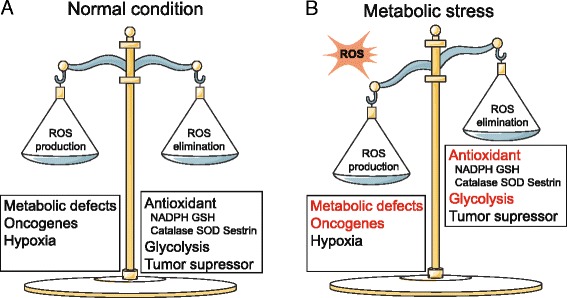
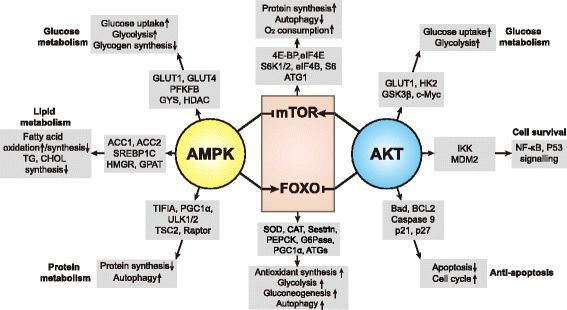
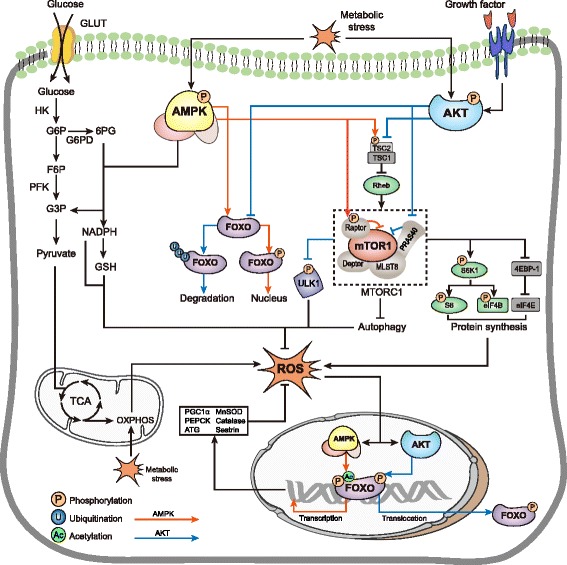
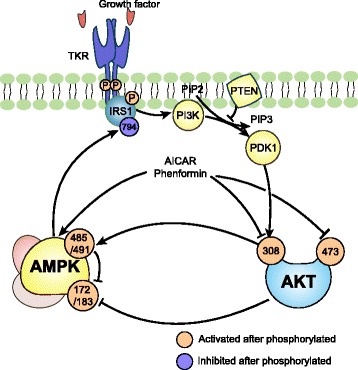
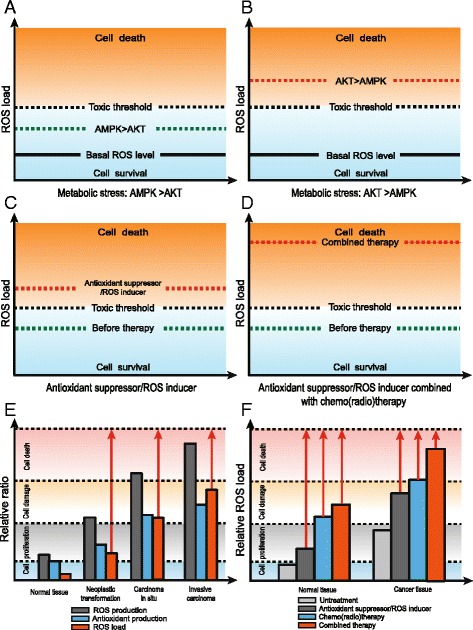
Cancer cells are frequently confronted with metabolic stress in tumor microenvironments due to their rapid growth and limited nutrient supply. Metabolic stress induces cell death through ROS-induced apoptosis. However, cancer cells can adapt to it by altering the metabolic pathways. AMPK and AKT are two primary effectors in response to metabolic stress: AMPK acts as an energy-sensing factor which rewires metabolism and maintains redox balance. AKT broadly promotes energy production in the nutrient abundance milieu, but the role of AKT under metabolic stress is in dispute. Recent studies show that AMPK and AKT display antagonistic roles under metabolic stress. Metabolic stress-induced ROS signaling lies in the hub between metabolic reprogramming and redox homeostasis. Here, we highlight the cross-talk between AMPK and AKT and their regulation on ROS production and elimination, which summarizes the mechanism of cancer cell adaptability under ROS stress and suggests potential options for cancer therapeutics.
Overview
The claims and statistics of this paper haven’t been checked yet.
Free: it reads the open-access text and checks the first 5 claims that cite a source we can check. Create a free account to check every claim.
Integrity signals
Registry
Cites
Statistics
Figures
Verification
Claims the paper makes
The claims and statistics of this paper haven’t been checked yet.
Free: it reads the open-access text and checks the first 5 claims that cite a source we can check. Create a free account to check every claim.
Claims other papers make about this one
Each is checked against this paper’s own text: does it say what the citing paper says it does?
The source backs part of the claim, not all of it — or backs it for a different population, condition or comparison.
In the citing paper
“Thus, by inhibiting PGAM5, AMPK suppresses necrosis, reduces ROS accumulation, and mitigates oxidative stress.385,387”
From Glucagon-like peptide-1 receptor: mechanisms and advances in therapy (2024) · cites this paper as [385]
Experimental — accuracy not yet measuredThe check wasn’t confident either way, so it gives no verdict — never disputed.
In the citing paper
“Importantly, the activation of AMPK reduces the expression of phosphoglycerate mutase 5 (PGAM5), which plays a promotive role in cell necrosis by contributing to mitochondrial dysfunction and the production of reactive oxygen species (ROS).385–387”
From Glucagon-like peptide-1 receptor: mechanisms and advances in therapy (2024) · cites this paper as [385]
Experimental — accuracy not yet measured
Self-check
Percentages, sums and reported differences re-computed from the paper’s own numbers.
The self-check needs the paper’s full text.
Citations
Cites
1 retracted
Zhang, S., Yang, C., Yang, Z., Zhang, D., Ma, X., Mills, G. B., & Liu, Z. (2015) · Europe PMC (PubMed Central) · Cited by 38
Self-citationRetractedAKT/PKB signaling: navigating downstream
Manning, B. D., & Cantley, L. C. (2007) · Cell · doi:10.1016/j.cell.2007.06.009 · Cited by 6,115 · cited 2×
“By activating mTORC1, AKT promotes oxygen consumption and increases ROS production under glucose deprivation [54, 62], rendering cancer cells closer to the death threshold of ROS.”
The emerging hallmarks of cancer metabolism
Pavlova, N. N., & Thompson, C. B. (2016) · Cell Metabolism · doi:10.1016/j.cmet.2015.12.006 · Cited by 5,926 · cited 9×
“Further, B Chaube et al. found that AMPK could enhance mitochondrial biogenesis and OXPHOS by activating p38/PGC1α pathway [53].”
InfluentialHydroperoxide metabolism in mammalian organs.
Chance, B., Sies, H., & Boveris, A. (1979) · Physiological Reviews · doi:10.1152/physrev.1979.59.3.527 · Cited by 5,827 · cited 1×
“It is estimated that ROS produced by mitochondria are about 1–2% of the total rate of oxygen consumption in normal cells [17].”
Targeting cancer cells by ROS-mediated mechanisms: a radical therapeutic approach?
Trachootham, D., Alexandre, J., & Huang, P. (2009) · Nature Reviews Drug Discovery · doi:10.1038/nrd2803 · Cited by 5,452 · cited 1×
“Even though cancer cells exhibit an enhanced antioxidant system, they still maintain higher ROS levels than normal cells [20, 109].”
Mitochondrial Reactive Oxygen Species (ROS) and ROS-Induced ROS Release
Zorov, D. B., Juhaszova, M., & Sollott, S. J. (2014) · Physiological Reviews · doi:10.1152/physrev.00026.2013 · Cited by 5,383 · cited 1×
“ROS are byproducts of biological reactions of energy generation, and are mainly produced in the mitochondria through the oxidative metabolism [15, 16].”
The Warburg Effect: How Does it Benefit Cancer Cells?
Liberti, M. V., & Locasale, J. W. (2016) · Trends in Biochemical Sciences · doi:10.1016/j.tibs.2015.12.001 · Cited by 5,150 · cited 1×
“Although this mode of energy production is less efficient than mitochondrial respiration per unit of glucose, the rate of glycolysis is 10–100 times faster [25].”
AMPK: a nutrient and energy sensor that maintains energy homeostasis
Hardie, D. G., Ross, F. A., & Hawley, S. A. (2012) · Nature Reviews Molecular Cell Biology · doi:10.1038/nrm3311 · Cited by 4,602 · cited 1×
“It is also regulated by its upstream LKB1, CaMMK or other factors like ADP or Ca [49].”
Reactive oxygen species (ROS) homeostasis and redox regulation in cellular signaling
Ray, P. D., Huang, B.-W., & Tsuji, Y. (2012) · Cellular Signalling · doi:10.1016/j.cellsig.2012.01.008 · Cited by 4,373 · cited 1×
“ROS are byproducts of biological reactions of energy generation, and are mainly produced in the mitochondria through the oxidative metabolism [15, 16].”
Modulation of oxidative stress as an anticancer strategy
Gorrini, C., Harris, I. S., & Mak, T. W. (2013) · Nature Reviews Drug Discovery · doi:10.1038/nrd4002 · Cited by 3,579 · cited 5×
“Glucose deficiency is one of the main factors leading to ROS stress in tumors, either in the stage of tumor initiation or progression [18].”
Influential
Cited by
Items 601–700 of 769
He, C., Ma, L., Hirst, J. J., Li, F., Wu, H., Liu, W., Zhao, J., Xu, F., Godwin, A. K., Wang, X., et al. (2024) · Frontiers in Pharmacology · doi:10.3389/fphar.2024.1409506 · Cited by 2
Singh, R. P., & Sonali (2024) · Current Protein and Peptide Science · doi:10.2174/0113892037307636240612112408 · Cited by 1
Fenvalerate exposure induces AKT/AMPK-dependent alterations in glucose metabolism in hepatoma cells
Sun, L., Cui, Z., Feng, Q., Muhammad, J. S., Jin, Y., Zhao, S., Zhou, L., & Wu, C. (2025) · Frontiers in Pharmacology · doi:10.3389/fphar.2025.1540567 · Cited by 1
ZHANG, X., Zhao, T., JIANG, X., JIANG, Y., SiQi, N. I., Yi, J. I. A. O., JiaMei, Y. U., & Liu, L. (2025) · Scientia Sinica Vitae · doi:10.1360/ssv-2025-0008 · Cited by 1
Wu, Y., Zhao, C.-X., Lu, C., & Shen, Y. (2025) · Food Bioscience · doi:10.1016/j.fbio.2025.106999 · Cited by 1
Liu, Y., Jiang, H., Gu, Y., Li, Y., & Ding, X. (2025) · International Journal of Molecular Sciences · doi:10.3390/ijms26199443 · Cited by 1
“Reactive oxygen species act as secondary messengers to cause cellular damage and even cell death via ROS-induced MAPK signaling [23,24].”
Self-citationXumeng, S. H. I., Lu, S., Guangman, Z. H. U., Tianjiao, C. U. I., Shunhang, W. U., Mengdan, S. A. N. G., Yiran, Z. H. E. N., Yang, X., Du, H., Han, M., et al. (2025) · Chinese Journal of Analytical Chemistry · doi:10.1016/j.cjac.2025.100672 · Cited by 1
AMPK regulates the anti-pulmonary fibrosis effects of tracheloside
Siyuan, L., Qian, R., Xie, W., Miao, L., Huang, X., Deng, L., Xiong, D., Liu, W., & Tang, S. (2025) · Chinese Journal of Natural Medicines · doi:10.1016/j.cjnm.2025.100005 · Cited by 1
Fu, W., Yan, Y., Shu, C.-H., Xu, C., Chen, Y., Xia, Y., Chen, J., Chen, Y., Cui, R., Zou, P., et al. (2026) · European Journal of Pharmacology · doi:10.1016/j.ejphar.2026.178544 · Cited by 1
Metformin in skin diseases: the role of gut microbiota and immune response
Kiecka, A., Macura, B., & Szczepanik, M. (2026) · Pharmacological Reports · doi:10.1007/s43440-026-00825-x · Cited by 1
The role of glucose metabolic reprogramming in myocarditis and advances in therapeutic strategies
Liu, X., & Han, B. (2026) · Frontiers in Cardiovascular Medicine · doi:10.3389/fcvm.2026.1781627 · Cited by 1
Yu, Y., Tian, S., Liu, Y., Zhang, Y., Bekish, Y. N., Fomich, M. A., Akhlamionak, T. P., Korotina, U. R., Samailovich, Y. M., Shmanai, V. V., et al. (2026) · Chinese Chemical Letters · doi:10.1016/j.cclet.2026.112644 · Cited by 1
Self-citationLi, Y., Zhou, X., Yang, Z., Yang, X., & Wei, A. (2026) · Immunology and Cell Biology · doi:10.1111/imcb.70105 · Cited by 1
“5,6 9 Activation of the AMPK pathway can mitigate damage caused by reactive oxygen species often produced by activated neutrophils, 10,11 suggesting a protective mechanism against inflammatory diseases.”
Zhou, X., Zhao, M., Cao, Y., Zhou, X., & Wang, K. (2026) · Cancer Medicine · doi:10.1002/cam4.71780 · Cited by 1
“An increase in ROS levels can also induce crosstalk between AMPK and the AKT pathway [35].”
Bai, H., Zhao, H., Feng, J., Wang, H., Li, Y., Chen, Z., He, B., Wang, C. C., Gao, R., Zhao, R., et al. (2026) · Frontiers in Pharmacology · doi:10.3389/fphar.2026.1747977 · Cited by 1
“However, under certain pathological conditions, sustained or aberrant activation of the PI3K/AKT pathway can paradoxically induce apoptosis (He et al., 2021; Park et al., 2015; Zhao et al., 2017).”
Advances in regulatory mechanisms of glycolysis in the pathological process of pulmonary fibrosis
Gao, F., Pu, R., Pan, G., Ma, Y., Zhao, J., Ruohui, W., Cao, X., & Liang, Q. (2026) · European journal of medical research · doi:10.1186/s40001-026-04423-8 · Cited by 1
“Upon activation, AMPK restores energy homeostasis by promoting ATP production and reducing ATP consumption via downstream signaling pathways [131].”
Wang, X., Jacky, H. C. K., Botelho, F. P., Che, Y., Sun, Z., & Xu, W. (2026) · AIMS Animal Science · doi:10.3934/aas.2026004 · Cited by 1
Tang, Z., Shi, Y., Jiang, X., Jiang, S., Maihemuti, N., Zhang, J., Tang, B., & Xu, Z. S. (2026) · Biomedicines · doi:10.3390/biomedicines14061262 · Cited by 1
“AMPK, as a key negative regulator of mTOR, can be activated by cell stress signals such as ROS [25].”
Wu, S., Chang, Z., Ye, X., Huang, Y., Yuan, H., Wang, H., Chen, S., Zhang, N., & Wang, S. (2026) · International Immunopharmacology · doi:10.1016/j.intimp.2026.116902 · Cited by 1
ROS as a powerful instrument for the advanced cancer prevention and management: Facts and outlook
Tang, Q., Cui, L., Du, W., Ruan, Y., Yang, L., Fu, C., Gui, J., Liu, Q., Chen, Y., Qiao, J., et al. (2026) · Journal of Advanced Research · doi:10.1016/j.jare.2026.07.002 · Cited by 1
Mitochondrial Energy Metabolism in Cancer, Immunoregulation and Antitumour Response
Patrício, J. S., Mendes, C., & Gameiro, P. A. (2026) · Advances in experimental medicine and biology · doi:10.1007/978-3-032-12166-0_17 · Cited by 1
LOX-1 silencing activates the PI3K/AKT pathway to inhibit ox-LDL-induced apoptosis of THVECs
Wang, S., Ding, W., Cheng, R., Wei, L., Tian, Q., Zhu, J., Li, Y., & Zhang, Q. (2026) · Archives of Biochemistry and Biophysics · doi:10.1016/j.abb.2026.110917 · Cited by 1
Li, X., Huang, Y., Cao, X., Luo, H., Zou, Y., Aldali, F., Chen, S., Li, Y., Zhou, Q., & Chen, H. (2026) · Advanced Healthcare Materials · doi:10.1002/adhm.71495 · Cited by 1
Glycolytic reprogramming and the EMT drive cervical cancer progression via the NQO1/HIF1α-SIX1 axis
Zhu, G., Piao, Z., Gao, Y., Cong, X., Wei, P., Han, A., Zhou, H., Lin, Z., & Jin, T. (2026) · iScience · doi:10.1016/j.isci.2026.117007 · Cited by 1
Zhu, X., Zhang, G., Li, L., Yu, P., Su, P., Liang, H., Dong, D., Liu, D., & Wang, K. (2026) · International Journal of Nanomedicine · doi:10.2147/ijn.s616904 · Cited by 1
Pan, H., Zhai, L., Zhao, S., Guo, Z., & Yao, P. (2026) · PLoS ONE · doi:10.1371/journal.pone.0358354 · Cited by 1
Obafemi, T. O., Ayeleso, A. O., Ekundayo, B. E., Obafemi, B. A., Adewale, O. B., Lebelo, S. L., & Ntwasa, M. M. (2026) · Molecular Biology Reports · doi:10.1007/s11033-026-12876-7 · Cited by 1
“This broad crosstalk facilitates cellular coordination of metabolic and stress responses [73].”
Choi, Y. H., Kim, M., Hwangbo, H., Choi, E., Kwon, D. H., Ahn, K. I., Ji, S., Jeong, J.-W., Hong, S. H., & Park, C. (2018) · Pharmacognosy Magazine · doi:10.4103/pm.pm_484_17 · Cited by 1
Perspectives of incretin mimetics in cardiovascular diseases
Cardoso, J. F. R., Cohen, C., Medeiros, F., Serfaty, F. M., & Neves, M. F. (2021) · Brazilian Journal of Health and Biomedical Sciences · doi:10.12957/bjhbs.2021.59746 · Cited by 1
Dico, A. L., Salvatore, D., Diceglie, C., Martelli, C., & Ottobrini, L. (2021) · Elsevier eBooks · doi:10.1016/b978-0-12-821567-8.00026-9 · Cited by 1
A blend of cod liver oil and virgin coconut oil improves the endurance performance in mice
Pavithra, V., Janhavi, P., Natasha, J., Neelam, R., Mrityunjaya, M., Selvi, M. K., & Veeranna, R. P. (2022) · Sport Sciences for Health · doi:10.1007/s11332-022-01001-3 · Cited by 1
Reactive Oxygen Species in Glioma: Mechanisms and Challenges
Deshpande, R. P., & Babu, P. P. (2022) · Handbook of Oxidative Stress in Cancer: Therapeutic Aspects · doi:10.1007/978-981-16-5422-0_145 · Cited by 1
Salita, T., Rustam, Y. H., Hofferek, V., Jackson, M., Tollestrup, I., Sheridan, J. P., Schramm, V. L., Evans, G. B., Reid, G. E., & Munkacsi, A. B. (2023) · Biochimica et Biophysica Acta (BBA) - Molecular and Cell Biology of Lipids · doi:10.1016/j.bbalip.2023.159346 · Cited by 1
Redox Modification of PKA-Cα Differentially Affects Its Substrate Selection
Delva‐Wiley, J., Ekhator, E. S., Adams, L. L., Patwardhan, S., Dong, M., & Newman, R. H. (2023) · Life · doi:10.3390/life13091811 · Cited by 1
Majd, S., Power, J. H., Majd, Z., & Tagesklinik, P. (2023) · Integrated Research in Health and Disease Journal · doi:10.61627/irhdj.1112023 · Cited by 2
Huang, L., Wang, D., Zhou, A., Qian, M., & Zhou, C. (2024) · Biology Bulletin · doi:10.1134/s1062359023604640 · Cited by 1
“Akt is the central survival mediator in cell signaling transmission and phosphorylated Akt can regulate such downstream protein as mTOR and plays an important role in cell apoptosis, autophagy and proliferation (Zhao et al., 2017; Liang et al., 2017).”
Coenzyme Q10 supplementation affects cellular ionic balance: relevance to aging
Srivastava, P., Bhoumik, S., Yadawa, A. K., Kesherwani, R., & Rizvi, S. I. (2024) · Zeitschrift für Naturforschung C · doi:10.1515/znc-2024-0129 · Cited by 1
Dias, A. M. M., Courteau, A., Petitot, C., Simonet, J., Vrigneaud, J., Bellaye, P., Oudot, A., Kownacka, A., Paris, J., Decréau, R. A., et al. (2024) · Interdisciplinary cancer research · doi:10.1007/16833_2024_467 · Cited by 1
Antidiabetic agents as potential cytotoxic candidates for cancer therapy
Alnaser, R. I., Alassaf, F. A., & Abed, M. N. (2024) · Forum of Clinical Oncology · doi:10.2478/fco-2023-0041 · Cited by 2
Alsubaie, N., Abd‐Elhakim, Y. M., Mohamed, A. A.-R., Ibrahim, R. E., Metwally, M. M. M., Khamis, T., Eskandrani, A. A., Bawahab, A. A., Alotaibi, B. S., & Farag, M. F. M. (2025) · Aquaculture International · doi:10.1007/s10499-025-02083-9 · Cited by 1
“Oxidative stress promotes AKT phosphorylation, which in turn stimulates mTOR, leading to suppressed autophagy (Zhao et al. 2017).”
Wang, S., Meng, H., Dou, X., Kong, L., Wang, W., Hou, M., Yan, Y., Li, B., & Jin, T. (2025) · Tissue and Cell · doi:10.1016/j.tice.2025.103186 · Cited by 1
Lepez, A., Pirnay, T., Denanglaire, S., Pérez-Morga, D. L., Vermeersch, M., Léo, O., & Andris, F. (2020) · bioRxiv (Cold Spring Harbor Laboratory) · doi:10.1101/2020.03.06.978791 · Cited by 1
“In agreement with a role for AMPK in maintaining redox balance in cancer cells (25, 26), AMPKKO homeostatic proliferating T cells and memory-like Th1 cells generated increased amounts of ROS (Figure 7B, C).”
BackgroundDaryanoosh, F., Moghadam, M. S., Pahlavani, H. A., Bahmanbeglou, N. A., & Mirzaei, S. (2022) · Research Square · doi:10.21203/rs.3.rs-2105962/v1 · Cited by 1
HIF-1α affects invasion and metastasis of prostate cancer by regulating invadopodia formationPreprint
Song, L., Zhu, H., Zhang, J., Luo, Y., Wei, C., Li, Y., Han, K., Su, S., & Wang, D. (2024) · Research Square · doi:10.21203/rs.3.rs-4867481/v1 · Cited by 1
Dai, M., Chen, Y., Yu, S., de Miguel, D., Liu, P.-Y., Chen, Y., Dai, Y.-H., Tseng, S., Ye, C.-H., Le, T.-L., et al. (2025) · Research Square · doi:10.21203/rs.3.rs-6656922/v1 · Cited by 1
Pieles, O. (2023) · University of Regensburg Publication Server (University of Regensburg) · doi:10.5283/epub.54118 · Cited by 1
Molecular mechanisms of kinase inhibitor resistance in melanoma
Cesi, G. (2017) · Open Repository and Bibliography (University of Luxembourg)
Novel metabolic regulations exerted by LKB1 signaling in polarized cells : impact on tissue ontogeny
Radu, A. G. (2018) · theses.fr (ABES) · doi:10.70675/4857176dz0993z4049z97c4zf8092fcf1e2e · Cited by 1
“Upon energy stress like glucose starvation, activated AMPK induces metabolic reprograming and subsequently controls redox balance and ROS production (Zhao et al., 2017).”
BackgroundInfluentialRiffel, A. P. K. (2017) · LA Referencia (Red Federada de Repositorios Institucionales de Publicaciones Científicas) · Cited by 1
Effects of AMP-activated kinase modulators on intracellular Ca2+ signalling and C. elegans lifespan
Arias-del-Val, J. (2018) · UVaDOC UVaDOC University of Valladolid Documentary Repository (University of Valladolid) · doi:10.35376/10324/33455
Rebelo, A. P. M. (2019) · Portuguese National Funding Agency for Science, Research and Technology (RCAAP Project by FCT)
Impact of Hepatitis C virus infection on mitochondria
Monnier, L. (2019) · theses.fr (ABES) · doi:10.70675/023433d6z727fz47fdza608z6867c4efb0b4 · Cited by 1
김은정 (2019) · Seoul National University Open Repository (Seoul National University)
Meyer, R. K. (2019) · UA Campus Repository (The University of Arizona)
Caffeic Acid targets metabolism of cervical squamous cell carcinoma
Tyszka‐Czochara, M. (2021) · Elsevier eBooks · doi:10.1016/b978-0-12-819547-5.00025-0
do Prado, S. B. R. (2019) · Digital Library of Theses and Dissertations (Universidade de São Paulo) · doi:10.11606/t.9.2019.tde-10062019-101437
ROS Induced Regulatory Crosstalk with Autophagy and AKT/mTOR Signaling in Cancer Cells
Das, P., Chatterjee, K., & Choudhuri, T. (2021) · Springer eBooks · doi:10.1007/978-981-15-4501-6_84-1 · Cited by 1
Reactive Oxygen Species in Glioma: Mechanisms and Challenges
Deshpande, R. P., & Babu, P. P. (2021) · Handbook of Oxidative Stress in Cancer: Therapeutic Aspects · doi:10.1007/978-981-16-1247-3_145-1
ROS-Induced Regulatory Crosstalk with Autophagy and AKT/mTOR Signaling in Cancer Cells
Das, P., Chatterjee, K., & Choudhuri, T. (2022) · Springer eBooks · doi:10.1007/978-981-15-9411-3_84
DO-SRS and MPF imaging of metabolic activities
Bagheri, P., Hoang, K., Fung, A. A., Hussain, S., & Shi, L. (2022) · Advanced Chemical Microscopy for Life Science and Translational Medicine · doi:10.1117/12.2607975
“mTOR inhibits transcription factors to block the targeting of transcriptional genes associated with the autophagy-lysosome [13-16, 27] ultimately resulting in lack of autophagy.”
BackgroundInnate immunity and metabolism in the bovine ovarian follicle
Horlock, A. D. (2022) · Cronfa (Swansea University) · doi:10.23889/suthesis.59754
Tirouvanziam, R. M. (2018) · Springer eBooks · doi:10.1007/978-981-10-5311-5_7
Rosenzweig, S. A. (2020) · Faculty Opinions – Post-Publication Peer Review of the Biomedical Literature · doi:10.3410/f.735351451.793572343
Cytotoxic Effects of the Schweinfurthin Analog 5′-Methylschweinfurthin G in Malignant Plasma Cells
Manfredi, B., Neighbors, J. D., & Hohl, R. J. (2022) · Pharmacology · doi:10.1159/000525299
Arias, A. C. R. (2020) · Repositorio Institucional (Pontificia Universidad Javeriana) · doi:10.11144/javeriana.10554.42453
BCL6 is a context-dependent mediator of the glioblastoma therapy response
Tribe, A. K. W. (2023) · Open Access Victoria University of Wellington | Te Herenga Waka (Figshare) · doi:10.26686/wgtn.21937850
Mao, C., Wang, Y., Xu, Z., Wang, X., Fang, B., & Chen, H. (2023) · Natural Product Communications · doi:10.1177/1934578x231167996
“AMPK regulates mTOR via the PI3K/Akt independent pathway.(20) Consequently, we hypothesized whether we could inhibit mTOR activity thus achieving an anti-tumor effect by simultaneously regulating the AMPK/mTOR and PI3K/Akt/mTOR signaling pathways.”
BackgroundTaurine and the Cardiovascular System: Focus on Mitochondrial-related Pathologies
Heidari, R., & Ommati, M. M. (2023) · BENTHAM SCIENCE PUBLISHERS eBooks · doi:10.2174/9789815124484123010006
Salita, T. (2018) · Open Access Victoria University of Wellington | Te Herenga Waka (Figshare) · doi:10.26686/wgtn.22757438
Wang, H., Zhang, J., Wang, L., Zhang, Y., Lei, J., Liu, S., Pan, M., Xue, Z., Hu, M., & Zhan, L. (2023) · Research Square · doi:10.21203/rs.3.rs-3701615/v1
Логаткина, А. В., Terekhov, I. V., & Nikiforov, V. S. (2023) · Regional blood circulation and microcirculation · doi:10.24884/1682-6655-2023-22-4-25-34
Sánchez, L. S. (2023) · UVaDOC UVaDOC University of Valladolid Documentary Repository (University of Valladolid) · doi:10.35376/10324/66283
Chudakov, D. B., Konovalova, M. V., Streltsova, M. A., Шустова, О. А., Generalov, A. A., & Fattakhova, G. V. (2023) · Прикладная биохимия и микробиология · doi:10.31857/s0555109923060028
Redox Regulation in Hematology and Stem Cell Research
Mushtaq, I., Hussain, K., Ishtiaq, A., & Murtaza, I. (2024) · Elsevier eBooks · doi:10.1016/b978-0-443-15717-2.00114-1
“NO” controversy?: A controversial role in insulin signaling of diabetic encephalopathy
Chen, X., Song, Y., Hong, Y., Zhang, X. M., Li, Q., & Zhou, H. (2024) · Molecular and Cellular Endocrinology · doi:10.1016/j.mce.2024.112346
Targeting autophagy with pharmacological small molecules to treat human diseases
Wang, G., Fu, Y., & Liu, B. (2024) · Elsevier eBooks · doi:10.1016/b978-0-443-23932-8.00010-8
Mitophagy inducers as potential therapeutic agents
D'Arcy, M. (2024) · Elsevier eBooks · doi:10.1016/b978-0-443-15260-3.00004-1
Mitochondrial quality control and the microphthalmia/transcription factor E (MiTF/TFE) family
Agostini, F., & Raimundo, N. (2024) · Elsevier eBooks · doi:10.1016/b978-0-443-15260-3.00003-x
Lopes, R., Brito, L. D., Rodrigues, E. M., Gaspar, A. M. M., & da Costa, P. I. (2025) · Revista Fitos · doi:10.32712/2446-4775.2025.1813
Jung, S. H., Roy, R., Zhao, Y. Q., O’Connell, T. M., Wohlford, R. K., Kim, D.-H., Hao, C., & Bellail, A. C. (2025) · bioRxiv (Cold Spring Harbor Laboratory) · doi:10.1101/2025.04.08.647644
Self-citationZhai, X., Gao, Y., Lou, H., Meng, L., Zhou, J., Lin, H., & Xu, F. (2025) · Diabetes Metabolic Syndrome and Obesity · doi:10.2147/dmso.s505138
Kim, Y., Deji-Oloruntoba, O. O., Choe, Y., Lee, J. Y., Park, J., Kim, B., Choi, S., & Jang, M. (2025) · Foods · doi:10.3390/foods14111995
“Together, AMPK and Akt work synergistically but competitively, coordinating cellular metabolism and maintaining energy homeostasis [27].”
Li, S., Jin, H., Li, Y., Yang, X., Li, J., Zhang, X., Wang, X., Li, X., Zhang, N., Gong, P., et al. (2025) · Animals and zoonoses. · doi:10.1016/j.azn.2025.07.003
Reactive oxygen species signaling
Sudar-Milovanovic, E. M., Panić, A., Obradovic, M. M., Saba, L., Tiwari, E., Suri, J. S., & Isenović, E. R. (2025) · Elsevier eBooks · doi:10.1016/b978-0-443-27333-9.00007-5
Shi, W., Hu, M., Han, J., Wang, L., Jiang, Y., Wu, H., Liu, W., Xiong, B., & Wang, Y. (2025) · Journal of Enzyme Inhibition and Medicinal Chemistry · doi:10.1080/14756366.2025.2553691
“…cell cycle progression, proliferation, differentiation, migration, and cell death, elevated ROs levels are known to cause cellular damage 32 , 33 . to evaluate the effects of compound C5 on intracellular ROs accumulation, the flow cytometric analysis was performed. cells were treated with…”
A Unifying Mechanism for Shared Splicing Aberrations in Splicing Factor Mutant CancersPreprint
Boddu, P. C., Roy, R., Hütter, S., Baumgartner, F., Li, W., Todisco, G., Ficara, F., Porta, M. G. D., Liu, Y., Haferlach, T., et al. (2025) · bioRxiv (Cold Spring Harbor Laboratory) · doi:10.1101/2025.10.08.679601
Self-citationJiang, M., Yang, Y., Li, M. Y., Jiang, X. Y., Hu, L. M., Li, Y., Zhang, H., Liao, J. Z., Tang, Z., & Pan, J. (2025) · Research in Veterinary Science · doi:10.1016/j.rvsc.2025.105941
Xi, Q., Lin, X., Xie, Y., Cheng, F., Hu, B., Zhang, F., Sun, F., Han, B., Lai, Y., Wang, Y., et al. (2025) · Chemical Engineering Journal · doi:10.1016/j.cej.2025.170761
Song, L., Ma, S., Wang, S., Zhang, X., Fan, W., Wang, N., Feng, S., Duan, Q., Bai, R., & Zheng, Y. (2025) · Acta Dermato Venereologica · doi:10.2340/actadv.v105.43849
Wang, D., Wang, C., Liang, Z., Lei, W., Deng, C., Liu, X., Jiang, S., Zhu, Y., Zhang, S., Yang, W., et al. (2022) · Figshare · doi:10.6084/m9.figshare.20962402
Self-citationYun, H. J., Li, M., Guo, D., Jeon, S. M., Park, S. H., Lim, J. S., Lee, S. B., Liu, R., Du, L., Kim, S.-H., et al. (2023) · Figshare · doi:10.6084/m9.figshare.24819674
Lei, J., Pan, Y., Gao, R., He, B., Wang, Z., Lei, X., Zhang, Z., Yang, N., & Yan, M. (2023) · Figshare · doi:10.6084/m9.figshare.23983350
Characterisation of autophagy modulation by thiopurines in inflammatory bowel disease
Masson, C. D. (2021) · Edinburgh Napier Research Repository (Edinburgh Napier University) · doi:10.17869/enu.2021.2813362
Zhu, H., Ma, H., Dong, N., Wu, M., Li, D., Liu, L., Shi, Q., & 鞠秀丽 (2023) · Figshare · doi:10.6084/m9.figshare.22602010
Chen, C., Zhai, E., Liu, Y., Qian, Y., Zhao, R., Ma, Y., Liu, J., Huang, Z., Chen, J., & Cai, S. (2024) · Figshare · doi:10.6084/m9.figshare.26645233
Self-citationChen, C., Zhai, E., Liu, Y., Qian, Y., Zhao, R., Ma, Y., Liu, J., Huang, Z., Chen, J., & Cai, S. (2024) · Figshare · doi:10.6084/m9.figshare.26645230
Self-citationChen, C., Zhai, E., Liu, Y., Qian, Y., Zhao, R., Ma, Y., Liu, J., Huang, Z., Chen, J., & Cai, S. (2024) · Figshare · doi:10.6084/m9.figshare.26645221
Self-citationCheng, S., Wan, X., Yang, L., Qin, Y., Chen, S., Liu, Y., Sun, Y., Qiu, Y., Huang, L., Qin, Q., et al. (2024) · Figshare · doi:10.6084/m9.figshare.24844712
Self-citationRossi, T., Zamponi, R., Chirico, M., Pisanu, M. E., Iorio, E., Torricelli, F., Gugnoni, M., Ciarrocchi, A., & Pistoni, M. (2023) · Figshare · doi:10.6084/m9.figshare.22610312
Metadata
- Authors
- Zhao, Y., Hu, X., Liu, Y., Dong, S., Wen, Z., He, W., Zhang, S., Huang, Q., & Shi, M.
- Affiliations
- Nanfang Hospital (CN)
- Corresponding author
- Shi, Min
- Venue
- Molecular Cancer
- Published
- 2017-04-13
- Volume
- 16
- Issue
- 1
- Pages
- 79-79
- ISSN
- 1476-4598 (ISSN-L)
- PMC
- PMC5390360
- OpenAlex
- W2607120474
- Cited by
- 735
- References
- 124
- Citations by year
- 2026: 71 · 2025: 99 · 2024: 102 · 2023: 98 · 2022: 124 · 2021: 80 · 2020: 70 · 2019: 43 · 2018: 41 · 2017: 7
- FWCI
- 4.12
- Type
- journal article
- Language
- en
- Open access
- gold
- doi.org
- Licence
- cc-by
- Locations
- Molecular Cancer (publishedVersion, cc-by)
- PubMed Central (publishedVersion, cc-by)
- PubMed (publishedVersion)
- DOAJ (DOAJ: Directory of Open Access Journals) (submittedVersion, cc-by-sa)
- Funders
- National Natural Science Foundation of China (81472317)
- The Special Foundation for National Clinical Specialties of China(to The Department of Oncology, Nanfang Hosptial)
- CSCO Merck Serono Oncology Research Fund (Y-MX2014-048)
- Topics
- Life Sciences › Biochemistry, Genetics and Molecular Biology › Molecular Biology › Metabolism, Diabetes, and Cancer
- Life Sciences › Biochemistry, Genetics and Molecular Biology › Cancer Research › Cancer, Hypoxia, and Metabolism
- Life Sciences › Biochemistry, Genetics and Molecular Biology › Molecular Biology › Redox biology and oxidative stress
- Keywords
- reactive oxygen species signaling, metabolic stress, AMPK, Akt, cancer metabolism, metabolic reprogramming, redox homeostasis, tumor microenvironment, cancer cell adaptation, cancer therapeutics
- MeSH terms
- Animals, Energy Metabolism, Homeostasis, Humans, Neoplasms, Oxidation-Reduction, Phosphorylation, Protein Binding, Stress, Physiological, Signal Transduction, Reactive Oxygen Species, Disease Progression, Proto-Oncogene Proteins c-akt, AMP-Activated Protein Kinases
About these checks
Registry, retraction, Cites and statistics results are computed, not judged, with one exception: a printed reference that no index lists is read once by a model before it counts as a citation error. Claims are extracted by a model and kept only when their quote appears verbatim in the text; each cited source is then checked, with a model’s help, for whether it says what the claim relies on. Those verdicts can be wrong — read the claim’s quote and the cited source before relying on one.
Statistics and arithmetic are recomputed, not judged.
Confidence bands are shown only for fields calibrated on our annotated test set. None is calibrated yet, so no band is shown.
What counts as a claim ›How we measure confidence ›How we check this ›
Are you an author, or do you see a problem with this page? Request a review
Data sources
Bibliographic data: Semantic Scholar, OpenAlex, Crossref.
Contains information from the Semantic Scholar Academic Graph Datasets, made available under the ODC Attribution License (ODC-BY 1.0).
Semantic Scholar’s data is described in: Kinney, R., et al. (2023). The Semantic Scholar Open Data Platform. arXiv:2301.10140.
