

Intermittent versus continuous energy restriction on weight loss and cardiometabolic outcomes: a systematic review and meta-analysis of randomized controlled trials
Open accessThe DOI matches its Crossref record; 49 of the 49 references it cites were found in a registry or an index.
Abstract
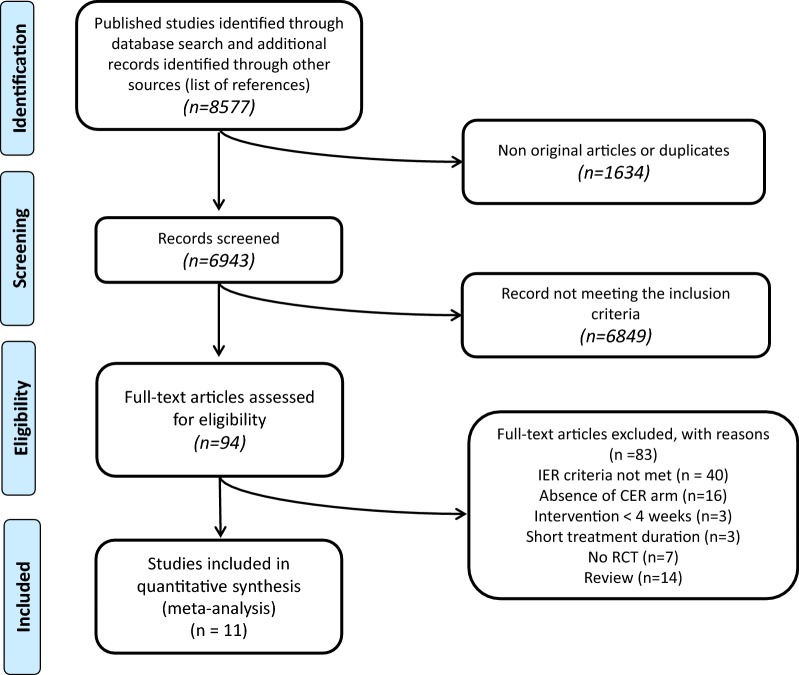
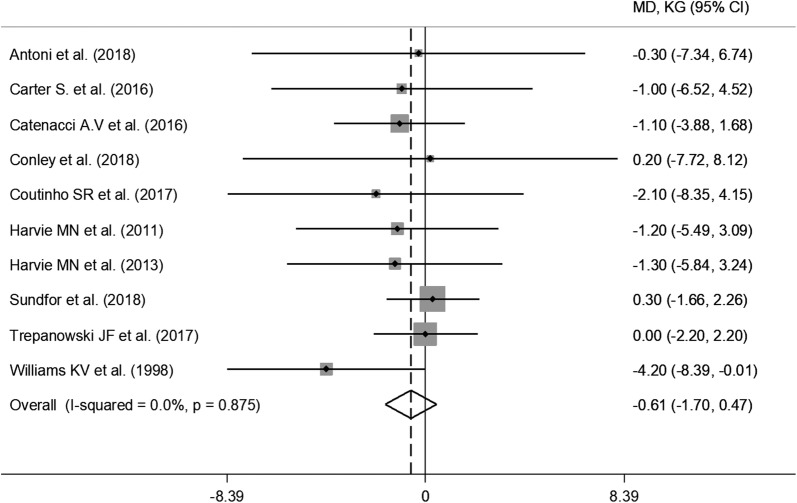
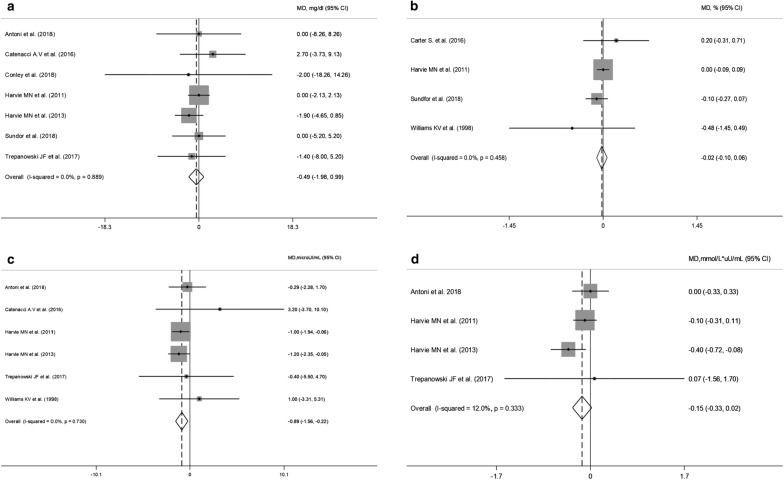
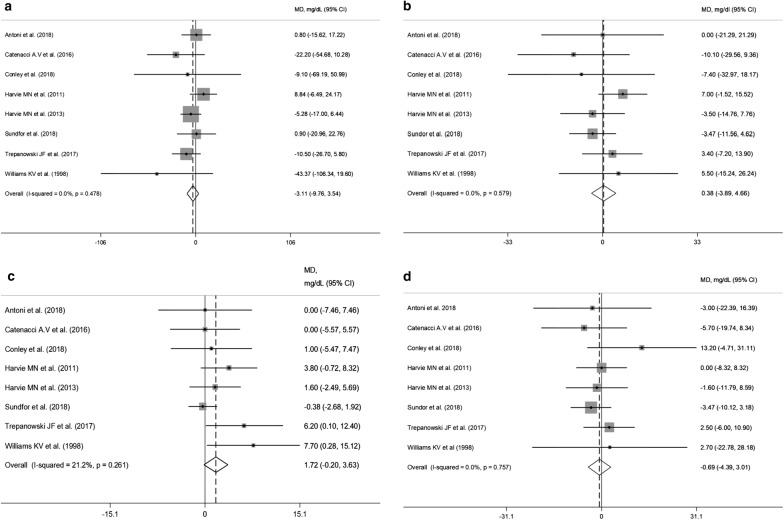
BACKGROUND: This systematic review and meta-analysis summarized the most recent evidence on the efficacy of intermittent energy restriction (IER) versus continuous energy restriction on weight-loss, body composition, blood pressure and other cardiometabolic risk factors. METHODS: Randomized controlled trials were systematically searched from MEDLINE, Cochrane Library, TRIP databases, EMBASE and CINAHL until May 2018. Effect sizes were expressed as weighted mean difference (WMD) and 95% confidence intervals (CI). RESULTS: Eleven trials were included (duration range 8-24 weeks). All selected intermittent regimens provided ≤ 25% of daily energy needs on "fast" days but differed for type of regimen (5:2 or other regimens) and/or dietary instructions given on the "feed" days (ad libitum energy versus balanced energy consumption). The intermittent approach determined a comparable weight-loss (WMD: - 0.61 kg; 95% CI - 1.70 to 0.47; p = 0.87) or percent weight loss (WMD: - 0.38%, - 1.16 to 0.40; p = 0.34) when compared to the continuous approach. A slight reduction in fasting insulin concentrations was evident with IER regimens (WMD = - 0.89 µU/mL; - 1.56 to - 0.22; p = 0.009), but the clinical relevance of this result is uncertain. No between-arms differences in the other variables were found. CONCLUSIONS: Both intermittent and continuous energy restriction achieved a comparable effect in promoting weight-loss and metabolic improvements. Long-term trials are needed to draw definitive conclusions.
Overview
The claims and statistics of this paper haven’t been checked yet.
Free: it reads the open-access text and checks the first 5 claims that cite a source we can check. Create a free account to check every claim.
Integrity signals
Registry
Cites
Statistics
Figures
Verification
Claims the paper makes
The claims and statistics of this paper haven’t been checked yet.
Free: it reads the open-access text and checks the first 5 claims that cite a source we can check. Create a free account to check every claim.
Claims other papers make about this one
Each is checked against this paper’s own text: does it say what the citing paper says it does?
The cited source says what the claim attributes to it.
In the citing paper
“consistent with two comprehensive systematic reviews [78, 79]”
From Comparing caloric restriction regimens for effective weight management in adults: a systematic review and network meta-analysis (2024) · cites this paper as [79]
The check wasn’t confident either way, so it gives no verdict — never disputed.
In the citing paper
“Overall, patients with higher baseline risks (e.g., diagnosed diabetes, hypertension, dyslipidemia) may derive the greater absolute benefit [79, 91, 92].”
From Comparing caloric restriction regimens for effective weight management in adults: a systematic review and network meta-analysis (2024) · cites this paper as [79]
Experimental — accuracy not yet measured
Self-check
Percentages, sums and reported differences re-computed from the paper’s own numbers.
The self-check needs the paper’s full text.
Citations
Cites
Preferred Reporting Items for Systematic Reviews and Meta-Analyses: the PRISMA statement
Moher, D., Liberati, A., Tetzlaff, J., Altman, D. G., & for the PRISMA Group (2009) · BMJ · doi:10.1136/bmj.b2535 · Cited by 83,823
Preferred Reporting Items for Systematic Reviews and Meta-Analyses: The PRISMA Statement
Moher, D., Liberati, A., Tetzlaff, J., Altman, D. G., & The PRISMA Group (2009) · PLoS Medicine · doi:10.1371/journal.pmed.1000097 · Cited by 64,042
Measuring inconsistency in meta-analyses
Higgins, J. P. T., Thompson, S. G., Deeks, J. J., & Altman, D. G. (2003) · BMJ · doi:10.1136/bmj.327.7414.557 · Cited by 63,139
Preferred reporting items for systematic reviews and meta-analyses: the PRISMA Statement.
(2009) · PubMed Central · Cited by 44,859
The Cochrane Collaboration's tool for assessing risk of bias in randomised trials
Higgins, J. P. T., Altman, D. G., Gotzsche, P. C., Juni, P., Moher, D., Oxman, A. D., Savovic, J., Schulz, K. F., Weeks, L., Sterne, J. A. C., et al. (2011) · BMJ · doi:10.1136/bmj.d5928 · Cited by 33,817
Dermyshi, E., Wang, Y., Yan, C., Hong, W., Qiu, G., Gong, X., & Zhang, T. (2017) · Neonatology · doi:10.1159/000454668 · Cited by 24,451
Wang, G., Ma, R., Qiao, G., Wada, K., Aizawa, Y., & Satoh, T. (2015) · Integrative Medicine International · doi:10.1159/000368408 · Cited by 18,657
Fasting: molecular mechanisms and clinical applications
Longo, V. D., & Mattson, M. P. (2014) · Cell Metabolism · doi:10.1016/j.cmet.2013.12.008 · Cited by 1,425
Harvie, M. N., Pegington, M., Mattson, M. P., Frystyk, J., Dillon, B., Evans, G., Cuzick, J., Jebb, S. A., Martin, B., Cutler, R. G., et al. (2011) · International Journal of Obesity · doi:10.1038/ijo.2010.171 · Cited by 804
Flipping the Metabolic Switch: Understanding and Applying the Health Benefits of Fasting
Anton, S. D., Moehl, K., Donahoo, W. T., Marosi, K., Lee, S. A., Mainous, A. G., Leeuwenburgh, C., & Mattson, M. P. (2018) · Obesity · doi:10.1002/oby.22065 · Cited by 756
Li, G., Xie, C., Lu, S., Nichols, R. G., Tian, Y., Li, L., Patel, D., Ma, Y., Brocker, C. N., Yan, T., et al. (2017) · Cell Metabolism · doi:10.1016/j.cmet.2017.08.019 · Cited by 667
Trepanowski, J. F., Kroeger, C. M., Barnosky, A., Klempel, M. C., Bhutani, S., Hoddy, K. K., Gabel, K., Freels, S., Rigdon, J., Rood, J., et al. (2017) · JAMA Internal Medicine · doi:10.1001/jamainternmed.2017.0936 · Cited by 645
Harvie, M., Wright, C., Pegington, M., McMullan, D., Mitchell, E., Martin, B., Cutler, R. G., Evans, G., Whiteside, S., Maudsley, S., et al. (2013) · British Journal Of Nutrition · doi:10.1017/s0007114513000792 · Cited by 431
Heilbronn, L. K., Smith, S. R., Martin, C. K., Anton, S. D., & Ravussin, E. (2005) · The American Journal of Clinical Nutrition · doi:10.1093/ajcn/81.1.69 · Cited by 393
INTERMITTENT FASTING AND HUMAN METABOLIC HEALTH
Patterson, R. E., Laughlin, G. A., LaCroix, A. Z., Hartman, S. J., Natarajan, L., Senger, C. M., Martínez, M. E., Villaseñor, A., Sears, D. D., Marinac, C. R., et al. (2015) · Journal of the Academy of Nutrition and Dietetics · doi:10.1016/j.jand.2015.02.018 · Cited by 390
Alternate-day fasting and chronic disease prevention: a review of human and animal trials
Varady, K. A., & Hellerstein, M. K. (2007) · The American Journal of Clinical Nutrition · doi:10.1093/ajcn/86.1.7 · Cited by 358
Catenacci, V. A., Pan, Z., Ostendorf, D., Brannon, S., Gozansky, W. S., Mattson, M. P., Martin, B., MacLean, P. S., Melanson, E. L., & Troy Donahoo, W. (2016) · Obesity · doi:10.1002/oby.21581 · Cited by 332
Harris, L., Hamilton, S., Azevedo, L. B., Olajide, J., De Brún, C., Waller, G., Whittaker, V., Sharp, T., Lean, M., Hankey, C., et al. (2018) · JBI Database of Systematic Reviews and Implementation Reports · doi:10.11124/jbisrir-2016-003248 · Cited by 319
Barnosky, A. R., Hoddy, K. K., Unterman, T. G., & Varady, K. A. (2014) · Translational Research · doi:10.1016/j.trsl.2014.05.013 · Cited by 296
Sundfør, T. M., Svendsen, M., & Tonstad, S. (2018) · Nutrition, Metabolism and Cardiovascular Diseases · doi:10.1016/j.numecd.2018.03.009 · Cited by 278
Intermittent versus daily calorie restriction: which diet regimen is more effective for weight loss?
Varady, K. A. (2011) · Obesity Reviews · doi:10.1111/j.1467-789x.2011.00873.x · Cited by 277
Time-restricted feeding and risk of metabolic disease: A review of human and animal studies
Rothschild, J., Hoddy, K. K., Jambazian, P., & Varady, K. A. (2014) · Nutrition Reviews · doi:10.1111/nure.12104 · Cited by 241
Health effects of intermittent fasting: hormesis or harm? A systematic review
Horne, B. D., Muhlestein, J. B., & Anderson, J. L. (2015) · The American Journal of Clinical Nutrition · doi:10.3945/ajcn.115.109553 · Cited by 239
Carter, S., Clifton, P. M., & Keogh, J. B. (2016) · Diabetes Research and Clinical Practice · doi:10.1016/j.diabres.2016.10.010 · Cited by 225
Health Benefits of Fasting and Caloric Restriction
Golbidi, S., Daiber, A., Korac, B., Li, H., Essop, M. F., & Laher, I. (2017) · Current Diabetes Reports · doi:10.1007/s11892-017-0951-7 · Cited by 217
Kim, K.-H., Kim, Y. H., Son, J. E., Lee, J. H., Kim, S., Choe, M. S., Moon, J. H., Zhong, J., Fu, K., Lenglin, F., et al. (2017) · Cell Research · doi:10.1038/cr.2017.126 · Cited by 216
Seimon, R. V., Roekenes, J. A., Zibellini, J., Zhu, B., Gibson, A. A., Hills, A. P., Wood, R. E., King, N. A., Byrne, N. M., & Sainsbury, A. (2015) · Molecular and Cellular Endocrinology · doi:10.1016/j.mce.2015.09.014 · Cited by 202
Concepts and Controversies in Evaluating Vitamin K Status in Population-Based Studies
Shea, M., & Booth, S. (2016) · Nutrients · doi:10.3390/nu8010008 · Cited by 197
Williams, K. V., Mullen, M. L., Kelley, D. E., & Wing, R. R. (1998) · Diabetes Care · doi:10.2337/diacare.21.1.2 · Cited by 194
Harvie, M., & Howell, A. (2017) · Behavioral Sciences · doi:10.3390/bs7010004 · Cited by 174 · cited 1×
“Indeed, some studies suggest that IER evokes the same adaptive response as CER [6, 37].”
BackgroundImpact of intermittent fasting on the lipid profile: Assessment associated with diet and weight loss
Santos, H. O., & Macedo, R. C. O. (2018) · Clinical Nutrition ESPEN · doi:10.1016/j.clnesp.2018.01.002 · Cited by 173
Fasting for weight loss: an effective strategy or latest dieting trend?
Johnstone, A. (2015) · International Journal of Obesity · doi:10.1038/ijo.2014.214 · Cited by 172
Horne, B. D., May, H. T., Anderson, J. L., Kfoury, A. G., Bailey, B. M., McClure, B. S., Renlund, D. G., Lappé, D. L., Carlquist, J. F., Fisher, P. W., et al. (2008) · The American Journal of Cardiology · doi:10.1016/j.amjcard.2008.05.021 · Cited by 143
Antoni, R., Johnston, K. L., Collins, A. L., & Robertson, M. D. (2018) · British Journal of Nutrition · doi:10.1017/s0007114517003890 · Cited by 122
Varady, K. A., Bhutani, S., Klempel, M. C., & Kroeger, C. M. (2011) · Lipids in Health and Disease · doi:10.1186/1476-511x-10-119 · Cited by 116
Headland, M., Clifton, P., Carter, S., & Keogh, J. (2016) · Nutrients · doi:10.3390/nu8060354 · Cited by 114
Intermittent energy restriction improves weight loss efficiency in obese men: the MATADOR study
Byrne, N. M., Sainsbury, A., King, N. A., Hills, A. P., & Wood, R. E. (2018) · International Journal of Obesity · doi:10.1038/ijo.2017.206 · Cited by 113
Compensatory mechanisms activated with intermittent energy restriction: A randomized control trial
Coutinho, S. R., Halset, E. H., Gåsbakk, S., Rehfeld, J. F., Kulseng, B., Truby, H., & Martins, C. (2018) · Clinical Nutrition · doi:10.1016/j.clnu.2017.04.002 · Cited by 108
Conley, M., Le Fevre, L., Haywood, C., & Proietto, J. (2018) · Nutrition & Dietetics · doi:10.1111/1747-0080.12372 · Cited by 104
Intermittent energy restriction and weight loss: a systematic review
Davis, C. S., Clarke, R. E., Coulter, S. N., Rounsefell, K. N., Walker, R. E., Rauch, C. E., Huggins, C. E., & Ryan, L. (2016) · European Journal of Clinical Nutrition · doi:10.1038/ejcn.2015.195 · Cited by 94
Metabolic impacts of altering meal frequency and timing - Does when we eat matter
Hutchison, A. T., & Heilbronn, L. K. (2016) · Biochimie · doi:10.1016/j.biochi.2015.07.025 · Cited by 91
Horne, B. D., Muhlestein, J. B., May, H. T., Carlquist, J. F., LAPPE, D. L., Bair, T. L., & Anderson, J. L. (2012) · The American Journal of Cardiology · doi:10.1016/j.amjcard.2012.01.379 · Cited by 78
Harris, L., McGarty, A., Hutchison, L., Ells, L., & Hankey, C. (2018) · Obesity Reviews · doi:10.1111/obr.12593 · Cited by 68
Obesity - an indication for GLP-1 treatment? Obesity pathophysiology and GLP-1 treatment potential
Torekov, S. S., Madsbad, S., & Holst, J. J. (2011) · Obesity Reviews · doi:10.1111/j.1467-789x.2011.00860.x · Cited by 65
Klempel, M. C., Kroeger, C. M., & Varady, K. A. (2013) · European Journal of Clinical Nutrition · doi:10.1038/ejcn.2013.83 · Cited by 62
Arguin, H., Dionne, I. J., Sénéchal, M., Bouchard, D. R., Carpentier, A. C., Ardilouze, J.-L., Tremblay, A., Leblanc, C., & Brochu, M. (2012) · Menopause · doi:10.1097/gme.0b013e318250a287 · Cited by 61
Intermittent versus on‐demand use of a very low calorie diet: a randomized 2‐year clinical trial
Lantz, H., Peltonen, M., Ågren, L., & Torgerson, J. S. (2003) · Journal of Internal Medicine · doi:10.1046/j.1365-2796.2003.01131.x · Cited by 54
Impact of intermittent fasting on glucose homeostasis
Varady, K. A. (2016) · Current Opinion in Clinical Nutrition & Metabolic Care · doi:10.1097/mco.0000000000000291 · Cited by 25
Is Periodic Fasting Really Good for Reducing Cardiovascular Risk and Improving Heart health?
Horne, B. D. (2011) · Future Cardiology · doi:10.2217/fca.11.50 · Cited by 2
Cited by
Jamshed, H., Beyl, R., Della Manna, D., Yang, E., Ravussin, E., & Peterson, C. (2019) · Nutrients · doi:10.3390/nu11061234 · Cited by 664
“While the benefits of some types of IF may stem mostly or entirely from energy restriction [8,9], one form of IF, called time-restricted feeding (TRF), has demonstrated benefits independent of energy restriction in both animals [10–17] and humans [18,19].”
BackgroundLowe, D. A., Wu, N., Rohdin-Bibby, L., Moore, A. H., Kelly, N., Liu, Y. E., Philip, E., Vittinghoff, E., Heymsfield, S. B., Olgin, J. E., et al. (2020) · JAMA Internal Medicine · doi:10.1001/jamainternmed.2020.4153 · Cited by 553
“Participants were excluded from participating if they (1) were older than 64 years (n = 5), (2) had a body mass index (calculated as weight in kilograms divided by height in meters squared) less than 27 (n = 348) or greater than 43 (n = 72), (3) did not regularly consume breakfast (n = 566), (4) were unwilling or unab…”
BackgroundClinical application of intermittent fasting for weight loss: progress and future directions
Varady, K. A., Cienfuegos, S., Ezpeleta, M., & Gabel, K. (2022) · Nature Reviews Endocrinology · doi:10.1038/s41574-022-00638-x · Cited by 357
Time-restricted eating for the prevention and management of metabolic diseases
Manoogian, E. N. C., Chow, L. S., Taub, P. R., Laferrère, B., & Panda, S. (2022) · Endocrine Reviews · doi:10.1210/endrev/bnab027 · Cited by 344
“A short duration trial demonstrated the efficacy of a drastic 6-hour TRE intervention; could a more manageable 8-hour, 10-hour, or even 12-hour TRE also be effective in improving metabolism? Does the restriction of the duration of the eating window need to be proportional to the duration of the baseline eating window?…”
BackgroundPatikorn, C., Roubal, K., Veettil, S. K., Chandran, V., Pham, T., Lee, Y. Y., Giovannucci, E. L., Varady, K. A., & Chaiyakunapruk, N. (2021) · JAMA Network Open · doi:10.1001/jamanetworkopen.2021.39558 · Cited by 298
Metadata
- Authors
- Cioffi, I., Evangelista, A., Ponzo, V., Ciccone, G., Soldati, L., Santarpia, L., Contaldo, F., Pasanisi, F., Ghigo, E., & Bo, S.
- Affiliations
- Federico II University Hospital (IT)
- Azienda Ospedaliera Citta' della Salute e della Scienza di Torino (IT)
- University of Turin (IT)
- University of Milan (IT)
- Corresponding author
- Bo, Simona
- ORCID
- Venue
- Journal of Translational Medicine
- Published
- 2018-12
- Volume
- 16
- Issue
- 1
- Pages
- 371-371
- ISSN
- 1479-5876 (ISSN-L)
- PMC
- PMC6304782
- OpenAlex
- W2906663197
- Cited by
- 190
- References
- 49
- Citations by year
- 2026: 15 · 2025: 19 · 2024: 40 · 2023: 22 · 2022: 31 · 2021: 30 · 2020: 27 · 2019: 5 · 2018: 1
- FWCI
- 2.07
- Type
- journal article
- Language
- en
- Open access
- gold
- doi.org
- Licence
- cc-by
- creativecommons.org/licenses/by/4.0/ (tdm)
- Locations
- Journal of Translational Medicine (publishedVersion, cc-by)
- Europe PMC (PubMed Central) (publishedVersion, cc-by)
- PubMed Central (publishedVersion, cc-by)
- PubMed (publishedVersion)
- Institutional Research Information System University of Turin (University of Turin) (submittedVersion, other-oa)
- Archivio Istituzionale della Ricerca (Universita Degli Studi Di Milano) (submittedVersion, other-oa)
- DOAJ (DOAJ: Directory of Open Access Journals) (submittedVersion, cc-by-sa)
- Topics
- Health Sciences › Medicine › Physiology (medical) › Dietary Effects on Health
- Health Sciences › Medicine › Physiology (medical) › Diet and metabolism studies
- Health Sciences › Medicine › Public Health, Environmental and Occupational Health › Nutritional Studies and Diet
- Keywords
- intermittent energy restriction, continuous energy restriction, weight loss, body composition, blood pressure, cardiometabolic risk factors, fasting insulin, 5:2 diet, ad libitum feeding
- MeSH terms
- Adult, Aged, Female, Heart, Humans, Male, Metabolism, Middle Aged, Biomarkers, Weight Loss, Randomized Controlled Trials as Topic, Publication Bias, Caloric Restriction
About these checks
Registry, retraction, Cites and statistics results are computed, not judged, with one exception: a printed reference that no index lists is read once by a model before it counts as a citation error. Claims are extracted by a model and kept only when their quote appears verbatim in the text; each cited source is then checked, with a model’s help, for whether it says what the claim relies on. Those verdicts can be wrong — read the claim’s quote and the cited source before relying on one.
Statistics and arithmetic are recomputed, not judged.
Confidence bands are shown only for fields calibrated on our annotated test set. None is calibrated yet, so no band is shown.
What counts as a claim ›How we measure confidence ›How we check this ›
Are you an author, or do you see a problem with this page? Request a review
Data sources
Bibliographic data: Semantic Scholar, OpenAlex, Crossref.
Contains information from the Semantic Scholar Academic Graph Datasets, made available under the ODC Attribution License (ODC-BY 1.0).
Semantic Scholar’s data is described in: Kinney, R., et al. (2023). The Semantic Scholar Open Data Platform. arXiv:2301.10140.
