

The DOI matches its Crossref record; 83 of the 84 references it cites were found in a registry or an index.
Adapting evidence-informed complex population health interventions for new contexts: a systematic review of guidance
Open accessAbstract
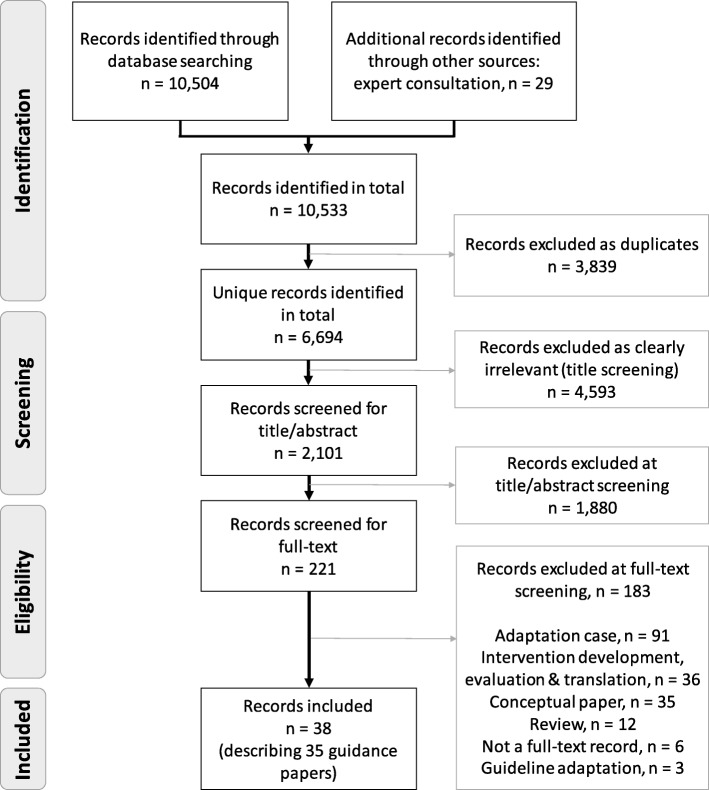
Background: Adapting interventions that have worked elsewhere can save resources associated with developing new interventions for each specific context. While a developing body of evidence shows benefits of adapted interventions compared with interventions transported without adaptation, there are also examples of interventions which have been extensively adapted, yet have not worked in the new context. Decisions on when, to what extent, and how to adapt interventions therefore are not straightforward, particularly when conceptualising intervention effects as contingent upon contextual interactions in complex systems. No guidance currently addresses these questions comprehensively. To inform development of an overarching guidance on adaptation of complex population health interventions, this systematic review synthesises the content of the existing guidance papers. Methods: We searched for papers published between January 2000 and October 2018 in 7 bibliographic databases. We used citation tracking and contacted authors and experts to locate further papers. We double screened all the identified records. We extracted data into the following categories: descriptive information, key concepts and definitions, rationale for adaptation, aspects of adaptation, process of adaptation, evaluating and reporting adapted interventions. Data extraction was conducted independently by two reviewers, and retrieved data were synthesised thematically within pre-specified and emergent categories. Results: We retrieved 6694 unique records. Thirty-eight papers were included in the review representing 35 sources of guidance. Most papers were developed in the USA in the context of implementing evidence-informed interventions among different population groups within the country, such as minority populations. We found much agreement on how the papers defined key concepts, aims, and procedures of adaptation, including involvement of key stakeholders, but also identified gaps in scope, conceptualisation, and operationalisation in several categories. Conclusions: Our review found limitations that should be addressed in future guidance on adaptation . Specifically, future guidance needs to be reflective of adaptations in the context of transferring interventions across countries, including macro- (e.g. national-) level interventions, better theorise the role of intervention mechanisms and contextual interactions in the replicability of effects and accordingly conceptualise key concepts, such as fidelity to intervention functions, and finally, suggest evidence-informed strategies for adaptation re-evaluation and reporting. Trial registration: PROSPERO 2018, CRD42018112714 .
Overview
The claims and statistics of this paper haven’t been checked yet.
Run the check — free, no account needed. It reads the open-access text and checks the sources it cites.
Integrity signals
Registry
Cites
Statistics
Figures
Verification
Claims the paper makes
The claims and statistics of this paper haven’t been checked yet.
Run the check — free, no account needed. It reads the open-access text and checks the sources it cites.
Claims other papers make about this one
Each is checked against this paper’s own text: does it say what the citing paper says it does?
The cited source says what the claim attributes to it.
In the citing paper
“Flawed programme adaptation efforts can also unintentionally undermine their ToC, reducing effectiveness (Movsisyan et al., 2019).”
From Promoting positive youth development with adolescent boys in UK schools: A theory-driven evaluation of the "Becoming a Man" programme (2026) · cites this paper as Movsisyan et al., 2019
The cited source says what the claim attributes to it.
In the citing paper
“A growing body of evidence suggests that effective application and uptake of an evidence-based intervention must be informed by the contextual needs of the intended new users of the intervention [18,19].”
From Promoting the mental health of university students in China: Protocol for contextual assessment to inform intervention design and adaptation (2021) · cites this paper as [18]
The cited source says what the claim attributes to it.
In the citing paper
“The use of mixed methods of quantitative and qualitative data collection and frequent dialogue enables the newly formed intervention team to identify the relevant needs for the users of the intervention, availability of resources and infrastructures, and acceptability of the intervention and implementation approaches [18].”
From Promoting the mental health of university students in China: Protocol for contextual assessment to inform intervention design and adaptation (2021) · cites this paper as [18]
Self-check
Percentages, sums and reported differences re-computed from the paper’s own numbers.
The self-check needs the paper’s full text.
Citations
Cites
Preferred Reporting Items for Systematic Reviews and Meta-Analyses: the PRISMA statement
Moher, D., Liberati, A., Tetzlaff, J., Altman, D. G., & for the PRISMA Group (2009) · BMJ · doi:10.1136/bmj.b2535 · Cited by 83,823
Preferred Reporting Items for Systematic Reviews and Meta-Analyses: The PRISMA Statement
Moher, D., Liberati, A., Tetzlaff, J., Altman, D. G., & The PRISMA Group (2009) · PLoS Medicine · doi:10.1371/journal.pmed.1000097 · Cited by 64,042
Qualitative Data Analysis: An Expanded Sourcebook
(1994) · Journal of Environmental Psychology · doi:10.1016/s0272-4944(05)80231-2 · Cited by 48,420
Preferred reporting items for systematic reviews and meta-analyses: the PRISMA Statement.
(2009) · PubMed Central · Cited by 44,859
Rogers, E. M., Singhal, A., & Quinlan, M. M. (2019) · Routledge eBooks · doi:10.4324/9780203710753-35 · Cited by 37,670
Rayyan-a web and mobile app for systematic reviews.
Ouzzani, M., Hammady, H., Fedorowicz, Z., & Elmagarmid, A. (2016) · Systematic Reviews · doi:10.1186/s13643-016-0384-4 · Cited by 26,092
Valente, T. W. (2003) · Genetics in Medicine · doi:10.1097/01.gim.0000061743.67794.c4 · Cited by 20,559
Wang, G., Ma, R., Qiao, G., Wada, K., Aizawa, Y., & Satoh, T. (2015) · Integrative Medicine International · doi:10.1159/000368408 · Cited by 18,762
Developing and evaluating complex interventions: the new Medical Research Council guidance
Craig, P., Dieppe, P., Macintyre, S., Michie, S., Nazareth, I., & Petticrew, M. (2008) · BMJ · doi:10.1136/bmj.a1655 · Cited by 10,995
The Coding Manual for Qualitative Researchers
Lungu, M. (2022) · American Journal of Qualitative Research · doi:10.29333/ajqr/12085 · Cited by 10,936
Hoffmann, T. C., Glasziou, P. P., Boutron, I., Milne, R., Perera, R., Moher, D., Altman, D. G., Barbour, V., Macdonald, H., Johnston, M., et al. (2014) · BMJ · doi:10.1136/bmj.g1687 · Cited by 10,548
Guidance on how to develop complex interventions to improve health and healthcare
O"Cathain, A., Croot, L., Duncan, E., Rousseau, N., Sworn, K., Turner, K. M., Yardley, L., & Hoddinott, P. (2019) · BMJ Open · doi:10.1136/bmjopen-2019-029954 · Cited by 1,591
Self-citationGuidance for Developers of Health Research Reporting Guidelines
Moher, D., Schulz, K. F., Simera, I., & Altman, D. G. (2010) · PLoS Medicine · doi:10.1371/journal.pmed.1000217 · Cited by 1,437
Davis, R., Campbell, R., Hildon, Z., Hobbs, L., & Michie, S. (2015) · Health Psychology Review · doi:10.1080/17437199.2014.941722 · Cited by 1,411
Wiltsey Stirman, S., Baumann, A. A., & Miller, C. J. (2019) · Implementation Science · doi:10.1186/s13012-019-0898-y · Cited by 1,329
Complex interventions: how “out of control” can a randomised controlled trial be?
Hawe, P., Shiell, A., & Riley, T. (2004) · BMJ · doi:10.1136/bmj.328.7455.1561 · Cited by 1,244
The Cultural Adaptation of Prevention Interventions: Resolving Tensions Between Fidelity and Fit
Castro, F. G., Barrera, M., & Martinez, C. R. (2004) · Prevention Science · doi:10.1023/b:prev.0000013980.12412.cd · Cited by 1,228
Systematic review of the Exploration, Preparation, Implementation, Sustainment (EPIS) framework
Moullin, J. C., Dickson, K. S., Stadnick, N. A., Rabin, B., & Aarons, G. A. (2019) · Implementation Science · doi:10.1186/s13012-018-0842-6 · Cited by 1,223
Theorising interventions as events in systems
Hawe, P., Shiell, A., & Riley, T. (2009) · American Journal of Community Psychology · doi:10.1007/s10464-009-9229-9 · Cited by 1,143
Evidence-Based Public Health: A Fundamental Concept for Public Health Practice
Brownson, R. C., Fielding, J. E., & Maylahn, C. (2009) · Annual Review of Public Health · doi:10.1146/annurev.publhealth.031308.100134 · Cited by 1,138
Pfadenhauer, L. M., Gerhardus, A., Mozygemba, K., Lysdahl, K. B., Booth, A., Hofmann, B., Wahlster, P., Polus, S., Burns, J., Brereton, L., et al. (2017) · Implementation Science · doi:10.1186/s13012-017-0552-5 · Cited by 1,016
Self-citationNilsen, P., & Bernhardsson, S. (2019) · BMC Health Services Research · doi:10.1186/s12913-019-4015-3 · Cited by 1,014
The dark side of coproduction: do the costs outweigh the benefits for health research?
Oliver, K., Kothari, A., & Mays, N. (2019) · Health Research Policy and Systems · doi:10.1186/s12961-019-0432-3 · Cited by 754
Stirman, S. W., Miller, C. J., Toder, K., & Calloway, A. (2013) · Implementation Science · doi:10.1186/1748-5908-8-65 · Cited by 691
Evidence-Based Policy: A Practical Guide to Doing It Better
Cartwright, N., & Hardie, J. (2012) · doi:10.1093/acprof:osobl/9780199841608.001.0001 · Cited by 672
The ADAPT-ITT Model: A Novel Method of Adapting Evidence-Based HIV Interventions
Wingood, G. M., & DiClemente, R. J. (2008) · JAIDS Journal of Acquired Immune Deficiency Syndromes · doi:10.1097/qai.0b013e3181605df1 · Cited by 664
Kilbourne, A. M., Neumann, M. S., Pincus, H. A., Bauer, M. S., & Stall, R. (2007) · Implementation Science · doi:10.1186/1748-5908-2-42 · Cited by 653
Lau, A. S. (2006) · Clinical Psychology: Science and Practice · doi:10.1111/j.1468-2850.2006.00042.x · Cited by 624
Applying Diffusion of Innovation Theory to Intervention Development
Dearing, J. W. (2009) · Research on Social Work Practice · doi:10.1177/1049731509335569 · Cited by 567
Evidence-based policy: a practical guide to doing it better
Cartwright, N. D., & Hardie, J. M. (2013) · Choice Reviews Online · doi:10.5860/choice.50-5831 · Cited by 535
Moore, G. F., Evans, R. E., Hawkins, J., Littlecott, H., Melendez-Torres, G. J., Bonell, C., & Murphy, S. (2019) · Evaluation · doi:10.1177/1356389018803219 · Cited by 471
Self-citationCulturally centered psychosocial interventions
Bernal, G., & Sáez‐Santiago, E. (2006) · Journal of Community Psychology · doi:10.1002/jcop.20096 · Cited by 463
Dynamic adaptation process to implement an evidence-based child maltreatment intervention
Aarons, G. A., Green, A. E., Palinkas, L. A., Self-Brown, S., Whitaker, D. J., Lutzker, J. R., Silovsky, J. F., Hecht, D. B., & Chaffin, M. J. (2012) · Implementation Science · doi:10.1186/1748-5908-7-32 · Cited by 449
Adapting Evidence–Based Behavioral Interventions for New Settings and Target Populations
McKleroy, V. S., Galbraith, J. S., Cummings, B., Jones, P., Harshbarger, C. L., Collins, C. B., Gelaude, D., Carey, J. W., & ADAPT Team (2006) · AIDS Education and Prevention · doi:10.1521/aeap.2006.18.supp.59 · Cited by 441
A Heuristic Framework for the Cultural Adaptation of Interventions.
Barrera, M., & Castro, F. G. (2006) · Clinical Psychology: Science and Practice · doi:10.1111/j.1468-2850.2006.00043.x · Cited by 425
“Scaling-out” evidence-based interventions to new populations or new health care delivery systems
Aarons, G. A., Sklar, M., Mustanski, B., Benbow, N., & Brown, C. H. (2017) · Implementation Science · doi:10.1186/s13012-017-0640-6 · Cited by 399
A systematic review of adaptations of evidence-based public health interventions globally
Escoffery, C., Lebow-Skelley, E., Haardoerfer, R., Boing, E., Udelson, H., Wood, R., Hartman, M., Fernandez, M. E., & Mullen, P. D. (2018) · Implementation Science · doi:10.1186/s13012-018-0815-9 · Cited by 386
Craig, P., Di Ruggiero, E., Frohlich, K. L., Mykhalovskiy, E., White, M., on behalf of the Canadian Institutes of Health Research (CIHR)–National Institute for Health Research (NIHR) Context Guidance Authors Group (listed alphabetically), Campbell, R., Cummins, S., Edwards, N., Hunt, K., et al. (2018) · doi:10.3310/cihr-nihr-01 · Cited by 370
Althabe, F., Belizán, J. M., McClure, E. M., Hemingway‐Foday, J., Berrueta, M. B., Mazzoni, A., Ciganda, A., Goudar, S. S., Kodkany, B. S., Mahantshetti, N. S., et al. (2014) · The Lancet · doi:10.1016/s0140-6736(14)61651-2 · Cited by 331
A scoping study of frameworks for adapting public health evidence-based interventions
Escoffery, C., Lebow-Skelley, E., Udelson, H., Böing, E. A., Wood, R., Fernandez, M. E., & Mullen, P. D. (2019) · Translational Behavioral Medicine · doi:10.1093/tbm/ibx067 · Cited by 307
Gardner, F. E. M., Montgomery, P., & Knerr, W. (2015) · Journal of Clinical Child & Adolescent Psychology · doi:10.1080/15374416.2015.1015134 · Cited by 292
The psychotherapy adaptation and modification framework: Application to Asian Americans.
Hwang, W.-C. (2006) · American Psychologist · doi:10.1037/0003-066x.61.7.702 · Cited by 291
Moore, G. F., & Evans, R. (2016) · SSM - Population Health · doi:10.1016/j.ssmph.2016.12.005 · Cited by 262
Self-citationPérez, D., Van der Stuyft, P., Zabala, M. D. C., Castro, M., & Lefèvre, P. (2015) · Implementation Science · doi:10.1186/s13012-016-0457-8 · Cited by 237
Cultural Adaptation Process for International Dissemination of the Strengthening Families Program
Kumpfer, K. L., Pinyuchon, M., de Melo, A. T., & Whiteside, H. O. (2008) · Evaluation & the Health Professions · doi:10.1177/0163278708315926 · Cited by 230
Petticrew, M. P., Knai, C., Thomas, J., Rehfuess, E. A., Noyes, J., Gerhardus, A., Grimshaw, J., Rutter, H., & McGill, E. (2019) · BMJ Global Health · doi:10.1136/bmjgh-2018-000899 · Cited by 212
Self-citationNetto, G., Bhopal, R., Lederle, N., Khatoon, J., & Jackson, A. (2010) · Health Promotion International · doi:10.1093/heapro/daq012 · Cited by 211
TIDieR-PHP: a reporting guideline for population health and policy interventions
Campbell, M., Katikireddi, S. V., Hoffmann, T., Armstrong, R., Waters, E. B., & Craig, P. (2018) · BMJ · doi:10.1136/bmj.k1079 · Cited by 211
Using Planned Adaptation to Implement Evidence‐Based Programs with New Populations
Lee, S. J., Altschul, I., & Mowbray, C. T. (2008) · American Journal of Community Psychology · doi:10.1007/s10464-008-9160-5 · Cited by 209
Sundell, K., Beelmann, A., Hasson, H., & von Thiele Schwarz, U. (2016) · Journal of Clinical Child & Adolescent Psychology · doi:10.1080/15374416.2015.1020540 · Cited by 179
Hwang, W.-C. (2009) · Professional Psychology: Research and Practice · doi:10.1037/a0016240 · Cited by 166
Nápoles, A. M., & Stewart, A. L. (2018) · BMC Health Services Research · doi:10.1186/s12913-018-3521-z · Cited by 163
Tailoring Evidence-Based Interventions for New Populations
Chen, E. K., Reid, M. C., Parker, S. J., & Pillemer, K. A. (2012) · Evaluation & the Health Professions · doi:10.1177/0163278712442536 · Cited by 126
How to Adapt Effective Programs for Use in New Contexts
Card, J. J., Solomon, J., & Cunningham, S. D. (2009) · Health Promotion Practice · doi:10.1177/1524839909348592 · Cited by 126
Leijten, P. H. O., Meléndez‐Torres, G. J., Knerr, W., & Gardner, F. E. M. (2016) · Journal of the American Academy of Child & Adolescent Psychiatry · doi:10.1016/j.jaac.2016.05.003 · Cited by 126
Rodríguez, M. M. D., & Wieling, E. A. (2005) · Sage eBooks · doi:10.4135/9781452231662.n18 · Cited by 122
Arthur, M. W., & Blitz, C. (2000) · Journal of Community Psychology · doi:10.1002/(sici)1520-6629(200005)28:3 · Cited by 118
Davidson, E. M., Liu, J., Raj, B., White, M. J., Johnson, M., Netto, G., Wabnitz, C., & Sheikh, A. (2013) · Milbank Quarterly · doi:10.1111/1468-0009.12034 · Cited by 116
Adapting Efficacious Interventions
Solomon, J., Card, J. J., & Malow, R. M. (2006) · Evaluation & the Health Professions · doi:10.1177/0163278706287344 · Cited by 116
Evans, R., Craig, P., Hoddinott, P., Littlecott, H., Moore, L., Murphy, S., O’Cathain, A., Pfadenhauer, L. M., Rehfuess, E. A., Segrott, J., et al. (2019) · Journal of Epidemiology & Community Health · doi:10.1136/jech-2018-210840 · Cited by 111
Self-citationKumpfer, K. L., Magalhães, C. C. Á., & Xie, J. C. (2016) · Prevention Science · doi:10.1007/s11121-016-0719-3 · Cited by 108
Synthesis: combining results systematically and appropriately
Thomas, J., Harden, A., & Newman, M. (2012) · Sage eBooks · Cited by 107
Cambon, L., Terral, P., & Alla, F. (2019) · BMC Public Health · doi:10.1186/s12889-019-6663-y · Cited by 105
Cultural adaptations to empirically supported treatments: A research agenda.
Cardemil, E. V. (2010) · Cited by 76
Adaptation and Fidelity: a Recipe Analogy for Achieving Both in Population Scale Implementation
Kemp, L. (2016) · Prevention Science · doi:10.1007/s11121-016-0642-7 · Cited by 73
Empowerment implementation: enhancing fidelity and adaptation in a psycho-educational intervention
Daele, T. V., Audenhove, C. V., Hermans, D., den Bergh, O. V., & den Broucke, S. V. (2012) · Health Promotion International · doi:10.1093/heapro/das070 · Cited by 72
Rhodes, S. D., Kelley, C. J., Simán, F. M., Cashman, R., Alonzo, J., McGuire, J. M., Wellendorf, T., Hinshaw, K., Allen, A. B., Downs, M., et al. (2012) · Women s Health Issues · doi:10.1016/j.whi.2012.02.002 · Cited by 70
Sundell, K., Ferrer‐Wreder, L., & Fräser, M. W. (2013) · Evaluation & the Health Professions · doi:10.1177/0163278712469813 · Cited by 67
Methods for Translating Evidence-Based Behavioral Interventions for Health-Disparity Communities
Nápoles, A. M., Santoyo‐Olsson, J., & Stewart, A. L. (2013) · Preventing Chronic Disease · doi:10.5888/pcd10.130133 · Cited by 65
PRISSMA Project, Wainberg, M. L., McKinnon, K. M., Mattos, P., Pinto, D., Mann, C. G., de Oliveira, C. S. D. S., de Oliveira, S. B., Remien, R. H., Elkington, K. S., et al. (2007) · AIDS and Behavior · doi:10.1007/s10461-006-9181-8 · Cited by 64
Goldstein, N. E. S., Kemp, K. A., Leff, S. S., & Lochman, J. E. (2012) · Clinical Psychology Science and Practice · doi:10.1111/cpsp.12011 · Cited by 61
Evaluation of a Swedish version of the Strengthening Families Programme
Skarstrand, E., Sundell, K., & Andreasson, S. (2014) · The European Journal of Public Health · doi:10.1093/eurpub/ckt146 · Cited by 61
Brand, S. L., Quinn, C., Pearson, M., Lennox, C., Owens, C. V., Kirkpatrick, T., Callaghan, L., Stirzaker, A., Michie, S., Maguire, M., et al. (2018) · Evaluation · doi:10.1177/1356389018802134 · Cited by 61
Kumpfer, K. L., Magalhães, C. C. Á., & Xie, J. C. (2012) · European Journal of Developmental Psychology · doi:10.1080/17405629.2011.639225 · Cited by 47
Burchett, H., Blanchard, L., Kneale, D., & Thomas, J. (2018) · Health Research Policy and Systems · doi:10.1186/s12961-018-0364-3 · Cited by 47
Hasson, H., Sundell, K., Beelmann, A., & Schwarz, U. V. T. (2014) · BMC Health Services Research · doi:10.1186/1472-6963-14-s2-o32 · Cited by 38
Wang‐Schweig, M., Kviz, F. J., Altfeld, S. J., Miller, A. M., & Miller, B. A. (2014) · Health Promotion Practice · doi:10.1177/1524839913518176 · Cited by 38
Movsisyan, A., Dennis, J. A., Rehfuess, E. A., Grant, S., & Montgomery, P. (2018) · Research Synthesis Methods · doi:10.1002/jrsm.1290 · Cited by 35
Self-citationA Framework for Translating an Evidence-Based Intervention from English to Spanish
Maríñez‐Lora, A. M., Boustani, M. M., del Busto, C. T., & Leone, C. (2015) · Hispanic Journal of Behavioral Sciences · doi:10.1177/0739986315612769 · Cited by 33
Implementing Evidence-Based Programs
Tomioka, M., & Braun, K. L. (2012) · Health Promotion Practice · doi:10.1177/1524839912469205 · Cited by 31
Rolleri, L. A., Fuller, T. R., Firpo‐Triplett, R., Lesesne, C. A., Moore, C., & Leeks, K. D. (2014) · American Journal of Sexuality Education · doi:10.1080/15546128.2014.900467 · Cited by 30
Yong, A. G., Lemyre, L., Farrell, S., & Young, M. Y. (2016) · Canadian Psychology/Psychologie canadienne · doi:10.1037/cap0000075 · Cited by 25
Pérez, D., der Stuyft, P. V., Zabala, M. D. C., Castro, M., & Lefèvre, P. (2015) · Implementation Science · doi:10.1186/s13012-016-0471-x · Cited by 18
Research works printed but not linked: 4
- Pawon R, Tilley N. Realist evaluation. London: Sage Publications Ltd; 1997.
- Bartholomew EL, Highfield L, Hartman MA, Mullen PD, Leerlooijer JN. Using intervention mapping to adapt evidence-based interventions. In: Bartholomew LKE, Markham CM, Ruiter RAC, Fernández ME, Kok Gund Parcel GS. (Hg.): Planning health promotion programs. An intervention mapping approach. p. 597–649. 4th ed. San Francisco: Jossey-Bass; 2016.
- Backer T. Finding the balance: program fidelity and adaptation in substance abuse prevention: a state-of-the-art review. Rockville: Center for Substance Abuse Prevention (CSAP). Substance Abuse and Mental Health Services Administration (SAMHSA); 2002.
- O’Cathain A, Croot L, Duncan E, Rousseau N, Sworn K, Turner KM, et al. Guidance on how to develop complex interventions to improve health and healthcare. BMJ Open. 2019;9(8):e029954. · DOI · Paper page
Cited by
Sorted by citations
Adapting interventions to new contexts—The ADAPT guidance
Moore, G., Campbell, M., Copeland, L., Craig, P., Movsisyan, A., Hoddinott, P., Littlecott, H., O’Cathain, A., Pfadenhauer, L., Rehfuess, E., et al. (2021) · BMJ · doi:10.1136/bmj.n1679 · Cited by 511
Self-citationPerera, C., Salamanca-Sanabria, A., Caballero-Bernal, J., Feldman, L., Hansen, M., Bird, M., Hansen, P., Dinesen, C., Wiedemann, N., & Vallières, F. (2020) · Conflict and Health · doi:10.1186/s13031-020-00290-0 · Cited by 158
Rabin, B. A., Cakici, J. A., Golden, C. A., Estabrooks, P. A., Glasgow, R. E., & Gaglio, B. (2022) · Implementation Science · doi:10.1186/s13012-022-01234-3 · Cited by 114
Cheng, Q., Xu, B., Ng, M. S. N., Duan, Y., & So, W. K. W. (2022) · International Journal of Nursing Studies · doi:10.1016/j.ijnurstu.2021.104162 · Cited by 83
Boyle, L. D., Husebo, B. S., & Vislapuu, M. (2022) · BMC Health Services Research · doi:10.1186/s12913-022-08968-2 · Cited by 104
Metadata
- Authors
- Movsisyan, A., Arnold, L., Evans, R., Hallingberg, B., Moore, G., O’Cathain, A., Pfadenhauer, L. M., Segrott, J., & Rehfuess, E.
- Affiliations
- Institut für Medizinische Informationsverarbeitung, Biometrie und Epidemiologie (DE)
- Centre for the Development and Evaluation of Complex Interventions for Public Health Improvement (GB)
- Cardiff Metropolitan University (GB)
- University of Sheffield (GB)
- Corresponding author
- Movsisyan, A.
- ORCID
- Venue
- Implementation Science
- Published
- 2019-12
- Volume
- 14
- Issue
- 1
- Pages
- 105-105
- ISSN
- 1748-5908 (ISSN-L)
- PMC
- PMC6918624
- OpenAlex
- W2995364571
- Cited by
- 331
- References
- 84
- Citations by year
- 2026: 41 · 2025: 45 · 2024: 68 · 2023: 35 · 2022: 46 · 2021: 72 · 2020: 22
- FWCI
- 6.55
- Type
- journal article
- Language
- en
- Open access
- gold
- doi.org
- Licence
- Locations
- Implementation Science (publishedVersion, cc-by)
- Europe PMC (PubMed Central) (publishedVersion, cc-by)
- PubMed Central (publishedVersion, cc-by)
- PubMed (publishedVersion)
- White Rose Research Online (University of Leeds, The University of Sheffield, University of York) (acceptedVersion)
- ORCA Online Research @Cardiff (Cardiff University) (acceptedVersion)
- DOAJ (DOAJ: Directory of Open Access Journals) (submittedVersion)
- Open access LMU (Ludwid Maxmilian's Universitat Munchen) (submittedVersion, cc-by)
- Cardiff Metropolitan Research Repository (Cardiff Metropolitan University) (submittedVersion, cc-by)
- Funders
- Medical Research Council (MR/R013357/1)
- Topics
- Health Sciences › Health Professions › General Health Professions › Health Policy Implementation Science
- Social Sciences › Public Administration › Evaluation and Performance Assessment
- Health Sciences › Medicine › Public Health, Environmental and Occupational Health › Clinical practice guidelines implementation
- Keywords
- intervention adaptation, evidence-informed interventions, adaptation guidance, contextual adaptation, intervention fidelity, intervention mechanisms, context-aware interaction, stakeholder engagement, minority groups
- MeSH terms
- Population Health, Delivery of Health Care, Health Plan Implementation, Health Promotion, Humans, Evidence-Based Medicine
About these checks
Registry, retraction, Cites and statistics results are computed, not judged, with one exception: a printed reference that no index lists is read once by a model before it counts as a citation error. Claims are extracted by a model and kept only when their quote appears verbatim in the text; each cited source is then checked, with a model’s help, for whether it says what the claim relies on. Those verdicts can be wrong — read the claim’s quote and the cited source before relying on one.
Statistics and arithmetic are recomputed, not judged.
Confidence bands are shown only for fields calibrated on our annotated test set. None is calibrated yet, so no band is shown.
What counts as a claim ›How we measure confidence ›How we check this ›
Are you an author, or do you see a problem with this page? Request a review
