

The DOI matches its Crossref record; 57 of the 57 references it cites were found in a registry or an index.
ABI3 and PLCG2 missense variants as risk factors for neurodegenerative diseases in Caucasians and African Americans
Open accessAbstract
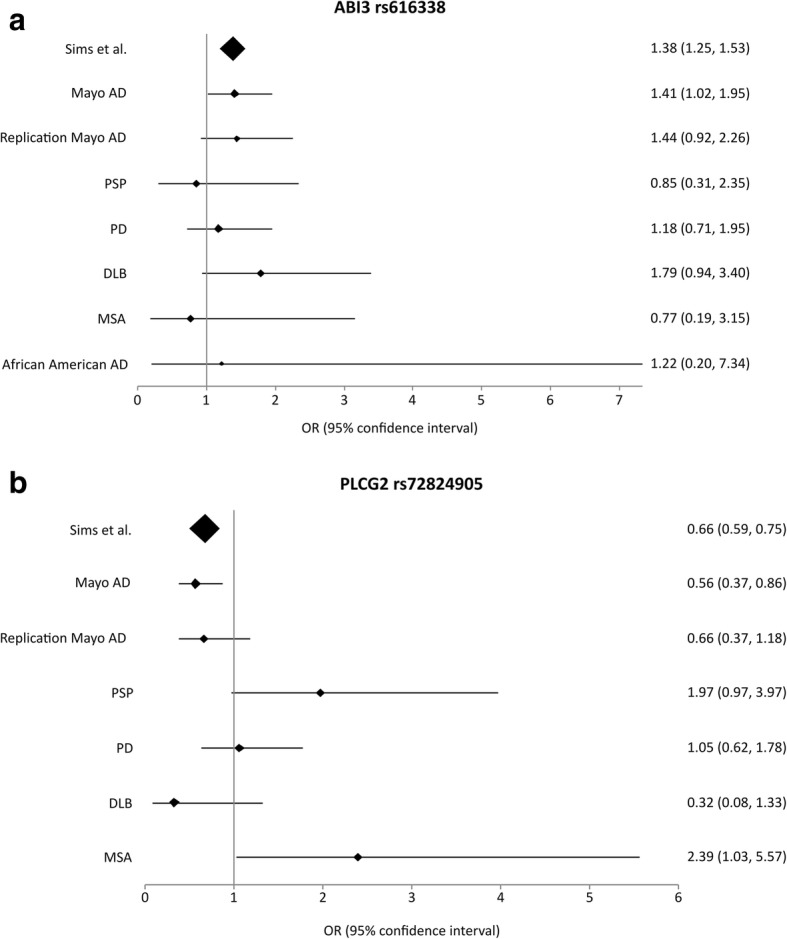
BACKGROUND: Rare coding variants ABI3_rs616338-T and PLCG2_rs72824905-G were identified as risk or protective factors, respectively, for Alzheimer's disease (AD). METHODS: We tested the association of these variants with five neurodegenerative diseases in Caucasian case-control cohorts: 2742 AD, 231 progressive supranuclear palsy (PSP), 838 Parkinson's disease (PD), 306 dementia with Lewy bodies (DLB) and 150 multiple system atrophy (MSA) vs. 3351 controls; and in an African-American AD case-control cohort (181 AD, 331 controls). 1479 AD and 1491 controls were non-overlapping with a prior report. RESULTS: Using Fisher's exact test, there was significant association of both ABI3_rs616338-T (OR = 1.41, p = 0.044) and PLCG2_rs72824905-G (OR = 0.56, p = 0.008) with AD. These OR estimates were maintained in the non-overlapping replication AD-control analysis, albeit at reduced significance (ABI3_rs616338-T OR = 1.44, p = 0.12; PLCG2_rs72824905-G OR = 0.66, p = 0.19). None of the other cohorts showed significant associations that were concordant with those for AD, although the DLB cohort had suggestive findings (Fisher's test: ABI3_rs616338-T OR = 1.79, p = 0.097; PLCG2_rs72824905-G OR = 0.32, p = 0.124). PLCG2_rs72824905-G showed suggestive association with pathologically-confirmed MSA (OR = 2.39, p = 0.050) and PSP (OR = 1.97, p = 0.061), although in the opposite direction of that for AD. We assessed RNA sequencing data from 238 temporal cortex (TCX) and 224 cerebellum (CER) samples from AD, PSP and control patients and identified co-expression networks, enriched in microglial genes and immune response GO terms, and which harbor PLCG2 and/or ABI3. These networks had higher expression in AD, but not in PSP TCX, compared to controls. This expression association did not survive adjustment for brain cell type population changes. CONCLUSIONS: We validated the associations previously reported with ABI3_rs616338-T and PLCG2_rs72824905-G in a Caucasian AD case-control cohort, and observed a similar direction of effect in DLB. Conversely, PLCG2_rs72824905-G showed suggestive associations with PSP and MSA in the opposite direction. We identified microglial gene-enriched co-expression networks with significantly higher levels in AD TCX, but not in PSP, a primary tauopathy. This co-expression network association appears to be driven by microglial cell population changes in a brain region affected by AD pathology. Although these findings require replication in larger cohorts, they suggest distinct effects of the microglial genes, ABI3 and PLCG2 in neurodegenerative diseases that harbor significant vs. low/no amyloid ß pathology.
Overview
The claims and statistics of this paper haven’t been checked yet.
Run the check — free, no account needed. It reads the open-access text and checks the sources it cites.
Integrity signals
Registry
Cites
Statistics
Figures
Verification
Claims the paper makes
The claims and statistics of this paper haven’t been checked yet.
Run the check — free, no account needed. It reads the open-access text and checks the sources it cites.
Claims other papers make about this one
Each is checked against this paper’s own text: does it say what the citing paper says it does?
The source backs part of the claim, not all of it — or backs it for a different population, condition or comparison.
In the citing paper
“Similar to newly identified other AD risk variants (e.g., TREM2, SPI1, and MS4A6A), ABI3 is highly expressed in microglia (8, 9, 11).”
From Deletion of Abi3 gene locus exacerbates neuropathological features of Alzheimer’s disease in a mouse model of Aβ amyloidosis (2021) · cites this paper as [9]
Experimental — accuracy not yet measuredThe source backs part of the claim, not all of it — or backs it for a different population, condition or comparison.
In the citing paper
“Subsequently, this association was replicated by independent groups (9, 10).”
From Deletion of Abi3 gene locus exacerbates neuropathological features of Alzheimer’s disease in a mouse model of Aβ amyloidosis (2021) · cites this paper as [9]
Experimental — accuracy not yet measuredThe source backs part of the claim, not all of it — or backs it for a different population, condition or comparison.
In the citing paper
“Consistent with its microglia specific gene expression pattern (8, 9, 11), we found that deletion of Abi3 locus altered the expression of genes regulating microglial phagocytosis and immune response.”
From Deletion of Abi3 gene locus exacerbates neuropathological features of Alzheimer’s disease in a mouse model of Aβ amyloidosis (2021) · cites this paper as [9]
Experimental — accuracy not yet measuredThe source backs part of the claim, not all of it — or backs it for a different population, condition or comparison.
In the citing paper
“The missense variant P522R in PLCG2 (rs72824905-G, P = 5.38 × 10⁻¹⁰, OR = 0.68) was shown to be protective, not only in the context of AD4,5, but also in other neurodegenerative diseases such as frontotemporal dementia and dementia with Lewy bodies6.”
From PLCγ2 regulates TREM2 signalling and integrin-mediated adhesion and migration of human iPSC-derived macrophages (2021) · cites this paper as [5]
Experimental — accuracy not yet measuredThe source backs part of the claim, not all of it — or backs it for a different population, condition or comparison.
In the citing paper
“The P522R variant in PLCG2 has been shown to confer protection for AD and to result in a subtle increase in enzymatic activity.”
From PLCγ2 regulates TREM2 signalling and integrin-mediated adhesion and migration of human iPSC-derived macrophages (2021) · cites this paper as [5]
Experimental — accuracy not yet measured
The source backs part of the claim, not all of it — or backs it for a different population, condition or comparison.
In the citing paper
“Genetic studies have identified a protective P522R variant in the PLCG2 gene (PLCG2-P522R; rs72824905 C > G), which decreases the risk of Alzheimer’s disease (AD) and increases longevity [1–4].”
From Protective PLCG2 variants associate with a delayed onset of Alzheimer’s disease among heterozygous APOE ε4 carriers (2026) · cites this paper as [2]
Experimental — accuracy not yet measuredThe source backs part of the claim, not all of it — or backs it for a different population, condition or comparison.
In the citing paper
“Human studies confirmed the relevance of the R522 variant with other dementias and associated it with increased longevity in centenarian cohorts (Bellenguez et al. 2022; Conway et al. 2018; van der Lee et al. 2019).”
From Alzheimer's Protection by PLCγ2 Compacts Plaques, Redistributes Microglia, and Protects Synapses in App NL ‐G‐F Mice (2026) · cites this paper as Conway et al. 2018
Experimental — accuracy not yet measuredThe source backs part of the claim, not all of it — or backs it for a different population, condition or comparison.
In the citing paper
“The initial genetic results were replicated by various independent cohorts (160, 161, 162).”
From The role of PLCγ2 in immunological disorders, cancer, and neurodegeneration (2021) · cites this paper as [160]
Experimental — accuracy not yet measuredThe source backs part of the claim, not all of it — or backs it for a different population, condition or comparison.
In the citing paper
“The S209F variant of Abelson Interactor Protein 3 (ABI3) increases risk for Alzheimer’s disease (AD)”
From Deletion of Abi3/Gngt2 influences age-progressive amyloid β and tau pathologies in distinctive ways (2022) · cites this paper as [7]
Experimental — accuracy not yet measuredThe source backs part of the claim, not all of it — or backs it for a different population, condition or comparison.
In the citing paper
“Recent reports have confirmed ABI3 as an AD risk gene [6–8].”
From Deletion of Abi3/Gngt2 influences age-progressive amyloid β and tau pathologies in distinctive ways (2022) · cites this paper as [7]
Experimental — accuracy not yet measuredThe cited source says what the claim attributes to it.
In the citing paper
“Results from RNA sequencing (RNA-seq) of human postmortem brain tissue further reinforce the importance of microglial and inflammatory mechanisms in AD pathogenesis, among other pathways (Allen et al., 2018; Conway et al., 2018; McKenzie et al., 2017; Patrick et al., 2017; Wang et al., 2016, 2019; Zhang et al., 2013).”
From Meta-Analysis of the Alzheimer’s Disease Human Brain Transcriptome and Functional Dissection in Mouse Models (2020) · cites this paper as Conway et al., 2018
The cited source says what the claim attributes to it.
In the citing paper
“This result suggests that many human brain gene expression changes associated with AD, including neuronal- and microglial-enriched modules reported in other studies (Conway et al., 2018; Mostafavi et al., 2018; Zhang et al., 2013), may represent common transcriptional programs activated by the aging process itself.”
From Meta-Analysis of the Alzheimer’s Disease Human Brain Transcriptome and Functional Dissection in Mouse Models (2020) · cites this paper as Conway et al., 2018
The cited source says what the claim attributes to it.
In the citing paper
“Human genetics studies of Alzheimer’s disease (AD) have identified the ABI3 gene as a candidate risk gene for AD.”
From The effect of Abi3 locus deletion on the progression of Alzheimer’s disease-related pathologies (2023) · cites this paper as [15]
The cited source says what the claim attributes to it.
In the citing paper
“For example, a rare coding missense variant in the ABI3 gene is associated with an increased risk of AD (8, 9).”
From Deletion of Abi3 gene locus exacerbates neuropathological features of Alzheimer’s disease in a mouse model of Aβ amyloidosis (2021) · cites this paper as [9]
The cited source says what the claim attributes to it.
In the citing paper
“Given our functional data shown in this study and its significant genetic association with AD (8–10), ABI3 and its downstream pathways may be promising therapeutic targets.”
From Deletion of Abi3 gene locus exacerbates neuropathological features of Alzheimer’s disease in a mouse model of Aβ amyloidosis (2021) · cites this paper as [9]
The cited source says what the claim attributes to it.
In the citing paper
“Although the ABI3 S209F variant is a recognized genetic risk for Alzheimer's disease (AD), its pathogenic mechanism remains elusive.”
From Aberrant phase separation from a rare ABI3 mutation drives microglial dysfunction and Alzheimer's risk (2026) · cites this paper as [16]
The cited source says what the claim attributes to it.
In the citing paper
“Human genetics studies of AD identified a coding variant of ABI3, p.Ser209Phe (rs616338), associated with late-onset AD158–161 (Table 2y).”
From The WAVE complex in developmental and adulthood brain disorders (2025) · cites this paper as [159]
The check wasn’t confident either way, so it gives no verdict — never disputed.
In the citing paper
“other rare PLCG2 variants, such as M28L (rs61749044) that confers a modest increased risk of AD (OR ≈ 1.16) [1, 4, 7–13]”
From PLCγ2 deficiency compromises systemic immune tolerance and erodes myelin homeostasis while enhancing oxidative metabolism in the mouse brain (2026) · cites this paper as [7]
Experimental — accuracy not yet measuredThe check wasn’t confident either way, so it gives no verdict — never disputed.
In the citing paper
“Human studies confirmed the relevance of the R522 variant with other dementias and associated it with increased longevity in centenarian cohorts (Bellenguez et al. 2022; Conway et al. 2018; van der Lee et al. 2019).”
From Alzheimer's Protection by PLCγ2 Compacts Plaques, Redistributes Microglia, and Protects Synapses in App NL ‐G‐F Mice (2026) · cites this paper as Conway et al. 2018
Experimental — accuracy not yet measured
Self-check
Percentages, sums and reported differences re-computed from the paper’s own numbers.
The self-check needs the paper’s full text.
Citations
Cites
PLINK: a tool set for whole-genome association and population-based linkage analyses.
Purcell, S., Neale, B., Todd-Brown, K., Thomas, L., Ferreira, M. A. R., Bender, D., Maller, J., Sklar, P., de Bakker, P. I. W., Daly, M. J., et al. (2007) · The American Journal of Human Genetics · doi:10.1086/519795 · Cited by 34,089
McKhann, G., Drachman, D., Folstein, M., Katzman, R., Price, D., & Stadlan, E. M. (1984) · Neurology · doi:10.1212/wnl.34.7.939 · Cited by 27,915
WGCNA: an R package for weighted correlation network analysis
Langfelder, P., & Horvath, S. (2008) · BMC Bioinformatics · doi:10.1186/1471-2105-9-559 · Cited by 27,252
Trapnell, C., Roberts, A., Goff, L. A., Pertea, G. M., Kim, D., Kelley, D. R., Pimentel, H., Salzberg, S. L., Rinn, J. L., & Pachter, L. S. (2012) · Nature Protocols · doi:10.1038/nprot.2012.016 · Cited by 12,145
Amyloid oligomers exacerbate tau pathology in a mouse model of tauopathy
Selenica, M.-L. B., Brownlow, M., Jimenez, J. P., Lee, D. C., Pena, G., Dickey, C. A., Gordon, M. N., & Morgan, D. (2013) · Neurodegenerative Diseases · doi:10.1159/000337230 · Cited by 10,359
Analysis of protein-coding genetic variation in 60,706 humans
Exome Aggregation Consortium, Lek, M., Karczewski, K. J., Minikel, E. V., Samocha, K. E., Banks, E., Fennell, T., O’Donnell-Luria, A. H., Ware, J. S., Hill, A. J., et al. (2016) · Nature · doi:10.1038/nature19057 · Cited by 9,587
Diagnosis and management of dementia with Lewy bodies: Fourth consensus report of the DLB Consortium
McKeith, I. G., Boeve, B. F., Dickson, D. W., Halliday, G., Taylor, J.-P., Weintraub, D., Aarsland, D., Galvin, J., Attems, J., Ballard, C. G., et al. (2017) · Neurology · doi:10.1212/wnl.0000000000004058 · Cited by 4,476
Self-citationMechanisms underlying inflammation in neurodegeneration
Glass, C. K., Saijo, K., Winner, B., Marchetto, M. C., & Gage, F. H. (2010) · Cell · doi:10.1016/j.cell.2010.02.016 · Cited by 3,580
The Subread aligner: fast, accurate and scalable read mapping by seed-and-vote
Liao, Y., Smyth, G. K., & Shi, W. (2013) · Nucleic Acids Research · doi:10.1093/nar/gkt214 · Cited by 3,064
TREM2 Variants in Alzheimer's Disease
Guerreiro, R., Wojtas, A., Bras, J., Carrasquillo, M., Rogaeva, E., Majounie, E., Cruchaga, C., Sassi, C., Kauwe, J. S. K., Younkin, S., et al. (2013) · New England Journal of Medicine · doi:10.1056/nejmoa1211851 · Cited by 3,020
Self-citationDiagnostic Criteria for Parkinson Disease
Gelb, D. J., Oliver, E., & Gilman, S. (1999) · Archives of Neurology · doi:10.1001/archneur.56.1.33 · Cited by 2,822
RSeQC: quality control of RNA-seq experiments
Wang, L., Wang, S., & Li, W. (2012) · Bioinformatics · doi:10.1093/bioinformatics/bts356 · Cited by 2,753
Variant of TREM2 Associated with the Risk of Alzheimer's Disease
Jonsson, T., Stefansson, H., Steinberg, S., Jonsdottir, I., Jonsson, P. V., Snaedal, J., Bjornsson, S., Huttenlocher, J., Levey, A. I., Lah, J. J., et al. (2013) · New England Journal of Medicine · doi:10.1056/nejmoa1211103 · Cited by 2,558
Zhang, Y., Sloan, S. A., Clarke, L. E., Caneda, C., Plaza, C. A., Blumenthal, P. D., Vogel, H., Steinberg, G. K., Edwards, M. S. B., Li, G., et al. (2016) · Neuron · doi:10.1016/j.neuron.2015.11.013 · Cited by 2,295
Microglia in Alzheimer’s disease
Hansen, D. V., Hanson, J. E., & Sheng, M. (2018) · Journal of Cell Biology · doi:10.1083/jcb.201709069 · Cited by 1,935 · cited 3×
“In the temporal cortex, ABI3 also belonged in the “immune/microglial” modules, which harbored many other AD candidate risk genes [10, 31] (Additional file 1: Table S4, Additional file 2: Figure S1).”
BackgroundMicroglial physiology: unique stimuli, specialized responses
Ransohoff, R. M., & Perry, V. H. (2009) · Annual Review of Immunology · doi:10.1146/annurev.immunol.021908.132528 · Cited by 1,858
Integrated Systems Approach Identifies Genetic Nodes and Networks in Late-Onset Alzheimer’s Disease
Zhang, B., Gaiteri, C., Bodea, L.-G., Wang, Z., McElwee, J., Podtelezhnikov, A. A., Zhang, C., Xie, T., Tran, L., Dobrin, R., et al. (2013) · Cell · doi:10.1016/j.cell.2013.03.030 · Cited by 1,657
Depletion of microglia and inhibition of exosome synthesis halt tau propagation
Asai, H., Ikezu, S., Tsunoda, S., Medalla, M., Luebke, J., Haydar, T., Wolozin, B., Butovsky, O., Kügler, S., & Ikezu, T. (2015) · Nature Neuroscience · doi:10.1038/nn.4132 · Cited by 1,591
ARUK Consortium, Sims, R., GERAD/PERADES, C., van der Lee, S. J., Naj, A. C., Bellenguez, C., Badarinarayan, N., Jakobsdottir, J., Kunkle, B. W., Boland, A., et al. (2017) · Nature Genetics · doi:10.1038/ng.3916 · Cited by 1,012
Self-citationInflammation in CNS neurodegenerative diseases
Stephenson, J., Nutma, E., van der Valk, P., & Amor, S. (2018) · Immunology · doi:10.1111/imm.12922 · Cited by 966
Hauw, J., Daniel, S. E., Dickson, D. W., Horoupian, D. S., Jellinger, K. A., Lantos, P. L., McKee, A. C., Tabaton, M., & Litvan, I. (1994) · Neurology · doi:10.1212/wnl.44.11.2015 · Cited by 854
Self-citationBarker, W., Luis, C. A., Kashuba, A., Luis, M., Harwood, D. G., Loewenstein, D., Waters, C., Jimison, P., Shepherd, E., Sevush, S., et al. (2002) · Alzheimer Disease & Associated Disorders · doi:10.1097/00002093-200210000-00001 · Cited by 714
Self-citationRemoving technical variability in RNA-seq data using conditional quantile normalization
Hansen, K. D., Irizarry, R. A., & WU, Z. (2012) · Biostatistics · doi:10.1093/biostatistics/kxr054 · Cited by 607
Walker, D. G., & Lue, L.-F. (2015) · Alzheimer's Research & Therapy · doi:10.1186/s13195-015-0139-9 · Cited by 562
Late onset Alzheimer’s disease genetics implicates microglial pathways in disease risk
Efthymiou, A. G., & Goate, A. M. (2017) · Molecular Neurodegeneration · doi:10.1186/s13024-017-0184-x · Cited by 562
Allen, M., Carrasquillo, M. M., Funk, C., Heavner, B. D., Zou, F., Younkin, C. S., Burgess, J. D., Chai, H.-S., Crook, J., Eddy, J. A., et al. (2016) · Scientific Data · doi:10.1038/sdata.2016.89 · Cited by 439
Self-citationCold Urticaria, Immunodeficiency, and Autoimmunity Related to PLCG2 Deletions
Ombrello, M. J., Remmers, E. F., Sun, G., Freeman, A. F., Datta, S., Torabi-Parizi, P., Subramanian, N., Bunney, T. D., Baxendale, R. W., Martins, M. S., et al. (2012) · New England Journal of Medicine · doi:10.1056/nejmoa1102140 · Cited by 425
MAP-RSeq: Mayo Analysis Pipeline for RNA sequencing
Kalari, K. R., Nair, A., Bhavsar, J., O’Brien, D. R., Davila, J. I., Bockol, M. A., Nie, J. J., Tang, X., Baheti, S., Doughty, J. B., et al. (2014) · BMC Bioinformatics · doi:10.1186/1471-2105-15-224 · Cited by 423
Lee, C. Y. D., Daggett, A., Gu, X., Jiang, L.-L., Langfelder, P., Li, X., Wang, N., Zhao, Y., Park, C. S., Cooper, Y., et al. (2018) · Neuron · doi:10.1016/j.neuron.2018.02.002 · Cited by 396
APOE ϵ4 Increases Risk for Dementia in Pure Synucleinopathies
Tsuang, D., Leverenz, J. B., Lopez, O. L., Hamilton, R. L., Bennett, D. A., Schneider, J. A., Buchman, A. S., Larson, E. B., Crane, P. K., Kaye, J. A., et al. (2013) · JAMA Neurology · doi:10.1001/jamaneurol.2013.600 · Cited by 378
Zhou, Q., Lee, G.-S., Brady, J., Datta, S., Katan, M., Sheikh, A., Martins, M. S., Bunney, T. D., Santich, B. H., Moir, S., et al. (2012) · The American Journal of Human Genetics · doi:10.1016/j.ajhg.2012.08.006 · Cited by 374
Elucidating the Role of TREM2 in Alzheimer’s Disease
Ulrich, J. D., Ulland, T. K., Colonna, M., & Holtzman, D. M. (2017) · Neuron · doi:10.1016/j.neuron.2017.02.042 · Cited by 325
Microglial genes regulating neuroinflammation in the progression of Alzheimer's disease
Villegas-Llerena, C., Phillips, A., Garcia-Reitboeck, P., Hardy, J., & Pocock, J. M. (2016) · Current Opinion in Neurobiology · doi:10.1016/j.conb.2015.10.004 · Cited by 270
Brain Expression Genome-Wide Association Study (eGWAS) Identifies Human Disease-Associated Variants
Zou, F., Chai, H. S., Younkin, C. S., Allen, M., Crook, J. E., Pankratz, V. S., Carrasquillo, M. M., Rowley, C. N., Nair, A., Middha, S., et al. (2012) · PLoS Genetics · doi:10.1371/journal.pgen.1002707 · Cited by 219
Self-citationMultiple System Atrophy: A Sporadic Synucleinopathy
Dickson, D. W., Lin, W.-L., Liu, W.-K., & Yen, S.-H. C. (1999) · Brain Pathology · doi:10.1111/j.1750-3639.1999.tb00553.x · Cited by 212
Self-citationIshizawa, K., & Dickson, D. W. (2001) · Journal of Neuropathology & Experimental Neurology · doi:10.1093/jnen/60.6.647 · Cited by 209
Self-citationYu, P., Constien, R., Dear, N., Katan, M., Hanke, P., Bunney, T. D., Kunder, S., Quintanilla-Martinez, L., Huffstadt, U., Schröder, A., et al. (2005) · Immunity · doi:10.1016/j.immuni.2005.01.018 · Cited by 177
Novel late-onset Alzheimer disease loci variants associate with brain gene expression
Allen, M., Zou, F., Chai, H. S., Younkin, C. S., Crook, J. E., Pankratz, V. S., Carrasquillo, M. M., Rowley, C. N., Nair, A., Middha, S., et al. (2012) · Neurology · doi:10.1212/wnl.0b013e3182605801 · Cited by 167
Self-citationTREM2 is associated with increased risk for Alzheimer’s disease in African Americans
Jin, S. C., Carrasquillo, M. M., Benitez, B. A., Skorupa, T., Carrell, D., Patel, D., Lincoln, S., Krishnan, S., Kachadoorian, M., Reitz, C., et al. (2015) · Molecular Neurodegeneration · doi:10.1186/s13024-015-0016-9 · Cited by 153
Self-citationConserved brain myelination networks are altered in Alzheimer’s and other neurodegenerative diseases
Allen, M., Wang, X., Burgess, J. D., Watzlawik, J., Serie, D. J., Younkin, C. S., Nguyen, T., Malphrus, K. G., Lincoln, S., Carrasquillo, M. M., et al. (2018) · Alzheimer's & Dementia · doi:10.1016/j.jalz.2017.09.012 · Cited by 143
Self-citationPhosphoregulation of the WAVE regulatory complex and signal integration
Mendoza, M. C. (2013) · Seminars in Cell & Developmental Biology · doi:10.1016/j.semcdb.2013.01.007 · Cited by 94
Neuroinflammation in Multiple System Atrophy: Response to and Cause of α-Synuclein Aggregation
Vieira, B. D. M., Radford, R. A., Chung, R. S., Guillemin, G. J., & Pountney, D. L. (2015) · Frontiers in Cellular Neuroscience · doi:10.3389/fncel.2015.00437 · Cited by 93 · cited 1×
“Neuroinflammation and microglial activation is observed in both PSP [51, 52] and MSA [53] in disease affected brain regions, although whether this is beneficial or detrimental to the disease progress remains to be established.”
BackgroundCytokine expression and microglial activation in progressive supranuclear palsy
Fernández-Botrán, R., Ahmed, Z., Crespo, F. A., Gatenbee, C., Gonzalez, J., Dickson, D. W., & Litvan, I. (2011) · Parkinsonism & Related Disorders · doi:10.1016/j.parkreldis.2011.06.007 · Cited by 93
Self-citationCommon Inflammatory Mechanisms in Lewy Body Disease and Alzheimer Disease
Mrak, R. E., & Griffin, W. S. T. (2007) · Journal of Neuropathology & Experimental Neurology · doi:10.1097/nen.0b013e31812503e1 · Cited by 86
PLAID: a Syndrome of Complex Patterns of Disease and Unique Phenotypes
Milner, J. D. (2015) · Journal of Clinical Immunology · doi:10.1007/s10875-015-0177-x · Cited by 85
DLB and PDD: a role for mutations in dementia and Parkinson disease genes?
Meeus, B., Verstraeten, A., Crosiers, D., Engelborghs, S., den Broeck, M. V., Mattheijssens, M., Peeters, K., Corsmit, E., Elinck, E., Pickut, B. A., et al. (2011) · Neurobiology of Aging · doi:10.1016/j.neurobiolaging.2011.10.014 · Cited by 81
Late-onset Alzheimer disease risk variants mark brain regulatory loci
Allen, M., Kachadoorian, M., Carrasquillo, M. M., Karhade, A., Manly, L., Burgess, J. D., Wang, C., Serie, D., Wang, X., Siuda, J., et al. (2015) · Neurology Genetics · doi:10.1212/nxg.0000000000000012 · Cited by 73
Self-citationNext-generation sequencing reveals substantial genetic contribution to dementia with Lewy bodies
Geiger, J. T., Ding, J., Crain, B. J., Pletniková, O., Letson, C., Dawson, T. M., Rosenthal, L. S., Pantelyat, A. Y., Gibbs, J. R., Albert, M., et al. (2016) · Neurobiology of Disease · doi:10.1016/j.nbd.2016.06.004 · Cited by 66
Characterization of Phospholipase Cγ Enzymes with Gain-of-Function Mutations
Everett, K. L., Bunney, T. D., Yoon, Y., Rodrigues-Lima, F., Harris, R., Driscoll, P. C., Abe, K., Fuchs, H., Hrabé de Angelis, M., Yu, P., et al. (2009) · Journal of Biological Chemistry · doi:10.1074/jbc.m109.019265 · Cited by 63
Carrasquillo, M. M., Allen, M., Burgess, J. D., Wang, X., Strickland, S. L., Aryal, S., Siuda, J., Kachadoorian, M. L., Medway, C., Younkin, C. S., et al. (2017) · Alzheimer's & Dementia · doi:10.1016/j.jalz.2016.10.005 · Cited by 58 · cited 1×
“TREM2, also associates with a protective effect in AD [46].”
BackgroundSelf-citationMicroglia express ABI3 in the brains of Alzheimer's disease and Nasu-Hakola disease
Satoh, J.-I., Kino, Y., Yanaizu, M., Tosaki, Y., Sakai, K., Ishida, T., & Saito, Y. (2017) · Intractable & Rare Diseases Research · doi:10.5582/irdr.2017.01073 · Cited by 55
The NESH/Abi-3-based WAVE2 complex is functionally distinct from the Abi-1-based WAVE2 complex
Sekino, S., Kashiwagi, Y., Kanazawa, H., Takada, K., Baba, T., Sato, S., Inoue, H., Kojima, M., & Tani, K. (2015) · Cell Communication and Signaling · doi:10.1186/s12964-015-0119-5 · Cited by 43
When less is more: primary immunodeficiency with an autoinflammatory kick
Giannelou, A., Zhou, Q., & Kastner, D. L. (2014) · Current Opinion in Allergy & Clinical Immunology · doi:10.1097/aci.0000000000000117 · Cited by 34
Phospholipase Cγ in Toll-like receptor-mediated inflammation and innate immunity
Bae, Y.-S., Lee, H. Y., Jung, Y. S., Lee, M., & Suh, P.-G. (2017) · Advances in Biological Regulation · doi:10.1016/j.jbior.2016.09.006 · Cited by 34
Membrane Environment Exerts an Important Influence on Rac-Mediated Activation of Phospholipase Cγ2
Everett, K. L., Buehler, A., Bunney, T. D., Margineanu, A., Baxendale, R. W., Vatter, P., Retlich, M., Walliser, C., Manning, H. B., Neil, M. A. A., et al. (2011) · Molecular and Cellular Biology · doi:10.1128/mcb.01408-10 · Cited by 25
TREM2 p.R47H substitution is not associated with dementia with Lewy bodies
Walton, R. L., Soto‐Ortolaza, A. I., Murray, M. E., Lorenzo‐Betancor, O., Ogaki, K., Heckman, M. G., Rayaprolu, S., Rademakers, R., Ertekin‐Taner, N., Uitti, R. J., et al. (2016) · Neurology Genetics · doi:10.1212/nxg.0000000000000085 · Cited by 21
Self-citationRespondek, G., Levin, J., & Höglinger, G. (2018) · Current Opinion in Neurology · doi:10.1097/wco.0000000000000581 · Cited by 15
Cited by
Sorted by citations
Deconstructing a Syndrome: Genomic Insights Into PCOS Causal Mechanisms and Classification
Dapas, M., & Dunaif, A. (2022) · Endocrine Reviews · doi:10.1210/endrev/bnac001 · Cited by 300
Wan, Y.-W., Al-Ouran, R., Mangleburg, C. G., Perumal, T. M., Lee, T. V., Allison, K., Swarup, V., Funk, C. C., Gaiteri, C., Allen, M., et al. (2020) · Cell Reports · doi:10.1016/j.celrep.2020.107908 · Cited by 295
“This result suggests that many human brain gene expression changes associated with AD, including neuronal- and microglial-enriched modules reported in other studies (Conway et al., 2018; Mostafavi et al., 2018; Zhang et al., 2013), may represent common transcriptional programs activated by the aging process itself.”
ResultSelf-citationAlzheimer’s Risk Factors Age, APOE Genotype, and Sex Drive Distinct Molecular Pathways
Zhao, N., Ren, Y., Yamazaki, Y., Qiao, W., Li, F., Felton, L. M., Mahmoudiandehkordi, S., Kueider-Paisley, A., Sonoustoun, B., Arnold, M., et al. (2020) · Neuron · doi:10.1016/j.neuron.2020.02.034 · Cited by 225
Self-citationDESGESCO (Dementia Genetics Spanish Consortium), E. (. D. E. D. B., van der Lee, S. J., biobank), E. (. D. E. D., IFGC (International FTD-Genomics Consortium), I. (. I. P. D. G. C., IPDGC (The International Parkinson Disease Genomics Consortium), Dementia), R.-F. (. A. M. F. I. F.-T., (NBB), N. B. B., The GIFT (Genetic Investigation in Frontotemporal Dementia and Alzheimer’s Disease) Study Group, Conway, O. J., Jansen, I., et al. (2019) · Acta Neuropathologica · doi:10.1007/s00401-019-02026-8 · Cited by 120
Self-citationThe role of PLCγ2 in immunological disorders, cancer, and neurodegeneration
Jackson, J. T., Mulazzani, E., Nutt, S. L., & Masters, S. L. (2021) · Journal of Biological Chemistry · doi:10.1016/j.jbc.2021.100905 · Cited by 113
Metadata
- Authors
- Conway, O. J., Carrasquillo, M. M., Wang, X., Bredenberg, J. M., Reddy, J. S., Strickland, S. L., Younkin, C. S., Burgess, J. D., Allen, M., Lincoln, S. J., Nguyen, T., Malphrus, K. G., Soto, A. I., Walton, R. L., Boeve, B. F., Petersen, R. C., Lucas, J. A., Ferman, T. J., Cheshire, W. P., van Gerpen, J. A., Uitti, R. J., Wszolek, Z. K., Ross, O. A., Dickson, D. W., Graff-Radford, N. R., & Ertekin-Taner, N.
- Affiliations
- Mayo Clinic in Florida (US)
- Mayo Clinic (US)
- ORCID
- Venue
- Molecular Neurodegeneration
- Published
- 2018-10-11
- Volume
- 13
- Issue
- 1
- Pages
- 53-53
- ISSN
- 1750-1326 (ISSN-L)
- PMC
- PMC6190665
- OpenAlex
- W2896393831
- Cited by
- 112
- References
- 57
- Citations by year
- 2026: 8 · 2025: 8 · 2024: 13 · 2023: 12 · 2022: 28 · 2021: 17 · 2020: 20 · 2019: 4 · 2018: 2
- FWCI
- 7.39
- Type
- journal article
- Language
- en
- Open access
- gold
- doi.org
- Locations
- Molecular Neurodegeneration (publishedVersion, cc-by)
- Europe PMC (PubMed Central) (publishedVersion, cc-by)
- PubMed Central (publishedVersion, cc-by)
- PubMed (publishedVersion)
- DOAJ (DOAJ: Directory of Open Access Journals) (submittedVersion, cc-by-sa)
- Funders
- National Institute on Aging (RF AG051504, U01 AG046139)
- National Institute of Neurological Disorders and Stroke (R01 NS080820, R01 NS078086)
- Topics
- Life Sciences › Neuroscience › Cellular and Molecular Neuroscience › Alzheimer's disease research and treatments
- Health Sciences › Medicine › Psychiatry and Mental health › Dementia and Cognitive Impairment Research
- Life Sciences › Neuroscience › Neurology › Neuroinflammation and Neurodegeneration Mechanisms
- Keywords
- PLCγ2, missense mutations, Alzheimer's disease, neurodegenerative diseases, progressive supranuclear palsy, Parkinson's disease, dementia with Lewy bodies, multiple system atrophy, genetic risk factors, African Americans, temporal cortex, cerebellum, co-expression network, gene regulatory networks, transcription factor binding sites, protein-protein interaction network
- MeSH terms
- Aged, Aged, 80 and over, Black or African American, Brain, Female, Humans, Male, Risk Factors, Microglia, Neurodegenerative Diseases, Mutation, Missense, White People, Adaptor Proteins, Signal Transducing, Phospholipase C gamma
About these checks
Registry, retraction, Cites and statistics results are computed, not judged, with one exception: a printed reference that no index lists is read once by a model before it counts as a citation error. Claims are extracted by a model and kept only when their quote appears verbatim in the text; each cited source is then checked, with a model’s help, for whether it says what the claim relies on. Those verdicts can be wrong — read the claim’s quote and the cited source before relying on one.
Statistics and arithmetic are recomputed, not judged.
Confidence bands are shown only for fields calibrated on our annotated test set. None is calibrated yet, so no band is shown.
What counts as a claim ›How we measure confidence ›How we check this ›
Are you an author, or do you see a problem with this page? Request a review
