

The DOI matches its Crossref record; 97 of the 97 references it cites were found in a registry or an index; 1 of the 85 sources its claims cite were checked for support.
Systematic review and meta-analysis of the effects of exercise on depression in adolescents
Open accessAbstract
Background: Depression is widespread among adolescents and seriously endangers their quality of life and academic performance. Developing strategies for adolescent depression has important public health implications. No systematic review on the effectiveness of physical exercise for adolescents aged 12–18 years with depression or depressive symptoms has previously been conducted. This study aims to systematically evaluate the effect of physical exercise on adolescent depression in the hope of developing optimum physical exercise programs. Methods: Nine major databases at home and abroad were searched to retrieve randomized controlled trials (RCTs) on exercise interventions among adolescents with depression or depressive symptoms. The retrieval period started from the founding date of each database to May 1, 2021. The methodological quality of the included articles was evaluated using the modified PEDro scale. A meta-analysis, subgroup analysis, sensitivity analysis, and publication bias tests were then conducted. Results: Fifteen articles, involving 19 comparisons, with a sample size of 1331, were included. Physical exercise significantly reduced adolescent depression (standardized mean difference [SMD] = − 0.64, 95% CI − 0.89, − 0.39, p < 0.01), with a moderate effect size, in both adolescents with depression (SMD = -0.57, 95% CI − 0.90, − 0.23, p < 0.01) and adolescents with depressive symptoms (SMD = − 0.67, 95% CI − 1.00, − 0.33, p < 0.01). In subgroups of different depression categories (depression or depressive symptoms), aerobic exercise was the main form of exercise for the treatment of adolescents with depression. For adolescents with depression, interventions lasting 6 weeks, 30 min/time, and 4 times/week had optimum results. The effects of aerobic exercise and resistance + aerobic exercise in the subgroup of adolescents with depressive symptoms were significant, while the effect of physical and mental exercise (yoga) was not significant. For adolescents with depressive symptoms, aerobic exercise lasting 8 weeks, 75–120 min/time, and 3 times/week had optimum results. Physical exercise with moderate intensity is a better choice for adolescents with depression and depressive symptoms. Conclusions: Physical exercise has a positive effect on the improvement of depression in adolescents. The protocol for this study was registered with INPLASY (202170013). DOI number is 10.37766/inplasy2021.7.0013. Registration Date:2021.7.06.
Overview
AI snapshot
Written from the paper’s full text.
TL;DR
This systematic review and meta-analysis found that physical exercise significantly reduces depression in adolescents, with a moderate overall effect. Aerobic exercise was the main effective modality, and the paper suggests specific program durations, session lengths, and frequencies for adolescents with depression versus depressive symptoms.
Key findings
- Across 15 articles, 19 comparisons, and 1331 participants, exercise significantly reduced adolescent depression: SMD = −0.64, 95% CI −0.89 to −0.39, p < 0.01, a moderate effect size.
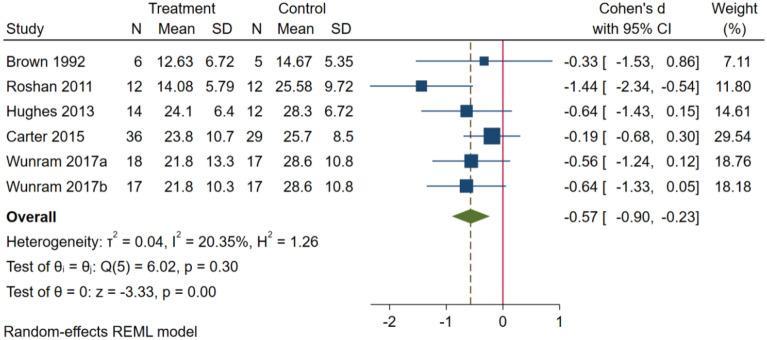
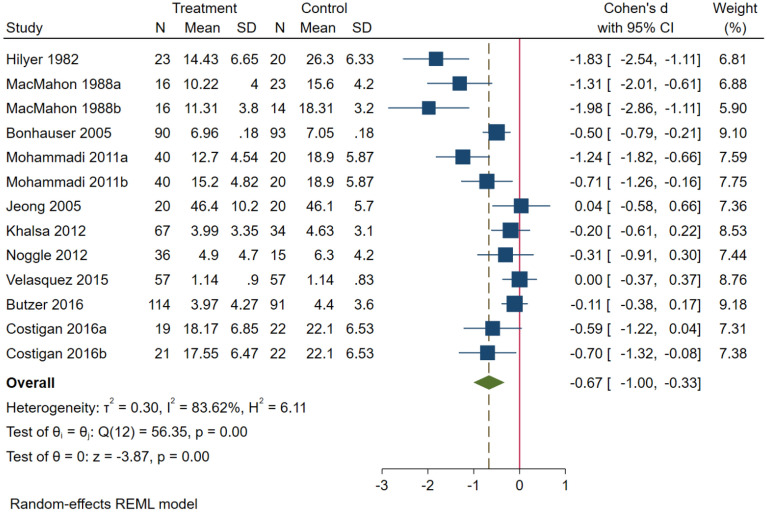
- Effects were significant in both adolescents with depression (SMD = −0.57, 95% CI −0.90 to −0.23, p < 0.01) and adolescents with depressive symptoms (SMD = −0.67, 95% CI −1.00 to −0.33, p < 0.01, as reported in the abstract).
- For adolescents with depression, the suggested optimal program was 6 weeks, 30 min/time, 4 times/week, with aerobic exercise; for adolescents with depressive symptoms, it was 8 weeks, 75–120 min/time, 3 times/week, with aerobic exercise.
- Aerobic exercise and resistance + aerobic exercise were significant for depressive symptoms, while yoga was not significant (SMD = −0.12, 95% CI −0.30 to 0.07, p = 0.22). Moderate intensity was reported as a better choice.
Methods
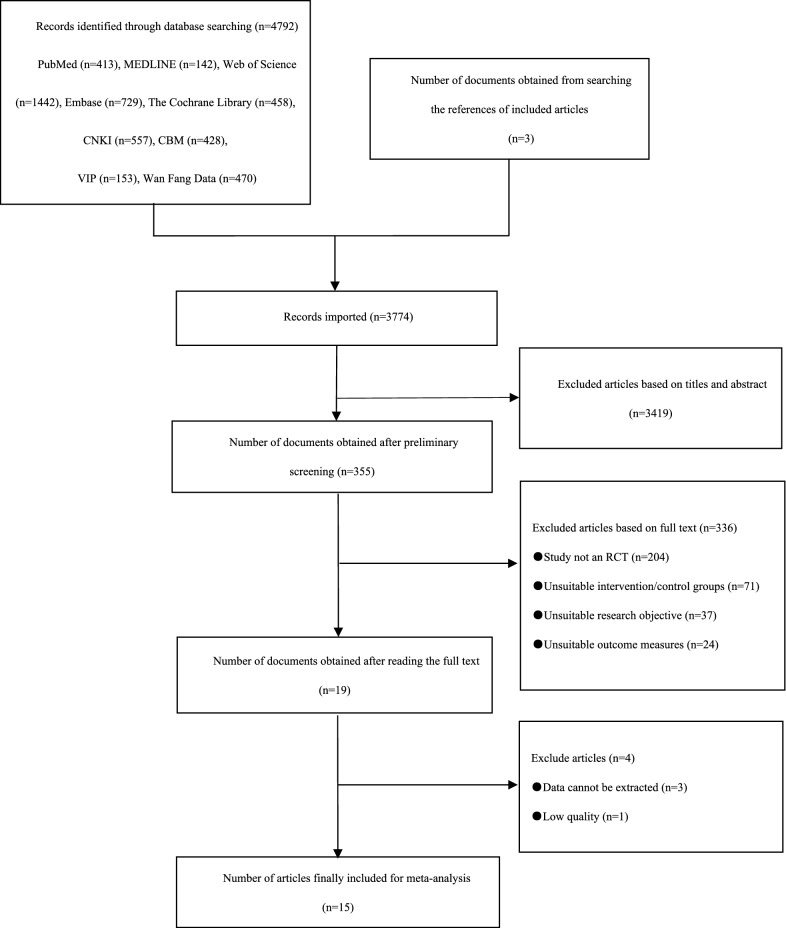
- Systematic review and meta-analysis following PRISMA 2020; nine databases were searched from inception to May 1, 2021, for RCTs of exercise interventions in adolescents aged 12–18 with depression or depressive symptoms.
- Fifteen articles involving 19 comparisons and 1331 participants were included; methodological quality was assessed with a modified PEDro scale, with scores of 5–8 (mean 6; 4 medium-quality and 11 high-quality articles).
- Analyses in Stata 16.0 used standardized mean difference (SMD), heterogeneity testing with I² and Cochran’s Q, subgroup analysis, sensitivity analysis, Egger’s test, and trim-and-fill.
Limitations
- The paper states that only published Chinese and English articles were included; only two included articles fully described allocation concealment and only one mentioned blinded outcome assessment; all outcomes were subjective self-reports without objective biomarkers; heterogeneity was high among depressive-symptom studies; exercise intensity lacked uniform standards and controls; participants’ physical activity level was not included; and optimal programs were based on current evidence, requiring more RCTs.
- Evident from the text: several subgroup analyses relied on very few comparisons (e.g., resistance + aerobic exercise n = 2; depression intensity subgroups n = 1 each), limiting precision.
- Evident from the text: publication bias was indicated in the depressive-symptom group (Egger’s test t = −3.12, p = 0.01), although trim-and-fill suggested the effect estimate did not change substantially.
Model-written summary. Check it against the paper before relying on it.
Integrity signals
Registry
Cites
Statistics
Figures
Verification
Claims the paper makes
69 Not checked yet · 30 Own result · 17 Own method · 17 Own interpretation · 2 No basis given · 1 Couldn’t confirm · accuracy not yet measured
A result the paper reports from its own data — it cites no other source for it, so there is none to check. The quote shows it is in the paper.
In the paper
“Moderate and high intensity exercise had a significant effect on depressive symptoms among adolescents with moderate intensity interventions producing the greater benefit.”
§ Systematic review and meta-analysis of the effects of exercise on depression in adolescents > Results > Subgroup analysis
plaindirect- Asserted: passes — The authors put it forward as true.
- Checkable: passes — It can be checked against evidence.
- Load-bearing: passes — The paper’s conclusions depend on it.
- Based: passes — The paper gives a reason why it holds.
A result the paper reports from its own data — it cites no other source for it, so there is none to check. The quote shows it is in the paper.
In the paper
“Regarding exercise type, the effect of aerobic exercise among adolescents with depression was significant.”
§ Systematic review and meta-analysis of the effects of exercise on depression in adolescents > Results > Subgroup analysis
plaindirect- Asserted: passes — The authors put it forward as true.
- Checkable: passes — It can be checked against evidence.
- Load-bearing: passes — The paper’s conclusions depend on it.
- Based: passes — The paper gives a reason why it holds.
A result the paper reports from its own data — it cites no other source for it, so there is none to check. The quote shows it is in the paper.
In the paper
“There were no adverse events among the included studies.”
§ Systematic review and meta-analysis of the effects of exercise on depression in adolescents > Results > Characteristics of included literature
plain- Asserted: passes — The authors put it forward as true.
- Checkable: passes — It can be checked against evidence.
- Load-bearing: unclear — It is unclear whether the paper’s conclusions depend on it.
- Based: passes — The paper gives a reason why it holds.
A result the paper reports from its own data — it cites no other source for it, so there is none to check. The quote shows it is in the paper.
In the paper
“Fifteen articles, involving 19 comparisons, with a sample size of 1331, were included.”
§ Systematic review and meta-analysis of the effects of exercise on depression in adolescents > Abstract > Results
plain- Asserted: passes — The authors put it forward as true.
- Checkable: passes — It can be checked against evidence.
- Load-bearing: unclear — It is unclear whether the paper’s conclusions depend on it.
- Based: passes — The paper gives a reason why it holds.
A result the paper reports from its own data — it cites no other source for it, so there is none to check. The quote shows it is in the paper.
In the paper
“The effects of aerobic exercise and resistance + aerobic exercise among adolescents with depressive symptoms were also significant”
§ Systematic review and meta-analysis of the effects of exercise on depression in adolescents > Results > Subgroup analysis
plaindirect- Asserted: passes — The authors put it forward as true.
- Checkable: passes — It can be checked against evidence.
- Load-bearing: passes — The paper’s conclusions depend on it.
- Based: passes — The paper gives a reason why it holds.
A result the paper reports from its own data — it cites no other source for it, so there is none to check. The quote shows it is in the paper.
In the paper
“while the effect of yoga was not significant.”
§ Systematic review and meta-analysis of the effects of exercise on depression in adolescents > Results > Subgroup analysis
plain- Asserted: passes — The authors put it forward as true.
- Checkable: passes — It can be checked against evidence.
- Load-bearing: unclear — It is unclear whether the paper’s conclusions depend on it.
- Based: passes — The paper gives a reason why it holds.
A result the paper reports from its own data — it cites no other source for it, so there is none to check. The quote shows it is in the paper.
In the paper
“adolescents with depressive symptoms I2 = 83.62%, combined effect size SMD = − 0.67, 95% CI (− 0.90, − 0.23), P < 0.01, there is a high degree of heterogeneity.”
§ Systematic review and meta-analysis of the effects of exercise on depression in adolescents > Results > Meta-analysis of the impact of exercise on depression in adolescents
plaindirect- Asserted: passes — The authors put it forward as true.
- Checkable: passes — It can be checked against evidence.
- Load-bearing: passes — The paper’s conclusions depend on it.
- Based: passes — The paper gives a reason why it holds.
- Rests on an assumption: There were no significant differences in the outcome variables between the groups in each comparison at baseline.
A result the paper reports from its own data — it cites no other source for it, so there is none to check. The quote shows it is in the paper.
In the paper
“in both adolescents with depression (SMD = -0.57, 95% CI − 0.90, − 0.23, p < 0.01)”
- Also stated in: § Meta-analysis of the impact of exercise on depression in adolescents · plain
“adolescents with depression I2 = 20.35%, combined effect size SMD = -0.57, 95% CI (− 0.90, − 0.23, P < 0.01), there is low heterogeneity.”
§ Systematic review and meta-analysis of the effects of exercise on depression in adolescents > Abstract > Results
plaindirect- Asserted: passes — The authors put it forward as true.
- Checkable: passes — It can be checked against evidence.
- Load-bearing: passes — The paper’s conclusions depend on it.
- Based: passes — The paper gives a reason why it holds.
- Rests on an assumption: There were no significant differences in the outcome variables between the groups in each comparison at baseline.
- Also stated in: § Meta-analysis of the impact of exercise on depression in adolescents · plain
A result the paper reports from its own data — it cites no other source for it, so there is none to check. The quote shows it is in the paper.
In the paper
“In addition, our meta-analysis found that yoga did not significantly impact depression in adolescents.”
§ Systematic review and meta-analysis of the effects of exercise on depression in adolescents > Discussion
plain- Asserted: passes — The authors put it forward as true.
- Checkable: passes — It can be checked against evidence.
- Load-bearing: passes — The paper’s conclusions depend on it.
- Based: passes — The paper gives a reason why it holds.
- It may state two separate claims as one. 47
- Probably not a substantial claim. 36
The cited sources that could be checked couldn’t confirm or dispute this claim.
In the paper
“Second, Costigan et al. found that resistance + aerobic exercise slightly improved subjective well-being among adolescents, but not depressive symptoms [40].”
§ Systematic review and meta-analysis of the effects of exercise on depression in adolescents > Discussion
What the sources say
- Could not verifycites [40] Butzer B, LoRusso A, Shin SH, Khalsa SBS. Evaluation of yoga for preventing adolescent substance use risk factors in a middle school setting: a preliminary group-randomized controlled trial. J Youth Adolesc. 2017;46:603–12. sourceExperimental — accuracy not yet measured
The Results (Primary and Secondary Analyses; page unavailable) describe a yoga-versus-physical-education trial and report depression changes regardless of condition. Our copy does not report a Costigan study or findings on combined resistance and aerobic exercise and subjective well-being (searched: Costigan; resistance aerobic exercise subjective well-being). (LLM, conf=0.77)
plaindirect- Asserted: passes — The authors put it forward as true.
- Checkable: passes — It can be checked against evidence.
- Load-bearing: unclear — It is unclear whether the paper’s conclusions depend on it.
- Based: passes — The paper gives a reason why it holds.
It may state two separate claims as one.
- Could not verify
A result the paper reports from its own data — it cites no other source for it, so there is none to check. The quote shows it is in the paper.
In the paper
“The mean dropout rate of the exercise group was 8.33% and that of the control group was 9.21%, with no significant difference (t = -0.18, p = 0.86).”
§ Systematic review and meta-analysis of the effects of exercise on depression in adolescents > Results > Characteristics of included literature
plain- Asserted: passes — The authors put it forward as true.
- Checkable: passes — It can be checked against evidence.
- Load-bearing: unclear — It is unclear whether the paper’s conclusions depend on it.
- Based: passes — The paper gives a reason why it holds.
It may state two separate claims as one.
A result the paper reports from its own data — it cites no other source for it, so there is none to check. The quote shows it is in the paper.
In the paper
“The PEDro score among the 15 included articles was 5–8 points. There were 4 medium and 11 high-quality articles, with a mean of 6 points. The overall research quality was good.”
§ Systematic review and meta-analysis of the effects of exercise on depression in adolescents > Results > Methodological quality evaluation
plain- Asserted: passes — The authors put it forward as true.
- Checkable: passes — It can be checked against evidence.
- Load-bearing: unclear — It is unclear whether the paper’s conclusions depend on it.
- Based: passes — The paper gives a reason why it holds.
It may state two separate claims as one.
A result the paper reports from its own data — it cites no other source for it, so there is none to check. The quote shows it is in the paper.
In the paper
“Physical exercise significantly reduced adolescent depression (standardized mean difference [SMD] = − 0.64, 95% CI − 0.89, − 0.39, p < 0.01), with a moderate effect size”
- Also stated in: § Meta-analysis of the impact of exercise on depression in adolescents · plain
“A total of 19 studies included I2 = 75.05%, combined effect size SMD = − 0.64, 95% CI (− 0.89, − 0.39, P < 0.01).”
§ Systematic review and meta-analysis of the effects of exercise on depression in adolescents > Abstract > Results
plaindirect- Asserted: passes — The authors put it forward as true.
- Checkable: passes — It can be checked against evidence.
- Load-bearing: passes — The paper’s conclusions depend on it.
- Based: passes — The paper gives a reason why it holds.
It may state two separate claims as one.
- Rests on an assumption: There were no significant differences in the outcome variables between the groups in each comparison at baseline.
- Also stated in: § Meta-analysis of the impact of exercise on depression in adolescents · plain
A result the paper reports from its own data — it cites no other source for it, so there is none to check. The quote shows it is in the paper.
In the paper
“Five comparisons (depression: 4; depressive symptoms: 1) included a follow-up period after the experiment. Two of these comparisons (depression: 1; depressive symptoms: 1) showed that the depression scores during the follow-up period were not significantly different between the exercise and control groups, while 3 comparisons (depression: 3) showed significant differences.”
§ Systematic review and meta-analysis of the effects of exercise on depression in adolescents > Results > Characteristics of included literature
plain- Asserted: passes — The authors put it forward as true.
- Checkable: passes — It can be checked against evidence.
- Load-bearing: unclear — It is unclear whether the paper’s conclusions depend on it.
- Based: passes — The paper gives a reason why it holds.
It may state two separate claims as one.
A result the paper reports from its own data — it cites no other source for it, so there is none to check. The quote shows it is in the paper.
In the paper
“Regarding depression type, 6 comparisons were on depression and 13 were on depressive symptoms.”
§ Systematic review and meta-analysis of the effects of exercise on depression in adolescents > Results > Characteristics of included literature
plain- Asserted: passes — The authors put it forward as true.
- Checkable: passes — It can be checked against evidence.
- Load-bearing: fails — The paper’s conclusions may not depend on it.
- Based: passes — The paper gives a reason why it holds.
Probably not a substantial claim. The paper’s conclusions may not depend on it. It may state two separate claims as one.
In the paper
“the two comparisons by Wunram et al. (one involving aerobic exercise and the other involving whole-body muscle vibration) both found that there was a significant difference at week 26 in depression scores between the exercise and control groups. The depression remission rate in both the exercise groups (67.8%) was significantly higher than that in the control group (26.8%) [39].”
§ Systematic review and meta-analysis of the effects of exercise on depression in adolescents > Discussion
What the sources say
- Not checked yetcites [39] Noggle JJ, Steiner NJ, Minami T, Khalsa SBS. Benefits of yoga for psychosocial well-being in a US high school curriculum: a preliminary randomized controlled trial. J Dev Behav Pediatr. 2012;33:193–201. source
plaindirect- Asserted: passes — The authors put it forward as true.
- Checkable: passes — It can be checked against evidence.
- Load-bearing: passes — The paper’s conclusions depend on it.
- Based: passes — The paper gives a reason why it holds.
It may state two separate claims as one.
A result the paper reports from its own data — it cites no other source for it, so there is none to check. The quote shows it is in the paper.
In the paper
“Regarding exercise frequency, 3–4 times/week among adolescents with depression was significant, and 4 times/week was better.”
§ Systematic review and meta-analysis of the effects of exercise on depression in adolescents > Results > Subgroup analysis
plaindirect- Asserted: passes — The authors put it forward as true.
- Checkable: passes — It can be checked against evidence.
- Load-bearing: passes — The paper’s conclusions depend on it.
- Based: passes — The paper gives a reason why it holds.
It may state two separate claims as one.
A result the paper reports from its own data — it cites no other source for it, so there is none to check. The quote shows it is in the paper.
In the paper
“Additionally, 4 articles mentioned “exercise intensity control”, 1 article mentioned “blinded outcome evaluation”, 2 articles mentioned using “intention-to-treat analysis”, and 7 articles mentioned “dropout rate < 15%” (Table 2).”
§ Systematic review and meta-analysis of the effects of exercise on depression in adolescents > Results > Methodological quality evaluation
plain- Asserted: passes — The authors put it forward as true.
- Checkable: passes — It can be checked against evidence.
- Load-bearing: unclear — It is unclear whether the paper’s conclusions depend on it.
- Based: passes — The paper gives a reason why it holds.
It may state two separate claims as one.
A result the paper reports from its own data — it cites no other source for it, so there is none to check. The quote shows it is in the paper.
In the paper
“Nine comparisons (depression: 3; depressive symptoms: 6) showed that there was no significant difference in depression scores between the exercise and control groups at the end of the study, while 10 comparisons (depression: 3; depressive symptoms: 7) showed significant differences.”
§ Systematic review and meta-analysis of the effects of exercise on depression in adolescents > Results > Characteristics of included literature
plain- Asserted: passes — The authors put it forward as true.
- Checkable: passes — It can be checked against evidence.
- Load-bearing: unclear — It is unclear whether the paper’s conclusions depend on it.
- Based: passes — The paper gives a reason why it holds.
It may state two separate claims as one.
A result the paper reports from its own data — it cites no other source for it, so there is none to check. The quote shows it is in the paper.
In the paper
“The mean age of the participants was 15.90 ± 1.23 years old.”
§ Systematic review and meta-analysis of the effects of exercise on depression in adolescents > Results > Characteristics of included literature
plainn = 1,331- Asserted: passes — The authors put it forward as true.
- Checkable: passes — It can be checked against evidence.
- Load-bearing: fails — The paper’s conclusions may not depend on it.
- Based: passes — The paper gives a reason why it holds.
Probably not a substantial claim. The paper’s conclusions may not depend on it.
A result the paper reports from its own data — it cites no other source for it, so there is none to check. The quote shows it is in the paper.
In the paper
“All articles mentioned “eligibility criteria”, “random allocation”, “baseline similarity between groups”, “statistical analysis comparing groups”, and “point and variability measures”.”
§ Systematic review and meta-analysis of the effects of exercise on depression in adolescents > Results > Methodological quality evaluation
plain- Asserted: passes — The authors put it forward as true.
- Checkable: passes — It can be checked against evidence.
- Load-bearing: unclear — It is unclear whether the paper’s conclusions depend on it.
- Based: passes — The paper gives a reason why it holds.
It may state two separate claims as one.
The paper states this without a source or data behind it here, so there is nothing to check it against. The quote shows it is in the paper.
In the paper
“This study shows that physical exercise, as an alternative or complementary treatment, has a positive effect on alleviating depression in adolescents, with a moderate effect size.”
§ Systematic review and meta-analysis of the effects of exercise on depression in adolescents > Conclusion
plaindirect- Asserted: passes — The authors put it forward as true.
- Checkable: passes — It can be checked against evidence.
- Load-bearing: passes — The paper’s conclusions depend on it.
- Based: passes — The paper gives a reason why it holds.
It may state two separate claims as one.
None of the sources cited for this claim have been checked yet.
In the paper
“The single included article on self-selected exercise intensity among adolescents with severe depression found that there was no significant difference in depression scores between the exercise and control groups after 6 weeks of intervention, but the exercise group had a significantly higher improvement at the 6-month follow-up.”
§ Systematic review and meta-analysis of the effects of exercise on depression in adolescents > Discussion
plain- Asserted: passes — The authors put it forward as true.
- Checkable: passes — It can be checked against evidence.
- Load-bearing: passes — The paper’s conclusions depend on it.
- Based: passes — The paper gives a reason why it holds.
It may state two separate claims as one.
In the paper
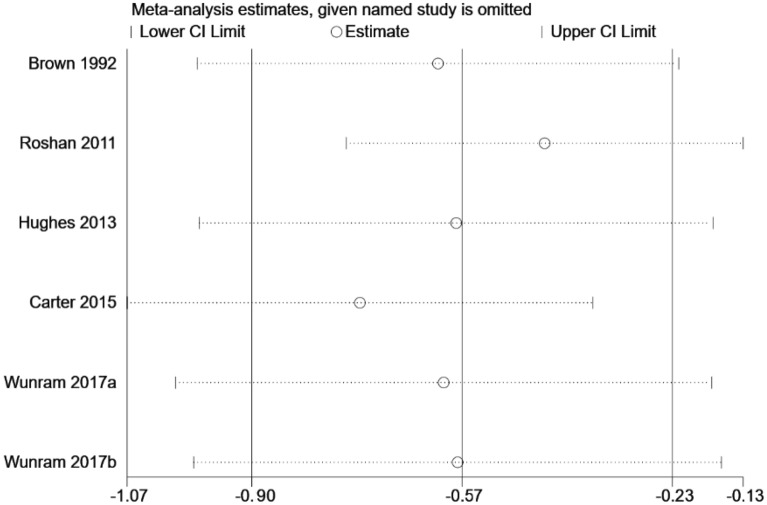
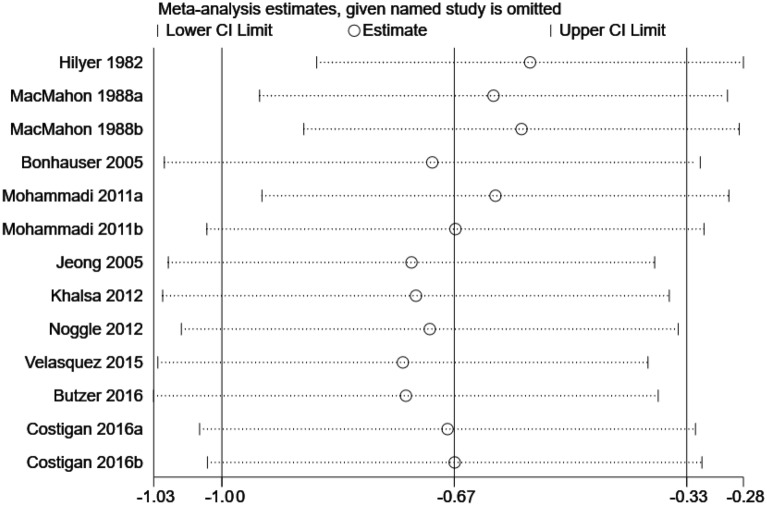
“the effect size of the depression group and the depressive symptom group were not significantly changed after eliminating single studies one by one, indicating that the study results were relatively stable.”
§ Systematic review and meta-analysis of the effects of exercise on depression in adolescents > Results > Sensitivity analysis
What the sources say
- Not checked yetcites [49] Zhang SH. Meta analysis should reasonably set up subgroup analysis and sensitivity analysis to accurately interpret the results. Chin J Mod Nerv Dis. 2016;16(1):1–2.
hedged- Asserted: passes — The authors put it forward as true.
- Checkable: passes — It can be checked against evidence.
- Load-bearing: unclear — It is unclear whether the paper’s conclusions depend on it.
- Based: passes — The paper gives a reason why it holds.
It may state two separate claims as one.
In the paper
“The random-effects model calculates the point estimate of the combined RR and 95% CI was − 0.65 (− 0.87, -0.58) after trim-and-fill, and the effect size RR difference before and after trim-and-fill did not change significantly, suggesting that publication bias has little effect on the results, and the meta-analysis results are relatively robust.”
§ Systematic review and meta-analysis of the effects of exercise on depression in adolescents > Results > Publication bias
What the sources say
- Not checked yetcites [52] Zhang TS, Zhong WZ. The realization of non-parametric clipping and compensation method in Stata. Evid Based Med. 2009;9(4):240–2.
hedged- Asserted: passes — The authors put it forward as true.
- Checkable: passes — It can be checked against evidence.
- Load-bearing: passes — The paper’s conclusions depend on it.
- Based: passes — The paper gives a reason why it holds.
It may state two separate claims as one.
None of the sources cited for this claim have been checked yet.
In the paper
“Cross-sectional studies over the past 30 years have suggested that low physical activity is an important risk factor for the development of depression [11, 12].”
§ Systematic review and meta-analysis of the effects of exercise on depression in adolescents > Background
What the sources say
- Not checked yetcites [11] Stubbs B, Koyanagi A, Schuch FB, Firth J, Rosenbaum S, Veronese N, Solmi M, Mugisha J, Vancampfort D. Physical activity and depression: a large cross-sectional, population-based study across 36 low- and middle-income countries. Acta Psychiatr Scand. 2016;134(6):1–11. source
- Not checked yetcites [12] Mc Dowell CP, Carlin A, Capranica L, Dillon C, Harrington JM, Lakerveld J, Loyen A, Ling FCM, Brug J, MacDonncha C, Herring MP. Associations of self-reported physical activity and depression in 10,000 Irish adults across harmonised datasets: a DEDIPAC-study. BMC Public Health. 2018;18:779–88. source
hedgedcorrelational- Asserted: passes — The authors put it forward as true.
- Checkable: passes — It can be checked against evidence.
- Load-bearing: fails — The paper’s conclusions may not depend on it.
- Based: passes — The paper gives a reason why it holds.
Probably not a substantial claim. The paper’s conclusions may not depend on it.
What the paper did — it cites no source for this, so there is none to check. The quote shows it is in the paper.
In the paper
“The protocol for this study was registered with INPLASY (202170013). DOI number is 10.37766/inplasy2021.7.0013. Registration Date:2021.7.06.”
§ Systematic review and meta-analysis of the effects of exercise on depression in adolescents > Abstract > Conclusions
plain- Asserted: passes — The authors put it forward as true.
- Checkable: passes — It can be checked against evidence.
- Load-bearing: fails — The paper’s conclusions may not depend on it.
- Based: passes — The paper gives a reason why it holds.
Probably not a substantial claim. The paper’s conclusions may not depend on it.
In the paper
“Psychotherapy is more resource-intensive and is associated with perceived stigma from attending the therapist [22].”
§ Systematic review and meta-analysis of the effects of exercise on depression in adolescents > Background
What the sources say
- Not checked yetcites [22] Wang LP, Wang HP. Challenge to traditional therapy: three new progresses in psychological treatment of adolescent depression. Med Philos. 2019;40(3):51–4.
plaincorrelational- Asserted: passes — The authors put it forward as true.
- Checkable: passes — It can be checked against evidence.
- Load-bearing: passes — The paper’s conclusions depend on it.
- Based: passes — The paper gives a reason why it holds.
It may state two separate claims as one.
In the paper
“The study adhered to the Preferred Reporting Items for Systematic Reviews and Meta-Analyses (PRISMA) 2020 guidelines (Fig. 1) [27].”
§ Systematic review and meta-analysis of the effects of exercise on depression in adolescents > Methods
What the sources say
- Not checked yetcites [27] Page M, McKenzie J, Bossuyt P. The PRISMA 2020 statement: an updated guideline for reporting systematic reviews. Int J Surg. 2021;6:1743–9191.
plain- Asserted: passes — The authors put it forward as true.
- Checkable: passes — It can be checked against evidence.
- Load-bearing: fails — The paper’s conclusions may not depend on it.
- Based: passes — The paper gives a reason why it holds.
Probably not a substantial claim. The paper’s conclusions may not depend on it.
In the paper
“Human and animal experiments showed that exercise can exert an antidepressant effect by increasing mitochondrial activity in brain neurons, stimulating the secretion of monoamine neurotransmitters, increasing the concentration of neurotrophic factors, inhibiting the overexpression of inflammatory factors, and regulating the expression of microRNAs [15].”
§ Systematic review and meta-analysis of the effects of exercise on depression in adolescents > Background
What the sources say
- Not checked yetcites [15] Ma K, Liu JM, Fu CY. Research progress on the intervention effect and mechanism of exercise on depression. China Sports Technology. 2020;56(11):13–24.
plaindirect- Asserted: passes — The authors put it forward as true.
- Checkable: passes — It can be checked against evidence.
- Load-bearing: fails — The paper’s conclusions may not depend on it.
- Based: passes — The paper gives a reason why it holds.
Probably not a substantial claim. The paper’s conclusions may not depend on it. It may state two separate claims as one.
None of the sources cited for this claim have been checked yet.
In the paper
“RCTs have also shown that structured exercise programs can effectively alleviate depressive symptoms, and there is a dose–response relationship [17, 18].”
§ Systematic review and meta-analysis of the effects of exercise on depression in adolescents > Background
What the sources say
- Not checked yetcites [17] Doose M, Reim D, Ziert Y. Self-selected intensity exercise in the treatment of major depression: a pragmatic RCT. Int J Psychiatry Clin Pract. 2015;5:1–19.
- Not checked yetcites [18] de Bruin EI, van der Zwan JE, Bögels SM. A RCT Comparing daily mindfulness meditations, biofeedback exercises, and daily physical exercise on attention control, executive functioning, mindful awareness, self-compassion, and worrying in stressed young adults. Mindfulness. 2016;6:1–11.
plaindirect- Asserted: passes — The authors put it forward as true.
- Checkable: passes — It can be checked against evidence.
- Load-bearing: passes — The paper’s conclusions depend on it.
- Based: passes — The paper gives a reason why it holds.
It may state two separate claims as one.
In the paper
“It can also reduce depressive symptoms by improving self-efficacy, reducing negative emotions, and stimulating positive behaviors in depressed patients [16].”
§ Systematic review and meta-analysis of the effects of exercise on depression in adolescents > Background
What the sources say
- Not checked yetcites [16] Hu L, Han YQ. The new development of the research on the neurobiological mechanism of sports anti-depression. J Shanxi Norm Univ (Natural Science Edition) 2019;47(3):9–20+125.
plaindirect- Asserted: passes — The authors put it forward as true.
- Checkable: passes — It can be checked against evidence.
- Load-bearing: passes — The paper’s conclusions depend on it.
- Based: passes — The paper gives a reason why it holds.
It may state two separate claims as one.
A conclusion the paper draws from its own results — it cites no other source for it, so there is none to check. The quote shows it is in the paper.
In the paper
“the use of exercise to prevent and treat depression in adolescents is feasible and acceptable.”
§ Systematic review and meta-analysis of the effects of exercise on depression in adolescents > Discussion
plain- Asserted: passes — The authors put it forward as true.
- Checkable: passes — It can be checked against evidence.
- Load-bearing: passes — The paper’s conclusions depend on it.
- Based: passes — The paper gives a reason why it holds.
It may state two separate claims as one.
- Rests on an assumption: Exercise has similar benefits to psychological and drug therapy.
None of the sources cited for this claim have been checked yet.
In the paper
“Prospective cohort studies have suggested that regular exercise reduces the risk of developing depression [13, 14].”
§ Systematic review and meta-analysis of the effects of exercise on depression in adolescents > Background
What the sources say
- Not checked yetcites [13] Mammen G, Faulkner G. Physical activity and the prevention of depression: a systematic review of prospective studies. Am J Prev Med. 2013;45(5):649–57. source
- Not checked yetcites [14] Schuch FB, Vancampfort D, Richards J, Rosenbaum S, Ward PB, Stubbs B. Exercise as a treatment for depression: a meta-analysis adjusting for publication bias. J Psychiatr Res. 2016;77:42–51. source
hedgeddirect- Asserted: passes — The authors put it forward as true.
- Checkable: passes — It can be checked against evidence.
- Load-bearing: fails — The paper’s conclusions may not depend on it.
- Based: passes — The paper gives a reason why it holds.
Probably not a substantial claim. The paper’s conclusions may not depend on it.
In the paper
“For adults, depression is usually regarded as the mental health problem most likely to be positively affected by exercise [20].”
§ Systematic review and meta-analysis of the effects of exercise on depression in adolescents > Background
What the sources say
- Not checked yetcites [20] Malcom E, Evans-Lacko S, Little K, Henderson C, Thornicroft G. The impact of exercise projects to promote mental wellbeing. J Ment Health. 2013;22(6):519–27. source
hedgedcorrelational- Asserted: passes — The authors put it forward as true.
- Checkable: passes — It can be checked against evidence.
- Load-bearing: fails — The paper’s conclusions may not depend on it.
- Based: passes — The paper gives a reason why it holds.
Probably not a substantial claim. The paper’s conclusions may not depend on it.
None of the sources cited for this claim have been checked yet.
In the paper
“Although RCTs in children and young people have shown that physical exercise can relieve depression and depressive symptoms [25, 26], the dose–response relationship remains unclear.”
§ Systematic review and meta-analysis of the effects of exercise on depression in adolescents > Background
What the sources say
- Not checked yetcites [25] Larun L, Nordheim LV, Ekeland E, Hagen KB, Heian F. Exercise in prevention and treatment of anxiety and depression among children and young people (review). Cochrane Database Syst Rev. 2009;1:1–49.
- Not checked yetcites [26] Brown HE, Pearson N, Braithwaite RE, Brown WJ, Biddle SJH. Physical activity interventions and depression in children and adolescents: a systematic review and meta-analysis. Sports Med. 2013;43:195–206. source
plaindirect- Asserted: passes — The authors put it forward as true.
- Checkable: passes — It can be checked against evidence.
- Load-bearing: passes — The paper’s conclusions depend on it.
- Based: passes — The paper gives a reason why it holds.
It may state two separate claims as one.
In the paper
“Two authors used a modified version of the PEDro scale [31] to evaluate the methodological quality of the included studies. If there was a disagreement, a third author evaluated the issue, which was discussed until a consensus was reached.”
§ Systematic review and meta-analysis of the effects of exercise on depression in adolescents > Methods > Literature screening, data extraction, and quality evaluation
What the sources say
- Not checked yetcites [31] Ludyga S, Gerber M, Brand S, Holsboer-Trachsler E, Pühse U. Acute effects of moderate aerobic exercise on specific aspects of executive function in different age and fitness groups: a meta-analysis. Psychophysiology. 2016;53(11):16–26. source
plain- Asserted: passes — The authors put it forward as true.
- Checkable: passes — It can be checked against evidence.
- Load-bearing: fails — The paper’s conclusions may not depend on it.
- Based: passes — The paper gives a reason why it holds.
Probably not a substantial claim. The paper’s conclusions may not depend on it. It may state two separate claims as one.
In the paper
“Comparatively, physical exercise is more cost-effective. It is convenient to implement within the community and can potentially have wider reach and participation [23].”
§ Systematic review and meta-analysis of the effects of exercise on depression in adolescents > Background
What the sources say
- Not checked yetcites [23] Li A, Yau S, Machado S, et al. Enhancement of hippocampal plasticity by physical exercise as a polypill for stress and depression: a review. CNS Neurol Disord Drug Targets. 2019;18(4):294–306. source
plain- Asserted: passes — The authors put it forward as true.
- Checkable: passes — It can be checked against evidence.
- Load-bearing: unclear — It is unclear whether the paper’s conclusions depend on it.
- Based: passes — The paper gives a reason why it holds.
It may state two separate claims as one.
What the paper did — it cites no source for this, so there is none to check. The quote shows it is in the paper.
In the paper
“We also excluded studies which recruited individuals with comorbid diseases closely related to depression.”
§ Systematic review and meta-analysis of the effects of exercise on depression in adolescents > Discussion
plain- Asserted: passes — The authors put it forward as true.
- Checkable: passes — It can be checked against evidence.
- Load-bearing: passes — The paper’s conclusions depend on it.
- Based: passes — The paper gives a reason why it holds.
Probably not a substantial claim.
What the paper did — it cites no source for this, so there is none to check. The quote shows it is in the paper.
In the paper
“Two authors used a pre-designed data extraction form to extract the following data and record it:”
§ Systematic review and meta-analysis of the effects of exercise on depression in adolescents > Methods > Literature screening, data extraction, and quality evaluation
plain- Asserted: passes — The authors put it forward as true.
- Checkable: passes — It can be checked against evidence.
- Load-bearing: fails — The paper’s conclusions may not depend on it.
- Based: passes — The paper gives a reason why it holds.
Probably not a substantial claim. The paper’s conclusions may not depend on it.
A conclusion the paper draws from its own results — it cites no other source for it, so there is none to check. The quote shows it is in the paper.
In the paper
“For adolescents with depression, moderate intensity and self-selected intensity may be better exercise options for them.”
§ Systematic review and meta-analysis of the effects of exercise on depression in adolescents > Discussion
hedgedconditional- Asserted: passes — The authors put it forward as true.
- Checkable: passes — It can be checked against evidence.
- Load-bearing: passes — The paper’s conclusions depend on it.
- Based: passes — The paper gives a reason why it holds.
It may state two separate claims as one.
None of the sources cited for this claim have been checked yet.
In the paper
“Six months of moderate-intensity aerobic exercise significantly increased the prefrontal cortex gray matter volume in patients with depression (decreased gray matter volume is a key physiological sign of depression [65]), which was directly proportional to the amount of exercise [66].”
§ Systematic review and meta-analysis of the effects of exercise on depression in adolescents > Discussion
What the sources say
- Not checked yetcites [65] Peng W, Chen Z, Yin L, Jia Z, Gong Q. Essential brain structural alterations in major depressive disorder: a voxel-wise meta-analysis on first episode, medication-naive patients. J Affect Disord. 2016;199(14):114–23. source
- Not checked yetcites [66] Matura S, Fleckenstein J, Deichmann R, Engeroff T, Füzéki E, Hattingen E, Hellweg R, Lienerth B, Pilatus U, Schwarz S, Tesky VA, Vogt L, Banzer W, Pantel J. Effects of aerobic exercise on brain metabolism and grey matter volume in older adults: results of the randomised controlled trial. Transl Psychiatry. 2017;7:1172–9. source
plaindirect- Asserted: passes — The authors put it forward as true.
- Checkable: passes — It can be checked against evidence.
- Load-bearing: unclear — It is unclear whether the paper’s conclusions depend on it.
- Based: passes — The paper gives a reason why it holds.
It may state two separate claims as one.
In the paper
“exercise alleviated hypothalamic–pituitary–adrenal feedback regulation obstacles by modulating cortisol and IL-6 levels, and thereby improved depression [69].”
§ Systematic review and meta-analysis of the effects of exercise on depression in adolescents > Discussion
What the sources say
- Not checked yetcites [69] Mihailova S, Ivanova-Genova E, Lukanov T, Stoyanova V, Milanova V, Naumova E. A study of TNF-α, TGF-β, IL-10, IL-6, and IFN-γ gene polymorphisms in patients with depression. J Neuroimmunol. 2016;293:123–8. source
plaindirect- Asserted: passes — The authors put it forward as true.
- Checkable: passes — It can be checked against evidence.
- Load-bearing: unclear — It is unclear whether the paper’s conclusions depend on it.
- Based: passes — The paper gives a reason why it holds.
It may state two separate claims as one.
None of the sources cited for this claim have been checked yet.
In the paper
“Studies have found that the effect of physical exercise on depression is influenced by the severity of depression, and is significantly negatively correlated with the level of depression [75, 76].”
§ Systematic review and meta-analysis of the effects of exercise on depression in adolescents > Discussion
What the sources say
- Not checked yetcites [75] Knapen J, Vancampfort D, Moriën Y, Marchal Y. Exercise therapy improves both mental and physical health in patients with major depression. Disabil Rehabil. 2015;37(16):1490–5. source
- Not checked yetcites [76] Machaczek KK, Allmark P, Goyder E, Grant G, Ricketts T, Pollard N, Booth A, Harrop D, de la Haye S, Collins K, Green G. A scoping study of interventions to increase the uptake of physical activity (PA) amongst individuals with mild-to-moderate depression (MMD). BMC Public Health. 2018;18(1):392. source
plaincorrelational- Asserted: passes — The authors put it forward as true.
- Checkable: passes — It can be checked against evidence.
- Load-bearing: unclear — It is unclear whether the paper’s conclusions depend on it.
- Based: passes — The paper gives a reason why it holds.
It may state two separate claims as one.
In the paper
“At present, most studies report that the cause of depression is related to the dysfunction of neurotransmitters such as serotonin (5-hydroxytryptamine), dopamine, and norepinephrine [61].”
§ Systematic review and meta-analysis of the effects of exercise on depression in adolescents > Discussion
What the sources say
- Not checked yetcites [61] Gujral S, Aizenstein H, Reynolds CF 3rd, Butters MA, Erickson KI. Exercise effects on depression: possible neural mechanisms. Gen Hosp Psychiatry. 2017;49:2–10. source
plaindirect- Asserted: passes — The authors put it forward as true.
- Checkable: passes — It can be checked against evidence.
- Load-bearing: fails — The paper’s conclusions may not depend on it.
- Based: passes — The paper gives a reason why it holds.
Probably not a substantial claim. The paper’s conclusions may not depend on it.
None of the sources cited for this claim have been checked yet.
In the paper
“exercise among patients with depression upregulated brain-derived neurotrophic factor (BDNF), which stimulates and mediates neurogenesis and regulates depressive behavior [67], in the hippocampus and cortex, promoted hippocampal neurogenesis, and significantly enhanced synaptic plasticity [68].”
§ Systematic review and meta-analysis of the effects of exercise on depression in adolescents > Discussion
What the sources say
- Not checked yetcites [67] Levy MJF, Boulle F, Steinbusch HW, van den Hove DLA, Kenis G, Lanfumey L. Neurotrophic factors and neuroplasticity pathways in the pathophysiology and treatment of depression. Psychopharmacology. 2018;235:2195–220. source
- Not checked yetcites [68] Himi N, Takahashi H, Okabe N, Nakamura E, Shiromoto T, Narita K, Koga T, Miyamoto O. Exercise in the early stage after stroke enhances hippocampal brain-derived neurotrophic factor expression and memory function recovery. J Stroke Cerebrovasc Dis. 2016;257:132–41.
plaindirect- Asserted: passes — The authors put it forward as true.
- Checkable: passes — It can be checked against evidence.
- Load-bearing: unclear — It is unclear whether the paper’s conclusions depend on it.
- Based: passes — The paper gives a reason why it holds.
It may state two separate claims as one.
In the paper
“Previous research showed that moderate- and high-intensity exercise has a stronger effect on depression than low-intensity exercise [109].”
§ Systematic review and meta-analysis of the effects of exercise on depression in adolescents > Discussion
What the sources say
- Not checked yetcites [109] Zhu XT, Ren YC, Feng L, et al. Application of exercise intervention in the treatment of depression (review). Chin Ment Health J. 2021;35(1):26–31.
plaindirect- Asserted: passes — The authors put it forward as true.
- Checkable: passes — It can be checked against evidence.
- Load-bearing: fails — The paper’s conclusions may not depend on it.
- Based: passes — The paper gives a reason why it holds.
Probably not a substantial claim. The paper’s conclusions may not depend on it.
In the paper
“After a 6-week jogging intervention for patients with depression, the plasma levels of gamma-aminobutyric acid (GABA) increased and the depression symptoms decreased [64].”
§ Systematic review and meta-analysis of the effects of exercise on depression in adolescents > Discussion
What the sources say
- Not checked yetcites [64] Du Y, Wang L, Zhang XL, et al. A controlled study on the effects of exercise on depression symptoms, cognitive function and γ-aminobutyric acid. Chin Gen Pract. 2019;17(9):1547–50.
plaindirect- Asserted: passes — The authors put it forward as true.
- Checkable: passes — It can be checked against evidence.
- Load-bearing: unclear — It is unclear whether the paper’s conclusions depend on it.
- Based: passes — The paper gives a reason why it holds.
It may state two separate claims as one.
In the paper
“Furthermore, a meta-analysis on exercise durations/frequencies showed that exercise that lasted ≤ 45 min/session reduced depression symptoms more than > 45 min/session, and ≥ 4 sessions/week had a greater effect than 2–3 sessions/week [108].”
§ Systematic review and meta-analysis of the effects of exercise on depression in adolescents > Discussion
What the sources say
- Not checked yetcites [108] Carneiro L, Afonso J, Ramirez-Campillo R, Murawska-Ciałowciz E, Marques A, Clemente FM. The effects of exclusively resistance training-based supervised programs in people with depression: a systematic review and meta-analysis of randomized controlled trials. Int J Environ Res Public Health. 2020;17(18):6715. source
plaindirect- Asserted: passes — The authors put it forward as true.
- Checkable: passes — It can be checked against evidence.
- Load-bearing: passes — The paper’s conclusions depend on it.
- Based: passes — The paper gives a reason why it holds.
It may state two separate claims as one.
In the paper
“When adolescents with depressive symptoms or negative emotions do not receive timely intervention, they risk developing depression [7].”
§ Systematic review and meta-analysis of the effects of exercise on depression in adolescents > Background
What the sources say
- Not checked yetcites [7] Rutter M, Kim-Cohen J, Maughan B. Continuities and discontinuities in psychopathology between childhood and adult life[J]. J Child Psychol Psychiatry. 2010;47(3–4):276–95.
plainconditional- Asserted: passes — The authors put it forward as true.
- Checkable: passes — It can be checked against evidence.
- Load-bearing: fails — The paper’s conclusions may not depend on it.
- Based: passes — The paper gives a reason why it holds.
Probably not a substantial claim. The paper’s conclusions may not depend on it.
In the paper
“In rats, swimming exercises over 10 weeks significantly increased the levels of serotonin, dopamine, and norepinephrine in the hippocampus [62].”
§ Systematic review and meta-analysis of the effects of exercise on depression in adolescents > Discussion
What the sources say
- Not checked yetcites [62] Cui DX. Effects of swimming exercise on neuroendocrine and behavior in experimental depression rats. East China Normal University. 2005.
plaindirect- Asserted: passes — The authors put it forward as true.
- Checkable: passes — It can be checked against evidence.
- Load-bearing: fails — The paper’s conclusions may not depend on it.
- Based: passes — The paper gives a reason why it holds.
Probably not a substantial claim. The paper’s conclusions may not depend on it.
A conclusion the paper draws from its own results — it cites no other source for it, so there is none to check. The quote shows it is in the paper.
In the paper
“Exercise program duration, session duration, frequency, and intensity may moderate the effects of exercise.”
§ Systematic review and meta-analysis of the effects of exercise on depression in adolescents > Discussion
hedgedconditional- Asserted: passes — The authors put it forward as true.
- Checkable: passes — It can be checked against evidence.
- Load-bearing: passes — The paper’s conclusions depend on it.
- Based: passes — The paper gives a reason why it holds.
It may state two separate claims as one.
What the paper did — it cites no source for this, so there is none to check. The quote shows it is in the paper.
In the paper
“Due to the limited number of studies in this literature, vibration training currently needs stronger empirical evidence to investigate the effects of this approach in alleviating depression in adolescents.”
§ Systematic review and meta-analysis of the effects of exercise on depression in adolescents > Discussion
plain- Asserted: passes — The authors put it forward as true.
- Checkable: fails — It may be too vague to check against evidence.
- Load-bearing: passes — The paper’s conclusions depend on it.
- Based: passes — The paper gives a reason why it holds.
Probably not a substantial claim. It may be too vague to check against evidence.
In the paper
“Kripalu Yoga has achieved significant intervention effects in one study, which may be related to its emphasis on obeying the wisdom of the body[40].”
§ Systematic review and meta-analysis of the effects of exercise on depression in adolescents > Discussion
What the sources say
- Not checked yetcites [40] Butzer B, LoRusso A, Shin SH, Khalsa SBS. Evaluation of yoga for preventing adolescent substance use risk factors in a middle school setting: a preliminary group-randomized controlled trial. J Youth Adolesc. 2017;46:603–12. source
hedgedconditional- Asserted: passes — The authors put it forward as true.
- Checkable: passes — It can be checked against evidence.
- Load-bearing: fails — The paper’s conclusions may not depend on it.
- Based: passes — The paper gives a reason why it holds.
Probably not a substantial claim. The paper’s conclusions may not depend on it. It may state two separate claims as one.
What the paper did — it cites no source for this, so there is none to check. The quote shows it is in the paper.
In the paper
“In addition, there are a total of 6 comparisons in this article detailing the control of exercise intensity in the experiment.”
§ Systematic review and meta-analysis of the effects of exercise on depression in adolescents > Discussion
plain- Asserted: passes — The authors put it forward as true.
- Checkable: passes — It can be checked against evidence.
- Load-bearing: fails — The paper’s conclusions may not depend on it.
- Based: passes — The paper gives a reason why it holds.
Probably not a substantial claim. The paper’s conclusions may not depend on it.
In the paper
“There is some evidence that whole-body muscle vibration training can have a positive effect on maintaining stable cortisol secretion in adolescents with severe depression and reducing the activity of the HPA [43].”
§ Systematic review and meta-analysis of the effects of exercise on depression in adolescents > Discussion
What the sources say
- Not checked yetcites [43] Wunram HL, Hamacher S, Hellmich M, Volk M, Jänicke F, Reinhard F, Bloch W, Zimmer P, Graf C, Schönau E, Lehmkuhl G, Bender S, Fricke O. Whole body vibration added to treatment as usual is effective in adolescents with depression: a partly randomized, three-armed clinical trial in inpatients. Eur Child Adolesc Psychiatry. 2017;27(5):645–62. source
hedgedconditional- Asserted: passes — The authors put it forward as true.
- Checkable: passes — It can be checked against evidence.
- Load-bearing: unclear — It is unclear whether the paper’s conclusions depend on it.
- Based: passes — The paper gives a reason why it holds.
It may state two separate claims as one.
In the paper
“Moreover, high-frequency exercise accelerated the serum BDNF peak, which promoted adaptation of central neurotransmitter release and was more effective at reducing depressive symptoms [106].”
§ Systematic review and meta-analysis of the effects of exercise on depression in adolescents > Discussion
What the sources say
- Not checked yetcites [106] Perraton LG, Kumar S, Machotka Z. Exercise parameters in the treatment of clinical depression: a systematic review of randomized controlled trials. J Eval Clin Pract. 2010;16(3):597–604. source
plaindirect- Asserted: passes — The authors put it forward as true.
- Checkable: passes — It can be checked against evidence.
- Load-bearing: unclear — It is unclear whether the paper’s conclusions depend on it.
- Based: passes — The paper gives a reason why it holds.
It may state two separate claims as one.
What the paper did — it cites no source for this, so there is none to check. The quote shows it is in the paper.
In the paper
“(3) All the articles used subjective self-reported outcomes, with a lack of objective evaluation (such as biomarkers).”
§ Systematic review and meta-analysis of the effects of exercise on depression in adolescents > Discussion
plain- Asserted: passes — The authors put it forward as true.
- Checkable: passes — It can be checked against evidence.
- Load-bearing: unclear — It is unclear whether the paper’s conclusions depend on it.
- Based: passes — The paper gives a reason why it holds.
It may state two separate claims as one.
What the paper did — it cites no source for this, so there is none to check. The quote shows it is in the paper.
In the paper
“Since only one comparison of each level of intensity was identified, further experiments are needed to strengthen any specific conclusions that can be drawn.”
§ Systematic review and meta-analysis of the effects of exercise on depression in adolescents > Discussion
plain- Asserted: passes — The authors put it forward as true.
- Checkable: passes — It can be checked against evidence.
- Load-bearing: passes — The paper’s conclusions depend on it.
- Based: passes — The paper gives a reason why it holds.
Probably not a substantial claim.
In the paper
“In depressed rats, a single 30-min session of wheel running reduced the serum corticosterone concentration compared to 20 min [104].”
§ Systematic review and meta-analysis of the effects of exercise on depression in adolescents > Discussion
What the sources say
- Not checked yetcites [104] Shiota N, Narikiyo K, Masuda A, Aou S. Water spray-induced grooming is negatively correlated with depressive behavior in the forced swimming test in rats. J Physiol Sci. 2016;66(3):265–73. source
plaindirect- Asserted: passes — The authors put it forward as true.
- Checkable: passes — It can be checked against evidence.
- Load-bearing: fails — The paper’s conclusions may not depend on it.
- Based: passes — The paper gives a reason why it holds.
Probably not a substantial claim. The paper’s conclusions may not depend on it.
A conclusion the paper draws from its own results — it cites no other source for it, so there is none to check. The quote shows it is in the paper.
In the paper
“The reason for the insignificant effect of yoga intervention may lie in the characteristics of yoga exercise, the duration of yoga experiment and experiment control.”
§ Systematic review and meta-analysis of the effects of exercise on depression in adolescents > Discussion
hedgedconditional- Asserted: passes — The authors put it forward as true.
- Checkable: passes — It can be checked against evidence.
- Load-bearing: passes — The paper’s conclusions depend on it.
- Based: passes — The paper gives a reason why it holds.
Probably not a substantial claim.
What the paper did — it cites no source for this, so there is none to check. The quote shows it is in the paper.
In the paper
“(7) The optimal exercise program in this research was based on the summary of current evidence.”
§ Systematic review and meta-analysis of the effects of exercise on depression in adolescents > Discussion
plain- Asserted: passes — The authors put it forward as true.
- Checkable: passes — It can be checked against evidence.
- Load-bearing: fails — The paper’s conclusions may not depend on it.
- Based: fails — The paper may give no reason why it holds.
Probably not a substantial claim. The paper’s conclusions may not depend on it. The paper may give no reason why it holds.
A conclusion the paper draws from its own results — it cites no other source for it, so there is none to check. The quote shows it is in the paper.
In the paper
“Physical exercise of moderate intensity is a better choice for adolescents with depression and depressive symptoms.”
§ Systematic review and meta-analysis of the effects of exercise on depression in adolescents > Conclusion
plaindirect- Asserted: passes — The authors put it forward as true.
- Checkable: passes — It can be checked against evidence.
- Load-bearing: passes — The paper’s conclusions depend on it.
- Based: passes — The paper gives a reason why it holds.
Probably not a substantial claim.
In the paper
“Yoga can improve negative emotions by regulating the hypothalamus–pituitary–adrenal axis and sympathetic nervous system, increasing thalamic GABA levels and reducing cortisol levels [93].”
§ Systematic review and meta-analysis of the effects of exercise on depression in adolescents > Discussion
What the sources say
- Not checked yetcites [93] Park CL, Finkelstein-Fox L, Groessl EJ, Elwy AR, Lee SY. Exploring how different types of yoga change psychological resources and emotional well-being across a single session. Complement Ther Med. 2020;49(2):102–14.
plaindirect- Asserted: passes — The authors put it forward as true.
- Checkable: passes — It can be checked against evidence.
- Load-bearing: fails — The paper’s conclusions may not depend on it.
- Based: passes — The paper gives a reason why it holds.
Probably not a substantial claim. The paper’s conclusions may not depend on it. It may state two separate claims as one.
In the paper
“A single exercise session among individuals with depressive symptoms can significantly improve self-efficacy, thereby reducing negative emotions [79]”
§ Systematic review and meta-analysis of the effects of exercise on depression in adolescents > Discussion
What the sources say
- Not checked yetcites [79] Jaffery A, Edwards MK, Loprinzi PD. Randomized control intervention evaluating the effects of acute exercise on depression and mood profile: solomon experimental design. Mayo Clin Proc. 2017;92(3):480–1. source
plaindirect- Asserted: passes — The authors put it forward as true.
- Checkable: passes — It can be checked against evidence.
- Load-bearing: unclear — It is unclear whether the paper’s conclusions depend on it.
- Based: passes — The paper gives a reason why it holds.
It may state two separate claims as one.
In the paper
“Adolescent males often resist participating in low-intensity exercise such as yoga and tend to choose more intense exercise types, so gender factors may impact the effect of yoga interventions [97].”
§ Systematic review and meta-analysis of the effects of exercise on depression in adolescents > Discussion
What the sources say
- Not checked yetcites [97] Conboy LA, Noggle JJ, Frey JL, Kudesia RS, Khalsa SB. Qualitative evaluation of a high school yoga program: feasibility and perceived benefits. Explore. 2013;9(3):171–80. source
hedgedconditional- Asserted: passes — The authors put it forward as true.
- Checkable: passes — It can be checked against evidence.
- Load-bearing: unclear — It is unclear whether the paper’s conclusions depend on it.
- Based: passes — The paper gives a reason why it holds.
It may state two separate claims as one.
In the paper
“Hyperactive HPA axis in patients with major depression is one of the important reasons for its onset[91].”
§ Systematic review and meta-analysis of the effects of exercise on depression in adolescents > Discussion
What the sources say
- Not checked yetcites [91] Mello AF, Juruena MF, Pariante CM, et al. Depression and stress: is there an endophenotype? Braz J Psychiatry. 2007;29(Suppl1(1)):13–8. source
plaindirect- Asserted: passes — The authors put it forward as true.
- Checkable: passes — It can be checked against evidence.
- Load-bearing: fails — The paper’s conclusions may not depend on it.
- Based: passes — The paper gives a reason why it holds.
Probably not a substantial claim. The paper’s conclusions may not depend on it.
What the paper did — it cites no source for this, so there is none to check. The quote shows it is in the paper.
In the paper
“As our meta-analysis only included 2 articles on resistance + aerobic exercise, its effect on depression in adolescents needs to be verified by multiple additional RCTs.”
§ Systematic review and meta-analysis of the effects of exercise on depression in adolescents > Discussion
plain- Asserted: passes — The authors put it forward as true.
- Checkable: passes — It can be checked against evidence.
- Load-bearing: passes — The paper’s conclusions depend on it.
- Based: passes — The paper gives a reason why it holds.
Probably not a substantial claim.
In the paper
“Another study showed that maintaining regular exercise for 6–8 weeks significantly reduced negative emotions in adolescents, but with the prolongation of the program, the benefits did not significantly improve [101].”
§ Systematic review and meta-analysis of the effects of exercise on depression in adolescents > Discussion
What the sources say
- Not checked yetcites [101] Stanton R, Reaburn P. Exercise and the treatment of depression: a review of the exercise program variables. J Sci Med Sport. 2014;17(2):177–82. source
plaindirect- Asserted: passes — The authors put it forward as true.
- Checkable: passes — It can be checked against evidence.
- Load-bearing: unclear — It is unclear whether the paper’s conclusions depend on it.
- Based: passes — The paper gives a reason why it holds.
It may state two separate claims as one.
What the paper did — it cites no source for this, so there is none to check. The quote shows it is in the paper.
In the paper
“(6) The physical activity level of the subjects may affect the intervention effect, while this variable was not found or included when compiling relevant data.”
§ Systematic review and meta-analysis of the effects of exercise on depression in adolescents > Discussion
hedgedconditional- Asserted: passes — The authors put it forward as true.
- Checkable: passes — It can be checked against evidence.
- Load-bearing: fails — The paper’s conclusions may not depend on it.
- Based: passes — The paper gives a reason why it holds.
Probably not a substantial claim. The paper’s conclusions may not depend on it. It may state two separate claims as one.
A conclusion the paper draws from its own results — it cites no other source for it, so there is none to check. The quote shows it is in the paper.
In the paper
“Participants' physical health may also be an important factor affecting the effectiveness of the intervention.”
§ Systematic review and meta-analysis of the effects of exercise on depression in adolescents > Discussion
hedgedconditional- Asserted: passes — The authors put it forward as true.
- Checkable: passes — It can be checked against evidence.
- Load-bearing: fails — The paper’s conclusions may not depend on it.
- Based: passes — The paper gives a reason why it holds.
Probably not a substantial claim. The paper’s conclusions may not depend on it.
In the paper
“International public health physical activity guidelines stipulate that at least 150 min of moderate-intensity exercise should be performed every week to maintain health [102].”
§ Systematic review and meta-analysis of the effects of exercise on depression in adolescents > Discussion
What the sources say
- Not checked yetcites [102] Tremblay MS, Kho ME, Tricco AC, Duggan M. Process description and evaluation of Canadian Physical Activity Guidelines development. J Int Soc Sports Nutr. 2010;7(1):42.
plaindirect- Asserted: passes — The authors put it forward as true.
- Checkable: passes — It can be checked against evidence.
- Load-bearing: fails — The paper’s conclusions may not depend on it.
- Based: passes — The paper gives a reason why it holds.
Probably not a substantial claim. The paper’s conclusions may not depend on it.
A conclusion the paper draws from its own results — it cites no other source for it, so there is none to check. The quote shows it is in the paper.
In the paper
“For adolescents with depressive symptoms lasting for 8 weeks, 75–120 min/time of exercise 3 times/week, and aerobic exercise is better.”
§ Systematic review and meta-analysis of the effects of exercise on depression in adolescents > Conclusion
plaindirect- Asserted: passes — The authors put it forward as true.
- Checkable: passes — It can be checked against evidence.
- Load-bearing: passes — The paper’s conclusions depend on it.
- Based: passes — The paper gives a reason why it holds.
It may state two separate claims as one.
In the paper
“In addition, due to the inherent listlessness of patients with major depression, it is sometimes difficult to motivate them to take active exercise[89].”
§ Systematic review and meta-analysis of the effects of exercise on depression in adolescents > Discussion
What the sources say
- Not checked yetcites [89] Carter T, Morres I, Repper J, et al. Exercise for adolescents with depression: valued aspects and perceived change. J Psychiatr Ment Health Nurs. 2016;23:37–44. source
hedgedconditional- Asserted: passes — The authors put it forward as true.
- Checkable: passes — It can be checked against evidence.
- Load-bearing: fails — The paper’s conclusions may not depend on it.
- Based: passes — The paper gives a reason why it holds.
Probably not a substantial claim. The paper’s conclusions may not depend on it.
The paper states this without a source or data behind it here, so there is nothing to check it against. The quote shows it is in the paper.
In the paper
“Reduced energy level is a characteristic symptom in depressed patients, and long-term continuous exercise may be too demanding for them.”
§ Systematic review and meta-analysis of the effects of exercise on depression in adolescents > Discussion
hedgedconditional- Asserted: passes — The authors put it forward as true.
- Checkable: passes — It can be checked against evidence.
- Load-bearing: passes — The paper’s conclusions depend on it.
- Based: passes — The paper gives a reason why it holds.
Probably not a substantial claim. It may state two separate claims as one.
In the paper
“Yoga, as a physical and mental exercise based on body posture exercises, has been found to reduce anxiety and stress [92].”
§ Systematic review and meta-analysis of the effects of exercise on depression in adolescents > Discussion
What the sources say
- Not checked yetcites [92] Weaver LL, Darragh AR. Systematic review of yoga interventions for anxiety reduction among children and adolescents. Am J Occup Ther. 2015;69(6):152–63. source
plaindirect- Asserted: passes — The authors put it forward as true.
- Checkable: passes — It can be checked against evidence.
- Load-bearing: fails — The paper’s conclusions may not depend on it.
- Based: passes — The paper gives a reason why it holds.
Probably not a substantial claim. The paper’s conclusions may not depend on it. It may state two separate claims as one.
A conclusion the paper draws from its own results — it cites no other source for it, so there is none to check. The quote shows it is in the paper.
In the paper
“In addition, the current practice of yoga among young people may limit its effectiveness due to the lack of specific standards for quality control of yoga implementation.”
§ Systematic review and meta-analysis of the effects of exercise on depression in adolescents > Discussion
hedgedconditional- Asserted: passes — The authors put it forward as true.
- Checkable: passes — It can be checked against evidence.
- Load-bearing: passes — The paper’s conclusions depend on it.
- Based: passes — The paper gives a reason why it holds.
Probably not a substantial claim.
In the paper
“Long-term follow-up showed that yoga led to delayed transformation, leading to improvement in long-term self-control in emotion, though the short-term effect was not significant [36].”
§ Systematic review and meta-analysis of the effects of exercise on depression in adolescents > Discussion
What the sources say
- Not checked yetcites [36] Hilyer JC, Wilson DG, Dillon C. Physical fitness training and counseling as treatment for youthful offenders. J Couns Psychol. 1982;29:292–303. source
plaindirect- Asserted: passes — The authors put it forward as true.
- Checkable: passes — It can be checked against evidence.
- Load-bearing: unclear — It is unclear whether the paper’s conclusions depend on it.
- Based: passes — The paper gives a reason why it holds.
It may state two separate claims as one.
What the paper did — it cites no source for this, so there is none to check. The quote shows it is in the paper.
In the paper
“(2) Only two of the included articles fully described allocation concealment and only one mentioned blinded outcome assessment.”
§ Systematic review and meta-analysis of the effects of exercise on depression in adolescents > Discussion
plain- Asserted: passes — The authors put it forward as true.
- Checkable: passes — It can be checked against evidence.
- Load-bearing: unclear — It is unclear whether the paper’s conclusions depend on it.
- Based: passes — The paper gives a reason why it holds.
It may state two separate claims as one.
What the paper did — it cites no source for this, so there is none to check. The quote shows it is in the paper.
In the paper
“(1) Only published Chinese and English articles were included, so the comprehensiveness of the search was limited.”
§ Systematic review and meta-analysis of the effects of exercise on depression in adolescents > Discussion
plaindirect- Asserted: passes — The authors put it forward as true.
- Checkable: passes — It can be checked against evidence.
- Load-bearing: unclear — It is unclear whether the paper’s conclusions depend on it.
- Based: passes — The paper gives a reason why it holds.
It may state two separate claims as one.
In the paper
“The American Sports Medicine Association recommends 60–80% HRmax intensity to treat depression [110].”
§ Systematic review and meta-analysis of the effects of exercise on depression in adolescents > Discussion
What the sources say
- Not checked yetcites [110] Pojednic RM, Polak R, Arnstein F, Kennedy MA, Bantham A, Phillips EM. Practice patterns, counseling and promotion of physical activity by sports medicine physicians. J Sci Med Sport. 2017;20(2):123. source
plaindirect- Asserted: passes — The authors put it forward as true.
- Checkable: passes — It can be checked against evidence.
- Load-bearing: fails — The paper’s conclusions may not depend on it.
- Based: passes — The paper gives a reason why it holds.
Probably not a substantial claim. The paper’s conclusions may not depend on it.
In the paper
“Given the low self-esteem and self-efficacy of depressed patients, moderate-intensity exercise is currently used more frequently [113].”
§ Systematic review and meta-analysis of the effects of exercise on depression in adolescents > Discussion
What the sources say
- Not checked yetcites [113] Grabovac I, Stefanac S, Smith L, Haider S, Cao C, Jackson SE, Dorner TE, Waldhoer T, Rieder A, Yang L. Association of depression symptoms with receipt of healthcare provider advice on physical activity among US adults. J Affect Disord. 2019;8:262–9.
plaindirect- Asserted: passes — The authors put it forward as true.
- Checkable: passes — It can be checked against evidence.
- Load-bearing: fails — The paper’s conclusions may not depend on it.
- Based: passes — The paper gives a reason why it holds.
Probably not a substantial claim. The paper’s conclusions may not depend on it.
In the paper
“Exercise intensity is positively associated with BDNF and plasma endorphin release [111].”
§ Systematic review and meta-analysis of the effects of exercise on depression in adolescents > Discussion
What the sources say
- Not checked yetcites [111] Morikawa R, Kubota N, Amemiya S, Nishijima T, Kita I. Interaction between intensity and duration of acute exercise on neuronal activity associated with depression-related behavior in rats. J Physiol Sci. 2021;71(1):1–11. source
plaincorrelational- Asserted: passes — The authors put it forward as true.
- Checkable: passes — It can be checked against evidence.
- Load-bearing: fails — The paper’s conclusions may not depend on it.
- Based: passes — The paper gives a reason why it holds.
Probably not a substantial claim. The paper’s conclusions may not depend on it. It may state two separate claims as one.
The paper relies on this without support.
No systematic review on the effectiveness of physical exercise for adolescents aged 12–18 years with depression or depressive symptoms has previously been conducted.
“No systematic review on the effectiveness of physical exercise for adolescents aged 12–18 years with depression or depressive symptoms has previously been conducted.”
The paper relies on this without support.
There were no significant differences in the outcome variables between the groups in each comparison at baseline.
“There were no significant differences in the outcome variables between the groups in each comparison at baseline.”
The paper relies on this without support.
Exercise has similar benefits to psychological and drug therapy.
“Given that exercise has similar benefits to psychological and drug therapy”
Claims other papers make about this one
Each is checked against this paper’s own text: does it say what the citing paper says it does?
In the citing paper
“The displacement hypothesis posits that screen time may replace time adolescents spend engaging in physical activity, sleep, in-person interactions, and other beneficial pursuits demonstrated to help reduce depression and anxiety symptoms [118–120].”
From Screen time and mental health: a prospective analysis of the Adolescent Brain Cognitive Development (ABCD) Study (2024) · cites this paper as [120]
Self-check
Percentages, sums and reported differences re-computed from the paper’s own numbers.
Each contradiction between two passages listed here was confirmed by an independent check.
Rated major: it would touch a result — a value a result rests on, reported and recomputed p-values on opposite sides of the significance level, two passages that conflict with no sign which is right, or a cited work retracted before this paper was published.
In the paper
“| Exercise program duration (weeks) | Depression | 6 | 4 (158) | 5.84 | 47.46% | − 0.61 (− 1.07, 0.15) | 0.01 |”
§ Systematic review and meta-analysis of the effects of exercise on depression in adolescents > Results > Subgroup analysis
Reported -0.61 · recomputed -0.46
Rated minor: it would not touch a result — a value no result rests on, a p-value that stays on the same side of the significance level, or a conflict that is clerical, resolved elsewhere in the paper, or outside its own findings.
In the paper
§ Systematic review and meta-analysis of the effects of exercise on depression in adolescents > Results > Publication bias
“The random-effects model calculates the point estimate of the combined RR and 95% CI was − 0.65 (− 0.87, -0.58) after trim-and-fill”
§ Systematic review and meta-analysis of the effects of exercise on depression in adolescents > Methods > Statistical analysis
“Due to the use of multiple depression scales among the included articles, standardized mean difference (SMD) was used as the effect size for analysis”
Rated minor: it would not touch a result — a value no result rests on, a p-value that stays on the same side of the significance level, or a conflict that is clerical, resolved elsewhere in the paper, or outside its own findings.
In the paper
§ Systematic review and meta-analysis of the effects of exercise on depression in adolescents > Abstract > Results
“adolescents with depressive symptoms (SMD = − 0.67, 95% CI − 1.00, − 0.33, p < 0.01)”
§ Systematic review and meta-analysis of the effects of exercise on depression in adolescents > Results > Meta-analysis of the impact of exercise on depression in adolescents
“adolescents with depressive symptoms I2 = 83.62%, combined effect size SMD = − 0.67, 95% CI (− 0.90, − 0.23), P < 0.01”
Rated minor: it would not touch a result — a value no result rests on, a p-value that stays on the same side of the significance level, or a conflict that is clerical, resolved elsewhere in the paper, or outside its own findings.
In the paper
§ Systematic review and meta-analysis of the effects of exercise on depression in adolescents > Results > Methodological quality evaluation
“There were 4 medium and 11 high-quality articles, with a mean of 6 points.”
§ Systematic review and meta-analysis of the effects of exercise on depression in adolescents > Methods > Literature screening, data extraction, and quality evaluation
“The highest score that could be achieved was 10 points, so < 4, 4–5, 6–8, and 9–10 indicated low, medium, good, and high quality, respectively.”
Citations
Cites
The PRISMA 2020 Statement: An Updated Guideline for Reporting Systematic Reviews
Page, M. J., McKenzie, J. E., Bossuyt, P. M., Boutron, I., Hoffmann, T. C., Mulrow, C. D., Shamseer, L., Tetzlaff, J. M., Akl, E. A., Brennan, S. E., et al. (2021) · International Journal of Surgery · doi:10.1016/j.ijsu.2021.105906 · Cited by 11,748
Malhi, G. S., & Mann, J. J. (2018) · The Lancet · doi:10.1016/s0140-6736(18)31948-2 · Cited by 4,099
The Neuroendocrinology of Stress: A Never Ending Story
Lightman, S. L. (2008) · Journal of Neuroendocrinology · doi:10.1111/j.1365-2826.2008.01711.x · Cited by 3,588
Physical activity and mental health in children and adolescents: a review of reviews
Biddle, S. J. H., & Asare, M. (2011) · British Journal of Sports Medicine · doi:10.1136/bjsports-2011-090185 · Cited by 2,447 · cited 1×
“, exercise type, exercise program duration, exercise session duration, exercise intensity, and exercise frequency) [24].”
BackgroundSelf-harm and suicide in adolescents
Hawton, K., Saunders, K. E., & O'Connor, R. C. (2012) · The Lancet · doi:10.1016/s0140-6736(12)60322-5 · Cited by 2,306
Unmet Need for Mental Health Care Among U.S. Children: Variation by Ethnicity and Insurance Status
Kataoka, S. H., Zhang, L., & Wells, K. B. (2002) · American Journal of Psychiatry · doi:10.1176/appi.ajp.159.9.1548 · Cited by 1,566 · cited 1×
“In addition, research has shown that 80% of depressed adolescents refuse to be treated again due to side effects or stigma after the first psychological or drug treatment [58].”
BackgroundExercise as a treatment for depression: a meta-analysis adjusting for publication bias
Schuch, F. B., Vancampfort, D., Richards, J., Rosenbaum, S., Ward, P. B., & Stubbs, B. (2016) · Journal of Psychiatric Research · doi:10.1016/j.jpsychires.2016.02.023 · Cited by 1,529 · cited 1×
“Prospective cohort studies have suggested that regular exercise reduces the risk of developing depression [13, 14].”
BackgroundRebar, A. L., Stanton, R., Geard, D., Short, C., Duncan, M. J., & Vandelanotte, C. (2015) · Health Psychology Review · doi:10.1080/17437199.2015.1022901 · Cited by 1,323
Physical Activity and the Prevention of Depression
Mammen, G., & Faulkner, G. (2013) · American Journal of Preventive Medicine · doi:10.1016/j.amepre.2013.08.001 · Cited by 1,122
The many faces of insulin-like peptide signalling in the brain
Fernandez, A. M., & Torres-Alemán, I. (2012) · Nature reviews. Neuroscience · doi:10.1038/nrn3209 · Cited by 872
Research works printed but not linked: 17
- Li JL, Chen X, Zhao CH. Meta-analysis of the prevalence of depressive symptoms in Chinese children and adolescents. Chin J Child Health. 2016;24(3):295–8.
- Liu FR, Song XQ, Shang XQ. A meta-analysis of the detection rate of depressive symptoms in middle school students. Chin Ment Health J. 2020;34(2):123–8.
- Chen M, Zhang XB, Luo YZ, et al. Research progress on neurobiological related mechanisms of exercise to improve depression. China Sports Technol. 2021;57(4):89–97.
- Ma K, Liu JM, Fu CY. Research progress on the intervention effect and mechanism of exercise on depression. China Sports Technology. 2020;56(11):13–24.
- Hu L, Han YQ. The new development of the research on the neurobiological mechanism of sports anti-depression. J Shanxi Norm Univ (Natural Science Edition) 2019;47(3):9–20+125.
- Wang LP, Wang HP. Challenge to traditional therapy: three new progresses in psychological treatment of adolescent depression. Med Philos. 2019;40(3):51–4.
- Cai ZD, Lou SJ, Chen AG. Expert consensus on the dose-effect relationship of physical exercise delaying the cognitive decline of the elderly. J Shanghai Sport Univ. 2021;45(1):51–65+77.
- Cohen J. Statistical power analysis for the behavioral sciences. J Am Stat Assoc. 1988;2(334):499–500.
- Wang D, Zhai JX, Mou ZY. Heterogeneity in meta analysis and its treatment methods. Chin J Evid Based Med. 2009;9(10):1115–8.
- Mohammadi M. A study and comparison of the effect of team sports (soccer and volleyball) and individual sports (table tennis and badminton) on depression among high school students. Aust J Basic Appl Sci. 2011;5:1005–11.
- Zhang SH. Meta analysis should reasonably set up subgroup analysis and sensitivity analysis to accurately interpret the results. Chin J Mod Nerv Dis. 2016;16(1):1–2.
- Yu HQ, Zheng HJ, Li Y, et al. Meta-analysis published a study on the method of bias diagnosis. China Health Stat. 2011;28(4):402–5.
- Shi XQ, Wang ZZ. Comparison of efficacy differences between Egger’s test and Begg’s test and reason analysis. J Huazhong Univ Sci Technol (Medical Edition) 2009;38(1):91–3+102.
- Zhang TS, Zhong WZ. The realization of non-parametric clipping and compensation method in Stata. Evid Based Med. 2009;9(4):240–2.
- Asante K. Exploring age and gender differences in health risk behaviours and psychological functioning among homeless children and adolescents. Int J Ment Health. 2015;17:278–92.
- Du Y, Wang L, Zhang XL, et al. A controlled study on the effects of exercise on depression symptoms, cognitive function and γ-aminobutyric acid. Chin Gen Pract. 2019;17(9):1547–50.
- Zhu XT, Ren YC, Feng L, et al. Application of exercise intervention in the treatment of depression (review). Chin Ment Health J. 2021;35(1):26–31.
Cited by
Sorted by citations
Items 101–162 of 162
Trends in Patterns of Physical Exercise and Screen‐Time in Swedish Adolescents From 2013 to 2019
Gothilander, J., Almqvist, L., Eriksson, C., et al. (2025) · European Journal of Sport Science · doi:10.1002/ejsc.12318 · Cited by 1
de Souza-Lima, J., Ferrari, G., Sepulveda, R. A. Y., Giakoni-Ramírez, F., Muñoz-Strale, C., Alarcón-Aguilar, J., Parra-Saldías, M., Bastías, D. M. D., Godoy-Cumillaf, A. E. R., Merellano-Navarro, E., et al. (2025) · Children · doi:10.3390/children12101282 · Cited by 2
“Age and gender often moderate these effects, though effect sizes tend to be small and vary across contexts [7,11,12].”
Qian, J., Xu, L., Liang, J., Wang, K., Xie, C., & Wang, P. (2025) · SAGE Open · doi:10.1177/21582440251365434 · Cited by 2
“…(Esteban-Cornejo et al., 2019; Macky et al., 2021; Pa´ez-Maldonado et al., 2020; Zhai et al., 2022), and emphasizes the role of physical activity in reducing anxiety and depression (Jayakody et al., 2014; Wang et al., 2022) and fostering positive personality development (Tazeg € ul, 2014).”
Sá, J., Filho, A. S. S., Chiappa, A. M. G., Duarte, A. G., Prilip, G. A., dos Reis, W. R. C., Machado, S. E. D. C., Aprigliano, V., Lima, F. V. S. D. O., Ferrari, G., et al. (2025) · CNS & Neurological Disorders - Drug Targets · doi:10.2174/0118715273377485251013035653 · Cited by 1
Murillo, S., Philipsheck, A. P., Dementyev, F., Bello-Soto, B., Bhatt, E., Wilson, H., Madison, K., Schuck, L., Wiafe, S., Brown, C. L., et al. (2025) · Frontiers in Sports and Active Living · doi:10.3389/fspor.2025.1646805 · Cited by 3
Li, L., Wang, S., Zhao, Y., & Qiao, L. (2025) · Cognitive Therapy and Research · doi:10.1007/s10608-025-10673-3 · Cited by 1
Olson, O. J., Garver, M. J., Cramer, E., Gross‐Toalson, J., Teson, K. M., Malloy-Walton, L. E., Watson, J. S., Walton, M. M., Martis, L. B., Watkins, D. J., et al. (2025) · Pediatric Exercise Science · doi:10.1123/pes.2024-0066 · Cited by 2
Does physical exercise inhibit smoking behavior? Evidence from the China General Social Survey
Zhao, S., & Huang, H. (2026) · Frontiers in Public Health · doi:10.3389/fpubh.2025.1723830 · Cited by 1
“A large body of evidence has shown that physical activity lowers the risk of depression and anxiety (21, 45), promotes overall well-being (46), and helps patients rebuild positive life attitudes and social functioning.”
Chen, A., Tian, X., & Ma, X. (2026) · Frontiers in Sports and Active Living · doi:10.3389/fspor.2025.1735531 · Cited by 1
Li, R., Li, H.-Y., Zuo, H.-J., Sun, J., Liu, Q., Li, C.-X., Zhou, N., Li, B., & Nazarudin, M. N. (2026) · PLoS ONE · doi:10.1371/journal.pone.0338382 · Cited by 3
“Research indicates that physical exercise can reduce negative emotions and lower the risk of mental disorders [18], while also mitigating anxiety-related psychophysiological responses, enhancing well-being, and preventing psychological problems, thereby reducing the likelihood of negative emotions…”
Tang, Q.-K., Li, H., Fairof, M. H. Z., Chen, L. L., & Ludin, A. F. M. (2026) · BMJ Open · doi:10.1136/bmjopen-2025-114175 · Cited by 1
“1 37 Mental health outcomes in this review were defined based on two sources: (1) recent systematic reviews demonstrating that exercise can improve multiple psychological domains in children and adolescents 38 39 and (2) the WHO conceptualisation of adolescent mental health.”
Özdemir, F., Sinanoğlu, B., Demir, A., Şen, M. E., Ucuz, İ., Kızılay, F., İnceoğlu, F., & Kızılay, E. (2026) · Scientific Reports · doi:10.1038/s41598-026-40645-w · Cited by 2
Bai, D., & Liu, X. (2026) · Acta Psychologica · doi:10.1016/j.actpsy.2026.106688 · Cited by 2
Zhao, X., Wang, Y., Yi, Y., Zhan, H., Chen, H., & Song, Q. (2026) · Journal of Affective Disorders · doi:10.1016/j.jad.2026.121998 · Cited by 1
Adams, R. A., Zor, C., Mihalik, Á., Tsirlis, K., Brudfors, M., Chapman, J., Ashburner, J., Paulus, M. P., & Mourão-Miranda, J. (2024) · Biological Psychiatry Cognitive Neuroscience and Neuroimaging · doi:10.1016/j.bpsc.2024.03.006 · Cited by 3
The effect of physiotherapy on anxiety, depression, and stress in chronic low back pain
Abbas, M. F., Al-Hussari, Z. N. A., & Mahmood, A. S. (2024) · Public Health of Indonesia · doi:10.36685/phi.v10i4.877 · Cited by 1
“…pain and improving the quality of life or Physiotherapy significantly impacts an individual's psychological condition, offering benefits comparable to conventional treatments, making it an effective standalone, adjuvant, or combination therapy for depression (Wang et al., 2022; Xie et al., 2021).”
Tjelesno vježbanje u osoba s mentalnim poremećajima
Crnjac, I., Krtalić, S., & Jozić, M. (2023) · Edukacija, rekreacija, sport/ERS. Edukacija rekreacija sport · doi:10.54478/ers.32.45.7
Yunus, A., Zhou, L., Addai‐Dansoh, S., et al. (2023) · SSRN Electronic Journal · doi:10.2139/ssrn.4631066
Shirsekar, N., & Phillips, S. (2023) · Journal of Student Research · doi:10.47611/jsrhs.v12i4.5797
Zhang, Y., Bornkamp, N., Hivert, M., Oken, E., & James, P. (2024) · doi:10.2196/preprints.59159
An Empirical Study on Campus Group Exercise Improving Depression Symptoms in AdolescentsPreprint
Li, L., Zhao, Y., Wang, S., Hu, Y., Qiao, L., Guo, X., & Wu, R. (2024) · SSRN Electronic Journal · doi:10.2139/ssrn.4833060
Adolescents’ Perspectives on Treatments for Depression: A Qualitative Study
Kraines, M. A., Wolff, J. C., Bergeron, A., Kirshy, S., Peterson, S. K., Noppen, D. V., Tremont, G. N., Yen, S., & Uebelacker, L. A. (2024) · Evidence-Based Practice in Child and Adolescent Mental Health · doi:10.1080/23794925.2024.2358474
“…with teens perceptions of alternative coping strategies for depression in this study, empirical research has also shown benefits of yoga, mindfulness, and exercise for teens with depression (Chi et al., 2018; James-Palmer et al., 2020; Uebelacker et al., 2021, 2022, 2023; Wang et al., 2022).”
Chandrasekaran, R., Kotaki, S., & Nagaraja, A. H. (2024) · doi:10.2196/preprints.63362
Sporttherapie im digitalen Zeitalter: Vielversprechende Ansätze bei Krebs und Depression?
Enders, K., & Haller, N. (2024) · Springer eBooks · doi:10.1007/978-3-662-68241-8_35-1
Lang, L., Ke-xin, R., & Bingbing, F. (2024) · Research Square · doi:10.21203/rs.3.rs-4579296/v1
Budde, H., Dolz, N., Mueller‐Alcazar, A., et al. (2024) · medRxiv · doi:10.1101/2024.08.28.24312666
“Wang et al. [62] report that six months of moderate-intensity aerobic training leads to a significant increase in the volume of grey matter in the prefrontal cortex in patients with depression.”
Cirulli, F., Ciacchella, C., & Collacchi, B. (2024) · Sustainable development goals series · doi:10.1007/978-3-031-70165-8_20
Chen, J., Deng, H., Feng, H., et al. (2024) · Research Square · doi:10.21203/rs.3.rs-5643493/v1
Self-citationSportliche Aktivität und mentale Gesundheit von Kindern und Jugendlichen
Göttlich, E., Henning, L., Burrmann, U., et al. (2025) · Bildung und Sport · doi:10.1007/978-3-658-47017-3_2
Cen, Z., Zhang, K., López‐Gil, J. F., Yang, X., Li, C., & Chen, S. (2025) · Journal of Exercise Science & Fitness · doi:10.1016/j.jesf.2025.06.002 · Cited by 1
“21,22 While mounting evidence suggests the positive effects of aerobic PA on AP in children and adolescents, 23 – 26 MSE has received less attention.”
Paton, L. W., Kreif, N., Aylott, L. M. E., Kerrigan, P., Nader, C., Gega, L., & Tiffin, P. A. (2025) · JCPP Advances · doi:10.1002/jcv2.70035
“Our findings are somewhat in contrast to the majority of those reported by meta - analytic studies of physical activity interventions on psychological outcomes, which report moderate to large effect sizes (Bailey et al., 2018; Biddle et al., 2019; Carter et al., 2016, 2021; Wang et al., 2022).”
Puttraju, V. P., & Srikanth, J. (2025) · Cureus · doi:10.7759/cureus.95723
“The 2.5-fold practice duration disparity suggests a dose-response relationship, consistent with systematic reviews demonstrating enhanced mental health benefits with greater physical activity exposure frequency and duration [32,33].”
InfluentialAshworth, B., Godley, J., & Daykin, A. R. (2025) · Research Square · doi:10.21203/rs.3.rs-8056734/v1
Ashworth, B., Godley, J., & Daykin, A. R. (2025) · Research Square · doi:10.21203/rs.3.rs-8056734/v2
Gothilander, J., Miech, E. J., Almqvist, L., et al. (2026) · Frontiers in Public Health · doi:10.3389/fpubh.2026.1723898
Liu, G., Yang, C., Wang, S., Chen, D., Xie, F., Xie, J., Tan, H., & Wu, Y. (2026) · Trials · doi:10.1186/s13063-026-09649-9
“Meta-analyses further confirm that among various exercise modalities, aerobic exercise has the most significant effect in alleviating depressive symptoms in adolescents [20].”
Wang, Y., Aziz, S. F. A., Zhang, L., Zhou, W., Zhang, Y., & Shi, Y. (2026) · BMC Public Health · doi:10.1186/s12889-026-26566-3 · Cited by 2
“…factors were chosen a priori because population characteristics and intervention parameters were hypothesized to influence the effectiveness of PA, and similar moderators have been shown to significantly affect the impact of exercise on depressive symptoms in previous meta-analyses [17, 18].”
Schwarz, A. V., Haynes, H. K., Puleali’i, S., Mota, J. A., Johnson, M. F., Kaylor, M. G., Addison, A., Braun-Trocchio, R., & Graybeal, A. J. (2026) · Translational Journal of the American College of Sports Medicine · doi:10.1249/tjx.0000000000000355
Cai, C., Mei, Z., Yang, Y., Shi, Y., & Luo, S. (2026) · BMC Psychiatry · doi:10.1186/s12888-026-08036-7
“Compared with previous findings, the effect size of VR-EXIs was substantially greater than that of traditional exercise models [56, 57].”
Computer-based tree drawing test in adolescents and adults with depression
Jin, H., Liu, Y., Li, Y.-L., Liu, L.-Y., Gao, L., Liu, W., Zhang, Y., & Liu, G.-R. (2026) · Frontiers in Psychiatry · doi:10.3389/fpsyt.2026.1785760
“Its development can have profound effects on long-term mental health, social functioning, and academic performance (20, 21).”
Oleiro, V. S., Alexandrino, E. G., Rodrigues, Y. D. G., et al. (2026) · Mental health and physical activity · doi:10.1016/j.mhpa.2026.100779
Hassan, A. A. F. (2026) · Sustainable civil infrastructures · doi:10.1007/978-3-032-17918-0_54
Morse, I., Mannes, J., Pilimatalawwe, D., Phippard, S., Sousa, F. D. S., Samuel, R., Ganesalingam, M., Rengasamy, E. R., Pinto, C., Woolgar, M., et al. (2026) · European Child & Adolescent Psychiatry · doi:10.1007/s00787-026-03064-w · Cited by 2
Tandonnet, L., Braconnier, A., & Marcelli, D. (2026) · Encyclopédie médico-chirurgicale. Psychiatrie · doi:10.1016/s0246-1072(26)45841-1
Zhang, Z., Ye, M., & Zhang, L. Y. (2026) · Child and Adolescent Psychiatry and Mental Health · doi:10.1186/s13034-026-01102-8
“…length (forty five minutes or less versus more than forty five minutes), session frequency (one session per week versus two sessions per week), program duration (twelve weeks or less versus more than twelve weeks), adherence (at least eighty percent versus less than eighty percent) [16, 17].”
Meng, Z., Yu, C., Li, Y., Hu, Y., & Xiangying, W. (2026) · Frontiers in Psychology · doi:10.3389/fpsyg.2026.1769651
“This pattern is generally consistent with the findings of Wang et al. (2022) and Singh et al. (2026), both of whom suggested that exercise may be particularly beneficial for depression in young people.”
The dynamic influence of exercise on emotional state among people with a history of mood disorder
Stapp, E. K., Husky, M. M., Cui, L., & Merikangas, K. R. (2026) · Psychiatry Research · doi:10.1016/j.psychres.2026.117319
Dongfei, L. I. U., Yuanhao, L. I., Ping, C. H. E. N., & Yujiang, G. U. O. (2026) · Journal of Zhejiang University (Medical Sciences) · doi:10.3724/zdxbyxb-2025-0925
Zhao, Z., Li, X., Li, L., & Yi, Y. (2026) · BMC Psychiatry · doi:10.1186/s12888-026-08378-2
哲也, 矢., Dg, A., & Koyama, K. (2026) · European Journal of Applied Physiology · doi:10.1007/s00421-026-06364-w
“Exercise has been recognized as one of the most effec - tive strategies for improving both physical and mental health (Wang et al. 2022).”
Ergenlerde Fiziksel Aktivite ile Mental İyi Oluş Arasındaki İlişkinin İncelenmesi
Kartal, E., & Yarım, İ. (2026) · The Online Journal of Recreation and Sport · doi:10.22282/tojras.1884722
Aytekin, Ç., Kılınç, F. Ö., & Doğan, R. Y. (2026) · Psychiatric Quarterly · doi:10.1007/s11126-026-10300-8
Huang, S., Sun, M., Zhu, H., & Zhang, L. (2026) · Mental health and physical activity · doi:10.1016/j.mhpa.2026.100818
Kim, T. (2026) · Frontiers in Public Health · doi:10.3389/fpubh.2026.1871867 · Cited by 1
Mahon, A., Thomas, C., Jago, R., Kidger, J., & Tinner, L. (2026) · Discover Public Health · doi:10.1186/s12982-026-02817-x
“Mental health difficulties at this life stage can have profound and long-lasting impacts on personal and social development and educational and employment outcomes [4].”
Li, M., & Zhai, B. (2026) · Frontiers in Sports and Active Living · doi:10.3389/fspor.2026.1924903
Costa, M. B., Noll, P. R. E. S., Cordeiro, L. L., Jesus, J. I. F. S., Nogueira, S. M., Barg, G., Monfort-Pañego, M., & Noll, M. A. (2026) · Discover Public Health · doi:10.1186/s12982-026-02944-5
“Additionally, moderate-intensity physical exercise [21] and outdoor activities are associated with a more favorable psychological profile [22], partly through increased social support and self-esteem [23].”
Yang, M., Ge, X., & Zhang, D. (2026) · Frontiers in Public Health · doi:10.3389/fpubh.2026.1879903
“The pattern is also consistent with international and domestic evidence indicating that regular physical activity is associated with lower levels of depression, anxiety, and stress (24).”
Digital Sports Therapy: Promising Approaches for Cancer and Depression?
Enders, K., & Haller, N. (2026) · Springer eBooks · doi:10.1007/978-3-662-73013-3_16
Legrand, F. D., & Duberg, A. (2026) · Child and Adolescent Mental Health · doi:10.1111/camh.70134
Zhang, N., Hu, G., & Ma, X. (2026) · Frontiers in Sports and Active Living · doi:10.3389/fspor.2026.1955833
Metadata
- Authors
- Wang, X., Cai, Z.-D., Jiang, W.-T., Fang, Y.-Y., Sun, W.-X., & Wang, X.
- Affiliations
- Shanghai University of Sport (CN)
- Corresponding author
- Wang, Xing
- Venue
- Child and Adolescent Psychiatry and Mental Health
- Published
- 2022-02-28
- Volume
- 16
- Issue
- 1
- Pages
- 16-16
- ISSN
- 1753-2000 (ISSN-L)
- PMC
- PMC8886903
- OpenAlex
- W4214633363
- Semantic Scholar
- 3d0b730468ff4d142f2f8c25bf48a381111e6834
- Cited by
- 169
- References
- 97
- Citations by year
- 2026: 45 · 2025: 56 · 2024: 39 · 2023: 25 · 2022: 4
- FWCI
- 4.27
- Type
- journal article
- Language
- en
- Open access
- gold
- doi.org
- Locations
- Child and Adolescent Psychiatry and Mental Health (publishedVersion, cc-by)
- PubMed Central (publishedVersion, cc-by)
- PubMed (publishedVersion)
- DOAJ (DOAJ: Directory of Open Access Journals) (submittedVersion, cc-by-sa)
- Funders
- the Key Laboratory Project of Shanghai Science and Technology Commission (11DZ2261100)
- Topics
- Health Sciences › Medicine › Public Health, Environmental and Occupational Health › Physical Activity and Health
- Health Sciences › Medicine › Pharmacology (medical) › Treatment of Major Depression
- Social Sciences › Psychology › Clinical Psychology › Child and Adolescent Psychosocial and Emotional Development
- Keywords
- adolescent depression, depressive symptoms, physical activity, aerobic exercise, resistance training, yoga, exercise intervention, exercise dose, exercise intensity, treatment effect size, quality of life, academic performance, exercise dose-response, exercise frequency and duration
About these checks
Registry, retraction, Cites and statistics results are computed, not judged, with one exception: a printed reference that no index lists is read once by a model before it counts as a citation error. Claims are extracted by a model and kept only when their quote appears verbatim in the text; each cited source is then checked, with a model’s help, for whether it says what the claim relies on. Those verdicts can be wrong — read the claim’s quote and the cited source before relying on one.
A language model drew the claims from the paper on 2026-10-08, under version 3 of the claim definition (model deepseek-v4.1-flash, prompt extract-v3).
A second model labelled each claim on 2026-10-08 (model jev-1.13-20260917, definition revision gold-guideline-v0.2).
Cited sources are checked with a language model’s help (gpt-6-sol).
Statistics and arithmetic are recomputed, not judged.
Confidence bands are shown only for fields calibrated on our annotated test set. None is calibrated yet, so no band is shown.
What counts as a claim ›How we measure confidence ›How we check this ›
Are you an author, or do you see a problem with this page? Request a review
