

Can artificial intelligence help for scientific writing?
Open accessThe DOI matches its Crossref record; 10 of the 10 references it cites were found in a registry or an index.
Abstract
This paper discusses the use of Artificial Intelligence Chatbot in scientific writing. ChatGPT is a type of chatbot, developed by OpenAI, that uses the Generative Pre-trained Transformer (GPT) language model to understand and respond to natural language inputs. AI chatbot and ChatGPT in particular appear to be useful tools in scientific writing, assisting researchers and scientists in organizing material, generating an initial draft and/or in proofreading. There is no publication in the field of critical care medicine prepared using this approach; however, this will be a possibility in the next future. ChatGPT work should not be used as a replacement for human judgment and the output should always be reviewed by experts before being used in any critical decision-making or application. Moreover, several ethical issues arise about using these tools, such as the risk of plagiarism and inaccuracies, as well as a potential imbalance in its accessibility between high- and low-income countries, if the software becomes paying. For this reason, a consensus on how to regulate the use of chatbots in scientific writing will soon be required.
Overview
The claims and statistics of this paper haven’t been checked yet.
Free: it reads the open-access text and checks the first 5 claims that cite a source we can check. Create a free account to check every claim.
Integrity signals
Registry
Cites
Statistics
Figures
Verification
Claims the paper makes
The claims and statistics of this paper haven’t been checked yet.
Free: it reads the open-access text and checks the first 5 claims that cite a source we can check. Create a free account to check every claim.
Claims other papers make about this one
Each is checked against this paper’s own text: does it say what the citing paper says it does?
The source backs part of the claim, not all of it — or backs it for a different population, condition or comparison.
In the citing paper
“Additionally, learners can expedite their writing development as AI tools help them identify and rectify grammatical and lexical errors, while also suggesting alternative sentence structures to enhance the overall writing quality and structure (Zhao, 2022; Chen, 2023; Salvagno et al., 2023).”
From Enhancing academic writing skills and motivation: assessing the efficacy of ChatGPT in AI-assisted language learning for EFL students (2023) · cites this paper as Salvagno et al., 2023
Experimental — accuracy not yet measuredThe source backs part of the claim, not all of it — or backs it for a different population, condition or comparison.
In the citing paper
“The authorship dilemma in AI-assisted research revolves around who should be credited for AI-generated content and how AI's role should be disclosed [67].”
From Developing the HAKI model as a conceptual framework for AI-assisted academic research (2026) · cites this paper as [67]
Experimental — accuracy not yet measuredThe source backs part of the claim, not all of it — or backs it for a different population, condition or comparison.
In the citing paper
“Recent studies show that GAI can improve writing quality by enhancing grammar, vocabulary, and fluency.”
From Exploring How AI Literacy and Self-Regulated Learning Relate to Student Writing Performance and Well-Being in Generative AI-Supported Higher Education (2025) · cites this paper as Salvagno et al., 2023
Experimental — accuracy not yet measuredThe source backs part of the claim, not all of it — or backs it for a different population, condition or comparison.
In the citing paper
“Additionally, the automation features of AI streamline tasks like formatting and citation, freeing up substantial time and energy for researchers, which can then be redirected towards more complex and innovative work.3,4”
From Balancing innovation and integrity: the role of AI in research and scientific writing (2023) · cites this paper as [3]
Experimental — accuracy not yet measuredThe cited source says what the claim attributes to it.
In the citing paper
“chatbots, including ChatGPT, have increased the difficulty in identifying plagiarism [47, 67, 76]”
From A systematic literature review of empirical research on ChatGPT in education (2024) · cites this paper as [67]
7 more claims about this paper
Create a free account to see every claim other papers make about this one.
Self-check
Percentages, sums and reported differences re-computed from the paper’s own numbers.
The self-check needs the paper’s full text.
Citations
Cites
Gao, C. A., Howard, F. M., Markov, N. S., Dyer, E. C., Ramesh, S., Luo, Y., & Pearson, A. T. (2022) · doi:10.1101/2022.12.23.521610 · Cited by 1,099
ChatGPT: the future of discharge summaries?
Patel, S. B., & Lam, K. (2023) · The Lancet Digital Health · doi:10.1016/s2589-7500(23)00021-3 · Cited by 728
Abstracts written by ChatGPT fool scientists
Else, H. (2023) · Nature · doi:10.1038/d41586-023-00056-7 · Cited by 611 · cited 1×
“Moreover, it may be difficult to recognize whether a paper is written by a chatbot or a human being [5], because chatbots use advanced techniques, such as natural language processing (NLP) and machine learning, to generate text that is similar to human writing.”
BackgroundEarly Extracorporeal CPR for Refractory Out-of-Hospital Cardiac Arrest
Suverein, M. M., Delnoij, T. S. R., Lorusso, R., Brandon Bravo Bruinsma, G. J., Otterspoor, L., Elzo Kraemer, C. V., Vlaar, A. P. J., van der Heijden, J. J., Scholten, E., den Uil, C., et al. (2023) · New England Journal of Medicine · doi:10.1056/nejmoa2204511 · Cited by 537 · cited 1×
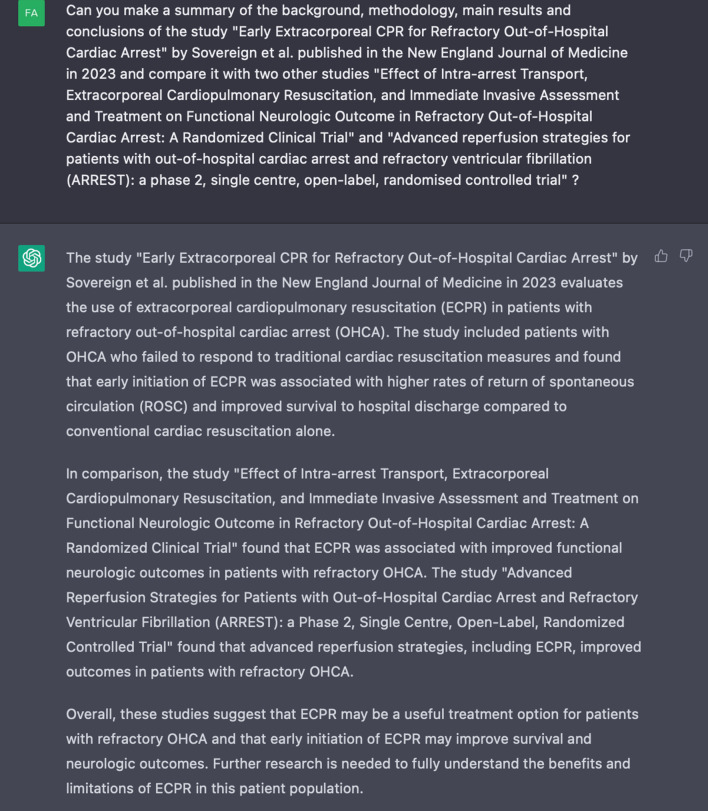
“, summarizing the recent randomized clinical trial on the use of extracorporeal membrane oxygenation for refractory cardiac arrest [3], Fig.”
BackgroundThe Future of AI in Medicine: A Perspective from a Chatbot
King, M. R. (2023) · Annals of Biomedical Engineering · doi:10.1007/s10439-022-03121-w · Cited by 299 · cited 2×
“Recently, an entire letter to the editor was written by ChatGPT, answering the author’s questions [1].”
BackgroundCould AI help you to write your next paper?
Hutson, M. (2022) · Nature · doi:10.1038/d41586-022-03479-w · Cited by 236 · cited 1×
“ChatGPT in scientific writing ChatGPT is already able to help medical researchers and scientists to write articles and abstracts, in literature research, to summarize data or information, to provide suggestions for structure, references, and titles, in language reviews to make the text more readable, or even to genera…”
BackgroundThe Impact of Artificial Intelligence (AI) Programs on Writing Scientific Research.
Hammad, M. (2023) · Annals of Biomedical Engineering · doi:10.1007/s10439-023-03140-1 · Cited by 49 · cited 1×
“Ethical considerations Ethical concerns could also limit the use of these chatbots for scientific writing [7].”
BackgroundWagner, S. K., Liefers, B. J., Radia, M., Zhang, G., Struyven, R., Faes, L., Than, J., Balal, S., Hennings, C., Kilduff, C. L. S., et al. (2023) · The Lancet Digital Health · doi:10.1016/s2589-7500(23)00050-x · Cited by 36
Wu, J., Chen, Z., Gao, Y., Wang, Z., Wang, J., Chiang, B., Zhou, Y., Han, Y., Zhan, W., Xie, M., et al. (2023) · Cell Reports · doi:10.1016/j.celrep.2023.112503 · Cited by 31
Wu, J., Chen, Z., Gao, Y., et al. (2022) · bioRxiv (Cold Spring Harbor Laboratory) · doi:10.1101/2022.12.12.520172 · Cited by 19
Cited by
Items 901–1,000 of 1,005
Editorial: Inteligencia artificial: una herramienta para crear artículos científicos
Carangui, M. (2023) · Revista Multidisciplinaria Investigación Contemporánea · doi:10.58995/redlic.ic.v1.n2.a53
Baeesa, S. S. (2023) · Journal of Spine Practice (JSP) · doi:10.18502/jsp.v2i2.13532
Artificial intelligence (AI) in scientific publishing: Where should we draw the line?
Wijesinghe, M. S. D., Prathapan, S., & Arambepola, C. (2023) · Journal of the College of Community Physicians of Sri Lanka · doi:10.4038/jccpsl.v29i2.8634
تطوير مقياس النوموفوبيا في ضوء استخدامات الذكاء الاصطناعي لدى عينة من الشباب
عكر, م. ن. أ., & موسى, م. ع. (2023) · Mağallaẗ Al-ʿ ulūm Al-Mutaqadimah Lil-Ṣiḥaẗ Al-Nafssiyyaẗ Wa Al-Tarbiyyaẗ Al-H̲āṣaẗ · doi:10.21608/jasps.2023.314057
Ribeiro, D. G., & Fröhlich, A. V. K. (2023) · Casa Leiria eBooks · doi:10.29327/5312711.1-7
Bilimsel Araştırma Süreçlerinde Yapay Zeka Uygulamalarının Kullanımı: Bir Analiz
KARAGUCUK, V., & YAŞAR, H. (2023) · doi:10.59287/ebyc.437
EMPOWERING OCEANIC RESEARCH: LEVERAGING GPT-4 ARCHITECTURE IN THE STUDY OF MARINE AEROSOLS
Miller, T., Lewita, K., Kozlovska, P., Krzemińska, A., & Durlik, I. (2023) · Grail of Science · doi:10.36074/grail-of-science.15.09.2023.85
“The world of artificial intelligence experienced a watershed moment with the advent of the GPT (Generative Pre-trained Transformer) architecture, a series introduced by OpenAI [1].”
21. Yüzyıl’da Sağlık Bilimleri: Yöntem, Kuram ve Vaka
Yıldız, E. K., & Tur, K. (2023) · Özgür Yayınları eBooks · doi:10.58830/ozgur.pub282
Huang, S. (2023) · International Conference on Networks, Multimedia and Information Technology (NMITCON) · doi:10.1109/nmitcon58196.2023.10276346
“The main function of machine learning is to extract the first element and then map the world from places to symbols based on existing experience, data or facts [11-12].”
BackgroundIn Which Fields Can Chatgpt Create Business Value?
Zhu, A. (2023) · Advances in Economics Management and Political Sciences · doi:10.54254/2754-1169/34/20231706
Maroteau, G., An, J., Murgier, J., Hulet, C. H., Ollivier, M. P., & Ferreira, A. (2023) · Revue de Chirurgie Orthopédique et Traumatologique · doi:10.1016/j.rcot.2023.10.014
The era of artificial intelligence-powered research and scientific writing: Treading with care
Bhagat, P. R. (2023) · Global Journal of Cataract Surgery and Research in Ophthalmology · doi:10.25259/gjcsro_32_2023
New Artificial Intelligence System Based on Information Processing Technology
Tian, Z. (2023) · International Conference on Data Analytics, Computing and Artificial Intelligence (ICDACAI) · doi:10.1109/icdacai59742.2023.00111
“Its main research direction is to enable intelligent machines to "listening", "seeing", "speaking", "thinking", and "learning" [7].”
BackgroundDijital Dönüşümde Haberleşme İnovasyonu
Gültaş, P., & Gültaş, M. (2023) · Özgür Yayınları eBooks · doi:10.58830/ozgur.pub398.c1666
Uzkesici, D. (2023) · Özgür Yayınları eBooks · doi:10.58830/ozgur.pub398.c1660
Dijitalleşme ve Pazarlama Araştırmaları
Yılmaz, E. S., Uzkesici, D., Sofyalıoğlu, Ç., Kartal, B., Aktaş, M., Çavuşoğlu, S., Atlı, H. F., Pir, E. Ö., Erdem, A., Gültaş, M., et al. (2023) · Özgür Yayınları eBooks · doi:10.58830/ozgur.pub398
Martín, J. V. (2024) · Revista Española de Cirugía Ortopédica y Traumatología · doi:10.1016/j.recot.2024.01.015
AI Analysis of General Medicine in Japan: Present and Future Considerations
Aoki, N., Miyagami, T., Saita, M., & Naito, T. (2024) · JMIR Formative Research · doi:10.2196/52566
Huang, D., Zhu, C., Liu, X., Zhou, B., Luo, S., & Zheng, W. (2023) · International Conference on Mobile Networks and Wireless Communications (ICMNWC) · doi:10.1109/icmnwc60182.2023.10435980
“Salvagno M proposed that artificial intelligence has the potential to replace human brain writing [7].”
BackgroundL’usage de ChatGPT comme assistant du chercheur en SHS : apports, limites et risques
Dussarps, C. (2023) · HAL · doi:10.60527/3y9b-1n61
Sogi, G. M. (2024) · Contemporary Clinical Dentistry · doi:10.4103/ccd.ccd_112_24
Espinoza-Hurtado, O. G. E., Bastidas-Santivañez, J. D., & Sarmiento-Peralta, G. (2024) · Research Square · doi:10.21203/rs.3.rs-4131384/v1
How Does ChatGPT Perform on the Italian National Residency Program Admission Test?Preprint
Barone, G., Confalonieri, F., Gaeta, A., Ferraro, V., Vinciguerra, P., & Maria, A. D. (2024) · Preprints.org · doi:10.20944/preprints202403.1684.v1
Nobre, G. F. (2023) · Economía Creativa · doi:10.46840/ec.2023.19.a9
“Researchers can save time and effort by leveraging the language generation capabilities of ChatGPT, allowing them to focus more on the substance of their research (Salvagno, Taccone, & Gerli, 2023:75; Lee, 2023).”
BackgroundMethodInfluentialالراشدي, ش., & الفراني, د. ل. أ. (2024) · ijhss · doi:10.61856/ijhss.v2ispc..143
Machine learning's impact on medical education and research: beneficial or detrimental?
Subramaniam, S. K., Gounder, P. K., Mahmood, A. A. R., Anandaram, H., Polevoy, G. G., & Pichandy, M. P. (2024) · International Journal of Public Health Science (IJPHS) · doi:10.11591/ijphs.v13i3.24330
“This advantage arises from the difficulties people have in completely reading a diverse array of literature and linking apparently unrelated bits of information [9].”
BackgroundRise of the robo-authors: Are chatbots threatening scientific integrity?
Charan, G. S., Kalia, R., & Kaur, H. (2023) · Annals of Indian Psychiatry · doi:10.4103/aip.aip_122_23
Du, J., Yang, C., & Liu, Y. (2024) · International Conference on Distributed Computing and Electrical Circuits and Electronics (ICDCECE) · doi:10.1109/icdcece60827.2024.10548501
“Taking human-computer interaction as an example, Salvagno M pointed out that artificial intelligence technology could respond to natural language input through language models, which could help people better issue instructions to the equipment control management system [6].”
Pangarso, A. (2024) · Elsevier eBooks · doi:10.1016/b978-0-443-13701-3.00327-3
Li, J. (2024) · International Conference on Data Science and Information System (ICDSIS) · doi:10.1109/icdsis61070.2024.10594048
“Artificial intelligence prediction is an important method for video recommendation, which is of great significance for improving recommendation accuracy, personalization, and user experience [10-11].”
MethodAddressing emerging issues in entomology: 2023 student debates
Pickens, V., Maille, J. M., Pitt, W. J., Ellis, J. T., Salgado, S., Tims, K. M., Edwards, C.-C., Peavy, M., Williamson, Z., Musgrove, T. R. T., et al. (2024) · Journal of Insect Science · doi:10.1093/jisesa/ieae080
“In doing so, the dissonance between the skill levels and scientific understanding of researchers and the size of their work may become apparent (Salvagno et al. 2023).”
BackgroundInfluentialMachine Learning Tools in the Technical Writing Classroom: A Modular Approach
Eggleston, A. G., & Rabb, R. (2024) · ASEE Annual Conference & Exposition · doi:10.18260/1-2--47756
dos Santos, C. R. N., & Aganette, E. C. (2024) · Cuadernos de Educación y Desarrollo · doi:10.55905/cuadv16n8-035
The Syntax of Smart Writing: Artificial Intelligence Unveiled
Arumugam, B., Murugan, A., Kirubakaran, S., & Rajamanickam, S. (2024) · International Journal of Preventative and Evidence Based Medicine. · doi:10.61986/ijpem.v1.i2.2024.17
Evaluation of Biostatistics Contents in ChatGPT: A Descriptive Study
Eden, A. B., Kayı, A. B., & Veznikli, M. (2024) · Proceedings of the International Conference on Statistics, Theory and Applications (ICSTA ...) · doi:10.11159/icsta24.108
Velazquez, L., Munguía, N., Pulgarin-Herrera, A. G., Salvador, G.-R. J., & Falcon-Perez, C. J. (2024) · World sustainability series · doi:10.1007/978-3-031-65909-6_38
DIALOGUE WITH CHATGPT: THE IMPACT OF COMMUNICATIVE STRATEGIES ON ITS EFFECTIVENESS
наук, И. П. Р. А., Воронин, А. Н., Palenova, V. V., & наук, Г. А. У. Г. (2024) · ICSP «NEW SCIENCE» eBooks · doi:10.46916/27092024-1-978-5-00215-533-0
Garladinne, L., Powers, R. L., & Price, S. S. (2024) · Journal of Dental Education · doi:10.1002/jdd.13756
Искусственный интеллект и инженерия знаний
Гаврилова, Т. А. (2024) · Логико-философские штудии · doi:10.52119/lphs.2024.22.82.002
Information Capsule: A New Approach for Summarizing Medical Information.
Hashemzadeh, M., Rahimi, A., Allahbakhsh, M., Adibi, P., & Beigi-Harchegani, H. (2024) · PubMed Central · doi:10.4103/ijpvm.ijpvm_254_23
“[33] The details of these cases are shown in Table 1.”
Kalaria, M. D. (2024) · International Journal of Neurolinguistics & Gestalt Psychology · doi:10.52522/ijngp.v5i1.1
“Limitations Salvagno et al. (2023) provide the following limitations that accompany ChatGPT.”
Influentialروبوتات الدردشة التفاعلية (Chat bots) كأحد تطبيقات الذكاء الاصطناعي وتأثيرها على البحث العلمي
فتوح, م. خ. م. (2024) · مجلة التربية النوعية و التکنولوجيا بحوث علمية و تطبيقية · doi:10.21608/maat.2024.328807.1168
The AI-generated Poem “Ode to War” and Wilfred Owen’s “Dulce et Decorum Est”: A Comparative Study
Saber, A. (2024) · Al-Mağallah Al-ʿilmiyyaẗ Li Kulliyyaẗ Al-Adāb - Ǧāmiʿaẗ Asyūṭ/Al-Mağallah Al-ʿilmiyyaẗ Li Kulliyyaẗ Al-Adāb - Ǧāmiʿaẗ Asyūṭ · doi:10.21608/aakj.2024.338876.1933
المعايير الأخلاقية لاستخدام الذكاء الاصطناعي في البحث التربوي
Fateel, M. J. (2024) · المجلة التربوية لکلية التربية بسوهاج · doi:10.21608/edusohag.2024.320549.1560
Development and Psychometric Validation of the Cyber-Self Scale (CSS) in Saudi Arabia
Dardara, E. A., & Al-Makhalid, K. A. M. (2025) · Actas Españolas de Psiquiatría · doi:10.62641/aep.v53i1.1758
Güncel Ortopedi ve Travmatoloji Çalışmaları VII
Demirkıran, N. D., GÜLNAHAR, K., Yıldırım, B., Kaban, İ., Acar, A., KANTAR, C. H., Perktaş, İ., Gökmen, M. Y., Torun, Ö., Bulut, E., et al. (2025) · Akademisyen Kitabevi eBooks · doi:10.37609/akya.3444
Díaz, J. J. S., & Fernández, J. J. D. (2025) · Revista Colombiana de Cardiología · doi:10.24875/rccar.23000076
“Es importante resaltar que mientras ChatGPT puede apoyar en la redacción científica, no se debería utilizar como un reemplazo del juicio humano, y el producto siempre debe ser revisado por expertos antes de usarse 28 .”
Asistentes virtuales y ChatGpt como herramienta personal y empresarial en Colombia
Hoyos, C. A. H., Osorio, B. C., Galeano, M. D., & Montoya, Y. (2024) · ECONDATA · doi:10.56205/econdata.1-1.5
“El Generative Pre-trained Transformer o ChatGPT, es un programa de computador elaborado para representar diálogos con personas (Salvagno et al., 2023).”
Instructions for authors for large language models: Missing in action!
CASSAI, A. D., Dost, B., Mormando, G., Boscolo, A., & Navalesi, P. (2025) · Journal of Clinical Anesthesia · doi:10.1016/j.jclinane.2025.111761
Proceedings of the III International Scientific and Practical Conference
Kychak, V. M., Krasilenko, V. G., Nikitovych, D. V., Кичак, В. М., & Nikitovich, D. V. (2025) · doi:10.46299/isg.2025.1.3
Practical training of AI tools in clinical research
Khan, S. M. (2025) · Elsevier eBooks · doi:10.1016/b978-0-443-33584-6.00022-0
Pembelajaran Multikultural Berbasis AI
Suhendra, S., Suhardi, E., Andriani, S., Puspita, A., Juliyana, M., Mudi, H., & Imron, H. M. (2025) · Reswara Jurnal Pengabdian Kepada Masyarakat · doi:10.46576/rjpkm.v6i1.5138
Díaz, J. J. S., & Fernández, J. J. D. (2025) · Revista Colombiana de Cardiología (English Edition) · doi:10.24875/rccare.m24000121
The Artificial Intelligence Application Model In Higher Education Towards World-Class University
Aedi, N. (2025) · Advances in Social Science, Education and Humanities Research/Advances in social science, education and humanities research · doi:10.2991/978-2-38476-317-7_224
Conceitos e Métodos de Inteligência Artificial para Análise de Dados
Cirac, G. M., Cavalca, T., Nunes, L. F., Pereira, L. D., & Rodrigues, V. D. P. (2024) · Revista Científic Universitas · doi:10.29327/2405740.11.2-9
مشترك, د. م. ع. ا. (2024) · تکنولوجيا التربية دراسات وبحوث · doi:10.21608/tessj.2024.415503
The Lived Experiences of Disabled Students in Inclusive Classrooms
Mizel, T. (2025) · Digital USD (University of San Diego) · doi:10.22371/05.2025.002
فاعليَّة دمج تطبيقات الذَّكاء الاصطناعيِّ في تطوير مهارات البحث العلميِّ لدى طلبة الجامعة
عبدالغني, آ. ا. ف. (2025) · المجله الدولیه للتعلیم بالانترنت · doi:10.21608/jaee.2025.417952
Analyze ChatGPT Usage in University Students’ Academic Writings
Tias, E. P. A. N., Wicaksono, M. G., Setyaningsih, E., Widyaningsih, T., Qurratu’ain, B. S., & Andika, M. R. (2025) · Advances in Social Science, Education and Humanities Research/Advances in social science, education and humanities research · doi:10.2991/978-2-38476-386-3_20
Uso de tecnologías asistidas por inteligencia artificial en la publicación científica
Miyahira, J. M. (2025) · Revista Médica Herediana · doi:10.20453/rmh.v36i1.6386
The Interconnection of AI and Social Research
Christou, P. (2025) · CABI eBooks · doi:10.1079/9781800626607.0002
Yaseeni, P. (2024) · Kardan Journal of Engineering and Technology · doi:10.31841/kjet.2024.36
Research on Generating and Optimizing English Writing Style Based on Generative Adversarial Networks
(2025) · Journal of Combinatorial Mathematics and Combinatorial Computing · doi:10.61091/jcmcc127b-150
Enseñando bajo presión: los retos de educar en cuidado intensivo
Yepes, A., Moreno-Araque, J. L., & Castaño, M. (2025) · Acta Colombiana de Cuidado Intensivo · doi:10.1016/j.acci.2025.04.004
Assess, Adapt, Apply: A3-Approach to Navigate the Writing Center Landscape in the Age of AI
Kallestinova, E. (2025) · IGI Global eBooks · doi:10.4018/979-8-3693-8059-8.ch001
Humanizing Writing Support and Maintaining Voice in the AI Era: A Writing Center's Perspective
Firdaus, A. N. F. A. (2025) · IGI Global eBooks · doi:10.4018/979-8-3693-8059-8.ch011
AI-Augmented authorship: revolutionizing histopathology publishing in the generative AI era
Gu, Q., Li, N., Littlefield, N. G., Gao, F., Saini, M. L., Wang, Y., Wheeler, B. J., Soong, T. R., Xia, R., & Tafti, A. P. (2025) · Journal of Histotechnology · doi:10.1080/01478885.2025.2505294
“These include inherent biases in GenAI-generated content, ethical concerns regarding potential sensitive data exposure to commercial GenAI applications [4], and the risk of hallucinated information being incorporated into scientific writings [2–7].”
Tıp Alanında ChatGPT Kullanımının Etik Açıdan İncelenmesi
Birden, B. (2025) · Mersin Üniversitesi Tıp Fakültesi Lokman Hekim Tıp Tarihi ve Folklorik Tıp Dergisi · doi:10.31020/mutftd.1553518
A proposed coding algorithm with AI-assisted restoration capability
Gharehbagheri, P., & Javadi, H. H. S. (2025) · TURKISH JOURNAL OF ELECTRICAL ENGINEERING & COMPUTER SCIENCES · doi:10.55730/1300-0632.4128
Mallik, S. (2025) · Annals of Library and Information Studies · doi:10.56042/alis.v72i2.15369
Artificial intelligence applications and achieving quality of group work research
Khalaf, A. M. (2025) · Egyptian Journal of Social Work · doi:10.21608/ejsw.2025.380947.1243
ChatGPT use among medical writers: A knowledge, attitude, and practices survey
Juneja, S. K., Ahaley, S. S., Pandey, A., & Vijayakumar, S. (2025) · Medical Writing · doi:10.56012/bqup6837
Cross-Linguistic Analysis of LLM Performance in Academic Title Generation
Timokhov, A. D. (2025) · Litera · doi:10.25136/2409-8698.2025.5.74592
Reevaluating Authorship in the Age of AI: The Case Against ChatGPT as a Scientific Co-Author
Keikha, M. (2025) · Archives of Iranian Medicine · doi:10.34172/aim.34214
Como escrever e publicar um artigo científico? Estratégias para facilitar seu processo criativo
da Rocha, N. S., Alexandrino, G. B., & Carniel, B. P. (2025) · Revista Ibero-Americana de Estudos em Educação · doi:10.21723/riaee.v20i00.1948001
Artificial Intelligence and Writing: An Analysis of AI’s Impact on Writing and Grammar Ability
Prodduturu, A. (2024) · Journal of Student Research · doi:10.47611/jsrhs.v13i4.8343
عيسى, أ., & العطفي, م. ع. س. (2025) · مجلة كلية التربية بتفهنا الأشراف · doi:10.21608/jfst.2025.450274
أكسيولوجيا البحث العلمي في عصر الذكاء الاصطناعي
السيد, م. ع. ا. ع. (2024) · التربية (الأزهر) مجلة علمية محکمة للبحوث التربوية والنفسية والاجتماعية) · doi:10.21608/jsrep.2024.451385
Artificial intelligence (AI) in medical research and publication
Bhalerao, M. M. (2025) · Indian Journal of Clinical Anatomy and Physiology · doi:10.18231/j.ijcap.v.12.i.3.11
Socialno in čustveno učenje ter generativna umetna inteligenca v visokošolskem izobraževanju
Lipovec, A., Košir, K., Perše, T. V., Kozmus, A., & Licardo, M. (2025) · doi:10.26493/978-961-293-431-6.12
Panahi, P., & Chen, J. (2025) · SSRN Electronic Journal · doi:10.2139/ssrn.5493308
Kumari, S., Raju, T. B., & Agarwal, S. (2025) · International Journal of Transport Development and Integration · doi:10.18280/ijtdi.090304
“In a study, it was urged to explore the sensibility aspect of AI-based chatbot [48].”
Ventura‐León, J., Gamboa‐Melgar, G., Castro, J. R., Tocto‐Muñoz, S., Sánchez‐Villena, A. R., & Lino‐Cruz, C. (2025) · PsyArXiv (OSF Preprints) · doi:10.31234/osf.io/bmhu2_v1
Generative AI for Advances in Biomedicine
Sun, Y. (2025) · Journal of Medicine and Life Sciences · doi:10.71222/7dmwdj95
“They assist researchers by rapidly reviewing and synthesizing extensive scientific literature, generating structured abstracts, extracting key concepts and keywords, categorizing topics, and facilitating efficient access to the latest advancements [15].”
Duran-Llaro, K. L., & Terán, F. F. S. C. (2025) · European Public & Social Innovation Review · doi:10.31637/epsir-2026-1932
Merino, M., & Duarte, S. R. (2025) · Advances in computational intelligence and robotics book series · doi:10.4018/979-8-3373-7574-8.ch004
AI TRONG VIẾT BÁO QUỐC TẾ: CƠ HỘI, RỦI RO VÀ CHIẾN LƯỢC TỪ CÁC TÁC GIẢ THÀNH CÔNG TRÊN THẾ GIỚI
Chung, T. T. T. T. N. T., Hương, Đ. B. S. N. T., & Anh, N. T. V. (2025) · Tạp chí Khoa học Trường Đại học Mở Hà Nội · doi:10.59266/houjs.2025.673
Ferreira, G. F., Lewis, T., Filho, M. V. P., Machado, F., Arliani, G. G., Foni, N. O., Zambeli, R., Nery, C. A. D. S., & Pagnano, R. G. (2025) · Qeios · doi:10.32388/usaktb
das Chagas, G. M., Fiuza, K.-E. H. M. R., Severino, H. A. M., & de Melo, T. (2025) · Revista Foco · doi:10.54751/revistafoco.v18n10-154
The Contribution of Reality Technologies to Gastronomy Education: The Example of ChatGPT
Yersüren, S. (2025) · Journal of Tourism and Gastronomy Studies · doi:10.21325/jotags.2025.1671
Механізми трансформації вибухових речовин у навколишньому середовищі
П., О. І., & В., П. А. (2025) · doi:10.70286/isu-29.10.2025
On the Impact of AI on Research Ethics
Karpouzis, K. C. (2025) · Frontiers of artificial intelligence, ethics and multidisciplinary applications. · doi:10.1007/978-981-96-7945-4_8
Ferreira, G. F., Lewis, T., Filho, M. V. P., Machado, F., Arliani, G. G., Foni, N. O., Zambeli, R., Nery, C. A. D. S., & Pagnano, R. G. (2025) · Qeios · doi:10.32388/usaktb.2
The Impact of Communicative Strategies on ChatGPT Interaction and Text Quality: A Comparative Study
Palenova, V. V., & Воронин, А. Н. (2025) · Procedia Computer Science · doi:10.1016/j.procs.2025.09.578
Analysis of clinical experience with angiotensin II: A meta-analysis and 4 AI
de Val, I. I., Juarros, S. A., Gajino, M. M., Castillo, H. M., Casla, I. O., Álvarez, R. L., Martínez, L. S., & Burdio, J. J. A. (2025) · Medicina Intensiva (English Edition) · doi:10.1016/j.medine.2025.502269
Li, X., Deng, Y., Liu, Q., Gao, Y., Zhang, G., & Zhu, M. Q. (2025) · International Symposium on Artificial Intelligence and Intelligent Manufacturing (AIIM) · doi:10.1109/aiim67611.2025.11232910
“While open-source LLMs are freely accessible, their performance in scientific literature services still reveals significant limitations[10].”
Wissenschaftliches Schreiben und KI
Geyer, B., & Stampfl, R. (2025) · Springer eBooks · doi:10.1007/978-3-658-48999-1_27
دور الذكاء الاصطناعي في تنمية مهارات البحث العلمي لدى أعضاء هيئة التدريس بجامعة فزان
درادي, س. ع. م., & علي, أ. س. م. أ. ا. (2025) · مجلة جامعة فزان العلمية · doi:10.64500/.v4i2.593
GENERATIVE ARTIFICIAL INTELLIGENCE: LEGAL CHALLENGES REGARDING COPYRIGHT IN THE USE OF CHATBOTS
Machado, J. D. S., Holanda, F. S. R., Neto, V. R. P., & Menezes, A. C. (2025) · Revista Foco · doi:10.54751/revistafoco.v18n11-292
Metadata
- Authors
- Salvagno, M., Taccone, F. S., & Gerli, A. G.
- Affiliations
- Université Libre de Bruxelles (BE)
- University of Milan (IT)
- Corresponding author
- Salvagno, Michele
- Venue
- Critical Care
- Published
- 2023-02-25
- Volume
- 27
- Issue
- 1
- Pages
- 75-75
- ISSN
- 1364-8535 (ISSN-L)
- PMC
- PMC9960412
- OpenAlex
- W4322008312
- Semantic Scholar
- 8d984ee2eeabb630014f31fc759d4980830c4bdb
- Cited by
- 827
- References
- 8
- Citations by year
- 2026: 116 · 2025: 174 · 2024: 288 · 2023: 249
- FWCI
- 33.03
- Type
- journal article
- Language
- en
- Update notices
- correction (2023-03-08)
- Open access
- gold
- doi.org
- Licence
- cc-by
- creativecommons.org/licenses/by/4.0 (tdm)
- creativecommons.org/licenses/by/4.0 (vor)
- Locations
- Critical Care (publishedVersion, cc-by)
- PubMed Central (publishedVersion, cc-by)
- PubMed (publishedVersion)
- DOAJ (DOAJ: Directory of Open Access Journals) (submittedVersion, cc-by-sa)
- Topics
- Health Sciences › Medicine › Health Informatics › Artificial Intelligence in Healthcare and Education
- Social Sciences › Library and Information Sciences › Academic Writing and Publishing
- Physical Sciences › Computer Science › Artificial Intelligence › Ethics and Social Impacts of AI
- Keywords
- ChatGPT, AI chatbots, scientific writing, generative AI, intensive care, proofreading, plagiarism risk, AI ethics, access inequality
- MeSH terms
- Artificial Intelligence, Humans, Writing
About these checks
Registry, retraction, Cites and statistics results are computed, not judged, with one exception: a printed reference that no index lists is read once by a model before it counts as a citation error. Claims are extracted by a model and kept only when their quote appears verbatim in the text; each cited source is then checked, with a model’s help, for whether it says what the claim relies on. Those verdicts can be wrong — read the claim’s quote and the cited source before relying on one.
Statistics and arithmetic are recomputed, not judged.
Confidence bands are shown only for fields calibrated on our annotated test set. None is calibrated yet, so no band is shown.
What counts as a claim ›How we measure confidence ›How we check this ›
Are you an author, or do you see a problem with this page? Request a review
Data sources
Bibliographic data: Semantic Scholar, OpenAlex, Crossref.
Contains information from the Semantic Scholar Academic Graph Datasets, made available under the ODC Attribution License (ODC-BY 1.0).
Semantic Scholar’s data is described in: Kinney, R., et al. (2023). The Semantic Scholar Open Data Platform. arXiv:2301.10140.
