

Can artificial intelligence help for scientific writing?
Open accessThe DOI matches its Crossref record; 10 of the 10 references it cites were found in a registry or an index.
Abstract
This paper discusses the use of Artificial Intelligence Chatbot in scientific writing. ChatGPT is a type of chatbot, developed by OpenAI, that uses the Generative Pre-trained Transformer (GPT) language model to understand and respond to natural language inputs. AI chatbot and ChatGPT in particular appear to be useful tools in scientific writing, assisting researchers and scientists in organizing material, generating an initial draft and/or in proofreading. There is no publication in the field of critical care medicine prepared using this approach; however, this will be a possibility in the next future. ChatGPT work should not be used as a replacement for human judgment and the output should always be reviewed by experts before being used in any critical decision-making or application. Moreover, several ethical issues arise about using these tools, such as the risk of plagiarism and inaccuracies, as well as a potential imbalance in its accessibility between high- and low-income countries, if the software becomes paying. For this reason, a consensus on how to regulate the use of chatbots in scientific writing will soon be required.
Overview
The claims and statistics of this paper haven’t been checked yet.
Free: it reads the open-access text and checks the first 5 claims that cite a source we can check. Create a free account to check every claim.
Integrity signals
Registry
Cites
Statistics
Figures
Verification
Claims the paper makes
The claims and statistics of this paper haven’t been checked yet.
Free: it reads the open-access text and checks the first 5 claims that cite a source we can check. Create a free account to check every claim.
Claims other papers make about this one
Each is checked against this paper’s own text: does it say what the citing paper says it does?
The source backs part of the claim, not all of it — or backs it for a different population, condition or comparison.
In the citing paper
“Additionally, learners can expedite their writing development as AI tools help them identify and rectify grammatical and lexical errors, while also suggesting alternative sentence structures to enhance the overall writing quality and structure (Zhao, 2022; Chen, 2023; Salvagno et al., 2023).”
From Enhancing academic writing skills and motivation: assessing the efficacy of ChatGPT in AI-assisted language learning for EFL students (2023) · cites this paper as Salvagno et al., 2023
Experimental — accuracy not yet measuredThe source backs part of the claim, not all of it — or backs it for a different population, condition or comparison.
In the citing paper
“The authorship dilemma in AI-assisted research revolves around who should be credited for AI-generated content and how AI's role should be disclosed [67].”
From Developing the HAKI model as a conceptual framework for AI-assisted academic research (2026) · cites this paper as [67]
Experimental — accuracy not yet measuredThe source backs part of the claim, not all of it — or backs it for a different population, condition or comparison.
In the citing paper
“Recent studies show that GAI can improve writing quality by enhancing grammar, vocabulary, and fluency.”
From Exploring How AI Literacy and Self-Regulated Learning Relate to Student Writing Performance and Well-Being in Generative AI-Supported Higher Education (2025) · cites this paper as Salvagno et al., 2023
Experimental — accuracy not yet measuredThe source backs part of the claim, not all of it — or backs it for a different population, condition or comparison.
In the citing paper
“Additionally, the automation features of AI streamline tasks like formatting and citation, freeing up substantial time and energy for researchers, which can then be redirected towards more complex and innovative work.3,4”
From Balancing innovation and integrity: the role of AI in research and scientific writing (2023) · cites this paper as [3]
Experimental — accuracy not yet measuredThe cited source says what the claim attributes to it.
In the citing paper
“chatbots, including ChatGPT, have increased the difficulty in identifying plagiarism [47, 67, 76]”
From A systematic literature review of empirical research on ChatGPT in education (2024) · cites this paper as [67]
7 more claims about this paper
Create a free account to see every claim other papers make about this one.
Self-check
Percentages, sums and reported differences re-computed from the paper’s own numbers.
The self-check needs the paper’s full text.
Citations
Cites
Gao, C. A., Howard, F. M., Markov, N. S., Dyer, E. C., Ramesh, S., Luo, Y., & Pearson, A. T. (2022) · doi:10.1101/2022.12.23.521610 · Cited by 1,099
ChatGPT: the future of discharge summaries?
Patel, S. B., & Lam, K. (2023) · The Lancet Digital Health · doi:10.1016/s2589-7500(23)00021-3 · Cited by 728
Abstracts written by ChatGPT fool scientists
Else, H. (2023) · Nature · doi:10.1038/d41586-023-00056-7 · Cited by 611 · cited 1×
“Moreover, it may be difficult to recognize whether a paper is written by a chatbot or a human being [5], because chatbots use advanced techniques, such as natural language processing (NLP) and machine learning, to generate text that is similar to human writing.”
BackgroundEarly Extracorporeal CPR for Refractory Out-of-Hospital Cardiac Arrest
Suverein, M. M., Delnoij, T. S. R., Lorusso, R., Brandon Bravo Bruinsma, G. J., Otterspoor, L., Elzo Kraemer, C. V., Vlaar, A. P. J., van der Heijden, J. J., Scholten, E., den Uil, C., et al. (2023) · New England Journal of Medicine · doi:10.1056/nejmoa2204511 · Cited by 537 · cited 1×
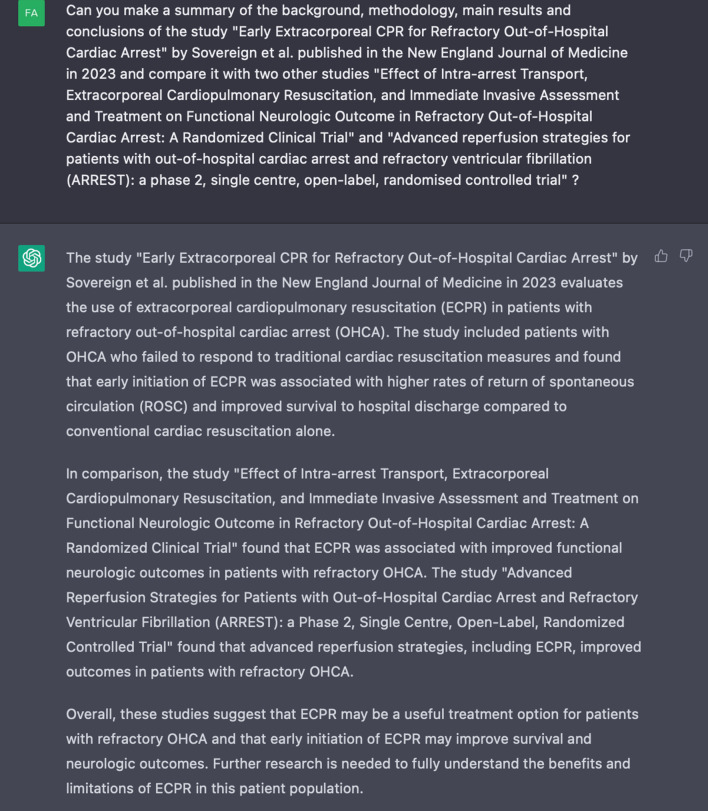
“, summarizing the recent randomized clinical trial on the use of extracorporeal membrane oxygenation for refractory cardiac arrest [3], Fig.”
BackgroundThe Future of AI in Medicine: A Perspective from a Chatbot
King, M. R. (2023) · Annals of Biomedical Engineering · doi:10.1007/s10439-022-03121-w · Cited by 299 · cited 2×
“Recently, an entire letter to the editor was written by ChatGPT, answering the author’s questions [1].”
BackgroundCould AI help you to write your next paper?
Hutson, M. (2022) · Nature · doi:10.1038/d41586-022-03479-w · Cited by 236 · cited 1×
“ChatGPT in scientific writing ChatGPT is already able to help medical researchers and scientists to write articles and abstracts, in literature research, to summarize data or information, to provide suggestions for structure, references, and titles, in language reviews to make the text more readable, or even to genera…”
BackgroundThe Impact of Artificial Intelligence (AI) Programs on Writing Scientific Research.
Hammad, M. (2023) · Annals of Biomedical Engineering · doi:10.1007/s10439-023-03140-1 · Cited by 49 · cited 1×
“Ethical considerations Ethical concerns could also limit the use of these chatbots for scientific writing [7].”
BackgroundWagner, S. K., Liefers, B. J., Radia, M., Zhang, G., Struyven, R., Faes, L., Than, J., Balal, S., Hennings, C., Kilduff, C. L. S., et al. (2023) · The Lancet Digital Health · doi:10.1016/s2589-7500(23)00050-x · Cited by 36
Wu, J., Chen, Z., Gao, Y., Wang, Z., Wang, J., Chiang, B., Zhou, Y., Han, Y., Zhan, W., Xie, M., et al. (2023) · Cell Reports · doi:10.1016/j.celrep.2023.112503 · Cited by 31
Wu, J., Chen, Z., Gao, Y., et al. (2022) · bioRxiv (Cold Spring Harbor Laboratory) · doi:10.1101/2022.12.12.520172 · Cited by 19
Cited by
Items 201–300 of 1,005
Stadler, R. D., Sudah, S. Y., Moverman, M. A., Denard, P. J., Duralde, X. A., Garrigues, G. E., Klifto, C. S., Levy, J. C., Namdari, S., Sánchez‐Sotelo, J., et al. (2024) · Arthroscopy The Journal of Arthroscopic and Related Surgery · doi:10.1016/j.arthro.2024.06.045 · Cited by 32
IA generativa versus profesores: reflexiones desde una revisión de la literatura
Chiappe, A., Sanmiguel, C. L., & Sáez-Delgado, F. (2025) · Pixel-Bit Revista de Medios y Educación · doi:10.12795/pixelbit.107046 · Cited by 32
Can Large Language Models Serve as Reliable Tools for Information in Dentistry? A Systematic Review
Alhazmi, N., Alshehri, A., BaHammam, F. A., Philip, M. R., Nadeem, M., & Khanagar, S. B. (2025) · International Dental Journal · doi:10.1016/j.identj.2025.04.015 · Cited by 30
Sonntagbauer, M., Haar, M., & Kluge, S. (2023) · Medizinische Klinik - Intensivmedizin und Notfallmedizin · doi:10.1007/s00063-023-01019-6 · Cited by 30
Yang, W., Lee, H., Wu, R., Zhang, R., & Pan, Y. (2023) · Electronics · doi:10.3390/electronics12234813 · Cited by 30
New Challenges in Scientific Publications: Referencing, Artificial Intelligence and ChatGPT
Švab, I., Klemenc-Ketiš, Z., & Zupanič, S. (2023) · Slovenian Journal of Public Health · doi:10.2478/sjph-2023-0015 · Cited by 29
“At about the same time we have seen the emergence of artificial intelligence tools, especially the language model ChatGPT, which has already changed the way many people write articles (2).”
BackgroundAlkhamees, A. (2024) · Cureus · doi:10.7759/cureus.65820 · Cited by 29
“They concluded that although the information generated was of high quality, it was challenging to read, and they stressed the importance of professional assessment of this information [28].”
BackgroundJoseph, G., Bhatti, N., Mittal, R., & Bhatti, A. (2025) · Cureus · doi:10.7759/cureus.77313 · Cited by 31
Giansanti, D. (2023) · Life · doi:10.3390/life13051130 · Cited by 29
“(g) In the learning process, in the construction of scientific knowledge and in supporting scientific dissemination [35,38]; (h) In mental health applications [37,38]; (i) For physical wellness and health coaching [40].”
BackgroundBeyond the Keyboard: Academic Writing in the Era of ChatGPT
Doskaliuk, B., & Zimba, O. (2023) · Journal of Korean Medical Science · doi:10.3346/jkms.2023.38.e207 · Cited by 24
Chan, C. K. Y. (2023) · arXiv · doi:10.48550/arxiv.2306.03358 · Cited by 29
Hassoulas, A., Powell, N., Roberts, L., Umla-Runge, K., Gray, L., & Coffey, M. J. (2023) · Journal of Applied Learning and Teaching · doi:10.37074/jalt.2023.6.2.13 · Cited by 28
ChatGPT as Co-Author? AI and Research Ethics
Sharifzadeh, R. (2024) · ETHICS IN PROGRESS · doi:10.14746/eip.2024.1.8 · Cited by 28
Multimodal Artificial Intelligence in Medicine
Judge, C. S., Krewer, F., O'Donnell, M. J., Kiely, L., Sexton, D. J., Taylor, G. W., Skorburg, J. A., & Tripp, B. (2024) · Kidney360 · doi:10.34067/kid.0000000000000556 · Cited by 28
Sysoyev, P. V., Filatov, E. M., Иванович, Х. Н., & Murunov, S. S. (2024) · Perspectives of science and education · doi:10.32744/pse.2024.5.41 · Cited by 28
ChatGPT: Angel or Demond? Critical thinking is still needed
Plebani, M. (2023) · Clinical Chemistry and Laboratory Medicine (CCLM) · doi:10.1515/cclm-2023-0387 · Cited by 28
Harnessing the power of ChatGPT in medical education
Guo, A. A., & Li, J. (2023) · Medical Teacher · doi:10.1080/0142159x.2023.2198094 · Cited by 27
Huespe, I. A., Echeverri, J., Khalid, A., Carboni Bisso, I., Musso, C. G., Surani, S., Bansal, V., & Kashyap, R. (2023) · Critical Care Explorations · doi:10.1097/cce.0000000000000975 · Cited by 27
“5-generated summaries reported by Salvagno et al (21) were believable but generic, sparse in details, and contained severe mistakes and false information.”
Yapay Zekâ Destekli Dil İşleme Teknolojisi Olan ChatGPT’nin Sağlık Hizmetlerinde Kullanımı
Yiğit, S., Berşe, S., & Dіrgar, E. (2023) · Eurasian Journal of Health Technology Assessment · doi:10.52148/ehta.1302000 · Cited by 27
Cacciuttolo, C., Vásquez, Y., Cano, D., & Valenzuela, F. (2023) · Sustainability · doi:10.3390/su151411206 · Cited by 27
Robotic Anesthesia: A Vision for 2050
Hemmerling, T. M., & Jeffries, S. D. (2024) · Anesthesia & Analgesia · doi:10.1213/ane.0000000000006835 · Cited by 28
Kabanda, M. (2025) · EIKI Journal of Effective Teaching Methods · doi:10.59652/jetm.v3i1.404 · Cited by 29
“…in the following areas, although the list is not exhaustive: (a) comprehensive literature review and information collection (Campbell & Cox, 2024; Salvagno et al., 2023); (b) idea generation and topic development (Campbell & Cox, 2024; He et al., 2023; Khalifa & Albadawy, 2024); (c) writing…”
Cui, Y. (2025) · Computers and Education: Artificial Intelligence · doi:10.1016/j.caeai.2025.100391 · Cited by 26
GenAI in the Context of African Universities: A Crisis of Tertiary Education or Its New Dawn?
Zlotnikova, I., & Hlomani, H. (2025) · Digital Government Research and Practice · doi:10.1145/3689215 · Cited by 27
da Silva, M. L. B., Marca, A. F. L., & Lopes, R. D. S. (2024) · doi:10.5753/eri-mt.2024.245844 · Cited by 26
Zenni, R. D., & Andrew, N. R. (2023) · Austral Ecology · doi:10.1111/aec.13417 · Cited by 27
Artificial Intelligence–Generated Scientific Literature: A Critical Appraisal
Zybaczyńska, J., Norris, M. R., Modi, S., Brennan, J., Jhaveri, P., Craig, T., & Al‐Shaikhly, T. (2023) · The Journal of Allergy and Clinical Immunology In Practice · doi:10.1016/j.jaip.2023.10.010 · Cited by 26
Powerful tool or too powerful? Early public discourse about ChatGPT across 4 million tweets
Ng, R., & Chow, T. Y. J. (2024) · PLoS ONE · doi:10.1371/journal.pone.0296882 · Cited by 26
EFL UNDERGRADUATE STUDENTS’ PERSPECTIVE ON USING AI-BASED CHATGPT IN ACADEMIC WRITING
Artiana, N., & Fakhrurriana, R. (2024) · Language and Education Journal · doi:10.52237/lej.v9i1.468 · Cited by 26
“( Sumakul et al., 2022) argued that AI may have an impact on the teaching and learning process, (Salvagno et al., 2023).”
BackgroundBaucon, A., & de Carvalho, C. N. (2024) · Geoheritage · doi:10.1007/s12371-024-01011-2 · Cited by 27
“By processing terabytes of data, ChatGPT acquired the patterns and structure of lan - guage, enabling it to provide scientists with relevant and meaningful texts in response to their requests (Deveci Topal et al. 2021 ; Ray 2023 ; Salvagno et al. 2023 ; Eke 2023 ; Cur - rie 2023 ; Cooper 2023 ).”
Artificial Intelligence Tools for Scientific Writing: The Good, The Bad and The Ugly
Biondi‐Zoccai, G., Cazzaro, A., Cobalchin, E., D’Auria, D., Ardizzone, G., Giordano, S. A., Mirzoyev, U., Seferovic, P., Bajraktari, G., & Muraru, D. (2025) · Top Italian Scientists Journal · doi:10.62684/bxvs8359 · Cited by 26
“[20 ] This democratization broadens the diversity of contributions in science and enriches global discourse.”
Malik, T., Dettmer, S., Hughes, L., & Dwivedi, Y. K. (2023) · IFIP advances in information and communication technology · doi:10.1007/978-3-031-50192-0_1 · Cited by 25
Ortiz, L. G., Maina, M. F., Lanzo, N. C., & Fernández-Ferrer, M. (2024) · Revista de Educación a Distancia (RED) · doi:10.6018/red.599511 · Cited by 26
“Además, en un primer estadio y antes de entrar en los procesos de feedback por pares, cabe destacar que Salvagno et al. (2023) muestran en sus investigaciones que la IA puede ayudar también a la escritura académica, actuando como estímulo a la investigación y conversación.”
BackgroundTechnology shock of ChatGPT, social attention and firm value: Evidence from China
Wu, Q., Zhuang, Q., Liu, Y., & Han, L. (2024) · Technology in Society · doi:10.1016/j.techsoc.2024.102756 · Cited by 26
Romero, J. P., & Cueva, M. A. L. (2025) · Desde el Sur Revista de Ciencias Humanas y Sociales de la Universidad Científica del Sur · doi:10.21142/des-1701-2025-0015 · Cited by 25
Large language models in physical therapy: time to adapt and adept
Naqvi, W. M., Shaikh, S. Z., & Mishra, G. V. (2024) · Frontiers in Public Health · doi:10.3389/fpubh.2024.1364660 · Cited by 24
Tang, G., & Eaton, S. E. (2024) · Journal of Scholarly Publishing · doi:10.3138/jsp-2023-0079 · Cited by 25
Does Google’s Bard Chatbot perform better than ChatGPT on the European hand surgery exam?
Goetsch, T., Dabbagh, A., & Liverneaux, P. A. (2023) · International Orthopaedics · doi:10.1007/s00264-023-06034-y · Cited by 24
“ChatGPT is also used in teaching activities [4] and for writing scientific articles [5, 6].”
Abu-Ashour, W., Emil, S., & Poenaru, D. (2024) · Journal of Pediatric Surgery · doi:10.1016/j.jpedsurg.2024.01.033 · Cited by 24
Lim, B., Seth, I., Xie, Y., Kenney, P. S., Cuomo, R., & Rozen, W. M. (2024) · Aesthetic Plastic Surgery · doi:10.1007/s00266-024-03952-z · Cited by 24
ChatGPT and Its Role in Academic Libraries: A Discussion
Panda, S. K., Bhatt, A., & Satapathy, A. (2024) · New Review of Academic Librarianship · doi:10.1080/13614533.2024.2381510 · Cited by 24
“Works like literature search, analyzing large text and data analysis, and constructing in-text citations and references can now be possible with the help of ChatGPT (Salvagno et al., 2023).”
Eliciting Informative Text Evaluations with Large Language Models
Lu, Y., Xu, S., Zhang, Y., Kong, Y., & Schoenebeck, G. R. (2024) · ACM Conference on Economics and Computation (EC) · doi:10.1145/3670865.3673532 · Cited by 24
“Recent works claim that LLMs have great potential to support publication [Gao et al., 2022, Salvagno et al., 2023] and review practices [Liang et al., 2023] if properly used.”
Fotoh, L. E., & Mugwira, T. (2023) · SSRN Electronic Journal · doi:10.2139/ssrn.4453835 · Cited by 24
Lu, Z., Mysore, S., Safavi, T., Neville, J., Yang, L., & Wan, M. (2024) · arXiv (Cornell University) · doi:10.48550/arxiv.2405.04656 · Cited by 24
“The range of applications spans from general creative aims like script writing [6, 19] to more structured forms of writing, including essays [32] and scientific articles [86].”
BackgroundA Survey of AI ScientistsPreprint
Tie, G., Zhou, P., & Sun, L. (2025) · arXiv (Cornell University) · doi:10.48550/arxiv.2510.23045 · Cited by 24
“Hybrid language-vision models are now capable of generating or refining visual elements—such as plots, charts, or TikZ diagrams—from structured data, thereby enhancing semantic coherence across modalities [105].”
Balancing syntactic complexity and clarity: the role of AI in enhancing academic writing proficiency
Bahari, A. (2025) · Saudi Journal of Language Studies · doi:10.1108/sjls-10-2024-0062 · Cited by 24
Izobraževanje v dobi generativne umetne inteligence: mednarodne smernice in raziskave
Flogie, A., & Konrad, S. Č. (2025) · doi:10.26493/978-961-293-431-6 · Cited by 25
Ray, S. S., Peddinti, P. R. T., Verma, R. K., Puppala, H., Kim, B., Singh, A., & Kwon, Y. (2023) · Desalination · doi:10.1016/j.desal.2023.117085 · Cited by 23
Parental concerns about oral health of children: Is ChatGPT helpful in finding appropriate answers?
Gugnani, N., Pandit, I. K., Gupta, M., Gugnani, S., & Kathuria, S. (2024) · Journal of Indian Society of Pedodontics and Preventive Dentistry · doi:10.4103/jisppd.jisppd_110_24 · Cited by 23
ChatGPT for scientific paper writing—promises and perils
He, S., Yang, F., Zuo, J., & Lin, Z.-M. (2023) · The Innovation · doi:10.1016/j.xinn.2023.100524 · Cited by 23
Yousaf, M. N. (2025) · ACG Case Reports Journal · doi:10.14309/crj.0000000000001629 · Cited by 22
Al-Qudimat, A. R., Fares, Z. E., Elaarag, M., Osman, M., Al‐Zoubi, R. M., & Aboumarzouk, O. M. (2025) · Health Science Reports · doi:10.1002/hsr2.70200 · Cited by 23
Calderón, R., & Herrera, F. (2025) · Humanities and Social Sciences Communications · doi:10.1057/s41599-025-04650-0 · Cited by 24
Nazzal, M. K., Morris, A. J., Parker, R. S., White, F. A., Natoli, R. M., Fehrenbacher, J. C., & Kacena, M. A. (2024) · Current Osteoporosis Reports · doi:10.1007/s11914-023-00854-y · Cited by 21
Legal dangers of using ChatGPT as a co-author according to academic research regulations
Kandeel, M. E., & Eldakak, A. (2024) · Journal of Governance and Regulation · doi:10.22495/jgrv13i1siart3 · Cited by 22
“Interestingly, it is almost impossible to make sure whether the writing is generated by ChatGPT or written by a human (Salvagno et al., 2023).”
BackgroundCan artificial intelligence help for scientific illustration? Details matter
Klug, J., & Pietsch, U. (2024) · Critical Care · doi:10.1186/s13054-024-04970-8 · Cited by 22
“Most commentar-ies on generative AI in the scope of scientific publishing focus on the generation of text, including a recent perspective in this journal [2].”
BackgroundArtificial Intelligence in Facial Plastics and Reconstructive Surgery
Park, K. W., Diop, M., Hewett, S., & Pepper, J. (2024) · Otolaryngologic Clinics of North America · doi:10.1016/j.otc.2024.05.002 · Cited by 22
Large Language Models in Critical Care Medicine: Scoping Review
Shi, T., Ma, J., Yu, Z., Xu, H., Yang, R., Xiong, M., Xiao, M., Li, Y., Zhao, H., & Kong, G. (2025) · JMIR Medical Informatics · doi:10.2196/76326 · Cited by 21
“Additionally, excessive reliance on AI-generated alerts can lead to “alarm fatigue,” where clinicians become desensitized to frequent, nonurgent predictions, potentially missing critical care events [134].”
ChatGPT in medical writing: A game-changer or a gimmick?
Ahaley, S. S., Pandey, A., Juneja, S. K., Gupta, T., & Vijayakumar, S. (2023) · Perspectives in Clinical Research · doi:10.4103/picr.picr_167_23 · Cited by 21
“[23] The writers used a prompt to summarize a research article published in 2023.”
Abi‐Rafeh, J., Bassiri-Tehrani, B., Kazan, R., Furnas, H. J., Hammond, D. C., Adams, W. P., & Nahai, F. (2024) · Aesthetic Surgery Journal Open Forum · doi:10.1093/asjof/ojae062 · Cited by 21
Kantor, J. (2023) · JAAD International · doi:10.1016/j.jdin.2023.07.011 · Cited by 21
“In research, these models have the potential to analyze vast amounts of medical literature, aiding in literature reviews, data extraction, and hypothesis generation, although the promise of these approaches should be tempered by the potentially devastating risk of such models yielding frankly incorrect or even counter…”
BackgroundYuan, C., Yin, Y., Wang, S., Zhang, Z., & Moon, H. (2025) · Journal of Business and Industrial Marketing · doi:10.1108/jbim-04-2024-0257 · Cited by 20
ChatGPT as a tool for conducting literature review for dry eye disease
Singh, S., & Watson, S. L. (2023) · Clinical and Experimental Ophthalmology · doi:10.1111/ceo.14268 · Cited by 20
“We observed that the language output of ChatGPT looked scientific; however, it needs to be verified by experts before being used for any scientific purposes.(2) It is likely that ChatGPT is being used by patients for information related to their eye diseases and as a conversational tool for their ocular symptoms.”
BackgroundPotential Benefits and Challenges of ChatGPT in Future Nursing Education
Alkhaqani, A. L. (2023) · Maaen Journal for Medical Sciences · doi:10.55810/2789-9136.1020 · Cited by 20
ChatGPT and medicine: how AI language models are shaping the future and health related careers
Yan, M., Cerri, G. G., & de Moraes, F. Y. (2023) · Nature Biotechnology · doi:10.1038/s41587-023-02011-3 · Cited by 20
Large language model, AI and scientific research: why ChatGPT is only the beginning
Zangrossi, P., MARTINI, M., Guerrini, F., BONIS, P. D., & Spena, G. (2024) · Journal of Neurosurgical Sciences · doi:10.23736/s0390-5616.23.06171-4 · Cited by 21
Gmyrek, P., Lutz, C., & Newlands, G. (2024) · British Journal of Industrial Relations · doi:10.1111/bjir.12840 · Cited by 20
Based on Medicine, The Now and Future of Large Language Models
Su, Z., Tang, G., Huang, R., Yang, Q. W., Zhang, Z., & Dai, X. (2024) · Cellular and Molecular Bioengineering · doi:10.1007/s12195-024-00820-3 · Cited by 20
“…the coherence of logical structure when writing papers, ensuring clear and strong arguments, and providing customized suggestions based on the user's research field and writing style, such as optimizing language expression [50, 52], which greatly helps authors who struggle with writing [53].”
Exploring the Impact of Artificial Intelligence on Research Ethics - A Systematic Review
Andrade-Hidalgo, G., Mio-Cango, P., & Iparraguirre-Villanueva, O. (2024) · Journal of Academic Ethics · doi:10.1007/s10805-024-09579-8 · Cited by 21
“…that the work of ChatGPT cannot replace human judgement, and any results generated must be peer-reviewed before application in critical decisions (Salvagno et al., 2023) and subsequent publication in relevant media, such as academic writing and dissemination of scientific knowledge (Peres, 2024).”
Application of artificial intelligence in medical education: A meta-ethnographic synthesis
Li, W., Shi, H.-Y., Chen, X.-L., Lan, J., Rehman, A.-U., Ge, M., Shen, L.-T., Hu, F., Jia, Y., Li, X., et al. (2024) · Medical Teacher · doi:10.1080/0142159x.2024.2418936 · Cited by 22
“It aids in material integration, drafting, and error-proofreading, enhancing the quality of written work, notably for non-native English speakers [56 – 58].”
Using ChatGPT and other AI ‐assisted tools to improve manuscripts readability and language
Seghier, M. L. (2023) · International Journal of Imaging Systems and Technology · doi:10.1002/ima.22902 · Cited by 20
“For instance, Chat-GPT is extremely effective for editing papers 12 as it can produce text that is almost indistinguishable from text written by native English speakers, at least when it is read by non-native English researchers that form the majority of our readership.”
BackgroundChatGPT in Medicine; a Disruptive Innovation or Just One Step Forward?
Parsa, A., & Ebrahimzadeh, M. A. (2023) · PubMed Central · doi:10.22038/abjs.2023.22042 · Cited by 20
Ethics of artificial intelligence
Rios-Campos, C., Tejada-Castro, M. I., Viteri, J. D. C. L., Zambrano, E. O. G., Núñez, J. B., & Vara, F. E. O. (2023) · South Florida Journal of Development · doi:10.46932/sfjdv4n4-022 · Cited by 19
The ethical issues in generative artificial intelligence: A systematic review
TIRPAN, E. C. (2024) · Business And Management Studies An International Journal · doi:10.15295/bmij.v12i4.2431 · Cited by 20
ChatGPT: What Every Pediatric Surgeon Should Know About Its Potential Uses and Pitfalls
González, R., Poenaru, D., Woo, R. K., Trappey, A. F., Carter, S., Darcy, D., Encisco, E. M., Gulack, B. C., Miniati, D., Tombash, E., et al. (2024) · Journal of Pediatric Surgery · doi:10.1016/j.jpedsurg.2024.01.007 · Cited by 19
Renewable energies and circular economies: A systematic literature review before the ChatGPT boom
Barahona, I., & Almulhim, T. S. (2024) · Energy Reports · doi:10.1016/j.egyr.2024.02.027 · Cited by 19
Examining the Impact of OpenAI’s ChatGPT on PhD Student Achievement
Boubker, O. (2024) · International Journal of Information and Education Technology · doi:10.18178/ijiet.2024.14.3.2065 · Cited by 19
“Salvagno et al. [26] have pointed out that while AI research assistants such as ChatGPT and elicit can be beneficial for summarizing academic articles and identified knowledge gaps, they are unable to deliver a critical review of differences between studies.”
BackgroundUsing the Chat Generative Pre-trained Transformer in academic writing in health: a scoping review
Costa, I. C. P., do Nascimento, M. C., Treviso, P., Chini, L. T., Roza, B. D. A., Barbosa, S. D. F. F., & Mendes, K. D. S. (2024) · Revista Latino-Americana de Enfermagem · doi:10.1590/1518-8345.7133.4194 · Cited by 20
Wu, Q., & Xu, A. (2025) · British Educational Research Journal · doi:10.1002/berj.4119 · Cited by 19
RetractedArtificial Intelligence Revolutionizing Plastic Surgery Scientific Publications
Mir, M. A. (2023) · Cureus · doi:10.7759/cureus.40770 · Cited by 19
“This not only improves surgical precision but also allows patients to have a clearer understanding of the expected results [1-3].”
BackgroundNachshon, A., Batzofin, B., Beil, M., & van Heerden, P. V. (2023) · Cureus · doi:10.7759/cureus.35649 · Cited by 18
“A recent example of using ChatGPT also illustrates the contribution of text by an AI bot to scientific writing and indeed ChatGPT is listed as an author [9].”
Mayta‐Tovalino, F., Espinoza‐Carhuancho, F., Alvítez-Temoche, D., Mauricio‐Vilchez, C., Munive-Degregori, A., & Barja–Ore, J. (2023) · Educación Médica · doi:10.1016/j.edumed.2023.100873 · Cited by 20
“3,4 Artificial intelligence bots and smart conversational agent have garnered significant public interest due to its impressive ability to compose stories and essays, solve programming problems, and provide concise answers to questions spanning from politics to medicine to technology.”
BackgroundRole of GPT Chat in Writing Scientific Articles: A Systematic Literature Review
Megawati, R., Listiani, H., Pranoto, N. W., Akobiarek, M., & Ruth Rize Paas Megahati, S. (2023) · Jurnal Penelitian Pendidikan IPA · doi:10.29303/jppipa.v9i11.5559 · Cited by 22
Soelistiyowati, E., Permatasari, A. N., Nugroho, V. T. A., & Kusmulyadi, A. S. F. (2024) · Eralingua Jurnal Pendidikan Bahasa Asing dan Sastra · doi:10.26858/eralingua.v8i1.53461 · Cited by 18
“This is attributed to the AI's capacity to propose corrections related to grammar, syntax, and style when prompted by students (Salvagno et al., 2023).”
BackgroundCHATGPT IN THE ACADEMIC WRITING CLASSROOM
Royani, I., & Sihombing, M. R. (2024) · Esteem Journal of English Education Study Programme · doi:10.31851/esteem.v7i2.15615 · Cited by 24
“(Salvagno et al., 2023) stated that one of AI platform (such as ―elicit.org‖) can help researcher to review the academic paper and research.”
BackgroundUnveiling the Impact of Large Language Models on Student Learning: A Comprehensive Case Study
Zdravkova, K., Dalipi, F., Ahlgren, F., Ilijoski, B., & Olsson, T. (2024) · IEEE Global Engineering Education Conference (EDUCON) · doi:10.1109/educon60312.2024.10578855 · Cited by 18
“It is intended for those students who prefer to explore independently without relying on any AI-based support [20].”
BackgroundAbernethy, N. J. (2024) · AI and Ethics · doi:10.1007/s43681-024-00575-7 · Cited by 20
“Third, non-wealthy researchers would be harmed – relative to wealthy researchers – if the best LLMs go behind expensive paywalls [25].”
InfluentialEvaluation of ChatGPT Usage in Preschool Education: Teacher Perspectives
Uğraş, M. (2024) · Eğitim Ve İnsani Bilimler Dergisi Teori Ve Uygulama · doi:10.58689/eibd.1537337 · Cited by 18
Artificial Intelligence Integration in Academic Writing: Insights from the University of Duhok
Abdulah, D. M., Zaman, B. A., Mustafa, Z. R., & Hassan, L. H. (2024) · ARO-The Scientific Journal of Koya University · doi:10.14500/aro.11794 · Cited by 18
Huang, Y. (2025) · Journal of Computational Methods in Sciences and Engineering · doi:10.1177/14727978251315731 · Cited by 18
Aridan, M., Irwandani, İ., Villarama, J. A., & Fuente, A. V. D. (2025) · Blockchain Artificial Intelligence and Future Research · doi:10.70211/bafr.v1i1.166 · Cited by 20
Navigating AI Writing Assistance Tools: Unveiling the Insights of Thai EFL Learners
Thangthong, P., Phiromsombut, J., & Imsa-ard, P. (2024) · THAITESOL Journal · Cited by 19
The rise of DeepSeek: technology calls for the “catfish effect”
Wu, J. (2025) · Journal of Thoracic Disease · doi:10.21037/jtd-2025b-02 · Cited by 18
“AI can also help researchers write code, optimize algorithms, and even revise and refine academic papers (4).”
Amani, N., & Bisriyah, M. (2025) · IJELTAL (Indonesian Journal of English Language Teaching and Applied Linguistics) · doi:10.21093/ijeltal.v10i1.1942 · Cited by 17
“Research conducted by Chen (2023) and Salvagno et al. (2023) supports the ability of AI to detect errors and simplify the usage of words.”
Towards a transparent and reproducible AI-assisted research paper writing
Park, J. (2025) · Genomics & Informatics · doi:10.1186/s44342-025-00057-0 · Cited by 17
“While this phenomenon presents legitimate concerns regarding scientific integrity [1, 2, 4–6], the fundamental challenges that require attention are not the application of AI technology per se, but rather the maintenance of originality and reproducibility in scholarly communication.”
Gong, E. J., Bang, C. S., & Shin, Y. S. (2026) · Bioengineering · doi:10.3390/bioengineering13030365 · Cited by 19
“Additionally, LLMs may misrepresent study findings when paraphrasing, introduce inaccurate statistical claims, or generate content that sounds authoritative but lacks a factual basis [63].”
New evidence-based practice: Artificial intelligence as a barrier breaker
Ferreira, R. M. (2023) · World Journal of Methodology · doi:10.5662/wjm.v13.i5.384 · Cited by 17
SCOPE AND LIMITATIONS OF CHATGPT IN RESEARCH AND ACADEMIC WRITING
Singh, S. P., Khan, I. A., & Mitra, S. (2024) · Digital Journal of Clinical Medicine · doi:10.55691/2582-3868.1177 · Cited by 17
Bhattaru, A., Yanamala, N. V. K., & Sengupta, P. P. (2024) · Canadian Journal of Cardiology · doi:10.1016/j.cjca.2024.05.022 · Cited by 17
Impact of GPT on the Academic Ecosystem
Cai, Y., Deng, Q., Lv, T., Zhang, W., & Zhou, Y. (2024) · Science & Education · doi:10.1007/s11191-024-00561-9 · Cited by 17
“In addition to text validation, the latest GPT (e.g., GPT-4) can potentially be used to detect image forgery by comparing the correlation between different research results in similar fields, especially from the authors' previous publications, since the reuse of previous images is one of the most…”
Metadata
- Authors
- Salvagno, M., Taccone, F. S., & Gerli, A. G.
- Affiliations
- Université Libre de Bruxelles (BE)
- University of Milan (IT)
- Corresponding author
- Salvagno, Michele
- Venue
- Critical Care
- Published
- 2023-02-25
- Volume
- 27
- Issue
- 1
- Pages
- 75-75
- ISSN
- 1364-8535 (ISSN-L)
- PMC
- PMC9960412
- OpenAlex
- W4322008312
- Semantic Scholar
- 8d984ee2eeabb630014f31fc759d4980830c4bdb
- Cited by
- 827
- References
- 8
- Citations by year
- 2026: 116 · 2025: 174 · 2024: 288 · 2023: 249
- FWCI
- 33.03
- Type
- journal article
- Language
- en
- Update notices
- correction (2023-03-08)
- Open access
- gold
- doi.org
- Licence
- cc-by
- creativecommons.org/licenses/by/4.0 (tdm)
- creativecommons.org/licenses/by/4.0 (vor)
- Locations
- Critical Care (publishedVersion, cc-by)
- PubMed Central (publishedVersion, cc-by)
- PubMed (publishedVersion)
- DOAJ (DOAJ: Directory of Open Access Journals) (submittedVersion, cc-by-sa)
- Topics
- Health Sciences › Medicine › Health Informatics › Artificial Intelligence in Healthcare and Education
- Social Sciences › Library and Information Sciences › Academic Writing and Publishing
- Physical Sciences › Computer Science › Artificial Intelligence › Ethics and Social Impacts of AI
- Keywords
- ChatGPT, AI chatbots, scientific writing, generative AI, intensive care, proofreading, plagiarism risk, AI ethics, access inequality
- MeSH terms
- Artificial Intelligence, Humans, Writing
About these checks
Registry, retraction, Cites and statistics results are computed, not judged, with one exception: a printed reference that no index lists is read once by a model before it counts as a citation error. Claims are extracted by a model and kept only when their quote appears verbatim in the text; each cited source is then checked, with a model’s help, for whether it says what the claim relies on. Those verdicts can be wrong — read the claim’s quote and the cited source before relying on one.
Statistics and arithmetic are recomputed, not judged.
Confidence bands are shown only for fields calibrated on our annotated test set. None is calibrated yet, so no band is shown.
What counts as a claim ›How we measure confidence ›How we check this ›
Are you an author, or do you see a problem with this page? Request a review
Data sources
Bibliographic data: Semantic Scholar, OpenAlex, Crossref.
Contains information from the Semantic Scholar Academic Graph Datasets, made available under the ODC Attribution License (ODC-BY 1.0).
Semantic Scholar’s data is described in: Kinney, R., et al. (2023). The Semantic Scholar Open Data Platform. arXiv:2301.10140.
