

Can artificial intelligence help for scientific writing?
Open accessThe DOI matches its Crossref record; 10 of the 10 references it cites were found in a registry or an index.
Abstract
This paper discusses the use of Artificial Intelligence Chatbot in scientific writing. ChatGPT is a type of chatbot, developed by OpenAI, that uses the Generative Pre-trained Transformer (GPT) language model to understand and respond to natural language inputs. AI chatbot and ChatGPT in particular appear to be useful tools in scientific writing, assisting researchers and scientists in organizing material, generating an initial draft and/or in proofreading. There is no publication in the field of critical care medicine prepared using this approach; however, this will be a possibility in the next future. ChatGPT work should not be used as a replacement for human judgment and the output should always be reviewed by experts before being used in any critical decision-making or application. Moreover, several ethical issues arise about using these tools, such as the risk of plagiarism and inaccuracies, as well as a potential imbalance in its accessibility between high- and low-income countries, if the software becomes paying. For this reason, a consensus on how to regulate the use of chatbots in scientific writing will soon be required.
Overview
The claims and statistics of this paper haven’t been checked yet.
Free: it reads the open-access text and checks the first 5 claims that cite a source we can check. Create a free account to check every claim.
Integrity signals
Registry
Cites
Statistics
Figures
Verification
Claims the paper makes
The claims and statistics of this paper haven’t been checked yet.
Free: it reads the open-access text and checks the first 5 claims that cite a source we can check. Create a free account to check every claim.
Claims other papers make about this one
Each is checked against this paper’s own text: does it say what the citing paper says it does?
The source backs part of the claim, not all of it — or backs it for a different population, condition or comparison.
In the citing paper
“Additionally, learners can expedite their writing development as AI tools help them identify and rectify grammatical and lexical errors, while also suggesting alternative sentence structures to enhance the overall writing quality and structure (Zhao, 2022; Chen, 2023; Salvagno et al., 2023).”
From Enhancing academic writing skills and motivation: assessing the efficacy of ChatGPT in AI-assisted language learning for EFL students (2023) · cites this paper as Salvagno et al., 2023
Experimental — accuracy not yet measuredThe source backs part of the claim, not all of it — or backs it for a different population, condition or comparison.
In the citing paper
“The authorship dilemma in AI-assisted research revolves around who should be credited for AI-generated content and how AI's role should be disclosed [67].”
From Developing the HAKI model as a conceptual framework for AI-assisted academic research (2026) · cites this paper as [67]
Experimental — accuracy not yet measuredThe source backs part of the claim, not all of it — or backs it for a different population, condition or comparison.
In the citing paper
“Recent studies show that GAI can improve writing quality by enhancing grammar, vocabulary, and fluency.”
From Exploring How AI Literacy and Self-Regulated Learning Relate to Student Writing Performance and Well-Being in Generative AI-Supported Higher Education (2025) · cites this paper as Salvagno et al., 2023
Experimental — accuracy not yet measuredThe source backs part of the claim, not all of it — or backs it for a different population, condition or comparison.
In the citing paper
“Additionally, the automation features of AI streamline tasks like formatting and citation, freeing up substantial time and energy for researchers, which can then be redirected towards more complex and innovative work.3,4”
From Balancing innovation and integrity: the role of AI in research and scientific writing (2023) · cites this paper as [3]
Experimental — accuracy not yet measuredThe cited source says what the claim attributes to it.
In the citing paper
“chatbots, including ChatGPT, have increased the difficulty in identifying plagiarism [47, 67, 76]”
From A systematic literature review of empirical research on ChatGPT in education (2024) · cites this paper as [67]
7 more claims about this paper
Create a free account to see every claim other papers make about this one.
Self-check
Percentages, sums and reported differences re-computed from the paper’s own numbers.
The self-check needs the paper’s full text.
Citations
Cites
Gao, C. A., Howard, F. M., Markov, N. S., Dyer, E. C., Ramesh, S., Luo, Y., & Pearson, A. T. (2022) · doi:10.1101/2022.12.23.521610 · Cited by 1,099
ChatGPT: the future of discharge summaries?
Patel, S. B., & Lam, K. (2023) · The Lancet Digital Health · doi:10.1016/s2589-7500(23)00021-3 · Cited by 728
Abstracts written by ChatGPT fool scientists
Else, H. (2023) · Nature · doi:10.1038/d41586-023-00056-7 · Cited by 611 · cited 1×
“Moreover, it may be difficult to recognize whether a paper is written by a chatbot or a human being [5], because chatbots use advanced techniques, such as natural language processing (NLP) and machine learning, to generate text that is similar to human writing.”
BackgroundEarly Extracorporeal CPR for Refractory Out-of-Hospital Cardiac Arrest
Suverein, M. M., Delnoij, T. S. R., Lorusso, R., Brandon Bravo Bruinsma, G. J., Otterspoor, L., Elzo Kraemer, C. V., Vlaar, A. P. J., van der Heijden, J. J., Scholten, E., den Uil, C., et al. (2023) · New England Journal of Medicine · doi:10.1056/nejmoa2204511 · Cited by 537 · cited 1×
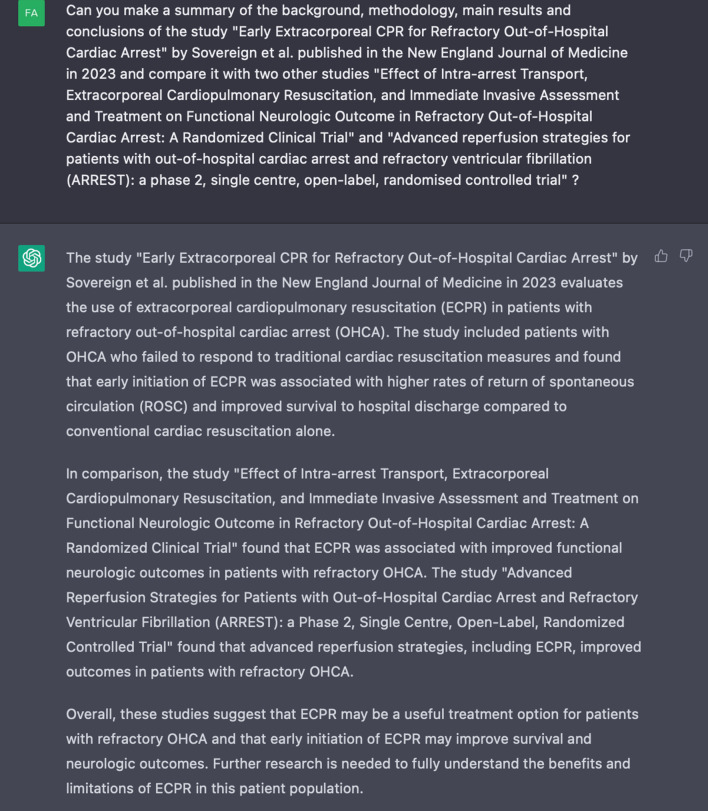
“, summarizing the recent randomized clinical trial on the use of extracorporeal membrane oxygenation for refractory cardiac arrest [3], Fig.”
BackgroundThe Future of AI in Medicine: A Perspective from a Chatbot
King, M. R. (2023) · Annals of Biomedical Engineering · doi:10.1007/s10439-022-03121-w · Cited by 299 · cited 2×
“Recently, an entire letter to the editor was written by ChatGPT, answering the author’s questions [1].”
BackgroundCould AI help you to write your next paper?
Hutson, M. (2022) · Nature · doi:10.1038/d41586-022-03479-w · Cited by 236 · cited 1×
“ChatGPT in scientific writing ChatGPT is already able to help medical researchers and scientists to write articles and abstracts, in literature research, to summarize data or information, to provide suggestions for structure, references, and titles, in language reviews to make the text more readable, or even to genera…”
BackgroundThe Impact of Artificial Intelligence (AI) Programs on Writing Scientific Research.
Hammad, M. (2023) · Annals of Biomedical Engineering · doi:10.1007/s10439-023-03140-1 · Cited by 49 · cited 1×
“Ethical considerations Ethical concerns could also limit the use of these chatbots for scientific writing [7].”
BackgroundWagner, S. K., Liefers, B. J., Radia, M., Zhang, G., Struyven, R., Faes, L., Than, J., Balal, S., Hennings, C., Kilduff, C. L. S., et al. (2023) · The Lancet Digital Health · doi:10.1016/s2589-7500(23)00050-x · Cited by 36
Wu, J., Chen, Z., Gao, Y., Wang, Z., Wang, J., Chiang, B., Zhou, Y., Han, Y., Zhan, W., Xie, M., et al. (2023) · Cell Reports · doi:10.1016/j.celrep.2023.112503 · Cited by 31
Wu, J., Chen, Z., Gao, Y., et al. (2022) · bioRxiv (Cold Spring Harbor Laboratory) · doi:10.1101/2022.12.12.520172 · Cited by 19
Cited by
Items 501–600 of 1,005
Yao-jun, R., & Tekwa, K. (2025) · Education and Information Technologies · doi:10.1007/s10639-025-13516-6 · Cited by 6
“Salvagno et al. (2023) speculated that GenAI may “help in the literature review, identify research questions, provide an overview of the current state of the field, and assist with tasks, such as formatting and language review” (p. 4).”
Heriyawati, D. F., & Romadhon, M. G. E. (2025) · Computer-Assisted Language Learning Electronic Journal · doi:10.54855/callej.252614 · Cited by 6
“Lastly, Salvagno et al. (2023) conducted a comprehensive review examining the ramifications associated with the utilization of chatbots.”
Redacción de un Artículo Científico: Algunas Sugerencias
Manterola, C., Zanella, L., Rivadeneira, J., & Holguín-Carvajal, J. P. (2025) · International Journal of Morphology · doi:10.4067/s0717-95022025000300737 · Cited by 6
Generative AI: Concerns, usage, challenges, opportunities and sentiments
Twinomurinzi, H., & Gumbo, S. (2025) · South African Computer Journal · doi:10.18489/sacjv37i1/17890 · Cited by 6
A Comprehensive Scientometric Analysis of ChatGPT Research Global Trends and Future Prospects
Monib, W. K., Qazi, A., Jain, J. A., & Ponniah, L. S. (2025) · TechTrends · doi:10.1007/s11528-025-01110-z · Cited by 6
Integridade acadêmica na era do ChatGPT: Desafios éticos e as novas fronteiras da Inovação
de Lima, J. C. R., & Felippe, M. L. (2025) · Revista Brasileira da Educação Profissional e Tecnológica · doi:10.15628/rbept.2025.17803 · Cited by 6
Mohamed, A. A., Rajendran, S., Colome, D., Sargent, E. C., Schirmer, C. M., Vessell, M., Lucke-Wold, B. P., Sharma, A., Adogwa, O., & Pirris, S. M. (2025) · Neurosurgical Review · doi:10.1007/s10143-025-03793-7 · Cited by 6
Critical Literacy in an AI World
Mills, K. A., & Gutierrez, A. (2025) · Routledge eBooks · doi:10.4324/9781003539193 · Cited by 8
Using ChatGPT to Write Scientific Papers in Indonesia: A Systematic Review
Suntoro, S., Ida, Z., Hari Bakti, M., & Tommi, Y. (2024) · Ianna Journal of Interdisciplinary Studies · doi:10.5281/zenodo.13337610 · Cited by 7
Bohler, F., Tran, T., Burmeister, J. R., Hadid, K., Joshi, S., Gao, S., & Chaiyasate, K. (2025) · Journal of Craniofacial Surgery · doi:10.1097/scs.0000000000012366 · Cited by 6
Quality assessment of large language model–generated prior authorization letters in nephrology
Aiumtrakul, N., Thongprayoon, C., Kookanok, C., Poochanasri, M., Phichedwanichskul, K., & Cheungpasitporn, W. (2026) · Frontiers in Digital Health · doi:10.3389/fdgth.2026.1767648 · Cited by 6
Publish or Perish: The Impact of ChatGPT on Future Academics
Kamal, M. A. A., & Khaidzir, M. F. S. (2024) · Arab World English Journal · doi:10.24093/awej/chatgpt.22 · Cited by 7
Large multimodal models assist in psychiatry disorders prevention and diagnosis of students
Liu, X., Wang, X., & Zhang, H.-R. (2024) · World Journal of Psychiatry · doi:10.5498/wjp.v14.i10.1415 · Cited by 6
The Role of Artificial Intelligence in Scientific Writing
Farhat, K. H., & Arafa, M. A. (2024) · International Journal of Science and Healthcare Research · doi:10.52403/ijshr.20240421 · Cited by 6
Stadnik, M., Coskovic, A. L., Banko, T., & Ružak, D. (2025) · Interdisciplinary Description of Complex Systems · doi:10.7906/indecs.23.1.3 · Cited by 6
“As AI technologies assist learners in recognising and correcting grammatical and lexical problems, as well as recommending alternative sentence patterns to improve the overall quality and structure of their writing, learners can accelerate their writing progress 4-6 .”
Fajt, B., & Kállai, B. J. (2024) · Iskolakultúra · doi:10.14232/iskkult.2024.12.75 · Cited by 6
Fitria, N., Fauzi, F., Muchsin, M., Zahra, C. M., Usman, M., & Usman, B. (2024) · Jurnal Sociohumaniora Kodepena (JSK) · doi:10.54423/jsk.v5i1.180 · Cited by 6
Areas of research focus and trends in the research on the application of AIGC in healthcare
Wang, C., Zhu, Y., Zhang, X., Chen, X., Li, Y., Tan, Y., & Qi, H. (2025) · Journal of Health Population and Nutrition · doi:10.1186/s41043-025-00947-7 · Cited by 6
“Both Alkaissi H et al. [22] and Salvagno M et al. [24] dicussed the use of ChatGPT in scienctific writing, concluded that although ChatGPT appear to be useful tools, it is still controversial in terms of ethics and acceptability; Cascella M et al. [23] analyzed the potential of AIGC applications in…”
Paradox Artificial Intelligence: Encourage Innovation or Kill Thoughts?
Wirawan, A. K., & Saputri, V. A. (2024) · Proceeding International Conference on Education · Cited by 6
Pursuing Sustainable Development Goals
Balın, B. E., Akan, H. M., Özenç, F. K., & Garan, Ö. (2024) · Istanbul University Press eBooks · doi:10.26650/b/ss10.2024.013 · Cited by 6
Bibliometric Analysis of Global Research on Scientific Writing
Maral, M. (2024) · DESIDOC Journal of Library & Information Technology · doi:10.14429/djlit.44.3.19534 · Cited by 6
“Furthermore, the problematic aspects of the use of ChatGPT in scientific writing have been discussed from an ethical point of view and it has been stated that it may increase inequality for disadvantaged countries and researchers 16 .”
BackgroundCan Generative AI Contribute to Health Literacy? A Study in the Field of Ophthalmology
Ruíz-Núñez, C., Rodríguez, J. G., Ruíz, A., Gismero-Moreno, S., Santos, M. S. C., & Herrera‐Peco, I. (2024) · Multimodal Technologies and Interaction · doi:10.3390/mti8090079 · Cited by 6
“Another limitation related to ethics is the tendency of these models to amplify biases [18,19], such as automation bias or attributing greater importance to information generated by a computer program.”
Kumar, S., & Jayswal, S. C. (2025) · Engineering Research Express · doi:10.1088/2631-8695/ada68c · Cited by 6
Impact of ChatGPT and Artificial Intelligence in the Contemporary Medical Landscape
Calleja-López, J. R. T., Rivera-Rosas, C. N., & Ruibal-Tavares, E. (2023) · Archives of Medical Research · doi:10.1016/j.arcmed.2023.05.003 · Cited by 6
Romero, J. P., Díaz, I. S., & Ramos-Castillo, J. (2023) · Revista Peruana de Ginecología y Obstetricia · doi:10.31403/rpgo.v69i2566 · Cited by 6
“…conse - cuencia surgen aspectos como la ética, integri - dad, precisión de datos, confiabilidad, derechos de propiedad intelectual, que aún se encuentran en debate entre quienes la consideran como una herramienta útil y quienes la juzgan como una amenaza contra la integridad de la autoría (20) .”
BackgroundRailean, Е., Pavalachi, D., & Ceobanu, C. (2023) · Proceedings of the... International Conference on Virtual Learning · doi:10.58503/icvl-v18y202312 · Cited by 5
Elméleti alapok és tapasztalatok a szisztematikus fókuszált szakirodalmi áttekintés során
Kolnhofer-Derecskei, A., Szászvári, K. Á., Téglás, T. T., & Reicher, R. Z. (2023) · Multidiszciplináris kihívások sokszínű válaszok · doi:10.33565/mksv.2023.02.01 · Cited by 5
Estrella, F. (2025) · Social Education Research · doi:10.37256/ser.6120255896 · Cited by 5
“These tools encompass collaborative text editors, concept-mapping programs, proofreading software, and writing cohesion support applications (Salvagno et al., 2023).”
Durrani, N., Imran, M., & Saeed, R. (2025) · Journal of Family Medicine and Primary Care · doi:10.4103/jfmpc.jfmpc_1615_24 · Cited by 6
“[10] Following the success and popularity of ChatGPT, another user-friendly chatbot was launched in 2023 by Google AI named “BARD”.”
Setyowati, E. M., Rahmawati, R., Nashrullah, A. H., Haqi, S., Wardana, L. W., & Narmaditya, B. S. (2025) · JISPENDIORA Jurnal Ilmu Sosial Pendidikan Dan Humaniora · doi:10.56910/jispendiora.v4i2.2285 · Cited by 5
Nieves-López, B., Wing, C. W., Springer, B. D., & Aziz, K. T. (2025) · Arthroplasty Today · doi:10.1016/j.artd.2025.101772 · Cited by 5
Khaw, L. L. (2025) · Innovations in Education and Teaching International · doi:10.1080/14703297.2025.2530766 · Cited by 5
“…in scientific writing has sparked off discussion on the integrity of academic research and scholarly publishing, with potential issues such as plagiarism, copyright infringement and privacy violation identified (Gomes et al., 2023; Lund et al., 2023; Pawlicka et al., 2024; Salvagno et al., 2023).”
Aich, F. Z., Boumahdy, L., Benfilali, I., & Sandy, K. (2025) · Arab World English Journal · doi:10.24093/awej/call11.12 · Cited by 5
“…easy for ChatGPT to be considered an author and to produce a complete literature review instantly and effortlessly (Pavlik, 2023), which raises academic ethical concerns—plagiarism and academic honesty (Buriak et al., 2023; Chen, 2023; Liebrenz et al., 2023; Salvagno et al., 2023; Halaweh, 2023).”
ZainAlAbdin, S., Kendakji, S., Alrahbi, F., Alazeezi, K., Jawas, M., Al-Shamsi, S. R., Almessabi, T., Zaki, N., & Aburuz, S. (2025) · Pharmacotherapy The Journal of Human Pharmacology and Drug Therapy · doi:10.1002/phar.70089 · Cited by 6
Sebo, P., Nie, B., & Wang, T. (2025) · F1000Research · doi:10.12688/f1000research.173647.1 · Cited by 5
Коваль, Е. А., Ушкин, С. Г., Николаевна, А. О., & Zhadunova, N. V. (2026) · Высшее образование в России · doi:10.31992/0869-3617-2025-34-12-107-126 · Cited by 5
Aydin, M. O., Vatansever, A., & Kafa, S. E. (2026) · Uludağ Üniversitesi Tıp Fakültesi Dergisi · doi:10.32708/uutfd.1870116 · Cited by 5
Tsaï, S. C. (2026) · Innovation in Language Learning and Teaching · doi:10.1080/17501229.2026.2645994 · Cited by 5
Zhang, Y., Zhou, H., Huo, H., Yue, Y., Wang, J., & Zhu, J. (2026) · Medical Teacher · doi:10.1080/0142159x.2026.2681199 · Cited by 5
Does AI's touch diminish the artistry of scientific writing or elevate it?
Gandhi, M., & Gandhi, M. A. (2023) · Critical Care · doi:10.1186/s13054-023-04634-z · Cited by 5
“There is a need for continuous human oversight and critical analysis to prevent the misleading information generated by AI systems and to avoid the deprivation of essential qualitative insights that human expertise can provide for tasks such as peer review and data analysis [4].”
BackgroundChatGPT in Education: Augmenting Learning Experience or Dehumanizing Education?
Srishti, R. (2024) · Advances in business information systems and analytics book series · doi:10.4018/979-8-3693-2314-4.ch005 · Cited by 5
Chat GPT: General applications and uses in Dentistry
Vishwanathaiah, S., Maganur, P. C., Khanagar, S. B., Marwah, N., Manoharan, V., & Jeevanandan, G. (2023) · doi:10.54276/jupd.2023.2207 · Cited by 5
The Effect of Virtual Science Teaching Model on Scientific Creativity and Learning Outcomes
Wicaksono, I., & Erlina, N. (2024) · Jurnal Pendidikan MIPA · doi:10.23960/jpmipa/v25i1.pp440-452 · Cited by 6
Okunlola, J. O. (2024) · E-Journal of Humanities Arts and Social Sciences · doi:10.38159/ehass.202451114 · Cited by 5
Yapay Zekâ’da Güncel Yaklaşımlar: Bir Tasarım Aracı Olarak Veri Görselleştirme Teknikleri
Alkan, İ., & Oduncu, S. (2024) · Dokuz Eylül Üniversitesi Güzel Sanatlar Fakültesi Dergisi · doi:10.17484/yedi.1483618 · Cited by 6
Salih, A. M., Ahmed, J. O., Hiwa, D. S., Salih, A. M., Salih, R. Q. M., Hassan, H. A., Mahmood, Y. M., Mohammed, S. H., & Abdalla, B. A. (2024) · Barw Medical Journal · doi:10.58742/bmj.v2i4.140 · Cited by 5
Аrtyukhov, А., Аrtyukhova, N., Dluhopolskyi, O. V., Adamyk, O., & Adamyk, B. (2025) · Naukovyi Visnyk Natsionalnoho Hirnychoho Universytetu · doi:10.33271/nvngu/2025-2/181 · Cited by 5
Woodrow, J., Nassour, N., Kwon, J. Y., Ashkani‐Esfahani, S., & Harris, M. B. (2025) · PubMed Central · doi:10.22038/abjs.2024.80093.3669 · Cited by 6
“17,18 In this study, we found that generative AI programs showed impressive sentence accuracy and was able to craft an entire scientific journal paper in under 30 minutes.”
Munoz, A., Meza-Málaga, J. M., Luján-Valencia, S. A., Valenti, E., Calvo, P. D. D. O., Terreros-Abril, K., Fuenzalida-Valdivia, J., & del Carpio, L. B. M. (2025) · Revista de Bioética y Derecho · doi:10.1344/rbd2025.64.48524 · Cited by 5
Manual de introdução às técnicas de pesquisa qualitativa em ciência política
Sampaio, R. C. (. )., & de Paula, C. (2024) · LA Referencia (Red Federada de Repositorios Institucionales de Publicaciones Científicas) · Cited by 5
Youssef, A. (2023) · Ultrasound in Obstetrics and Gynecology · doi:10.1002/uog.26297 · Cited by 5
Mueen Ahmed, K. K., & Chaman Sab, M. (2023) · International Journal of Medicine and Public Health · doi:10.5530/ijmedph.2023.2.13 · Cited by 5
Bisi, T., Risser, A., Clavert, P., Migаud, H., & Dаrtus, J. (2023) · Revue de Chirurgie Orthopédique et Traumatologique · doi:10.1016/j.rcot.2023.09.014 · Cited by 5
Cautionary note: Chatbots generate fictitious references on the topics related to oral pathology
Sarode, G. S., Singh, S., & Sarode, S. C. (2024) · Oral Oncology Reports · doi:10.1016/j.oor.2024.100168 · Cited by 5
Meşe, İ., Kuzan, B. N., & Kuzan, T. Y. (2024) · Anatolian Current Medical Journal · doi:10.38053/acmj.1367414 · Cited by 5
Albuck, A. L., Becnel, C. M., Sirna, D. J., & Turner, J. (2024) · Journal of Surgical Research · doi:10.1016/j.jss.2024.07.021 · Cited by 5
Cybersecurity and artificial intelligence (AI)
Rios-Campos, C. A., Paz, S. C. V., Vilema, G. O., Díaz, L. M. R., Zambrano, D. P. F., Zambrano, G. M. M., Viteri, J. D. C. L., Vara, F. E. O., Vallejos, P. A. A., Llontop, R. F. G., et al. (2024) · South Florida Journal of Development · doi:10.46932/sfjdv5n8-021 · Cited by 5
“…of the current state of the field, and assist with tasks, such as formatting and language review… Chatbots are simply tools, they can assist human researchers but should not be used as a replacement for human researchers' expertise, judgment, and personality (Salvagno; Taccone; Gerli, 2023).”
BackgroundAlharbi, F., & Asiri, S. N. (2024) · Applied Sciences · doi:10.3390/app142210323 · Cited by 5
Özdemir, F. S., Bengü, H., & Turan, E. (2024) · Niğde Ömer Halisdemir Üniversitesi Sosyal Bilimler Enstitüsü Dergisi · doi:10.56574/nohusosbil.1604719 · Cited by 5
Artificial Intelligence in Academic Writing
Saeki, S. (2025) · JMA Journal · doi:10.31662/jmaj.2024-0224 · Cited by 5
Effectiveness Meta AI in Enhancing Academic Writing Proficiency: The Case of Filipino ESL Learners
Sonny Soriano, R. A. M. J., Martinez, R. A., Pabalan, J. L., Dulay, M. J. B., Fangon, M. R., Rosales, R. S. T., Nabor-Ferrer, C., & Mathur, A. (2024) · Library Progress (International) · Cited by 5
ChatGPT, a powerful language model and its potential uses in bioinformatics
Bhardwaj, S., & Hasija, Y. (2023) · International Conference on Computing, Communication and Networking Technologies (ICCCNT) · doi:10.1109/icccnt56998.2023.10308320 · Cited by 5
“[40 ] As a result, it is critical to carefully examine the generated material and guarantee that the data generated by ChatGPT is evaluated and confirmed by specialists before being used in the study.”
MethodPrime-Time for Heart(ificial)-Team?
Cardaioli, F., Fovino, L. N., & Tarantini, G. (2023) · The American Journal of Cardiology · doi:10.1016/j.amjcard.2023.06.085 · Cited by 5
ChatGPT: unlocking the potential of Artifical Intelligence in COVID-19 monitoring and prediction
Gerli, A. G., Soriano, J. B., Alicandro, G., Salvagno, M., Taccone, F. S., Centanni, S., & Vecchia, C. L. (2023) · Panminerva Medica · doi:10.23736/s0031-0808.23.04853-x · Cited by 5
Self-citationChatGPT : une solution pour rédiger des revues de littérature en médecine ?
Maeker, É., & Maeker-Poquet, B. (2023) · NPG. Neurologie, psychiatrie, gériatrie/NPG · doi:10.1016/j.npg.2023.03.002 · Cited by 5
Ng, J. Y., Maduranayagam, S. G., Lokker, C., Iorio, A., Haynes, R. B., & Moher, D. (2023) · medRxiv · doi:10.1101/2023.07.26.23293211 · Cited by 5
“There are also ethical and legal issues associated with chatbot use in scientific research, such as plagiarism, a risk of amplifying and perpetuating biases and inaccuracies, the risk of research fraud, copyright issues, and the lack of transparency regarding content generation (Liebrenz et al., 2023; Sallam, 2023; Sa…”
BackgroundInfluentialAfter one year of ChatGPT’s launch: reflections on artificial intelligence in scientific writing
Feng, Y., Han, J., & Lan, X. (2024) · European Journal of Nuclear Medicine and Molecular Imaging · doi:10.1007/s00259-023-06579-5 · Cited by 5
“Despite its growing popularity, concerns have emerged regarding its impact on scientific writing and publishing [3, 4].”
Generative AI in Science: Applications, Challenges, and Emerging QuestionsPreprint
Harries, R., Lawson, C., & Shapira, P. (2025) · arXiv (Cornell University) · doi:10.48550/arxiv.2507.08310 · Cited by 5
“…with a wide range of language applications such as translation, text summarization, being able to answer questions on a wide range of topics, editing the style and grammar of text, as well generating text for users, for example composing emails (Cotton et al., 2023; Salvagno et al., 2023).”
Assessing the performance of GPT-4 in the filed of osteoarthritis and orthopaedic case consultation
Li, J., Gao, X., Dou, T., Gao, Y., & Zhu, W. (2023) · doi:10.1101/2023.08.06.23293735 · Cited by 4
“discerned during the training phase, these models interpret contextual input and estimate the subsequent word in an ongoing sentence([2-3]).”
BackgroundCrockett, R., & Howe, R. (2024) · Advances in Educational Marketing, Administration, and Leadership · doi:10.4018/979-8-3693-0240-8.ch010 · Cited by 4
Artificial Intelligence (AI) is Not A Writing Gods, So Why Do Post-Graduate Students Believe It?
Ikrawansyah, I., & Romadhon, M. G. E. (2024) · Jurnal Paedagogy · doi:10.33394/jp.v11i3.11994 · Cited by 4
An Assessment of the Performance of Different Chatbots on Shoulder and Elbow Questions
Fares, M. Y., Parmar, T., Boufadel, P., Daher, M., Berg, J., Witt, A., Hill, B. W., Horneff, J. G., Khan, A. Z., & Abboud, J. A. (2025) · Journal of Clinical Medicine · doi:10.3390/jcm14072289 · Cited by 4
“It functions as a chatbot to simulate natural conversations by synthesizing user input and generating responses to specific words, phrases, questions, or other prompts [2].”
Fattahipour, R., Sharififar, S., Teymouri, F., Azizi, M., & Marzaleh, M. A. (2025) · Discover Psychology · doi:10.1007/s44202-025-00371-2 · Cited by 4
Bernstein, E., Ramsamooj, A., Millar, K. L., & Lum, Z. C. (2025) · JMIR AI · doi:10.2196/68603 · Cited by 4
“One paper reported concerns with shortcuts in the research or learning process, which could lead to inflated numbers of publications without the same level of expertise [21].”
Rodríguez, M. E. C., Subirats, L., Reina, B. N., & Sacha, G. M. (2025) · Applied Sciences · doi:10.3390/app152011004 · Cited by 4
Enhancing Academic Writing with AI Tools: A Framework for Responsible Integration
Santos, J. M., Andres, T. C. S., & Piad, K. C. (2025) · International Journal of Information and Education Technology · doi:10.18178/ijiet.2025.15.10.2420 · Cited by 4
Kim, S. H., Shin, J.-S., Lee, H., Shin, S. Y., Kang, K. M., & Song, S. Y. (2025) · Orthopaedic Journal of Sports Medicine · doi:10.1177/23259671251385127 · Cited by 4
“29 In recent years, LLM chatbots have become an increasingly popular source of information in the medical field, with many patients turning to these tools for guidance on health-related questions.”
Using artificial intelligence in educational research: The competencies of researchers
Eid, M., Ewees, H., & Khatiry, A. R. (2025) · Innovations in Education and Teaching International · doi:10.1080/14703297.2025.2574059 · Cited by 4
Comprehensive Scoping Review on Discrepancy in Accuracy of ChatGPT in Dental Health Practice
Bommanavar, S., Varma, S. R., & Karobari, M. I. (2025) · Human Behavior and Emerging Technologies · doi:10.1155/hbe2/1269498 · Cited by 4
Salman, H., Ahmad, M. A., Ibrahim, R. B., & Mahmood, J. (2026) · PeerJ Computer Science · doi:10.7717/peerj-cs.3417 · Cited by 4
Gençel, N., Yılmaz, F. G. K., & Yılmaz, R. (2026) · Computers in Human Behavior Artificial Humans · doi:10.1016/j.chbah.2026.100252 · Cited by 4
Perceptions challenges and ethical concerns of ChatGPT use in Indian higher education institutions
Singh, A., Bajpai, A., & Singh, S. (2026) · Discover Education · doi:10.1007/s44217-026-01300-8 · Cited by 4
Day, M. J. (2026) · Journal of ICT and Education · doi:10.69739/jicte.v1i1.1626 · Cited by 4
Baig, M., & Paparo, J. (2026) · Teaching in Higher Education · doi:10.1080/13562517.2026.2663440 · Cited by 4
“GAITs are artificial intelligence systems that can generate new content, such as images, text, audio, music, and videos (Salvagno, Taccone, and Gerli 2023).”
AI-assisted academic writing: Balancing linguistic enhancement with legal and ethical oversight
Baltezarević, R., Stošić, L. V., & Mikhailova, O. B. (2026) · Russian Journal of Linguistics · doi:10.22363/2687-0088-44754 · Cited by 5
ChatGPT: immutable insertion in health research and researchers’ lives
Vieira, A. G. D. S., Saconato, H., Eid, R. A. C., & Nawa, R. K. (2024) · Einstein (São Paulo) · doi:10.31744/einstein_journal/2024ce0752 · Cited by 4
Evaluating the Effectiveness of AI Source Disclosure in Human–AI Communication
Bródy, G., Rouillard, V., Asherov, D., & Aravind, A. (2024) · doi:10.21428/e4baedd9.3f5bb369 · Cited by 4
The potential of chatGPT in digital learning: A Review
Purnamasari, L. (2023) · JOURNAL OF DIGITAL LEARNING AND DISTANCE EDUCATION · doi:10.56778/jdlde.v2i6.278 · Cited by 5
Rawashdeh, B., Kim, J., Dunn, T. B., Al‐Abdallat, H., Qasem, A., Bhatt, R., Prasad, R., & COOPER, M. M. (2024) · Transplantology · doi:10.3390/transplantology5040027 · Cited by 4
“It is a type of machine learning system that learns on its own from data and is trained on a massive database of text to create sophisticated and apparently intelligent responses [10,12].”
Strategic tips to successfully undertake research: a comprehensive roadmap for medical trainees
Akefe, I. O., Adegoke, V. A., & Akefe, E. (2025) · Postgraduate Medical Journal · doi:10.1093/postmj/qgaf001 · Cited by 4
Miller, A. S., Tyagi, A., Sudah, S. Y., Rompala, A., Nicholson, A. D., Srikumaran, U., & Menendez, M. E. (2025) · JSES International · doi:10.1016/j.jseint.2025.05.027 · Cited by 4
The impact of ChatGPT on orthopedic residents’ scientific writing: A quasi-experimental study
Kumar, R., P., A. K. H. P. P., Selvam, A. A., Dhamu, I. M., & Balasubramanian, N. (2025) · Journal of Clinical Orthopaedics and Trauma · doi:10.1016/j.jcot.2025.103116 · Cited by 4
Integrating generative AI in perinatology: applications for literature review
Ayala‐Yáñez, R., Grunebaum, A. N., & Chervenak, F. A. (2025) · Journal of Perinatal Medicine · doi:10.1515/jpm-2025-0392 · Cited by 4
Ergün, Y. (2023) · ESMO Open · doi:10.1016/j.esmoop.2023.101634 · Cited by 4
Sanpablo, A. I. P., Ruiz, M. D. C. A., Peñaloza, A. M., Rodríguez‐Reyes, G., Quiñones-Urióstegui, I., & Anaya-Campos, L. (2023) · World Congress on Medical Physics and Biomedical Engineering, September 7 - 12, 2009, Munich, Germany · doi:10.1007/978-3-031-46933-6_14 · Cited by 4
Aktaş, M., & Çavuşoğlu, S. (2023) · Özgür Yayınları eBooks · doi:10.58830/ozgur.pub398.c1662 · Cited by 4
Exploring the Practitioner Perspective of ChatGPT in Academic Research: A Quantitative Analysis
Ara, A., & Thomas, A. (2024) · International Women in Data Science Conference at Prince Sultan University (WiDS PSU) · doi:10.1109/wids-psu61003.2024.00018 · Cited by 4
van Staalduine, N., & Zuiderwijk, A. (2025) · Digital Government Research and Practice · doi:10.1145/3678264 · Cited by 4
“…et al. [ 2003 ]; Venkatesh et al. [ 2011 ]; Venkatesh et al. [ 2012 ]), this study assumes three factors influence the intention of civil servants to use ChatGPT for personal data anonymization: (1) The technical operation of ChatGPT; (2) The way ChatGPT performs in the anonymization of…”
Evolution of the use of conversational agents in business education: Past, present, and future
López, V. (2024) · RAM. Revista de Administração Mackenzie · doi:10.1590/1678-6971/eramd240062 · Cited by 4
Pasenta, P., & Chakim, N. (2024) · Yavana Bhasha Journal of English Language Education · doi:10.25078/yb.v7i2.3937 · Cited by 4
Metadata
- Authors
- Salvagno, M., Taccone, F. S., & Gerli, A. G.
- Affiliations
- Université Libre de Bruxelles (BE)
- University of Milan (IT)
- Corresponding author
- Salvagno, Michele
- Venue
- Critical Care
- Published
- 2023-02-25
- Volume
- 27
- Issue
- 1
- Pages
- 75-75
- ISSN
- 1364-8535 (ISSN-L)
- PMC
- PMC9960412
- OpenAlex
- W4322008312
- Semantic Scholar
- 8d984ee2eeabb630014f31fc759d4980830c4bdb
- Cited by
- 827
- References
- 8
- Citations by year
- 2026: 116 · 2025: 174 · 2024: 288 · 2023: 249
- FWCI
- 33.03
- Type
- journal article
- Language
- en
- Update notices
- correction (2023-03-08)
- Open access
- gold
- doi.org
- Licence
- cc-by
- creativecommons.org/licenses/by/4.0 (tdm)
- creativecommons.org/licenses/by/4.0 (vor)
- Locations
- Critical Care (publishedVersion, cc-by)
- PubMed Central (publishedVersion, cc-by)
- PubMed (publishedVersion)
- DOAJ (DOAJ: Directory of Open Access Journals) (submittedVersion, cc-by-sa)
- Topics
- Health Sciences › Medicine › Health Informatics › Artificial Intelligence in Healthcare and Education
- Social Sciences › Library and Information Sciences › Academic Writing and Publishing
- Physical Sciences › Computer Science › Artificial Intelligence › Ethics and Social Impacts of AI
- Keywords
- ChatGPT, AI chatbots, scientific writing, generative AI, intensive care, proofreading, plagiarism risk, AI ethics, access inequality
- MeSH terms
- Artificial Intelligence, Humans, Writing
About these checks
Registry, retraction, Cites and statistics results are computed, not judged, with one exception: a printed reference that no index lists is read once by a model before it counts as a citation error. Claims are extracted by a model and kept only when their quote appears verbatim in the text; each cited source is then checked, with a model’s help, for whether it says what the claim relies on. Those verdicts can be wrong — read the claim’s quote and the cited source before relying on one.
Statistics and arithmetic are recomputed, not judged.
Confidence bands are shown only for fields calibrated on our annotated test set. None is calibrated yet, so no band is shown.
What counts as a claim ›How we measure confidence ›How we check this ›
Are you an author, or do you see a problem with this page? Request a review
Data sources
Bibliographic data: Semantic Scholar, OpenAlex, Crossref.
Contains information from the Semantic Scholar Academic Graph Datasets, made available under the ODC Attribution License (ODC-BY 1.0).
Semantic Scholar’s data is described in: Kinney, R., et al. (2023). The Semantic Scholar Open Data Platform. arXiv:2301.10140.
