

Can artificial intelligence help for scientific writing?
Open accessThe DOI matches its Crossref record; 10 of the 10 references it cites were found in a registry or an index.
Abstract
This paper discusses the use of Artificial Intelligence Chatbot in scientific writing. ChatGPT is a type of chatbot, developed by OpenAI, that uses the Generative Pre-trained Transformer (GPT) language model to understand and respond to natural language inputs. AI chatbot and ChatGPT in particular appear to be useful tools in scientific writing, assisting researchers and scientists in organizing material, generating an initial draft and/or in proofreading. There is no publication in the field of critical care medicine prepared using this approach; however, this will be a possibility in the next future. ChatGPT work should not be used as a replacement for human judgment and the output should always be reviewed by experts before being used in any critical decision-making or application. Moreover, several ethical issues arise about using these tools, such as the risk of plagiarism and inaccuracies, as well as a potential imbalance in its accessibility between high- and low-income countries, if the software becomes paying. For this reason, a consensus on how to regulate the use of chatbots in scientific writing will soon be required.
Overview
The claims and statistics of this paper haven’t been checked yet.
Free: it reads the open-access text and checks the first 5 claims that cite a source we can check. Create a free account to check every claim.
Integrity signals
Registry
Cites
Statistics
Figures
Verification
Claims the paper makes
The claims and statistics of this paper haven’t been checked yet.
Free: it reads the open-access text and checks the first 5 claims that cite a source we can check. Create a free account to check every claim.
Claims other papers make about this one
Each is checked against this paper’s own text: does it say what the citing paper says it does?
The source backs part of the claim, not all of it — or backs it for a different population, condition or comparison.
In the citing paper
“Additionally, learners can expedite their writing development as AI tools help them identify and rectify grammatical and lexical errors, while also suggesting alternative sentence structures to enhance the overall writing quality and structure (Zhao, 2022; Chen, 2023; Salvagno et al., 2023).”
From Enhancing academic writing skills and motivation: assessing the efficacy of ChatGPT in AI-assisted language learning for EFL students (2023) · cites this paper as Salvagno et al., 2023
Experimental — accuracy not yet measuredThe source backs part of the claim, not all of it — or backs it for a different population, condition or comparison.
In the citing paper
“The authorship dilemma in AI-assisted research revolves around who should be credited for AI-generated content and how AI's role should be disclosed [67].”
From Developing the HAKI model as a conceptual framework for AI-assisted academic research (2026) · cites this paper as [67]
Experimental — accuracy not yet measuredThe source backs part of the claim, not all of it — or backs it for a different population, condition or comparison.
In the citing paper
“Recent studies show that GAI can improve writing quality by enhancing grammar, vocabulary, and fluency.”
From Exploring How AI Literacy and Self-Regulated Learning Relate to Student Writing Performance and Well-Being in Generative AI-Supported Higher Education (2025) · cites this paper as Salvagno et al., 2023
Experimental — accuracy not yet measuredThe source backs part of the claim, not all of it — or backs it for a different population, condition or comparison.
In the citing paper
“Additionally, the automation features of AI streamline tasks like formatting and citation, freeing up substantial time and energy for researchers, which can then be redirected towards more complex and innovative work.3,4”
From Balancing innovation and integrity: the role of AI in research and scientific writing (2023) · cites this paper as [3]
Experimental — accuracy not yet measuredThe cited source says what the claim attributes to it.
In the citing paper
“chatbots, including ChatGPT, have increased the difficulty in identifying plagiarism [47, 67, 76]”
From A systematic literature review of empirical research on ChatGPT in education (2024) · cites this paper as [67]
7 more claims about this paper
Create a free account to see every claim other papers make about this one.
Self-check
Percentages, sums and reported differences re-computed from the paper’s own numbers.
The self-check needs the paper’s full text.
Citations
Cites
Gao, C. A., Howard, F. M., Markov, N. S., Dyer, E. C., Ramesh, S., Luo, Y., & Pearson, A. T. (2022) · doi:10.1101/2022.12.23.521610 · Cited by 1,099
ChatGPT: the future of discharge summaries?
Patel, S. B., & Lam, K. (2023) · The Lancet Digital Health · doi:10.1016/s2589-7500(23)00021-3 · Cited by 728
Abstracts written by ChatGPT fool scientists
Else, H. (2023) · Nature · doi:10.1038/d41586-023-00056-7 · Cited by 611 · cited 1×
“Moreover, it may be difficult to recognize whether a paper is written by a chatbot or a human being [5], because chatbots use advanced techniques, such as natural language processing (NLP) and machine learning, to generate text that is similar to human writing.”
BackgroundEarly Extracorporeal CPR for Refractory Out-of-Hospital Cardiac Arrest
Suverein, M. M., Delnoij, T. S. R., Lorusso, R., Brandon Bravo Bruinsma, G. J., Otterspoor, L., Elzo Kraemer, C. V., Vlaar, A. P. J., van der Heijden, J. J., Scholten, E., den Uil, C., et al. (2023) · New England Journal of Medicine · doi:10.1056/nejmoa2204511 · Cited by 537 · cited 1×
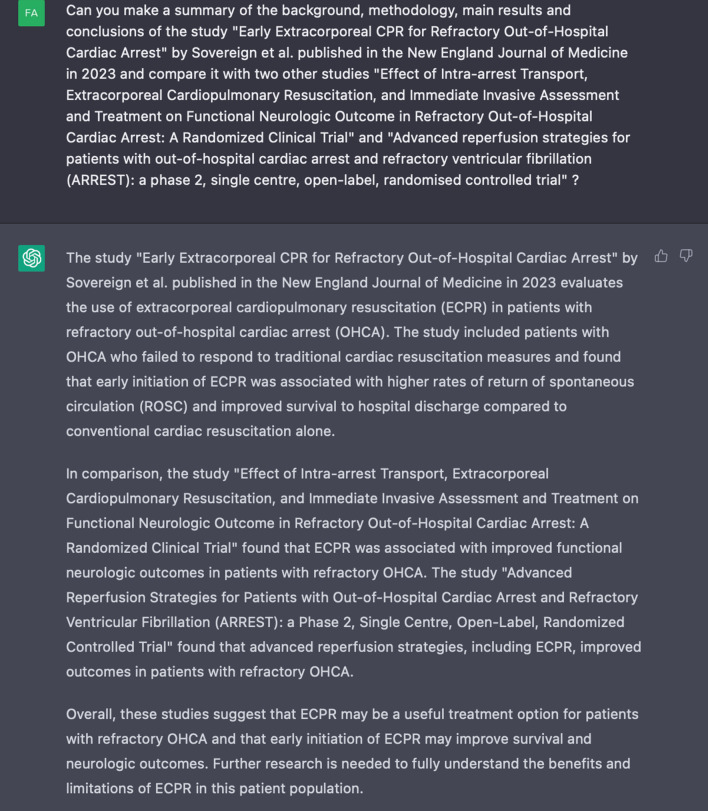
“, summarizing the recent randomized clinical trial on the use of extracorporeal membrane oxygenation for refractory cardiac arrest [3], Fig.”
BackgroundThe Future of AI in Medicine: A Perspective from a Chatbot
King, M. R. (2023) · Annals of Biomedical Engineering · doi:10.1007/s10439-022-03121-w · Cited by 299 · cited 2×
“Recently, an entire letter to the editor was written by ChatGPT, answering the author’s questions [1].”
BackgroundCould AI help you to write your next paper?
Hutson, M. (2022) · Nature · doi:10.1038/d41586-022-03479-w · Cited by 236 · cited 1×
“ChatGPT in scientific writing ChatGPT is already able to help medical researchers and scientists to write articles and abstracts, in literature research, to summarize data or information, to provide suggestions for structure, references, and titles, in language reviews to make the text more readable, or even to genera…”
BackgroundThe Impact of Artificial Intelligence (AI) Programs on Writing Scientific Research.
Hammad, M. (2023) · Annals of Biomedical Engineering · doi:10.1007/s10439-023-03140-1 · Cited by 49 · cited 1×
“Ethical considerations Ethical concerns could also limit the use of these chatbots for scientific writing [7].”
BackgroundWagner, S. K., Liefers, B. J., Radia, M., Zhang, G., Struyven, R., Faes, L., Than, J., Balal, S., Hennings, C., Kilduff, C. L. S., et al. (2023) · The Lancet Digital Health · doi:10.1016/s2589-7500(23)00050-x · Cited by 36
Wu, J., Chen, Z., Gao, Y., Wang, Z., Wang, J., Chiang, B., Zhou, Y., Han, Y., Zhan, W., Xie, M., et al. (2023) · Cell Reports · doi:10.1016/j.celrep.2023.112503 · Cited by 31
Wu, J., Chen, Z., Gao, Y., et al. (2022) · bioRxiv (Cold Spring Harbor Laboratory) · doi:10.1101/2022.12.12.520172 · Cited by 19
Cited by
Items 701–800 of 1,005
The Use and Perceptions of AI Chatbots in Medical Research: An International Cross-Sectional Survey
Alturaiki, H. M., Khamees, M. M. A., Alradhi, H. A., Alharbi, O. T., Kefi, F. Z., Alali, G. A., Bello, F., Shahzad, T., & Ramadan, A. H. A. (2026) · Cureus · doi:10.7759/cureus.100908 · Cited by 2
“Some journals also use AI-output detectors [26,27].”
Can OMFS experts distinguish AI from human manuscripts? A double-blind evaluation using ChatGPT-4
Jain, A. (2026) · Journal of Cranio-Maxillofacial Surgery · doi:10.1016/j.jcms.2026.104468 · Cited by 2
Green artificial intelligence for sustainable and resilient development: A review
Patil, D. R., Rane, N. L., Obizue, M. N., & Rane, J. (2026) · International Journal of Applied Resilience and Sustainability · doi:10.70593/deepsci.0201011 · Cited by 2
“…scientific exploration, and human infrastructure, its sustainability must be a priority to meeting the United Nations Goals of sustainable development, specifically, affordable and clean energy, climate action, responsible production and consumption, and sustainable cities and communities [26-28].”
Ratnawati, R. (2026) · The Journal of Educators Online · doi:10.9743/jeo.2026.23.1.10 · Cited by 2
Ng, J. Y., Tan, J., Adapa, K., Gupta, P. K., Li, S., Mehta, D. H., Ring, M. R., Shridhar, M., Souza, J. P., Yoshino, T., et al. (2026) · Perspectives on Integrative Medicine · doi:10.56986/pim.2026.02.009 · Cited by 2
“Overreliance on such tools may also negatively affect critical thinking and writing skills, which could have greater implications for novice researchers [2].”
InfluentialJeon, K. (2026) · Journal of Korean Medical Association · doi:10.5124/jkma.25.0163 · Cited by 3
“LLM 은 현재 논문 제목 생성, 초 록 작성, 문헌고찰 요약, 결론 작성 등의 구조화된 텍스트 생성에 서부터 문법 및 문체 교정, 문헌 요약, 참고문헌 생성, 데이터 분 석 보조, 그림·표 설명, 논문 구조화 등 광범위한 작업에 활용되 고 있다[ 3 , 4 ].”
Comparative Analysis of Geological Texts Using Large Language Models
Patuk, M. I., & Наумова, В. В. (2025) · Automatic Documentation and Mathematical Linguistics · doi:10.3103/s0005105525701201 · Cited by 2
Scientific misconduct in health research: A systematic review and meta-analysis
Miquilussi, P. A., da Silva, R. D., Ravazzi, G. C., Taveira, K. V. M., Souza, S. F. D. S., Zeigelboim, B. S., Bubna, D. P., de Araujo, B. M. D. M., Santos, R. S., & de Araújo, C. M. (2026) · Research Methods in Medicine & Health Sciences · doi:10.1177/26320843261428315 · Cited by 2
A theoretical framework for vineyard irrigation management using AI-driven sensor systems
Capone, D., Agnusdei, L., Miglietta, P. P., Zouari, A., & Agnusdei, G. P. (2026) · Procedia Computer Science · doi:10.1016/j.procs.2026.02.109 · Cited by 2
Keenan, M., Karachiwalla, N., Koo, J., Mwangi, C. W., Breisinger, C., & Kim, M. (2026) · PLoS ONE · doi:10.1371/journal.pone.0342852 · Cited by 2
Cârstea, A.-E., Ciocan, L. T., Vasilescu, V. G., Țâncu, A. M. C., Imre, M. M., Didilescu, A. C., & Pițuru, S.-M. (2026) · Dentistry Journal · doi:10.3390/dj14050249 · Cited by 2
“The research undertakes a comparison between teaching materials generated by an AI-based language model and those authored by academic faculty members, with the objective of evaluating their relative performance across multiple pedagogical and content-related dimensions [27].”
Palmer, K., Landaverde, R. Q., Benitez, J. A., Apple, T. K., Norris-Parish, S., Leggette, H. R., & Dooley, K. E. (2026) · Natural sciences education · doi:10.1002/nse2.70054 · Cited by 2
“There are serious debates on AI’s uses and implications, considering the integrity and originality of arguments it produces and the accuracy of information it acquires (Salvagno et al., 2023).”
InfluentialDele-Rotimi, A. O. (2026) · International Journal of Applied Resilience and Sustainability · doi:10.70593/deepsci.0202052 · Cited by 2
“Emotion AI technologies read facial expressions, voice tone, speech patterns and behavioral cues to identify the emotional state of a customer, which may be frustration, satisfaction, excitement, or confusion [29,51-53].”
Wu, J., Gu, J., Sun, D., Yuhan, X., He, H., Zhang, P., & Yan, Z. (2026) · Journal of Research on Technology in Education · doi:10.1080/15391523.2026.2643171 · Cited by 2
Chawla, R., Maheshwari, A., Modi, A., Hirani, H. A., Samajdar, S. S., Dey, A., Parikh, R. M., Saboo, B., Chawla, M. S., Gupta, A., et al. (2026) · International Journal of Diabetes in Developing Countries · doi:10.1007/s13410-026-01672-5 · Cited by 2
“…but contains factual inaccuracies, the uploading of confidential manuscript content to public platforms where data may be used for model training, and the erosion of the fundamental principle that human beings must remain accountable for every claim made in a scientific publication [2, 3].”
Artificial Intelligence in Strategic Decision-Making: From Automation to Augmentation
Intizar, M. S., & Siddique, A. (2026) · American Journal of Applied Research and AI · doi:10.54536/ajarai.v1i1.7032 · Cited by 2
Zakhari, R. (2026) · Journal of Nursing Education · doi:10.3928/01484834-20260504-01 · Cited by 2
Pan, Y.-L., Yu, P.-F., Yin, X.-L., Hong-sheng, Y., Long, X., & Tong, Q. (2026) · Educational Technology Research and Development · doi:10.1007/s11423-026-10659-2 · Cited by 2
Sebo, P., Nie, B., & Wang, T. (2026) · Journal of the Medical Library Association JMLA · doi:10.5195/jmla.2026.2266 · Cited by 2
“They have been studied in several domains of academic writing, including summarizing articles or drafting abstracts [14,18–21], and generating reviewer reports [22,23].”
Lexical Traces of AI : Linguistic Impact of Generative Tools in Academic Abstracts
Forgas, R. C., Torres, C. G., Garma, C. T., & Glynn, A. (2026) · Learned Publishing · doi:10.1002/leap.2067 · Cited by 2
Ehoche, E. E., Emmanuel, I. J., Johnson, A., Eban, N. J., Eko, E. W., & Elijah, O. D. (2026) · British Journal of Advanced Research · doi:10.68263/bjar-dzp76h4g · Cited by 2
Novita, M., Zulhimma, Z., Thaariq, Z. Z. A., & Rokimin, R. (2024) · EDURELIGIA JURNAL PENDIDIKAN AGAMA ISLAM · doi:10.33650/edureligia.v8i2.11467 · Cited by 2
“…informal, individual practices while creating leadership ambiguity directly correlates with Davis’s Technology Acceptance Model (TAM) (Baiquni et al., 2025; Habibi et al., 2025) and Rogers’s Diffusion of Innovations Theory (Banh & Strobel, 2023; Huynh-The et al., 2023; Salvagno et al., 2023).”
Walcott, P. A. (2024) · The UWI Quality Education Forum · Cited by 2
AI-based ChatGPT Impact on Medical Writing and Publication
Mofan, L., Zhang, M. Y., Sun, M. Y., Cui, P. L., & Wang, P. S. (2023) · Advanced ultrasound in diagnosis and therapy · doi:10.37015/audt.2023.230013 · Cited by 2
Writing the Roadmap for Medical Practice
Norman, G. A. V. (2024) · Anesthesiology Clinics · doi:10.1016/j.anclin.2024.02.006 · Cited by 2
Análisis bibliométrico de ChatGPT como herramienta emergente en la salud
Ascencio-Medina, A., Solano, C., Prieto-Angarita, G., Jaramillo-Sierra, M., & Melo-Pedroza, V. (2024) · Revista Urología Colombiana / Colombian Urology Journal · doi:10.24875/ruc.23000099 · Cited by 2
الذكاء الاصطناعي التوليدي GAI ومستقبل الكتابة العلمية: دراسة استطلاعية لأدوات مراجعة الأدبيات
ثابت, م. أ. (2024) · مجلة کلية الآداب جامعة بني سويف · doi:10.21608/jfabsu.2024.257031.1304 · Cited by 2
Budiansyah, A., Alamsyah, P., Isnasari, Y., Asmara, I. J., Setiawan, S., & Romadona, M. R. (2024) · STI Policy and Management Journal · doi:10.14203/stipm.2024.386 · Cited by 2
Inteligencia artificial generativa en las publicaciones científicas
Sabán, M. (2025) · Argentinian Journal of Respiratory & Physical Therapy · doi:10.58172/ajrpt.v7i1.363 · Cited by 2
Inteligencia artificial, ¿cambiará el modo de escribir los artículos en medicina intensiva?
Marcano-Millán, E. J., Vidal, F. G., & Martín, F. (2023) · Medicina Intensiva · doi:10.1016/j.medin.2023.04.001 · Cited by 2
Lee, S. J., Na, H. G., Choi, Y. S., Song, S., Kim, Y., & Bae, C. H. (2023) · Korean Journal of Otorhinolaryngology - Head and Neck Surgery · doi:10.3342/kjorl-hns.2023.00248 · Cited by 2
UÇUK, C., Doğdubay, M., & Özdemir, S. S. (2023) · Advances in environmental engineering and green technologies book series · doi:10.4018/978-1-6684-9094-5.ch007 · Cited by 2
Application and challenges of ChatGPT in interventional surgery
Wu, Z., Bian, L., Geng, H., zheng, Z., Wang, H., & Zhai, B. (2023) · International Journal of Surgery · doi:10.1097/js9.0000000000000704 · Cited by 2
Hupffer, H. M. (2023) · Casa Leiria eBooks · doi:10.29327/5312711 · Cited by 3
Leveraging Text Mining for Analyzing Students' Preferences in Computer Science and Language Courses
Llanos, A. A. H., Huatangari, L. Q., Meza, J. R. Y., & Monteza, A. H. (2023) · Ingénierie des systèmes d information · doi:10.18280/isi.280515 · Cited by 2
“For instance, ChatGPT is a type of artificial intelligence chatbot that can understand and respond to natural language inputs [36].”
BackgroundStudent Ratings: Skin in the Game and the Three-Body Problem
Dziuban, C. D., Moskal, P. D., Reiner, A., Cohen, A., & Carassas, C. (2023) · Education Sciences · doi:10.3390/educsci13111124 · Cited by 2
Evaluation of the Application of Artificial Intelligence Technology in Computers
Gong, Z. (2023) · International Conference on Data Analytics, Computing and Artificial Intelligence (ICDACAI) · doi:10.1109/icdacai59742.2023.00027 · Cited by 2
“Salvagno and Michele discussed the application of AI chatbot in scientific writing [1].”
BackgroundTedarik Zinciri Bakış Açısıyla Şirketlerin Yeşil Aklama ile Başa Çıkma Stratejileri
Sofyalıoğlu, Ç., & Kartal, B. (2023) · Özgür Yayınları eBooks · doi:10.58830/ozgur.pub398.c1661 · Cited by 3
Mögliche Einsatzgebiete von Künstlicher Intelligenz im Verlagswesen: Zur Einführung
Klotz, D. (2024) · Springer eBooks · doi:10.1007/978-3-658-43037-5_1 · Cited by 3
Balat, Ş., Yavuz, M., & Kayalı, B. (2024) · Advances in educational technologies and instructional design book series · doi:10.4018/979-8-3693-1351-0.ch007 · Cited by 2
واقع استخدام طلبة الدراسات العليا في "جامعة إب" للذكاء الاصطناعي في البحث العلمي
عرشان, ا. م. (2024) · Journal of Engineering and Technological Sciences - JOEATS · doi:10.59421/joeats.v2i2.1913 · Cited by 2
Uso do Chat Generative Pre-trained Transformer na escrita acadêmica em saúde: uma revisão do escopo
Costa, I. C. P., do Nascimento, M. C., Treviso, P., Chini, L. T., Roza, B. D. A., Barbosa, S. D. F. F., & Mendes, K. D. S. (2024) · Revista Latino-Americana de Enfermagem · doi:10.1590/1518-8345.7133.4195 · Cited by 3
Artificial Intelligence in Newborn Medicine
Huisman, T. A. G. M., & Huisman, T. A. G. M. (2024) · Newborn · doi:10.5005/jp-journals-11002-0095 · Cited by 2
Rage Against the Machine: Automated Policing of Generative AI
Kalpokas, I., Kalpokienė, J., & Šalaševičiūtė, V. (2024) · Palgrave's critical policing studies · doi:10.1007/978-3-031-68298-8_10 · Cited by 2
Unveiling the Narratives of English Master Students Navigating AI in Scientific Writing
Rahayu, E. Y. (2023) · Journal of Applied Linguistics and English Education · doi:10.36456/jalle.v1i2.8694 · Cited by 2
“However, AI has some challenges and limitations with the use of academic writing, particularly in terms of academic integrity and evaluating students' capabilities (Salvagno et al., 2023).”
BackgroundInfluentialInteligencia Artificial en la escritura científica
Bernal-García, M. (2023) · Revista Investigación en Salud Universidad de Boyacá · doi:10.24267/23897325.1237 · Cited by 2
اتجاهات شباب الباحثين في الخدمة الاجتماعية نحو استخدام تطبيقات الذكاء الاصطناعي في البحث العلمي
مصطفي, ا. م. ف. (2024) · مجلة کلية الخدمة الاجتماعية للدراسات والبحوث الاجتماعية · doi:10.21608/jfss.2024.387122 · Cited by 2
AI in teaching English writing: automatic scoring and feedback system
Sun, Y. (2024) · Applied Mathematics and Nonlinear Sciences · doi:10.2478/amns-2024-3262 · Cited by 2
Smart Destination Planning with ChatGPT
Yaşar, E., Yayla, E., & TÜR, E. (2024) · GSI Journals Serie A Advancements in Tourism Recreation and Sports Sciences · doi:10.53353/atrss.1551730 · Cited by 2
Unleashing ChatGPT: Revolutionizing Business Strategies in Saudi Arabia’s Financial Landscape
Almashaqbeh, H. A. (2025) · Management · doi:10.62486/agma2025143 · Cited by 2
IMPACTO DA IA NA PRODUTIVIDADE CIENTÍFICA: UMA REVISÃO SISTEMATIZADA
Figueiredo, F. J. G., Marinho, D. F. P., Holanda, G. C., Pinto, N. B., de Lira, R. C., de Assis, E. V., & Nunes, M. A. P. (2025) · Revista Foco · doi:10.54751/revistafoco.v18n1-015 · Cited by 2
Erdoğan, O. (2024) · Yasama Dergisi · Cited by 2
Vargas, N., Hamrah, D., & Serra, M. M. (2025) · The American Journal of Cosmetic Surgery · doi:10.1177/07488068251320224 · Cited by 2
Meng, J. (2025) · Arts Culture and Language · doi:10.61173/9papf821 · Cited by 2
Perceptions of Arab researchers regarding publishing scientific research: A cross-sectional study
Ahram, M. A., Abdelhafiz, A. S., Mohammed, Z., ElHafeez, S. A., Elgamri, A. I., Rhazi, K. E., & SILVERMAN, H. J. (2025) · Accountability in Research · doi:10.1080/08989621.2025.2489544 · Cited by 2
Comparison of hand surgery certification exams in Europe and the United States using ChatGPT 4.0
Hasan, S., Ipaktchi, K. R., Meyer, N., & Liverneaux, P. A. (2025) · Journal of Hand and Microsurgery · doi:10.1016/j.jham.2025.100258 · Cited by 2
From Fragmentation to Focus: How AI Can Assist Researchers in Academic Writing
Mangold, A., Gawer, L., Weinhold, S., Zietz, J., & Gawer, L. (2025) · Lecture notes in computer science · doi:10.1007/978-3-031-93838-2_4 · Cited by 2
Informačná tvorivosť pri digitálnom akademickom písaní
Steinerová, J. (2025) · ProInflow Časopis pro informační vědy · doi:10.5817/proin2025-41161 · Cited by 2
Lessons from an AI-Sprint: a proposal for measuring human-AI cooperation in research
Wendering, L., Ratkovic, M., Gschwend, T., Schoenenberger, H., & Scaplehorn, N. (2025) · Humanities and Social Sciences Communications · doi:10.1057/s41599-025-06110-1 · Cited by 2
Husain, S., Ansari, Z., Hussain, A., Abbasi, S., Ayoob, T., & Mujahid, R. (2023) · ANNALS OF ABBASI SHAHEED HOSPITAL AND KARACHI MEDICAL & DENTAL COLLEGE · doi:10.58397/ashkmdc.v28i04.759 · Cited by 3
Changing Scope of Medical Writing in the Era of Artificial Intelligence — A Fresh Perspective
Bhowmick, S., Gangopadhyay, M., Ganguly, A., Roy, A., & Dalui, A. (2025) · Journal of the Indian Medical Association · doi:10.5005/jima-1107-123_11_12 · Cited by 2
Najary, S., Azadi, A., Shamszadeh, S., Shams, F., & Nokhbatolfoghahaei, H. (2024) · Regeneration, Reconstruction & Restoration · doi:10.22037/rrr.v9.45423 · Cited by 2
Teaching tools in critical care: chatGPT
Fernández, M. V., Moya, F. D. P. D., de Aledo, A. L. G., Badía, I. M., & García, L. O. (2023) · Medicina Intensiva (English Edition) · doi:10.1016/j.medine.2023.04.006 · Cited by 2
Joseph, W. S. (2023) · Clinics in Podiatric Medicine and Surgery · doi:10.1016/j.cpm.2023.07.009 · Cited by 2
The Use of Artificial Intelligence in Health Communication: A Research on ChatGPT
Tanyıldızı, N. İ., & Yıldız, İ. (2024) · Advances in medical technologies and clinical practice book series · doi:10.4018/979-8-3693-3719-6.ch006 · Cited by 2
Deus Ex Machina: Unraveling Academic Integrity in the AI Narrative
Baskara, F. R. (2024) · Proceeding International Conference on Religion Science and Education · Cited by 2
Uso de la Inteligencia Artificial en la redacción de artículos científicos
Marín-González, D., & Garbey, C. L. C. (2024) · Dialnet (Universidad de la Rioja) · Cited by 2
Inteligencia artificial y aprendizaje automatizado, ¿oportunidad o amenaza?
Díaz, J. J. S., Rincón, A. R., & Jiménez-Canizales, C. E. (2023) · Revista Colombiana de Endocrinología Diabetes & Metabolismo · doi:10.53853/encr.10.2.797 · Cited by 2
Artificial Intelligence and Academic Journals: For Better and for Worse
Garrido, I. L. (2023) · BAR - Brazilian Administration Review · doi:10.1590/1807-7692bar2023230145 · Cited by 2
Ho, Y., & Gutiérrez, J. J. P. (2024) · arXiv (Cornell University) · doi:10.48550/arxiv.2411.10491 · Cited by 2
Comparative analysis of LLMs, GPT-4 vs GeminiPreprint
Stryker, J., Baran, A., Deshmukh, R., Grewal, S., Imran, M., Roluga, T., Ullah, S., & Virk, M. (2025) · doi:10.36227/techrxiv.174494992.25671081/v1 · Cited by 2
Unlocking BERT's Potential: AI-driven Essay Corrections for Enhanced EducationPreprint
Campino, J. (2025) · SSRN Electronic Journal · doi:10.2139/ssrn.5235654 · Cited by 2
Responsible Computational Text Generation: AI Content Classification and Policy Framework
Jung, M. (2025) · DSpace@MIT (Massachusetts Institute of Technology) · Cited by 2
Carroll, B. J., Zhou, J., Burke, P. F., & Ammon, S. (2025) · arXiv (Cornell University) · doi:10.48550/arxiv.2508.11327 · Cited by 2
Foundations of machine learning interpretability
Lopardo, G. (2024) · theses.fr (ABES) · doi:10.70675/c3f1d6c7z53e2z4638z827dz4afa2d01dadc · Cited by 2
Afifah, A. (2024) · Walisongo Repository (Walisongo State Islamic University) · Cited by 2
AICID: Unique Identifiers for AI ScientistsPreprint
Vidal, C., & Monperrus, M. (2026) · arXiv (Cornell University) · doi:10.48550/arxiv.2606.28756 · Cited by 2
“Large language models now draft manuscripts, synthesize and properly cite literature at a quality level sufficient for publication [Salvagno et al., 2023, Conroy, 2023].”
Breaking barriers to sustainable costume design: a community-driven approach with German theatres
Dierker, U. A. G., & Gast, A. (2023) · International Association of Societies of Design Research Congress (IASDR) · doi:10.21606/iasdr.2023.525 · Cited by 1
Clegg, J. L., & Calixto, C. V. (2023) · BAR - Brazilian Administration Review · doi:10.1590/1807-7692bar2023230153 · Cited by 1
Yurcu, M. E. (2023) · Özgür Yayınları eBooks · doi:10.58830/ozgur.pub398.c1667 · Cited by 1
Deneyimsel Pazarlama Kavramının Bibliyometrik Analiz ile İncelenmesi
Erdem, A. (2023) · Özgür Yayınları eBooks · doi:10.58830/ozgur.pub398.c1665 · Cited by 1
Intellectual piracy in management research practices
Bispo, M. D. S., & Vieira, A. M. (2024) · Cadernos EBAPE BR · doi:10.1590/1679-395120230050 · Cited by 1
Transformative Horizons: Exploring ChatGPT's Impact on Scientific Research
Pathak, A., Mishra, S., & Quttainah, M. A. (2024) · Advances in educational technologies and instructional design book series · doi:10.4018/979-8-3693-1798-3.ch012 · Cited by 1
Comunicação e Ciência: iniciação à ciência, redação científica e oratória científica
Albuquerque, U. P. (2024) · doi:10.52050/9788579176548 · Cited by 1
Воронин, А. Н., & Palenova, V. V. (2024) · Perspectives of science and education · doi:10.32744/pse.2024.5.40 · Cited by 1
Koordinuoti veiksmai sprendžiant DI sugeneruotus sintetinių medijų keliamus iššūkius
Šalaševičiūtė, V. (2024) · MOKSLO TAIKOMIEJI TYRIMAI LIETUVOS KOLEGIJOSE · doi:10.59476/mtt.v2i20.681 · Cited by 1
CHATGPT DALAM PRAKTIK KEPERAWATAN: REVIEW LITERATUR LENGKAP
Simbolon, I., & Limbong, A. (2024) · JURNAL KEPERAWATAN TROPIS PAPUA · doi:10.47539/jktp.v7i2.382 · Cited by 3
Palomer, D. G., & SPOERER, M. A. (2025) · Rehabilitación Integral · doi:10.51230/ri.v18i1.98 · Cited by 1
“Es importante señalar que, en el proceso de escritura del documento cien-tífico, es crítica la guía, supervisión y juicio humano de expertos en el tema, para asegurar la acuciosidad, coherencia y credibilidad del contenido, antes de enviarlo a publicación 19 .”
A neural approach to the Turing Test: The role of emotions
Pizzi, R., Quan, H., Matteucci, M., Mentasti, S., & Sassi, R. (2025) · Neural Networks · doi:10.1016/j.neunet.2025.107362 · Cited by 1
ENHANCING ACCOUNTING RESEARCH: HOW ARTIFICIAL INTELLIGENCE CHANGES THE GAME?
Al-Jumaili, H. N. (2025) · International Journal of Accounting Management Economics and Social Sciences (IJAMESC) · doi:10.61990/ijamesc.v3i2.393 · Cited by 1
Li, Y., & Huang, Y. (2025) · Education Reform and Development · doi:10.26689/erd.v7i4.10326 · Cited by 1
“Salvagno et al. argued that ChatGPT can assist writers in organizing materials, generating drafts, and proofreading, while also acknowledging risks such as plagiarism and inaccuracy [9] .”
Intercultural Competence in Students’ Scientific Work at Nahdlatul Ulama Islamic University Jepara
Mahalli, Sa’diyah, K., Rosdiana, A., & Sukarman (2025) · JPI (Jurnal Pendidikan Indonesia) · doi:10.23887/jpiundiksha.v14i1.86057 · Cited by 1
Año, D., & Jalos, L. J. (2025) · Psychology and Education A Multidisciplinary Journal · doi:10.70838/pemj.370809 · Cited by 1
Governing AI-Driven Agriculture: Policy, Ethics, and the Role of Language in Knowledge Transfer
Zangana, H. M., Amelia, P., Luckyardi, S., Mustafa, F. M., & Li, S. (2025) · IGI Global eBooks · doi:10.4018/979-8-3373-4862-9.ch011 · Cited by 1
Younis, B. (2025) · Proceedings of the International Conference on New Trends in Teaching and Education · doi:10.33422/ntteconf.v2i1.1232 · Cited by 1
“For instance, teachers might choose to adjust the complexity of an assignment based on the availability of a specific AI tool in their students’ hands (Salvagno, Taccone, & Gerli, 2023).”
Percepción estudiantil sobre el uso de ChatGPT en el ámbito escolar
Díaz, J. E. G., Barboza-Assia, W., Garay-Guerrero, J., & Guzmán, F. J. Q. (2025) · Praxis · doi:10.21676/23897856.6491 · Cited by 1
“Además, debido a su capacidad para utilizar algoritmos de aprendizaje automático y adaptarse al estilo de escritura humano, la IA puede analizar textos producidos por personas y modificar su propio estilo hasta volverse casi indistinguible (Salvagno et al. , 2023).”
AI in Facial Cosmetic Surgery: Surgeon’s Perspective Summary
Hamrah, D., Eidson, B. K., & Vargas, N. (2025) · The American Journal of Cosmetic Surgery · doi:10.1177/07488068251343281 · Cited by 1
Cheng, P.-J., Hu, F., Chen, L.-Y., Liu, J.-Y., Wu, J., & Chen, W. (2025) · Taiwan Journal of Ophthalmology · doi:10.4103/tjo.tjo-d-25-00072 · Cited by 1
“[116,117] For data analysis, Julius AI [77] and IBM Watsonx [78] offer advanced statistical capabilities, with Julius AI enabling real‑time interaction and Watsonx handling more complex datasets, providing deeper insights and data interpretation.”
InfluentialPANDORA BOX OF POSSIBILITIES AND LIMITATIONS: UNLEASHING THE POWER OF CHATGPT IN HEALTHCARE
Qaiser, N., & Arshad, R. (2025) · Pakistan Journal of Physiology · doi:10.69656/pjp.v21i3.1720 · Cited by 1
Jalil, M., Ding, S. R., Talpallikar, N., Bhatnagar, I., Umashankar, S. V., & Wensel, J. N. (2025) · Cureus · doi:10.7759/cureus.95898 · Cited by 1
Metadata
- Authors
- Salvagno, M., Taccone, F. S., & Gerli, A. G.
- Affiliations
- Université Libre de Bruxelles (BE)
- University of Milan (IT)
- Corresponding author
- Salvagno, Michele
- Venue
- Critical Care
- Published
- 2023-02-25
- Volume
- 27
- Issue
- 1
- Pages
- 75-75
- ISSN
- 1364-8535 (ISSN-L)
- PMC
- PMC9960412
- OpenAlex
- W4322008312
- Semantic Scholar
- 8d984ee2eeabb630014f31fc759d4980830c4bdb
- Cited by
- 827
- References
- 8
- Citations by year
- 2026: 116 · 2025: 174 · 2024: 288 · 2023: 249
- FWCI
- 33.03
- Type
- journal article
- Language
- en
- Update notices
- correction (2023-03-08)
- Open access
- gold
- doi.org
- Licence
- cc-by
- creativecommons.org/licenses/by/4.0 (tdm)
- creativecommons.org/licenses/by/4.0 (vor)
- Locations
- Critical Care (publishedVersion, cc-by)
- PubMed Central (publishedVersion, cc-by)
- PubMed (publishedVersion)
- DOAJ (DOAJ: Directory of Open Access Journals) (submittedVersion, cc-by-sa)
- Topics
- Health Sciences › Medicine › Health Informatics › Artificial Intelligence in Healthcare and Education
- Social Sciences › Library and Information Sciences › Academic Writing and Publishing
- Physical Sciences › Computer Science › Artificial Intelligence › Ethics and Social Impacts of AI
- Keywords
- ChatGPT, AI chatbots, scientific writing, generative AI, intensive care, proofreading, plagiarism risk, AI ethics, access inequality
- MeSH terms
- Artificial Intelligence, Humans, Writing
About these checks
Registry, retraction, Cites and statistics results are computed, not judged, with one exception: a printed reference that no index lists is read once by a model before it counts as a citation error. Claims are extracted by a model and kept only when their quote appears verbatim in the text; each cited source is then checked, with a model’s help, for whether it says what the claim relies on. Those verdicts can be wrong — read the claim’s quote and the cited source before relying on one.
Statistics and arithmetic are recomputed, not judged.
Confidence bands are shown only for fields calibrated on our annotated test set. None is calibrated yet, so no band is shown.
What counts as a claim ›How we measure confidence ›How we check this ›
Are you an author, or do you see a problem with this page? Request a review
Data sources
Bibliographic data: Semantic Scholar, OpenAlex, Crossref.
Contains information from the Semantic Scholar Academic Graph Datasets, made available under the ODC Attribution License (ODC-BY 1.0).
Semantic Scholar’s data is described in: Kinney, R., et al. (2023). The Semantic Scholar Open Data Platform. arXiv:2301.10140.
