

Can artificial intelligence help for scientific writing?
Open accessThe DOI matches its Crossref record; 10 of the 10 references it cites were found in a registry or an index.
Abstract
This paper discusses the use of Artificial Intelligence Chatbot in scientific writing. ChatGPT is a type of chatbot, developed by OpenAI, that uses the Generative Pre-trained Transformer (GPT) language model to understand and respond to natural language inputs. AI chatbot and ChatGPT in particular appear to be useful tools in scientific writing, assisting researchers and scientists in organizing material, generating an initial draft and/or in proofreading. There is no publication in the field of critical care medicine prepared using this approach; however, this will be a possibility in the next future. ChatGPT work should not be used as a replacement for human judgment and the output should always be reviewed by experts before being used in any critical decision-making or application. Moreover, several ethical issues arise about using these tools, such as the risk of plagiarism and inaccuracies, as well as a potential imbalance in its accessibility between high- and low-income countries, if the software becomes paying. For this reason, a consensus on how to regulate the use of chatbots in scientific writing will soon be required.
Overview
The claims and statistics of this paper haven’t been checked yet.
Free: it reads the open-access text and checks the first 5 claims that cite a source we can check. Create a free account to check every claim.
Integrity signals
Registry
Cites
Statistics
Figures
Verification
Claims the paper makes
The claims and statistics of this paper haven’t been checked yet.
Free: it reads the open-access text and checks the first 5 claims that cite a source we can check. Create a free account to check every claim.
Claims other papers make about this one
Each is checked against this paper’s own text: does it say what the citing paper says it does?
The source backs part of the claim, not all of it — or backs it for a different population, condition or comparison.
In the citing paper
“Additionally, learners can expedite their writing development as AI tools help them identify and rectify grammatical and lexical errors, while also suggesting alternative sentence structures to enhance the overall writing quality and structure (Zhao, 2022; Chen, 2023; Salvagno et al., 2023).”
From Enhancing academic writing skills and motivation: assessing the efficacy of ChatGPT in AI-assisted language learning for EFL students (2023) · cites this paper as Salvagno et al., 2023
Experimental — accuracy not yet measuredThe source backs part of the claim, not all of it — or backs it for a different population, condition or comparison.
In the citing paper
“The authorship dilemma in AI-assisted research revolves around who should be credited for AI-generated content and how AI's role should be disclosed [67].”
From Developing the HAKI model as a conceptual framework for AI-assisted academic research (2026) · cites this paper as [67]
Experimental — accuracy not yet measuredThe source backs part of the claim, not all of it — or backs it for a different population, condition or comparison.
In the citing paper
“Recent studies show that GAI can improve writing quality by enhancing grammar, vocabulary, and fluency.”
From Exploring How AI Literacy and Self-Regulated Learning Relate to Student Writing Performance and Well-Being in Generative AI-Supported Higher Education (2025) · cites this paper as Salvagno et al., 2023
Experimental — accuracy not yet measuredThe source backs part of the claim, not all of it — or backs it for a different population, condition or comparison.
In the citing paper
“Additionally, the automation features of AI streamline tasks like formatting and citation, freeing up substantial time and energy for researchers, which can then be redirected towards more complex and innovative work.3,4”
From Balancing innovation and integrity: the role of AI in research and scientific writing (2023) · cites this paper as [3]
Experimental — accuracy not yet measuredThe cited source says what the claim attributes to it.
In the citing paper
“chatbots, including ChatGPT, have increased the difficulty in identifying plagiarism [47, 67, 76]”
From A systematic literature review of empirical research on ChatGPT in education (2024) · cites this paper as [67]
7 more claims about this paper
Create a free account to see every claim other papers make about this one.
Self-check
Percentages, sums and reported differences re-computed from the paper’s own numbers.
The self-check needs the paper’s full text.
Citations
Cites
Gao, C. A., Howard, F. M., Markov, N. S., Dyer, E. C., Ramesh, S., Luo, Y., & Pearson, A. T. (2022) · doi:10.1101/2022.12.23.521610 · Cited by 1,099
ChatGPT: the future of discharge summaries?
Patel, S. B., & Lam, K. (2023) · The Lancet Digital Health · doi:10.1016/s2589-7500(23)00021-3 · Cited by 728
Abstracts written by ChatGPT fool scientists
Else, H. (2023) · Nature · doi:10.1038/d41586-023-00056-7 · Cited by 611 · cited 1×
“Moreover, it may be difficult to recognize whether a paper is written by a chatbot or a human being [5], because chatbots use advanced techniques, such as natural language processing (NLP) and machine learning, to generate text that is similar to human writing.”
BackgroundEarly Extracorporeal CPR for Refractory Out-of-Hospital Cardiac Arrest
Suverein, M. M., Delnoij, T. S. R., Lorusso, R., Brandon Bravo Bruinsma, G. J., Otterspoor, L., Elzo Kraemer, C. V., Vlaar, A. P. J., van der Heijden, J. J., Scholten, E., den Uil, C., et al. (2023) · New England Journal of Medicine · doi:10.1056/nejmoa2204511 · Cited by 537 · cited 1×
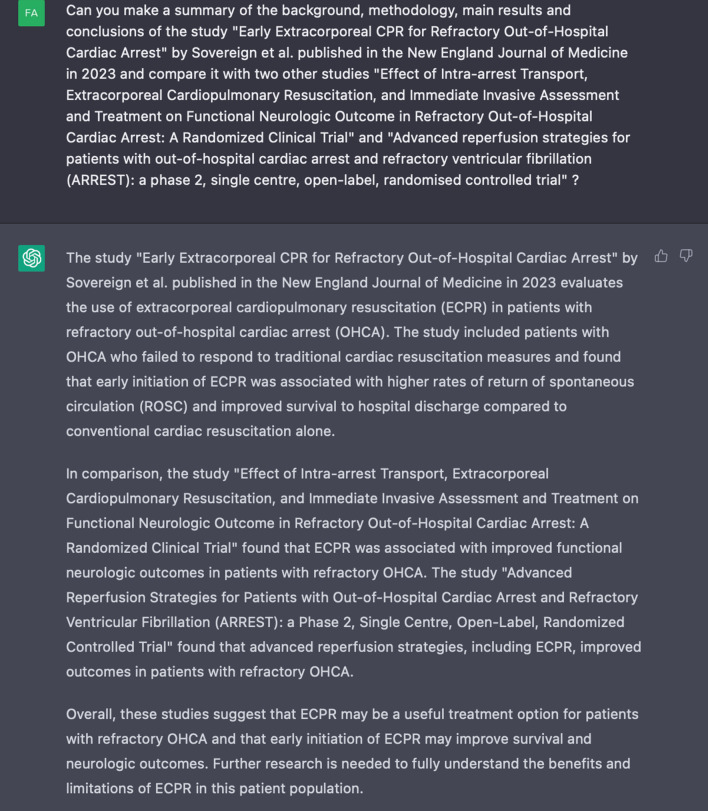
“, summarizing the recent randomized clinical trial on the use of extracorporeal membrane oxygenation for refractory cardiac arrest [3], Fig.”
BackgroundThe Future of AI in Medicine: A Perspective from a Chatbot
King, M. R. (2023) · Annals of Biomedical Engineering · doi:10.1007/s10439-022-03121-w · Cited by 299 · cited 2×
“Recently, an entire letter to the editor was written by ChatGPT, answering the author’s questions [1].”
BackgroundCould AI help you to write your next paper?
Hutson, M. (2022) · Nature · doi:10.1038/d41586-022-03479-w · Cited by 236 · cited 1×
“ChatGPT in scientific writing ChatGPT is already able to help medical researchers and scientists to write articles and abstracts, in literature research, to summarize data or information, to provide suggestions for structure, references, and titles, in language reviews to make the text more readable, or even to genera…”
BackgroundThe Impact of Artificial Intelligence (AI) Programs on Writing Scientific Research.
Hammad, M. (2023) · Annals of Biomedical Engineering · doi:10.1007/s10439-023-03140-1 · Cited by 49 · cited 1×
“Ethical considerations Ethical concerns could also limit the use of these chatbots for scientific writing [7].”
BackgroundWagner, S. K., Liefers, B. J., Radia, M., Zhang, G., Struyven, R., Faes, L., Than, J., Balal, S., Hennings, C., Kilduff, C. L. S., et al. (2023) · The Lancet Digital Health · doi:10.1016/s2589-7500(23)00050-x · Cited by 36
Wu, J., Chen, Z., Gao, Y., Wang, Z., Wang, J., Chiang, B., Zhou, Y., Han, Y., Zhan, W., Xie, M., et al. (2023) · Cell Reports · doi:10.1016/j.celrep.2023.112503 · Cited by 31
Wu, J., Chen, Z., Gao, Y., et al. (2022) · bioRxiv (Cold Spring Harbor Laboratory) · doi:10.1101/2022.12.12.520172 · Cited by 19
Cited by
Items 301–400 of 1,005
CASSAI, A. D., Dost, B., Karapınar, Y. E., Beldağlı, M., Yalin, M. S. O., Turunç, E., Turan, E. İ., & Sella, N. (2025) · Regional Anesthesia & Pain Medicine · doi:10.1136/rapm-2024-106231 · Cited by 17
Navigating the future: unveiling new facets of nurse work engagement
Zhang, Y., Qiu, R., Wang, Y., & Ye, Z. (2025) · BMC Nursing · doi:10.1186/s12912-024-02517-4 · Cited by 17
Rizki, D. P., & Soulthoni, H. P. N. (2025) · Room of Civil Society Development · doi:10.59110/rcsd.565 · Cited by 17
(2024) · Journal of Management Changes in the Digital Era · doi:10.33168/jmcde.2024.0101 · Cited by 17
“…and its internally dependent configuration; on the other hand, it represents an information-program system configured for manipulation (Salvagno, Taccone, & Gerli, 2023), which are similar to the actions of a person, controlled by his brain and realizing his personal internal creative…”
Ros‐Arlanzón, P., & Pérez-Sempere, Á. (2023) · Revista de Neurología · doi:10.33588/rn.7608.2023066 · Cited by 17
Unpacking the Rejection of L2 Students Toward ChatGPT-Generated Feedback: An Explanatory Research
Chen (陈子淇), Z., Wei (韦卫), W., Zhu (祝新华), X., & Yao (姚远), Y. (2026) · ECNU Review of Education · doi:10.1177/20965311241305140 · Cited by 16
“Open AI released a powerful generative AI technology (Rozencwajg & Kantor, 2023; Salvagno et al., 2023; Zimmerman, 2023).”
Equity in Scientific Publishing: Can Artificial Intelligence Transform the Peer Review Process?
Sabet, C. J., Bajaj, S. S., Stanford, F. C., & Celi, L. A. (2023) · Mayo Clinic Proceedings Digital Health · doi:10.1016/j.mcpdig.2023.10.002 · Cited by 16
Wang, X., & Liu, X.-Q. (2023) · World Journal of Clinical Cases · doi:10.12998/wjcc.v11.i32.7935 · Cited by 12
“ChatGPT, as a typical representative of generative artificial intelligence technologies, is a chatbot developed by OpenAI that utilizes a pretrained transformer language model known as GPT to comprehend and respond to natural language inputs[14].”
Artificial Intelligence and Academic Research: An Exploratory Study with Master's Students
Gouveia, T., Raposo, R., & Morais, N. S. (2023) · International Symposium on Computers in Education · doi:10.1109/siie59826.2023.10423679 · Cited by 16
“In scientific writing, the limitations of currently available technology regarding the complexity of this type of writing are underscored [11].”
BackgroundInfluentialMohammed, S. I., Jasim, A. L., Al‐Jumaili, A. A., Mikhael, E. M., & Ali, F. Z. (2024) · Al-Rafidain Journal of Medical Sciences · doi:10.54133/ajms.v6i1.538 · Cited by 16
“…AI in the academic community continue to grow, especially in the enhancement of learning outcomes and improvement of writing quality and efficiency [2] by offering suggestions about grammar, sentence structure, assembly, and general clarity [3], as well as helping students save effort and time…”
BackgroundChatGPT in surgery: a revolutionary innovation?
Bektaş, M., Pereira, J. K., Daams, F. D., & van der Peet, D. L. (2024) · Surgery Today · doi:10.1007/s00595-024-02800-6 · Cited by 16
“To this end, ChatGPT has already been used to generate drafts of manuscripts, abstracts, research protocols, and research proposals [14, 15].”
MethodPinto, D. S., Noronha, S. M., Saigal, G. M., & Quencer, R. M. (2024) · Cureus · doi:10.7759/cureus.60461 · Cited by 18
YAPAY ZEKA ÖZ-YETERLİLİK ÖLÇEĞİNİN TÜRKÇE’YE UYARLANMASI: GEÇERLİLİLİK VE GÜVENİRLİK ÇALIŞMASI
Uyan, U., & Gültekin, S. U. (2024) · Journal of Research in Business · doi:10.54452/jrb.1415212 · Cited by 16
Alami, K., Willemse, E., Quiriny, M., Lipski, S. M., Laurent, C., Donquier, V., & Digonnet, A. (2024) · Cureus · doi:10.7759/cureus.68808 · Cited by 16
“Launched on November 20, 2022, ChatGPT-4 uses advanced algorithms, native language processing, and machine learning to provide fast, user-friendly, and insightful answers [7,8].”
MethodThe Utility and Limitations of Artificial Intelligence-Powered Chatbots in Healthcare
Hayat, J., Lari, M., Alherz, M., & Lari, A. (2024) · Cureus · doi:10.7759/cureus.73127 · Cited by 16
Benjamín, M.-Q. (2025) · International Journal of Information and Education Technology · doi:10.18178/ijiet.2025.15.1.2218 · Cited by 16
Inteligencia artificial en educación superior: integridad académica y nuevas formas de escritura
Ruiz, E. S., & Chávez, A. G. E. P. (2025) · IE Revista de Investigación Educativa de la REDIECH · doi:10.33010/ie_rie_rediech.v16i0.2225 · Cited by 16
Artificial intelligence is the new chief editor of Critical Care (maybe?)
Salvagno, M., & Taccone, F. S. (2023) · Critical Care · doi:10.1186/s13054-023-04455-0 · Cited by 16
Self-citationChatGPT in the world of medical research: From how it works to how to use it
Blanchard, F., Assefi, M., Gatulle, N., & Constantin, J. (2023) · Anaesthesia Critical Care & Pain Medicine · doi:10.1016/j.accpm.2023.101231 · Cited by 16
Spennemann, D. H. R. (2023) · Preprints.org · doi:10.20944/preprints202308.1271.v1 · Cited by 14
Evaluating the Efficacy of Large Language Models for Systematic Review and Meta-Analysis ScreeningPreprint
Luo, R., Sastimoglu, Z., Faisal, A. I., & Deen, M. J. (2024) · medRxiv · doi:10.1101/2024.06.03.24308405 · Cited by 18
Inteligencia artificial en publicaciones científicas. Ética e integridad ante un desafío emergente
Ramos-Castillo, J. (2024) · Anales de la Facultad de Medicina · doi:10.15381/anales.v85i4.16129 · Cited by 16
“La IA en publicaciones científicas constituye la aplicación de herramientas tecnológicas, cumpliendo reglas lógicas de computación, para la generación de contenidos relacionados a la estructura de un artículo científico (3,4) .”
Cheng, H., Sheng, B., Lee, A., Chaudary, V., Atanasov, A. G., Liu, N., Qiu, Y., Wong, T. Y., Tham, Y.-C., & Zheng, Y. (2024) · doi:10.1101/2024.03.25.586710 · Cited by 15
“Since nationalize.io also returns unknown for some names occasionally, we excluded such manuscripts for the country/region/language analysis.”
BackgroundYang, Y., Huang, L., Lin, W., Li, Y., Xu, Y., & Cheng, L. (2025) · Sustainability · doi:10.3390/su17198770 · Cited by 16
PhD Thesis on AI: a New Challenge of the Digital Era
Alfimtsev, A., Bagdasaryan, N. G., & Сакулин, С. А. (2024) · Высшее образование в России · doi:10.31992/0869-3617-2024-33-4-33-48 · Cited by 15
Hsu, T., Tseng, P., Tsai, S., Ko, C., Thompson, T., Hsu, C., Yang, F., Tsai, C., Tu, Y., Yang, S., et al. (2024) · Psychiatry Research · doi:10.1016/j.psychres.2024.116145 · Cited by 15
Faiyazuddin, M., Gholap, A. D., Maqsood, S., Abbas, S., Chaudhari, Y. S., Sharmila, S., & Webster, T. J. (2024) · Journal of Biomedical Nanotechnology · doi:10.1166/jbn.2024.3925 · Cited by 15
Li, J., Gao, X., Dou, T., Gao, Y., Xu, L., & Zhu, W. (2024) · BMJ Open · doi:10.1136/bmjopen-2023-082344 · Cited by 15
Can ChatGPT Pass a Physics Test?
Rēvalde, G., Zholdakhmet, M., Abola, A., & Murzagaliyeva, A. (2025) · Technology Knowledge and Learning · doi:10.1007/s10758-025-09814-0 · Cited by 16
“The problem is that these biases may perpetuate and even amplify the existing stereotypes and discrimination, and in the case of education may lead to marginalization of some student groups (Salvagno et al., 2023; Yang et al., 2024).”
Sadowsky, S. J. (2025) · Journal of Prosthetic Dentistry · doi:10.1016/j.prosdent.2025.03.025 · Cited by 15
Karasneh, S. M. A., Kanaan, E. M., Al‐Barakat, A. A., AlAli, R. M., Zaher, A. M., & Ibrahim, N. A. (2025) · International Journal of Learning Teaching and Educational Research · doi:10.26803/ijlter.24.5.16 · Cited by 18
Shi, L., Zhao, J., Du, X., Tan, Y., Lei, T., Ming, X., & Shen, Y. (2025) · Frontiers in Earth Science · doi:10.3389/feart.2025.1618999 · Cited by 15
A design-based approach to analysing student engagement with a GenAI-Enabled brainstorming app
Chia, J., & Frattarola, A. (2025) · Computers and Education Artificial Intelligence · doi:10.1016/j.caeai.2025.100468 · Cited by 16
Banele, S. D. (2023) · SocioEdu Sociological Education · doi:10.59098/socioedu.v4i2.1203 · Cited by 15
Akpur, A. (2023) · International Journal of Contemporary Tourism Research · doi:10.30625/ijctr.1325428 · Cited by 18
Generative AI and Otolaryngology—Head & Neck Surgery
Lechien, J. R. (2024) · Otolaryngologic Clinics of North America · doi:10.1016/j.otc.2024.04.006 · Cited by 15
AI-Powered Chatbots as Personalized Academic Writing Assistants for Non-Native English Speakers
Sol, K., & Heng, K. (2024) · Springer eBooks · doi:10.1007/978-981-13-2262-4_313-1 · Cited by 15
From Reproduction to Replication: Evaluating Research Agents with Progressive Code MaskingPreprint
Kim, G. J., Wilf, A., Morency, L., & Fried, D. (2025) · arXiv (Cornell University) · doi:10.48550/arxiv.2506.19724 · Cited by 15
“Recent advancements in generative AI agents have led to progress on important capabilities such as idea generation [Qi et al., 2023, Wang et al., 2024a], peer review [Tyser et al., 2024, Liu and Shah, 2023], and writing aids [Altmäe et al., 2023, Salvagno et al., 2023].”
AI-based Writing Tools: Empowering Students to Achieve Writing Success
(2024) · Advances in Educational Technology and Psychology · doi:10.23977/aetp.2024.080206 · Cited by 14
“According to Salvagno et al. [14], ChatGPT’s integration into classrooms has been met with enthusiasm.”
MethodDi Paolo, L. D., White, B., Guénin-Carlut, A., Constant, A., & Clark, A. (2024) · Philosophical Transactions of the Royal Society B: Biological Sciences · doi:10.1098/rstb.2023.0148 · Cited by 14
Ten simple rules to leverage large language models for getting grants
Seckel, E., Stephens, B. Y., & Rodriguez, F. (2024) · PLOS Computational Biology · doi:10.1371/journal.pcbi.1011863 · Cited by 14
Gawlik-Kobylińska, M. (2024) · Education Sciences · doi:10.3390/educsci14101132 · Cited by 14
Altamimi, I., Alhumimidi, A. S., Alshehri, S., AlRumayan, A. F., Al-khlaiwi, T., Meo, S. A., & Temsah, M.-H. A. (2024) · Annals of Medicine and Surgery · doi:10.1097/ms9.0000000000002120 · Cited by 14
Guan, K., Adlung, C., Keijsers, L., Smit, C. R., Vreeker, A., Thalassinou, E., van Roekel, E., de Reuver, M., & Figueroa, C. A. (2024) · BMJ Open · doi:10.1136/bmjopen-2024-083870 · Cited by 14
“58 We will transparently detail our usage of AI-based translation in the methods that accompany our final findings.”
MethodSekli, G. M. (2024) · Kybernetes · doi:10.1108/k-03-2024-0554 · Cited by 15
Inteligencia artificial y transformación social: desafíos para el sistema educativo en Ecuador
Sinchi, M. E. A., Sánchez, K. P. L., Fontaines-Ruíz, T., & Apolo, D. (2024) · Revista de educación y derecho · doi:10.1344/reyd2024.2-extraordinario.49191 · Cited by 14
Riehm, L., Nanji, K., Lakhani, M., Pankiv, E., Hasanee, D., & Pfeifer, W. (2026) · PLoS ONE · doi:10.1371/journal.pone.0340277 · Cited by 15
Revolution or Peril? The Controversial Role of Large Language Models in Medical Manuscript Writing
Milian, R. D., Franco, P. M., Freeman, W. D., & Halamka, J. D. (2023) · Mayo Clinic Proceedings · doi:10.1016/j.mayocp.2023.07.009 · Cited by 14
[Scientific integrity faces plagiarism fabricated with the ChatGPT]
Rivera, H. (2023) · Revista Médica del Instituto Mexicano del Seguro Social · doi:10.5281/zenodo.10064457 · Cited by 14
Sharma, H., & Ruikar, M. (2023) · Perspectives in Clinical Research · doi:10.4103/picr.picr_196_23 · Cited by 16
“[28] Authorship issues and unintentional plagiarism The growth of biomedical research depends on current information.”
BackgroundChatGPT in psychiatry: promises and pitfalls
Wong, R. S.-Y. (2024) · The Egyptian Journal of Neurology Psychiatry and Neurosurgery · doi:10.1186/s41983-024-00791-2 · Cited by 14
“Since the release of ChatGPT, there is an increasing number of publications on its applications in various areas such as scientific writing [2], language editing [3] and medical education [4].”
BackgroundChatGPT’nin Muhasebe Mesleğine ve Muhasebecilere Yönelik Öngörüleri: Fırsatlar ve Riskler
Azaltun, M., Aktaş, A., Tekbaş, İ., & GENÇ, S. T. (2024) · Hitit Sosyal Bilimler Dergisi · doi:10.17218/hititsbd.1393675 · Cited by 14
Waisberg, E., Ong, J., Masalkhi, M., Zaman, N., Kamran, S. A., Sarker, P., Lee, A. G., & Tavakkoli, A. (2023) · Prehospital and Disaster Medicine · doi:10.1017/s1049023x23005848 · Cited by 14
Large Language Models are Catalyzing Chemistry EducationPreprint
Du, Y., Duan, C., Bran, A. M., Sotnikova, A., Qu, Y., Kulik, H. J., Bosselut, A., Xu, J., & Schwaller, P. (2024) · ChemRxiv · doi:10.26434/chemrxiv-2024-h722v · Cited by 14
Chen, J., Liu, L., Ruan, S., Li, M., & Yin, C. (2023) · Journal of Multidisciplinary Healthcare · doi:10.2147/jmdh.s441790 · Cited by 14
Usage Intention of ChatGPT for Health in Turkey: An Extended Technology Acceptance Model
Argan, M., Gürbüz, B., Dursun, M., Dinç, H., & Tokay-Argan, M. (2024) · International journal of human computer interactions · doi:10.1080/10447318.2024.2426045 · Cited by 9
“(Salvagno et al., 2023).”
Penny‐Dimri, J. C., Bachmann, M., Cooke, W. R., Mathewlynn, S., Dockree, S., Tolladay, J., Kossen, J., Li, L., Gal, Y., & Jones, G. D. (2025) · The Lancet Obstetrics Gynaecology & Women s Health · doi:10.1016/j.lanogw.2025.100005 · Cited by 13
Evolution of Healthcare with ChatGPT: A Word of Caution
Sajjad, M., & Saleem, R. (2023) · Annals of Biomedical Engineering · doi:10.1007/s10439-023-03225-x · Cited by 13
A role of inflammaging in aortic aneurysm: new insights from bioinformatics analysis
Wang, S., Liu, H., Yang, P., Wang, Z., Ye, P., Xia, J., & Chen, S. (2023) · Frontiers in Immunology · doi:10.3389/fimmu.2023.1260688 · Cited by 13
“com/blog/ chatgpt), developed by OpenAI, to refine the language of our article (41, 42).”
MethodTasker, R. C. (2023) · Pediatric Critical Care Medicine · doi:10.1097/pcc.0000000000003356 · Cited by 13
“consensus on how to regulate the use of chatbots in scientific writing will soon be required” (13).”
BackgroundThe use of ChatGPT in occupational medicine: opportunities and threats
Sridi, C., & Brigui, S. (2023) · Annals of Occupational and Environmental Medicine · doi:10.35371/aoem.2023.35.e42 · Cited by 13
ChatGPT and Moodle Walk into a Bar: Capabilities, Integration, Use Cases, and Challenges
Lin, J. (2023) · IEEE International Conference on Teaching, Assessment, and Learning for Engineering · doi:10.1109/tale56641.2023.10398369 · Cited by 13
“ChatGPT has been recognized by the researcher community, for instance, for its ability to act as a co-pilot to humans in scientific writing [8], data analysis [9], repetitive programming [10], picking up latest information [11], decision-making [12], and more.”
BackgroundThe future of midwife-led continuity of care: Call for a dialogue
Kuipers, Y. (2024) · Dialogues in Health · doi:10.1016/j.dialog.2024.100170 · Cited by 14
“Despite the debate around the use of artificial intelligence in academic writing, this assisted the author in organising the key variables within the four quadrants and facilitated to enhance the meaning and authenticity of the scenarios ’ content [20].”
BackgroundMethodBeltozar-Clemente, S., Díaz-Vega, E., Zapata-Paulini, J. E., & Tejeda-Navarrete, R. E. (2024) · International Journal of Engineering Pedagogy (iJEP) · doi:10.3991/ijep.v14i1.46787 · Cited by 13
Saccenti, D., Buattini, M., Grazioli, S., & Torres, D. (2024) · Possibility Studies & Society · doi:10.1177/27538699241231862 · Cited by 13
“Accordingly, by providing raw information, Salvagno et al. (2023) noticed that ChatGPT was capable of editing formats and language, rewriting particularly complex sentences more clearly, as well as summarizing entire texts to compose a suitable abstract for journal submission; although they also…”
Ethical issues around artificial intelligence
Ansarullah, S. I., Kirmani, M. M., Alshmrany, S., & Firdous, A. (2024) · Elsevier eBooks · doi:10.1016/b978-0-443-24001-0.00018-x · Cited by 13
Augmenting Research: The Role of Artificial Intelligence in Recognizing Topics and Ideas
Agrawal, V., Bhardwaj, S., Pathak, N., Dixit, J. K., Agarwal, S., & Momin, M. (2024) · Advances in educational technologies and instructional design book series · doi:10.4018/979-8-3693-1798-3.ch003 · Cited by 13
CORCUERA, L. (2024) · Uluslararası Eğitim Araştırmacıları Dergisi · doi:10.52134/ueader.1497368 · Cited by 13
ChatGPT and its application in the field of mental health.
Bhattacharyya, R., Chakraborty, K., & Neogi, R. (2023) · Journal of SAARC Psychiatric Federation · doi:10.4103/jspf.jspf_9_23 · Cited by 12
Concordance of ChatGPT With American Burn Association Guidelines on Acute Burns
Pandya, S., Bonetti, M. A., Liu, H. Y., Jeong, T., Ziembicki, J. A., & Egro, F. M. (2024) · Annals of Plastic Surgery · doi:10.1097/sap.0000000000004128 · Cited by 12
Anthony, A., Sharma, S., & Sharma, S. (2025) · Bulletin of Science Technology & Society · doi:10.1177/02704676251353105 · Cited by 13
Carvalho, I., Loureiro, S. M. C., Ivanov, S. H., Björk, P., & Seyitoğlu, F. (2025) · Journal of Hospitality and Tourism Insights · doi:10.1108/jhti-01-2025-0126 · Cited by 13
KUZMENKO, M. V. (2025) · Lifelong education the XXI century · doi:10.15393/j5.art.2025.10846 · Cited by 13
SecureTLM: Private inference for transformer-based large model with MPC
Chen, Y., Meng, X., Shi, Z., Ning, Z., & Lin, J. (2024) · Information Sciences · doi:10.1016/j.ins.2024.120429 · Cited by 13
ChatGPT, a Helpful Scaffold or a Debilitating Crutch for Academic Writing?
Mahdi, R., Salehi, H., & Tabatabaei, O. (2024) · International and National Conference on E-Learning and E-Teaching (ICeLeT) · doi:10.1109/icelet62507.2024.10493087 · Cited by 12
“Its capabilities in these areas make it a valuable resource for researchers and writers seeking efficient and effective solutions in their writing and content creation endeavors [33].”
BackgroundChatGPT – Technical Research Model, Capability Analysis, and Application Prospects
Wang, T., & Zhu, Q. (2024) · IEEE Advanced Information Technology, Electronic and Automation Control Conference (IAEAC) · doi:10.1109/iaeac59436.2024.10503756 · Cited by 12
“Salvagno [47] discuss the use of AI chatbots in scientific writing to assist researchers and scientists in organizing materials, generating first drafts, and proofreading.”
BackgroundPilane, P. M., Jordaan, H., & Bahta, Y. T. (2024) · Hydrology · doi:10.3390/hydrology11050072 · Cited by 12
Chu, C., Cheng, S., & Cao, C. (2024) · Cross Cultural & Strategic Management · doi:10.1108/ccsm-08-2023-0165 · Cited by 12
Kim, H. J., Yoon, P. W., Yoon, J. Y., Kim, H., Choi, Y. J., Park, S. H., & Moon, J. K. (2024) · Journal of Clinical Medicine · doi:10.3390/jcm13195971 · Cited by 12
“In particular, the deficiencies of AI in medicine have been addressed in areas from educational tools to clinical decision-making [26,27].”
BackgroundJurišević, N., Gordić, D., Nikolić, D., Nešović, A., & Kowalik, R. (2024) · Buildings · doi:10.3390/buildings14124038 · Cited by 12
ChatGPT’s Performance in Spinal Metastasis Cases—Can We Discuss Our Complex Cases with ChatGPT?
Heisinger, S., Salzmann, S. N., Senker, W., Aspalter, S., Oberndorfer, J., Matzner, M., Stienen, M. N., Motov, S., Huber, D., & Grohs, J. G. (2024) · Journal of Clinical Medicine · doi:10.3390/jcm13247864 · Cited by 13
Evaluation of ChatGPT as a New Assessment Tool in Dental Education
Shete, A. V., Shete, M. V., Chavan, M. S., Channe, P. P., Sapkal, R., & Buva, K. B. (2024) · Journal of Indian Academy of Oral Medicine and Radiology · doi:10.4103/jiaomr.jiaomr_62_24 · Cited by 12
Botelho, F. M. N., Tshimula, J. M., & Poenaru, D. (2023) · World Journal of Surgery · doi:10.1007/s00268-023-07167-2 · Cited by 12
“Chatbots like ChatGPT can assist throughout the research process, from project ideation to manuscript fine-tuning and correction [10].”
Prompting Datasets: Data Discovery with Conversational AgentsPreprint
Walker, J., Koutsiana, E., Massey, J., Thuermer, G., & Simperl, E. P. B. (2023) · arXiv (Cornell University) · doi:10.48550/arxiv.2312.09947 · Cited by 12
“Such conversational generative artificial intelligence (CGAI) can be used to address natural language tasks, commonly include writing essays or literature reviews of scientific papers, and reading and summarising reports [2, 38, 39].”
Backgroundda Costa, É. G., Coelho, G., & Salmi, F. (2024) · Cadernos de Educação Tecnologia e Sociedade · doi:10.14571/brajets.v16.n4.891-904 · Cited by 11
Waduge, A. O., Kulasooriya, W. K. V. J. B., Ranasinghe, R. S. S., Ekanayake, I. U., Rathnayake, U., & Meddage, D. P. P. (2024) · Journal of Computational and Cognitive Engineering · doi:10.47852/bonviewjcce42023238 · Cited by 11
Rough, K., Rashidi, E., Tai, C. G.-L., Lucia, R. M., Mack, C. D., & Largent, J. A. (2024) · Pharmacoepidemiology and Drug Safety · doi:10.1002/pds.70041 · Cited by 12
“…tools, such as OpenAI's ChatGPT or Google's Gemini, are based on LLMs that have been trained on extremely large quantities of natural language data and are able to perform a wide variety of tasks, including summarization, question answering, information extraction, and sentiment analysis [17, 18].”
Ejas, F., Khan, S. A., Mujahid, A., AlJoker, F., Mautong, H., Alvarado-Villa, G., Kashyap, A., Yasir, M. U., Woubshet, K., Jain, N., et al. (2025) · Journal of Medical Education and Curricular Development · doi:10.1177/23821205251331124 · Cited by 11
Artificial intelligence and medical writing: where are we going?
Fingerhut, A. L., & Winter, D. C. (2023) · British journal of surgery · doi:10.1093/bjs/znad169 · Cited by 11
ChatGPT in Scholarly Discourse: Sentiments and an Inflection Point
Twinomurinzi, H., & Gumbo, S. (2023) · Communications in computer and information science · doi:10.1007/978-3-031-39652-6_17 · Cited by 11
Impact of ChatGPT on Medical Research Article Writing and Publication
Chandra, A., & Dasgupta, S. (2023) · Sultan Qaboos University medical journal · doi:10.18295/squmj.11.2023.068 · Cited by 11
The Challenges of ChatGPT in Healthcare Scientific Writing
SeyedAlinaghi, S., Abbaspour, F., & Mehraeen, E. (2023) · Shiraz E-Medical Journal · doi:10.5812/semj-141861 · Cited by 11
Tech Unleashed: The Influential Power of Artificial Intelligence on Venture Capital and Startups
Kaur, J. (2024) · Advances in business strategy and competitive advantage book series · doi:10.4018/979-8-3693-1326-8.ch011 · Cited by 11
Moralidade e modelagem da intenção de uso da tecnologia ChatGPT
Urdan, A. T., & Marson, C. (2024) · International Journal of Innovation · doi:10.5585/2024.26378 · Cited by 11
Zhong, J., Xing, Y., Hu, Y., Lu, J. A., Yang, J., Zhang, G., Mao, S., Chen, H., Yin, Q., Cen, Q., et al. (2024) · Insights into Imaging · doi:10.1186/s13244-024-01769-7 · Cited by 11
The Use of ChatGPT in Improving and Reviewing Scientific Paper Writing: An Exploratory Study
Bernardino, M., Cargnelutti, R., Garcia, R. D. S., & Silva, W. (2024) · IEEE Revista Iberoamericana de Tecnologias del Aprendizaje · doi:10.1109/rita.2024.3458848 · Cited by 11
“These are some of the main concerns in academia [12].”
BackgroundMED-ChatGPT CoPilot: a ChatGPT medical assistant for case mining and adjunctive therapy
Liu, W., Kan, H., Jiang, Y., Geng, Y., Nie, Y., & Yang, M. (2024) · Frontiers in Medicine · doi:10.3389/fmed.2024.1460553 · Cited by 11
Pressman, S. M., Garcia, J. P., Borna, S., Gomez-Cabello, C. A., Haider, S. A., Haider, C. R., & Forte, A. J. (2025) · Aesthetic Plastic Surgery · doi:10.1007/s00266-025-04836-6 · Cited by 11
Using CHAT GPT to write scientific manuscripts: Frame of reference
Kohli, S. S. (2023) · Journal of Contemporary Orthodontics · doi:10.18231/j.jco.2023.001 · Cited by 11
Intelligent Plagiarism as a Misconduct in Academic Integrity
Cantero, J. M. M., & Espiñeira-Bellón, E.-M. (2023) · Acta Médica Portuguesa · doi:10.20344/amp.20233 · Cited by 12
Metadata
- Authors
- Salvagno, M., Taccone, F. S., & Gerli, A. G.
- Affiliations
- Université Libre de Bruxelles (BE)
- University of Milan (IT)
- Corresponding author
- Salvagno, Michele
- Venue
- Critical Care
- Published
- 2023-02-25
- Volume
- 27
- Issue
- 1
- Pages
- 75-75
- ISSN
- 1364-8535 (ISSN-L)
- PMC
- PMC9960412
- OpenAlex
- W4322008312
- Semantic Scholar
- 8d984ee2eeabb630014f31fc759d4980830c4bdb
- Cited by
- 827
- References
- 8
- Citations by year
- 2026: 116 · 2025: 174 · 2024: 288 · 2023: 249
- FWCI
- 33.03
- Type
- journal article
- Language
- en
- Update notices
- correction (2023-03-08)
- Open access
- gold
- doi.org
- Licence
- cc-by
- creativecommons.org/licenses/by/4.0 (tdm)
- creativecommons.org/licenses/by/4.0 (vor)
- Locations
- Critical Care (publishedVersion, cc-by)
- PubMed Central (publishedVersion, cc-by)
- PubMed (publishedVersion)
- DOAJ (DOAJ: Directory of Open Access Journals) (submittedVersion, cc-by-sa)
- Topics
- Health Sciences › Medicine › Health Informatics › Artificial Intelligence in Healthcare and Education
- Social Sciences › Library and Information Sciences › Academic Writing and Publishing
- Physical Sciences › Computer Science › Artificial Intelligence › Ethics and Social Impacts of AI
- Keywords
- ChatGPT, AI chatbots, scientific writing, generative AI, intensive care, proofreading, plagiarism risk, AI ethics, access inequality
- MeSH terms
- Artificial Intelligence, Humans, Writing
About these checks
Registry, retraction, Cites and statistics results are computed, not judged, with one exception: a printed reference that no index lists is read once by a model before it counts as a citation error. Claims are extracted by a model and kept only when their quote appears verbatim in the text; each cited source is then checked, with a model’s help, for whether it says what the claim relies on. Those verdicts can be wrong — read the claim’s quote and the cited source before relying on one.
Statistics and arithmetic are recomputed, not judged.
Confidence bands are shown only for fields calibrated on our annotated test set. None is calibrated yet, so no band is shown.
What counts as a claim ›How we measure confidence ›How we check this ›
Are you an author, or do you see a problem with this page? Request a review
Data sources
Bibliographic data: Semantic Scholar, OpenAlex, Crossref.
Contains information from the Semantic Scholar Academic Graph Datasets, made available under the ODC Attribution License (ODC-BY 1.0).
Semantic Scholar’s data is described in: Kinney, R., et al. (2023). The Semantic Scholar Open Data Platform. arXiv:2301.10140.
