

Can artificial intelligence help for scientific writing?
Open accessThe DOI matches its Crossref record; 10 of the 10 references it cites were found in a registry or an index.
Abstract
This paper discusses the use of Artificial Intelligence Chatbot in scientific writing. ChatGPT is a type of chatbot, developed by OpenAI, that uses the Generative Pre-trained Transformer (GPT) language model to understand and respond to natural language inputs. AI chatbot and ChatGPT in particular appear to be useful tools in scientific writing, assisting researchers and scientists in organizing material, generating an initial draft and/or in proofreading. There is no publication in the field of critical care medicine prepared using this approach; however, this will be a possibility in the next future. ChatGPT work should not be used as a replacement for human judgment and the output should always be reviewed by experts before being used in any critical decision-making or application. Moreover, several ethical issues arise about using these tools, such as the risk of plagiarism and inaccuracies, as well as a potential imbalance in its accessibility between high- and low-income countries, if the software becomes paying. For this reason, a consensus on how to regulate the use of chatbots in scientific writing will soon be required.
Overview
The claims and statistics of this paper haven’t been checked yet.
Free: it reads the open-access text and checks the first 5 claims that cite a source we can check. Create a free account to check every claim.
Integrity signals
Registry
Cites
Statistics
Figures
Verification
Claims the paper makes
The claims and statistics of this paper haven’t been checked yet.
Free: it reads the open-access text and checks the first 5 claims that cite a source we can check. Create a free account to check every claim.
Claims other papers make about this one
Each is checked against this paper’s own text: does it say what the citing paper says it does?
The source backs part of the claim, not all of it — or backs it for a different population, condition or comparison.
In the citing paper
“Additionally, learners can expedite their writing development as AI tools help them identify and rectify grammatical and lexical errors, while also suggesting alternative sentence structures to enhance the overall writing quality and structure (Zhao, 2022; Chen, 2023; Salvagno et al., 2023).”
From Enhancing academic writing skills and motivation: assessing the efficacy of ChatGPT in AI-assisted language learning for EFL students (2023) · cites this paper as Salvagno et al., 2023
Experimental — accuracy not yet measuredThe source backs part of the claim, not all of it — or backs it for a different population, condition or comparison.
In the citing paper
“The authorship dilemma in AI-assisted research revolves around who should be credited for AI-generated content and how AI's role should be disclosed [67].”
From Developing the HAKI model as a conceptual framework for AI-assisted academic research (2026) · cites this paper as [67]
Experimental — accuracy not yet measuredThe source backs part of the claim, not all of it — or backs it for a different population, condition or comparison.
In the citing paper
“Recent studies show that GAI can improve writing quality by enhancing grammar, vocabulary, and fluency.”
From Exploring How AI Literacy and Self-Regulated Learning Relate to Student Writing Performance and Well-Being in Generative AI-Supported Higher Education (2025) · cites this paper as Salvagno et al., 2023
Experimental — accuracy not yet measuredThe source backs part of the claim, not all of it — or backs it for a different population, condition or comparison.
In the citing paper
“Additionally, the automation features of AI streamline tasks like formatting and citation, freeing up substantial time and energy for researchers, which can then be redirected towards more complex and innovative work.3,4”
From Balancing innovation and integrity: the role of AI in research and scientific writing (2023) · cites this paper as [3]
Experimental — accuracy not yet measuredThe cited source says what the claim attributes to it.
In the citing paper
“chatbots, including ChatGPT, have increased the difficulty in identifying plagiarism [47, 67, 76]”
From A systematic literature review of empirical research on ChatGPT in education (2024) · cites this paper as [67]
7 more claims about this paper
Create a free account to see every claim other papers make about this one.
Self-check
Percentages, sums and reported differences re-computed from the paper’s own numbers.
The self-check needs the paper’s full text.
Citations
Cites
Gao, C. A., Howard, F. M., Markov, N. S., Dyer, E. C., Ramesh, S., Luo, Y., & Pearson, A. T. (2022) · doi:10.1101/2022.12.23.521610 · Cited by 1,099
ChatGPT: the future of discharge summaries?
Patel, S. B., & Lam, K. (2023) · The Lancet Digital Health · doi:10.1016/s2589-7500(23)00021-3 · Cited by 728
Abstracts written by ChatGPT fool scientists
Else, H. (2023) · Nature · doi:10.1038/d41586-023-00056-7 · Cited by 611 · cited 1×
“Moreover, it may be difficult to recognize whether a paper is written by a chatbot or a human being [5], because chatbots use advanced techniques, such as natural language processing (NLP) and machine learning, to generate text that is similar to human writing.”
BackgroundEarly Extracorporeal CPR for Refractory Out-of-Hospital Cardiac Arrest
Suverein, M. M., Delnoij, T. S. R., Lorusso, R., Brandon Bravo Bruinsma, G. J., Otterspoor, L., Elzo Kraemer, C. V., Vlaar, A. P. J., van der Heijden, J. J., Scholten, E., den Uil, C., et al. (2023) · New England Journal of Medicine · doi:10.1056/nejmoa2204511 · Cited by 537 · cited 1×
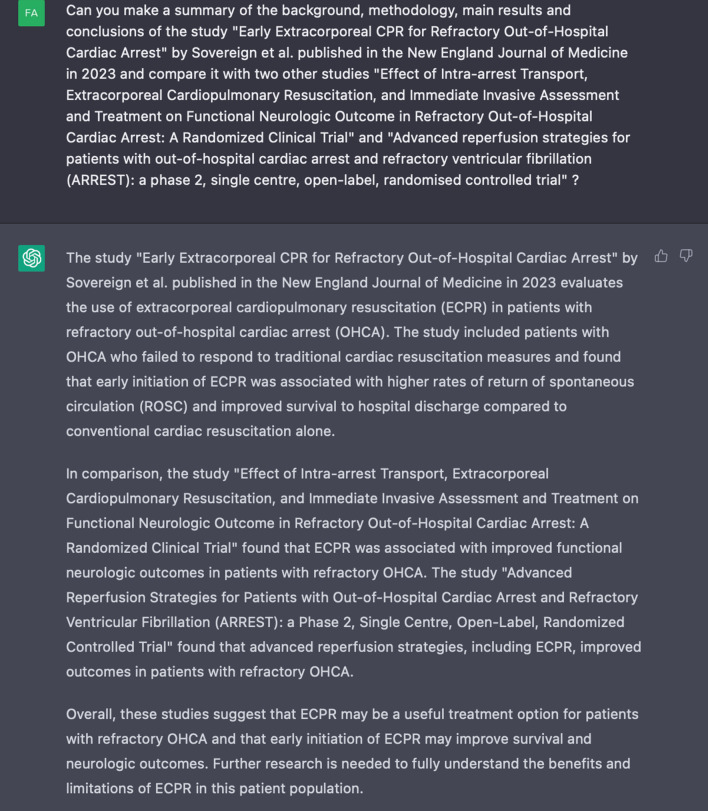
“, summarizing the recent randomized clinical trial on the use of extracorporeal membrane oxygenation for refractory cardiac arrest [3], Fig.”
BackgroundThe Future of AI in Medicine: A Perspective from a Chatbot
King, M. R. (2023) · Annals of Biomedical Engineering · doi:10.1007/s10439-022-03121-w · Cited by 299 · cited 2×
“Recently, an entire letter to the editor was written by ChatGPT, answering the author’s questions [1].”
BackgroundCould AI help you to write your next paper?
Hutson, M. (2022) · Nature · doi:10.1038/d41586-022-03479-w · Cited by 236 · cited 1×
“ChatGPT in scientific writing ChatGPT is already able to help medical researchers and scientists to write articles and abstracts, in literature research, to summarize data or information, to provide suggestions for structure, references, and titles, in language reviews to make the text more readable, or even to genera…”
BackgroundThe Impact of Artificial Intelligence (AI) Programs on Writing Scientific Research.
Hammad, M. (2023) · Annals of Biomedical Engineering · doi:10.1007/s10439-023-03140-1 · Cited by 49 · cited 1×
“Ethical considerations Ethical concerns could also limit the use of these chatbots for scientific writing [7].”
BackgroundWagner, S. K., Liefers, B. J., Radia, M., Zhang, G., Struyven, R., Faes, L., Than, J., Balal, S., Hennings, C., Kilduff, C. L. S., et al. (2023) · The Lancet Digital Health · doi:10.1016/s2589-7500(23)00050-x · Cited by 36
Wu, J., Chen, Z., Gao, Y., Wang, Z., Wang, J., Chiang, B., Zhou, Y., Han, Y., Zhan, W., Xie, M., et al. (2023) · Cell Reports · doi:10.1016/j.celrep.2023.112503 · Cited by 31
Wu, J., Chen, Z., Gao, Y., et al. (2022) · bioRxiv (Cold Spring Harbor Laboratory) · doi:10.1101/2022.12.12.520172 · Cited by 19
Cited by
Items 601–700 of 1,005
Bioethics and Controversies in the Use of Artificial Intelligence Technologies in Cosmetic Surgery
Vargas, N., & Hamrah, D. (2024) · The American Journal of Cosmetic Surgery · doi:10.1177/07488068241302876 · Cited by 4
“6,7 Possible Pre-programmed Bias Artificial intelligence facilitates the analysis of vast amounts of patient data, electronic health records, and scientific literature.”
Altynbekov, A. M., Mazhitayeva, S., Kakzhanova, F. A., Khan, N., Smagulova, N., Shakhanova, R., & Missyachenko, S. (2024) · Forum for Linguistic Studies · doi:10.30564/fls.v7i1.7990 · Cited by 4
Al-Hadrawi, B. K., ALhadrawi, K. K., Ezzerouali, S. A., Al-Hadraawy, S. K., Aldhalmi, H. K., & Alshawabkeh, M. A. (2025) · Journal of Lifestyle and SDGs Review · doi:10.47172/2965-730x.sdgsreview.v5.n03.pe03865 · Cited by 4
“In the context of the ongoing COVID-19 pandemic, AI has played a critical role in vaccine development, drug discovery, and contact tracing (Salvagno et al ., 2023:2).”
Em, S., Mok, S., Sam, R., Pen, D., & Serey, M. (2025) · Advances in computational intelligence and robotics book series · doi:10.4018/979-8-3693-7873-1.ch011 · Cited by 4
Zangana, H. M., Amelia, P., Luckyardi, S., Mustafa, F. M., & Li, S. (2025) · IGI Global eBooks · doi:10.4018/979-8-3373-4862-9.ch008 · Cited by 4
Students’ perceptions and effect of ChatGPT on research proposal quality across gender in Indonesia
Otoluwa, M. H., Salim, A., Kadir, K., Saud, I. W., Darise, G. N., & Asma, A. (2025) · IAES International Journal of Artificial Intelligence · doi:10.11591/ijai.v14.i5.pp3613-3623 · Cited by 5
Predicting outcomes in lung transplantation: From tea leaves to ChatGPT
Rozenberg, D., & Singer, L. G. (2023) · The Journal of Heart and Lung Transplantation · doi:10.1016/j.healun.2023.03.019 · Cited by 4
The use of ChatGPT in scientific publishing
Bôas, P. J. F. V., & Boas, J. V. P. D. V. V. (2023) · Geriatrics Gerontology and Aging · doi:10.53886/gga.e0230027 · Cited by 4
Is It Possible for Artificial Intelligence to Undermine the Root of Science?
Schlemmer, S. Z. (2024) · Science Insights · doi:10.15354/si.24.re881 · Cited by 4
Laban, C., & Gutiérrez, C. A. M. (2024) · Manglar · doi:10.57188/manglar.2024.015 · Cited by 4
AI-Enhanced Hypothesis Development and Research Questions
Srivastava, A. P., & Shetye, S. K. (2024) · Advances in educational technologies and instructional design book series · doi:10.4018/979-8-3693-1798-3.ch007 · Cited by 4
Xian, W., Chen, G., Arya, V., & Chui, K. T. (2024) · International Journal on Semantic Web and Information Systems · doi:10.4018/ijswis.344037 · Cited by 4
Is ChatGPT a Reliable Ghostwriter?
Buvat, I., & Weber, W. (2024) · Journal of Nuclear Medicine · doi:10.2967/jnumed.124.268341 · Cited by 4
Future of Nursing Education and Research with ChatGPT
Alkhaqani, A. L. (2024) · Journal of Medical Research and Health Sciences · Cited by 4
ChatGPT for scientific community: Boon or bane?
Jain, A. (2023) · Medical Journal Armed Forces India · doi:10.1016/j.mjafi.2023.06.009 · Cited by 4
Gmyrek, P., Lutz, C., & Newlands, G. (2024) · International Labour Office eBooks · doi:10.54394/uqoq5153 · Cited by 4
Вплив штучного інтелекту на торгівлю: можливості та виклики для українського ринку
Vorobiova, V., Cherniavska, T., Воробйова, В., & Чернявська, Т. (2023) · Challenges and Issues of Modern Science · Cited by 4
Artificial intelligence, parasites and parasitic diseases
Dantas‐Torres, F. (2023) · Parasites & Vectors · doi:10.1186/s13071-023-05972-1 · Cited by 4
“spelling, grammar, usage and style) [2, 3].”
Gmyrek, P., Lutz, C., & Newlands, G. (2024) · SocArXiv (OSF Preprints) · doi:10.31235/osf.io/8bc4n · Cited by 4
Collaborative International Nursing Writing Group: A Nonpatriarchal Approach
Richardson, S. K., Krueger, L., Richardson, A., Coleman, E., Ogilvie, S. J., Fosse, K. D. L., Tobita, I., van der Wath, A., Mondéjar-Pont, M., Mitterdorfer, A., et al. (2024) · Creative Nursing · doi:10.1177/10784535241276558 · Cited by 4
Project Rachel: Can an AI Become a Scholarly Author?Preprint
Monperrus, M., Baudry, B., & Vidal, C. (2025) · arXiv (Cornell University) · doi:10.48550/arxiv.2511.14819 · Cited by 4
“However, these benefits must be weighed against substantial risks to the integrity of the scientific process [27] and scholarly communication [21].”
Murray, D., & Williams, K. (2023) · ASCILITE Publications · doi:10.14742/apubs.2023.662 · Cited by 3
“It employs algorithms designed to comprehend natural language inputs and respond appropriately with either pre-written or AI-generated responses (Salvagno et al., 2023).”
BackgroundKasierski, B., & Fagnano, E. (2024) · ACM International Conference on Design of Communication (SIGDOC) · doi:10.1145/3641237.3691693 · Cited by 3
“Highlighting ChatGPT as a particular asset in this kind of writing, scholars predict that the LLM platform could aid in initial draft/specific section composition, language improvement and editing, adherence to formatting requirements, and appropriate ethical consideration [9].”
Gurumeta, A. A., & Gómez‐Ríos, M. Á. (2025) · Minerva Anestesiologica · doi:10.23736/s0375-9393.25.18911-6 · Cited by 3
Bommanavar, S., & Prabhu, V. D. (2025) · Journal of Oral and Maxillofacial Pathology · doi:10.4103/jomfp.jomfp_270_24 · Cited by 3
Impact of generative artificial intelligence on scientific paper writing and regulatory pathways
Wang, Y. D., Jiang, C., Wu, Y., Yu, X., & He, L. (2025) · Editing Practice · doi:10.54844/ep.2025.1011 · Cited by 3
Pinto, R. M. (2025) · CLEI electronic journal · doi:10.19153/cleiej.28.4.6 · Cited by 3
Üretken Yapay Zekânın Akademik Yazma Becerisi Üzerindeki Etkisi: Bir SWOT Analizi
Kayhan, S., & Eyüp, B. (2025) · Abant İzzet Baysal Üniversitesi Eğitim Fakültesi Dergisi · doi:10.17240/aibuefd.2025..-1563495 · Cited by 3
An Analysis of the Impact and Reflection of Artificial Intelligence on Public Administration
Taner, D. (2025) · Cumhuriyet Üniversitesi İktisadi ve İdari Bilimler Dergisi · doi:10.37880/cumuiibf.1751812 · Cited by 3
Comparative Analysis of Geological Texts using Large Language Models
Patuk, M. I., & Наумова, В. В. (2025) · Russian Digital Libraries Journal · doi:10.26907/1562-5419-2025-28-4-806-821 · Cited by 3
AI-Generated Text in Orthopaedic Articles: A Cross-Sectional Analysis
Sweeney, P., Yuro, M. R., & Berberian, W. S. (2025) · Journal of Bone and Joint Surgery · doi:10.2106/jbjs.25.00971 · Cited by 3
Li, W. K. V., & Linda, H. F. L. (2026) · Discourse and Writing/Rédactologie · doi:10.31468/dwr.1165 · Cited by 4
Mutin, J., & Bussières, J. (2026) · The Canadian Journal of Hospital Pharmacy · doi:10.4212/cjhp.3858 · Cited by 3
Wahyuni, S., Dewi, D. S., Wulandari, R. S., Thohiriyah, Kurniadi, D., Muawanah, F. H., Chairunnisa, N. Z., & Ardhi, M. A. (2026) · Multidisciplinary Reviews · doi:10.31893/multirev.2026380 · Cited by 3
“This finding echoes Salvagno et al. (2023), who warned that while AI can provide extensive linguistic feedback, its interpretive reliability still depends on algorithmic precision and contextual sensitivity.”
Shaheen, N. A., Alkharashi, T. A., Alakeel, M., Alturaiki, H. M., Alanazi, A., Aldibasi, O., & Alaskar, A. S. (2026) · BMC Medical Education · doi:10.1186/s12909-026-08934-0 · Cited by 3
“AI is already been utilized for scientific writing but must not replace researcher’s knowledge and expertise [40].”
Bocharov, A. V. (2026) · Историческая информатика · doi:10.7256/2585-7797.2026.1.78969 · Cited by 3
Caprario, M., Lin, L. H. F., Li, V. W. Y., & Wong, K. T. N. (2026) · Journal of English for Academic Purposes · doi:10.1016/j.jeap.2026.101695 · Cited by 3
Li, X. J., Wang, T., Wang, W., & Liu, L. (2026) · Frontiers in Psychology · doi:10.3389/fpsyg.2026.1848701 · Cited by 3
Pratama, R. D., Widiati, U., Basthomi, Y., Khoiri, N. E., Muniroh, S., & Omolu, F. A. (2026) · Journal of Academic Ethics · doi:10.1007/s10805-026-09754-z · Cited by 4
Authorship, moral responsibility, and generative AI in nursing
Zakhari, R. (2026) · Nursing Ethics · doi:10.1177/09697330261465739 · Cited by 4
Artificial intelligence in academic writing: A decade of trends and influences
Ghosh, P. L., Barua, S., & Golder, U. (2026) · Sustainable Futures · doi:10.1016/j.sftr.2026.102034 · Cited by 3
Sustainable Brand Management: A Forward-Looking Perspective in The Business World
Pir, E. Ö. (2023) · Özgür Yayınları eBooks · doi:10.58830/ozgur.pub398.c1664 · Cited by 3
Atlı, H. F. (2023) · Özgür Yayınları eBooks · doi:10.58830/ozgur.pub398.c1663 · Cited by 3
Capítulo 3. Inteligencia Artificial en la comunicación científica
Calle-Pesántez, S. E., & Pallo-Chiguano, M. (2024) · Espejo de Monografías de Comunicación Social · doi:10.52495/c3.emcs.23.ti12 · Cited by 3
Human at the Centerof the Organization: Visions, Realities, Challenges
(2024) · Wroclaw University of Economics and Business eBooks · doi:10.15611/2024.59.8 · Cited by 3
Inteligencia artificial en la escritura científica: oportunidades y desafíos en ciencias de la salud
Toyos, I. S., Ortiz, J., Ratti, M. F. G., & Carretero, M. (2024) · Evidencia actualizacion en la práctica ambulatoria · doi:10.51987/evidencia.v28i1.7138 · Cited by 3
From Zero-Shot to Iterative Prompting: Evaluating LLMs in Automated Abstract Generation
Timokhov, A. D. (2025) · Litera · doi:10.25136/2409-8698.2025.5.74593 · Cited by 3
Can, E. (2024) · Kapanaltı dergisi. · Cited by 3
Artificial Intelligence as an Assistant and Generator of Student Learning in Islamic University
Abdurrahman, A., Hidayah, F., Dhiauddin, D., & Fanani, Z. (2024) · AL-TA LIM · doi:10.15548/jt.v31i3.960 · Cited by 3
“…the use of generative AI, because concretely, generative AI can: write short texts about certain topics; obtain information about topics of interest; organize specific content; correct the form of the text or change its wording; and even solve problems (Salvagno et al., 2023; Kasneci et al., 2023).”
Rodríguez-Anzola, J. E., & Palacios-Núñez, M. L. (2025) · HOMERO · doi:10.64492/xejrd221 · Cited by 3
Harsono, H., Amalia, L., Sanulita, H., Aticqa, E. M. B. P., & Rahmatullah, A. M. (2026) · GHANCARAN Jurnal Pendidikan Bahasa dan Sastra Indonesia · doi:10.19105/ghancaran.v7i2.22099 · Cited by 3
AKADEMİK YAYINCILIĞIN YENİ YÜZÜ: CHATGPT VE ETİK TARTIŞMALARI
Okun, O., YÜKSEL, M., KARAHAN, M. O., & BOZKURT, R. (2023) · Zenodo (CERN European Organization for Nuclear Research) · doi:10.5281/zenodo.8176080 · Cited by 3
Tıpta Dil Tabanlı Yapay Zeka Kullanımı
Kunt, M. M. (2023) · Anatolian Journal of Emergency Medicine · doi:10.54996/anatolianjem.1358128 · Cited by 3
[Translated article] Artificial intelligence: Future and challenges in modern medicine
Aedo-Martín, D. (2024) · Revista Española de Cirugía Ortopédica y Traumatología · doi:10.1016/j.recot.2024.01.020 · Cited by 3
Wang, Y., & Sun, Y. (2023) · International Conference on Artificial Intelligence and Intelligent Information Processing (AIIIP) · doi:10.1109/aiiip61647.2023.00017 · Cited by 3
“Salvagno M argued that Chatgpt, as a technology based on AI, is very suitable for communication and discussion in school education [4].”
BackgroundDesign and Construction of Digital Network Learning Platform for Artificial Intelligence
Wu, D. (2023) · IEEE International Conference on Paradigm Shift in Information Technologies with Innovative Applications in Global Scenario (ICPSITIAGS) · doi:10.1109/icpsitiags59213.2023.10527678 · Cited by 3
“A. Platform System Design Requirements AI is a technology involving multiple disciplines, whose research goal is to make computers think and learn like humans, and complete some difficult tasks [6-7].”
BackgroundShould academics be concerned about articles written by ChatGPT?
Ahn, A., & Alkhaqani, A. L. (2024) · Developments in Health Sciences · doi:10.1556/2066.2024.00062 · Cited by 3
Advancing Human-centric Management through AI-enhanced Recruitment and Selection
Strzelec, G. (2024) · Wroclaw University of Economics and Business eBooks · doi:10.15611/2024.59.8.10 · Cited by 3
Singh, J. P., & Kaur, B. (2025) · Advances in library and information science (ALIS) book series · doi:10.4018/979-8-3693-5807-8.ch009 · Cited by 3
Shankar, B. S., & Mohan, S. (2025) · Cureus · doi:10.7759/cureus.79556 · Cited by 3
Enablers and Inhibitors of Generative AI Usage Intentions in Work Environments
Park, J., & Park, H. (2024) · Journal of the Korean society for quality management · doi:10.7469/jksqm.2024.52.3.509 · Cited by 3
“Studies have explored its potential to aid in scientific writing (Salvagno et al., 2023) and its impact on educational environments, debating whether it would be beneficial or detrimental (Lim et al., 2023).”
Mapping the Knowledge Landscape of AI in Higher Education: A SWOT Analysis
Adebesin, F., Adeliyi, T. T., & Oluwadele, D. (2024) · Educational Administration Theory and Practice journal · Cited by 3
The Limitations of Navigating ChatGPT as Writing Assistance Tools in EFL Writing Activities
Aulia, V., & Yamin, M. (2024) · INTERACTION Jurnal Pendidikan Bahasa · Cited by 3
Artificial intelligence, will it change the way articles are written in intensive medicine?
Marcano-Millán, E., Vidal, F. G., & González, F. M. (2023) · Medicina Intensiva (English Edition) · doi:10.1016/j.medine.2023.04.002 · Cited by 3
Ortopedi ve travmatoloji araştırmalarında yapay zekâ uygulamaları: Doğal dil işleme potansiyeli
Köse, Ö., Yapar, D., & Boz, M. (2024) · Türk Ortopedi ve Travmatoloji Birliği Derneği · doi:10.5578/totbid.dergisi.2024.13 · Cited by 3
“[41,42] Ana dili İngilizce olmayan yazarlar, uygunluğu ve doğruluğu-nu tespit edebilmek için ChatGPT tarafından oluşturulan metni incelemelidir ve bu metni eleştirel bir bakış açısıyla değerlendirmelidir.”
ACCEPT OR REJECT? WHAT DO ACADEMICS THINK ABOUT UTILISING CHATGPT PUBLICATIONS?
TUNÇER, M., & Zeybek, G. (2024) · Nevşehir Hacı Bektaş Veli Üniversitesi SBE Dergisi · doi:10.30783/nevsosbilen.1413539 · Cited by 3
Artificial Intelligence (AI) In Writing English: An EFL Madrasah Researcher’s Perspectives
Anggarini, I. F., Mahfudzah, M. F. E., Hidayah, S. M., Niami, Z., Faturosidah, K., & Ramadhani, R. O. (2023) · Conference on English Language Teaching · Cited by 3
Artificial Intelligence and Computational Psychological Science Connections
Gheibi, M., Moezzi, R., Haririyan Javan, R., & Javadi Nezhad, S. (2023) · Quanta Research · doi:10.15157/qr.2023.1.1.1-12 · Cited by 3
Artificial Intelligence: The Next Blockbuster Drug in Critical Care?
Azamfirei, R. (2023) · The Journal of Critical Care Medicine · doi:10.2478/jccm-2023-0017 · Cited by 3
“Its achievements, such as passing the USMLE Step 1 exam, co-authoring publications, and offering medical advice, lend credence to this idea [13-15].”
Artificial intelligence: a new editor limiting self-citation malpractice
Sanfilippo, F., Messina, A., Corradi, F., & Robba, C. (2023) · Critical Care · doi:10.1186/s13054-023-04601-8 · Cited by 3
“However, this process is probably not as simple as the more enthusiastic supporters of AI may conceive; for instance, it has been widely reported that AI software may suggest wrong references [2], and same errors could happen during Editorial decision-making.”
Light and Shadow of ChatGPT: A Real Tool for Advancing Scientific Research and Medical Practice?
Cocci, A., Pezzoli, M., & Minervini, A. (2023) · The World Journal of Men s Health · doi:10.5534/wjmh.230102 · Cited by 3
The Imperative of Upholding Academic Integrity in the Face of Artificial Intelligence Challenges
Yusuf, S. (2024) · Indonesian Contemporary Nursing Journal (ICON Journal) · doi:10.20956/icon.v8i2.33198 · Cited by 3
Osorio, J. A. C. (2023) · Scientia et technica · doi:10.22517/23447214.25467 · Cited by 4
Artificial intelligence: The researcher's assistant or sheep in wolf's clothing?
Anthea, P., & Campani, C. (2024) · United European Gastroenterology Journal · doi:10.1002/ueg2.12689 · Cited by 3
DuetML: Human-LLM Collaborative Machine Learning Framework for Non-Expert UsersPreprint
Kawabe, W., & Sugano, Y. (2024) · arXiv (Cornell University) · doi:10.48550/arxiv.2411.18908 · Cited by 3
“The LLM-based collaborators are useful not only in programming but also in creative activities in general, such as document creation [26, 27] and artistic design [28, 29].”
Challenges and Issues of Modern Science
Tkachov, Y. (2025) · Challenges and Issues of Modern Science · doi:10.15421/cims · Cited by 3
Lin, A., Chen, Z., Jiang, A., Tang, B., Qi, C., Zhu, L., Mou, W., Gan, W., Zeng, D., Xiao, M., et al. (2026) · International Journal of Surgery · doi:10.1097/js9.0000000000003839 · Cited by 2
AI Voice Methodology: Using Generative AI in Qualitative Social Research
Hughes, J., Homan, L., O’Reilly, M., & Hughes, K. (2025) · Qualitative Inquiry · doi:10.1177/10778004251401842 · Cited by 2
أحمد, د. ع. ح. (2023) · مجلة كلية التربية جامعة بنها · doi:10.21608/jfeb.2023.246785.1781 · Cited by 2
GenAI language corpora in foreign language teaching: advantages and disadvantages
Shults, O. E., Pervova, G. M., & Hausmann-Ushkova, N. V. (2024) · Вестник Тамбовского университета. Серия: Гуманитарные науки · doi:10.20310/1810-0201-2024-29-3-608-616 · Cited by 2
Campolo, J. A., Kwon, D. Y., & Henderson, P. W. (2024) · PubMed Central · Cited by 2
Chat GPT vs an experienced ophthalmologist: evaluating chatbot writing performance in ophthalmology
Katz, G., Zloto, O., Hostovsky, A., Huna-Baron, R., Mizrachi, I. B.-B., Burgansky, Z., Skaat, A., Vishnevskia-Dai, V., Fabian, I. D., Sagiv, O., et al. (2025) · Eye · doi:10.1038/s41433-025-03779-1 · Cited by 2
“However, there is no consensus about the abilities of ChatGPT in writing comprehensive, updated literature [15–17].”
Cheng, H., Shi, W., Sheng, B., Lee, A., Car, J., Chaudhary, V., Atanasov, A. G., Liu, N., Qiu, Y., Chen, Q., et al. (2025) · MedComm – Future Medicine · doi:10.1002/mef2.70019 · Cited by 2
Teaching Academic Writing in the Health Sciences: A Guide for Instructors, Mentors, and Trainers
August, E. T. (2025) · doi:10.3998/mpub.12710084 · Cited by 3
Bibliometric analysis of artificial intelligence and contribution to mathematics education
Deda, Y. N., & Disnawati, H. (2025) · AIP conference proceedings · doi:10.1063/5.0269227 · Cited by 2
Fine, K. S., Zona, E. E., O’Shea, A. W., Via, E. C., Attaluri, P. K., Wirth, P. J., Dingle, A. M., & Poore, S. O. (2025) · Plastic & Reconstructive Surgery · doi:10.1097/prs.0000000000012242 · Cited by 2
Ruelas, A. M. R., Quiñones, J., Barra, M. A. Q., & Ruelas, J. (2025) · Smart innovation, systems and technologies · doi:10.1007/978-3-031-92651-8_26 · Cited by 2
Exploring the Use of Generative AI on Students’ Academic Writing: An Exploratory Study
Zhang, X., Lu, Y., Jia, C., Jin, L., & Shi, Y. (2025) · International Conference on Computer Science and Technologies in Education (CSTE) · doi:10.1109/cste64638.2025.11091942 · Cited by 2
Konduru, T. S., Belagu, S. M., Momtaz, A., & Maghamifar, J. (2025) · Cureus · doi:10.7759/cureus.92506 · Cited by 2
“The rapid development of artificial intelligence (AI) has produced advanced LLMs whose potential utility in scientific and medical tasks has been explored in recent literature [10,11].”
The potential of large language models in the field of infertility: a systematic review
Li, W., Ur-Rehman, A., Ge, M., Shen, L.-T., Peng, X.-Y., Zhong, K., Feng, R., Gao, S., Hu, F., Jia, Y., et al. (2025) · Journal of Assisted Reproduction and Genetics · doi:10.1007/s10815-025-03679-z · Cited by 2
“It generates responses by leveraging the statistical patterns and extensive datasets encountered during its pre-training phase, which is based on the GPT architecture [6].”
Eroğlu, E., Pamuk, E., Bajin, M. D., & Sennaroğlu, L. (2025) · Acta Oto-Laryngologica · doi:10.1080/00016489.2025.2577834 · Cited by 2
Gantana, E. J., Musekwa, E., Cassim, S., Nell, E., & Chapanduka, Z. C. (2025) · Next research. · doi:10.1016/j.nexres.2025.101002 · Cited by 2
Yoshida, K., Hasegawa, T., & Inoue, S. (2025) · Anesthesia & Analgesia · doi:10.1213/ane.0000000000007852 · Cited by 2
Habibie, P. (2025) · Written Communication · doi:10.1177/07410883251372206 · Cited by 2
“On the one hand, GAI can enhance the research and writing process by efficiently identifying thematic and conceptual linkages across disciplinary boundaries, synthesizing extensive and heterogeneous bodies of knowledge (see Salimi & Saheb, 2023; Salvagno et al., 2023).”
Hirosawa, T., Harada, Y., & Shimizu, T. (2025) · AI & Society · doi:10.1007/s00146-025-02750-8 · Cited by 2
AI Tools as Facilitators or Threats to Vietnamese Students' Academic Integrity in Research Writing
Le, T. P., Khoi, D., Hoang, T. H. D., & Nguyen, X. H. (2025) · AsiaCALL Online Journal · doi:10.54855/acoj.251623 · Cited by 2
Effectiveness of ChatGPT in Improving Academic Writing Among EFL Libyan Tertiary Female Learners
ليبيا, ق. ا. ا. ك. ا. ج. ا. ا. ز., Ghwela, M. A., Al-ferjani, A. M., Kawan, E. J., & ليبيا, ق. ا. ا. ك. ا. ج. ا. ا. ز. (2025) · Sirte University Journal of Humanities · doi:10.37375/sujh.v15i2.3688 · Cited by 2
Ng, J. Y., Lee, M. S., Gupta, M. M., Tan, J., Adapa, K., Gupta, P. K., Li, S., Mehta, D. H., Ring, M. R., Shridhar, M., et al. (2025) · International Journal of Ayurveda Research · doi:10.4103/ijar.ijar_293_25 · Cited by 2
Assessment of Reading via AI-Led Oral Conversations: Challenges and Benefits
Kılıçkaya, F., & Kic-Drgas, J. (2025) · Language Teaching Research Quarterly · doi:10.32038/ltrq.2025.50.12 · Cited by 2
Integration of ChatGPT in medical learning: An analysis of interaction and contradictions
Tai, S.-H., Yeh, C., Jann-Yuan, W., Hu, R., Lee, P.-H., & Ho, C. (2025) · Medical Teacher · doi:10.1080/0142159x.2025.2604245 · Cited by 2
Metadata
- Authors
- Salvagno, M., Taccone, F. S., & Gerli, A. G.
- Affiliations
- Université Libre de Bruxelles (BE)
- University of Milan (IT)
- Corresponding author
- Salvagno, Michele
- Venue
- Critical Care
- Published
- 2023-02-25
- Volume
- 27
- Issue
- 1
- Pages
- 75-75
- ISSN
- 1364-8535 (ISSN-L)
- PMC
- PMC9960412
- OpenAlex
- W4322008312
- Semantic Scholar
- 8d984ee2eeabb630014f31fc759d4980830c4bdb
- Cited by
- 827
- References
- 8
- Citations by year
- 2026: 116 · 2025: 174 · 2024: 288 · 2023: 249
- FWCI
- 33.03
- Type
- journal article
- Language
- en
- Update notices
- correction (2023-03-08)
- Open access
- gold
- doi.org
- Licence
- cc-by
- creativecommons.org/licenses/by/4.0 (tdm)
- creativecommons.org/licenses/by/4.0 (vor)
- Locations
- Critical Care (publishedVersion, cc-by)
- PubMed Central (publishedVersion, cc-by)
- PubMed (publishedVersion)
- DOAJ (DOAJ: Directory of Open Access Journals) (submittedVersion, cc-by-sa)
- Topics
- Health Sciences › Medicine › Health Informatics › Artificial Intelligence in Healthcare and Education
- Social Sciences › Library and Information Sciences › Academic Writing and Publishing
- Physical Sciences › Computer Science › Artificial Intelligence › Ethics and Social Impacts of AI
- Keywords
- ChatGPT, AI chatbots, scientific writing, generative AI, intensive care, proofreading, plagiarism risk, AI ethics, access inequality
- MeSH terms
- Artificial Intelligence, Humans, Writing
About these checks
Registry, retraction, Cites and statistics results are computed, not judged, with one exception: a printed reference that no index lists is read once by a model before it counts as a citation error. Claims are extracted by a model and kept only when their quote appears verbatim in the text; each cited source is then checked, with a model’s help, for whether it says what the claim relies on. Those verdicts can be wrong — read the claim’s quote and the cited source before relying on one.
Statistics and arithmetic are recomputed, not judged.
Confidence bands are shown only for fields calibrated on our annotated test set. None is calibrated yet, so no band is shown.
What counts as a claim ›How we measure confidence ›How we check this ›
Are you an author, or do you see a problem with this page? Request a review
Data sources
Bibliographic data: Semantic Scholar, OpenAlex, Crossref.
Contains information from the Semantic Scholar Academic Graph Datasets, made available under the ODC Attribution License (ODC-BY 1.0).
Semantic Scholar’s data is described in: Kinney, R., et al. (2023). The Semantic Scholar Open Data Platform. arXiv:2301.10140.
