

Can artificial intelligence help for scientific writing?
Open accessThe DOI matches its Crossref record; 10 of the 10 references it cites were found in a registry or an index.
Abstract
This paper discusses the use of Artificial Intelligence Chatbot in scientific writing. ChatGPT is a type of chatbot, developed by OpenAI, that uses the Generative Pre-trained Transformer (GPT) language model to understand and respond to natural language inputs. AI chatbot and ChatGPT in particular appear to be useful tools in scientific writing, assisting researchers and scientists in organizing material, generating an initial draft and/or in proofreading. There is no publication in the field of critical care medicine prepared using this approach; however, this will be a possibility in the next future. ChatGPT work should not be used as a replacement for human judgment and the output should always be reviewed by experts before being used in any critical decision-making or application. Moreover, several ethical issues arise about using these tools, such as the risk of plagiarism and inaccuracies, as well as a potential imbalance in its accessibility between high- and low-income countries, if the software becomes paying. For this reason, a consensus on how to regulate the use of chatbots in scientific writing will soon be required.
Overview
The claims and statistics of this paper haven’t been checked yet.
Free: it reads the open-access text and checks the first 5 claims that cite a source we can check. Create a free account to check every claim.
Integrity signals
Registry
Cites
Statistics
Figures
Verification
Claims the paper makes
The claims and statistics of this paper haven’t been checked yet.
Free: it reads the open-access text and checks the first 5 claims that cite a source we can check. Create a free account to check every claim.
Claims other papers make about this one
Each is checked against this paper’s own text: does it say what the citing paper says it does?
The source backs part of the claim, not all of it — or backs it for a different population, condition or comparison.
In the citing paper
“Additionally, learners can expedite their writing development as AI tools help them identify and rectify grammatical and lexical errors, while also suggesting alternative sentence structures to enhance the overall writing quality and structure (Zhao, 2022; Chen, 2023; Salvagno et al., 2023).”
From Enhancing academic writing skills and motivation: assessing the efficacy of ChatGPT in AI-assisted language learning for EFL students (2023) · cites this paper as Salvagno et al., 2023
Experimental — accuracy not yet measuredThe source backs part of the claim, not all of it — or backs it for a different population, condition or comparison.
In the citing paper
“The authorship dilemma in AI-assisted research revolves around who should be credited for AI-generated content and how AI's role should be disclosed [67].”
From Developing the HAKI model as a conceptual framework for AI-assisted academic research (2026) · cites this paper as [67]
Experimental — accuracy not yet measuredThe source backs part of the claim, not all of it — or backs it for a different population, condition or comparison.
In the citing paper
“Recent studies show that GAI can improve writing quality by enhancing grammar, vocabulary, and fluency.”
From Exploring How AI Literacy and Self-Regulated Learning Relate to Student Writing Performance and Well-Being in Generative AI-Supported Higher Education (2025) · cites this paper as Salvagno et al., 2023
Experimental — accuracy not yet measuredThe source backs part of the claim, not all of it — or backs it for a different population, condition or comparison.
In the citing paper
“Additionally, the automation features of AI streamline tasks like formatting and citation, freeing up substantial time and energy for researchers, which can then be redirected towards more complex and innovative work.3,4”
From Balancing innovation and integrity: the role of AI in research and scientific writing (2023) · cites this paper as [3]
Experimental — accuracy not yet measuredThe cited source says what the claim attributes to it.
In the citing paper
“chatbots, including ChatGPT, have increased the difficulty in identifying plagiarism [47, 67, 76]”
From A systematic literature review of empirical research on ChatGPT in education (2024) · cites this paper as [67]
7 more claims about this paper
Create a free account to see every claim other papers make about this one.
Self-check
Percentages, sums and reported differences re-computed from the paper’s own numbers.
The self-check needs the paper’s full text.
Citations
Cites
Gao, C. A., Howard, F. M., Markov, N. S., Dyer, E. C., Ramesh, S., Luo, Y., & Pearson, A. T. (2022) · doi:10.1101/2022.12.23.521610 · Cited by 1,099
ChatGPT: the future of discharge summaries?
Patel, S. B., & Lam, K. (2023) · The Lancet Digital Health · doi:10.1016/s2589-7500(23)00021-3 · Cited by 728
Abstracts written by ChatGPT fool scientists
Else, H. (2023) · Nature · doi:10.1038/d41586-023-00056-7 · Cited by 611 · cited 1×
“Moreover, it may be difficult to recognize whether a paper is written by a chatbot or a human being [5], because chatbots use advanced techniques, such as natural language processing (NLP) and machine learning, to generate text that is similar to human writing.”
BackgroundEarly Extracorporeal CPR for Refractory Out-of-Hospital Cardiac Arrest
Suverein, M. M., Delnoij, T. S. R., Lorusso, R., Brandon Bravo Bruinsma, G. J., Otterspoor, L., Elzo Kraemer, C. V., Vlaar, A. P. J., van der Heijden, J. J., Scholten, E., den Uil, C., et al. (2023) · New England Journal of Medicine · doi:10.1056/nejmoa2204511 · Cited by 537 · cited 1×
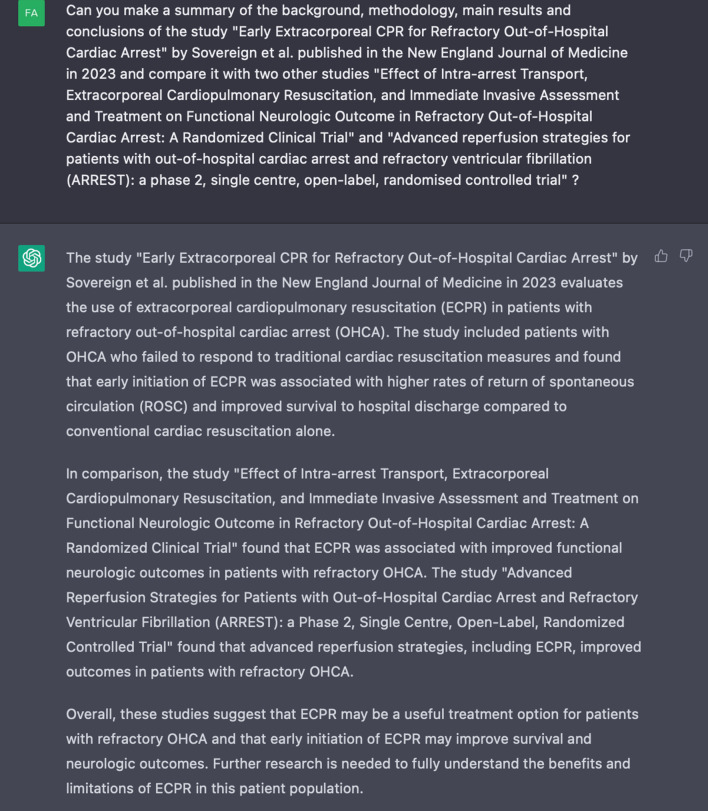
“, summarizing the recent randomized clinical trial on the use of extracorporeal membrane oxygenation for refractory cardiac arrest [3], Fig.”
BackgroundThe Future of AI in Medicine: A Perspective from a Chatbot
King, M. R. (2023) · Annals of Biomedical Engineering · doi:10.1007/s10439-022-03121-w · Cited by 299 · cited 2×
“Recently, an entire letter to the editor was written by ChatGPT, answering the author’s questions [1].”
BackgroundCould AI help you to write your next paper?
Hutson, M. (2022) · Nature · doi:10.1038/d41586-022-03479-w · Cited by 236 · cited 1×
“ChatGPT in scientific writing ChatGPT is already able to help medical researchers and scientists to write articles and abstracts, in literature research, to summarize data or information, to provide suggestions for structure, references, and titles, in language reviews to make the text more readable, or even to genera…”
BackgroundThe Impact of Artificial Intelligence (AI) Programs on Writing Scientific Research.
Hammad, M. (2023) · Annals of Biomedical Engineering · doi:10.1007/s10439-023-03140-1 · Cited by 49 · cited 1×
“Ethical considerations Ethical concerns could also limit the use of these chatbots for scientific writing [7].”
BackgroundWagner, S. K., Liefers, B. J., Radia, M., Zhang, G., Struyven, R., Faes, L., Than, J., Balal, S., Hennings, C., Kilduff, C. L. S., et al. (2023) · The Lancet Digital Health · doi:10.1016/s2589-7500(23)00050-x · Cited by 36
Wu, J., Chen, Z., Gao, Y., Wang, Z., Wang, J., Chiang, B., Zhou, Y., Han, Y., Zhan, W., Xie, M., et al. (2023) · Cell Reports · doi:10.1016/j.celrep.2023.112503 · Cited by 31
Wu, J., Chen, Z., Gao, Y., et al. (2022) · bioRxiv (Cold Spring Harbor Laboratory) · doi:10.1101/2022.12.12.520172 · Cited by 19
Cited by
Ray, P. P. (2023) · Internet of Things and Cyber-Physical Systems · doi:10.1016/j.iotcps.2023.04.003 · Cited by 2,463
Song, C., & Song, Y. (2023) · Frontiers in Psychology · doi:10.3389/fpsyg.2023.1260843 · Cited by 717
“Additionally, learners can expedite their writing development as AI tools help them identify and rectify grammatical and lexical errors, while also suggesting alternative sentence structures to enhance the overall writing quality and structure (Zhao, 2022; Chen, 2023; Salvagno et al., 2023).”
Chelli, M., Descamps, J., Lavoué, V., Trojani, C., Azar, M., Deckert, M., Raynier, J.-L., Clowez, G., Boileau, P., & Ruetsch-Chelli, C. (2024) · Journal of Medical Internet Research · doi:10.2196/53164 · Cited by 602
“While it is known that ChatGPT can help researchers write papers [3-5], controversy exists about whether it should be used at all, whether its use should be disclosed, and whether it should be listed as an author or not [6].”
BackgroundThe Ethics of ChatGPT-Exploring the Ethical Issues of an Emerging Technology
Stahl, B. C., & Eke, D. (2024) · International Journal of Information Management · doi:10.1016/j.ijinfomgt.2023.102700 · Cited by 476
ChatGPT in healthcare: A taxonomy and systematic review
Li, J., Dada, A., Puladi, B., Kleesiek, J., & Egger, J. (2024) · Computer Methods and Programs in Biomedicine · doi:10.1016/j.cmpb.2024.108013 · Cited by 452
Exploring students' perspectives on generative AI-assisted academic writing
Kim, J., Yu, S., Detrick, R., & Li, N. (2025) · Education and Information Technologies · doi:10.1007/s10639-024-12878-7 · Cited by 438
“As a result, by over-relying on GenAI without applying an appropriate level of skepticism, academic writers could help perpetuate such bias (Salvagno et al., 2023).”
InfluentialImran, M., & Almusharraf, N. (2023) · Contemporary Educational Technology · doi:10.30935/cedtech/13605 · Cited by 421
“…software potentially able to assist in the writing process of a scientific paper and can help in the literature review, identify research questions, provide an overview of the current state of the field, and assist with tasks, such as formatting and language review ” (Salvagno et al., 2023, p. 4).”
MethodExploring Artificial Intelligence in Academic Essay: Higher Education Student's Perspective
Malik, A. R., Pratiwi, Y., Andajani, K., Numertayasa, I. W., Suharti, S., Darwis, A., & Marzuki (2023) · International Journal of Educational Research Open · doi:10.1016/j.ijedro.2023.100296 · Cited by 418
Walker, H. L., Ghani, S., Kuemmerli, C., Nebiker, C. A., Müller, B. P., Raptis, D. A., & Staubli, S. M. (2023) · Journal of Medical Internet Research · doi:10.2196/47479 · Cited by 363
“The nature of this AI tool therefore harbors the danger of perpetuating mistakes, misconceptions, and biases [29].”
Ng, D. T. K., Tan, C. W., & Leung, J. K. L. (2024) · British Journal of Educational Technology · doi:10.1111/bjet.13454 · Cited by 362
Large language models and the perils of their hallucinations
Azamfirei, R., Kudchadkar, S. R., & Fackler, J. (2023) · Critical Care · doi:10.1186/s13054-023-04393-x · Cited by 323
Large Language Models in Education: Vision and Opportunities
Gan, W., Qi, Z., Wu, J., & Lin, J. C. (2023) · IEEE International Conference on Big Data (BigData) · doi:10.1109/bigdata59044.2023.10386291 · Cited by 314
“Wide range of applications : LLMs have extensive applications in natural language processing, virtual assistants [35], intelligent customer service [36], and intelligent writing [37], among others.”
BackgroundAcademic integrity and artificial intelligence: is ChatGPT hype, hero or heresy?
Currie, G. M. (2023) · Seminars in Nuclear Medicine · doi:10.1053/j.semnuclmed.2023.04.008 · Cited by 283
Use of ChatGPT at University as a Tool for Complex Thinking: Students’ Perceived Usefulness
Romero-Rodríguez, J.-M., Ramírez-Montoya, M.-S., Buenestado-Fernández, M., & Lara-Lara, F. (2023) · Journal of New Approaches in Educational Research · doi:10.7821/naer.2023.7.1458 · Cited by 277
Han, Z., Yang, Y., Rushlow, J., Huo, J., Liu, Z., Hsu, Y.-C., Yin, R., Wang, M., Liang, R., Wang, K.-Y., et al. (2025) · Chemical Society Reviews · doi:10.1039/d4cs00432a · Cited by 272
A Systematic Review of Generative AI for Teaching and Learning Practice
Ogunleye, B., Zakariyyah, K. I., Ajao, O., Olayinka, O., & Sharma, H. (2024) · Education Sciences · doi:10.3390/educsci14060636 · Cited by 251
Exploring the impact of ChatGPT: conversational AI in education
Bettayeb, A. M., Abu Talib, M., Sobhe Altayasinah, A. Z., & Dakalbab, F. (2024) · Frontiers in Education · doi:10.3389/feduc.2024.1379796 · Cited by 127
“In this study, thematic analysis was implemented following the steps outlined by Braun and Clarke (Salvagno et al., 2023).”
ChatGPT is a Remarkable Tool—For Experts
Azaria, A., Azoulay, R., & Reches, S. (2024) · Data Intelligence · doi:10.1162/dint_a_00235 · Cited by 130
Samala, A. D., Rawas, S., Wang, T., Reed, J. M., Kim, J., Howard, N.-J., & Ertz, M. (2025) · Education and Information Technologies · doi:10.1007/s10639-024-12936-0 · Cited by 229
“In other words, while ChatGPT can display human-like intelligence, it cannot exhibit human-like emotions or empathy (Salvagno et al., 2023; Zou et al., 2023).”
Gravel, J., D’Amours-Gravel, M., & Osmanlliu, E. (2023) · Mayo Clinic Proceedings: Digital Health · doi:10.1016/j.mcpdig.2023.05.004 · Cited by 222
Using ChatGPT in academic writing is (not) a form of plagiarism: What does the literature say?
Jarrah, A. M., Wardat, Y., & Fidalgo, P. (2023) · Online Journal of Communication and Media Technologies · doi:10.30935/ojcmt/13572 · Cited by 220
Gravel, J., D’Amours-Gravel, M., & Osmanlliu, E. (2023) · doi:10.1101/2023.03.16.23286914 · Cited by 220
Carobene, A., Padoan, A., Cabitza, F., Banfi, G., & Plebani, M. (2024) · Clinical Chemistry and Laboratory Medicine (CCLM) · doi:10.1515/cclm-2023-1136 · Cited by 137
Exploring ChatGPT Capabilities and Limitations: A Survey
Koubaa, A., Boulila, W., Ghouti, L., Alzahem, A., & Latif, S. (2023) · IEEE Access · doi:10.1109/access.2023.3326474 · Cited by 97
“This editorial in [66] explored the potential use of an AI chatbot, ChatGPT, in scientific writing.”
BackgroundAlshami, A., Elsayed, M., Ali, E., Eltoukhy, A. E. E., & Zayed, T. (2023) · Systems · doi:10.3390/systems11070351 · Cited by 202
Garg, R. K., Urs, V. L., Agrawal, A. A., Chaudhary, S. K., Paliwal, V., & Kar, S. K. (2023) · Health Promotion Perspectives · doi:10.34172/hpp.2023.22 · Cited by 202
The Use of Artificial Intelligence in Writing Scientific Review Articles
Kacena, M. A., Plotkin, L. I., & Fehrenbacher, J. C. (2024) · Current Osteoporosis Reports · doi:10.1007/s11914-023-00852-0 · Cited by 193
Sohail, S. S., Farhat, F., Himeur, Y., Nadeem, M., Madsen, D. Ø., Singh, Y., Atalla, S., & Mansoor, W. (2023) · Journal of King Saud University - Computer and Information Sciences · doi:10.1016/j.jksuci.2023.101675 · Cited by 192
A systematic literature review of empirical research on ChatGPT in education
Albadarin, Y., Saqr, M., Pope, N., & Tukiainen, M. (2024) · Discover Education · doi:10.1007/s44217-024-00138-2 · Cited by 191
Temsah, O., Khan, S. A., Chaiah, Y., Senjab, A., Alhasan, K., Jamal, A., Aljamaan, F., Malki, K. H., Halwani, R., Al-Tawfiq, J. A., et al. (2023) · Cureus · doi:10.7759/cureus.37281 · Cited by 179
“Interestingly, one of the papers listed ChatGPT as a co-author [7].”
BackgroundArtificial intelligence in scientific writing: a friend or a foe?
Altmäe, S., Sola-Leyva, A., & Salumets, A. (2023) · Reproductive BioMedicine Online · doi:10.1016/j.rbmo.2023.04.009 · Cited by 174
Sison, A. J. G., Daza, M. T., Gozalo-Brizuela, R., & Garrido-Merchán, E. C. (2024) · International Journal of Human–Computer Interaction · doi:10.1080/10447318.2023.2225931 · Cited by 169
“…assist health-care providers in Intensive Care Units (ICUs) monitoring patient information (treatment progression, laboratory values, microbiological results, fluid balance calculation, and so forth) (Salvagno et al., 2023); so long as it does not replace humans in decision making (Harrer, 2023).”
ChatGPT for Future Medical and Dental Research
Fatani, B. (2023) · Cureus · doi:10.7759/cureus.37285 · Cited by 121
“Nonetheless, due to ethical concerns, its use in scientific writing should be regulated [8].”
BackgroundInfluentialLund, B. D., & Naheem, K. T. (2024) · Learned Publishing · doi:10.1002/leap.1582 · Cited by 94
“These AI tools cannot freely approve content and consent to the submission of a manuscript, and are therefore more like tools such as Microsoft Word than true intelligent agents that approximate human capabilities (Salvagno et al., 2023).”
MethodThe Capability of ChatGPT in Predicting and Explaining Common Drug-Drug Interactions
Juhi, A., Pipil, N., Santra, S., Mondal, S., Behera, J. K., & Mondal, H. (2023) · Cureus · doi:10.7759/cureus.36272 · Cited by 128
“Previous studies have ascertained the capability of ChatGPT in academic writing [10], in answering various levels of reasoning questions in Pathology and Microbiology [11, 12], or the capability of writing medical examinations [13].”
Zeb, A., Ullah, R., & Karim, R. (2024) · The International Journal of Information and Learning Technology · doi:10.1108/ijilt-04-2023-0046 · Cited by 96
Cadamuro, J., Cabitza, F., Debeljak, Z., De Bruyne, S., Frans, G., Perez, S. M., Ozdemir, H., Tolios, A., Carobene, A., & Padoan, A. (2023) · Clinical Chemistry and Laboratory Medicine (CCLM) · doi:10.1515/cclm-2023-0355 · Cited by 116
Eger, S., Cao, Y., D'Souza, J., Geiger, A., Greisinger, C., Gross, S., Hou, Y.-F., Krenn, B., Lauscher, A., Li, Y.-Z., et al. (2025) · ACM Computing Surveys · doi:10.1145/3845596 · Cited by 67
“Luo et al. [152] provide nvBench , a benchmark of 25k tuples of natural language queries and corresponding visualizations. nvBench is based on 153 databases and contains more than 7k visualizations on seven chart types. nvBench is synthesized from natural language to SQL benchmarks.”
Ojeda, A. D., Solano-Barliza, A. D., Álvarez, D. D. O., & Boom-Cárcamo, E. (2023) · Formación universitaria · doi:10.4067/s0718-50062023000600061 · Cited by 141
Lozić, E., & Štular, B. (2023) · Future Internet · doi:10.3390/fi15100336 · Cited by 74
Kim, J., Yu, S., Lee, S.-S., & Detrick, R. (2025) · Journal of Research on Technology in Education · doi:10.1080/15391523.2025.2456043 · Cited by 137
“The academic community fosters genuine concern that GenAI will encourage or increase accidental plagiarism for academic writers who fail to critically evaluate AI suggestions and simply incorporate them into their writing (Salvagno et al., 2023).”
Aljuaid, H. (2024) · Arab World English Journal · doi:10.24093/awej/chatgpt.2 · Cited by 129
“…observed that overreliance might result in a deterioration of students’ cognitive abilities related to analytical reasoning and a diminishment of the individual’s originality in written expression (Algerafi et al., 2023; Berssanette & de Francisco, 2022; Lin et al., 2022; Salvagno et al., 2023).”
BackgroundMethodInfluentialChan, C. K. Y. (2025) · Education and Information Technologies · doi:10.1007/s10639-024-13151-7 · Cited by 128
“These findings align with concerns raised by academics about the emergence of AI-giarism (Chan & Tsi, 2023; Salvagno et al., 2023).”
Generalization bias in large language model summarization of scientific research
Peters, U., & Chin-Yee, B. (2025) · Royal Society Open Science · doi:10.1098/rsos.241776 · Cited by 126
“AI chatbots can process vast amounts of scientific information and summarize content in easily understandable language, thus helping to spread scientific knowledge, promote evidence uptake, and facilitate research [3,6,7].”
Academic publisher guidelines on AI usage: A ChatGPT supported thematic analysis
Perkins, M., & Roe, J. (2024) · F1000Research · doi:10.12688/f1000research.142411.2 · Cited by 123
“Furthermore, at this stage, using a GenAI tool like ChatGPT to draft a scientific paper still requires expert supervision, as text generated by AI is claimed to lack the nuances of human-authored text (Salvagno et al. , 2023).”
Zong, H., Li, J., Wu, E., Wu, R., Lu, J., & Shen, B. (2024) · BMC Medical Education · doi:10.1186/s12909-024-05125-7 · Cited by 114
Artificial intelligence in nursing: Current trends, possibilities and pitfalls
Ahmed, S. K. (2024) · Journal of Medicine, Surgery, and Public Health · doi:10.1016/j.glmedi.2024.100072 · Cited by 90
Bukar, U. A., Sayeed, M. S., Fatimah Abdul Razak, S., Yogarayan, S., & Sneesl, R. (2024) · IEEE Access · doi:10.1109/access.2024.3425172 · Cited by 69
“Plagia-rism [21], [29], [30], [31], [33], [34], [89], [99] indicating that the ease of generating content with ChatGPT increases the risk of plagiarism, undermining academic integrity.”
BackgroundInfluentialHead‐to‐Head Comparison of ChatGPT Versus Google Search for Medical Knowledge Acquisition
Ayoub, N. F., Lee, Y., Grimm, D., & Divi, V. (2024) · Otolaryngology–Head and Neck Surgery · doi:10.1002/ohn.465 · Cited by 111
Artificial hallucination: GPT on LSD?
Beutel, G., Geerits, E., & Kielstein, J. T. (2023) · Critical Care · doi:10.1186/s13054-023-04425-6 · Cited by 111
“[1] resulted in a completely different response from ChatGPT.”
BackgroundResultInfluentialResearch integrity in the era of artificial intelligence: Challenges and responses
Chen, Z., Chen, C., Yang, G., He, X., Chi, X., Zeng, Z., & Chen, X. (2024) · Medicine · doi:10.1097/md.0000000000038811 · Cited by 109
“[32] 3.”
BackgroundIs ChatGPT a “fire of Prometheus” for non-native English-speaking researchers in academic writing?
Hwang, S. I., Lim, J. S., Lee, R. W., Matsui, Y., Iguchi, T., Hiraki, T., & Ahn, H. (2023) · Korean Journal of Radiology · doi:10.3348/kjr.2023.0773 · Cited by 107
“Since LLMs excel at generating contextually relevant content [10,12,13], they can be useful tools for writing English manuscripts [9].”
BackgroundSemrl, N., Feigl, S., Taumberger, N., Bracic, T., Fluhr, H., Blockeel, C., & Kollmann, M. (2023) · Human Reproduction · doi:10.1093/humrep/dead207 · Cited by 68
Qadhi, S. M., Alduais, A., Chaaban, Y., & Khraisheh, M. (2024) · Information · doi:10.3390/info15060325 · Cited by 106
Arillotta, D., Floresta, G., Guirguis, A., Corkery, J. M., Catalani, V., Martinotti, G., Sensi, S. L., & Schifano, F. (2023) · Brain Sciences · doi:10.3390/brainsci13111503 · Cited by 104
Jin, S., Tu, H., Li, J., Fang, Y., Zhang, Q., Xu, F., Liu, K., & Lin, Y. (2024) · Buildings · doi:10.3390/buildings14061613 · Cited by 102
Kendall, G., & Teixeira da Silva, J. A. (2024) · Learned Publishing · doi:10.1002/leap.1578 · Cited by 100
“Even though AI is already used to write scienti fi c papers, it should not replace researchers ’ expertise and judgement (Salvagno et al., 2023).”
BackgroundAI in higher education: a systematic literature review
Castillo-Martínez, I. M., Flores-Bueno, D., Gómez-Puente, S. M., & Vite-León, V. O. (2024) · Frontiers in Education · doi:10.3389/feduc.2024.1391485 · Cited by 96
Talyshinskii, A., Naik, N., Hameed, B. M. Z., Juliebø-Jones, P., & Somani, B. K. (2024) · Current Urology Reports · doi:10.1007/s11934-023-01184-3 · Cited by 70
Spennemann, D. H. R. (2023) · Knowledge · doi:10.3390/knowledge3030032 · Cited by 93
ChatGPT in society: emerging issues
Farina, M., & Lavazza, A. (2023) · Frontiers in Artificial Intelligence · doi:10.3389/frai.2023.1130913 · Cited by 66
Gödde, D., Nöhl, S., Wolf, C., Rupert, Y., Rimkus, L., Ehlers, J., Breuckmann, F., & Sellmann, T. (2023) · Journal of Medical Internet Research · doi:10.2196/49368 · Cited by 69
“In these domains, it has already been shown that ChatGPT can create partially or completely fictitious passages [16,29,30,44], which cannot withstand critical review.”
InfluentialThe scholarly footprint of ChatGPT: a bibliometric analysis of the early outbreak phase
Farhat, F., Silva, E. S., Hassani, H., Madsen, D. Ø., Sohail, S. S., Himeur, Y., Alam, M. A., & Zafar, A. (2024) · Frontiers in Artificial Intelligence · doi:10.3389/frai.2023.1270749 · Cited by 48
da Trindade, A. S. C. E., & de Oliveira, H. P. C. (2024) · Perspectivas em Ciência da Informação · doi:10.1590/1981-5344/47485 · Cited by 86
Huber, S. E., Kiili, K., Nebel, S., Ryan, R. M., Sailer, M., & Ninaus, M. (2024) · Educational Psychology Review · doi:10.1007/s10648-024-09868-z · Cited by 85
“…has also the consequence that their output definitely requires critical evaluation and careful revision by domain experts (Ali et al., 2023; Biswas, 2023; Hosseini et al., 2023; Howard et al., 2023; Kasneci et al., 2023; Mogali, 2023; Salvagno et al., 2023; Van Dis et al., 2023; Zhu et al., 2023).”
LLatrieval: LLM-Verified Retrieval for Verifiable Generation
Li, X., Zhu, C., Li, L., Yin, Z., Sun, T., & Qiu, X. (2024) · Conference of the North American Chapter of the Association for Computational Linguistics: Human Language Technologies (NAACL-HLT) · doi:10.18653/v1/2024.naacl-long.305 · Cited by 85
Ofosu-Ampong, K. (2024) · Telematics and Informatics Reports · doi:10.1016/j.teler.2024.100127 · Cited by 81
ChatGPT in academic writing: Maximizing its benefits and minimizing the risks
Mondal, H., & Mondal, S. (2023) · Indian Journal of Ophthalmology · doi:10.4103/ijo.ijo_718_23 · Cited by 80
“[25] Manuscript revision When a manuscript is rejected, it is revised either for submission in the same journal or to other journals.”
BackgroundShi, J., Liu, W., & Hu, K. (2025) · Behavioral Sciences · doi:10.3390/bs15050705 · Cited by 77
“For cross-lingual writing, GAI enables students to overcome language barriers to access and assimilate content in multiple languages and learn diverse perspectives (Salvagno et al., 2023).”
Ethical Aspects of ChatGPT in Software Engineering Research
Akbar, M. A., Khan, A. A., & Liang, P. (2025) · IEEE Transactions on Artificial Intelligence · doi:10.1109/tai.2023.3318183 · Cited by 49
“Using the existing studies [10], [11], [15], [37], [43], [45]–[48], [51], [55], [56], we draw the following ethical aspects (principles) of using ChatGPT in SE research.”
Malik, M. A., Amjad, A. I., Aslam, S., & Fakhrou, A. A. (2024) · Frontiers in Research Metrics and Analytics · doi:10.3389/frma.2024.1486832 · Cited by 83
Hryciw, B. N., Seely, A. J. E., & Kyeremanteng, K. (2023) · Frontiers in Artificial Intelligence · doi:10.3389/frai.2023.1283353 · Cited by 45
Rapp, A., Lodovico, C. D., & Di, L. (2025) · International Journal of Human-Computer Studies · doi:10.1016/j.ijhcs.2025.103471 · Cited by 79
Kim, T., Shin, D., Kim, Y.-H., & Hong, H. (2024) · Proceedings of the CHI Conference on Human Factors in Computing Systems · doi:10.1145/3613904.3642693 · Cited by 75
How trustworthy is ChatGPT? The case of bibliometric analyses
Farhat, F., Sohail, S. S., & Madsen, D. Ø. (2023) · Cogent Engineering · doi:10.1080/23311916.2023.2222988 · Cited by 56
“Several recent studies have highlighted the difficulty faced by researchers in distinguishing between AI-generated and original abstracts (Else, 2023; Salvagno et al., 2023).”
BackgroundInfluentialCheng, S.-L., Tsai, S.-J., Bai, Y.-M., Ko, C.-H., Hsu, C.-W., Yang, F.-C., Tsai, C.-K., Tu, Y.-K., Yang, S.-N., Tseng, P.-T., et al. (2023) · Journal of Medical Internet Research · doi:10.2196/51229 · Cited by 50
“In scientific writing, ChatGPT may provide valuable support for drafting manuscripts, summarizing articles, translating languages, and refining text structures or wording [1].”
Meo, S. A., Al-Masri, A. A., Alotaibi, M., Meo, M. Z. S., & Meo, M. O. S. (2023) · Healthcare · doi:10.3390/healthcare11142046 · Cited by 74
“ChatGPT is enriched with advanced technology and techniques to respond to users’ requirements [1].”
BackgroundArtificial Intelligence to Support Qualitative Data Analysis: Promises, Approaches, Pitfalls
Cook, D. A., Ginsburg, S., Sawatsky, A. P., Kuper, A., & D’Angelo, J. D. (2025) · Academic Medicine · doi:10.1097/acm.0000000000006134 · Cited by 81
Huang, Y., Wu, R., He, J., & Xiang, Y. (2024) · Journal of Global Health · doi:10.7189/jogh.14.04070 · Cited by 72
Large language models for life cycle assessments: Opportunities, challenges, and risks
Preuss, N., Alshehri, A. S., & You, F. (2024) · Journal of Cleaner Production · doi:10.1016/j.jclepro.2024.142824 · Cited by 71
Students' reflections on their experience with ChatGPT
Šedlbauer, J., Činčera, J., Slavík, M., & Hartlová, A. (2024) · Journal of Computer Assisted Learning · doi:10.1111/jcal.12967 · Cited by 71
Multimodal composing with generative AI: Examining preservice teachers’ processes and perspectives
Smith, B. E., Shimizu, A. Y., Burriss, S. K., Hundley, M. K., & Pendergrass, E. (2024) · Computers & composition/Computers and composition · doi:10.1016/j.compcom.2024.102896 · Cited by 76
Use of Artificial Intelligence Tools for Research by Medical Students: A Narrative Review
Jhajj, K. S., Jindal, P., & Kaur, K. (2024) · Cureus · doi:10.7759/cureus.55367 · Cited by 70
“Various AI applications have been developed in the last few years, which can help seasoned researchers streamline the processes of literature review, identifying research questions, evidence synthesis, and manuscript and grant writing [6].”
BackgroundInfluentialChatGPT and L2 Written Communication: A Game-Changer or Just Another Tool?
Zadorozhnyy, A., & Lai, W. Y. W. (2023) · Languages · doi:10.3390/languages9010005 · Cited by 69
Watters, C., & Lemański, M. K. (2023) · Frontiers in Big Data · doi:10.3389/fdata.2023.1224976 · Cited by 71
Jiang, Y. (2024) · The Internet and Higher Education · doi:10.1016/j.iheduc.2024.100975 · Cited by 69
May Artificial Intelligence Influence Future Pediatric Research?—The Case of ChatGPT
Corsello, A., & Santangelo, A. (2023) · Children · doi:10.3390/children10040757 · Cited by 66
YAPAY ZEKÂ İLETİŞİMİNDE CHATGPT: İNSANLAŞAN DİJİTALLEŞMENİN GELECEĞİ
Koçyiğit, A., & Abdülhakim Bahadır, D. A. R. I. (2023) · Stratejik ve Sosyal Araştırmalar Dergisi · doi:10.30692/sisad.1311336 · Cited by 68
Exploring the potential of AI-Chatbots in organic chemistry: An assessment of ChatGPT and Bard
Hallal, K., Hamdan, R., & Tlais, S. (2023) · Computers and Education: Artificial Intelligence · doi:10.1016/j.caeai.2023.100170 · Cited by 37
A Bibliometric Analysis of Research on ChatGPT in Education
Polat, H., Topuz, A. C., Yıldız, M., Taşlıbeyaz, E., & Kurşun, E. (2024) · International Journal of Technology in Education · doi:10.46328/ijte.606 · Cited by 35
Ng, J. Y., Maduranayagam, S. G., Suthakar, N., Li, A., Lokker, C., Iorio, A., Haynes, R. B., & Moher, D. (2025) · The Lancet Digital Health · doi:10.1016/s2589-7500(24)00202-4 · Cited by 64
Cuthbert, R., & Simpson, A. I. (2023) · Postgraduate Medical Journal · doi:10.1093/postmj/qgad053 · Cited by 56
Sumbal, A., Sumbal, R., & Amir, A. (2024) · Journal of Medical Education and Curricular Development · doi:10.1177/23821205241238641 · Cited by 63
THE USE OF CHATGPT IN ACADEMIC WRITING: A BLESSING OR A CURSE IN DISGUISE?
Alberth, N. A. (2023) · TEFLIN Journal - A publication on the teaching and learning of English · doi:10.15639/teflinjournal.v34i2/337-352 · Cited by 63
“…have even recommended that international academic laws be made in place to control the use of chatbot tools in scientific writing and that systems for identifying and sanctioning unethical usage be provided because AI will soon be extensively implemented in various fields (Salvagno et al., 2023).”
BackgroundMethodResultInfluentialBaxter, S. L., Longhurst, C. A., Millen, M., Sitapati, A. M., & Tai-Seale, M. (2024) · JAMIA Open · doi:10.1093/jamiaopen/ooae028 · Cited by 47
Generative Artificial Intelligence: Fundamentals
Corchado, J. M., Sebastian López, F., V., J., Raul Garcia, S., & Chamoso, P. (2023) · ADCAIJ ADVANCES IN DISTRIBUTED COMPUTING AND ARTIFICIAL INTELLIGENCE JOURNAL · doi:10.14201/adcaij.31704 · Cited by 64
Take It, Leave It, or Fix It: Measuring Productivity and Trust in Human-AI Collaboration
Qian, C., & Wexler, J. (2024) · ACM International Conference on Intelligent User Interfaces (IUI) · doi:10.1145/3640543.3645198 · Cited by 63
“Recent advancements in generative artificial intelligence (AI) have the potential to enhance productivity across domains such as medicine [37], research [38, 50], and technology [48].”
BackgroundInfluentialCybersecurity in the generative artificial intelligence era
Teo, Z. L., Quek, C. W. N., Wong, J. L. Y., & Ting, D. S. W. (2024) · Asia-Pacific Journal of Ophthalmology · doi:10.1016/j.apjo.2024.100091 · Cited by 62
Ethical decision-making and artificial intelligence in nursing education: An integrative review
Şengül, T., Sarıköse, S., & Gül, A. (2025) · Nursing Ethics · doi:10.1177/09697330251366600 · Cited by 61
An integrative decision-making framework to guide policies on regulating ChatGPT usage
Bukar, U. A., Sayeed, M. S., Abdul Razak, S. F., Yogarayan, S., & Ahmed Amodu, O. (2024) · PeerJ Computer Science · doi:10.7717/peerj-cs.1845 · Cited by 43
Metadata
- Authors
- Salvagno, M., Taccone, F. S., & Gerli, A. G.
- Affiliations
- Université Libre de Bruxelles (BE)
- University of Milan (IT)
- Corresponding author
- Salvagno, Michele
- Venue
- Critical Care
- Published
- 2023-02-25
- Volume
- 27
- Issue
- 1
- Pages
- 75-75
- ISSN
- 1364-8535 (ISSN-L)
- PMC
- PMC9960412
- OpenAlex
- W4322008312
- Semantic Scholar
- 8d984ee2eeabb630014f31fc759d4980830c4bdb
- Cited by
- 827
- References
- 8
- Citations by year
- 2026: 116 · 2025: 174 · 2024: 288 · 2023: 249
- FWCI
- 33.03
- Type
- journal article
- Language
- en
- Update notices
- correction (2023-03-08)
- Open access
- gold
- doi.org
- Licence
- cc-by
- creativecommons.org/licenses/by/4.0 (tdm)
- creativecommons.org/licenses/by/4.0 (vor)
- Locations
- Critical Care (publishedVersion, cc-by)
- PubMed Central (publishedVersion, cc-by)
- PubMed (publishedVersion)
- DOAJ (DOAJ: Directory of Open Access Journals) (submittedVersion, cc-by-sa)
- Topics
- Health Sciences › Medicine › Health Informatics › Artificial Intelligence in Healthcare and Education
- Social Sciences › Library and Information Sciences › Academic Writing and Publishing
- Physical Sciences › Computer Science › Artificial Intelligence › Ethics and Social Impacts of AI
- Keywords
- ChatGPT, AI chatbots, scientific writing, generative AI, intensive care, proofreading, plagiarism risk, AI ethics, access inequality
- MeSH terms
- Artificial Intelligence, Humans, Writing
About these checks
Registry, retraction, Cites and statistics results are computed, not judged, with one exception: a printed reference that no index lists is read once by a model before it counts as a citation error. Claims are extracted by a model and kept only when their quote appears verbatim in the text; each cited source is then checked, with a model’s help, for whether it says what the claim relies on. Those verdicts can be wrong — read the claim’s quote and the cited source before relying on one.
Statistics and arithmetic are recomputed, not judged.
Confidence bands are shown only for fields calibrated on our annotated test set. None is calibrated yet, so no band is shown.
What counts as a claim ›How we measure confidence ›How we check this ›
Are you an author, or do you see a problem with this page? Request a review
Data sources
Bibliographic data: Semantic Scholar, OpenAlex, Crossref.
Contains information from the Semantic Scholar Academic Graph Datasets, made available under the ODC Attribution License (ODC-BY 1.0).
Semantic Scholar’s data is described in: Kinney, R., et al. (2023). The Semantic Scholar Open Data Platform. arXiv:2301.10140.
