

Can artificial intelligence help for scientific writing?
Open accessThe DOI matches its Crossref record; 10 of the 10 references it cites were found in a registry or an index.
Abstract
This paper discusses the use of Artificial Intelligence Chatbot in scientific writing. ChatGPT is a type of chatbot, developed by OpenAI, that uses the Generative Pre-trained Transformer (GPT) language model to understand and respond to natural language inputs. AI chatbot and ChatGPT in particular appear to be useful tools in scientific writing, assisting researchers and scientists in organizing material, generating an initial draft and/or in proofreading. There is no publication in the field of critical care medicine prepared using this approach; however, this will be a possibility in the next future. ChatGPT work should not be used as a replacement for human judgment and the output should always be reviewed by experts before being used in any critical decision-making or application. Moreover, several ethical issues arise about using these tools, such as the risk of plagiarism and inaccuracies, as well as a potential imbalance in its accessibility between high- and low-income countries, if the software becomes paying. For this reason, a consensus on how to regulate the use of chatbots in scientific writing will soon be required.
Overview
The claims and statistics of this paper haven’t been checked yet.
Free: it reads the open-access text and checks the first 5 claims that cite a source we can check. Create a free account to check every claim.
Integrity signals
Registry
Cites
Statistics
Figures
Verification
Claims the paper makes
The claims and statistics of this paper haven’t been checked yet.
Free: it reads the open-access text and checks the first 5 claims that cite a source we can check. Create a free account to check every claim.
Claims other papers make about this one
Each is checked against this paper’s own text: does it say what the citing paper says it does?
The source backs part of the claim, not all of it — or backs it for a different population, condition or comparison.
In the citing paper
“Additionally, learners can expedite their writing development as AI tools help them identify and rectify grammatical and lexical errors, while also suggesting alternative sentence structures to enhance the overall writing quality and structure (Zhao, 2022; Chen, 2023; Salvagno et al., 2023).”
From Enhancing academic writing skills and motivation: assessing the efficacy of ChatGPT in AI-assisted language learning for EFL students (2023) · cites this paper as Salvagno et al., 2023
Experimental — accuracy not yet measuredThe source backs part of the claim, not all of it — or backs it for a different population, condition or comparison.
In the citing paper
“The authorship dilemma in AI-assisted research revolves around who should be credited for AI-generated content and how AI's role should be disclosed [67].”
From Developing the HAKI model as a conceptual framework for AI-assisted academic research (2026) · cites this paper as [67]
Experimental — accuracy not yet measuredThe source backs part of the claim, not all of it — or backs it for a different population, condition or comparison.
In the citing paper
“Recent studies show that GAI can improve writing quality by enhancing grammar, vocabulary, and fluency.”
From Exploring How AI Literacy and Self-Regulated Learning Relate to Student Writing Performance and Well-Being in Generative AI-Supported Higher Education (2025) · cites this paper as Salvagno et al., 2023
Experimental — accuracy not yet measuredThe source backs part of the claim, not all of it — or backs it for a different population, condition or comparison.
In the citing paper
“Additionally, the automation features of AI streamline tasks like formatting and citation, freeing up substantial time and energy for researchers, which can then be redirected towards more complex and innovative work.3,4”
From Balancing innovation and integrity: the role of AI in research and scientific writing (2023) · cites this paper as [3]
Experimental — accuracy not yet measuredThe cited source says what the claim attributes to it.
In the citing paper
“chatbots, including ChatGPT, have increased the difficulty in identifying plagiarism [47, 67, 76]”
From A systematic literature review of empirical research on ChatGPT in education (2024) · cites this paper as [67]
7 more claims about this paper
Create a free account to see every claim other papers make about this one.
Self-check
Percentages, sums and reported differences re-computed from the paper’s own numbers.
The self-check needs the paper’s full text.
Citations
Cites
Gao, C. A., Howard, F. M., Markov, N. S., Dyer, E. C., Ramesh, S., Luo, Y., & Pearson, A. T. (2022) · doi:10.1101/2022.12.23.521610 · Cited by 1,099
ChatGPT: the future of discharge summaries?
Patel, S. B., & Lam, K. (2023) · The Lancet Digital Health · doi:10.1016/s2589-7500(23)00021-3 · Cited by 728
Abstracts written by ChatGPT fool scientists
Else, H. (2023) · Nature · doi:10.1038/d41586-023-00056-7 · Cited by 611 · cited 1×
“Moreover, it may be difficult to recognize whether a paper is written by a chatbot or a human being [5], because chatbots use advanced techniques, such as natural language processing (NLP) and machine learning, to generate text that is similar to human writing.”
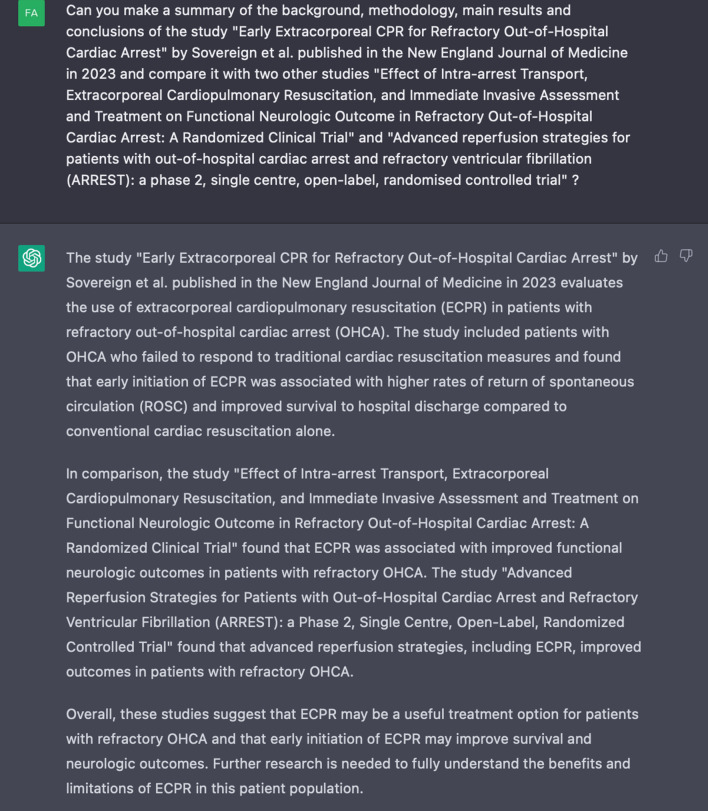
BackgroundEarly Extracorporeal CPR for Refractory Out-of-Hospital Cardiac Arrest
Suverein, M. M., Delnoij, T. S. R., Lorusso, R., Brandon Bravo Bruinsma, G. J., Otterspoor, L., Elzo Kraemer, C. V., Vlaar, A. P. J., van der Heijden, J. J., Scholten, E., den Uil, C., et al. (2023) · New England Journal of Medicine · doi:10.1056/nejmoa2204511 · Cited by 537 · cited 1×
“, summarizing the recent randomized clinical trial on the use of extracorporeal membrane oxygenation for refractory cardiac arrest [3], Fig.”
BackgroundThe Future of AI in Medicine: A Perspective from a Chatbot
King, M. R. (2023) · Annals of Biomedical Engineering · doi:10.1007/s10439-022-03121-w · Cited by 299 · cited 2×
“Recently, an entire letter to the editor was written by ChatGPT, answering the author’s questions [1].”
BackgroundCould AI help you to write your next paper?
Hutson, M. (2022) · Nature · doi:10.1038/d41586-022-03479-w · Cited by 236 · cited 1×
“ChatGPT in scientific writing ChatGPT is already able to help medical researchers and scientists to write articles and abstracts, in literature research, to summarize data or information, to provide suggestions for structure, references, and titles, in language reviews to make the text more readable, or even to genera…”
BackgroundThe Impact of Artificial Intelligence (AI) Programs on Writing Scientific Research.
Hammad, M. (2023) · Annals of Biomedical Engineering · doi:10.1007/s10439-023-03140-1 · Cited by 49 · cited 1×
“Ethical considerations Ethical concerns could also limit the use of these chatbots for scientific writing [7].”
BackgroundWagner, S. K., Liefers, B. J., Radia, M., Zhang, G., Struyven, R., Faes, L., Than, J., Balal, S., Hennings, C., Kilduff, C. L. S., et al. (2023) · The Lancet Digital Health · doi:10.1016/s2589-7500(23)00050-x · Cited by 36
Wu, J., Chen, Z., Gao, Y., Wang, Z., Wang, J., Chiang, B., Zhou, Y., Han, Y., Zhan, W., Xie, M., et al. (2023) · Cell Reports · doi:10.1016/j.celrep.2023.112503 · Cited by 31
Wu, J., Chen, Z., Gao, Y., et al. (2022) · bioRxiv (Cold Spring Harbor Laboratory) · doi:10.1101/2022.12.12.520172 · Cited by 19
Cited by
Items 401–500 of 1,005
Sanii, R. Y., Kasto, J. K., Wines, W., Mahylis, J. M., & Muh, S. J. (2023) · Orthopedics · doi:10.3928/01477447-20231220-02 · Cited by 11
Liu, W., Bilal, M., Shi, Y., & Xu, X. (2024) · Digital Communications and Networks · doi:10.1016/j.dcan.2024.11.009 · Cited by 10
White, R. R. (2025) · JDS Communications · doi:10.3168/jdsc.2024-0707 · Cited by 11
Gencer, B., Arzu, U., Orhan, S. S., Dinçal, T., & Ekinci, M. (2025) · Journal of Clinical Medicine · doi:10.3390/jcm14092942 · Cited by 10
The Role of English Language and AI in Scientific Writing: Ethical and Academic Implications
Zangana, H. M., Amelia, P., Mustafa, F. M., & Li, S. (2025) · Advances in computational intelligence and robotics book series · doi:10.4018/979-8-3373-4252-8.ch005 · Cited by 10
Augmentation or limitation? Generative AI’s influence on college students’ creative problem-solving
Wang, H., Da, T., Wang, Y., Luo, F., Zhang, Y., Tlili, A., Yang, D., Wang, Y., Xu, J., Zhu, X., et al. (2025) · Thinking Skills and Creativity · doi:10.1016/j.tsc.2025.102116 · Cited by 10
Commentary to the article “A CHAT(GPT) about the future of scientific publishing”
Ortíz, A. F. H. (2023) · Brain Behavior and Immunity · doi:10.1016/j.bbi.2023.04.004 · Cited by 10
GPT4: The Indispensable Helper for Neurosurgeons in the New Era
Liu, G., Ma, X., Zhang, Y., Su, B., & Liu, P. (2023) · Annals of Biomedical Engineering · doi:10.1007/s10439-023-03241-x · Cited by 10
“However, it should be noted that the process of data collection by GPT may inadvertently increase the phenomenon of plagiarism [12].”
BackgroundWang, W. H., Wang, S. Y., Huang, J. Y., Liu, X., Yang, J., Liao, M., Lu, Q., & Wu, Z. (2023) · Journal of Clinical Ultrasound · doi:10.1002/jcu.23590 · Cited by 10
Cargnelutti, R., Bernardino, M., Garcia, R., & Silva, W. (2023) · Anais do ... Simpósio Brasileiro de Informática na Educação/Anais do Simpósio Brasileiro de Informática na Educação · doi:10.5753/sbie.2023.234610 · Cited by 10
EXPLORING THE POTENTIAL AND LIMITATIONS OF CHATGPT IN ACADEMIC WRITING AND EDITORIAL TASKS
Akpur, A. (2024) · Fırat Üniversitesi Sosyal Bilimler Dergisi · doi:10.18069/firatsbed.1299700 · Cited by 11
An efficient full-size convolutional computing method based on memristor crossbar
Tan, J., Shen, S., Duan, S., & Wang, L. (2024) · Artificial Intelligence Review · doi:10.1007/s10462-024-10787-2 · Cited by 10
“…(AI) to a new level, with the ChatGPT chat robot model released by OpenAI, which combines reinforcement techniques, natural language processing, and machine learning to improve its ability to understand and comprehensively respond to users’ needs (Salvagno et al. 2023; Khowaja et al. 2023).”
Li, X., Yang, Z., Zhang, W., & Yang, Z. (2024) · International Conference on Educational and Information Technology · doi:10.1109/iceit61397.2024.10540814 · Cited by 10
“[3] Can significantly improve the efficiency and quality of scientists writing review articles.”
BackgroundRise of the machines: trends and challenges of implementing AI in biomedical scientific writing
Fornalik, M., Makuch, M., Lemanska, A., Moska, S., Wiczuk-Wiczewska, M., Anderko, I., Stochaj, L., Szczygieł, M. B., & Zielińska, A. (2024) · Exploration of Digital Health Technologies · doi:10.37349/edht.2024.00024 · Cited by 13
Will ChatGPT-4 improve the quality of medical abstracts?
Gravel, J., Dion, C., Kermani, M. F., Mousseau, S., & Osmanlliu, E. (2024) · Paediatrics & Child Health · doi:10.1093/pch/pxae062 · Cited by 10
AI Tools in LIS Research: Navigating Opportunities and Challenges for Scholarly Advancement
Maurya, A., & Sinha, P. (2024) · The Serials Librarian · doi:10.1080/0361526x.2024.2400719 · Cited by 10
The Use of Artificial Intelligence in Academic Writing: What is Ethical and What is Not
Mwita, K., & Mwilongo, N. H. (2025) · Journal of Digital Learning and Education · doi:10.52562/jdle.v5i1.1318 · Cited by 12
Writing in the era of large language models: a bibliometric analysis of research field
Litvinova, T., Mikros, G. K., & Dekhnich, O. V. (2024) · RESEARCH RESULT Theoretical and Applied Linguistics · doi:10.18413/2313-8912-2024-10-4-0-1 · Cited by 12
Galli, C., Moretti, C., & Calciolari, E. (2024) · Learned Publishing · doi:10.1002/leap.1648 · Cited by 10
“These tools can support scholars to expand on written passages, make them clearer and suggest the next best textual move (Ginting et al., 2023; Salvagno et al., 2023).”
Maslinski, J., Grasfield, R. H., Awasthi, R., Mishra, S. V., Mahapatra, D., & Mathur, P. (2025) · Cureus · doi:10.7759/cureus.82397 · Cited by 9
Generative AI in peer review process for occupational health
Lim, G. H., Tan, M. L., Hoe, V. C. W., & Koh, D. S. Q. (2025) · Occupational Medicine · doi:10.1093/occmed/kqaf051 · Cited by 9
“These include editing, summarizing, idea generation, data analysis, evaluation and coming out with recommendations [1–4].”
Assessing DeepSeek-R1 for Clinical Decision Support in Multidisciplinary Laboratory Medicine
Li, Q., Zhan, L., & Cai, X. (2025) · Journal of Multidisciplinary Healthcare · doi:10.2147/jmdh.s538253 · Cited by 9
Buitrago, J., Campos, E. M., & Romero, C. L. V. (2025) · Investigación Bibliotecológica Archivonomía Bibliotecología e Información · doi:10.22201/iibi.24488321xe.2025.104.59032 · Cited by 9
Malpique, A., Valcan, D. S., Pino‐Pasternak, D., & Ledger, S. (2025) · The Australian Educational Researcher · doi:10.1007/s13384-025-00910-9 · Cited by 9
“Researchers point out that generative AI should not replace human writers (Kasneci et al., 2023; Salvagno et al., 2023), highlighting the importance of developing human-AI constructive collaborations in which effective writers use their critical, creative, and problem-solving skills to assess the…”
Alif, H. A., Mashrafi, M. J., Islam, S. R., Fahim, A., Nath, A. D., & Ahmed, J. (2025) · Asian Conference on Innovation in Technology (ASIANCON) · doi:10.1109/asiancon66527.2025.11281210 · Cited by 9
“[11].”
Ghimire, S. N., Baral, R. K., & Bhattarai, U. (2026) · Interactive Learning Environments · doi:10.1080/10494820.2025.2611124 · Cited by 9
“…of GenAI technologies in content generation and the submission of such content as their own original work without proper attribution of sources and inadequate modification under-mines established norms around originality, authorship, and academic integrity (Salvagno et al., 2023; Wu et al., 2025).”
Hlede, V., Valanci, S., D’Antuono, G., Dow, H., Wiggins, R. H., Dorman, T., & O’Beirne, R. (2026) · JMIR Medical Education · doi:10.2196/69156 · Cited by 9
“All parts of this article—except the practical examples of framework use—were created by human authors with AI support [40].”
Charbonneau, D. H., & Zhang, M. (2026) · Accountability in Research · doi:10.1080/08989621.2026.2632083 · Cited by 9
“…concerns include the difficulty of discerning AI-generated content from human work, the improving sophistication of AI tools that hinders detection, and the critical need to prevent AI from replacing researchers’ expertise and judgment (Gao et al. 2023; Hu 2024; Salvagno, Taccone, and Gerli 2023).”
Large language models in healthcare and biomedical informatics: A comprehensive review
Hornback, A. M., Sathu, H., Kim, K., Wang, Y., Zhu, Y., Isgut, M., Avula, P., Khimani, A., & Wang, M. D. (2026) · Innovation and Emerging Technologies · doi:10.1142/s2737599426300011 · Cited by 9
Joo, H. J., Radnaabaatar, M., & Jung, J. (2026) · Journal of Korean Medical Science · doi:10.3346/jkms.2026.41.e306 · Cited by 10
“1,2 While this capability can serve legitimate purposes, such as helping researchers articulate complex ideas and overcome language barriers, it has also lowered the barrier to producing superficial, derivative, and in some cases fraudulent manuscripts.”
Lim, B., Seth, I., Dooreemeah, D., & Lee, C. H. A. (2023) · Langenbeck s Archives of Surgery · doi:10.1007/s00423-023-03173-z · Cited by 9
“Additionally, ChatGPT may occasionally provide information that is not directly relevant to the user’s query or overlook specific nuances of the question, necessitating iterative engagement to obtain the desired information.”
Investigating Chinese Learners ‘ Use and Perceptions of ChatGPT in EAP
Shen, Y. (2024) · International Conference on Information and Education Technology (ICIET) · doi:10.1109/iciet60671.2024.10542734 · Cited by 9
Indriyana, I., Ulfiyani, S., Naviatun, T., & Ulumuddin, A. (2024) · Jurnal Pembahsi (Pembelajaran Bahasa Dan Sastra Indonesia) · doi:10.31851/pembahsi.v14i2.16220 · Cited by 9
Leveraging Design Thinking and Generative AI to Transform TPC Pedagogy
Shalamova, N., & Rice-Bailey, T. (2024) · Programmatic Perspectives · Cited by 9
Maporn, S., Burinprakhon, B., Chaiyasuk, I., & Nattheeraphong, A. (2024) · HUSO Journal of Humanities and Social Sciences · Cited by 9
Understanding Radiological Journal Views and Policies on Large Language Models in Academic Writing
Lee, T.-L., Ding, J., Trivedi, H., Gichoya, J. W., Moon, J. T., & Li, H. (2023) · Journal of the American College of Radiology · doi:10.1016/j.jacr.2023.08.001 · Cited by 9
Morrison, F. M. M., Rezaei, N., Arero, A. G., Graklanov, V., Iritsyan, S., Ivanovska, M., Makuku, R., Marquez, L. P., Mіnakova, K., Mmema, L. P., et al. (2023) · Journal of Medical Artificial Intelligence · doi:10.21037/jmai-23-63 · Cited by 9
Akıllı Turizmin ChatGPT Tarafından Değerlendirilmesi (Evaluation of Smart Tourism by ChatGPT)
Erdem, A. (2023) · Journal of Tourism and Gastronomy Studies · doi:10.21325/jotags.2024.1343 · Cited by 9
The Acceptable Text Similarity Level in Manuscripts Submitted to Scientific Journals
Habibzadeh, F. (2023) · Journal of Korean Medical Science · doi:10.3346/jkms.2023.38.e240 · Cited by 9
Artificial intelligence/machine learning and journalology: Challenges and opportunities
Shah, P. S., & Acharya, G. (2024) · Acta Obstetricia Et Gynecologica Scandinavica · doi:10.1111/aogs.14772 · Cited by 9
Salimi, E. A., & Hajinia, M. (2024) · Research Square · doi:10.21203/rs.3.rs-5534554/v1 · Cited by 9
From Hypothesis to Publication: A Comprehensive Survey of AI-Driven Research Support SystemsPreprint
Zhou, Z.-K., Feng, X.-C., Huang, L., Feng, X.-C., Song, Z., Chen, R.-H., Zhao, L., Ma, W.-T., Gu, Y., Wang, B., et al. (2025) · Conference on Empirical Methods in Natural Language Processing · doi:10.48550/arxiv.2503.01424 · Cited by 13
“Furthermore, the text generated by models requires meticulous examination by researchers to avoid ethical concerns, such as plagia-rism risks (Salvagno et al., 2023).”
Expert Preference-based Evaluation of Automated Related Work GenerationPreprint
Şahinuç, F., Dutta, S., & Gurevych, I. (2025) · arXiv (Cornell University) · doi:10.48550/arxiv.2508.07955 · Cited by 9
“With the advent of Large Language Models (LLMs) and Large Reasoning Models (LRMs), there has been an increasing attempt to incorporate AI assistance in expert domain problems, such as scientific writing (Salvagno, Taccone, and Gerli 2023; Wang et al. 2024d; Lin 2025).”
Wang, G., Shakibaei, G., & Çakmak, F. (2025) · British Educational Research Journal · doi:10.1002/berj.4190 · Cited by 8
RetractedArzu, U., & Gencer, B. (2025) · Diagnostics · doi:10.3390/diagnostics15141834 · Cited by 9
“Numerous publications in the extant literature address the utilization of chatbots in orthopaedics, with a focus on various facets of these systems, ranging from their role in academic writing processes to their capacity to address common inquiries on specialized subjects [8,13–15].”
ChatGPT: How Can It Impact Nursing and Health Science Education?
Alkhaqani, A. L. (2023) · Al-Rafidain Journal of Medical Sciences · doi:10.54133/ajms.v5i.209 · Cited by 8
Nato, C. G., & Bilotta, F. (2024) · Anesthesiology Clinics · doi:10.1016/j.anclin.2024.02.004 · Cited by 8
ChatGPT in dentomaxillofacial radiology education
Öztürk, H. P., Avsever, H., Şenel, B., Ayran, Ş., Peker, M. Ç., Özgedik, H. S., & Baysal, N. (2024) · Journal of Health Sciences and Medicine · doi:10.32322/jhsm.1419341 · Cited by 8
Board 66: Impact of ChatGPT on Student Writing in Construction Management: A Study of Applied Risks
Zhao, T., Wang, G. C., Chance, R., & Buckhalter, C. (2024) · ASEE Annual Conference & Exposition · doi:10.18260/1-2--48363 · Cited by 8
Trust and Trustworthiness: Privacy Protection in the ChatGPT Era
Yu, S., Carroll, F., & Bentley, B. L. (2024) · Springer eBooks · doi:10.1007/978-3-031-76473-8_6 · Cited by 8
Artificial intelligence in scientific writing: opportunities and ethical considerations
Sharma, A. K., Rao, P., Ahmed, M. Z., & Chaturvedi, K. K. (2024) · International Journal of Research in Medical Sciences · doi:10.18203/2320-6012.ijrms20244167 · Cited by 8
Advancing Language Assessment with GPT: Is It Nonnative-Language Friendly?
Won, D.-O., Shin, Y. K., Kim, H.-J., & Yoo, I. W. (2025) · Language Assessment Quarterly · doi:10.1080/15434303.2024.2444349 · Cited by 7
“…(Köbis & Mossink, 2021), story writing (Fang et al., 2023), and case reports (Pinto et al., 2024), with a particular concentration on academic research articles (e.g., Awosanya et al., 2024; Dergaa et al., 2023; Kacena et al., 2024; Salvagno et al., 2023; Semrl et al., 2023; Tang et al., 2024).”
Wang, X., Dai, C., & Bao, L. (2025) · Information Discovery and Delivery · doi:10.1108/idd-05-2024-0072 · Cited by 8
Alotaibi, A. S., Contreras, R., Thakker, N., Mahapatro, A., Jala, S. R. A., Mohanty, E., Devulapally, P., Mirchandani, M., Marsool, M. D. M., Jain, S. M., et al. (2025) · Annals of Medicine and Surgery · doi:10.1097/ms9.0000000000003080 · Cited by 8
“It is crucial to recognize that our study offers a snapshot of the field as of 2024, and regular updates will be needed to capture future advancements in the literature.”
Artificial Intelligence in Academic Writing: Opportunities and Risks from Planning to Publication
Williams, A., Smith, H., & Raja, S. G. (2025) · Journal of The Best Available Evidence in Medicine · doi:10.63720/jqz1pdhl · Cited by 8
Atanasov, R., Hirian, R., Bortnic, R. A., Souca, G., Barbu–Tudoran, L., & Deac, I. G. (2025) · Journal of Alloys and Compounds · doi:10.1016/j.jallcom.2025.181992 · Cited by 8
ANALYSIS OF THE IMPACT OF CHATGPT ON LEARNING PRODUCTIVITY OF ISLAMIC EDUCATION STUDENTS
Baiquni, A., Rusli, T. I., Juhardin, J., Kholida, L., & Arsam, A. (2025) · EDURELIGIA JURNAL PENDIDIKAN AGAMA ISLAM · doi:10.33650/edureligia.v9i1.10407 · Cited by 8
“So that it can improve students' writing ability (Salvagno et al., 2023).”
Busciantella-Ricci, D. (2023) · International Association of Societies of Design Research Congress (IASDR) · doi:10.21606/iasdr.2023.527 · Cited by 10
“All these aspects contribute to making these instruments time-savers for contributing to the research processes (cf. Salvagno et al., 2023) and broaden the horizon of the possibilities of discussions on a topic.”
BackgroundCan ChatGPT help researchers with scientific research writing?
Alkhaqani, A. L. (2023) · Journal of Medical Research and Reviews · doi:10.5455/jmrr.20230626013424 · Cited by 8
Zhao, T., Chance, R., Buckhalter, C., & Wang, G. C. (2024) · EPiC series in built environment · doi:10.29007/4d7m · Cited by 8
Pirvu, R. V., MIHAI, D. M., Ecobici, N., Antoniu, M. E., Chirtoc, I.-E., & Buşan, G. (2024) · Amfiteatru Economic · doi:10.24818/ea/2024/66/458 · Cited by 8
“While some see it as a useful tool for speeding up the research, others see it as a threat to the integrity of authors (Salvagno et al., 2023).”
MethodAI discernment in foot and ankle surgery research: A survey investigation
Cooperman, S. R., Olaniyan, A., & Brandão, R. A. (2024) · Foot and Ankle Surgery · doi:10.1016/j.fas.2024.10.001 · Cited by 8
Editorial: The Use of Artificial Intelligence (AI)-Assisted Technologies in Scientific Discourse
Vitente, A. C., LAZARO, R. T., Escuadra, C. J. T., Regino, J., & Rotor, E. (2023) · Philippine Journal of Physical Therapy · doi:10.46409/002.hnuy6271 · Cited by 8
Lysandrou, G., Owen, R. E., Mursec, K., Brun, G. L., & Fairley, E. A. L. (2023) · arXiv (Cornell University) · doi:10.48550/arxiv.2307.16850 · Cited by 9
“Salvagno et al. (2023) discuss the potential use of artificial intelligence (AI) chatbots, specifically ChatGPT, in scientific writing.”
BackgroundProcko, T., Davidoff, A., Elvira, T., & Ochoa, O. (2023) · SSRN Electronic Journal · doi:10.2139/ssrn.4594836 · Cited by 8
Impacto de la Inteligencia Artificial generativa en la publicación científica
Mayol, J. (2024) · Enfermería Nefrológica · doi:10.37551/s2254-28842024019 · Cited by 8
Patil, D. (2025) · SSRN Electronic Journal · doi:10.2139/ssrn.5057396 · Cited by 8
From Hypothesis to Publication: A Comprehensive Survey of AI-Driven Research Support Systems
Zhou, Z., Feng, X., Huang, L., Feng, X., Song, Z., Chen, R., Zhao, L., Ma, W., Gu, Y., Wang, B., et al. (2025) · Findings of the Association for Computational Linguistics: EMNLP 2025 · doi:10.18653/v1/2025.findings-emnlp.631 · Cited by 7
Madzík, P., Falát, L., Jayaraman, R., Sony, M., Antony, J., Zimon, D., & Skýpalová, R. (2025) · Technovation · doi:10.1016/j.technovation.2025.103404 · Cited by 7
Can artificial intelligence (AI)-based software programs generate accurate clinical dictation?
Kazim, S. A., Goodacre, C. J., Kan, J. Y. K., & Goldstein, G. (2025) · Journal of Prosthetic Dentistry · doi:10.1016/j.prosdent.2025.10.051 · Cited by 7
Artificial intelligence in medical writing and in scientific papers
Gutiérrez, R. F.-S. (2023) · Angiología · doi:10.20960/angiologia.00512 · Cited by 7
Promoting Students' Writing by Using Essay Writing GPT: A Mix Method
Inderawati, R., Apriani, E., Jaya, H. P., Saputri, K., Wijayanti, E., Ifnaldi, & Muthmainnah, M. (2023) · Advances in computational intelligence and robotics book series · doi:10.4018/979-8-3693-0502-7.ch012 · Cited by 7
Zia, M. A., Gul, H., & Janjua, I. M. (2024) · Contemporary Issues in Social Sciences and Management Practices · doi:10.61503/cissmp.v3i2.161 · Cited by 7
Evaluating Chatbot Assistance in Historical Document Analysis
Hazemali, D., Osojnik, J., Onič, T., Todorović, T., & Borovič, M. (2024) · Moderna arhivistika · doi:10.54356/ma/2024/biub3010 · Cited by 7
Buitrago, J., & Franco-Rico, J. A. (2025) · INTERdisciplina · doi:10.22201/ceiich.24485705e.2025.36.90833 · Cited by 8
Vissak, T., & Torkkeli, L. (2025) · Review of International Business and Strategy · doi:10.1108/ribs-10-2024-0120 · Cited by 7
Performance of five large language models in managing acute dental pain: A comprehensive analysis
Tosun, B. (2025) · Turkish Endodontic Journal · doi:10.14744/tej.2025.27147 · Cited by 7
“ChatGPT is a tool that is equipped with advanced technology and AI techniques, and, tailored to users’ needs, its topic-relevant responses are quick and effective (10).”
Enhancing Scientific Writing with AI: Evaluating Tools, Practices and Future Implications
Review, D. S. S. (2024) · Dialogue Social Science Review (DSSR) · doi:10.5281/zenodo.14511674 · Cited by 7
Hatiarová, P. (2025) · L10N Journal · Cited by 7
Inteligencia artificial: futuro y desafíos en la medicina moderna
Aedo-Martín, D. (2023) · Revista Española de Cirugía Ortopédica y Traumatología · doi:10.1016/j.recot.2023.03.015 · Cited by 7
Isabella, G., de Almeida, M. I. S., & Mazzon, J. A. (2023) · RAUSP Management Journal · doi:10.1108/rausp-07-2023-273 · Cited by 7
Integrating an artificial intelligence chatbot in scientific communication: Dos and don’ts
Pollesello, P., & Papp, Z. (2023) · European Science Editing · doi:10.3897/ese.2023.e112023 · Cited by 7
Artificial Intelligence in Higher Education
Poëllhuber, B., Roy, N., & Lepage, A. (2024) · Chapman & Hall/CRC eBooks · doi:10.1201/9781003320791-17 · Cited by 7
Moya‐Salazar, J., Salazar, C. R., Delzo, S. S., Goicochea‐Palomino, E. A., & Rojas-Zumarán, V. (2024) · Electronic Journal of General Medicine · doi:10.29333/ejgm/14354 · Cited by 7
“This review has identified some papers [23, 24, 26, 27] discussing this topic and highlighting that with proper guidance, OpenAI ’ s ChatGPT can be a “ co-author ” of scientific documents.”
BackgroundThe Effectiveness of ChatGPT in Translating Chunky Construction Texts in Chinese Political Discourse
Cao, S. L. H. (2024) · Journal of Electrical Systems · doi:10.52783/jes.1616 · Cited by 7
Yapay Zekâ Destekli Sohbet Robotları ile Tatil Rotası Belirleme: Karşılaştırmalı Bir Analiz
Çiçekdağı, M. (2024) · Çatalhöyük Uluslararası Turizm ve Sosyal Araştırmalar Dergisi · doi:10.58455/cutsad.1470842 · Cited by 7
Hirosawa, T., & Shimizu, T. (2024) · Medical Science Educator · doi:10.1007/s40670-024-02078-w · Cited by 7
Ethics in Qualitative Criminological Research: Risks, Boundaries, Emotions, and Reflexivity
Rahman, M., & Deuchar, R. (2024) · Routledge eBooks · doi:10.4324/9781003304746 · Cited by 8
Santina, C. D., Hernández, C., Şişman, B., Leiva, L. A., Arapakis, I., Vakalellis, M., Vanderdonckt, J. M., D’Haro, L. F., Manzi, G., Becchio, C., et al. (2024) · Springer proceedings in advanced robotics · doi:10.1007/978-3-031-76424-0_20 · Cited by 7
Perspectives on Potential Plagiarism Triggered by AI Among Chinese University Students
Zhang, C., Ma, X., & Lee, I. (2025) · The Asia-Pacific Education Researcher · doi:10.1007/s40299-025-01004-x · Cited by 7
“Furthermore, they can even produce entire articles or specific sections (Salvagno et al., 2023).”
Artificial intelligence: Emergence and possible fraudulent use in medical publishing
Jacques, T., Sleiman, R., Diaz, M. I., & Dаrtus, J. (2023) · Orthopaedics & Traumatology Surgery & Research · doi:10.1016/j.otsr.2023.103709 · Cited by 7
Matsui, K. (2025) · Perspectives on Medical Education · doi:10.5334/pme.1929 · Cited by 6
“Shortly after its release, ChatGPT’s applicability for scientific writing in medical and biological fields became evident [1, 2].”
Chon-Torres, O. A., Zavala, D. A. M., Ramírez, J. C. R., Jiménez, O. C. S., Oyague, S. E. L., & Murga-Moreno, C. A. (2024) · International Journal of Astrobiology · doi:10.1017/s1473550424000028 · Cited by 6
Gandhi, A., & Gani, P. H. (2024) · Ingénierie des systèmes d information · doi:10.18280/isi.290314 · Cited by 6
“Moreover, practically, AI-based software can compose an initial draft of an article following the instructions [7].”
BackgroundResultInfluentialArtificial intelligence generates proficient Spanish obstetrics and gynecology counseling templates
Solmonovich, R. L., Kouba, I., Quezada, O., Rodríguez-Ayala, G., Rojas, V., Bonilla, K., Espino, K., & Bracero, L. A. (2024) · AJOG Global Reports · doi:10.1016/j.xagr.2024.100400 · Cited by 6
The Application of Artificial Intelligence in Exam Evaluation
Li, Y. (2024) · Procedia Computer Science · doi:10.1016/j.procs.2024.09.144 · Cited by 7
Ansari, N., Pitts, L. N., & Wilson, C. M. (2024) · Nurse Education in Practice · doi:10.1016/j.nepr.2024.104241 · Cited by 6
Matalon, J., Spurzem, A., Ahsan, S., White, E., Kothari, R., & Varma, M. (2024) · Frontiers in Artificial Intelligence · doi:10.3389/frai.2024.1477535 · Cited by 6
“” Furthermore, Salvagno et al. (2023) warns of the risk of plagiarism by AI-generated medical writing.”
Zhang, W., & An, S. (2025) · Journal of Language Teaching and Research · doi:10.17507/jltr.1602.35 · Cited by 7
Metadata
- Authors
- Salvagno, M., Taccone, F. S., & Gerli, A. G.
- Affiliations
- Université Libre de Bruxelles (BE)
- University of Milan (IT)
- Corresponding author
- Salvagno, Michele
- Venue
- Critical Care
- Published
- 2023-02-25
- Volume
- 27
- Issue
- 1
- Pages
- 75-75
- ISSN
- 1364-8535 (ISSN-L)
- PMC
- PMC9960412
- OpenAlex
- W4322008312
- Semantic Scholar
- 8d984ee2eeabb630014f31fc759d4980830c4bdb
- Cited by
- 827
- References
- 8
- Citations by year
- 2026: 116 · 2025: 174 · 2024: 288 · 2023: 249
- FWCI
- 33.03
- Type
- journal article
- Language
- en
- Update notices
- correction (2023-03-08)
- Open access
- gold
- doi.org
- Licence
- cc-by
- creativecommons.org/licenses/by/4.0 (tdm)
- creativecommons.org/licenses/by/4.0 (vor)
- Locations
- Critical Care (publishedVersion, cc-by)
- PubMed Central (publishedVersion, cc-by)
- PubMed (publishedVersion)
- DOAJ (DOAJ: Directory of Open Access Journals) (submittedVersion, cc-by-sa)
- Topics
- Health Sciences › Medicine › Health Informatics › Artificial Intelligence in Healthcare and Education
- Social Sciences › Library and Information Sciences › Academic Writing and Publishing
- Physical Sciences › Computer Science › Artificial Intelligence › Ethics and Social Impacts of AI
- Keywords
- ChatGPT, AI chatbots, scientific writing, generative AI, intensive care, proofreading, plagiarism risk, AI ethics, access inequality
- MeSH terms
- Artificial Intelligence, Humans, Writing
About these checks
Registry, retraction, Cites and statistics results are computed, not judged, with one exception: a printed reference that no index lists is read once by a model before it counts as a citation error. Claims are extracted by a model and kept only when their quote appears verbatim in the text; each cited source is then checked, with a model’s help, for whether it says what the claim relies on. Those verdicts can be wrong — read the claim’s quote and the cited source before relying on one.
Statistics and arithmetic are recomputed, not judged.
Confidence bands are shown only for fields calibrated on our annotated test set. None is calibrated yet, so no band is shown.
What counts as a claim ›How we measure confidence ›How we check this ›
Are you an author, or do you see a problem with this page? Request a review
Data sources
Bibliographic data: Semantic Scholar, OpenAlex, Crossref.
Contains information from the Semantic Scholar Academic Graph Datasets, made available under the ODC Attribution License (ODC-BY 1.0).
Semantic Scholar’s data is described in: Kinney, R., et al. (2023). The Semantic Scholar Open Data Platform. arXiv:2301.10140.
