

Can artificial intelligence help for scientific writing?
Open accessThe DOI matches its Crossref record; 10 of the 10 references it cites were found in a registry or an index.
Abstract
This paper discusses the use of Artificial Intelligence Chatbot in scientific writing. ChatGPT is a type of chatbot, developed by OpenAI, that uses the Generative Pre-trained Transformer (GPT) language model to understand and respond to natural language inputs. AI chatbot and ChatGPT in particular appear to be useful tools in scientific writing, assisting researchers and scientists in organizing material, generating an initial draft and/or in proofreading. There is no publication in the field of critical care medicine prepared using this approach; however, this will be a possibility in the next future. ChatGPT work should not be used as a replacement for human judgment and the output should always be reviewed by experts before being used in any critical decision-making or application. Moreover, several ethical issues arise about using these tools, such as the risk of plagiarism and inaccuracies, as well as a potential imbalance in its accessibility between high- and low-income countries, if the software becomes paying. For this reason, a consensus on how to regulate the use of chatbots in scientific writing will soon be required.
Overview
The claims and statistics of this paper haven’t been checked yet.
Free: it reads the open-access text and checks the first 5 claims that cite a source we can check. Create a free account to check every claim.
Integrity signals
Registry
Cites
Statistics
Figures
Verification
Claims the paper makes
The claims and statistics of this paper haven’t been checked yet.
Free: it reads the open-access text and checks the first 5 claims that cite a source we can check. Create a free account to check every claim.
Claims other papers make about this one
Each is checked against this paper’s own text: does it say what the citing paper says it does?
The source backs part of the claim, not all of it — or backs it for a different population, condition or comparison.
In the citing paper
“Additionally, learners can expedite their writing development as AI tools help them identify and rectify grammatical and lexical errors, while also suggesting alternative sentence structures to enhance the overall writing quality and structure (Zhao, 2022; Chen, 2023; Salvagno et al., 2023).”
From Enhancing academic writing skills and motivation: assessing the efficacy of ChatGPT in AI-assisted language learning for EFL students (2023) · cites this paper as Salvagno et al., 2023
Experimental — accuracy not yet measuredThe source backs part of the claim, not all of it — or backs it for a different population, condition or comparison.
In the citing paper
“The authorship dilemma in AI-assisted research revolves around who should be credited for AI-generated content and how AI's role should be disclosed [67].”
From Developing the HAKI model as a conceptual framework for AI-assisted academic research (2026) · cites this paper as [67]
Experimental — accuracy not yet measuredThe source backs part of the claim, not all of it — or backs it for a different population, condition or comparison.
In the citing paper
“Recent studies show that GAI can improve writing quality by enhancing grammar, vocabulary, and fluency.”
From Exploring How AI Literacy and Self-Regulated Learning Relate to Student Writing Performance and Well-Being in Generative AI-Supported Higher Education (2025) · cites this paper as Salvagno et al., 2023
Experimental — accuracy not yet measuredThe source backs part of the claim, not all of it — or backs it for a different population, condition or comparison.
In the citing paper
“Additionally, the automation features of AI streamline tasks like formatting and citation, freeing up substantial time and energy for researchers, which can then be redirected towards more complex and innovative work.3,4”
From Balancing innovation and integrity: the role of AI in research and scientific writing (2023) · cites this paper as [3]
Experimental — accuracy not yet measuredThe cited source says what the claim attributes to it.
In the citing paper
“chatbots, including ChatGPT, have increased the difficulty in identifying plagiarism [47, 67, 76]”
From A systematic literature review of empirical research on ChatGPT in education (2024) · cites this paper as [67]
7 more claims about this paper
Create a free account to see every claim other papers make about this one.
Self-check
Percentages, sums and reported differences re-computed from the paper’s own numbers.
The self-check needs the paper’s full text.
Citations
Cites
Gao, C. A., Howard, F. M., Markov, N. S., Dyer, E. C., Ramesh, S., Luo, Y., & Pearson, A. T. (2022) · doi:10.1101/2022.12.23.521610 · Cited by 1,099
ChatGPT: the future of discharge summaries?
Patel, S. B., & Lam, K. (2023) · The Lancet Digital Health · doi:10.1016/s2589-7500(23)00021-3 · Cited by 728
Abstracts written by ChatGPT fool scientists
Else, H. (2023) · Nature · doi:10.1038/d41586-023-00056-7 · Cited by 611 · cited 1×
“Moreover, it may be difficult to recognize whether a paper is written by a chatbot or a human being [5], because chatbots use advanced techniques, such as natural language processing (NLP) and machine learning, to generate text that is similar to human writing.”
BackgroundEarly Extracorporeal CPR for Refractory Out-of-Hospital Cardiac Arrest
Suverein, M. M., Delnoij, T. S. R., Lorusso, R., Brandon Bravo Bruinsma, G. J., Otterspoor, L., Elzo Kraemer, C. V., Vlaar, A. P. J., van der Heijden, J. J., Scholten, E., den Uil, C., et al. (2023) · New England Journal of Medicine · doi:10.1056/nejmoa2204511 · Cited by 537 · cited 1×
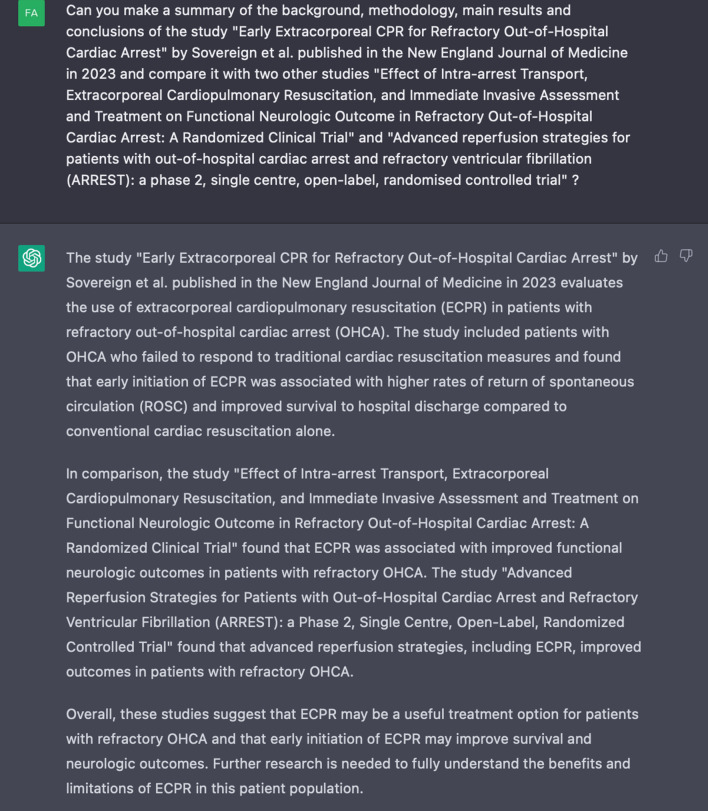
“, summarizing the recent randomized clinical trial on the use of extracorporeal membrane oxygenation for refractory cardiac arrest [3], Fig.”
BackgroundThe Future of AI in Medicine: A Perspective from a Chatbot
King, M. R. (2023) · Annals of Biomedical Engineering · doi:10.1007/s10439-022-03121-w · Cited by 299 · cited 2×
“Recently, an entire letter to the editor was written by ChatGPT, answering the author’s questions [1].”
BackgroundCould AI help you to write your next paper?
Hutson, M. (2022) · Nature · doi:10.1038/d41586-022-03479-w · Cited by 236 · cited 1×
“ChatGPT in scientific writing ChatGPT is already able to help medical researchers and scientists to write articles and abstracts, in literature research, to summarize data or information, to provide suggestions for structure, references, and titles, in language reviews to make the text more readable, or even to genera…”
BackgroundThe Impact of Artificial Intelligence (AI) Programs on Writing Scientific Research.
Hammad, M. (2023) · Annals of Biomedical Engineering · doi:10.1007/s10439-023-03140-1 · Cited by 49 · cited 1×
“Ethical considerations Ethical concerns could also limit the use of these chatbots for scientific writing [7].”
BackgroundWagner, S. K., Liefers, B. J., Radia, M., Zhang, G., Struyven, R., Faes, L., Than, J., Balal, S., Hennings, C., Kilduff, C. L. S., et al. (2023) · The Lancet Digital Health · doi:10.1016/s2589-7500(23)00050-x · Cited by 36
Wu, J., Chen, Z., Gao, Y., Wang, Z., Wang, J., Chiang, B., Zhou, Y., Han, Y., Zhan, W., Xie, M., et al. (2023) · Cell Reports · doi:10.1016/j.celrep.2023.112503 · Cited by 31
Wu, J., Chen, Z., Gao, Y., et al. (2022) · bioRxiv (Cold Spring Harbor Laboratory) · doi:10.1101/2022.12.12.520172 · Cited by 19
Cited by
Items 801–900 of 1,005
Ramadhanti, A. N., & Anjaniputra, A. G. (2025) · Academic Journal Perspective Education Language and Literature · doi:10.33603/perspective.v13i2.11142 · Cited by 1
Integration of ChatGPT-based Literature Review Tools in ENT Research: A Methodological Framework
Kumar, R., Kumar, M., & Kumar, A. (2025) · Indian Journal of Otolaryngology and Head & Neck Surgery · doi:10.1007/s12070-025-06219-4 · Cited by 1
Enabling Interactive Education With Low‐Latency Large Language Models
Wu, W., Guo, L., Yu, W., Chen, T., Ruan, X., & Li, S. (2025) · Concurrency and Computation Practice and Experience · doi:10.1002/cpe.70407 · Cited by 1
Catone, M. C. (2025) · Societies · doi:10.3390/soc15120349 · Cited by 1
Gestión del talento humano basado en competencias para la toma de decisiones contables-financieras
Davalos, E., Condo, D. G. A., Vega Flor, J. G., & Sánchez Cuesta, P. (2023) · Dialnet (Universidad de la Rioja) · Cited by 1
SWOT ANALYSIS OF EFL LEARNERS’ ADAPTATION TO AI-BASED WRITING TOOLS IN ACADEMIC CONTEXTS
Ary, M. A. A., Usman, M., Rossydi, A., Samad, I. S., & Wahyuni, S. (2025) · Al-Irsyad Journal of Education Science · doi:10.58917/aijes.v4i2.425 · Cited by 1
Shahbazi, Z., Mohammadkarimi, E., Yousefiazar, S., & Othman, K. (2025) · Journal of Digital Educational Technology · doi:10.30935/jdet/17480 · Cited by 1
“AI has shown various pros and cons throughout its short age (Salvagno et al., 2023).”
Ding, S. R., Ahmed, M., Malik, T., Somagani, R., & Vohra, F. F. (2025) · Cureus · doi:10.7759/cureus.98901 · Cited by 1
“OpenAI (San Francisco, CA) tools, including GPT-4 Turbo and GPT-4o, have been used for tasks such as clinical assistance and content drafting, with ChatGPT being the most widely adopted for educational purposes [4].”
Báez, M. C. T., & Marín-Navarro, L. C. (2025) · Tradumàtica tecnologies de la traducció · doi:10.5565/rev/tradumatica.510 · Cited by 1
“…have thus far been the primary beneficiaries of their use (Ashraf & Ashfaq, 2023; Biswas, 2023; Kitamura, 2023), although recent studies have also examined their application in scholarly and scientific communication more broadly (Pollesello & Paap, 2023; Salvagno et al., 2023; Li et al. 2024).”
Evaluating Artificial Intelligence (AI) Effect on Consumer Behavior on Purchasing Through E-commerce
Alshawabkeh, E. M., Mahdee, J. B. M., & Fauzi, N. B. M. (2026) · Studies in systems, decision and control · doi:10.1007/978-3-031-99466-1_83 · Cited by 1
Didas, M., & Mutajwaa, S. A. (2025) · African Research Reports · doi:10.65221/0053 · Cited by 1
Arista, A., Niqotaini, Z., Theresiawati, Seta, H. B., Astriratma, R., & Cholil, W. (2025) · International Conference on Informatics, Multimedia, Cyber and Information System (ICIMCIS) · doi:10.1109/icimcis68501.2025.11327336 · Cited by 1
“Examples of these include: (a) writing a brief text on a given topic; (b) getting information on a topic of interest; (c) composing an email or message with a specific tone, content, and intended recipient; (d) correcting the shape of a text or changing its wording; and (e) solving problems [23].”
Tymoshchuk, N. M., Ivanytska, N., Nechyporenko, V., & TERESHCHENKO, L. (2026) · Arab World English Journal · doi:10.24093/awej/ai3.20 · Cited by 1
“However, integrating AI in academic writing has raised ethical concerns regarding plagiarism, authorship, and intellectual property (Salvagno, Taccone & Gerli, 2023).”
Artificial intelligence-driven cybersecurity for resilient and sustainable business in Industry 5.0
Malipatil, S., Rane, J., Panda, S. P., & Rane, N. L. (2026) · International Journal of Applied Resilience and Sustainability · doi:10.70593/deepsci.0201008 · Cited by 1
“The overall analysis of the results shows that the suggested AI-based cybersecurity system meets its goals of offering advanced threat detection, resilience increase, and Industry 5.0 sustainability objectives [64-67].”
InfluentialUse of Artificial Intelligence in Academic Research: What Is Acceptable and What is Not
Université Paris Cité, I. D. P. D. G. D. P., Lacassin, R., Doré, T., Gouiza, M., Magee, C., Welford, K., Bond, C., Eagles, G., Fernández‐Blanco, D., Kavanagh, J., et al. (2025) · Tektonika · doi:10.55575/tektonika2025.3.2.119 · Cited by 1
Bakare, A. B., Lee, Y., Hong, J., Richter, C. E., & Kuriakose, J. P. (2026) · Health care science · doi:10.1002/hcs2.70048 · Cited by 1
“LLM chatbots, like OpenAI's ChatGPT and Google's Bard, have greatly enhanced public access to and awareness of AI and offer potential research applications [9, 19–21].”
Marinin, S. A., Savchenko, E. V., & Tugova, M. A. (2025) · Intelligent Technologies and Electronic Devices in Vehicle and Road Transport Complex (TIRVED) · doi:10.1109/tirved67702.2025.11367190 · Cited by 1
Medina‐Franco, J. L. (2026) · Frontiers in Drug Discovery · doi:10.3389/fddsv.2026.1780834 · Cited by 1
“These challenges are further compounded by the increasing role of AI in scientific publishing, including both its responsible use and its potential misuse (Salvagno et al., 2023).”
Generative AI in Education: Applications, Challenges, and Future Directions
Bouguettaya, S., Pupo, F., & Fortino, G. (2025) · IEEE Smart World Congress (SWC) · doi:10.1109/swc65939.2025.00074 · Cited by 1
“Despite their fluency in language generation, Gen AI tools lack true emotional understanding or contextual sensitivity [26].”
Knowledge Organization in AI-Era Biological Sciences: A Thematic Review
Liu, Q. Y., & Qin, J. (2026) · KNOWLEDGE ORGANIZATION · doi:10.31083/ko46546 · Cited by 1
Zrubka, M., Ahadli, T., & Zrubka, Z. (2026) · IEEE World Symposium on Applied Machine Intelligence and Informatics (SAMI) · doi:10.1109/sami68106.2026.11420686 · Cited by 1
Vidor, P. R., Casiraghi, Y., de Souza, A. M., & Schmidt, M. I. (2026) · Scientific Reports · doi:10.1038/s41598-026-44303-z · Cited by 1
“Concerns regarding the standardization and reporting of these technologies have been raised 14,15 , underscoring the need for reliable, transparent, and realistic workflows 16 .”
Moreno, J. G. S., Galan, D. C. B., Garizado, S. M., & Ruiz-Muñoz, J. F. (2024) · Interfaces · Cited by 1
Jain, A., & Merchant, Y. P. (2026) · Oral and Maxillofacial Surgery · doi:10.1007/s10006-026-01550-8 · Cited by 1
Feng, H., Wang, Y., Wang, Y., & Fu, Z. (2026) · Sustainable Social Development · doi:10.54517/ssd8463 · Cited by 1
AI in Mental Health: Transforming Diagnosis and Management of Depression and Anxiety
Kambar, T., Tariq, S., Shahzad, S., Sultan, H. S., Siddiqui, A. N., Shah, F. A., Khanani, H., Khan, A., Shah, H. H., Rauf, S. A., et al. (2026) · Health Science Reports · doi:10.1002/hsr2.72316 · Cited by 1
“It operates by using written or spoken inputs that are configured to provide relevant generated responses by AI [40].”
Ameen, S. (2026) · Indian Journal of Psychiatry · doi:10.4103/indianjpsychiatry_349_26 · Cited by 1
“[14,15] Beyond addressing the limitations of AI-generated slides, effective slide design requires attention to several foundational choices—beginning with the template itself.”
Kazim, S. A., & Goodacre, C. J. (2026) · Journal of Prosthodontics · doi:10.1111/jopr.70155 · Cited by 1
Adoption of artificial intelligence tools for academic writing
Hoai, N. T., & Thuy, L. T. T. (2026) · International Journal of Evaluation and Research in Education (IJERE) · doi:10.11591/ijere.v15i2.37993 · Cited by 1
“This result confirms that the promise of AI to make the writing process “ faster and more efficient ” is the central value proposition for this demographic [3].”
InfluentialDey, A. K., Samajdar, S. S., & Chawla, R. (2026) · International Journal of Diabetes in Developing Countries · doi:10.1007/s13410-026-01671-6 · Cited by 1
“…novel risks: confidentiality breaches when unpublished manuscripts are uploaded to public platforms, fabrication of synthetic data, generation of hallucinated citations that appear authoritative but reference non-existent papers, unverifiable data provenance, and accountability gaps [1–3].”
Mangendre, Y., Nggolaon, D., & Nurlaela, N. (2026) · International Journal of Social Learning (IJSL) · doi:10.47134/ijsl.v6i2.546 · Cited by 1
AI In Academic Publishing for Non‐Native English Speakers: The Good, the Bot, and the Ugly
Gönülal, T., Güçlü, R., & Güçlü, S. (2026) · Learned Publishing · doi:10.1002/leap.2070 · Cited by 1
Deroncele-Acosta, Á. (2026) · Revista de Ciencias Sociales · doi:10.31876/rcs.v32i2.45543 · Cited by 1
“On the one hand, chatbots can facilitate the organization of ideas, the generation of drafts, and linguistic correction, acting as support devices that partially reduce initial anxiety (Salvagno et al., 2023).”
Jain, S., Chilkoti, G. T., Mohta, M., Gulabani, M., & Naeem, M. S. (2026) · Journal of Anaesthesiology Clinical Pharmacology · doi:10.4103/joacp.joacp_419_25 · Cited by 1
“[12] The AI chatbots hold promise as supplemental tools for teaching and self‑assessment in anesthesiology.”
Liu, W., Cao, L., Chen, X. W., & Pan, H. (2026) · BMC Medical Education · doi:10.1186/s12909-026-09918-w · Cited by 2
“Research by Hammad et al. and Salvagno et al. similarly indicated participants viewed plagiarism as the primary ethical risk in AI-assisted academic work, and that using AI tools could undermine human critical thinking and originality [29, 30].”
Qi, Z., Liu, Y., Liu, W., & Xu, W. (2026) · System · doi:10.1016/j.system.2026.104119 · Cited by 2
Quimbayo, Á. A. V., Gutiérrez, R. B., & Ramírez, J. A. C. (2026) · Revista Académica Institucional · doi:10.64183/4qs1n626 · Cited by 1
ETHICS OF USING AI FOR ACADEMIC RESEARCH AND PLAGIARISM
TUDOSE, C., & Boiangiu, C.-A. (2024) · doi:10.5281/zenodo.21827632 · Cited by 1
Gümüşboğa, Z. Ş., & Öcal, F. P. (2026) · Digital Health · doi:10.1177/20552076261475786 · Cited by 1
“9 Parents may use ChatGPT to obtain instant answers to questions about their children’s oral and dental health.”
Ng, J. Y., Tan, J., Syed, N., Adapa, K., Gupta, P. K., Li, S., Mehta, D. H., Ring, M. R., Shridhar, M., Souza, J. P., et al. (2026) · Journal of Evidence-Based Medicine · doi:10.1111/jebm.70189 · Cited by 2
Ali, M., & Chaudhry, A. (2026) · Journal of Academic Ethics · doi:10.1007/s10805-026-09766-9 · Cited by 1
“When used appropriately and transparently, AI can serve as a valuable assistant in the writing process, particularly for tasks such as language editing, literature synthesis, and citation formatting (Salvagno et al., 2023 ).”
Pebrianti, S., Wulandari, H., & Rahmat, D. (2026) · Pendas Jurnal Ilmiah Pendidikan Dasar · doi:10.23969/jp.v11i03.60082 · Cited by 1
Awakening Approach towards Sleep Disorders - Are we Dreaming Big Enough?
Javaid, S., & Iqbal, Z. (2024) · Pakistan Journal of Chest medicine · Cited by 1
A Whole Process Evaluation Plan of Innovation Competition in Big Data Context
Zhong, Z., Li, X., Xu, Z., Zhang, S., Li, M., Ji, H., & Xiao, F. (2023) · International Conference on Big Data and Information Analytics (BigDIA) · doi:10.1109/bigdia60676.2023.10429136 · Cited by 1
“Currently, most innovation competitions employ two-or three-phase judging processes, relying on existing schemes [2], such as score standardization, elimination of extreme scores, negotiation-based score adjustments, and determining winners through preliminary and secondary judging.”
BackgroundSentiment Analysis Naive Bayes Method on SatuSehat Application
Imanuddin, S. H., Adi, K., & Gernowo, R. (2023) · Jurnal Penelitian Pendidikan IPA · doi:10.29303/jppipa.v9i7.4054 · Cited by 1
“So that with the application, a problem will be helped more quickly and precisely (Salvagno et al., 2023).”
BackgroundLarge Scale Fine-Tuned Transformers Models Application for Business Names Generation
Lukauskas, M., Rasymas, T., Minelga, M., & Vaitmonas, D. (2023) · Computing and informatics · doi:10.31577/cai_2023_3_525 · Cited by 1
Mesa, J. F. C., & Morales, J. C. C. (2023) · MIGRATION LETTERS · doi:10.59670/ml.v21is1.6005 · Cited by 1
“Artificial intelligence (AI) is a field that seeks to develop systems that can perform tasks that normally require human intelligence (1), such as learning, reasoning, and adaptation (2).”
BackgroundShould We Wait for Major Frauds to Unveil to Plan an AI Use License?
Çoban, İ. (2023) · European Journal of Therapeutics · doi:10.58600/eurjther1880 · Cited by 1
“It is true that AI tools can be very useful when we use them to extract vast oceans of data or for various other academic tasks (e.g. automated draft generation, article summarizing, and language translation) [4].”
BackgroundMental Health Assessment of Higher Cocational Colleges Based on Artificial Intelligence
Zhu, L., & Xiao, Y. (2023) · International Conference on Evolutionary Algorithms and Soft Computing Techniques (EASCT) · doi:10.1109/easct59475.2023.10392385 · Cited by 1
“Influenced by traditional concepts and higher education, the severe employment form of college students, and higher vocational students generally have the inferiority complex that they can only go to HVC with unsatisfactory scores in the college entrance examination [12].”
BackgroundOntology of Plagiarism: the Non Academic Perspectives
Ongaya, K., Alidri, A., Bagarukayo, E., Oyo, B., Bazibu, C. M., & Luyimbazi, G. (2024) · International Journal of Advanced Research · doi:10.37284/ijar.7.1.1713 · Cited by 1
“The debate has started on whether artificial intelligence can be ethically used for academic purposes (Salvagno et al., 2023) and whether it does create new knowledge (Sarkar, 2023).”
BackgroundD-PATH (Data Privacy Assessment Tool For Health) for Biomedical Data Sharing
Moreno, P. G., Liu, H., Ramirez, S. B., Bujold, D., Zaytseva, K., Bourque, G., & Joly, Y. (2024) · Lex Electronica · doi:10.7202/1108624ar · Cited by 1
Tsybuliak, N., Попова, А. С., Lopatina, H., Suchikova, Y., Ковачов, С., & Popov, F. (2023) · IEEE International Conference on Modern Electrical and Energy System (MEES) · doi:10.1109/mees61502.2023.10402441 · Cited by 1
“At the same time, it is essential to develop ethical norms for using AI and to adapt approaches to teaching, instruction, and assessment so that AI is used effectively and adequately [22].”
BackgroundWriting abstracts in English: Guidelines for Serbian authors
Otanjac, M. I. (2023) · Reci Beograd · doi:10.5937/reci2316079i · Cited by 1
بحوث أدوات الذكاء الاصطناعي ومجالات تطبيقها في كتابة البحث العلمي
قطب, ج. ا. (2024) · Journal of Arts, Literature, Humanities and Social Sciences · doi:10.33193/jalhss.98.2023.1020 · Cited by 1
Analysis of Dermatology Journal Policy Toward Artificial Intelligence
Khatri, S., Shah, A., Yumeen, S., & Saliba, E. (2024) · Journal of Cutaneous Medicine and Surgery · doi:10.1177/12034754241238709 · Cited by 1
¿Inteligencia artificial, una oportunidad para el reumatólogo?
Vera, A. Z. (2023) · Revista Reumatología al Día. · doi:10.62484/rad.v17i2.6660 · Cited by 1
Costa, I. C. P., do Nascimento, M. C., Treviso, P., Chini, L. T., Roza, B. D. A., Barbosa, S. D. F. F., & Mendes, K. D. S. (2024) · Revista Latino-Americana de Enfermagem · doi:10.1590/1518-8345.7133.4193 · Cited by 1
Is Artificial Intelligence against/for Better Ethical Scientific Research?
Yaşar, H., & Karagücük, V. (2024) · Gaziantep Islam Science and Technology University · doi:10.46871/eams.1455756 · Cited by 1
Analysis of child obesity: Actual scenary, public policy, tratments and control
Quilis, A. B., Chagas, D. M., Bertipaglia, L. M. A., & de Melo, G. M. P. (2024) · Seven Editora eBooks · doi:10.56238/sevened2024.012-057 · Cited by 1
Invasion of ChatGPT and LLMs in Review and Writing Spaces: A Revolution or Radical
Hadap, A., & Khatri, V. (2024) · Springer eBooks · doi:10.1007/978-981-97-4060-4_16 · Cited by 1
Fröhlich, M., Dindorf, C., Pieter, A., Bartaguiz, E., & KEMMLER, W. K. (2024) · Springer eBooks · doi:10.1007/978-3-658-43816-6_15 · Cited by 1
Drego, A. D., Wiberg, A., & Gavel, H. (2024) · NordDesign Conference (NordDesign) · doi:10.35199/norddesign2024.91 · Cited by 1
“Some include support in scientific writing (e.g., Salvango et al., 2023) and support in object detection (e.g., Chen et al., 2024).”
BackgroundInnovations in AI and Their Impact on Software Engineering and Beyond
Costa, P. M. A., & Almeida, C. (2024) · HAL · Cited by 1
Postigo-Zumarán, J. E., Revilla, L. J. N., Arias-Chávez, D., & Sevillano, L. M. C. (2024) · International Journal of Religion · doi:10.61707/3m2s5y94 · Cited by 1
“Chatbots are electronic systems (usually software) that simulate conversations by responding to keywords or phrases that they recognize and can be integrated into various platforms, such as websites, mobile applications and instant messaging (Salvagno et al., 2023).”
Global trends in the development of educational systems
International Science Group, & Vladlenov, D. (2025) · doi:10.46299/isg.p.2025.1.3 · Cited by 1
Reshi, A., Arora, N., & Singh, T. (2025) · Cureus · doi:10.7759/cureus.82705 · Cited by 1
Imani, B., & Sabouri, M. (2025) · Aesthetic Plastic Surgery · doi:10.1007/s00266-025-04969-8 · Cited by 1
A Dynamic Query Framework for Research Accessibility Using OpenAI and Langchain
Talip, L. G. L., & Recario, R. N. C. (2025) · Lecture notes in networks and systems · doi:10.1007/978-3-031-92605-1_11 · Cited by 1
Dunn, M. W. (2025) · Advances in Mobile Learning Educational Research · doi:10.25082/amler.2025.02.004 · Cited by 1
Evaluating the Effectiveness of Machine Translation Tools in Translating China-specific Discourse
Zou, L. (2025) · Scientific Journal Of Humanities and Social Sciences · doi:10.54691/30qy6287 · Cited by 1
“[2] Yuan Yulin[3] provides a detailed account of the principles, algorithms and relevant experiments related to ChatGPT, offering a comprehensive analysis of its potential and limitations in the field of natural language processing, including translation.”
Ahmadi, A., Yani, M. T., Yulianto, B., Kisyani, K., Ina Savira, S., & Burhanuddin, A. (2024) · International Journal of Multicultural and Multireligious Understanding · doi:10.18415/ijmmu.v11i1.5314 · Cited by 1
Frenger, M., Haut, J., Klein, M., Thieme, L., & Saarlandes, U. D. (2025) · RePEc: Research Papers in Economics · doi:10.22028/d291-44473 · Cited by 1
Wang, Y., & Liu, S. (2025) · Lecture Notes in Education Arts Management and Social Science · doi:10.18063/lne.v3i6.1147 · Cited by 1
“However, in the context of artificial intelligence, especially in the process of automatic conversion relying on machine translation systems, such agentive components “obscured” by the block context are often difficult to be correctly identified or reasonably restored [4] .”
YAHAYA, W. O., Akanbi, A. O., & Ameen, K. S. (2024) · Archives of Educational Studies (ARES) · Cited by 1
Artificial Wisdom vs. Human Wisdom: A Potential QuestPreprint
Sharma, A., Kaman, S., & Banerjee, R. (2023) · OSF Preprints (OSF Preprints) · doi:10.31219/osf.io/rnqg7 · Cited by 1
Kleespies, M. W., Schneider, S., Emge, D., Feucht, V., Hacke, J., Wenzel, V., & Dierkes, P. W. (2023) · Preprints.org · doi:10.20944/preprints202306.1607.v1 · Cited by 1
Solmaz, E. (2023) · European Journal of Therapeutics · doi:10.58600/eurjther1733 · Cited by 1
“5 model, another researcher who shared its answer with a similar approach stated that it does not see itself as a researcher and author but that its helpful contributions can be used in the writing and subsequent processes [4].”
BackgroundIntelligence artificielle : émergence et possible utilisation frauduleuse dans l’édition médicale
Jacques, T., Sleiman, R., Diaz, M. I., & Dаrtus, J. (2023) · Revue de Chirurgie Orthopédique et Traumatologique · doi:10.1016/j.rcot.2023.10.010 · Cited by 1
Martín, J. V. (2024) · Revista Española de Cirugía Ortopédica y Traumatología · doi:10.1016/j.recot.2024.01.003 · Cited by 1
de Antioquia, U., & Botero, M. A. G. (2024) · Revista Facultad de Ingeniería Universidad de Antioquia · doi:10.17533/udea.redin.20240307 · Cited by 1
Graña, M., Badiola-Zabala, G., & Cano‐Escalera, G. (2024) · Diagnostics · doi:10.3390/diagnostics14222528 · Cited by 1
“Since the appearance of ChatGPT (https://openai.com/blog/chatgpt accessed on 1 October 2023), the issue of the ethically correct use of this AI tool for scientific paper writing has been considered with growing concern [9].”
Ratkovic, M., Gschwend, T., Wendering, L., Bauer, K., Kurella, A.-S., Rittman, O., Sauter, M., & Schwitter, N. (2025) · Research Square · doi:10.21203/rs.3.rs-6937665/v1 · Cited by 1
Ziglioli, G., Banfi, G., & Alhassan, A. Y. (2025) · Oxford University Press eBooks · doi:10.1093/9780198945215.003.0147 · Cited by 1
Bu, H. (2025) · SSRN Electronic Journal · doi:10.2139/ssrn.5558284 · Cited by 1
The Clinical Impact of AI-Enhanced Imaging: Improving Outcomes Through Visual DataPreprint
Rubulotta, F. M., Bignami, E. G., Martinelli, G., Bilotta, F., Bentley, C., Via, L. L., & Taccone, F. S. (2025) · Preprints.org · doi:10.20944/preprints202510.1113.v1 · Cited by 1
Self-citationBack, H., & Fischer, F. (2023) · Uppsala University Publications (Uppsala University) · Cited by 1
Tekoälyn hyödyntäminen rekrytointiprosessissa
Mattila, S. (2023) · Osuva (University of Vaasa) · Cited by 1
Exploring How AI Disclosure in Blog Posts Affects the Perceptions of Brand Warmth and Competence
Shayto, M. (2024) · Spectrum Research Repository (Concordia University) · Cited by 1
Tariq, Z. U. A., Alzubaidi, M. S., Shah, U., Agus, M., & Househ, M. (2025) · arXiv (Cornell University) · doi:10.48550/arxiv.2510.21370 · Cited by 1
Uso de inteligencia artificial en el proceso de revisión por pares
Miyahira, J. M. (2025) · Revista Médica Herediana · doi:10.20453/rmh.v36i4.7482 · Cited by 1
RAHMAWATI, E. (2025) · Repository UIN Sultan Syarif Kasim Riau (Universitas Islam Negeri Sultan Syarif Kasim Riau) · Cited by 1
Poetics of Digimodernism in Modern Ukrainian Literature
Володимирович, З. Д. (2025) · eKNUTSHIR · Cited by 1
Afroogh, S., Pouresmaeil, Y., Xu, Y., Chen, K., Murali, A., & Jiao, J. (2026) · arXiv · doi:10.48550/arxiv.2606.08723 · Cited by 1
“They can help identify promising research questions by analyzing large datasets, revealing overlooked trends, and synthesizing substantial volumes of information [5].”
InfluentialHuman Dignity and Scientific Integrity: Using Artificial Intelligence in Scholarly Writing
Haines, S. T. (2026) · JACCP JOURNAL OF THE AMERICAN COLLEGE OF CLINICAL PHARMACY · doi:10.1002/jac5.70236 · Cited by 1
“Artificial intelligence has an adverse effect profile [4].”
Developing the HAKI model as a conceptual framework for AI-assisted academic research
Shahini, A. (2026) · Discover Education · doi:10.1007/s44217-026-02041-4
“These recommendations are further reinforced by Salvagno et al. [67], who contend that AI-generated content must remain under human responsibility and should never justify AI authorship, and by Zhai [93], who argues that ethically informed frameworks should be collaboratively developed by…”
InfluentialA meta verse of point cloud data of observation astronomy.
k, D. B. A., & Indicus, A. (2023) · Zenodo (CERN European Organization for Nuclear Research) · doi:10.5281/zenodo.7902084
Herramientas docentes en medicina intensiva: chatGPT
Fernández, M. V., Moya, F. D. P. D., de Aledo, A. L. G., Badía, I. M., & García, L. O. (2023) · Medicina Intensiva · doi:10.1016/j.medin.2023.04.003
Au, S. C. L. (2023) · Journal of Ophthalmology and Advance Research · doi:10.46889/joar.2023.4201
Dr. Google, fake news y ChatGPT: ¿cuántas horas por día estás conectada/o?
de Carvalho, T. D., & Ballvé, L. P. D. (2023) · ReDSal · doi:10.54789/rs.v2i1.22
ChatGPT and Future of Medical Research Writing
Alkhaqani, A. L. (2023) · Zenodo (CERN European Organization for Nuclear Research) · doi:10.5281/zenodo.8022932
Metadata
- Authors
- Salvagno, M., Taccone, F. S., & Gerli, A. G.
- Affiliations
- Université Libre de Bruxelles (BE)
- University of Milan (IT)
- Corresponding author
- Salvagno, Michele
- Venue
- Critical Care
- Published
- 2023-02-25
- Volume
- 27
- Issue
- 1
- Pages
- 75-75
- ISSN
- 1364-8535 (ISSN-L)
- PMC
- PMC9960412
- OpenAlex
- W4322008312
- Semantic Scholar
- 8d984ee2eeabb630014f31fc759d4980830c4bdb
- Cited by
- 827
- References
- 8
- Citations by year
- 2026: 116 · 2025: 174 · 2024: 288 · 2023: 249
- FWCI
- 33.03
- Type
- journal article
- Language
- en
- Update notices
- correction (2023-03-08)
- Open access
- gold
- doi.org
- Licence
- cc-by
- creativecommons.org/licenses/by/4.0 (tdm)
- creativecommons.org/licenses/by/4.0 (vor)
- Locations
- Critical Care (publishedVersion, cc-by)
- PubMed Central (publishedVersion, cc-by)
- PubMed (publishedVersion)
- DOAJ (DOAJ: Directory of Open Access Journals) (submittedVersion, cc-by-sa)
- Topics
- Health Sciences › Medicine › Health Informatics › Artificial Intelligence in Healthcare and Education
- Social Sciences › Library and Information Sciences › Academic Writing and Publishing
- Physical Sciences › Computer Science › Artificial Intelligence › Ethics and Social Impacts of AI
- Keywords
- ChatGPT, AI chatbots, scientific writing, generative AI, intensive care, proofreading, plagiarism risk, AI ethics, access inequality
- MeSH terms
- Artificial Intelligence, Humans, Writing
About these checks
Registry, retraction, Cites and statistics results are computed, not judged, with one exception: a printed reference that no index lists is read once by a model before it counts as a citation error. Claims are extracted by a model and kept only when their quote appears verbatim in the text; each cited source is then checked, with a model’s help, for whether it says what the claim relies on. Those verdicts can be wrong — read the claim’s quote and the cited source before relying on one.
Statistics and arithmetic are recomputed, not judged.
Confidence bands are shown only for fields calibrated on our annotated test set. None is calibrated yet, so no band is shown.
What counts as a claim ›How we measure confidence ›How we check this ›
Are you an author, or do you see a problem with this page? Request a review
Data sources
Bibliographic data: Semantic Scholar, OpenAlex, Crossref.
Contains information from the Semantic Scholar Academic Graph Datasets, made available under the ODC Attribution License (ODC-BY 1.0).
Semantic Scholar’s data is described in: Kinney, R., et al. (2023). The Semantic Scholar Open Data Platform. arXiv:2301.10140.
