

Can artificial intelligence help for scientific writing?
Open accessThe DOI matches its Crossref record; 10 of the 10 references it cites were found in a registry or an index.
Abstract
This paper discusses the use of Artificial Intelligence Chatbot in scientific writing. ChatGPT is a type of chatbot, developed by OpenAI, that uses the Generative Pre-trained Transformer (GPT) language model to understand and respond to natural language inputs. AI chatbot and ChatGPT in particular appear to be useful tools in scientific writing, assisting researchers and scientists in organizing material, generating an initial draft and/or in proofreading. There is no publication in the field of critical care medicine prepared using this approach; however, this will be a possibility in the next future. ChatGPT work should not be used as a replacement for human judgment and the output should always be reviewed by experts before being used in any critical decision-making or application. Moreover, several ethical issues arise about using these tools, such as the risk of plagiarism and inaccuracies, as well as a potential imbalance in its accessibility between high- and low-income countries, if the software becomes paying. For this reason, a consensus on how to regulate the use of chatbots in scientific writing will soon be required.
Overview
The claims and statistics of this paper haven’t been checked yet.
Free: it reads the open-access text and checks the first 5 claims that cite a source we can check. Create a free account to check every claim.
Integrity signals
Registry
Cites
Statistics
Figures
Verification
Claims the paper makes
The claims and statistics of this paper haven’t been checked yet.
Free: it reads the open-access text and checks the first 5 claims that cite a source we can check. Create a free account to check every claim.
Claims other papers make about this one
Each is checked against this paper’s own text: does it say what the citing paper says it does?
The source backs part of the claim, not all of it — or backs it for a different population, condition or comparison.
In the citing paper
“Additionally, learners can expedite their writing development as AI tools help them identify and rectify grammatical and lexical errors, while also suggesting alternative sentence structures to enhance the overall writing quality and structure (Zhao, 2022; Chen, 2023; Salvagno et al., 2023).”
From Enhancing academic writing skills and motivation: assessing the efficacy of ChatGPT in AI-assisted language learning for EFL students (2023) · cites this paper as Salvagno et al., 2023
Experimental — accuracy not yet measuredThe source backs part of the claim, not all of it — or backs it for a different population, condition or comparison.
In the citing paper
“The authorship dilemma in AI-assisted research revolves around who should be credited for AI-generated content and how AI's role should be disclosed [67].”
From Developing the HAKI model as a conceptual framework for AI-assisted academic research (2026) · cites this paper as [67]
Experimental — accuracy not yet measuredThe source backs part of the claim, not all of it — or backs it for a different population, condition or comparison.
In the citing paper
“Recent studies show that GAI can improve writing quality by enhancing grammar, vocabulary, and fluency.”
From Exploring How AI Literacy and Self-Regulated Learning Relate to Student Writing Performance and Well-Being in Generative AI-Supported Higher Education (2025) · cites this paper as Salvagno et al., 2023
Experimental — accuracy not yet measuredThe source backs part of the claim, not all of it — or backs it for a different population, condition or comparison.
In the citing paper
“Additionally, the automation features of AI streamline tasks like formatting and citation, freeing up substantial time and energy for researchers, which can then be redirected towards more complex and innovative work.3,4”
From Balancing innovation and integrity: the role of AI in research and scientific writing (2023) · cites this paper as [3]
Experimental — accuracy not yet measuredThe cited source says what the claim attributes to it.
In the citing paper
“chatbots, including ChatGPT, have increased the difficulty in identifying plagiarism [47, 67, 76]”
From A systematic literature review of empirical research on ChatGPT in education (2024) · cites this paper as [67]
7 more claims about this paper
Create a free account to see every claim other papers make about this one.
Self-check
Percentages, sums and reported differences re-computed from the paper’s own numbers.
The self-check needs the paper’s full text.
Citations
Cites
Gao, C. A., Howard, F. M., Markov, N. S., Dyer, E. C., Ramesh, S., Luo, Y., & Pearson, A. T. (2022) · doi:10.1101/2022.12.23.521610 · Cited by 1,099
ChatGPT: the future of discharge summaries?
Patel, S. B., & Lam, K. (2023) · The Lancet Digital Health · doi:10.1016/s2589-7500(23)00021-3 · Cited by 728
Abstracts written by ChatGPT fool scientists
Else, H. (2023) · Nature · doi:10.1038/d41586-023-00056-7 · Cited by 611 · cited 1×
“Moreover, it may be difficult to recognize whether a paper is written by a chatbot or a human being [5], because chatbots use advanced techniques, such as natural language processing (NLP) and machine learning, to generate text that is similar to human writing.”
BackgroundEarly Extracorporeal CPR for Refractory Out-of-Hospital Cardiac Arrest
Suverein, M. M., Delnoij, T. S. R., Lorusso, R., Brandon Bravo Bruinsma, G. J., Otterspoor, L., Elzo Kraemer, C. V., Vlaar, A. P. J., van der Heijden, J. J., Scholten, E., den Uil, C., et al. (2023) · New England Journal of Medicine · doi:10.1056/nejmoa2204511 · Cited by 537 · cited 1×
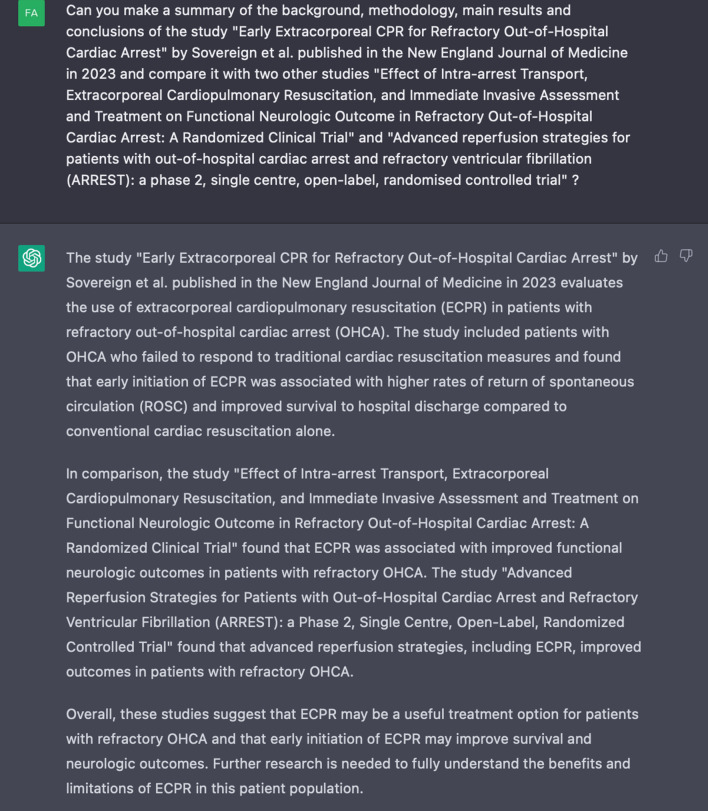
“, summarizing the recent randomized clinical trial on the use of extracorporeal membrane oxygenation for refractory cardiac arrest [3], Fig.”
BackgroundThe Future of AI in Medicine: A Perspective from a Chatbot
King, M. R. (2023) · Annals of Biomedical Engineering · doi:10.1007/s10439-022-03121-w · Cited by 299 · cited 2×
“Recently, an entire letter to the editor was written by ChatGPT, answering the author’s questions [1].”
BackgroundCould AI help you to write your next paper?
Hutson, M. (2022) · Nature · doi:10.1038/d41586-022-03479-w · Cited by 236 · cited 1×
“ChatGPT in scientific writing ChatGPT is already able to help medical researchers and scientists to write articles and abstracts, in literature research, to summarize data or information, to provide suggestions for structure, references, and titles, in language reviews to make the text more readable, or even to genera…”
BackgroundThe Impact of Artificial Intelligence (AI) Programs on Writing Scientific Research.
Hammad, M. (2023) · Annals of Biomedical Engineering · doi:10.1007/s10439-023-03140-1 · Cited by 49 · cited 1×
“Ethical considerations Ethical concerns could also limit the use of these chatbots for scientific writing [7].”
BackgroundWagner, S. K., Liefers, B. J., Radia, M., Zhang, G., Struyven, R., Faes, L., Than, J., Balal, S., Hennings, C., Kilduff, C. L. S., et al. (2023) · The Lancet Digital Health · doi:10.1016/s2589-7500(23)00050-x · Cited by 36
Wu, J., Chen, Z., Gao, Y., Wang, Z., Wang, J., Chiang, B., Zhou, Y., Han, Y., Zhan, W., Xie, M., et al. (2023) · Cell Reports · doi:10.1016/j.celrep.2023.112503 · Cited by 31
Wu, J., Chen, Z., Gao, Y., et al. (2022) · bioRxiv (Cold Spring Harbor Laboratory) · doi:10.1101/2022.12.12.520172 · Cited by 19
Cited by
Items 101–200 of 1,005
Use of ChatGPT in medical research and scientific writing
Lee, P. Y., Salim, H., Abdullah, A., & Teo, C. H. (2023) · Malaysian Family Physician · doi:10.51866/cm0006 · Cited by 42
ChatGPT in Medical Education and Research: A Boon or a Bane?
Jeyaraman, M., K, S. P., Jeyaraman, N., Nallakumarasamy, A., Yadav, S., & Bondili, S. K. (2023) · Cureus · doi:10.7759/cureus.44316 · Cited by 58
“· Time-saving [25]: With ChatGPT, medical professionals and researchers can save time in researching, writing papers, and studying as the information can be accessed quickly.”
BackgroundAI-empowered scale development: Testing the potential of ChatGPT
Hoffmann, S., Lasarov, W., & Dwivedi, Y. K. (2024) · Technological Forecasting and Social Change · doi:10.1016/j.techfore.2024.123488 · Cited by 57
Kong, X., & Liu, C. (2024) · Journal of English for Academic Purposes · doi:10.1016/j.jeap.2024.101432 · Cited by 58
Towards Verifiable Generation: A Benchmark for Knowledge-aware Language Model Attribution
Li, X., Cao, Y., Pan, L., Ma, Y., & Sun, A. (2024) · Findings of the Association for Computational Linguistics: ACL (Findings of ACL) · doi:10.18653/v1/2024.findings-acl.28 · Cited by 58
Suppadungsuk, S., Thongprayoon, C., Krisanapan, P., Tangpanithandee, S., Garcia Valencia, O., Miao, J., Mekraksakit, P., Kashani, K., & Cheungpasitporn, W. (2023) · Journal of Clinical Medicine · doi:10.3390/jcm12175550 · Cited by 56
The impact of using ChatGPT on academic writing among medical undergraduates
Wang, J., Liao, Y., Liu, S., Zhang, D., Wang, N., Shu, J., & Wang, R. (2024) · Annals of Medicine · doi:10.1080/07853890.2024.2426760 · Cited by 59
“Given the continuous advancements in ai and its undeniable utilization in academic writing by medical students, ongoing concerns [17–19] highlight the necessity for a thorough evaluation of ai applications in academic writing for students. in this study, we aim to elucidate the influence of chatGPt…”
Inam, M., Sheikh, S., Minhas, A. M. K., Vaughan, E. M., Krittanawong, C., Samad, Z., Lavie, C. J., Khoja, A., D'Cruze, M., Slipczuk, L., et al. (2024) · Current Problems in Cardiology · doi:10.1016/j.cpcardiol.2024.102387 · Cited by 55
Abi-Rafeh, J., Xu, H. H., Kazan, R., Tevlin, R., & Furnas, H. (2024) · Aesthetic Surgery Journal · doi:10.1093/asj/sjad260 · Cited by 49
Lechien, J. R., Briganti, G., & Vaira, L. A. (2024) · European Archives of Oto-Rhino-Laryngology · doi:10.1007/s00405-023-08441-8 · Cited by 54
How to mitigate the risks of deployment of artificial intelligence in medicine?
İlikhan, S. U., Özer, M., Tanberkan, H., & Bozkurt, V. (2024) · TURKISH JOURNAL OF MEDICAL SCIENCES · doi:10.55730/1300-0144.5814 · Cited by 55
“Especially, generative AI systems such as ChatGPT can produce responses in a reasonable manner even for nonexistent or inaccurate information, a phenomenon known as hallucination in AI systems [25,45,69,70].”
BackgroundPrandner, D., Wetzelhütter, D., & Hese, S. (2025) · Frontiers in Education · doi:10.3389/feduc.2024.1417900 · Cited by 56
ChatGPT and Nursing Education: Challenges and Opportunities
Alkhaqani, A. L. (2023) · Al-Rafidain Journal of Medical Sciences ( ISSN: 2789-3219 ) · doi:10.54133/ajms.v4i.110 · Cited by 39
You, Y., Chen, Y., You, Y., Zhang, Q., & Cao, Q. (2023) · Sustainability · doi:10.3390/su15129355 · Cited by 53
Research writing with ChatGPT: A descriptive embodied practice framework
Pigg, S. (2024) · Computers & composition/Computers and composition · doi:10.1016/j.compcom.2024.102830 · Cited by 54
Large Language Models and the Future of Organization Theory
Cornelissen, J., Höllerer, M. A., Boxenbaum, E., Faraj, S. A., & Gehman, J. (2024) · Organization Theory · doi:10.1177/26317877241239056 · Cited by 55
“Indeed, the overriding belief is that such algorithms will reconstitute how scholars across the natural and social sciences form a theoretical understanding of their respective phenomena of interest (e.g. Beam et al., 2024; Heidt, 2023; Salvagno et al., 2023; Susarla et al., 2023; Thorp, 2023).”
BackgroundOduoye, M. O., Javed, B., Gupta, N., & Sih, C. M. V. (2023) · International Journal of Surgery · doi:10.1097/js9.0000000000000552 · Cited by 51
Lee, S.-W., & Choi, W.-J. (2023) · Anesthesia and Pain Medicine · doi:10.17085/apm.23056 · Cited by 35
“Utilizing ChatGPT, an AI chatbot, can greatly assist in writing scientific research papers through automatically generating drafts, summarizing papers, and providing translations [8-14].”
MethodChatGPT performance in laryngology and head and neck surgery: a clinical case-series
Lechien, J. R., Georgescu, B. M., Hans, S., & Chiesa-Estomba, C. M. (2023) · European Archives of Oto-Rhino-Laryngology · doi:10.1007/s00405-023-08282-5 · Cited by 53
“Some reports have showed that Chat-GPT is able to succeed law, business, or medical school exams [3], and should be useful to help the practitioner in clinical practice, research or administrative tasks [4, 5].”
Applications of ChatGPT in Otolaryngology–Head Neck Surgery: A State of the Art Review
Lechien, J. R., & Rameau, A. (2024) · Otolaryngology · doi:10.1002/ohn.807 · Cited by 52
Designing a model of sustainable education based on artificial intelligence in higher education
Bagherimajd, K., & Khajedad, K. (2025) · Computers and Education Artificial Intelligence · doi:10.1016/j.caeai.2025.100439 · Cited by 51
The importance of human supervision in the use of ChatGPT as a support tool in scientific writing
Castillo‐González, W. (2023) · Metaverse Basic and Applied Research · doi:10.56294/mr202329 · Cited by 52
Balancing innovation and integrity: the role of AI in research and scientific writing
BaHammam, A. (2023) · Nature and Science of Sleep · doi:10.2147/nss.s455765 · Cited by 50
Bouzar, A., EL Idrissi, K., & Ghourdou, T. (2024) · Arab World English Journal · doi:10.24093/awej/chatgpt.15 · Cited by 50
“Although it lacks the capacity for novel idea creation, ChatGPT has demonstrated its utility in scholarly tasks such as condensing articles, automatically producing drafts, and facilitating language conversion (Salvagno et al., 2023).”
BackgroundBisi, T., Risser, A., Clavert, P., Migaud, H., & Dartus, J. (2023) · Orthopaedics & Traumatology: Surgery & Research · doi:10.1016/j.otsr.2023.103694 · Cited by 37
GPT-4 in a Cancer Center — Institute-Wide Deployment Challenges and Lessons Learned
Umeton, R., Kwok, A., Maurya, R., Leco, D., Lenane, N., Willcox, J., Abel, G. A., Tolikas, M., & Johnson, J. M. (2024) · NEJM AI · doi:10.1056/aics2300191 · Cited by 36
Impact of ChatGPT on English Academic Writing Ability and Engagement of Chinese EFL Undergraduates
Hongxia, H., & Razali, A. B. (2025) · International Journal of Instruction · doi:10.29333/iji.2025.18218a · Cited by 53
Impacts of generative artificial intelligence on the future of labor market: a systematic review
Salari, N., Beiromvand, M., Hosseinian-Far, A., Habibi, J., Babajani, F., & Mohammadi, M. (2025) · Computers in Human Behavior Reports · doi:10.1016/j.chbr.2025.100652 · Cited by 49
“Salvagno et al. (2023) argue that with proper and balanced use of ChatGPT, productivity and speed can be achieved in scientific writing.”
InfluentialChlorogiannis, D.-D., Apostolos, A., Chlorogiannis, A., Palaiodimos, L., Giannakoulas, G., Pargaonkar, S., Xesfingi, S., & Kokkinidis, D. G. (2023) · Healthcare · doi:10.3390/healthcare11212906 · Cited by 37
Kedia, N., Sanjeev, S., Ong, J., & Chhablani, J. K. (2024) · Eye · doi:10.1038/s41433-023-02915-z · Cited by 50
“ChatGPT can help researchers quickly summarize large bodies of information, be used to improve scientific writing, aid in idea generation, and advise on statistical analyses [68, 71, 72].”
Human-Centered AI: A Multidisciplinary Perspective for Policy-Makers, Auditors, and Users
Régis, C., Denis, J., Axente, M., & Kishimoto, A. (2024) · Chapman & Hall/CRC eBooks · doi:10.1201/9781003320791 · Cited by 50
Artificial intelligence in rheumatology research: what is it good for?
Sequí-Sabater, J. M., & Benavent, D. (2025) · RMD Open · doi:10.1136/rmdopen-2024-004309 · Cited by 50
Correction to: Can artificial intelligence help for scientific writing?
Salvagno, M., Taccone, F. S., & Gerli, A. G. (2023) · Critical Care · doi:10.1186/s13054-023-04390-0 · Cited by 38
Self-citationPemahaman Etika Akademik Mahasiswa dalam Penggunaan Artificial Intelligence (AI)
Salsabila, S., & Sohidin, S. (2024) · Journal of Education Research · doi:10.37985/jer.v5i4.1944 · Cited by 48
ChatGPT in Colorectal Surgery: A Promising Tool or a Passing Fad?
Li, W., Zhang, Y., & Chen, F. (2023) · Annals of Biomedical Engineering · doi:10.1007/s10439-023-03232-y · Cited by 45
“It has demonstrated remarkable capabilities in various areas such as scientific paper writing, code revision, and passing the United States Medical Licensing Examination (USMLE) [3, 16].”
BackgroundArtificial intelligence-powered tools and academic writing: to use or not to use ChatGPT
Al-Sofi, B. (2024) · Saudi Journal of Language Studies · doi:10.1108/sjls-06-2024-0029 · Cited by 45
Hashish, E. A. A., Alsayed, S., & Razek, N. M. F. A. (2025) · PLoS ONE · doi:10.1371/journal.pone.0327981 · Cited by 46
“This aligns with research by Alkhaqani [12,13] and Salvagno et al. [45] which highlighted ChatGPT’s ability to foster collaboration and enhance academic communication.”
Transforming Education and Learning through Chat GPT: A Systematic Literature Review
Prananta, A. W., Ruth Rize Paas Megahati, S., Susanto, N., & Raule, J. H. (2023) · Jurnal Penelitian Pendidikan IPA · doi:10.29303/jppipa.v9i11.5468 · Cited by 45
“Several reasons why GPT Chat is Important (Cotton et al., 2023); (Hennig et al., 2023) Assistance in Education (Sanmarchi et al., 2023); (Vidhya et al., 2023); (Fuchs, 2023) Research and Exploration Support (Salvagno et al., 2023); (Grassini, 2023) Product Development and Innovation (Yu, 2023); (Achuthan et al., 2021)…”
Application of ChatGPT for Orthopedic Surgeries and Patient Care
Morya, V. K., Lee, H.-W., Shahid, H., Magar, A. G., Lee, J.-H., Kim, J.-H., Jun, L., & Noh, K.-C. (2024) · Clinics in Orthopedic Surgery · doi:10.4055/cios23181 · Cited by 44
Faisal, E. (2024) · Frontiers in Education · doi:10.3389/feduc.2024.1325601 · Cited by 44
“Similarly, Salvagno et al. (2023) showed that ChatGPT extended to scientific writing, assisting in organizing material, generating drafts, and proofreading.”
BackgroundSystematic reviews as a metaknowledge tool: caveats and a review of available options
Avenali, A., Daraio, C. C., Leo, S. D., Matteucci, G., & Nepomuceno, T. C. C. (2023) · International Transactions in Operational Research · doi:10.1111/itor.13309 · Cited by 45
Innovating Personalized Nephrology Care: Exploring the Potential Utilization of ChatGPT
Miao, J., Thongprayoon, C., Suppadungsuk, S., Garcia Valencia, O. A., Qureshi, F., & Cheungpasitporn, W. (2023) · Journal of Personalized Medicine · doi:10.3390/jpm13121681 · Cited by 36
Khalifa, A. A., & Ibrahim, M. A. (2024) · Arab Gulf Journal of Scientific Research · doi:10.1108/agjsr-09-2023-0423 · Cited by 43
Exploring University Students Perceptions of Generative Artificial Intelligence in Education
Bucharest University of Economic Studies, tala, M. L., Muller, C. N., Hochschule Fresenius, B., Nastase, I. A., Bucharest University of Economic Studies, State, O., Bucharest University of Economic Studies, Gheorghe, G., & Bucharest University of Economic Studies (2024) · Amfiteatru Economic · doi:10.24818/ea/2024/65/71 · Cited by 42
Impact of Chat GPT on Scientific Research: Opportunities, Risks, Limitations, and Ethical Issues
Obaid, O. I., Ali, A. H., & Yaseen, M. G. (2023) · Iraqi Journal for Computer Science and Mathematics · doi:10.52866/ijcsm.2023.04.04.002 · Cited by 44
AI assistance with scientific writing: Possibilities, pitfalls, and ethical considerations
Cooperman, S. R., & Brandão, R. A. (2023) · Foot & Ankle Surgery Techniques Reports & Cases · doi:10.1016/j.fastrc.2023.100350 · Cited by 42
Formanek, M. (2024) · Journal of Librarianship and Information Science · doi:10.1177/09610006241241066 · Cited by 42
“Its potential utility extends to facilitating academic endeavors, facilitating swifter and more efficient writing processes (Salvagno et al., 2023).”
InfluentialAlyasiri, O. M., Salisu, S., Younis, H., Salman, A. M., Sahib, T. M., Akhtom, D., & Hayder, I. M. (2024) · Journal of Stomatology Oral and Maxillofacial Surgery · doi:10.1016/j.jormas.2024.101842 · Cited by 42
ChatGPT: towards AI subjectivity
D’Amato, K. (2024) · AI & Society · doi:10.1007/s00146-024-01898-z · Cited by 42
“…public health (Biswas 2023), the medical industry (Kung et al. 2023), business and finance (AlAfan et al. 2023), law (Choi et al. 2023), creative writing (Cox and Tzoc 2023), software development (Jalil et al. 2023), marketing (Dwivedi et al. 2023), and scientific research (Salvagno et al. 2023).”
Chen, Z., Wei, W., & Zou, D. (2026) · Interactive Learning Environments · doi:10.1080/10494820.2025.2511248 · Cited by 24
“Most studies on integrating ChatGPT in language learning relate to AI-assisted writing (Salvagno et al., 2023), in which researchers expressed mixed and contradictory opinions.”
L2 learners’ engagement with AI-generated feedback on writing
Ma, X., Zhang, C., & LEE, I. B. H. (2026) · Assessing Writing · doi:10.1016/j.asw.2026.101020 · Cited by 43
Breeding, T., Martinez, B., Patel, H. S., Nasef, H., Arif, H., Nakayama, D. K., & Elkbuli, A. (2023) · The American Surgeon · doi:10.1177/00031348231180950 · Cited by 40
Artificial Intelligence and the Simulationists
Rodgers, D. L., Needler, M., Robinson, A., Barnes, R., Brosche, T., Hernandez, J., Poore, J., VandeKoppel, P., & Ahmed, R. (2023) · Simulation in Healthcare: The Journal of the Society for Simulation in Healthcare · doi:10.1097/sih.0000000000000747 · Cited by 34
Exploring the role of generative AI in academia: Opportunities and challenges
Panda, S., & Kaur, N. (2024) · IP Indian Journal of Library Science and Information Technology · doi:10.18231/j.ijlsit.2024.003 · Cited by 41
Appraising the Potential Uses and Harms of LLMs for Medical Systematic Reviews
Yun, H., Marshall, I. J., Trikalinos, T. A., & Wallace, B. (2023) · Conference on Empirical Methods in Natural Language Processing (EMNLP) · doi:10.18653/v1/2023.emnlp-main.626 · Cited by 41
Papakonstantinidis, S., Kwiatek, P., & Spathopoulou, F. (2024) · Contemporary Educational Technology · doi:10.30935/cedtech/14250 · Cited by 43
ChatGPT in head and neck scientific writing: A precautionary anecdote.
Wu, R. T., & Dang, R. R. (2023) · American Journal of Otolaryngology · doi:10.1016/j.amjoto.2023.103980 · Cited by 39
Development of search strategies for systematic reviews in health using ChatGPT: a critical analysis
Guimarães, N. S., Joviano‐Santos, J. V., Reis, M. G., & Martins‐Chaves, R. R. (2024) · Journal of Translational Medicine · doi:10.1186/s12967-023-04371-5 · Cited by 39
“This AI has been trained to access an enormity of data, texts, newspapers and scientific articles been evaluated for validity and execution in scientific research [2–4].”
MethodChatGPT or Gemini: Who Makes the Better Scientific Writing Assistant?
AlSagri, H. S., Farhat, F., Sohail, S. S., & Saudagar, A. K. J. (2024) · Journal of Academic Ethics · doi:10.1007/s10805-024-09549-0 · Cited by 39
Lymar, L. V., Kuchyn, I. L., Bielka, K., & Puljak, L. (2025) · BMC Medical Education · doi:10.1186/s12909-025-08100-y · Cited by 39
“However, concerns expressed by our participants, such as overreliance, misinformation, and ethical ambiguity, align with warnings raised by other studies [24–26] about the limitations and potential misuse of AI in academic settings.”
Explorando el potencial de ChatGPT en la escritura científica: ventajas, desafíos y precauciones
Osorio, J. A. C. (2023) · Scientia et technica · doi:10.22517/23447214.25303 · Cited by 39
Abi‐Rafeh, J., Hanna, S., Bassiri-Tehrani, B., Kazan, R., & Nahai, F. (2023) · Aesthetic Plastic Surgery · doi:10.1007/s00266-023-03538-1 · Cited by 38
Field courses for dummies: To what extent can ChatGPT design a higher education field course?
Tupper, M. H., Hendy, I. W., & Shipway, J. R. (2024) · Innovations in Education and Teaching International · doi:10.1080/14703297.2024.2316716 · Cited by 38
“As wisely noted by Salvagno et al. (2023), it is always worth considering the veracity of ChatGPT output, and that human judgement and expert consideration is still required before ‘any critical decision-making or application’.”
Hijriyah, U. (2025) · International Journal of Information and Education Technology · doi:10.18178/ijiet.2025.15.2.2251 · Cited by 38
Afjal, M. (2023) · Library Hi Tech · doi:10.1108/lht-07-2023-0322 · Cited by 38
Ahmed, I., Hajiabadi, M., Raihan, A. S., Shafie, M. R., & Khosravi, H. (2023) · International Journal of Data Mining Modelling and Management · doi:10.1504/ijdmmm.2024.10061138 · Cited by 42
Mudawy, A. M. A. (2024) · Arab World English Journal · doi:10.24093/awej/chatgpt.11 · Cited by 37
“Salvagno, Taccone, and Gerli (2023) discussed the employment of artificial intelligence chatbots in academic writing, especially ChatGPT.”
BackgroundMethodResultInfluentialWang, M., Zhang, D., Zhu, J., & Gu, H. (2025) · Journal of Educational Computing Research · doi:10.1177/07356331251321719 · Cited by 38
“For instance, Salvagno et al. (2023) developed an LLM-based tool with responsive instructional features to enhance students ’ logical reasoning, writing abilities, and positive attitudes toward science disciplines.”
CASSAI, A. D., Dost, B., Augoustides, J. G., Azamfirei, L., Alanoğlu, Z., Azi, L. M. T. D. A., Calvache, J. A., Černý, V., Hert, S. G. D., Eldawlatly, A. A., et al. (2026) · British Journal of Anaesthesia · doi:10.1016/j.bja.2026.01.029 · Cited by 37
Maroteau, G., An, J., Murgier, J., Hulet, C. H., Ollivier, M. P., & Ferreira, A. (2023) · Orthopaedics & Traumatology Surgery & Research · doi:10.1016/j.otsr.2023.103720 · Cited by 37
Dorta-González, P., López-Puig, A. J., Dorta-González, M. I., & González-Betancor, S. M. (2024) · Telematics and Informatics · doi:10.1016/j.tele.2024.102187 · Cited by 36
Anghelescu, A., Firan, F. C., Onose, G., Munteanu, C., Vlădulescu-Trandafir, A.-I., Ciobanu, I., Gheorghița, Ș., & Ciobanu, V. (2023) · Biomedicines · doi:10.3390/biomedicines11061623 · Cited by 36
“There are several ways chatbots can be involved in scientific research papers [13].”
BackgroundSikander, B., Baker, J. J., Deveci, C. D., Lund, L. C., & Rosenberg, J. (2023) · Cureus · doi:10.7759/cureus.49019 · Cited by 36
“This includes manuscript writing [6], and assessment for grammar, spelling, and style [7].”
BackgroundSampaio, R. C., Chagas, V. H. C. D. S., Sanchez, C. S., Gonçalves, J., Borges, T., Alison, M. B., Tigrinho, C. S., de Souza, J. R., & Paz, F. S. (2024) · Revista Pesquisa Qualitativa · doi:10.33361/rpq.2024.v.12.n.30.729 · Cited by 39
Embracing the future: Integrating ChatGPT into China’s nursing education system
Ni, Z., Peng, R., Zheng, X., & Xie, P. (2024) · International Journal of Nursing Sciences · doi:10.1016/j.ijnss.2024.03.006 · Cited by 35
Lewis, S., Bhyat, F., Casmod, Y., Ismail, A., Gumede, L., Hajat, A., Hazell, L. J., Kammies, C., Mahlaola, T. B., Mokoena, L., et al. (2024) · Radiography · doi:10.1016/j.radi.2024.10.006 · Cited by 35
Leveraging Large Language Models for Collective Decision-Making
Papachristou, M., Yang, L., & Hsu, C.-C. (2025) · Proceedings of the ACM on Human-Computer Interaction · doi:10.1145/3757418 · Cited by 37
Is ChatGPT‐4 Accurate in Proofread a Manuscript in Otolaryngology–Head and Neck Surgery?
Lechien, J. R., Gorton, A., Robertson, J., & Vaira, L. A. (2024) · Otolaryngology–Head and Neck Surgery · doi:10.1002/ohn.526 · Cited by 28
Samala, A. D., Sokolova, E. V., Grassini, S., & Rawas, S. (2024) · International Journal of Evaluation and Research in Education (IJERE) · doi:10.11591/ijere.v13i4.28119 · Cited by 34
“Salvagno et al. [17] believes it would be more appropriate to encourage teachers and students to incorporate AI tools, such as ChatGPT, into the writing process rather than impose restrictions [18].”
BackgroundA data-driven risk assessment of cybersecurity challenges posed by generative AI
Mohawesh, R., Ottom, M. A., & Salameh, H. B. (2025) · Decision Analytics Journal · doi:10.1016/j.dajour.2025.100580 · Cited by 36
Deep learning technology of computer network security detection based on artificial intelligence
Liu, Q., & Zhang, T. (2023) · Computers & Electrical Engineering · doi:10.1016/j.compeleceng.2023.108813 · Cited by 34
Raman, R. (2025) · Accountability in Research · doi:10.1080/08989621.2023.2273377 · Cited by 33
“AI technologies, such as the Generative Pre-trained Transformer (GPT), a tool developed by OpenAI, have transformed how researchers write and construct academic papers (Alattar and McDowell 2023; Salvagno, Taccone, and Gerli 2023).”
Clarifying Ethical Dilemmas of Using Artificial Intelligence in Research Writing: A Rapid Review
Ugwu, N. F., Igbinlade, A. S., Ochiaka, R. E., Ezeani, U. D., Okorie, N. C., Opele, J. K., Onayinka, T. S., Iroegbu, O., Onyekwere, O. K., Adams, A. B., et al. (2024) · Higher Learning Research Communications · doi:10.18870/hlrc.v142.1549 · Cited by 35
Assessing the applicability and appropriateness of ChatGPT in answering clinical pharmacy questions
Fournier, A., Fallet, C., Sadeghipour, F., & Perrottet, N. (2024) · Annales Pharmaceutiques Françaises · doi:10.1016/j.pharma.2023.11.001 · Cited by 28
ChatGPT and Patients With Heart Failure
Dimitriadis, F., Alkagiet, S., Tsigkriki, L., Kleitsioti, P., Sidiropoulos, G., Efstratiou, D., Askalidi, T., Tsaousidis, A., Siarkos, M., Giannakopoulou, P., et al. (2024) · Angiology · doi:10.1177/00033197241238403 · Cited by 33
Komorowski, M., Lopez, M. D. P. A., & Chang, A. C. (2023) · Intensive Care Medicine · doi:10.1007/s00134-023-07096-7 · Cited by 33
“Scientific writing ChatGPT can assist in the writing process of scientific papers, identify research questions, provide an overview of the current state of the field, and assist with tasks such as formatting and language and content review [12].”
BackgroundInvestigating the accuracy of ChatGPT as a writing error correction tool
Alsaweed, W., & Aljebreen, S. (2024) · International Journal of Computer-Assisted Language Learning and Teaching · doi:10.4018/ijcallt.364847 · Cited by 14
ChatGPT applications in Academic Research: A Review of Benefits, Concerns, and Recommendations
AlZaabi, A., ALAmri, A., Albalushi, H., Aljabri, R., & AalAbdulsalam, A. (2023) · doi:10.1101/2023.08.17.553688 · Cited by 32
“It is obvious that most of the existing literature agreed that ChatGPT does not meet the International Committee of Medical Journal Editors (ICMJ) and the Committee on Publication Ethics (COPE) criteria for authorship [10], [11], [54], [55], [62], [67], [71], [72], [78], [81], [83], [85], [13], [86], [96]–[98], [102],…”
BackgroundInfluentialSalvagno, M., Cassai, A. D., Zorzi, S., Zaccarelli, M., Pasetto, M., Sterchele, E. D., Chumachenko, D., Gerli, A. G., Azamfirei, R., & Taccone, F. S. (2024) · PLOS ONE · doi:10.1371/journal.pone.0309208 · Cited by 32
Self-citationKapsali, M. Z., Livanis, E., Tsalikidis, C., Oikonomou, P., Voultsos, P. P., & Tsaroucha, A. (2024) · Cureus · doi:10.7759/cureus.54759 · Cited by 32
“In addition to the risk of plagiarism and inaccuracies, there is a chance of a potential imbalance in its accessibility between high-and low-income countries, if the software becomes available after payment [59].”
BackgroundChatGPT applications in academic writing: a review of potential, limitations, and ethical challenges
Liu, Y., Kong, W., & Merve, K. (2025) · Arquivos Brasileiros de Oftalmologia · doi:10.5935/0004-2749.2024-0269 · Cited by 35
“It can become a valuable tool and transform the writing process (6) .”
InfluentialMashagbeh, M. A., Alsharqawi, M., Tudevdagva, U., & Khasawneh, H. J. (2025) · Frontiers in Education · doi:10.3389/feduc.2025.1550147 · Cited by 32
Applications and Implication of Generative AI in Non-STEM Disciplines in Higher Education
Wu, T., & Zhang, S. H. (2023) · Communications in computer and information science · doi:10.1007/978-981-99-7587-7_29 · Cited by 32
White, M. (2023) · Acta Psychologica · doi:10.1016/j.actpsy.2023.104095 · Cited by 33
Hu, X., Niemann, M., Kienzle, A., Braun, K. F., Back, D. A., Gwinner, C., Renz, N., Stoeckle, U., Trampuž, A., & Meller, S. (2024) · Digital Health · doi:10.1177/20552076241272620 · Cited by 32
Pham, N. N. H. (2025) · International journal of AI in language education. · doi:10.54855/ijaile.25213 · Cited by 31
“Additionally, AI tools are able to help students improve their writing skills rapidly by finding and fixing grammar and vocabulary mistakes and then offering fixed-error sentences with general quality and structure writing (Zhao, 2022; Chen, 2023; Salvagno et al., 2023).”
The Paradox of Ethical AI-Assisted Research
Mezzadri, D. (2025) · Journal of Academic Ethics · doi:10.1007/s10805-025-09671-7 · Cited by 32
“…2024; Dergaa et al., 2023; Pinzolits, 2023 ; Khalifa & Albadawy, 2024; Kocak, 2024; Kooli, 2023; Rahman et al., 2023; Resnik & Hosseini, 2025; Salvagno et al., 2023; Van Noorden & Perkel, 2023 ): AI-powered tools and research assistants such as Semantic Scholar , SciSpace , Scite , ThesisAI…”
AI-enabled ChatGPT or LLM: a new algorithm is required for plagiarism-free scientific writing
Pal, S., Bhattacharya, M., Islam, M. A., & Chakraborty, C. (2023) · International Journal of Surgery · doi:10.1097/js9.0000000000000939 · Cited by 32
Sobaih, A. E. (2024) · Journal of Applied Learning & Teaching · doi:10.37074/jalt.2024.7.1.21 · Cited by 33
Exploring ChatGPT's abilities in medical article writing and peer review
Kadı, G., & Aslaner, M. A. (2024) · Croatian Medical Journal · doi:10.3325/cmj.2024.65.93 · Cited by 32
“Salvagno et al stated that human input in meta-analyses and systematic texts requiring complicated writing processes remains essential, but that ChatGPT can be used as an editing tool (19).”
Metadata
- Authors
- Salvagno, M., Taccone, F. S., & Gerli, A. G.
- Affiliations
- Université Libre de Bruxelles (BE)
- University of Milan (IT)
- Corresponding author
- Salvagno, Michele
- Venue
- Critical Care
- Published
- 2023-02-25
- Volume
- 27
- Issue
- 1
- Pages
- 75-75
- ISSN
- 1364-8535 (ISSN-L)
- PMC
- PMC9960412
- OpenAlex
- W4322008312
- Semantic Scholar
- 8d984ee2eeabb630014f31fc759d4980830c4bdb
- Cited by
- 827
- References
- 8
- Citations by year
- 2026: 116 · 2025: 174 · 2024: 288 · 2023: 249
- FWCI
- 33.03
- Type
- journal article
- Language
- en
- Update notices
- correction (2023-03-08)
- Open access
- gold
- doi.org
- Licence
- cc-by
- creativecommons.org/licenses/by/4.0 (tdm)
- creativecommons.org/licenses/by/4.0 (vor)
- Locations
- Critical Care (publishedVersion, cc-by)
- PubMed Central (publishedVersion, cc-by)
- PubMed (publishedVersion)
- DOAJ (DOAJ: Directory of Open Access Journals) (submittedVersion, cc-by-sa)
- Topics
- Health Sciences › Medicine › Health Informatics › Artificial Intelligence in Healthcare and Education
- Social Sciences › Library and Information Sciences › Academic Writing and Publishing
- Physical Sciences › Computer Science › Artificial Intelligence › Ethics and Social Impacts of AI
- Keywords
- ChatGPT, AI chatbots, scientific writing, generative AI, intensive care, proofreading, plagiarism risk, AI ethics, access inequality
- MeSH terms
- Artificial Intelligence, Humans, Writing
About these checks
Registry, retraction, Cites and statistics results are computed, not judged, with one exception: a printed reference that no index lists is read once by a model before it counts as a citation error. Claims are extracted by a model and kept only when their quote appears verbatim in the text; each cited source is then checked, with a model’s help, for whether it says what the claim relies on. Those verdicts can be wrong — read the claim’s quote and the cited source before relying on one.
Statistics and arithmetic are recomputed, not judged.
Confidence bands are shown only for fields calibrated on our annotated test set. None is calibrated yet, so no band is shown.
What counts as a claim ›How we measure confidence ›How we check this ›
Are you an author, or do you see a problem with this page? Request a review
Data sources
Bibliographic data: Semantic Scholar, OpenAlex, Crossref.
Contains information from the Semantic Scholar Academic Graph Datasets, made available under the ODC Attribution License (ODC-BY 1.0).
Semantic Scholar’s data is described in: Kinney, R., et al. (2023). The Semantic Scholar Open Data Platform. arXiv:2301.10140.
