

Ancient DNA and the rewriting of human history: be sparing with Occam’s razor
Open accessThe DOI matches its Crossref record; 48 of the 50 references it cites were found in a registry or an index, and 1 are not checked yet; 17 of the 64 sources its claims cite were checked for support.
Abstract
Ancient DNA research is revealing a human history far more complex than that inferred from parsimonious models based on modern DNA. Here, we review some of the key events in the peopling of the world in the light of the findings of work on ancient DNA.
Verified 2026-10-05 · 1 reference not checked yet
Overview
CoChat Summary
TL;DR
This review argues that ancient DNA is revealing a human history far more complex than parsimonious models based on modern DNA alone, using examples from archaic admixture, the peopling of Europe and the Americas, and recent selection. It concludes that human evolutionary genetics is moving toward first looking for aDNA evidence and interpreting present-day variation in its light, while noting major preservation and methodological limits.
Key findings
- aDNA supports a “leaky replacement” model: Neanderthal ancestry is estimated at 1.5–2.1% in all present-day non-Africans, with gene flow likely around 47,000–65,000 ya; Ust’-Ishim suggests 50,000–60,000 ya, and the Oase individual had 6–9% Neanderthal-derived alleles. Denisovan ancestry is 4–6% in New Guineans, Aboriginal Australians and Bougainville Islanders, with ~0.2% across Eastern Eurasia and Native American populations.
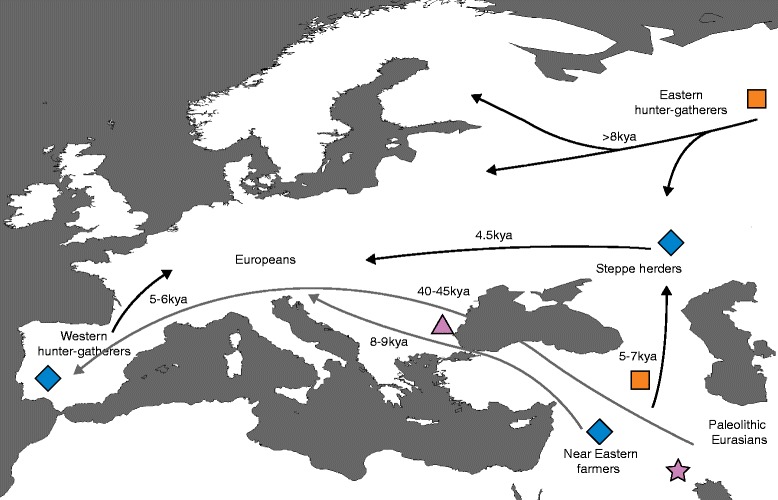
- European population history is more complex than simple demic diffusion: present-day Europeans derive from at least three ancient populations, with a massive migration from the Eurasian Steppe ~4500 ya involving Yamnaya culture people; Y-chromosomal haplogroups shifted from predominantly G2a beforehand to R1a and R1b afterwards. Lactose tolerance was absent in early European farmers, found in only 10% of Bronze Age Europeans, and increased dramatically in just the past 3000 years.
- Native American origins are refined by aDNA: Kennewick Man was genetically closer to modern Native Americans than to any other population; the 24,000-year-old Mal’ta boy linked Upper Paleolithic West Eurasians to Native Americans; Anzick-1 (~12,500 years old) belonged to a meta-population related to many contemporary Native Americans. Native Americans appear to have diverged from Siberian ancestors ~20,000 ya, with another diversification ~13,000 ya in the Americas.
- aDNA is transforming understanding of selection and introgression: the Tibetan EPAS1 advantageous allele is best explained by Denisovan introgression; testes-expressed genes show reduced Neanderthal ancestry, while Neanderthal alleles are enriched in keratin filament genes; adaptive immune variants were already present in Mesolithic hunter-gatherers before agriculture.
Methods
- Narrative review of ancient DNA research and its implications for human population history, not a primary research study.
- Synthesizes published findings from ancient genomes and population-genetic studies, including Neanderthal, Denisovan, European, Native American, and selection examples.
- Main analysis is qualitative and interpretive, discussing how aDNA supports, refines, or overturns models previously inferred from present-day DNA.
Limitations
- The authors state that samples more than 100,000 years old and regions such as the Near East and Africa remain challenging for aDNA research because of time and poor DNA preservation in hot wet climates; sequences below 25 base pairs often do not map uniquely to the human genome, and extraction, library construction, and molecule repair/reconstruction need improvement.
- The paper identifies unresolved questions, including the frequency and number of Neanderthal–modern human mixture events, the source of non-Neanderthal/non-Denisovan archaic admixture, what Denisovans looked like, and the number, timing, and routes of major out-of-Africa expansions.
- As a review, no systematic search strategy or quantitative meta-analysis is described; the synthesis is selective and depends on the cited studies (evident from the text).
Model-written summary. Check it against the paper before relying on it.
Integrity signals
Registry
Cites
Statistics
Figures
Verification
Claims the paper makes
16 Valid · 4 Not valid · 40 Not checked · 23 Own results and interpretations
Every source the paper cites for this claim was checked and supports it.
In the paper
“whereas present-day humans carry, on average, introgressed haplotypes of ~57 kb in length [16].”
§ Ancient DNA and the rewriting of human history: be sparing with Occam’s razor > Origin and expansion of modern humans and admixture with archaic species
What the sources say
- Supportedcites [16] Vernot B Akey JM Resurrecting surviving Neandertal lineages from modern human genomes Science 2014 343 1017 21 10.1126/science.1245938 24476670 source
The Reports section (p. 1) explicitly states that the average length of introgressed haplotypes was approximately 57 kb. The paper identifies these as Neandertal lineages recovered from modern human genomes. (LLM, conf=0.94)
plain- Asserted: passes — The authors put it forward as true.
- Checkable: passes — It can be checked against evidence.
- Load-bearing: unclear — It is unclear whether the paper’s conclusions depend on it.
- Based: passes — The paper gives a reason why it holds.
- Supported
Every source the paper cites for this claim was checked and supports it.
In the paper
“Neanderthal ancestry in all present-day non-Africans is estimated to be 1.5–2.1 % [14].”
§ Ancient DNA and the rewriting of human history: be sparing with Occam’s razor > Origin and expansion of modern humans and admixture with archaic species
What the sources say
- Supportedcites [14] Prufer K Racimo F Patterson N Jay F Sankararaman S Sawyer S The complete genome sequence of a Neanderthal from the Altai Mountains Nature 2014 505 43 9 10.1038/nature12886 24352235 PMC4031459 source
The section “Neandertal gene flow into modern humans” explicitly estimates that 1.5–2.1% of the DNA in people outside Africa is Neandertal-derived. This matches the cited claim. (LLM, conf=0.95)
hedged- Asserted: passes — The authors put it forward as true.
- Checkable: passes — It can be checked against evidence.
- Load-bearing: unclear — It is unclear whether the paper’s conclusions depend on it.
- Based: passes — The paper gives a reason why it holds.
- Supported
Every source the paper cites for this claim was checked and supports it.
In the paper
“Denisovans themselves appear to have received gene flow from other archaic humans.”
§ Ancient DNA and the rewriting of human history: be sparing with Occam’s razor > Origin and expansion of modern humans and admixture with archaic species
What the sources say
- Supportedcites [14] Prufer K Racimo F Patterson N Jay F Sankararaman S Sawyer S The complete genome sequence of a Neanderthal from the Altai Mountains Nature 2014 505 43 9 10.1038/nature12886 24352235 PMC4031459 source
The “Neandertal gene flow into Denisovans” section states that gene flow from Neandertals into Denisovans occurred. The “Unknown archaic gene flow into Denisovan” section also finds gene flow from a deeply diverged hominin consistent with the data, while noting that ancient population structure remains an alternative explanation for that component. (LLM, conf=0.94)
hedgedstates a cause- Asserted: passes — The authors put it forward as true.
- Checkable: passes — It can be checked against evidence.
- Load-bearing: unclear — It is unclear whether the paper’s conclusions depend on it.
- Based: passes — The paper gives a reason why it holds.
- Supported
The cited sources support only part of this claim — read each source’s verdict below.
In the paper
“providing more evidence that archaic admixture occurred in West Asia early during modern humans’ exit from Africa.”
§ Ancient DNA and the rewriting of human history: be sparing with Occam’s razor > Origin and expansion of modern humans and admixture with archaic species
What the sources say
- Partly supportedcites [14] Prufer K Racimo F Patterson N Jay F Sankararaman S Sawyer S The complete genome sequence of a Neanderthal from the Altai Mountains Nature 2014 505 43 9 10.1038/nature12886 24352235 PMC4031459 sourceExperimental — accuracy not yet measured
The Discussion (page not provided) says that allele sharing between Neandertals and non-Africans reflects admixture, and the ‘Neandertal gene flow into modern humans’ section finds their Neandertal-derived DNA closer to a Neandertal from the Caucasus. The copy does not establish that admixture occurred in West Asia or date it to early in modern humans’ exit from Africa; the 77,000–114,000-year estimate is a population split time, not the date of admixture. (LLM, conf=0.82)
hedgedstates a cause- Asserted: passes — The authors put it forward as true.
- Checkable: passes — It can be checked against evidence.
- Load-bearing: passes — The paper’s conclusions depend on it.
- Based: passes — The paper gives a reason why it holds.
- Partly supported
Every source the paper cites for this claim was checked and supports it.
In the paper
“but the Oase genome provides direct evidence that multiple mixture events between modern humans and Neanderthals have occurred.”
§ Ancient DNA and the rewriting of human history: be sparing with Occam’s razor > Origin and expansion of modern humans and admixture with archaic species
What the sources say
- Supportedcites [20] Fu Q Hajdinjak M Moldovan OT Constantin S Mallick S Skoglund P An early modern human from Romania with a recent Neanderthal ancestor Nature 2015 524 216 9 10.1038/nature14558 26098372 PMC4537386 source
The Abstract's concluding paragraph states directly that 'the Oase 1 genome shows that mixture between modern humans and Neanderthals was not limited to the first ancestors of present-day people to leave Africa, nor to the Near East; it occurred later as well and probably in Europe' — i.e. more than one mixture event, with the recent one dated to less than 200 years before Oase 1 lived. The Introduction frames this as direct evidence from a genome of a modern human who could have met Neanderthals ('More direct insight into the interactions between modern and archaic humans...'), against a background where 'where and how often this occurred is not understood'. The Fig. 2/results discussion adds a possible older Neanderthal admixture in Oase 1's ancestors beyond the recent one, reinforcing multiplicity (hedged there, but the Abstract's 'not limited to' claim is stated without hedge). (LLM, conf=0.85)
boostedstates a causeSingle case- Asserted: passes — The authors put it forward as true.
- Checkable: passes — It can be checked against evidence.
- Load-bearing: passes — The paper’s conclusions depend on it.
- Based: passes — The paper gives a reason why it holds.
- Supported
38 more claims · 7 with their cited sources checked
Create a free account to see all 83 claims and to verify the 47 references still open.
- It may state two separate claims as one. 27
- Probably not a substantial claim. 14
Claims other papers make about this one
Each is checked against this paper’s own text: does it say what the citing paper says it does?
The check wasn’t confident either way, so it gives no verdict — never disputed.
In the citing paper
“To address this gap, computational methods for protein function prediction have been developed and significantly advanced over the past 15 years as demonstrated by the recent Critical Assessment of Functional Annotation (CAFA) challenges7,8.”
From Environmental conditions shape the nature of a minimal bacterial genome (2019) · cites this paper as [8]
Experimental — accuracy not yet measured
Citations
Cites
A draft sequence of the Neandertal genome
Green, R. E., Krause, J., Briggs, A. W., Maricic, T., Stenzel, U., Kircher, M., Patterson, N., Li, H., Zhai, W., Fritz, M. H.-Y., et al. (2010) · Science · doi:10.1126/science.1188021 · Cited by 4,318 · cited 2×
“Moreover, the Neanderthal-derived DNA in all non-Africans is more closely related to a Neanderthal from the Caucasus than it is to either the Neanderthal from Siberia or the Neanderthal from Croatia [14], providing more evidence that archaic admixture occurred in West Asia early during modern humans’ exit from Africa.”
BackgroundMitochondrial DNA and human evolution
Cann, R. L., Stoneking, M., & Wilson, A. C. (1987) · Nature · doi:10.1038/325031a0 · Cited by 3,100 · cited 1×
“in Africa around 200,000 years ago (ya) [3], followed by”
BackgroundThe complete genome sequence of a Neanderthal from the Altai Mountains
Prüfer, K., Racimo, F., Patterson, N., Jay, F., Sankararaman, S., Sawyer, S., Heinze, A., Renaud, G., Sudmant, P. H., de Filippo, C., et al. (2014) · Nature · doi:10.1038/nature12886 · Cited by 2,254 · cited 4×
“2 %) of Denisovan ancestry is also found across Eastern Eurasia and in Native American populations [14], but it is unclear whether this originated via gene flow from the same mixture event or through a second one.”
BackgroundInfluentialGenetic history of an archaic hominin group from Denisova Cave in Siberia
Reich, D., Green, R. E., Kircher, M., Krause, J., Patterson, N., Durand, E. Y., Viola, B., Briggs, A. W., Stenzel, U., Johnson, P. L. F., et al. (2010) · Nature · doi:10.1038/nature09710 · Cited by 1,991 · cited 12×
“A more substantial revision of the demic diffusion model was introduced when several 7000–8000-year-old individuals from Western Europe [29] and a 24,000-yearold individual from Siberia [30] were sequenced.”
BackgroundInfluentialMassive migration from the steppe was a source for Indo-European languages in Europe
Haak, W., Lazaridis, I., Patterson, N., Rohland, N., Mallick, S., Llamas, B., Brandt, G., Nordenfelt, S., Harney, E., Stewardson, K., et al. (2015) · Nature · doi:10.1038/nature14317 · Cited by 1,940 · cited 3×
“Controversially, these people were suggested to have also brought Indo-European languages into Europe [31].”
BackgroundOn the genealogy of large populations
Kingmán, J. F. C. (1982) · Journal of Applied Probability · doi:10.1017/s0021900200034446 · Cited by 1,628 · cited 1×
“Kingman in 1982 [49], provided an unprecedented understanding of the genetic relationships among human populations, as well as”
BackgroundSequencing of 50 Human Exomes Reveals Adaptation to High Altitude
Yi, X., Liang, Y., Huerta-Sanchez, E., Jin, X., Cuo, Z. X. P., Pool, J. E., Xu, X., Jiang, H., Vinckenbosch, N., Korneliussen, T. S., et al. (2010) · Science · doi:10.1126/science.1190371 · Cited by 1,611 · cited 1×
“For example, by studying genes that show population-specific allele-frequency differences between Tibetans and Han Chinese, a signal of positive natural selection was detected in EPAS1, a transcription factor involved in the response to hypoxia, which most probably helps the Tibetans to live at high altitudes [40].”
BackgroundPopulation genomics of Bronze Age Eurasia
Allentoft, M. E., Sikora, M., Sjögren, K.-G., Rasmussen, S., Rasmussen, M., Stenderup, J., Damgaard, P. B., Schroeder, H., Ahlström, T., Vinner, L., et al. (2015) · Nature · doi:10.1038/nature14507 · Cited by 1,550 · cited 15×
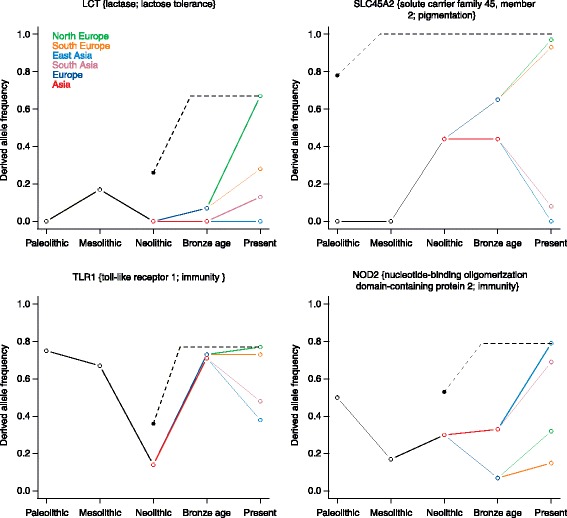
“In particular, selection on immune genes was believed to have been increased by the spread of diseases after the Neolithic due to dense settlements and proximity to domesticated animals. aDNA from Mesolithic Europeans shows, however, that adaptive variants associated with pathogen resistance in modern populations were…”
BackgroundInfluentialGenome-wide patterns of selection in 230 ancient Eurasians
Mathieson, I., Lazaridis, I., Rohland, N., Mallick, S., Patterson, N., Roodenberg, S. A., Harney, E., Stewardson, K., Fernandes, D., Novak, M., et al. (2015) · Nature · doi:10.1038/nature16152 · Cited by 1,515 · cited 4×
“Even lactose tolerance, assumed to be associated with pastoralism, appears to have been absent in early European farmers, being found in only 10 % of Bronze Age Europeans and increasing dramatically in just the past 3000 years [32, 44] (Fig.”
BackgroundResultInfluentialAncient human genomes suggest three ancestral populations for present-day Europeans
Lazaridis, I., Patterson, N., Mittnik, A., Renaud, G., Mallick, S., Kirsanow, K., Sudmant, P. H., Schraiber, J. G., Castellano, S., Lipson, M., et al. (2014) · Nature · doi:10.1038/nature13673 · Cited by 1,357 · cited 2×
“A more substantial revision of the demic diffusion model was introduced when several 7000–8000-year-old individuals from Western Europe [29] and a 24,000-yearold individual from Siberia [30] were sequenced.”
BackgroundAltitude adaptation in Tibetans caused by introgression of Denisovan-like DNA
Huerta-Sánchez, E., Jin, X., Asan, Bianba, Z., Peter, B. M., Vinckenbosch, N., Liang, Y., Yi, X., He, M., Somel, M., et al. (2014) · Nature · doi:10.1038/nature13408 · Cited by 1,208 · cited 8×
“Allele frequencies in ancient populations are replotted f from theoretical models of selection based only on present-day population alleles in Eurasians in the past was similar to that in present-day Near Easte started in Paleolithic times (SLC24A5) or in Neolithic times (TLR1, NOD2 and Denisovans [41].”
BackgroundInfluentialThe genomic landscape of Neanderthal ancestry in present-day humans
Sankararaman, S., Mallick, S., Dannemann, M., Prüfer, K., Kelso, J., Pääbo, S., Patterson, N., & Reich, D. (2014) · Nature · doi:10.1038/nature12961 · Cited by 1,107 · cited 2×
“Other examples include Neanderthal alleles that are enriched in genes affecting keratin filaments, which make up most of the outer layer of human skin and produce hair, suggesting that Neanderthal alleles may have helped modern humans to adapt to non-African cold environments [42].”
BackgroundInferring human population size and separation history from multiple genome sequences
Schiffels, S., & Durbin, R. (2014) · Nature Genetics · doi:10.1038/ng.3015 · Cited by 1,073
Genome sequence of a 45,000-year-old modern human from western Siberia
Fu, Q., Li, H., Moorjani, P., Jay, F., Slepchenko, S. M., Bondarev, A. A., Johnson, P. L. F., Aximu-Petri, A., Prüfer, K., de Filippo, C., et al. (2014) · Nature · doi:10.1038/nature13810 · Cited by 1,023 · cited 1×
“2 times longer than those observed in presentday individuals, suggesting that the Neanderthal gene flow occurred 232–430 generations before Ust’-Ishim lived, or approximately 50,000–60,000 ya [17], narrowing the previous range.”
BackgroundUpper Palaeolithic Siberian genome reveals dual ancestry of Native Americans
Raghavan, M., Skoglund, P., Graf, K. E., Metspalu, M., Albrechtsen, A., Moltke, I., Rasmussen, S., Stafford Jr, T. W., Orlando, L., Metspalu, E., et al. (2014) · Nature · doi:10.1038/nature12736 · Cited by 963 · cited 3×
“Insights into the Asian origin of the Native Americans came from a genome sequence of a 24,000-year-old boy found in Mal’ta in south-central Siberia [30].”
BackgroundResultAncient human genome sequence of an extinct Palaeo-Eskimo
Rasmussen, M., Li, Y., Lindgreen, S., Pedersen, J. S., Albrechtsen, A., Moltke, I., Metspalu, M., Metspalu, E., Kivisild, T., Gupta, R., et al. (2010) · Nature · doi:10.1038/nature08835 · Cited by 849 · cited 1×
“Subsequent migration of the ancestors of the Inuit is evident from the genome sequence of ~4000-year-old Saqqaqman [39].”
BackgroundAn early modern human from Romania with a recent Neanderthal ancestor
Fu, Q., Hajdinjak, M., Moldovan, O. T., Constantin, S., Mallick, S., Skoglund, P., Patterson, N., Rohland, N., Lazaridis, I., Nickel, B., et al. (2015) · Nature · doi:10.1038/nature14558 · Cited by 802 · cited 1×
“DNA from a 37,000–42,000-year-old modern human from Romania (named Oase) had 6–9 % Neanderthalderived alleles, including three large segments of Neanderthal ancestry of over 50 centimorgans in size, suggesting that Oase had a Neanderthal ancestor as a fourth-, fifthor sixth-degree relative [20].”
BackgroundDenisova Admixture and the First Modern Human Dispersals into Southeast Asia and Oceania
Reich, D., Patterson, N., Kircher, M., Delfin, F., Nandineni, M. R., Pugach, I., Ko, A. M.-S., Ko, Y.-C., Jinam, T. A., Phipps, M. E., et al. (2011) · The American Journal of Human Genetics · doi:10.1016/j.ajhg.2011.09.005 · Cited by 656 · cited 1×
“Admixture with Denisovans also occurred, possibly in South-East Asia [21], and affected the ancestors of present-day populations in Oceania, introducing 4–6 % Denisovan ancestry (in addition to their Neanderthal ancestry) in today’s New Guineans, Aboriginal Australians and Bougainville Islanders.”
BackgroundMenozzi, P., Piazza, A., & Cavalli-Sforza, L. (1978) · Science · doi:10.1126/science.356262 · Cited by 638 · cited 1×
“In 1978, the cover of Science magazine featured an image by Cavalli-Sforza and colleagues showing maps of Europe constructed with ten loci using multivariate techniques to reveal clines [23], which they interpreted as agreement with the demic diffusion model.”
MethodThe genome of a Late Pleistocene human from a Clovis burial site in western Montana
Rasmussen, M., Anzick, S. L., Waters, M. R., Skoglund, P., DeGiorgio, M., Stafford, T. W., Rasmussen, S., Moltke, I., Albrechtsen, A., Doyle, S. M., et al. (2014) · Nature · doi:10.1038/nature13025 · Cited by 562 · cited 3×
“Rasmussen M, Anzick SL, Waters MR, Skoglund P, DeGiorgio M, Stafford Jr TW, et al. The genome of a Late Pleistocene human from a Clovis burial site in western Montana.”
BackgroundResurrecting Surviving Neandertal Lineages from Modern Human Genomes
Vernot, B., & Akey, J. M. (2014) · Science · doi:10.1126/science.1245938 · Cited by 562 · cited 1×
“For example, a genome sequence from Kostenki 14 who lived in Russia 38,700–36,200 ya had a segment of Neanderthal ancestry of ~3 Mb on chromosome 6 [15], whereas present-day humans carry, on average, introgressed haplotypes of ~57 kb in length [16].”
BackgroundGenomic evidence for the Pleistocene and recent population history of Native Americans
Raghavan, M., Steinrücken, M., Harris, K., Schiffels, S., Rasmussen, S., DeGiorgio, M., Albrechtsen, A., Valdiosera, C., Ávila-Arcos, M. C., Malaspinas, A.-S., et al. (2015) · Science · doi:10.1126/science.aab3884 · Cited by 540 · cited 1×
“Native Americans appear to have diverged from Siberian ancestors ~20,000 ya, with another diversification occurring ~13,000 ya in the Americas leading to ‘northern’ and ‘southern’ Native American branches [38].”
BackgroundSelf-citationA mitochondrial genome sequence of a hominin from Sima de los Huesos
Meyer, M., Fu, Q., Aximu-Petri, A., Glocke, I., Nickel, B., Arsuaga, J.-L., Martínez, I., Gracia, A., de Castro, J. M. B., Carbonell, E., et al. (2014) · Nature · doi:10.1038/nature12788 · Cited by 534 · cited 12×
“Sequences from the genomes of ancient Eurasians show that they carried longer archaic segments that have been affected by less recombination than those in present-day humans, consistent with the ancient individuals being closer to the time of the admixture event with Neanderthals.”
BackgroundInfluentialA recent bottleneck of Y chromosome diversity coincides with a global change in culture
Karmin, M., Saag, L., Vicente, M., Sayres, M. A. W., Järve, M., Talas, U. G., Rootsi, S., Ilumäe, A.-M., Mägi, R., Mitt, M., et al. (2015) · Genome Research · doi:10.1101/gr.186684.114 · Cited by 485 · cited 1×
“The genetic impact of the Yamnaya migration is strikingly illustrated by the transition in European Y-chromosomal haplogroups from a predominance of G2a beforehand to R1a and R1b afterwards [31], an impact that is, retrospectively, detectable in present-day DNA [33, 34].”
BackgroundSelf-citationThe Distribution of the Human Blood Groups
Mourant, A. E., & Phil, D. (1955) · Southern Medical Journal · doi:10.1097/00007611-195508000-00026 · Cited by 477
The Date of Interbreeding between Neandertals and Modern Humans
Sankararaman, S., Patterson, N., Li, H., Pääbo, S., & Reich, D. (2012) · PLoS Genetics · doi:10.1371/journal.pgen.1002947 · Cited by 460 · cited 2×
“However, several later studies using different statistics showed that ancient structure alone cannot explain the introgression signal [12, 13].”
BackgroundNew insights into the Tyrolean Iceman's origin and phenotype as inferred by whole-genome sequencing
Keller, A., Graefen, A., Ball, M., Matzas, M., Boisguerin, V., Maixner, F., Leidinger, P., Backes, C., Khairat, R., Forster, M., et al. (2012) · Nature Communications · doi:10.1038/ncomms1701 · Cited by 437 · cited 1×
“Surprisingly, the Iceman had more genetic affinity to present-day Sardinians than to the present-day populations inhabiting the region where he probably lived [28], showing that major demographic changes have occurred in Europe after the Neolithic era.”
BackgroundNo Evidence of Neandertal mtDNA Contribution to Early Modern Humans
Serre, D., Langaney, A., Chech, M., Teschler-Nicola, M., Paunovic, M., Mennecier, P., Hofreiter, M., Possnert, G., & Pääbo, S. (2004) · PLoS Biology · doi:10.1371/journal.pbio.0020057 · Cited by 436 · cited 1×
“For example, Neanderthal mtDNA analysis shows no evidence of admixture with modern humans [50], although admixture”
BackgroundModern Humans Did Not Admix with Neanderthals during Their Range Expansion into Europe
Currat, M., & Excoffier, L. (2004) · PLoS Biology · doi:10.1371/journal.pbio.0020421 · Cited by 376 · cited 1×
“A few early studies did propose admixture with archaic humans [6, 7], but alternative interpretations of their examples were usually possible [8].”
BackgroundGenetic evidence for two founding populations of the Americas
Skoglund, P., Mallick, S., Bortolini, M. C., Chennagiri, N., Hünemeier, T., Petzl-Erler, M. L., Salzano, F. M., Patterson, N., & Reich, D. (2015) · Nature · doi:10.1038/nature14895 · Cited by 365 · cited 7×
“Native Americans appear to have diverged from Siberian ancestors ~20,000 ya, with another diversification occurring ~13,000 ya in the Americas leading to ‘northern’ and ‘southern’ Native American branches [38].”
BackgroundInfluentialDerived immune and ancestral pigmentation alleles in a 7,000-year-old Mesolithic European
Olalde, I., Allentoft, M. E., Sánchez-Quinto, F., Santpere, G., Chiang, C. W. K., DeGiorgio, M., Prado-Martinez, J., Rodríguez, J. A., Rasmussen, S., Quilez, J., et al. (2014) · Nature · doi:10.1038/nature12960 · Cited by 360
Y genetic data support the Neolithic demic diffusion model
Chikhi, L., Nichols, R. A., Barbujani, G., & Beaumont, M. A. (2002) · Proceedings of the National Academy of Sciences · doi:10.1073/pnas.162158799 · Cited by 327 · cited 1×
“Some of these studies were uninformative, some were interpreted as supporting acculturation [24, 25] and others as favoring demic diffusion [26], with perhaps a balance supporting the latter [27].”
BackgroundGenomic structure in Europeans dating back at least 36,200 years
Seguin-Orlando, A., Korneliussen, T. S., Sikora, M., Malaspinas, A.-S., Manica, A., Moltke, I., Albrechtsen, A., Ko, A., Margaryan, A., Moiseyev, V., et al. (2014) · Science · doi:10.1126/science.aaa0114 · Cited by 315
Ancient Ethiopian genome reveals extensive Eurasian admixture in Eastern Africa
Llorente, M. G., Jones, E. R., Eriksson, A., Siska, V., Arthur, K. W., Arthur, J. W., Curtis, M. C., Stock, J. T., Coltorti, M., Pieruccini, P., et al. (2015) · Science · doi:10.1126/science.aad2879 · Cited by 295 · cited 1×
“Identifying favorable locations within these regions [46], or relevant relict populations and migrant individuals, offers some ways around such limitations.”
BackgroundThe ancestry and affiliations of Kennewick Man
Rasmussen, M., Sikora, M., Albrechtsen, A., Korneliussen, T. S., Moreno-Mayar, J. V., Poznik, G. D., Zollikofer, C. P. E., Ponce de León, M. S., Allentoft, M. E., Moltke, I., et al. (2015) · Nature · doi:10.1038/nature14625 · Cited by 288 · cited 1×
“Kennewick man, as the skeleton came to be known, was recently sequenced and found to be genetically closer to modern Native Americans than to any other population worldwide, therefore showing continuity with Native North Americans over at least the past eight millennia, despite the difference in morphology [35].”
BackgroundPossible Ancestral Structure in Human Populations
Plagnol, V., & Wall, J. D. (2006) · PLoS Genetics · doi:10.1371/journal.pgen.0020105 · Cited by 275 · cited 1×
“A few early studies did propose admixture with archaic humans [6, 7], but alternative interpretations of their examples were usually possible [8].”
BackgroundThe Multiregional Evolution of Humans
Thorne, A. G., & Wolpoff, M. H. (1992) · Scientific American · doi:10.1038/scientificamerican0492-76 · Cited by 243 · cited 1×
“org/publicdomain/ze Origin and expansion of modern humans and admixture with archaic species For decades, the theories about the origin of modern humans were summarized in two main competing models: multiregional evolution or recent replacement from Africa [1, 2].”
BackgroundEriksson, A., & Manica, A. (2012) · Proceedings of the National Academy of Sciences · doi:10.1073/pnas.1200567109 · Cited by 220 · cited 12×
“Sequences from the genomes of ancient Eurasians show that they carried longer archaic segments that have been affected by less recombination than those in present-day humans, consistent with the ancient individuals being closer to the time of the admixture event with Neanderthals.”
BackgroundInfluentialPagani, L., Schiffels, S., Gurdasani, D., Danecek, P., Scally, A., Chen, Y., Xue, Y., Haber, M., Ekong, R., Oljira, T., et al. (2015) · The American Journal of Human Genetics · doi:10.1016/j.ajhg.2015.04.019 · Cited by 216 · cited 2×
“an expansion out of Africa around 50,000–60,000 ya and subsequent colonization of the rest of the world [4].”
BackgroundSelf-citationA Predominantly Neolithic Origin for European Paternal Lineages
Balaresque, P., Bowden, G. R., Adams, S. M., Leung, H.-Y., King, T. E., Rosser, Z. H., Goodwin, J., Moisan, J.-P., Richard, C., Millward, A., et al. (2010) · PLoS Biology · doi:10.1371/journal.pbio.1000285 · Cited by 179 · cited 1×
“Some of these studies were uninformative, some were interpreted as supporting acculturation [24, 25] and others as favoring demic diffusion [26], with perhaps a balance supporting the latter [27].”
BackgroundSelf-citationWilson, J. F., Weiss, D. A., Richards, M., Thomas, M. G., Bradman, N., & Goldstein, D. B. (2001) · Proceedings of the National Academy of Sciences · doi:10.1073/pnas.071036898 · Cited by 173 · cited 1×
“Some of these studies were uninformative, some were interpreted as supporting acculturation [24, 25] and others as favoring demic diffusion [26], with perhaps a balance supporting the latter [27].”
BackgroundY-chromosomal evidence of the cultural diffusion of agriculture in southeast Europe
Battaglia, V., Fornarino, S., Al-Zahery, N., Olivieri, A., Pala, M., Myres, N. M., King, R. J., Rootsi, S., Marjanovic, D., Primorac, D., et al. (2009) · European Journal of Human Genetics · doi:10.1038/ejhg.2008.249 · Cited by 160
The timing of pigmentation lightening in Europeans
Beleza, S., Santos, A. M., McEvoy, B., Alves, I., Martinho, C., Cameron, E., Shriver, M. D., Parra, E. J., & Rocha, J. (2013) · Molecular Biology and Evolution · doi:10.1093/molbev/mss207 · Cited by 156 · cited 1×
“It was thought that the light skin of Europeans was a Paleolithic adaptation to facilitate vitamin D production in reduced sunlight regions [43].”
BackgroundComplex History of Admixture between Modern Humans and Neandertals
Vernot, B., & Akey, J. M. (2015) · The American Journal of Human Genetics · doi:10.1016/j.ajhg.2015.01.006 · Cited by 149 · cited 3×
“Modern East Asians appear to have replaced this ancient Eurasian population and hence have obscured the origin of the Native Americans.”
BackgroundAncient Structure in Africa Unlikely to Explain Neanderthal and Non-African Genetic Similarity
Yang, M. A., Malaspinas, A.-S., Durand, E. Y., & Slatkin, M. (2012) · Molecular Biology and Evolution · doi:10.1093/molbev/mss117 · Cited by 101 · cited 1×
“However, several later studies using different statistics showed that ancient structure alone cannot explain the introgression signal [12, 13].”
BackgroundLarge-scale recent expansion of European patrilineages shown by population resequencing
Batini, C., Hallast, P., Zadik, D., Delser, P. M., Benazzo, A., Ghirotto, S., Arroyo-Pardo, E., Cavalleri, G. L., de Knijff, P., Dupuy, B. M., et al. (2015) · Nature Communications · doi:10.1038/ncomms8152 · Cited by 91
Kim, B. Y., & Lohmueller, K. E. (2015) · The American Journal of Human Genetics · doi:10.1016/j.ajhg.2014.12.029 · Cited by 82 · cited 3×
“Modern East Asians appear to have replaced this ancient Eurasian population and hence have obscured the origin of the Native Americans.”
BackgroundGarrigan, D., Mobasher, Z., Kingan, S. B., Wilder, J. A., & Hammer, M. F. (2005) · Genetics · doi:10.1534/genetics.105.041095 · Cited by 74 · cited 1×
“A few early studies did propose admixture with archaic humans [6, 7], but alternative interpretations of their examples were usually possible [8].”
BackgroundHuman evolution: Origins of modern humans still look recent
Disotell, T. R. (1999) · Current Biology · doi:10.1016/s0960-9822(99)80414-x · Cited by 15 · cited 1×
“org/publicdomain/ze Origin and expansion of modern humans and admixture with archaic species For decades, the theories about the origin of modern humans were summarized in two main competing models: multiregional evolution or recent replacement from Africa [1, 2].”
Background
Cited by
Integrated analysis of single cell transcriptomic data across conditions, technologies, and species
Butler, A., & Satija, R. (2017) · doi:10.1101/164889 · Cited by 13,200
Integrating single-cell transcriptomic data across different conditions, technologies, and species
Butler, A., Hoffman, P., Smibert, P., Papalexi, E., & Satija, R. (2018) · Nature Biotechnology · doi:10.1038/nbt.4096 · Cited by 13,174
Salmon provides fast and bias-aware quantification of transcript expression
Patro, R., Duggal, G., Love, M. I., Irizarry, R. A., & Kingsford, C. (2017) · Nature Methods · doi:10.1038/nmeth.4197 · Cited by 12,700
Hafemeister, C., & Satija, R. (2019) · Genome Biology · doi:10.1186/s13059-019-1874-1 · Cited by 4,479
Beghini, F., McIver, L. J., Blanco-Míguez, A., Dubois, L., Asnicar, F., Maharjan, S., Mailyan, A., Manghi, P., Scholz, M., Thomas, A. M., et al. (2021) · eLife · doi:10.7554/elife.65088 · Cited by 2,303
Metadata
- Authors
- Haber, M., Mezzavilla, M., Xue, Y., & Tyler-Smith, C.
- Affiliations
- Wellcome Sanger Institute (GB)
- University of Trieste (IT)
- Venue
- Genome Biology
- Published
- 2016-01-11
- Volume
- 17
- Issue
- 1
- Pages
- 1-1
- ISSN
- 1465-6906 (ISSN-L)
- 1474-760X
- PMC
- PMC4707776
- OpenAlex
- W2233603983
- Semantic Scholar
- c387b4a2b9f15441325a0d52ddc1d3fa20513dd8
- Cited by
- 1,924
- References
- 50
- Citations by year
- 2026: 86 · 2025: 226 · 2024: 204 · 2023: 226 · 2022: 197 · 2021: 404 · 2020: 175 · 2019: 133 · 2018: 92 · 2017: 122 · 2016: 57
- FWCI
- 18.02
- Type
- journal article
- Language
- en
- Open access
- gold
- doi.org
- Licence
- cc-by
- creativecommons.org/licenses/by/4.0/ (tdm)
- Locations
- Genome biology (publishedVersion, cc-by)
- Europe PMC (PubMed Central) (publishedVersion, cc-by)
- PubMed Central (publishedVersion, cc-by)
- PubMed (publishedVersion)
- University of Birmingham Research Portal (University of Birmingham) (submittedVersion)
- Padua Research Archive (University of Padova) (submittedVersion, cc-by)
- Funders
- Wellcome Trust (098051)
- Topics
- Life Sciences › Biochemistry, Genetics and Molecular Biology › Genetics › Forensic and Genetic Research
- Social Sciences › Anthropology › Pleistocene-Era Hominins and Archaeology
- Life Sciences › Biochemistry, Genetics and Molecular Biology › Genetics › Genetic diversity and population structure
- Keywords
- ancient DNA, human migration, human history, population genetics, history of human evolution
- MeSH terms
- DNA, Humans, Selection, Genetic, History, Ancient, Human Migration
About these checks
Registry, retraction, Cites and statistics results are computed, not judged, with one exception: a printed reference that no index lists is read once by a model before it counts as a citation error. Claims are extracted by a model and kept only when their quote appears verbatim in the text; each cited source is then checked, with a model’s help, for whether it says what the claim relies on. Those verdicts can be wrong — read the claim’s quote and the cited source before relying on one.
The claim verdicts this report counts are experimental: their accuracy is not yet measured.
A language model drew the claims from the paper on 2026-10-05, under version 3 of the claim definition (model deepseek-v4.1-flash, prompt extract-v3).
A second model labelled each claim on 2026-10-05 (model jev-1.13-20260917, definition revision gold-guideline-v0.2).
Cited sources are checked with a language model’s help (gpt-6-sol and qwen3.8-omni-flash).
Statistics and arithmetic are recomputed, not judged.
Confidence bands are shown only for fields calibrated on our annotated test set. None is calibrated yet, so no band is shown.
What counts as a claim ›How we measure confidence ›How we check this ›
Are you an author, or do you see a problem with this page? Request a review
Data sources
Bibliographic data: Semantic Scholar, OpenAlex, Crossref.
Contains information from the Semantic Scholar Academic Graph Datasets, made available under the ODC Attribution License (ODC-BY 1.0).
Semantic Scholar’s data is described in: Kinney, R., et al. (2023). The Semantic Scholar Open Data Platform. arXiv:2301.10140.
