

Ancient DNA and the rewriting of human history: be sparing with Occam’s razor
Open accessThe DOI matches its Crossref record; 48 of the 50 references it cites were found in a registry or an index, and 1 are not checked yet; 17 of the 64 sources its claims cite were checked for support.
Abstract
Ancient DNA research is revealing a human history far more complex than that inferred from parsimonious models based on modern DNA. Here, we review some of the key events in the peopling of the world in the light of the findings of work on ancient DNA.
Verified 2026-10-05 · 1 reference not checked yet
Overview
CoChat Summary
TL;DR
This review argues that ancient DNA is revealing a human history far more complex than parsimonious models based on modern DNA alone, using examples from archaic admixture, the peopling of Europe and the Americas, and recent selection. It concludes that human evolutionary genetics is moving toward first looking for aDNA evidence and interpreting present-day variation in its light, while noting major preservation and methodological limits.
Key findings
- aDNA supports a “leaky replacement” model: Neanderthal ancestry is estimated at 1.5–2.1% in all present-day non-Africans, with gene flow likely around 47,000–65,000 ya; Ust’-Ishim suggests 50,000–60,000 ya, and the Oase individual had 6–9% Neanderthal-derived alleles. Denisovan ancestry is 4–6% in New Guineans, Aboriginal Australians and Bougainville Islanders, with ~0.2% across Eastern Eurasia and Native American populations.
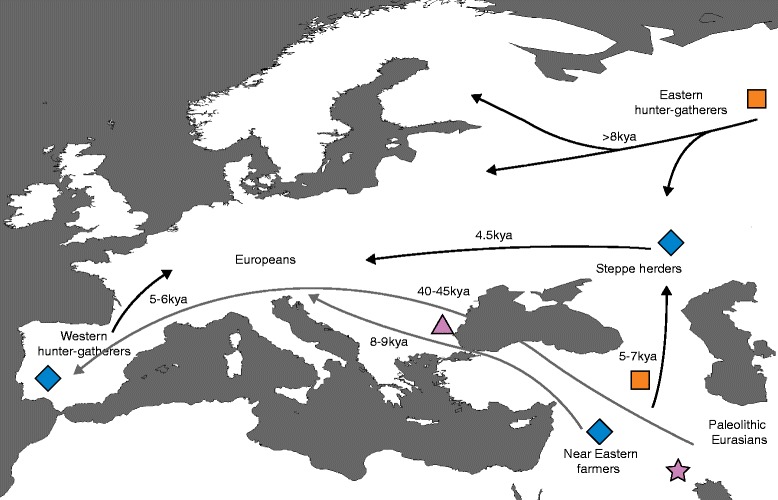
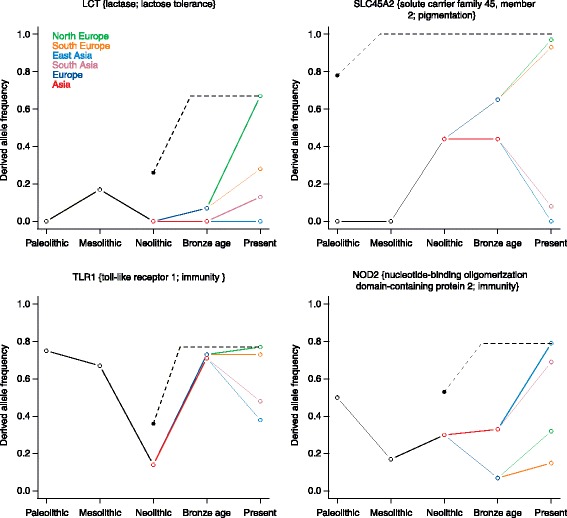
- European population history is more complex than simple demic diffusion: present-day Europeans derive from at least three ancient populations, with a massive migration from the Eurasian Steppe ~4500 ya involving Yamnaya culture people; Y-chromosomal haplogroups shifted from predominantly G2a beforehand to R1a and R1b afterwards. Lactose tolerance was absent in early European farmers, found in only 10% of Bronze Age Europeans, and increased dramatically in just the past 3000 years.
- Native American origins are refined by aDNA: Kennewick Man was genetically closer to modern Native Americans than to any other population; the 24,000-year-old Mal’ta boy linked Upper Paleolithic West Eurasians to Native Americans; Anzick-1 (~12,500 years old) belonged to a meta-population related to many contemporary Native Americans. Native Americans appear to have diverged from Siberian ancestors ~20,000 ya, with another diversification ~13,000 ya in the Americas.
- aDNA is transforming understanding of selection and introgression: the Tibetan EPAS1 advantageous allele is best explained by Denisovan introgression; testes-expressed genes show reduced Neanderthal ancestry, while Neanderthal alleles are enriched in keratin filament genes; adaptive immune variants were already present in Mesolithic hunter-gatherers before agriculture.
Methods
- Narrative review of ancient DNA research and its implications for human population history, not a primary research study.
- Synthesizes published findings from ancient genomes and population-genetic studies, including Neanderthal, Denisovan, European, Native American, and selection examples.
- Main analysis is qualitative and interpretive, discussing how aDNA supports, refines, or overturns models previously inferred from present-day DNA.
Limitations
- The authors state that samples more than 100,000 years old and regions such as the Near East and Africa remain challenging for aDNA research because of time and poor DNA preservation in hot wet climates; sequences below 25 base pairs often do not map uniquely to the human genome, and extraction, library construction, and molecule repair/reconstruction need improvement.
- The paper identifies unresolved questions, including the frequency and number of Neanderthal–modern human mixture events, the source of non-Neanderthal/non-Denisovan archaic admixture, what Denisovans looked like, and the number, timing, and routes of major out-of-Africa expansions.
- As a review, no systematic search strategy or quantitative meta-analysis is described; the synthesis is selective and depends on the cited studies (evident from the text).
Model-written summary. Check it against the paper before relying on it.
Integrity signals
Registry
Cites
Statistics
Figures
Verification
Claims the paper makes
16 Valid · 4 Not valid · 40 Not checked · 23 Own results and interpretations
Every source the paper cites for this claim was checked and supports it.
In the paper
“whereas present-day humans carry, on average, introgressed haplotypes of ~57 kb in length [16].”
§ Ancient DNA and the rewriting of human history: be sparing with Occam’s razor > Origin and expansion of modern humans and admixture with archaic species
What the sources say
- Supportedcites [16] Vernot B Akey JM Resurrecting surviving Neandertal lineages from modern human genomes Science 2014 343 1017 21 10.1126/science.1245938 24476670 source
The Reports section (p. 1) explicitly states that the average length of introgressed haplotypes was approximately 57 kb. The paper identifies these as Neandertal lineages recovered from modern human genomes. (LLM, conf=0.94)
plain- Asserted: passes — The authors put it forward as true.
- Checkable: passes — It can be checked against evidence.
- Load-bearing: unclear — It is unclear whether the paper’s conclusions depend on it.
- Based: passes — The paper gives a reason why it holds.
- Supported
Every source the paper cites for this claim was checked and supports it.
In the paper
“Neanderthal ancestry in all present-day non-Africans is estimated to be 1.5–2.1 % [14].”
§ Ancient DNA and the rewriting of human history: be sparing with Occam’s razor > Origin and expansion of modern humans and admixture with archaic species
What the sources say
- Supportedcites [14] Prufer K Racimo F Patterson N Jay F Sankararaman S Sawyer S The complete genome sequence of a Neanderthal from the Altai Mountains Nature 2014 505 43 9 10.1038/nature12886 24352235 PMC4031459 source
The section “Neandertal gene flow into modern humans” explicitly estimates that 1.5–2.1% of the DNA in people outside Africa is Neandertal-derived. This matches the cited claim. (LLM, conf=0.95)
hedged- Asserted: passes — The authors put it forward as true.
- Checkable: passes — It can be checked against evidence.
- Load-bearing: unclear — It is unclear whether the paper’s conclusions depend on it.
- Based: passes — The paper gives a reason why it holds.
- Supported
Every source the paper cites for this claim was checked and supports it.
In the paper
“Denisovans themselves appear to have received gene flow from other archaic humans.”
§ Ancient DNA and the rewriting of human history: be sparing with Occam’s razor > Origin and expansion of modern humans and admixture with archaic species
What the sources say
- Supportedcites [14] Prufer K Racimo F Patterson N Jay F Sankararaman S Sawyer S The complete genome sequence of a Neanderthal from the Altai Mountains Nature 2014 505 43 9 10.1038/nature12886 24352235 PMC4031459 source
The “Neandertal gene flow into Denisovans” section states that gene flow from Neandertals into Denisovans occurred. The “Unknown archaic gene flow into Denisovan” section also finds gene flow from a deeply diverged hominin consistent with the data, while noting that ancient population structure remains an alternative explanation for that component. (LLM, conf=0.94)
hedgedstates a cause- Asserted: passes — The authors put it forward as true.
- Checkable: passes — It can be checked against evidence.
- Load-bearing: unclear — It is unclear whether the paper’s conclusions depend on it.
- Based: passes — The paper gives a reason why it holds.
- Supported
The cited sources support only part of this claim — read each source’s verdict below.
In the paper
“providing more evidence that archaic admixture occurred in West Asia early during modern humans’ exit from Africa.”
§ Ancient DNA and the rewriting of human history: be sparing with Occam’s razor > Origin and expansion of modern humans and admixture with archaic species
What the sources say
- Partly supportedcites [14] Prufer K Racimo F Patterson N Jay F Sankararaman S Sawyer S The complete genome sequence of a Neanderthal from the Altai Mountains Nature 2014 505 43 9 10.1038/nature12886 24352235 PMC4031459 sourceExperimental — accuracy not yet measured
The Discussion (page not provided) says that allele sharing between Neandertals and non-Africans reflects admixture, and the ‘Neandertal gene flow into modern humans’ section finds their Neandertal-derived DNA closer to a Neandertal from the Caucasus. The copy does not establish that admixture occurred in West Asia or date it to early in modern humans’ exit from Africa; the 77,000–114,000-year estimate is a population split time, not the date of admixture. (LLM, conf=0.82)
hedgedstates a cause- Asserted: passes — The authors put it forward as true.
- Checkable: passes — It can be checked against evidence.
- Load-bearing: passes — The paper’s conclusions depend on it.
- Based: passes — The paper gives a reason why it holds.
- Partly supported
Every source the paper cites for this claim was checked and supports it.
In the paper
“but the Oase genome provides direct evidence that multiple mixture events between modern humans and Neanderthals have occurred.”
§ Ancient DNA and the rewriting of human history: be sparing with Occam’s razor > Origin and expansion of modern humans and admixture with archaic species
What the sources say
- Supportedcites [20] Fu Q Hajdinjak M Moldovan OT Constantin S Mallick S Skoglund P An early modern human from Romania with a recent Neanderthal ancestor Nature 2015 524 216 9 10.1038/nature14558 26098372 PMC4537386 source
The Abstract's concluding paragraph states directly that 'the Oase 1 genome shows that mixture between modern humans and Neanderthals was not limited to the first ancestors of present-day people to leave Africa, nor to the Near East; it occurred later as well and probably in Europe' — i.e. more than one mixture event, with the recent one dated to less than 200 years before Oase 1 lived. The Introduction frames this as direct evidence from a genome of a modern human who could have met Neanderthals ('More direct insight into the interactions between modern and archaic humans...'), against a background where 'where and how often this occurred is not understood'. The Fig. 2/results discussion adds a possible older Neanderthal admixture in Oase 1's ancestors beyond the recent one, reinforcing multiplicity (hedged there, but the Abstract's 'not limited to' claim is stated without hedge). (LLM, conf=0.85)
boostedstates a causeSingle case- Asserted: passes — The authors put it forward as true.
- Checkable: passes — It can be checked against evidence.
- Load-bearing: passes — The paper’s conclusions depend on it.
- Based: passes — The paper gives a reason why it holds.
- Supported
38 more claims · 7 with their cited sources checked
Create a free account to see all 83 claims and to verify the 47 references still open.
- It may state two separate claims as one. 27
- Probably not a substantial claim. 14
Claims other papers make about this one
Each is checked against this paper’s own text: does it say what the citing paper says it does?
The check wasn’t confident either way, so it gives no verdict — never disputed.
In the citing paper
“To address this gap, computational methods for protein function prediction have been developed and significantly advanced over the past 15 years as demonstrated by the recent Critical Assessment of Functional Annotation (CAFA) challenges7,8.”
From Environmental conditions shape the nature of a minimal bacterial genome (2019) · cites this paper as [8]
Experimental — accuracy not yet measured
Citations
Cites
A draft sequence of the Neandertal genome
Green, R. E., Krause, J., Briggs, A. W., Maricic, T., Stenzel, U., Kircher, M., Patterson, N., Li, H., Zhai, W., Fritz, M. H.-Y., et al. (2010) · Science · doi:10.1126/science.1188021 · Cited by 4,318 · cited 2×
“Moreover, the Neanderthal-derived DNA in all non-Africans is more closely related to a Neanderthal from the Caucasus than it is to either the Neanderthal from Siberia or the Neanderthal from Croatia [14], providing more evidence that archaic admixture occurred in West Asia early during modern humans’ exit from Africa.”
BackgroundMitochondrial DNA and human evolution
Cann, R. L., Stoneking, M., & Wilson, A. C. (1987) · Nature · doi:10.1038/325031a0 · Cited by 3,100 · cited 1×
“in Africa around 200,000 years ago (ya) [3], followed by”
BackgroundThe complete genome sequence of a Neanderthal from the Altai Mountains
Prüfer, K., Racimo, F., Patterson, N., Jay, F., Sankararaman, S., Sawyer, S., Heinze, A., Renaud, G., Sudmant, P. H., de Filippo, C., et al. (2014) · Nature · doi:10.1038/nature12886 · Cited by 2,254 · cited 4×
“2 %) of Denisovan ancestry is also found across Eastern Eurasia and in Native American populations [14], but it is unclear whether this originated via gene flow from the same mixture event or through a second one.”
BackgroundInfluentialGenetic history of an archaic hominin group from Denisova Cave in Siberia
Reich, D., Green, R. E., Kircher, M., Krause, J., Patterson, N., Durand, E. Y., Viola, B., Briggs, A. W., Stenzel, U., Johnson, P. L. F., et al. (2010) · Nature · doi:10.1038/nature09710 · Cited by 1,991 · cited 12×
“A more substantial revision of the demic diffusion model was introduced when several 7000–8000-year-old individuals from Western Europe [29] and a 24,000-yearold individual from Siberia [30] were sequenced.”
BackgroundInfluentialMassive migration from the steppe was a source for Indo-European languages in Europe
Haak, W., Lazaridis, I., Patterson, N., Rohland, N., Mallick, S., Llamas, B., Brandt, G., Nordenfelt, S., Harney, E., Stewardson, K., et al. (2015) · Nature · doi:10.1038/nature14317 · Cited by 1,940 · cited 3×
“Controversially, these people were suggested to have also brought Indo-European languages into Europe [31].”
BackgroundOn the genealogy of large populations
Kingmán, J. F. C. (1982) · Journal of Applied Probability · doi:10.1017/s0021900200034446 · Cited by 1,628 · cited 1×
“Kingman in 1982 [49], provided an unprecedented understanding of the genetic relationships among human populations, as well as”
BackgroundSequencing of 50 Human Exomes Reveals Adaptation to High Altitude
Yi, X., Liang, Y., Huerta-Sanchez, E., Jin, X., Cuo, Z. X. P., Pool, J. E., Xu, X., Jiang, H., Vinckenbosch, N., Korneliussen, T. S., et al. (2010) · Science · doi:10.1126/science.1190371 · Cited by 1,611 · cited 1×
“For example, by studying genes that show population-specific allele-frequency differences between Tibetans and Han Chinese, a signal of positive natural selection was detected in EPAS1, a transcription factor involved in the response to hypoxia, which most probably helps the Tibetans to live at high altitudes [40].”
BackgroundPopulation genomics of Bronze Age Eurasia
Allentoft, M. E., Sikora, M., Sjögren, K.-G., Rasmussen, S., Rasmussen, M., Stenderup, J., Damgaard, P. B., Schroeder, H., Ahlström, T., Vinner, L., et al. (2015) · Nature · doi:10.1038/nature14507 · Cited by 1,550 · cited 15×
“In particular, selection on immune genes was believed to have been increased by the spread of diseases after the Neolithic due to dense settlements and proximity to domesticated animals. aDNA from Mesolithic Europeans shows, however, that adaptive variants associated with pathogen resistance in modern populations were…”
BackgroundInfluentialGenome-wide patterns of selection in 230 ancient Eurasians
Mathieson, I., Lazaridis, I., Rohland, N., Mallick, S., Patterson, N., Roodenberg, S. A., Harney, E., Stewardson, K., Fernandes, D., Novak, M., et al. (2015) · Nature · doi:10.1038/nature16152 · Cited by 1,515 · cited 4×
“Even lactose tolerance, assumed to be associated with pastoralism, appears to have been absent in early European farmers, being found in only 10 % of Bronze Age Europeans and increasing dramatically in just the past 3000 years [32, 44] (Fig.”
BackgroundResultInfluentialAncient human genomes suggest three ancestral populations for present-day Europeans
Lazaridis, I., Patterson, N., Mittnik, A., Renaud, G., Mallick, S., Kirsanow, K., Sudmant, P. H., Schraiber, J. G., Castellano, S., Lipson, M., et al. (2014) · Nature · doi:10.1038/nature13673 · Cited by 1,357 · cited 2×
“A more substantial revision of the demic diffusion model was introduced when several 7000–8000-year-old individuals from Western Europe [29] and a 24,000-yearold individual from Siberia [30] were sequenced.”
Background
Cited by
Integrated analysis of single cell transcriptomic data across conditions, technologies, and species
Butler, A., & Satija, R. (2017) · doi:10.1101/164889 · Cited by 13,200
Integrating single-cell transcriptomic data across different conditions, technologies, and species
Butler, A., Hoffman, P., Smibert, P., Papalexi, E., & Satija, R. (2018) · Nature Biotechnology · doi:10.1038/nbt.4096 · Cited by 13,174
Salmon provides fast and bias-aware quantification of transcript expression
Patro, R., Duggal, G., Love, M. I., Irizarry, R. A., & Kingsford, C. (2017) · Nature Methods · doi:10.1038/nmeth.4197 · Cited by 12,700
Hafemeister, C., & Satija, R. (2019) · Genome Biology · doi:10.1186/s13059-019-1874-1 · Cited by 4,479
Beghini, F., McIver, L. J., Blanco-Míguez, A., Dubois, L., Asnicar, F., Maharjan, S., Mailyan, A., Manghi, P., Scholz, M., Thomas, A. M., et al. (2021) · eLife · doi:10.7554/elife.65088 · Cited by 2,303
(2020) · doi:10.1101/2020.11.19.388223 · Cited by 2,303
Integrative single-cell analysis
Stuart, T., & Satija, R. (2019) · Nature Reviews Genetics · doi:10.1038/s41576-019-0093-7 · Cited by 1,460
Splatter: simulation of single-cell RNA sequencing data
Zappia, L., Phipson, B., & Oshlack, A. (2017) · Genome Biology · doi:10.1186/s13059-017-1305-0 · Cited by 905
Gustavsson, E. K., Zhang, D., Reynolds, R. H., Garcia-Ruiz, S., & Ryten, M. (2022) · Bioinformatics · doi:10.1093/bioinformatics/btac409 · Cited by 735
The ExAC browser: displaying reference data information from over 60 000 exomes
Karczewski, K. J., Weisburd, B., Thomas, B., Solomonson, M., Ruderfer, D. M., Kavanagh, D., Hamamsy, T., Lek, M., Samocha, K. E., Cummings, B. B., et al. (2017) · Nucleic Acids Research · doi:10.1093/nar/gkw971 · Cited by 781
Nucleotide Transformer: building and evaluating robust foundation models for human genomics
Dalla-Torre, H., Gonzalez, L., Mendoza-Revilla, J., Lopez Carranza, N., Grzywaczewski, A. H., Oteri, F., Dallago, C., Trop, E., de Almeida, B. P., Sirelkhatim, H., et al. (2025) · Nature Methods · doi:10.1038/s41592-024-02523-z · Cited by 772
Polypolish: Short-read polishing of long-read bacterial genome assemblies
Wick, R. R., & Holt, K. E. (2022) · PLOS Computational Biology · doi:10.1371/journal.pcbi.1009802 · Cited by 703
A general and flexible method for signal extraction from single-cell RNA-seq data
Risso, D., Perraudeau, F., Gribkova, S., Dudoit, S., & Vert, J.-P. (2018) · Nature Communications · doi:10.1038/s41467-017-02554-5 · Cited by 718
The Nucleotide Transformer: Building and Evaluating Robust Foundation Models for Human Genomics
Dalla-Torre, H., Gonzalez, L., Mendoza Revilla, J., Lopez Carranza, N., Henryk Grywaczewski, A., Oteri, F., Dallago, C., Trop, E., De Almeida, B. P., Sirelkhatim, H., et al. (2023) · doi:10.1101/2023.01.11.523679 · Cited by 680
Oblak, L., van der Zaag, J., Higgins-Chen, A. T., Levine, M. E., & Boks, M. P. (2021) · Ageing Research Reviews · doi:10.1016/j.arr.2021.101348 · Cited by 595
McCormick, R. F., Truong, S. K., Sreedasyam, A., Jenkins, J., Shu, S., Sims, D., Kennedy, M., Amirebrahimi, M., Weers, B. D., McKinley, B., et al. (2018) · The Plant Journal · doi:10.1111/tpj.13781 · Cited by 586
Applications of machine learning to diagnosis and treatment of neurodegenerative diseases
Myszczynska, M. A., Ojamies, P. N., Lacoste, A. M. B., Neil, D., Saffari, A., Mead, R., Hautbergue, G. M., Holbrook, J. D., & Ferraiuolo, L. (2020) · Nature Reviews Neurology · doi:10.1038/s41582-020-0377-8 · Cited by 595
Multiplexed CRISPR technologies for gene editing and transcriptional regulation
McCarty, N. S., Graham, A. E., Studená, L., & Ledesma-Amaro, R. (2020) · Nature Communications · doi:10.1038/s41467-020-15053-x · Cited by 552
Foley, C. N., Staley, J. R., Breen, P. G., Sun, B. B., Kirk, P. D. W., Burgess, S., & Howson, J. M. M. (2021) · Nature Communications · doi:10.1038/s41467-020-20885-8 · Cited by 557
Gene Regulatory Network Inference from Single-Cell Data Using Multivariate Information Measures
Chan, T. E., Stumpf, M. P. H., & Babtie, A. C. (2017) · Cell Systems · doi:10.1016/j.cels.2017.08.014 · Cited by 578
Trycycler: consensus long-read assemblies for bacterial genomes
Wick, R. R., Judd, L. M., Cerdeira, L. T., Hawkey, J., Méric, G., Vezina, B., Wyres, K. L., & Holt, K. E. (2021) · Genome Biology · doi:10.1186/s13059-021-02483-z · Cited by 531
CIDR: Ultrafast and accurate clustering through imputation for single-cell RNA-seq data
Lin, P., Troup, M., & Ho, J. W. K. (2017) · Genome Biology · doi:10.1186/s13059-017-1188-0 · Cited by 537
Metabolic modeling of single Th17 cells reveals regulators of autoimmunity
Wagner, A., Wang, C., Fessler, J., DeTomaso, D., Avila-Pacheco, J., Kaminski, J., Zaghouani, S., Christian, E., Thakore, P., Schellhaass, B., et al. (2021) · Cell · doi:10.1016/j.cell.2021.05.045 · Cited by 524
Higgins-Chen, A. T., Thrush, K. L., Wang, Y., Minteer, C. J., Kuo, P.-L., Wang, M., Niimi, P., Sturm, G., Lin, J., Moore, A. Z., et al. (2022) · Nature Aging · doi:10.1038/s43587-022-00248-2 · Cited by 502
Evolution of plant genome architecture
Wendel, J. F., Jackson, S. A., Meyers, B. C., & Wing, R. A. (2016) · Genome Biology · doi:10.1186/s13059-016-0908-1 · Cited by 461
The sequences of 150,119 genomes in the UK Biobank
Halldorsson, B. V., Eggertsson, H. P., Moore, K. H. S., Hauswedell, H., Eiriksson, O., Ulfarsson, M. O., Palsson, G., Hardarson, M. T., Oddsson, A., Jensson, B. O., et al. (2022) · Nature · doi:10.1038/s41586-022-04965-x · Cited by 448
Distinct amyloid-β and tau-associated microglia profiles in Alzheimer’s disease
Gerrits, E., Brouwer, N., Kooistra, S. M., Woodbury, M. E., Vermeiren, Y., Lambourne, M., Mulder, J., Kummer, M., Möller, T., Biber, K., et al. (2021) · Acta Neuropathologica · doi:10.1007/s00401-021-02263-w · Cited by 441
Fast and flexible bacterial genomic epidemiology with PopPUNK
Lees, J. A., Harris, S. R., Tonkin-Hill, G., Gladstone, R. A., Lo, S. W., Weiser, J. N., Corander, J., Bentley, S. D., & Croucher, N. J. (2019) · Genome Research · doi:10.1101/gr.241455.118 · Cited by 438
Restricting retrotransposons: a review
Goodier, J. L. (2016) · Mobile DNA · doi:10.1186/s13100-016-0070-z · Cited by 436
Single-cell RNA sequencing: Technical advancements and biological applications
Hedlund, E., & Deng, Q. (2018) · Molecular Aspects of Medicine · doi:10.1016/j.mam.2017.07.003 · Cited by 405
Transposable elements drive widespread expression of oncogenes in human cancers
Jang, H. S., Shah, N. M., Du, A. Y., Dailey, Z. Z., Pehrsson, E. C., Godoy, P. M., Zhang, D., Li, D., Xing, X., Kim, S., et al. (2019) · Nature Genetics · doi:10.1038/s41588-019-0373-3 · Cited by 392
Mapping the immune environment in clear cell renal carcinoma by single-cell genomics
Borcherding, N., Vishwakarma, A., Voigt, A. P., Bellizzi, A., Kaplan, J., Nepple, K., Salem, A. K., Jenkins, R. W., Zakharia, Y., & Zhang, W. (2021) · Communications Biology · doi:10.1038/s42003-020-01625-6 · Cited by 364
A comprehensive single cell transcriptional landscape of human hematopoietic progenitors
Pellin, D., Loperfido, M., Baricordi, C., Wolock, S. L., Montepeloso, A., Weinberg, O. K., Biffi, A., Klein, A. M., & Biasco, L. (2019) · Nature Communications · doi:10.1038/s41467-019-10291-0 · Cited by 360
Rozeman, E. A., Hoefsmit, E. P., Reijers, I. L. M., Saw, R. P. M., Versluis, J. M., Krijgsman, O., Dimitriadis, P., Sikorska, K., van de Wiel, B. A., Eriksson, H., et al. (2021) · Nature Medicine · doi:10.1038/s41591-020-01211-7 · Cited by 336
pyseer: a comprehensive tool for microbial pangenome-wide association studies
Lees, J. A., Galardini, M., Bentley, S. D., Weiser, J. N., & Corander, J. (2018) · Bioinformatics · doi:10.1093/bioinformatics/bty539 · Cited by 354
Live-cell imaging reveals enhancer-dependent Sox2 transcription in the absence of enhancer proximity
Alexander, J. M., Guan, J., Li, B., Maliskova, L., Song, M., Shen, Y., Huang, B., Lomvardas, S., & Weiner, O. D. (2019) · eLife · doi:10.7554/elife.41769 · Cited by 346
Predicting cellular responses to complex perturbations in high‐throughput screens
Lotfollahi, M., Klimovskaia Susmelj, A., De Donno, C., Hetzel, L., Ji, Y., Ibarra, I. L., Srivatsan, S. R., Naghipourfar, M., Daza, R. M., Martin, B., et al. (2023) · Molecular Systems Biology · doi:10.15252/msb.202211517 · Cited by 307
m6A RNA methylation regulates the fate of endogenous retroviruses
Chelmicki, T., Roger, E., Teissandier, A., Dura, M., Bonneville, L., Rucli, S., Dossin, F., Fouassier, C., Lameiras, S., & Bourc’his, D. (2021) · Nature · doi:10.1038/s41586-020-03135-1 · Cited by 307
Resolving host–pathogen interactions by dual RNA-seq
Westermann, A. J., Barquist, L., & Vogel, J. (2017) · PLOS Pathogens · doi:10.1371/journal.ppat.1006033 · Cited by 289
Tumor microenvironment promotes breast cancer chemoresistance
Mehraj, U., Dar, A. H., Wani, N. A., & Mir, M. A. (2021) · Cancer Chemotherapy and Pharmacology · doi:10.1007/s00280-020-04222-w · Cited by 289
Honkoop, H., de Bakker, D. E., Aharonov, A., Kruse, F., Shakked, A., Nguyen, P. D., de Heus, C., Garric, L., Muraro, M. J., Shoffner, A., et al. (2019) · eLife · doi:10.7554/elife.50163 · Cited by 279
Aissa, A. F., Islam, A. B. M. M. K., Ariss, M. M., Go, C. C., Rader, A. E., Conrardy, R. D., Gajda, A. M., Rubio-Perez, C., Valyi-Nagy, K., Pasquinelli, M., et al. (2021) · Nature Communications · doi:10.1038/s41467-021-21884-z · Cited by 273
A statistical approach for identifying differential distributions in single-cell RNA-seq experiments
Korthauer, K. D., Chu, L.-F., Newton, M. A., Li, Y., Thomson, J., Stewart, R., & Kendziorski, C. (2016) · Genome Biology · doi:10.1186/s13059-016-1077-y · Cited by 273
Comparing Current Noise in Biological and Solid-State Nanopores
Fragasso, A., Schmid, S., & Dekker, C. (2020) · ACS Nano · doi:10.1021/acsnano.9b09353 · Cited by 258
Genetic impacts on DNA methylation: research findings and future perspectives
Villicaña, S., & Bell, J. T. (2021) · Genome Biology · doi:10.1186/s13059-021-02347-6 · Cited by 242
King, H. W., & Klose, R. J. (2017) · eLife · doi:10.7554/elife.22631 · Cited by 270
(2020) · doi:10.1093/nar/gkaa609 · Cited by 268
Quan, J., Langelier, C., Kuchta, A., Batson, J., Teyssier, N., Lyden, A., Caldera, S., McGeever, A., Dimitrov, B., King, R., et al. (2019) · Nucleic Acids Research · doi:10.1093/nar/gkz418 · Cited by 261
Liu, Y., Rosikiewicz, W., Pan, Z., Jillette, N., Wang, P., Taghbalout, A., Foox, J., Mason, C., Carroll, M., Cheng, A., et al. (2021) · Genome Biology · doi:10.1186/s13059-021-02510-z · Cited by 240
Endogenous retroviral promoter exaptation in human cancer
Babaian, A., & Mager, D. L. (2016) · Mobile DNA · doi:10.1186/s13100-016-0080-x · Cited by 247
Kieu, N. P., Lenman, M., Wang, E. S., Petersen, B. L., & Andreasson, E. (2021) · Scientific Reports · doi:10.1038/s41598-021-83972-w · Cited by 237
Human Y-chromosome variation in the genome-sequencing era
Jobling, M. A., & Tyler-Smith, C. (2017) · Nature Reviews Genetics · doi:10.1038/nrg.2017.36 · Cited by 241
Self-citationCackett, L., Luginbuehl, L. H., Schreier, T. B., Lopez‐Juez, E., & Hibberd, J. M. (2022) · New Phytologist · doi:10.1111/nph.17839 · Cited by 230
Küpers, L. K., Monnereau, C., Sharp, G. C., Yousefi, P., Salas, L. A., Ghantous, A., Page, C. M., Reese, S. E., Wilcox, A. J., Czamara, D., et al. (2019) · Nature Communications · doi:10.1038/s41467-019-09671-3 · Cited by 233
Synergistic insights into human health from aptamer- and antibody-based proteomic profiling
Pietzner, M., Wheeler, E., Carrasco-Zanini, J., Kerrison, N. D., Oerton, E., Koprulu, M., Luan, J., Hingorani, A. D., Williams, S. A., Wareham, N. J., et al. (2021) · Nature Communications · doi:10.1038/s41467-021-27164-0 · Cited by 234
Overlooked roles of DNA damage and maternal age in generating human germline mutations
Gao, Z., Moorjani, P., Sasani, T. A., Pedersen, B. S., Quinlan, A. R., Jorde, L. B., Amster, G., & Przeworski, M. (2019) · Proceedings of the National Academy of Sciences · doi:10.1073/pnas.1901259116 · Cited by 229
Advances in Industrial Biotechnology Using CRISPR-Cas Systems
Donohoue, P. D., Barrangou, R., & May, A. P. (2018) · Trends in Biotechnology · doi:10.1016/j.tibtech.2017.07.007 · Cited by 218
Sharkey, C. R., Fujimoto, M. S., Lord, N. P., Shin, S., McKenna, D. D., Suvorov, A., Martin, G. J., & Bybee, S. M. (2017) · Scientific Reports · doi:10.1038/s41598-017-00061-7 · Cited by 222
Comprehensive Benchmarking and Integration of Tumor Microenvironment Cell Estimation Methods
Jiménez-Sánchez, A., Cast, O., & Miller, M. L. (2019) · Cancer Research · doi:10.1158/0008-5472.can-18-3560 · Cited by 210
Inherent mosaicism and extensive mutation of human placentas
Coorens, T. H. H., Oliver, T. R. W., Sanghvi, R., Sovio, U., Cook, E., Vento-Tormo, R., Haniffa, M., Young, M. D., Rahbari, R., Sebire, N., et al. (2021) · Nature · doi:10.1038/s41586-021-03345-1 · Cited by 211
Computational methods for trajectory inference from single‐cell transcriptomics
Cannoodt, R., Saelens, W., & Saeys, Y. (2016) · European Journal of Immunology · doi:10.1002/eji.201646347 · Cited by 208
A new model for ancient DNA decay based on paleogenomic meta-analysis
Kistler, L., Ware, R., Smith, O., Collins, M., & Allaby, R. G. (2017) · Nucleic Acids Research · doi:10.1093/nar/gkx361 · Cited by 199
“We permuted the minimum number of significant clusters detected (2,3,4), a minimum observed proportion of all plausible histone periods given the range of values analyzed (0, 0.”
BackgroundPan, S., Zhu, C., Zhao, X.-M., & Coelho, L. P. (2022) · Nature Communications · doi:10.1038/s41467-022-29843-y · Cited by 193
Nuclear genetic control of mtDNA copy number and heteroplasmy in humans
Gupta, R., Kanai, M., Durham, T. J., Tsuo, K., McCoy, J. G., Kotrys, A. V., Zhou, W., Chinnery, P. F., Karczewski, K. J., Calvo, S. E., et al. (2023) · Nature · doi:10.1038/s41586-023-06426-5 · Cited by 188
The application of long-read sequencing in clinical settings
Oehler, J. B., Wright, H., Stark, Z., Mallett, A. J., & Schmitz, U. (2023) · Human Genomics · doi:10.1186/s40246-023-00522-3 · Cited by 185
Gervin, K., Salas, L. A., Bakulski, K. M., van Zelm, M. C., Koestler, D. C., Wiencke, J. K., Duijts, L., Moll, H. A., Kelsey, K. T., Kobor, M. S., et al. (2019) · Clinical Epigenetics · doi:10.1186/s13148-019-0717-y · Cited by 195
Dating genomic variants and shared ancestry in population-scale sequencing data
Albers, P. K., & McVean, G. (2020) · PLOS Biology · doi:10.1371/journal.pbio.3000586 · Cited by 196
Hitch, T. C. A., Riedel, T., Oren, A., Overmann, J., Lawley, T. D., & Clavel, T. (2021) · ISME Communications · doi:10.1038/s43705-021-00017-z · Cited by 189
Genomic resources in plant breeding for sustainable agriculture
Thudi, M., Palakurthi, R., Schnable, J. C., Chitikineni, A., Dreisigacker, S., Mace, E., Srivastava, R. K., Satyavathi, C. T., Odeny, D., Tiwari, V. K., et al. (2021) · Journal of Plant Physiology · doi:10.1016/j.jplph.2020.153351 · Cited by 177
Single-cell transcriptomics in cancer: computational challenges and opportunities
Fan, J., Slowikowski, K., & Zhang, F. (2020) · Experimental & Molecular Medicine · doi:10.1038/s12276-020-0422-0 · Cited by 191
Using neural networks for reducing the dimensions of single-cell RNA-Seq data
Lin, C., Jain, S., Kim, H., & Bar-Joseph, Z. (2017) · Nucleic Acids Research · doi:10.1093/nar/gkx681 · Cited by 197
Spatially resolved epigenomic profiling of single cells in complex tissues
Lu, T., Ang, C. E., & Zhuang, X. (2022) · Cell · doi:10.1016/j.cell.2022.09.035 · Cited by 197
Normalizing and denoising protein expression data from droplet-based single cell profiling
Mulè, M. P., Martins, A. J., & Tsang, J. S. (2022) · Nature Communications · doi:10.1038/s41467-022-29356-8 · Cited by 197
Normalizing and denoising protein expression data from droplet-based single cell profiling
(2020) · doi:10.1101/2020.02.24.963603 · Cited by 197
Sequence element enrichment analysis to determine the genetic basis of bacterial phenotypes
Lees, J. A., Vehkala, M., Välimäki, N., Harris, S. R., Chewapreecha, C., Croucher, N. J., Marttinen, P., Davies, M. R., Steer, A. C., Tong, S. Y. C., et al. (2016) · Nature Communications · doi:10.1038/ncomms12797 · Cited by 197
Analytic Pearson residuals for normalization of single-cell RNA-seq UMI data
Lause, J., Berens, P., & Kobak, D. (2021) · Genome Biology · doi:10.1186/s13059-021-02451-7 · Cited by 195
Ippolito, M. R., Martis, V., Martin, S., Tijhuis, A. E., Hong, C., Wardenaar, R., Dumont, M., Zerbib, J., Spierings, D. C. J., Fachinetti, D., et al. (2021) · Developmental Cell · doi:10.1016/j.devcel.2021.07.006 · Cited by 188
Anatomical Alterations in Plant Tissues Induced by Plant-Parasitic Nematodes
Palomares-Rius, J. E., Escobar, C., Cabrera, J., Vovlas, A., & Castillo, P. (2017) · Frontiers in Plant Science · doi:10.3389/fpls.2017.01987 · Cited by 180
Circular RNA expression in human hematopoietic cells is widespread and cell-type specific
Nicolet, B. P., Engels, S., Aglialoro, F., van den Akker, E., von Lindern, M., & Wolkers, M. C. (2018) · Nucleic Acids Research · doi:10.1093/nar/gky721 · Cited by 182
Reproducible, portable, and efficient ancient genome reconstruction with nf-core/eager
Fellows Yates, J. A., Lamnidis, T. C., Borry, M., Andrades Valtueña, A., Fagernäs, Z., Clayton, S., Garcia, M. U., Neukamm, J., & Peltzer, A. (2021) · PeerJ · doi:10.7717/peerj.10947 · Cited by 167
Extrachromosomal DNA in the cancerous transformation of Barrett’s oesophagus
Luebeck, J., Ng, A. W. T., Galipeau, P. C., Li, X., Sanchez, C. A., Katz-Summercorn, A. C., Kim, H., Jammula, S., He, Y., Lippman, S. M., et al. (2023) · Nature · doi:10.1038/s41586-023-05937-5 · Cited by 183
De La Vega, F. M., Chowdhury, S., Moore, B., Frise, E., McCarthy, J., Hernandez, E. J., Wong, T., James, K., Guidugli, L., Agrawal, P. B., et al. (2021) · Genome Medicine · doi:10.1186/s13073-021-00965-0 · Cited by 172
Mismatch repair deficiency is not sufficient to elicit tumor immunogenicity
Westcott, P. M. K., Muyas, F., Hauck, H., Smith, O. C., Sacks, N. J., Ely, Z. A., Jaeger, A. M., Rideout, W. M., Zhang, D., Bhutkar, A., et al. (2023) · Nature Genetics · doi:10.1038/s41588-023-01499-4 · Cited by 165
A framework for understanding gene expression plasticity and its influence on stress tolerance
Rivera, H. E., Aichelman, H. E., Fifer, J. E., Kriefall, N. G., Wuitchik, D. M., Smith, S. J., & Davies, S. W. (2021) · Molecular Ecology · doi:10.1111/mec.15820 · Cited by 173
DNA methylation-based age clocks: From age prediction to age reversion
Noroozi, R., Ghafouri-Fard, S., Pisarek, A., Rudnicka, J., Spólnicka, M., Branicki, W., Taheri, M., & Pośpiech, E. (2021) · Ageing Research Reviews · doi:10.1016/j.arr.2021.101314 · Cited by 163
Performance Assessment and Selection of Normalization Procedures for Single-Cell RNA-Seq
Cole, M. B., Risso, D., Wagner, A., DeTomaso, D., Ngai, J., Purdom, E., Dudoit, S., & Yosef, N. (2019) · Cell Systems · doi:10.1016/j.cels.2019.03.010 · Cited by 173
Evolution of bird genomes—a transposon's‐eye view
Kapusta, A., & Suh, A. (2017) · Annals of the New York Academy of Sciences · doi:10.1111/nyas.13295 · Cited by 172
Deep learning applications in single-cell genomics and transcriptomics data analysis
Erfanian, N., Heydari, A. A., Feriz, A. M., Iañez, P., Derakhshani, A., Ghasemigol, M., Farahpour, M., Razavi, S. M., Nasseri, S., Safarpour, H., et al. (2023) · Biomedicine & Pharmacotherapy · doi:10.1016/j.biopha.2023.115077 · Cited by 140
Identifying plant genes shaping microbiota composition in the barley rhizosphere
Escudero-Martinez, C., Coulter, M., Alegria Terrazas, R., Foito, A., Kapadia, R., Pietrangelo, L., Maver, M., Sharma, R., Aprile, A., Morris, J., et al. (2022) · Nature Communications · doi:10.1038/s41467-022-31022-y · Cited by 159
DEEPred: Automated Protein Function Prediction with Multi-task Feed-forward Deep Neural Networks
Sureyya Rifaioglu, A., Doğan, T., Jesus Martin, M., Cetin-Atalay, R., & Atalay, V. (2019) · Scientific Reports · doi:10.1038/s41598-019-43708-3 · Cited by 156
Huang, H., Wang, Y., Rudin, C. D., & Browne, E. P. (2022) · Communications Biology · doi:10.1038/s42003-022-03628-x · Cited by 198
Mulder, R. H., Neumann, A., Cecil, C. A. M., Walton, E., Houtepen, L. C., Simpkin, A. J., Rijlaarsdam, J., Heijmans, B. T., Gaunt, T. R., Felix, J. F., et al. (2021) · Human Molecular Genetics · doi:10.1093/hmg/ddaa280 · Cited by 165
Huang, C.-H., Shen, C. R., Li, H., Sung, L.-Y., Wu, M.-Y., & Hu, Y.-C. (2016) · Microbial Cell Factories · doi:10.1186/s12934-016-0595-3 · Cited by 164
Marco, A., Meharena, H. S., Dileep, V., Raju, R. M., Davila-Velderrain, J., Zhang, A. L., Adaikkan, C., Young, J. Z., Gao, F., Kellis, M., et al. (2020) · Nature Neuroscience · doi:10.1038/s41593-020-00717-0 · Cited by 159
Germain, P.-L., Sonrel, A., & Robinson, M. D. (2020) · Genome Biology · doi:10.1186/s13059-020-02136-7 · Cited by 147
DNA language models are powerful predictors of genome-wide variant effects
Benegas, G., Batra, S. S., & Song, Y. S. (2023) · Proceedings of the National Academy of Sciences · doi:10.1073/pnas.2311219120 · Cited by 157
SiFit: inferring tumor trees from single-cell sequencing data under finite-sites models
Zafar, H., Tzen, A., Navin, N. E., Chen, K., & Nakhleh, L. K. (2017) · Genome biology · doi:10.1186/s13059-017-1311-2 · Cited by 180
A pan-tissue DNA-methylation epigenetic clock based on deep learning
Camillo, L. P. D. L., Lapierre, L. R., & Singh, R. (2022) · npj Aging · doi:10.1038/s41514-022-00085-y · Cited by 180
DNA language models are powerful predictors of genome-wide variant effects
(2022) · doi:10.1101/2022.08.22.504706 · Cited by 157
Cisplatin-Membrane Interactions and Their Influence on Platinum Complexes Activity and Toxicity
Martinho, N., Santos, T. C. B., Florindo, H. F., & Silva, L. C. (2019) · Frontiers in Physiology · doi:10.3389/fphys.2018.01898 · Cited by 161
Metadata
- Authors
- Haber, M., Mezzavilla, M., Xue, Y., & Tyler-Smith, C.
- Affiliations
- Wellcome Sanger Institute (GB)
- University of Trieste (IT)
- Venue
- Genome Biology
- Published
- 2016-01-11
- Volume
- 17
- Issue
- 1
- Pages
- 1-1
- ISSN
- 1465-6906 (ISSN-L)
- 1474-760X
- PMC
- PMC4707776
- OpenAlex
- W2233603983
- Semantic Scholar
- c387b4a2b9f15441325a0d52ddc1d3fa20513dd8
- Cited by
- 1,924
- References
- 50
- Citations by year
- 2026: 86 · 2025: 226 · 2024: 204 · 2023: 226 · 2022: 197 · 2021: 404 · 2020: 175 · 2019: 133 · 2018: 92 · 2017: 122 · 2016: 57
- FWCI
- 18.02
- Type
- journal article
- Language
- en
- Open access
- gold
- doi.org
- Licence
- cc-by
- creativecommons.org/licenses/by/4.0/ (tdm)
- Locations
- Genome biology (publishedVersion, cc-by)
- Europe PMC (PubMed Central) (publishedVersion, cc-by)
- PubMed Central (publishedVersion, cc-by)
- PubMed (publishedVersion)
- University of Birmingham Research Portal (University of Birmingham) (submittedVersion)
- Padua Research Archive (University of Padova) (submittedVersion, cc-by)
- Funders
- Wellcome Trust (098051)
- Topics
- Life Sciences › Biochemistry, Genetics and Molecular Biology › Genetics › Forensic and Genetic Research
- Social Sciences › Anthropology › Pleistocene-Era Hominins and Archaeology
- Life Sciences › Biochemistry, Genetics and Molecular Biology › Genetics › Genetic diversity and population structure
- Keywords
- ancient DNA, human migration, human history, population genetics, history of human evolution
- MeSH terms
- DNA, Humans, Selection, Genetic, History, Ancient, Human Migration
About these checks
Registry, retraction, Cites and statistics results are computed, not judged, with one exception: a printed reference that no index lists is read once by a model before it counts as a citation error. Claims are extracted by a model and kept only when their quote appears verbatim in the text; each cited source is then checked, with a model’s help, for whether it says what the claim relies on. Those verdicts can be wrong — read the claim’s quote and the cited source before relying on one.
The claim verdicts this report counts are experimental: their accuracy is not yet measured.
A language model drew the claims from the paper on 2026-10-05, under version 3 of the claim definition (model deepseek-v4.1-flash, prompt extract-v3).
A second model labelled each claim on 2026-10-05 (model jev-1.13-20260917, definition revision gold-guideline-v0.2).
Cited sources are checked with a language model’s help (gpt-6-sol and qwen3.8-omni-flash).
Statistics and arithmetic are recomputed, not judged.
Confidence bands are shown only for fields calibrated on our annotated test set. None is calibrated yet, so no band is shown.
What counts as a claim ›How we measure confidence ›How we check this ›
Are you an author, or do you see a problem with this page? Request a review
Data sources
Bibliographic data: Semantic Scholar, OpenAlex, Crossref.
Contains information from the Semantic Scholar Academic Graph Datasets, made available under the ODC Attribution License (ODC-BY 1.0).
Semantic Scholar’s data is described in: Kinney, R., et al. (2023). The Semantic Scholar Open Data Platform. arXiv:2301.10140.
