

The design and construction of reference pangenome graphs with minigraph
Open accessThe DOI matches its Crossref record; 69 of the 69 references it cites were found in a registry or an index.
Abstract
The recent advances in sequencing technologies enable the assembly of individual genomes to the quality of the reference genome. How to integrate multiple genomes from the same species and make the integrated representation accessible to biologists remains an open challenge. Here, we propose a graph-based data model and associated formats to represent multiple genomes while preserving the coordinate of the linear reference genome. We implement our ideas in the minigraph toolkit and demonstrate that we can efficiently construct a pangenome graph and compactly encode tens of thousands of structural variants missing from the current reference genome.
Overview
The claims and statistics of this paper haven’t been checked yet.
Free: it reads the open-access text and checks the first 5 claims that cite a source we can check. Create a free account to check every claim.
Integrity signals
Registry
Cites
Statistics
Figures
Verification
Claims the paper makes
The claims and statistics of this paper haven’t been checked yet.
Free: it reads the open-access text and checks the first 5 claims that cite a source we can check. Create a free account to check every claim.
Claims other papers make about this one
Each is checked against this paper’s own text: does it say what the citing paper says it does?
The source backs part of the claim, not all of it — or backs it for a different population, condition or comparison.
In the citing paper
“Although minigraph can perform base-level alignment since version 0.17, it only includes SVs (≥50 base pairs (bp) by default) during graph construction.”
From Pangenome graph construction from genome alignments with Minigraph-Cactus (2024) · cites this paper as [16]
Experimental — accuracy not yet measuredThe source backs part of the claim, not all of it — or backs it for a different population, condition or comparison.
In the citing paper
“Either the graphs needed to be constructed from variant calls against a reference 3,6,32 and, therefore, unable to properly represent nested variation while still suffering from some reference bias, or they were limited to only SVs 16 and unable to effectively be used for short-read mapping with current tools 6 .”
From Pangenome graph construction from genome alignments with Minigraph-Cactus (2024) · cites this paper as [16]
Experimental — accuracy not yet measured
Self-check
Percentages, sums and reported differences re-computed from the paper’s own numbers.
The self-check needs the paper’s full text.
Citations
Cites
The variant call format and VCFtools
Danecek, P., Auton, A., Abecasis, G., Albers, C. A., Banks, E., DePristo, M. A., Handsaker, R. E., Lunter, G., Marth, G. T., Sherry, S. T., et al. (2011) · Bioinformatics · doi:10.1093/bioinformatics/btr330 · Cited by 16,200
Robinson, J. T., Thorvaldsdóttir, H., Winckler, W., Guttman, M., Lander, E. S., Getz, G., & Mesirov, J. P. (2011) · Nature Biotechnology · doi:10.1038/nbt.1754 · Cited by 15,390 · cited 1×
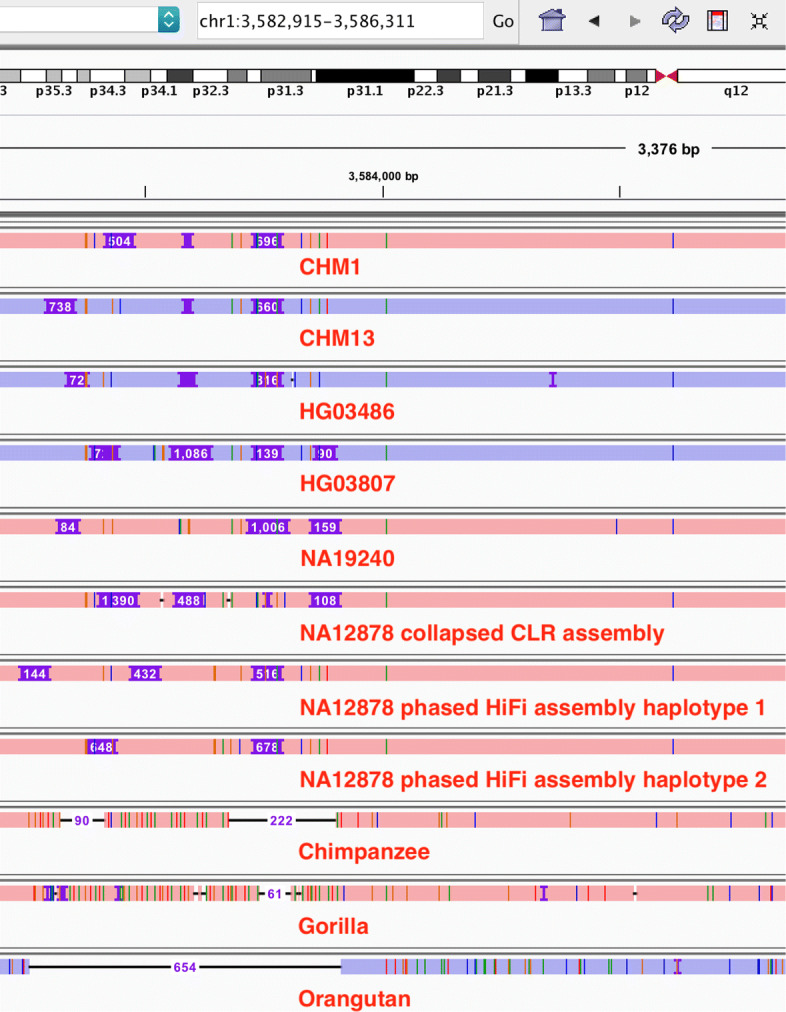
“We manually inspected tens of differences in IGV [42] and identified two causes.”
MethodMinimap2: Pairwise alignment for nucleotide sequences
Li, H. (2018) · Bioinformatics · doi:10.1093/bioinformatics/bty191 · Cited by 14,807 · cited 3×
“As existing sequence-to-graph aligners [38, 39] do not work with chromosomelong query sequences, we adapted minimap2 [40] for our purpose and implemented minigraph (Fig.”
BackgroundMethodInfluentialSelf-citationA framework for variation discovery and genotyping using next-generation DNA sequencing data
DePristo, M. A., Banks, E., Poplin, R., Garimella, K. V., Maguire, J. R., Hartl, C., Philippakis, A. A., del Angel, G., Rivas, M. A., Hanna, M., et al. (2011) · Nature Genetics · doi:10.1038/ng.806 · Cited by 11,456 · cited 1×
“1.2 [46].”
InfluentialUsing RepeatMasker to Identify Repetitive Elements in Genomic Sequences
Tarailo‐Graovac, M., & Chen, N. (2009) · Current Protocols in Bioinformatics · doi:10.1002/0471250953.bi0410s25 · Cited by 3,398
Wenger, A. M., Peluso, P., Rowell, W. J., Chang, P.-C., Hall, R. J., Concepcion, G. T., Ebler, J., Fungtammasan, A., Kolesnikov, A., Olson, N. D., et al. (2019) · Nature Biotechnology · doi:10.1038/s41587-019-0217-9 · Cited by 1,841 · cited 1×
“iting factor in our understanding of genetic variations. Meanwhile, the advances in long-read sequencing technologies make it possible to assemble a human individual to a quality comparable to GRCh38 [1,5]. There are already a dozen of high-quality human assemblies available in GenBank [6]. Properly integrating these…”
BackgroundSelf-citationThe ENCODE Blacklist: Identification of Problematic Regions of the Genome
Amemiya, H. M., Kundaje, A., & Boyle, A. P. (2019) · Scientific Reports · doi:10.1038/s41598-019-45839-z · Cited by 1,831 · cited 1×
“We constructed a human pangenome graph excluding CHM1 and CHM13, the two samples used in the SynDip benchmark [4], and generated regions around variations (see Methods), which we call as blacklist regions, following the rationale in [45].”
MethodMissing heritability and strategies for finding the underlying causes of complex disease
Eichler, E. E., Flint, J., Gibson, G., Kong, A., Leal, S. M., Moore, J. H., & Nadeau, J. H. (2010) · Nature Reviews Genetics · doi:10.1038/nrg2809 · Cited by 1,687 · cited 1×
“Some of these variants are likely associated with phenotype [3] but are often missed or misinterpreted when we map sequence data to GRCh38, in particular with short reads [4].”
BackgroundHigh-quality draft assemblies of mammalian genomes from massively parallel sequence data
Gnerre, S., MacCallum, I., Przybylski, D., Ribeiro, F. J., Burton, J. N., Walker, B. J., Sharpe, T., Hall, G., Shea, T. P., Sykes, S., et al. (2011) · Proceedings of the National Academy of Sciences · doi:10.1073/pnas.1017351108 · Cited by 1,533 · cited 1×
“In a de Bruijn graph, we often attach sequences to edges instead of vertices [36, 37].”
BackgroundMinimap and miniasm: fast mapping and de novo assembly for noisy long sequences
Li, H. (2016) · Bioinformatics · doi:10.1093/bioinformatics/btw152 · Cited by 1,508 · cited 6×
“As there are no text formats for sequence-to-graph alignment, we propose a new Graphical mApping Format (GAF) by extending the Pairwise mApping Format (PAF) [35].”
BackgroundMethodInfluentialSelf-citation
Cited by
Items 301–400 of 461
PangenomicsBench: A Benchmark Suite and Characterization of Pangenomics
Kaplan, N., Schmelzle, J.-N., Gu, Y., Garrison, E. P., Batten, C., & Das, R. (2025) · IEEE International Symposium on Workload Characterization · doi:10.1109/iiswc66894.2025.00031 · Cited by 2
“We analyze four tools—GraphAligner [9], Vg Map [10], Vg Giraffe [11], and Minigraph [12]—that implement the end-to-end Seq2Graph mapping pipeline, along with the Minigraph-Cactus [13], and PGGB suites [14], which are used for graph construction.”
Pangenomes, Super-Pangenomes and Beyond
Khan, A. W., Gupta, S., & Nguyen, H. T. (2026) · Sustainability Sciences in Asia and Africa · doi:10.1007/978-981-95-5109-5_3 · Cited by 1
Epigenetics and genotypic variation
Merenciano, M., Larue, A. E. A., Groza, C., Vieira, C. P., Rebollo, R., & Goubert, C. (2024) · Elsevier eBooks · doi:10.1016/b978-0-443-19051-3.00006-1 · Cited by 4
A survey of computational approaches for characterizing microbial interactions in microbial mats
Perillo, V. L., Nute, M., Sapoval, N., Curry, K. D., Golia, L., Yin, Y., Ogilvie, H. A., Nakhleh, L. K., Segarra, S., Bhaya, D., et al. (2025) · Genome biology · doi:10.1186/s13059-025-03634-2 · Cited by 2
“…series of the same microbiome or a cross-sectional study where a significant portion of the strains are shared across samples Alg: Constructs metagenome co-assembly graph (i.e., from all samples at once) with metaFlye [75] and each sample is mapped back to the assembly graph with minigraph [76].”
High-Quality Plant Genomes for and through Pangenomics
Papastolopoulou, C., Yang, Z., van Workum, D. M., Wijfjes, R. Y., & Smit, S. (2012) · Methods in molecular biology · doi:10.1007/978-1-0716-4702-8_14 · Cited by 1
The pangenome enhances the understanding of the genetic diversity of papaya
Yang, M., Zhou, C., Kong, X., Kuang, R., Liu, C., Wu, X., Xu, Z., He, H., & Wei, Y. (2025) · Horticulture Research · doi:10.1093/hr/uhaf282 · Cited by 1
“5) [67].”
Reaching Software Quality for Bioinformatics Applications: How Far Are We?
Zhu, X., Xu, T., Lai, X., Lian, X., Cheng, H., & Wang, J. (2025) · IEEE Transactions on Software Engineering · doi:10.1109/tse.2025.3641225 · Cited by 2
On Deriving Synteny Blocks by Compacting Elements
Bohnenkämper, L., Parmigiani, L., Hepak, K., Chauve, C., & Stoye, J. (2026) · Journal of Computational Biology · doi:10.1177/15578666261491605 · Cited by 1
“We distinguish two cases: (I) f a x ; b w g is an adjacency in t for w 6¼ y and (II) f a x ; c z g is an adjacency in t j s for some other element c with z 2 f h ; t g .”
Su, Q., Luo, J., & Guo, F. (2026) · Briefings in Bioinformatics · doi:10.1093/bib/bbag003 · Cited by 1
“With advancements in technology, genome assembly has become a key focus in the field of genomics research [1–5].”
Pangenome-guided sequence assembly via binary optimization
Cudby, J., Bonfield, J., Zhou, C., Durbin, R. M., & Strelchuk, S. (2026) · Briefings in Bioinformatics · doi:10.1093/bib/bbag084 · Cited by 4
Wang, Y., Chen, Y., Zhu, Z., Zeng, X., Ha, W., Su, L., Hu, L., Li, B., Li, B., Loor, J., et al. (2026) · Biomolecules · doi:10.3390/biom16030471 · Cited by 1
“The minigraph algorithm [48] is inherently suited for constructing chromosome-level graphs because its implementation naturally partitions the resulting pangenome into multiple, disconnected subgraphs, each corresponding to a distinct chromosome.”
Building and applying pangenome references to capture genetic diversity
Ashraf, H., Doerr, D., Ebler, J., & Marschall, T. (2026) · Nature Reviews Genetics · doi:10.1038/s41576-026-00987-7 · Cited by 4
Theseus: fast and optimal affine-gap sequence-to-graph alignment
Jiménez-Blanco, A., López‐Villellas, L., Moure, J. C., Moretó, M., & Marco‐Sola, S. (2026) · Bioinformatics · doi:10.1093/bioinformatics/btag561 · Cited by 3
“Examples of such heuristic strategies include the banded alignment mode of GraphAligner (Rautiainen and Marschall 2020), the seed-chaining approach of minigraph (Li et al. 2020), and the adaptive banding in abPOA (Gao et al. 2021).”
Abuelanin, M., Kaya, G., Lake, J. A., Lambert, C. C., Wu, M. V., Berendzen, K. M., Wood, J., Krasheninnikova, K., Solomon, N. G., Donaldson, Z. R., et al. (2026) · Cell Genomics · doi:10.1016/j.xgen.2026.101336 · Cited by 1
Bioinformatics for human long-read whole-genome sequencing
Zheng, X., Sanio, P., Luo, R., Li, H., & Sedlazeck, F. J. (2026) · Nature Reviews Methods Primers · doi:10.1038/s43586-026-00519-x · Cited by 2
“For long read-to-graph alignment, GraphAligner performs base-level alignments 137 , whereas Minigraph aligns long reads to graphs at structural rather than base-level resolution 128 .”
Self-citationThe Onychomys pangenome reveals the unique molecular adaptations that confer toxin resistance
Pérez-Calles, C., Lilue, J., Anderson, E. L., Haggerty, L. S., Martin, F. J., McCarthy, S., Adams, D. J., Thybert, D., Rowe, A. H., & Keane, T. (2026) · Genome biology · doi:10.1186/s13059-026-04288-4 · Cited by 1
TextFormats: Simplifying the definition and parsing of text formats in bioinformatics
Gonnella, G. (2022) · PLoS ONE · doi:10.1371/journal.pone.0268910 · Cited by 1
“1 [8], GFA2 [9], rGFA [10]) as a result of disagreements among researchers and the need to make the format particularly suitable to different applications.”
InfluentialInvestigating Pangenome Graphs Using Wheat Panache
Bayer, P. E., & Edwards, D. (2023) · Methods in molecular biology · doi:10.1007/978-1-0716-3389-2_2 · Cited by 1
From de Bruijn Graphs to Variation Graphs – Relationships Between Pangenome Models
Cicherski, A., & Dojer, N. (2023) · Lecture notes in computer science · doi:10.1007/978-3-031-43980-3_10 · Cited by 6
“Given 100 human genomes, the respective dBG can be built in a few hours [18,25], while the construction of VG requires several days [9,8,13,15].”
Exploiting uniqueness: seed-chain-extend alignment on elastic founder graphs
Rizzo, N., Cáceres, M., & Mäkinen, V. (2025) · Bioinformatics · doi:10.1093/bioinformatics/btaf225 · Cited by 2
Pangenomics for developing heavy metal stress-tolerant plants
Sinha, D., Majgaonkar, A., Kazi, Z., Chatterjee, S., Paul, I., Paulchoudhury, A., & Das, S. (2025) · Elsevier eBooks · doi:10.1016/b978-0-443-26791-8.00013-3 · Cited by 1
Pangenomics for developing heat stress-tolerant plants
Essemine, J., Xu, Z., Lyu, M. A., Chen, J., & Qu, M. (2025) · Elsevier eBooks · doi:10.1016/b978-0-443-26791-8.00009-1 · Cited by 1
Kumar, A., & Verma, V. (2021) · International Conference on Advanced Computing and Communication Systems (ICACCS) · doi:10.1109/icaccs51430.2021.9441878 · Cited by 1
Guo, M., Songyang, Z., & Xiong, Y. (2023) · Small Methods · doi:10.1002/smtd.202300385 · Cited by 2
Disease association with frequented regions of genotype graphsPreprint
Hokin, S., Cleary, A. M., & Mudge, J. (2020) · medRxiv · doi:10.1101/2020.09.25.20201640 · Cited by 1
Moyers, B. A., Loupe, J. M., Felker, S. A., Lawlor, J. M. J., Anderson, A. G., Rodríguez-Nunez, I., Bunney, W. E., Bunney, B. G., Cartagena, P. M., Sequeira, A., et al. (2023) · bioRxiv (Cold Spring Harbor Laboratory) · doi:10.1101/2023.10.06.561245 · Cited by 1
The reference-free pangenome of Arabidopsis thalianaPreprint
Obinu, L., Guarracino, A., Trivedi, U. H., & Porceddu, A. (2025) · bioRxiv (Cold Spring Harbor Laboratory) · doi:10.1101/2025.06.25.661508 · Cited by 1
The avocado pangenome reveals dynamic clustering and lineage-specific diversity of NLR genesPreprint
Backer, R., Clarke, A., Vermeulen, A., Bombarely, A., & van den Berg, N. (2025) · bioRxiv (Cold Spring Harbor Laboratory) · doi:10.1101/2025.10.28.684993 · Cited by 1
Structural variation shapes regulatory and evolutionary diversity at the HLA locusPreprint
Canalda-Baltrons, A., Silcocks, M., Saunders, P. M., Jackson, S. F., Coin, L., & Dunstan, S. J. (2026) · bioRxiv (Cold Spring Harbor Laboratory) · doi:10.64898/2026.04.23.720469 · Cited by 1
Selecting genomes that matter: haplotype-based prioritization for iterative pangenome expansionPreprint
Marone, M. P., Chen, E., Himmelbach, A., Haberer, G., Spannagl, M., Stein, N., & Mascher, M. (2026) · bioRxiv (Cold Spring Harbor Laboratory) · doi:10.64898/2026.05.13.724976 · Cited by 1
Synteny-aware microbial pangenome graphs reveal blueprints of genomic variationPreprint
Henoch, A., Sever, M., Tucker, S. J., Trigodet, F., Veseli, I., Chang, T., McInerney, J. O., Söylev, A., Freel, K. C., Rappé, M. S., et al. (2026) · bioRxiv (Cold Spring Harbor Laboratory) · doi:10.64898/2026.07.03.736256 · Cited by 1
Arnoux, J. (2026) · Thèse de doctorat, Université Paris-Saclay / PPanGGOLiN · doi:10.70675/eee354d9zf63dz48ebz9444zd1809f8fb74d
En Route to Completion: What Is an Ideal Reference Genome?
Pan, W., & Ruan, J. (2021) · Genomics Proteomics & Bioinformatics · doi:10.1016/j.gpb.2021.09.001
A computational study of genomic rearrangements in plants
Demirci, S. (2021) · doi:10.18174/551238 · Cited by 1
Application of genomics technology in biodiversity conservation research
Liu, S., Qiu, N., Zhang, S., Zhao, Z., & Zhou, X. (2022) · Biodiversity Science · doi:10.17520/biods.2022441 · Cited by 3
Leonard, A. S., & Pausch, H. (2022) · World Congress on Genetics Applied to Livestock Production (WCGALP) · doi:10.3920/978-90-8686-940-4_251
Human pangenome: far-reaching implications in precision medicine
Yu, Y., & Chen, H. (2023) · Frontiers of Medicine · doi:10.1007/s11684-023-1039-1
Yang, X., Wang, X., Zou, Y., Zhang, S., Xia, M., Fu, L., Vollger, M. R., Chen, N.-C., Taylor, D. J., Harvey, W. T., et al. (2023) · Figshare · doi:10.6084/m9.figshare.23625387
John, S., Sura, T., Dejsuphong, D., Srit, P., Vathesatogkit, P., Thongchompoo, N., Thabthimthong, W., Teerakulkittipong, N., Chantratita, W., Sukasem, C., et al. (2024) · Research Square · doi:10.21203/rs.3.rs-4489678/v1
Maximum-scoring path sets on pangenome graphs of constant treewidth
Brejová, B., Gagie, T., Herencsárová, E., & Vinař, T. (2024) · Frontiers in Bioinformatics · doi:10.3389/fbinf.2024.1391086 · Cited by 1
“Several authors have studied a related but more complex co-linear chaining problem (Mäkinen et al., 2019; Li et al., 2020; Chandra and Jain, 2023; Ma et al., 2023; Rizzo et al., 2023; Rajput et al., 2024), where we look for a walk containing many seeds, but these seeds should occur in the same…”
BackgroundDNA sequences alignment method using sparse index on pan-genome graph
Gao, J., & Xu, Y. (2024) · Journal of Bioinformatics and Computational Biology · doi:10.1142/s0219720024500197
Canderan, J., Yuan, R., Tang, H., & Ye, Y. (2024) · bioRxiv (Cold Spring Harbor Laboratory) · doi:10.1101/2024.11.25.625239
extgfa: a low-memory on-disk representation of genome graphsPreprint
Dabbaghie, F. (2024) · bioRxiv (Cold Spring Harbor Laboratory) · doi:10.1101/2024.11.29.626045
GIN-TONIC: non-hierarchical full-text indexing for graph genomes
Öztürk, Ü., Mattavelli, M., & Ribeca, P. (2024) · NAR Genomics and Bioinformatics · doi:10.1093/nargab/lqae159 · Cited by 1
“Although implementations of the FM-Index abound, each one striking a different balance between compression and speed ( 10 ,11 ), a common use for them is to check the existence, and compute the locations, of the exact matches of shorter k -mers from a query sequence.”
Fast sequence to graph alignment based on graph folding
Deng, Y., Kang, J., Liu, Z., Zhu, X. M., & Quan, W. (2024) · IEEE International Conference on Bioinformatics and Biomedicine (BIBM) · doi:10.1109/bibm62325.2024.10822090
“Research methodologies based on pan-genomics (multiple reference genomes) are gaining prominence in genomics and bioinformatics due to their capacity to mitigate the biases associated with reference genomes [6], leading to enhanced analytical accuracy [7].”
Weighted syncmer sampling improves long-read mapping
Quan, W., Kang, J., Deng, Y., Liu, Z., Zhu, X. G., & Quan, G. (2024) · IEEE International Conference on Bioinformatics and Biomedicine (BIBM) · doi:10.1109/bibm62325.2024.10821776
“A chain [16] can be viewed as a set of nearby anchors, with penalties applied for shifts relative to the main diagonal.”
A Vectorized Sequence-to-Graph Alignment Algorithm
Peng, C., Tang, S., Guo, Y., Xia, Z., Yang, C., & Cui, Y. (2025) · Lecture notes in computer science · doi:10.1007/978-981-96-1525-4_22
Somatic repetitive element insertions Define New Biomarkers in Pan-cancer genomePreprint
Lin, X., Tu, K., Wang, H., Liu, X., Liu, Y., Zhang, Q., Feng, Z., Yu, C., Li, M., Huang, Y., et al. (2025) · bioRxiv (Cold Spring Harbor Laboratory) · doi:10.1101/2025.02.19.638966
Lossless pangenome indexing using tag arrays
Eskandar, P., Paten, B., & Sirén, J. (2026) · Algorithms for Molecular Biology · doi:10.1186/s13015-026-00301-4 · Cited by 4
“The index can be built quickly, and by making it report graph positions, we can avoid redundant seeds.”
Assembling unmapped reads reveals hidden variation in South Asian genomes
Das, A., Biddanda, A., McCoy, R. C., & Schatz, M. C. (2026) · Nature Communications · doi:10.1038/s41467-026-71755-8 · Cited by 1
“1 ” annotations generated by the T2T consortium and intersected this with the list of placements generated in the previous step.”
He, R., Zhao, R. Y., Lin, J.-J., Li, Y., Kong, X.-Z., Xu, J.-X., Wu, J.-H., Bu, X., Zhang, Y., & Sun, Y. (2025) · BMC Biology · doi:10.1186/s12915-025-02296-7
Xia, X., Wu, J., Gao, Z., Yuan, P., & Ye, S. (2025) · bioRxiv (Cold Spring Harbor Laboratory) · doi:10.1101/2025.08.07.669060
Dynamic Programming Alignments With Skips
Mwaniki, M. N., & Pisanti, N. (2025) · IEEE Access · doi:10.1109/access.2025.3597547 · Cited by 1
“In particular, many algorithms and tools [12], [17], [25], [26], [27], [28], [29], [30], [31], [32], [33], [34], as well as lower bounds [35], [36], [37], [38] have been designed in the last few years for the problem of aligning a sequence to a graph.”
NGS in Cancer and Translational Medicine: Unlocking the Future of Precision Oncology (A Review)
Aksenova, A. Y., Stepchenkova, E. I., Korman, M. V., & Zhuk, A. S. (2025) · Cell and Tissue Biology · doi:10.1134/s1990519x2560036x
“Recently, graph-based alignment tools such as GraphMap, VG, DRAGEN, DRAGMAP, VARA have emerged, enabling reads to be mapped against a pangenome graph rather than a linear reference (Sović et al., 2016; Garrison et al., 2018; Guo et al., 2019; H. Li et al., 2020; Behera et al., 2024) .”
Accurate hybrid plasmids assembly with HyPlAsPreprint
Karaoğlanoğlu, F., Wiese, K. C., & Chauve, C. (2025) · bioRxiv (Cold Spring Harbor Laboratory) · doi:10.1101/2025.08.21.671630
“Given a short-read draft assembly, a classification of its contigs as either plasmidic, chromosomal or ambiguous, and long-read data, we start by mapping the long reads to the assembly graph using minigraph [Li et al., 2020].”
Technological development for analyzing and constructing plant pangenomes
Singh, N. P., Mendu, L., Thudi, M., & Mendu, V. (2025) · Elsevier eBooks · doi:10.1016/b978-0-443-26791-8.00001-7
Pangenomics-assisted breeding of biotic stress-resilient crops
Kamalesh, M., Manoj, M., Balasubramanian, B., Rajagopal, R., Alfarhan, A., Sampathkumar, P., Begam, A. K. U., Anand, A., & Arthi, G. (2025) · Elsevier eBooks · doi:10.1016/b978-0-443-26791-8.00021-2
Seiko, T., Nagasawa, K., & Naito, K. (2025) · Ecological Research · doi:10.1111/1440-1703.70015
Sequence-to-graph alignment based copy number calling using a network flow formulationPreprint
Magalhães, H., Weber, J., Klau, G. W., Marschall, T., & Prodanov, T. (2025) · bioRxiv (Cold Spring Harbor Laboratory) · doi:10.1101/2025.11.21.689771
“For the pangenome use case, we used the minigraph [30] pangenome graph from the Human Pangenome Reference Consortium (HPRC) [15], which contains 90 haplotypes, being the most fragmented of the graphs (671k nodes and 965k edges).”
Haplotype-resolved diploid genome inference on pangenome graphsPreprint
Chandra, G., Doan, W. T., & Gibney, D. (2025) · bioRxiv (Cold Spring Harbor Laboratory) · doi:10.1101/2025.11.26.690754 · Cited by 2
“Using minimap2 [28], these reads were aligned to the GRCh38.p14 ( SRA: GCA_000001405.”
Comparative metagenomics using pan-metagenomic graphsPreprint
Coleman, I., Mametyarova, N., Zaznaev, A., Cai, P., Yu, L. X., Meydan, Y., Litman, A., Sharma, A., He, L., Simkhovich, A., et al. (2025) · bioRxiv (Cold Spring Harbor Laboratory) · doi:10.1101/2025.11.24.690211
Leonard, A. S., Crysnanto, D., Mapel, X. M., Bhati, M., & Pausch, H. (2024) · Figshare · doi:10.6084/m9.figshare.26590973
Additional file 1 of A survey of mapping algorithms in the long-reads era
Sahlin, K., Baudeau, T., Cazaux, B., & Marchet, C. (2024) · Figshare · doi:10.6084/m9.figshare.26593343
Maestri, S., Gambino, G., Lopatriello, G., Minio, A., Perrone, I., Cosentino, E., Giovannone, B., Marcolungo, L., Alfano, M., Rombauts, S., et al. (2022) · Figshare · doi:10.6084/m9.figshare.19234334
Léger, A., Brettell, I., Monahan, J., Barton, C., Wolf, N., Kusminski, N., Herder, C., Aadepu, N., Becker, C., Gierten, J., et al. (2022) · Figshare · doi:10.6084/m9.figshare.19211440
Leonard, A. S., Crysnanto, D., Mapel, X. M., Bhati, M., & Pausch, H. (2024) · Figshare · doi:10.6084/m9.figshare.26590976
Leonard, A. S., Crysnanto, D., Mapel, X. M., Bhati, M., & Pausch, H. (2024) · Figshare · doi:10.6084/m9.figshare.26590970
Contreras‐Moreira, B., Saraf, S., Naamati, G., Casas, A. M., Amberkar, S., Flicek, P., Jones, A. R., & Dyer, S. C. (2023) · Figshare · doi:10.6084/m9.figshare.24257488
Additional file 1 of Identification of transposable element families from pangenome polymorphisms
Sierra, P., & Durbin, R. M. (2024) · Figshare · doi:10.6084/m9.figshare.26739363
Yang, X., Wang, X., Zou, Y., Zhang, S., Xia, M., Fu, L., Vollger, M. R., Chen, N.-C., Taylor, D. J., Harvey, W. T., et al. (2023) · Figshare · doi:10.6084/m9.figshare.23625384
Additional file 2 of A survey of mapping algorithms in the long-reads era
Sahlin, K., Baudeau, T., Cazaux, B., & Marchet, C. (2024) · Figshare · doi:10.6084/m9.figshare.26593346
Additional file 2 of Identification of transposable element families from pangenome polymorphisms
Sierra, P., & Durbin, R. M. (2024) · Figshare · doi:10.6084/m9.figshare.26739366
DiVerG: Scalable Distance Index for Validation of Paired-End Alignments in Sequence GraphsPreprint
Ghaffaari, A., Schönhuth, A., & Marschall, T. (2025) · bioRxiv (Cold Spring Harbor Laboratory) · doi:10.1101/2025.02.12.637964
Leonard, A. S., Crysnanto, D., Mapel, X. M., Bhati, M., & Pausch, H. (2024) · Figshare · doi:10.6084/m9.figshare.26590994
Contreras‐Moreira, B., Saraf, S., Naamati, G., Casas, A. M., Amberkar, S., Flicek, P., Jones, A. R., & Dyer, S. C. (2024) · Figshare · doi:10.6084/m9.figshare.24257604
Additional file 2 of Pig pangenome graph reveals functional features of non-reference sequences
Miao, J., Wei, X., Cao, C., Sun, J., Xu, Y., Zhang, Z., Wang, Q., Pan, Y., & Wang, Z. (2024) · Figshare · doi:10.6084/m9.figshare.25271911
Leonard, A. S., Crysnanto, D., Mapel, X. M., Bhati, M., & Pausch, H. (2024) · Figshare · doi:10.6084/m9.figshare.26590991
Additional file 1 of Pan-genome de Bruijn graph using the bidirectional FM-index
Depuydt, L., Renders, L., Abeel, T., & Fostier, J. (2024) · Figshare · doi:10.6084/m9.figshare.26632834
Rice, E. S., Alberdi, A., Alfieri, J. M., Athrey, G., Balacco, J., Bardou, P., Blackmon, H., Charles, M., Cheng, H. H., Fedrigo, O. D., et al. (2024) · Figshare · doi:10.6084/m9.figshare.26643784
Leonard, A. S., Crysnanto, D., Mapel, X. M., Bhati, M., & Pausch, H. (2024) · Figshare · doi:10.6084/m9.figshare.26590997
Leonard, A. S., Crysnanto, D., Mapel, X. M., Bhati, M., & Pausch, H. (2024) · Figshare · doi:10.6084/m9.figshare.26590985
Additional file 2 of Gramtools enables multiscale variation analysis with genome graphs
Letcher, B., Hunt, M., & Iqbal, Z. (2021) · Figshare · doi:10.6084/m9.figshare.16576017
Bonnet, K., Marschall, T., & Doerr, D. (2024) · Figshare · doi:10.6084/m9.figshare.26621083
Rice, E. S., Alberdi, A., Alfieri, J. M., Athrey, G., Balacco, J., Bardou, P., Blackmon, H., Charles, M., Cheng, H. H., Fedrigo, O. D., et al. (2024) · Figshare · doi:10.6084/m9.figshare.26643793
Additional file 1 of Gramtools enables multiscale variation analysis with genome graphs
Letcher, B., Hunt, M., & Iqbal, Z. (2021) · Figshare · doi:10.6084/m9.figshare.16576014
Rice, E. S., Alberdi, A., Alfieri, J. M., Athrey, G., Balacco, J., Bardou, P., Blackmon, H., Charles, M., Cheng, H. H., Fedrigo, O. D., et al. (2024) · Figshare · doi:10.6084/m9.figshare.26643787
Léger, A., Brettell, I., Monahan, J., Barton, C., Wolf, N., Kusminski, N., Herder, C., Aadepu, N., Becker, C., Gierten, J., et al. (2022) · Figshare · doi:10.6084/m9.figshare.19211446
Driguez, P., Bougouffa, S., Carty, K., Putra, A., Jabbari, K., Reddy, M., Soppe, R. W. O., Cheung, M.-S., Fukasawa, Y., & Ermini, L. (2021) · Figshare · doi:10.6084/m9.figshare.16569893
Additional file 1 of Pig pangenome graph reveals functional features of non-reference sequences
Miao, J., Wei, X., Cao, C., Sun, J., Xu, Y., Zhang, Z., Wang, Q., Pan, Y., & Wang, Z. (2024) · Figshare · doi:10.6084/m9.figshare.25271839
Leonard, A. S., Crysnanto, D., Mapel, X. M., Bhati, M., & Pausch, H. (2024) · Figshare · doi:10.6084/m9.figshare.26590982
Yang, X., Wang, X., Zou, Y., Zhang, S., Xia, M., Fu, L., Vollger, M. R., Chen, N.-C., Taylor, D. J., Harvey, W. T., et al. (2023) · Figshare · doi:10.6084/m9.figshare.23625390
Léger, A., Brettell, I., Monahan, J., Barton, C., Wolf, N., Kusminski, N., Herder, C., Aadepu, N., Becker, C., Gierten, J., et al. (2022) · Figshare · doi:10.6084/m9.figshare.19211470
Smith, T. P. L., Bickhart, D. M., Boichard, D., Chamberlain, A. J., Djikeng, A., Jiang, Y., Low, W. Y., Pausch, H., Demyda-Peyrás, S., Prendergast, J., et al. (2024) · Figshare · doi:10.6084/m9.figshare.26598209
Additional file 1 of Genomic variant benchmark: if you cannot measure it, you cannot improve it
Majidian, S., Agustinho, D. P., Chin, C.-S., Sedlazeck, F. J., & Mahmoud, M. (2023) · Figshare · doi:10.6084/m9.figshare.24257470
Rice, E. S., Alberdi, A., Alfieri, J. M., Athrey, G., Balacco, J., Bardou, P., Blackmon, H., Charles, M., Cheng, H. H., Fedrigo, O. D., et al. (2024) · Figshare · doi:10.6084/m9.figshare.26643790
Metadata
- Authors
- Li, H., Feng, X., & Chu, C.
- Affiliations
- Harvard University (US)
- Corresponding author
- Li, Heng
- Venue
- Genome Biology
- Published
- 2020-10-16
- Volume
- 21
- Issue
- 1
- Pages
- 265-265
- ISSN
- 1465-6906 (ISSN-L)
- 1474-760X
- PMC
- PMC7568353
- OpenAlex
- W3092652421
- Semantic Scholar
- 4aa51fbe41e6588e59c8f9f7aaaaac3c83a56019
- Cited by
- 455
- References
- 68
- Citations by year
- 2026: 70 · 2025: 101 · 2024: 93 · 2023: 68 · 2022: 67 · 2021: 50 · 2020: 5
- FWCI
- 15.48
- Type
- journal article
- Language
- en
- Open access
- gold
- doi.org
- Licence
- cc-by
- creativecommons.org/licenses/by/4.0 (tdm)
- creativecommons.org/licenses/by/4.0 (vor)
- Locations
- Genome biology (publishedVersion, cc-by)
- PubMed Central (publishedVersion, cc-by)
- PubMed (publishedVersion)
- DOAJ (DOAJ: Directory of Open Access Journals) (submittedVersion, cc-by-sa)
- Funders
- National Institutes of Health
- National Human Genome Research Institute (U01HG010961, R01HG010040)
- Topics
- Life Sciences › Biochemistry, Genetics and Molecular Biology › Molecular Biology › Genomics and Phylogenetic Studies
- Life Sciences › Biochemistry, Genetics and Molecular Biology › Genetics › Genome Rearrangement Algorithms
- Physical Sciences › Mathematics › Theoretical Computer Science › Algorithms and Data Compression
- Keywords
- pangenome graphs, Minigraph, reference genome, structural variants, graph-based data model, genome assembly, coordinate alignment, chromosomal integration
- MeSH terms
- Animals, Humans, Reference Standards, Genome, Human, Genomics, Genomic Structural Variation
About these checks
Registry, retraction, Cites and statistics results are computed, not judged, with one exception: a printed reference that no index lists is read once by a model before it counts as a citation error. Claims are extracted by a model and kept only when their quote appears verbatim in the text; each cited source is then checked, with a model’s help, for whether it says what the claim relies on. Those verdicts can be wrong — read the claim’s quote and the cited source before relying on one.
Statistics and arithmetic are recomputed, not judged.
Confidence bands are shown only for fields calibrated on our annotated test set. None is calibrated yet, so no band is shown.
What counts as a claim ›How we measure confidence ›How we check this ›
Are you an author, or do you see a problem with this page? Request a review
Data sources
Bibliographic data: Semantic Scholar, OpenAlex, Crossref.
Contains information from the Semantic Scholar Academic Graph Datasets, made available under the ODC Attribution License (ODC-BY 1.0).
Semantic Scholar’s data is described in: Kinney, R., et al. (2023). The Semantic Scholar Open Data Platform. arXiv:2301.10140.
