

Immediate help through group therapy for patients with somatic diseases and depressive or adjustment disorders in outpatient care: study protocol for a randomized controlled trial.
Open accessThe DOI matches its Crossref record; 60 of the 61 references it cites were found in a registry or an index, and 1 are not checked yet; 8 of the 43 sources its claims cite were checked for support.
Abstract
Background: One in three people with a chronic somatic disease suffer from a comorbid mental disorder. Most common comorbidities are depressive, anxiety and adjustment disorders. These lead to an increase in morbidity and mortality, and a deterioration of quality of life and healthcare costs. Treatment of mental disorders is of great importance, but the waiting time for outpatient individual psychotherapy can be up to six months in Germany. Group therapy has comparable treatment effects and is considerably more economic than individual therapy; however, it is still almost unused in the outpatient care system. The introduction of a stepped care approach, such as attending a group program before individual therapy, could improve this issue. For this purpose we developed a group program (STEpS), and its efficacy will be evaluated in this study.Methods/design: A randomized controlled trial will be conducted to evaluate the efficacy of a cognitive behavioral therapy (CBT) group program for patients with somatic diseases and depressive or adjustment disorders, compared to a wait-list control group. A total of 128 adults with any chronic somatic disease and comorbid depression or adjustment disorder will be recruited in our outpatient clinic, and will be randomly assigned to participate in the group program immediately after contacting the clinic (intervention group) or after a waiting period of four months (wait-list control group). Primary outcomes will be self-reported depressive and anxiety symptoms. Secondary outcomes will be self-reported psychological distress, changes in experience and behavior, health-related quality of life, state of self-esteem and subjective need for therapy. Assessments will take place at baseline, 10 weeks (post-treatment) and 18 weeks (follow-up) after randomization. Additionally, treatment acceptance and psychotherapeutic process will be assessed after each session.Discussion: This study investigates whether the CBT group program is an effective treatment to reduce depressive and anxiety symptoms and psychological distress in these patients. If the group program is effective, it could be implemented as a treatment option prior to individual outpatient therapy. These results will contribute to improving outpatient care for mental disorders in patients with somatic diseases.Trial Registration: German Clinical Trials Register DRKS00005140 (27 August 2013).
Verified 2026-11-22 · 1 reference not checked yet
Overview
CoChat Summary
## TL;DR
This is a randomized wait-list controlled trial protocol for testing a new CBT group program (STEpS) for outpatients with chronic somatic disease plus depressive or adjustment disorders. The study plans to recruit 128 adults and compare immediate group therapy with a four-month wait-list control using self-reported symptom and functioning outcomes.
## Key findings
- Not stated in the paper.
- The trial is designed to recruit 128 adults with any chronic somatic disease and comorbid depression or adjustment disorder, randomized 1:1 to immediate group therapy or a four-month wait-list control.
- The primary outcomes are self-reported depressive and anxiety symptoms measured with the HADS-D; secondary outcomes include psychological distress, changes in experience and behavior, health-related quality of life, self-esteem, and subjective need for therapy.
- The STEpS program consists of eight weekly sessions of 100 minutes, with a group size limited to eight patients and a half-open format allowing new members every other session.
## Methods
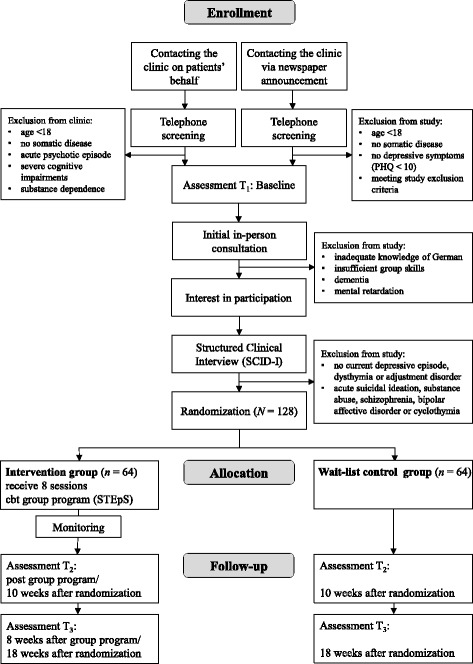
- Randomized, wait-list controlled trial at an outpatient clinic of the Albert-Ludwigs-University of Freiburg, with assessments at baseline, 10 weeks, and 18 weeks after randomization.
- Participants are adults older than 18 years with a chronic somatic disease and comorbid adjustment disorder, depressive episode, or dysthymia; planned sample size is 128.
- Main analyses are planned as intention-to-treat with ANCOVA comparing intervention vs wait-list at post-treatment and follow-up, adjusting for baseline scores; if sample size is not reached, the authors say they will use ANOVA instead.
## Limitations
- The authors state that they may not achieve the target sample size and power needed for ANCOVAs; if so, they will use ANOVAs instead.
- The authors state that all outcomes are self-reported, and that clinician-rated measures would be beneficial but are not feasible due to effort.
- The authors state that missing data are a concern because of the long follow-up design; they plan to address this with recommended imputation methods.
- Evident from the protocol text: the study is not blinded for participants or therapists, which may increase risk of expectancy bias.
Model-written summary. Check it against the paper before relying on it.
Integrity signals
Registry
Cites
Statistics
Figures
Verification
Claims the paper makes
7 Valid · 1 Not valid · 27 Not checked · 13 Own results and interpretations
Every source the paper cites for this claim was checked and supports it.
In the paper
“The prevalence rates of mental disorders do not differ significantly for patients with different somatic diseases [4].”
§ Immediate help through group therapy for patients with somatic diseases and depressive or adjustment disorders in outpatient care: study protocol for a randomized controlled trial > Background
What the sources say
- Supportedcites [4] Härter M Baumeister H Reuter K Jacobi F Höfler M Bengel J Increased 12-month prevalence rates of mental disorders in patients with chronic somatic diseases Psychother Psychosom. 2007 76 354 60 10.1159/000107563 17917471 source
The Abstract states that prevalence rates of mental disorders did not differ significantly between the somatic index diseases. The Discussion likewise describes only slight differences among the disease groups investigated. This finding concerns the broad disease groups studied, not every individual somatic disease. (LLM, conf=0.95)
plain- Asserted: passes — The authors put it forward as true.
- Checkable: passes — It can be checked against evidence.
- Load-bearing: unclear — It is unclear whether the paper’s conclusions depend on it.
- Based: passes — The paper gives a reason why it holds.
- Supported
The cited sources that could be checked couldn’t confirm or dispute this claim.
In the paper
“According to Cho and Leonhart [59], data missing completely at random is very unlikely in a rehabilitation research setting, so missing data will probably be imputed with a missing at random-capable method (for example, using multiple imputations).”
§ Immediate help through group therapy for patients with somatic diseases and depressive or adjustment disorders in outpatient care: study protocol for a randomized controlled trial > Methods/Design > Statistical analyses
What the sources say
- Could not verifycites [59] Cho A Leonhart R Lösungsansätze für das Problem fehlender Werte: Mechanismen erkennen und adäquat behandeln Rehabilitation. 2011 52 273 9 23233334 sourceExperimental — accuracy not yet measured
The Abstract says that the paper discusses missing-data mechanisms and methods and gives guidance, but it does not state that MCAR is unlikely in rehabilitation research or recommend a MAR-capable method such as multiple imputation for that reason. Searches for MCAR, MAR, rehabilitation settings, and multiple imputation returned no passage establishing that recommendation; the available passages are largely the abstract and references. (LLM, conf=0.68)
hedged- Asserted: passes — The authors put it forward as true.
- Checkable: passes — It can be checked against evidence.
- Load-bearing: unclear — It is unclear whether the paper’s conclusions depend on it.
- Based: passes — The paper gives a reason why it holds.
- Could not verify
In the paper
“Long waiting periods increase patients’ dissatisfaction with the healthcare system [13]”
§ Immediate help through group therapy for patients with somatic diseases and depressive or adjustment disorders in outpatient care: study protocol for a randomized controlled trial > Background
What the sources say
- Not checked — no full text of the sourcecites [13] McCarthy K McGee HM O’Boyle CA Outpatient clinic waiting times and non-attendance as indicators of quality Psychol Health Med. 2000 5 287 93 10.1080/713690194 source
plainstates a cause- Asserted: passes — The authors put it forward as true.
- Checkable: passes — It can be checked against evidence.
- Load-bearing: passes — The paper’s conclusions depend on it.
- Based: passes — The paper gives a reason why it holds.
In the paper
“Comorbid mental disorders have negative effects on morbidity, mortality, quality of life and healthcare costs [11].”
§ Immediate help through group therapy for patients with somatic diseases and depressive or adjustment disorders in outpatient care: study protocol for a randomized controlled trial > Background
What the sources say
- Not checked — no full text of the sourcecites [11] Baumeister H Härter M Auswirkungen komorbider psychischer Störungen bei chronischen körperlichen Erkrankungen Z Med Psychol. 2005 14 175 89 source
plainstates a cause- Asserted: passes — The authors put it forward as true.
- Checkable: passes — It can be checked against evidence.
- Load-bearing: passes — The paper’s conclusions depend on it.
- Based: passes — The paper gives a reason why it holds.
A claim is checked only against the cited paper’s full text, never its abstract, and none is available for its sources.
In the paper
“are one reason why patients do not appear for their initial appointments [14, 15] or give up their intentions for psychotherapy [16].”
§ Immediate help through group therapy for patients with somatic diseases and depressive or adjustment disorders in outpatient care: study protocol for a randomized controlled trial > Background
What the sources say
- Not checked — no full text of the sourcecites [14] Loumidis KS Shropshire JM Effects of waiting time on appointment attendance with clinical psychologists and length of treatment Irish J Psychol Med. 1997 14 49 54 source
- Not checked — no full text of the sourcecites [15] Hicks C Hickman G The impact of waiting-list times on client attendance for relationship counselling Brit J Guid Couns. 1994 22 175 82 10.1080/03069889408260312 source
- Not checked — no full text of the sourcecites [16] Hoyer J Helbig S Wittchen H Experiences with psychotherapy for depression in routine care: a naturalistic patient survey in Germany Clin Psychol Psychot. 2006 13 414 21 10.1002/cpp.504 source
plainstates a cause- Asserted: passes — The authors put it forward as true.
- Checkable: passes — It can be checked against evidence.
- Load-bearing: passes — The paper’s conclusions depend on it.
- Based: passes — The paper gives a reason why it holds.
17 more claims
Create a free account to see all 48 claims and every source verdict.
- Probably not a substantial claim. 18
- It may state two separate claims as one. 15
Self-check
Percentages, sums and reported differences re-computed from the paper’s own numbers.
Each contradiction between two passages listed here was confirmed by an independent check.
Rated minor: it would not touch a result — a value no result rests on, a p-value that stays on the same side of the significance level, or a conflict that is clerical, resolved elsewhere in the paper, or outside its own findings.
In the paper
§ Immediate help through group therapy for patients with somatic diseases and depressive or adjustment disorders in outpatient care: study protocol for a randomized controlled trial > Methods/Design > Study design
“The 18-week follow-up measurement is scheduled in a relatively short interval of two months after treatment because we did not want to extend the usual waiting period of four months for individual psychotherapy for patients in the wait-list control group.”
§ Immediate help through group therapy for patients with somatic diseases and depressive or adjustment disorders in outpatient care: study protocol for a randomized controlled trial > Methods/Design > Study design
“After completion of the follow-up assessment (about five months after randomization), study participants of the wait-list control group are also offered to participate in the group program.”
Citations
Cites
Statistical Power Analysis for the Behavioral Sciences
Muller, K. (1989) · Technometrics · doi:10.1080/00401706.1989.10488618 · Cited by 99,167
Faul, F., Erdfelder, E., Lang, A.-G., & Buchner, A. (2007) · Behavior Research Methods · doi:10.3758/bf03193146 · Cited by 65,971
Statistical power analysis for the behavioral sciences
(1990) · Computers, Environment and Urban Systems · doi:10.1016/0198-9715(90)90050-4 · Cited by 65,269
The Hospital Anxiety and Depression Scale
Zigmond, A. S., & Snaith, R. P. (1983) · Acta Psychiatrica Scandinavica · doi:10.1111/j.1600-0447.1983.tb09716.x · Cited by 47,139
Multivariate data analysis : a global perspective
Hair, J. F. (2010) · Cited by 19,929
WARE, J. E., KOSINSKI, M., & KELLER, S. D. (1996) · Medical Care · doi:10.1097/00005650-199603000-00003 · Cited by 17,392 · cited 1×
“Its psychometric properties are well established [51].”
CONSORT 2010 Statement: updated guidelines for reporting parallel group randomised trials
the CONSORT Group, Schulz, K. F., Altman, D. G., & Moher, D. (2010) · BMC Medicine · doi:10.1186/1741-7015-8-18 · Cited by 13,371
The validity of the Hospital Anxiety and Depression Scale
Bjelland, I., Dahl, A. A., Haug, T. T., & Neckelmann, D. (2002) · Journal of Psychosomatic Research · doi:10.1016/s0022-3999(01)00296-3 · Cited by 9,779 · cited 1×
“anxiety severity [42].”
The PHQ-9: A New Depression Diagnostic and Severity Measure
Kroenke, K., & Spitzer, R. L. (2002) · Psychiatric Annals · doi:10.3928/0048-5713-20020901-06 · Cited by 5,898 · cited 1×
“The telephone screening will be conducted by a trained clinician and includes a depression screening (Patient Health Questionnaire (PHQ-9) score ≥10 [36]), and questions about the somatic disease, alcohol, drug and medication consumption, schizophrenia (questions”
MethodImproving the reporting of pragmatic trials: An extension of the CONSORT statement
Zwarenstein, M., Treweek, S., Gagnier, J. J., Altman, D. G., Tunis, S., Haynes, B., Oxman, A. D., Moher, D., & groups, F. T. C. A. P. T. I. H. (. (2008) · BMJ · doi:10.1136/bmj.a2390 · Cited by 1,813
Bower, P., & Gilbody, S. (2005) · British Journal of Psychiatry · doi:10.1192/bjp.186.1.11 · Cited by 1,084 · cited 1×
“(such as self-help, bibliotherapy and computer-based interventions) in order to reserve more intensive and expensive treatments like outpatient individual therapy for those who did not, or very likely will not benefit from these minimal interventions [20].”
BackgroundMünster, R. D. (1999) · Zeitschrift für Klinische Psychologie und Psychotherapie · doi:10.1026//0084-5345.28.1.68 · Cited by 1,010
SF-36, Fragebogen zum Gesundheitszustand
Bullinger, M., & Kirchberger, I. (1998) · Cited by 835
Hospital anxiety and depression scale, Deutsche version (HADS-D)
Petermann, F. (2011) · Zeitschrift für Psychiatrie, Psychologie und Psychotherapie · doi:10.1024/1661-4747/a000077 · Cited by 558
Mehnert, A., Müller, D., Lehmann, C., & Koch, U. (2006) · Zeitschrift für Psychiatrie, Psychologie und Psychotherapie · doi:10.1024/1661-4747.54.3.213 · Cited by 440 · cited 1×
“Current psychosocial distress To assess the current psychosocial distress level we use the first part of the German version of the NCCN Distress Thermometer (DT) [45].”
MethodMehnert, A., & Koch, U. (2007) · Psycho-Oncology · doi:10.1002/pon.1057 · Cited by 402
Estimating remission from untreated major depression: a systematic review and meta-analysis
Whiteford, H. A., Harris, M. G., McKeon, G., Baxter, A., Pennell, C., Barendregt, J. J., & Wang, J. (2013) · Psychological Medicine · doi:10.1017/s0033291712001717 · Cited by 375 · cited 1×
“[18], long waiting times mean that patients who do need professional help to overcome their depression remain depressive for a longer period.”
BackgroundDerogatis, L. R. (1993) · Medical Entomology and Zoology · Cited by 375
The differential effectiveness of group psychotherapy: A meta-analytic perspective.
Burlingame, G. M., Fuhriman, A., & Mosier, J. (2003) · Group Dynamics: Theory, Research, and Practice · doi:10.1037/1089-2699.7.1.3 · Cited by 321 · cited 4×
“Solid empirical evidence exists for group therapy for cancer and HIV patients [24].”
BackgroundResultInfluentialPankow, G. (1980) · PubMed · Cited by 307
Kognitive Verhaltenstherapie bei Depressionen
Hautzinger, M. (1993) · Depression · doi:10.1007/978-3-642-85010-3_16 · Cited by 285
Tackling Chronic Disease in Europe: Strategies, Interventions and Challenges
Busse, R. (2010) · Cited by 285
Comparative efficacy of individual and group psychotherapy: A meta-analytic perspective.
McRoberts, C., Burlingame, G. M., & Hoag, M. J. (1998) · Group Dynamics: Theory, Research, and Practice · doi:10.1037/1089-2699.2.2.101 · Cited by 253 · cited 1×
“The effectiveness of group therapy has been proven in several meta-analyses [24], and in general, the established effects of group therapy were comparable to individual therapy [25].”
ResultSass, H. P., Wïttchen, H., & Zaudig, M. (1996) · RWTH Publications (RWTH Aachen) · Cited by 249
Increased 12-month prevalence rates of mental disorders in patients with chronic somatic diseases
Härter, M., Baumeister, H., Reuter, K., Jacobi, F., Höfler, M., Bengel, J., & Wittchen, H.-U. (2007) · Psychotherapy and Psychosomatics · doi:10.1159/000107563 · Cited by 236 · cited 2×
“[4] reported a 12-month prevalence rate of 42.”
BackgroundSelf-citationMaercker, A., Einsle, F., & Köllner, V. (2007) · Psychopathology · doi:10.1159/000099290 · Cited by 202
Gessler, S., Low, J., Daniells, E., Williams, R., Brough, V., Tookman, A., & Jones, L. (2008) · Psycho-Oncology · doi:10.1002/pon.1273 · Cited by 196
Strain, J. (1998) · General Hospital Psychiatry · doi:10.1016/s0163-8343(98)00020-6 · Cited by 180 · cited 1×
“1 % in patients with breast cancer [8] to 12 % in a consultation-liaison psychiatry service [9] and to 17 % in patients with cardiovascular diseases [10].”
BackgroundDaten und Fakten: Ergebnisse der Studie "Gesundheit in Deutschland aktuell 2010"
Koch-Institut, R. (2012) · Publication server of the Robert Koch Institute (Robert Kock Institute) · doi:10.25646/3162 · Cited by 162
Tucker, M., & Oei, T. P. S. (2007) · Behavioural and Cognitive Psychotherapy · doi:10.1017/s1352465806003134 · Cited by 154 · cited 1×
“In depression care, group therapy has been shown to be more economic than individual therapy [23].”
BackgroundAdjustment disorders: Fault line in the psychiatric glossary
Casey, P., Dowrick, C., & Wilkinson, G. (2001) · British Journal of Psychiatry · doi:10.1192/bjp.179.6.479 · Cited by 153 · cited 1×
“In outpatient care, adjustment disorders are diagnosed very often: between 5 and 20 % of patients in outpatient care have an adjustment disorder as their main diagnosis [7].”
BackgroundFlückiger, C., Regli, D., Zwahlen, D., Hostettler, S., & Caspar, F. (2010) · Zeitschrift für Klinische Psychologie und Psychotherapie · doi:10.1026/1616-3443/a000015 · Cited by 138
Cuijpers, P., van Straten, A., & Warmerdam, L. (2008) · The European Journal of Psychiatry · doi:10.4321/s0213-61632008000100005 · Cited by 137 · cited 1×
“When comparing long-term effects, group therapy for depression reaches similar effects compared to individual therapy [26].”
BackgroundOutpatient clinic waiting times and non-attendance as indicators of quality
McCarthy, K., McGee, H. M., & O'Boyle, C. A. (2000) · Psychology, Health & Medicine · doi:10.1080/713690194 · Cited by 135 · cited 1×
“Long waiting periods increase patients’ dissatisfaction with the healthcare system [13], and are one reason why patients do not appear for their initial appointments [14, 15] or give up their intentions for psychotherapy [16].”
BackgroundFuchs, R., Goehner, W., & Seelig, H. (2011) · Journal of Physical Activity and Health · doi:10.1123/jpah.8.6.794 · Cited by 134
The European Health Report 2012: Charting the Way to Well-being
Regional Office for Europe (2013) · Cited by 130
Das Brief Symptom Inventory (BSI) als Instrument zur Qualitätssicherung in der Psychotherapie
Geisheim, C., Hahlweg, K., Fiegenbaum, W., Frank, M., Schröder, B., & von Witzleben, I. (2002) · Diagnostica · doi:10.1026//0012-1924.48.1.28 · Cited by 119
Epidemiology, burden, and disability in depression and anxiety.
Lépine, J. (2001) · PubMed · Cited by 119
Cost-Effectiveness of Cognitive–Behavioural Therapy and Drug Interventions for Major Depression
Vos, T., Corry, J., Haby, M. M., Carter, R., & Andrews, G. (2005) · Australian & New Zealand Journal of Psychiatry · doi:10.1080/j.1440-1614.2005.01652.x · Cited by 114 · cited 1×
“Group therapy has the advantage of being able to treat many patients simultaneously; therefore, the costs for group therapy are less than half the costs for individual therapy [22].”
Backgroundvon Ameln, F., Gerstmann, R., & Kramer, J. (2009) · Springer eBooks · doi:10.1007/978-3-540-89913-6 · Cited by 105
Stepped Care and e-Health: Practical Applications to Behavioral Disorders
Draper, C., & O’Donohue, W. (2010) · Springer eBooks · doi:10.1007/978-1-4419-6510-3 · Cited by 72
Peterson, A. L., & Halstead, T. S. (1998) · Behavior Therapy · doi:10.1016/s0005-7894(98)80015-4 · Cited by 65 · cited 1×
“In depression care, cognitive behavioral group therapy has been recommended as a first-line treatment in stepped care [33].”
MethodA randomized clinical trial of a coping improvement group intervention for HIV-infected older adults
The AIDS and Aging Research Group, Heckman, T. G., Sikkema, K. J., Hansen, N., Kochman, A., Heh, V., & Neufeld, S. (2011) · Journal of Behavioral Medicine · doi:10.1007/s10865-010-9292-6 · Cited by 53 · cited 1×
“[28] reported a small effect size for a coping improvement group intervention (12 sessions) for”
BackgroundSherman, A. C., Mosier, J., Leszcz, M., Burlingame, G. M., Ulman, K. H., Cleary, T., Simonton, S., Latif, U., Hazelton, L., & Strauss, B. (2004) · International Journal of Group Psychotherapy · doi:10.1521/ijgp.54.1.29.40376 · Cited by 45 · cited 1×
“[27] examined the effectiveness of group interventions for cancer and HIV patients concerning psychosocial outcomes.”
BackgroundHörrmann, F., Trendler, G., Schmidt, M., Häfner, H., Maier, W., Wagner, M., Gaebel, W., Wölwer, W., Klosterkötter, J., Schultze-Lutter, F., et al. (2006) · Nervenheilkunde · doi:10.1055/s-0038-1626434 · Cited by 40
Cost-effectiveness of cognitive-behavioural therapy and drug interventions for major depression
Vos, T., Corry, J., Haby, M. M., et al. (2005) · Australian & New Zealand Journal of Psychiatry · doi:10.1111/j.1440-1614.2005.01652.x · Cited by 36
Barth, N. (2004) · Zeitschrift für Kinder- und Jugendpsychiatrie und Psychotherapie · doi:10.1024/1422-4917.32.2.140a · Cited by 33
May, R. J. (1991) · Professional Psychology: Research and Practice · doi:10.1037/0735-7028.22.3.209 · Cited by 29
Thalén-Lindström, A., Larsson, G., Hellbom, M., Glimelius, B., & Johansson, B. (2013) · European Journal of Oncology Nursing · doi:10.1016/j.ejon.2012.12.005 · Cited by 29 · cited 1×
“The DT is capable of monitoring changes in psychosocial distress over time [46, 47].”
BackgroundAuswirkungen komorbider psychischer Störungen bei chronischen körperlichen Erkrankungen
Baumeister, H., & Härter, M. (2005) · Zeitschrift für Medizinische Psychologie · doi:10.3233/zmp-2005-14_4_06 · Cited by 29
Taylor, N. T., Burlingame, G. M., Kristensen, K. B., Fuhriman, A., Johansen, J., & Dahl, D. (2001) · International Journal of Group Psychotherapy · doi:10.1521/ijgp.51.2.243.49848 · Cited by 27
Gesundheit in Deutschland aktuell 2012 (GEDA 2012)
Lange, C., Dölle, R., & Robert Koch-Institut, A. F. E. U. G. (2015) · Forschungsdatenzentrum am Robert Koch Institut · doi:10.7797/29-201213-1-1-1 · Cited by 27
Loumidis, K. S., & Shropshire, J. M. (1997) · Irish Journal of Psychological Medicine · doi:10.1017/s0790966700002986 · Cited by 25 · cited 1×
“Long waiting periods increase patients’ dissatisfaction with the healthcare system [13], and are one reason why patients do not appear for their initial appointments [14, 15] or give up their intentions for psychotherapy [16].”
BackgroundDepression and a Stepped Care Model
Broten, L. A., Naugle, A. E., Kalata, A. H., & Gaynor, S. T. (2010) · Springer eBooks · doi:10.1007/978-1-4419-6510-3_2 · Cited by 23
The impact of waiting-list times on client attendance for relationship counselling
Hicks, C., & Hickman, G. (1994) · British Journal of Guidance & Counselling · doi:10.1080/03069889408260312 · Cited by 22 · cited 1×
“Long waiting periods increase patients’ dissatisfaction with the healthcare system [13], and are one reason why patients do not appear for their initial appointments [14, 15] or give up their intentions for psychotherapy [16].”
BackgroundHoyer, J., Helbig, S., & Wittchen, H. (2006) · Clinical Psychology & Psychotherapy · doi:10.1002/cpp.504 · Cited by 22 · cited 1×
“Long waiting periods increase patients’ dissatisfaction with the healthcare system [13], and are one reason why patients do not appear for their initial appointments [14, 15] or give up their intentions for psychotherapy [16].”
BackgroundHambridge, J. A., Turner, A., & Baker, A. L. (2009) · Australian & New Zealand Journal of Psychiatry · doi:10.3109/00048670903270415 · Cited by 21 · cited 1×
“[29] found a moderate effect from pre to posttreatment (d = 0.”
Background4 Psychotherapeutische Versorgung
(2007) · Thieme eBooks · doi:10.1055/b-0034-11325 · Cited by 15
Dörner, U., & Muthny, F. A. (2008) · Zeitschrift für Medizinische Psychologie · doi:10.3233/zmp-2008-17_2-3_10 · Cited by 7
Lösungsansätze für das Problem fehlender Werte: Mechanismen erkennen und adäquat behandeln
Cho, A., & Leonhart, R. (2012) · Die Rehabilitation · doi:10.1055/s-0032-1327588 · Cited by 3 · cited 3×
“Cho and Leonhart [59], data missing completely at ran-”
BackgroundInfluential
Research works printed but not linked: 17
- Bengel J Hubert S Anpassungsstörung und Akute Belastungsreaktion 2010 Göttingen Hogrefe
- BPtK BPtK-Studie zu Wartezeiten in der ambulanten psychotherapeutischen Versorgung 2011
- Schuster N Rüddel H Keck M Schwarting A Arbeitskreis Klinische Psychologie in der Rehabilitation BDP Evaluation einer gruppenpsychotherapeutischen Behandlung bei komorbiden psychischen Störungen in der kardiologischen und orthopädischen Rehabilitation Psychische Störungen in der somatischen Rehabilitation 2009 Bonn Deutscher Psychologen Verlag 26 33
- Schulz H Psychotherapeutische Versorgung 2008 Berlin Robert-Koch-Institut
- Sass H Wittchen H Zaudig M Houben I Diagnostisches und statistisches Manual psychischer Störungen - Textrevision: DSM-IV-TR 2003 Göttingen Hogrefe
- Wittchen H Zaudig M Fydrich T SKID-I, Strukturiertes klinisches Interview für DSM-IV, Achse I 1997 Göttingen Hogrefe
- Jacobson E Wirth K Entspannung als Therapie: Progressive Relaxation in Theorie und Praxis 2006 Stuttgart Klett-Cotta
- Mehnert A Müller D Lehmann C Koch U Die deutsche Version des NCCN Distress-Thermometers Z Psychiatr Psych Ps. 2006 54 213 23
- Veith A Willutzki U Eine Revision des Veränderungsfragebogens des Erlebens und Verhaltens (VEV) 2000 Berlin Vortrag auf dem Kongress für Klinische Psychologie und Psychotherapie der Deutschen Gesellschaft für Verhaltenstherapie
- Zielke M Kopf-Mehnert C Veränderungsfragebogen des Erlebens und Verhaltens (VEV) 1978 Weinheim Beltz
- Rudolph A Schütz A Schröder-Abé M Validation of a 15-item German version of the State Self-Esteem Scale 2008 Berlin XXIX International Congress of Psychology
- Klauer T Filipp S Trierer Skalen der Krankheitsbewältigung (TSK): Handanweisung 1993 Göttingen Hogrefe
- Dörner U Muthny FA Testgüte-Vergleich von zwei Instrumenten zur Krankheitsverarbeitung in der kardiologischen Rehabilitation – Trierer Skalen zur Krankheitsbewältigung (TSK) und Freiburger Fragebogen zur Krankheitsverarbeitung (FKV) Z Med Psychol. 2008 17 125 32
- Hautzinger M Akute Depression 2010 Göttingen Hogrefe
- Hammer M SBT: Stressbewältigungstraining für psychisch kranke Menschen: Ein Handbuch zur Moderation von Gruppen 2010 Bonn Psychiatrie-Verlag
- Ellis A Die rational-emotive Therapie: Das innere Selbstgespräch bei seelischen Problemen und seine Veränderung 1993 München Pfeiffer
- Potreck-Rose F Jacob G Selbstzuwendung, Selbstakzeptanz, Selbstvertrauen: Psychotherapeutische Interventionen zum Aufbau von Selbstwertgefühl 2014 Stuttgart Klett-Cotta
Cited by
Psychotherapy of adjustment disorders: Current state and future directions
Domhardt, M., & Baumeister, H. (2018) · The World Journal of Biological Psychiatry · doi:10.1080/15622975.2018.1467041 · Cited by 58
“Currently, the efficacy of a cognitive behavioural therapy group programme for patients with somatic diseases and comorbid depressive or ADs is being evaluated in an RCT (Ruesch et al. 2015).”
BackgroundResultFuhr, K., Fahse, B., Hautzinger, M., & Gulewitsch, M. D. (2018) · PPmP - Psychotherapie · Psychosomatik · Medizinische Psychologie · doi:10.1055/s-0043-122241 · Cited by 26
“Auch in Deutschland befassen sich nun erste Studien mit der Anwendung internet-basierter Interventionen [19] oder eines strukturierteren Gruppentherapieprogrammes [20] während der Wartezeit auf die Psychotherapie.”
BackgroundRuesch, M., Helmes, A., & Bengel, J. (2017) · BMC Psychiatry · doi:10.1186/s12888-017-1494-9 · Cited by 15
“The study took place at the outpatient clinic of the Institute of Psychology at the AlbertLudwigs-University of Freiburg, which is specialized in the treatment of mental disorders in patients with chronic physical diseases.”
MethodSelf-citationBardon, C., Guillemette, A., Rioux, M.-E., & Rivard, M. (2023) · Disability and Rehabilitation · doi:10.1080/09638288.2022.2104943 · Cited by 8
Kudryavtseva, N. N., Шурлыгина, А. В., Galyamina, A. G., Смагин, Д. А., Kovalenko, I. L., Popova, N. A., Nikolin, V. P., Ilnitskaya, S. I., Melnikova, E. V., & Труфакин, В. А. (2019) · Neuroscience and Behavioral Physiology · doi:10.1007/s11055-019-00745-9 · Cited by 7
“Depression may also be the cause and consequence of the development of many somatic [Prigerson et al., 1997; Ruesch et al., 2015] and mental disorders and can occur simultaneously with them [Katon et al.”
Background
Metadata
- Authors
- Ruesch, M., Helmes, A. W., & Bengel, J.
- Affiliations
- University of Freiburg (DE)
- Corresponding author
- Ruesch, Miriam
- ORCID
- Helmes, Almut Wiebke
- Venue
- Trials
- Published
- 2015-06-27
- Volume
- 16
- Issue
- 1
- Pages
- 287-287
- ISSN
- 1745-6215 (ISSN-L)
- PMC
- PMC4486426
- OpenAlex
- W2169837169
- Cited by
- 10
- References
- 60
- Citations by year
- 2024: 1 · 2023: 1 · 2022: 2 · 2021: 1 · 2020: 1 · 2019: 1 · 2018: 2 · 2017: 1
- FWCI
- 1.24
- Type
- journal article
- Language
- en
- Open access
- gold
- doi.org
- Locations
- Trials (publishedVersion, cc-by)
- Europe PMC (PubMed Central) (publishedVersion, cc-by)
- PubMed Central (publishedVersion, cc-by)
- PubMed (publishedVersion)
- FreiDok plus (Universitätsbibliothek Freiburg) (submittedVersion)
- Funders
- Deutsche Forschungsgemeinschaft
- Topics
- Social Sciences › Psychology › Clinical Psychology › Psychotherapy Techniques and Applications
- Social Sciences › Psychology › Experimental and Cognitive Psychology › Anxiety, Depression, Psychometrics, Treatment, Cognitive Processes
- Social Sciences › Psychology › Applied Psychology › Digital Mental Health Interventions
- Keywords
- group therapy, cognitive behavioral therapy, somatic diseases, comorbid depression, adjustment disorder, stepped care, outpatient psychotherapy, waiting lists, anxiety symptoms, psychological distress, health-related quality of life, self-esteem, treatment acceptance, therapeutic process
- MeSH terms
- Adjustment Disorders, Ambulatory Care, Chronic Disease, Clinical Protocols, Depression, Germany, Humans, Patient Acceptance of Health Care, Psychiatric Status Rating Scales, Psychotherapy, Group, Quality of Life, Research Design, Self Concept, Time Factors, Comorbidity, Cognitive Behavioral Therapy, Treatment Outcome
About these checks
Registry, retraction, Cites and statistics results are computed, not judged, with one exception: a printed reference that no index lists is read once by a model before it counts as a citation error. Claims are extracted by a model and kept only when their quote appears verbatim in the text; each cited source is then checked, with a model’s help, for whether it says what the claim relies on. Those verdicts can be wrong — read the claim’s quote and the cited source before relying on one.
The claim verdicts this report counts are experimental: their accuracy is not yet measured.
A language model drew the claims from the paper on 2026-10-11, under version 3 of the claim definition (model deepseek-v4.1-flash, prompt extract-v3).
A second model labelled each claim on 2026-10-11 (model jev-1.13-20260917, definition revision gold-guideline-v0.2).
Cited sources are checked with a language model’s help (gpt-6-sol).
Statistics and arithmetic are recomputed, not judged.
Confidence bands are shown only for fields calibrated on our annotated test set. None is calibrated yet, so no band is shown.
What counts as a claim ›How we measure confidence ›How we check this ›
Are you an author, or do you see a problem with this page? Request a review
Data sources
Bibliographic data: Semantic Scholar, OpenAlex, Crossref.
Contains information from the Semantic Scholar Academic Graph Datasets, made available under the ODC Attribution License (ODC-BY 1.0).
Semantic Scholar’s data is described in: Kinney, R., et al. (2023). The Semantic Scholar Open Data Platform. arXiv:2301.10140.
