

A practical guide to single-cell RNA-sequencing for biomedical research and clinical applications
Open accessThe DOI matches its Crossref record; 110 of the 110 references it cites were found in a registry or an index.
Abstract
RNA sequencing (RNA-seq) is a genomic approach for the detection and quantitative analysis of messenger RNA molecules in a biological sample and is useful for studying cellular responses. RNA-seq has fueled much discovery and innovation in medicine over recent years. For practical reasons, the technique is usually conducted on samples comprising thousands to millions of cells. However, this has hindered direct assessment of the fundamental unit of biology-the cell. Since the first single-cell RNA-sequencing (scRNA-seq) study was published in 2009, many more have been conducted, mostly by specialist laboratories with unique skills in wet-lab single-cell genomics, bioinformatics, and computation. However, with the increasing commercial availability of scRNA-seq platforms, and the rapid ongoing maturation of bioinformatics approaches, a point has been reached where any biomedical researcher or clinician can use scRNA-seq to make exciting discoveries. In this review, we present a practical guide to help researchers design their first scRNA-seq studies, including introductory information on experimental hardware, protocol choice, quality control, data analysis and biological interpretation.
Overview
The claims and statistics of this paper haven’t been checked yet.
Free: it reads the open-access text and checks the first 5 claims that cite a source we can check. Create a free account to check every claim.
Integrity signals
Registry
Cites
Statistics
Figures
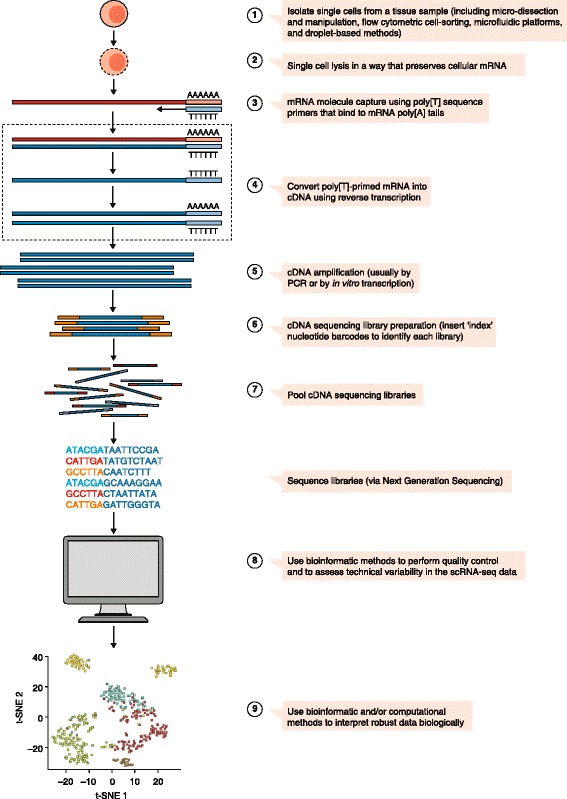
Verification
Claims the paper makes
The claims and statistics of this paper haven’t been checked yet.
Free: it reads the open-access text and checks the first 5 claims that cite a source we can check. Create a free account to check every claim.
Claims other papers make about this one
Each is checked against this paper’s own text: does it say what the citing paper says it does?
The source backs part of the claim, not all of it — or backs it for a different population, condition or comparison.
In the citing paper
“Increasing sequencing depth increases the UMI counts measured even for low-expression genes, reducing the uncertainty associated with zero counts34,47.”
From scPerturb: harmonized single-cell perturbation data (2024) · cites this paper as [47]
Experimental — accuracy not yet measuredThe cited source says what the claim attributes to it.
In the citing paper
“The average sequencing depth, that is, the mean number of reads per cell, in each study affects the number of low-expression genes observed.”
From scPerturb: harmonized single-cell perturbation data (2024) · cites this paper as [47]
Self-check
Percentages, sums and reported differences re-computed from the paper’s own numbers.
The self-check needs the paper’s full text.
Citations
Cites
Massively parallel digital transcriptional profiling of single cells
Zheng, G. X. Y., Terry, J. M., Belgrader, P., Ryvkin, P., Bent, Z. W., Wilson, R., Ziraldo, S. B., Wheeler, T. D., McDermott, G. P., Zhu, J., et al. (2017) · Nature Communications · doi:10.1038/ncomms14049 · Cited by 7,353 · cited 2×
“To this end, recent studies have explored the effect of cryopreservation on scRNA-seq profiles and indeed suggest that high-fidelity scRNA-seq data can be recovered from stored cells [47, 53].”
Trapnell, C., Cacchiarelli, D., Grimsby, J., Pokharel, P., Li, S., Morse, M., Lennon, N. J., Livak, K. J., Mikkelsen, T. S., & Rinn, J. L. (2014) · Nature Biotechnology · doi:10.1038/nbt.2859 · Cited by 7,314
Highly parallel genome-wide expression profiling of individual cells using nanoliter droplets.
Macosko, E. Z., Basu, A., Satija, R., Nemesh, J., Shekhar, K., Goldman, M., Tirosh, I., Bialas, A. R., Kamitaki, N., Martersteck, E. M., et al. (2015) · Cell · doi:10.1016/j.cell.2015.05.002 · Cited by 7,110 · cited 3×
“Second, spike-in mixes are Table 1 Brief overview of scRNA-seq approaches Protocol example C1 (SMARTer) Smartseq2 MATQseq MARS-seq CEL-seq Drop-seq InDrop Chromium SEQ-well SPLIT-seq Transcript data Full length Full length Full length 3’-end counting 3’-end counting 3’-end counting 3’-end counting 3’-end counting 3’-e…”
Single-cell RNA-seq highlights intratumoral heterogeneity in primary glioblastoma
Patel, A. P., Tirosh, I., Trombetta, J. J., Shalek, A. K., Gillespie, S. M., Wakimoto, H., Cahill, D. P., Nahed, B. V., Curry, W. T., Martuza, R. L., et al. (2014) · Science · doi:10.1126/science.1254257 · Cited by 5,063 · cited 1×
“What types of material can be assessed by scRNA-seq? Many of the initial scRNA-seq studies successfully examined human or mouse primary cells, such as those from embryos [17], tumours [14], the nervous system [15, 48] and haematopoietically derived cells, including stem cells and fully differentiated lymphocytes [8, 1…”
BackgroundDissecting the multicellular ecosystem of metastatic melanoma by single-cell RNA-seq
Tirosh, I., Izar, B., Prakadan, S. M., Wadsworth, M. H., Treacy, D., Trombetta, J. J., Rotem, A., Rodman, C., Lian, C., Murphy, G., et al. (2016) · Science · doi:10.1126/science.aad0501 · Cited by 4,944
mRNA-Seq whole-transcriptome analysis of a single cell
Tang, F., Barbacioru, C., Wang, Y., Nordman, E., Lee, C., Xu, N., Wang, X., Bodeau, J., Tuch, B. B., Siddiqui, A., et al. (2009) · Nature Methods · doi:10.1038/nmeth.1315 · Cited by 3,969 · cited 1×
“Since the first scRNA-seq study was published in 2009 [5], there has been increasing interest in conducting such studies.”
BackgroundDroplet barcoding for single-cell transcriptomics applied to embryonic stem cells
Klein, A. M., Mazutis, L., Akartuna, I., Tallapragada, N., Veres, A., Li, V., Peshkin, L., Weitz, D. A., & Kirschner, M. W. (2015) · Cell · doi:10.1016/j.cell.2015.04.044 · Cited by 3,356 · cited 1×
“Reference [63] [57] [39] [10] [64] [45] [46] [47] [101] [38] Haque et al.”
Cell types in the mouse cortex and hippocampus revealed by single-cell RNA-seq
Zeisel, A., Muñoz-Manchado, A. B., Codeluppi, S., Lönnerberg, P., La Manno, G., Juréus, A., Marques, S., Munguba, H., He, L., Betsholtz, C., et al. (2015) · Science · doi:10.1126/science.aaa1934 · Cited by 3,124
Smart-seq2 for sensitive full-length transcriptome profiling in single cells
Picelli, S., Björklund, Å. K., Faridani, O. R., Sagasser, S., Winberg, G., & Sandberg, R. (2013) · Nature Methods · doi:10.1038/nmeth.2639 · Cited by 2,358 · cited 2×
“Reference [63] [57] [39] [10] [64] [45] [46] [47] [101] [38] Haque et al.”
BackgroundMeasurement of mRNA abundance using RNA-seq data: RPKM measure is inconsistent among samples
Wagner, G. P., Kin, K., & Lynch, V. J. (2012) · Theory in Biosciences · doi:10.1007/s12064-012-0162-3 · Cited by 2,136 · cited 1×
“Because of this imperfect coverage, the commonly used unit of normalized transcript levels used for bulk RNAseq, expressed as ‘reads per kilobase per million’ (RPKM), is biased on a single-cell level, and instead the related unit ‘transcripts per million’ (TPM) should be used for scRNA-seq [66].”
Method
Cited by
Items 601–700 of 1,002
Gong, M., He, Y., Wang, M., Zhang, Y., & Ding, C. (2023) · Computational Biology and Chemistry · doi:10.1016/j.compbiolchem.2023.107923 · Cited by 5
TransAtlasDB: an integrated database connecting expression data, metadata and variants
Adetunji, M. O., Lamont, S. J., & Schmidt, C. J. (2018) · Database · doi:10.1093/database/bay014 · Cited by 5
“The schema contains twenty-one (21) tables, six (6) views and four (4) stored procedures, which are relevant to the organization of the different required datasets; the sample (Sample table) and additional information about the sample are stored in the Sample sub-tables.”
BackgroundMTGO-SC, A Tool to Explore Gene Modules in Single-Cell RNA Sequencing Data
Nazzicari, N., Vella, D., Coronnello, C., Silvestre, D. D., Bellazzi, R., & Marini, S. (2019) · Frontiers in Genetics · doi:10.3389/fgene.2019.00953 · Cited by 5
scASK: A Novel Ensemble Framework for Classifying Cell Types Based on Single-cell RNA-seq Data
Liu, B., Wu, F., & Zou, X. (2021) · IEEE Journal of Biomedical and Health Informatics · doi:10.1109/jbhi.2021.3050963 · Cited by 5
Forte, E., McLellan, M. A., Skelly, D. A., & Rosenthal, N. A. (2021) · International Journal of Molecular Sciences · doi:10.3390/ijms22042071 · Cited by 5
ExperimentSubset: an R package to manage subsets of Bioconductor Experiment objects
Sarfraz, I., Asif, M., & Campbell, J. D. (2021) · Bioinformatics · doi:10.1093/bioinformatics/btab179 · Cited by 5
Beyond Genome Editing: CRISPR Approaches
Sultan, Q., Ashraf, S., Munir, A., Khan, S. H., Munawar, N., Abd-Elsalam, K. A., & Ahmad, A. (2022) · Springer eBooks · doi:10.1007/978-981-16-6305-5_6 · Cited by 6
Automatic Microfluidic Cell Wash Platform for Purifying Cells in Suspension: Puriogen
Lu, X., & Ai, Y. (2022) · Analytical Chemistry · doi:10.1021/acs.analchem.2c01616 · Cited by 5
Boolean implication analysis of single-cell data predicts retinal cell type markers
Subramanian, R., & Sahoo, D. (2022) · BMC Bioinformatics · doi:10.1186/s12859-022-04915-4 · Cited by 5
“As a result, scRNA-seq data generates sparse arrays with low false omission rate and high negative predictive values [62].”
BackgroundOlaniru, O. E., Hook, P., & Persaud, S. J. (2022) · Diabetic Medicine · doi:10.1111/dme.14992 · Cited by 6
Arambula, A. M., Gu, S., Warnecke, A., Schmitt, H. A., Staecker, H., & Hoa, M. (2023) · Otology & Neurotology Open · doi:10.1097/ono.0000000000000027 · Cited by 6
Gene Self-Expressive Networks as a Generalization-Aware Tool to Model Gene Regulatory Networks
Peignier, S., & Calevro, F. (2023) · Biomolecules · doi:10.3390/biom13030526 · Cited by 6
Deconvolution of cancer cell states by the XDec-SM method
Murillo, O. D., Petrosyan, V., LaPlante, E. L., Dobrolecki, L. E., Lewis, M. T., & Milosavljevic, A. (2023) · PLoS Computational Biology · doi:10.1371/journal.pcbi.1011365 · Cited by 5
Wang, K., & Adler, C. E. (2023) · BMC Genomics · doi:10.1186/s12864-023-09724-4 · Cited by 5
An evaluation of statistical differential analysis methods in single-cell RNA-seq dataPreprint
Li, D., Zand, M. S., Dye, T., Goniewicz, M. L., Rahman, I., & Xie, Z. (2023) · Research Square · doi:10.21203/rs.3.rs-2670717/v1 · Cited by 5
“Single-cell RNA-seq could also help us identify cell heterogeneity, cell population, and sub-population, identify specific cells such as senescence cells, as well as examine the effects of low copy mRNA distributions and transcription regulation ([7–9]).”
BackgroundInfluentialTransformer Enables Reference Free And Unsupervised Analysis of Spatial TranscriptomicsPreprint
Zhao, C., Xu, Z., Wang, X., Chen, K., Huang, H., & Chen, W. (2022) · bioRxiv (Cold Spring Harbor Laboratory) · doi:10.1101/2022.08.11.503261 · Cited by 6
“Moreover, single-cell references and spatial transcriptomics are affected by different perturbations, which may affect the deconvolution accuracy [27].”
BackgroundSong, W., Chen, M., Forst, C. V., & Zhang, B. (2025) · GigaScience · doi:10.1093/gigascience/giaf111 · Cited by 4
“scRNA-seq data are often noisy and suffer from dropout reads and low library sizes to interfere with the underlying cellular land-scapes [ 12 , 23 ].”
Methodologies for Sample Multiplexing and Computational Deconvolution in Single‐Cell Sequencing
Gao, Y., Yin, W., Hu, W., & Chen, W. (2025) · Advanced Science · doi:10.1002/advs.202513396 · Cited by 6
Shah, M. S., Kondo, T., Sundarabupathi, M., Samaranayake, L. P., Jamal, M., & Egusa, H. (2025) · Japanese Dental Science Review · doi:10.1016/j.jdsr.2025.11.004 · Cited by 4
“In contrast, scRNA-seq provides transcriptome-wide profiling of individual cells, significantly advancing research in developmental biology, endogenous niche population identification, and epigenetics, as well as offering unprecedented insights into cellular diversity and disease mechanisms [2].”
Lu, Z., Wang, C., Zhu, Y., Zhao, J., Gu, Y., Zhu, X., Liao, W., Zhu, J., Jiang, R., Feng, S., et al. (2026) · Brain Behavior and Immunity · doi:10.1016/j.bbi.2026.106472 · Cited by 4
Nikhat, A., Mandal, T., Veerasubramanian, N., & Chakrabarti, S. (2026) · iScience · doi:10.1016/j.isci.2026.115394 · Cited by 4
Press, W. H. (2022) · PNAS Nexus · doi:10.1093/pnasnexus/pgac252 · Cited by 4
Preparation of a Single-Cell Suspension from Tumor Biopsy Samples for Single-Cell RNA Sequencing
Frolova, A. A., Gerashchenko, T. S., Patysheva, M. R., Fedorov, A. A., Tsyganov, M. M., Bokova, U. A., Bragina, O., Александровна, В. М., Garbukov, Е. Y., & Cherdyntseva, N. V. (2023) · Bulletin of Experimental Biology and Medicine · doi:10.1007/s10517-023-05898-9 · Cited by 4
“Most dissociation methods involve prolonged incubation at high temperatures (>37°C) in the absence of nutrients, combined with aggressive post-incubation influences during centrifugation of the cell suspensions (>800g) [9], which can induce stress associated with functional changes and induction of apoptosis program i…”
BackgroundDiscoveries in Retina Physiology and Disease Biology Using Single-Cell RNA Sequencing
Zong, Y.-J., Xiao, S., Lei, D., & Li, H. (2023) · Frontiers in Bioscience-Landmark · doi:10.31083/j.fbl2810247 · Cited by 4
“At the single-cell level, single-cell RNA sequencing (scRNA-seq) is high-throughput sequencing analysis of the transcriptome, genome, and epigenome [4]. scRNA-seq technology is widely employed in tumor, embryo, and stem cell research [5].”
MethodJang, W., Lee, S., & Jeong, C. (2024) · Frontiers in Psychiatry · doi:10.3389/fpsyt.2023.1302994 · Cited by 4
“However, scRNA-Seq also has some limitations, including technical noise, the large amount of data generated, the requirement for specialized analytical tools, and the relatively high cost compared to bulk RNA-Seq (57).”
BackgroundWood, J. A., Chaparala, S., Bantang, C., Chattopadhyay, A., Wesesky, M. A., Kinchington, P. R., Nimgaonkar, V. L., Bloom, D. C., & D’Aiuto, L. (2024) · Journal of NeuroVirology · doi:10.1007/s13365-024-01198-8 · Cited by 4
“Additionally, bulk RNA-seq provides a comprehensive overview of gene expression changes within a sample, making it a valuable tool for identifying pathways that are affected by HSV-1 infection and antiviral treatment (Haque et al. 2017).”
BackgroundSingle-Cell Analysis in Cerebrovascular Research: Primed for Breakthroughs and Clinical Impact
Albertson, A. J., Winkler, E. A., Yang, A. C., Buckwalter, M. S., Dingman, A., Fan, H., Herson, P. S., McCullough, L. D., Pérez‐Pinzón, M. A., Sansing, L. H., et al. (2024) · Stroke · doi:10.1161/strokeaha.124.049001 · Cited by 5
SCIG: Machine learning uncovers cell identity genes in single cells by genetic sequence codes
Kulandaisamy, A., Xia, B., Yu, Y., Chen, H., Pu, W. T., Zhang, L., & Chen, K. (2025) · Nucleic Acids Research · doi:10.1093/nar/gkaf431 · Cited by 5
“This technique has enabled researchers to delve into cellular heterogeneity, cell fate conversion, and other cellular processes [ 168–170 ].”
Sahni, S., Chattopadhyay, P., Khare, K., & Pandey, R. (2021) · Pathogens · doi:10.3390/pathogens10111467 · Cited by 4
“…technical noise and higher biological variability (such as stochastic transcription) compared to conventional bulk RNASeq data impose substantial challenges on the computational analysis of scRNA-Seq data [56]. impose substantial challenges on the computational analysis of scRNA-Seq data [56].”
BackgroundO’Callaghan, A., Eling, N., Marioni, J. C., & Vallejos, C. A. (2022) · F1000Research · doi:10.12688/f1000research.74416.1 · Cited by 5
Single Cell RNA Sequencing (scRNA-Seq) as an Emerging Technology in Cancer Research
Rehman, A. U., Rashid, A., & Anwar, I. (2022) · Proceedings of the Pakistan Academy of Sciences B Life and Environmental Sciences · doi:10.53560/ppasb(58-3)663 · Cited by 5
Glass, M. R., Kyere, F. A., French, D. L., Stein, J. L., & Waxman, E. A. (2022) · Elsevier eBooks · doi:10.1016/b978-0-12-822277-5.00005-5 · Cited by 4
Conundrums of choice of ‘normal’ kidney tissue for single cell studies
Jain, S. R. (2023) · Current Opinion in Nephrology & Hypertension · doi:10.1097/mnh.0000000000000875 · Cited by 4
Hui‐Yuen, J. S., Jiang, K., Malkiel, S., Eberhard, B. A., Walters, H. M., Diamond, B., & Jarvis, J. N. (2023) · Lupus Science & Medicine · doi:10.1136/lupus-2023-000921 · Cited by 4
An image-guided microfluidic system for single-cell lineage tracking
Kamil, M. A., Fourneaux, C., Yılmaz, A., Stavrakis, S., Parmentier, R., Páldi, A., Gonin-Giraud, S., deMello, A. J., & Gandrillon, O. (2023) · PLoS ONE · doi:10.1371/journal.pone.0288655 · Cited by 4
(2023) · Biointerface Research in Applied Chemistry · doi:10.33263/briac136.543 · Cited by 4
“In eukaryotic organisms, most proteins encoding RNAs (mRNAs) and many noncoding long RNAs (lncRNAs) (> 200 nucleotides) have a poly (A) tail [65].”
Single-Cell Transcriptomics in Spinal Cord Studies: Progress and Perspectives
Maihemuti, M., Mimi, M. A., Sohag, S. M., & Hasan, M. M. (2025) · BioChem · doi:10.3390/biochem5020016 · Cited by 4
“A major issue in scRNA-seq data is their high sparsity and technical noise, which complicate data preprocessing and quality control [92].”
Adil, A., Bhattacharya, N., Aadam, Khan, N. J., & Asger, M. (2025) · Scientific Reports · doi:10.1038/s41598-025-12897-5 · Cited by 5
“To tackle these challenges head-on, researchers have proposed a number of techniques and frameworks, all aimed at efficiently handling the massive scale and complexity that comes with analyzing scRNA-seq data 17 .”
Schilder, B. M., Murphy, K. B., Dash, H., Zhang, Y., Gordon-Smith, R., Chapman, J., Otani, M., & Skene, N. (2026) · Genome Medicine · doi:10.1186/s13073-026-01692-0 · Cited by 6
Tokarev, A., Creegan, M., Eller, M. A., Roederer, M., & Bolton, D. L. (2018) · Journal of Visualized Experiments · doi:10.3791/57776 · Cited by 5
Single identical cell toxicity assay on coordinately ordered patterns
Li, Q., Ma, L., & Su, M. (2019) · Analytica Chimica Acta · doi:10.1016/j.aca.2019.02.040 · Cited by 4
Innovative Molecular Testing Strategies for Adjunctive Investigations in Hemostasis and Thrombosis
Ghorbanpour, E., & Lillicrap, D. (2019) · Seminars in Thrombosis and Hemostasis · doi:10.1055/s-0039-1692977 · Cited by 4
Stevenson, K. B., & Uversky, V. N. (2019) · Journal of Biomolecular Structure and Dynamics · doi:10.1080/07391102.2019.1659859 · Cited by 4
“As sequencing costs decrease and technological improvements are made in single cell isolation and droplet-based sequencing, the number cells analyzed in a single experiment will be in the millions or billions (Haque et al., 2017).”
BackgroundMethodInfluentialJOINT for large-scale single-cell RNA-sequencing analysis via soft-clustering and parallel computing
Cui, T., & Wang, T. (2021) · BMC Genomics · doi:10.1186/s12864-020-07302-6 · Cited by 7
Deconvolution of Focal Segmental Glomerulosclerosis Pathophysiology Using Transcriptomics Techniques
Deleersnijder, D., Craenenbroeck, A. H. V., & Sprangers, B. (2021) · Glomerular Diseases · doi:10.1159/000518404 · Cited by 5
Prieto‐Vila, M., Yamamoto, Y., Takahashi, R., & Ochiya, T. (2021) · Springer eBooks · doi:10.1007/978-981-10-8953-4_12 · Cited by 5
Pathergy: a review of potential mechanisms and novel therapeutic targets
Honigman, A. D., Kern, J. S., & Frew, J. W. (2022) · Wound Practice and Research · doi:10.33235/wpr.30.1.55-61 · Cited by 6
Matthews, E., Lanham, S., White, K., Kyriazi, M. E., Alexaki, K., El-Sagheer, A. H., Brown, T., Kanaras, A. G., West, J. J., MacArthur, B. D., et al. (2023) · Journal of Tissue Engineering · doi:10.1177/20417314231169375 · Cited by 4
“84 Sequencing of populations enriched for desirable cell types, has been applied previously for the characterisation of rare cell haematopoietic subtypes and identification of unique biomarkers.”
FaStaNMF: A Fast and Stable Non-Negative Matrix Factorization for Gene Expression
Sweeney, M. D., Torre-Healy, L. A., Ma, V. L., Hall, M. A., Chrastecka, L., Yurovsky, A., & Moffitt, R. A. (2023) · IEEE Transactions on Computational Biology and Bioinformatics · doi:10.1109/tcbb.2023.3296979 · Cited by 5
“These Methods are expensive, Require Intensive Equipment resources, and Cannot Be Used on the Majority of the World’s Existing samples, Which are Formalin-Preserved [2], [3].”
Heralding a new era of oxytocinergic research: New tools, new problems?
Althammer, F. (2023) · Journal of Neuroendocrinology · doi:10.1111/jne.13333 · Cited by 4
“While hierarchical clustering strongly depends on individual parameters such as filtering, preprocessing and sorting, 3 – 5 the idea that more than two subtypes of OT neurons could be identified based on their genetic identities, was new at the time.”
BackgroundGray, S., & Ottensmeier, C. H. H. (2023) · Cancers · doi:10.3390/cancers15194797 · Cited by 4
Koçhan, N., & Dayanç, B. E. (2023) · TURKISH JOURNAL OF BIOLOGY · doi:10.55730/1300-0152.2675 · Cited by 4
“Single-cell RNA sequencing (scRNA-Seq) is a widely used transcriptomics sequencing method that can sequence the mRNA profile of up to millions of single cells (Haque et al., 2017; Chen et al., 2019).”
BackgroundMethodTrends Innovations Challenges in Employing Interdisciplinary Approaches to Biomedical Sciences
Ganeshkumar, M., Ayyadhury, S., & Murugan, E. (2024) · Springer eBooks · doi:10.1007/978-981-97-1777-4_20 · Cited by 6
Single-Cell Transcriptome Analysis of T Cells
Byl, W. V. D., Rizzetto, S., Samir, J., Cai, C., Eltahla, A. A., & Luciani, F. (2019) · Methods in molecular biology · doi:10.1007/978-1-4939-9728-2_16 · Cited by 18
Sánchez, J. A., Gil-Martínez, A. L., Cisterna‐García, A., García-Ruiz, S., Gómez-Pascual, A., Reynolds, R. H., Nalls, M. A., Hardy, J., Ryten, M., & Botía, J. A. (2021) · Bioinformatics · doi:10.1093/bioinformatics/btab175 · Cited by 4
Multi-omic analysis of subtype evolution and heterogeneity in high-grade serous ovarian carcinomaPreprint
Geistlinger, L., Oh, S., Ramos, M., Schiffer, L., LaRue, R. S., Henzler, C., Munro, S. A., Daughters, C., Nelson, A. C., Winterhoff, B., et al. (2019) · bioRxiv (Cold Spring Harbor Laboratory) · doi:10.1101/554394 · Cited by 3
Tian, R., Zhu, H., Pang, Z., Tian, Y., & Liang, C. (2019) · bioRxiv (Cold Spring Harbor Laboratory) · doi:10.1101/725119 · Cited by 5
Perfect genetic biomarkers for cancer from a fresh view of gene dysregulationPreprint
Gil, G., & González, A. (2022) · bioRxiv (Cold Spring Harbor Laboratory) · doi:10.1101/2022.07.25.501449 · Cited by 4
Editorial: Applications of RNA-seq in cancer and tumor research
Lang, J., Cho, W. C. S., Huang, T., Wu, T., & Xu, J. (2023) · Frontiers in Genetics · doi:10.3389/fgene.2023.1331576 · Cited by 4
DeepDecon accurately estimates cancer cell fractions in bulk RNA-seq data
Huang, J., Du, Y., Stucky, A., Kelly, K. R., Zhong, J. F., & Sun, F. (2024) · Patterns · doi:10.1016/j.patter.2024.100969 · Cited by 3
Choudhury, P., Dasgupta, S., Bhattacharyya, P., Roychowdhury, S., & Chaudhury, K. (2024) · Molecular Omics · doi:10.1039/d3mo00266g · Cited by 3
Profiling of Microbial Community and Their Role in Solid Waste Treatment
Singh, S., & Shyu, D. J. H. (2024) · Springer eBooks · doi:10.1007/978-3-031-58441-1_15 · Cited by 3
scRNA sequencing technology for PitNET studies
Asaad, W., Utkina, M. V., Shcherbakova, A. S., Popov, S., Mel'nichenko, G. A., & Mokrysheva, N. (2024) · Frontiers in Endocrinology · doi:10.3389/fendo.2024.1414223 · Cited by 6
“Notably, different scRNA-seq protocols of different tissues have already been published (17, 18) and the choice of the protocol to apply depends on many factors, mainly the research question and the tissue under investigation.”
BackgroundMethodIdentification of models describing gene expression data leveraging machine learning methods
Klomp, L. F. J., Queirolo, E., Post, J. N., Meijer, H. G. E., & Brüne, C. (2025) · Interface Focus · doi:10.1098/rsfs.2025.0014 · Cited by 3
Mouse-Specific Single cell cytokine activity prediction and Estimation (MouSSE)
Javaid, A., & Frost, H. R. (2025) · PLoS Computational Biology · doi:10.1371/journal.pcbi.1013475 · Cited by 3
“Since its introduction in 2009 [6], single cell RNA-sequencing (scRNA-seq) has enabled the transcriptomic profiling of tens to hundreds-of-thousands of cells from a single tissue sample [7].”
GeneRAIN: multifaceted representation of genes via deep learning of gene expression networks
Su, Z., Fang, M., Smolnikov, A., Dinger, M. E., Oates, E. C., & Vafaee, F. (2025) · Genome biology · doi:10.1186/s13059-025-03749-6 · Cited by 3
“Furthermore, to date, most models have been trained on single-cell RNA-seq data, which captures cellular heterogeneity but often suffers from high dropout rates and technical noise [20].”
Romero, S., Kumar, V., Chapkin, R. S., & Cai, J. J. (2026) · APL Quantum · doi:10.1063/5.0317792 · Cited by 5
Research progress of single cell RNA sequencing in nervous system
Hu, L., Qi, L., Lin, Z., Zhu, J., & Zhang, M. (2025) · Molecular Biology Reports · doi:10.1007/s11033-025-11155-1 · Cited by 4
“Future research will likely require integrating multi - modal data to develop novel approaches for classifying cells based on molecular divergence or biological effect [ 4]. their regulatory gene networks.”
Rahm, K. K., Kinghorn, B. S., Moody, M. J., Stone, B. C., Strong, K., Kim, B. S., Chang, Y. J., Sleight, S., Nitz, A. A., Hansen, D. V., et al. (2025) · Frontiers in Bioinformatics · doi:10.3389/fbinf.2025.1681811 · Cited by 5
“Single-cell and bulk RNA sequencing are powerful tools for distinguishing cell types by measuring transcriptome-wide differences in gene expression levels, providing a robust alternative to morphology-based observations (Haque et al., 2017; Mukamel and Ngai, 2019; Ofengeim et al., 2017).”
PLAID: ultrafast single-sample gene set enrichment scoring
Zito, A., Escribà-Montagut, X., Scorici, G., Martinelli, A., Akhmedov, M., & Kwee, I. (2025) · Bioinformatics · doi:10.1093/bioinformatics/btaf621 · Cited by 3
“Single sample analyses, including at single cell resolution, are advancing our understanding of biology (Haque et al. 2017, Van de Sande et al. 2023, Zheng et al. 2025).”
Leveraging single-cell RNA-seq in helminthology
Mu, Y., Zumuk, C. P., Jones, M. K., & Cai, P. (2025) · Trends in Parasitology · doi:10.1016/j.pt.2025.11.003 · Cited by 4
The transformative role of single-cell analysis in multifactorial disorders research
Wang, C., Ko, C.-C., Kumar, S., Xuan, D. T. M., Lin, H.-R., Lee, Y.-K., Nguyen, N. U. N., Pei-Ming, Y., & Solomon, D. D. (2026) · Methods · doi:10.1016/j.ymeth.2026.03.009 · Cited by 3
Integration of Bulk and Single-Cell RNA Sequencing Analyses in Biomedicine
Golushko, N., & Buzdin, A. A. (2026) · International Journal of Molecular Sciences · doi:10.3390/ijms27073334 · Cited by 8
Werth, V. P., Rönnblom, L., Wenzel, J., Moseley, M. K., Rohrbach, J., Reynolds, T. L., Barbey, C., Grogan, J. L., & Colonna, M. (2026) · Frontiers in Immunology · doi:10.3389/fimmu.2026.1807771 · Cited by 3
Pu, W., Zhang, X., Tian, M., He, Z., Zhu, J., Song, S., Li, L., Lian, P., Lu, R., Wang, R., et al. (2026) · Nature Communications · doi:10.1038/s41467-026-74032-w · Cited by 4
“Gene set enrichment analyses, including Gene Ontology (GO) functional enrichment, Reactome pathway enrichment, and KEGG pathway enrichment, were performed using the clusterPro fi ler 3.8.1 91,92 .”
InfluentialClustering single-cell multimodal omics data with jrSiCKLSNMF
Ellis, D. D., Roy, A., & Datta, S. (2023) · Frontiers in Genetics · doi:10.3389/fgene.2023.1179439 · Cited by 3
“These data consist of count matrices where each column corresponds to a cell and each row to a gene (Haque et al., 2017).”
Yu, Q., Shi, X., Wang, H., Zhang, S., Hu, S., & Cai, T. (2023) · Journal of Cancer · doi:10.7150/jca.85873 · Cited by 3
Nakagawa, T., Santos, J. L. D., Nasamran, C. A., Sen, P., Sadat, S., Monther, A., Bendik, J., Ebisumoto, K., Hu, J., Preißl, S., et al. (2023) · International Journal of Cancer · doi:10.1002/ijc.34790 · Cited by 4
GRAIGH: Gene Regulation accessibility integrating GeneHancer database
Martini, L., Savino, A., Bardini, R., & Carlo, S. D. (2023) · IEEE International Conference on Bioinformatics and Biomedicine (BIBM) · doi:10.1109/bibm58861.2023.10385417 · Cited by 3
“Recent advances in experimental techniques, such as Next-Generation Sequencing (NGS) and, specifically, single-cell RNA sequencing (scRNA-seq), enable high-resolution pro-filing of gene expression at the single-cell level [5] [6].”
BackgroundHwang, J. Y., Kim, Y., Na, K., Kim, D. K., Lee, S., Kang, S.-S., Baek, S., Yang, S. M., Kim, M. H., Han, H., et al. (2024) · Yonsei Medical Journal · doi:10.3349/ymj.2023.0639 · Cited by 5
Su, K., Roberts, C., Heagerty, A., & Reynolds, J. A. (2023) · Clinical and Experimental Rheumatology · doi:10.55563/clinexprheumatol/8vvgva · Cited by 3
Innovative aspects and applications of single cell technology for different diseases
Ali, A., Manzoor, S., Ali, T., Asim, M., Muhammad, G., Ahmad, A., Jamaludin, M. I., Devaraj, S., & Munawar, N. (2024) · American Journal of Cancer Research · doi:10.62347/vufu1836 · Cited by 3
Prater, K. E., & Lin, K. (2024) · Glia · doi:10.1002/glia.24633 · Cited by 2
“Single-cell tutorials (e.g., Amezquita et al., 2020; Andrews et al., 2021; Haque et al., 2017; Heumos et al., 2023; Lähnemann et al., 2020; Wang et al., 2022) are a good place to start to determine what method will be best for your particular application.”
Amin, M. T., Coussement, L., & Meyer, T. D. (2024) · Biomolecules · doi:10.3390/biom14121598 · Cited by 3
Integration of mass cytometry and single-cell RNA-sequencing of cells in bronchoalveolar lavage
Guinto, E., Chopra, S., Kuo, I.-C., Shin, S. B., Messing, M., Cheung, C. Y., Yang, J. S., Gerayeli, F. V., Yip, W., Milne, S. B., et al. (2025) · BioTechniques · doi:10.1080/07366205.2025.2505347 · Cited by 3
Etiology of Iridocorneal Endothelial Syndrome: Viral Infection and Immune Suppression
Zhang, J., Yuan, B., Peng, R., Zhang, P., Liu, X., Qu, Y., Xiao, G., Li, Y., Zhang, X. D., & Hong, J. (2025) · Cornea · doi:10.1097/ico.0000000000003911 · Cited by 3
“39 Besides, the discrepancies between qPCR and sequencing results may stem from individual differences among patient samples or variations in disease stages.”
Sun, N., Wang, Y., Shi, X. D., Yang, D., Wu, R., & Yau, S. S.-T. (2025) · BMC Bioinformatics · doi:10.1186/s12859-025-06309-8 · Cited by 4
“With the advancement of single-cell RNA sequencing (scRNA-seq) technology, researchers can now explore cellular heterogeneity at the transcriptional level with unprecedented resolution [1–3].”
Hilbert space methods for approximating multi-output latent variable Gaussian processes
Mukherjee, S., Claassen, M., & Bürkner, P. (2026) · Statistics and Computing · doi:10.1007/s11222-026-10869-x · Cited by 3
“There, multi-output structures naturally arise in a plethora of research problems (Haque et al. 2017) and latent GPs are common to model cellular ordering (Hensmanetal.2013b;CampbellandYau2015).”
Remmen, H. V., Freeman, W. M., Miller, B. F., Kinter, M. T., Wren, J. D., Chiao, A., Towner, R. A., Snider, T. A., Sonntag, W. E., & Richardson, A. G. (2021) · GeroScience · doi:10.1007/s11357-021-00454-7 · Cited by 3
“Many investigators are in a rush to use the new 10X Genomics technology [78] resulting in technical issues and at times expensive and poor quality data [22, 82].”
BackgroundImproving Transcriptome Fidelity Following Synovial Tissue Disaggregation
Boyle, D. L., Prideaux, E. B., Hillman, J., Wang, W., & Firestein, G. S. (2022) · Frontiers in Medicine · doi:10.3389/fmed.2022.919748 · Cited by 3
“Synovial Tissue Disaggregation Protocols Two proteinase-based methods based on current Liberase TL (Lib) (Roche) methods (7) were evaluated and compared to Lib alone: (1) Bacillus licheniformis protease, Subtilisin A (Sub A) (Sigma-Aldrich), which is active at 4C, and (2) Lib in the presence of the RNA polymerase inhi…”
MethodCAMML with the Integration of Marker Proteins (ChIMP)
Schiebout, C. T., & Frost, H. R. (2022) · Bioinformatics · doi:10.1093/bioinformatics/btac674 · Cited by 3
“18,19 To 20–22 Specifically, it is common practice for investigators to cluster scRNA-seq data,determine the most differentially expressed (DE) genes present in each cluster, and then manually deduce the most likely cell type identity of each cluster based on the DE genes.”
BackgroundMethodSingle-cell sequencing: promises and challenges for human genetics
Sreenivasan, V. K. A., Henck, J., & Spielmann, M. (2022) · Medizinische Genetik · doi:10.1515/medgen-2022-2156 · Cited by 6
Profiling RNA Editing in Single Cells
Fonzino, A., Pesole, G., & Picardi, E. (2022) · Methods in molecular biology · doi:10.1007/978-1-0716-2756-3_18 · Cited by 3
Priol, C. L., Azencott, C., & Gidrol, X. (2023) · PLoS Computational Biology · doi:10.1371/journal.pcbi.1010342 · Cited by 4
“Technical null values, or dropouts, are much more present in single-cell RNAseq data than in bulk RNA-seq data due to the limited amount of mRNA material available at the cellular level [65].”
BackgroundRNAget: an API to securely retrieve RNA quantifications
Upchurch, S., Palumbo, E., Adams, J. B., Bujold, D., Bourque, G., Nedzel, J. L., Graham, K., Kagda, M. S., Assis, P., Hitz, B. C., et al. (2023) · Bioinformatics · doi:10.1093/bioinformatics/btad126 · Cited by 3
“Translating these methods and datatypes into clinical medicine and routine healthcare is a natural progression (Haque et al. 2017, https://doi.org/10.1186/s13073-017-0467-4), following the trajectory of whole-exome and whole-genome DNA sequencing (Birney et al. 2017,…”
MethodInfluentialPavan, R. R., Diniz, F., El-Dahr, S. S., & Tortelote, G. G. (2023) · Frontiers in Bioinformatics · doi:10.3389/fbinf.2023.1144266 · Cited by 4
“Surely, location in the cell (for example, the nucleus versus the cytoplasm) may also contribute to the observed differences (Haque et al., 2017; Jiang, 2019; Potter and Steven Potter, 2019; Ding et al., 2020; Gibson, 2022).”
BackgroundMethodInfluentialThe Contribution of Multiplexing Single Cell RNA Sequencing in Acute Myeloid Leukemia
Madaci, L., Gard, C., Nin, S., Venton, G., Rihet, P., Puthier, D., Loriod, B., & Costello, R. T. (2023) · Diseases · doi:10.3390/diseases11030096 · Cited by 5
“Single cell RNA sequencing (scRNA-seq) has emerged as a powerful tool for investigating the intricate cellular transcriptome at a single cell level, especially in systems with cellular heterogeneity [17,18].”
MethodAn End-to-End Deep Hybrid Autoencoder Based Method for Single-Cell RNA-Seq Data Analysis
Ji, C., Yu, N., Wang, Y., Qi, R., & Zheng, C.-H. (2023) · IEEE Transactions on Computational Biology and Bioinformatics · doi:10.1109/tcbb.2023.3328029 · Cited by 3
“Nowadays, it has become a hot topics in the field of life sciences and widely used in the clinical practice [3].”
BackgroundEssential procedures of single-cell RNA sequencing in multiple myeloma and its translational value
Du, J., Gu, X.-R., Yu, X., Cao, Y.-J., & Hou, J. (2023) · Blood Science · doi:10.1097/bs9.0000000000000172 · Cited by 3
“79 Most scRNA-seq protocols may encapsulate 2 or more cells and barcode in 1 reaction volume, and the data that represent multi-plets can use doublet removal 42 package to remove.”
MethodEngland, S. J., Rusnock, A. K., Mujcic, A., Kowalchuk, A. M., de Jager, S., Hilinski, W. C., Juárez‐Morales, J. L., Smith, M. E., Grieb, G., Banerjee, S., et al. (2023) · Neural Development · doi:10.1186/s13064-023-00176-w · Cited by 3
“To further maintain maximum cell viability and preserve endogenous mRNA expression, which are the most significant technical barriers to transcriptional profiling [48], FACS was performed no later than four hours after beginning embryo deyolking and dissection.”
Background
Metadata
- Authors
- Haque, A., Engel, J., Teichmann, S. A., & Lönnberg, T.
- Affiliations
- QIMR Berghofer Medical Research Institute (AU)
- Wellcome Sanger Institute (GB)
- Åbo Akademi University (FI)
- Corresponding author
- Haque, Ashraful
- Lönnberg, Tapio
- Venue
- Genome Medicine
- Published
- 2017-08-18
- Volume
- 9
- Issue
- 1
- Pages
- 75-75
- ISSN
- 1756-994X (ISSN-L)
- PMC
- PMC5561556
- OpenAlex
- W2746479894
- Cited by
- 1,071
- References
- 106
- Citations by year
- 2026: 83 · 2025: 164 · 2024: 163 · 2023: 183 · 2022: 152 · 2021: 123 · 2020: 92 · 2019: 58 · 2018: 51 · 2017: 1
- FWCI
- 5.16
- Type
- journal article
- Language
- en
- Open access
- gold
- doi.org
- Licence
- cc-by
- Locations
- Genome Medicine (publishedVersion, cc-by)
- PubMed Central (publishedVersion, cc-by)
- PubMed (publishedVersion)
- UTUPub (University of Turku) (submittedVersion, cc-by)
- DOAJ (DOAJ: Directory of Open Access Journals) (submittedVersion, cc-by-sa)
- Minerva Access (University of Melbourne) (submittedVersion, cc-by)
- Apollo (University of Cambridge) (submittedVersion, cc-by)
- Apollo (cc-by)
- Funders
- European Research Council (260507)
- Australian National Health and Medical Research Council (1028641, 1028643)
- Topics
- Life Sciences › Biochemistry, Genetics and Molecular Biology › Molecular Biology › Single-cell and spatial transcriptomics
- Life Sciences › Biochemistry, Genetics and Molecular Biology › Molecular Biology › Genomics and Phylogenetic Studies
- Life Sciences › Biochemistry, Genetics and Molecular Biology › Molecular Biology › Gene expression and cancer classification
- Keywords
- single-cell RNA sequencing, quality control, data analysis, biological interpretation, clinical application, experimental protocol
- MeSH terms
- Animals, Humans, Sequence Analysis, RNA, Computational Biology, Biomedical Research, Single-Cell Analysis
About these checks
Registry, retraction, Cites and statistics results are computed, not judged, with one exception: a printed reference that no index lists is read once by a model before it counts as a citation error. Claims are extracted by a model and kept only when their quote appears verbatim in the text; each cited source is then checked, with a model’s help, for whether it says what the claim relies on. Those verdicts can be wrong — read the claim’s quote and the cited source before relying on one.
Statistics and arithmetic are recomputed, not judged.
Confidence bands are shown only for fields calibrated on our annotated test set. None is calibrated yet, so no band is shown.
What counts as a claim ›How we measure confidence ›How we check this ›
Are you an author, or do you see a problem with this page? Request a review
Data sources
Bibliographic data: Semantic Scholar, OpenAlex, Crossref.
Contains information from the Semantic Scholar Academic Graph Datasets, made available under the ODC Attribution License (ODC-BY 1.0).
Semantic Scholar’s data is described in: Kinney, R., et al. (2023). The Semantic Scholar Open Data Platform. arXiv:2301.10140.
