

A practical guide to single-cell RNA-sequencing for biomedical research and clinical applications
Open accessThe DOI matches its Crossref record; 110 of the 110 references it cites were found in a registry or an index.
Abstract
RNA sequencing (RNA-seq) is a genomic approach for the detection and quantitative analysis of messenger RNA molecules in a biological sample and is useful for studying cellular responses. RNA-seq has fueled much discovery and innovation in medicine over recent years. For practical reasons, the technique is usually conducted on samples comprising thousands to millions of cells. However, this has hindered direct assessment of the fundamental unit of biology-the cell. Since the first single-cell RNA-sequencing (scRNA-seq) study was published in 2009, many more have been conducted, mostly by specialist laboratories with unique skills in wet-lab single-cell genomics, bioinformatics, and computation. However, with the increasing commercial availability of scRNA-seq platforms, and the rapid ongoing maturation of bioinformatics approaches, a point has been reached where any biomedical researcher or clinician can use scRNA-seq to make exciting discoveries. In this review, we present a practical guide to help researchers design their first scRNA-seq studies, including introductory information on experimental hardware, protocol choice, quality control, data analysis and biological interpretation.
Overview
The claims and statistics of this paper haven’t been checked yet.
Free: it reads the open-access text and checks the first 5 claims that cite a source we can check. Create a free account to check every claim.
Integrity signals
Registry
Cites
Statistics
Figures
Verification
Claims the paper makes
The claims and statistics of this paper haven’t been checked yet.
Free: it reads the open-access text and checks the first 5 claims that cite a source we can check. Create a free account to check every claim.
Claims other papers make about this one
Each is checked against this paper’s own text: does it say what the citing paper says it does?
The source backs part of the claim, not all of it — or backs it for a different population, condition or comparison.
In the citing paper
“Increasing sequencing depth increases the UMI counts measured even for low-expression genes, reducing the uncertainty associated with zero counts34,47.”
From scPerturb: harmonized single-cell perturbation data (2024) · cites this paper as [47]
Experimental — accuracy not yet measuredThe cited source says what the claim attributes to it.
In the citing paper
“The average sequencing depth, that is, the mean number of reads per cell, in each study affects the number of low-expression genes observed.”
From scPerturb: harmonized single-cell perturbation data (2024) · cites this paper as [47]
Self-check
Percentages, sums and reported differences re-computed from the paper’s own numbers.
The self-check needs the paper’s full text.
Citations
Cites
Massively parallel digital transcriptional profiling of single cells
Zheng, G. X. Y., Terry, J. M., Belgrader, P., Ryvkin, P., Bent, Z. W., Wilson, R., Ziraldo, S. B., Wheeler, T. D., McDermott, G. P., Zhu, J., et al. (2017) · Nature Communications · doi:10.1038/ncomms14049 · Cited by 7,353 · cited 2×
“To this end, recent studies have explored the effect of cryopreservation on scRNA-seq profiles and indeed suggest that high-fidelity scRNA-seq data can be recovered from stored cells [47, 53].”
Trapnell, C., Cacchiarelli, D., Grimsby, J., Pokharel, P., Li, S., Morse, M., Lennon, N. J., Livak, K. J., Mikkelsen, T. S., & Rinn, J. L. (2014) · Nature Biotechnology · doi:10.1038/nbt.2859 · Cited by 7,314
Highly parallel genome-wide expression profiling of individual cells using nanoliter droplets.
Macosko, E. Z., Basu, A., Satija, R., Nemesh, J., Shekhar, K., Goldman, M., Tirosh, I., Bialas, A. R., Kamitaki, N., Martersteck, E. M., et al. (2015) · Cell · doi:10.1016/j.cell.2015.05.002 · Cited by 7,110 · cited 3×
“Second, spike-in mixes are Table 1 Brief overview of scRNA-seq approaches Protocol example C1 (SMARTer) Smartseq2 MATQseq MARS-seq CEL-seq Drop-seq InDrop Chromium SEQ-well SPLIT-seq Transcript data Full length Full length Full length 3’-end counting 3’-end counting 3’-end counting 3’-end counting 3’-end counting 3’-e…”
Single-cell RNA-seq highlights intratumoral heterogeneity in primary glioblastoma
Patel, A. P., Tirosh, I., Trombetta, J. J., Shalek, A. K., Gillespie, S. M., Wakimoto, H., Cahill, D. P., Nahed, B. V., Curry, W. T., Martuza, R. L., et al. (2014) · Science · doi:10.1126/science.1254257 · Cited by 5,063 · cited 1×
“What types of material can be assessed by scRNA-seq? Many of the initial scRNA-seq studies successfully examined human or mouse primary cells, such as those from embryos [17], tumours [14], the nervous system [15, 48] and haematopoietically derived cells, including stem cells and fully differentiated lymphocytes [8, 1…”
BackgroundDissecting the multicellular ecosystem of metastatic melanoma by single-cell RNA-seq
Tirosh, I., Izar, B., Prakadan, S. M., Wadsworth, M. H., Treacy, D., Trombetta, J. J., Rotem, A., Rodman, C., Lian, C., Murphy, G., et al. (2016) · Science · doi:10.1126/science.aad0501 · Cited by 4,944
mRNA-Seq whole-transcriptome analysis of a single cell
Tang, F., Barbacioru, C., Wang, Y., Nordman, E., Lee, C., Xu, N., Wang, X., Bodeau, J., Tuch, B. B., Siddiqui, A., et al. (2009) · Nature Methods · doi:10.1038/nmeth.1315 · Cited by 3,969 · cited 1×
“Since the first scRNA-seq study was published in 2009 [5], there has been increasing interest in conducting such studies.”
BackgroundDroplet barcoding for single-cell transcriptomics applied to embryonic stem cells
Klein, A. M., Mazutis, L., Akartuna, I., Tallapragada, N., Veres, A., Li, V., Peshkin, L., Weitz, D. A., & Kirschner, M. W. (2015) · Cell · doi:10.1016/j.cell.2015.04.044 · Cited by 3,356 · cited 1×
“Reference [63] [57] [39] [10] [64] [45] [46] [47] [101] [38] Haque et al.”
Cell types in the mouse cortex and hippocampus revealed by single-cell RNA-seq
Zeisel, A., Muñoz-Manchado, A. B., Codeluppi, S., Lönnerberg, P., La Manno, G., Juréus, A., Marques, S., Munguba, H., He, L., Betsholtz, C., et al. (2015) · Science · doi:10.1126/science.aaa1934 · Cited by 3,124
Smart-seq2 for sensitive full-length transcriptome profiling in single cells
Picelli, S., Björklund, Å. K., Faridani, O. R., Sagasser, S., Winberg, G., & Sandberg, R. (2013) · Nature Methods · doi:10.1038/nmeth.2639 · Cited by 2,358 · cited 2×
“Reference [63] [57] [39] [10] [64] [45] [46] [47] [101] [38] Haque et al.”
BackgroundMeasurement of mRNA abundance using RNA-seq data: RPKM measure is inconsistent among samples
Wagner, G. P., Kin, K., & Lynch, V. J. (2012) · Theory in Biosciences · doi:10.1007/s12064-012-0162-3 · Cited by 2,136 · cited 1×
“Because of this imperfect coverage, the commonly used unit of normalized transcript levels used for bulk RNAseq, expressed as ‘reads per kilobase per million’ (RPKM), is biased on a single-cell level, and instead the related unit ‘transcripts per million’ (TPM) should be used for scRNA-seq [66].”
Method
Cited by
scGPT: Towards Building a Foundation Model for Single-Cell Multi-omics Using Generative AI
Cui, H., Wang, C., Maan, H., Pang, K., Luo, F., & Wang, B. (2023) · doi:10.1101/2023.04.30.538439 · Cited by 1,694
Cross-tissue immune cell analysis reveals tissue-specific features in humans
Domínguez Conde, C., Xu, C., Jarvis, L. B., Rainbow, D. B., Wells, S. B., Gomes, T., Howlett, S. K., Suchanek, O., Polanski, K., King, H. W., et al. (2022) · Science · doi:10.1126/science.abl5197 · Cited by 1,159
Self-citationChallenges in unsupervised clustering of single-cell RNA-seq data
Kiselev, V. Y., Andrews, T. S., & Hemberg, M. (2019) · Nature Reviews Genetics · doi:10.1038/s41576-018-0088-9 · Cited by 1,160
Integrating single-cell and spatial transcriptomics to elucidate intercellular tissue dynamics
Longo, S. K., Guo, M. G., Ji, A. L., & Khavari, P. A. (2021) · Nature Reviews Genetics · doi:10.1038/s41576-021-00370-8 · Cited by 1,059
The protein expression profile of ACE2 in human tissues
Hikmet, F., Méar, L., Edvinsson, Å., Micke, P., Uhlén, M., & Lindskog, C. (2020) · Molecular Systems Biology · doi:10.15252/msb.20209610 · Cited by 1,016
“It may also lead to the “drop out” phenomenon, where a gene showing high expression levels in a certain cell lacks expression in other cells corresponding to the same cell type (Haque et al , 2017).”
Single-Cell RNA-Seq Technologies and Related Computational Data Analysis
Chen, G., Ning, B., & Shi, T. (2019) · Frontiers in Genetics · doi:10.3389/fgene.2019.00317 · Cited by 923
An introduction to spatial transcriptomics for biomedical research
Williams, C. G., Lee, H. J., Asatsuma, T., Vento-Tormo, R., & Haque, A. (2022) · Genome Medicine · doi:10.1186/s13073-022-01075-1 · Cited by 848
“This triggered an explosion in efforts to study heterogeneity and dynamic change in eukaryotic cells using single-cell transcriptomics, more commonly referred to as single-cell RNA-seq (scRNA-seq) [2].”
BackgroundSelf-citationSystematic comparison of single-cell and single-nucleus RNA-sequencing methods
Ding, J., Adiconis, X., Simmons, S. K., Kowalczyk, M. S., Hession, C. C., Marjanovic, N. D., Hughes, T. K., Wadsworth, M. H., Burks, T., Nguyen, L. T., et al. (2020) · Nature Biotechnology · doi:10.1038/s41587-020-0465-8 · Cited by 871
Redefining Tumor-Associated Macrophage Subpopulations and Functions in the Tumor Microenvironment
Wu, K., Lin, K., Li, X., Yuan, X., Xu, P., Ni, P., & Xu, D. (2020) · Frontiers in Immunology · doi:10.3389/fimmu.2020.01731 · Cited by 687
From bulk, single-cell to spatial RNA sequencing
Li, X., & Wang, C.-Y. (2021) · International Journal of Oral Science · doi:10.1038/s41368-021-00146-0 · Cited by 605
Joint probabilistic modeling of single-cell multi-omic data with totalVI
Gayoso, A., Steier, Z., Lopez, R., Regier, J., Nazor, K. L., Streets, A., & Yosef, N. (2021) · Nature Methods · doi:10.1038/s41592-020-01050-x · Cited by 592
“By extending single-cell RNA-sequencing (scRNA-seq) to simultaneously measure the abundance of proteins on the cell surface, CITE-seq [6,7] presents the opportunity to connect the information that can be gleaned from the transcriptome [8, 9] to the functional information contained in proteins [10, 11].”
BackgroundFlyBase: a guided tour of highlighted features
Gramates, L. S., Agapite, J., Attrill, H., Calvi, B. R., Crosby, M. A., dos Santos, G., Goodman, J. L., Goutte-Gattat, D., Jenkins, V. K., Kaufman, T., et al. (2022) · Genetics · doi:10.1093/genetics/iyac035 · Cited by 505
“Over the past few years, single-cell RNA sequencing (scRNA-seq) (Haque et al. 2017) has proved an invaluable tool in biomedical research.”
BackgroundApplications of single-cell RNA sequencing in drug discovery and development
Van de Sande, B., Lee, J. S., Mutasa-Gottgens, E., Naughton, B., Bacon, W., Manning, J., Wang, Y., Pollard, J., Mendez, M., Hill, J., et al. (2023) · Nature Reviews Drug Discovery · doi:10.1038/s41573-023-00688-4 · Cited by 437
Maguire, C. M., Rösslein, M., Wick, P., & Prina-Mello, A. (2018) · Science and Technology of Advanced Materials · doi:10.1080/14686996.2018.1517587 · Cited by 387
Roles of tumor-associated macrophages in anti-PD-1/PD-L1 immunotherapy for solid cancers
Zhang, H., Liu, L., Liu, J., Dang, P., Hu, S., Yuan, W., Sun, Z., Liu, Y., & Wang, C. (2023) · Molecular Cancer · doi:10.1186/s12943-023-01725-x · Cited by 389
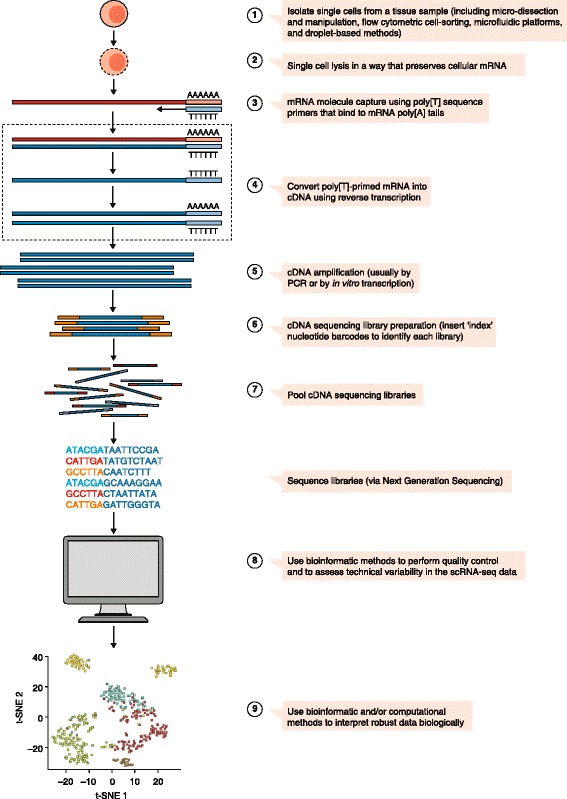
“The workflow typically includes sample collection, cell dissociation, single-cell capture, reverse transcription, cDNA amplification, library preparation, and sequencing and analysis [95].”
MethodWagner, M., Yoshihara, M., Douagi, I., Damdimopoulos, A., Panula, S., Petropoulos, S., Lu, H., Pettersson, K., Palm, K., Katayama, S., et al. (2020) · Nature Communications · doi:10.1038/s41467-020-14936-3 · Cited by 370
Nebulosa recovers single-cell gene expression signals by kernel density estimation
Alquicira-Hernandez, J., & Powell, J. E. (2021) · Bioinformatics · doi:10.1093/bioinformatics/btab003 · Cited by 381
Single-Cell Transcriptomics Meets Lineage Tracing
Kester, L., & van Oudenaarden, A. (2018) · Cell Stem Cell · doi:10.1016/j.stem.2018.04.014 · Cited by 375
“A more detailed overview of the available single-cell mRNA sequencing techniques and their properties can be found in Haque et al. (2017) and Papalexi and Satija (2018).”
Droplet scRNA-seq is not zero-inflated
Svensson, V. (2019) · doi:10.1101/582064 · Cited by 356
Cytokine-mediated communication: a quantitative appraisal of immune complexity
Altan-Bonnet, G., & Mukherjee, R. (2019) · Nature Reviews Immunology · doi:10.1038/s41577-019-0131-x · Cited by 341
Vireo: Bayesian demultiplexing of pooled single-cell RNA-seq data without genotype reference
Huang, Y., McCarthy, D. J., & Stegle, O. (2019) · Genome Biology · doi:10.1186/s13059-019-1865-2 · Cited by 348
“The multiplexed designs with genetic barcoding are particularly useful in biomedical research, where the analysis of larger cohorts of genetically distinct individuals is particularly relevant [14].”
BackgroundSingle-Cell Transcriptome Analysis in Plants: Advances and Challenges
Shaw, R., Tian, X., & Xu, J. (2021) · Molecular Plant · doi:10.1016/j.molp.2020.10.012 · Cited by 288
Deconstructing a Syndrome: Genomic Insights Into PCOS Causal Mechanisms and Classification
Dapas, M., & Dunaif, A. (2022) · Endocrine Reviews · doi:10.1210/endrev/bnac001 · Cited by 300
Molecular mechanisms of environmental exposures and human disease
Wu, H., Eckhardt, C. M., & Baccarelli, A. A. (2023) · Nature Reviews Genetics · doi:10.1038/s41576-022-00569-3 · Cited by 273
Molla, G., & Bitew, M. (2024) · Biomedicines · doi:10.3390/biomedicines12122750 · Cited by 246
“…health status and conditions. transcriptomics, and proteomics data to identify distinct molecular subtypes that varied responses to treatment Recent investigations have connected genetic differences between individuals to RNA expression [66], translation [67], and protein levels [68,69].”
Protein-Based Biological Materials: Molecular Design and Artificial Production
Miserez, A., Yu, J., & Mohammadi, P. (2023) · Chemical Reviews · doi:10.1021/acs.chemrev.2c00621 · Cited by 257
scCATCH: Automatic Annotation on Cell Types of Clusters from Single-Cell RNA Sequencing Data
Shao, X., Liao, J., Lu, X., Xue, R., Ai, N., & Fan, X. (2020) · iScience · doi:10.1016/j.isci.2020.100882 · Cited by 286
Integrative Methods and Practical Challenges for Single-Cell Multi-omics
Ma, A., McDermaid, A., Xu, J., Chang, Y., & Ma, Q. (2020) · Trends in Biotechnology · doi:10.1016/j.tibtech.2020.02.013 · Cited by 273
“molecular information about whole-genome gene copies [3, 4], gene expression [5, 6], epigenome [7, 8], CRISPR perturbation [9, 10], spatial information [11, 12], and protein abundance [13, 14], among other phenomena.”
BackgroundSingle-Cell RNA Sequencing Analysis: A Step-by-Step Overview
Slovin, S., Carissimo, A., Panariello, F., Grimaldi, A., Bouché, V., Gambardella, G., & Cacchiarelli, D. (2021) · Methods in Molecular Biology · doi:10.1007/978-1-0716-1307-8_19 · Cited by 252
Classification of midbrain dopamine neurons using single-cell gene expression profiling approaches
Poulin, J.-F., Gaertner, Z., Moreno-Ramos, O. A., & Awatramani, R. (2020) · Trends in Neurosciences · doi:10.1016/j.tins.2020.01.004 · Cited by 238
“Single-cell RNA-Seq suffers from limitations, as it has for instance a low capture efficiency compared to “bulk” RNA-Seq, leading to dropout events, that is – a failure to detect the expression of a gene [10,101].”
BackgroundSarkar, A., & Stephens, M. (2021) · Nature Genetics · doi:10.1038/s41588-021-00873-4 · Cited by 224
Comparison of clustering tools in R for medium-sized 10x Genomics single-cell RNA-sequencing data
Freytag, S., Tian, L., Lönnstedt, I., Ng, M., & Bahlo, M. (2018) · F1000Research · doi:10.12688/f1000research.15809.1 · Cited by 220
Miller, B. F., Huang, F., Atta, L., Sahoo, A., & Fan, J. (2022) · Nature Communications · doi:10.1038/s41467-022-30033-z · Cited by 218
“Additionally, dif-fi culties dissociating and capturing certain cell types via single-cell sequencing may result in missing or inconsistent cell types between scRNA-seq references and ST datasets 10,11 .”
BackgroundUnderstanding tumour endothelial cell heterogeneity and function from single-cell omics
Zeng, Q., Mousa, M., Nadukkandy, A. S., Franssens, L., Alnaqbi, H., Alshamsi, F. Y., Safar, H. A., & Carmeliet, P. (2023) · Nature Reviews Cancer · doi:10.1038/s41568-023-00591-5 · Cited by 194
Bernink, J. H., Ohne, Y., Teunissen, M. B. M., Wang, J., Wu, J., Krabbendam, L., Guntermann, C., Volckmann, R., Koster, J., van Tol, S., et al. (2019) · Nature Immunology · doi:10.1038/s41590-019-0423-0 · Cited by 198
Multi-OMICS approaches in cancer biology: New era in cancer therapy
Chakraborty, S., Sharma, G., Karmakar, S., & Banerjee, S. (2024) · Biochimica et Biophysica Acta (BBA) - Molecular Basis of Disease · doi:10.1016/j.bbadis.2024.167120 · Cited by 178
Sudhagar, A., Kumar, G., & El-Matbouli, M. (2018) · International Journal of Molecular Sciences · doi:10.3390/ijms19010245 · Cited by 193
“have gained momentum, rendering transcriptome information from a single cell and thus avoiding the limitations caused by heterogeneous cell populations [151].”
BackgroundTemporal modelling using single-cell transcriptomics
Ding, J., Sharon, N., & Bar-Joseph, Z. (2022) · Nature Reviews Genetics · doi:10.1038/s41576-021-00444-7 · Cited by 195
“75 .”
scPerturb: harmonized single-cell perturbation data
Peidli, S., Green, T. D., Shen, C., Gross, T., Min, J., Garda, S., Yuan, B., Schumacher, L. J., Taylor-King, J. P., Marks, D. S., et al. (2024) · Nature Methods · doi:10.1038/s41592-023-02144-y · Cited by 194
“Increasing sequencing depth increases the UMI counts measured even for low-expression genes, reducing the uncertainty associated with zero counts 34,47 .”
Current and Future Biomarkers in Multiple Sclerosis
Yang, J., Hamade, M., Wu, Q., Wang, Q., Axtell, R., Giri, S., & Mao-Draayer, Y. (2022) · International Journal of Molecular Sciences · doi:10.3390/ijms23115877 · Cited by 155
Statistical and machine learning methods for spatially resolved transcriptomics data analysis
Zeng, Z., Li, Y., Li, Y., & Luo, Y. (2022) · Genome Biology · doi:10.1186/s13059-022-02653-7 · Cited by 186
“…achieved transcriptome-wide sequencing, spatial transcriptomics data quality is still limited by reduced coverage and low cellular resolution [96]. scRNA-seq has limitations of low capture efficiency and high dropouts, and these limitations are inherited by the spatial transcriptomics data [97].”
BackgroundGorin, G., Fang, M., Chari, T., & Pachter, L. (2022) · PLOS Computational Biology · doi:10.1371/journal.pcbi.1010492 · Cited by 186
Shaping the brain vasculature in development and disease in the single-cell era
Wälchli, T., Bisschop, J., Carmeliet, P., Zadeh, G., Monnier, P. P., De Bock, K., & Radovanovic, I. (2023) · Nature Reviews Neuroscience · doi:10.1038/s41583-023-00684-y · Cited by 164
Experimental Considerations for Single-Cell RNA Sequencing Approaches
Nguyen, Q. H., Pervolarakis, N., Nee, K., & Kessenbrock, K. (2018) · Frontiers in Cell and Developmental Biology · doi:10.3389/fcell.2018.00108 · Cited by 170
Platforms for Single-Cell Collection and Analysis
Valihrach, L., Androvic, P., & Kubista, M. (2018) · International Journal of Molecular Sciences · doi:10.3390/ijms19030807 · Cited by 164
SCSA: A Cell Type Annotation Tool for Single-Cell RNA-seq Data
Cao, Y., Wang, X., & Peng, G. (2020) · Frontiers in Genetics · doi:10.3389/fgene.2020.00490 · Cited by 167
“…analysis of individual cells in a heterogeneous cell population (Tang et al., 2009; Picelli et al., 2013a; Kolodziejczyk et al., 2015; Haque et al., 2017). scRNA-35 seq methods have been used to characterize thousands to millions of cells in developing embryos (Chu et al., 2016),…”
MethodTranscriptomic comparison of human and mouse brain microvessels
Song, H. W., Foreman, K. L., Gastfriend, B. D., Kuo, J. S., Palecek, S. P., & Shusta, E. V. (2020) · Scientific Reports · doi:10.1038/s41598-020-69096-7 · Cited by 155
Transformers and genome language models
Consens, M. E., Dufault, C., Wainberg, M., Forster, D., Karimzadeh, M., Goodarzi, H., Theis, F. J., Moses, A. M., & Wang, B. (2025) · Nature Machine Intelligence · doi:10.1038/s42256-025-01007-9 · Cited by 196
“While this Review focuses on DNA-based genome language models, single-cell RNA-seq language models follow many similar principles 40,41,132–136 .”
InfluentialSingle-cell analysis of human embryos reveals diverse patterns of aneuploidy and mosaicism
Starostik, M. R., Sosina, O. A., & McCoy, R. C. (2020) · Genome Research · doi:10.1101/gr.262774.120 · Cited by 155
“, number of cells) but are limited to 3′ end sequences upstream of poly(A) tails (Haque et al. 2017).”
BackgroundHigh-throughput single-сell sequencing in cancer research
Jia, Q., Chu, H., Jin, Z., Long, H., & Zhu, B. (2022) · Signal Transduction and Targeted Therapy · doi:10.1038/s41392-022-00990-4 · Cited by 178
Niazi, S. K. (2023) · Drug Design Development and Therapy · doi:10.2147/dddt.s424991 · Cited by 185
“Machine learning models can help optimize the production of therapeutic cells and ir effects on patients.(64)”
BackgroundCross-species RNA-seq for deciphering host–microbe interactions
Westermann, A. J., & Vogel, J. (2021) · Nature Reviews Genetics · doi:10.1038/s41576-021-00326-y · Cited by 134
The Impact of Heterogeneity on Single-Cell Sequencing
Goldman, S. L., MacKay, M., Afshinnekoo, E., Melnick, A. M., Wu, S., & Mason, C. E. (2019) · Frontiers in Genetics · doi:10.3389/fgene.2019.00008 · Cited by 138
“…knowledge of cellular heterogeneity is transcriptional, newer techniques such as single-cell epigenomics have tremendous potential to study heterogeneity (Hassan et al., 2017) and may be able to provide further insights into the characterization and mechanisms of heterogeneity (Clark et al., 2016).”
BackgroundSingle-Cell Transcriptomics: Current Methods and Challenges in Data Acquisition and Analysis
Adil, A., Kumar, V., Jan, A. T., & Asger, M. (2021) · Frontiers in Neuroscience · doi:10.3389/fnins.2021.591122 · Cited by 132
Transcriptomics and single‐cell RNA‐sequencing
Chambers, D. C., Carew, A. M., Lukowski, S. W., & Powell, J. E. (2018) · Respirology · doi:10.1111/resp.13412 · Cited by 153
Desta, G. M., & Birhanu, A. G. (2025) · Acta Biochimica Polonica · doi:10.3389/abp.2025.13922 · Cited by 150
Systematic benchmarking of imaging spatial transcriptomics platforms in FFPE tissues
Wang, H., Huang, R., Nelson, J., Gao, C., Tran, M., Yeaton, A. H., Krishna, S., Felt, K. D., Pfaff, K. L., Bowman, T., et al. (2025) · Nature Communications · doi:10.1038/s41467-025-64990-y · Cited by 157
Single-Cell Virus Sequencing of Influenza Infections That Trigger Innate Immunity
Russell, A. B., Elshina, E., Kowalsky, J. R., Velthuis, A. J. W. T., & Bloom, J. D. (2019) · Journal of Virology · doi:10.1128/jvi.00500-19 · Cited by 140
“To remove some of these multiplets along with low-quality droplets, we filtered transcriptomes with unusually high or low numbers of cellular transcripts as is commonly done in analysis of single-cell transcriptome sequencing (scRNA-seq) data (60).”
MethodHigh Expression of ACE2 on Keratinocytes Reveals Skin as a Potential Target for SARS-CoV-2
Xue, X., Mi, Z., Wang, Z., Pang, Z., Liu, H., & Zhang, F. (2020) · Journal of Investigative Dermatology · doi:10.1016/j.jid.2020.05.087 · Cited by 132
Multiomic Analysis of Subtype Evolution and Heterogeneity in High-Grade Serous Ovarian Carcinoma
Geistlinger, L., Oh, S., Ramos, M., Schiffer, L., LaRue, R. S., Henzler, C. M., Munro, S. A., Daughters, C., Nelson, A., Winterhoff, B. J. N., et al. (2020) · Cancer Research · doi:10.1158/0008-5472.can-20-0521 · Cited by 139
“The observed ambiguity in classification of single cells did not result from the low coverage of scRNA-seq data (35), as downsampling Geistlinger et al.”
Inference of Gene Regulatory Network from Single-Cell Transcriptomic Data Using pySCENIC
Kumar, N., Mishra, B., Athar, M., & Mukhtar, S. M. (2021) · Methods in molecular biology · doi:10.1007/978-1-0716-1534-8_10 · Cited by 146
Changing Technologies of RNA Sequencing and Their Applications in Clinical Oncology
Wang, Y., Mashock, M. J., Tong, Z., Mu, X., Chen, H., Zhou, X., Zhang, H., Zhao, G., Liu, B., & Li, X. (2020) · Frontiers in Oncology · doi:10.3389/fonc.2020.00447 · Cited by 142
“There are a number of different technologies available today for single-cell RNAseq (scRNAseq) (34).”
BackgroundGottschlich, A., Thomas, M., Grünmeier, R., Lesch, S., Rohrbacher, L., Igl, V., Briukhovetska, D., Benmebarek, M.-R., Vick, B., Dede, S., et al. (2023) · Nature Biotechnology · doi:10.1038/s41587-023-01684-0 · Cited by 139
“Nevertheless, it is crucial to bear in mind that scRNA-seq-centered strategies come with their own limitations (for example, the zero or dropout problem of singe-cell gene expression 52 ) and in any case require protein validation.”
BackgroundSpatial transcriptomic characterization of pathologic niches in IPF
Mayr, C. H., Santacruz, D., Jarosch, S., Bleck, M., Dalton, J., McNabola, A., Lempp, C., Neubert, L., Rath, B., Kamp, J. C., et al. (2024) · Science Advances · doi:10.1126/sciadv.adl5473 · Cited by 147
“…+ macrophages, or PVLAP + bronchial vessels are located, is lacking ( 5 – 9 , 16 Spatial transcriptomics addresses this by providing spatially resolved gene expression within the natural tissue environment of intact tissue without inducing cell stress, death, or an isolation bias ( 13 , 17 , 18 ).”
Han, X., Chen, H., Huang, D., Chen, H., Fei, L., Cheng, C., Huang, H., Yuan, G.-C., & Guo, G. (2018) · Genome Biology · doi:10.1186/s13059-018-1426-0 · Cited by 116
An Introduction to the Analysis of Single-Cell RNA-Sequencing Data
AlJanahi, A. A., Danielsen, M., & Dunbar, C. E. (2018) · Molecular Therapy - Methods & Clinical Development · doi:10.1016/j.omtm.2018.07.003 · Cited by 119
“32,33,35,39,40 High numbers of mitochondrial transcripts are indicators of cell stress, 41 and therefore cells with elevated mitochondrial gene expression are often not included in the analysis, because most experiments will not bene fi t from clustering cells based on stress levels.”
BackgroundThe Comparison of Two Single-cell Sequencing Platforms: BD Rhapsody and 10x Genomics Chromium
Gao, C., Zhang, M., & Chen, L. (2020) · Current Genomics · doi:10.2174/1389202921999200625220812 · Cited by 132
“These SCS techniques include the detection of DNA mutations, copy-number variants (CNVs), DNA-protein binding, RNA splicing, and the measurement of mRNA expression [4].”
BackgroundCurrent and future directions in network biology
Žitnik, M., Li, M. M., Wells, A., Glass, K., Gysi, D. M., Krishnan, A., Murali, T. M., Radivojac, P., Roy, S., Baudot, A., et al. (2024) · Bioinformatics Advances · doi:10.1093/bioadv/vbae099 · Cited by 157
“Heterogeneous networks offer a powerful framework to integrate, interpret, and reconcile missing and noisy measurements commonly seen in multi-omic experiments [155, 320].”
BackgroundA multimodal knowledge-enhanced whole-slide pathology foundation model
Xu, Y., Wang, Y., Zhou, F., Ma, J., Jin, C., Yang, S., Li, J., Zhang, Z., Zhao, C., Zhou, H., et al. (2025) · Nature Communications · doi:10.1038/s41467-025-66220-x · Cited by 157
“Therefore, we further applied a common preprocessing technique log1p transformation 54 for gene expression values.”
McInturff, S., Burns, J. C., & Kelley, M. W. (2018) · Biology Open · doi:10.1242/bio.038083 · Cited by 115
“DISCUSSION The development and subsequent diversification of methodologies for the isolation and transcriptional profiling of single cells provides a powerful new approach for the identification of known and novel cell types within heterogeneous organs or tissues (Cuevas-Diaz Duran et al., 2017; Haque et al., 2017).”
MethodGRNdb: decoding the gene regulatory networks in diverse human and mouse conditions
Li, F., Li, Y., Ma, L., Xu, Q., Tan, F., & Chen, G. (2020) · Nucleic Acids Research · doi:10.1093/nar/gkaa995 · Cited by 123
“The development of bulk and single-cell RNAsequencing (scRNA-seq) technologies and related computational methods has brought unprecedented opportunities to unravel the expression dynamics and cellular heterogeneity (8,9).”
BackgroundDetermining sequencing depth in a single-cell RNA-seq experiment
Zhang, M. J., Ntranos, V., & Tse, D. (2020) · Nature Communications · doi:10.1038/s41467-020-14482-y · Cited by 112
Sun, T., Song, D., Li, W. V., & Li, J. J. (2021) · Genome Biology · doi:10.1186/s13059-021-02367-2 · Cited by 109
“The recent development of single-cell RNA-seq (scRNA-seq) technologies has revolutionized transcriptomic studies by revealing the genome-wide gene expression levels within individual cells [1, 2].”
BackgroundAplastic anemia: Etiology, molecular pathogenesis, and emerging concepts
Shallis, R. M., Ahmad, R., & Zeidan, A. M. (2018) · European Journal Of Haematology · doi:10.1111/ejh.13153 · Cited by 117
Single-cell multiomics analysis reveals regulatory programs in clear cell renal cell carcinoma
Long, Z., Sun, C., Tang, M., Wang, Y., Ma, J., Yu, J., Wei, J., Ma, J., Wang, B., Xie, Q., et al. (2022) · Cell Discovery · doi:10.1038/s41421-022-00415-0 · Cited by 109
Data analysis guidelines for single-cell RNA-seq in biomedical studies and clinical applications
Su, M., Pan, T., Chen, Q.-Z., Zhou, W., Gong, Y., Xu, G., Yan, H.-Y., Li, S., Shi, Q.-Z., Zhang, Y., et al. (2022) · Military Medical Research · doi:10.1186/s40779-022-00434-8 · Cited by 144
“…offered by 10 × genomics [29, 30] and Singleron [31, 32], scRNA-seq services provided by core facilities of research institutes or third-party companies, are making the technology more accessible, affordable and in some cases a routine technique for bio-medical researchers and clinicians [33].”
BackgroundSingle-cell RNA sequencing in cancer: Applications, advances, and emerging challenges
Sun, G., Li, Z., Rong, D., Zhang, H., Shi, X., Yang, W., Zheng, W., Sun, G., Wu, F., Cao, H., et al. (2021) · Molecular Therapy - Oncolytics · doi:10.1016/j.omto.2021.04.001 · Cited by 99
“The data from sequencing are then analyzed, rather than simply quantitative analysis of the gene expressing state, for including deep studies on cellular heterogeneity, pedigree transformation, and relationships between cells.(12,17,18)”
BackgroundMethodRole of ctDNA in Breast Cancer
Sant, M., Bernat‐Peguera, A., Felip, E., & Vila, M. M. (2022) · Cancers · doi:10.3390/cancers14020310 · Cited by 111
A Single Cell but Many Different Transcripts: A Journey into the World of Long Non-Coding RNAs
Alessio, E., Bonadio, R. S., Buson, L., Chemello, F., & Cagnin, S. (2020) · International Journal of Molecular Sciences · doi:10.3390/ijms21010302 · Cited by 100
“Differently, by sequencing 3′ end libraries researchers can use a lower depth sequencing (104–105 reads per cell) [144].”
BackgroundAn Integrated Map of Cell Type–Specific Gene Expression in Pancreatic Islets
Elgamal, R. M., Kudtarkar, P., Melton, R. L., Mummey, H. M., Benaglio, P., Okino, M.-L., & Gaulton, K. J. (2023) · Diabetes · doi:10.2337/db23-0130 · Cited by 117
“Single cell technologies enable profiling the expression levels of genes in individual cells, which can then be used to define the gene regulatory profiles of specific cell types (7,8).”
BackgroundComputational Oncology in the Multi-Omics Era: State of the Art
de Anda‐Jáuregui, G., & Lemus, E. H. (2020) · Frontiers in Oncology · doi:10.3389/fonc.2020.00423 · Cited by 117
“Single-cell RNA-seq (scRNA-seq) is currently the most developed highthroughput omics technology for individual cell analysis (146).”
MethodTian, M., Qiao, M., Shen, C., Meng, F., Frank, L. A., Krasitskaya, V. V., Wang, T.-J., Zhang, X., Song, R., Li, Y., et al. (2020) · Applied Surface Science · doi:10.1016/j.apsusc.2020.146839 · Cited by 104
Tackling Chronic Kidney Transplant Rejection: Challenges and Promises
Lai, X., Zheng, X., Mathew, J. M., Gallon, L. G., Leventhal, J. R., & Zhang, Z. J. (2021) · Frontiers in Immunology · doi:10.3389/fimmu.2021.661643 · Cited by 116
Schmiedel, B. J., González-Colín, C., Fajardo, V., Rocha, J., Madrigal, A., Ramírez-Suástegui, C., Bhattacharyya, S., Simon, H. A., Greenbaum, J., Peters, B., et al. (2022) · Science Immunology · doi:10.1126/sciimmunol.abm2508 · Cited by 111
Megakaryocyte and Platelet Transcriptomics for Discoveries in Human Health and Disease
Davizon‐Castillo, P., Rowley, J. W., & Rondina, M. T. (2020) · Arteriosclerosis Thrombosis and Vascular Biology · doi:10.1161/atvbaha.119.313280 · Cited by 107
Single-Cell RNA Sequencing for Plant Research: Insights and Possible Benefits
Bawa, G., Liu, Z., Yu, X., Qin, A., & Sun, X. (2022) · International Journal of Molecular Sciences · doi:10.3390/ijms23094497 · Cited by 102
“It is worth mentioning that, while scRNA-seq technology has been increasingly applied in plant science experiments, its successful functioning in any experiment depends on the methodology or protocol used and how successful the cells are isolated [80].”
BackgroundIndel-correcting DNA barcodes for high-throughput sequencing
Hawkins, J. A., Jones, S. K., Finkelstein, I. J., & Press, W. H. (2018) · Proceedings of the National Academy of Sciences · doi:10.1073/pnas.1802640115 · Cited by 98
Liu, X., Jin, S., Hu, S., Li, R., Pan, H., Liu, Y., Lai, P., Xu, D., Sun, J., Liu, Z., et al. (2022) · Nature Communications · doi:10.1038/s41467-022-28799-3 · Cited by 107
Self-citationSpecies and cell-type properties of classically defined human and rodent neurons and glia
Xu, X., Stoyanova, E. I., Patriotis, A. L., Xing, J., Mash, D. C., & Heintz, N. (2018) · eLife · doi:10.7554/elife.37551 · Cited by 93
Zhang, J., Song, C., Tian, Y. F., & Yang, X. (2022) · Frontiers in Immunology · doi:10.3389/fimmu.2021.802080 · Cited by 99
What are the applications of single-cell RNA sequencing in cancer research: a systematic review
Li, L., Xiong, F., Wang, Y., Zhang, S., Gong, Z., Li, X., He, Y., Shi, L., Wang, F., Liao, Q., et al. (2021) · Journal of Experimental & Clinical Cancer Research · doi:10.1186/s13046-021-01955-1 · Cited by 112
Novel molecular regulators of breast cancer stem cell plasticity and heterogeneity
Zhang, R., Tu, J., & Liu, S. (2021) · Seminars in Cancer Biology · doi:10.1016/j.semcancer.2021.03.008 · Cited by 91
Multi-Omics Approaches in Immunological Research
Chu, X., Zhang, B., Koeken, V. A. C. M., Gupta, M. K., & Li, Y. (2021) · Frontiers in Immunology · doi:10.3389/fimmu.2021.668045 · Cited by 99
Biofilm Survival Strategies in Chronic Wounds
Thaarup, I. C., Iversen, A. K. S., Lichtenberg, M., Bjarnsholt, T., & Jakobsen, T. H. (2022) · Microorganisms · doi:10.3390/microorganisms10040775 · Cited by 90
“The challenge of collecting sufficient useful material from clinical samples for sequencing can potentially be overcome by using single-cell RNA-seq (scRNA-seq) [62,63].”
BackgroundA guidebook of spatial transcriptomic technologies, data resources and analysis approaches
Yue, L., Liu, F., Hu, J., Yang, P., Wang, Y., Dong, J., Shu, W., Huang, X., & Wang, S. (2023) · Computational and Structural Biotechnology Journal · doi:10.1016/j.csbj.2023.01.016 · Cited by 95
“The development of transcriptomic technologies from bulk RNA sequencing to single-cell RNA sequencing (scRNA-seq) [1,2] advances knowledge of cellular gene expression to the single-cell level.”
BackgroundSiGra: single-cell spatial elucidation through an image-augmented graph transformer
Tang, Z., Li, Z., Hou, T., Zhang, T., Yang, B., Su, J., & Song, Q. (2023) · Nature Communications · doi:10.1038/s41467-023-41437-w · Cited by 75
Varney, M. J., & Benovic, J. (2024) · Pharmacological Reviews · doi:10.1124/pharmrev.123.001015 · Cited by 90
“Bioinformatic tools are then used to determine which cell type was identified based on marker genes for each cell type (Haque et al., 2017; Baysoy et al., 2023).”
MethodSingle cell transcriptomics in neuroscience: cell classification and beyond
Tasic, B. (2018) · Current Opinion in Neurobiology · doi:10.1016/j.conb.2018.04.021 · Cited by 83
Developmental single-cell transcriptomics in the Lytechinus variegatus sea urchin embryo
Massri, A. J., Greenstreet, L., Afanassiev, A., Berrío, A., Wray, G. A., Schiebinger, G. R., & McClay, D. R. (2021) · Development · doi:10.1242/dev.198614 · Cited by 90
Ke, M. S., Elshenawy, B., Sheldon, H., Arora, A., & Buffa, F. M. (2022) · BioEssays · doi:10.1002/bies.202200084 · Cited by 89
“Depending on the research question and the complexity of the samples, researchers will need to decide, which platform to adopt, the desired number of cells, the sequencing depth and the computational analysis approaches.[3,15,16]”
Background
Metadata
- Authors
- Haque, A., Engel, J., Teichmann, S. A., & Lönnberg, T.
- Affiliations
- QIMR Berghofer Medical Research Institute (AU)
- Wellcome Sanger Institute (GB)
- Åbo Akademi University (FI)
- Corresponding author
- Haque, Ashraful
- Lönnberg, Tapio
- Venue
- Genome Medicine
- Published
- 2017-08-18
- Volume
- 9
- Issue
- 1
- Pages
- 75-75
- ISSN
- 1756-994X (ISSN-L)
- PMC
- PMC5561556
- OpenAlex
- W2746479894
- Cited by
- 1,071
- References
- 106
- Citations by year
- 2026: 83 · 2025: 164 · 2024: 163 · 2023: 183 · 2022: 152 · 2021: 123 · 2020: 92 · 2019: 58 · 2018: 51 · 2017: 1
- FWCI
- 5.16
- Type
- journal article
- Language
- en
- Open access
- gold
- doi.org
- Licence
- cc-by
- Locations
- Genome Medicine (publishedVersion, cc-by)
- PubMed Central (publishedVersion, cc-by)
- PubMed (publishedVersion)
- UTUPub (University of Turku) (submittedVersion, cc-by)
- DOAJ (DOAJ: Directory of Open Access Journals) (submittedVersion, cc-by-sa)
- Minerva Access (University of Melbourne) (submittedVersion, cc-by)
- Apollo (University of Cambridge) (submittedVersion, cc-by)
- Apollo (cc-by)
- Funders
- European Research Council (260507)
- Australian National Health and Medical Research Council (1028641, 1028643)
- Topics
- Life Sciences › Biochemistry, Genetics and Molecular Biology › Molecular Biology › Single-cell and spatial transcriptomics
- Life Sciences › Biochemistry, Genetics and Molecular Biology › Molecular Biology › Genomics and Phylogenetic Studies
- Life Sciences › Biochemistry, Genetics and Molecular Biology › Molecular Biology › Gene expression and cancer classification
- Keywords
- single-cell RNA sequencing, quality control, data analysis, biological interpretation, clinical application, experimental protocol
- MeSH terms
- Animals, Humans, Sequence Analysis, RNA, Computational Biology, Biomedical Research, Single-Cell Analysis
About these checks
Registry, retraction, Cites and statistics results are computed, not judged, with one exception: a printed reference that no index lists is read once by a model before it counts as a citation error. Claims are extracted by a model and kept only when their quote appears verbatim in the text; each cited source is then checked, with a model’s help, for whether it says what the claim relies on. Those verdicts can be wrong — read the claim’s quote and the cited source before relying on one.
Statistics and arithmetic are recomputed, not judged.
Confidence bands are shown only for fields calibrated on our annotated test set. None is calibrated yet, so no band is shown.
What counts as a claim ›How we measure confidence ›How we check this ›
Are you an author, or do you see a problem with this page? Request a review
Data sources
Bibliographic data: Semantic Scholar, OpenAlex, Crossref.
Contains information from the Semantic Scholar Academic Graph Datasets, made available under the ODC Attribution License (ODC-BY 1.0).
Semantic Scholar’s data is described in: Kinney, R., et al. (2023). The Semantic Scholar Open Data Platform. arXiv:2301.10140.
