

A practical guide to single-cell RNA-sequencing for biomedical research and clinical applications
Open accessThe DOI matches its Crossref record; 110 of the 110 references it cites were found in a registry or an index.
Abstract
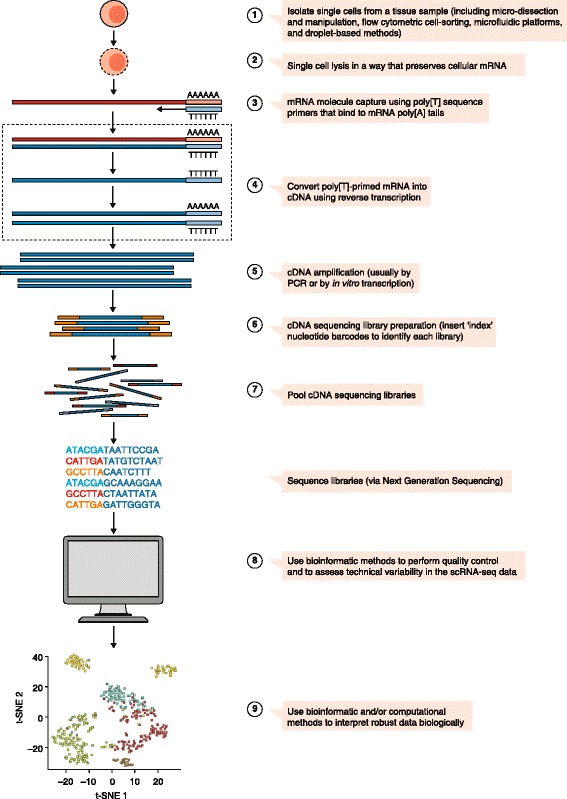
RNA sequencing (RNA-seq) is a genomic approach for the detection and quantitative analysis of messenger RNA molecules in a biological sample and is useful for studying cellular responses. RNA-seq has fueled much discovery and innovation in medicine over recent years. For practical reasons, the technique is usually conducted on samples comprising thousands to millions of cells. However, this has hindered direct assessment of the fundamental unit of biology-the cell. Since the first single-cell RNA-sequencing (scRNA-seq) study was published in 2009, many more have been conducted, mostly by specialist laboratories with unique skills in wet-lab single-cell genomics, bioinformatics, and computation. However, with the increasing commercial availability of scRNA-seq platforms, and the rapid ongoing maturation of bioinformatics approaches, a point has been reached where any biomedical researcher or clinician can use scRNA-seq to make exciting discoveries. In this review, we present a practical guide to help researchers design their first scRNA-seq studies, including introductory information on experimental hardware, protocol choice, quality control, data analysis and biological interpretation.
Overview
The claims and statistics of this paper haven’t been checked yet.
Free: it reads the open-access text and checks the first 5 claims that cite a source we can check. Create a free account to check every claim.
Integrity signals
Registry
Cites
Statistics
Figures
Verification
Claims the paper makes
The claims and statistics of this paper haven’t been checked yet.
Free: it reads the open-access text and checks the first 5 claims that cite a source we can check. Create a free account to check every claim.
Claims other papers make about this one
Each is checked against this paper’s own text: does it say what the citing paper says it does?
The source backs part of the claim, not all of it — or backs it for a different population, condition or comparison.
In the citing paper
“Increasing sequencing depth increases the UMI counts measured even for low-expression genes, reducing the uncertainty associated with zero counts34,47.”
From scPerturb: harmonized single-cell perturbation data (2024) · cites this paper as [47]
Experimental — accuracy not yet measuredThe cited source says what the claim attributes to it.
In the citing paper
“The average sequencing depth, that is, the mean number of reads per cell, in each study affects the number of low-expression genes observed.”
From scPerturb: harmonized single-cell perturbation data (2024) · cites this paper as [47]
Self-check
Percentages, sums and reported differences re-computed from the paper’s own numbers.
The self-check needs the paper’s full text.
Citations
Cites
Massively parallel digital transcriptional profiling of single cells
Zheng, G. X. Y., Terry, J. M., Belgrader, P., Ryvkin, P., Bent, Z. W., Wilson, R., Ziraldo, S. B., Wheeler, T. D., McDermott, G. P., Zhu, J., et al. (2017) · Nature Communications · doi:10.1038/ncomms14049 · Cited by 7,353 · cited 2×
“To this end, recent studies have explored the effect of cryopreservation on scRNA-seq profiles and indeed suggest that high-fidelity scRNA-seq data can be recovered from stored cells [47, 53].”
Trapnell, C., Cacchiarelli, D., Grimsby, J., Pokharel, P., Li, S., Morse, M., Lennon, N. J., Livak, K. J., Mikkelsen, T. S., & Rinn, J. L. (2014) · Nature Biotechnology · doi:10.1038/nbt.2859 · Cited by 7,314
Highly parallel genome-wide expression profiling of individual cells using nanoliter droplets.
Macosko, E. Z., Basu, A., Satija, R., Nemesh, J., Shekhar, K., Goldman, M., Tirosh, I., Bialas, A. R., Kamitaki, N., Martersteck, E. M., et al. (2015) · Cell · doi:10.1016/j.cell.2015.05.002 · Cited by 7,110 · cited 3×
“Second, spike-in mixes are Table 1 Brief overview of scRNA-seq approaches Protocol example C1 (SMARTer) Smartseq2 MATQseq MARS-seq CEL-seq Drop-seq InDrop Chromium SEQ-well SPLIT-seq Transcript data Full length Full length Full length 3’-end counting 3’-end counting 3’-end counting 3’-end counting 3’-end counting 3’-e…”
Single-cell RNA-seq highlights intratumoral heterogeneity in primary glioblastoma
Patel, A. P., Tirosh, I., Trombetta, J. J., Shalek, A. K., Gillespie, S. M., Wakimoto, H., Cahill, D. P., Nahed, B. V., Curry, W. T., Martuza, R. L., et al. (2014) · Science · doi:10.1126/science.1254257 · Cited by 5,063 · cited 1×
“What types of material can be assessed by scRNA-seq? Many of the initial scRNA-seq studies successfully examined human or mouse primary cells, such as those from embryos [17], tumours [14], the nervous system [15, 48] and haematopoietically derived cells, including stem cells and fully differentiated lymphocytes [8, 1…”
BackgroundDissecting the multicellular ecosystem of metastatic melanoma by single-cell RNA-seq
Tirosh, I., Izar, B., Prakadan, S. M., Wadsworth, M. H., Treacy, D., Trombetta, J. J., Rotem, A., Rodman, C., Lian, C., Murphy, G., et al. (2016) · Science · doi:10.1126/science.aad0501 · Cited by 4,944
mRNA-Seq whole-transcriptome analysis of a single cell
Tang, F., Barbacioru, C., Wang, Y., Nordman, E., Lee, C., Xu, N., Wang, X., Bodeau, J., Tuch, B. B., Siddiqui, A., et al. (2009) · Nature Methods · doi:10.1038/nmeth.1315 · Cited by 3,969 · cited 1×
“Since the first scRNA-seq study was published in 2009 [5], there has been increasing interest in conducting such studies.”
BackgroundDroplet barcoding for single-cell transcriptomics applied to embryonic stem cells
Klein, A. M., Mazutis, L., Akartuna, I., Tallapragada, N., Veres, A., Li, V., Peshkin, L., Weitz, D. A., & Kirschner, M. W. (2015) · Cell · doi:10.1016/j.cell.2015.04.044 · Cited by 3,356 · cited 1×
“Reference [63] [57] [39] [10] [64] [45] [46] [47] [101] [38] Haque et al.”
Cell types in the mouse cortex and hippocampus revealed by single-cell RNA-seq
Zeisel, A., Muñoz-Manchado, A. B., Codeluppi, S., Lönnerberg, P., La Manno, G., Juréus, A., Marques, S., Munguba, H., He, L., Betsholtz, C., et al. (2015) · Science · doi:10.1126/science.aaa1934 · Cited by 3,124
Smart-seq2 for sensitive full-length transcriptome profiling in single cells
Picelli, S., Björklund, Å. K., Faridani, O. R., Sagasser, S., Winberg, G., & Sandberg, R. (2013) · Nature Methods · doi:10.1038/nmeth.2639 · Cited by 2,358 · cited 2×
“Reference [63] [57] [39] [10] [64] [45] [46] [47] [101] [38] Haque et al.”
BackgroundMeasurement of mRNA abundance using RNA-seq data: RPKM measure is inconsistent among samples
Wagner, G. P., Kin, K., & Lynch, V. J. (2012) · Theory in Biosciences · doi:10.1007/s12064-012-0162-3 · Cited by 2,136 · cited 1×
“Because of this imperfect coverage, the commonly used unit of normalized transcript levels used for bulk RNAseq, expressed as ‘reads per kilobase per million’ (RPKM), is biased on a single-cell level, and instead the related unit ‘transcripts per million’ (TPM) should be used for scRNA-seq [66].”
Method
Cited by
Items 101–200 of 1,002
Ullah, I., Yang, L., Yin, F., Sun, Y., Li, X., Li, J., & Wang, X. (2022) · Cancers · doi:10.3390/cancers14225545 · Cited by 91
A guide to systems-level immunomics
Bonaguro, L., Schulte-Schrepping, J., Ulas, T., Aschenbrenner, A. C., Beyer, M., & Schultze, J. L. (2022) · Nature Immunology · doi:10.1038/s41590-022-01309-9 · Cited by 86
Chiaro, P. D., Nacci, L., Arco, F., Brandini, S., Polletti, S., Palamidessi, A., Donati, B., Soriani, C., Gualdrini, F., Frigè, G., et al. (2024) · Cancer Cell · doi:10.1016/j.ccell.2024.02.017 · Cited by 89
A unified statistical framework for single cell and bulk RNA sequencing data
Zhu, L., Lei, J., Devlin, B., & Roeder, K. (2018) · The Annals of Applied Statistics · doi:10.1214/17-aoas1110 · Cited by 68
Muñoz-Rojas, A. R., Kelsey, I., Pappalardo, J. L., Chen, M., & Miller-Jensen, K. (2021) · Nature Communications · doi:10.1038/s41467-020-20540-2 · Cited by 74
Song, D., & Li, J. J. (2021) · Genome biology · doi:10.1186/s13059-021-02341-y · Cited by 93
“, Tn) T, where Ti ∈ [0, 1] denotes the normalized inferred pseudotime of cell i (i.”
BackgroundMethodInfluentialCrafting a blueprint for single-cell RNA sequencing
Denyer, T., & Timmermans, M. C. P. (2021) · Trends in Plant Science · doi:10.1016/j.tplants.2021.08.016 · Cited by 80
Sarcomas: Immune biomarker expression and checkpoint inhibitor trials
Zhu, M. M. T., Shenasa, E., & Nielsen, T. O. (2020) · Cancer Treatment Reviews · doi:10.1016/j.ctrv.2020.102115 · Cited by 75
Benchmark and Parameter Sensitivity Analysis of Single-Cell RNA Sequencing Clustering Methods
Krzak, M., Raykov, Y. P., Boukouvalas, A., Cutillo, L., & Angelini, C. (2019) · Frontiers in Genetics · doi:10.3389/fgene.2019.01253 · Cited by 79
“Evaluating and improving clustering approaches for scRNAseq data might be beneficial for several areas of biomedical science such as immunology, cell development and cancer see for example Haque et al. (2017).”
BackgroundLorenzo, G., Ahmed, S. R., Hormuth, D. A., Vaughn, B., Kalpathy–Cramer, J., Solorio, L., Yankeelov, T. E., & Gómez, H. (2024) · Annual Review of Biomedical Engineering · doi:10.1146/annurev-bioeng-081623-025834 · Cited by 99
A statistical simulator scDesign for rational scRNA-seq experimental design
Li, W. V., & Li, J. J. (2019) · Bioinformatics · doi:10.1093/bioinformatics/btz321 · Cited by 79
“The emergence and rapid development of single-cell RNA sequencing (scRNA-seq) technologies offer unprecedented opportunities for investigating transcriptional mechanisms underlying biological and medical phenomena at the individual-cell resolution (Wagner et al., 2016; Haque et al., 2017).”
BackgroundInfluentialCurrent approaches and developments in transcript profiling of the human placenta
Yong, H. E. J., & Chan, S. (2020) · Human Reproduction Update · doi:10.1093/humupd/dmaa028 · Cited by 85
“For instance, the ENCODE guidelines recommend a minimum sequencing depth of 30 million reads for bulk RNA sequencing that is commonly used for differential gene expression analysis, while 10 000 to 50 000 reads per cell in single-cell sequencing are sufficient to classify cells in an unbiased manner (Haque et al., 201…”
MethodDeterministic scRNA-seq captures variation in intestinal crypt and organoid composition
Bues, J., Biočanin, M., Pezoldt, J., Dainese, R., Chrisnandy, A., Rezakhani, S., Saelens, W., Gardeux, V., Gupta, R., Sarkis, R., et al. (2022) · Nature Methods · doi:10.1038/s41592-021-01391-1 · Cited by 71
McCracken, I. R., Taylor, R. S., Kok, F. O., de la Cuesta, F., Dobie, R., Henderson, B. E. P., Mountford, J. C., Caudrillier, A., Henderson, N. C., Ponting, C. P., et al. (2019) · European Heart Journal · doi:10.1093/eurheartj/ehz351 · Cited by 76
“enabled the sequencing of thousands of cells in parallel, and the rigorous unbiased modelling of cellular heterogeneity.(13) Consequently,”
Geng, J., Xia, X., Teng, L., Wang, L., Chen, L., Guo, X., Belingon, B., Li, J., Feng, X., Li, X., et al. (2021) · Journal of Controlled Release · doi:10.1016/j.jconrel.2021.11.032 · Cited by 71
Glioma Stem Cells: Novel Data Obtained by Single-Cell Sequencing
Gisina, A. M., Kholodenko, I. V., Kim, Y. S., Abakumov, M. A., Lupatov, A. Y., & Yarygin, K. N. (2022) · International Journal of Molecular Sciences · doi:10.3390/ijms232214224 · Cited by 73
“Flow cytometry Proteins and other antigens Up to ten Tens of thousands [125] Mass cytometry Proteins and other antigens Tens Tens of thousands [131] Single-cell RNA sequencing RNA molecules Thousands Thousands [101]”
BackgroundMethodBibliometric review of ATAC-Seq and its application in gene expression
Luo, L.-H., Gribskov, M., & Wang, S. (2022) · Briefings in Bioinformatics · doi:10.1093/bib/bbac061 · Cited by 68
“[28] provide a guide to the use of scRNA-seq for biomedical and clinical purposes that lists the problems that may be encountered when using scRNA-seq, including protocol selection and biological interpretation.”
Extracellular vesicles from lung tissue drive bone marrow neutrophil recruitment in inflammation
Liu, B., Jin, Y., Yang, J., Han, Y., Shan, H., Qiu, M., Zhao, X., Liu, A., Jin, Y., & Yin, Y. (2022) · Journal of Extracellular Vesicles · doi:10.1002/jev2.12223 · Cited by 70
“…including batch effect (Hicks et al., 2018; Leek et al., 2010), cell-specific capture efficiency (Kolodziejczyk et al., 2015) and dropout (Haque et al., 2017; Sarkar & Stephens, 2021; Svensson et al., 2017) and biological variation, including stochastic gene expression (Hwang et al.,…”
Smart-RRBS for single-cell methylome and transcriptome analysis
Gu, H., Raman, A. T., Wang, X., Gaiti, F., Chaligne, R., Mohammad, A. W., Arczewska, A., Smith, Z. D., Landau, D. A., Aryee, M. J., et al. (2021) · Nature Protocols · doi:10.1038/s41596-021-00571-9 · Cited by 61
Cuevas-Diaz Duran, R., González-Orozco, J. C., Velasco, I., & Wu, J. Q. (2022) · Frontiers in Cell and Developmental Biology · doi:10.3389/fcell.2022.884748 · Cited by 66
“Additionally, the inclusion of spike-ins is often complicated when using droplet-based separation methods (Haque et al., 2017; Svensson et al., 2017).”
MethodThe current landscape of single-cell transcriptomics for cancer immunotherapy
Guruprasad, P., Lee, Y. G., Kim, K. H., & Ruella, M. (2020) · The Journal of Experimental Medicine · doi:10.1084/jem.20201574 · Cited by 66
Wang, X., Ha, D., Yoshitake, R., Chan, Y. S., Sadava, D., & Chen, S. (2021) · International Journal of Molecular Sciences · doi:10.3390/ijms22168798 · Cited by 66
Inference and effects of barcode multiplets in droplet-based single-cell assays
Lareau, C. A., Ma, S., Duarte, F. M., & Buenrostro, J. D. (2020) · Nature Communications · doi:10.1038/s41467-020-14667-5 · Cited by 69
Identification of cell types from single cell data using stable clustering
Peyvandipour, A., Shafi, A., Saberian, N., & Drăghici, S. (2020) · Scientific Reports · doi:10.1038/s41598-020-66848-3 · Cited by 68
Lee, H. J., Georgiadou, A., Otto, T. D., Levin, M., Coin, L., Conway, D. J., & Cunnington, A. J. (2018) · Microbiology and Molecular Biology Reviews · doi:10.1128/mmbr.00071-17 · Cited by 66
“Techniques are evolving for the microscopic dissection and capture of specific cells from tissues and for the purification of single cells from blood and organs (36, 240) (Fig.”
BackgroundDeciphering Brain Complexity using Single-Cell Sequencing
Mu, Q., Chen, Y., & Wang, J. (2019) · Genomics, Proteomics & Bioinformatics · doi:10.1016/j.gpb.2018.07.007 · Cited by 59
“Additionally, these protocols generate either cDNA library composed of only the 30-end for quantification, or full-length transcripts by tagmentation that allow detection of different transcript variants and splicing events among cell types [47,48].”
MethodA Multimodal Knowledge-enhanced Whole-slide Pathology Foundation Model
Xu, Y., Wang, Y., Zhou, F., Ma, J., Jin, C., Yang, S., Li, J., Zhang, Z., Zhao, C., Zhou, H., et al. (2024) · arXiv · doi:10.48550/arxiv.2407.15362 · Cited by 60
“Therefore, we further applied a common preprocessing technique log1p transformation 54 for gene expression values.”
Streamlining data-intensive biology with workflow systems
Reiter, T. E., Brooks, P., Irber, L. C., Joslin, S. E. K., Reid, C., Scott, C., Brown, C. T., & Pierce‐Ward, N. T. (2021) · GigaScience · doi:10.1093/gigascience/giaa140 · Cited by 68
Single‐cell RNA sequencing in osteoarthritis
Gu, Y., Hu, Y., Zhang, H., Wang, S., Xu, K., & Su, J. (2023) · Cell Proliferation · doi:10.1111/cpr.13517 · Cited by 59
“8,9 The importance of single-cell analysis for understanding disease development and progression has been widely applied in studies such as heterogeneity in tumours.”
BackgroundSchnepp, P. M., Shelley, G., Dai, J., Wakim, N. I., Jiang, H., Mizokami, A., & Keller, E. T. (2020) · Molecular Cancer Research · doi:10.1158/1541-7786.mcr-20-0051 · Cited by 67
“To better understand how similar the resistant transcriptome-like–sensitive cells are to either treatment-na€ ve or drug-resistant cells, more single cells would need to be sequenced (35).”
BackgroundThe Application of Single‐Cell RNA Sequencing in Vaccinology
Noé, A., Cargill, T. N., Nielsen, C. M., Russell, A. J. C., & Barnes, E. J. (2020) · Journal of Immunology Research · doi:10.1155/2020/8624963 · Cited by 66
“This is a major motivation for embarking in scRNA-seq studies [4, 5].”
InfluentialChen, B., Banton, M. C., Singh, L., Parkinson, D. B., & Dun, X. (2021) · Frontiers in Cellular Neuroscience · doi:10.3389/fncel.2021.624826 · Cited by 69
“In particularly, Csf3r positive cells exhibit segmented nuclei with three to five distinct lobes connected by thin filaments ( Figures 8I,M ), this is a key feature of mature neutrophils (Hermann and Gunzer, 2019).”
BackgroundSingle‐Cell Sequencing Methodologies: From Transcriptome to Multi‐Dimensional Measurement
Chen, Y., Song, J. T., Ruan, Q., Zeng, X., Wu, L., Cai, L., Wang, X., & Yang, C. J. (2021) · Small Methods · doi:10.1002/smtd.202100111 · Cited by 66
De novo compartment deconvolution and weight estimation of tumor samples using DECODER
Peng, X. L., Moffitt, R. A., Torphy, R. J., Volmar, K. E., & Yeh, J. J. (2019) · Nature Communications · doi:10.1038/s41467-019-12517-7 · Cited by 65
Neurovascular adaptations modulating cognition, mood, and stress responses
Dion‐Albert, L., Dudek, K., Russo, S. J., Campbell, M., & Ménard, C. (2023) · Trends in Neurosciences · doi:10.1016/j.tins.2023.01.005 · Cited by 61
The use of single-cell RNA-Seq to understand virus–host interactions
Cristinelli, S., & Ciuffi, A. (2018) · Current Opinion in Virology · doi:10.1016/j.coviro.2018.03.001 · Cited by 61
“From that point on, lot of efforts have been devoted to develop new chemistries and devices with high throughput capacity, such as Next Generation Sequencing (NGS) and Mass Spectrometry (MS), and to bring them to basic and clinical research [3 ,4].”
BackgroundIdentification of cancer subtypes from single-cell RNA-seq data using a consensus clustering method
Gan, Y., Li, N., Zou, G., Xin, Y., & Guan, J. (2018) · BMC Medical Genomics · doi:10.1186/s12920-018-0433-z · Cited by 61
Probing Plasmodium falciparum sexual commitment at the single-cell level
Brancucci, N. M. B., Niz, M. D., Straub, T. J., Ravel, D., Sollelis, L., Birren, B. W., Voss, T. S., Neafsey, D. E., & Marti, M. (2018) · Wellcome Open Research · doi:10.12688/wellcomeopenres.14645.3 · Cited by 57
Nerurkar, S. N., Goh, D. L. M., Cheung, C. C. L., Nga, P. Q. Y., Lim, J. C. T., & Yeong, J. P.-S. (2020) · Cancers · doi:10.3390/cancers12092572 · Cited by 60
A review of computational strategies for denoising and imputation of single-cell transcriptomic data
Patruno, L., Maspero, D., Craighero, F., Angaroni, F., Antoniotti, M., & Graudenzi, A. (2020) · Briefings in Bioinformatics · doi:10.1093/bib/bbaa222 · Cited by 56
Single-Cell Multiomics Techniques: From Conception to Applications
Dimitriu, M. A., Lazar-Contes, I., Roszkowski, M., & Mansuy, I. M. (2022) · Frontiers in Cell and Developmental Biology · doi:10.3389/fcell.2022.854317 · Cited by 53
A Roadmap for the Human Gut Cell Atlas
Zilbauer, M., James, K. R., Kaur, M., Pott, S., Li, Z., Burger, A., Thiagarajah, J. R., Burclaff, J., Jahnsen, F. L., Perrone, F., et al. (2023) · Nature Reviews Gastroenterology & Hepatology · doi:10.1038/s41575-023-00784-1 · Cited by 55
Self-citationMachine learning and related approaches in transcriptomics
Cheng, Y., Xu, S.-M., Santucci, K., Lindner, G., & Janitz, M. (2024) · Biochemical and Biophysical Research Communications · doi:10.1016/j.bbrc.2024.150225 · Cited by 59
Wu, T., Wu, X., Wang, H., & Chen, L. (2019) · 癌症:英文版 · doi:10.1186/s40880-019-0365-9 · Cited by 69
“Different from the first scRNA-seq experiment in 2009 which profiled only eight cells [95], we now can obtain a large amount of scRNA-seq data to provide detailed biological information of the cells found in a sample [96].”
MethodSingle‐cell deconstruction of post‐sepsis skeletal muscle and adipose tissue microenvironments
Cho, D. S., Schmitt, R. E., Dasgupta, A., Ducharme, A. M., & Doles, J. D. (2020) · Journal of Cachexia Sarcopenia and Muscle · doi:10.1002/jcsm.12596 · Cited by 67
“In particular, droplet-based single-cell mRNAsequencing (scRNA-seq) has been used to query tissue heterogeneity in myriad biological contexts including development, aging, disease, and cancer, and in experimental models including but not limited to yeast, drosophila, zebrafish, mice, and humans.(18) In this study, we…”
MethodAdvances in Genomics for Drug Development
Spreafico, R., Soriaga, L. B., Grosse, J., Virgin, H. W., & Telenti, A. (2020) · Genes · doi:10.3390/genes11080942 · Cited by 61
“Such flexibility stems from a diverse array of protocols ranging across low inputs [38], bulk or single-cell interrogation [39] and, more recently, even spatial transcriptomics [40].”
BackgroundSingle‐cell RNA sequencing in Drosophila: Technologies and applications
Li, H. (2021) · WIREs Developmental Biology · doi:10.1002/wdev.396 · Cited by 60
Goals and approaches for each processing step for single-cell RNA sequencing data
Zhang, Z., Cui, F., Wang, C., Zhao, L., & Zou, Q. (2020) · Briefings in Bioinformatics · doi:10.1093/bib/bbaa314 · Cited by 58
Ackers-Johnson, M., Tan, W. L. W., & Foo, R. S.-Y. (2018) · Nature Communications · doi:10.1038/s41467-018-06894-8 · Cited by 53
100 Years of evolving gene–disease complexities and scientific debutants
Zeeshan, S., Xiong, R., Liang, B. T., & Ahmed, Z. (2019) · Briefings in Bioinformatics · doi:10.1093/bib/bbz038 · Cited by 56
Hoa, M., Olszewski, R. T., Li, X., Taukulis, I., Gu, S., DeTorres, A., López, I. A., Linthicum, F. H., Ishiyama, A., Martín, D., et al. (2020) · Frontiers in Molecular Neuroscience · doi:10.3389/fnmol.2020.00013 · Cited by 57
She, H., Tan, L., Wang, Y., Du, Y., Zhou, Y., Zhang, J., Du, Y., Guo, N., Wu, Z., Li, Q., et al. (2023) · Frontiers in Immunology · doi:10.3389/fimmu.2023.1181697 · Cited by 52
“Thanks to the technological advances, gene expression analysis can be performed at a higher resolution, and single-cell RNA sequencing enables the determination of the precise gene expression patterns at the single-cell level (22).”
BackgroundDanishuddin, M., Jamal, M. S., Song, K. S., Lee, K., Kim, J.-J., & Park, Y. (2023) · Pharmaceuticals · doi:10.3390/ph16121649 · Cited by 54
“Efforts have been made to improve the solubility of PROTACs, such as incorporating the piperazine moiety to improve rigidity and solubility upon protonation [55].”
BackgroundZhou, L., Adrianto, I., Wang, J., Wu, X., Datta, I., & Mi, Q. (2020) · Frontiers in Cell and Developmental Biology · doi:10.3389/fcell.2020.00384 · Cited by 52
Lombardo, J. A., Aliaghaei, M., Nguyen, Q., Kessenbrock, K., & Haun, J. B. (2021) · Nature Communications · doi:10.1038/s41467-021-23238-1 · Cited by 56
Consensus clustering of single-cell RNA-seq data by enhancing network affinity
Cui, Y., Zhang, S., Liang, Y. J., Wang, X., Ferraro, T. N., & Chen, Y. (2021) · Briefings in Bioinformatics · doi:10.1093/bib/bbab236 · Cited by 53
“However, due to the complexity of the cell typing problem caused by highlevelsoftechnicalnoisefromdifferentprotocols[26,27]and a large number of zeros (zeros commonly make up > 50% of the total estimated genes with expression, known as dropouts) in scRNA-seq data [28, 29], no clustering method…”
BackgroundThe Use of the Fluidigm C1 for RNA Expression Analyses of Single Cells
DeLaughter, D. M. (2018) · Current Protocols in Molecular Biology · doi:10.1002/cpmb.55 · Cited by 53
“…there is no consensus best protocol, but rather specific niches for each methodology governed by the biological system and the specific questions being asked (reviewed in Haque, Engel, Teichmann, & Lonnberg, 2017; Kolodziejczyk, Kim, Svensson, Marioni, & Teichmann, 2015; Ziegenhain et al., 2017).”
Transcriptomic analysis of mRNA expression and alternative splicing during mouse sex determination
Zhao, L., Wang, C., Lehman, M., He, M., An, J., Svingen, T., Spiller, C. M., Ng, E. T., Nelson, C. C., & Koopman, P. A. (2018) · Molecular and Cellular Endocrinology · doi:10.1016/j.mce.2018.07.010 · Cited by 57
Differential Expression Analysis of RNA-seq Reads: Overview, Taxonomy, and Tools
Chowdhury, H. A., Bhattacharyya, D. K., & Kalita, J. K. (2018) · IEEE Transactions on Computational Biology and Bioinformatics · doi:10.1109/tcbb.2018.2873010 · Cited by 59
“[10] for different computational methods developed for scRNA-seq data analysis.”
MethodSimultaneous Profiling of Gene Expression and Chromatin Accessibility in Single Cells
Reyes, M., Billman, K., Hacohen, N., & Blainey, P. C. (2019) · Advanced Biosystems · doi:10.1002/adbi.201900065 · Cited by 48
Deleersnijder, D., Callemeyn, J., Arijs, I., Naesens, M., van Craenenbroeck, A. V., Lambrechts, D., & Sprangers, B. (2021) · Journal of the American Society of Nephrology · doi:10.1681/asn.2021020157 · Cited by 42
Ma, W., Su, K., & Wu, H. (2021) · Genome biology · doi:10.1186/s13059-021-02480-2 · Cited by 53
Wnt/beta-catenin signalling is dispensable for adult neural stem cell homeostasis and activation
Austin, S. H. L., Gabarró‐Solanas, R., Rigo, P., Păun, O., Harris, L., Guillemot, F., & Urbán, N. (2021) · Development · doi:10.1242/dev.199629 · Cited by 51
“1A), which might suggest that few NSCs respond to Wnt/β-catenin signalling, but could also reflect the limitation of single cell RNA-sequencing in detecting lowly expressed genes (Haque et al., 2017).”
BackgroundTowards AI-driven longevity research: An overview
Marino, N., Putignano, G., Cappilli, S., Chersoni, E., Chadha, A. S., Calabrese, G., Bischof, E. Y., Vanhaelen, Q., Zhavoronkov, A. A., Scarano, B., et al. (2023) · Frontiers in Aging · doi:10.3389/fragi.2023.1057204 · Cited by 52
“RNA sequencing (RNA-seq) is a genomic approach for the detection and quantitative analysis of messenger RNA molecules in a biological sample and is useful for studying cellular responses (Haque et al., 2017).”
BackgroundCzupalla, C., Yousef, H., Wyss-Coray, T., & Butcher, E. (2018) · BIO-PROTOCOL · doi:10.21769/bioprotoc.3092 · Cited by 48
“Using flow cytometry, cell populations are separated and sorted directly into either RNA lysis buffer for bulk RNA analyses (e.g., RNA microarray and RNA-Seq) or in pure fetal bovine serum to preserve viability for other downstream applications such as single cell RNA-Seq and Assay for Transposase-Accessible Chromatin…”
InfluentialSubcellular Transcriptomics and Proteomics: A Comparative Methods Review
Christopher, J. A., Geladaki, A., Dawson, C. S., Vennard, O. L., & Lilley, K. S. (2021) · Molecular & Cellular Proteomics · doi:10.1016/j.mcpro.2021.100186 · Cited by 51
Zheng, B., Yang, Y., Chen, L., Wu, M., & Zhou, S. (2022) · iScience · doi:10.1016/j.isci.2022.105002 · Cited by 53
Pan, Y., Fu, Y., Baird, P. N., Guymer, R. H., Das, T., & Iwata, T. (2022) · Progress in Retinal and Eye Research · doi:10.1016/j.preteyeres.2022.101159 · Cited by 50
The human placenta and its role in reproductive outcomes revisited
Aye, I. L. M. H., Tong, S., Charnock‐Jones, D. S., & Smith, G. C. S. (2025) · Physiological Reviews · doi:10.1152/physrev.00039.2024 · Cited by 58
ascend : R package for analysis of single-cell RNA-seq data
Senabouth, A., Lukowski, S. W., Hernandez, J. A., Andersen, S. B., Mei, X., Nguyen, Q. H., & Powell, J. E. (2019) · GigaScience · doi:10.1093/gigascience/giz087 · Cited by 49
“Platforms and protocols such as 10X Genomics Chromium [1], Drop-seq [2], InDrop [3], and others (reviewed in [4]) provide accessible high-throughput methods for generating scRNA-seq data.”
MethodSpatial tissue profiling by imaging-free molecular tomography
Schede, H. H., Schneider, C. G., Stergiadou, J., Borm, L. E., Ranjak, A., Yamawaki, T., David, F. P. A., Lönnerberg, P., Laurent, G., Tosches, M. A., et al. (2021) · Nature Biotechnology · doi:10.1038/s41587-021-00879-7 · Cited by 47
Claflin, K. E., Flippo, K. H., Sullivan, A. I., Naber, M. C., Zhou, B., Neff, T. J., Jensen-Cody, S. O., & Potthoff, M. J. (2021) · Molecular Metabolism · doi:10.1016/j.molmet.2021.101405 · Cited by 49
Iqbal, F., Lupieri, A., Aikawa, M., & Aïkawa, E. (2020) · Arteriosclerosis Thrombosis and Vascular Biology · doi:10.1161/atvbaha.120.314776 · Cited by 46
Shi, W., Zhang, Z., Xu, X., Tian, Y., Feng, L., Huang, X., Du, Y., & Li, Z. (2025) · Frontiers in Immunology · doi:10.3389/fimmu.2025.1649468 · Cited by 60
scLink: Inferring Sparse Gene Co-Expression Networks from Single-Cell Expression Data
Li, W. V., & Li, Y. (2021) · Genomics Proteomics & Bioinformatics · doi:10.1016/j.gpb.2020.11.006 · Cited by 47
Deep learning in spatial transcriptomics: Learning from the next next-generation sequencing
Heydari, A. A., & Sindi, S. S. (2023) · Biophysics Reviews · doi:10.1063/5.0091135 · Cited by 44
Zhao, C., Xu, Z., Wang, X., Tao, S., MacDonald, W. A., He, K., Poholek, A. C., Chen, K., Huang, H., & Chen, W. (2024) · Briefings in Bioinformatics · doi:10.1093/bib/bbae052 · Cited by 43
Lac, L., Leung, C. K.-S., & Hu, P. (2024) · Journal of Biomedical Informatics · doi:10.1016/j.jbi.2024.104629 · Cited by 49
Deep Learning in Spatial Transcriptomics: Learning From the Next Next-Generation Sequencing
Heydari, A. A., & Sindi, S. S. (2022) · doi:10.1101/2022.02.28.482392 · Cited by 44
Aghagolzadeh, P., Plaisance, I., Bernasconi, R., Treibel, T. A., Pulido-Quetglas, C., Wyss, T., Wigger, L., Nemir, M., Sarre, A., Chouvardas, P., et al. (2023) · Circulation · doi:10.1161/circulationaha.122.062601 · Cited by 46
Single-Cell Transcriptomic Analysis of Dental Pulp and Periodontal Ligament Stem Cells
Yang, Y., Alves, T., Miao, M. Z., Wu, Y. C., Li, G., Lou, J., Hastürk, H., Dyke, T. E. V., Kantarcı, A., & Wu, D. (2023) · Journal of Dental Research · doi:10.1177/00220345231205283 · Cited by 50
“1 platform from 10X Genomics that we used in this study is designed to target between 500 and 10,000 cells per sample (Haque et al. 2017); thus, the number of cells (about 500 cells per cluster in main clusters 0–4) was adequate for the unbiased characterization of their distinct features among…”
MethodMimicking and analyzing the tumor microenvironment
Crouigneau, R., Li, Y., Auxillos, J., Gonçalves‐Alves, E., Marie, R., Sandelin, A., & Pedersen, S. F. (2024) · Cell Reports Methods · doi:10.1016/j.crmeth.2024.100866 · Cited by 53
“170 A large number of scRNA-seq methods are available, as reviewed in Stuart and Satija.”
Single‐cell omics: Overview, analysis, and application in biomedical science
Stein, C. M., Weiskirchen, R., Damm, F., & Strzelecka, P. M. (2021) · Journal of Cellular Biochemistry · doi:10.1002/jcb.30134 · Cited by 44
Little, R. D., Jayawardana, T. C., Koentgen, S., Zhang, F., Connor, S. J., Boussioutas, A., Ward, M. G., Gibson, P. R., Sparrow, M., & Hold, G. L. (2024) · eGastroenterology · doi:10.1136/egastro-2023-100006 · Cited by 46
“137 With increasing access and affordability, scRNA-seq is being increasingly applied to the prediction of therapeutic response in IBD.”
MethodMolecular Interactions Between Vascular Smooth Muscle Cells and Macrophages in Atherosclerosis
Beck-Joseph, J., Tabrizian, M., & Lehoux, S. (2021) · Frontiers in Cardiovascular Medicine · doi:10.3389/fcvm.2021.737934 · Cited by 47
“Most notably, only 10-40% of all transcripts in a particular cell are captured and converted into cDNA (16).”
BackgroundFlynn, E., Almonte-Loya, A., & Fragiadakis, G. K. (2023) · Annual Review of Biomedical Data Science · doi:10.1146/annurev-biodatasci-020422-050645 · Cited by 54
Unveiling novel double-negative prostate cancer subtypes through single-cell RNA sequencing analysis
Cheng, S., Li, L., Yeh, Y. A., Shi, Y., Franco, O. E., Corey, E., & Yu, X. (2024) · npj Precision Oncology · doi:10.1038/s41698-024-00667-x · Cited by 50
“Additionally, scRNAseq aids in tracing lineage and developmental relationships in contexts like embryonic development and cancer progression 13 .”
Solt, I., Cohen, S. M., Admati, I., Beharier, O., Dominsky, O., & Yagel, S. (2025) · American Journal of Obstetrics and Gynecology · doi:10.1016/j.ajog.2025.01.041 · Cited by 46
Tellurium‐based mass cytometry barcode for live and fixed cells
Willis, L. M., Park, H., Watson, M. W. L., Majonis, D., Watson, J. L., & Nitz, M. (2018) · Cytometry Part A · doi:10.1002/cyto.a.23495 · Cited by 46
“A high correlation between mRNA levels in treated and control cells indicates minimal changes in mRNA levels after treatment (31).”
BackgroundDing, J., Smith, S. L., Orozco, G., Barton, A. C., Eyre, S., & Martin, P. (2020) · Scientific Reports · doi:10.1038/s41598-020-76972-9 · Cited by 43
Characterization of symbiotic and nitrogen fixing bacteria
Kawaka, F. (2022) · AMB Express · doi:10.1186/s13568-022-01441-7 · Cited by 45
Bonev, B., Castelo‐Branco, G., Chen, F., Codeluppi, S., Corces, M. R., Fan, J., Heiman, M., Harris, K., Inoue, F., Kellis, M., et al. (2024) · Nature Neuroscience · doi:10.1038/s41593-024-01806-0 · Cited by 47
“Thus, consideration for cellular coverage and sequencing depth should guide the computational strategy applied for cell annotations as well as for association analysis, depending on the biological question 23,24 .”
Yin, Y., Liu, P., Shi, Y., & Li, P. (2021) · Reviews of physiology, biochemistry and pharmacology · doi:10.1007/112_2020_47 · Cited by 45
SMaSH: a scalable, general marker gene identification framework for single-cell RNA-sequencing
Nelson, M. E., Riva, S. G., & Cvejic, A. (2022) · BMC Bioinformatics · doi:10.1186/s12859-022-04860-2 · Cited by 43
“Single-cell RNA-sequencing (scRNA-seq) [1, 2] is advancing our understanding of gene expression at the single-cell level in a variety of biological contexts, and is particularly relevant for learning the genetic profile of known and new cell types in a variety of different biological contexts at…”
BackgroundLatent feature extraction with a prior-based self-attention framework for spatial transcriptomics
Li, Z., Chen, X., Zhang, X., Chen, S., & Jiang, R. (2023) · Genome Research · doi:10.1101/gr.277891.123 · Cited by 47
Ulbrich, J., Lopéz-Salmerón, V., & Gerrard, I. (2022) · Methods in molecular biology · doi:10.1007/978-1-0716-2756-3_2 · Cited by 42
Advances and challenges in single-cell RNA sequencing data analysis: a comprehensive review
Nesari, A. M., MotieGhader, H., & Ghorbian, . (2026) · Briefings in Bioinformatics · doi:10.1093/bib/bbaf723 · Cited by 58
Senescent Microglia Represent a Subset of Disease-Associated Microglia in P301S Mice
Ng, P. Y., Zhang, C., Li, H., & Baker, D. J. (2023) · Journal of Alzheimer s Disease · doi:10.3233/jad-230109 · Cited by 41
Lei, T., Chen, R., Zhang, S., & Chen, Y. (2023) · Briefings in Bioinformatics · doi:10.1093/bib/bbad335 · Cited by 41
“Although scRNA-seq can reveal individual cell characteristics more accurately, the data often contains higher noise and missing values than bulk RNA-seq due to the low RNA capture rate [8].”
A limited set of transcriptional programs define major cell types
Breschi, A., Muñoz-Aguirre, M., Wucher, V., Davis, C., Garrido-Martín, D., Djebali, S., Gillis, J., Pervouchine, D. D., Vlasova, A. V., Dobin, A., et al. (2020) · Genome Research · doi:10.1101/gr.263186.120 · Cited by 47
“In tissues and organs, they are monitored in RNA extracted from millions to billions of cells (116–109) (Haque et al. 2017), likely including multiple cell types.”
Background
Metadata
- Authors
- Haque, A., Engel, J., Teichmann, S. A., & Lönnberg, T.
- Affiliations
- QIMR Berghofer Medical Research Institute (AU)
- Wellcome Sanger Institute (GB)
- Åbo Akademi University (FI)
- Corresponding author
- Haque, Ashraful
- Lönnberg, Tapio
- Venue
- Genome Medicine
- Published
- 2017-08-18
- Volume
- 9
- Issue
- 1
- Pages
- 75-75
- ISSN
- 1756-994X (ISSN-L)
- PMC
- PMC5561556
- OpenAlex
- W2746479894
- Cited by
- 1,071
- References
- 106
- Citations by year
- 2026: 83 · 2025: 164 · 2024: 163 · 2023: 183 · 2022: 152 · 2021: 123 · 2020: 92 · 2019: 58 · 2018: 51 · 2017: 1
- FWCI
- 5.16
- Type
- journal article
- Language
- en
- Open access
- gold
- doi.org
- Licence
- cc-by
- Locations
- Genome Medicine (publishedVersion, cc-by)
- PubMed Central (publishedVersion, cc-by)
- PubMed (publishedVersion)
- UTUPub (University of Turku) (submittedVersion, cc-by)
- DOAJ (DOAJ: Directory of Open Access Journals) (submittedVersion, cc-by-sa)
- Minerva Access (University of Melbourne) (submittedVersion, cc-by)
- Apollo (University of Cambridge) (submittedVersion, cc-by)
- Apollo (cc-by)
- Funders
- European Research Council (260507)
- Australian National Health and Medical Research Council (1028641, 1028643)
- Topics
- Life Sciences › Biochemistry, Genetics and Molecular Biology › Molecular Biology › Single-cell and spatial transcriptomics
- Life Sciences › Biochemistry, Genetics and Molecular Biology › Molecular Biology › Genomics and Phylogenetic Studies
- Life Sciences › Biochemistry, Genetics and Molecular Biology › Molecular Biology › Gene expression and cancer classification
- Keywords
- single-cell RNA sequencing, quality control, data analysis, biological interpretation, clinical application, experimental protocol
- MeSH terms
- Animals, Humans, Sequence Analysis, RNA, Computational Biology, Biomedical Research, Single-Cell Analysis
About these checks
Registry, retraction, Cites and statistics results are computed, not judged, with one exception: a printed reference that no index lists is read once by a model before it counts as a citation error. Claims are extracted by a model and kept only when their quote appears verbatim in the text; each cited source is then checked, with a model’s help, for whether it says what the claim relies on. Those verdicts can be wrong — read the claim’s quote and the cited source before relying on one.
Statistics and arithmetic are recomputed, not judged.
Confidence bands are shown only for fields calibrated on our annotated test set. None is calibrated yet, so no band is shown.
What counts as a claim ›How we measure confidence ›How we check this ›
Are you an author, or do you see a problem with this page? Request a review
Data sources
Bibliographic data: Semantic Scholar, OpenAlex, Crossref.
Contains information from the Semantic Scholar Academic Graph Datasets, made available under the ODC Attribution License (ODC-BY 1.0).
Semantic Scholar’s data is described in: Kinney, R., et al. (2023). The Semantic Scholar Open Data Platform. arXiv:2301.10140.
