

The psychometric properties of the Vietnamese Version of the Five Facet Mindfulness Questionnaire
Open accessThe DOI matches its Crossref record; 72 of the 72 references it cites were found in a registry or an index; 2 of the 6 sources its claims cite were checked for support.
Abstract
Background: Although recent decades have witnessed a growing interest in mindfulness with the development of many mindfulness scales and their adaptation to different cultures, there has been no attempt at developing or adapting a mindfulness scale for Vietnamese people. To fill this gap and encourage the study of mindfulness in Vietnam, we adapted a 20-item short-form of the Five Facet Mindfulness Questionnaire (FFMQ-20) into Vietnamese, which we called the FFMQ-V, and examined its psychometric properties in a series of three independent studies. Methods: In Study 1, using a college sample (N = 412) we conducted several exploratory factor analyses to elucidate the factor structure of the FFMQ-V. In Study 2, using an independent college sample (N = 344) we performed a confirmatory factor analysis (CFA) to test the goodness-of-fit for all obtained factor models from Study 1. In this study, we also examined the discriminant validities of the FFMQ-V by correlating mindfulness and other related psychological constructs, including acceptance, nonattachment, depression, anxiety, and stress. In Study 3, we replicated all data analyses in Study 2 using a community sample of young adults (N = 574). Results: Across all Studies, our results indicated that the hierarchical five-factor model with method factors best captured the latent structure of the FFMQ-V. Our results also showed that the mindfulness facets met our expectations as they correlated positively with the acceptance and nonattachment and negatively with the depression, anxiety, and stress. Conclusions: In aggregate, our EFA and CFA results provided strong evidence for the hierarchical five-factor model with method factors in both community and college samples, suggesting that the FFMQ-V can be used to measure trait mindfulness of the Vietnamese young adults. © 2022, The Author(s).
Overview
CoChat Summary
TL;DR
The paper adapted the 20-item Five Facet Mindfulness Questionnaire into Vietnamese (FFMQ-V) and evaluated it in three studies with college and community young-adult samples. The best-supported structure was a hierarchical five-factor model with method factors, and the authors conclude the FFMQ-V can measure trait mindfulness in Vietnamese young adults.
Key findings
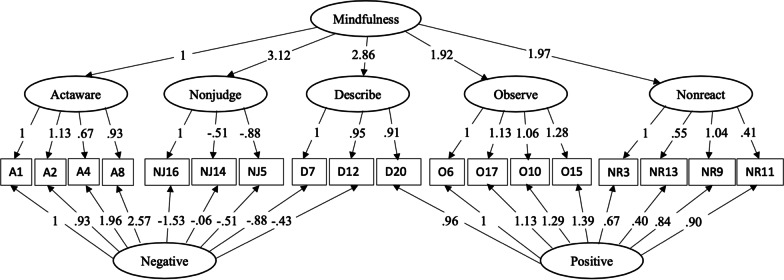
- Across all three studies, the hierarchical five-factor model with method factors fit best; in Study 3 it fit well with CFI = .97, TLI = .96, RMSEA = .04, SRMR = .03.
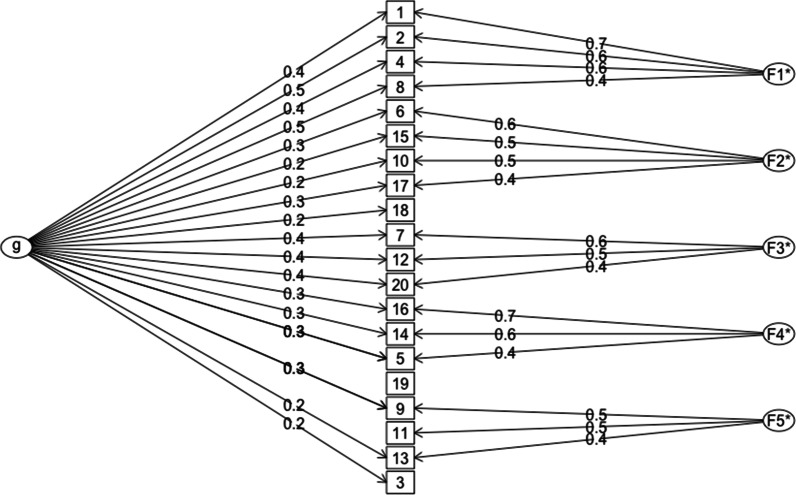
- Study 1’s EFA in a college sample found a clear five-factor structure, but items 18 and 19 had weak loadings; the authors excluded them, and the final Vietnamese version retained 18 items.
- In Study 2, the FFMQ-V total score predicted about 30% of the variance in acceptance (AAQ-II); in Study 3 it accounted for 24% of AAQ-II variance and about 14% of nonattachment variance.
- The FFMQ-V correlated in expected directions with related constructs: positively with acceptance and nonattachment, and negatively with depression, anxiety, and stress; the Nonreact facet had the lowest internal consistency, and in Study 3 the Observe, Nonjudge, and Describe subscales had ω = .48 to .57.
Methods
- The paper conducted three independent studies: Study 1 used a college sample (N = 412) for exploratory factor analysis; Study 2 used an independent college sample (N = 344) for confirmatory factor analysis and discriminant validity; Study 3 replicated Study 2 in a community sample of young adults (N = 574).
- The FFMQ-20 was adapted into Vietnamese using back-translation, expert translation, back-translation, and feedback from five Vietnamese college students.
- Analyses included EFA, exploratory bifactor analysis, CFA with fit indices, and Pearson correlations plus univariate linear regressions with acceptance, nonattachment, depression, anxiety, and stress; missing data were handled with predictive mean matching.
Limitations
- The authors state that the student samples were mostly female in Studies 1 and 2, and recommend balancing the male-to-female ratio in future replication studies.
- They also state that they adapted only the short-form FFMQ-20, and suggest future researchers adapt the original FFMQ into Vietnamese.
- Evident from the text: the samples were all young adults, so the findings are limited to that age range rather than the full Vietnamese population.
Model-written summary. Check it against the paper before relying on it.
Integrity signals
Registry
Cites
Statistics
Figures
Verification
Claims the paper makes
1 Valid · 1 Not valid · 1 Not checked · 31 Own results and interpretations
A result the paper reports from its own data — it cites no other source for it, so there is none to check. The quote shows it is in the paper.
In the paper
“the Observe and Nonreact subscales hardly accounted for any variance of the DASS subscales (i.e., the R2 for these models were around zero)”
§ The psychometric properties of the Vietnamese Version of the Five Facet Mindfulness Questionnaire > Results > Study 3: Confirmatory study using community sample
plain- Asserted: passes — The authors put it forward as true.
- Checkable: passes — It can be checked against evidence.
- Load-bearing: passes — The paper’s conclusions depend on it.
- Based: passes — The paper gives a reason why it holds.
A result the paper reports from its own data — it cites no other source for it, so there is none to check. The quote shows it is in the paper.
In the paper
“compared to the college sample, the Nonjudge subscale accounted for less variance of the Depression (i.e., R2 = .10), the Anxiety (i.e., R2 = .09), and the Stress (i.e., R2 = .12).”
§ The psychometric properties of the Vietnamese Version of the Five Facet Mindfulness Questionnaire > Results > Study 3: Confirmatory study using community sample
plainstates an association- Asserted: passes — The authors put it forward as true.
- Checkable: passes — It can be checked against evidence.
- Load-bearing: unclear — It is unclear whether the paper’s conclusions depend on it.
- Based: passes — The paper gives a reason why it holds.
A result the paper reports from its own data — it cites no other source for it, so there is none to check. The quote shows it is in the paper.
In the paper
“the Observe and Nonreact scores hardly accounted for the variance of any psychological constructs included in the present study.”
§ The psychometric properties of the Vietnamese Version of the Five Facet Mindfulness Questionnaire > Results > Study 2: Confirmatory study using college sample
plain- Asserted: passes — The authors put it forward as true.
- Checkable: passes — It can be checked against evidence.
- Load-bearing: passes — The paper’s conclusions depend on it.
- Based: passes — The paper gives a reason why it holds.
A result the paper reports from its own data — it cites no other source for it, so there is none to check. The quote shows it is in the paper.
In the paper
“the Actaware and Describe subscales accounted for more variance of the DASS subscales in community sample than in college sample.”
§ The psychometric properties of the Vietnamese Version of the Five Facet Mindfulness Questionnaire > Results > Study 3: Confirmatory study using community sample
plainstates an association- Asserted: passes — The authors put it forward as true.
- Checkable: passes — It can be checked against evidence.
- Load-bearing: unclear — It is unclear whether the paper’s conclusions depend on it.
- Based: passes — The paper gives a reason why it holds.
A result the paper reports from its own data — it cites no other source for it, so there is none to check. The quote shows it is in the paper.
In the paper
“the FFMQ-V total score could account for 24% of variance in the AAQ-II score”
§ The psychometric properties of the Vietnamese Version of the Five Facet Mindfulness Questionnaire > Results > Study 3: Confirmatory study using community sample
hedgedstates an association- Asserted: passes — The authors put it forward as true.
- Checkable: passes — It can be checked against evidence.
- Load-bearing: passes — The paper’s conclusions depend on it.
- Based: passes — The paper gives a reason why it holds.
16 more claims
Create a free account to see all 34 claims and to verify the 1 reference still open.
- Probably not a substantial claim. 7
- It may state two separate claims as one. 9
- The quote only partly states this claim. 2
Citations
Cites
Hu, L., & Bentler, P. M. (1999) · Structural Equation Modeling A Multidisciplinary Journal · doi:10.1080/10705519909540118 · Cited by 108,788 · cited 5×
“Hu L, Bentler PM.”
MethodInfluentialComparative fit indexes in structural models.
Bentler, P. M. (1990) · Psychological Bulletin · doi:10.1037/0033-2909.107.2.238 · Cited by 25,266 · cited 1×
“Furthermore, for each fitted CFA model we computed a number of fit indices: (1) the Chi-squared test for goodness of fit, (2) the Comparative Fit Index (CFI, [71]), (3) the Tucker-Lewis Index (TLI, [72]), (4) the Root Mean Squared Error of Approximation (RMSEA, [73]), and (5) the Standardized Root Mean Square Residual…”
MethodAn Index of Factorial Simplicity
Kaiser, H. F. (1974) · Psychometrika · doi:10.1007/bf02291575 · Cited by 14,898
The benefits of being present: Mindfulness and its role in psychological well-being
Brown, K. W., & Ryan, R. M. (2003) · Journal of Personality and Social Psychology · doi:10.1037/0022-3514.84.4.822 · Cited by 13,448 · cited 6×
“construct, resulting in varied interpretations of mindfulness and many mindfulness scales [14] such as the Five Facet Mindfulness Questionnaire (FFMQ) [15, 16], the Freiburg Mindfulness Inventory (FMI) [17], and the Mindful Attention Awareness Scale (MAAS) [18].”
BackgroundInfluentialA Rationale and Test for the Number of Factors in Factor Analysis
Horn, J. L. (1965) · Psychometrika · doi:10.1007/bf02289447 · Cited by 8,714
Mindfulness-based interventions in context: Past, present, and future
Kabat-Zinn, J. (2003) · Clinical Psychology: Science and Practice · doi:10.1093/clipsy.bpg016 · Cited by 8,615 · cited 2×
“Kabat-Zinn J. Mindfulness-based interventions in context: Past, present, and future.”
BackgroundUsing Self-Report Assessment Methods to Explore Facets of Mindfulness
Baer, R. A., Smith, G. T., Hopkins, J., Krietemeyer, J., & Toney, L. (2006) · Assessment · doi:10.1177/1073191105283504 · Cited by 7,511 · cited 5×
“construct, resulting in varied interpretations of mindfulness and many mindfulness scales [14] such as the Five Facet Mindfulness Questionnaire (FFMQ) [15, 16], the Freiburg Mindfulness Inventory (FMI) [17], and the Mindful Attention Awareness Scale (MAAS) [18].”
BackgroundMethodInfluentialA Reliability Coefficient for Maximum Likelihood Factor Analysis
Tucker, L. R., & Lewis, C. (1973) · Psychometrika · doi:10.1007/bf02291170 · Cited by 7,330 · cited 1×
“Furthermore, for each fitted CFA model we computed a number of fit indices: (1) the Chi-squared test for goodness of fit, (2) the Comparative Fit Index (CFI, [71]), (3) the Tucker-Lewis Index (TLI, [72]), (4) the Root Mean Squared Error of Approximation (RMSEA, [73]), and (5) the Standardized Root Mean Square Residual…”
Mindfulness: A proposed operational definition.
Bishop, S. R., Lau, M., Shapiro, S., Carlson, L., Anderson, N. D., Carmody, J., Segal, Z. V., Abbey, S., Speca, M., Velting, D., et al. (2004) · Clinical Psychology: Science and Practice · doi:10.1093/clipsy.bph077 · Cited by 7,234 · cited 1×
“[38], Brown and Ryan [18], and Kabat-Zinn [39].”
BackgroundEstimating psychological networks and their accuracy: A tutorial paper
Epskamp, S., Borsboom, D., & Fried, E. I. (2018) · Behavior Research Methods · doi:10.3758/s13428-017-0862-1 · Cited by 5,715
Bond, F. W., Hayes, S. C., Baer, R. A., Carpenter, K. M., Guenole, N., Orcutt, H. K., Waltz, T., & Zettle, R. D. (2011) · Behavior Therapy · doi:10.1016/j.beth.2011.03.007 · Cited by 3,950 · cited 1×
“The Acceptance and Action Questionnaire (AAQ-II, [50]) consists of seven items and measures acceptance, experiential avoidance, and psychological flexibility.”
MethodBaer, R. A., Smith, G. T., Lykins, E., Button, D., Krietemeyer, J., Sauer, S., Walsh, E., Duggan, D., & Williams, J. M. G. (2008) · Assessment · doi:10.1177/1073191107313003 · Cited by 2,930
Effects of mindfulness on psychological health: A review of empirical studies
Keng, S.-L., Smoski, M. J., & Robins, C. J. (2011) · Clinical Psychology Review · doi:10.1016/j.cpr.2011.04.006 · Cited by 2,687 · cited 1×
“Several review studies [2, 3] concluded that trait mindfulness was negatively associated with many health issues such as chronic pain, depression, social anxiety, and emotion regulation and that mindfulness training could bring about positive psychological effects.”
BackgroundDepression Anxiety Stress Scales
Lovibond, S. H., & Lovibond, P. F. (2011) · PsycTESTS Dataset · doi:10.1037/t01004-000 · Cited by 2,416
Assessment of Mindfulness by Self-Report: The Kentucky Inventory of Mindfulness Skills
Baer, R. A., Smith, G. T., & Allen, K. B. (2004) · Assessment · doi:10.1177/1073191104268029 · Cited by 2,298
Flexible Imputation of Missing Data, Second Edition
van Buuren, S. (2018) · doi:10.1201/9780429492259 · Cited by 2,273
Creswell, J. D. (2017) · Annual Review of Psychology · doi:10.1146/annurev-psych-042716-051139 · Cited by 1,702 · cited 2×
“Furthermore, based on the theoretical relations between mindfulness and psychological constructs such as acceptance, nonattachment, and mental health issues [2, 28, 29, 52, 55, 56], we hypothesized that the FFMQ-V correlated positively with the AAQ-II and the NAS and negatively with the DASS subscales.”
BackgroundMethodGolino, H. F., & Epskamp, S. (2017) · PLOS ONE · doi:10.1371/journal.pone.0174035 · Cited by 1,060
Missing Data in Clinical Research: A Tutorial on Multiple Imputation
Austin, P. C., White, I. R., Lee, D. S., & van Buuren, S. (2021) · Canadian Journal of Cardiology · doi:10.1016/j.cjca.2020.11.010 · Cited by 1,006 · cited 1×
“For each study sample, we imputed missing data using the predictive mean matching (PMM) method [57, 58] as simulation results showed that the PMM method worked well across a wide range of missing data situations [59].”
MethodBohlmeijer, E., ten Klooster, P. M., Fledderus, M., Veehof, M., & Baer, R. (2011) · Assessment · doi:10.1177/1073191111408231 · Cited by 990
ITC Guidelines for Translating and Adapting Tests (Second Edition)
(2018) · International Journal of Testing · doi:10.1080/15305058.2017.1398166 · Cited by 789
Weekly change in mindfulness and perceived stress in a mindfulness-based stress reduction program
Baer, R. A., Carmody, J., & Hunsinger, M. (2012) · Journal of Clinical Psychology · doi:10.1002/jclp.21865 · Cited by 546 · cited 1×
“Furthermore, based on the theoretical relations between mindfulness and psychological constructs such as acceptance, nonattachment, and mental health issues [2, 28, 29, 52, 55, 56], we hypothesized that the FFMQ-V correlated positively with the AAQ-II and the NAS and negatively with the DASS subscales.”
MethodHow Does Mindfulness Training Affect Health? A Mindfulness Stress Buffering Account
Creswell, J. D., & Lindsay, E. K. (2014) · Current Directions in Psychological Science · doi:10.1177/0963721414547415 · Cited by 543
Golino, H., Shi, D., Christensen, A. P., Garrido, L. E., Nieto, M. D., Sadana, R., Thiyagarajan, J. A., & Martinez-Molina, A. (2020) · Psychological Methods · doi:10.1037/met0000255 · Cited by 532
Irving, J. A., Dobkin, P. L., & Park, J. (2009) · Complementary Therapies in Clinical Practice · doi:10.1016/j.ctcp.2009.01.002 · Cited by 531
Chadwick, P., Hember, M., Symes, J., Peters, E., Kuipers, E., & Dagnan, D. (2008) · British Journal of Clinical Psychology · doi:10.1348/014466508x314891 · Cited by 517
The Assessment of Mindfulness with Self-Report Measures: Existing Scales and Open Issues
Bergomi, C., Tschacher, W., & Kupper, Z. (2013) · Mindfulness · doi:10.1007/s12671-012-0110-9 · Cited by 506 · cited 1×
“construct, resulting in varied interpretations of mindfulness and many mindfulness scales [14] such as the Five Facet Mindfulness Questionnaire (FFMQ) [15, 16], the Freiburg Mindfulness Inventory (FMI) [17], and the Mindful Attention Awareness Scale (MAAS) [18].”
BackgroundReliability from α to ω: A tutorial.
Revelle, W., & Condon, D. M. (2019) · Psychological Assessment · doi:10.1037/pas0000754 · Cited by 506
Gu, J., Strauss, C., Crane, C., Barnhofer, T., Karl, A., Cavanagh, K., & Kuyken, W. (2016) · Psychological Assessment · doi:10.1037/pas0000263 · Cited by 431 · cited 1×
“[80] opined that researchers should consider excluding the Observing subscale from comparisons of total scale/subscale scores before and after treatment by Mindfulness Based Table 6 Linear regression models of predicting acceptance, nonattachment, and mental health using mindfulness facets in college sample (N = 344)”
Organizing for Mindfulness: Eastern Wisdom and Western Knowledge
Weick, K. E., & Putnam, T. (2006) · Journal of Management Inquiry · doi:10.1177/1056492606291202 · Cited by 397
Mindfulness Revisited: A Buddhist-Based Conceptualization
Purser, R. E., & Milillo, J. (2015) · Journal of Management Inquiry · doi:10.1177/1056492614532315 · Cited by 331
de Bruin, E. I., Topper, M., Muskens, J. G. A. M., Bögels, S. M., & Kamphuis, J. H. (2012) · Assessment · doi:10.1177/1073191112446654 · Cited by 316
Prospects for a clinical science of mindfulness-based intervention
Dimidjian, S., & Segal, Z. V. (2015) · American Psychologist · doi:10.1037/a0039589 · Cited by 291
van der Riet, P., Levett-Jones, T., & Aquino-Russell, C. (2018) · Nurse Education Today · doi:10.1016/j.nedt.2018.03.018 · Cited by 286
Linear Causal Modeling with Structural Equations
Mulaik, S. A. (2009) · Chapman & Hall/CRC eBooks · doi:10.1201/9781439800393 · Cited by 278
Depression Anxiety and Stress Scales
Lovibond, P. F., & Lovibond, S. H. (2015) · PsycTESTS Dataset · doi:10.1037/t39835-000 · Cited by 255
The Effect of Standardization on a χ 2 Approximation in Factor Analysis
Bartlett, M. S. (1951) · Biometrika · doi:10.2307/2332580 · Cited by 236
Exploring the Psychometric Properties of the Five Facet Mindfulness Questionnaire
Christopher, M. S., Neuser, N. J., Michael, P. G., & Baitmangalkar, A. (2012) · Mindfulness · doi:10.1007/s12671-011-0086-x · Cited by 234
Baminiwatta, A., & Solangaarachchi, I. (2021) · Mindfulness · doi:10.1007/s12671-021-01681-x · Cited by 232 · cited 1×
“Background For the past few decades, mindfulness research has enjoyed a rapid growth in interest and publication [1].”
BackgroundHou, J., Wong, S. Y.-S., Lo, H. H.-M., Mak, W. W.-S., & Ma, H. S.-W. (2014) · Assessment · doi:10.1177/1073191113485121 · Cited by 215
Heeren, A., Douilliez, C., Peschard, V., Debrauwere, L., & Philippot, P. (2011) · European Review of Applied Psychology · doi:10.1016/j.erap.2011.02.001 · Cited by 197
Tran, U. S., Glück, T. M., & Nader, I. W. (2013) · Journal of Clinical Psychology · doi:10.1002/jclp.21996 · Cited by 188 · cited 6×
“More specifically, we propose to adapt the 20-item shortform of the FFMQ (FFMQ-20, [46]) as the FFMQ-20 possesses good psychometric properties in both college and community samples (see also [47, 48]).”
BackgroundMethodInfluentialDevelopment and Validation of the Japanese Version of the Five Facet Mindfulness Questionnaire
Sugiura, Y., Sato, A., Ito, Y., & Murakami, H. (2012) · Mindfulness · doi:10.1007/s12671-011-0082-1 · Cited by 164
Fischer, R., Bortolini, T., Karl, J. A., Zilberberg, M., Robinson, K., Rabelo, A., Gemal, L., Wegerhoff, D., Nguyễn, T. B. T., Irving, B., et al. (2020) · Frontiers in Psychology · doi:10.3389/fpsyg.2020.563876 · Cited by 153
Seven Easy Steps to Open Science: An Annotated Reading List
Crüwell, S., van Doorn, J., Etz, A., Makel, M. C., Moshontz, H., Niebaum, J. C., Orben, A., Parsons, S., & Schulte-Mecklenbeck, M. (2019) · Zeitschrift für Psychologie · doi:10.1027/2151-2604/a000387 · Cited by 153
Kleinke, K. (2017) · Journal of Educational and Behavioral Statistics · doi:10.3102/1076998616687084 · Cited by 148 · cited 1×
“For each study sample, we imputed missing data using the predictive mean matching (PMM) method [57, 58] as simulation results showed that the PMM method worked well across a wide range of missing data situations [59].”
MethodThe Italian five facet mindfulness questionnaire: A contribution to its validity and reliability
Giovannini, C., Giromini, L., Bonalume, L., Tagini, A., Lang, M., & Amadei, G. (2014) · Journal of Psychopathology and Behavioral Assessment · doi:10.1007/s10862-013-9403-0 · Cited by 142 · cited 1×
“[15] and other researchers [28, 79] noted that although the Observe factor is a component of the mindfulness definition, it only correlated with the other FFMQ factors when measuring mindfulness of experienced practitioners.”
ResultNonattachment and mindfulness: Related but distinct constructs.
Sahdra, B., Ciarrochi, J., & Parker, P. (2016) · Psychological Assessment · doi:10.1037/pas0000264 · Cited by 141 · cited 2×
“The Nonattachment Scale is a 7-item scale (NAS, [52]) that measures nonattachment, a Buddhist concept that describe as “a flexible, balanced way of relating to one’s experiences without clinging to or suppressing them” (p.”
BackgroundMethodAguado, J., Luciano, J. V., Cebolla, A., Serrano-Blanco, A., Soler, J., & García-Campayo, J. (2015) · Frontiers in Psychology · doi:10.3389/fpsyg.2015.00404 · Cited by 137 · cited 1×
“[30] suggested that their bifactor model of mindfulness outperformed the non-hierarchical five-factor model (see also [31]).”
BackgroundTran, U. S., Cebolla, A., Glück, T. M., Soler, J., Garcia-Campayo, J., & von Moy, T. (2014) · PLoS ONE · doi:10.1371/journal.pone.0110192 · Cited by 105 · cited 1×
“More specifically, we propose to adapt the 20-item shortform of the FFMQ (FFMQ-20, [46]) as the FFMQ-20 possesses good psychometric properties in both college and community samples (see also [47, 48]).”
MethodThe Effects of Two Novel Gratitude and Mindfulness Interventions on Well-Being
O' Leary, K., & Dockray, S. (2015) · The Journal of Alternative and Complementary Medicine · doi:10.1089/acm.2014.0119 · Cited by 102
Perceived Stress in Multiple Sclerosis: The Potential Role of Mindfulness in Health and Well-Being
Senders, A., Bourdette, D., Hanes, D., Yadav, V., & Shinto, L. (2014) · Journal of Evidence-Based Complementary & Alternative Medicine · doi:10.1177/2156587214523291 · Cited by 101
Van Dam, N. T., Hobkirk, A. L., Danoff-Burg, S., & Earleywine, M. (2012) · Assessment · doi:10.1177/1073191112438743 · Cited by 94
Sahdra, B. K., Ciarrochi, J., Parker, P. D., Basarkod, G., Bradshaw, E. L., & Baer, R. (2017) · European Journal of Personality · doi:10.1002/per.2108 · Cited by 90 · cited 1×
“More specifically, we propose to adapt the 20-item shortform of the FFMQ (FFMQ-20, [46]) as the FFMQ-20 possesses good psychometric properties in both college and community samples (see also [47, 48]).”
MethodThe cross-cultural validity of the five-facet mindfulness questionnaire across 16 countries
Karl, J. A., Prado, S. M. M., Gračanin, A., Verhaeghen, P., Ramos, A., Mandal, S. P., Michalak, J., Zhang, C.-Q., Schmidt, C., Tran, U. S., et al. (2020) · Mindfulness · doi:10.1007/s12671-020-01333-6 · Cited by 85 · cited 7×
“’s [20] opinion that the structure and thus measurement of the FFMQ may be culturally oriented.”
BackgroundMethodResultInfluentialForgiveness, Mindfulness, and Health
Webb, J. R., Phillips, T. D., Bumgarner, D. J., & Conway-Williams, E. (2012) · Mindfulness · doi:10.1007/s12671-012-0119-0 · Cited by 67
The State of Dispositional Mindfulness Research
Karl, J. A., & Fischer, R. D. (2022) · Mindfulness · doi:10.1007/s12671-022-01853-3 · Cited by 57 · cited 7×
“To put these results in a broader context of trait mindfulness research, Karl and Fischer [22] reported that “the publications on trait mindfulness were substantially biased towards Europe, Australia, and North America” (p. 1364).”
BackgroundResultInfluentialDirect Schmid–Leiman Transformations and Rank-Deficient Loadings Matrices
Waller, N. G. (2018) · Psychometrika · doi:10.1007/s11336-017-9599-0 · Cited by 51
Validation of a Short-Form Five Facet Mindfulness Questionnaire Instrument in China
Meng, Y., Mao, K., & Li, C. (2020) · Frontiers in Psychology · doi:10.3389/fpsyg.2019.03031 · Cited by 50 · cited 1×
“[76] retained all 20 items, whereas Cheong et al.”
BackgroundAbujaradeh, H., Colaianne, B. A., Roeser, R. W., Tsukayama, E., & Galla, B. M. (2020) · International Journal of Behavioral Development · doi:10.1177/0165025419873039 · Cited by 46 · cited 1×
“[78] suggested removing the entire Observe subscale (with four items) and one Describe item.”
Lecuona, O., García-Garzón, E., García-Rubio, C., & Rodríguez-Carvajal, R. (2020) · Assessment · doi:10.1177/1073191119873718 · Cited by 45
Karl, J. A., Johnson, F. N., Bucci, L., & Fischer, R. (2022) · Journal of the Royal Society of New Zealand · doi:10.1080/03036758.2021.1915804 · Cited by 44 · cited 1×
“These and other diverged results on the latent structure of the FFMQ led several authors [20, 22, 36, 37] to reexamine the contemporary approach to mindfulness assessment (including the FFMQ) that was mostly based on research conducted in Western countries.”
ResultLocal minima and factor rotations in exploratory factor analysis.
Nguyen, H. V., & Waller, N. G. (2023) · Psychological Methods · doi:10.1037/met0000467 · Cited by 43 · cited 1×
“Next, we rotated the extracted factor loadings using the oblimin algorithm from 1,000 random starts [63].”
MethodSelf-citationA Network Analysis of the Five Facets Mindfulness Questionnaire (FFMQ)
Lecuona, O. Z., García‐Rubio, C., de Rivas, S., Moreno‐Jiménez, J. E., Lara, R. M. M., & Rodríguez‐Carvajal, R. (2021) · Mindfulness · doi:10.1007/s12671-021-01704-7 · Cited by 35 · cited 2×
“[21] that used a recently developed psychometric method (i.”
Method7 Easy Steps to Open Science: An Annotated Reading ListPreprint
Crüwell, S., van Doorn, J. B., Etz, A. J., et al. (2018) · doi:10.31234/osf.io/cfzyx · Cited by 33
Feasibility of a mindfulness-based intervention to address youth issues in Vietnam
Le, T. N., & Trieu, D. T. (2016) · Health Promotion International · doi:10.1093/heapro/dau101 · Cited by 16
Lyzwinski, L. N., Caffery, L., Bambling, M., & Edirippulige, S. (2018) · Alternative and Complementary Therapies · doi:10.1089/act.2018.29182.lnl · Cited by 14
Do, V. V., Spears, C. A., Van Minh, H., Huang, J., Redmon, P. B., Xuan Long, N., & Eriksen, M. P. (2020) · JMIR mHealth and uHealth · doi:10.2196/17337 · Cited by 10
Positive and Negative Emotions and Nonattachment in Vietnamese Buddhists
Nguyen, H. T. M., & Nguyen, H. V. (2018) · Asian Journal of Social Science Studies · doi:10.20849/ajsss.v3i1.324 · Cited by 8
Self-citationRababah, J. A., Al‐Hammouri, M. M., & Drew, B. L. (2020) · Journal of Advanced Nursing · doi:10.1111/jan.14556 · Cited by 7
Relevance of mindfulness practices for culturally and linguistically diverse cancer populations
Russell, L., Ugalde, A., White, V., Pitcher, M., Jorgenssen, S., Whitfield, K., Rasmussen, B., & Livingston, P. (2019) · Psycho-Oncology · doi:10.1002/pon.5221 · Cited by 6
The Validation of Korean Version of Five Facet Mindfulness Questionnaire Short Form
Cheong, M. J., Chae, E.-Y., Lyu, Y.-S., & Kang, H.-W. (2017) · The Royal Society of Chemistry’s Journals, Books and Databases (The Royal Society of Chemistry) · doi:10.7231/jon.2017.28.3.207 · Cited by 5
Research works printed but not linked: 8
- Mandal SP Arya YK Pandey R Mental health and mindfulness: Mediational role of positive and negative affect SIS J Proj Psychol Ment Health 2012 19 2 150 159
- Buchheld N Grossman P Walach H Measuring mindfulness in insight meditation (Vipassana) and meditation-based psychotherapy: the development of the Freiburg Mindfulness Inventory (FMI) J Medit Medit Res 2001 1 1 11 34
- Le TN Cultural considerations in a phenomenological study of mindfulness with Vietnamese youth and cyclo drivers Int Perspect Psychol Res Pract Consult 2017 6 4 246
- Nguyen HTM. Mindfulness, nonattachment and life satisfaction of students: What are contributions to positive psychology? In: Psychological Health in Moderm Society. Hanoi: Vietnam National University Press; 2021. p. 252–65.
- Nguyễn HTM Nguyễn LT Đào HT Ảnh hưởng của chấp nhận đến trầm cảm, lo âu và stress: Những gợi ý cho tâm lý trị liệu ở Việt Nam TẠP CHÍ TÂM LÝ HỌC 2021 9 270 3 21
- Van Buuren S mice: multivariate imputation by chained equations in R J Stat Softw 2011 12 45 1 67
- Bentler PM. EQS structural equations program manual. Vol. 6. Multivariate software Encino, CA; 1995.
- Rosseel Y lavaan: an R package for structural equation modeling J Stat Softw 2012 24 48 1 36
Cited by
Perry, A., Gardener, C., Shieh, J., Hồ, Q. T., Doan, A., & Bhui, K. (2024) · Transcultural Psychiatry · doi:10.1177/13634615241228071 · Cited by 7
“AAQ-II has demonstrated good internal consistency, test – retest reliability and validity in community samples (Bond et al., 2011), with the psychometric properties also validated in clinical and non-clinical samples in diverse countries (Nguyen et al., 2022; Zhang et al., 2014).”
Do, T.-T., & Giang, T.-V. (2024) · Heliyon · doi:10.1016/j.heliyon.2024.e32977 · Cited by 7
“Notably, scholars, such as Nguyen and Dorjee [13], Tran et al. [14], and Nguyen et al. [22] have utilized the western theoretical frameworks of mindfulness to design studies that focus on eastern participants.”
BackgroundChau, D. Q. M. (2025) · English Teaching & Learning · doi:10.1007/s42321-025-00214-2 · Cited by 3
Do, T.-T., & Giang, T.-V. (2023) · SSRN Electronic Journal · doi:10.2139/ssrn.4632240
Metadata
- Authors
- Nguyen, H. T. M., Nguyen, H. V., & Bui, T. T. H.
- Affiliations
- University of Minnesota (US)
- Corresponding author
- Nguyen, Hoang V.
- Venue
- BMC Psychology
- Published
- 2022-12-12
- Volume
- 10
- Issue
- 1
- Pages
- 300-300
- ISSN
- 2050-7283 (ISSN-L)
- PMC
- PMC9743563
- OpenAlex
- W4311586212
- Cited by
- 6
- References
- 70
- Citations by year
- 2026: 1 · 2025: 1 · 2024: 2 · 2023: 2
- FWCI
- 1.14
- Type
- journal article
- Language
- en
- Open access
- gold
- doi.org
- Licence
- cc-by
- creativecommons.org/licenses/by/4.0 (tdm)
- creativecommons.org/licenses/by/4.0 (vor)
- Locations
- BMC Psychology (publishedVersion, cc-by)
- PubMed Central (publishedVersion, cc-by)
- PubMed (publishedVersion)
- DOAJ (DOAJ: Directory of Open Access Journals) (submittedVersion, cc-by-sa)
- Funders
- VNU University of Social Sciences and Humanities (2022.10)
- Topics
- Social Sciences › Psychology › Clinical Psychology › Mindfulness and Compassion Interventions
- Social Sciences › Decision Sciences › Management Science and Operations Research › Psychometric Methodologies and Testing
- Social Sciences › Psychology › Experimental and Cognitive Psychology › Anxiety, Depression, Psychometrics, Treatment, Cognitive Processes
- Keywords
- Five Facet Mindfulness Questionnaire, mindfulness, cross-cultural adaptation, Vietnamese, psychometric properties, factor structure, methodological factors, acceptance, non-attachment, depression, anxiety, stress, young adults
- MeSH terms
- Southeast Asian People, Humans, Psychometrics, Surveys and Questionnaires, Reproducibility of Results, Young Adult, Mindfulness
About these checks
Registry, retraction, Cites and statistics results are computed, not judged, with one exception: a printed reference that no index lists is read once by a model before it counts as a citation error. Claims are extracted by a model and kept only when their quote appears verbatim in the text; each cited source is then checked, with a model’s help, for whether it says what the claim relies on. Those verdicts can be wrong — read the claim’s quote and the cited source before relying on one.
The claim verdicts this report counts are experimental: their accuracy is not yet measured.
A language model drew the claims from the paper on 2026-10-11, under version 3 of the claim definition (model deepseek-v4.1-flash, prompt extract-v3).
A second model labelled each claim on 2026-10-11 (model jev-1.13-20260917, definition revision gold-guideline-v0.2).
Statistics and arithmetic are recomputed, not judged.
Confidence bands are shown only for fields calibrated on our annotated test set. None is calibrated yet, so no band is shown.
What counts as a claim ›How we measure confidence ›How we check this ›
Are you an author, or do you see a problem with this page? Request a review
Data sources
Bibliographic data: Semantic Scholar, OpenAlex, Crossref.
Contains information from the Semantic Scholar Academic Graph Datasets, made available under the ODC Attribution License (ODC-BY 1.0).
Semantic Scholar’s data is described in: Kinney, R., et al. (2023). The Semantic Scholar Open Data Platform. arXiv:2301.10140.
