

Anxiety and Depression Symptoms among Youth Survivors of Childhood Sexual Abuse: A Network Analysis
Open accessThe DOI matches its Crossref record; 92 of the 92 references it cites were found in a registry or an index; 6 of the 75 sources its claims cite were checked for support.
Abstract
Background: Previous studies have frequently reported a high prevalence of co-occurring anxiety and depression among people who experienced stressful events in childhood. However, few have noted the symptomatic relationship of this comorbidity among childhood sexual abuse (CSA) survivors. Therefore, this study’s objectives were as follows: (1) to examine the relationship across symptoms between anxiety and depression among CSA survivors; (2) to compare differences between male and female network structures among CSA survivors. Methods: A total of 63 Universities and Colleges in Jilin Province, China, covered 96,218 participants in this study, a sub-set data of which met the criteria of CSA was analyzed with the network analysis. The Childhood Trauma Questionnaire-Short Form (CTQ-SF), measured CSA. Anxiety was measured by the seven-item Generalized Anxiety Disorder Scale (GAD-7), and depression was measured by the Patient Health Questionnaire (PHQ-9). The sex difference between anxiety and depression among CSA survivors was compared. Results: 3,479 college students reported the experience of CSA (CTQ-SF total scores ≥ 8), with a prevalence of 3.62% (95% CI: 3.50–3.73%). Among CSA survivors, control worry, sad mood, and energy were central and bridge symptoms of the anxiety and depression network. Meanwhile, male CSA survivors appeared to have a stronger correlation between guilt and suicide, but female CSA survivors seemed to have a stronger correlation between control worry and suicide. Moreover, the edge of control worry-relax-afraid was stronger in the male network, while the edge of restless-relax was stronger in the female network. Conclusion: Control worry, sad mood, and energy are crucial to offer targeted treatment and to relieve anxiety and depression symptoms for CSA survivors. Guilt needs more attention for male CSA survivors, while control worry remains more important for female CSA survivors to reduce suicidal ideation and suicide attempts.
Overview
CoChat Summary
TL;DR
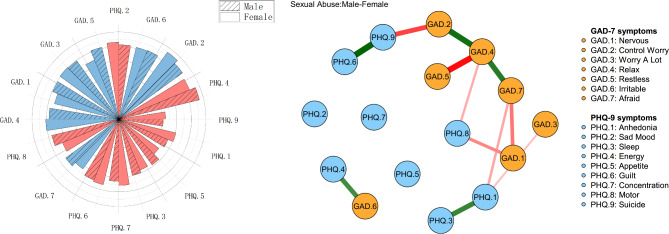
This cross-sectional network analysis of 3,479 university students in Jilin Province, China with childhood sexual abuse (CSA) found that “Control Worry,” “Sad Mood,” and “Energy” were the most central and bridge symptoms linking anxiety and depression. The paper also reported sex differences in network structure, including stronger guilt–suicide links in males and stronger control-worry–suicide links in females.
Key findings
- Among 96,218 participants, 3.62% (95% CI 3.50–3.73%; n = 3,479) reported CSA; prevalence was 4.2% in males (95% CI 4.04–4.44%) and 3.2% in females (95% CI 3.03–3.32%).
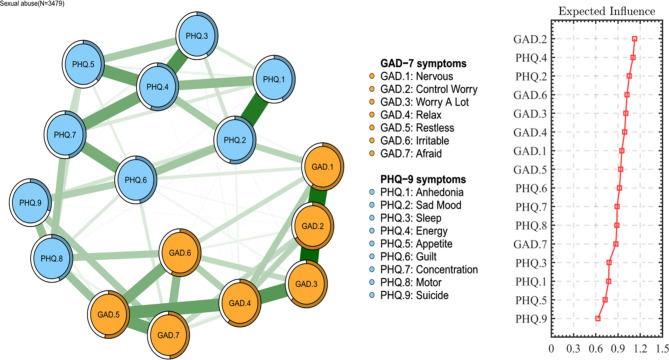
- In the full CSA sample, the most central symptoms by expected influence were GAD.2 “Control Worry”, followed by PHQ.4 “Energy,” PHQ.2 “Sad Mood,” and GAD.6 “Irritable.”
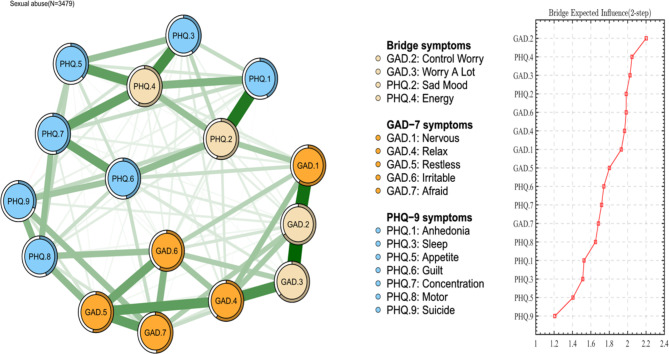
- The most critical bridge symptoms by bridge expected influence were GAD.2 “Control Worry,” PHQ.4 “Energy,” GAD.3 “Worry A Lot,” and PHQ.2 “Sad Mood.”
- The strongest within-domain edges were GAD.2–GAD.3 (“Control Worry”–“Worry A Lot”) for anxiety and PHQ.1–PHQ.2 (“Anhedonia”–“Sad Mood”) for depression; the strongest cross-domain edge was GAD.5–PHQ.8 with mean edge weight 0.14, followed by GAD.7–PHQ.9 and GAD.6–PHQ.8 with mean edge weight 0.13 each.
Methods
- Design: Cross-sectional online survey following STROBE guidelines, conducted in Jilin Province, China, from October to November 2021.
- Sample/data: University/college students aged 16 or older; after exclusions, 96,218 participants remained, and 3,479 who met the CSA cut-off on CTQ-SF (total scores ≥ 8) were analyzed.
- Analysis: Anxiety and depression symptoms were measured with GAD-7 and PHQ-9; symptom networks were estimated using a Graphical Gaussian Model with LASSO/EBIC regularization, centrality via expected influence, bridge symptoms via bridge expected influence, sex differences via Network Comparison Test, and stability via bootstrapping. An adjusted network controlled for sex, family type, current annual income, and only-child status.
Limitations
- The paper states it was cross-sectional, so it cannot establish causality; the authors say longitudinal studies are required to examine causal relationships and chronic vs acute psychological issues.
- The study relied on self-report and did not confirm clinical diagnoses by a psychiatrist, so some participants may or may not have met clinical criteria.
- The authors state the direction of edges could not be identified, and that the network approach has limited replicability across samples; they also note possible report bias and memory errors from subjective scales.
- Evident from the text: the sample was restricted to students in colleges/universities in Jilin Province, so the findings may not generalize beyond this specific population.
Model-written summary. Check it against the paper before relying on it.
Integrity signals
Registry
Cites
Statistics
Figures
Verification
Claims the paper makes
6 Valid · 0 Not valid · 55 Not checked · 53 Own results and interpretations
Every source the paper cites for this claim was checked and supports it.
In the paper
“All these simultaneously result in more co-occurring negative emotions and physical arousal symptoms [ 66 ].”
What the sources say
- Supportedcites [66] Newman MG, Llera SJ, Erickson TM, Przeworski A, Castonguay LG. Worry and generalized anxiety disorder: a review and theoretical synthesis of evidence on nature, etiology, mechanisms, and treatment. Annu Rev Clin Psychol. 2013;9:275–97. source
The Cognitive, Affective, and Neurobiological Mechanisms section explicitly says worry leads to greater concurrent negative emotionality and physiological activation. It reports increased negative emotion and sympathetic nervous system activity following worry induction, supporting the cited point about co-occurring negative emotions and physical arousal. (LLM, conf=0.92)
plainstates a cause- Asserted: passes — The authors put it forward as true.
- Checkable: passes — It can be checked against evidence.
- Load-bearing: unclear — It is unclear whether the paper’s conclusions depend on it.
- Based: passes — The paper gives a reason why it holds.
- Supported
The sources with a verdict support this claim; the rest weren’t checked yet, have no full text we could read, or their verdicts aren’t rated yet.
In the paper
“In line with previous network structures of anxiety and depression [ 37 , 57 ], restlessness is highly correlated to female CSA survivors’ inability to relax.”
What the sources say
- Not checked yetcites [37] Beard C, Millner AJ, Forgeard MJ, Fried EI, Hsu KJ, Treadway MT, Leonard CV, Kertz SJ, Bjorgvinsson T. Network analysis of depression and anxiety symptom relationships in a psychiatric sample. Psychol Med. 2016;46(16):3359–69. source
- Supportedcites [57] Kaiser T, Herzog P, Voderholzer U, Brakemeier EL. Unraveling the comorbidity of depression and anxiety in a large inpatient sample: network analysis to examine bridge symptoms. Depress Anxiety. 2021;38(3):307–17. source
The citation is attached to the clause about previous network structures of anxiety and depression, not to the citing authors' own CSA finding. Kaiser et al. (2021) provide exactly that: in their depression/anxiety network, 'restless' and 'trouble relaxing' are named among the most central symptoms (Results 3.1.1) and among the significantly strongest bridge symptoms between depression and anxiety (Results 3.2, Aim 2), and the Discussion (Section 4) summarises the strongest bridge symptoms as describing 'restlessness and the inability to end this restlessness'. Our copy does not report a single explicit edge weight between the restless and relax nodes (community analysis even places them in different communities), but the attributed content — a prior anxiety–depression network in which restlessness and inability to relax are tightly linked bridge/central symptoms — is clearly stated. (LLM, conf=0.82)
plainstates an association- Asserted: passes — The authors put it forward as true.
- Checkable: passes — It can be checked against evidence.
- Load-bearing: unclear — It is unclear whether the paper’s conclusions depend on it.
- Based: passes — The paper gives a reason why it holds.
A result the paper reports from its own data — it cites no other source for it, so there is none to check. The quote shows it is in the paper.
In the paper
“The network structure of anxiety and depression showed good stability, among CSA victims”
plain- Asserted: passes — The authors put it forward as true.
- Checkable: passes — It can be checked against evidence.
- Load-bearing: unclear — It is unclear whether the paper’s conclusions depend on it.
- Based: passes — The paper gives a reason why it holds.
A result the paper reports from its own data — it cites no other source for it, so there is none to check. The quote shows it is in the paper.
In the paper
“The prevalence of CSA among males was 4.2% (95% CI: 4.04–4.44%), while among females was 3.2% (95% CI: 3.03–3.32%).”
plainn = 96,218- Asserted: passes — The authors put it forward as true.
- Checkable: passes — It can be checked against evidence.
- Load-bearing: unclear — It is unclear whether the paper’s conclusions depend on it.
- Based: passes — The paper gives a reason why it holds.
- Rests on an assumption not shown here.
A result the paper reports from its own data — it cites no other source for it, so there is none to check. The quote shows it is in the paper.
In the paper
“The t-test result suggested that the confounding variables did not significantly affect the network model (t = 0.89, P = 0.38).”
hedged- Asserted: passes — The authors put it forward as true.
- Checkable: passes — It can be checked against evidence.
- Load-bearing: unclear — It is unclear whether the paper’s conclusions depend on it.
- Based: passes — The paper gives a reason why it holds.
35 more claims
Create a free account to see all 114 claims and to verify the 69 references still open.
- It may state two separate claims as one. 40
- Probably not a substantial claim. 56
Self-check
Percentages, sums and reported differences re-computed from the paper’s own numbers.
Each contradiction between two passages listed here was confirmed by an independent check.
Rated minor: it would not touch a result — a value no result rests on, a p-value that stays on the same side of the significance level, or a conflict that is clerical, resolved elsewhere in the paper, or outside its own findings.
In the paper
“The remaining participants were extracted to form the sub-data (n = 3,479) who met the cut-off for CSA (CTQ-SF total scores ≥ 8)”
“For sexual abuse, the cut-off score is ≥ 8, inclusive of moderate to severe exposure (CSA in this study).”
Citations
Cites
The PHQ-9: Validity of a brief depression severity measure
Kroenke, K., Spitzer, R. L., & Williams, J. B. W. (2001) · Journal of General Internal Medicine · doi:10.1046/j.1525-1497.2001.016009606.x · Cited by 44,910
A Brief Measure for Assessing Generalized Anxiety Disorder: The GAD-7
Spitzer, R. L., Kroenke, K., Williams, J. B. W., & Löwe, B. (2006) · Archives of Internal Medicine · doi:10.1001/archinte.166.10.1092 · Cited by 31,765
von Elm, E., Altman, D. G., Egger, M., Pocock, S. J., Gøtzsche, P. C., & Vandenbroucke, J. P. (2014) · International Journal of Surgery · doi:10.1016/j.ijsu.2014.07.013 · Cited by 9,909
Development and validation of a brief screening version of the Childhood Trauma Questionnaire
Bernstein, D. P., Stein, J. A., Newcomb, M. D., Walker, E., Pogge, D., Ahluvalia, T., Stokes, J., Handelsman, L., Medrano, M., Desmond, D., et al. (2003) · Child Abuse & Neglect · doi:10.1016/s0145-2134(02)00541-0 · Cited by 6,419 · cited 1×
“Childhood sexual abuse The Chinese version of the Childhood Trauma Questionnaire-Short Form (CTQ-SF) was utilized to screen the experience of CSA [40], developed by the version of Bernstein and colleagues [41].”
MethodEstimating psychological networks and their accuracy: A tutorial paper
Epskamp, S., Borsboom, D., & Fried, E. I. (2018) · Behavior Research Methods · doi:10.3758/s13428-017-0862-1 · Cited by 5,715
Hughes, K., Bellis, M. A., Hardcastle, K. A., Sethi, D., Butchart, A., Mikton, C., Jones, L., & Dunne, M. P. (2017) · The Lancet Public Health · doi:10.1016/s2468-2667(17)30118-4 · Cited by 5,255 · cited 1×
“Literature suggests that experiences of CSA could permanently harm mental and physical development across the life span [6, 7].”
Backgroundqgraph: Network Visualizations of Relationships in Psychometric Data
Epskamp, S., Cramer, A. O. J., Waldorp, L. J., Schmittmann, V. D., & Borsboom, D. (2012) · Journal of Statistical Software · doi:10.18637/jss.v048.i04 · Cited by 4,856 · cited 1×
“The ‘qgraph’ R package [54] was employed to visualize the symptomatic correlation of a network.”
MethodA network theory of mental disorders
Borsboom, D. (2017) · World Psychiatry · doi:10.1002/wps.20375 · Cited by 3,482 · cited 2×
“Based on network analysis theory, a “node” is used to represent a symptom in a network, and an “edge” is used to describe the correlation between any two nodes [32].”
BackgroundMethodMoral Emotions and Moral Behavior
Tangney, J. P., Stuewig, J., & Mashek, D. J. (2007) · Annual Review of Psychology · doi:10.1146/annurev.psych.56.091103.070145 · Cited by 3,222 · cited 1×
“Once disclosing their experience of CSA, men may meet negative responses in the form of stigma and stereotypes (i.e., blaming, wagging, ignoring) [79], which could increase the severity of guilt symptoms to reflect perceived inward interpersonal failure and negative empathic recognition [80].”
BackgroundA tutorial on regularized partial correlation networks
Epskamp, S., & Fried, E. I. (2018) · Psychological Methods · doi:10.1037/met0000167 · Cited by 2,918 · cited 1×
“Using the graphic least absolute shrink-age and selection operator (LASSO) [51], the network was regulated to avoid overfitting and to elevate the interpretability of a network model structure.”
MethodThe p Factor: One General Psychopathology Factor in the Structure of Psychiatric Disorders?
Caspi, A., Houts, R. M., Belsky, D. W., Goldman-Mellor, S. J., Harrington, H., Israel, S., Meier, M. H., Ramrakha, S., Shalev, I., Poulton, R., et al. (2014) · Clinical Psychological Science · doi:10.1177/2167702613497473 · Cited by 2,449
Extended Bayesian information criteria for model selection with large model spaces
Chen, J., & Chen, Z. (2008) · Biometrika · doi:10.1093/biomet/asn034 · Cited by 2,011 · cited 1×
“Mean-while, the shrinkage parameter could be selected based on the Extended Bayesian Information Criterion (EBIC) [52].”
MethodA Global Perspective on Child Sexual Abuse: Meta-Analysis of Prevalence Around the World
Stoltenborgh, M., van IJzendoorn, M. H., Euser, E. M., & Bakermans-Kranenburg, M. J. (2011) · Child Maltreatment · doi:10.1177/1077559511403920 · Cited by 2,010 · cited 1×
“Meanwhile, it is further reported that survivors of CSA suffer from severe damage to their self-esteem [8], which may hinder an individual’s overall well-being [9] and increase risks of suicidal ideation and attempts [10].”
BackgroundBridge Centrality: A Network Approach to Understanding Comorbidity
Jones, P. J., Ma, R., & McNally, R. J. (2021) · Multivariate Behavioral Research · doi:10.1080/00273171.2019.1614898 · Cited by 1,741 · cited 1×
“Moreover, bridge symptoms, connecting and activating each other through their linked symptoms, exert influence from one disorder to another, which can be estimated by bridge expected influence (bEI) indices [38].”
BackgroundWang, W., Bian, Q., Zhao, Y., Li, X., Wang, W., Du, J., Zhang, G., Zhou, Q., & Zhao, M. (2014) · General Hospital Psychiatry · doi:10.1016/j.genhosppsych.2014.05.021 · Cited by 1,480 · cited 1×
“A cut-off score of 7 or higher on the PHQ-9 had a sensitivity and specificity of both 86% [48].”
BackgroundComparing network structures on three aspects: A permutation test.
van Borkulo, C. D., van Bork, R., Boschloo, L., Kossakowski, J. J., Tio, P., Schoevers, R. A., Borsboom, D., & Waldorp, L. J. (2023) · Psychological Methods · doi:10.1037/met0000476 · Cited by 1,465 · cited 2×
“The centrality of each node was identified according to the expected influence (EI), which represents the whole edges of the weight connecting to this code [53].”
BackgroundMethodValidity of the brief patient health questionnaire mood scale (PHQ-9) in the general population
Martin, A., Rief, W., Klaiberg, A., & Braehler, E. (2006) · General Hospital Psychiatry · doi:10.1016/j.genhosppsych.2005.07.003 · Cited by 1,379 · cited 1×
“Previous studies indicate that the PHQ-9 scale could be a valid and reliable measurement among the general population [47].”
BackgroundChu, C., Buchman-Schmitt, J. M., Stanley, I. H., Hom, M. A., Tucker, R. P., Hagan, C. R., Rogers, M. L., Podlogar, M. C., Chiurliza, B., Ringer, F. B., et al. (2017) · Psychological Bulletin · doi:10.1037/bul0000123 · Cited by 1,231
The Gaussian Graphical Model in Cross-Sectional and Time-Series Data
Epskamp, S., Waldorp, L. J., Mõttus, R., & Borsboom, D. (2018) · Multivariate Behavioral Research · doi:10.1080/00273171.2018.1454823 · Cited by 1,134 · cited 1×
“Estimating the Graphical Gaussian Model (GGM) represent the structure of anxiety and depression in terms of the severity of symptoms [50].”
BackgroundNetwork analysis of depression and anxiety symptom relationships in a psychiatric sample
Beard, C., Millner, A. J., Forgeard, M. J. C., Fried, E. I., Hsu, K. J., Treadway, M. T., Leonard, C. V., Kertz, S. J., & Björgvinsson, T. (2016) · Psychological Medicine · doi:10.1017/s0033291716002300 · Cited by 929 · cited 4×
“The expected influence (EI) index indicates the centrality of each symptom, and via it, the most central symptoms could be identified in a network [37].”
BackgroundInfluentialRobinaugh, D. J., Hoekstra, R. H. A., Toner, E. R., & Borsboom, D. (2020) · Psychological Medicine · doi:10.1017/s0033291719003404 · Cited by 861 · cited 1×
“The network approach, a relatively novel research method to explore various relationships across symptoms, has been widely applied in psychopathological and clinical psychiatric fields [32, 33].”
BackgroundLong-term outcomes of childhood sexual abuse: an umbrella review
Hailes, H. P., Yu, R., Danese, A., & Fazel, S. (2019) · The Lancet Psychiatry · doi:10.1016/s2215-0366(19)30286-x · Cited by 827 · cited 2×
“Reviews also reported that persons with a history of CSA are potentially at risk of long-term anxiety and depression diagnoses [11, 12].”
BackgroundThe retrosplenial cortex and emotion: new insights from functional neuroimaging of the human brain
Maddock, R. J. (1999) · Trends in Neurosciences · doi:10.1016/s0166-2236(98)01374-5 · Cited by 733 · cited 1×
“Neuroimaging results identified that sad mood affects the thalamus, a specific brain region of cognition linked to emotional state [69].”
Fergusson, D. M., McLeod, G. F. H., & Horwood, L. J. (2013) · Child Abuse & Neglect · doi:10.1016/j.chiabu.2013.03.013 · Cited by 703 · cited 1×
“Another longitudinal cohort study of non-clinical individuals summarized the extent of CSA significantly exerted positive associations with major depression (β = 0.426, SE = 0.094, P 0.001) and anxiety disorder (β = 0.364, SE = 0.089, P 0.001) [14].”
BackgroundInfluentialDuffy, M. E., Twenge, J. M., & Joiner, T. E. (2019) · Journal of Adolescent Health · doi:10.1016/j.jadohealth.2019.04.033 · Cited by 579 · cited 1×
“Women appear to have a greater tendency toward emotional disorders, which could incur more suicide-related outcomes across the life course [83].”
BackgroundRisk factors associated with stress, anxiety, and depression among university undergraduate students
Mofatteh, M., Lincoln College, U. O. O., Merton College, U. O. O., & Sir William Dunn School of Pathology, U. O. O. (2021) · AIMS Public Health · doi:10.3934/publichealth.2021004 · Cited by 561 · cited 1×
“All these stressors would aggravate the individuals’ risks of anxiety, depression, and even suicidal behaviors [23].”
BackgroundGardner, M. J., Thomas, H. J., & Erskine, H. E. (2019) · Child Abuse & Neglect · doi:10.1016/j.chiabu.2019.104082 · Cited by 545 · cited 1×
“A meta-analysis included studies based on non-clinical samples found that individuals with a history of CSA may sustainably tolerate various mental disorders, in particular, bearing the burden of anxiety [OR = 1.90 (95% CI: 1.60–2.25)] and depression symptoms [OR = 2.11 (95% CI: 1.83–2.44)] [13].”
MethodInfluentialSex differences in anxiety and depression: circuits and mechanisms
Bangasser, D. A., & Cuarenta, A. (2021) · Nature Reviews Neuroscience · doi:10.1038/s41583-021-00513-0 · Cited by 479 · cited 2×
“Research on arginine vasopressin and oxytocin illustrated that these matters could activate the same neuro system in both sexes but produce anxiety only for males [30].”
BackgroundNewman, M. G., Llera, S. J., Erickson, T. M., Przeworski, A., & Castonguay, L. G. (2013) · Annual Review of Clinical Psychology · doi:10.1146/annurev-clinpsy-050212-185544 · Cited by 472 · cited 1×
“All these simultaneously result in more co-occurring negative emotions and physical arousal symptoms [66].”
BackgroundComparing network structures on three aspects: A permutation test
van Borkulo, C. D., Boschloo, L., Kossakowski, J. J., Tio, P., Schoevers, R. A., Borsboom, D., & Waldorp, L. (2017) · doi:10.13140/rg.2.2.29455.38569 · Cited by 465
Hanson, J. L., Chung, M. K., Avants, B. B., Shirtcliff, E. A., Gee, J. C., Davidson, R. J., & Pollak, S. D. (2010) · The Journal of Neuroscience · doi:10.1523/jneurosci.0859-10.2010 · Cited by 455 · cited 1×
“Earlier studies have explored that exposure to sexual abuse may affect smaller thalamic volume as well [70, 71].”
BackgroundThe Study of Psychopathology from the Network Analysis Perspective: A Systematic Review
Contreras, A., Nieto, I., Valiente, C., Espinosa, R., & Vazquez, C. (2019) · Psychotherapy and Psychosomatics · doi:10.1159/000497425 · Cited by 448
Gender differences in risk factors for suicide in Denmark
Qin, P., Agerbo, E., Westergård-Nielsen, N., Eriksson, T., & Mortensen, P. B. (2000) · British Journal of Psychiatry · doi:10.1192/bjp.177.6.546 · Cited by 375 · cited 1×
“Moreover, comorbid anxiety and depression result in a two-fold higher risk of suicide in men than in women [31].”
BackgroundEvidence that psychopathology symptom networks have limited replicability.
Forbes, M. K., Wright, A. G. C., Markon, K. E., & Krueger, R. F. (2017) · Journal of Abnormal Psychology · doi:10.1037/abn0000276 · Cited by 354 · cited 1×
“Fourth, the network approach has the inherent flaw of limited replicability across samples [96].”
BackgroundHe, J., Zhong, X., Gao, Y., Xiong, G., & Yao, S. (2019) · Child Abuse & Neglect · doi:10.1016/j.chiabu.2019.03.009 · Cited by 329 · cited 1×
“The Chinese version of CTQ-SF has a Cronbach’s alpha of 0.79, showing acceptable reliability among the undergraduate sample [43].”
MethodInfluentialKaiser, T., Herzog, P., Voderholzer, U., & Brakemeier, E. (2021) · Depression and Anxiety · doi:10.1002/da.23136 · Cited by 296 · cited 2×
“In two network analyses based on clinical psychiatric samples, sad mood was the most central symptom in the anxiety and depression network structure, followed by uncontrollable worry [37, 57].”
BackgroundGallo, E. A. G., Munhoz, T. N., Loret de Mola, C., & Murray, J. (2018) · Child Abuse & Neglect · doi:10.1016/j.chiabu.2018.01.003 · Cited by 279 · cited 1×
“Women with a history of CSA have stronger anxiety and depression symptoms than men [29].”
BackgroundOpposite Molecular Signatures of Depression in Men and Women
Seney, M. L., Huo, Z., Cahill, K., French, L., Puralewski, R., Zhang, J., Logan, R. W., Tseng, G., Lewis, D. A., & Sibille, E. (2018) · Biological Psychiatry · doi:10.1016/j.biopsych.2018.01.017 · Cited by 272 · cited 1×
“From the transcriptomic perspective, there were sex-specific transcriptional profiles in cortical regions and limbic systems among patients with major depressive symptoms [93].”
BackgroundRodebaugh, T. L., Tonge, N. A., Piccirillo, M. L., Fried, E., Horenstein, A., Morrison, A. S., Goldin, P., Gross, J. J., Lim, M. H., Fernandez, K. C., et al. (2018) · Journal of Consulting and Clinical Psychology · doi:10.1037/ccp0000336 · Cited by 229 · cited 1×
“Central symptoms could predict changes to other symptoms, and bridge symptoms could be clinically transdiagnostic to differences between the two symptoms [95]; hence, targeted interventions toward these symptoms could be imposed to relieve anxiety and depressive disorders for CSA survivors.”
BackgroundSheehy, K., Noureen, A., Khaliq, A., Dhingra, K., Husain, N., Pontin, E. E., Cawley, R., & Taylor, P. J. (2019) · Clinical Psychology Review · doi:10.1016/j.cpr.2019.101779 · Cited by 223 · cited 1×
“[77].”
Paquola, C., Bennett, M. R., & Lagopoulos, J. (2016) · Neuroscience & Biobehavioral Reviews · doi:10.1016/j.neubiorev.2016.08.011 · Cited by 217 · cited 2×
“Compared with non-abused adults, individuals who experience CSA were found to have primarily reduced hippocampal volume as well [28].”
BackgroundThe Suicidal Mode: A Cognitive‐Behavioral Model of Suicidality
Rudd, M. D. (2000) · Suicide and Life-Threatening Behavior · doi:10.1111/j.1943-278x.2000.tb01062.x · Cited by 213 · cited 1×
“Guilt is one of the mixed emotions in the affective system to trigger suicidal ideation and behavior [81].”
BackgroundSelf esteem levels vs global scores on the Rosenberg self-esteem scale
García, J. A., y Olmos, F. C., Matheu, M. L., & Carreño, T. P. (2019) · Heliyon · doi:10.1016/j.heliyon.2019.e01378 · Cited by 200 · cited 1×
“Meanwhile, it is further reported that survivors of CSA suffer from severe damage to their self-esteem [8], which may hinder an individual’s overall well-being [9] and increase risks of suicidal ideation and attempts [10].”
BackgroundLlera, S. J., & Newman, M. G. (2010) · Emotion · doi:10.1037/a0019351 · Cited by 195 · cited 1×
“Empirical studies indicate that worry exerts specific effects on cardiac activity [63], and it increases the activity of the sympathetic nervous system while decreasing the activity of the parasympathetic nervous system [64].”
BackgroundNetwork structure of depression and anxiety symptoms in Chinese female nursing students
Ren, L., Wang, Y., Wu, L., Wei, Z., Cui, L., Wei, X., Hu, X., Peng, J., Jin, Y., Li, F., et al. (2021) · BMC Psychiatry · doi:10.1186/s12888-021-03276-1 · Cited by 194 · cited 3×
“One study on patients with clinical major depression found that loss of energy or fatigue was the most central symptom in the anxiety and depression network [58], and the same finding was stated in another network analysis based on non-clinical nursing undergraduate students [59].”
BackgroundResultInfluentialSelf-citationGarabiles, M. R., Lao, C. K., Xiong, Y., & Hall, B. J. (2019) · Journal of Affective Disorders · doi:10.1016/j.jad.2019.02.062 · Cited by 192 · cited 1×
“We exposed a strong correlation between being afraid and being able to relax within the anxiety and depression network structure among CSA male survivors, which was reported in previous network analyses as well [89, 90].”
ResultChild Sexual Abuse in the Etiology of Anxiety Disorders: A Systematic Review of Reviews
Maniglio, R. (2013) · Trauma, Violence, & Abuse · doi:10.1177/1524838012470032 · Cited by 178
Characteristics of child physical and sexual abuse as predictors of psychopathology
Adams, J., Mrug, S., & Knight, D. C. (2018) · Child Abuse & Neglect · doi:10.1016/j.chiabu.2018.09.019 · Cited by 178 · cited 1×
“With the gradual maturation of the cognitive system, rumination of past CSA could trigger retrospective traumatic memories, increasing risks to mental health as well [22].”
BackgroundChronic fatigue syndrome: diagnosis and treatment.
Yancey, J. R., & Thomas, S. M. (2012) · PubMed · Cited by 177
Predictors of suicidality across the life span: The Isle of Wight study
Pickles, A., Aglan, A., Collishaw, S., Messer, J., Rutter, M., & Maughan, B. (2010) · Psychological Medicine · doi:10.1017/s0033291709991905 · Cited by 175 · cited 1×
“Thus, women who experienced CSA may incur repetitive and elevated levels of worry [87] and may generate more frequent suicide attempts [88].”
BackgroundSu, Y., D’Arcy, C., Yuan, S., & Meng, X. (2019) · Journal of Affective Disorders · doi:10.1016/j.jad.2019.04.026 · Cited by 169 · cited 1×
“Such a complex stressor could disrupt crucial cognitive functions such as emotional regulation, negatively reinforcing an individual’s psychiatric problems [18].”
BackgroundPark, S.-C., & Kim, D. (2020) · Journal of Affective Disorders · doi:10.1016/j.jad.2020.03.078 · Cited by 166
Child abuse, neural structure, and adolescent psychopathology: a longitudinal study
Busso, D. S., McLaughlin, K. A., Brueck, S., Peverill, M., Gold, A. L., & Sheridan, M. A. (2017) · Journal of the American Academy of Child & Adolescent Psychiatry · doi:10.1016/j.jaac.2017.01.013 · Cited by 164 · cited 1×
“Literature suggests that experiences of CSA could permanently harm mental and physical development across the life span [6, 7].”
BackgroundYang, Y., Sun, H., Luo, X., Li, W., Yang, F., Xu, W., Ding, K., Zhou, J., Liu, W., Garg, S., et al. (2022) · Journal of Affective Disorders · doi:10.1016/j.jad.2022.04.119 · Cited by 152 · cited 1×
“In this study, “Control worry” refers to being unable to stop or control worry, frequently identified as one central or bridge symptom in the network structure of comorbid anxiety and depression [60, 61].”
BackgroundSelf-citationChildhood adversities and depression in adulthood: Current findings and future directions.
Liu, R. T. (2017) · Clinical Psychology: Science and Practice · doi:10.1111/cpsp.12190 · Cited by 147 · cited 1×
“According to the cognitive perspective, CSA, as one of the stressful events in childhood, enables the formation of maladaptive schemas for a person [17].”
BackgroundThe Disclosure Experiences of Male Child Sexual Abuse Survivors
Gagnier, C., & Collin-Vézina, D. (2016) · Journal of Child Sexual Abuse · doi:10.1080/10538712.2016.1124308 · Cited by 144 · cited 1×
“Once disclosing their experience of CSA, men may meet negative responses in the form of stigma and stereotypes (i.e., blaming, wagging, ignoring) [79], which could increase the severity of guilt symptoms to reflect perceived inward interpersonal failure and negative empathic recognition [80].”
BackgroundProlonged cardiac effects of momentary assessed stressful events and worry episodes
Pieper, S., Brosschot, J. F., van der Leeden, R., & Thayer, J. F. (2010) · Psychosomatic Medicine · doi:10.1097/psy.0b013e3181dbc0e9 · Cited by 136 · cited 1×
“Empirical studies indicate that worry exerts specific effects on cardiac activity [63], and it increases the activity of the sympathetic nervous system while decreasing the activity of the parasympathetic nervous system [64].”
BackgroundAdverse childhood experiences and repetitive negative thinking in adulthood: A systematic review
Mansueto, G., Cavallo, C., Palmieri, S., Ruggiero, G. M., Sassaroli, S., & Caselli, G. (2021) · Clinical Psychology & Psychotherapy · doi:10.1002/cpp.2590 · Cited by 124 · cited 1×
“Thus, women who experienced CSA may incur repetitive and elevated levels of worry [87] and may generate more frequent suicide attempts [88].”
BackgroundCleare, A. J. (2001) · Journal of Clinical Endocrinology & Metabolism · doi:10.1210/jc.86.8.3545 · Cited by 123 · cited 1×
“Chronic fatigue syndrome results in hypercortisolism [73], impairing the adrenal cortex’s responsiveness to adrenocorticotropic hormones [74], and it may be connected to dysfunction of the immune system [75], which has further impacts on mental health.”
BackgroundKamiya, Y., Timonen, V., & Kenny, R. A. (2015) · International Psychogeriatrics · doi:10.1017/s1041610215001672 · Cited by 113 · cited 1×
“Previous research has continuously reported that compared with non-abused young adults, survivors of CSA have a higher possibility of co-occurring anxiety and depression [24, 25].”
ResultKertz, S. J., Bigda-Peyton, J. S., Rosmarin, D. H., & Björgvinsson, T. (2012) · Journal of Anxiety Disorders · doi:10.1016/j.janxdis.2011.10.005 · Cited by 100 · cited 1×
“Worry has been hypothesized to be a core transdiagnostic process crossing current mental disorders diagnostic boundaries [62].”
BackgroundRepetitive negative thinking and suicide: a burgeoning literature with need for further exploration
Law, K. C., & Tucker, R. P. (2018) · Current Opinion in Psychology · doi:10.1016/j.copsyc.2017.08.027 · Cited by 95 · cited 1×
“Existing research indicates that worry is one of the core repetitive negative thinking (RNT) patterns in psychiatric disorders connected to suicide [84], which links to suicidal ideation and attempts (i.e., feeling hopeless, burdensome) [85].”
BackgroundLarge-Scale Transcriptomics Studies Provide Insight Into Sex Differences in Depression
Seney, M. L., Glausier, J., & Sibille, E. (2022) · Biological Psychiatry · doi:10.1016/j.biopsych.2020.12.025 · Cited by 95 · cited 1×
“And the male brain’s microglia could be activated at lower numbers, where males have much more dense spines than their female counterparts once they have entered a severe-depressive mood [94].”
BackgroundSchellekens, M. P. J., Wolvers, M. D. J., Schroevers, M. J., Bootsma, T. I., Cramer, A. O. J., & van der Lee, M. L. (2020) · Journal of Behavioral Medicine · doi:10.1007/s10865-019-00084-7 · Cited by 93 · cited 1×
“Sad mood, referring to feeling down, depressed, or hopeless, was more central than most other symptoms in the anxiety and depression network [68].”
BackgroundSousa, A. D., Shrivastava, A., Karia, S., & Sonavane, S. (2017) · Industrial Psychiatry Journal · doi:10.4103/ipj.ipj_38_15 · Cited by 90
Alexander, N., Kirschbaum, C., Wankerl, M., Stauch, B. J., Stalder, T., Steudte-Schmiedgen, S., Muehlhan, M., & Miller, R. (2018) · Psychoneuroendocrinology · doi:10.1016/j.psyneuen.2018.01.020 · Cited by 90 · cited 1×
“Different optimal cut-off scores are recommended to screen for positive participants in each of the five subscales [42].”
BackgroundBai, W., Cai, H., Liu, S., Chen, X., Sha, S., Cheung, T., Lin, J. J., Cui, X., Ng, C. H., & Xiang, Y.-T. (2021) · Translational Psychiatry · doi:10.1038/s41398-021-01738-4 · Cited by 89 · cited 1×
“We exposed a strong correlation between being afraid and being able to relax within the anxiety and depression network structure among CSA male survivors, which was reported in previous network analyses as well [89, 90].”
ResultNetwork of depression and anxiety symptoms in patients with epilepsy
Wei, Z., Ren, L., Wang, X., Liu, C., Cao, M., Mengmeng, H., Jiang, Z., Hui, B., Feng, X., Yang, Q., et al. (2021) · Epilepsy Research · doi:10.1016/j.eplepsyres.2021.106696 · Cited by 83 · cited 1×
“In this study, “Control worry” refers to being unable to stop or control worry, frequently identified as one central or bridge symptom in the network structure of comorbid anxiety and depression [60, 61].”
BackgroundSelf-citationEnsink, K., Borelli, J. L., Normandin, L., Target, M., & Fonagy, P. (2020) · American Journal of Orthopsychiatry · doi:10.1037/ort0000407 · Cited by 78 · cited 1×
“The commonly known risk consequences of CSA are correlated to psychiatric or psychopathological problems [15, 16].”
BackgroundChildhood Sexual Abuse and Indicators of Immune Activity: A Systematic Review
D'Elia, A. T., Matsuzaka, C. T., Neto, J. B. B., Mello, M. F., Juruena, M. F., & Mello, A. F. (2018) · Frontiers in Psychiatry · doi:10.3389/fpsyt.2018.00354 · Cited by 75 · cited 1×
“A systematic review showed that the immune system of CSA survivors could be damaged and then inhibits the secretion of cortisol from the adrenal cortex, whose analogical mechanism may exacerbate fatigue [76].”
BackgroundKeromnes, G., Chokron, S., Celume, M.-P., Berthoz, A., Botbol, M., Canitano, R., Boisguéheneuc, F. D., Jaafari, N., Lavenne-Collot, N., Martin, B., et al. (2019) · Frontiers in Psychology · doi:10.3389/fpsyg.2019.00719 · Cited by 72 · cited 1×
“Psychologically, young adults may fail to build stable self-consciousness and self-esteem after being sexually abused as a child [21].”
Backgroundden Bergh, N. V., Marchetti, I., & Koster, E. H. W. (2020) · Cognitive Therapy and Research · doi:10.1007/s10608-020-10153-w · Cited by 64 · cited 1×
“For example, a previous network analysis conducted on a large international non-clinical sample also found that worry emerged as a crucial symptom in the interaction between anxiety and depression [56].”
ResultPrevalence of Childhood Sexual Abuse in China: A Meta-Analysis
Ma, Y. (2018) · Journal of Child Sexual Abuse · doi:10.1080/10538712.2018.1425944 · Cited by 62
An epidemiologic study of childhood sexual abuse and adult sleep disturbances.
Lind, M. J., Aggen, S. H., Kendler, K. S., York, T. P., & Amstadter, A. B. (2016) · Psychological Trauma: Theory, Research, Practice, and Policy · doi:10.1037/tra0000080 · Cited by 60 · cited 1×
“This may be attributed to the fact that women, after CSA, frequently encounter sleep disturbances causing restlessness [92].”
BackgroundKumari, V., Gudjonsson, G. H., Raghuvanshi, S., Barkataki, I., Taylor, P., Sumich, A., Das, K., Kuipers, E., Ffytche, D. H., & Das, M. (2013) · European Psychiatry · doi:10.1016/j.eurpsy.2012.03.002 · Cited by 55 · cited 1×
“Earlier studies have explored that exposure to sexual abuse may affect smaller thalamic volume as well [70, 71].”
BackgroundGorday, J. Y., Rogers, M. L., & Joiner, T. E. (2018) · Journal of Psychiatric Research · doi:10.1016/j.jpsychires.2018.10.004 · Cited by 54 · cited 1×
“And worry is crucial in suicidality among those suffering from co-occurring depression and anxiety symptoms [86].”
BackgroundAttachment, Self-Esteem and Subjective Well-Being Among Survivors of Childhood Sexual Trauma
Barnum, E. L., & Perrone, K. M. (2017) · Journal of Mental Health Counseling · doi:10.17744/mehc.39.1.04 · Cited by 52 · cited 1×
“Meanwhile, it is further reported that survivors of CSA suffer from severe damage to their self-esteem [8], which may hinder an individual’s overall well-being [9] and increase risks of suicidal ideation and attempts [10].”
BackgroundTang, K., Qu, X., Li, C., & Tan, S. (2018) · Child Abuse & Neglect · doi:10.1016/j.chiabu.2018.07.038 · Cited by 52 · cited 1×
“In China, the overall prevalence of CSA ranges from 8.9 to 27.5% [2–4].”
BackgroundInfluentialEdwards, D. (2018) · Child Abuse Review · doi:10.1002/car.2514 · Cited by 49 · cited 1×
“Once subjected to CSA, neurological systems connecting to emotional functions could be a deficit, such as decreased thickness in the ventromedial prefrontal cortex, damage to neurons in the hippocampus, and injury of the prefrontal cortex and amygdala [27].”
BackgroundDavey, G. C. L., Eldridge, F., Drost, J., & MacDonald, B. A. (2007) · Behaviour Research and Therapy · doi:10.1016/j.brat.2006.08.024 · Cited by 45 · cited 1×
“Mean-while, an increased sad mood may generate worries over catastrophizing (thinking something happens with cata-strophic steps) [67].”
BackgroundCevik, R., Gur, A., Acar, S., Nas, K., & Sarac, A. J. (2004) · BMC Musculoskeletal Disorders · doi:10.1186/1471-2474-5-47 · Cited by 39 · cited 1×
“Chronic fatigue syndrome results in hypercortisolism [73], impairing the adrenal cortex’s responsiveness to adrenocorticotropic hormones [74], and it may be connected to dysfunction of the immune system [75], which has further impacts on mental health.”
BackgroundRisk Factors and Services to Reduce Child Sexual Abuse Recurrence
Palusci, V. J., & Ilardi, M. C. (2019) · Child Maltreatment · doi:10.1177/1077559519848489 · Cited by 36 · cited 1×
“Worries or fears of unsafety and recurrent sexual abuse may hinder the ability to relax [91].”
BackgroundHelminen, E. C., Scheer, J. R., Edwards, K. M., & Felver, J. C. (2021) · Journal of Affective Disorders · doi:10.1016/j.jad.2021.10.058 · Cited by 34 · cited 1×
“In particular, good cognitive performance appears more important for college students, and adverse childhood experiences hinder functioning due to numerous biological systems, such as reduced hippocampal volume, which would affect college students’ academic achievement [20].”
BackgroundLorenz, T. K., Harte, C. B., & Meston, C. M. (2015) · The Journal of Sexual Medicine · doi:10.1111/jsm.12908 · Cited by 27 · cited 1×
“Survivors of CSA also appear to have a higher sympathetic nervous system response to sex-related stimuli, [65], which may aggravate worries as well.”
BackgroundVenter, M. D., Illegems, J., Royen, R. V., Moorkens, G. H., Sabbe, B., & Eede, F. V. D. (2017) · Comprehensive Psychiatry · doi:10.1016/j.comppsych.2017.07.006 · Cited by 26 · cited 1×
“Fatigue symptoms seemed more likely to be predicted by CSA among all childhood trauma subtypes [72], which indicated fatigue was one typical symptom for the studied groups.”
BackgroundAnxiety symptoms and suicidal thoughts and behaviors among patients with mood disorders
Sanches, M., Nguyen, L. K., Chung, T. H., Nestadt, P. S., Wilcox, H. C., Coryell, W. H., Soares, J. C., & Selvaraj, S. (2022) · Journal of Affective Disorders · doi:10.1016/j.jad.2022.03.046 · Cited by 26 · cited 1×
“A study among patients with mood disorders broadly revealed that patients with severe anxiety symptoms (including worry symptoms) showed a strong correlation to suicidal thoughts and behaviors compared to their counterparts with mild symptoms (P 0.001) [82].”
BackgroundInfluentialThe Dynamic Interplay of Anxious and Depressive Symptoms in a Sample of Undergraduate Students
Marian, Ș., Costantini, G., Macsinga, I., & Sava, F. A. (2022) · Journal of Psychopathology and Behavioral Assessment · doi:10.1007/s10862-022-10014-8 · Cited by 24 · cited 2×
“Also, a near-term study on non-clinical undergraduate students supported that sad mood had a high centrality and bridge centrality in the anxiety and depression network structure [35].”
BackgroundLast Words: Analysis of Suicide Notes from an RECBT Perspective: An Exploratory Study
Coster, D., & Lester, D. (2013) · Journal of Rational-Emotive & Cognitive-Behavior Therapy · doi:10.1007/s10942-013-0166-z · Cited by 19 · cited 1×
“The earlier analysis of suicide also found that feeling guilty seems to be an aggravating underlying emotional factor among men for attempting suicide, which acts as a punishment for those feelings of guilt [78].”
BackgroundZhang, R., Liang, Y., Cao, W., Zeng, L., & Tang, K. (2022) · International Journal of Environmental Research and Public Health · doi:10.3390/ijerph19159225 · Cited by 19 · cited 1×
“In China, the overall prevalence of CSA ranges from 8.9 to 27.5% [2–4].”
BackgroundInfluentialKorbman, M., Pirutinsky, S., Feindler, E. L., & Rosmarin, D. H. (2021) · Journal of Interpersonal Violence · doi:10.1177/08862605211001462 · Cited by 18 · cited 1×
“Previous research has continuously reported that compared with non-abused young adults, survivors of CSA have a higher possibility of co-occurring anxiety and depression [24, 25].”
ResultThe factor structure, reliability and validity of the Chinese version of the Van Dream Anxiety Scale
Wang, X., Dai, L., Yin, M., & Yun-long, D. (2018) · Neuropsychiatric Disease and Treatment · doi:10.2147/ndt.s192891 · Cited by 14 · cited 1×
“The GAD-7 scale has a good test-retest reliability of 0.856, with a sensitivity of 86.2% and a specificity of 95.5%, using 10 as the cutoff [45].”
MethodInfluentialSelf-citationNonparametric confidence regions via the analytic wild bootstrap
Burak, K. L., & Kashlak, A. B. (2022) · Canadian Journal of Statistics · doi:10.1002/cjs.11687 · Cited by 4 · cited 1×
“It is recommended to examine the accuracy and stability of the network after estimation with the bootstrapping method [55].”
Method
Research works printed but not linked: 1
- Zhao XF, Zhang YL, Li LF, Zhou YF, Li H-Z, Yang SC. Reliability and validity of the chinese version of childhood trauma questionnaire. Chin J Clin Rehabilitation. 2005;9:105–7.
Cited by
Ma, H., Zhao, M., Liu, Y., & Wei, P. (2024) · Frontiers in Public Health · doi:10.3389/fpubh.2024.1370359 · Cited by 57
“However, the results were not the same as the core bridge symptom results from the adolescent and adult depression-anxiety network analysis studies (20, 43).”
ResultLuo, J., Bei, D.-L., Zheng, C.-Z., Jin, J., Yao, C.-K., Zhao, J., & Gong, J. (2024) · BMC Psychiatry · doi:10.1186/s12888-024-05733-z · Cited by 29
“Among extant studies, “depressed/sad mood”, “control worry”, and “worry too much” are the three central symptoms most often noted [14–11, 13–16, 19–20, 24], while “sad mood” and “irritable” are the two most recognized bridging symptoms [ 14– 12, 18– 19].”
BackgroundResultInfluentialNetwork analysis of anxiety and depressive symptoms among patients with heart failure
Zhao, Q., Sun, X., Zhang, Y., Zhang, Y., & Chen, C. (2024) · BMC Psychiatry · doi:10.1186/s12888-024-06259-0 · Cited by 22
Self-citationMolecular Changes Associated with Suicide
Navarro, D., Marín, M., Gasparyan, A., García‐Gutiérrez, M. S., Rubio, G., & Manzanares, J. (2023) · International Journal of Molecular Sciences · doi:10.3390/ijms242316726 · Cited by 22
“…maltreatment experience, perceived social support and specific psychopathological symptoms such as impulsivity, dissociation, personality dysfunction, emotional dysregulation, depression, uncontrollable worry, low self-esteem, a sense of hopelessness, and feelings of worthlessness and guilt [90–92].”
BackgroundZhao, N., Tang, M., Wang, L., Liu, T., Zhao, T., Xie, K., Xue, Y., & Zeng, W. (2025) · BMC Psychiatry · doi:10.1186/s12888-025-06764-w · Cited by 12
“Childhood abuse, particularly emotional, physical, and sexual abuse, significantly increases the risk of comorbid depression and anxiety, as well as impaired cognition, thereby exacerbating the severity of depressive symptoms and ultimately leading to adverse clinical outcomes [16, 17].”
Metadata
- Authors
- Li, J., Jin, Y., Xu, S., Luo, X., Wilson, A., Li, H., Wang, X., Sun, X., & Wang, Y.
- Affiliations
- Ministry of Education of the People's Republic of China (CN)
- Beijing Normal University (CN)
- Jilin University (CN)
- De Montfort University (GB)
- Corresponding author
- Xu, Shicun
- Wang, Yuanyuan
- Venue
- BMC Psychology
- Published
- 2023-09-16
- Volume
- 11
- Issue
- 1
- Pages
- 278-278
- ISSN
- 2050-7283 (ISSN-L)
- PMC
- PMC10504753
- OpenAlex
- W4386802928
- Semantic Scholar
- ee69ac989cbf09daa23883cebdf556aebd589424
- Cited by
- 29
- References
- 92
- Citations by year
- 2026: 6 · 2025: 16 · 2024: 6 · 2023: 1
- FWCI
- 8.42
- Type
- journal article
- Language
- en
- Open access
- gold
- doi.org
- Licence
- cc-by
- creativecommons.org/licenses/by/4.0 (tdm)
- creativecommons.org/licenses/by/4.0 (vor)
- Locations
- BMC Psychology (publishedVersion, cc-by)
- PubMed Central (publishedVersion, cc-by)
- PubMed (publishedVersion)
- DOAJ (DOAJ: Directory of Open Access Journals) (submittedVersion, cc-by-sa)
- Funders
- Guangdong Planning Office of Philosophy and Social Science Program (GD23YXL01)
- National Natural Science Foundation of China (NSFC 82201708)
- Topics
- Social Sciences › Psychology › Clinical Psychology › Child Abuse and Trauma
- Social Sciences › Psychology › Experimental and Cognitive Psychology › Mental Health Research Topics
- Social Sciences › Psychology › Experimental and Cognitive Psychology › Anxiety, Depression, Psychometrics, Treatment, Cognitive Processes
- Keywords
- child sexual abuse, anxiety, depression, comorbid depression and anxiety, symptom networks, sad mood, energy, guilt, suicidal ideation, suicide attempts, sex differences, university students, childhood trauma
- MeSH terms
- Adolescent, Anxiety, Anxiety Disorders, Depression, Fear, Female, Humans, Male, Survivors
About these checks
Registry, retraction, Cites and statistics results are computed, not judged, with one exception: a printed reference that no index lists is read once by a model before it counts as a citation error. Claims are extracted by a model and kept only when their quote appears verbatim in the text; each cited source is then checked, with a model’s help, for whether it says what the claim relies on. Those verdicts can be wrong — read the claim’s quote and the cited source before relying on one.
The claim verdicts this report counts are experimental: their accuracy is not yet measured.
A language model drew the claims from the paper on 2026-10-11, under version 3 of the claim definition (model deepseek-v4.1-flash, prompt extract-v3).
A second model labelled each claim on 2026-10-11 (model jev-1.13-20260917, definition revision gold-guideline-v0.2).
Cited sources are checked with a language model’s help (gpt-6-sol and qwen3.8-omni-flash).
Statistics and arithmetic are recomputed, not judged.
Confidence bands are shown only for fields calibrated on our annotated test set. None is calibrated yet, so no band is shown.
What counts as a claim ›How we measure confidence ›How we check this ›
Are you an author, or do you see a problem with this page? Request a review
Data sources
Bibliographic data: Semantic Scholar, OpenAlex, Crossref.
Contains information from the Semantic Scholar Academic Graph Datasets, made available under the ODC Attribution License (ODC-BY 1.0).
Semantic Scholar’s data is described in: Kinney, R., et al. (2023). The Semantic Scholar Open Data Platform. arXiv:2301.10140.
