

SANRA—a scale for the quality assessment of narrative review articles
Open accessThe DOI matches its Crossref record; 12 of the 13 references it cites were found in a registry or an index; 4 of the 12 sources its claims cite were checked for support.
Abstract
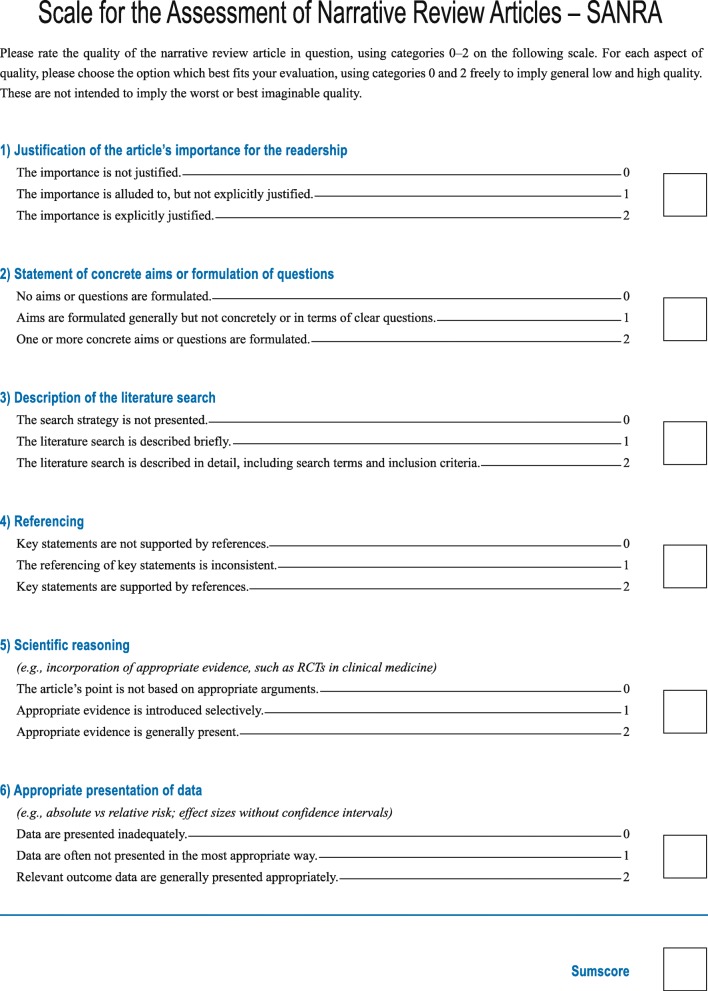
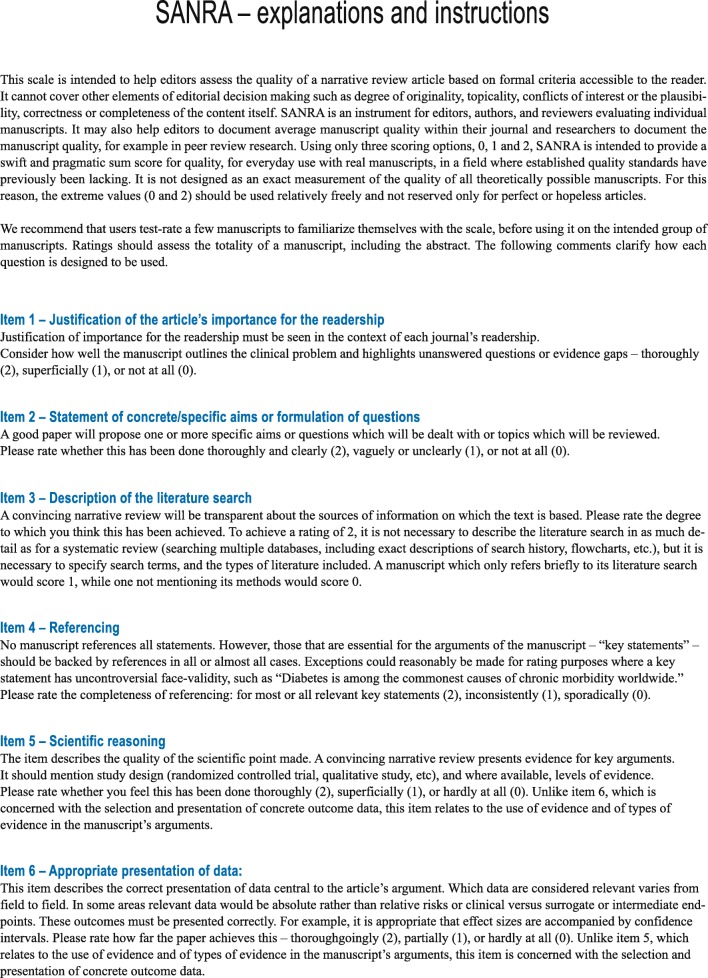
BACKGROUND: Narrative reviews are the commonest type of articles in the medical literature. However, unlike systematic reviews and randomized controlled trials (RCT) articles, for which formal instruments exist to evaluate quality, there is currently no instrument available to assess the quality of narrative reviews. In response to this gap, we developed SANRA, the Scale for the Assessment of Narrative Review Articles. METHODS: A team of three experienced journal editors modified or deleted items in an earlier SANRA version based on face validity, item-total correlations, and reliability scores from previous tests. We deleted an item which addressed a manuscript's writing and accessibility due to poor inter-rater reliability. The six items which form the revised scale are rated from 0 (low standard) to 2 (high standard) and cover the following topics: explanation of (1) the importance and (2) the aims of the review, (3) literature search and (4) referencing and presentation of (5) evidence level and (6) relevant endpoint data. For all items, we developed anchor definitions and examples to guide users in filling out the form. The revised scale was tested by the same editors (blinded to each other's ratings) in a group of 30 consecutive non-systematic review manuscripts submitted to a general medical journal. RESULTS: Raters confirmed that completing the scale is feasible in everyday editorial work. The mean sum score across all 30 manuscripts was 6.0 out of 12 possible points (SD 2.6, range 1-12). Corrected item-total correlations ranged from 0.33 (item 3) to 0.58 (item 6), and Cronbach's alpha was 0.68 (internal consistency). The intra-class correlation coefficient (average measure) was 0.77 [95% CI 0.57, 0.88] (inter-rater reliability). Raters often disagreed on items 1 and 4. CONCLUSIONS: SANRA's feasibility, inter-rater reliability, homogeneity of items, and internal consistency are sufficient for a scale of six items. Further field testing, particularly of validity, is desirable. We recommend rater training based on the "explanations and instructions" document provided with SANRA. In editorial decision-making, SANRA may complement journal-specific evaluation of manuscripts-pertaining to, e.g., audience, originality or difficulty-and may contribute to improving the standard of non-systematic reviews.
Overview
CoChat Summary
TL;DR
SANRA is a six-item, 0–2 scale (maximum 12) for assessing the quality of narrative review articles, developed and field-tested by three journal editors. In 30 consecutive non-systematic review manuscripts, it showed feasible use, sufficient internal consistency and inter-rater reliability, and a modest association with editorial acceptance.
Key findings
- Across 30 manuscripts (90 ratings), the mean SANRA sum score was 6.0 out of 12 (SD 2.6, range 1–12, median 6).
- Internal consistency was Cronbach’s alpha 0.68; corrected item-total correlations ranged from 0.33 (item 3) to 0.58 (item 6).
- Inter-rater reliability was an intra-class correlation coefficient (average measure) of 0.77 [95% CI 0.57, 0.88]; raters often disagreed on items 1 and 4.
- Average SANRA scores were modestly associated with editorial acceptance (mean 6.6, SD 1.9, n = 17) versus rejection (mean 5.1, SD 2.1, n = 13), point biserial correlation 0.37 (t = 2.09, df 28; two-sided p = 0.046).
Methods
- SANRA was developed between 2010 and 2017 by three experienced editors at Deutsches Ärzteblatt; the revised six-item version deleted an item on writing and accessibility due to poor inter-rater reliability.
- The revised scale was tested on 30 consecutive non-systematic review manuscripts submitted to Deutsches Ärzteblatt in 2015; three editor-raters scored them independently and blinded to each other’s ratings.
- Analyses included descriptive statistics, Cronbach’s alpha, corrected item-total correlations, average-measure intra-class correlation using a two-way random effects model (consistency definition), and a post hoc point biserial correlation between SANRA sum scores and acceptance/rejection.
Limitations
- The paper states the main limitation is sample size: 30 manuscripts was a compromise between representativeness, power, and feasibility, and took about 6 months to sample.
- The authors state that the scale’s authors were also the test-raters, so inter-rater reliability may be lower in groups less familiar with SANRA; the study also did not assess test-retest reliability, and results are study-specific.
- The paper acknowledges restricted content validity because SANRA is limited to six items and is a critical appraisal tool rather than a reporting guideline; criterion validity evidence is post hoc and weak, and no established cut-offs exist for comparing manuscripts across settings.
Model-written summary. Check it against the paper before relying on it.
Integrity signals
Registry
Cites
Statistics
Figures
Verification
Claims the paper makes
3 Valid · 0 Not valid · 5 Not checked · 27 Own results and interpretations
The cited sources support only part of this claim — read each source’s verdict below.
In the paper
“Bastian et al. found that they constitute the largest share of all text types in medicine and they concluded that they “remain the staple of medical literature” [1].”
- Also stated in: § Background · plain
“Narrative reviews are the commonest type of articles in the medical literature.”
§ SANRA—a scale for the quality assessment of narrative review articles > Background
What the sources say
- Partly supportedcites [1] Bastian H Glasziou P Chalmers I Seventy-five trials and eleven systematic reviews a day: how will we ever keep up? PLoS Med 2010 7 9 e1000326 10.1371/journal.pmed.1000326 20877712 PMC2943439 sourceExperimental — accuracy not yet measured
In “How Close Are We to Archie Cochrane’s Goal?” and the Summary Points (pages unavailable), the paper calls non-systematic narrative reviews the staple of medical literature synthesis. It does not say they constitute the largest share of all medical text types; that extends a claim about literature synthesis to medical literature as a whole. (LLM, conf=0.88)
plain- Asserted: passes — The authors put it forward as true.
- Checkable: passes — It can be checked against evidence.
- Load-bearing: unclear — It is unclear whether the paper’s conclusions depend on it.
- Based: passes — The paper gives a reason why it holds.
- Also stated in: § Background · plain
The sources with a verdict support this claim; the rest weren’t checked yet, have no full text we could read, or their verdicts aren’t rated yet.
In the paper
“non-systematic reviews or narrative reviews have been widely criticized as unreliable [1, 4].”
§ SANRA—a scale for the quality assessment of narrative review articles > Background
What the sources say
- Supportedcites [1] Bastian H Glasziou P Chalmers I Seventy-five trials and eleven systematic reviews a day: how will we ever keep up? PLoS Med 2010 7 9 e1000326 10.1371/journal.pmed.1000326 20877712 PMC2943439 source
In “How Close Are We to Archie Cochrane’s Goal?”, the paper describes reviews not conducted systematically as having great potential for error and calls them less reliable forms of information. Box 1 also says that articles and textbooks had highlighted the risk of bias and chance in reviews. Together, these passages support the broad characterization that narrative reviews have been criticized as unreliable; page numbers are not provided in our copy. (LLM, conf=0.89)
- Not checked — no full text of the sourcecites [4] Mulrow CD The medical review article: state of the science Ann Intern Med 1987 106 485 488 10.7326/0003-4819-106-3-485 3813259 source
plain- Asserted: passes — The authors put it forward as true.
- Checkable: passes — It can be checked against evidence.
- Load-bearing: passes — The paper’s conclusions depend on it.
- Based: passes — The paper gives a reason why it holds.
- Supported
A result the paper reports from its own data — it cites no other source for it, so there is none to check. The quote shows it is in the paper.
In the paper
“Cronbach’s alpha was 0.68 (internal consistency).”
- Also stated in: § Results · plain
“The scale’s internal consistency, measured as Cronbach’s alpha, was 0.68.”
§ SANRA—a scale for the quality assessment of narrative review articles > Abstract > Results
plainn = 90- Asserted: passes — The authors put it forward as true.
- Checkable: passes — It can be checked against evidence.
- Load-bearing: passes — The paper’s conclusions depend on it.
- Based: passes — The paper gives a reason why it holds.
- Also stated in: § Results · plain
A result the paper reports from its own data — it cites no other source for it, so there is none to check. The quote shows it is in the paper.
In the paper
“Raters often disagreed on items 1 and 4.”
- Also stated in: § Results · plain
“Disagreements most often occurred with regard to items 1 and 4.”
§ SANRA—a scale for the quality assessment of narrative review articles > Abstract > Results
plain- Asserted: passes — The authors put it forward as true.
- Checkable: passes — It can be checked against evidence.
- Load-bearing: unclear — It is unclear whether the paper’s conclusions depend on it.
- Based: passes — The paper gives a reason why it holds.
- Also stated in: § Results · plain
A result the paper reports from its own data — it cites no other source for it, so there is none to check. The quote shows it is in the paper.
In the paper
“The intra-class correlation coefficient (average measure) was 0.77 [95% CI 0.57, 0.88] (inter-rater reliability).”
- Also stated in: § Results · plain
“The intra-class correlation coefficient (average measure) amounted to 0.77 [95% CI 0.57, 0.88; F 4.3; df 29, 58].”
§ SANRA—a scale for the quality assessment of narrative review articles > Abstract > Results
plain- Asserted: passes — The authors put it forward as true.
- Checkable: passes — It can be checked against evidence.
- Load-bearing: passes — The paper’s conclusions depend on it.
- Based: passes — The paper gives a reason why it holds.
- Also stated in: § Results · plain
14 more claims
Create a free account to see all 35 claims and to verify the 3 references still open.
- Probably not a substantial claim. 11
- It may state two separate claims as one. 11
Claims other papers make about this one
Each is checked against this paper’s own text: does it say what the citing paper says it does?
The source backs part of the claim, not all of it — or backs it for a different population, condition or comparison.
In the citing paper
“The review was conducted and reported in accordance with the principles of the Scale for the Assessment of Narrative Review Articles (SANRA), which provides a validated framework for ensuring methodological transparency, scientific rigor, and balanced interpretation in narrative reviews [ 19 ].”
From Paracetamol: A History of Assumptions, Errors, and Evidence Reversals in Pain Management (2026) · cites this paper as [19]
Experimental — accuracy not yet measuredThe source backs part of the claim, not all of it — or backs it for a different population, condition or comparison.
In the citing paper
“As a narrative review, the present work does not include an aggregated quantitative assessment and is more exposed to selection subjectivity than a registered systematic review [124,125].”
From Berberine-Drug Interactions: Mechanisms, Clinical Relevance and Risk Stratification-A Narrative Review (2026) · cites this paper as [124]
Experimental — accuracy not yet measuredThe cited source says what the claim attributes to it.
In the citing paper
“This work is designed as a structured narrative review, with transparent reporting of the documentation strategy, guided by the quality criteria of the Scale for the Assessment of Narrative Review Articles (SANRA) [124].”
From Berberine-Drug Interactions: Mechanisms, Clinical Relevance and Risk Stratification-A Narrative Review (2026) · cites this paper as [124]
The cited source says what the claim attributes to it.
In the citing paper
“we used the following:-Cochrane Risk of Bias 2 (RoB 2) [29] and PEDRO scale tools for RCTs.-AMSTAR 2 [30] checklist for systematic review.-SANRA (Scale for the Assessment of Narrative Review Articles) [31] for narrative reviews.-JBI Checklist for Text and Opinion [32] for expert opinion papers.”
From Pelvic Floor Muscle Training Following Surgery for Pelvic Organ Prolapse: Recommendation from Scientific Literature (2026) · cites this paper as [31]
The cited source says what the claim attributes to it.
In the citing paper
“Data analysis employed a narrative and thematic synthesis methodology,adhering to the SANRA guidelines for narrative reviews (32).”
From Ethical issues in multi-agent AI systems for healthcare: a narrative review (2026) · cites this paper as [32]
12 more claims about this paper
Create a free account to see every claim other papers make about this one.
Citations
Cites
Shea, B. J., Reeves, B. C., Wells, G., Thuku, M., Hamel, C., Moran, J., Moher, D., Tugwell, P., Welch, V., Kristjansson, E., et al. (2017) · BMJ · doi:10.1136/bmj.j4008 · Cited by 10,636 · cited 2×
“Critical appraisal tools have been developed for systematic reviews (e.g., AMSTAR 2 [A MeaSurement Tool to Assess Systematic Reviews] [7]) and papers on RCTs (e.g., the CASP [Critical Appraisal Skills Program] checklist for randomized trials [8]) and other types of medical studies.”
BackgroundStreiner, D. L., & Norman, G. R. (2008) · doi:10.1093/acprof:oso/9780199231881.001.0001 · Cited by 2,631
Critical appraisal skills programme
Singh, J. (2013) · Journal of Pharmacology and Pharmacotherapeutics · doi:10.4103/0976-500x.107697 · Cited by 2,556
Guidelines for Reporting Reliability and Agreement Studies (GRRAS) were proposed
Kottner, J., Audigé, L., Brorson, S., Donner, A., Gajewski, B. J., Hróbjartsson, A., Roberts, C., Shoukri, M., & Streiner, D. L. (2011) · Journal of Clinical Epidemiology · doi:10.1016/j.jclinepi.2010.03.002 · Cited by 2,174
The Mass Production of Redundant, Misleading, and Conflicted Systematic Reviews and Meta‐analyses
IOANNIDIS, J. P. A. (2016) · The Milbank Quarterly · doi:10.1111/1468-0009.12210 · Cited by 1,483 · cited 1×
“While systematic reviews are not per se superior articles and while certain systematic reviews have been criticized lately [3], non-systematic reviews or narrative reviews have”
BackgroundSeventy-five trials and eleven systematic reviews a day: how will we ever keep up?
Bastian, H., Glasziou, P., & Chalmers, I. (2010) · PLoS Medicine · doi:10.1371/journal.pmed.1000326 · Cited by 1,188 · cited 2×
“found that they constitute the largest share of all text types in medicine and they concluded that they “remain the staple of medical literature” [1].”
BackgroundThe Medical Review Article: State of the Science
MULROW, C. D. (1987) · Annals of Internal Medicine · doi:10.7326/0003-4819-106-3-485 · Cited by 856 · cited 1×
“been widely criticized as unreliable [1, 4].”
Writing a narrative biomedical review: considerations for authors, peer reviewers, and editors
Gasparyan, A. Y., Ayvazyan, L., Blackmore, H., & Kitas, G. D. (2011) · Rheumatology International · doi:10.1007/s00296-011-1999-3 · Cited by 694 · cited 1×
“[13], for example, have provided guidance for writing narrative reviews, and Byrne [14] as well as Pautasso [15] has written, from different angles, thoughtful editorials on improving narrative reviews and presented lists of key features of writing a good review—lists that naturally overlap with SANRA items (e.”
BackgroundTen Simple Rules for Writing a Literature Review
Pautasso, M. (2013) · PLoS Computational Biology · doi:10.1371/journal.pcbi.1003149 · Cited by 272 · cited 3×
“[13], for example, have provided guidance for writing narrative reviews, and Byrne [14] as well as Pautasso [15] has written, from different angles, thoughtful editorials on improving narrative reviews and presented lists of key features of writing a good review—lists that naturally overlap with SANRA items (e.”
BackgroundImproving the peer review of narrative literature reviews
Byrne, J. A. (2016) · Research Integrity and Peer Review · doi:10.1186/s41073-016-0019-2 · Cited by 159 · cited 3×
“[13], for example, have provided guidance for writing narrative reviews, and Byrne [14] as well as Pautasso [15] has written, from different angles, thoughtful editorials on improving narrative reviews and presented lists of key features of writing a good review—lists that naturally overlap with SANRA items (e.”
Background
Research works printed but not linked: 3
- Higgins JPT, Green S. (eds.). Cochrane Handbook for Systematic Reviews and Interventions. Version 5.1.0. The Cochrane Collaboration 2011, section 1.2.2., www.handbook.cochrane.org, retrieved on Oct 31, 2018.
- Baethge C Mertens S Goldbeck-Wood S Development of a quality score for the assessment of non-systematic review articles (SANRA) Poster, Seventh International Congress on Peer Review and Biomedical Publication 2013 USA Chicago, Illinois
- Baethge C Goldbeck-Wood S Mertens S A scale for the assessment of non-systematic review articles (SANRA) Poster, Eighth International Congress on Peer and Biomedical Publication 2017 USA Chicago, Illinois
Cited by
Items 1,101–1,200 of 4,334
Aquino, C. I., Ligori, A., Tinelli, R., Boldorini, R. L., Cosma, S. D., & Surico, D. (2026) · Sci · doi:10.3390/sci8070167 · Cited by 4
Albert, O. M. (2026) · Frontiers in Psychiatry · doi:10.3389/fpsyt.2026.1819543 · Cited by 4
Dharmansyah, D., Rahayuwati, L., Defi, I. R., Pramukti, I., & Mutyara, K. (2026) · Experimental Gerontology · doi:10.1016/j.exger.2026.113247 · Cited by 6
The Use of Interpreters in Medical Education: A Narrative Literature Review
Constantinou, C. S., Ng, A. T., Becker, C. B., Zadeh, P. E., & Papageorgiou, A. (2021) · Societies · doi:10.3390/soc11030070 · Cited by 4
Gua sha therapy in the management of musculoskeletal pathology: a narrative review
Hartnett, D. A. (2021) · Physical Therapy Reviews · doi:10.1080/10833196.2021.2011581 · Cited by 4
Vithani, V., Sutariya, B., Montenegro, D. M., Chukwu, M., Ehsan, P., Aburumman, R. N., Muthanna, S. I., Menon, S. R., & Penumetcha, S. S. (2022) · Cureus · doi:10.7759/cureus.32665 · Cited by 4
de Souza, S. M. S., Soares, J. C. S., & Cavalcanti, I. D. L. (2023) · Current Cancer Therapy Reviews · doi:10.2174/1573394719666230403110650 · Cited by 1
Cardiovascular health in kratom users; a narrative review
Chichagi, F., Alikhani, R., & Harchegani, A. B. (2023) · Journal of Addictive Diseases · doi:10.1080/10550887.2023.2282033 · Cited by 4
Treatment‐induced neuropathy of diabetes: an update
Aldave, J. E. Q., Concepción‐Zavaleta, M. J., Durand‐Vásquez, M. D. C., Osorio, E. R. G., Alcalá‐Mendoza, R. M., Puelles‐León, S. L., Ildefonso-Najarro, S. P., Urteaga, L. A. C., Gonzáles‐Mendoza, J. E., & Paz‐Ibarra, J. (2023) · Practical Diabetes · doi:10.1002/pdi.2485 · Cited by 5
Lupia, T., Crisà, E., Sangiorgio, V. F. I., Bosio, R., Stroffolini, G., Staffilano, E., Gregorc, V., Corcione, S., & Rosa, F. G. D. (2024) · Infezioni in Medicina · doi:10.53854/liim-3201-14 · Cited by 6
Uludağ, K. (2024) · Advances in higher education and professional development book series · doi:10.4018/979-8-3693-6100-9.ch009 · Cited by 6
Diabetic acidosis with severe fetal hypoxia in pregnancy: Narrative review and case study
Mam‐Lam‐Fouck, J., Cheloufi, M., Rigouzzo, A., Kayem, G., & Pinton, A. (2024) · International Journal of Gynecology & Obstetrics · doi:10.1002/ijgo.15593 · Cited by 5
Tang, J. P. (2024) · ACM Transactions on Asian and Low-Resource Language Information Processing · doi:10.1145/3625545 · Cited by 5
D’Onofrio, R., Laterza, F., Sannicandro, I., Masucci, M., Bovenzi, A., & Manzi, V. (2024) · The Journal of Sports Medicine and Physical Fitness · doi:10.23736/s0022-4707.24.15900-2 · Cited by 6
Raj, A., Valsala, P., & Unnikrishanan, R. (2024) · International Conference on Innovative Trends in Information Technology (ICITIIT) · doi:10.1109/icitiit61487.2024.10580209 · Cited by 4
“A narrative review can be best described as an attempt to encapsulate the literature in a way which is not systematic (Baethge et al., 2019).”
BackgroundRelevance of Competency Based Education for Architectural Education in India
Kohale, N. S., Kini, P. G., & Mohammed, C. (2024) · F1000Research · doi:10.12688/f1000research.148617.1 · Cited by 4
Symptomatic uncomplicated diverticular disease: a critical appraisal
Ritieni, C., Sbarigia, C., Scalamonti, S., Annibale, B., & Carabotti, M. (2024) · Expert Review of Gastroenterology & Hepatology · doi:10.1080/17474124.2024.2388797 · Cited by 4
“We conducted a narrative review in which we reported SUDD diagnostic criteria adopted in the current literature, following the SANRA scale [9].”
Drug Delivery Strategies for Age-Related Diseases
Yoshihara, K., & Horiguchi, M. (2024) · International Journal of Molecular Sciences · doi:10.3390/ijms25168693 · Cited by 5
“This review article was written in accordance with the guidelines set forth in the Scale for Assessment of Narrative Review Articles (SANRA) [3].”
MethodYu, J., Du, Q., Li, X., Wei, W., Fan, Y., Zhang, J., & Chen, J. (2024) · Frontiers in Cellular Neuroscience · doi:10.3389/fncel.2024.1456775 · Cited by 4
Corcione, S., Lupia, T., Vita, D., Sidoti, F., Zanotto, E., Solidoro, P., Biancone, L., Costa, C. S., Balagna, R., & Rosa, F. G. D. (2024) · Transplantation Reviews · doi:10.1016/j.trre.2024.100873 · Cited by 4
Extracellular vesicles in ZIKV infection: Carriers and facilitators of viral pathogenesis?
Calderón-Peláez, M.-A., Castellanos, J. E., & Velandia-Romero, M. L. (2025) · Science Progress · doi:10.1177/00368504241312073 · Cited by 4
Stephenson, C. F., Serry, T. A., & Snow, P. C. (2025) · Language Speech and Hearing Services in Schools · doi:10.1044/2024_lshss-24-00109 · Cited by 4
Harvery, M., Harrington, R., Morgan, M., Yule, E., & Wright, S. (2025) · International Journal of Mental Health Nursing · doi:10.1111/inm.70061 · Cited by 5
Cailhol, L., Soltani, K., Neige, C., Mondino, M., Brunelin, J., & Blay, M. (2025) · Brain Sciences · doi:10.3390/brainsci15060547 · Cited by 4
Nikolaou, C., Frountzas, M., Kapetanakis, E. I., Stefanoudakis, D., Papadopulos, N. Α., Kykalos, S., Schizas, D., & Iliopoulos, D. (2025) · European Burn Journal · doi:10.3390/ebj6020032 · Cited by 4
“The present comprehensive review was designed according to the SANRA (Scale for the Assessment of Narrative Review Articles) bundle [19].”
Youssouf, N. I., Khan, H. A., Mohamed, A., Othman, M. H. S., Ismail, M. H. F., Hassan, A. A., Alkhazendar, A. H., Alkhazendar, J. H. J., Zehra, M., & Aakash, D. (2025) · Cureus · doi:10.7759/cureus.86252 · Cited by 4
“Narrative reviews were assessed using the Scale for the Assessment of Narrative Review Articles (SANRA) [6], emphasizing clarity, justification of relevance, and comprehensiveness.”
RetractedImmunomodulatory Role of Mesenchymal Stem Cell Therapy in Multiple Sclerosis: A Systematic Review
Amin, M. N., Hashish, R., Tabari, K. A., Swami, S. S., Kasagga, A., Assefa, A. K., & Yu, A. K. (2025) · Cureus · doi:10.7759/cureus.86988 · Cited by 6
“…Institute (JBI) Critical Appraisal Checklist for quasi-experimental studies; we used the Assessment of Multiple Systematic Reviews 2 (AMSTAR 2) for systematic reviews and meta-analyses; and we used the Scale for the Assessment of Narrative Review Articles 2 (SANRA 2) for narrative reviews [23-26].”
InfluentialTong, C. M. (2025) · Innovations in Acupuncture and Medicine · doi:10.1186/s44424-025-00015-1 · Cited by 4
“…to appraise the identified RCT studies [48]; methodological Items for Non-Randomized Studies (MINORS) instrument was applied to appraise the identified NRCT studies [49]; the Scale for the Assessment of Narrative Review Articles (SARN) was applied to appraise the identified narrative reviews [50].”
González-de-la-Flor, Á. (2025) · Journal of Functional Morphology and Kinesiology · doi:10.3390/jfmk10030294 · Cited by 4
“This clinical commentary was conducted following the SANRA (Scale for the Assessment of Narrative Review Articles) guideline [12].”
Zhuang, Z., & Bo, Y. (2025) · Frontiers in Medicine · doi:10.3389/fmed.2025.1626447 · Cited by 6
Cuperus, L. J. A., Ahmed, W., Veen, J. C. C. M. I. ’., Kerstjens, H. A. M., Zijp, T. R., Stevens, J., Wessels, A. M. A., Touw, D. J., & van Boven, J. F. M. (2025) · European Journal of Clinical Pharmacology · doi:10.1007/s00228-025-03903-w · Cited by 4
“The SANRA scale for narrative reviews was used to structure this paper [24].”
Lupia, T., Sarda, C., Canta, F., Casarotto, M., Accardo, G., Roccuzzo, G., Macagno, N., Gelato, F., Senetta, R., Ottobrelli, A., et al. (2025) · Life · doi:10.3390/life15091453 · Cited by 4
“The current narrative review followed the Scale for the Assessment of Narrative Review Articles (SANRA) flow-chart [11] (Figure 1).”
Liu, L., Zhang, P., Jia, Y., Hou, L., Peng, D., Li, Z., & Liang, P. (2025) · Journal of Medical Systems · doi:10.1007/s10916-025-02286-w · Cited by 5
“A narrative review was conducted in accordance with the Scale for the Quality Assessment of Narrative Review Articles(SANRA) [8].”
Rodríguez-Reyes, D., Vargas-Figueroa, R. A., Vázquez-Lloret, A. S., Martinez, H. E. L., González-Díaz, G., & Ortiz, R. S. (2025) · Cureus · doi:10.7759/cureus.95540 · Cited by 5
Neurobiology of Cancer Pain: A Narrative Review
Varrassi, G., Leoni, M. L. G., Farì, G., Caruso, A., Al-Alwany, A. A., Mercieri, M., Pergolizzi, J. V., & Guillen, R. (2025) · OBM Neurobiology · doi:10.21926/obm.neurobiol.2504315 · Cited by 5
Precision oncology: from large language models to multi-agent systems
Guo, X., Chen, J., Zhang, Y., Zhang, X., Lu, J., Qin, Q., Chen, J., Gao, X., & Wang, J. (2026) · Frontiers in Oncology · doi:10.3389/fonc.2026.1828507 · Cited by 5
“The search strategy was developed in accordance with established recommendations for transparent reporting in narrative reviews, including the SANRA guidance (16).”
Khan, S., Patel, S., Saipavankumar, M., & Hamid, P. (2020) · Cureus · doi:10.7759/cureus.9526 · Cited by 4
Clinical Considerations in the Approach to Vancomycin-Resistant Enterococci: A Narrative Review
Beale, J. W., & Durward, M. (2022) · International Journal of Medical Students · doi:10.5195/ijms.2022.1010 · Cited by 4
Bhatt, U., & Shukla, Y. (2022) · International Journal of Health Sciences and Research · doi:10.52403/ijhsr.20220353 · Cited by 4
Hapsari, I. (2023) · Jurnal Obsesi Jurnal Pendidikan Anak Usia Dini · doi:10.31004/obsesi.v7i3.4308 · Cited by 6
“This narrative review protocol was informed by SANRA - Scale for the Assessment of Narrative Review Articles (Baethge et al., 2019).”
MethodBooth, L., Miller, M., & Pettigrew, S. (2023) · Drug and Alcohol Review · doi:10.1111/dar.13769 · Cited by 4
Effects of Electronic Dance Music on Academic Performance among Medical Students: A Narrative Review
Hau, K. T., Tee, V., & Kuan, G. (2024) · Education in Medicine Journal · doi:10.21315/eimj2024.16.1.2 · Cited by 5
“The cognitive load theory suggests that cognitive resources are limited and can be overloaded by external stimuli (10).”
BackgroundClinical markers in heart failure: a narrative review
Javed, N., El-Far, M., & Vittorio, T. J. (2024) · Journal of International Medical Research · doi:10.1177/03000605241254330 · Cited by 4
“13 The main parameters used to out-line the narrative review included justification of the article’s topic for readership, formulation of review question, description of literature search, referencing, scientific reasoning and data presentation.”
BackgroundVarrassi, G., Cereda, E., Ruoppolo, G., Mercieri, M., & Muscaritoli, M. (2024) · Advancements in health research. · doi:10.4081/ahr.2024.6 · Cited by 4
Nutritional Ketosis as a Therapeutic Approach in Critical Illness: A Systematic Review
Abdelrahim, R. A., Mekala, S. R. R., Polepalli, K. V., Priyatha, V., Ezeano, C., AlEdani, E. M., & Nassar, S. T. (2024) · Cureus · doi:10.7759/cureus.65455 · Cited by 4
“Table 2 details the assessment of narrative reviews through the SANRA 2 checklist [17].”
BackgroundMethodExploring the determinants of community-oriented health professions education: A narrative review
Talaat, W., & Hamed, O. (2024) · Education for Health · doi:10.62694/efh.2024.81 · Cited by 5
Ahmed, O., Ibrahiam, A. T., Al-Qassab, Z. M. S., Kannan, V., Ullah, N., Geddada, S., & Nassar, S. T. (2024) · Cureus · doi:10.7759/cureus.71316 · Cited by 9
Ambarsari, C. G., Nadhifah, N., & Lestari, H. I. (2024) · Kidney & Blood Pressure Research · doi:10.1159/000542897 · Cited by 5
“Furthermore, the Scale for the Assessment of Narrative Review Articles developed by Baethge et al. [26] was used to enhance the review ’ s rigor.”
CyberKnife in Pediatric Oncology: A Narrative Review of Treatment Approaches and Outcomes
Donati, C. M., Medici, F., Zamfir, A. A., Galietta, E., Cammelli, S., Buwenge, M., Masetti, R., Prete, A., Strigari, L., Forlani, L., et al. (2025) · Current Oncology · doi:10.3390/curroncol32020076 · Cited by 5
“The review was conducted by a multidisciplinary team, composed of radiation oncologists, pediatric oncologists, and medical physicists, based on the Scale for the Assessment of Narrative Review Articles (SANRA) guidelines [22].”
Cardiac computed tomography for cardiac masses: a necessity or a luxury?
Joudar, I., Nasri, S., Kamaoui, I., & Skiker, I. (2025) · Journal of International Medical Research · doi:10.1177/03000605241306604 · Cited by 4
Ursoleo, J. D., Agosta, V. T., Bottussi, A., D’Amico, F., & Monaco, F. (2025) · Journal of Cardiothoracic and Vascular Anesthesia · doi:10.1053/j.jvca.2025.02.019 · Cited by 4
Physical and Respiratory Rehabilitation in Spinal Muscular Atrophy: A Critical Narrative Review
Cammarano, S., Chirico, V. A., Giardulli, B., Mazzuoccolo, G., Ruosi, C., & Corrado, B. (2025) · Applied Sciences · doi:10.3390/app15084398 · Cited by 4
Efficacy of probiotics in dermatitis herpetiformis management: an umbrella review
Alghuyaythat, W. K. Z., Al-Faifi, F., Alshalhoob, H. B. S., Abanumay, R. K. A., Asiree, R. H., Alnumayr, H. S., Alanazi, A. G. T., & Alluli, M. M. (2025) · Frontiers in Physiology · doi:10.3389/fphys.2025.1556998 · Cited by 5
“A variably adapted version of the SANRA instrument—Scale for the Assessment of Narrative Review Articles (Baethge et al., 2019)-assesses the quality of accessible narrative reviews concerning research question clarity, scope of literature search, justification of probiotics’ efficacy, and coherent…”
Threshold to initiate chest compressions for bradycardia at birth: A narrative review
Binkhorst, M., van Elsäcker, E., Matthijsse, R. P., Antonius, T. A. J., Timmermans, N. A., Pas, A. B. T., de Boode, W. P., & Hogeveen, M. (2025) · Journal of Perinatology · doi:10.1038/s41372-025-02320-2 · Cited by 5
“Although there are no validated and universally applied checklists for narrative reviews, we used the Scale for the Assessment of Narrative Review Articles (SANRA) during the preparation of this review [19].”
The Future of PET Imaging in Multiple Sclerosis: Characterisation of Individual White Matter Lesions
van der Weijden, C. W. J., Meilof, J. F., van der Hoorn, A., de Vries, E. F. J., & Baron, W. (2025) · Journal of Clinical Medicine · doi:10.3390/jcm14134439 · Cited by 5
“In this narrative review [25], we first provide an overview of the cellular composition and molecular extracellular matrix (ECM) environment that can be used to classify MS lesions.”
Jahan, D., Peile, E., Sheikh, M. A., Islam, S., Parasnath, S., Sharma, P., Iskandar, K., Dhingra, S., Charan, J., Hardcastle, T. C., et al. (2021) · Expert Review of Anti-infective Therapy · doi:10.1080/14787210.2021.1902304 · Cited by 5
“[16], so distinguishing our work from those of systematic reviews and meta-analysis.”
ResultJohnsson, G., & Bulkeley, K. (2021) · Research and Practice in Intellectual and Developmental Disabilities · doi:10.1080/23297018.2021.1896975 · Cited by 4
PEDAGOGIC INTERVENTION FOR HEALTH: A NARRATIVE SYSTEMATIC REVIEW ON BIODANZA
Ferraro, F., Aruta, L., Ambra, F. I., Distaso, F. P., & Iavarone, M. L. (2021) · Movimento (Porto Alegre) · doi:10.22456/1982-8918.111547 · Cited by 4
Torres‐Castaño, A., Delgado, J., del Pino‐Sedeño, T., Malaret, D. E., de Pascual, A. M., Toledo‐Chávarri, A., & Serrano‐Aguilar, P. (2022) · European Eating Disorders Review · doi:10.1002/erv.2909 · Cited by 4
How crises work: A model of error cause and effect in surgical practice
Gogălniceanu, P., Karydis, N., Kessaris, N., Olsburgh, J., Calder, F., Sevdalis, N., & Mamode, N. (2022) · International Journal of Surgery · doi:10.1016/j.ijsu.2022.106711 · Cited by 5
Fròsina, G. (2022) · Strahlentherapie und Onkologie · doi:10.1007/s00066-022-02020-2 · Cited by 5
“, effect sizes not accompanied by confidence intervals (CI)]) [95].”
BackgroundKavka, T. (2022) · Journal of Back and Musculoskeletal Rehabilitation · doi:10.3233/bmr-220081 · Cited by 4
“This narrative review was conducted in accordance with a Scale for the Quality Assessment of Narrative Review Articles (SANRA) [45] and secondarily with the PRISMA harms checklist [46] since its focus is on harms.”
Emphasis on Icosapent Ethyl for Cardiovascular Risk Reduction: A Systematic Review
Sutariya, B., Montenegro, D. M., Chukwu, M., Ehsan, P., Aburumman, R. N., Muthanna, S. I., Menon, S. R., Vithani, V., & Penumetcha, S. S. (2022) · Cureus · doi:10.7759/cureus.32346 · Cited by 5
The Potential Cutaneous Effects of Pornography Addiction: A Narrative Review
Rasul, T. F., Schwartz, K., Qureshi, F. M., Eachus, E., & Henderson, A. (2022) · Cureus · doi:10.7759/cureus.33066 · Cited by 6
“The article was prepared using the Scale for the Assessment of Narrative Review Articles (SANRA) [7].”
MethodLaethem, J. V., Pierreux, J., Wuyts, S. C. M., Geyter, D. D., Allard, S. D., & Dauby, N. (2023) · Acta Clinica Belgica · doi:10.1080/17843286.2023.2167328 · Cited by 4
Aguilera-Cobos, L., García‐Sanz, P., Rosario-Lozano, M. P., Claros, M. G., & Blasco‐Amaro, J. A. (2023) · Frontiers in Public Health · doi:10.3389/fpubh.2023.1039688 · Cited by 5
“The authors of the SANRA tool (21) suggest that a score of 4 or lower indicates the inferior quality of the review in question.”
BackgroundMethodInfluentialLearning Theories in Games That Teach Responsible Antibiotic Use: A Literature Review
Molnar, A., & Molnar, I. (2023) · Sustainability · doi:10.3390/su15054643 · Cited by 5
Association of Major Depressive Disorder in Hyperparathyroidism: A Systematic Review
Desai, A. V., Bajgain, A., Ali, A., Dutta, C., Pasha, K., Paul, S., Abbas, M. S., Nassar, S. T., Tasha, T., & Khan, S. (2023) · Cureus · doi:10.7759/cureus.40150 · Cited by 5
“(c) Scale for the Assessment of Narrative Review Articles (SANRA) checklist for narrative/traditional reviews [8]”
MethodEstratégias terapêuticas no manejo do risco suicida
Laguna, G. G. D. C., Gusmão, A. B. F., Gusmão, A. L. F., Libarino, D. S., & de Azevedo, K. R. M. (2023) · Saúde com · doi:10.22481/rsc.v19i2.12256 · Cited by 8
Adnyana, I. M. D. M., Utomo, B., Fauziyah, S., Eljatin, D. S., Setyawan, M. F., Sumah, L. H. M., & Karina, C. A. (2024) · Journal of Research in Pharmacy · doi:10.29228/jrp.700 · Cited by 4
Adult Education in the Age of Artificial Intelligence: The Human Resource Development Perspective
Osolase, E. H., Rasdi, R. M., Mansor, Z. D., & Kou, Q. (2024) · International Journal of Academic Research in Business and Social Sciences · doi:10.6007/ijarbss/v14-i5/21464 · Cited by 4
“Through the aid of narrative reviews which is sometimes described as traditional or literature reviews, the authors of this article were able to rigorously evaluate past literatures which are interconnected wit h this study’s objective (Byrne, 2016; Baethge et al., 2019).”
BackgroundLin, Y. M., Banoth, D., Wali, M. H., Bekova, K., Abdulla, N., Gurugubelli, S., & Khan, S. (2024) · Cureus · doi:10.7759/cureus.64766 · Cited by 5
AlEdani, E. M., Gurramkonda, J., Chaudhri, S., Amin, A., Panjiyar, B. K., Al-taie, D. S., & Nath, T. S. (2024) · Cureus · doi:10.7759/cureus.68441 · Cited by 4
“…and exclusion criteria, quality assessment was done on the remaining systematic reviews by using the Assessing the Methodological Quality of Systematic Reviews (AMSTAR) checklist [9; for narrative reviews, we used Scale for the Assessment of Narrative Review Articles (SANRA) guidelines [10].”
MethodOlfactory Stimulation for Memory Retrieval and Cognitive Improvement in Dementia: A Narrative Review
Buetow, S., & MacLeod, R. (2024) · Journal of the American Medical Directors Association · doi:10.1016/j.jamda.2024.105240 · Cited by 4
Kinsella, M., Capel, Y., Nelson, S. M., & Kearns, R. J. (2022) · Journal of Substance Use · doi:10.1080/14659891.2022.2106600 · Cited by 6
“This article was prepared using the SARNA guidelines for quality assessment of narrative review articles (Baethge et al., 2019).”
MethodAugmented reality as an aid to behavior therapy for anxiety disorders: A narrative review
Rajkumar, R. P. (2024) · Cureus · doi:10.7759/cureus.69454 · Cited by 3
“This review was designed and conducted based on standard quality indicators for narrative reviews [17,18].”
MethodFolic Acid in the Treatment of Sickle Cell Disease: A Systematic Review
Agbor, D. B. A., Panday, P., Ejaz, S., Gurugubelli, S., Prathi, S. K., Martinez, Y. P., & Nassar, S. T. (2024) · Cureus · doi:10.7759/cureus.57962 · Cited by 5
Can Hemorrhagic Stroke Genetics Help Forensic Diagnosis in Pediatric Age (<5 Years Old)?
Treves, B., Sonnini, E., Russa, R. L., Duca, F. D., Ghamlouch, A., Matteis, A. D., Trignano, C., Marchal, J. A., Carrillo, E., Napoletano, G., et al. (2024) · Genes · doi:10.3390/genes15050618 · Cited by 4
“Finally, despite the lack of formal instruments to evaluate risk of bias in narrative reviews, we utilized the Scale for the Assessment of Narrative Review Articles (SANRA) [14], which we also utilized for evaluating the scientific statement by the American Heart Association [1].”
MethodSaleem, A., Zeeshan, B., Dissanayake, G., Zergaw, M., Elgendy, M., & Billey, A. (2024) · Cureus · doi:10.7759/cureus.66270 · Cited by 3
“…(JBI) Critical Appraisal Checklist [14]; systematic reviews and meta-analyses, Assessment of Multiple Systematic Reviews 2 (AMSTAR 2) [15]; narrative reviews, Scale for the Assessment of Narrative Review Articles 2 (SANRA 2) [16]; and appraisal tool for Cross-Sectional Studies (AXIS) [17].”
MethodThe Efficacy of Renal Denervation in Treating Resistant Hypertension: A Systematic Review
Azeez, G. A., Thirunagari, M., Fatima, N., Anand, A., Palvia, A. R., Kaur, A., & Nassar, S. T. (2024) · Cureus · doi:10.7759/cureus.67007 · Cited by 5
“For literature reviews, the Scale for the Assessment of Narrative Review Articles (SANRA) was chosen [14].”
MethodBernier, A., Poitras, M.-È., & Lacasse, A. (2024) · Canadian Journal of Pain · doi:10.1080/24740527.2024.2394207 · Cited by 4
Taye, I., Grace, S., & Bradbury, J. (2024) · Journal of Integrative and Complementary Medicine · doi:10.1089/jicm.2024.0569 · Cited by 3
Assessment and treatment of headache in primary care: a scoping review
Dickson, J. M., Kimaro, A., Chang, C. S., & Hind, D. (2025) · BJGP Open · doi:10.3399/bjgpo.2025.0064 · Cited by 3
“23,24 We did not undertake a formal narrative synthesis, instead we aimed to summarise the studies as a body of evidence while preserving their idiosyncratic and unique nature.”
Lim, Z. W., & Meade, M. J. (2025) · Seminars in Orthodontics · doi:10.1053/j.sodo.2025.04.002 · Cited by 4
Galli, K. J., Wadid, M., & Bessada, Y. (2025) · Journal of Cardiovascular Pharmacology · doi:10.1097/fjc.0000000000001703 · Cited by 3
Al-Ariki, M. K., Sidik, A. I., Ghosh, D., Hossain, M., Asadi, R., Mishra, R., Abuirayyeh, A. M. A., Samnang, E., Kairatuly, M. I., Uktamov, D. S., et al. (2025) · Cureus · doi:10.7759/cureus.83205 · Cited by 3
“The structure and content of this review were guided by the Scale for the Assessment of Narrative Review Articles (SANRA) framework [7].”
Mastalgia in Fibrocystic Changes; From the Diagnosis Bench to Innovative Therapy: A Narrative Review
Nori, W., Zghair, M. A. G., Abdulqader, S. K., & Jaber, R. A. (2025) · The Open Medicinal Chemistry Journal · doi:10.2174/0118741045371715250404073206 · Cited by 3
Kuitunen, S. K., Laakkonen, L., Janhunen, K., Kvarnström, K., & Lindén-Lahti, C. (2025) · Journal of Patient Safety · doi:10.1097/pts.0000000000001381 · Cited by 6
The forgotten powerhouse: Variations of the soleus muscle and their clinical relevance
Olewnik, Ł. H., Landfald, I. C., Ruzik, K., Gołek, Ł., & Gonera, B. (2025) · Annals of Anatomy - Anatomischer Anzeiger · doi:10.1016/j.aanat.2025.152696 · Cited by 3
Arturi, F., Melegari, G., Gazzotti, F., Bertellini, E., & Barbieri, A. (2025) · Neurology International · doi:10.3390/neurolint17080115 · Cited by 3
Ethical dimensions in nursing care for individuals with intellectual disabilities
Elmadani, M., Klara, S. M., Mustafa, M. Q., Limungi, G. M., Kiptulon, E. K., Besbes, M., Mesmar, A., Hamad, O., Horváth, É., Tóth, L., et al. (2025) · Nursing Ethics · doi:10.1177/09697330251366607 · Cited by 3
Shaltout, A. E., Elbadri, M. E., Kaur, K., Alsharif, M. M., Alkhazendar, A. H., Hassouba, O. N., Ahmad, M. N., Osman, M., Zahid, A., & Banjamin, S. (2025) · Cureus · doi:10.7759/cureus.92796 · Cited by 3
“The Scale for the Assessment of Narrative Review Articles (SANRA) was used for non-randomized studies [12].”
Early revision in total joint arthroplasty surgery – a narrative review
Santarelli, M., Wirth, W., Engl, M., & Saccoccio, M. (2025) · Orthopedic Reviews · doi:10.52965/001c.144006 · Cited by 3
Shaw, J., Lai, C., Bota, P. G., Le, A., Andricioaei, A., Tran, T., & Allee, T. (2025) · Healthcare · doi:10.3390/healthcare13192433 · Cited by 3
Khan, R., Yeasmin, S., Rony, M. K. K., Das, S., Semi, M. M. A., Islam, M. A., Sabeena, A. A., Samiun, M., & Hasan, R. (2025) · International Journal of Developmental Disabilities · doi:10.1080/20473869.2025.2562953 · Cited by 4
Peña, I. G., Robles, Y., Salenga, R. L., Loquias, M. M., Capule, F. R., Bulatao, B. P. I., & Casauay, J. F. C. (2025) · Acta Medica Philippina · doi:10.47895/amp.v59i14.9562 · Cited by 3
“21 An author reviewed the quality of the evidence, while another author reviewed the quality assessment conducted.”
Molecular and Clinical Perspectives on the Regulation of Sleep and Uric Acid Metabolism
Ha, G., Wu, J., Hu, J., Wang, X., Xie, Y., Zhao, Z., & Cai, D. (2025) · Nature and Science of Sleep · doi:10.2147/nss.s545905 · Cited by 4
“21,22 Identification of studies via databases 31 The activity of XO is regulated by hypoxia-inducible factor-1α (HIF-1α), with hypoxic conditions significantly upregulating XO activity, thereby increasing uric acid production.”
Akkermansia muciniphila and HCC: A Gut Feeling
Capasso, M., Sanduzzi‐Zamparelli, M., Cossiga, V., Guarino, M., Murzilli, S., Pelagalli, A., Sorrentino, D., Rutigliano, A., & Morisco, F. (2025) · Current Oncology · doi:10.3390/curroncol32100577 · Cited by 4
“…with SANRA (Scale of the Assessment of Narrative Review Articles) criteria, which assess the methodological quality across topic significance, clarity of aims, adequacy of the literature search, referencing quality, strength of scientific reasoning, and appropriateness of data presentation [13].”
Tekin, B. H., & Aktog, M. A. (2025) · Buildings · doi:10.3390/buildings15213825 · Cited by 3
Assessing autonomy in psychiatric practice: a narrative literature review
Disha, T. I., Papavasiliou, E., & Gill, S. (2025) · Discover Mental Health · doi:10.1007/s44192-025-00287-2 · Cited by 4
“Two rating scales guided the construction of this narrative literature review – the Scale for the Assessment of Narrative Review Articles, i.e. SANRA [14], and the Narrative Overview Rating Scale, i.e. NORS [15].”
Metadata
- Authors
- Baethge, C., Goldbeck-Wood, S., & Mertens, S.
- Affiliations
- University of Cologne (DE)
- BMJ Group (United Kingdom) (GB)
- Corresponding author
- Baethge, Christopher
- ORCID
- Baethge, Christopher
- Venue
- Research Integrity and Peer Review
- Published
- 2019-03-26
- Volume
- 4
- Issue
- 1
- Pages
- 5-5
- ISSN
- 2058-8615 (ISSN-L)
- PMC
- PMC6434870
- OpenAlex
- W2922577842
- Semantic Scholar
- ea7f35b3069b53791c3b746c5c4b3c72a83a526b
- Cited by
- 3,469
- References
- 13
- Citations by year
- 2026: 1823 · 2025: 551 · 2024: 379 · 2023: 309 · 2022: 218 · 2021: 152 · 2020: 32 · 2019: 4
- FWCI
- 20.57
- Type
- journal article
- Language
- en
- Open access
- gold
- doi.org
- Licence
- cc-by
- creativecommons.org/licenses/by/4.0/ (tdm)
- Locations
- Research Integrity and Peer Review (publishedVersion, cc-by)
- Europe PMC (PubMed Central) (publishedVersion, other-oa)
- PubMed Central (publishedVersion, cc-by)
- PubMed (publishedVersion)
- Kölner Universitäts PublikationsServer (Universität zu Köln) (publishedVersion)
- DOAJ (DOAJ: Directory of Open Access Journals) (submittedVersion, cc-by-sa)
- Topics
- Social Sciences › Decision Sciences › Statistics, Probability and Uncertainty › Meta-analysis and systematic reviews
- Social Sciences › Library and Information Sciences › Academic Writing and Publishing
- Social Sciences › Library and Information Sciences › scientometrics and bibliometrics research
- Keywords
- quality assessment scale, manuscript review, inter-rater reliability, level of evidence, scale development
About these checks
Registry, retraction, Cites and statistics results are computed, not judged, with one exception: a printed reference that no index lists is read once by a model before it counts as a citation error. Claims are extracted by a model and kept only when their quote appears verbatim in the text; each cited source is then checked, with a model’s help, for whether it says what the claim relies on. Those verdicts can be wrong — read the claim’s quote and the cited source before relying on one.
The claim verdicts this report counts are experimental: their accuracy is not yet measured.
A language model drew the claims from the paper on 2026-11-10, under version 3 of the claim definition (model deepseek-v4.1-flash, prompt extract-v3).
A second model labelled each claim on 2026-11-10 (model jev-1.13-20260917, definition revision gold-guideline-v0.2).
Cited sources are checked with a language model’s help (gpt-6-sol).
Statistics and arithmetic are recomputed, not judged.
Confidence bands are shown only for fields calibrated on our annotated test set. None is calibrated yet, so no band is shown.
What counts as a claim ›How we measure confidence ›How we check this ›
Are you an author, or do you see a problem with this page? Request a review
Data sources
Bibliographic data: Semantic Scholar, OpenAlex, Crossref.
Contains information from the Semantic Scholar Academic Graph Datasets, made available under the ODC Attribution License (ODC-BY 1.0).
Semantic Scholar’s data is described in: Kinney, R., et al. (2023). The Semantic Scholar Open Data Platform. arXiv:2301.10140.
