

SANRA—a scale for the quality assessment of narrative review articles
Open accessThe DOI matches its Crossref record; 12 of the 13 references it cites were found in a registry or an index; 4 of the 12 sources its claims cite were checked for support.
Abstract
BACKGROUND: Narrative reviews are the commonest type of articles in the medical literature. However, unlike systematic reviews and randomized controlled trials (RCT) articles, for which formal instruments exist to evaluate quality, there is currently no instrument available to assess the quality of narrative reviews. In response to this gap, we developed SANRA, the Scale for the Assessment of Narrative Review Articles. METHODS: A team of three experienced journal editors modified or deleted items in an earlier SANRA version based on face validity, item-total correlations, and reliability scores from previous tests. We deleted an item which addressed a manuscript's writing and accessibility due to poor inter-rater reliability. The six items which form the revised scale are rated from 0 (low standard) to 2 (high standard) and cover the following topics: explanation of (1) the importance and (2) the aims of the review, (3) literature search and (4) referencing and presentation of (5) evidence level and (6) relevant endpoint data. For all items, we developed anchor definitions and examples to guide users in filling out the form. The revised scale was tested by the same editors (blinded to each other's ratings) in a group of 30 consecutive non-systematic review manuscripts submitted to a general medical journal. RESULTS: Raters confirmed that completing the scale is feasible in everyday editorial work. The mean sum score across all 30 manuscripts was 6.0 out of 12 possible points (SD 2.6, range 1-12). Corrected item-total correlations ranged from 0.33 (item 3) to 0.58 (item 6), and Cronbach's alpha was 0.68 (internal consistency). The intra-class correlation coefficient (average measure) was 0.77 [95% CI 0.57, 0.88] (inter-rater reliability). Raters often disagreed on items 1 and 4. CONCLUSIONS: SANRA's feasibility, inter-rater reliability, homogeneity of items, and internal consistency are sufficient for a scale of six items. Further field testing, particularly of validity, is desirable. We recommend rater training based on the "explanations and instructions" document provided with SANRA. In editorial decision-making, SANRA may complement journal-specific evaluation of manuscripts-pertaining to, e.g., audience, originality or difficulty-and may contribute to improving the standard of non-systematic reviews.
Overview
CoChat Summary
TL;DR
SANRA is a six-item, 0–2 scale (maximum 12) for assessing the quality of narrative review articles, developed and field-tested by three journal editors. In 30 consecutive non-systematic review manuscripts, it showed feasible use, sufficient internal consistency and inter-rater reliability, and a modest association with editorial acceptance.
Key findings
- Across 30 manuscripts (90 ratings), the mean SANRA sum score was 6.0 out of 12 (SD 2.6, range 1–12, median 6).
- Internal consistency was Cronbach’s alpha 0.68; corrected item-total correlations ranged from 0.33 (item 3) to 0.58 (item 6).
- Inter-rater reliability was an intra-class correlation coefficient (average measure) of 0.77 [95% CI 0.57, 0.88]; raters often disagreed on items 1 and 4.
- Average SANRA scores were modestly associated with editorial acceptance (mean 6.6, SD 1.9, n = 17) versus rejection (mean 5.1, SD 2.1, n = 13), point biserial correlation 0.37 (t = 2.09, df 28; two-sided p = 0.046).
Methods
- SANRA was developed between 2010 and 2017 by three experienced editors at Deutsches Ärzteblatt; the revised six-item version deleted an item on writing and accessibility due to poor inter-rater reliability.
- The revised scale was tested on 30 consecutive non-systematic review manuscripts submitted to Deutsches Ärzteblatt in 2015; three editor-raters scored them independently and blinded to each other’s ratings.
- Analyses included descriptive statistics, Cronbach’s alpha, corrected item-total correlations, average-measure intra-class correlation using a two-way random effects model (consistency definition), and a post hoc point biserial correlation between SANRA sum scores and acceptance/rejection.
Limitations
- The paper states the main limitation is sample size: 30 manuscripts was a compromise between representativeness, power, and feasibility, and took about 6 months to sample.
- The authors state that the scale’s authors were also the test-raters, so inter-rater reliability may be lower in groups less familiar with SANRA; the study also did not assess test-retest reliability, and results are study-specific.
- The paper acknowledges restricted content validity because SANRA is limited to six items and is a critical appraisal tool rather than a reporting guideline; criterion validity evidence is post hoc and weak, and no established cut-offs exist for comparing manuscripts across settings.
Model-written summary. Check it against the paper before relying on it.
Integrity signals
Registry
Cites
Statistics
Figures
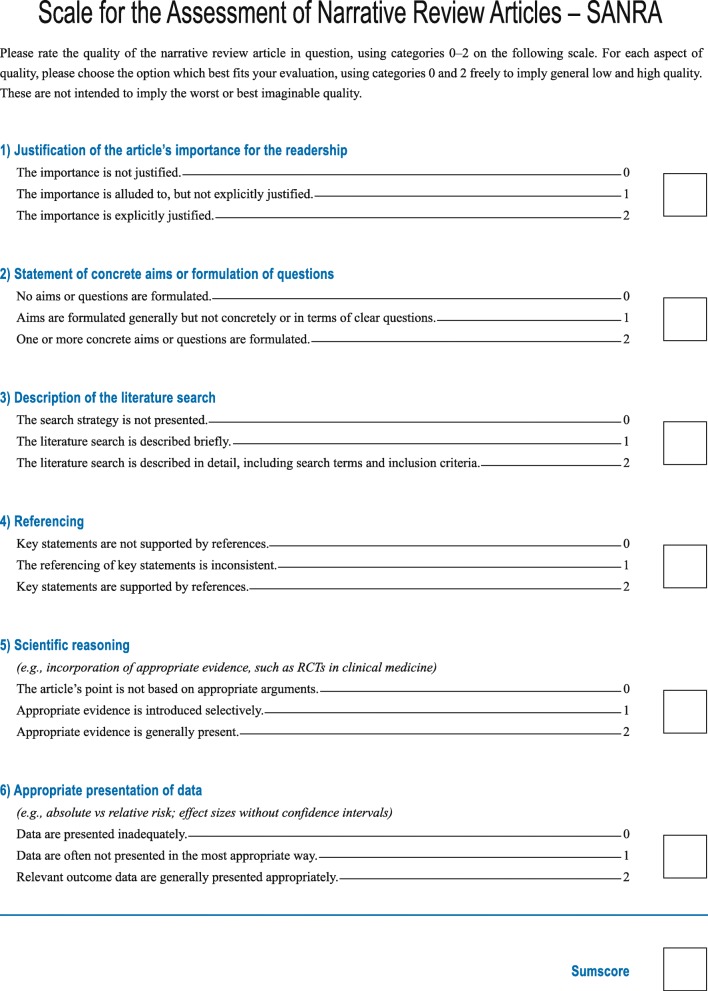
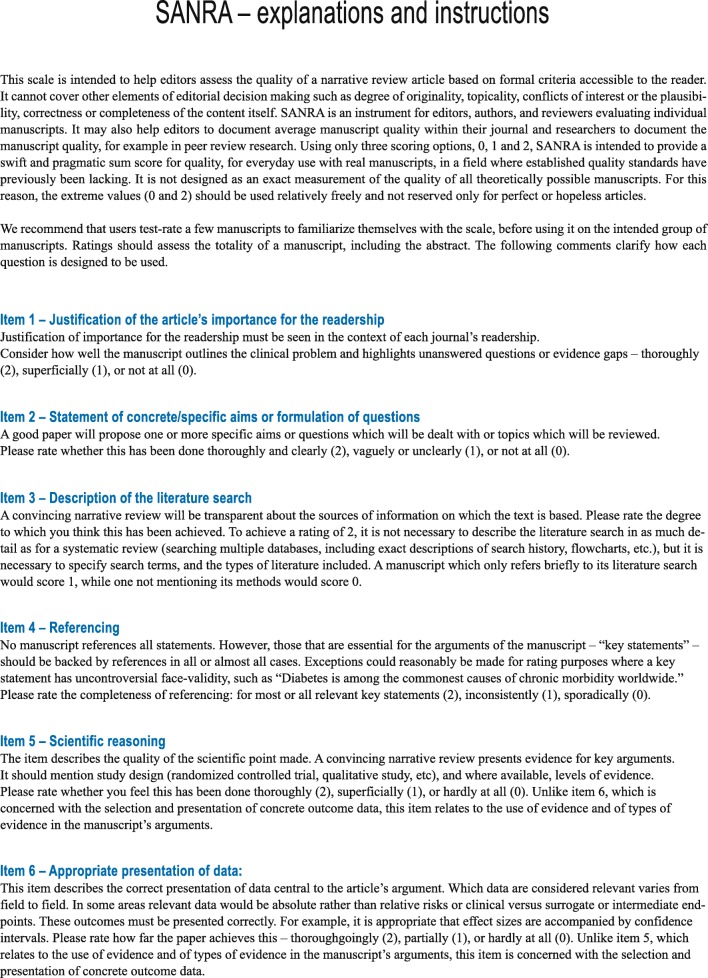
Verification
Claims the paper makes
3 Valid · 0 Not valid · 5 Not checked · 27 Own results and interpretations
The cited sources support only part of this claim — read each source’s verdict below.
In the paper
“Bastian et al. found that they constitute the largest share of all text types in medicine and they concluded that they “remain the staple of medical literature” [1].”
- Also stated in: § Background · plain
“Narrative reviews are the commonest type of articles in the medical literature.”
§ SANRA—a scale for the quality assessment of narrative review articles > Background
What the sources say
- Partly supportedcites [1] Bastian H Glasziou P Chalmers I Seventy-five trials and eleven systematic reviews a day: how will we ever keep up? PLoS Med 2010 7 9 e1000326 10.1371/journal.pmed.1000326 20877712 PMC2943439 sourceExperimental — accuracy not yet measured
In “How Close Are We to Archie Cochrane’s Goal?” and the Summary Points (pages unavailable), the paper calls non-systematic narrative reviews the staple of medical literature synthesis. It does not say they constitute the largest share of all medical text types; that extends a claim about literature synthesis to medical literature as a whole. (LLM, conf=0.88)
plain- Asserted: passes — The authors put it forward as true.
- Checkable: passes — It can be checked against evidence.
- Load-bearing: unclear — It is unclear whether the paper’s conclusions depend on it.
- Based: passes — The paper gives a reason why it holds.
- Also stated in: § Background · plain
The sources with a verdict support this claim; the rest weren’t checked yet, have no full text we could read, or their verdicts aren’t rated yet.
In the paper
“non-systematic reviews or narrative reviews have been widely criticized as unreliable [1, 4].”
§ SANRA—a scale for the quality assessment of narrative review articles > Background
What the sources say
- Supportedcites [1] Bastian H Glasziou P Chalmers I Seventy-five trials and eleven systematic reviews a day: how will we ever keep up? PLoS Med 2010 7 9 e1000326 10.1371/journal.pmed.1000326 20877712 PMC2943439 source
In “How Close Are We to Archie Cochrane’s Goal?”, the paper describes reviews not conducted systematically as having great potential for error and calls them less reliable forms of information. Box 1 also says that articles and textbooks had highlighted the risk of bias and chance in reviews. Together, these passages support the broad characterization that narrative reviews have been criticized as unreliable; page numbers are not provided in our copy. (LLM, conf=0.89)
- Not checked — no full text of the sourcecites [4] Mulrow CD The medical review article: state of the science Ann Intern Med 1987 106 485 488 10.7326/0003-4819-106-3-485 3813259 source
plain- Asserted: passes — The authors put it forward as true.
- Checkable: passes — It can be checked against evidence.
- Load-bearing: passes — The paper’s conclusions depend on it.
- Based: passes — The paper gives a reason why it holds.
- Supported
A result the paper reports from its own data — it cites no other source for it, so there is none to check. The quote shows it is in the paper.
In the paper
“Cronbach’s alpha was 0.68 (internal consistency).”
- Also stated in: § Results · plain
“The scale’s internal consistency, measured as Cronbach’s alpha, was 0.68.”
§ SANRA—a scale for the quality assessment of narrative review articles > Abstract > Results
plainn = 90- Asserted: passes — The authors put it forward as true.
- Checkable: passes — It can be checked against evidence.
- Load-bearing: passes — The paper’s conclusions depend on it.
- Based: passes — The paper gives a reason why it holds.
- Also stated in: § Results · plain
A result the paper reports from its own data — it cites no other source for it, so there is none to check. The quote shows it is in the paper.
In the paper
“Raters often disagreed on items 1 and 4.”
- Also stated in: § Results · plain
“Disagreements most often occurred with regard to items 1 and 4.”
§ SANRA—a scale for the quality assessment of narrative review articles > Abstract > Results
plain- Asserted: passes — The authors put it forward as true.
- Checkable: passes — It can be checked against evidence.
- Load-bearing: unclear — It is unclear whether the paper’s conclusions depend on it.
- Based: passes — The paper gives a reason why it holds.
- Also stated in: § Results · plain
A result the paper reports from its own data — it cites no other source for it, so there is none to check. The quote shows it is in the paper.
In the paper
“The intra-class correlation coefficient (average measure) was 0.77 [95% CI 0.57, 0.88] (inter-rater reliability).”
- Also stated in: § Results · plain
“The intra-class correlation coefficient (average measure) amounted to 0.77 [95% CI 0.57, 0.88; F 4.3; df 29, 58].”
§ SANRA—a scale for the quality assessment of narrative review articles > Abstract > Results
plain- Asserted: passes — The authors put it forward as true.
- Checkable: passes — It can be checked against evidence.
- Load-bearing: passes — The paper’s conclusions depend on it.
- Based: passes — The paper gives a reason why it holds.
- Also stated in: § Results · plain
14 more claims
Create a free account to see all 35 claims and to verify the 3 references still open.
- Probably not a substantial claim. 11
- It may state two separate claims as one. 11
Claims other papers make about this one
Each is checked against this paper’s own text: does it say what the citing paper says it does?
The source backs part of the claim, not all of it — or backs it for a different population, condition or comparison.
In the citing paper
“The review was conducted and reported in accordance with the principles of the Scale for the Assessment of Narrative Review Articles (SANRA), which provides a validated framework for ensuring methodological transparency, scientific rigor, and balanced interpretation in narrative reviews [ 19 ].”
From Paracetamol: A History of Assumptions, Errors, and Evidence Reversals in Pain Management (2026) · cites this paper as [19]
Experimental — accuracy not yet measuredThe source backs part of the claim, not all of it — or backs it for a different population, condition or comparison.
In the citing paper
“As a narrative review, the present work does not include an aggregated quantitative assessment and is more exposed to selection subjectivity than a registered systematic review [124,125].”
From Berberine-Drug Interactions: Mechanisms, Clinical Relevance and Risk Stratification-A Narrative Review (2026) · cites this paper as [124]
Experimental — accuracy not yet measuredThe cited source says what the claim attributes to it.
In the citing paper
“This work is designed as a structured narrative review, with transparent reporting of the documentation strategy, guided by the quality criteria of the Scale for the Assessment of Narrative Review Articles (SANRA) [124].”
From Berberine-Drug Interactions: Mechanisms, Clinical Relevance and Risk Stratification-A Narrative Review (2026) · cites this paper as [124]
The cited source says what the claim attributes to it.
In the citing paper
“we used the following:-Cochrane Risk of Bias 2 (RoB 2) [29] and PEDRO scale tools for RCTs.-AMSTAR 2 [30] checklist for systematic review.-SANRA (Scale for the Assessment of Narrative Review Articles) [31] for narrative reviews.-JBI Checklist for Text and Opinion [32] for expert opinion papers.”
From Pelvic Floor Muscle Training Following Surgery for Pelvic Organ Prolapse: Recommendation from Scientific Literature (2026) · cites this paper as [31]
The cited source says what the claim attributes to it.
In the citing paper
“Data analysis employed a narrative and thematic synthesis methodology,adhering to the SANRA guidelines for narrative reviews (32).”
From Ethical issues in multi-agent AI systems for healthcare: a narrative review (2026) · cites this paper as [32]
12 more claims about this paper
Create a free account to see every claim other papers make about this one.
Citations
Cites
Shea, B. J., Reeves, B. C., Wells, G., Thuku, M., Hamel, C., Moran, J., Moher, D., Tugwell, P., Welch, V., Kristjansson, E., et al. (2017) · BMJ · doi:10.1136/bmj.j4008 · Cited by 10,636 · cited 2×
“Critical appraisal tools have been developed for systematic reviews (e.g., AMSTAR 2 [A MeaSurement Tool to Assess Systematic Reviews] [7]) and papers on RCTs (e.g., the CASP [Critical Appraisal Skills Program] checklist for randomized trials [8]) and other types of medical studies.”
BackgroundStreiner, D. L., & Norman, G. R. (2008) · doi:10.1093/acprof:oso/9780199231881.001.0001 · Cited by 2,631
Critical appraisal skills programme
Singh, J. (2013) · Journal of Pharmacology and Pharmacotherapeutics · doi:10.4103/0976-500x.107697 · Cited by 2,556
Guidelines for Reporting Reliability and Agreement Studies (GRRAS) were proposed
Kottner, J., Audigé, L., Brorson, S., Donner, A., Gajewski, B. J., Hróbjartsson, A., Roberts, C., Shoukri, M., & Streiner, D. L. (2011) · Journal of Clinical Epidemiology · doi:10.1016/j.jclinepi.2010.03.002 · Cited by 2,174
The Mass Production of Redundant, Misleading, and Conflicted Systematic Reviews and Meta‐analyses
IOANNIDIS, J. P. A. (2016) · The Milbank Quarterly · doi:10.1111/1468-0009.12210 · Cited by 1,483 · cited 1×
“While systematic reviews are not per se superior articles and while certain systematic reviews have been criticized lately [3], non-systematic reviews or narrative reviews have”
BackgroundSeventy-five trials and eleven systematic reviews a day: how will we ever keep up?
Bastian, H., Glasziou, P., & Chalmers, I. (2010) · PLoS Medicine · doi:10.1371/journal.pmed.1000326 · Cited by 1,188 · cited 2×
“found that they constitute the largest share of all text types in medicine and they concluded that they “remain the staple of medical literature” [1].”
BackgroundThe Medical Review Article: State of the Science
MULROW, C. D. (1987) · Annals of Internal Medicine · doi:10.7326/0003-4819-106-3-485 · Cited by 856 · cited 1×
“been widely criticized as unreliable [1, 4].”
Writing a narrative biomedical review: considerations for authors, peer reviewers, and editors
Gasparyan, A. Y., Ayvazyan, L., Blackmore, H., & Kitas, G. D. (2011) · Rheumatology International · doi:10.1007/s00296-011-1999-3 · Cited by 694 · cited 1×
“[13], for example, have provided guidance for writing narrative reviews, and Byrne [14] as well as Pautasso [15] has written, from different angles, thoughtful editorials on improving narrative reviews and presented lists of key features of writing a good review—lists that naturally overlap with SANRA items (e.”
BackgroundTen Simple Rules for Writing a Literature Review
Pautasso, M. (2013) · PLoS Computational Biology · doi:10.1371/journal.pcbi.1003149 · Cited by 272 · cited 3×
“[13], for example, have provided guidance for writing narrative reviews, and Byrne [14] as well as Pautasso [15] has written, from different angles, thoughtful editorials on improving narrative reviews and presented lists of key features of writing a good review—lists that naturally overlap with SANRA items (e.”
BackgroundImproving the peer review of narrative literature reviews
Byrne, J. A. (2016) · Research Integrity and Peer Review · doi:10.1186/s41073-016-0019-2 · Cited by 159 · cited 3×
“[13], for example, have provided guidance for writing narrative reviews, and Byrne [14] as well as Pautasso [15] has written, from different angles, thoughtful editorials on improving narrative reviews and presented lists of key features of writing a good review—lists that naturally overlap with SANRA items (e.”
Background
Research works printed but not linked: 3
- Higgins JPT, Green S. (eds.). Cochrane Handbook for Systematic Reviews and Interventions. Version 5.1.0. The Cochrane Collaboration 2011, section 1.2.2., www.handbook.cochrane.org, retrieved on Oct 31, 2018.
- Baethge C Mertens S Goldbeck-Wood S Development of a quality score for the assessment of non-systematic review articles (SANRA) Poster, Seventh International Congress on Peer Review and Biomedical Publication 2013 USA Chicago, Illinois
- Baethge C Goldbeck-Wood S Mertens S A scale for the assessment of non-systematic review articles (SANRA) Poster, Eighth International Congress on Peer and Biomedical Publication 2017 USA Chicago, Illinois
Cited by
Items 301–400 of 4,334
Long-term systemic effects of metabolic bariatric surgery: A multidisciplinary perspective
Rajabi, M. R., Rezaei, M., Abdollahi, A., Gholi, Z., Mokhber, S., Farsani, G. M., Abdoli, D., Mousavi, S. D., Amini, H., & Ghandchi, M. (2024) · Heliyon · doi:10.1016/j.heliyon.2024.e34339 · Cited by 31
“This narrative review is structured according to SANRA guidelines (the Scale for the Assessment of Narrative Review Articles) [16].”
MethodEvaluating the Effectiveness and Ethical Implications of AI Detection Tools in Higher Education
Deep, P. D., Edgington, W. D., Ghosh, N., & Rahaman, M. S. (2025) · doi:10.20944/preprints202507.2233.v1 · Cited by 26
Exploration of Features of Mobile Applications for Medication Adherence in Asia: Narrative Review
Wang, T., Huang, Y., & Chan, H. (2024) · Journal of Medical Internet Research · doi:10.2196/60787 · Cited by 28
Motevalli, M. S. (2025) · International Journal of Clinical Practice · doi:10.1155/ijcp/9929300 · Cited by 29
“Te methodology of a narrative review is relatively informal and adaptable [10, 45].”
Brunner, K., Linder, T., Klaritsch, P., Tura, A., Windsperger, K., & Göbl, C. S. (2025) · Current Diabetes Reports · doi:10.1007/s11892-025-01585-3 · Cited by 33
“To evaluate the methodological quality of the included studies, we used the open-access tool “Assessment Scale for Narrative Reviews (SANRA),” as recommended by Baethge et al., who encourage its use for critically appraising articles while preparing narrative reviews [ 22].”
Burns, J. L., Miller, C. H., Fontaine‐Bisson, B., & Connor, K. L. (2025) · Journal of Trace Elements in Medicine and Biology · doi:10.1016/j.jtemb.2025.127684 · Cited by 30
Vaughn, L. M., & DeJonckheere, M. J. (2021) · PubMed Central · Cited by 48
Santana, M. Á. C., Arreguín-Cano, J. A., Kanán, A. D., Velázquez, F. A. D., Munguía, P. D. C. S., Martínez-Castañón, G. A., Castillo, B., Valencia, C. S., & Orozco, M. F. S. (2021) · Medicina · doi:10.3390/medicina57050493 · Cited by 29
Media use and children's self-regulation: a narrative review
John, A., Bates, S. M., & Zimmermann, N. (2022) · Early Child Development and Care · doi:10.1080/03004430.2022.2047036 · Cited by 28
“Finally, we sought to present findings in a translational manner, confirmed key statements were supported by references and ensured all relevant data were extracted from the reviewed articles (see Baethge et al., 2019).”
BackgroundLippi, L., Alessandro de, S. I. R. E., Folli, A., Turco, A., Moalli, S., Ammendolia, A., Maconi, A., & Invernizzi, M. (2022) · International Journal of Environmental Research and Public Health · doi:10.3390/ijerph192215186 · Cited by 25
Preventing Persistence of HPV Infection with Natural Molecules
Laganà, A. S., Chiàntera, V., Gerli, S., Proietti, S., Lepore, E., Unfer, V., Carugno, J. A., & Favilli, A. (2023) · Pathogens · doi:10.3390/pathogens12030416 · Cited by 25
“This review was reported and qualitatively assessed following the Scale for the Assessment of Narrative Review Articles (SANRA) [33].”
MethodA meta‐study analysing the discourses of discourse analysis in health professions education
MacLeod, A., Ellaway, R., & Cleland, J. (2024) · Medical Education · doi:10.1111/medu.15309 · Cited by 28
“90 Nevertheless, we note some limitations to this current study.”
Dance and stress regulation: A multidisciplinary narrative review
Klaperski, S., Skinner, J., Opacka‐Juffry, J., & Pfeffer, K. (2025) · Psychology of sport and exercise · doi:10.1016/j.psychsport.2025.102823 · Cited by 30
Vesting, S., Gutke, A., & Baets, L. D. (2025) · Annals of Medicine · doi:10.1080/07853890.2025.2476046 · Cited by 24
“This systematized narrative review was designed according to the Scale for the Assessment of Narrative Review Articles (SANRA) [21].”
Deep, P. D., Ghosh, N., & Chen, Y. (2025) · Journal of Educational and Developmental Psychology · doi:10.5539/jedp.v15n1p29 · Cited by 26
Pati, A. K., Tripathy, A. R., & Subudhi, S. (2025) · Measurement · doi:10.1016/j.measurement.2025.119122 · Cited by 28
Alqahtani, M. S. (2025) · Medicina · doi:10.3390/medicina61112017 · Cited by 26
“The review was conducted and reported in accordance with the Scale for the Assessment of Narrative Review Articles (SANRA) guidelines, as recommended by the EQUATOR Network for enhancing transparency and scientific rigor [28].”
Burge, K. Y., Bergner, E. M., Gunasekaran, A., Eckert, J. V., & Chaaban, H. (2020) · Nutrients · doi:10.3390/nu12020546 · Cited by 26
“This narrative [25,26] review briefly summarizes what is known about the pathogenesis of NEC in premature infants, and expands upon the potential role of glycosaminoglycans, bioactive components of HM, in protection from NEC.”
BackgroundLobchuk, M., Bell, A., Hoplock, L. B., & Lemoine, J. (2020) · Journal of Interprofessional Education & Practice · doi:10.1016/j.xjep.2020.100393 · Cited by 25
Pebole, M. M., Hall, K. S. M., & Gobin, R. L. (2021) · Psychology of sport and exercise · doi:10.1016/j.psychsport.2021.101962 · Cited by 27
An Overview of Sex Hormones in Relation to SARS-CoV-2 Infection
Naz, M. S. G., Banaei, M., Dashti, S., & Tehrani, F. R. (2021) · Future Virology · doi:10.2217/fvl-2021-0058 · Cited by 27
Epidemiological Review of Spinal Cord Injury due to Road Traffic Accidents in Latin America
Fernández, L., Marchesini, N., Ballesteros, D. E., García, L. A., Jiménez, J. A. G., Ginalis, E. E., & Rubiano, A. M. (2021) · Medical Principles and Practice · doi:10.1159/000520112 · Cited by 27
Pop, R. S., Puia, A., & Mosoiu, D. V. (2022) · Journal of Palliative Medicine · doi:10.1089/jpm.2021.0322 · Cited by 29
“26 Two re-viewers were involved.”
Hypnotherapy and insomnia: A narrative review of the literature
Mamoune, S. L., Mener, É., Chapron, A., & Poimboeuf, J. (2022) · Complementary Therapies in Medicine · doi:10.1016/j.ctim.2022.102805 · Cited by 26
Lee, K. J., & Choi, K. (2022) · Exposure and Health · doi:10.1007/s12403-022-00475-3 · Cited by 26
“For the quality assessment of the literature reviews and scoping reviews, SANRA (Scale for the Assessment of Narrative Review Articles) (Baethge et al. 2019) was used.”
MethodBass, G. A., Kaplan, L. J., Ryan, É. J., Cao, Y., Lane-Fall, M. B., Duffy, C. C., Vail, E. A., & Mohseni, S. (2022) · European Journal of Trauma and Emergency Surgery · doi:10.1007/s00068-022-02045-3 · Cited by 29
Current role of neuromodulation in bladder pain syndrome/interstitial cystitis
Padilla-Fernández, B. Y., Hernández-Hernández, D., & Castro-Diaz, D. M. (2022) · Therapeutic Advances in Urology · doi:10.1177/17562872221135941 · Cited by 26
Possible cognition changes in women with polycystic ovary syndrome: a narrative review
Naz, M. S. G., Rahnemaei, F. A., Tehrani, F. R., Sayehmiri, F., Ghasemi, V., Banaei, M., & Ozgoli, G. (2023) · Obstetrics & Gynecology Science · doi:10.5468/ogs.22165 · Cited by 29
“a standard checklist for quality assessment of narrative review articles [27].”
BackgroundPostoperative anemia in cardiac surgery patients: a narrative review
Li, M. M., Miles, S. J., Callum, J., Lin, Y., Karkouti, K., & Bartoszko, J. M. (2023) · Canadian Journal of Anesthesia/Journal canadien d anesthésie · doi:10.1007/s12630-023-02650-9 · Cited by 27
“25”
Machine Learning Models for Prediction of Diabetic Microvascular Complications
Kanbour, S., Harris, C., Lalani, B., Wolf, R. M., Fitipaldi, H., Gomez, M. F., & Mathioudakis, N. N. (2024) · Journal of Diabetes Science and Technology · doi:10.1177/19322968231223726 · Cited by 28
The Role of Automated Infrared Pupillometry in Traumatic Brain Injury: A Narrative Review
Vrettou, C. S., Fragkou, P. C., Mallios, I., Barba, C., Giannopoulos, C., Gavrielatou, E., & Dimopoulou, I. (2024) · Journal of Clinical Medicine · doi:10.3390/jcm13020614 · Cited by 25
“We aimed to comply with the Scale for the Assessment of Narrative Review Articles (SANRA) [37].”
MethodD’Amico, F., Marmiere, M., Fonti, M., Battaglia, M., & Belletti, A. (2024) · Journal of Evaluation in Clinical Practice · doi:10.1111/jep.14288 · Cited by 34
A narrative review of the use of alcohol during the Covid-19 pandemic; effects and implications
Bantounou, M. A. (2022) · Journal of Addictive Diseases · doi:10.1080/10550887.2022.2058852 · Cited by 27
Predictive Modeling of Bovine Respiratory Disease Outcomes in Feedlot Cattle: A Narrative Review
Wisnieski, L., Amrine, D. E., & Renter, D. G. (2021) · Livestock Science · doi:10.1016/j.livsci.2021.104666 · Cited by 23
Smith, C. L., Fisher, G., Dharmayani, P. N. A., Wijekulasuriya, S., Ellis, L. A., Spanos, S., Dammery, G., Zurynski, Y. A., & Braithwaite, J. (2024) · BMC Medicine · doi:10.1186/s12916-024-03345-8 · Cited by 18
“…were used depending on methodology used in the publication: the Mixed-Methods Appraisal Tool (MMAT [33]), the Scale for the Assessment of Narrative Review Articles (SANRA) [34]), and the Joanna Briggs Institute (JBI) critical appraisal checklist for systematic reviews and research synthesis [35].”
MethodIgnot-Gutiérrez, A., Serena-Romero, G., Guajardo‐Flores, D., Alvarado, M., Martínez, A. J., & Cruz-Huerta, E. (2024) · Nutrients · doi:10.3390/nu16203560 · Cited by 26
“…search strategy was used to identify relevant literature on the impact of food-derived proteins and peptides on satiety regulation and appetite control, essential factors in preventing and treating obesity, based on the scale for the quality assessment of narrative review articles (SANRA) [25].”
MethodEvaluating the clinical dyad leadership model: a narrative review
Clouser, J. M., Vundi, N., Cowley, A., Cook, C., Williams, M. V., McIntosh, M., & Li, J. (2020) · Journal of Health Organization and Management · doi:10.1108/jhom-06-2020-0212 · Cited by 24
Panchal, Z., Piper, C., Whitmore, C. A., & Davies, R. D. (2021) · Journal of Gay & Lesbian Mental Health · doi:10.1080/19359705.2021.1899094 · Cited by 23
“We constructed the review with reference to the SANRA criteria for narrative reviews (Baethge et al., 2019).”
MethodOrsini, G., Orilisi, G., Notarstefano, V., Monterubbianesi, R., Vitiello, F., Tosco, V., Belloni, A., Putignano, A., & Giorgini, E. (2021) · Applied Sciences · doi:10.3390/app112411953 · Cited by 24
Countries Response for People With Disabilities During the COVID-19 Pandemic
Lugo-Agudelo, L., Brunal, M. A. S., Borrero, A. M. P., Sarmiento, K. M. C., Velásquez, J. C., Iannini, R. D. D. C., Zuluaga, M. G., Ospina, V. A., Patiño-Lugo, D. F., Franco, L. F. M., et al. (2022) · Frontiers in Rehabilitation Sciences · doi:10.3389/fresc.2021.796074 · Cited by 24
“We used a narrative approach (19) to identify countries’ responses to PWD and rehabilitation needs during the COVID19 pandemic.”
MethodDiagnosis and management of small bowel neuroendocrine tumors: A state-of-the-art
Yovera, J. G. G., Roseboom, P. J., Concepción‐Zavaleta, M. J., Córdova, I. B. G., Dueñas, E. A. P., Quispe-Flores, M. A., Ramos-Yataco, A., Alcalde-Loyola, C., Massucco-Revoredo, F. G., Paz‐Ibarra, J., et al. (2022) · World Journal of Methodology · doi:10.5662/wjm.v12.i5.381 · Cited by 30
Zhou, D., Fu, D., Yan, L., & Xie, L. (2023) · Medicina · doi:10.3390/medicina59040762 · Cited by 23
Interventions to reduce the stigma of mental health at work: a narrative review
Ramírez-Vielma, R., Vaccari, P., Félix Cova, S., Saldivia, S., Vielma-Aguilera, A., & Grandón, P. (2023) · Psicologia Reflexão e Crítica · doi:10.1186/s41155-023-00255-1 · Cited by 28
“All these steps were followed to safeguard the quality of the literature search for the narrative review (Baethge et al., 2019).”
BackgroundCastro, M. A., Marazuela, M., Puig‐Domingo, M., & Biagetti, B. (2023) · International Journal of Molecular Sciences · doi:10.3390/ijms241814002 · Cited by 26
“This narrative review was conducted following the SANRA scale [15].”
MethodStigter‐Outshoven, C., van de Glind, G., Wieberdink, L. J., Zelm, R. V., & Braam, A. W. (2023) · Journal of Emergency Nursing · doi:10.1016/j.jen.2023.08.005 · Cited by 26
Metabolic Benefits of Phytosterols: Chemical, Nutritional, and Functional Aspects
Jiménez, P., Bustamante, A., Echeverría, F., Sambra, V., Rincón‐Cervera, M. Á., Farías, C., & Valenzuela, R. (2023) · Food Reviews International · doi:10.1080/87559129.2023.2290489 · Cited by 23
“The Scale for the Assessment of Narrative Review Articles (SANRA) [26] was applied to improve the review quality regarding the literature search and selection process, excluding studies that did not reach a minimum of six points.”
Chang, M. G., & Bittner, E. A. (2024) · Canadian Journal of Anesthesia/Journal canadien d anesthésie · doi:10.1007/s12630-024-02810-5 · Cited by 26
Moreno, E. M., Montero, A., & Crespo, J. M. A. (2024) · Anales de Psicología · doi:10.6018/analesps.488251 · Cited by 25
“Non-systematic literature reviews or narratives were evaluated with the SANRA (Scale for the Assessment of Narrative Review Articles) (Baethge et al, 2019), which is composed of 6 items that assess: justification of the review (item 1); objectives (item 2); search description (item 3); references (item 4); scientific…”
MethodOxidative stress and programmed cell death in diabetic wounds: A comprehensive review
Hong, L., Li, M., & Fan, Y. (2025) · Science Progress · doi:10.1177/00368504251370676 · Cited by 25
“17”
Wearable Devices in Healthcare Beyond the One-Size-Fits All Paradigm
Bignami, E. G., Fornaciari, A., Fedele, S., Madeo, M., Panizzi, M., Marconi, F., Cerdelli, E., & Bellini, V. (2025) · Sensors · doi:10.3390/s25206472 · Cited by 27
“This review followed recognized best practices for narrative syntheses, including the SANRA quality assessment framework and recommendations outlined by Ferrari and Greenhalgh [43–45].”
Effects of licorice on sex hormones and the reproductive system
Minnetti, M., Alcubierre, D. D., Bonaventura, I., Pofi, R., Hasenmajer, V., Tarsitano, M. G., Gianfrilli, D., Poggiogalle, E., & Isidori, A. M. (2022) · Nutrition · doi:10.1016/j.nut.2022.111727 · Cited by 25
Microbiota Dysbiosis a Cause of Colorectal Cancer or Not? A Systematic Review
Tabowei, G., Gaddipati, G. N., Mukhtar, M., Alzubaidee, M. J., Dwarampudi, R. S., Mathew, S., Bichenapally, S., Khachatryan, V., Muazzam, A., Hamal, C., et al. (2022) · Cureus · doi:10.7759/cureus.30893 · Cited by 26
Ultrasound-guided axial facet joint interventions for chronic spinal pain: A narrative review
Wong, M. J., & Rajarathinam, M. (2023) · Canadian Journal of Pain · doi:10.1080/24740527.2023.2193617 · Cited by 22
“Case reports were evaluated using the CARE (CAse REport) checklist.20 Randomized controlled trials were assessed using the Cochrane Risk of Bias version 2 tool.21 Nonrandomized, prospective observational studies were assessed using the Risk of Bias in Non-Randomized Studies of Interventions tool, and retrospective obs…”
MethodPoint-of-care testing in private pharmacy and drug retail settings: a narrative review
Chan, J. T. N., Nguyen, V. D., Tran, T. N., Nguyen, N. V., Do, N. T. T., van Doorn, H. R., & Lewycka, S. O. (2023) · BMC Infectious Diseases · doi:10.1186/s12879-023-08480-w · Cited by 25
“This review was structured with reference to the Scale for the Assessment of Narrative Review Articles (SANRA) [29] and Preferred Reporting Items for Systematic Reviews and Meta-Analyses (PRISMA) [30].”
MethodMedforth, N., & Boyle, C. (2023) · Comprehensive Child and Adolescent Nursing · doi:10.1080/24694193.2023.2245473 · Cited by 26
“Examples included Joanna Briggs Institute Critical Appraisal Checklists for Systematic Reviews and Research Synthesis, Qualitative Research, Analytical Cross-Sectional Studies, and Text and Opinion Papers (Joanna Briggs Institute, 2023); a Mixed Methods Appraisal Tool (Hong et al., 0000); National Institute for Clinic…”
MethodPham, T. V., Doorley, J. D., Kenney, M. O., Joo, J. H., Shallcross, A. J., Kincade, M., Jackson, J., & Vranceanu, A. (2023) · Pain Management · doi:10.2217/pmt-2023-0032 · Cited by 23
Lippi, L., Alessandro de, S. I. R. E., Folli, A., Turco, A., Moalli, S., Marcasciano, M., Ammendolia, A., & Invernizzi, M. (2024) · Cancers · doi:10.3390/cancers16030521 · Cited by 29
“This narrative review was conducted in accordance with the established quality criteria outlined in the SANRA framework [22].”
MethodCashman, K. D. (2024) · The Journal of Steroid Biochemistry and Molecular Biology · doi:10.1016/j.jsbmb.2024.106494 · Cited by 25
Narrative reviews in anesthesia and pain medicine: guidelines for producers, reviewers and consumers
Kelley, G. A., & D'Souza, R. S. (2024) · Regional Anesthesia & Pain Medicine · doi:10.1136/rapm-2024-105661 · Cited by 26
Bradicich, M., Pengo, M. F., Steier, J. S., & Schwarz, E. I. (2024) · ERJ Open Research · doi:10.1183/23120541.00718-2024 · Cited by 24
“We followed the Scale for the Assessment of Narrative Review Articles (SANRA) for structuring this narrative review [41].”
Polycystic Ovary Syndrome and Pelvic Floor Dysfunction: A Narrative Review
Naz, M. S. G., Tehrani, F. R., Behroozi-Lak, T., Mohammadzadeh, F., Badr, F. K., & Ozgoli, G. (2020) · Research and Reports in Urology · doi:10.2147/rru.s249611 · Cited by 24
“a feasible and valid scale for assessment of narrative reviews to improve the standard of nonsystematic reviews.(32) This study was approved by ethical committee of Shahid Beheshti University of Medical Sciences, Tehran, Iran with”
Is the digitalization of play technological mutation or digital evolution?
Güneş, G. (2020) · Early Child Development and Care · doi:10.1080/03004430.2020.1787402 · Cited by 22
“…quality assessment of the studies to be reviewed was performed using the Scale for the Assessment of Narrative Review Articles (SANRA) developed by Baethe, Goldbeck-Wood, and Martens (2019), consisting of six subscales: importance, aims, literature, references, scienti fi c reasoning, and…”
MethodHerzberg, M. P., & Smyser, C. D. (2024) · Pediatric Research · doi:10.1038/s41390-024-03345-7 · Cited by 22
“Both the Scale for the Assessment of Narrative Review Articles (SANRA) 14 and Synthesis Without Meta-analysis (SWiM) 15 reporting standards were referenced in the preparation of this review.”
Zhang, H., & Lin, X. (2024) · Journal of International Medical Research · doi:10.1177/03000605241300096 · Cited by 21
“7 Because this study was a review, ethics approval and informed consent were not required.”
Zhang, B., Sahardi, N. F. N. M., Di, W. J., Long, X., & Shafiee, M. N. (2025) · Cancers · doi:10.3390/cancers17061044 · Cited by 26
“The reporting of this study adheres to the guideline of the Scale for the Assessment of Narrative Review Articles (SANRA) tool, a concise guideline for critically evaluating nonsystematic articles [14].”
Martuszewski, A., Paluszkiewicz, P., Poręba, R., & Gać, P. (2025) · Current Issues in Molecular Biology · doi:10.3390/cimb47050332 · Cited by 22
“Our narrative review was prepared following the SANRA (Scale for the Assessment of Narrative Review Articles) criteria, ensuring originality and scientific rigor [19].”
Managing Food Allergies in Dining Establishments: Challenges and Innovative Solutions
Konstantinou, G. Ν., Pampoukidou, O., Sergelidis, D., & Fotoulaki, M. (2025) · Nutrients · doi:10.3390/nu17101737 · Cited by 21
“Narrative articles were evaluated according to the six items of SANRA [14] to identify weaknesses such as inadequate literature coverage or a lack of critical perspective.”
Skoczek-Rubińska, A., Cisek-Woźniak, A., Molska, M., Heyser, M., Trocholepsza, M., Pietrzak, S., & Mruczyk, K. (2025) · Nutrients · doi:10.3390/nu17162655 · Cited by 24
“Methodological quality was appraised with the Scale for the Assessment of Narrative Review Articles (SANRA) (Table 1) [32].”
Venkatesh, A., Johansson, L., Sivanandan, P. V., Gopakumar, S., Sankaranarayanan, K., Keßler, C. S., Ravani, S., & Puthiyedath, R. (2025) · Frontiers in Medicine · doi:10.3389/fmed.2025.1656249 · Cited by 34
“This is a narrative review, adhering to the SANRA framework—a scale for the quality assessment of narrative review articles (36) while using elements of the PRISMA flow diagram designed for systematic reviews (37) to present the study selection process.”
Christodoulou, R. C., Eller, D., Papageorgiou, P. S., Angelopoulou, E., Vassiliou, E. K., & Papageorgiou, S. G. (2026) · Journal of Clinical Medicine · doi:10.3390/jcm15051884 · Cited by 26
“The methodological principles of this structured narrative review were guided by the Scale for the Assessment of Narrative Review Articles (SANRA) recommendations [16].”
A narrative review of evidence to guide deprescribing among older adults
Ie, K., Aoshima, S., Yabuki, T., & Albert, S. M. (2021) · Journal of General and Family Medicine · doi:10.1002/jgf2.464 · Cited by 23
Tertiary peritonitis: considerations for complex team-based care
Bass, G. A., Dzierba, A. L., Taylor, B. E., Lane-Fall, M. B., & Kaplan, L. J. (2021) · European Journal of Trauma and Emergency Surgery · doi:10.1007/s00068-021-01750-9 · Cited by 26
Minetto, M. A., Busso, C., Lalli, P., Gamerro, G., & Massazza, G. (2021) · Frontiers in Rehabilitation Sciences · doi:10.3389/fresc.2021.712977 · Cited by 23
“This tutorial article was prepared according to the recommendations of the Scale for the Assessment of Narrative Review articles (13).”
MethodState‐Level Social and Economic Policies and Their Association With Perinatal and Infant Outcomes
Webster, J. L., Paul, D. A., Purtle, J., Locke, R. G., & Goldstein, N. D. (2022) · Milbank Quarterly · doi:10.1111/1468-0009.12548 · Cited by 22
Chronic Stress and Steatosis of Muscles, Bones, Liver, and Pancreas: A Review
Stefanaki, C., Paltoglou, G., Mastorakos, G. P., & Chrousos, G. P. (2022) · Hormone Research in Paediatrics · doi:10.1159/000522540 · Cited by 24
Opioids in the Elderly Patients with Cognitive Impairment: A Narrative Review
Rekatsina, M., Paladini, A., Viswanath, O., Urits, I., Myrcik, D., Pergolizzi, J. V., Breve, F., & Varrassi, G. (2022) · Pain and Therapy · doi:10.1007/s40122-022-00376-y · Cited by 23
“We used the Scale for the Assessment of Narrative Review Articles (SANRA) criteria [2].”
MethodManagement of biliary stones in bariatric surgery
Tustumi, F., Filho, J. E. L. P., Stolzemburg, L. C. P., Serigiolle, L. C., Costa, T. N., Pajecki, D., Santo, M. A., & Nahas, S. C. (2022) · Therapeutic Advances in Gastrointestinal Endoscopy · doi:10.1177/26317745221105087 · Cited by 25
Hamal, C., Velugoti, L. S. D. R., Tabowei, G., Gaddipati, G. N., Mukhtar, M., Alzubaidee, M. J., Dwarampudi, R. S., Mathew, S., Bichenapally, S., Khachatryan, V., et al. (2022) · Cureus · doi:10.7759/cureus.28609 · Cited by 21
“DOI 10.7759/cureus.28609 4 of 14 AMSTAR: Assessment of Multiple Systematic Reviews, PICO: patient/population, intervention, comparison, and outcomes, RoB: Risk of bias, CCRBT: Cochrane Collaboration Risk of Bias Tool, RCTs: Randomized controlled trials, AXIS: Appraisal tool for Cross-Sectional Studies, NOS: Newcastle…”
BackgroundMethodInfluentialReina‐Varona, Á., de Rivera-Romero, B. R., Cabrera-López, C. D., Fierro‐Marrero, J., Sánchez-Ruíz, I., & Touche, R. L. (2022) · PeerJ · doi:10.7717/peerj.14150 · Cited by 21
Effective Coverage in Health Systems: Evolution of a Concept
Karim, A., & de Savigny, D. (2023) · Diseases · doi:10.3390/diseases11010035 · Cited by 21
“As a quality control measure, we corroborated our methods with the SANRA scale [20] to guide the review process.”
MethodVujosevic, S., Chew, E. Y., Labriola, L. T., Sivaprasad, S., & Lamoureux, E. L. (2023) · Ophthalmology Science · doi:10.1016/j.xops.2023.100378 · Cited by 21
Soman, B., Lathika, A. R., Unnikrishnan, B., & Shetty, R. S. (2023) · Journal of Racial and Ethnic Health Disparities · doi:10.1007/s40615-023-01810-3 · Cited by 30
“We have used the Scale for the Assessment of Narrative Review Articles-SANRA, using categories 0–2 on a scale consisting of six items, to ensure the quality of this review [8].”
Dexter, F., & Hindman, B. J. (2023) · Anesthesia & Analgesia · doi:10.1213/ane.0000000000006644 · Cited by 21
Roche, A., Sanchez‐Ballester, N. M., Bataille, B., Delannoy, V., & Soulairol, I. (2023) · Journal of Controlled Release · doi:10.1016/j.jconrel.2023.11.041 · Cited by 21
Giannotta, G., Ruggiero, M., & Trabacca, A. (2024) · Journal of Clinical Medicine · doi:10.3390/jcm13247737 · Cited by 24
Diabetic Retinopathy Screening and Registration in Europe—Narrative Review
Hristova, E. G., Koseva, D., Zlatarova, Z. I., & Dokova, K. G. (2021) · Healthcare · doi:10.3390/healthcare9060745 · Cited by 24
Belvis, A. D., Pellegrino, R., Castagna, C., Morsella, A., Pastorino, R., & Boccia, S. (2021) · Journal of Personalized Medicine · doi:10.3390/jpm11070654 · Cited by 21
Elnaffar, S., Rashidi, F., & Abualkishik, A. Z. (2026) · International Journal of Learning, Teaching and Educational Research · doi:10.26803/ijlter.25.1.1 · Cited by 20
“Among the six articles evaluated with SANRA, four scored 10 out of 12 and two scored 11 out of 12 [17, 18].”
Kuitunen, S. K., Airaksinen, M., & Holmström, A.-R. (2024) · Journal of Patient Safety · doi:10.1097/pts.0000000000001222 · Cited by 23
Exercise Recommendations and Practical Considerations for Asthma Management—An EAACI Position Paper
Price, O. J., Papadopoulos, N. G., Antolín‐Amérigo, D., Backer, V., Bougault, V., Giacco, S. R. D., Gawlik, R., Eguíluz‐Gracia, I., Heffler, E. M., Janson, C., et al. (2025) · Allergy · doi:10.1111/all.16573 · Cited by 22
Dimitri, D., Delia, G., Cavallo, F., Varini, M., & Fioretto, F. (2025) · Frontiers in Child and Adolescent Psychiatry · doi:10.3389/frcha.2025.1582502 · Cited by 24
Passet-Wittig, J., & Greil, A. L. (2021) · Human Reproduction Open · doi:10.1093/hropen/hoaa065 · Cited by 23
“In developing our methodological approach, we referred to the Scale for the Assessment of Narrative Review Articles for the quality assessment of narrative review articles (Baethge et al., 2019) and to the guidelines spelled out by Torraco (2005, 2016).”
MethodPaediatrics: how to manage acute asthma exacerbations
Leung, J. (2021) · Drugs in Context · doi:10.7573/dic.2020-12-7 · Cited by 20
Alyousef, M. S., Naughton, C., Bradley, C., & Savage, E. (2021) · Chronic Illness · doi:10.1177/17423953211059143 · Cited by 21
“Further field testing for validity has been recommended.(28)”
BackgroundPredictors of Neonatal Mortality in Ethiopia: A Comprehensive Review of Follow-Up Studies
Girma, D., Dejene, H., & Adugna, L. (2022) · International Journal of Pediatrics · doi:10.1155/2022/1491912 · Cited by 20
“This comprehensive narrative review was conducted by considering SANRA (the Scale for the Assessment of Narrative Review Articles) guidelines [8].”
MethodA meta-review of psychological resilience during COVID-19
Seaborn, K., Henderson, K., Gwizdka, J., & Chignell, M. (2022) · npj Mental Health Research · doi:10.1038/s44184-022-00005-8 · Cited by 20
Bioactive Glass Applications in Different Periodontal Lesions: A Narrative Review
Shaikh, M. S., Fareed, M. A., & Zafar, M. S. (2023) · Coatings · doi:10.3390/coatings13040716 · Cited by 20
Evidence of Placental Aging in Late SGA, Fetal Growth Restriction and Stillbirth—A Systematic Review
Kajdy, A., Sys, D., Modzelewski, J., Bogusławska, J., Cymbaluk‐Płoska, A., Kwiatkowska, E., Bednarek-Jędrzejek, M., Borowski, D., Stefanska, K. A., Rabijewski, M., et al. (2023) · Biomedicines · doi:10.3390/biomedicines11071785 · Cited by 24
“The SANRA scale was used for the quality assessment of narrative review articles [24].”
MethodCushing disease in pediatrics: an update
Concepción‐Zavaleta, M. J., Flórez, C. D. A., Aldave, J. E. Q., García-Villasante, E. J., Gariza-Solano, A. C., Durand‐Vásquez, M. D. C., Urteaga, L. A. C., & Zavaleta‐Gutiérrez, F. E. (2023) · Annals of Pediatric Endocrinology & Metabolism · doi:10.6065/apem.2346074.037 · Cited by 20
Bayır, A. G., Mendeş, B., & Dadak, A. M. (2023) · Current Issues in Molecular Biology · doi:10.3390/cimb45070341 · Cited by 25
Metadata
- Authors
- Baethge, C., Goldbeck-Wood, S., & Mertens, S.
- Affiliations
- University of Cologne (DE)
- BMJ Group (United Kingdom) (GB)
- Corresponding author
- Baethge, Christopher
- ORCID
- Baethge, Christopher
- Venue
- Research Integrity and Peer Review
- Published
- 2019-03-26
- Volume
- 4
- Issue
- 1
- Pages
- 5-5
- ISSN
- 2058-8615 (ISSN-L)
- PMC
- PMC6434870
- OpenAlex
- W2922577842
- Semantic Scholar
- ea7f35b3069b53791c3b746c5c4b3c72a83a526b
- Cited by
- 3,469
- References
- 13
- Citations by year
- 2026: 1823 · 2025: 551 · 2024: 379 · 2023: 309 · 2022: 218 · 2021: 152 · 2020: 32 · 2019: 4
- FWCI
- 20.57
- Type
- journal article
- Language
- en
- Open access
- gold
- doi.org
- Licence
- cc-by
- creativecommons.org/licenses/by/4.0/ (tdm)
- Locations
- Research Integrity and Peer Review (publishedVersion, cc-by)
- Europe PMC (PubMed Central) (publishedVersion, other-oa)
- PubMed Central (publishedVersion, cc-by)
- PubMed (publishedVersion)
- Kölner Universitäts PublikationsServer (Universität zu Köln) (publishedVersion)
- DOAJ (DOAJ: Directory of Open Access Journals) (submittedVersion, cc-by-sa)
- Topics
- Social Sciences › Decision Sciences › Statistics, Probability and Uncertainty › Meta-analysis and systematic reviews
- Social Sciences › Library and Information Sciences › Academic Writing and Publishing
- Social Sciences › Library and Information Sciences › scientometrics and bibliometrics research
- Keywords
- quality assessment scale, manuscript review, inter-rater reliability, level of evidence, scale development
About these checks
Registry, retraction, Cites and statistics results are computed, not judged, with one exception: a printed reference that no index lists is read once by a model before it counts as a citation error. Claims are extracted by a model and kept only when their quote appears verbatim in the text; each cited source is then checked, with a model’s help, for whether it says what the claim relies on. Those verdicts can be wrong — read the claim’s quote and the cited source before relying on one.
The claim verdicts this report counts are experimental: their accuracy is not yet measured.
A language model drew the claims from the paper on 2026-11-10, under version 3 of the claim definition (model deepseek-v4.1-flash, prompt extract-v3).
A second model labelled each claim on 2026-11-10 (model jev-1.13-20260917, definition revision gold-guideline-v0.2).
Cited sources are checked with a language model’s help (gpt-6-sol).
Statistics and arithmetic are recomputed, not judged.
Confidence bands are shown only for fields calibrated on our annotated test set. None is calibrated yet, so no band is shown.
What counts as a claim ›How we measure confidence ›How we check this ›
Are you an author, or do you see a problem with this page? Request a review
Data sources
Bibliographic data: Semantic Scholar, OpenAlex, Crossref.
Contains information from the Semantic Scholar Academic Graph Datasets, made available under the ODC Attribution License (ODC-BY 1.0).
Semantic Scholar’s data is described in: Kinney, R., et al. (2023). The Semantic Scholar Open Data Platform. arXiv:2301.10140.
