

SANRA—a scale for the quality assessment of narrative review articles
Open accessThe DOI matches its Crossref record; 12 of the 13 references it cites were found in a registry or an index; 4 of the 12 sources its claims cite were checked for support.
Abstract
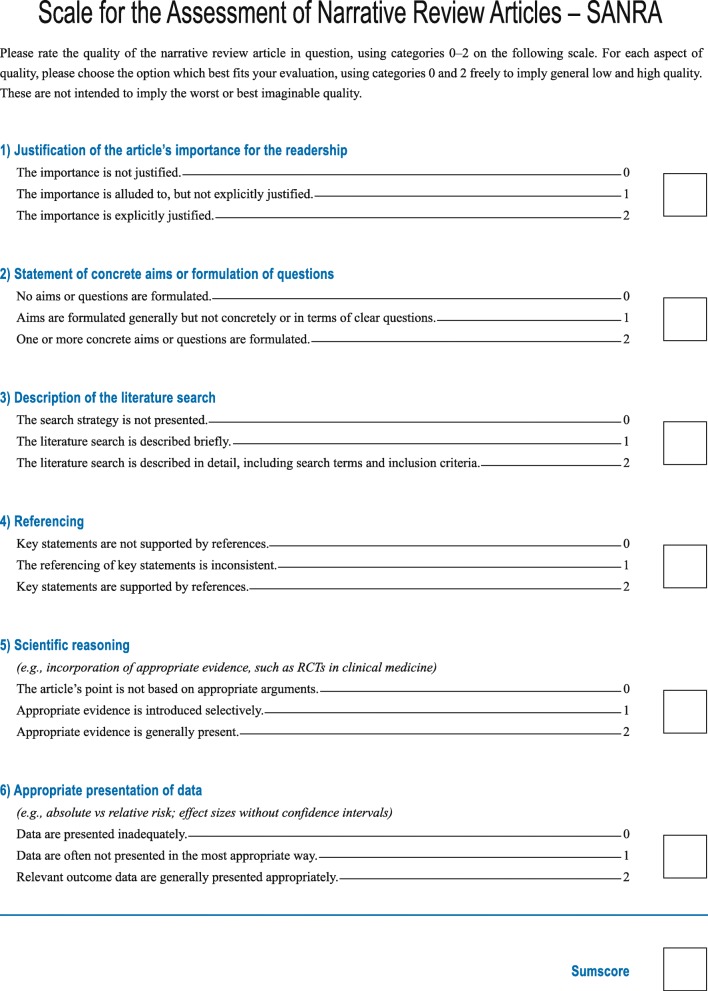
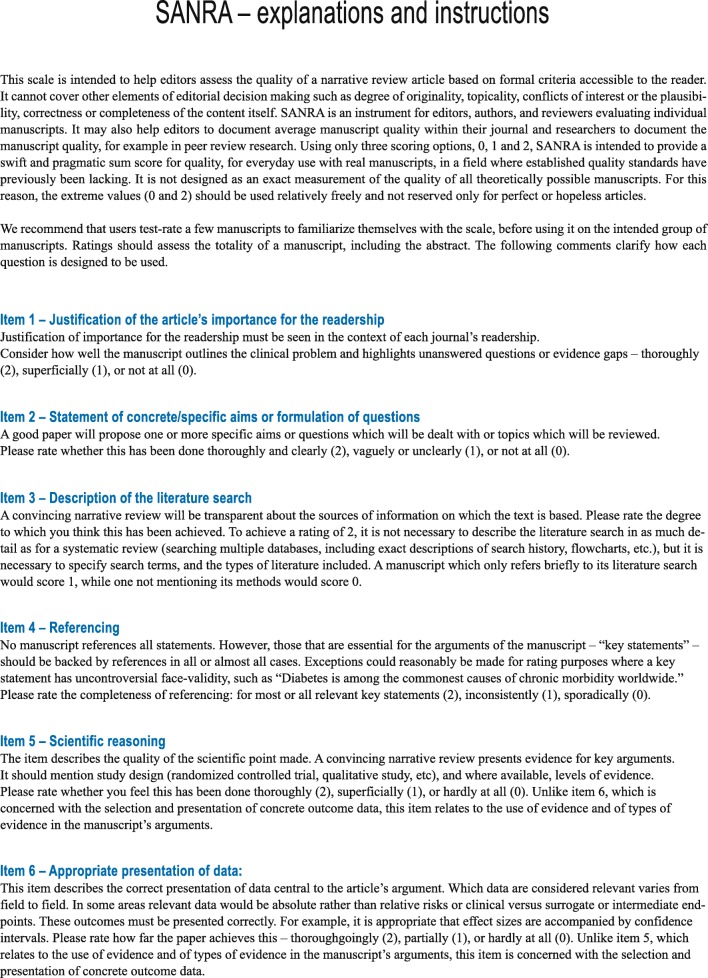
BACKGROUND: Narrative reviews are the commonest type of articles in the medical literature. However, unlike systematic reviews and randomized controlled trials (RCT) articles, for which formal instruments exist to evaluate quality, there is currently no instrument available to assess the quality of narrative reviews. In response to this gap, we developed SANRA, the Scale for the Assessment of Narrative Review Articles. METHODS: A team of three experienced journal editors modified or deleted items in an earlier SANRA version based on face validity, item-total correlations, and reliability scores from previous tests. We deleted an item which addressed a manuscript's writing and accessibility due to poor inter-rater reliability. The six items which form the revised scale are rated from 0 (low standard) to 2 (high standard) and cover the following topics: explanation of (1) the importance and (2) the aims of the review, (3) literature search and (4) referencing and presentation of (5) evidence level and (6) relevant endpoint data. For all items, we developed anchor definitions and examples to guide users in filling out the form. The revised scale was tested by the same editors (blinded to each other's ratings) in a group of 30 consecutive non-systematic review manuscripts submitted to a general medical journal. RESULTS: Raters confirmed that completing the scale is feasible in everyday editorial work. The mean sum score across all 30 manuscripts was 6.0 out of 12 possible points (SD 2.6, range 1-12). Corrected item-total correlations ranged from 0.33 (item 3) to 0.58 (item 6), and Cronbach's alpha was 0.68 (internal consistency). The intra-class correlation coefficient (average measure) was 0.77 [95% CI 0.57, 0.88] (inter-rater reliability). Raters often disagreed on items 1 and 4. CONCLUSIONS: SANRA's feasibility, inter-rater reliability, homogeneity of items, and internal consistency are sufficient for a scale of six items. Further field testing, particularly of validity, is desirable. We recommend rater training based on the "explanations and instructions" document provided with SANRA. In editorial decision-making, SANRA may complement journal-specific evaluation of manuscripts-pertaining to, e.g., audience, originality or difficulty-and may contribute to improving the standard of non-systematic reviews.
Overview
CoChat Summary
TL;DR
SANRA is a six-item, 0–2 scale (maximum 12) for assessing the quality of narrative review articles, developed and field-tested by three journal editors. In 30 consecutive non-systematic review manuscripts, it showed feasible use, sufficient internal consistency and inter-rater reliability, and a modest association with editorial acceptance.
Key findings
- Across 30 manuscripts (90 ratings), the mean SANRA sum score was 6.0 out of 12 (SD 2.6, range 1–12, median 6).
- Internal consistency was Cronbach’s alpha 0.68; corrected item-total correlations ranged from 0.33 (item 3) to 0.58 (item 6).
- Inter-rater reliability was an intra-class correlation coefficient (average measure) of 0.77 [95% CI 0.57, 0.88]; raters often disagreed on items 1 and 4.
- Average SANRA scores were modestly associated with editorial acceptance (mean 6.6, SD 1.9, n = 17) versus rejection (mean 5.1, SD 2.1, n = 13), point biserial correlation 0.37 (t = 2.09, df 28; two-sided p = 0.046).
Methods
- SANRA was developed between 2010 and 2017 by three experienced editors at Deutsches Ärzteblatt; the revised six-item version deleted an item on writing and accessibility due to poor inter-rater reliability.
- The revised scale was tested on 30 consecutive non-systematic review manuscripts submitted to Deutsches Ärzteblatt in 2015; three editor-raters scored them independently and blinded to each other’s ratings.
- Analyses included descriptive statistics, Cronbach’s alpha, corrected item-total correlations, average-measure intra-class correlation using a two-way random effects model (consistency definition), and a post hoc point biserial correlation between SANRA sum scores and acceptance/rejection.
Limitations
- The paper states the main limitation is sample size: 30 manuscripts was a compromise between representativeness, power, and feasibility, and took about 6 months to sample.
- The authors state that the scale’s authors were also the test-raters, so inter-rater reliability may be lower in groups less familiar with SANRA; the study also did not assess test-retest reliability, and results are study-specific.
- The paper acknowledges restricted content validity because SANRA is limited to six items and is a critical appraisal tool rather than a reporting guideline; criterion validity evidence is post hoc and weak, and no established cut-offs exist for comparing manuscripts across settings.
Model-written summary. Check it against the paper before relying on it.
Integrity signals
Registry
Cites
Statistics
Figures
Verification
Claims the paper makes
3 Valid · 0 Not valid · 5 Not checked · 27 Own results and interpretations
The cited sources support only part of this claim — read each source’s verdict below.
In the paper
“Bastian et al. found that they constitute the largest share of all text types in medicine and they concluded that they “remain the staple of medical literature” [1].”
- Also stated in: § Background · plain
“Narrative reviews are the commonest type of articles in the medical literature.”
§ SANRA—a scale for the quality assessment of narrative review articles > Background
What the sources say
- Partly supportedcites [1] Bastian H Glasziou P Chalmers I Seventy-five trials and eleven systematic reviews a day: how will we ever keep up? PLoS Med 2010 7 9 e1000326 10.1371/journal.pmed.1000326 20877712 PMC2943439 sourceExperimental — accuracy not yet measured
In “How Close Are We to Archie Cochrane’s Goal?” and the Summary Points (pages unavailable), the paper calls non-systematic narrative reviews the staple of medical literature synthesis. It does not say they constitute the largest share of all medical text types; that extends a claim about literature synthesis to medical literature as a whole. (LLM, conf=0.88)
plain- Asserted: passes — The authors put it forward as true.
- Checkable: passes — It can be checked against evidence.
- Load-bearing: unclear — It is unclear whether the paper’s conclusions depend on it.
- Based: passes — The paper gives a reason why it holds.
- Also stated in: § Background · plain
The sources with a verdict support this claim; the rest weren’t checked yet, have no full text we could read, or their verdicts aren’t rated yet.
In the paper
“non-systematic reviews or narrative reviews have been widely criticized as unreliable [1, 4].”
§ SANRA—a scale for the quality assessment of narrative review articles > Background
What the sources say
- Supportedcites [1] Bastian H Glasziou P Chalmers I Seventy-five trials and eleven systematic reviews a day: how will we ever keep up? PLoS Med 2010 7 9 e1000326 10.1371/journal.pmed.1000326 20877712 PMC2943439 source
In “How Close Are We to Archie Cochrane’s Goal?”, the paper describes reviews not conducted systematically as having great potential for error and calls them less reliable forms of information. Box 1 also says that articles and textbooks had highlighted the risk of bias and chance in reviews. Together, these passages support the broad characterization that narrative reviews have been criticized as unreliable; page numbers are not provided in our copy. (LLM, conf=0.89)
- Not checked — no full text of the sourcecites [4] Mulrow CD The medical review article: state of the science Ann Intern Med 1987 106 485 488 10.7326/0003-4819-106-3-485 3813259 source
plain- Asserted: passes — The authors put it forward as true.
- Checkable: passes — It can be checked against evidence.
- Load-bearing: passes — The paper’s conclusions depend on it.
- Based: passes — The paper gives a reason why it holds.
- Supported
A result the paper reports from its own data — it cites no other source for it, so there is none to check. The quote shows it is in the paper.
In the paper
“Cronbach’s alpha was 0.68 (internal consistency).”
- Also stated in: § Results · plain
“The scale’s internal consistency, measured as Cronbach’s alpha, was 0.68.”
§ SANRA—a scale for the quality assessment of narrative review articles > Abstract > Results
plainn = 90- Asserted: passes — The authors put it forward as true.
- Checkable: passes — It can be checked against evidence.
- Load-bearing: passes — The paper’s conclusions depend on it.
- Based: passes — The paper gives a reason why it holds.
- Also stated in: § Results · plain
A result the paper reports from its own data — it cites no other source for it, so there is none to check. The quote shows it is in the paper.
In the paper
“Raters often disagreed on items 1 and 4.”
- Also stated in: § Results · plain
“Disagreements most often occurred with regard to items 1 and 4.”
§ SANRA—a scale for the quality assessment of narrative review articles > Abstract > Results
plain- Asserted: passes — The authors put it forward as true.
- Checkable: passes — It can be checked against evidence.
- Load-bearing: unclear — It is unclear whether the paper’s conclusions depend on it.
- Based: passes — The paper gives a reason why it holds.
- Also stated in: § Results · plain
A result the paper reports from its own data — it cites no other source for it, so there is none to check. The quote shows it is in the paper.
In the paper
“The intra-class correlation coefficient (average measure) was 0.77 [95% CI 0.57, 0.88] (inter-rater reliability).”
- Also stated in: § Results · plain
“The intra-class correlation coefficient (average measure) amounted to 0.77 [95% CI 0.57, 0.88; F 4.3; df 29, 58].”
§ SANRA—a scale for the quality assessment of narrative review articles > Abstract > Results
plain- Asserted: passes — The authors put it forward as true.
- Checkable: passes — It can be checked against evidence.
- Load-bearing: passes — The paper’s conclusions depend on it.
- Based: passes — The paper gives a reason why it holds.
- Also stated in: § Results · plain
14 more claims
Create a free account to see all 35 claims and to verify the 3 references still open.
- Probably not a substantial claim. 11
- It may state two separate claims as one. 11
Claims other papers make about this one
Each is checked against this paper’s own text: does it say what the citing paper says it does?
The source backs part of the claim, not all of it — or backs it for a different population, condition or comparison.
In the citing paper
“The review was conducted and reported in accordance with the principles of the Scale for the Assessment of Narrative Review Articles (SANRA), which provides a validated framework for ensuring methodological transparency, scientific rigor, and balanced interpretation in narrative reviews [ 19 ].”
From Paracetamol: A History of Assumptions, Errors, and Evidence Reversals in Pain Management (2026) · cites this paper as [19]
Experimental — accuracy not yet measuredThe source backs part of the claim, not all of it — or backs it for a different population, condition or comparison.
In the citing paper
“As a narrative review, the present work does not include an aggregated quantitative assessment and is more exposed to selection subjectivity than a registered systematic review [124,125].”
From Berberine-Drug Interactions: Mechanisms, Clinical Relevance and Risk Stratification-A Narrative Review (2026) · cites this paper as [124]
Experimental — accuracy not yet measuredThe cited source says what the claim attributes to it.
In the citing paper
“This work is designed as a structured narrative review, with transparent reporting of the documentation strategy, guided by the quality criteria of the Scale for the Assessment of Narrative Review Articles (SANRA) [124].”
From Berberine-Drug Interactions: Mechanisms, Clinical Relevance and Risk Stratification-A Narrative Review (2026) · cites this paper as [124]
The cited source says what the claim attributes to it.
In the citing paper
“we used the following:-Cochrane Risk of Bias 2 (RoB 2) [29] and PEDRO scale tools for RCTs.-AMSTAR 2 [30] checklist for systematic review.-SANRA (Scale for the Assessment of Narrative Review Articles) [31] for narrative reviews.-JBI Checklist for Text and Opinion [32] for expert opinion papers.”
From Pelvic Floor Muscle Training Following Surgery for Pelvic Organ Prolapse: Recommendation from Scientific Literature (2026) · cites this paper as [31]
The cited source says what the claim attributes to it.
In the citing paper
“Data analysis employed a narrative and thematic synthesis methodology,adhering to the SANRA guidelines for narrative reviews (32).”
From Ethical issues in multi-agent AI systems for healthcare: a narrative review (2026) · cites this paper as [32]
12 more claims about this paper
Create a free account to see every claim other papers make about this one.
Citations
Cites
Shea, B. J., Reeves, B. C., Wells, G., Thuku, M., Hamel, C., Moran, J., Moher, D., Tugwell, P., Welch, V., Kristjansson, E., et al. (2017) · BMJ · doi:10.1136/bmj.j4008 · Cited by 10,636 · cited 2×
“Critical appraisal tools have been developed for systematic reviews (e.g., AMSTAR 2 [A MeaSurement Tool to Assess Systematic Reviews] [7]) and papers on RCTs (e.g., the CASP [Critical Appraisal Skills Program] checklist for randomized trials [8]) and other types of medical studies.”
BackgroundStreiner, D. L., & Norman, G. R. (2008) · doi:10.1093/acprof:oso/9780199231881.001.0001 · Cited by 2,631
Critical appraisal skills programme
Singh, J. (2013) · Journal of Pharmacology and Pharmacotherapeutics · doi:10.4103/0976-500x.107697 · Cited by 2,556
Guidelines for Reporting Reliability and Agreement Studies (GRRAS) were proposed
Kottner, J., Audigé, L., Brorson, S., Donner, A., Gajewski, B. J., Hróbjartsson, A., Roberts, C., Shoukri, M., & Streiner, D. L. (2011) · Journal of Clinical Epidemiology · doi:10.1016/j.jclinepi.2010.03.002 · Cited by 2,174
The Mass Production of Redundant, Misleading, and Conflicted Systematic Reviews and Meta‐analyses
IOANNIDIS, J. P. A. (2016) · The Milbank Quarterly · doi:10.1111/1468-0009.12210 · Cited by 1,483 · cited 1×
“While systematic reviews are not per se superior articles and while certain systematic reviews have been criticized lately [3], non-systematic reviews or narrative reviews have”
BackgroundSeventy-five trials and eleven systematic reviews a day: how will we ever keep up?
Bastian, H., Glasziou, P., & Chalmers, I. (2010) · PLoS Medicine · doi:10.1371/journal.pmed.1000326 · Cited by 1,188 · cited 2×
“found that they constitute the largest share of all text types in medicine and they concluded that they “remain the staple of medical literature” [1].”
BackgroundThe Medical Review Article: State of the Science
MULROW, C. D. (1987) · Annals of Internal Medicine · doi:10.7326/0003-4819-106-3-485 · Cited by 856 · cited 1×
“been widely criticized as unreliable [1, 4].”
Writing a narrative biomedical review: considerations for authors, peer reviewers, and editors
Gasparyan, A. Y., Ayvazyan, L., Blackmore, H., & Kitas, G. D. (2011) · Rheumatology International · doi:10.1007/s00296-011-1999-3 · Cited by 694 · cited 1×
“[13], for example, have provided guidance for writing narrative reviews, and Byrne [14] as well as Pautasso [15] has written, from different angles, thoughtful editorials on improving narrative reviews and presented lists of key features of writing a good review—lists that naturally overlap with SANRA items (e.”
BackgroundTen Simple Rules for Writing a Literature Review
Pautasso, M. (2013) · PLoS Computational Biology · doi:10.1371/journal.pcbi.1003149 · Cited by 272 · cited 3×
“[13], for example, have provided guidance for writing narrative reviews, and Byrne [14] as well as Pautasso [15] has written, from different angles, thoughtful editorials on improving narrative reviews and presented lists of key features of writing a good review—lists that naturally overlap with SANRA items (e.”
BackgroundImproving the peer review of narrative literature reviews
Byrne, J. A. (2016) · Research Integrity and Peer Review · doi:10.1186/s41073-016-0019-2 · Cited by 159 · cited 3×
“[13], for example, have provided guidance for writing narrative reviews, and Byrne [14] as well as Pautasso [15] has written, from different angles, thoughtful editorials on improving narrative reviews and presented lists of key features of writing a good review—lists that naturally overlap with SANRA items (e.”
Background
Research works printed but not linked: 3
- Higgins JPT, Green S. (eds.). Cochrane Handbook for Systematic Reviews and Interventions. Version 5.1.0. The Cochrane Collaboration 2011, section 1.2.2., www.handbook.cochrane.org, retrieved on Oct 31, 2018.
- Baethge C Mertens S Goldbeck-Wood S Development of a quality score for the assessment of non-systematic review articles (SANRA) Poster, Seventh International Congress on Peer Review and Biomedical Publication 2013 USA Chicago, Illinois
- Baethge C Goldbeck-Wood S Mertens S A scale for the assessment of non-systematic review articles (SANRA) Poster, Eighth International Congress on Peer and Biomedical Publication 2017 USA Chicago, Illinois
Cited by
Items 601–700 of 4,334
Culture, theory-of-mind, and morality: How independent and interdependent minds make moral judgments
Park, B., Vepachedu, S., Keshava, P., & Minns, S. A. (2022) · Biological Psychology · doi:10.1016/j.biopsycho.2022.108423 · Cited by 13
Verbal fluency and autism: Reframing current data through the lens of monotropism
Grissom, A., Finke, E. H., & Zane, E. R. (2023) · Autism Research · doi:10.1002/aur.3071 · Cited by 15
“The review follows the criteria outlined by the Scale for the Assessment of Narrative Review Articles (Baethge et al., 2019), designed to guide researchers in completing high-quality narrative reviews.”
BackgroundMethodFat Matters: Exploring Cancer Risk through the Lens of Computed Tomography and Visceral Adiposity
Greco, F., Piccolo, C. L., D’Andrea, V., Scardapane, A., Zobel, B. B., & Mallio, C. A. (2024) · Journal of Clinical Medicine · doi:10.3390/jcm13020453 · Cited by 14
“Reporting of the results is in alignment with the SANRA checklist for narrative review [13].”
ResultFantin, A., Castaldo, N., Palou, M. S., Viterale, G., Crisafulli, E., Sartori, G., Patrucco, F., Vailati, P., Morana, G., Mei, F., et al. (2024) · Journal of Thoracic Disease · doi:10.21037/jtd-23-1745 · Cited by 12
“This manuscript is written as per SANRA quality scale (29).”
Ramalho, A. L. G., Paulo, R. M., Duarte‐Mendes, P., Serrano, J., & Petrica, J. (2024) · Healthcare · doi:10.3390/healthcare12090935 · Cited by 12
“This study performs a qualitative synthesis and uses a streamlined literature review process guided by the SANRA (Scale for the Quality Assessment of Narrative Review Articles) [20] framework to ensure a high standard throughout the review.”
MethodSpanos, S., Dammery, G., Pagano, L., Ellis, L. A., Fisher, G., Smith, C. L., Foo, D., & Braithwaite, J. (2024) · BMC Health Services Research · doi:10.1186/s12913-024-11295-3 · Cited by 13
“As the included articles were broad in their publication design, three appraisal tools were used: 1) Mixed-Methods Appraisal Tool (MMAT) [27]; 2) Scale for the quality Assessment of Narrative Reviews (SANRA) [28]; and 3) Joanna Briggs Institute (JBI) Text and Opinion [29].”
MethodInterprofessional education in cardiothoracic surgery: a narrative review
Lampridis, S., Scarci, M., & Cerfolio, R. J. (2024) · Frontiers in Surgery · doi:10.3389/fsurg.2024.1467940 · Cited by 13
Disclosure Practices in Muslim Patients and the Impact on End-of-Life Care: A Narrative Review
Tareen, M. (2024) · American Journal of Hospice and Palliative Medicine® · doi:10.1177/10499091241303684 · Cited by 12
Annual Research Review: Micronutrients and their role in the treatment of paediatric mental illness
Rucklidge, J. J., Bruton, A. M., Welsh, A., Ast, H. K., & Johnstone, J. M. (2024) · Journal of Child Psychology and Psychiatry · doi:10.1111/jcpp.14091 · Cited by 13
Mariani, A., Spaccarotella, C., Rea, F. S., Franzone, A., Piccolo, R., Castiello, D. S., Indolfi, C., & Esposito, G. (2025) · Life · doi:10.3390/life15040515 · Cited by 12
Neal, D. P., Bartels, S. L., Chaouni, S. B., Caprioli, T., Comas‐Herrera, A., Chattat, R., Diaz, A., Dröes, R., Faulkner, T. C., Felding, S. A., et al. (2025) · Behavioral Sciences · doi:10.3390/bs15040457 · Cited by 13
“The report is in line with the SANRA checklist for narrative reviews (Baethge et al., 2019).”
Genetic Aspects of Tooth Agenesis
Modafferi, C., Tucci, I., Bogliardi, F. M., Gimondo, E., Chiurazzi, P., Tabolacci, E., & Grippaudo, C. (2025) · Genes · doi:10.3390/genes16050582 · Cited by 14
“We referred to the SANRA scale for the quality assessment of narrative review articles [13].”
Tran, T. T., Be, H. T., Hoang, K. D., & Dong, H. D. (2025) · Clinical & Translational Oncology · doi:10.1007/s12094-025-03965-3 · Cited by 13
“To uphold methodological rigor, we assessed study quality using the appropriate Critical Appraisal Skills Programme (CASP) checklist [10] for each design, and we recorded our entire process in accordance with SANRA standards [11].”
Kowalówka, M., Górna, I., Karaźniewicz‐Łada, M., Kusyk, D., Przysławski, J., & Drzymała-Czyż, S. (2025) · Metabolites · doi:10.3390/metabo15070436 · Cited by 15
Dahò, M., & Monzani, D. (2025) · Cognitive Neuropsychology · doi:10.1080/02643294.2025.2527983 · Cited by 19
“The quality of this narrative review was assessed using the SANRA scale (Baethge et al., 2019), with a total score of 11 out of 12, indicating high quality; the completed scale is available in Supplementary File 2.”
Advances in the diagnosis and treatment of congenital scoliosis
Peng, Z., Zhang, H., Wang, S., & Zhang, J. (2025) · European journal of medical research · doi:10.1186/s40001-025-02943-3 · Cited by 12
“We conducted a narrative literature review in July 2025, adhering to the SANRA (Scale for the Assessment of Narrative Review Articles) guidelines [17].”
An Updated Review of Topical Tretinoin in Dermatology: From Acne and Photoaging to Skin Cancer
Balado-Simó, P., Morgado‐Carrasco, D., Gómez‐Armayones, S., López‐Ferrer, A., Barco, D., Ferrándiz‐Pulido, C., & Podlipnik, S. (2025) · Journal of Clinical Medicine · doi:10.3390/jcm14227958 · Cited by 13
Myalgic encephalomyelitis/chronic fatigue syndrome (ME/CFS): diagnosis and management
Fan, J., Jiao, J., Chang, H.-Q., Zhong, D., Liu, X.-B., Li, J., Chen, L., Jin, R., & Wu, X. (2025) · Journal of Translational Medicine · doi:10.1186/s12967-025-07506-y · Cited by 16
“The narrative review was reported and conducted in accordance with the SANRA (the Scale for the Assessment of Narrative Review Articles) [16].”
Immuno-Inflammatory Mechanisms in the Chronification of Pain
Moncada, M. A. A., Tamayo, M. A. N., Encinas, M. N., Leoni, M. L. G., & Varrassi, G. (2026) · Pain and Therapy · doi:10.1007/s40122-026-00818-x · Cited by 15
“This narrative review was conducted following the Scale for the Assessment of Narrative Review Articles (SANRA) guidelines to ensure methodological rigor and transparency in the synthesis of evidence [13].”
Perrone, P., & D’Angelo, S. (2026) · Nutrients · doi:10.3390/nu18142396 · Cited by 16
“Nevertheless, narrative reviews are useful for integrating heterogeneous evidence, developing conceptual frameworks, and identifying research gaps when a field includes mechanistic, clinical, analytical, and translational dimensions [29,30].”
McCaskie, C. J., Sim, M., Newton, R. U., & Hart, N. H. (2021) · Physical Therapy in Sport · doi:10.1016/j.ptsp.2021.08.006 · Cited by 13
Ryom, K., Simonsen, C. B., Eshøj, S., Nielsen, G., Troelsen, J., & Maindal, H. T. (2021) · Scandinavian Journal of Public Health · doi:10.1177/14034948211042956 · Cited by 12
Exploring a Possible Interplay between Schizophrenia, Oxytocin, and Estrogens: A Narrative Review
Papadea, D., Dalla, C., & Tata, D. Α. (2023) · Brain Sciences · doi:10.3390/brainsci13030461 · Cited by 14
“This narrative review conforms to the Scale for the Assessment of Narrative Review Articles (SANRA) guidelines [32].”
MethodPatel, U. P., Saxena, A., Patel, D. N., Ayesha, I. E., Monson, N. R., Klair, N., & Yu, A. K. (2023) · Cureus · doi:10.7759/cureus.45044 · Cited by 12
“The quality and risk of bias of included studies are assessed using appropriate tools such as the NewcastleOttawa Scale for observational studies [11], Scale for the Assessment of Narrative Review Articles 2 (SANRA) for narrative review articles [12], Assessment of Multiple Systematic Reviews 2 (AMSTAR 2) for systemat…”
MethodA comprehensive review of the intersection between asthma and depression
Surve, T. A. N., Sharma, D., Khan, K. G., Ghanie, N., Charanrak, R., Sharifa, M., Begum, S., Auz, M. J., Akbarova, N., & Mylavarapu, M. (2024) · Journal of Asthma · doi:10.1080/02770903.2024.2324862 · Cited by 12
“The review was conducted in accordance with the SANRA guidelines (9).”
Yeh, L. H., Seng, W. Y., Yin, K. Y., Nor, N. M., Juan, W. M., Ling, L. H., & Zhiqiang, S. (2024) · Journal of Advanced Research in Applied Sciences and Engineering Technology · doi:10.37934/araset.41.2.6281 · Cited by 12
Karuppannan, M., Muthanna, F. M. S., & Fauzi, F. M. (2024) · Nutrition and Cancer · doi:10.1080/01635581.2024.2321654 · Cited by 12
“This narrative review is based on SANRA (Scale For The Quality Assessment Of Narrative Review Articles) to guide synthesis of this information into a quality narrative review (26).”
MethodNammi, J., Pasala, R., Kotaru, S., Bandikolla, S. S., Andhe, N., & Gouravaram, P. R. (2024) · Cureus · doi:10.7759/cureus.58361 · Cited by 16
“The study was conducted through a thorough literature review following the SANRA guidelines [9].”
MethodPrognostic factors and genetic markers in thymic epithelial tumors: A narrative review
Agrafiotis, A. C., Siozopoulou, V., Hendriks, J. M. H., Pauwels, P., Koljenović, S., & Schil, P. E. V. (2022) · Thoracic Cancer · doi:10.1111/1759-7714.14725 · Cited by 12
“This article was designed according to the recent recommendations on quality assessment of narrative review articles.(13) Our review article was focused on the two selected elements concerning TET.”
MethodEthical issues in multi-agent AI systems for healthcare: a narrative review
Xie, Z., Wang, H., Dai, L., Wang, Z., Song, H., & Qian, J. (2026) · Frontiers in Public Health · doi:10.3389/fpubh.2026.1792627 · Cited by 11
“Data analysis employed a narrative and thematic synthesis methodology,adhering to the SANRA guidelines for narrative reviews (32).”
Medical malpractice stress syndrome in theory and practice – a narrative review
Kruczaj, K., Krawczyk, E. H., & Piegza, M. J. (2023) · Medycyna Pracy · doi:10.13075/mp.5893.01425 · Cited by 10
Ospemifene and vulvovaginal atrophy: an update of the clinical profile for post-menopausal women
Carlo, C. D., Cagnacci, A., Murina, F., Maffei, S., Becorpi, A., & Lello, S. (2024) · Expert Opinion on Pharmacotherapy · doi:10.1080/14656566.2024.2391009 · Cited by 11
“The SANRA (Scale for Assessment of Narrative Review Articles) check list for narrative reviews was applied [8].”
Herrera, D., Almhdie-Imjabbar, A., Toumi, H., & Lespessailles, É. (2024) · European Journal of Radiology · doi:10.1016/j.ejrad.2024.111731 · Cited by 13
Kyranou, M., & Karanikola, M. N. K. (2025) · Healthcare · doi:10.3390/healthcare13030274 · Cited by 13
Çalışkan, E., & Gökkaya, F. (2025) · Current Pain and Headache Reports · doi:10.1007/s11916-025-01373-4 · Cited by 13
“Foremostly, narrative review consists of some limitations, including the missing quality check, and the lacking conclu - sions for effectiveness [ 88].”
Croft, J., LaMacchia, Z. M., Alderete, J. F., Maestas, A., Nguyen, K., & O’Hara, R. B. (2025) · Military Medicine · doi:10.1093/milmed/usaf063 · Cited by 13
Alghamdi, A. A. (2025) · Pharmacy · doi:10.3390/pharmacy13020050 · Cited by 17
“The review followed SANRA (Scale for the Assessment of Narrative Review Articles) and PRISMA (Preferred Reporting Items for Systematic reviews and Meta-Analyses) guidelines (to illustrate the selection criteria) to ensure a transparent and reproducible methodology (Figure 1) [15–17].”
Leale, I., Vinciguerra, C., Stefano, V. D., Brighina, F., & Battaglia, G. (2025) · Healthcare · doi:10.3390/healthcare13070826 · Cited by 12
“This narrative review was developed in accordance with the Assessment of Narrative Review Articles (SANRA) guidelines [18].”
Giannella, L., Grelloni, C., Natalini, L., Sartini, G., Lavezzo, F., Cicoli, C., Bernardi, M., Bordini, M., Petrini, M., Petrucci, J., et al. (2025) · Vaccines · doi:10.3390/vaccines13050445 · Cited by 11
“We conducted a comprehensive literature search using the Pubmed, Scopus, and Web of Science databases [21].”
Purr-ogrammed love: A narrative review of virtual pets
Dodd, M., Fowler, A., & Lottridge, D. M. (2025) · Entertainment Computing · doi:10.1016/j.entcom.2025.100958 · Cited by 13
Moszak, M., Marcickiewicz, J., Pelczyńska, M., & Bogdański, P. (2025) · Nutrients · doi:10.3390/nu17101662 · Cited by 12
“The Scale for Assessment of Narrative Review Articles (SANRA) checklist was used to assess the quality of the studies (Table S2) [18].”
Paulsson, M., Svendsen, R., Andersen, J. K. N., Sporrong, S. K., Andersson, Y., & Tho, I. (2025) · Acta Paediatrica · doi:10.1111/apa.70199 · Cited by 17
“This included ensuring a clear explanation of the review's importance and aims, a well-structured presentation of the literature, accurate referencing, and critical appraisal of the included sources [11].”
Horovitz, O. (2025) · Frontiers in Nutrition · doi:10.3389/fnut.2025.1592528 · Cited by 12
Fouillen, K. J., Duncan, H. F., & Chevalier, V. (2025) · International Endodontic Journal · doi:10.1111/iej.70012 · Cited by 11
“There are no reporting guidelines for narrative reviews; therefore, the Scale for the Assessment of Narrative Review Articles (SANRA) served as a methodological guide (Baethge et al. 2019).”
Violence towards emergency nurses: an update of a narrative review of theories and frameworks
Ramacciati, N., & Palomares, S. M. (2025) · International Emergency Nursing · doi:10.1016/j.ienj.2025.101661 · Cited by 11
Giordano, G., Terranova, R., Mastrantoni, L., & Landi, F. (2025) · Nutrients · doi:10.3390/nu17182928 · Cited by 14
Durney, P., Paquin, E., Fitzpatrick, G., Lockstein, D., Warrick-Stone, T., Montesi, M., Patel-Francis, S. H., Rashid, J., Vaughan-Ogunlusi, O., Goodsell, K., et al. (2025) · Psychoactives · doi:10.3390/psychoactives4040037 · Cited by 11
Oral health and healthy aging: A multiregional review
Tadjoedin, F. M., Adiatman, M., Lee, Y. Y. A., Banu, U. S., Tan, S. S. L., & Garg, V. (2025) · Journal of Aging Research and Lifestyle · doi:10.1016/j.jarlif.2025.100057 · Cited by 15
“This review was conducted in accordance with the Scale for the Assessment of Narrative Review Articles (SANRA), a validated tool to assess the quality and transparency of narrative review articles [25].”
The oral mucosal barrier: a dynamic gateway in oral and systemic health
Xin, Y., & Lei, H. (2026) · Tissue Barriers · doi:10.1080/21688370.2025.2610035 · Cited by 13
Optimizing cardiac telerehabilitation programs: psychological, social, and implementation factors
Micheluzzi, V., Merella, P., Burrai, F., Canu, A., Sircana, A., Marongiu, B., Soro, G., & Casu, G. (2026) · Current Problems in Cardiology · doi:10.1016/j.cpcardiol.2026.103290 · Cited by 11
Amawi, A. T., Grivas, G. V., & Alkasasbeh, W. J. (2026) · Frontiers in Public Health · doi:10.3389/fpubh.2026.1822194 · Cited by 14
Lopes, A. C., Roque, F., Morgado, S., Dinis, C., Herdeiro, M. T., & Morgado, M. (2021) · Behavioral Sciences · doi:10.3390/bs11110153 · Cited by 14
Constantinou, C. S., Thrastardottir, T. O., Baidwan, H. K., Makenete, M. S., Papageorgiou, A., & Georgiades, S. (2022) · Behavioral Sciences · doi:10.3390/bs12090305 · Cited by 15
Zohara, Z., Adelekun, A., Seffah, K. D., Salib, K., Dardari, L., Taha, M., Dahat, P., Toriola, S. L., Satnarine, T., & Franchini, A. P. A. (2023) · Cureus · doi:10.7759/cureus.41959 · Cited by 15
“The 37 chosen articles are then assessed by two authors (the first and second authors) using tools such as Newcastle-Ottawa Scale adapted for cohort and case-control studies and the SANRA (scale for the assessment of narrative review articles) checklist for review articles [27,28].”
MethodCancerogenic parasites in veterinary medicine: a narrative literature review
Fonti, N., Parisi, F., Mancianti, F., Freer, G., & Poli, A. (2023) · Infectious Agents and Cancer · doi:10.1186/s13027-023-00522-x · Cited by 14
“The search methodology adheres to the recommended standards for effective narrative review articles [36, 37].”
MethodCold-stored platelets for acute bleeding in cardiac surgical patients: a narrative review
Lu, J. Y., Karkouti, K., Peer, M., Englesakis, M. F., Spinella, P. C., Apelseth, T. O., Scorer, T. G., Kahr, W. H. A., McVey, M. J., Rao, V. A., et al. (2023) · Canadian Journal of Anesthesia/Journal canadien d anesthésie · doi:10.1007/s12630-023-02561-9 · Cited by 11
“31 How room-temperature platelets became the standard The 1950s brought an increase in blood use with the pioneering of open-heart surgery and improved resuscitation practices in trauma patients.”
BackgroundPaltiel, M., Cheong, M., Coghlan, S., & Lederman, R. (2023) · AJIS. Australasian journal of information systems/AJIS. Australian journal of information systems/Australian journal of information systems · doi:10.3127/ajis.v27i0.4517 · Cited by 13
“First, systematic reviews presuppose a "specific" research question 1 , whereas a narrative review style is "better suited to addressing a topic in wider ways" (Baethge et al., 2019, p. 2).”
BackgroundSpivack, O. K. C., Dellenmark‐Blom, M., Dingemann, J., ten Kate, C. A., Wallace, V., Bramer, W. M., Quitmann, J., & Rietman, A. B. (2024) · European Journal of Pediatric Surgery · doi:10.1055/s-0043-1778108 · Cited by 12
“This review adhered to the six prede fi ned criteria aimed at enhancing the quality of narrative reviews, as outlined by Baethge et al. 25 This includes providing an explanation of the article ’ s importance, de fi ning and describing the aims of the review and the literature search, Most PROMs were…”
MethodGuillaumie, L., Vézina‐Im, L., Bourque, L., Boiral, O., Talbot, D., & Harb, E. (2024) · Social Sciences · doi:10.3390/socsci13030127 · Cited by 15
Palliative Care in Sub-Saharan Africa: A Narrative Review
Heller, L. D. (2024) · Journal of Palliative Medicine · doi:10.1089/jpm.2023.0501 · Cited by 11
Dioguardi, M., Notte, D. L., Sovereto, D., Quarta, C., Martella, A., & Ballini, A. (2024) · The Scientific World JOURNAL · doi:10.1155/2024/1648011 · Cited by 11
“A checklist was also performed, taking into consideration the SANRA [34] and the guidelines provided by Green et al. [35] on the writing of a narrative literature review.”
MethodTejativaddhana, P., Chuakhamfoo, N. N., & Vo, M. T. H. (2022) · Public Administration and Policy · doi:10.1108/pap-02-2022-0013 · Cited by 12
Baets, L. D., Vets, N., Emmerzaal, J., Devoogdt, N., & Groef, A. D. (2022) · The Anatomical Record · doi:10.1002/ar.25120 · Cited by 12
“To guarantee the quality of this narrative review, it was prepared with the aid of the SANRA scale which is developed for assessing the quality of narrative review articles (Baethge et al., 2019).”
MethodAssessment of neuropathic pain following cancer treatment
Moloney, N. A., & Lenoir, D. (2023) · The Anatomical Record · doi:10.1002/ar.25161 · Cited by 14
“A narrative review in line with the scale for the assessment of narrative review articles (SANRA) was conducted (Baethge et al., 2019).”
MethodUse of the opioid receptor antagonist – naltrexone in the treatment of non-suicidal self-injury
Karakuła‐Juchnowicz, H., Banaszek, A., & Juchnowicz, D. (2023) · Psychiatria Polska · doi:10.12740/pp/onlinefirst/161954 · Cited by 11
“In addition, it allows for the identification of key questions about the paper, the literature search process and its quality [7, 8].”
Aldakhlan, H. A., Khan, A. S., & Alabdulbaqi, D. (2024) · Cureus · doi:10.7759/cureus.53059 · Cited by 10
“The full manuscripts of the included articles were then screened using the Scale for the Assessment of Narrative Review Articles (SANRA) [7].”
MethodWhat is Polarization in the Social Sciences? A Scoping Review of Reviews
Garzón‐Velandia, D. C., Barreto, I., & Cameselle, J. M. S. (2024) · Acta Colombiana de Psicología · doi:10.14718/acp.2024.27.2.11 · Cited by 11
“The scale assesses the articles’ justification, importance for the readership, statement of aims or questions, description of literature search, references, scientific reasoning, and appropriate presentation of data (Baethge et al., 2019).”
BackgroundBacillus cereus in rice: A review on food poisoning, antimicrobial resistance, and control measures
Woh, P. Y. (2024) · Tropical biomedicine · doi:10.47665/tb.41.3.010 · Cited by 12
“We then assessed all short-listed articles for quality and risk of bias using Scale for the Assessment of Narrative Review Articles 2 (SANRA 2) (Baethge et al ., 2019), Assessing the Methodological Quality of Systematic Reviews (AMSTAR 2) (Pizarro et al ., 2020), and the Critical Appraisal Tool…”
MethodEffects of pretreatment strategies on fertility outcomes in patients with adenomyosis
Moawad, G., Youssef, Y., Fruscalzo, A., Khedhri, S., Faysal, H., Pirtea, P., Guani, B., Vallée, A., Ayoubi, J. M., & Féki, A. (2024) · Frontiers in Reproductive Health · doi:10.3389/frph.2024.1484202 · Cited by 12
Witry, M. J. (2025) · Research in Social and Administrative Pharmacy · doi:10.1016/j.sapharm.2025.01.007 · Cited by 11
Barazesh, P., Hajihassani, H., Motalebi, F., Neiresi, S. M. H., Hajihassani, R., & Mehrabian, A. R. (2025) · Health Science Reports · doi:10.1002/hsr2.70240 · Cited by 12
Sung, S., Seo, M., Park, W.-T., Lim, Y.-J., Park, S., & Lee, G. W. (2025) · Journal of International Medical Research · doi:10.1177/03000605251317476 · Cited by 12
“3 Our objective is to synthesize the latest research on the role of EVs as biomarkers in musculoskeletal diseases, with a particular focus on their diagnostic and prognostic potential.”
Advances in the study of Wellens syndrome
Zhang, Y., & Shen, Y. (2025) · Journal of International Medical Research · doi:10.1177/03000605251324480 · Cited by 10
Zhang, Y., Li, H., Xu, S., Guo, R., Ma, D., & Wang, Y. (2025) · Pain and Therapy · doi:10.1007/s40122-025-00754-2 · Cited by 10
“In accordance with the SANRA criteria for the quality assessment of narrative reviews [8], we conducted a comprehensive literature search using PubMed.”
Primary Care Strategies for Managing Musculoskeletal Pain: A Narrative Overview
Khan, A., Husain, S. O., Kaur, R., Hashmat, A., Adil, A. N. K., Berkhamova, A., Awan, S. K., & Varrassi, G. (2025) · Cureus · doi:10.7759/cureus.88447 · Cited by 12
“This was done using strategies developed through consulting team members and published literature on the subject of biomedical reviews using the Scale for the Assessment of Narrative Review Articles (SANRA) scale [22].”
Advancements in non-invasive biomarkers for detection and monitoring of breast cancer recurrence
El‐Tanani, Y., El‐Tanani, M., Rabbani, S. A., Babiker, R. A., & Satyam, S. M. (2025) · Science Progress · doi:10.1177/00368504251362350 · Cited by 14
“21 The objectives of the review were to (1) summarize recent advancements in non-invasive biomarkers for the detection and monitoring of breast cancer recurrence; (2) critically appraise their analytic performance and clinical utility; and (3) identify the challenges and future research directions.”
Ebrahimi, R., Masouri, M. M., Razeghian, I., Azad, G., & Nejadghaderi, S. A. (2025) · Health Science Reports · doi:10.1002/hsr2.71289 · Cited by 12
“To enhance transparency and reporting quality, this review adheres to the principles outlined in the SANRA (Scale for the Assessment of Narrative Review Articles) guideline [29].”
Next-generation nanotechnology strategies for infection-resistant and bio-integrative implants
Al-Suhaimi, E. A., Cabrera-Fuentes, H. A., Aljafary, M. A., Sharma, I., Kotb, E., Al-Harbi, G. M., Alyami, R. I., Alqarni, J. M., Al-Dossary, H. A., González, E. E. J., et al. (2025) · Journal of Drug Delivery Science and Technology · doi:10.1016/j.jddst.2025.107686 · Cited by 11
Touzami, S., Bencharki, B., Jaafar, M., Hassan, R. E., Barkat, A., & Laamırı, F. Z. (2025) · International Nursing Review · doi:10.1111/inr.70128 · Cited by 10
Papadopoulou, S. Κ., Poulios, E., Pritsa, A., Psara, E., Migdanis, A., & Giaginis, C. (2026) · Pharmaceuticals · doi:10.3390/ph19060910 · Cited by 13
“Furthermore, principles of reproducible evidence synthesis in narrative reviews were incorporated, including explicit documentation of search procedures, predefined eligibility criteria, and structured qualitative synthesis approaches [133–135].”
Methodological Proposal for Strength and Power Training in Older Athletes: A Narrative Review
Jofré‐Saldía, E., Villalobos-Gorigoitía, Á., & Gea-García, G. M. (2022) · Current Aging Science · doi:10.2174/1874609815666220228153646 · Cited by 11
Bergantini, L., Nardelli, G., d’Alessandro, M., Montuori, G., Piccioli, C., Rosi, E., Gangi, S., Cavallaro, D., Cameli, P., & Bargagli, E. (2022) · Journal of Clinical Medicine · doi:10.3390/jcm11072065 · Cited by 10
Rajashekar, S., Ravindran, S. G., Kakarla, M., Gambo, M. A., Salama, M. Y., Ismail, N. H., Tavalla, P., Uppal, P., Mohammed, S. A., & Hamid, P. (2022) · Cureus · doi:10.7759/cureus.25340 · Cited by 18
“For Systematic Reviews & Meta-Analysis, the assessment of multiple systematic reviews (AMSTAR 2) checklist was used for Traditional Reviews, and the scale for the assessment of narrative review articles, SANRA Checklist, was implemented [26,27].”
MethodLoBrutto, L. R., Fix, G. M., Wiener, R. S., & Linsky, A. M. (2022) · Health Expectations · doi:10.1111/hex.13531 · Cited by 10
Implementing predictive tools in surgery: A narrative review in the context of orthopaedic surgery
Zhou, Y., Gould, D. J., Choong, P., Dowsey, M. M., & Schilling, C. G. (2022) · ANZ Journal of Surgery · doi:10.1111/ans.18044 · Cited by 11
Arenson, A., Campbell, C. I., & Remler, I. (2023) · Journal of Addictive Diseases · doi:10.1080/10550887.2023.2195777 · Cited by 10
“16”
Social Workers Putting into Practice the Convention on the Rights of Persons with Disabilities
Knevel, J., Wilken, J. P., & Schippers, A. (2023) · Journal of Human Rights and Social Work · doi:10.1007/s41134-023-00255-2 · Cited by 11
“SANRA comprises six items: (1) justification of the article’s importance for readership, (2) statement of concrete aims or formulation of questions, (3) description of the literature search, (4) refer-encing, (5) scientific reasoning, and (6) appropriate presentation of data.”
MethodYasir, M. B., Man, R. K., Gogikar, A., Nanda, A., Janga, L. S. N., Sambe, H. G., & Mohamed, L. (2023) · Annals of Vascular Surgery · doi:10.1016/j.avsg.2023.10.010 · Cited by 13
Kranz, A., Schulz, A. A., Weinert, K., Abele, H., & Wirtz, M. A. (2024) · European Journal of Midwifery · doi:10.18332/ejm/188195 · Cited by 12
“The narrative review follows a systematic approach 42,43 , nevertheless, it is possible that relevant Master’s programs and publications have been missed.”
BackgroundMethodCosta, D., Scalise, E., Ielapi, N., Bracale, U. M., Faga, T., Michael, A., Andreucci, M., & Serra, R. (2024) · Biomolecules · doi:10.3390/biom14080972 · Cited by 10
Solís‐García, G., Bravo, M. C., & Pellicer, A. (2024) · Pediatric Research · doi:10.1038/s41390-024-03451-6 · Cited by 12
Fisu, A. A., Syabri, I., Andani, I. G. A., & Humang, W. P. (2024) · Journal of Infrastructure Policy and Development · doi:10.24294/jipd.v8i9.5873 · Cited by 12
Melatonin as an adjunctive therapy in cardiovascular disease management
Luo, Z., Tang, Y., & Zhou, L. (2024) · Science Progress · doi:10.1177/00368504241299993 · Cited by 14
Saczuk, K., Kal, W., Kaczała, A., Wawrzeń, J., Mielczarek, M., Eyüboğlu, T. F., Özcan, M., & Łukomska−Szymańska, M. (2024) · Journal of Clinical Medicine · doi:10.3390/jcm13237346 · Cited by 13
A scoping review on dental clinic accessibility for people using wheelchairs
Makansi, N., Blaizot, A., Vergnes, J., Morris, M., Rousseau, J., & Bedos, C. P. (2021) · Special Care in Dentistry · doi:10.1111/scd.12565 · Cited by 10
Perioperative management of spinal cord injury: the anesthesiologist's point of view
FURLAN, D., Deana, C., Orso, D., LICARI, M., Cappelletto, B., MONTE, A. D., Vetrugno, L., & Bove, T. (2021) · Minerva Anestesiologica · doi:10.23736/s0375-9393.21.15753-0 · Cited by 10
Beiting, M. (2022) · Language Speech and Hearing Services in Schools · doi:10.1044/2022_lshss-21-00162 · Cited by 11
Zhang, D., & Yuan, X. (2022) · Mathematical Problems in Engineering · doi:10.1155/2022/9070272 · Cited by 13
“summarized and found that the explanation of composition importance, the purpose of review, reference and presentation, evidence level, and results were very important for the evaluation of composition structure [7].”
BackgroundPressure Ulcers from the Medico-Legal Perspective: A Case Report and Literature Review
Gibelli, F., Bailo, P., Sirignano, A., & Ricci, G. (2022) · Healthcare · doi:10.3390/healthcare10081426 · Cited by 13
Ferguson, A. A., Khan, A. I., Abuzainah, B., Chaudhuri, D., Khan, K. I., Shouli, R. A., Allakky, A., & Hamdan, J. A. (2023) · Cureus · doi:10.7759/cureus.37833 · Cited by 15
“[5] SANRA- A Scale for the Quality Assessment of Narrative Review Articles [31] 83.”
Influential
Metadata
- Authors
- Baethge, C., Goldbeck-Wood, S., & Mertens, S.
- Affiliations
- University of Cologne (DE)
- BMJ Group (United Kingdom) (GB)
- Corresponding author
- Baethge, Christopher
- ORCID
- Baethge, Christopher
- Venue
- Research Integrity and Peer Review
- Published
- 2019-03-26
- Volume
- 4
- Issue
- 1
- Pages
- 5-5
- ISSN
- 2058-8615 (ISSN-L)
- PMC
- PMC6434870
- OpenAlex
- W2922577842
- Semantic Scholar
- ea7f35b3069b53791c3b746c5c4b3c72a83a526b
- Cited by
- 3,469
- References
- 13
- Citations by year
- 2026: 1823 · 2025: 551 · 2024: 379 · 2023: 309 · 2022: 218 · 2021: 152 · 2020: 32 · 2019: 4
- FWCI
- 20.57
- Type
- journal article
- Language
- en
- Open access
- gold
- doi.org
- Licence
- cc-by
- creativecommons.org/licenses/by/4.0/ (tdm)
- Locations
- Research Integrity and Peer Review (publishedVersion, cc-by)
- Europe PMC (PubMed Central) (publishedVersion, other-oa)
- PubMed Central (publishedVersion, cc-by)
- PubMed (publishedVersion)
- Kölner Universitäts PublikationsServer (Universität zu Köln) (publishedVersion)
- DOAJ (DOAJ: Directory of Open Access Journals) (submittedVersion, cc-by-sa)
- Topics
- Social Sciences › Decision Sciences › Statistics, Probability and Uncertainty › Meta-analysis and systematic reviews
- Social Sciences › Library and Information Sciences › Academic Writing and Publishing
- Social Sciences › Library and Information Sciences › scientometrics and bibliometrics research
- Keywords
- quality assessment scale, manuscript review, inter-rater reliability, level of evidence, scale development
About these checks
Registry, retraction, Cites and statistics results are computed, not judged, with one exception: a printed reference that no index lists is read once by a model before it counts as a citation error. Claims are extracted by a model and kept only when their quote appears verbatim in the text; each cited source is then checked, with a model’s help, for whether it says what the claim relies on. Those verdicts can be wrong — read the claim’s quote and the cited source before relying on one.
The claim verdicts this report counts are experimental: their accuracy is not yet measured.
A language model drew the claims from the paper on 2026-11-10, under version 3 of the claim definition (model deepseek-v4.1-flash, prompt extract-v3).
A second model labelled each claim on 2026-11-10 (model jev-1.13-20260917, definition revision gold-guideline-v0.2).
Cited sources are checked with a language model’s help (gpt-6-sol).
Statistics and arithmetic are recomputed, not judged.
Confidence bands are shown only for fields calibrated on our annotated test set. None is calibrated yet, so no band is shown.
What counts as a claim ›How we measure confidence ›How we check this ›
Are you an author, or do you see a problem with this page? Request a review
Data sources
Bibliographic data: Semantic Scholar, OpenAlex, Crossref.
Contains information from the Semantic Scholar Academic Graph Datasets, made available under the ODC Attribution License (ODC-BY 1.0).
Semantic Scholar’s data is described in: Kinney, R., et al. (2023). The Semantic Scholar Open Data Platform. arXiv:2301.10140.
