

SANRA—a scale for the quality assessment of narrative review articles
Open accessThe DOI matches its Crossref record; 12 of the 13 references it cites were found in a registry or an index; 4 of the 12 sources its claims cite were checked for support.
Abstract
BACKGROUND: Narrative reviews are the commonest type of articles in the medical literature. However, unlike systematic reviews and randomized controlled trials (RCT) articles, for which formal instruments exist to evaluate quality, there is currently no instrument available to assess the quality of narrative reviews. In response to this gap, we developed SANRA, the Scale for the Assessment of Narrative Review Articles. METHODS: A team of three experienced journal editors modified or deleted items in an earlier SANRA version based on face validity, item-total correlations, and reliability scores from previous tests. We deleted an item which addressed a manuscript's writing and accessibility due to poor inter-rater reliability. The six items which form the revised scale are rated from 0 (low standard) to 2 (high standard) and cover the following topics: explanation of (1) the importance and (2) the aims of the review, (3) literature search and (4) referencing and presentation of (5) evidence level and (6) relevant endpoint data. For all items, we developed anchor definitions and examples to guide users in filling out the form. The revised scale was tested by the same editors (blinded to each other's ratings) in a group of 30 consecutive non-systematic review manuscripts submitted to a general medical journal. RESULTS: Raters confirmed that completing the scale is feasible in everyday editorial work. The mean sum score across all 30 manuscripts was 6.0 out of 12 possible points (SD 2.6, range 1-12). Corrected item-total correlations ranged from 0.33 (item 3) to 0.58 (item 6), and Cronbach's alpha was 0.68 (internal consistency). The intra-class correlation coefficient (average measure) was 0.77 [95% CI 0.57, 0.88] (inter-rater reliability). Raters often disagreed on items 1 and 4. CONCLUSIONS: SANRA's feasibility, inter-rater reliability, homogeneity of items, and internal consistency are sufficient for a scale of six items. Further field testing, particularly of validity, is desirable. We recommend rater training based on the "explanations and instructions" document provided with SANRA. In editorial decision-making, SANRA may complement journal-specific evaluation of manuscripts-pertaining to, e.g., audience, originality or difficulty-and may contribute to improving the standard of non-systematic reviews.
Overview
CoChat Summary
TL;DR
SANRA is a six-item, 0–2 scale (maximum 12) for assessing the quality of narrative review articles, developed and field-tested by three journal editors. In 30 consecutive non-systematic review manuscripts, it showed feasible use, sufficient internal consistency and inter-rater reliability, and a modest association with editorial acceptance.
Key findings
- Across 30 manuscripts (90 ratings), the mean SANRA sum score was 6.0 out of 12 (SD 2.6, range 1–12, median 6).
- Internal consistency was Cronbach’s alpha 0.68; corrected item-total correlations ranged from 0.33 (item 3) to 0.58 (item 6).
- Inter-rater reliability was an intra-class correlation coefficient (average measure) of 0.77 [95% CI 0.57, 0.88]; raters often disagreed on items 1 and 4.
- Average SANRA scores were modestly associated with editorial acceptance (mean 6.6, SD 1.9, n = 17) versus rejection (mean 5.1, SD 2.1, n = 13), point biserial correlation 0.37 (t = 2.09, df 28; two-sided p = 0.046).
Methods
- SANRA was developed between 2010 and 2017 by three experienced editors at Deutsches Ärzteblatt; the revised six-item version deleted an item on writing and accessibility due to poor inter-rater reliability.
- The revised scale was tested on 30 consecutive non-systematic review manuscripts submitted to Deutsches Ärzteblatt in 2015; three editor-raters scored them independently and blinded to each other’s ratings.
- Analyses included descriptive statistics, Cronbach’s alpha, corrected item-total correlations, average-measure intra-class correlation using a two-way random effects model (consistency definition), and a post hoc point biserial correlation between SANRA sum scores and acceptance/rejection.
Limitations
- The paper states the main limitation is sample size: 30 manuscripts was a compromise between representativeness, power, and feasibility, and took about 6 months to sample.
- The authors state that the scale’s authors were also the test-raters, so inter-rater reliability may be lower in groups less familiar with SANRA; the study also did not assess test-retest reliability, and results are study-specific.
- The paper acknowledges restricted content validity because SANRA is limited to six items and is a critical appraisal tool rather than a reporting guideline; criterion validity evidence is post hoc and weak, and no established cut-offs exist for comparing manuscripts across settings.
Model-written summary. Check it against the paper before relying on it.
Integrity signals
Registry
Cites
Statistics
Figures
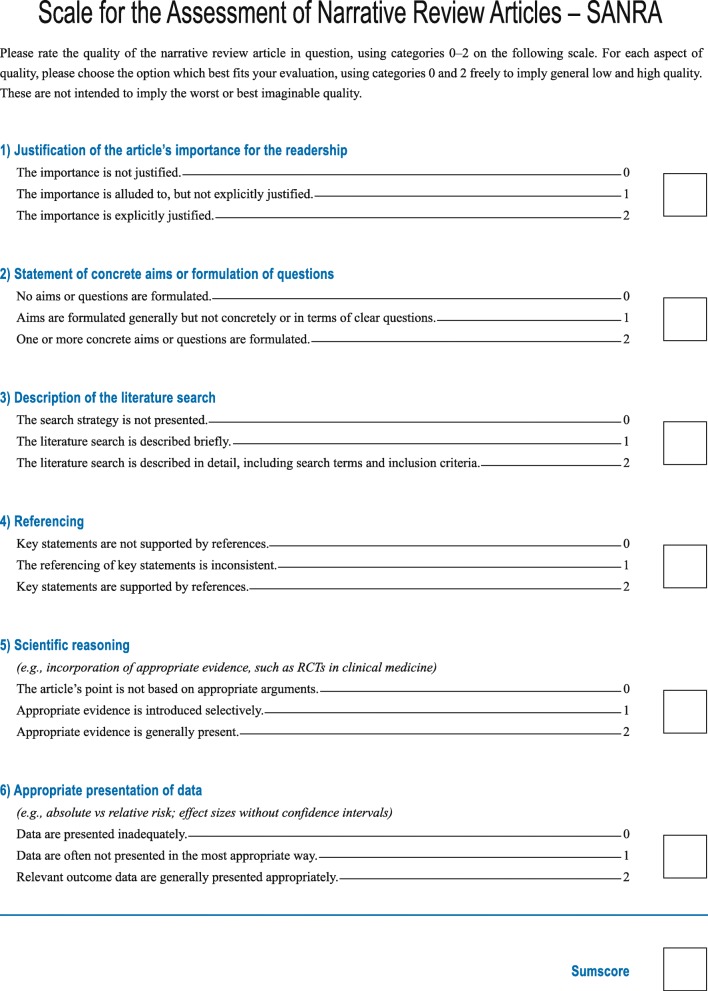
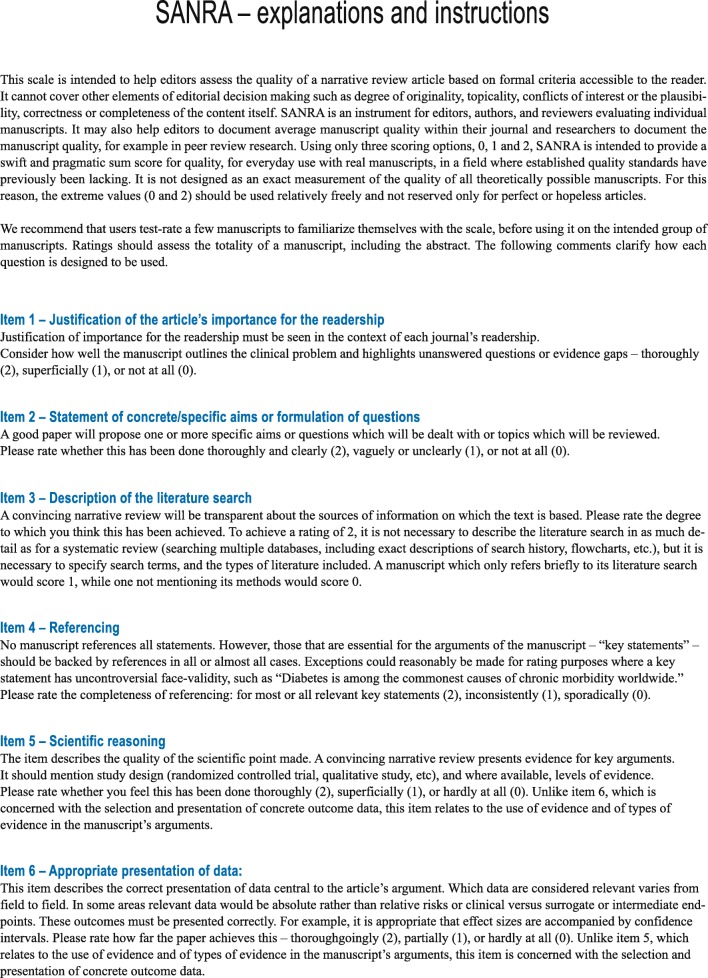
Verification
Claims the paper makes
3 Valid · 0 Not valid · 5 Not checked · 27 Own results and interpretations
The cited sources support only part of this claim — read each source’s verdict below.
In the paper
“Bastian et al. found that they constitute the largest share of all text types in medicine and they concluded that they “remain the staple of medical literature” [1].”
- Also stated in: § Background · plain
“Narrative reviews are the commonest type of articles in the medical literature.”
§ SANRA—a scale for the quality assessment of narrative review articles > Background
What the sources say
- Partly supportedcites [1] Bastian H Glasziou P Chalmers I Seventy-five trials and eleven systematic reviews a day: how will we ever keep up? PLoS Med 2010 7 9 e1000326 10.1371/journal.pmed.1000326 20877712 PMC2943439 sourceExperimental — accuracy not yet measured
In “How Close Are We to Archie Cochrane’s Goal?” and the Summary Points (pages unavailable), the paper calls non-systematic narrative reviews the staple of medical literature synthesis. It does not say they constitute the largest share of all medical text types; that extends a claim about literature synthesis to medical literature as a whole. (LLM, conf=0.88)
plain- Asserted: passes — The authors put it forward as true.
- Checkable: passes — It can be checked against evidence.
- Load-bearing: unclear — It is unclear whether the paper’s conclusions depend on it.
- Based: passes — The paper gives a reason why it holds.
- Also stated in: § Background · plain
The sources with a verdict support this claim; the rest weren’t checked yet, have no full text we could read, or their verdicts aren’t rated yet.
In the paper
“non-systematic reviews or narrative reviews have been widely criticized as unreliable [1, 4].”
§ SANRA—a scale for the quality assessment of narrative review articles > Background
What the sources say
- Supportedcites [1] Bastian H Glasziou P Chalmers I Seventy-five trials and eleven systematic reviews a day: how will we ever keep up? PLoS Med 2010 7 9 e1000326 10.1371/journal.pmed.1000326 20877712 PMC2943439 source
In “How Close Are We to Archie Cochrane’s Goal?”, the paper describes reviews not conducted systematically as having great potential for error and calls them less reliable forms of information. Box 1 also says that articles and textbooks had highlighted the risk of bias and chance in reviews. Together, these passages support the broad characterization that narrative reviews have been criticized as unreliable; page numbers are not provided in our copy. (LLM, conf=0.89)
- Not checked — no full text of the sourcecites [4] Mulrow CD The medical review article: state of the science Ann Intern Med 1987 106 485 488 10.7326/0003-4819-106-3-485 3813259 source
plain- Asserted: passes — The authors put it forward as true.
- Checkable: passes — It can be checked against evidence.
- Load-bearing: passes — The paper’s conclusions depend on it.
- Based: passes — The paper gives a reason why it holds.
- Supported
A result the paper reports from its own data — it cites no other source for it, so there is none to check. The quote shows it is in the paper.
In the paper
“Cronbach’s alpha was 0.68 (internal consistency).”
- Also stated in: § Results · plain
“The scale’s internal consistency, measured as Cronbach’s alpha, was 0.68.”
§ SANRA—a scale for the quality assessment of narrative review articles > Abstract > Results
plainn = 90- Asserted: passes — The authors put it forward as true.
- Checkable: passes — It can be checked against evidence.
- Load-bearing: passes — The paper’s conclusions depend on it.
- Based: passes — The paper gives a reason why it holds.
- Also stated in: § Results · plain
A result the paper reports from its own data — it cites no other source for it, so there is none to check. The quote shows it is in the paper.
In the paper
“Raters often disagreed on items 1 and 4.”
- Also stated in: § Results · plain
“Disagreements most often occurred with regard to items 1 and 4.”
§ SANRA—a scale for the quality assessment of narrative review articles > Abstract > Results
plain- Asserted: passes — The authors put it forward as true.
- Checkable: passes — It can be checked against evidence.
- Load-bearing: unclear — It is unclear whether the paper’s conclusions depend on it.
- Based: passes — The paper gives a reason why it holds.
- Also stated in: § Results · plain
A result the paper reports from its own data — it cites no other source for it, so there is none to check. The quote shows it is in the paper.
In the paper
“The intra-class correlation coefficient (average measure) was 0.77 [95% CI 0.57, 0.88] (inter-rater reliability).”
- Also stated in: § Results · plain
“The intra-class correlation coefficient (average measure) amounted to 0.77 [95% CI 0.57, 0.88; F 4.3; df 29, 58].”
§ SANRA—a scale for the quality assessment of narrative review articles > Abstract > Results
plain- Asserted: passes — The authors put it forward as true.
- Checkable: passes — It can be checked against evidence.
- Load-bearing: passes — The paper’s conclusions depend on it.
- Based: passes — The paper gives a reason why it holds.
- Also stated in: § Results · plain
14 more claims
Create a free account to see all 35 claims and to verify the 3 references still open.
- Probably not a substantial claim. 11
- It may state two separate claims as one. 11
Claims other papers make about this one
Each is checked against this paper’s own text: does it say what the citing paper says it does?
The source backs part of the claim, not all of it — or backs it for a different population, condition or comparison.
In the citing paper
“The review was conducted and reported in accordance with the principles of the Scale for the Assessment of Narrative Review Articles (SANRA), which provides a validated framework for ensuring methodological transparency, scientific rigor, and balanced interpretation in narrative reviews [ 19 ].”
From Paracetamol: A History of Assumptions, Errors, and Evidence Reversals in Pain Management (2026) · cites this paper as [19]
Experimental — accuracy not yet measuredThe source backs part of the claim, not all of it — or backs it for a different population, condition or comparison.
In the citing paper
“As a narrative review, the present work does not include an aggregated quantitative assessment and is more exposed to selection subjectivity than a registered systematic review [124,125].”
From Berberine-Drug Interactions: Mechanisms, Clinical Relevance and Risk Stratification-A Narrative Review (2026) · cites this paper as [124]
Experimental — accuracy not yet measuredThe cited source says what the claim attributes to it.
In the citing paper
“This work is designed as a structured narrative review, with transparent reporting of the documentation strategy, guided by the quality criteria of the Scale for the Assessment of Narrative Review Articles (SANRA) [124].”
From Berberine-Drug Interactions: Mechanisms, Clinical Relevance and Risk Stratification-A Narrative Review (2026) · cites this paper as [124]
The cited source says what the claim attributes to it.
In the citing paper
“we used the following:-Cochrane Risk of Bias 2 (RoB 2) [29] and PEDRO scale tools for RCTs.-AMSTAR 2 [30] checklist for systematic review.-SANRA (Scale for the Assessment of Narrative Review Articles) [31] for narrative reviews.-JBI Checklist for Text and Opinion [32] for expert opinion papers.”
From Pelvic Floor Muscle Training Following Surgery for Pelvic Organ Prolapse: Recommendation from Scientific Literature (2026) · cites this paper as [31]
The cited source says what the claim attributes to it.
In the citing paper
“Data analysis employed a narrative and thematic synthesis methodology,adhering to the SANRA guidelines for narrative reviews (32).”
From Ethical issues in multi-agent AI systems for healthcare: a narrative review (2026) · cites this paper as [32]
12 more claims about this paper
Create a free account to see every claim other papers make about this one.
Citations
Cites
Shea, B. J., Reeves, B. C., Wells, G., Thuku, M., Hamel, C., Moran, J., Moher, D., Tugwell, P., Welch, V., Kristjansson, E., et al. (2017) · BMJ · doi:10.1136/bmj.j4008 · Cited by 10,636 · cited 2×
“Critical appraisal tools have been developed for systematic reviews (e.g., AMSTAR 2 [A MeaSurement Tool to Assess Systematic Reviews] [7]) and papers on RCTs (e.g., the CASP [Critical Appraisal Skills Program] checklist for randomized trials [8]) and other types of medical studies.”
BackgroundStreiner, D. L., & Norman, G. R. (2008) · doi:10.1093/acprof:oso/9780199231881.001.0001 · Cited by 2,631
Critical appraisal skills programme
Singh, J. (2013) · Journal of Pharmacology and Pharmacotherapeutics · doi:10.4103/0976-500x.107697 · Cited by 2,556
Guidelines for Reporting Reliability and Agreement Studies (GRRAS) were proposed
Kottner, J., Audigé, L., Brorson, S., Donner, A., Gajewski, B. J., Hróbjartsson, A., Roberts, C., Shoukri, M., & Streiner, D. L. (2011) · Journal of Clinical Epidemiology · doi:10.1016/j.jclinepi.2010.03.002 · Cited by 2,174
The Mass Production of Redundant, Misleading, and Conflicted Systematic Reviews and Meta‐analyses
IOANNIDIS, J. P. A. (2016) · The Milbank Quarterly · doi:10.1111/1468-0009.12210 · Cited by 1,483 · cited 1×
“While systematic reviews are not per se superior articles and while certain systematic reviews have been criticized lately [3], non-systematic reviews or narrative reviews have”
BackgroundSeventy-five trials and eleven systematic reviews a day: how will we ever keep up?
Bastian, H., Glasziou, P., & Chalmers, I. (2010) · PLoS Medicine · doi:10.1371/journal.pmed.1000326 · Cited by 1,188 · cited 2×
“found that they constitute the largest share of all text types in medicine and they concluded that they “remain the staple of medical literature” [1].”
BackgroundThe Medical Review Article: State of the Science
MULROW, C. D. (1987) · Annals of Internal Medicine · doi:10.7326/0003-4819-106-3-485 · Cited by 856 · cited 1×
“been widely criticized as unreliable [1, 4].”
Writing a narrative biomedical review: considerations for authors, peer reviewers, and editors
Gasparyan, A. Y., Ayvazyan, L., Blackmore, H., & Kitas, G. D. (2011) · Rheumatology International · doi:10.1007/s00296-011-1999-3 · Cited by 694 · cited 1×
“[13], for example, have provided guidance for writing narrative reviews, and Byrne [14] as well as Pautasso [15] has written, from different angles, thoughtful editorials on improving narrative reviews and presented lists of key features of writing a good review—lists that naturally overlap with SANRA items (e.”
BackgroundTen Simple Rules for Writing a Literature Review
Pautasso, M. (2013) · PLoS Computational Biology · doi:10.1371/journal.pcbi.1003149 · Cited by 272 · cited 3×
“[13], for example, have provided guidance for writing narrative reviews, and Byrne [14] as well as Pautasso [15] has written, from different angles, thoughtful editorials on improving narrative reviews and presented lists of key features of writing a good review—lists that naturally overlap with SANRA items (e.”
BackgroundImproving the peer review of narrative literature reviews
Byrne, J. A. (2016) · Research Integrity and Peer Review · doi:10.1186/s41073-016-0019-2 · Cited by 159 · cited 3×
“[13], for example, have provided guidance for writing narrative reviews, and Byrne [14] as well as Pautasso [15] has written, from different angles, thoughtful editorials on improving narrative reviews and presented lists of key features of writing a good review—lists that naturally overlap with SANRA items (e.”
Background
Research works printed but not linked: 3
- Higgins JPT, Green S. (eds.). Cochrane Handbook for Systematic Reviews and Interventions. Version 5.1.0. The Cochrane Collaboration 2011, section 1.2.2., www.handbook.cochrane.org, retrieved on Oct 31, 2018.
- Baethge C Mertens S Goldbeck-Wood S Development of a quality score for the assessment of non-systematic review articles (SANRA) Poster, Seventh International Congress on Peer Review and Biomedical Publication 2013 USA Chicago, Illinois
- Baethge C Goldbeck-Wood S Mertens S A scale for the assessment of non-systematic review articles (SANRA) Poster, Eighth International Congress on Peer and Biomedical Publication 2017 USA Chicago, Illinois
Cited by
Items 801–900 of 4,334
Colzin, S., Crépet, A., Wies, B., Rocabois, A., Margaux, S., Simon, P., Jean, J., Redaelli, M., Kortenkamp, A., Rousselle, C., et al. (2024) · International Journal of Hygiene and Environmental Health · doi:10.1016/j.ijheh.2023.114311 · Cited by 11
“A scoring system was implemented for SANRA tool to standardize quality assessment (Table S4) (Baethge et al., 2019).”
MethodInfluentialToledano‐Osorio, M., Osorio, R., Bueno, J., Vallecillo, C., Vallecillo‐Rivas, M., & Sanz, M. (2024) · International Endodontic Journal · doi:10.1111/iej.14040 · Cited by 8
Temporomandibular disorders among Ehlers-Danlos syndromes: a narrative review
Oelerich, O., Daume, L., Yekkalam, N., Hanisch, M. R., & Menne, M. C. (2024) · Journal of International Medical Research · doi:10.1177/03000605241242582 · Cited by 9
Boruah, A. M., Banerjee, D., Bhardwaj, F., Mallya, S., Singal, R., Sharma, S., & Gautam, A. (2024) · Drugs in Context · doi:10.7573/dic.2024-4-1 · Cited by 8
Khorram-Manesh, R., & Khorram‐Manesh, A. (2024) · AIMS Public Health · doi:10.3934/publichealth.2024047 · Cited by 8
Emergency Awake Laparotomy Using Neuraxial Anaesthesia: A Case Series and Literature Review
Leoni, M. L. G., Rossi, T., Mercieri, M., Cerati, G., Abbott, D. M., Varrassi, G., Cattaneo, G. M., Capelli, P., Mazzoni, M., & Corso, R. M. (2024) · Journal of Personalized Medicine · doi:10.3390/jpm14080845 · Cited by 8
“Unfortunately, the quantification of these scores was not feasible due to missing variables.”
BackgroundMuñoz, M. D. L. F. R., Chrzan‐Dętkoś, M., Uka, A., García-López, H. S., Bina, R., & Le, H. (2024) · Archives of Women s Mental Health · doi:10.1007/s00737-024-01537-y · Cited by 8
Wiedermann, C. J., Mahlknecht, A., Barbieri, V., Ausserhofer, D., Plagg, B., Felderer, C., Marino, P., Engl, A., & Piccoliori, G. (2024) · Epidemiologia · doi:10.3390/epidemiologia5040057 · Cited by 11
The putative role of immune-inflammatory mechanisms in nociplastic pain pathways: a narrative review
Giglio, M., Corriero, A., Preziosa, A., Varrassi, G., & Puntillo, F. (2025) · Exploration of Immunology · doi:10.37349/ei.2025.1003178 · Cited by 12
Implicit bias assessment by career stage in medical education training: a narrative review
Crump, A. A., Al-Jorani, M. S., Ahmed, S., Abrol, E. S., & Jain, S. (2025) · BMC Medical Education · doi:10.1186/s12909-024-06319-9 · Cited by 9
“The Assessment of Scale for the Assessment of Narrative Reviews (SANRA) is a methodological tool used to evaluate the quality of narrative review articles, by assessing things like research aims, study methodology and presentation of evidence [24].”
An overview of Sgc8 aptamer as a potential theranostic agent for cancer with PTK7 oncogenic target
Wang, Y., Yuan, Z., Zhai, L., Lv, M., Iqbal, H., Ur-Rehman, U., Ning, X., Jin, Z., Yi, Z., & Xiao, R. (2025) · Science Progress · doi:10.1177/00368504251325385 · Cited by 11
Adamczyk, K., Zuzda, K., Jankowski, M., Świerczyński, R., Chudziński, K., Czapski, B., & Szuldrzynski, K. S. (2025) · Cancers · doi:10.3390/cancers17050863 · Cited by 8
The relationship between attachment and mental health at work: A narrative review
McConnell, D., Wong, G., & Ferrey, A. E. (2025) · Work · doi:10.1177/10519815251327313 · Cited by 9
Literature reviews: typology and forensic applications
Franco, A., Anees, W., Moreira, D. D., Blumenberg, C., Napimoga, M. H., & Paranhos, L. R. (2025) · International Journal of Legal Medicine · doi:10.1007/s00414-025-03514-1 · Cited by 11
“Examples are the development of the International Narrative Systematic Assessment (INSA) [ 18 ] and the Scale for the Assessment of Narrative Review Articles (SANRA) [19 ], which are critical appraisal tools to help identify rigorous studies based on the content and quality of what is presented.”
Bacterial lysates in allergic rhinitis and chronic rhinosinusitis: Mechanisms and clinical evidence
Huang, X., Zhang, X., Zhang, Z., Liu, M., Bai, D., Yang, R., & Yang, C. (2025) · Science Progress · doi:10.1177/00368504251355373 · Cited by 8
Bongiorno, V., & Heaner, M. K. (2025) · Journal of Eating Disorders · doi:10.1186/s40337-025-01305-y · Cited by 9
“The Scale for the Assessment of Narrative Review Articles (SANRA) was used as a guideline for conducting this review in order to ensure high quality standards were met [42].”
Menopause is more than Hot Flashes: What is Missing in Homeopathic Research? A Narrative Review
Macías-Cortés, E. D. C. (2021) · Homeopathy · doi:10.1055/s-0041-1733971 · Cited by 11
Camartin, C., & Björkhem‐Bergman, L. (2022) · Life · doi:10.3390/life12020298 · Cited by 12
COVID and Gender: A Narrative Review of the Asia-Pacific Region
Binns, C. W., Lee, M. K., Duong, D. T. T., Lee, A. H., Pham, N. M., & Zhao, Y. (2022) · International Journal of Environmental Research and Public Health · doi:10.3390/ijerph20010245 · Cited by 9
“The aim was assessed by the authors for consistency with the SANRA guidelines for narrative reviews [11].”
MethodAshrafi, H., & Parhizkar, T. (2023) · The Electricity Journal · doi:10.1016/j.tej.2023.107290 · Cited by 9
“Nitrogen Wash-Out” in Non-Hypoxaemic Patients with Spontaneous Pneumothorax: A Narrative Review
Grasmuk‐Siegl, E., & Valipour, A. (2023) · Journal of Clinical Medicine · doi:10.3390/jcm12134300 · Cited by 8
Current Opinions in Open and Endovascular Treatment of Major Arterial Injuries in Pediatric Patient
Franchin, M., Righini, P., D’Oria, M., Mazzaccaro, D. P., Nano, G., Tozzi, M., Selmo, G., & Piffaretti, G. (2023) · Journal of Clinical Medicine · doi:10.3390/jcm12154906 · Cited by 8
An Overview of the Use of Anti-Angiogenic Agents in the Treatment of Thymic Epithelial Tumors
Agrafiotis, A. C., Berzenji, L., Koyen, S., Vermeulen, D., Winthagen, R., Hendriks, J. M., & Schil, P. E. V. (2023) · International Journal of Molecular Sciences · doi:10.3390/ijms242317065 · Cited by 8
How Religious Delusions Impact Patients with Schizophrenia
Uludağ, K., & Zhao, M. (2024) · International Journal of Religion · doi:10.61707/cnj9b481 · Cited by 10
Singh, S., Singh, R., Kumar, S., & Suri, A. (2024) · World Neurosurgery · doi:10.1016/j.wneu.2024.03.134 · Cited by 8
Maternal tetanus, diphtheria, and acellular pertussis (Tdap) and influenza immunization: an overview
Brillo, E., Tosto, V., Giardina, I., & Buonomo, E. (2019) · The Journal of Maternal-Fetal & Neonatal Medicine · doi:10.1080/14767058.2019.1680633 · Cited by 10
Bielsten, T. (2020) · Linköping University medical dissertations · doi:10.3384/diss.diva-164273 · Cited by 9
Beyond Bone: Infectious Diseases and Immunity in Parathyroid Disorders
Hasenmajer, V., Puliani, G., Minnetti, M., Sbardella, E., Mastroianni, C. M., d’Ettorre, G., Isidori, A. M., & Gianfrilli, D. (2021) · Advances in experimental medicine and biology · doi:10.1007/5584_2021_629 · Cited by 9
Kannan, A., Ravichandran, M., Sundaramurthi, S., Win, M., Tara, A., Ruo, S. W., Sultan, W., Yanamala, V. L., Mohammed, A. R. H., & Dominic, J. L. (2021) · Cureus · doi:10.7759/cureus.16939 · Cited by 8
“Narrative Review Articles (SANRA) guidelines and checklist [8].”
BackgroundCritical Analysis of Corruption in Iran's Health Care System and Its Control Strategies
Joulaei, H., Lankarani, K. B., Shahabi, S., Azizmohammadi, F., & Keshavarzian, A. (2021) · Shiraz E-Medical Journal · doi:10.5812/semj.115669 · Cited by 9
Evidenzsynthesen in Public Health: ein Überblick
Barnes, B., Buchmann, M., Mumm, R., Nowossadeck, E., Peitz, D., Prütz, F., Wachtler, B., & Wienecke, A. (2022) · Zeitschrift für Evidenz Fortbildung und Qualität im Gesundheitswesen · doi:10.1016/j.zefq.2022.09.003 · Cited by 8
Rompianesi, G., Loiaco, G., Rescigno, L., Benassai, G., Giglio, M. C., Campanile, S., Caggiano, M., Montalti, R., & TROISI, R. I. (2025) · Cancers · doi:10.3390/cancers17030408 · Cited by 7
“The Newcastle–Ottawa Scale (NOS) was used to assess the quality of observational studies [17], while for non-randomized interventional and pilot studies, we used the MINORS criteria [18], and for conference abstracts, we assessed their quality with SANRA criteria [19].”
Current perspective on dental black stain of bacterial origin: A narrative review
Al‐Shareef, A., González-Martínez, R., Cortell‐Ballester, I., Jovani‐Sancho, M., Sheth, C. C., & Veses, V. (2025) · European Journal Of Oral Sciences · doi:10.1111/eos.70007 · Cited by 7
Es-Saad, O., Darraz, A., Alkouh, R., Motiaa, Y., & Labib, S. (2025) · Science Progress · doi:10.1177/00368504251338927 · Cited by 9
Systems Thinking in Mental Health Patient Safety: A Narrative Review of Complex Adaptive Systems
Challinor, A., Bifarin, O. O., Morasae, E. K., Saini, P., Berzins, K. M., & Nathan, R. (2025) · Journal of Evaluation in Clinical Practice · doi:10.1111/jep.70080 · Cited by 7
“We used an exploratory narrative methodology to review the evidence investigating patient safety in mental healthcare [20].”
di Visconte, M. S. (2025) · Updates in Surgery · doi:10.1007/s13304-025-02314-x · Cited by 7
“…quality of the selected studies was evaluated using the SANRA tool, which includes six domains: justification of the review’s relevance, clarity of objectives, transparency of the literature search, adequacy of referencing, scientific reasoning, and appropriate presentation of outcomes [13].”
InfluentialSchroeder, B. E., Kuller, J. A., & Dotters-Katz, S. K. (2025) · Pregnancy · doi:10.1002/pmf2.70081 · Cited by 7
“This narrative review was structured in accordance with the SANRA (Scale for the Assessment of Narrative Review Articles) guidelines to ensure clarity, scientific rigor, and relevance (Supporting Information S1) [28].”
From Glycemia to Grip: A Comprehensive Review of Musculoskeletal Complications in Diabetic Patients
Hussain, S., Irfan, M. I., Khan, M. U. G., Khan, M. K., Awan, S. K., Raza, S. S., Adil, A. N. K., & Varrassi, G. (2025) · Cureus · doi:10.7759/cureus.90838 · Cited by 7
“This review was conducted in accordance with the Scale for the Assessment of Narrative Review Articles (SANRA) guidelines to ensure methodological rigor and clarity [11].”
Evidence of Multifidus Changes Post-Lumbar Radiofrequency Ablation: A Narrative Literature Review
Garcia, A., Lee, D. W., Leavitt, L., & Francio, V. T. (2025) · Journal of Clinical Medicine · doi:10.3390/jcm14186462 · Cited by 7
“…of Narrative Review Articles) criteria, which assess the methodological quality of narrative reviews across six domains: topic significance, clarity of aims, adequacy of the literature search, referencing quality, strength of scientific reasoning, and appropriateness of data presentation [25].”
Wiesepape, C. N., Soza, S. E. Q., & Faith, L. A. (2025) · Healthcare · doi:10.3390/healthcare13192387 · Cited by 10
“…followed recommendations from the Scale for the Assessment of Narrative Review Articles (SANRA), which emphasizes clear justification of the review, explicit aims, transparent literature search strategies, appropriate referencing, critical synthesis of findings, and clear presentation of data [22].”
Singh, J., Santosh, P., & Ramaswami, U. (2025) · Current Issues in Molecular Biology · doi:10.3390/cimb47100855 · Cited by 7
“The SANRA can be used as a self-assessment measure to ensure the robustness and improve the quality of narrative reviews [40].”
A matter arising: When should inflammatory and autoimmune rheumatic diseases be considered ‘early’?
Hysa, E., Gotelli, E., Pizzorni, C., Paolino, S., Sulli, A., Smith, V. M., Campitiello, R., & Cutolo, M. (2025) · European Journal of Clinical Investigation · doi:10.1111/eci.70136 · Cited by 7
FakhriRavari, A., & Nguyen, M. H. (2025) · Gastrointestinal Disorders · doi:10.3390/gidisord7040072 · Cited by 9
Zhang, Y., Xu, S., Lan, H., Ma, D., & Wang, Y. (2025) · Pain and Therapy · doi:10.1007/s40122-025-00797-5 · Cited by 7
“Guided by the SANRA quality assessment criteria for narrative reviews [11], a literature search was performed using PubMed, covering the period from July 5, 2025, to September 25, 2025.”
Massimino, M., Rubino, M., Natale, M. R., Salerno, L., Belviso, S., Mancuso, E., Dagostino, A., Demasi, D., Barreca, F., Averta, C., et al. (2025) · Pharmaceuticals · doi:10.3390/ph18121805 · Cited by 7
“This work was conducted as a narrative review, following scholarly standards for non-systematic literature syntheses (SANRA) [20].”
Brain and retina in Alzheimer's disease: Pathological intersections and estimates from imaging
Banihashemi, M. A., Krance, S. H., Ji, P. X., Koo, M., Ottoy, J., Swartz, R. H., Kertes, P. J., Hudson, C., Goubran, M., & Black, S. E. (2025) · Alzheimer s & Dementia · doi:10.1002/alz.70884 · Cited by 11
“We aligned our work with the proposed scale for quality assessment of narrative reviews (SANRA) 19 and included a search strategy in the supplementary material.”
Patterns of Elder Caregiving Among Nigerians: An Integrative Review
Okigbo, C. S., Freeman, S., Hemingway, D. E., Holler, J. S., & Schmidt, G. (2025) · International Journal of Environmental Research and Public Health · doi:10.3390/ijerph23010002 · Cited by 7
“Two types of quality assessment tools were employed depending on the methodology of the included article: the SANRA [31] (Supplementary File S4) and the MMAT [32,33], applied separately to qualitative (Supplementary File S5), mixed-methods (Supplementary File S6), and quantitative studies…”
Esht, V., Verma, M., Malik, S., Slimani, M. A. M., Kaur, G., Tripathy, J. P., Jeet, G., & Kalra, S. (2026) · Advances in Therapy · doi:10.1007/s12325-025-03462-7 · Cited by 9
“This review adheres to the principles of quality reporting as outlined in the SANRA (Scale for the Assessment of Narrative Review Articles) guidelines [21].”
Personalized Learning With Artificial Intelligence in Dental Education: An Integrative Review
MithunPai, B. H., Yellapurkar, S., Chengappa, K., Pentapati, K. C., & Poudyal, S. (2026) · International Journal of Dentistry · doi:10.1155/ijod/8928166 · Cited by 9
“…Briggs Institute Critical Appraisal Checklist for Cross Sectional Studies [24] was used, for mixed methods study, the Mixed Methods Appraisal Tool (MMAT), Version 2018 [25] was applied and for narrative review, the Scale for the Assessment of Narrative Review Articles (SANRA) [26] was applied.”
Kelly, B. S., Clifford, S. M., Mankad, K., & Colleran, G. (2026) · Pediatric Radiology · doi:10.1007/s00247-026-06547-9 · Cited by 8
“Specifically, we addressed SANRA’s [14] six items: importance, aims, literature search, referencing, scientific reasoning, and presentation of endpoint data prospectively from the outset of our search by design.”
Ning, S., Wu, H., Guo, R., Deng, M., Cui, Y., Xue, D., Li, C., Jin, C., & Li, H. (2026) · Cancer Control · doi:10.1177/10732748261430581 · Cited by 9
Durability of Mitral Valve Transcatheter Edge-to-Edge Repair
Mariani, A., Stolz, L., von Bardeleben, R. S., Treede, H., Modine, T., Kardys, I., Latib, A., Lim, D. S., Hausleiter, J., & Mieghem, N. M. V. (2026) · JACC: Cardiovascular Interventions · doi:10.1016/j.jcin.2026.02.019 · Cited by 7
Point-of-Care Ultrasound in Airway Management
Paternò, D. S., Via, L. L., Giudice, E. C. L., Lentini, M., Maniaci, A., Bonaccorso, A. M., Moltisanti, R., Putaggio, A., Pappalardo, F., & Sorbello, M. (2026) · Journal of Clinical Medicine · doi:10.3390/jcm15072726 · Cited by 8
“Following SANRA principles [17], we critically appraised the methodological strength and potential bias of included studies.”
Hughes, D. A., Broom, M. A., Eley, V. A., Melber, A. A., Metodiev, Y., Maclennan, K., Sundaram, S., de Velde, M. V., Anderson, P., & Lucas, N. (2026) · European Journal of Anaesthesiology · doi:10.1097/eja.0000000000002373 · Cited by 7
Hinchcliff, K. W., Morley, P. S., DiBartola, S. P., Taylor, S. D., & Harrell, K. A. (2023) · Journal of Veterinary Internal Medicine · doi:10.1111/jvim.16869 · Cited by 7
“2,15,16 Scoping reviews do not seek to answer a particular question or questions, but are intended to identify certain characteristics or concepts in papers or studies, and examine the mapping, reporting or discussion of these characteristics or concepts.”
BackgroundThe Role of Nutraceuticals in the Prevention and/or Treatment of COVID-19: An Umbrella Review
Karzon, R., Jackson, A., Lloyd, I., Hall, A., & Lee, L. (2023) · CAND Journal · doi:10.54434/candj.165 · Cited by 7
Haylor, H., Sparkes, T., Armitage, G., Dawson-Jones, M., Double, K., & Edwards, L. (2024) · BJPsych Bulletin · doi:10.1192/bjb.2023.98 · Cited by 8
Kvarda, P., Mills, A., Shepherd, D., & Schneider, T. (2024) · Journal of Clinical Medicine · doi:10.3390/jcm13030786 · Cited by 7
CRITICAL APPRAISAL TOOLS FOR QUALITATIVE SYSTEMATIC REVIEWS IN MEDICAL EDUCATION.
Saaiq, M., & Ashraf, B. (2024) · Journal of Health Professions Education and Innovation · doi:10.21608/jhpei.2024.254400.1009 · Cited by 9
“By awarding one point to each of the 39-items, a total score of 39 will be obtained by the most robust review [19-27].”
BackgroundPerioperative Blood Transfusions and Cancer Progression: A Narrative Review
Daher, L. A., Heppell, O., Lopez‐Plaza, I., & Guerra‐Londono, C. E. (2024) · Current Oncology Reports · doi:10.1007/s11912-024-01552-3 · Cited by 9
“The present is a SANRA (Scale for the Assessment of Narrative Review Articles)- compliant manuscript (21), which included the use of a librarian-made electronic literature search.”
Impact of Digital Innovations in Preventive Dentistry: A Narrative Review
Asanza, D. M., Herrera, I. A. R., Mouloudj, K., Amable, O. G., & Muzzamil, M. (2024) · Advances in medical technologies and clinical practice book series · doi:10.4018/979-8-3693-3872-8.ch003 · Cited by 7
Laparoscopic prediction of primary cytoreducibility of epithelial ovarian cancer
D’Augè, T. G., Giannini, A., Cuccu, I., Angelis, E. D., Donato, V. D., Muzii, L., D’Oria, O., Chiantera, V., Gerli, S., Caserta, D., et al. (2024) · Minerva Obstetrics and Gynecology · doi:10.23736/s2724-606x.24.05452-6 · Cited by 8
Vadlamani, N., Ibrahimli, S., Khan, F. A., Castillo, J. A., Amaravadi, K. S. S., Nalisetty, P., & Khan, S. (2024) · Cureus · doi:10.7759/cureus.71476 · Cited by 7
Mulinari‐Santos, G., Santana, A. P., Botacin, P. R., & Okamoto, R. (2024) · Surgeries · doi:10.3390/surgeries5040090 · Cited by 7
“To provide a comprehensive overview of current practices and emerging strategies in pediatric facial trauma management, a narrative review of the literature was conducted according to the SANRA scale [14].”
Integrating Information Governance as the Foundation for Information Dashboard Design Ontology
Nasir, A. H. M., Salwana, E., & Ahmad, M. N. (2025) · Journal of Information Technology Education Innovations in Practice · doi:10.28945/5432 · Cited by 7
“Furthermore, the evolving nature of IG practices may not be fully captured within the reviewed studies, as literature reviews are inherently dependent on existing research at the time of analysis (Baethge et al., 2019).”
Body Composition and Its Outcomes and Management in Multiple Sclerosis: Narrative Review
Kidwell-Chandler, A. L., Jackson, J., Jeng, B., Silveira, S. L., Pilutti, L. A., Hibbing, P. R., & Motl, R. W. (2025) · Nutrients · doi:10.3390/nu17061021 · Cited by 8
“…and six quality criteria metrics: (1) justification of the article’s importance for the readership, (2) statement of concrete aims or formulation of questions, (3) description of the literature search, (4) referencing, (5) scientific reasoning, and (6) appropriate presentation of data [32].”
InfluentialClinical Benefits of Ibuprofen Arginine: A Narrative Review
Sarzi‐Puttini, P., Perrot, S., Pérez‐Cajaraville, J., Fornasari, D., Radaelli, F., & Varrassi, G. (2025) · Pain and Therapy · doi:10.1007/s40122-025-00735-5 · Cited by 10
“This narrative review adheres to the SANRA guideline (Scale for the Assessment of Narra‑ tive Review Articles) to maintain the quality standards pertinent to narrative review articles, thereby ensuring transparency, reproducibility, and scholarly rigor [18].”
Galietta, E., Donati, C. M., Bazzocchi, A., Sassi, R., Zamfir, A. A., Hovenier, R., Bos, C., Hendriks, N., Boomsma, M. F., Huhtala, M., et al. (2025) · Cancers · doi:10.3390/cancers17101683 · Cited by 7
Pelaksanaan discharge planning pada pasien diabetes melitus: Studi literatur
Yulia, L., Pahria, T., & Pebrianti, S. (2020) · HOLISTIK JURNAL KESEHATAN · doi:10.33024/hjk.v14i4.3446 · Cited by 7
Guggisberg, M., & Holt, A. (2022) · Journal of Social Psychology Research · doi:10.37256/jspr.1220221564 · Cited by 8
Alnasser, A. R., Akram, A., Kar, S., Osman, F., Mashat, G. D., Tran, H. H.-V., Urgessa, N. A., Geethakumari, P., Kampa, P., Parchuri, R., et al. (2022) · Cureus · doi:10.7759/cureus.30847 · Cited by 7
“The Scale for the Quality Assessment of Narrative Review Articles (SANRA) was used for other studies [6-9].”
MethodNogueira, H. C., Zanca, G. G., & Haik, M. N. (2022) · Diagnostics · doi:10.3390/diagnostics13010062 · Cited by 11
O’Neill, M., Duffy, O. M., Henderson, M., & Kernohan, G. W. (2023) · International Journal of Language & Communication Disorders · doi:10.1111/1460-6984.12924 · Cited by 10
Evidence or no evidence for essential fatty acids in the treatment of autism spectrum disorders?
Pancheva, R., Nikolova, S., Serbezova, A., Zaykova, K., Zhelyazkova, D., & Dimitrov, L. (2023) · Frontiers in Nutrition · doi:10.3389/fnut.2023.1251083 · Cited by 8
Nashwan, A. J., Alahmad, R., Afifeh, G. A., & Afifeh, N. A. (2023) · F1000Research · doi:10.12688/f1000research.141325.1 · Cited by 9
Brunal, M. A. S., Borrero, A. M. P., Guevara, C. R., Iannini, R. D. D. C., Velásquez, J. C., & Zuluaga, M. (2023) · Rehabilitación · doi:10.1016/j.rh.2023.100827 · Cited by 9
Castro, M. A., Ramírez, P. A. P., Rojas‐Marcos, P. M., Paja, M., Boillos, M. G., Corrales, E. P., Cano, A. M. G., Ruiz-Sánchez, J. G., Delgado, A. V., Hoyos, E. G., et al. (2024) · Frontiers in Endocrinology · doi:10.3389/fendo.2024.1336306 · Cited by 7
Iftikhar, S., Alhaddad, S. F., Paulsingh, C. N., Riaz, M. F., Garg, G., Umeano, L., & Hamid, P. (2024) · Cureus · doi:10.7759/cureus.55980 · Cited by 8
Surgical treatment of thymic epithelial tumors: a narrative review
Agrafiotis, A. C., Berzenji, L., Koyen, S., Vermeulen, D., Winthagen, R., Hendriks, J. M., & Schil, P. E. V. (2024) · Mediastinum · doi:10.21037/med-23-44 · Cited by 7
“The current recommendations on the quality assessment of narrative review articles were followed in the elaboration of this review (13).”
Blood Viscosity Changes in Diabetes Mellitus: A 20-Year Bibliometric Review and Future Directions
Mbah, J. I., Bwititi, P., Gyawali, P., & Nwose, E. U. (2024) · Cureus · doi:10.7759/cureus.64211 · Cited by 14
“Given cognizance of the systematic review being driven by hypothesis [19], which is not of interest, this review followed the Scale for the Assessment of Narrative Review Articles (SANRA) [20].”
MethodKarimijashni, M., Ramsay, T., Beaulé, P. E., & Poitras, S. (2024) · Musculoskeletal Care · doi:10.1002/msc.1921 · Cited by 7
Palvia, A. R., Damera, A. R., Nandi, A. R., Magar, S., Patidar, S., Kasarla, S. R., Ghantasala, V., Shah, M. K., & Goyal, M. (2024) · Cureus · doi:10.7759/cureus.66215 · Cited by 7
“…study: the Cochrane risk of bias tool was used for randomized controlled trials (RCT), a measurement tool to assess systematic reviews (AMSTAR) checklist was used for systematic reviews, and the scale for the assessment of narrative review articles 2 (SANRA 2) was used for narrative reviews [8-10].”
MethodEpigenetics of violence against women: a systematic review of the literature
Bailo, P., Piccinini, A., Barbàra, G., Caruso, P., Bollati, V., & Gaudi, S. (2024) · Environmental Epigenetics · doi:10.1093/eep/dvae012 · Cited by 8
Ferroptosis: a novel pathogenesis and therapeutic strategies for Parkinson disease: A review
Jiao, D., Yang, Y., Wang, K., & Wang, Y. (2025) · Medicine · doi:10.1097/md.0000000000041218 · Cited by 9
Mancin, S., Zarrella, A., Petrelli, F., Cosmai, S., Cattani, D., Lopane, D., Scollo, S., Palomares, S. M., Sguanci, M. E., Amendola, A., et al. (2025) · Diabetology · doi:10.3390/diabetology6020010 · Cited by 9
Rekatsina, M., & Peng, P. (2025) · Pain and Therapy · doi:10.1007/s40122-025-00731-9 · Cited by 7
“SANRA (Scale for the Assessment of Narrative Review Articles) criteria were followed [15].”
Ganau, M., Magdum, S. A., & Calisto, A. (2021) · Translational Pediatrics · doi:10.21037/tp-20-484 · Cited by 7
Kiliś‐Pstrusińska, K., Rogowski, A., & Bieńkowski, P. (2021) · Journal of Clinical Medicine · doi:10.3390/jcm10081645 · Cited by 7
“The paucity of clinical data and lack of randomized clinical trials on the role of the microbiome in overactive bladder symptoms in children precluded a meaningful scoping review approach [31].”
BackgroundConducting a Scoping Review in Physical Medicine and Rehabilitation
Lew, H. L., Kahili-Heede, M. K., Mashima, P. A., & Hou, W. (2021) · American Journal of Physical Medicine & Rehabilitation · doi:10.1097/phm.0000000000001763 · Cited by 8
Miovský, M., Černíková, T., Nováková, E., & Gabrhelík, R. (2022) · Journal of Substance Use · doi:10.1080/14659891.2022.2082336 · Cited by 7
Nandula, S. A., Boddepalli, C. S., Gutlapalli, S. D., Lavu, V. K., Abdelwahab, R. A. M., Huang, R., Potla, S., Bhalla, S., AlQabandi, Y., & Balani, P. L. (2022) · Cureus · doi:10.7759/cureus.31482 · Cited by 7
“We employed the following methods: clinical trials = Cochrane Risk Bias Assessment tool, observational studies = Newcastle Ottawa, Appraisal Tool for Cross-sectional Studies (AXIS), a systematic review and meta-analysis = Assessment of Multiple Systematic Reviews (AMSTAR), literature review articles = Scale for the As…”
MethodTobacco quitlines: Opportunities for innovation to increase reach and effectiveness
Sheffer, C. E. (2022) · Preventive Medicine · doi:10.1016/j.ypmed.2022.107319 · Cited by 28
A Narrative Review of Military Reverse Triage
Hurst, D. J. (2025) · Military Medicine · doi:10.1093/milmed/usaf122 · Cited by 7
Decarbonizing Concrete: Ultra-Low-Carbon Pathways and Policy Integration
Arthur, C., Onuche, P. U. O., Yusuf, M., ANIMASHAUN, T. A., Boansi, S. O., Adewale, K., & Bart-Addison, C. E. (2025) · Scientific journal of engineering and technology. · doi:10.69739/sjet.v2i1.669 · Cited by 6
Gates, P., Zocco, A., & Farnbach, S. (2025) · Addiction · doi:10.1111/add.70153 · Cited by 6
“Review quality was assessed using highly cited and recommended tools — the 16-item AMSTAR-2 [37] for systematic reviews, and the 6-item SANRA [38] for narrative reviews.”
Mukai, K., Yamanishi, K., Ogino, S., Hosoi, Y., Hayashida, K., & Matsunaga, H. (2025) · Frontiers in Psychiatry · doi:10.3389/fpsyt.2025.1593384 · Cited by 6
“In conducting this narrative review, we adhered to the SANRA (Scale for the Assessment of Narrative Review Articles) criteria to ensure methodological rigor and transparency (21).”
Pancreatic Stone Protein as a Versatile Biomarker: Current Evidence and Clinical Applications
Arturi, F., Melegari, G., Mancano, R., Gazzotti, F., Bertellini, E., & Barbieri, A. (2025) · Diseases · doi:10.3390/diseases13080240 · Cited by 6
“This narrative review was conducted following the principles outlined in the SANRA framework, a validated tool developed to improve the methodological quality and reporting standards of narrative reviews [4].”
Lakshmisai, S. S., Bheemaneni, R. S., Nwachukwu, E. C., Nigam, A., Sakarkar, P., & Khan, S. (2025) · Cureus · doi:10.7759/cureus.90606 · Cited by 14
“…the Cochrane risk of bias assessment tool (RoB-2)[15], and narrative reviews by the scale for the quality assessment of narrative review articles (SANRA) checklist [16], cohort studies by the Newcastle-Ottawa Scale [17] and, case reports are assessed by the Joanna Briggs Institute (JBI) tool [18].”
Occupational Health Issues in the Seafood Industry Due to Biological Exposures: A Narrative Review
Andrup, L., Hadrup, N., & Madsen, A. M. (2025) · Safety and Health at Work · doi:10.1016/j.shaw.2025.08.001 · Cited by 6
“The structure of this review follows the guidelines for narrative reviews as outlined by Baethge et al [9], using the Scale for the Assessment of Narrative Review Articles (SANRA).”
Gonzales, G. F. (2025) · Science Progress · doi:10.1177/00368504251387827 · Cited by 6
“The review follows the Scale for the Assessment of Narrative Review Articles (SANRA) 15 (Supplementary Table 1).”
Metadata
- Authors
- Baethge, C., Goldbeck-Wood, S., & Mertens, S.
- Affiliations
- University of Cologne (DE)
- BMJ Group (United Kingdom) (GB)
- Corresponding author
- Baethge, Christopher
- ORCID
- Baethge, Christopher
- Venue
- Research Integrity and Peer Review
- Published
- 2019-03-26
- Volume
- 4
- Issue
- 1
- Pages
- 5-5
- ISSN
- 2058-8615 (ISSN-L)
- PMC
- PMC6434870
- OpenAlex
- W2922577842
- Semantic Scholar
- ea7f35b3069b53791c3b746c5c4b3c72a83a526b
- Cited by
- 3,469
- References
- 13
- Citations by year
- 2026: 1823 · 2025: 551 · 2024: 379 · 2023: 309 · 2022: 218 · 2021: 152 · 2020: 32 · 2019: 4
- FWCI
- 20.57
- Type
- journal article
- Language
- en
- Open access
- gold
- doi.org
- Licence
- cc-by
- creativecommons.org/licenses/by/4.0/ (tdm)
- Locations
- Research Integrity and Peer Review (publishedVersion, cc-by)
- Europe PMC (PubMed Central) (publishedVersion, other-oa)
- PubMed Central (publishedVersion, cc-by)
- PubMed (publishedVersion)
- Kölner Universitäts PublikationsServer (Universität zu Köln) (publishedVersion)
- DOAJ (DOAJ: Directory of Open Access Journals) (submittedVersion, cc-by-sa)
- Topics
- Social Sciences › Decision Sciences › Statistics, Probability and Uncertainty › Meta-analysis and systematic reviews
- Social Sciences › Library and Information Sciences › Academic Writing and Publishing
- Social Sciences › Library and Information Sciences › scientometrics and bibliometrics research
- Keywords
- quality assessment scale, manuscript review, inter-rater reliability, level of evidence, scale development
About these checks
Registry, retraction, Cites and statistics results are computed, not judged, with one exception: a printed reference that no index lists is read once by a model before it counts as a citation error. Claims are extracted by a model and kept only when their quote appears verbatim in the text; each cited source is then checked, with a model’s help, for whether it says what the claim relies on. Those verdicts can be wrong — read the claim’s quote and the cited source before relying on one.
The claim verdicts this report counts are experimental: their accuracy is not yet measured.
A language model drew the claims from the paper on 2026-11-10, under version 3 of the claim definition (model deepseek-v4.1-flash, prompt extract-v3).
A second model labelled each claim on 2026-11-10 (model jev-1.13-20260917, definition revision gold-guideline-v0.2).
Cited sources are checked with a language model’s help (gpt-6-sol).
Statistics and arithmetic are recomputed, not judged.
Confidence bands are shown only for fields calibrated on our annotated test set. None is calibrated yet, so no band is shown.
What counts as a claim ›How we measure confidence ›How we check this ›
Are you an author, or do you see a problem with this page? Request a review
Data sources
Bibliographic data: Semantic Scholar, OpenAlex, Crossref.
Contains information from the Semantic Scholar Academic Graph Datasets, made available under the ODC Attribution License (ODC-BY 1.0).
Semantic Scholar’s data is described in: Kinney, R., et al. (2023). The Semantic Scholar Open Data Platform. arXiv:2301.10140.
