

SANRA—a scale for the quality assessment of narrative review articles
Open accessThe DOI matches its Crossref record; 12 of the 13 references it cites were found in a registry or an index; 4 of the 12 sources its claims cite were checked for support.
Abstract
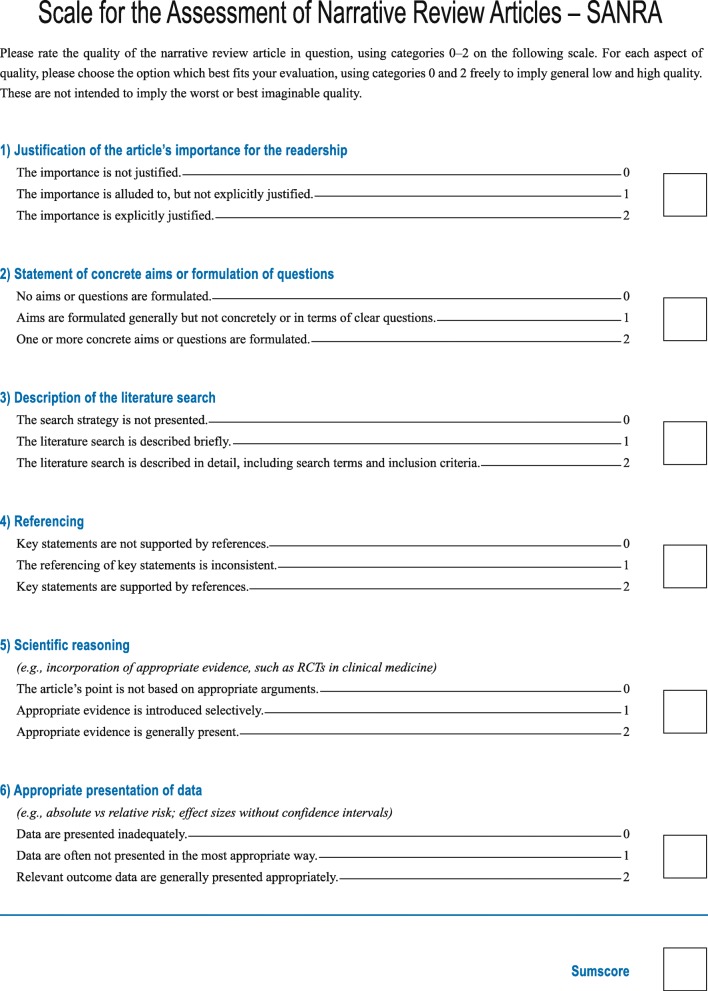
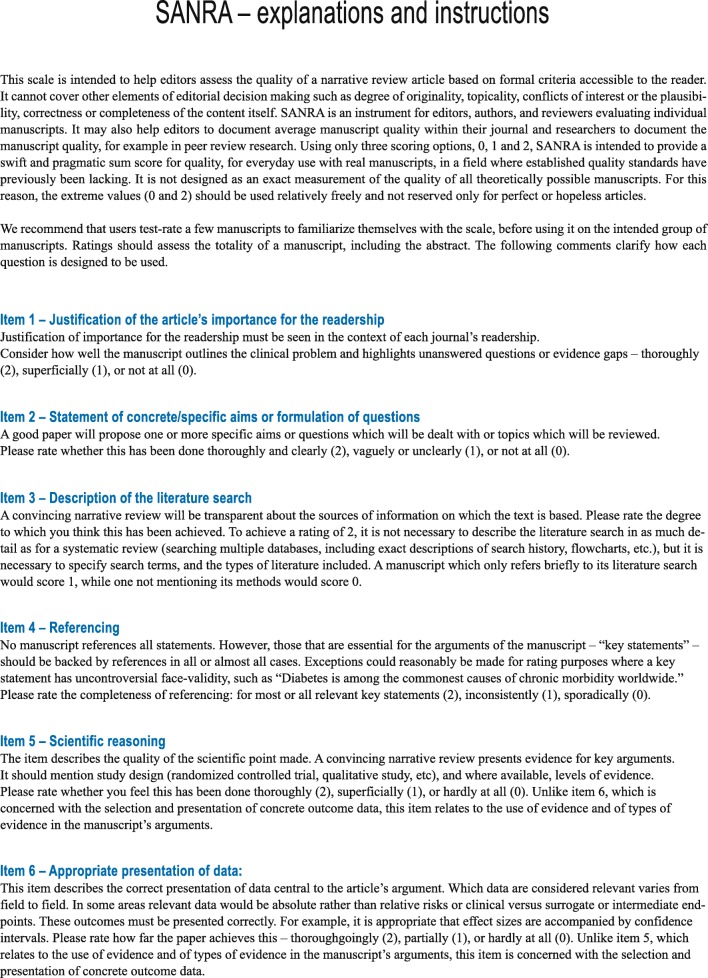
BACKGROUND: Narrative reviews are the commonest type of articles in the medical literature. However, unlike systematic reviews and randomized controlled trials (RCT) articles, for which formal instruments exist to evaluate quality, there is currently no instrument available to assess the quality of narrative reviews. In response to this gap, we developed SANRA, the Scale for the Assessment of Narrative Review Articles. METHODS: A team of three experienced journal editors modified or deleted items in an earlier SANRA version based on face validity, item-total correlations, and reliability scores from previous tests. We deleted an item which addressed a manuscript's writing and accessibility due to poor inter-rater reliability. The six items which form the revised scale are rated from 0 (low standard) to 2 (high standard) and cover the following topics: explanation of (1) the importance and (2) the aims of the review, (3) literature search and (4) referencing and presentation of (5) evidence level and (6) relevant endpoint data. For all items, we developed anchor definitions and examples to guide users in filling out the form. The revised scale was tested by the same editors (blinded to each other's ratings) in a group of 30 consecutive non-systematic review manuscripts submitted to a general medical journal. RESULTS: Raters confirmed that completing the scale is feasible in everyday editorial work. The mean sum score across all 30 manuscripts was 6.0 out of 12 possible points (SD 2.6, range 1-12). Corrected item-total correlations ranged from 0.33 (item 3) to 0.58 (item 6), and Cronbach's alpha was 0.68 (internal consistency). The intra-class correlation coefficient (average measure) was 0.77 [95% CI 0.57, 0.88] (inter-rater reliability). Raters often disagreed on items 1 and 4. CONCLUSIONS: SANRA's feasibility, inter-rater reliability, homogeneity of items, and internal consistency are sufficient for a scale of six items. Further field testing, particularly of validity, is desirable. We recommend rater training based on the "explanations and instructions" document provided with SANRA. In editorial decision-making, SANRA may complement journal-specific evaluation of manuscripts-pertaining to, e.g., audience, originality or difficulty-and may contribute to improving the standard of non-systematic reviews.
Overview
CoChat Summary
TL;DR
SANRA is a six-item, 0–2 scale (maximum 12) for assessing the quality of narrative review articles, developed and field-tested by three journal editors. In 30 consecutive non-systematic review manuscripts, it showed feasible use, sufficient internal consistency and inter-rater reliability, and a modest association with editorial acceptance.
Key findings
- Across 30 manuscripts (90 ratings), the mean SANRA sum score was 6.0 out of 12 (SD 2.6, range 1–12, median 6).
- Internal consistency was Cronbach’s alpha 0.68; corrected item-total correlations ranged from 0.33 (item 3) to 0.58 (item 6).
- Inter-rater reliability was an intra-class correlation coefficient (average measure) of 0.77 [95% CI 0.57, 0.88]; raters often disagreed on items 1 and 4.
- Average SANRA scores were modestly associated with editorial acceptance (mean 6.6, SD 1.9, n = 17) versus rejection (mean 5.1, SD 2.1, n = 13), point biserial correlation 0.37 (t = 2.09, df 28; two-sided p = 0.046).
Methods
- SANRA was developed between 2010 and 2017 by three experienced editors at Deutsches Ärzteblatt; the revised six-item version deleted an item on writing and accessibility due to poor inter-rater reliability.
- The revised scale was tested on 30 consecutive non-systematic review manuscripts submitted to Deutsches Ärzteblatt in 2015; three editor-raters scored them independently and blinded to each other’s ratings.
- Analyses included descriptive statistics, Cronbach’s alpha, corrected item-total correlations, average-measure intra-class correlation using a two-way random effects model (consistency definition), and a post hoc point biserial correlation between SANRA sum scores and acceptance/rejection.
Limitations
- The paper states the main limitation is sample size: 30 manuscripts was a compromise between representativeness, power, and feasibility, and took about 6 months to sample.
- The authors state that the scale’s authors were also the test-raters, so inter-rater reliability may be lower in groups less familiar with SANRA; the study also did not assess test-retest reliability, and results are study-specific.
- The paper acknowledges restricted content validity because SANRA is limited to six items and is a critical appraisal tool rather than a reporting guideline; criterion validity evidence is post hoc and weak, and no established cut-offs exist for comparing manuscripts across settings.
Model-written summary. Check it against the paper before relying on it.
Integrity signals
Registry
Cites
Statistics
Figures
Verification
Claims the paper makes
3 Valid · 0 Not valid · 5 Not checked · 27 Own results and interpretations
The cited sources support only part of this claim — read each source’s verdict below.
In the paper
“Bastian et al. found that they constitute the largest share of all text types in medicine and they concluded that they “remain the staple of medical literature” [1].”
- Also stated in: § Background · plain
“Narrative reviews are the commonest type of articles in the medical literature.”
§ SANRA—a scale for the quality assessment of narrative review articles > Background
What the sources say
- Partly supportedcites [1] Bastian H Glasziou P Chalmers I Seventy-five trials and eleven systematic reviews a day: how will we ever keep up? PLoS Med 2010 7 9 e1000326 10.1371/journal.pmed.1000326 20877712 PMC2943439 sourceExperimental — accuracy not yet measured
In “How Close Are We to Archie Cochrane’s Goal?” and the Summary Points (pages unavailable), the paper calls non-systematic narrative reviews the staple of medical literature synthesis. It does not say they constitute the largest share of all medical text types; that extends a claim about literature synthesis to medical literature as a whole. (LLM, conf=0.88)
plain- Asserted: passes — The authors put it forward as true.
- Checkable: passes — It can be checked against evidence.
- Load-bearing: unclear — It is unclear whether the paper’s conclusions depend on it.
- Based: passes — The paper gives a reason why it holds.
- Also stated in: § Background · plain
The sources with a verdict support this claim; the rest weren’t checked yet, have no full text we could read, or their verdicts aren’t rated yet.
In the paper
“non-systematic reviews or narrative reviews have been widely criticized as unreliable [1, 4].”
§ SANRA—a scale for the quality assessment of narrative review articles > Background
What the sources say
- Supportedcites [1] Bastian H Glasziou P Chalmers I Seventy-five trials and eleven systematic reviews a day: how will we ever keep up? PLoS Med 2010 7 9 e1000326 10.1371/journal.pmed.1000326 20877712 PMC2943439 source
In “How Close Are We to Archie Cochrane’s Goal?”, the paper describes reviews not conducted systematically as having great potential for error and calls them less reliable forms of information. Box 1 also says that articles and textbooks had highlighted the risk of bias and chance in reviews. Together, these passages support the broad characterization that narrative reviews have been criticized as unreliable; page numbers are not provided in our copy. (LLM, conf=0.89)
- Not checked — no full text of the sourcecites [4] Mulrow CD The medical review article: state of the science Ann Intern Med 1987 106 485 488 10.7326/0003-4819-106-3-485 3813259 source
plain- Asserted: passes — The authors put it forward as true.
- Checkable: passes — It can be checked against evidence.
- Load-bearing: passes — The paper’s conclusions depend on it.
- Based: passes — The paper gives a reason why it holds.
- Supported
A result the paper reports from its own data — it cites no other source for it, so there is none to check. The quote shows it is in the paper.
In the paper
“Cronbach’s alpha was 0.68 (internal consistency).”
- Also stated in: § Results · plain
“The scale’s internal consistency, measured as Cronbach’s alpha, was 0.68.”
§ SANRA—a scale for the quality assessment of narrative review articles > Abstract > Results
plainn = 90- Asserted: passes — The authors put it forward as true.
- Checkable: passes — It can be checked against evidence.
- Load-bearing: passes — The paper’s conclusions depend on it.
- Based: passes — The paper gives a reason why it holds.
- Also stated in: § Results · plain
A result the paper reports from its own data — it cites no other source for it, so there is none to check. The quote shows it is in the paper.
In the paper
“Raters often disagreed on items 1 and 4.”
- Also stated in: § Results · plain
“Disagreements most often occurred with regard to items 1 and 4.”
§ SANRA—a scale for the quality assessment of narrative review articles > Abstract > Results
plain- Asserted: passes — The authors put it forward as true.
- Checkable: passes — It can be checked against evidence.
- Load-bearing: unclear — It is unclear whether the paper’s conclusions depend on it.
- Based: passes — The paper gives a reason why it holds.
- Also stated in: § Results · plain
A result the paper reports from its own data — it cites no other source for it, so there is none to check. The quote shows it is in the paper.
In the paper
“The intra-class correlation coefficient (average measure) was 0.77 [95% CI 0.57, 0.88] (inter-rater reliability).”
- Also stated in: § Results · plain
“The intra-class correlation coefficient (average measure) amounted to 0.77 [95% CI 0.57, 0.88; F 4.3; df 29, 58].”
§ SANRA—a scale for the quality assessment of narrative review articles > Abstract > Results
plain- Asserted: passes — The authors put it forward as true.
- Checkable: passes — It can be checked against evidence.
- Load-bearing: passes — The paper’s conclusions depend on it.
- Based: passes — The paper gives a reason why it holds.
- Also stated in: § Results · plain
14 more claims
Create a free account to see all 35 claims and to verify the 3 references still open.
- Probably not a substantial claim. 11
- It may state two separate claims as one. 11
Claims other papers make about this one
Each is checked against this paper’s own text: does it say what the citing paper says it does?
The source backs part of the claim, not all of it — or backs it for a different population, condition or comparison.
In the citing paper
“The review was conducted and reported in accordance with the principles of the Scale for the Assessment of Narrative Review Articles (SANRA), which provides a validated framework for ensuring methodological transparency, scientific rigor, and balanced interpretation in narrative reviews [ 19 ].”
From Paracetamol: A History of Assumptions, Errors, and Evidence Reversals in Pain Management (2026) · cites this paper as [19]
Experimental — accuracy not yet measuredThe source backs part of the claim, not all of it — or backs it for a different population, condition or comparison.
In the citing paper
“As a narrative review, the present work does not include an aggregated quantitative assessment and is more exposed to selection subjectivity than a registered systematic review [124,125].”
From Berberine-Drug Interactions: Mechanisms, Clinical Relevance and Risk Stratification-A Narrative Review (2026) · cites this paper as [124]
Experimental — accuracy not yet measuredThe cited source says what the claim attributes to it.
In the citing paper
“This work is designed as a structured narrative review, with transparent reporting of the documentation strategy, guided by the quality criteria of the Scale for the Assessment of Narrative Review Articles (SANRA) [124].”
From Berberine-Drug Interactions: Mechanisms, Clinical Relevance and Risk Stratification-A Narrative Review (2026) · cites this paper as [124]
The cited source says what the claim attributes to it.
In the citing paper
“we used the following:-Cochrane Risk of Bias 2 (RoB 2) [29] and PEDRO scale tools for RCTs.-AMSTAR 2 [30] checklist for systematic review.-SANRA (Scale for the Assessment of Narrative Review Articles) [31] for narrative reviews.-JBI Checklist for Text and Opinion [32] for expert opinion papers.”
From Pelvic Floor Muscle Training Following Surgery for Pelvic Organ Prolapse: Recommendation from Scientific Literature (2026) · cites this paper as [31]
The cited source says what the claim attributes to it.
In the citing paper
“Data analysis employed a narrative and thematic synthesis methodology,adhering to the SANRA guidelines for narrative reviews (32).”
From Ethical issues in multi-agent AI systems for healthcare: a narrative review (2026) · cites this paper as [32]
12 more claims about this paper
Create a free account to see every claim other papers make about this one.
Citations
Cites
Shea, B. J., Reeves, B. C., Wells, G., Thuku, M., Hamel, C., Moran, J., Moher, D., Tugwell, P., Welch, V., Kristjansson, E., et al. (2017) · BMJ · doi:10.1136/bmj.j4008 · Cited by 10,636 · cited 2×
“Critical appraisal tools have been developed for systematic reviews (e.g., AMSTAR 2 [A MeaSurement Tool to Assess Systematic Reviews] [7]) and papers on RCTs (e.g., the CASP [Critical Appraisal Skills Program] checklist for randomized trials [8]) and other types of medical studies.”
BackgroundStreiner, D. L., & Norman, G. R. (2008) · doi:10.1093/acprof:oso/9780199231881.001.0001 · Cited by 2,631
Critical appraisal skills programme
Singh, J. (2013) · Journal of Pharmacology and Pharmacotherapeutics · doi:10.4103/0976-500x.107697 · Cited by 2,556
Guidelines for Reporting Reliability and Agreement Studies (GRRAS) were proposed
Kottner, J., Audigé, L., Brorson, S., Donner, A., Gajewski, B. J., Hróbjartsson, A., Roberts, C., Shoukri, M., & Streiner, D. L. (2011) · Journal of Clinical Epidemiology · doi:10.1016/j.jclinepi.2010.03.002 · Cited by 2,174
The Mass Production of Redundant, Misleading, and Conflicted Systematic Reviews and Meta‐analyses
IOANNIDIS, J. P. A. (2016) · The Milbank Quarterly · doi:10.1111/1468-0009.12210 · Cited by 1,483 · cited 1×
“While systematic reviews are not per se superior articles and while certain systematic reviews have been criticized lately [3], non-systematic reviews or narrative reviews have”
BackgroundSeventy-five trials and eleven systematic reviews a day: how will we ever keep up?
Bastian, H., Glasziou, P., & Chalmers, I. (2010) · PLoS Medicine · doi:10.1371/journal.pmed.1000326 · Cited by 1,188 · cited 2×
“found that they constitute the largest share of all text types in medicine and they concluded that they “remain the staple of medical literature” [1].”
BackgroundThe Medical Review Article: State of the Science
MULROW, C. D. (1987) · Annals of Internal Medicine · doi:10.7326/0003-4819-106-3-485 · Cited by 856 · cited 1×
“been widely criticized as unreliable [1, 4].”
Writing a narrative biomedical review: considerations for authors, peer reviewers, and editors
Gasparyan, A. Y., Ayvazyan, L., Blackmore, H., & Kitas, G. D. (2011) · Rheumatology International · doi:10.1007/s00296-011-1999-3 · Cited by 694 · cited 1×
“[13], for example, have provided guidance for writing narrative reviews, and Byrne [14] as well as Pautasso [15] has written, from different angles, thoughtful editorials on improving narrative reviews and presented lists of key features of writing a good review—lists that naturally overlap with SANRA items (e.”
BackgroundTen Simple Rules for Writing a Literature Review
Pautasso, M. (2013) · PLoS Computational Biology · doi:10.1371/journal.pcbi.1003149 · Cited by 272 · cited 3×
“[13], for example, have provided guidance for writing narrative reviews, and Byrne [14] as well as Pautasso [15] has written, from different angles, thoughtful editorials on improving narrative reviews and presented lists of key features of writing a good review—lists that naturally overlap with SANRA items (e.”
BackgroundImproving the peer review of narrative literature reviews
Byrne, J. A. (2016) · Research Integrity and Peer Review · doi:10.1186/s41073-016-0019-2 · Cited by 159 · cited 3×
“[13], for example, have provided guidance for writing narrative reviews, and Byrne [14] as well as Pautasso [15] has written, from different angles, thoughtful editorials on improving narrative reviews and presented lists of key features of writing a good review—lists that naturally overlap with SANRA items (e.”
Background
Research works printed but not linked: 3
- Higgins JPT, Green S. (eds.). Cochrane Handbook for Systematic Reviews and Interventions. Version 5.1.0. The Cochrane Collaboration 2011, section 1.2.2., www.handbook.cochrane.org, retrieved on Oct 31, 2018.
- Baethge C Mertens S Goldbeck-Wood S Development of a quality score for the assessment of non-systematic review articles (SANRA) Poster, Seventh International Congress on Peer Review and Biomedical Publication 2013 USA Chicago, Illinois
- Baethge C Goldbeck-Wood S Mertens S A scale for the assessment of non-systematic review articles (SANRA) Poster, Eighth International Congress on Peer and Biomedical Publication 2017 USA Chicago, Illinois
Cited by
Items 901–1,000 of 4,334
Decoding uterine contractility: from physiology to pathology, through emerging technologies
Nicolì, P., Viganò, P., de Ziegler, D., Saccone, G., Saponara, S., Vitale, S. G., Naro, E. D., Cicinelli, E., Pinto, V., & Vitagliano, A. (2025) · Reproductive BioMedicine Online · doi:10.1016/j.rbmo.2025.105355 · Cited by 7
Morytko, M. Z., Matusik, P. S., Wawrzyniak, R., & Popiela, T. J. (2025) · Rheumatology International · doi:10.1007/s00296-025-06051-7 · Cited by 8
Mohamed, R. N., AdamSabi, Y., Hassan, S., Mahmoud, A., Mohammadat, D. T., Abdalla, E. S., Mutawali, G., Ali, L., Shabat, L., Mohamedahmed, L., et al. (2025) · Conflict and Health · doi:10.1186/s13031-025-00737-2 · Cited by 6
“…appropriate critical appraisal check-lists (Cochrane Risk of Bias tool for RCTs [18]; Newcas-tle-Ottawa Scale for observational studies [19]; Mixed Methods Appraisal Tool (MMAT) for mixed methods studies [20]; SANDRA scale for narrative reviews [21]; CASP checklist for qualitative studies [22].”
Protachevicz, A. P., Boldt, A. B. W., & Pileggi, M. (2026) · Biogerontology · doi:10.1007/s10522-025-10373-1 · Cited by 6
“…were adopted, which encompass fundamental criteria, including justification of the relevance of the topic, explicit definition of objectives, description of the search strategy, adequate referencing, consistency of scientific reasoning, and appropriate presentation of data (Baethge et al. 2019).”
Integrating IVF and Surgical Management in Endometriosis-Associated Infertility: A Review
Colombo, G. E., Salmeri, N., & Leonardi, M. (2026) · Advances in Therapy · doi:10.1007/s12325-025-03489-w · Cited by 8
“This narrative review will explore the multifactorial relationship between endometriosis and infertility, and is reported according to the Scale for the Assessment of Narrative Review Articles (SANRA) (see Supplementary Material) [8].”
Eftekharian, M., & Hashemi, Z. (2026) · BMC Medical Imaging · doi:10.1186/s12880-026-02222-5 · Cited by 7
“For narrative (non‑sys‑ tematic) reviews, we used the Scale for the Assessment of Narrative Review Articles (SANRA) [26] to rate six items (justification of importance, stated aims, literature search, referencing, scientific reasoning, and presenta‑ tion) on the standard 0–2 scale.”
Bereda, G. (2026) · Health Science Reports · doi:10.1002/hsr2.71952 · Cited by 8
“Methodological quality was assessed using SANRA [17], which evaluates six domains (justification, aims, search strategy, referencing, scientific reasoning, and data presentation) with scores from 0 to 12.”
Christodoulou, R. C., Papageorgiou, P. S., Eller, D., Vassiliou, E. K., Papageorgiou, S. G., Solomou, E. E., & Georgiou, M. F. (2026) · Frontiers in Oncology · doi:10.3389/fonc.2026.1812518 · Cited by 6
Turky, M., Samaranayake, L. P., Osathanon, T., & Dummer, P. M. H. (2026) · Journal of Dentistry · doi:10.1016/j.jdent.2026.106733 · Cited by 18
Breast Cancer Surgery: Past, Present and Future—A Narrative Review
Izzo, P., Molle, M., Cello, P. D., Meloni, P., Lai, S., Izzo, L., Sibio, S., Messineo, D., & Izzo, S. (2026) · Journal of Clinical Medicine · doi:10.3390/jcm15103778 · Cited by 6
“The narrative synthesis was developed with attention to transparency, balance, and clinical applicability, in line with established standards for high-quality narrative reviews [5].”
Carotid Interventions in Patients Undergoing Coronary Artery Bypass Grafting: A Narrative Review
Xodo, A., Gregio, A., Pilon, F., Milite, D., Danesi, T. H., Badalamenti, G., Lepidi, S., & D’Oria, M. (2024) · Journal of Clinical Medicine · doi:10.3390/jcm13113019 · Cited by 6
“The review was constructed following the Scale for the Assessment of Narrative Review Articles principles [13].”
MethodImmune Competence and Pain: A Narrative Review
Coaccioli, S., Sarzi‐Puttini, P., Fornasari, D., Schweiger, V., Zis, P., Viswanath, O., & Varrassi, G. (2024) · Current Pain and Headache Reports · doi:10.1007/s11916-024-01282-y · Cited by 6
“The review was developed following the principles of the Scale for the Assessment of Narrative Review Articles (SANRA) [9].”
Castro, M. A., Ruiz-Sánchez, J. G., Gonzalvo, C., Lamas, C., Ramírez, P. A. P., Rojas‐Marcos, P. M., Paja, M., Lázaro, C. R., Michalopoulou, T., Tous, M. D. C., et al. (2024) · The Journal of Clinical Endocrinology & Metabolism · doi:10.1210/clinem/dgae523 · Cited by 6
Makhdoom, N., Chaudry, A. S., & Wong, Z. Y. (2024) · Journal of Plastic Reconstructive & Aesthetic Surgery · doi:10.1016/j.bjps.2024.11.003 · Cited by 7
Mansoor, S., Jindal, A., Badu, N. Y. A., Katiki, C., Ponnapalli, V. J. S., Desai, K. J., & Nassar, S. T. (2024) · Cureus · doi:10.7759/cureus.74048 · Cited by 6
Kaptain, R. J., Helle, T., & Larsen, S. M. (2024) · Disability and Rehabilitation Assistive Technology · doi:10.1080/17483107.2024.2431627 · Cited by 6
Plebon‐Huff, S., Haji-Mohamed, H., Gardiner, H., Ghanem, S., Koh, J., & LeBlanc, A. G. (2025) · Current Diabetes Reports · doi:10.1007/s11892-024-01574-y · Cited by 7
“Narrative reviews or papers without clear methods selection were evaluated with the SANRA tool [15] as high quality (score ≥ 10), moderate quality (7 ≤ score < 10), low quality (4 ≤ score < 9) or critically low quality (score < 4).”
Paiva, B. S. R., Trevizan, F. B., de Oliveira, L. C., Rosa, K. S. D. C., Betussi, V. A., Lourenço, B. M., Julião, M., & Paiva, C. E. (2025) · Cancers · doi:10.3390/cancers17040560 · Cited by 6
“Overcoming the barrier of the relationship between the healthcare professional and the patient involves more than just communicating information; it encompasses empathy, mutual understanding, and a sense of security that enables the patient to comfortably explore sensitive issues [11,26,52].”
Gender and urban health: a Latin American structured tool for research and policy
Morais, L. M. D. O., Borde, E., Guevara-Aladino, P., Valdebenito, R., Baldovino-Chiquillo, L., Sarmiento, O. L., Vives, A., Friche, A. A. D. L., & Caiaffa, W. T. (2024) · Cadernos de Saúde Pública · doi:10.1590/0102-311xen046124 · Cited by 6
“Even though it is not a comprehensive review, it is rigorous and flexible enough to allow the dialogue between disciplines and may be shaped to fit research specificities 61,62,63,64 .”
Neurophysiology of Micturition: a Narrative Review on Preventing Mismanagement
de Mattos, R. C., & Favorito, L. A. (2025) · International braz j urol · doi:10.1590/s1677-5538.ibju.2025.9907 · Cited by 9
A Narrative Review of Home Enteral Nutrition in Australia with a Focus on Blended Tube Feeding
Breik, L., Barker, L. A., Bauer, J. D., & Davidson, Z. E. (2025) · Nutrients · doi:10.3390/nu17060931 · Cited by 6
“The methodology for this narrative review was informed by the SANRA checklist to ensure a structured approach (see Supplementary S1) [25].”
Unearthing the Literature Review Dilemma: A Comparative of Typologies of Literature Reviews
Khatri, P., Dabas, V., Thomas, A., Russo, G. M., & Kallmuenzer, A. (2025) · Business Ethics the Environment & Responsibility · doi:10.1111/beer.12789 · Cited by 6
The Role of Endocrine Disruptors in Childhood Obesity: Unraveling the Obesogens
Kapama, A., Stefanaki, C., Mastorakos, G. P., & Papagianni, M. (2025) · Hormone Research in Paediatrics · doi:10.1159/000545043 · Cited by 8
“This review was performed according to the SANRA Scale [14].”
Cerrone, V., Andretta, V., Prendin, A., Ilardi, B., Bonetti, C., Capunzo, M., & Cascella, M. (2025) · Patient Experience Journal · doi:10.35680/2372-0247.2001 · Cited by 9
Voniati, L., Papadopoulos, A. A., Ziavra, N., & Tafiadis, D. (2025) · Brain Sciences · doi:10.3390/brainsci15070753 · Cited by 7
“In 2014, the authors refined SANRA to enhance its clarity and reliability, streamlining the wording of its items and eliminating a criterion related to manuscript writing and accessibility due to inconsistent ratings [37,38].”
Undergraduate Endodontic Teaching in Dental Schools Around the World: A Narrative Review
Segura-Egea, J. J., López, M. L., Cabanillas‐Balsera, D., Segura-Egea, J. J., González‐Gallego, J., & Alonso-Ezpeleta, Ó. (2025) · European Endodontic Journal · doi:10.14744/eej.2025.49379 · Cited by 7
“In the writing of this review article, the Scale for the Assessment of Narrative Review Articles (SANRA) has been followed (19).”
Isolated distal deep vein thrombosis: Diagnosis and management
Tang, Y., Luo, Z., & Ye, X. (2025) · Science Progress · doi:10.1177/00368504251364934 · Cited by 6
Rahmat, S. S., & Karuppannan, M. (2021) · Journal of Pharmaceutical Health Services Research · doi:10.1093/jphsr/rmab024 · Cited by 6
Campbell, N. G. S., Wollborn, J., Fields, K. G., Lip, G. Y. H., Ruetzler, K., Muehlschlegel, J. D., & O’Brien, B. (2021) · Journal of Cardiothoracic and Vascular Anesthesia · doi:10.1053/j.jvca.2021.10.009 · Cited by 6
Potenciais de desgaste no trabalho da Atenção Básica no Brasil: uma revisão integrativa
da Silva, L. M. P., Gaiotto, E. M. G., Campos, C. M. S., & Soares, C. B. (2022) · Conjecturas · doi:10.53660/conj-1807-2l07 · Cited by 37
Ravi, N., Choday, S., Kumar, V. S., Anil, K. C., Parisapogu, A., Ojinna, B. T., Tran, H. H.-V., Sherpa, M. L., Shrestha, N., & Mohammed, L. (2022) · Cureus · doi:10.7759/cureus.31324 · Cited by 6
Pitner, I., Mikuš, M., Goldštajn, M. Š., Laganà, A. S., Chiàntera, V., Ferrari, F. G., Shah, M., D’Alterio, M. N., Vitale, S. G., & Angioni, S. L. (2023) · Gynecological Endocrinology · doi:10.1080/09513590.2023.2190806 · Cited by 8
“We followed the quality standards for narrative reviews as defined and quantified by ‘SANRA – a scale for the quality assessment of narrative review articles’ [7].”
MethodGold, N. D., Mallard, A. J., Hermann, J. C., Zeifman, R. J., Pagni, B. A., Bogenschutz, M. P., & Ross, S. (2023) · Journal of Palliative Medicine · doi:10.1089/jpm.2022.0604 · Cited by 6
Renaud, Y., Suter, P., & Grandmaison, G. (2023) · Respiration · doi:10.1159/000530277 · Cited by 8
Belleza, N. C., & Johnson, M. E. (2023) · Philippine Journal of Physical Therapy · doi:10.46409/002.einb1913 · Cited by 5
“This narrative review was conducted following the Scale for the Assessment of Narrative Review Articles (SANRA) checklist (Baethge et al., 2019).”
MethodPerson-centered care for diverse women: Narrative review of foundational research
Dong, K., & Gagliardi, A. (2023) · Women's Health · doi:10.1177/17455057231192317 · Cited by 6
Reactivity of the triple task on writing processes and product in adults with dyslexia
Olujić, M., Kraljević, J. K., & Alves, R. A. (2023) · Frontiers in Psychology · doi:10.3389/fpsyg.2023.1112274 · Cited by 6
Dexter, F., Epstein, R. H., & Marian, A. A. (2023) · Perioperative Care and Operating Room Management · doi:10.1016/j.pcorm.2023.100358 · Cited by 6
The Influence of Policy on Early Diagnosis and Other Autism Services: a Narrative Review
Lindly, O. J., Abate, D. J., Park, H. J., Kuhn, J., Fuchu, P., Feinberg, E., & Broder‐Fingert, S. (2024) · Review Journal of Autism and Developmental Disorders · doi:10.1007/s40489-023-00423-0 · Cited by 8
“Though some debate exists about the types of narrative literature reviews and their methods (Baethge et al., 2019; Chaney, 2021; Grant & Booth, 2009), we employed a structured methodological approach for this narrative review.”
Faheem, Y. A. M., Jaiswal, A., Shergill, K., Boppana, K., Almansouri, N. E., Bakkannavar, S., & Yu, A. K. (2024) · Cureus · doi:10.7759/cureus.54863 · Cited by 6
“We used the Cochrane Collaboration risk of bias tool (CCRBT) for randomized controlled trials [12], the scale for the assessment of narrative review articles 2 (SANRA 2) for narrative reviews [13], and the assessment of multiple systematic reviews 2 (AMSTAR 2) for systematic reviews [14].”
MethodKandari, S. (2024) · Fertility Science and Research · doi:10.25259/fsr_43_23 · Cited by 6
Brooker, P. G., Howlett, C. A., Brindal, E., & Hendrie, G. A. (2024) · Frontiers in Public Health · doi:10.3389/fpubh.2024.1334324 · Cited by 6
“To assess the quality of narrative reviews, the Scale for the Assessment of Narrative Review Articles (SANRA) was used (40).”
BackgroundMethodThe role of extended reality in optometry education: a narrative review
Edgar, A. K., Chong, L. X., Wood‐Bradley, R. J., Armitage, J. A., Narayanan, A., & Macfarlane, S. (2024) · Clinical and Experimental Optometry · doi:10.1080/08164622.2024.2366366 · Cited by 6
Paidimarri, S. P., Ayuthu, S., Chauhan, Y. D., Bittla, P., Mirza, A. A., Saad, M. Z., & Khan, S. (2024) · Cureus · doi:10.7759/cureus.67672 · Cited by 7
“Observational studies were evaluated using the Newcastle-Ottawa Scale (NOS) tool [22], systematic reviews were assessed using the Assessment of Multiple Systematic Reviews (AMSTAR) [23], and narrative reviews were evaluated by the Scale for the Assessment of Narrative Review (SANRA) [24].”
MethodMeghani, S. T., Frishkopf, M., Park, T., Montgomery, C., Norris, C. M., & Papathanassoglou, E. D. E. (2024) · Intensive and Critical Care Nursing · doi:10.1016/j.iccn.2024.103777 · Cited by 6
Dissanayake, G., Zergaw, M., Elgendy, M., Billey, A., Saleem, A., Zeeshan, B., & Nassar, S. T. (2024) · Cureus · doi:10.7759/cureus.67771 · Cited by 6
“The qualities of studies were assessed using standardized tools such as the Scale for the Assessment of Narrative Review Articles 2 (SANRA 2) checklists for traditional reviews were implemented [14].”
MethodEfficacy of Traditional Anti-lipidemic Drugs in Lowering Lipoprotein(a) Levels: A Systematic Review
Sinha, M., Maged, R., Tarar, P., Bandi, V. V., Koneru, H. M., & Sarwar, H. (2024) · Cureus · doi:10.7759/cureus.69824 · Cited by 10
Acosta, Y. Z., Cortés, J. A. G., Betancourt, J. T. S., Ceballos, F. B., & Basulto, S. F. C. (2024) · DIVULGARE Boletín Científico de la Escuela Superior de Actopan · doi:10.29057/esa.v12iespecial.13308 · Cited by 6
Bizarria, F. P. D. A., Moreira, M. Z., Barbosa, F. L. S., Córdova, I. E. A., & Santos, G. C. (2024) · Frontiers in Education · doi:10.3389/feduc.2024.1303320 · Cited by 6
Community-Oriented Dentistry Education: A Narrative Review
Kukreja, B. J., & Kukreja, P. (2025) · Cureus · doi:10.7759/cureus.76986 · Cited by 6
Quisbert-Trujillo, E., & Rejeb, H. B. (2025) · Sustainability · doi:10.3390/su17020761 · Cited by 6
Job, M. K., Schumacher, P., Müller, G., & Kreyer, C. (2022) · Palliative & Supportive Care · doi:10.1017/s1478951521001991 · Cited by 9
Muzyka, M., Tagliafico, L., Serafini, G., Baiardini, I., Braido, F., Nencioni, A., & Monacelli, F. (2022) · Cancers · doi:10.3390/cancers14010258 · Cited by 7
A Narrative Review of Pediatric Respite Care Initiatives in the United States
Ferragamo, T., Pituch, K., Sorkin, T., Simon, N., Lindley, L. C., & Weaver, M. S. (2022) · Journal of Hospice and Palliative Nursing · doi:10.1097/njh.0000000000000867 · Cited by 6
Integrating oral care into nursing practice in care homes
Oda, K., Boyd, M. L., Parsons, J. G. M., & Smith, M. (2022) · Nursing Older People · doi:10.7748/nop.2022.e1406 · Cited by 6
ABC complementary approaches for HIV/AIDS prevention: a literature review
Larki, M., Manouchehri, E., & Roudsari, R. L. (2022) · HIV & AIDS Review · doi:10.5114/hivar.2022.115950 · Cited by 8
Evolutionary Challenges to Humanity Caused by Uncontrolled Carbon Emissions: The Stockholm Paradigm
Boguslavsky, D. V., Sharova, N. P., & Sharov, K. S. (2022) · International Journal of Environmental Research and Public Health · doi:10.3390/ijerph192416920 · Cited by 6
COVID-19 and Pregnancy: An Updated Review about Evidence-Based Therapeutic Strategies
Favilli, A., Gentili, M. M., Paola, F. D., Laganà, A. S., Vitagliano, A., Bosco, M., Cicinelli, E., Chiàntera, V., Uccella, S., Parazzini, F., et al. (2023) · Journal of Personalized Medicine · doi:10.3390/jpm13071035 · Cited by 8
“The review was reported and qualitatively assessed following the SANRA, the Scale for the Assessment of Narrative Review Articles [29].”
MethodAn Approach for Developing an Ontology: Learned from Business Model Ontology Design and Development
Nasir, A. H. M., Sulaiman, M. F., Leong, L. K., Salwana, E., & Ahmad, M. N. (2024) · International Journal of Advanced Computer Science and Applications · doi:10.14569/ijacsa.2024.0150355 · Cited by 6
“The NLR is a useful method to synthesize a complex and emerging field [6] as well as better suited to addressing a topic in broader ways [7].”
MethodRittmannsberger, H., Barth, M., Malík, P., Malsiner‐Walli, G., & Yazdi, K. (2022) · Acta Neuropsychiatrica · doi:10.1017/neu.2022.11 · Cited by 7
“We conducted our review following the SANRA-criteria for quality assessment of narrative review articles (Baethge et al ., 2019).”
MethodAntiretrovirals for People with HIV on Dialysis
Dandachi, D., Fabricius, M., Saad, B., Sawkin, M. T., & Malhotra, K. (2022) · AIDS Patient Care and STDs · doi:10.1089/apc.2021.0173 · Cited by 6
Atsaidis, Z., Antel, R., Guadagno, E., Wiseman, J., & Poenaru, D. (2022) · Journal of Pediatric Surgery · doi:10.1016/j.jpedsurg.2022.08.004 · Cited by 7
The Multidisciplinary Management of Perianal Fistulas in Crohn’s Disease: A Systematic Review
Badla, O., Goit, R., Saddik, S. E., Dawood, S. N., Rabih, A. M., Mohammed, A., Raman, A., Uprety, M., Calero, M. J., Villanueva, M. R. B., et al. (2022) · Cureus · doi:10.7759/cureus.29347 · Cited by 6
“SANRA [14] Traditional review 12 9 Klag et al. [7].”
Systematic literature review of the use of generative AI in health economic evaluationPreprint
Sharp, S., Lokuge, K., Elvidge, J., Hudson, T., & Dawoud, D. (2025) · medRxiv · doi:10.1101/2025.04.25.25326412 · Cited by 7
Das, E., Wasserbauer, M., Loopuijt, C., Plug, I., Uilhoorn, A. H., van der Vleuten, J. M., & Verhaak, C. M. (2023) · Radboud Repository (Radboud University) · Cited by 16
Spaulding, S. E., Utay, J. B., & Sachs, S. N. (2023) · JPO Journal of Prosthetics and Orthotics · doi:10.1097/jpo.0000000000000471 · Cited by 5
Nutritional and metabolic aspects related to vulvodynia: What do we really know?
Mocini, E., Donini, L. M., Isidori, A. M., & Minnetti, M. (2023) · Nutrition · doi:10.1016/j.nut.2023.112232 · Cited by 5
Sorrentino, F., Silvestris, T., Greco, F., Vasciaveo, L., Stabile, G., Falcone, V., Etrusco, A., D’Amato, A., Laganà, A. S., & Nappi, L. (2024) · Diagnostics · doi:10.3390/diagnostics14212454 · Cited by 5
“Titles and/or abstracts of studies retrieved using the search strategy were screened independently by two review authors (F.S. and L.N.) to identify studies that met the inclusion criteria.”
MethodDisaster‐Related Wound Care: A Scoping Review
Shu, Q., Zhang, X., Yuan, Y., Li, Z., Ren, W., Chen, B., Xie, F., & Hu, G. (2024) · Nursing Open · doi:10.1002/nop2.70066 · Cited by 5
He, J., Chen, L., Hu, Y., Gu, S., Deng, H., & Shen, Z. (2024) · Science Progress · doi:10.1177/00368504241291342 · Cited by 5
van der Ven, E., Yang, X., Mascayano, F., Weinreich, K. J., Chen, E. Y. H., Tang, C. Y. Z., Kim, S., Burns, J. K., Chiliza, B., Mohan, G., et al. (2025) · Cambridge Prisms Global Mental Health · doi:10.1017/gmh.2024.78 · Cited by 10
“Second,weconductedasystematicsearch guidedbythescaleforthequalityassessmentofnarrativereview articles(SANRA)(Baethgeetal.,2019).”
Alexandrova, M. L. (2024) · Journal of Medicine and Life · doi:10.25122/jml-2024-0284 · Cited by 6
Sattamini, I. F., Hanley‐Cook, G., Frongillo, E. A., & Coates, J. (2025) · Current Developments in Nutrition · doi:10.1016/j.cdnut.2025.107439 · Cited by 5
“In the absence of a speci fi c reporting guideline, this narrative review was cross-checked against the items on the scale for the assessment of narrative review articles [16].”
Interventions to improve patient safety during the COVID-19 pandemic: a systematic review
Wu, A. W., Trigg, K. L., Zhang, A. W., Alexander, G. C., Haut, E. R., Rock, C., McDonald, K. M., Padula, W. V., Fisseha, S., Duncan, R., et al. (2025) · BMJ Open Quality · doi:10.1136/bmjoq-2024-003076 · Cited by 5
Baladaniya, M., & Baldania, S. (2025) · Cureus · doi:10.7759/cureus.87144 · Cited by 5
“…for the Assessment of Narrative Review Articles (SANRA) guided article selection, inclusion/exclusion criteria, critical appraisal, and evidence presentation [14] along with the Preferred Reporting Items for Systematic Reviews and Meta-analyses (PRISMA) framework [15], as illustrated in Figure 1 .”
Maternal RSV vaccination to protect infants: current evidence and future directions
Sallam, M., Naji, H., Shibli, A. A., & Sallam, M. (2025) · Exploration of Asthma & Allergy · doi:10.37349/eaa.2025.100988 · Cited by 6
A synapse perspective on the function of the amyloid precursor protein
Kruse, P., Eichler, A., Klukas, L., & Lenz, M. (2025) · Science Progress · doi:10.1177/00368504251360728 · Cited by 6
Esquisábel‐Soteras, B., Olano‐Lizarraga, M., Pardavila‐Belio, M. I., & Vázquez‐Calatayud, M. (2025) · Nurse Education in Practice · doi:10.1016/j.nepr.2025.104537 · Cited by 6
Resilience and adaptability in food sustainability
Azam, H., Muhamad, N., Talib, M. S. A., & Sumardi, W. H. (2025) · Environmental and Sustainability Indicators · doi:10.1016/j.indic.2025.100911 · Cited by 6
Baladaniya, M., Baldania, S., Hait, A., & Choudhary, A. (2025) · Cureus · doi:10.7759/cureus.93268 · Cited by 6
di Visconte, M. S. (2025) · Journal of Robotic Surgery · doi:10.1007/s11701-025-02841-0 · Cited by 5
“This study was conducted as a narrative review in accordance with the Scale for the Assessment of Narrative Review Articles (SANRA) guidelines, ensuring methodological transparency, appropriate referencing, and critical interpretation of the literature [10].”
Jackman, P. C., Greer, J., Schweickle, M. J., Boudreau, P., Goddard, S. G., Vella, S. A., & Swann, C. (2025) · Journal of Applied Sport Psychology · doi:10.1080/10413200.2025.2561824 · Cited by 7
“Narrative reviews are suited to addressing topics of interest in broad ways and can advance knowledge in a field (Baethge et al., 2019).”
Garea, S. C., & Díaz, M. J. F. (2025) · BMC Nursing · doi:10.1186/s12912-025-03885-1 · Cited by 5
“These findings are consistent with recent contributions in nursing education and evidence-based practice, which highlight the transformative potential of structured learning and rigorous methodologies in strengthening cardiovascular nursing interventions [13–16].”
Older Transgender People’s Discrimination in Healthcare: A Scoping Review
Constantinou, C. S., & Nikitara, M. (2025) · Geriatrics · doi:10.3390/geriatrics10060140 · Cited by 6
“…for detailed review and coding, we relied on the Joanna Briggs Institute’s critical appraisal tools [29], which were relevant to the type of studies included (Tables 4 and 5), with the exception of one article that was closer to a narrative review, for which we used the SANRA scale [30] (Table 6).”
Fareed, M. A., Masri, M. A., Al-sammarraie, A. W. M., & Akil, B. M. E. (2025) · Prosthesis · doi:10.3390/prosthesis7060139 · Cited by 5
“This narrative review adheres to the guidelines outlined by the Scale for the Assessment of Narrative Review Articles (SANRA) standards [27].”
Menzella, F., Cottini, M., & Chan, R. (2025) · Journal of International Medical Research · doi:10.1177/03000605251392717 · Cited by 5
Sinatra, N., Maniaci, A., Cuttone, G., Testa, T. S., Tutino, S., Paternò, D. S., Girombelli, A., Ippati, G., Caputo, G., Sorbello, M., et al. (2025) · Journal of Personalized Medicine · doi:10.3390/jpm15110545 · Cited by 5
“As SANRA recognizes the inherent risks of subjectivity in narrative reviews, steps were taken to minimize bias [9].”
InfluentialUnraveling the Association Between Fibromyalgia and Irritable Bowel Syndrome: A Systematic Review
Bheemaneni, R. S., Sakarkar, P., Nigam, A., Nwachukwu, E. C., Lakshmisai, S. S., & Mohammed, L. (2025) · Cureus · doi:10.7759/cureus.96801 · Cited by 7
“The Newcastle-Ottawa Scale [16] was used for cohort and case-control studies, the Assessment of Multiple Systematic Reviews [17] was used for systematic reviews, and the Scale for the Assessment of Narrative Review Articles [18] was employed for narrative reviews.”
Kelly, B. S., Duignan, S. M., Booth, C. C., Gangadharan, S., & Clifford, S. M. (2025) · Pediatric Radiology · doi:10.1007/s00247-025-06470-5 · Cited by 5
“The review process aligned with best-practice recommendations for narrative reviews, following the Scale for the Assessment of Narrative Review Articles (SANRA) [18] framework to ensure clarity, transparency, and scientific rigour.”
Lewerenz, S., Chronaki, C. E., do Carmo, A. O., & Martins, H. (2025) · International Journal of Medical Informatics · doi:10.1016/j.ijmedinf.2025.106184 · Cited by 5
HPV Prevention in Men: A Narrative Review of Strategies, Risks, and Public Health Implications
Lipsky, M. S., Gunnell, B., Nguyen, J., Lee, S., Wolfe, G., & Hung, M. (2025) · American Journal of Men s Health · doi:10.1177/15579883251391750 · Cited by 6
“…of the review’s relevance, (2) clear articulation of its objectives, (3) thorough description of the literature search strategy, (4) targeted and appropriate referencing, (5) sound scientific reasoning, and (6) comprehensive presentation of relevant data and conclusions (Baethge et al., 2019).”
A historical review: Surgical management of massive irreparable rotator cuff tears
Zhou, A., Duru, D. O., Nandra, S., & Chaudhury, S. (2025) · Shoulder & Elbow · doi:10.1177/17585732251397826 · Cited by 5
Robotic Pancreaticoduodenectomy: Current Evidence and Future Perspectives
Caringi, S., Delvecchio, A., Casella, A., Palma, C. D., Ferraro, V., Filippo, R., Stasi, M., Tralli, N., Manzia, T. M., Memeo, R., et al. (2025) · Journal of Clinical Medicine · doi:10.3390/jcm14238372 · Cited by 5
“The review followed SANRA (Scale for the Assessment of Narrative Review Articles) guidelines, which provide a structured system for evaluating the quality of non-systematic reviews [7].”
Sel, E. K., Gkrinia, E. M. M., Roncato, R., Vitezić, D., Јаnkovic, S., & Belančić, A. (2025) · Journal of International Medical Research · doi:10.1177/03000605251397777 · Cited by 5
“By month 12, 29.3% of patients achieved the primary endpoint of independent sitting for (cid:4) 5 s, rising to 61% by month 24.”
InfluentialZhang, B., Li, Y., Shi, J., Su, L., & Liu, C. (2025) · Journal of International Medical Research · doi:10.1177/03000605251404778 · Cited by 6
“22”
Chen, K., Antonen, E., Nadler, M. B., Mauti, E., & Jones, J. M. (2025) · JNCI Cancer Spectrum · doi:10.1093/jncics/pkaf119 · Cited by 8
“11 Finally, data should be presented in a way that appropriately complements and supports the central topic of the review.”
Wiedermann, C. J., Engl, A., Piccoliori, G., & von Strobele-Prainsack, D. H. (2026) · Diagnostics · doi:10.3390/diagnostics16020196 · Cited by 5
“The quality of this narrative review was appraised against the domains of the Scale for the Assessment of Narrative Review Articles (SANRA) [15], which is intended to evaluate clarity, transparency, and balance in narrative evidence synthesis.”
Dogma, data, and decision-making: a history of treatment for small-bowel obstruction
Bass, G. A., McLaughlin, C. J., Kaplan, L. J., & Lee, M. (2026) · World Journal of Emergency Surgery · doi:10.1186/s13017-025-00670-y · Cited by 5
“Narrative construction followed the SANRA (Scale for the Assessment of Narrative Review Articles) guideline emphasizing clearly defined scope, systematic sourcing, appropriate referencing, and critical interpretation [5].”
Embedding Compassion and Communication Frameworks in Pediatric Cardiology
McMahon, C. J., Ryan, C. E., Vacher, C. S., Rossano, J. W., & Penny, D. J. (2026) · Pediatric Cardiology · doi:10.1007/s00246-025-04150-7 · Cited by 5
“A structured narrative review was selected due to the methodological heterogeneity and limited number of available studies across CHD communication research, making a formal systematic review impractical [ 11, 12].”
Metadata
- Authors
- Baethge, C., Goldbeck-Wood, S., & Mertens, S.
- Affiliations
- University of Cologne (DE)
- BMJ Group (United Kingdom) (GB)
- Corresponding author
- Baethge, Christopher
- ORCID
- Baethge, Christopher
- Venue
- Research Integrity and Peer Review
- Published
- 2019-03-26
- Volume
- 4
- Issue
- 1
- Pages
- 5-5
- ISSN
- 2058-8615 (ISSN-L)
- PMC
- PMC6434870
- OpenAlex
- W2922577842
- Semantic Scholar
- ea7f35b3069b53791c3b746c5c4b3c72a83a526b
- Cited by
- 3,469
- References
- 13
- Citations by year
- 2026: 1823 · 2025: 551 · 2024: 379 · 2023: 309 · 2022: 218 · 2021: 152 · 2020: 32 · 2019: 4
- FWCI
- 20.57
- Type
- journal article
- Language
- en
- Open access
- gold
- doi.org
- Licence
- cc-by
- creativecommons.org/licenses/by/4.0/ (tdm)
- Locations
- Research Integrity and Peer Review (publishedVersion, cc-by)
- Europe PMC (PubMed Central) (publishedVersion, other-oa)
- PubMed Central (publishedVersion, cc-by)
- PubMed (publishedVersion)
- Kölner Universitäts PublikationsServer (Universität zu Köln) (publishedVersion)
- DOAJ (DOAJ: Directory of Open Access Journals) (submittedVersion, cc-by-sa)
- Topics
- Social Sciences › Decision Sciences › Statistics, Probability and Uncertainty › Meta-analysis and systematic reviews
- Social Sciences › Library and Information Sciences › Academic Writing and Publishing
- Social Sciences › Library and Information Sciences › scientometrics and bibliometrics research
- Keywords
- quality assessment scale, manuscript review, inter-rater reliability, level of evidence, scale development
About these checks
Registry, retraction, Cites and statistics results are computed, not judged, with one exception: a printed reference that no index lists is read once by a model before it counts as a citation error. Claims are extracted by a model and kept only when their quote appears verbatim in the text; each cited source is then checked, with a model’s help, for whether it says what the claim relies on. Those verdicts can be wrong — read the claim’s quote and the cited source before relying on one.
The claim verdicts this report counts are experimental: their accuracy is not yet measured.
A language model drew the claims from the paper on 2026-11-10, under version 3 of the claim definition (model deepseek-v4.1-flash, prompt extract-v3).
A second model labelled each claim on 2026-11-10 (model jev-1.13-20260917, definition revision gold-guideline-v0.2).
Cited sources are checked with a language model’s help (gpt-6-sol).
Statistics and arithmetic are recomputed, not judged.
Confidence bands are shown only for fields calibrated on our annotated test set. None is calibrated yet, so no band is shown.
What counts as a claim ›How we measure confidence ›How we check this ›
Are you an author, or do you see a problem with this page? Request a review
Data sources
Bibliographic data: Semantic Scholar, OpenAlex, Crossref.
Contains information from the Semantic Scholar Academic Graph Datasets, made available under the ODC Attribution License (ODC-BY 1.0).
Semantic Scholar’s data is described in: Kinney, R., et al. (2023). The Semantic Scholar Open Data Platform. arXiv:2301.10140.
