

SANRA—a scale for the quality assessment of narrative review articles
Open accessThe DOI matches its Crossref record; 12 of the 13 references it cites were found in a registry or an index; 4 of the 12 sources its claims cite were checked for support.
Abstract
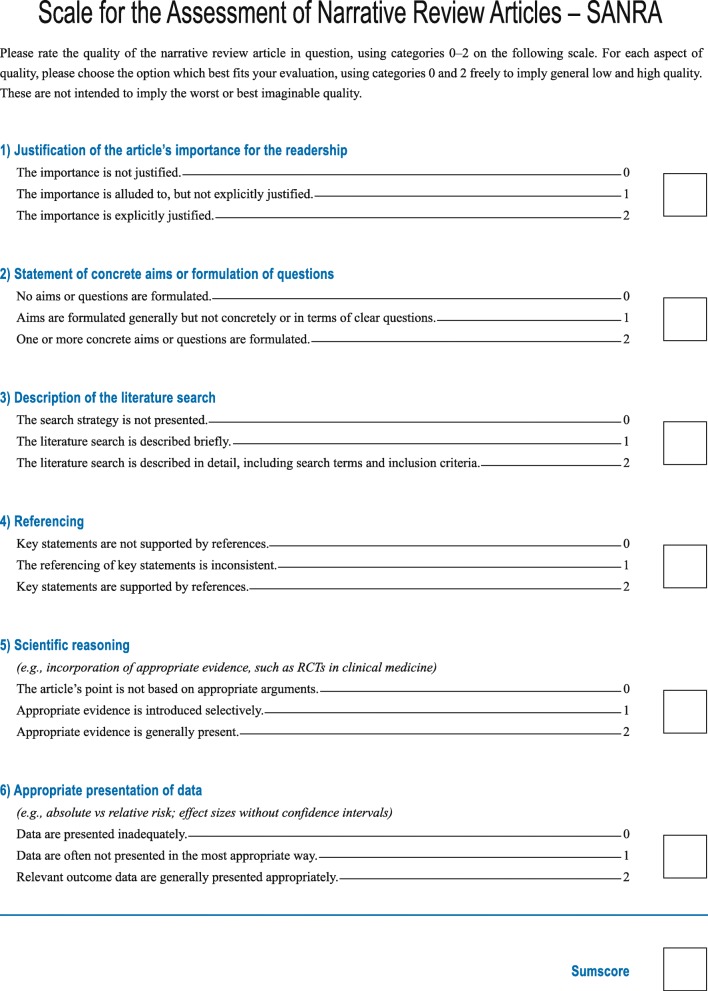
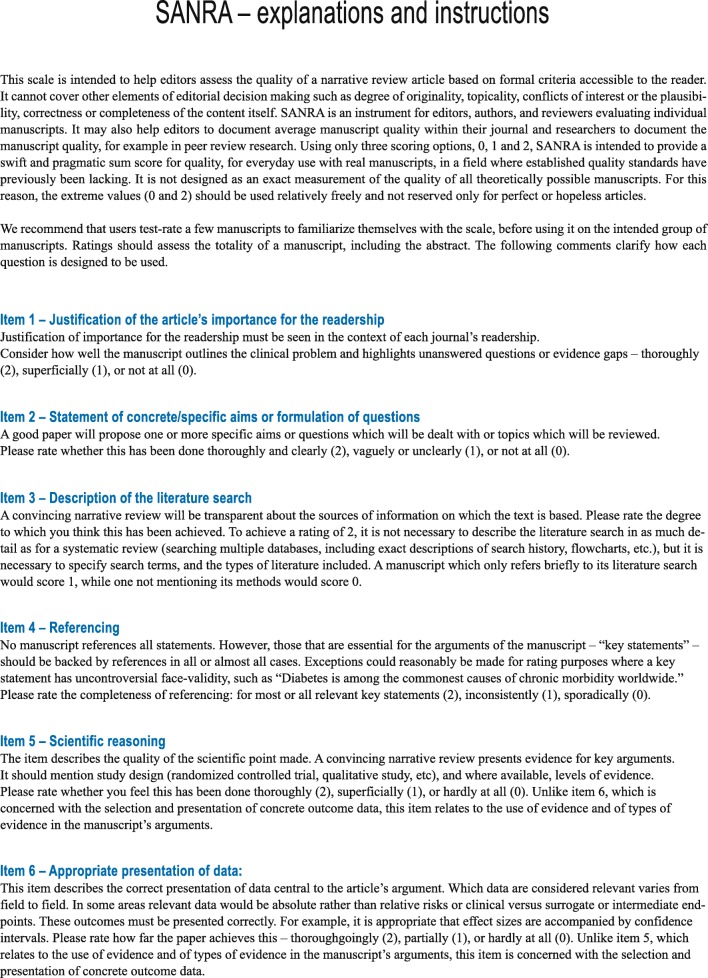
BACKGROUND: Narrative reviews are the commonest type of articles in the medical literature. However, unlike systematic reviews and randomized controlled trials (RCT) articles, for which formal instruments exist to evaluate quality, there is currently no instrument available to assess the quality of narrative reviews. In response to this gap, we developed SANRA, the Scale for the Assessment of Narrative Review Articles. METHODS: A team of three experienced journal editors modified or deleted items in an earlier SANRA version based on face validity, item-total correlations, and reliability scores from previous tests. We deleted an item which addressed a manuscript's writing and accessibility due to poor inter-rater reliability. The six items which form the revised scale are rated from 0 (low standard) to 2 (high standard) and cover the following topics: explanation of (1) the importance and (2) the aims of the review, (3) literature search and (4) referencing and presentation of (5) evidence level and (6) relevant endpoint data. For all items, we developed anchor definitions and examples to guide users in filling out the form. The revised scale was tested by the same editors (blinded to each other's ratings) in a group of 30 consecutive non-systematic review manuscripts submitted to a general medical journal. RESULTS: Raters confirmed that completing the scale is feasible in everyday editorial work. The mean sum score across all 30 manuscripts was 6.0 out of 12 possible points (SD 2.6, range 1-12). Corrected item-total correlations ranged from 0.33 (item 3) to 0.58 (item 6), and Cronbach's alpha was 0.68 (internal consistency). The intra-class correlation coefficient (average measure) was 0.77 [95% CI 0.57, 0.88] (inter-rater reliability). Raters often disagreed on items 1 and 4. CONCLUSIONS: SANRA's feasibility, inter-rater reliability, homogeneity of items, and internal consistency are sufficient for a scale of six items. Further field testing, particularly of validity, is desirable. We recommend rater training based on the "explanations and instructions" document provided with SANRA. In editorial decision-making, SANRA may complement journal-specific evaluation of manuscripts-pertaining to, e.g., audience, originality or difficulty-and may contribute to improving the standard of non-systematic reviews.
Overview
CoChat Summary
TL;DR
SANRA is a six-item, 0–2 scale (maximum 12) for assessing the quality of narrative review articles, developed and field-tested by three journal editors. In 30 consecutive non-systematic review manuscripts, it showed feasible use, sufficient internal consistency and inter-rater reliability, and a modest association with editorial acceptance.
Key findings
- Across 30 manuscripts (90 ratings), the mean SANRA sum score was 6.0 out of 12 (SD 2.6, range 1–12, median 6).
- Internal consistency was Cronbach’s alpha 0.68; corrected item-total correlations ranged from 0.33 (item 3) to 0.58 (item 6).
- Inter-rater reliability was an intra-class correlation coefficient (average measure) of 0.77 [95% CI 0.57, 0.88]; raters often disagreed on items 1 and 4.
- Average SANRA scores were modestly associated with editorial acceptance (mean 6.6, SD 1.9, n = 17) versus rejection (mean 5.1, SD 2.1, n = 13), point biserial correlation 0.37 (t = 2.09, df 28; two-sided p = 0.046).
Methods
- SANRA was developed between 2010 and 2017 by three experienced editors at Deutsches Ärzteblatt; the revised six-item version deleted an item on writing and accessibility due to poor inter-rater reliability.
- The revised scale was tested on 30 consecutive non-systematic review manuscripts submitted to Deutsches Ärzteblatt in 2015; three editor-raters scored them independently and blinded to each other’s ratings.
- Analyses included descriptive statistics, Cronbach’s alpha, corrected item-total correlations, average-measure intra-class correlation using a two-way random effects model (consistency definition), and a post hoc point biserial correlation between SANRA sum scores and acceptance/rejection.
Limitations
- The paper states the main limitation is sample size: 30 manuscripts was a compromise between representativeness, power, and feasibility, and took about 6 months to sample.
- The authors state that the scale’s authors were also the test-raters, so inter-rater reliability may be lower in groups less familiar with SANRA; the study also did not assess test-retest reliability, and results are study-specific.
- The paper acknowledges restricted content validity because SANRA is limited to six items and is a critical appraisal tool rather than a reporting guideline; criterion validity evidence is post hoc and weak, and no established cut-offs exist for comparing manuscripts across settings.
Model-written summary. Check it against the paper before relying on it.
Integrity signals
Registry
Cites
Statistics
Figures
Verification
Claims the paper makes
3 Valid · 0 Not valid · 5 Not checked · 27 Own results and interpretations
The cited sources support only part of this claim — read each source’s verdict below.
In the paper
“Bastian et al. found that they constitute the largest share of all text types in medicine and they concluded that they “remain the staple of medical literature” [1].”
- Also stated in: § Background · plain
“Narrative reviews are the commonest type of articles in the medical literature.”
§ SANRA—a scale for the quality assessment of narrative review articles > Background
What the sources say
- Partly supportedcites [1] Bastian H Glasziou P Chalmers I Seventy-five trials and eleven systematic reviews a day: how will we ever keep up? PLoS Med 2010 7 9 e1000326 10.1371/journal.pmed.1000326 20877712 PMC2943439 sourceExperimental — accuracy not yet measured
In “How Close Are We to Archie Cochrane’s Goal?” and the Summary Points (pages unavailable), the paper calls non-systematic narrative reviews the staple of medical literature synthesis. It does not say they constitute the largest share of all medical text types; that extends a claim about literature synthesis to medical literature as a whole. (LLM, conf=0.88)
plain- Asserted: passes — The authors put it forward as true.
- Checkable: passes — It can be checked against evidence.
- Load-bearing: unclear — It is unclear whether the paper’s conclusions depend on it.
- Based: passes — The paper gives a reason why it holds.
- Also stated in: § Background · plain
The sources with a verdict support this claim; the rest weren’t checked yet, have no full text we could read, or their verdicts aren’t rated yet.
In the paper
“non-systematic reviews or narrative reviews have been widely criticized as unreliable [1, 4].”
§ SANRA—a scale for the quality assessment of narrative review articles > Background
What the sources say
- Supportedcites [1] Bastian H Glasziou P Chalmers I Seventy-five trials and eleven systematic reviews a day: how will we ever keep up? PLoS Med 2010 7 9 e1000326 10.1371/journal.pmed.1000326 20877712 PMC2943439 source
In “How Close Are We to Archie Cochrane’s Goal?”, the paper describes reviews not conducted systematically as having great potential for error and calls them less reliable forms of information. Box 1 also says that articles and textbooks had highlighted the risk of bias and chance in reviews. Together, these passages support the broad characterization that narrative reviews have been criticized as unreliable; page numbers are not provided in our copy. (LLM, conf=0.89)
- Not checked — no full text of the sourcecites [4] Mulrow CD The medical review article: state of the science Ann Intern Med 1987 106 485 488 10.7326/0003-4819-106-3-485 3813259 source
plain- Asserted: passes — The authors put it forward as true.
- Checkable: passes — It can be checked against evidence.
- Load-bearing: passes — The paper’s conclusions depend on it.
- Based: passes — The paper gives a reason why it holds.
- Supported
A result the paper reports from its own data — it cites no other source for it, so there is none to check. The quote shows it is in the paper.
In the paper
“Cronbach’s alpha was 0.68 (internal consistency).”
- Also stated in: § Results · plain
“The scale’s internal consistency, measured as Cronbach’s alpha, was 0.68.”
§ SANRA—a scale for the quality assessment of narrative review articles > Abstract > Results
plainn = 90- Asserted: passes — The authors put it forward as true.
- Checkable: passes — It can be checked against evidence.
- Load-bearing: passes — The paper’s conclusions depend on it.
- Based: passes — The paper gives a reason why it holds.
- Also stated in: § Results · plain
A result the paper reports from its own data — it cites no other source for it, so there is none to check. The quote shows it is in the paper.
In the paper
“Raters often disagreed on items 1 and 4.”
- Also stated in: § Results · plain
“Disagreements most often occurred with regard to items 1 and 4.”
§ SANRA—a scale for the quality assessment of narrative review articles > Abstract > Results
plain- Asserted: passes — The authors put it forward as true.
- Checkable: passes — It can be checked against evidence.
- Load-bearing: unclear — It is unclear whether the paper’s conclusions depend on it.
- Based: passes — The paper gives a reason why it holds.
- Also stated in: § Results · plain
A result the paper reports from its own data — it cites no other source for it, so there is none to check. The quote shows it is in the paper.
In the paper
“The intra-class correlation coefficient (average measure) was 0.77 [95% CI 0.57, 0.88] (inter-rater reliability).”
- Also stated in: § Results · plain
“The intra-class correlation coefficient (average measure) amounted to 0.77 [95% CI 0.57, 0.88; F 4.3; df 29, 58].”
§ SANRA—a scale for the quality assessment of narrative review articles > Abstract > Results
plain- Asserted: passes — The authors put it forward as true.
- Checkable: passes — It can be checked against evidence.
- Load-bearing: passes — The paper’s conclusions depend on it.
- Based: passes — The paper gives a reason why it holds.
- Also stated in: § Results · plain
14 more claims
Create a free account to see all 35 claims and to verify the 3 references still open.
- Probably not a substantial claim. 11
- It may state two separate claims as one. 11
Claims other papers make about this one
Each is checked against this paper’s own text: does it say what the citing paper says it does?
The source backs part of the claim, not all of it — or backs it for a different population, condition or comparison.
In the citing paper
“The review was conducted and reported in accordance with the principles of the Scale for the Assessment of Narrative Review Articles (SANRA), which provides a validated framework for ensuring methodological transparency, scientific rigor, and balanced interpretation in narrative reviews [ 19 ].”
From Paracetamol: A History of Assumptions, Errors, and Evidence Reversals in Pain Management (2026) · cites this paper as [19]
Experimental — accuracy not yet measuredThe source backs part of the claim, not all of it — or backs it for a different population, condition or comparison.
In the citing paper
“As a narrative review, the present work does not include an aggregated quantitative assessment and is more exposed to selection subjectivity than a registered systematic review [124,125].”
From Berberine-Drug Interactions: Mechanisms, Clinical Relevance and Risk Stratification-A Narrative Review (2026) · cites this paper as [124]
Experimental — accuracy not yet measuredThe cited source says what the claim attributes to it.
In the citing paper
“This work is designed as a structured narrative review, with transparent reporting of the documentation strategy, guided by the quality criteria of the Scale for the Assessment of Narrative Review Articles (SANRA) [124].”
From Berberine-Drug Interactions: Mechanisms, Clinical Relevance and Risk Stratification-A Narrative Review (2026) · cites this paper as [124]
The cited source says what the claim attributes to it.
In the citing paper
“we used the following:-Cochrane Risk of Bias 2 (RoB 2) [29] and PEDRO scale tools for RCTs.-AMSTAR 2 [30] checklist for systematic review.-SANRA (Scale for the Assessment of Narrative Review Articles) [31] for narrative reviews.-JBI Checklist for Text and Opinion [32] for expert opinion papers.”
From Pelvic Floor Muscle Training Following Surgery for Pelvic Organ Prolapse: Recommendation from Scientific Literature (2026) · cites this paper as [31]
The cited source says what the claim attributes to it.
In the citing paper
“Data analysis employed a narrative and thematic synthesis methodology,adhering to the SANRA guidelines for narrative reviews (32).”
From Ethical issues in multi-agent AI systems for healthcare: a narrative review (2026) · cites this paper as [32]
12 more claims about this paper
Create a free account to see every claim other papers make about this one.
Citations
Cites
Shea, B. J., Reeves, B. C., Wells, G., Thuku, M., Hamel, C., Moran, J., Moher, D., Tugwell, P., Welch, V., Kristjansson, E., et al. (2017) · BMJ · doi:10.1136/bmj.j4008 · Cited by 10,636 · cited 2×
“Critical appraisal tools have been developed for systematic reviews (e.g., AMSTAR 2 [A MeaSurement Tool to Assess Systematic Reviews] [7]) and papers on RCTs (e.g., the CASP [Critical Appraisal Skills Program] checklist for randomized trials [8]) and other types of medical studies.”
BackgroundStreiner, D. L., & Norman, G. R. (2008) · doi:10.1093/acprof:oso/9780199231881.001.0001 · Cited by 2,631
Critical appraisal skills programme
Singh, J. (2013) · Journal of Pharmacology and Pharmacotherapeutics · doi:10.4103/0976-500x.107697 · Cited by 2,556
Guidelines for Reporting Reliability and Agreement Studies (GRRAS) were proposed
Kottner, J., Audigé, L., Brorson, S., Donner, A., Gajewski, B. J., Hróbjartsson, A., Roberts, C., Shoukri, M., & Streiner, D. L. (2011) · Journal of Clinical Epidemiology · doi:10.1016/j.jclinepi.2010.03.002 · Cited by 2,174
The Mass Production of Redundant, Misleading, and Conflicted Systematic Reviews and Meta‐analyses
IOANNIDIS, J. P. A. (2016) · The Milbank Quarterly · doi:10.1111/1468-0009.12210 · Cited by 1,483 · cited 1×
“While systematic reviews are not per se superior articles and while certain systematic reviews have been criticized lately [3], non-systematic reviews or narrative reviews have”
BackgroundSeventy-five trials and eleven systematic reviews a day: how will we ever keep up?
Bastian, H., Glasziou, P., & Chalmers, I. (2010) · PLoS Medicine · doi:10.1371/journal.pmed.1000326 · Cited by 1,188 · cited 2×
“found that they constitute the largest share of all text types in medicine and they concluded that they “remain the staple of medical literature” [1].”
BackgroundThe Medical Review Article: State of the Science
MULROW, C. D. (1987) · Annals of Internal Medicine · doi:10.7326/0003-4819-106-3-485 · Cited by 856 · cited 1×
“been widely criticized as unreliable [1, 4].”
Writing a narrative biomedical review: considerations for authors, peer reviewers, and editors
Gasparyan, A. Y., Ayvazyan, L., Blackmore, H., & Kitas, G. D. (2011) · Rheumatology International · doi:10.1007/s00296-011-1999-3 · Cited by 694 · cited 1×
“[13], for example, have provided guidance for writing narrative reviews, and Byrne [14] as well as Pautasso [15] has written, from different angles, thoughtful editorials on improving narrative reviews and presented lists of key features of writing a good review—lists that naturally overlap with SANRA items (e.”
BackgroundTen Simple Rules for Writing a Literature Review
Pautasso, M. (2013) · PLoS Computational Biology · doi:10.1371/journal.pcbi.1003149 · Cited by 272 · cited 3×
“[13], for example, have provided guidance for writing narrative reviews, and Byrne [14] as well as Pautasso [15] has written, from different angles, thoughtful editorials on improving narrative reviews and presented lists of key features of writing a good review—lists that naturally overlap with SANRA items (e.”
BackgroundImproving the peer review of narrative literature reviews
Byrne, J. A. (2016) · Research Integrity and Peer Review · doi:10.1186/s41073-016-0019-2 · Cited by 159 · cited 3×
“[13], for example, have provided guidance for writing narrative reviews, and Byrne [14] as well as Pautasso [15] has written, from different angles, thoughtful editorials on improving narrative reviews and presented lists of key features of writing a good review—lists that naturally overlap with SANRA items (e.”
Background
Research works printed but not linked: 3
- Higgins JPT, Green S. (eds.). Cochrane Handbook for Systematic Reviews and Interventions. Version 5.1.0. The Cochrane Collaboration 2011, section 1.2.2., www.handbook.cochrane.org, retrieved on Oct 31, 2018.
- Baethge C Mertens S Goldbeck-Wood S Development of a quality score for the assessment of non-systematic review articles (SANRA) Poster, Seventh International Congress on Peer Review and Biomedical Publication 2013 USA Chicago, Illinois
- Baethge C Goldbeck-Wood S Mertens S A scale for the assessment of non-systematic review articles (SANRA) Poster, Eighth International Congress on Peer and Biomedical Publication 2017 USA Chicago, Illinois
Cited by
Items 101–200 of 4,334
Polycystic Ovarian Syndrome (PCOS): Does the Challenge End at Conception?
Mirza, F., Tahlak, M., Rjeili, R. B., Hazari, K., Ennab, F., Hodgman, C. T., Khamis, A. H., & Atiomo, W. (2022) · International Journal of Environmental Research and Public Health · doi:10.3390/ijerph192214914 · Cited by 57
“The paper followed the Scale of Assessment of Narrative Review Articles (SANRA) [32].”
MethodHow to write a narrative review
Agarwal, S., Charlesworth, M., & Elrakhawy, M. (2023) · Anaesthesia · doi:10.1111/anae.16016 · Cited by 55
“The Scale for the Assessment of Narrative Review Articles (SANRA) includes six variables which are rated when assessing the quality of the article and provide a useful guide for inclusion [17].”
BackgroundNakaishi, T., & Chapman, A. J. (2024) · Renewable and Sustainable Energy Reviews · doi:10.1016/j.rser.2024.114708 · Cited by 61
Gaudreau, C., Guillaumie, L., Jobin, É., & Diallo, T. (2024) · Canadian Journal of Nursing Research · doi:10.1177/08445621241229932 · Cited by 54
“A narrative review was chosen for its ability to document new and emerging practices and to summarize all types of evidence, including grey literature (e.g., institutional reports) (Baethge, 2019).”
BackgroundMethodInfluentialSocial Modeling and Eating Behavior—A Narrative Review
Suwalska, J., & Bogdański, P. (2021) · Nutrients · doi:10.3390/nu13041209 · Cited by 58
“However, while systematic reviews are superior to narrative reviews in answering specific questions, narrative reviews are better suited to addressing a topic in wider ways [69].”
BackgroundFuchs, K. (2023) · International Journal of Changes in Education · doi:10.47852/bonviewijce32021604 · Cited by 67
Exploring the Current Trends of Artificial Intelligence in Stem Cell Therapy: A Systematic Review
Srinivasan, M., Thangaraj, S. R., Ramasubramanian, K., Thangaraj, P. P., & Ramasubramanian, K. V. (2021) · Cureus · doi:10.7759/cureus.20083 · Cited by 69
“Table 1 below depicts the type of study reviewed and corresponding scores awarded to each study according to the respective quality appraisal tools [13-16].”
MethodGuerra‐Londono, C. E., Cata, J. P., Nowak, K., & Gottumukkala, V. N. R. (2024) · Current Oncology · doi:10.3390/curroncol31040162 · Cited by 58
“This study follows the recommendations of the SANRA scale for narrative reviews [19].”
MethodCohen, A., Steinert, Y., & Cea, E. R. (2022) · Academic Medicine · doi:10.1097/acm.0000000000004608 · Cited by 55
Role of vitamin C in preventing of COVID-19 infection, progression and severity
Shahbaz, U., Fatima, N., Basharat, S., Bibi, A., Yu, X., Hussain, M. I., & Nasrullah, M. (2022) · AIMS Microbiology · doi:10.3934/microbiol.2022010 · Cited by 57
Pavlovic, D., Nićiforović, D., Papic, D., Milojevic, K., & Marković, M. (2023) · Therapeutic Advances in Medical Oncology · doi:10.1177/17588359231205848 · Cited by 57
“…appraise the literature and assess any bias of studies is performed by SANRA – a scale for the quality assessment of narrative review articles, 8 which include: The six items which form the revised scale are rated from 0 (low standard) to 2 (high standard) and cover the following topics:…”
MethodGuzmán-Leguel, Y. M., & Rodríguez-Lara, S. Q. (2025) · Healthcare · doi:10.3390/healthcare13141714 · Cited by 67
“This methodological approach is consistent with international quality standards for narrative reviews, such as the SANRA scale [20], which emphasize clarity, logical argumentation, and interpretive depth over formalized data extraction and reporting.”
GDF-15, a future therapeutic target of glucolipid metabolic disorders and cardiovascular disease
Xiao, Q.-A., He, Q., Zeng, J., & Xia, X. (2021) · Biomedicine & Pharmacotherapy · doi:10.1016/j.biopha.2021.112582 · Cited by 54
Efficacy, Safety, and Regulation of Cannabidiol on Chronic Pain: A Systematic Review
Villanueva, M. R. B., Joshaghani, N., Villa, N., Badla, O., Goit, R., Saddik, S. E., Dawood, S. N., Rabih, A. M., Niaj, A., Raman, A., et al. (2022) · Cureus · doi:10.7759/cureus.26913 · Cited by 50
“Table 2 shows the use of SANRA for five review articles.”
Chatterjee, A., Prinz, A., Riegler, M. A., & Das, J. (2023) · BMC Health Services Research · doi:10.1186/s12913-023-10047-z · Cited by 55
“Afterward, we used the Scale for the Assessment of Narrative Review Articles (SANRA) [15] to assess the articles in the final round.”
MethodInfluentialNarrative review of pelvic floor muscle training for childbearing women—why, when, what, and how
Woodley, S. J., & Hay‐Smith, J. (2021) · International Urogynecology Journal · doi:10.1007/s00192-021-04804-z · Cited by 50
“The six items of the scale for quality assessment of narrative review articles (SANRA) were used as a guide to the reporting of this review [24].”
MethodThyroid dysfunction and female infertility. A comprehensive review
Concepción‐Zavaleta, M. J., Arroyo, J., Aldave, J. E. Q., Urteaga, L. A. C., & Paz‐Ibarra, J. (2023) · Diabetes & Metabolic Syndrome Clinical Research & Reviews · doi:10.1016/j.dsx.2023.102876 · Cited by 63
Johansson, M., Romero, D., Jakobson, M., Heinemans, N., & Lindner, P. (2024) · Frontiers in Psychiatry · doi:10.3389/fpsyt.2024.1233888 · Cited by 50
“In addition, in the style of a narrative review (20), we also include descriptive summary and synthesis of the fi ndings of the many meta-analyses and systematic reviews that have been performed on the topic of ef fi cacy.”
BackgroundAnalysing health system capacity and preparedness for climate change
Braithwaite, J., Leask, E., Smith, C. L., Dammery, G., Brooke-Cowden, K., Carrigan, A., McQuillan, E., Ehrenfeld, L., Coiera, E. W., Westbrook, J. I., et al. (2024) · Nature Climate Change · doi:10.1038/s41558-024-01994-4 · Cited by 54
“…four quality appraisal tools were applied, depending on publication type: (1) mixed-methods appraisal tool 188 , (2) scale for the assessment of narrative review articles 189 and (3) Joanna Briggs Institute critical appraisal checklist for systematic reviews and research synthesis 190,191 .”
Domínguez, A. M. C., Salazar, D. D. J. R., stefanolo, J. P., Serrano, M. C. C., Quiroga, I. C. C., & Peña, J. R. Z. (2024) · Probiotics and Antimicrobial Proteins · doi:10.1007/s12602-024-10353-w · Cited by 59
Lipids in Clinical Nutrition and Health: Narrative Review and Dietary Recommendations
Frydrych, A., Kulita, K., Jurowski, K., & Piekoszewski, W. (2025) · Foods · doi:10.3390/foods14030473 · Cited by 65
Danilovich, N., Kitto, S. C., Price, D. W., Campbell, C. B., Hodgson, A., & HENDRY, P. J. (2021) · Family Medicine · doi:10.22454/fammed.2021.453158 · Cited by 59
Ferreira, P. G., Ferreira, A. R., Barreto, B., & Fernandes, L. P. N. S. (2021) · European Geriatric Medicine · doi:10.1007/s41999-021-00553-w · Cited by 49
“Regarding the narrative reviews appraised, although a clear description of the search strategy is of utmost importance for the sake of reproducibility and transparency of the studies [40], most of them have failed to adequately describe the literature search used.”
BackgroundInfluentialExecutive Dysfunction in Patients With Alcohol Use Disorder: A Systematic Review
Maharjan, S., Amjad, Z., Abaza, A., Vasavada, A. M., Sadhu, A., Valencia, C., Fatima, H., Nwankwo, I., Anam, M., & Mohammed, L. (2022) · Cureus · doi:10.7759/cureus.29207 · Cited by 59
Psychosocial Aspects of Female Breast Cancer in the Middle East and North Africa
Salem, H., & Daher‐Nashif, S. (2020) · International Journal of Environmental Research and Public Health · doi:10.3390/ijerph17186802 · Cited by 55
“SANRA Scale is a validated tool developed to evaluate the quality of narrative and literature reviews [18].”
MethodD’Oria, M., Mani, K., DeMartino, R. R., Czerny, M., Donas, K. P., Wanhainen, A., & Lepidi, S. (2020) · Interactive Cardiovascular and Thoracic Surgery · doi:10.1093/icvts/ivaa342 · Cited by 48
“Assessment of Narrative Review Articles principles [6].”
Obesity and female infertility
Ennab, F., & Atiomo, W. (2023) · Best Practice & Research Clinical Obstetrics & Gynaecology · doi:10.1016/j.bpobgyn.2023.102336 · Cited by 47
Strahan, K., & Gilbert, J. (2021) · Fire · doi:10.3390/fire4010004 · Cited by 52
Albumin in adult cardiac surgery: a narrative review
Hanley, C., Callum, J. L., Karkouti, K., & Bartoszko, J. M. (2021) · Canadian Journal of Anesthesia/Journal canadien d anesthésie · doi:10.1007/s12630-021-01991-7 · Cited by 52
“This review followed the SANRA reporting recommendations for high-quality narrative reviews.(12)”
MethodKawu, A. A., Hederman, L., Doyle, J., & O’Sullivan, D. M. (2022) · Informatics in Medicine Unlocked · doi:10.1016/j.imu.2022.101153 · Cited by 57
A Guide for Accounting Researchers to Conduct and Report Systematic Literature Reviews
Hardies, K., Ohlrogge, F., Mentens, J., & Vandennieuwenhuysen, J. (2024) · Behavioral Research in Accounting · doi:10.2308/bria-2022-042 · Cited by 58
Common Molecular Pathways Between Post-COVID19 Syndrome and Lung Fibrosis: A Scoping Review
Bergantini, L., Mainardi, A., d’Alessandro, M., Cameli, P., Bennett, D., Bargagli, E., & Sestini, P. (2022) · Frontiers in Pharmacology · doi:10.3389/fphar.2022.748931 · Cited by 51
“This article conforms to the Scale for Assessment of Narrative Review Articles (SANRA) guidelines (Baethge et al., 2019).”
MethodLegazpi, P. C. C., Muñoz, M. D. L. F. R., Crespo, M. E. O., & Méndez, N. I. (2022) · Psicologia Reflexão e Crítica · doi:10.1186/s41155-022-00220-4 · Cited by 57
Chadwick, A. L., Frazier, A., Khan, T. W., & Young, E. E. (2021) · Journal of Pain Research · doi:10.2147/jpr.s320863 · Cited by 61
Dekker, J., de Boer, M. R., & Ostelo, R. (2023) · Osteoarthritis and Cartilage · doi:10.1016/j.joca.2023.09.002 · Cited by 51
Emerging drugs for the treatment of irritability associated with autism spectrum disorder
Shamabadi, A., Karimi, H., Bahri, R. A., Motavaselian, M., & Akhondzadeh, S. (2024) · Expert Opinion on Emerging Drugs · doi:10.1080/14728214.2024.2313650 · Cited by 51
“In this regard, this study reviewed emerging medications in treating irritability associated with ASD, considering the Scale for the Assessment of Narrative Review Articles (SANRA) [17].”
Liu, T., Krentz, A. J., Huo, Z., & Ćurčin, V. (2025) · Reviews in Cardiovascular Medicine · doi:10.31083/rcm37443 · Cited by 55
“This review is conducted based upon the elements which described in the Preferred Reporting Items for Systematic Reviews and Meta-Analyses (PRISMA) [14] and Scale for the Assessment of Narrative Review Articles (SANRA) [15].”
Neuropsychiatric symptoms in spinocerebellar ataxias and Friedreich ataxia
Karamazovová, S., Matušková, V., Ismail, Z., & Vyhnálek, M. (2023) · Neuroscience & Biobehavioral Reviews · doi:10.1016/j.neubiorev.2023.105205 · Cited by 49
“Narrative Review Articles (SANRA), which incorporates key criteria such as statement of specific aims, justification of an article’s importance, referencing, and scientific reasoning, to promote high-quality narrative reviews (Baethge et al., 2019).”
BackgroundMethodTeaching and Rehabilitation of Handwriting for Children in the Digital Age: Issues and Challenges
Bonneton-Botté, N., Miramand, L., Bailly, R., & Pons, C. (2023) · Children · doi:10.3390/children10071096 · Cited by 60
“This narrative review was conducted according to the Scale for the Assessment of Narrative Review Articles (SANRA) criteria [26].”
MethodCalcaterra, V., Rossi, V., Magenes, V. C., Baldassarre, P., Grazi, R., Loiodice, M., Fabiano, V., & Zuccotti, G. (2024) · Frontiers in Pediatrics · doi:10.3389/fped.2024.1368283 · Cited by 46
“We conducted a narrative review (6, 7) to examine the relationship between dietary patterns and depression in children and adolescents with obesity.”
The Basic Determinants of Malnutrition: Resources, Structures, Ideas and Power
Harris, J., & Nisbett, N. (2020) · International Journal of Health Policy and Management · doi:10.34172/ijhpm.2020.259 · Cited by 60
Gambling behaviors during COVID-19: a narrative review
Sachdeva, V., Sharma, S., & Sarangi, A. (2021) · Journal of Addictive Diseases · doi:10.1080/10550887.2021.1971942 · Cited by 45
Pituitary Apoplexy: Risk Factors and Underlying Molecular Mechanisms
Biagetti, B., & Simó, R. (2022) · International Journal of Molecular Sciences · doi:10.3390/ijms23158721 · Cited by 46
“This narrative review about molecular mechanisms in pituitary apoplexy was conducted following the SANRA scale [14].”
MethodMcCullough, P. A., Amin, A., Pantalone, K. M., & Ronco, C. (2022) · Journal of the American Heart Association · doi:10.1161/jaha.121.024139 · Cited by 47
MRI image features with an evident relation to low back pain: a narrative review
van der Graaf, J. W., Kroeze, R. J., Buckens, C. F. M., Leßmann, N., & van Hooff, M. L. (2023) · European Spine Journal · doi:10.1007/s00586-023-07602-x · Cited by 51
“This study was designed as a narrative review and follows the quality assessment guidelines of the Scale for the Assessment of Narrative Review Articles (SANRA), a brief critical appraisal tool for the assessment of non-systematic articles [12].”
MethodSalmeri, N., Viganò, P., Cavoretto, P. I., Marci, R., & Candiani, M. (2023) · Reviews in Endocrine and Metabolic Disorders · doi:10.1007/s11154-023-09826-0 · Cited by 44
“…search was conducted using PubMed, Medline, Embase and Scopus to identify all English-language articles published up to January 2023, investigating the role of KP in the field of reproduction and in accordance with the Scale for the Assessment of Narrative Review Articles (SANRA) guidelines [19].”
Pharmacotherapeutic strategies for the treatment of anorexia nervosa – too much for one drug?
Frank, G. (2020) · Expert Opinion on Pharmacotherapy · doi:10.1080/14656566.2020.1748600 · Cited by 51
“For this review, we adhered to the scale for the quality assessment of narrative review articles (SANRA) [13].”
MethodClinical efficacy of medical hydrology: an umbrella review
Antonelli, M., Donelli, D., Veronesi, L., Vitale, M., & Pasquarella, C. I. M. (2021) · International Journal of Biometeorology · doi:10.1007/s00484-021-02133-w · Cited by 47
“The methodological quality of narrative reviews was assessed with the SANRA scale (Baethge et al. 2019) during the article selection process and only higher-quality narrative reviews were included in this work.”
MethodLiver Impairment—The Potential Application of Volatile Organic Compounds in Hepatology
Stavropoulos, G., van Munster, K. N., Ferrandino, G., Sauca, M., Ponsioen, C. Y., van Schooten, F., & Smolinska, A. (2021) · Metabolites · doi:10.3390/metabo11090618 · Cited by 47
Epidemiology, common diagnoses, treatments and prognosis of shoulder pain: A narrative review
Hodgetts, C. J., & Walker, B. F. (2021) · International journal of osteopathic medicine · doi:10.1016/j.ijosm.2021.10.006 · Cited by 52
Lam, T. T., Dang, D. A., Tran, H. H., Do, D. V., Le, H., Negin, J., Jan, S., Marks, G. B., Nguyen, T. A., Fox, G. J., et al. (2021) · Journal of Antimicrobial Chemotherapy · doi:10.1093/jac/dkaa556 · Cited by 49
Clinical and economic consequences of medication nonadherence: a review of systematic reviews
Achterbosch, M., Aksoy, N., Obeng, G. D., Ameyaw, D., Ágh, T., & van Boven, J. F. M. (2025) · Frontiers in Pharmacology · doi:10.3389/fphar.2025.1570359 · Cited by 51
Pant, U., Frishkopf, M., Park, T., Norris, C. M., & Papathanassoglou, E. D. E. (2022) · International Journal of Environmental Research and Public Health · doi:10.3390/ijerph19053113 · Cited by 50
“The Scale for the Assessment of Narrative Review Articles (SANRA) guided reporting [26].”
Calini, G., Aziz, M. A. A. E., Paolini, L., Abdalla, S., Rottoli, M., Mari, G. M., & Larson, D. W. (2023) · Clinical and Experimental Gastroenterology · doi:10.2147/ceg.s340929 · Cited by 46
Age-Related Hormones Changes and Its Impact on Health Status and Lifespan
Biagetti, B., & Puig‐Domingo, M. (2023) · Aging and Disease · doi:10.14336/ad.2022.1109 · Cited by 50
“This review was conducted following SANRA scale[6].”
Lupia, T., Benedetto, I. D., Bosio, R., Shbaklo, N., Rosa, F. G. D., & Corcione, S. (2023) · Life · doi:10.3390/life13040959 · Cited by 41
Approaches for supporting adolescents' reading motivation: existing research and future priorities
Webber, C., Wilkinson, K., Duncan, L., & McGeown, S. (2023) · Frontiers in Education · doi:10.3389/feduc.2023.1254048 · Cited by 14
“NRs are common within medical literature (Bastian et al., 2010; Baethge et al., 2019) and are used to summarize a body of research in a way which allows greater flexibility in terms of selection criteria, thematic inclusion, and exploration of specific research questions than a systematic review…”
BackgroundMethodInfluentialMoult induction methods in soft‐shell crab production
Waiho, K., Ikhwanuddin, M., Baylon, J. C., Jalilah, M., Rukminasari, N., Fujaya, Y., & Fazhan, H. (2021) · Aquaculture Research · doi:10.1111/are.15274 · Cited by 44
Current trends and future implications in the utilization of ChatGPT in nursing: a rapid review
Kleib, M., Darko, E. M., Akingbade, O., Kennedy, M., Majekodunmi, P., Nickel, E., & Vogelsang, L. (2024) · International Journal of Nursing Studies Advances · doi:10.1016/j.ijnsa.2024.100252 · Cited by 40
“Different appraisal tools were used, including the Scale for the Assessment of Narrative Review Articles (Baethge et al., 2019), Joanna Briggs Institute critical appraisal tools (Joanna Briggs Institute, n.d.), and Center for Evidence-Based Management tools (Center for Evidence-Based Management,…”
Clemens, K. K., Ernst, J., Khan, T., Reichert, S., Khan, M. Q., LaPier, H., Chiu, M., Stranges, S., Sahi, G., Castrillon-Ramirez, F., et al. (2023) · Nutrition, Metabolism and Cardiovascular Diseases · doi:10.1016/j.numecd.2023.03.023 · Cited by 40
Shafaghat, T., Bastani, P., Nasab, M. H. I., Bahrami, M. A., Kavosi, Z., Montazer, M. R. A., Zarchi, M. K. R., & Edirippulige, S. (2022) · Archives of Public Health · doi:10.1186/s13690-022-00843-0 · Cited by 41
“These tools were including Critical Appraisal Skills Program (CASP) for assessing the quality of qualitative researches [28], Scale for the Assessment of Narrative Review Articles (SANRA) [29], and The Mixed Methods Appraisal Tool (MMAT) version 2018 for information professionals and researchers [30] (Table 3-Appendix…”
MethodA review of Bruton’s tyrosine kinase inhibitors in multiple sclerosis
Airas, L. M., Bermel, R. A., Chitnis, T., Hartung, H., Nakahara, J., Stüve, O., Williams, M. J., Kieseier, B. C., & Wiendl, H. (2024) · Therapeutic Advances in Neurological Disorders · doi:10.1177/17562864241233041 · Cited by 42
“25 Literature searching focused on three themes using pre-defined eligibility criteria and identified evidence relating to BTK inhibition in auto-immune conditions, MS and BTK inhibitor safety profiles.”
BackgroundOpportunities for Smartphone Sensing in E-Health Research: A Narrative Review
Kulkarni, P., Kirkham, R., & McNaney, R. (2022) · Sensors · doi:10.3390/s22103893 · Cited by 43
“However, a few authors have provided a set of recommendations to follow while writing [35,43] and evaluating [44] NRLs.”
BackgroundAdult Inpatients’ Perceptions of Their Fall Risk: A Scoping Review
Dabkowski, E., Cooper, S. J., Duncan, J. R., & Missen, K. (2022) · Healthcare · doi:10.3390/healthcare10060995 · Cited by 40
Work and health challenges of Indigenous people in Canada
Durand-Moreau, Q. V., Lafontaine, J., & Ward, J. (2022) · The Lancet Global Health · doi:10.1016/s2214-109x(22)00203-0 · Cited by 40
The Art and Science of Writing Narrative Reviews
Basheer, A. (2022) · International Journal of Advanced Medical and Health Research · doi:10.4103/ijamr.ijamr_234_22 · Cited by 46
Hurdawaty, R., & Tukiran, M. (2024) · South Asian Journal of Social Studies and Economics · doi:10.9734/sajsse/2024/v21i1768 · Cited by 59
Harm Reduction for Opioid Use Disorder: Strategies and Outcome Metrics
Ellis, J. D., Dunn, K. E., & Huhn, A. S. (2024) · American Journal of Psychiatry · doi:10.1176/appi.ajp.20230918 · Cited by 40
Groom, L. L., Schoenthaler, A., Mann, D. M., & Brody, A. A. (2024) · PLOS Digital Health · doi:10.1371/journal.pdig.0000509 · Cited by 48
“We conducted a narrative review following the Scale for the Assessment of Narrative Review Articles [33] to comprehensively describe and interpret previously published literature on digital health implementation models incorporating concepts of health equity [34].”
MethodImpact of environmental air pollution on respiratory health and function
Wallbanks, S. R., Griffiths, B., Thomas, M., Price, O. J., & Sylvester, K. P. (2024) · Physiological Reports · doi:10.14814/phy2.70006 · Cited by 42
“In accordance with the Scale for the Assessment of Narrative Review Articles (SANRA) (Baethge et al., 2019), peer-reviewed scientific literature published between 2018 and 2024 were identified in PubMed and Google Scholar using broad search terms such as “lung function” or “pulmonary function” and…”
MethodCybersecurity threats and mitigation measures in agriculture 4.0 and 5.0
Maraveas, C., Rajarajan, M., Arvanitis, K. G., & Vatsanidou, A. (2024) · Smart Agricultural Technology · doi:10.1016/j.atech.2024.100616 · Cited by 49
Beyond “just” fun: The role of exergames in advancing health promotion and disease prevention
Manser, P., de Bruin, E. D., Temprado, J.-J., Bherer, L., & Herold, F. (2025) · Neuroscience & Biobehavioral Reviews · doi:10.1016/j.neubiorev.2025.106260 · Cited by 43
“This review followed recommendations and quality criteria for planning, conducting, and reporting high-quality narrative reviews [35, 36]. r”
Epigenetics Beyond Fetal Growth Restriction: A Comprehensive Overview
Salmeri, N., Carbone, I. F., Cavoretto, P. I., Farina, A., & Morano, D. (2022) · Molecular Diagnosis & Therapy · doi:10.1007/s40291-022-00611-4 · Cited by 47
“The literature review was performed according to the Scale for the Assessment of Narrative Review Articles guidelines [21].”
MethodResearching minoritised communities in palliative care: An agenda for change
Koffman, J., Bajwah, S., Davies, J. M., & Hussain, J. A. (2022) · Palliative Medicine · doi:10.1177/02692163221132091 · Cited by 42
Artificial Intelligence (AI) in Breast Imaging: A Scientometric Umbrella Review
Tan, X. J., Cheor, W. L., Lim, L. L., Rahman, K. S. A., & Bakrin, I. H. (2022) · Diagnostics · doi:10.3390/diagnostics12123111 · Cited by 43
Relevant Sport Management Knowledge, Competencies, and Skills: An Umbrella Review
Guidotti, F., Demarie, S., Ciaccioni, S., & Capranica, L. (2023) · Sustainability · doi:10.3390/su15129515 · Cited by 38
“Exclusion criteria were: (i) primary research articles (identified and retained for other research purposes); (ii) not peer-reviewed publications (e.g., book chapters, book reviews, commentaries); (iii) a weak methodological quality [48,49]; and (iv) the absence of cited K/C/S.”
InfluentialZurynski, Y. A., Fisher, G., Wijekulasuriya, S., Leask, E., Dharmayani, P. N. A., Ellis, L. A., Smith, C. L., & Braithwaite, J. (2024) · The International Journal of Health Planning and Management · doi:10.1002/hpm.3769 · Cited by 43
dos Anjos, G. R., Machado, G. F., de Barros, C. P., de Andrade, V. P., Maciel, R. M. B., & Cunha, L. L. (2025) · Frontiers in Public Health · doi:10.3389/fpubh.2025.1601483 · Cited by 42
Ganapathy, A., Clough, B. A., & Casey, L. M. (2021) · Telemedicine Journal and e-Health · doi:10.1089/tmj.2020.0455 · Cited by 43
“The Scale for the Assessment of Narrative Review Articles (SANRA) 21 was used to guide the conception and methodology of the current review.”
The skin microbiome of infected pressure ulcers: A review and implications for health professionals
Gomes, F., Furtado, G. E., Henriques, M., Sousa, L. B., Santos‐Costa, P., Bernardes, R. A., Apóstolo, J., Parreira, P., & Salgueiro‐Oliveira, A. (2021) · European Journal of Clinical Investigation · doi:10.1111/eci.13688 · Cited by 47
King, T., Schindler, R., Chavda, S., & Conly, J. M. (2022) · Antimicrobial Resistance and Infection Control · doi:10.1186/s13756-022-01059-1 · Cited by 40
“Overall, our review scores highly on the SANRA – the Scale for the Assessment of Narrative Review Articles [48], a quality appraisal tool for narrative review studies.”
MethodLocal Antibiotics in the Treatment of Diabetic Foot Infections: A Narrative Review
Soldevila‐Boixader, L., Fernández, A. P., Laguna, J. M., & Uçkay, İ. (2023) · Antibiotics · doi:10.3390/antibiotics12010124 · Cited by 41
Exergames to Limit Weight Gain and to Fight Sedentarism in Children and Adolescents with Obesity
Calcaterra, V., Vandoni, M., Marin, L., Pellino, V. C., Rossi, V., Gatti, A., Patanè, P., Cavallo, C., Re, F., Albanese, I., et al. (2023) · Children · doi:10.3390/children10060928 · Cited by 41
“We conducted a literature narrative review [12,13] on the topic of the role of exergames in body composition and weight modifications and changes in sedentary behavior.”
MethodNutrition Transition in Europe: East-West Dimensions in the Last 30 Years—A Narrative Review
Dokova, K. G., Pancheva, R., Usheva, N., Haralanova, G., Nikolova, S., Kostadinova, T. I., Rodrigues, C. E., Singh, J., Illner, A., & Aleksandrova, K. (2022) · Frontiers in Nutrition · doi:10.3389/fnut.2022.919112 · Cited by 39
“The present narrative review is based on the general framework of narrative reviews proposed by Ferrari (22) and complies with the requirements of the Scale for the Assessment of Narrative Review Articles (SANRA) (23).”
MethodPopulation-based physical activity promotion with a focus on health equity: a review of reviews
Kohler, S., Dippon, L., Helsper, N., Rütten, A., Abu‐Omar, K., Birkholz, L., Pfeifer, K., Weber, P., & Semrau, J. (2023) · International Journal for Equity in Health · doi:10.1186/s12939-023-01834-5 · Cited by 39
Berkane, Y., Oubari, H., Dieren, L. V., Charlès, L., Lupon, E. L., McCarthy, M. E., Cetrulo, C. L., Bertheuil, N., Uygun, B. E., Smadja, D. M., et al. (2024) · Annals of Translational Medicine · doi:10.21037/atm-23-1724 · Cited by 43
Dignam, P., Elshafey, M., Jeganathan, A., Foo, M., Park, J., & Ratnaweera, M. (2024) · International Journal of Dentistry · doi:10.1155/2024/7712829 · Cited by 53
“However, we have utilised the SANRA checklist to ensure transparency [46].”
Biomaterials for Guided Tissue Regeneration and Guided Bone Regeneration: A Review
Duarte, N. D., Frigério, P. B., Chica, G. E. A., Okamoto, R., Buchaim, R. L., Buchaim, D. V., Messora, M. R., & Issa, J. P. M. (2025) · Dentistry Journal · doi:10.3390/dj13040179 · Cited by 37
“This narrative review was conducted following the guidelines of the Scale for the Assessment of Narrative Review Articles (SANRA) [18].”
Ergonomics in Interventional Radiology: Awareness Is Mandatory
Cornélis, F., Razakamanantsoa, L., Ammar, M. B., Lehrer, R., Haffaf, I., Mouhadi, S. E., Gardavaud, F., Najdawi, M., & Barral, M. (2021) · Medicina · doi:10.3390/medicina57050500 · Cited by 41
“A total of 62 articles were included in this review article, which follows the Scale for the Assessment of Narrative Review Articles [12].”
BackgroundSystematic Review to Update ‘Value of a Statistical Life’ Estimates for Australia
Ananthapavan, J., Moodie, M., Milat, A., & Carter, R. (2021) · International Journal of Environmental Research and Public Health · doi:10.3390/ijerph18116168 · Cited by 37
Infective endocarditis in developing countries: An update
Mutagaywa, R., Vroon, J. C., Fundikira, L. S., Wind, A. M., Kunambi, P. P., Manyahi, J., Kamuhabwa, A., Kwesigabo, G., Chamuleau, S. A. J., Cramer, M. J., et al. (2022) · Frontiers in Cardiovascular Medicine · doi:10.3389/fcvm.2022.1007118 · Cited by 44
“The reporting of this study conforms to SANRA (the Scale for Assessment of Narrative Review Articles) guidelines (20).”
MethodA SWOT Analysis of Pharmacy Students’ Perspectives on e-Learning Based on a Narrative Review
Pires, C. M. B. F. (2023) · Pharmacy · doi:10.3390/pharmacy11030089 · Cited by 36
Loggen, J., Moneva, A., & Leukfeldt, R. (2023) · Computer law & security review · doi:10.1016/j.clsr.2023.105858 · Cited by 41
Multi-domain narrative review of vaccine hesitancy in childhood
Hasnan, S., & Tan, N. C. (2021) · Vaccine · doi:10.1016/j.vaccine.2021.02.057 · Cited by 43
MacFarlane, A. E., Ogoro, M., de Freitas, C., Niranjan, V. R., Severoni, S., & Waagensen, E. (2021) · Tropical Medicine & International Health · doi:10.1111/tmi.13643 · Cited by 37
van Ruler, R., Eikendal, T., Kooij, F. O., & Tan, E. C. T. H. (2022) · Injury · doi:10.1016/j.injury.2022.08.024 · Cited by 42
Thyrotoxic Cardiomyopathy: State of the Art
Aldave, J. E. Q., Durand‐Vásquez, M. D. C., Lobato-Jeri, C. J., Division of Cardiology, C. L. L., Moreno, J. M. M., Condori, D. C. D.-G., Ildefonso-Najarro, S. P., Contreras-Yametti, F., Zavaleta‐Gutiérrez, F. E., Urteaga, L. A. C., et al. (2023) · touchREVIEWS in Endocrinology · doi:10.17925/ee.2023.19.1.78 · Cited by 43
Workplace safety and future and emerging ways of work: A systematic literature review
Cheng, T. C., Caponecchia, C., & O’Neill, S. (2022) · Safety Science · doi:10.1016/j.ssci.2022.105873 · Cited by 35
Baets, L. D., Runge, N., Labie, C., Maîresse, O., Malfliet, A., Verschueren, S., Assche, D. V., de Vlam, K., Luyten, F. P., Coppieters, I., et al. (2023) · Sleep Medicine Reviews · doi:10.1016/j.smrv.2023.101793 · Cited by 36
Health equity integrated epilepsy care and research: A narrative review
Gotlieb, E. G., Blank, L. J., Willis, A. W., Agarwal, P., & Jetté, N. (2023) · Epilepsia · doi:10.1111/epi.17728 · Cited by 35
Metadata
- Authors
- Baethge, C., Goldbeck-Wood, S., & Mertens, S.
- Affiliations
- University of Cologne (DE)
- BMJ Group (United Kingdom) (GB)
- Corresponding author
- Baethge, Christopher
- ORCID
- Baethge, Christopher
- Venue
- Research Integrity and Peer Review
- Published
- 2019-03-26
- Volume
- 4
- Issue
- 1
- Pages
- 5-5
- ISSN
- 2058-8615 (ISSN-L)
- PMC
- PMC6434870
- OpenAlex
- W2922577842
- Semantic Scholar
- ea7f35b3069b53791c3b746c5c4b3c72a83a526b
- Cited by
- 3,469
- References
- 13
- Citations by year
- 2026: 1823 · 2025: 551 · 2024: 379 · 2023: 309 · 2022: 218 · 2021: 152 · 2020: 32 · 2019: 4
- FWCI
- 20.57
- Type
- journal article
- Language
- en
- Open access
- gold
- doi.org
- Licence
- cc-by
- creativecommons.org/licenses/by/4.0/ (tdm)
- Locations
- Research Integrity and Peer Review (publishedVersion, cc-by)
- Europe PMC (PubMed Central) (publishedVersion, other-oa)
- PubMed Central (publishedVersion, cc-by)
- PubMed (publishedVersion)
- Kölner Universitäts PublikationsServer (Universität zu Köln) (publishedVersion)
- DOAJ (DOAJ: Directory of Open Access Journals) (submittedVersion, cc-by-sa)
- Topics
- Social Sciences › Decision Sciences › Statistics, Probability and Uncertainty › Meta-analysis and systematic reviews
- Social Sciences › Library and Information Sciences › Academic Writing and Publishing
- Social Sciences › Library and Information Sciences › scientometrics and bibliometrics research
- Keywords
- quality assessment scale, manuscript review, inter-rater reliability, level of evidence, scale development
About these checks
Registry, retraction, Cites and statistics results are computed, not judged, with one exception: a printed reference that no index lists is read once by a model before it counts as a citation error. Claims are extracted by a model and kept only when their quote appears verbatim in the text; each cited source is then checked, with a model’s help, for whether it says what the claim relies on. Those verdicts can be wrong — read the claim’s quote and the cited source before relying on one.
The claim verdicts this report counts are experimental: their accuracy is not yet measured.
A language model drew the claims from the paper on 2026-11-10, under version 3 of the claim definition (model deepseek-v4.1-flash, prompt extract-v3).
A second model labelled each claim on 2026-11-10 (model jev-1.13-20260917, definition revision gold-guideline-v0.2).
Cited sources are checked with a language model’s help (gpt-6-sol).
Statistics and arithmetic are recomputed, not judged.
Confidence bands are shown only for fields calibrated on our annotated test set. None is calibrated yet, so no band is shown.
What counts as a claim ›How we measure confidence ›How we check this ›
Are you an author, or do you see a problem with this page? Request a review
Data sources
Bibliographic data: Semantic Scholar, OpenAlex, Crossref.
Contains information from the Semantic Scholar Academic Graph Datasets, made available under the ODC Attribution License (ODC-BY 1.0).
Semantic Scholar’s data is described in: Kinney, R., et al. (2023). The Semantic Scholar Open Data Platform. arXiv:2301.10140.
