

SANRA—a scale for the quality assessment of narrative review articles
Open accessThe DOI matches its Crossref record; 12 of the 13 references it cites were found in a registry or an index; 4 of the 12 sources its claims cite were checked for support.
Abstract
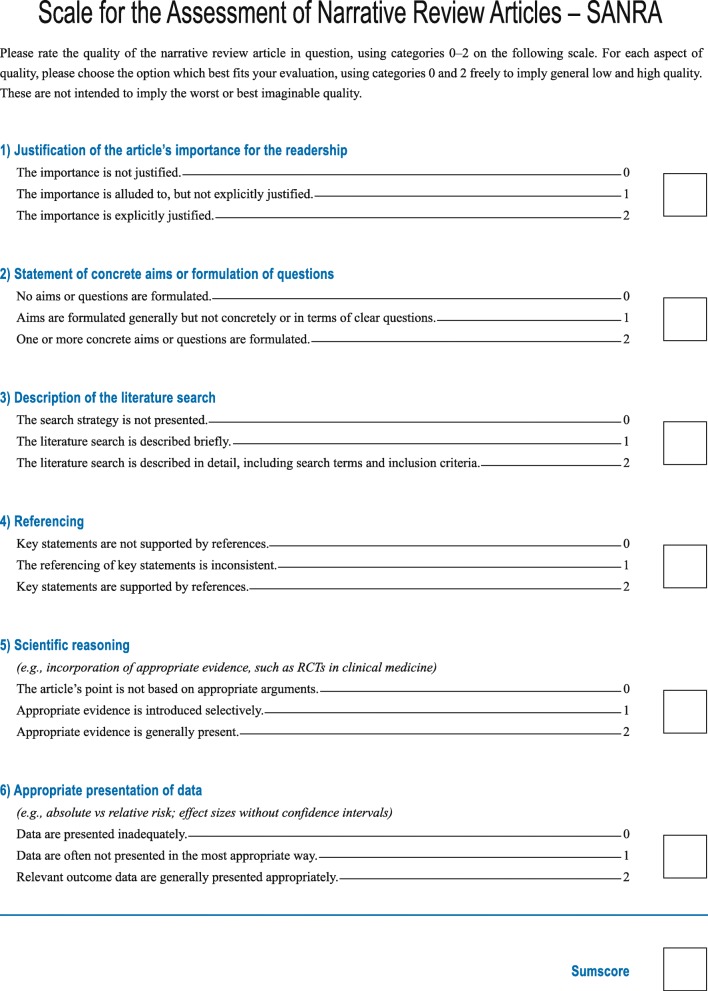
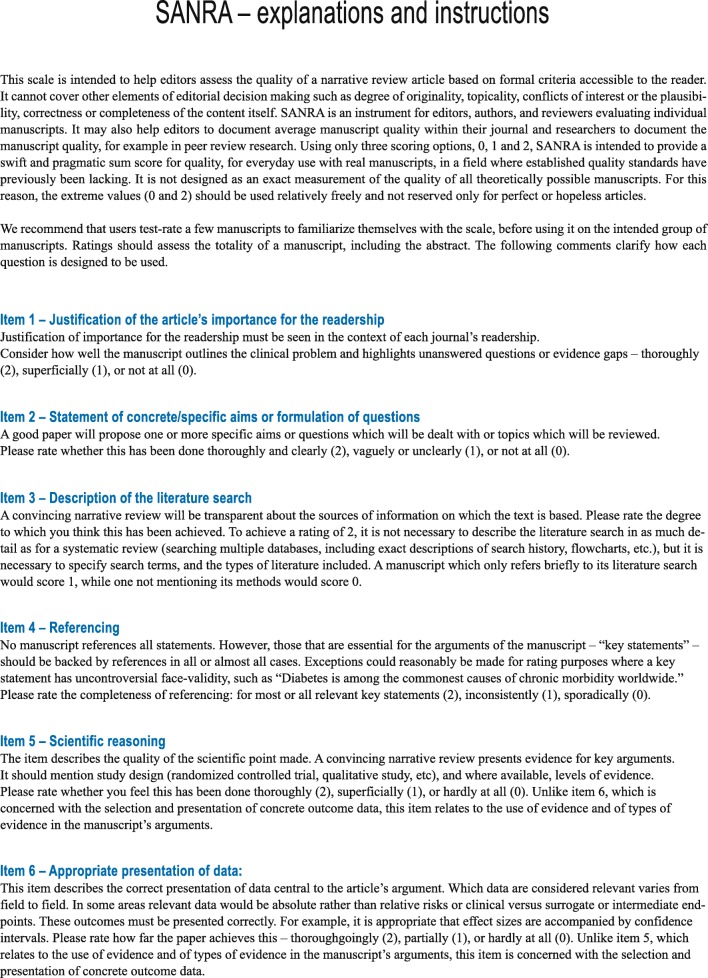
BACKGROUND: Narrative reviews are the commonest type of articles in the medical literature. However, unlike systematic reviews and randomized controlled trials (RCT) articles, for which formal instruments exist to evaluate quality, there is currently no instrument available to assess the quality of narrative reviews. In response to this gap, we developed SANRA, the Scale for the Assessment of Narrative Review Articles. METHODS: A team of three experienced journal editors modified or deleted items in an earlier SANRA version based on face validity, item-total correlations, and reliability scores from previous tests. We deleted an item which addressed a manuscript's writing and accessibility due to poor inter-rater reliability. The six items which form the revised scale are rated from 0 (low standard) to 2 (high standard) and cover the following topics: explanation of (1) the importance and (2) the aims of the review, (3) literature search and (4) referencing and presentation of (5) evidence level and (6) relevant endpoint data. For all items, we developed anchor definitions and examples to guide users in filling out the form. The revised scale was tested by the same editors (blinded to each other's ratings) in a group of 30 consecutive non-systematic review manuscripts submitted to a general medical journal. RESULTS: Raters confirmed that completing the scale is feasible in everyday editorial work. The mean sum score across all 30 manuscripts was 6.0 out of 12 possible points (SD 2.6, range 1-12). Corrected item-total correlations ranged from 0.33 (item 3) to 0.58 (item 6), and Cronbach's alpha was 0.68 (internal consistency). The intra-class correlation coefficient (average measure) was 0.77 [95% CI 0.57, 0.88] (inter-rater reliability). Raters often disagreed on items 1 and 4. CONCLUSIONS: SANRA's feasibility, inter-rater reliability, homogeneity of items, and internal consistency are sufficient for a scale of six items. Further field testing, particularly of validity, is desirable. We recommend rater training based on the "explanations and instructions" document provided with SANRA. In editorial decision-making, SANRA may complement journal-specific evaluation of manuscripts-pertaining to, e.g., audience, originality or difficulty-and may contribute to improving the standard of non-systematic reviews.
Overview
CoChat Summary
TL;DR
SANRA is a six-item, 0–2 scale (maximum 12) for assessing the quality of narrative review articles, developed and field-tested by three journal editors. In 30 consecutive non-systematic review manuscripts, it showed feasible use, sufficient internal consistency and inter-rater reliability, and a modest association with editorial acceptance.
Key findings
- Across 30 manuscripts (90 ratings), the mean SANRA sum score was 6.0 out of 12 (SD 2.6, range 1–12, median 6).
- Internal consistency was Cronbach’s alpha 0.68; corrected item-total correlations ranged from 0.33 (item 3) to 0.58 (item 6).
- Inter-rater reliability was an intra-class correlation coefficient (average measure) of 0.77 [95% CI 0.57, 0.88]; raters often disagreed on items 1 and 4.
- Average SANRA scores were modestly associated with editorial acceptance (mean 6.6, SD 1.9, n = 17) versus rejection (mean 5.1, SD 2.1, n = 13), point biserial correlation 0.37 (t = 2.09, df 28; two-sided p = 0.046).
Methods
- SANRA was developed between 2010 and 2017 by three experienced editors at Deutsches Ärzteblatt; the revised six-item version deleted an item on writing and accessibility due to poor inter-rater reliability.
- The revised scale was tested on 30 consecutive non-systematic review manuscripts submitted to Deutsches Ärzteblatt in 2015; three editor-raters scored them independently and blinded to each other’s ratings.
- Analyses included descriptive statistics, Cronbach’s alpha, corrected item-total correlations, average-measure intra-class correlation using a two-way random effects model (consistency definition), and a post hoc point biserial correlation between SANRA sum scores and acceptance/rejection.
Limitations
- The paper states the main limitation is sample size: 30 manuscripts was a compromise between representativeness, power, and feasibility, and took about 6 months to sample.
- The authors state that the scale’s authors were also the test-raters, so inter-rater reliability may be lower in groups less familiar with SANRA; the study also did not assess test-retest reliability, and results are study-specific.
- The paper acknowledges restricted content validity because SANRA is limited to six items and is a critical appraisal tool rather than a reporting guideline; criterion validity evidence is post hoc and weak, and no established cut-offs exist for comparing manuscripts across settings.
Model-written summary. Check it against the paper before relying on it.
Integrity signals
Registry
Cites
Statistics
Figures
Verification
Claims the paper makes
3 Valid · 0 Not valid · 5 Not checked · 27 Own results and interpretations
The cited sources support only part of this claim — read each source’s verdict below.
In the paper
“Bastian et al. found that they constitute the largest share of all text types in medicine and they concluded that they “remain the staple of medical literature” [1].”
- Also stated in: § Background · plain
“Narrative reviews are the commonest type of articles in the medical literature.”
§ SANRA—a scale for the quality assessment of narrative review articles > Background
What the sources say
- Partly supportedcites [1] Bastian H Glasziou P Chalmers I Seventy-five trials and eleven systematic reviews a day: how will we ever keep up? PLoS Med 2010 7 9 e1000326 10.1371/journal.pmed.1000326 20877712 PMC2943439 sourceExperimental — accuracy not yet measured
In “How Close Are We to Archie Cochrane’s Goal?” and the Summary Points (pages unavailable), the paper calls non-systematic narrative reviews the staple of medical literature synthesis. It does not say they constitute the largest share of all medical text types; that extends a claim about literature synthesis to medical literature as a whole. (LLM, conf=0.88)
plain- Asserted: passes — The authors put it forward as true.
- Checkable: passes — It can be checked against evidence.
- Load-bearing: unclear — It is unclear whether the paper’s conclusions depend on it.
- Based: passes — The paper gives a reason why it holds.
- Also stated in: § Background · plain
The sources with a verdict support this claim; the rest weren’t checked yet, have no full text we could read, or their verdicts aren’t rated yet.
In the paper
“non-systematic reviews or narrative reviews have been widely criticized as unreliable [1, 4].”
§ SANRA—a scale for the quality assessment of narrative review articles > Background
What the sources say
- Supportedcites [1] Bastian H Glasziou P Chalmers I Seventy-five trials and eleven systematic reviews a day: how will we ever keep up? PLoS Med 2010 7 9 e1000326 10.1371/journal.pmed.1000326 20877712 PMC2943439 source
In “How Close Are We to Archie Cochrane’s Goal?”, the paper describes reviews not conducted systematically as having great potential for error and calls them less reliable forms of information. Box 1 also says that articles and textbooks had highlighted the risk of bias and chance in reviews. Together, these passages support the broad characterization that narrative reviews have been criticized as unreliable; page numbers are not provided in our copy. (LLM, conf=0.89)
- Not checked — no full text of the sourcecites [4] Mulrow CD The medical review article: state of the science Ann Intern Med 1987 106 485 488 10.7326/0003-4819-106-3-485 3813259 source
plain- Asserted: passes — The authors put it forward as true.
- Checkable: passes — It can be checked against evidence.
- Load-bearing: passes — The paper’s conclusions depend on it.
- Based: passes — The paper gives a reason why it holds.
- Supported
A result the paper reports from its own data — it cites no other source for it, so there is none to check. The quote shows it is in the paper.
In the paper
“Cronbach’s alpha was 0.68 (internal consistency).”
- Also stated in: § Results · plain
“The scale’s internal consistency, measured as Cronbach’s alpha, was 0.68.”
§ SANRA—a scale for the quality assessment of narrative review articles > Abstract > Results
plainn = 90- Asserted: passes — The authors put it forward as true.
- Checkable: passes — It can be checked against evidence.
- Load-bearing: passes — The paper’s conclusions depend on it.
- Based: passes — The paper gives a reason why it holds.
- Also stated in: § Results · plain
A result the paper reports from its own data — it cites no other source for it, so there is none to check. The quote shows it is in the paper.
In the paper
“Raters often disagreed on items 1 and 4.”
- Also stated in: § Results · plain
“Disagreements most often occurred with regard to items 1 and 4.”
§ SANRA—a scale for the quality assessment of narrative review articles > Abstract > Results
plain- Asserted: passes — The authors put it forward as true.
- Checkable: passes — It can be checked against evidence.
- Load-bearing: unclear — It is unclear whether the paper’s conclusions depend on it.
- Based: passes — The paper gives a reason why it holds.
- Also stated in: § Results · plain
A result the paper reports from its own data — it cites no other source for it, so there is none to check. The quote shows it is in the paper.
In the paper
“The intra-class correlation coefficient (average measure) was 0.77 [95% CI 0.57, 0.88] (inter-rater reliability).”
- Also stated in: § Results · plain
“The intra-class correlation coefficient (average measure) amounted to 0.77 [95% CI 0.57, 0.88; F 4.3; df 29, 58].”
§ SANRA—a scale for the quality assessment of narrative review articles > Abstract > Results
plain- Asserted: passes — The authors put it forward as true.
- Checkable: passes — It can be checked against evidence.
- Load-bearing: passes — The paper’s conclusions depend on it.
- Based: passes — The paper gives a reason why it holds.
- Also stated in: § Results · plain
14 more claims
Create a free account to see all 35 claims and to verify the 3 references still open.
- Probably not a substantial claim. 11
- It may state two separate claims as one. 11
Claims other papers make about this one
Each is checked against this paper’s own text: does it say what the citing paper says it does?
The source backs part of the claim, not all of it — or backs it for a different population, condition or comparison.
In the citing paper
“The review was conducted and reported in accordance with the principles of the Scale for the Assessment of Narrative Review Articles (SANRA), which provides a validated framework for ensuring methodological transparency, scientific rigor, and balanced interpretation in narrative reviews [ 19 ].”
From Paracetamol: A History of Assumptions, Errors, and Evidence Reversals in Pain Management (2026) · cites this paper as [19]
Experimental — accuracy not yet measuredThe source backs part of the claim, not all of it — or backs it for a different population, condition or comparison.
In the citing paper
“As a narrative review, the present work does not include an aggregated quantitative assessment and is more exposed to selection subjectivity than a registered systematic review [124,125].”
From Berberine-Drug Interactions: Mechanisms, Clinical Relevance and Risk Stratification-A Narrative Review (2026) · cites this paper as [124]
Experimental — accuracy not yet measuredThe cited source says what the claim attributes to it.
In the citing paper
“This work is designed as a structured narrative review, with transparent reporting of the documentation strategy, guided by the quality criteria of the Scale for the Assessment of Narrative Review Articles (SANRA) [124].”
From Berberine-Drug Interactions: Mechanisms, Clinical Relevance and Risk Stratification-A Narrative Review (2026) · cites this paper as [124]
The cited source says what the claim attributes to it.
In the citing paper
“we used the following:-Cochrane Risk of Bias 2 (RoB 2) [29] and PEDRO scale tools for RCTs.-AMSTAR 2 [30] checklist for systematic review.-SANRA (Scale for the Assessment of Narrative Review Articles) [31] for narrative reviews.-JBI Checklist for Text and Opinion [32] for expert opinion papers.”
From Pelvic Floor Muscle Training Following Surgery for Pelvic Organ Prolapse: Recommendation from Scientific Literature (2026) · cites this paper as [31]
The cited source says what the claim attributes to it.
In the citing paper
“Data analysis employed a narrative and thematic synthesis methodology,adhering to the SANRA guidelines for narrative reviews (32).”
From Ethical issues in multi-agent AI systems for healthcare: a narrative review (2026) · cites this paper as [32]
12 more claims about this paper
Create a free account to see every claim other papers make about this one.
Citations
Cites
Shea, B. J., Reeves, B. C., Wells, G., Thuku, M., Hamel, C., Moran, J., Moher, D., Tugwell, P., Welch, V., Kristjansson, E., et al. (2017) · BMJ · doi:10.1136/bmj.j4008 · Cited by 10,636 · cited 2×
“Critical appraisal tools have been developed for systematic reviews (e.g., AMSTAR 2 [A MeaSurement Tool to Assess Systematic Reviews] [7]) and papers on RCTs (e.g., the CASP [Critical Appraisal Skills Program] checklist for randomized trials [8]) and other types of medical studies.”
BackgroundStreiner, D. L., & Norman, G. R. (2008) · doi:10.1093/acprof:oso/9780199231881.001.0001 · Cited by 2,631
Critical appraisal skills programme
Singh, J. (2013) · Journal of Pharmacology and Pharmacotherapeutics · doi:10.4103/0976-500x.107697 · Cited by 2,556
Guidelines for Reporting Reliability and Agreement Studies (GRRAS) were proposed
Kottner, J., Audigé, L., Brorson, S., Donner, A., Gajewski, B. J., Hróbjartsson, A., Roberts, C., Shoukri, M., & Streiner, D. L. (2011) · Journal of Clinical Epidemiology · doi:10.1016/j.jclinepi.2010.03.002 · Cited by 2,174
The Mass Production of Redundant, Misleading, and Conflicted Systematic Reviews and Meta‐analyses
IOANNIDIS, J. P. A. (2016) · The Milbank Quarterly · doi:10.1111/1468-0009.12210 · Cited by 1,483 · cited 1×
“While systematic reviews are not per se superior articles and while certain systematic reviews have been criticized lately [3], non-systematic reviews or narrative reviews have”
BackgroundSeventy-five trials and eleven systematic reviews a day: how will we ever keep up?
Bastian, H., Glasziou, P., & Chalmers, I. (2010) · PLoS Medicine · doi:10.1371/journal.pmed.1000326 · Cited by 1,188 · cited 2×
“found that they constitute the largest share of all text types in medicine and they concluded that they “remain the staple of medical literature” [1].”
BackgroundThe Medical Review Article: State of the Science
MULROW, C. D. (1987) · Annals of Internal Medicine · doi:10.7326/0003-4819-106-3-485 · Cited by 856 · cited 1×
“been widely criticized as unreliable [1, 4].”
Writing a narrative biomedical review: considerations for authors, peer reviewers, and editors
Gasparyan, A. Y., Ayvazyan, L., Blackmore, H., & Kitas, G. D. (2011) · Rheumatology International · doi:10.1007/s00296-011-1999-3 · Cited by 694 · cited 1×
“[13], for example, have provided guidance for writing narrative reviews, and Byrne [14] as well as Pautasso [15] has written, from different angles, thoughtful editorials on improving narrative reviews and presented lists of key features of writing a good review—lists that naturally overlap with SANRA items (e.”
BackgroundTen Simple Rules for Writing a Literature Review
Pautasso, M. (2013) · PLoS Computational Biology · doi:10.1371/journal.pcbi.1003149 · Cited by 272 · cited 3×
“[13], for example, have provided guidance for writing narrative reviews, and Byrne [14] as well as Pautasso [15] has written, from different angles, thoughtful editorials on improving narrative reviews and presented lists of key features of writing a good review—lists that naturally overlap with SANRA items (e.”
BackgroundImproving the peer review of narrative literature reviews
Byrne, J. A. (2016) · Research Integrity and Peer Review · doi:10.1186/s41073-016-0019-2 · Cited by 159 · cited 3×
“[13], for example, have provided guidance for writing narrative reviews, and Byrne [14] as well as Pautasso [15] has written, from different angles, thoughtful editorials on improving narrative reviews and presented lists of key features of writing a good review—lists that naturally overlap with SANRA items (e.”
Background
Research works printed but not linked: 3
- Higgins JPT, Green S. (eds.). Cochrane Handbook for Systematic Reviews and Interventions. Version 5.1.0. The Cochrane Collaboration 2011, section 1.2.2., www.handbook.cochrane.org, retrieved on Oct 31, 2018.
- Baethge C Mertens S Goldbeck-Wood S Development of a quality score for the assessment of non-systematic review articles (SANRA) Poster, Seventh International Congress on Peer Review and Biomedical Publication 2013 USA Chicago, Illinois
- Baethge C Goldbeck-Wood S Mertens S A scale for the assessment of non-systematic review articles (SANRA) Poster, Eighth International Congress on Peer and Biomedical Publication 2017 USA Chicago, Illinois
Cited by
Items 401–500 of 4,334
Nursing Care Throughout the Chimeric Antigen Receptor T-Cell Therapy Process for Multiple Myeloma
Steinbach, M. N., Zitella, L. J., Florendo, E., Lee, E., Riccobono, C., Difilippo, H., & Aronson, E. A. (2023) · Seminars in Oncology Nursing · doi:10.1016/j.soncn.2023.151505 · Cited by 20
Tanenbaum, G. J., & Holden, L. R. (2023) · International Journal of Environmental Research and Public Health · doi:10.3390/ijerph20206949 · Cited by 20
“This will take the form of a narrative review, which was chosen to allow for more flexibility in the inclusion of articles [30,31].”
MethodA critical review of the role of manual therapy in the treatment of individuals with low back pain
Grenier, J., & Rothmund, M. (2024) · Journal of Manual & Manipulative Therapy · doi:10.1080/10669817.2024.2316393 · Cited by 22
“This review adhered to the guidelines of the Scale for the Assessment of Narrative Review Articles [53].”
Personality of marathon runners: a narrative review of recent findings
Braschler, L., Thuany, M., de Lira, C. A. B., Scheer, V., Nikolaidis, P. Τ., Weiss, K., & Knechtle, B. (2024) · EXCLI journal · doi:10.17179/excli2024-6907 · Cited by 26
Current Status and Perspectives of Diagnosis and Treatment of Periprosthetic Joint Infection
Zhou, H., Yang, Y., Zhang, Y., Li, F., Shen, Y., Qin, L., & Huang, W. (2024) · Infection and Drug Resistance · doi:10.2147/idr.s457644 · Cited by 23
“15 This article focuses on addressing several key questions: How do the latest molecular diagnostic techniques improve the detection rates of PJI?”
Vitale, S. G., Giannini, A., Carugno, J. A., Herendael, B. V., Riemma, G., Pacheco, L. A., Drizi, A., Mereu, L., Bettocchi, S., Angioni, S. L., et al. (2024) · Archives of Gynecology and Obstetrics · doi:10.1007/s00404-024-07677-x · Cited by 20
“The evaluation of the narrative review was made according to SANRA guidelines [7].”
MethodNeuropharmacology of Neuropathic Pain: A Systematic Review
Mian, M. U., Afzal, M., Butt, A. A., Ijaz, M., Khalil, K., Abbasi, M., Fatima, M., Asif, M. F., Nadeem, S., Jha, S., et al. (2024) · Cureus · doi:10.7759/cureus.69028 · Cited by 25
“Cochrane Risk of Bias Assessment Tool [8] Randomized Controlled Trials AMSTAR Checklist [9] Systematic Reviews and Meta-Analysis SANRA Checklist [10] Any other without a Clear methods section 4 , and Table 5 present the specific overall scores for risks of bias for every study that was chosen.”
MethodAmendola, S. (2024) · Journal of Pacific Rim Psychology · doi:10.1177/18344909241274808 · Cited by 25
“This narrative review was performed following previous recommendations on standards for reporting of narrative reviews (Baethge et al., 2019; Byrne, 2016; Gasparyan et al., 2011; B. N. Green et al., 2006; Kable et al., 2012; Pautasso, 2013).”
Performance support team effectiveness in elite sport: a narrative review
Stewart, P. F., Fletcher, D., Arnold, R., & McEwan, D. (2024) · International Review of Sport and Exercise Psychology · doi:10.1080/1750984x.2024.2411215 · Cited by 28
“However, as narrative reviews can be thought of as less ‘objective’ than other reviews (Greenhalgh et al., 2018), the authors sought to enhance the validity and rigor of this article by adhering to the Scale for the Assessment of Narrative Review Articles – SANRA (Baethge et al., 2019).”
The Role of Biomarkers in Acute Pain: A Narrative Review
Asimakopoulos, T., Τsaroucha, A., Kouri, M., Pasqualucci, A., Varrassi, G., Leoni, M. L. G., & Rekatsina, M. (2025) · Pain and Therapy · doi:10.1007/s40122-025-00718-6 · Cited by 20
“According to SANRA criteria for the quality assessment of narrative reviews [7], we conducted a comprehensive literature review using PubMed and Google Scholar.”
Women's views of birth after cesarean section
Sys, D., Kajdy, A., Baranowska, B. M., Tataj–Puzyna, U., Gotlib, J., Bączek, G., & Rabijewski, M. (2021) · Journal of obstetrics and gynaecology research · doi:10.1111/jog.15056 · Cited by 22
“manuscript to ensure the quality of presentation and reporting.(17) It contains the following aspects: justification of the importance of the topic, statement of aims in the introduction, description of the literature search in the methods section, referencing, scientific reasoning, and appropriate presentation of dat…”
BackgroundPeltola, J.-P., Lindfors, E., & Luukka, E. (2024) · Journal of Educational Change · doi:10.1007/s10833-024-09516-x · Cited by 19
“Narrative reviews are used to refer to the efforts made to summarize the litera - ture in a way that is not explicitly systematic (Baethge et al., 2019).”
Sallam, M., Snygg, J., Ghandour, S. E., & Sallam, M. (2025) · Obesities · doi:10.3390/obesities5020026 · Cited by 21
Andreou, E. P., & Papaneophytou, C. P. (2025) · Nutrients · doi:10.3390/nu17101685 · Cited by 24
“For narrative reviews and opinion pieces, the SANRA checklist [31] was used to assess strengths and weaknesses (e.g., coverage of literature, critical perspective).”
The Association Between Racism and Suicidality Among Young Minority Groups: A Systematic Review
Rudes, G., & Fantuzzi, C. (2021) · Journal of Transcultural Nursing · doi:10.1177/10436596211046983 · Cited by 21
“…for qualitative studies, the SANRA (Scale for the Assessment of Narrative Reviews Article, see online supplementary quality assessment material; Baethge et al., 2019) for narrative reviews, the Preferred Reporting Items for Systematic reviews and Meta-Analyses checklist (Moher et al., 2009)…”
BackgroundMethodInfluentialBeckstein, A. S., Chollier, M., Kaur, S., & Ghimire, A. R. (2022) · SAGE Open · doi:10.1177/21582440221100455 · Cited by 22
“Despite roughly following quality criteria for narrative reviews (Baethge et al., 2019), the lack of comparable data only allowed for a narrative summary.”
BackgroundJackson, J. E., Safari, R., & Hallam, J. L. (2022) · International Journal of Health Promotion and Education · doi:10.1080/14635240.2022.2098162 · Cited by 22
“Narrative reviews are common in medical literature and was employed as a way of rapidly and efficiently gathering relevant information that provides context (Baethge, Goldbeck-Wood, and Mertens 2019).”
Averill, P., Vincent, C. A., Reen, G., Henderson, C., & Sevdalis, N. (2022) · Health Expectations · doi:10.1111/hex.13660 · Cited by 22
Downie, L. E., Britten‐Jones, A. C., Hogg, R. E., Jalbert, I., Li, T., Lingham, G., Liu, S., Qureshı, R., Saldanha, I. J., Singh, S., et al. (2023) · The Ocular Surface · doi:10.1016/j.jtos.2023.04.009 · Cited by 20
“Narrative reviews are the most common form of literature review in the medical literature [52].”
BackgroundMethodInfluentialFemale empowerment through sport: an exploratory narrative review
Streetman, A. E., & Heinrich, K. M. (2023) · Sport in Society · doi:10.1080/17430437.2023.2270443 · Cited by 28
“…methodology consistent with the Scale for the Assessment of Narrative Review Articles (SANRA), a literature review was performed in April 2022 using the following databases: ProQuest Central, SCOPUS, SportDiscus, and Psychology and Behavioral Science (Baethge, Goldbeck-Wood, and Mertens 2019).”
MethodA Systematic Review of Vaccination Guidance for Humanitarian Responses
Allison, L. E., Alhaffar, M., Checchi, F., Abdelmagid, N., Nor, B., Sabahelzain, M. M., Light, P. M., & Singh, N. (2023) · Vaccines · doi:10.3390/vaccines11121743 · Cited by 20
“To evaluate the quality of evidence reviews, the Scale for the Quality Assessment of Narrative Review Articles (SANRA) was used [15].”
MethodSandwich generation caregivers’ problems: a narrative review
Pashazade, H., Momtaz, Y. A., Abdi, K., & Maarefvand, M. (2023) · Educational Gerontology · doi:10.1080/03601277.2023.2293568 · Cited by 19
“SANRA is a critical appraisal tool for the assessment of non-systematic (Baethge et al., 2019).”
MethodWong, J. C., Lao, C. T., Dino, G., Donyaei, R., Lui, R., & Huynh, J. (2024) · Vaccines · doi:10.3390/vaccines12050445 · Cited by 19
“…the Critical Appraisal Skills Programme (CASP) checklist for qualitative studies [17], the updated Assessment of Multiple Systematic Reviews (AMSTAR-2) scale for systematic reviews and meta-analyses [18], and the Scale for Assessment of Narrative Review Articles (SANRA) for narrative reviews [19].”
MethodOliveira, A., Pereira, H., & Alckmin-Carvalho, F. (2024) · Societies · doi:10.3390/soc14080136 · Cited by 31
“…as well as public policies, in this context, where the relevant literature is still scarce [29], experiences of discrimination in the workplace are prevalent [30], and psychological distress has been identified as a significant indicator of lower occupational health and well-being [31].”
BackgroundWhat do we know about portable dental services? A scoping review
Fathi, H., Rousseau, J., Makansi, N., Blaizot, A., Morris, M., Vergnes, J., & Bedos, C. P. (2021) · Gerodontology · doi:10.1111/ger.12524 · Cited by 19
Quality of life of caregivers of end‐stage kidney disease patients: Caregivers or care recipients?
Vovlianou, S., Koutlas, V., Ikonomou, M., Vassilikopoulos, T., Papoulidou, F., & Dounousi, E. C. (2021) · Journal of Renal Care · doi:10.1111/jorc.12403 · Cited by 20
The advantages of physical exercise as a preventive strategy against NAFLD in postmenopausal women
Molina‐Molina, E., Furtado, G. E., Jones, J. G., Portincasa, P., Pedrosa, A., Teixeira, A. M., Barros, M. P., Bachi, A. L. L., & Sardão, V. A. (2022) · European Journal of Clinical Investigation · doi:10.1111/eci.13731 · Cited by 21
Increased Threat of Thyroid Diseases in Patients With Sjogren’s Syndrome: A Systematic Review
Kaur, H., Alazzeh, M. S., Thandavaram, A., Channar, A., Purohit, A., Shrestha, B., Patel, D., Shah, H., Hanna, K. S., & Mohammed, L. (2022) · Cureus · doi:10.7759/cureus.28062 · Cited by 19
“Accepted studies for this review SANRA checklist Narrative review articles 6 items: the importance of the article for readership, statement of concrete aims of formulation of questions, literature search description, referencing, scientific reasoning, presentation of data 12 9 4: Baldini et al. 2018 [12]; Tincani et a…”
MethodInfluentialSelvaratnam, R., & Venaruzzo, L. (2024) · Journal of Ethics in Higher Education · doi:10.26034/fr.jehe.2024.6864 · Cited by 21
Metformin’s Effects on Cognitive Function from a Biovariance Perspective: A Narrative Review
Chele, D., Sîrbu, C. A., Mitrică, M., Toma, M., Vasiliu, O., Sirbu, A. M., Authier, F., Mischianu, D. L. D., & Munteanu, A. E. (2025) · International Journal of Molecular Sciences · doi:10.3390/ijms26041783 · Cited by 18
“…and synthesis of relevant literature were conducted in accordance with the SANRA (Scale for the Assessment of Narrative Review Articles) guidelines [16]. is a narrative review, the selection and synthesis of relevant literature were conducted in accordance with the SANRA (Scale for the Assessment…”
Li, J., Liu, H., Lim, J. W.-J., Xing, H., Chen, Y., Yang, S., & Fu, X. (2025) · Journal of International Medical Research · doi:10.1177/03000605251328893 · Cited by 20
Antibiotic Misuse: An In-Depth Examination of Its Global Consequences and Public Health Challenges
Nammi, J., Pasala, R., Andhe, N., Vasam, R., Poruri, A. D., & Sherikar, R. R. (2025) · Cureus · doi:10.7759/cureus.85941 · Cited by 37
“This narrative review was conducted by the Scale for the Assessment of Narrative Review Articles guidelines to ensure quality and rigor [4].”
Bioengineering Support in the Assessment and Rehabilitation of Low Back Pain
Varrassi, G., Leoni, M. L. G., Al-Alwany, A. A., Sarzi‐Puttini, P., & Farì, G. (2025) · Bioengineering · doi:10.3390/bioengineering12090900 · Cited by 22
“The methodological approach adhered to accepted principles for narrative synthesis and was informed by the Scale for the Assessment of Narrative Review Articles (SANRA) to ensure clarity, scientific credibility, and completeness [16].”
Machine learning applications in sports injury prediction: A narrative review
Yuan, J., Zeng, Q., Li, J., Cong, Z., & Zhang, Y. (2025) · Science Progress · doi:10.1177/00368504251385956 · Cited by 27
“14 Given the interdisciplinary scope, methodological heterogeneity, and limited standardization observed in current applications of ML for sports injury prediction, a narrative review is particularly suitable for synthesizing insights and identifying emerging trends in the fi eld.”
Ojija, F. S., Ogwu, M. C., Ally, J. S., John, J. P., Lameck, A. S., Felix, N., & Tekka, R. S. (2025) · Science Progress · doi:10.1177/00368504251394584 · Cited by 24
“28 This narrative review employed a systematic approach to identify relevant literature on the application AI in mitigating HWC within biodiversity hotspots.”
Pinto, C. M. M., Borrego, R., Eiró-Gomes, M., Casimiro, I., Raposo, A., Folha, T., Virella, D., & Moreira, A. C. (2022) · Nutrients · doi:10.3390/nu14061180 · Cited by 19
Perceived teacher support in secondary education from 1980 to 2019: An integrative review
Botellero, V. L., Ekornes, S. M., Gamlem, S. M., Torrissen, W., & Løvoll, H. S. (2023) · Cogent Education · doi:10.1080/2331186x.2022.2164648 · Cited by 21
“To apply the same quality assessment to all articles, we developed an assessment scale based on the Scale for the Assessment of Narrative Review Articles (Baethge et al., 2019), following the recommendations of Jesson et al. (2011) and Mårtensson et al. (2016).”
MethodTeixeira, J. M. F., & Oliveira, P. C. A. (2023) · Brazilian Journal of Health Review · doi:10.34119/bjhrv6n1-266 · Cited by 18
Saldaña, Á. B., Bustamante-Bravo, J., Sanhueza, J. R., & Montt-Maray, E. (2023) · Sexuality and Disability · doi:10.1007/s11195-023-09778-y · Cited by 23
A Step-by-Step Guide to Writing a Scientific Review Article
Bahl, M. (2023) · Journal of Breast Imaging · doi:10.1093/jbi/wbad028 · Cited by 21
Aluh, D. O., Aigbogun, O., Ukoha-Kalu, B. O., Silva, M., Grigaitė, U., Pedrosa, B., Santos-Dias, M., Cardoso, G., & Caldas‐de‐Almeida, J. M. (2023) · Healthcare · doi:10.3390/healthcare11141986 · Cited by 20
Kabir, R., Hayhoe, R. P. G., Bai, A. C. M., Vinnakota, D., Sivasubramanian, M., Afework, S., Chilaka, M. A., Mohammadnezhad, M., Aremu, O., Sah, R. K., et al. (2023) · International Journal of Research in Medical Sciences · doi:10.18203/2320-6012.ijrms20232496 · Cited by 26
Vitale, S. G., Saponara, S., Sicilia, G., Klarić, M., Sorrentino, F., D’Alterio, M. N., Nappi, L., & Angioni, S. L. (2023) · Archives of Gynecology and Obstetrics · doi:10.1007/s00404-023-07218-y · Cited by 18
“We complied with the quality standards for narrative reviews, as characterized and measured by the Scale for the Quality Assessment of Narrative Review Articles (SANRA) [27].”
MethodCrinion, S., Morris, D. W., & Lopez, L. M. (2024) · Genes Brain & Behavior · doi:10.1111/gbb.12885 · Cited by 21
McKinnon, K. M., Lentz, C. L., Boccher‐Lattimore, D., Cournos, F., Pather, A., Sukumaran, S., Remien, R. H., & Mellins, C. A. (2024) · AIDS and Behavior · doi:10.1007/s10461-024-04324-z · Cited by 20
“Whereas systematic reviews focus on answering specific questions, narrative reviews are evidence-based summaries on a defined topic and are particularly well-suited to outlining general principles [ 33 ].”
Katyal, G., Kaur, G., Ashraf, H., Bodapati, A., Hanif, A., Okafor, D. K., & Khan, S. (2024) · Daehan saengsik uihak hoeji/Clinical and experimental reproductive medicine · doi:10.5653/cerm.2023.06485 · Cited by 24
“The Newcastle-Ottawa Scale was utilized for observational studies, the A Measurement Tool to Assess Systematic Reviews (AMSTAR) instrument was applied to systematic reviews, and the Scale for the Assessment of Narrative Review Articles (SANRA) checklist was used for narrative reviews [8].”
MethodGbenonsi, G. Y., Martini, J., & Mahieu, C. (2024) · BMC Public Health · doi:10.1186/s12889-024-18937-5 · Cited by 18
“Narrative literature reviews were evaluated with the Scale for the Assessment of Narrative Review Articles (SANRA) [13, 15] (see Additional file 3).”
MethodLoggen, J., Moneva, A., & Leukfeldt, R. (2024) · Victims & Offenders · doi:10.1080/15564886.2024.2370295 · Cited by 18
Applications of 3D-printed teeth in dental education: A narrative review
Fayyaz, Y., Ali, M., Ullah, R., & Shaikh, M. S. (2024) · Journal of Taibah University Medical Sciences · doi:10.1016/j.jtumed.2024.07.005 · Cited by 18
Athanasiou, A., Fruscalzo, A., Dedes, I., Mueller, M. D., Londero, A. P., Marti, C., Guani, B., & Féki, A. (2024) · Journal of Clinical Medicine · doi:10.3390/jcm13195828 · Cited by 18
“This review was performed following the SANRA (scale for the quality assessment of narrative review articles) recommendations, developed to improve the quality of narrative reviews [16].”
MethodThe Potential Effects of Red Wine and Its Components on Neurocognitive Disorders: A Narrative Review
Boccardi, V., Tagliafico, L., Persia, A., Page, E., Ottaviani, S., Cremonini, A. L., Borgarelli, C., Pisciotta, L., Mecocci, P., Nencioni, A., et al. (2024) · Nutrients · doi:10.3390/nu16203431 · Cited by 18
“To enhance the rigor of the search and writing process, we used the Scale for the Assessment of Narrative Review Articles (SANRA) as a methodological guideline [40].”
MethodVarrassi, G., Rekatsina, M., Leoni, M. L. G., Cascella, M., Finco, G., Sardo, S., Corno, C., Tiso, D., Schweiger, V., Fornasari, D., et al. (2024) · Pain and Therapy · doi:10.1007/s40122-024-00685-4 · Cited by 19
“The study’s approach places significant importance on adhering to the Scale for Assessment of Narrative Review Articles (SANRA) standard [6].”
Khorasani, E., & Vahidi, B. (2025) · Biotechnology and Bioengineering · doi:10.1002/bit.28994 · Cited by 18
“While these reviews scored high in clarity and reasoning, they showed moderate performance in search method reporting (Baethge et al. 2019).”
Leveraging machine learning in nursing: innovations, challenges, and ethical insights
Yip, S. S. W., Ning, S., Wong, N. Y. K., Chan, J., Ng, K. S., Kwok, B. O. T., Anders, R. L., & Lam, S. C. (2025) · Frontiers in Digital Health · doi:10.3389/fdgth.2025.1514133 · Cited by 21
“Additionally, the current review was conducted in compliance with the Scale for the Assessment of Narrative Review Articles quality checklist (10) to ensure a high standard of narrative review integrity and thoroughness.”
Impact of COVID-19 on management of urogynaecology patients: a rapid review of the literature
Loganathan, J., & Doumouchtsis, S. K. (2021) · International Urogynecology Journal · doi:10.1007/s00192-021-04704-2 · Cited by 18
Peddapalli, A., Gehani, M., Kalle, A. M., Peddapalli, S. R., Peter, A. E., & Sharad, S. (2021) · Viruses · doi:10.3390/v13030378 · Cited by 19
Yang, K., Liao, Y., Yang, Y. K., Lin, S., Liang, C., & Bai, Y. (2021) · CNS Drugs · doi:10.1007/s40263-021-00838-5 · Cited by 21
Nabbe, M., & Brand, H. (2021) · Healthcare · doi:10.3390/healthcare9121741 · Cited by 18
Yu, A. K., Kilic, F., Dhawan, R., Sidhu, R., Elazrag, S. E., Bijoora, M., Sekhar, S., Ravinarayan, S. M., & Mohammed, L. (2022) · Cureus · doi:10.7759/cureus.21333 · Cited by 23
Lampersberger, L. M., Bauer, S., & Osmancevic, S. (2022) · Health & Social Care in the Community · doi:10.1111/hsc.14021 · Cited by 18
“A summary of the current literature was not performed in an explicitly systematic way, but a systematic literature review was conducted, a specific research question was asked, and a narrative summary of included studies is provided (Baethge et al., 2019).”
BackgroundMarchi, G., Cucchiara, F., Gregori, A., Biondi, G., Guglielmi, G., Serradori, M., Gherardi, M., Gabbrielli, L., Pistelli, F., & Carrozzi, L. (2025) · Journal of Clinical Medicine · doi:10.3390/jcm14062062 · Cited by 18
“This balanced approach ensured a comprehensive yet critical appraisal of the evidence, maintaining transparency and reproducibility in accordance with the SANRA guidelines for narrative reviews [27].”
Deep, P. D., & Chen, Y. (2025) · Higher Education Studies · doi:10.5539/hes.v15n2p381 · Cited by 17
“The review followed the SANRA (Scale for the Assessment of Narrative Review Articles) framework to uphold methodological quality and reliability (Baethge et al., 2019).”
InfluentialShareef, R. A., Fathelrahman, E., Osman, R., Challa, T. G., & Platat, C. (2025) · Frontiers in Nutrition · doi:10.3389/fnut.2025.1698147 · Cited by 20
Acculturation and drinking behavior among Latinxs: a narrative review
Ruíz, M., Johnson, A. E., & Campbell, L. C. (2022) · Journal of Ethnicity in Substance Abuse · doi:10.1080/15332640.2022.2080144 · Cited by 19
“…of Narrative Review Articles (SANRA), a validated critical appraisal tool for assessing a narrative review’s importance, statement of the aims, description of the literature search, referencing, scientific reasoning, and presentation of relevant and appropriate endpoint data (Baethge et al., 2019).”
BackgroundLanzoni, G., Sembenini, C., Gastaldo, S., Leonardi, L., Bentivoglio, V., Faggian, G., Bosa, L., Gaio, P., & Cananzi, M. (2022) · Frontiers in Pediatrics · doi:10.3389/fped.2022.885308 · Cited by 19
“We performed a narrative review of the literature as to satisfy the Scale for the Assessment of Narrative Review Articles (SANRA) (8).”
MethodVitale, S. G., Corte, L. D., Ciebiera, M., Carugno, J. A., Riemma, G., Lasmar, R. B., Lasmar, B. P., Kahramanoğlu, İ., Urman, B., Mikuš, M., et al. (2023) · Diagnostics · doi:10.3390/diagnostics13030339 · Cited by 17
The Use of Tactile Sensors in Oral and Maxillofacial Surgery: An Overview
Navalesi, P., Oddo, C. M., Chisci, G., Frosolini, A., Gennaro, P., Abbate, V., Prattichizzo, D., & Gabriele, G. (2023) · Bioengineering · doi:10.3390/bioengineering10070765 · Cited by 17
Myths and truths on biophysics-based approach in rehabilitation of musculoskeletal disorders
Alessandro de, S. I. R. E., Lippi, L., Marotta, N., Ferrillo, M., Folli, A., Turco, A., Ammendolia, A., & Invernizzi, M. (2023) · Therapeutic Advances in Musculoskeletal Disease · doi:10.1177/1759720x231183867 · Cited by 19
Omega-3 index as risk factor in psychiatric diseases: a narrative review
Antão, H. S., Sacadura‐Leite, E., Bandarra, N. M., & Figueira, M. L. (2023) · Frontiers in Psychiatry · doi:10.3389/fpsyt.2023.1200403 · Cited by 17
Perinatal Depression: A Guide to Detection and Management in Primary Care
Dama, M. H., & Lieshout, R. J. V. (2023) · The Journal of the American Board of Family Medicine · doi:10.3122/jabfm.2023.230061r1 · Cited by 19
“36 To ensure that our narrative literature review was conducted and reported appropriately, we followed recommendations from the Scale for the Assessment of Narrative Review Articles (SANRA), 37 a quality assessment tool for narrative reviews.”
MethodKey Considerations When Addressing Physical Inactivity and Sedentary Behaviour in People with Asthma
Guerrero, P. D. U., de Oliveira, J. M., Lewthwaite, H., Gibson, P. G., & McDonald, V. M. (2023) · Journal of Clinical Medicine · doi:10.3390/jcm12185998 · Cited by 19
Non-Pharmacological Strategies and Interventions for Effective COVID-19 Control: A Narrative Review
Aho, S., & de Rougemont, A. (2023) · Journal of Clinical Medicine · doi:10.3390/jcm12206465 · Cited by 23
“The aim of this narrative review (NR) [11] is to present and summarize effective prevention strategies for COVID-19, focusing primarily on meta-analyses (MA) and literature reviews (LR).”
BackgroundAl-taie, D. S., AlEdani, E. M., Gurramkonda, J., Chaudhri, S., Amin, A., Panjiyar, B. K., & Nath, T. S. (2023) · Cureus · doi:10.7759/cureus.50728 · Cited by 17
“In the paper by Raggio and Asaria, quality was assessed using the SANRA tool with a total score of 9 [20,21].”
MethodHöppchen, I., Wurhofer, D., Meschtscherjakov, A., Smeddinck, J. D., & Kulnik, S. T. (2024) · Frontiers in Digital Health · doi:10.3389/fdgth.2024.1324544 · Cited by 20
Outcome measures in hemophilia: current and future perspectives
Benemei, S., Boni, L., & Castaman, G. (2024) · Expert Review of Hematology · doi:10.1080/17474086.2024.2365929 · Cited by 17
“Furthermore, we evaluated the quality of our narrative review using the Scale for the Assessment of Narrative Review Articles (SANRA) tool [86].”
MethodQuantity and Distribution of Muscle Spindles in Animal and Human Muscles
Sun, Y., Fede, C., Zhao, X., Felice, A. D., Pirri, C., & Stecco, C. (2024) · International Journal of Molecular Sciences · doi:10.3390/ijms25137320 · Cited by 18
“We followed the guidelines for narrative reviews [25].”
MethodCho, C., & Lee, S. (2024) · International Journal of Molecular Sciences · doi:10.3390/ijms25179274 · Cited by 18
“The Scale for the Assessment of Narrative Review Articles (SANRA) was utilized to ensure the quality of the narrative review [12].”
MethodDeep, P. D., Chen, Y., Ghosh, N., & Basith, I. I. (2025) · Social Sciences · doi:10.3390/socsci14040218 · Cited by 17
Russell, B. A., Häggström, C., Holmberg, L., Liedberg, F., Gårdmark, T., Bryan, R. T., Kumar, P., & Hemelrijck, M. V. (2021) · BJUI Compass · doi:10.1002/bco2.65 · Cited by 18
Seetharaman, R., Pawar, S. R., & Advani, M. (2021) · British Journal of Clinical Pharmacology · doi:10.1111/bcp.15100 · Cited by 17
Larki, M., Sharifi, F., Manouchehri, E., & Roudsari, R. L. (2021) · Malaysian Journal of Medical Sciences · doi:10.21315/mjms2021.28.6.2 · Cited by 18
Bambhroliya, Z., Sandrugu, J., Lowe, M., Okunlola, O. I., Raza, S., Osasan, S. A., Sethia, S., Batool, T., & Hamid, P. (2022) · PubMed Central · doi:10.7759/cureus.26325 · Cited by 24
Grudzen, C. R., Barker, P. C., Bischof, J. J., Cuthel, A. M., Isaacs, E., Southerland, L. T., & Yamarik, R. L. L. (2022) · Emergency Cancer Care · doi:10.1186/s44201-022-00010-9 · Cited by 20
“The Scale for the Assessment of Narrative Review Articles (SANRA) was completed [13].”
MethodThandavaram, A., Channar, A., Purohit, A., Shrestha, B., Patel, D., Shah, H., Hanna, K. S., Kaur, H., Alazzeh, M. S., & Mohammed, L. (2022) · Cureus · doi:10.7759/cureus.27979 · Cited by 20
Pask, S., Okwuosa, C., Mohamed, A. A., Price, R., Young, J., Curtis, T., Henderson, S., Winter-Luke, I., Sunny, A., Chambers, R. L., et al. (2025) · Palliative Medicine · doi:10.1177/02692163251362567 · Cited by 16
“41 SANRA, a brief critical appraisal tool for the assessment of non-systematic articles has good specificity for narrative reviews, internal consistency and inter-rater reliability for multiple reviewers.”
Ahn, E., Sebok‐Syer, S. S., Maniate, J. M., Endres, K., & Cheung, W. J. (2025) · Perspectives on Medical Education · doi:10.5334/pme.2000 · Cited by 16
“We followed the steps of NR methodology outlined in the literature as best practices [18–20].”
The Role of Artificial Intelligence in Shaping the Doctor–Patient Relationship: A Narrative Review
Merlo, E. M., Sparacino, G., Silvestro, O., Giacobello, M. L., Meduri, A., Casciaro, M., Gangemi, S., & Martino, G. (2026) · Healthcare · doi:10.3390/healthcare14040481 · Cited by 18
“In line with SANRA indications [86] for justifying the research relevance, referencing the state of the art, and stating the concrete aims, the adopted approach enabled the identification and synthesis of relevant empirical studies.”
Evolución del Deepfake: campos semánticos y géneros discursivos 2017-2021
Bañuelos, J. (2022) · Revista ICONO14 · doi:10.7195/ri14.v20i1.1773 · Cited by 17
“Inventario de artículos analizados utilizando la metodología de la Escala SANRA - Scale for the Assessment of Narrative Review Articles (Baethge, C., Goldbeck-Wood, S., y Mertens, S., 2019). https://figshare.com/s/07888bce696bfe90939c Barnes, C. y Barraclough, T. (2019).”
BackgroundCorrea, E. J., O’Connor-Reina, C., Alcalá, L. R., Conti, D. M., Rabino, A. E., Baptista, P. M., García-Iriarte, M. T., & Plaza, G. (2022) · International Journal of Orofacial Myology · doi:10.52010/ijom.2023.49.2.1 · Cited by 16
“The process followed the Scale for the Assessment of Narrative Review Articles (SANRA) as a scale for the quality assessment of narrative review articles (Baethge et al., 2019).”
Wetterwald, L., Sarivalasis, A., Liapi, A., Mathevet, P., & Achtari, C. (2023) · Cancers · doi:10.3390/cancers15030890 · Cited by 16
Is There Still a Place for Surgery in Patients with PCOS? A Review
Corte, L. D., Boccia, D., Palumbo, M., Mercorio, A., Ronsini, C., Bifulco, G., & Giampaolino, P. (2023) · Life · doi:10.3390/life13061270 · Cited by 16
Quantitative Assessment of Upper-Limb Volume: Implications for Lymphedema Rehabilitation?
Lippi, L., Turco, A., Moalli, S., Nascimben, M., Curci, C., Alessandro de, S. I. R. E., Rimondini, L., & Invernizzi, M. (2023) · Applied Sciences · doi:10.3390/app13179810 · Cited by 16
Dsouza, M. P., Shetty, A., Dinesh, T. K., & Damodar, P. (2023) · IIMBG Journal of Sustainable Business and Innovation · doi:10.1108/ijsbi-06-2023-0037 · Cited by 21
Dioguardi, M., Polverari, D., Spirito, F., Iacovelli, G., Sovereto, D., Laneve, E., Caloro, G. A., Ballini, A., & Muzio, L. L. (2023) · International Journal of Dentistry · doi:10.1155/2023/8838314 · Cited by 16
“The drafting of this narrative review followed the indications of the SANRA (Scale for the Assessment of Narrative Review Articles) [18].”
MethodIntravenous Fosfomycin for Systemic Multidrug-Resistant Pseudomonas aeruginosa Infections
Pipitone, G., Bella, S. D., Maraolo, A. E., Granata, G., Gatti, M., Principe, L., Russo, A., Gizzi, A., Pallone, R., Cascio, A., et al. (2023) · Antibiotics · doi:10.3390/antibiotics12121653 · Cited by 16
“…of Narrative Review Articles (SANRA) through the following six areas: an explanation of the review’s importance, definitions of the aims of the review, description of the literature search, appropriate referencing, scientific reasoning, and presentation of relevant and appropriate endpoint data [93].”
BackgroundMedical ethics of long-duration spaceflight
Rajput, S., Mayor, I., Diamond, M., Rosenberg, M. J., Cole, V. M., Bhakare, N. S., Aziz, O., & Wilder, A. (2023) · npj Microgravity · doi:10.1038/s41526-023-00333-9 · Cited by 18
Macchitella, L., Amendola, S., Barraco, G., Scoditti, S., Gallo, I., Oliva, M. C., & Trabacca, A. (2023) · Neurorehabilitation · doi:10.3233/nre-230066 · Cited by 18
“The narrative review was prepared in accordance to previous recommendations on standards for reporting of narrative reviews (Baethge et al., 2019; Byrne, 2016; Gasparyan et al., 2011; Green et al., 2006; Kable et al., 2012; Pautasso, 2013).”
MethodAssessment of the risk of malignancy in Bethesda III thyroid nodules: a comprehensive review
Rao, K. N., Randolph, G. W., López, F., Zafereo, M., Pelaz, A. C., Piazza, C., Dange, P., Rodrigo, J. P., Stenman, G., de Keizer, B., et al. (2024) · Endocrine · doi:10.1007/s12020-024-03737-z · Cited by 16
Integrative Medicine Across the Pediatric Cancer Care Trajectory: A Narrative Review
Ben‐Arye, E., Samuels, N., Seifert, G., Gressel, O., Peleg, R., & Jong, M. C. (2024) · Current Oncology Reports · doi:10.1007/s11912-024-01538-1 · Cited by 14
“The design of the review was guided by key elements identified in the narrative review by Sukhera [49], while using items of quality assessment from a narrative review by Baethge et al. [50] The following review questions were formulated: 1.”
MethodMaqsood, H. A., Jawed, H. A., Kumar, H., Bansal, R., Shahid, B., Nazir, A., Rustam, Z., Aized, M. T., Secemsky, E. A., Lepidi, S., et al. (2024) · Annals of Vascular Surgery · doi:10.1016/j.avsg.2024.06.003 · Cited by 16
Metadata
- Authors
- Baethge, C., Goldbeck-Wood, S., & Mertens, S.
- Affiliations
- University of Cologne (DE)
- BMJ Group (United Kingdom) (GB)
- Corresponding author
- Baethge, Christopher
- ORCID
- Baethge, Christopher
- Venue
- Research Integrity and Peer Review
- Published
- 2019-03-26
- Volume
- 4
- Issue
- 1
- Pages
- 5-5
- ISSN
- 2058-8615 (ISSN-L)
- PMC
- PMC6434870
- OpenAlex
- W2922577842
- Semantic Scholar
- ea7f35b3069b53791c3b746c5c4b3c72a83a526b
- Cited by
- 3,469
- References
- 13
- Citations by year
- 2026: 1823 · 2025: 551 · 2024: 379 · 2023: 309 · 2022: 218 · 2021: 152 · 2020: 32 · 2019: 4
- FWCI
- 20.57
- Type
- journal article
- Language
- en
- Open access
- gold
- doi.org
- Licence
- cc-by
- creativecommons.org/licenses/by/4.0/ (tdm)
- Locations
- Research Integrity and Peer Review (publishedVersion, cc-by)
- Europe PMC (PubMed Central) (publishedVersion, other-oa)
- PubMed Central (publishedVersion, cc-by)
- PubMed (publishedVersion)
- Kölner Universitäts PublikationsServer (Universität zu Köln) (publishedVersion)
- DOAJ (DOAJ: Directory of Open Access Journals) (submittedVersion, cc-by-sa)
- Topics
- Social Sciences › Decision Sciences › Statistics, Probability and Uncertainty › Meta-analysis and systematic reviews
- Social Sciences › Library and Information Sciences › Academic Writing and Publishing
- Social Sciences › Library and Information Sciences › scientometrics and bibliometrics research
- Keywords
- quality assessment scale, manuscript review, inter-rater reliability, level of evidence, scale development
About these checks
Registry, retraction, Cites and statistics results are computed, not judged, with one exception: a printed reference that no index lists is read once by a model before it counts as a citation error. Claims are extracted by a model and kept only when their quote appears verbatim in the text; each cited source is then checked, with a model’s help, for whether it says what the claim relies on. Those verdicts can be wrong — read the claim’s quote and the cited source before relying on one.
The claim verdicts this report counts are experimental: their accuracy is not yet measured.
A language model drew the claims from the paper on 2026-11-10, under version 3 of the claim definition (model deepseek-v4.1-flash, prompt extract-v3).
A second model labelled each claim on 2026-11-10 (model jev-1.13-20260917, definition revision gold-guideline-v0.2).
Cited sources are checked with a language model’s help (gpt-6-sol).
Statistics and arithmetic are recomputed, not judged.
Confidence bands are shown only for fields calibrated on our annotated test set. None is calibrated yet, so no band is shown.
What counts as a claim ›How we measure confidence ›How we check this ›
Are you an author, or do you see a problem with this page? Request a review
Data sources
Bibliographic data: Semantic Scholar, OpenAlex, Crossref.
Contains information from the Semantic Scholar Academic Graph Datasets, made available under the ODC Attribution License (ODC-BY 1.0).
Semantic Scholar’s data is described in: Kinney, R., et al. (2023). The Semantic Scholar Open Data Platform. arXiv:2301.10140.
