

SANRA—a scale for the quality assessment of narrative review articles
Open accessThe DOI matches its Crossref record; 12 of the 13 references it cites were found in a registry or an index; 4 of the 12 sources its claims cite were checked for support.
Abstract
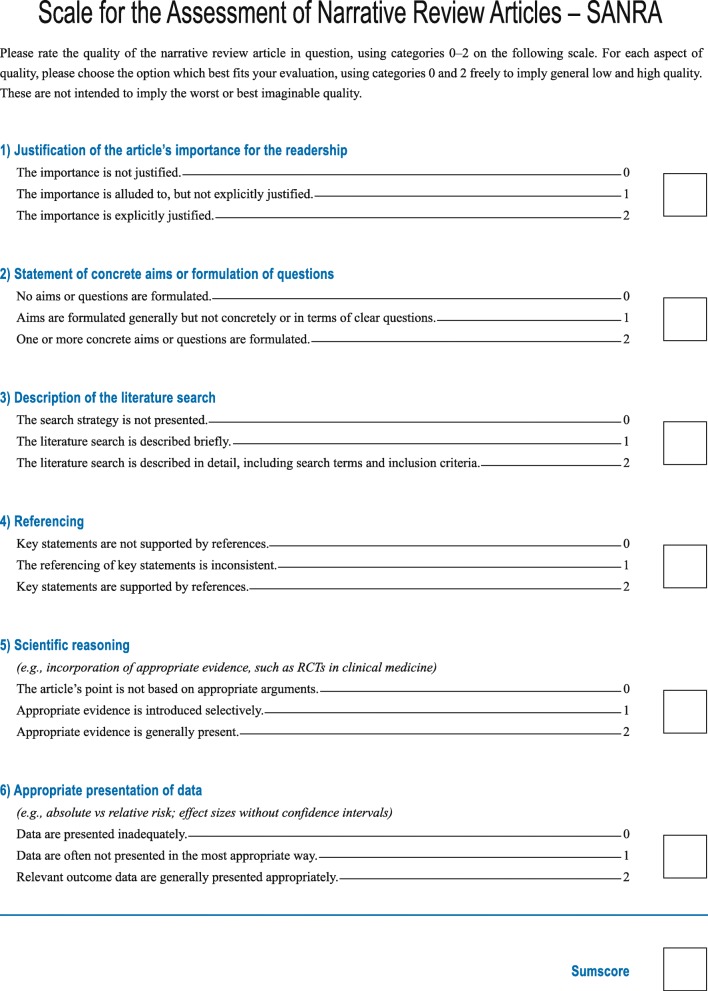
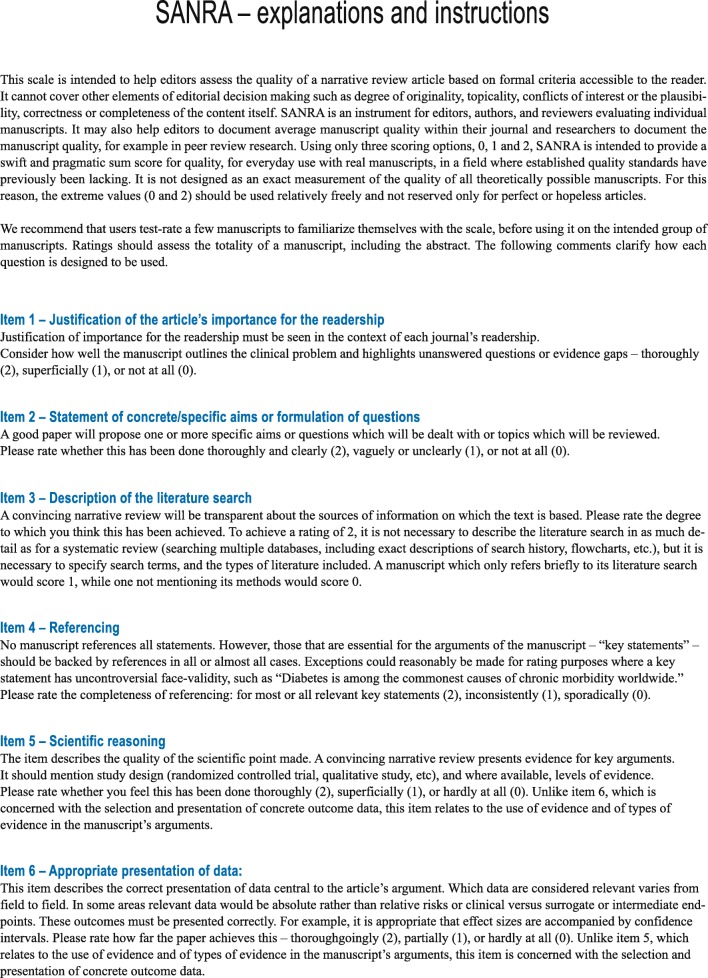
BACKGROUND: Narrative reviews are the commonest type of articles in the medical literature. However, unlike systematic reviews and randomized controlled trials (RCT) articles, for which formal instruments exist to evaluate quality, there is currently no instrument available to assess the quality of narrative reviews. In response to this gap, we developed SANRA, the Scale for the Assessment of Narrative Review Articles. METHODS: A team of three experienced journal editors modified or deleted items in an earlier SANRA version based on face validity, item-total correlations, and reliability scores from previous tests. We deleted an item which addressed a manuscript's writing and accessibility due to poor inter-rater reliability. The six items which form the revised scale are rated from 0 (low standard) to 2 (high standard) and cover the following topics: explanation of (1) the importance and (2) the aims of the review, (3) literature search and (4) referencing and presentation of (5) evidence level and (6) relevant endpoint data. For all items, we developed anchor definitions and examples to guide users in filling out the form. The revised scale was tested by the same editors (blinded to each other's ratings) in a group of 30 consecutive non-systematic review manuscripts submitted to a general medical journal. RESULTS: Raters confirmed that completing the scale is feasible in everyday editorial work. The mean sum score across all 30 manuscripts was 6.0 out of 12 possible points (SD 2.6, range 1-12). Corrected item-total correlations ranged from 0.33 (item 3) to 0.58 (item 6), and Cronbach's alpha was 0.68 (internal consistency). The intra-class correlation coefficient (average measure) was 0.77 [95% CI 0.57, 0.88] (inter-rater reliability). Raters often disagreed on items 1 and 4. CONCLUSIONS: SANRA's feasibility, inter-rater reliability, homogeneity of items, and internal consistency are sufficient for a scale of six items. Further field testing, particularly of validity, is desirable. We recommend rater training based on the "explanations and instructions" document provided with SANRA. In editorial decision-making, SANRA may complement journal-specific evaluation of manuscripts-pertaining to, e.g., audience, originality or difficulty-and may contribute to improving the standard of non-systematic reviews.
Overview
CoChat Summary
TL;DR
SANRA is a six-item, 0–2 scale (maximum 12) for assessing the quality of narrative review articles, developed and field-tested by three journal editors. In 30 consecutive non-systematic review manuscripts, it showed feasible use, sufficient internal consistency and inter-rater reliability, and a modest association with editorial acceptance.
Key findings
- Across 30 manuscripts (90 ratings), the mean SANRA sum score was 6.0 out of 12 (SD 2.6, range 1–12, median 6).
- Internal consistency was Cronbach’s alpha 0.68; corrected item-total correlations ranged from 0.33 (item 3) to 0.58 (item 6).
- Inter-rater reliability was an intra-class correlation coefficient (average measure) of 0.77 [95% CI 0.57, 0.88]; raters often disagreed on items 1 and 4.
- Average SANRA scores were modestly associated with editorial acceptance (mean 6.6, SD 1.9, n = 17) versus rejection (mean 5.1, SD 2.1, n = 13), point biserial correlation 0.37 (t = 2.09, df 28; two-sided p = 0.046).
Methods
- SANRA was developed between 2010 and 2017 by three experienced editors at Deutsches Ärzteblatt; the revised six-item version deleted an item on writing and accessibility due to poor inter-rater reliability.
- The revised scale was tested on 30 consecutive non-systematic review manuscripts submitted to Deutsches Ärzteblatt in 2015; three editor-raters scored them independently and blinded to each other’s ratings.
- Analyses included descriptive statistics, Cronbach’s alpha, corrected item-total correlations, average-measure intra-class correlation using a two-way random effects model (consistency definition), and a post hoc point biserial correlation between SANRA sum scores and acceptance/rejection.
Limitations
- The paper states the main limitation is sample size: 30 manuscripts was a compromise between representativeness, power, and feasibility, and took about 6 months to sample.
- The authors state that the scale’s authors were also the test-raters, so inter-rater reliability may be lower in groups less familiar with SANRA; the study also did not assess test-retest reliability, and results are study-specific.
- The paper acknowledges restricted content validity because SANRA is limited to six items and is a critical appraisal tool rather than a reporting guideline; criterion validity evidence is post hoc and weak, and no established cut-offs exist for comparing manuscripts across settings.
Model-written summary. Check it against the paper before relying on it.
Integrity signals
Registry
Cites
Statistics
Figures
Verification
Claims the paper makes
3 Valid · 0 Not valid · 5 Not checked · 27 Own results and interpretations
The cited sources support only part of this claim — read each source’s verdict below.
In the paper
“Bastian et al. found that they constitute the largest share of all text types in medicine and they concluded that they “remain the staple of medical literature” [1].”
- Also stated in: § Background · plain
“Narrative reviews are the commonest type of articles in the medical literature.”
§ SANRA—a scale for the quality assessment of narrative review articles > Background
What the sources say
- Partly supportedcites [1] Bastian H Glasziou P Chalmers I Seventy-five trials and eleven systematic reviews a day: how will we ever keep up? PLoS Med 2010 7 9 e1000326 10.1371/journal.pmed.1000326 20877712 PMC2943439 sourceExperimental — accuracy not yet measured
In “How Close Are We to Archie Cochrane’s Goal?” and the Summary Points (pages unavailable), the paper calls non-systematic narrative reviews the staple of medical literature synthesis. It does not say they constitute the largest share of all medical text types; that extends a claim about literature synthesis to medical literature as a whole. (LLM, conf=0.88)
plain- Asserted: passes — The authors put it forward as true.
- Checkable: passes — It can be checked against evidence.
- Load-bearing: unclear — It is unclear whether the paper’s conclusions depend on it.
- Based: passes — The paper gives a reason why it holds.
- Also stated in: § Background · plain
The sources with a verdict support this claim; the rest weren’t checked yet, have no full text we could read, or their verdicts aren’t rated yet.
In the paper
“non-systematic reviews or narrative reviews have been widely criticized as unreliable [1, 4].”
§ SANRA—a scale for the quality assessment of narrative review articles > Background
What the sources say
- Supportedcites [1] Bastian H Glasziou P Chalmers I Seventy-five trials and eleven systematic reviews a day: how will we ever keep up? PLoS Med 2010 7 9 e1000326 10.1371/journal.pmed.1000326 20877712 PMC2943439 source
In “How Close Are We to Archie Cochrane’s Goal?”, the paper describes reviews not conducted systematically as having great potential for error and calls them less reliable forms of information. Box 1 also says that articles and textbooks had highlighted the risk of bias and chance in reviews. Together, these passages support the broad characterization that narrative reviews have been criticized as unreliable; page numbers are not provided in our copy. (LLM, conf=0.89)
- Not checked — no full text of the sourcecites [4] Mulrow CD The medical review article: state of the science Ann Intern Med 1987 106 485 488 10.7326/0003-4819-106-3-485 3813259 source
plain- Asserted: passes — The authors put it forward as true.
- Checkable: passes — It can be checked against evidence.
- Load-bearing: passes — The paper’s conclusions depend on it.
- Based: passes — The paper gives a reason why it holds.
- Supported
A result the paper reports from its own data — it cites no other source for it, so there is none to check. The quote shows it is in the paper.
In the paper
“Cronbach’s alpha was 0.68 (internal consistency).”
- Also stated in: § Results · plain
“The scale’s internal consistency, measured as Cronbach’s alpha, was 0.68.”
§ SANRA—a scale for the quality assessment of narrative review articles > Abstract > Results
plainn = 90- Asserted: passes — The authors put it forward as true.
- Checkable: passes — It can be checked against evidence.
- Load-bearing: passes — The paper’s conclusions depend on it.
- Based: passes — The paper gives a reason why it holds.
- Also stated in: § Results · plain
A result the paper reports from its own data — it cites no other source for it, so there is none to check. The quote shows it is in the paper.
In the paper
“Raters often disagreed on items 1 and 4.”
- Also stated in: § Results · plain
“Disagreements most often occurred with regard to items 1 and 4.”
§ SANRA—a scale for the quality assessment of narrative review articles > Abstract > Results
plain- Asserted: passes — The authors put it forward as true.
- Checkable: passes — It can be checked against evidence.
- Load-bearing: unclear — It is unclear whether the paper’s conclusions depend on it.
- Based: passes — The paper gives a reason why it holds.
- Also stated in: § Results · plain
A result the paper reports from its own data — it cites no other source for it, so there is none to check. The quote shows it is in the paper.
In the paper
“The intra-class correlation coefficient (average measure) was 0.77 [95% CI 0.57, 0.88] (inter-rater reliability).”
- Also stated in: § Results · plain
“The intra-class correlation coefficient (average measure) amounted to 0.77 [95% CI 0.57, 0.88; F 4.3; df 29, 58].”
§ SANRA—a scale for the quality assessment of narrative review articles > Abstract > Results
plain- Asserted: passes — The authors put it forward as true.
- Checkable: passes — It can be checked against evidence.
- Load-bearing: passes — The paper’s conclusions depend on it.
- Based: passes — The paper gives a reason why it holds.
- Also stated in: § Results · plain
14 more claims
Create a free account to see all 35 claims and to verify the 3 references still open.
- Probably not a substantial claim. 11
- It may state two separate claims as one. 11
Claims other papers make about this one
Each is checked against this paper’s own text: does it say what the citing paper says it does?
The source backs part of the claim, not all of it — or backs it for a different population, condition or comparison.
In the citing paper
“The review was conducted and reported in accordance with the principles of the Scale for the Assessment of Narrative Review Articles (SANRA), which provides a validated framework for ensuring methodological transparency, scientific rigor, and balanced interpretation in narrative reviews [ 19 ].”
From Paracetamol: A History of Assumptions, Errors, and Evidence Reversals in Pain Management (2026) · cites this paper as [19]
Experimental — accuracy not yet measuredThe source backs part of the claim, not all of it — or backs it for a different population, condition or comparison.
In the citing paper
“As a narrative review, the present work does not include an aggregated quantitative assessment and is more exposed to selection subjectivity than a registered systematic review [124,125].”
From Berberine-Drug Interactions: Mechanisms, Clinical Relevance and Risk Stratification-A Narrative Review (2026) · cites this paper as [124]
Experimental — accuracy not yet measuredThe cited source says what the claim attributes to it.
In the citing paper
“This work is designed as a structured narrative review, with transparent reporting of the documentation strategy, guided by the quality criteria of the Scale for the Assessment of Narrative Review Articles (SANRA) [124].”
From Berberine-Drug Interactions: Mechanisms, Clinical Relevance and Risk Stratification-A Narrative Review (2026) · cites this paper as [124]
The cited source says what the claim attributes to it.
In the citing paper
“we used the following:-Cochrane Risk of Bias 2 (RoB 2) [29] and PEDRO scale tools for RCTs.-AMSTAR 2 [30] checklist for systematic review.-SANRA (Scale for the Assessment of Narrative Review Articles) [31] for narrative reviews.-JBI Checklist for Text and Opinion [32] for expert opinion papers.”
From Pelvic Floor Muscle Training Following Surgery for Pelvic Organ Prolapse: Recommendation from Scientific Literature (2026) · cites this paper as [31]
The cited source says what the claim attributes to it.
In the citing paper
“Data analysis employed a narrative and thematic synthesis methodology,adhering to the SANRA guidelines for narrative reviews (32).”
From Ethical issues in multi-agent AI systems for healthcare: a narrative review (2026) · cites this paper as [32]
12 more claims about this paper
Create a free account to see every claim other papers make about this one.
Citations
Cites
Shea, B. J., Reeves, B. C., Wells, G., Thuku, M., Hamel, C., Moran, J., Moher, D., Tugwell, P., Welch, V., Kristjansson, E., et al. (2017) · BMJ · doi:10.1136/bmj.j4008 · Cited by 10,636 · cited 2×
“Critical appraisal tools have been developed for systematic reviews (e.g., AMSTAR 2 [A MeaSurement Tool to Assess Systematic Reviews] [7]) and papers on RCTs (e.g., the CASP [Critical Appraisal Skills Program] checklist for randomized trials [8]) and other types of medical studies.”
BackgroundStreiner, D. L., & Norman, G. R. (2008) · doi:10.1093/acprof:oso/9780199231881.001.0001 · Cited by 2,631
Critical appraisal skills programme
Singh, J. (2013) · Journal of Pharmacology and Pharmacotherapeutics · doi:10.4103/0976-500x.107697 · Cited by 2,556
Guidelines for Reporting Reliability and Agreement Studies (GRRAS) were proposed
Kottner, J., Audigé, L., Brorson, S., Donner, A., Gajewski, B. J., Hróbjartsson, A., Roberts, C., Shoukri, M., & Streiner, D. L. (2011) · Journal of Clinical Epidemiology · doi:10.1016/j.jclinepi.2010.03.002 · Cited by 2,174
The Mass Production of Redundant, Misleading, and Conflicted Systematic Reviews and Meta‐analyses
IOANNIDIS, J. P. A. (2016) · The Milbank Quarterly · doi:10.1111/1468-0009.12210 · Cited by 1,483 · cited 1×
“While systematic reviews are not per se superior articles and while certain systematic reviews have been criticized lately [3], non-systematic reviews or narrative reviews have”
BackgroundSeventy-five trials and eleven systematic reviews a day: how will we ever keep up?
Bastian, H., Glasziou, P., & Chalmers, I. (2010) · PLoS Medicine · doi:10.1371/journal.pmed.1000326 · Cited by 1,188 · cited 2×
“found that they constitute the largest share of all text types in medicine and they concluded that they “remain the staple of medical literature” [1].”
BackgroundThe Medical Review Article: State of the Science
MULROW, C. D. (1987) · Annals of Internal Medicine · doi:10.7326/0003-4819-106-3-485 · Cited by 856 · cited 1×
“been widely criticized as unreliable [1, 4].”
Writing a narrative biomedical review: considerations for authors, peer reviewers, and editors
Gasparyan, A. Y., Ayvazyan, L., Blackmore, H., & Kitas, G. D. (2011) · Rheumatology International · doi:10.1007/s00296-011-1999-3 · Cited by 694 · cited 1×
“[13], for example, have provided guidance for writing narrative reviews, and Byrne [14] as well as Pautasso [15] has written, from different angles, thoughtful editorials on improving narrative reviews and presented lists of key features of writing a good review—lists that naturally overlap with SANRA items (e.”
BackgroundTen Simple Rules for Writing a Literature Review
Pautasso, M. (2013) · PLoS Computational Biology · doi:10.1371/journal.pcbi.1003149 · Cited by 272 · cited 3×
“[13], for example, have provided guidance for writing narrative reviews, and Byrne [14] as well as Pautasso [15] has written, from different angles, thoughtful editorials on improving narrative reviews and presented lists of key features of writing a good review—lists that naturally overlap with SANRA items (e.”
BackgroundImproving the peer review of narrative literature reviews
Byrne, J. A. (2016) · Research Integrity and Peer Review · doi:10.1186/s41073-016-0019-2 · Cited by 159 · cited 3×
“[13], for example, have provided guidance for writing narrative reviews, and Byrne [14] as well as Pautasso [15] has written, from different angles, thoughtful editorials on improving narrative reviews and presented lists of key features of writing a good review—lists that naturally overlap with SANRA items (e.”
Background
Research works printed but not linked: 3
- Higgins JPT, Green S. (eds.). Cochrane Handbook for Systematic Reviews and Interventions. Version 5.1.0. The Cochrane Collaboration 2011, section 1.2.2., www.handbook.cochrane.org, retrieved on Oct 31, 2018.
- Baethge C Mertens S Goldbeck-Wood S Development of a quality score for the assessment of non-systematic review articles (SANRA) Poster, Seventh International Congress on Peer Review and Biomedical Publication 2013 USA Chicago, Illinois
- Baethge C Goldbeck-Wood S Mertens S A scale for the assessment of non-systematic review articles (SANRA) Poster, Eighth International Congress on Peer and Biomedical Publication 2017 USA Chicago, Illinois
Cited by
Items 501–600 of 4,334
Castaldo, N., Fantin, A., Palou, M. S., Viterale, G., Crisafulli, E., Sartori, G., Aujayeb, A., Patrucco, F., & Patruno, V. (2024) · Breathe · doi:10.1183/20734735.0002-2024 · Cited by 16
“This manuscript is written as per SANRA (Scale for the Assessment of Narrative Review Articles) [1].”
MethodWidiarti, W., Saputra, P. B. T., Savitri, C. G., Putranto, J. N. E., & Alkaff, F. F. (2024) · Hellenic Journal of Cardiology · doi:10.1016/j.hjc.2024.09.007 · Cited by 20
Saponara, S., Angioni, S. L., Parry, J. P., Pacheco, L. A., Carugno, J. A., Moawad, N. S., Haimovich, S., Lasmar, R. B., Dealberti, D., Aksakal, E., et al. (2024) · European Journal of Obstetrics & Gynecology and Reproductive Biology · doi:10.1016/j.ejogrb.2024.12.013 · Cited by 20
Patient-centred outcomes in severe asthma: fatigue, sleep, physical activity and work
ten Have, L., Meulmeester, F. L., de Jong, K., & Brinke, A. T. (2025) · European Respiratory Review · doi:10.1183/16000617.0122-2024 · Cited by 16
“We aimed to report the results of this narrative review in accordance with the Scale for the Assessment of Narrative Review Articles (SANRA) guidelines [18], noting that, in line with these guidelines, this review does not provide a comprehensive overview but highlights key studies.”
Ellis, L. A., Fisher, G., Saba, M., Dammery, G., Churruca, K., Spanos, S., Smith, C. L., Forrester, B., Zurynski, Y. A., & Braithwaite, J. (2025) · Learning Health Systems · doi:10.1002/lrh2.70006 · Cited by 18
Tenkorang, P. O., Awuah, W. A., Mannan, K. M., Roy, S., Nkrumah-Boateng, P. A., Asiedu, O., Tahiru, M., Ahluwalia, A., Bediako, N. O. O., & Darko, K. (2025) · Brain and Spine · doi:10.1016/j.bas.2025.104269 · Cited by 18
“This narrative review was conducted according to the scale for quality assessment of narrative reviews (SANRA) (Baethge et al., 2019) to assess the role of telemedicine in neurosurgery in LMICs using the research question: How has teleneurosurgery been used to enhance access to specialized neurological care and improv…”
Complications and Risks of High-Intensity Focused Ultrasound (HIFU) in Esthetic Procedures: A Review
Βiskanaki, F., Tertipi, Ν., Sfyri, Ε., Kefala, V., & Rallis, E. A. (2025) · Applied Sciences · doi:10.3390/app15094958 · Cited by 16
Drag Forces after Thoracic Endovascular Aortic Repair. General Review of the Literature
Domanin, M., Bissacco, D., Romarowski, R. M., Conti, M., Auricchio, F., Ferraresi, M., & Trimarchi, S. (2021) · Annals of Vascular Surgery · doi:10.1016/j.avsg.2021.02.042 · Cited by 17
da Costa, Y. P., de Freitas-Junior, C. G., de Lima-Júnior, D. R. A. A., Silva, E. L. S., Batista, G. R., Hayes, L. D., & Fortes, L. D. S. (2022) · Motriz Revista de Educação Física · doi:10.1590/s1980-657420220004822 · Cited by 19
“The quality of this narrative review was rated at 11 (SANRA scale 0-12, see more details in supplementary files) using the Scale for the Assessment of Narrative Review Articles 29 , and the searched papers were published between 2015 and 2022.”
MethodBabatunde, O. O., Dawson, S., Brammar, J., Parton, L., Dziedzic, K., & Adebajo, A. (2022) · BMC Rheumatology · doi:10.1186/s41927-022-00310-x · Cited by 16
“The review was guided by published methods for conducting scoping reviews [13] and the Scale for the Assessment of Narrative Review Articles [14].”
MethodBartoli, F., Riboldi, I., Bachi, B., Calabrese, A., Moretti, F., Crocamo, C., & Carrà, G. (2021) · Journal of Clinical Medicine · doi:10.3390/jcm10061303 · Cited by 18
González-Iglesias, M., Martínez‐Benito, A., López-Vidal, J. A., Melis-Romeu, A., Gómez-Rabadán, D. J., Reina‐Varona, Á., Di‐Bonaventura, S., Touche, R. L., & Fierro‐Marrero, J. (2025) · Medicina · doi:10.3390/medicina61030401 · Cited by 18
“Methodological quality of narrative reviews was evaluated with the Scale for the Assessment of Narrative Review Articles (SANRA) [28].”
Rocha-Ávila, L.-R., Núñez-Baila, M.-Á., & González‐López, J. R. (2025) · Healthcare · doi:10.3390/healthcare13172150 · Cited by 22
“The review was conducted following the Scale for the Assessment of Narrative Review Articles (SANRA) criteria for narrative reviews [38].”
Local anesthetic dosing for fascial plane blocks to avoid systemic toxicity: a narrative review
Bailey, J. G., Barry, G. S., & Volk, T. J. (2025) · Canadian Journal of Anesthesia/Journal canadien d anesthésie · doi:10.1007/s12630-025-03034-x · Cited by 15
Alòs, F., & Puig-Ribera, A. M. (2021) · Atención Primaria Práctica · doi:10.1016/j.appr.2021.100122 · Cited by 21
Bantounou, M. A., Plascevic, J., MacDonald, L., Wong, M. C., O'Connell, N., & Galley, H. F. (2023) · Current Urology · doi:10.1097/cu9.0000000000000204 · Cited by 17
Substance use disorders after natural disasters: a narrative review
İspir, G. Z., Danışman, M., & Katar, K. S. (2023) · Journal of Addictive Diseases · doi:10.1080/10550887.2023.2242073 · Cited by 18
Diode laser use in hysteroscopic surgery: current status and future perspectives
Vitale, S. G., Mikuš, M., Angelis, M. C. D., Carugno, J. A., Riemma, G., Franušić, L., Cerovac, A., D’Alterio, M. N., Nappi, L., & Angioni, S. L. (2023) · Minimally Invasive Therapy & Allied Technologies · doi:10.1080/13645706.2023.2247483 · Cited by 17
“This study was conducted according to the SANRA (Scale for the quality Assessment of Narrative Review Articles) guidelines [17].”
MethodJung, S. O., Kim, J. E. E., & Kim, H. (2023) · Asia-Pacific Journal of Oncology Nursing · doi:10.1016/j.apjon.2023.100309 · Cited by 15
Common Diagnostic Challenges and Pitfalls in Segmental Colitis Associated with Diverticulosis (SCAD)
Sbarigia, C., Ritieni, C., Annibale, B., & Carabotti, M. (2023) · Journal of Clinical Medicine · doi:10.3390/jcm12186084 · Cited by 15
“The SANRA scale was used to structure the present narrative review [19].”
MethodAggarwal, S. S., Agarwal, P., Nigam, K., Vijay, N., Yadav, P. D., & Gupta, N. (2023) · Pathogens · doi:10.3390/pathogens12111352 · Cited by 15
“Narrative review articles are a common literature type and constitute a significant portion of medical literature [10].”
BackgroundNarrative review of telemedicine applications in decentralized research
Cummins, M. R., Soni, H., Ivanova, J., Ong, T., Barrera, J. F., Wilczewski, H., Welch, B. M., & Bunnell, B. E. (2024) · Journal of Clinical and Translational Science · doi:10.1017/cts.2024.3 · Cited by 18
“In conducting and reporting the narrative review, we followed available guidance related to quality of narrative, nonsystematic review articles [19 – 21].”
MethodSharma, A., Sharma, N., & Chahal, A. (2024) · Pain Management Nursing · doi:10.1016/j.pmn.2024.04.015 · Cited by 16
Elhamma, A. (2024) · Advances in library and information science (ALIS) book series · doi:10.4018/979-8-3693-5543-5.ch004 · Cited by 15
Inman, A., & Cservenka, A. (2024) · Journal of Addictive Diseases · doi:10.1080/10550887.2024.2418225 · Cited by 18
“To ensure high quality of this narrative review, we applied the Scale for the Assessment of Narrative Review Articles (SANRA 7 ), to assess the quality of the review in six different areas: the review’s importance to the field, aims of the review, a description of how the literature search was…”
Impact of Obesity on Pubertal Timing and Male Fertility
Calcaterra, V., Tiranini, L., Magenes, V. C., Rossi, V., Cucinella, L., Nappi, R. E., & Zuccotti, G. (2025) · Journal of Clinical Medicine · doi:10.3390/jcm14030783 · Cited by 15
Ursoleo, J. D., Bottussi, A., Khanna, A. K., Léone, M., Wieruszewski, P. M., & Monaco, F. (2025) · Intensive Care Medicine · doi:10.1007/s00134-025-08053-2 · Cited by 15
“This review adheres to the Scale for the Assessment of Narrative Review Articles (SANRA) guidelines to ensure methodological rigor [8].”
D’Alessio, I., Domanin, M., Bissacco, D., Rimoldi, P., Palmieri, B., Piffaretti, G., & Trimarchi, S. (2021) · The Journal of Cardiovascular Surgery · doi:10.23736/s0021-9509.20.11580-5 · Cited by 15
Bliznina, N. (2021) · Housing Policy Debate · doi:10.1080/10511482.2021.1950801 · Cited by 14
Kuipers, T., van de Pas, R., & Krumeich, A. J. S. M. (2022) · Globalization and Health · doi:10.1186/s12992-022-00831-7 · Cited by 15
Neural timing of the other‐race effect across the lifespan: A review
Serafini, L., & Pesciarelli, F. (2022) · Psychophysiology · doi:10.1111/psyp.14203 · Cited by 15
Keating, G., Hawk, C., Amorin-Woods, L., Amorin‐Woods, D., Vallone, S., Farabaugh, R. J., Todd, A. L., Ferrance, R. J., Young, J. L., Bhogal, S. O., et al. (2023) · Journal of Integrative and Complementary Medicine · doi:10.1089/jicm.2023.0010 · Cited by 18
“33 At least two investigators (C.H., L.A.-W., D.A.-W., A.S.) rated each article; differences in ratings were resolved by discussion.”
BackgroundHemadsorption for removal of ticagrelor and direct oral anticoagulants in cardiac surgery
Jackson, R., Trus, R., & El-Diasty, M. M. (2022) · Expert Review of Cardiovascular Therapy · doi:10.1080/14779072.2022.2044306 · Cited by 15
“Selected articles were narratively reviewed in compliance with the Scale for the Assessment of Narrative Review Articles (SANRA) narrative review checklist [58].”
MethodFood‐induced anaphylaxis and mental health in children and their parents: A narrative review
Polloni, L., & Muraro, A. M. (2025) · Pediatric Allergy and Immunology · doi:10.1111/pai.70187 · Cited by 16
Bereda, G. (2025) · Journal of Food Composition and Analysis · doi:10.1016/j.jfca.2025.108303 · Cited by 16
Generative Artificial Intelligence: Applications and Future Prospects in Dentistry
Ma, Z., Du, C., Lao, Q., & Xie, X. (2025) · International Dental Journal · doi:10.1016/j.identj.2025.108276 · Cited by 17
Ben-Jaafar, A., Sinha, A., Nkrumah-Boateng, P. A., Roy, S., Sanker, V., Mohamed, S., Sarfo-Adu, F., Ali, S. H., & Awuah, W. A. (2026) · Molecular Brain · doi:10.1186/s13041-026-01287-1 · Cited by 16
“This narrative review was conducted using the Scale for the Assessment of Narrative Reviews (SANRA) [13], with the aim of evaluating the use of AI in biomarker discovery and prognosis for neurological disorders.”
Peer Review Guidance for Evaluating the Narrative Review: Lessons Applied From the Systematic Review
Harvey, R. E., Williams, T. M., Hernandez-Morgan, M., Fischer, M. A., & Neelankavil, J. P. (2021) · Journal of Cardiothoracic and Vascular Anesthesia · doi:10.1053/j.jvca.2021.11.020 · Cited by 15
Gonot-Schoupinsky, F., Garip, G., & Sheffield, D. (2021) · Evaluation and Program Planning · doi:10.1016/j.evalprogplan.2021.102043 · Cited by 14
EoE behaves as a unique Th2 disease: a narrative review
Rabinowitz, S. S., Yu, L., & Geraghty, P. M. (2023) · Translational Gastroenterology and Hepatology · doi:10.21037/tgh-22-15 · Cited by 14
Vascular Access Challenges in Thoracic Endovascular Aortic Repair: A Literature Review
Mandigers, T. J., Lomazzi, C., Domanin, M., Pirrelli, S., Piffaretti, G., van Herwaarden, J. A., & Trimarchi, S. (2022) · Annals of Vascular Surgery · doi:10.1016/j.avsg.2022.10.001 · Cited by 14
Lu, Y., Chen, Y., Lee, C.-L., Kuo, F.-Y., Tseng, Y.-H., & Chen, C. (2023) · Lasers in Medical Science · doi:10.1007/s10103-022-03661-6 · Cited by 16
“To ensure quality assessment of this review, the design and reporting were conceived and conducted in agreement with Scale for the Assessment of Narrative Review Articles (SANRA) guidelines for the narrative review of articles [16].”
Kéri, S. (2023) · Children · doi:10.3390/children10081417 · Cited by 18
Carossa, M., Scotti, N., Alovisi, M., Catapano, S., Grande, F., Corsalini, M., Ruffino, S., & Pera, F. (2023) · Prosthesis · doi:10.3390/prosthesis5030058 · Cited by 14
“The review was performed following the scale for the quality assessment of narrative review articles (SANRA) [33].”
Awuah, W. A., Ahluwalia, A., Ali, S. H., Shah, M. H., Aderinto, N., Banerjee, S., Roy, S., Ferreira, T., Tan, J. K., Berjaoui, C., et al. (2024) · SAGE Open Medicine · doi:10.1177/20503121241226891 · Cited by 19
“11”
BackgroundGodolias, P., Pluemer, J., Cibura, C., Dudda, M., Schildhauer, T. A., & Chapman, J. R. (2024) · Archives of Orthopaedic and Trauma Surgery · doi:10.1007/s00402-024-05211-x · Cited by 14
“As a scale for quality assessment, the SANRA-scoring system was taken into account [11].”
The Interplay of Comorbidities in Chronic Heart Failure: Challenges and Solutions
Agress, S., Sheikh, J. S., Ramos, A. A. P., Kashyap, D., Razmjouei, S., Kumar, J., Singh, M., Lak, M. A., Osman, A., & Haq, M. Z. U. (2024) · Current Cardiology Reviews · doi:10.2174/011573403x289572240206112303 · Cited by 19
Pancheva, R., Chamova, R., Marinov, D. B., Toneva, A., Dzhogova, M., Eyubova, S. A., & Usheva, N. (2024) · Research in Autism · doi:10.1016/j.rasd.2024.102352 · Cited by 16
Activismo y discapacidad en Latinoamérica: luchas por el reconocimiento
Sanhueza, J. R., & Valderrama, C. J. G. (2024) · Revista Estudos Feministas · doi:10.1590/1806-9584-2024v32n190769 · Cited by 14
Dexter, F., Epstein, R. H., & Titler, S. S. (2024) · Journal of Clinical Anesthesia · doi:10.1016/j.jclinane.2024.111498 · Cited by 14
Völker, J. S. D., Micluția, I., & Vinași, R.-C. (2024) · European Journal of Pharmacology · doi:10.1016/j.ejphar.2024.176821 · Cited by 14
Yang, Y., Jian, Y., Liu, Y., Ma, M., Guo, J., Xu, B., & Chen, Y. (2024) · EFORT Open Reviews · doi:10.1530/eor-24-0023 · Cited by 15
Ji, C., Su, X., Gao, C., Liu, Q., Liu, Y., Fu, Q., Gao, B., & Liu, Y. (2024) · Journal of International Medical Research · doi:10.1177/03000605241290715 · Cited by 17
Metaverse-Aided Rehabilitation: A Perspective Review of Successes and Pitfalls
Vecchio, M. M., Chiaramonte, R., Buccheri, E., Tomasello, S., Leonforte, P., Rescifina, A., Ammendolia, A., Longo, U. G., & Alessandro de, S. I. R. E. (2025) · Journal of Clinical Medicine · doi:10.3390/jcm14020491 · Cited by 15
Understanding HIV-Exposed Uninfected Children: A Narrative Review
Salvi, M., Fioretti, B., Alberti, M., Scarvaglieri, I., Arsuffi, S., Tiecco, G., Castelli, F., & Quirós-Roldán, E. (2025) · Viruses · doi:10.3390/v17030442 · Cited by 14
Effects of Thermal Environment on Bone Microenvironment: A Narrative Review
Yin, J., Guan, Q., Chen, M., Cao, Y., Zou, J., & Zhang, L. (2025) · International Journal of Molecular Sciences · doi:10.3390/ijms26083501 · Cited by 18
“This review, adhering to SANRA (Supplementary Materials) guidelines [127], searched PubMed through January 2025 using keywords including “bone”, “bone metabolism”, “bone microenvironment”, “heat shock”, “heat exposure”, “heat stress”, “osteoblast”, “os-teoclast”, “osteocyte”, “hot environment”,…”
Xie, Z., Li, Y., Li, X., & Zhang, J. (2025) · Journal of International Medical Research · doi:10.1177/03000605251355996 · Cited by 15
PCOS and the Genome: Is the Genetic Puzzle Still Worth Solving?
Palumbo, M., Corte, L. D., Colacurci, D., Ascione, M., D’Angelo, G., Baldini, G. M., Giampaolino, P., & Bifulco, G. (2025) · Biomedicines · doi:10.3390/biomedicines13081912 · Cited by 16
“This narrative review was conducted in accordance with the quality standards defined by the SANRA [8] (Scale for the Assessment of Narrative Review Articles) guidelines for methodological rigor and transparency.”
From Natriuretic Peptides to microRNAs: Multi-Analyte Liquid Biopsy Horizons in Heart Failure
Charidemou, E., Felekkis, K. N., & Papaneophytou, C. P. (2025) · Biomolecules · doi:10.3390/biom15081189 · Cited by 16
Montagnani, E., Price, C., Nester, C., & Morrison, S. C. (2021) · Pediatric Physical Therapy · doi:10.1097/pep.0000000000000819 · Cited by 15
Psychiatric Disorders among the Military in West Africa: A Systematic Narrative Review
Asare‐Doku, W., Donnir, G. M., Ae-Ngibise, K. A., Peprah, J., Awuviry‐Newton, K., & Acquah, F. N. (2021) · Behavioral Sciences · doi:10.3390/bs11100138 · Cited by 15
Sarahian, N., Noroozzadeh, M., Naz, M. S. G., Roozbahani, N. E., Mahboobifard, F., & Tehrani, F. R. (2021) · Molecular Biology Reports · doi:10.1007/s11033-021-06799-8 · Cited by 19
Ngo, N. V., Pemunta, N. V., Basil, N., Fokunang, E. T., Mbong, S. E., Ezra, K., Ngwa, C. H., & Umbugadu, E. S. (2021) · Health Care For Women International · doi:10.1080/07399332.2021.1994971 · Cited by 16
“The scale for the assessment of narrative review articles (SANRA) (Baethge et al., 2019) was used to guide our selection of quality articles for this review.”
MethodExploring the Role of Enforcement in Promoting Adherence with Protective Behaviours during COVID-19
Mills, F., Symons, C., & Carter, H. (2021) · Policing A Journal of Policy and Practice · doi:10.1093/police/paab079 · Cited by 15
Kodintcev, A. N. (2022) · Chimica Techno Acta · doi:10.15826/chimtech.2022.9.4.02 · Cited by 15
Devinney, M. J., VanDusen, K. W., Kfouri, J. M., Avasarala, P., Spector, A. R., Mathew, J. P., & Berger, M. (2022) · Canadian Journal of Anesthesia/Journal canadien d anesthésie · doi:10.1007/s12630-022-02302-4 · Cited by 18
“The scale for the quality assessment of narrative review articles was followed when preparing this manuscript.(5)”
MethodSex- and Gender-Related Aspects in Pulmonary Hypertension
D'Agostino, A. G., Guindani, P., Scaglione, G., Vincenzo, A. D., Tamascelli, S., Spaggiari, R., Salzano, A., D’Amuri, A., Marra, A. M., Pilote, L., et al. (2022) · Heart Failure Clinics · doi:10.1016/j.hfc.2022.09.002 · Cited by 15
Tumor Microenvironment in Thymic Epithelial Tumors: A Narrative Review
Agrafiotis, A. C., Siozopoulou, V., Hendriks, J. M., Pauwels, P., Koljenović, S., & Schil, P. E. V. (2022) · Cancers · doi:10.3390/cancers14246082 · Cited by 15
Delgado, J., Ramos‐García, V., Infante‐Ventura, D., Suárez-Herrera, J. C., Rueda‐Domínguez, A., Serrano‐Aguilar, P., & Trujillo‐Martín, M. M. (2022) · Health Expectations · doi:10.1111/hex.13679 · Cited by 18
Craniovertebral Junction Instability after Oncological Resection: A Narrative Review
Ottenhausen, M., Greco, E., Bertolini, G., Gerosa, A., Ippolito, S., Middlebrooks, E. H., Serrao, G., Bruzzone, M. G., Costa, F., Ferroli, P., et al. (2023) · Diagnostics · doi:10.3390/diagnostics13081502 · Cited by 14
COVID-19 Biomarkers for Critically Ill Patients: A Compendium for the Physician
Arturi, F., Melegari, G., Giansante, A., Giuliani, E., Bertellini, E., & Barbieri, A. (2023) · Neurology International · doi:10.3390/neurolint15030056 · Cited by 14
Animal experimental models of ischemic limbs – A systematic review
Lovasova, V., Bém, R., Chlupáč, J., Dubský, M., Husáková, J., Němcová, A., & Froněk, J. (2023) · Vascular Pharmacology · doi:10.1016/j.vph.2023.107237 · Cited by 14
Arslan, S. (2026) · Clinical Nutrition ESPEN · doi:10.1016/j.clnesp.2026.103305 · Cited by 13
The A52 Breath Method: A Narrative Review of Breathwork for Mental Health and Stress Resilience
Little, A. G. (2025) · Stress and Health · doi:10.1002/smi.70098 · Cited by 15
Morbidity and Mortality of Neutropenic Patients in Visceral Surgery: A Narrative Review
Lederer, A., Bartsch, F., Moehler, M. H., Gaßmann, P., & Lang, H. (2022) · Cells · doi:10.3390/cells11203314 · Cited by 14
“The manuscript was prepared according to recent recommendations for the preparation of narrative reviews, as well as to the Scale for the Assessment of Narrative Review Articles (SANRA) to ensure quality [21,22].”
MethodDolci, G., Burastero, G. J., Paglia, F., Cervo, A., Meschiari, M., Guaraldi, G., Chester, J., Mussini, C., & Franceschini, E. (2023) · Microorganisms · doi:10.3390/microorganisms11061606 · Cited by 21
Neubauer, F. B., Wagner, F. L., Lörwald, A. C., & Huwendiek, S. (2024) · BMC Medical Education · doi:10.1186/s12909-024-05590-0 · Cited by 16
“…we performed iterative literature searches (detailed below) followed by critical appraisal by the authors, and transformed the resulting insights into the critical discussion presented in the main section of the present article by applying the 6 quality criteria of the SANRA scale [24]: 1.”
MethodAnand, S., Visser, A., Epstein, J. B., & Jalovcic, D. (2024) · Supportive Care in Cancer · doi:10.1007/s00520-024-08632-x · Cited by 16
“…limitations, relevant evidence was selected with justice and purpose, acknowledging the inability to comprehensively cover factors including socio-economic status, contextual and geographical differences in healthcare systems, age-related differences, and types of cancer treatments [67, 68].”
BackgroundEmotional labour and burnout in the hair and beauty industry: A narrative review
Page, S. M., Chur‐Hansen, A., & Delfabbro, P. (2024) · Social Sciences & Humanities Open · doi:10.1016/j.ssaho.2024.101078 · Cited by 13
Pain in non-communicative older adults beyond dementia: a narrative review
Tagliafico, L., Maizza, G., Ottaviani, S., Muzyka, M., Rovere, F. D., Nencioni, A., & Monacelli, F. (2024) · Frontiers in Medicine · doi:10.3389/fmed.2024.1393367 · Cited by 17
Anti-obesity Drugs for the Treatment of Binge Eating Disorder: Opportunities and Challenges
Riboldi, I., & Carrá, G. (2024) · ALPHA PSYCHIATRY · doi:10.5152/alphapsychiatry.2024.241464 · Cited by 10
“25 Only clinical studies testing the efficacy of approved anti-obesity drugs in individuals suffering from BED according to DSM-IV or DSM-5 criteria or positively assessed for BE behaviors through a validated tool were included.”
BackgroundAzzam, S., Almari, R., Khattab, K., Badr, A., Balawi, A. R., Haddad, R., Almasri, R., & Varrassi, G. (2024) · Cureus · doi:10.7759/cureus.75893 · Cited by 18
“Acknowledging the complexities of its etiology, symptomatology, and therapeutic approaches can foster better outcomes for those navigating the challenges of this disorder, ultimately paving the way for enhanced recovery and improved quality of life [6-8].”
Robotic liver parenchymal transection techniques: a comprehensive overview and classification
Palucci, M., Giannone, F., Ángel-Millán, G. D., Alagia, M., BASSO, C. D., Lodin, M., Monsellato, I., Sangiuolo, F., Cassese, G., & Panaro, F. (2024) · Journal of Robotic Surgery · doi:10.1007/s11701-024-02200-5 · Cited by 13
“Furthermore, the quality assessment was tested through the SANRA Scale [17].”
Fonti, N., & Millanta, F. (2025) · Research in Veterinary Science · doi:10.1016/j.rvsc.2025.105673 · Cited by 16
Microbial inoculants – fostering sustainability in groundnut production
Krishnan, K. S., Anandham, R., Arunan, Y. E., Balachandar, D., Subramanium, T., & Saminathan, V. (2025) · Science Progress · doi:10.1177/00368504251338943 · Cited by 15
Inayat, N., Zahir, A., Hashmat, A., Khan, A., Ahmad, A. M., Sikander, M., Zakir, S., Ahmad, S., Awan, S. K., Raza, S. S., et al. (2025) · Cureus · doi:10.7759/cureus.84687 · Cited by 25
“This was done using strategies developed through consulting team members and published literature on the subject of biomedical reviews using the Scale for the Assessment of Narrative Review Articles (SANRA) [10].”
Alkasites in restorative dentistry: a review of their performance and properties
Bonchev, A., & Bogovska-Gigova, R. (2025) · Journal of Dentistry · doi:10.1016/j.jdent.2025.105916 · Cited by 17
Research progress on the effect of neutrophil elastase and its inhibitors in respiratory diseases
Liang, C., Zhao, J., Zhang, Y., Chen, J., & Wang, Y. (2025) · Journal of International Medical Research · doi:10.1177/03000605251352789 · Cited by 13
Gong, E. J., Bang, C. S., & Shin, Y. S. (2026) · Bioengineering · doi:10.3390/bioengineering13030365 · Cited by 19
“The SANRA (Scale for the Assessment of Narrative Review Articles) framework [24] provides the appropriate quality assessment standard for this format.”
Griffiths, L. A., Douglas, S. M., & Raynor, H. A. (2021) · Obesity Reviews · doi:10.1111/obr.13266 · Cited by 13
Adversarial Collaboration on a Drake-S Equation for the Survival Question
Laythe, B. R., & Houran, J. (2022) · Journal of Scientific Exploration · doi:10.31275/20222357 · Cited by 14
Haenen, V., Dams, L., Meeus, M., & Groef, A. D. (2022) · The Anatomical Record · doi:10.1002/ar.25121 · Cited by 14
“For this narrative review, the SANRA checklist was used (Baethge et al., 2019).”
MethodCannabidiol as a Harm Reduction Strategy for People Who Use Drugs: A Rapid Review
Lo, L. A., MacCallum, C. A., Nanson, K., Koehn, M., Mitchell, I., Milloy, M., Walsh, Z., & Fehr, F. C. (2023) · The Canadian Journal of Psychiatry · doi:10.1177/07067437231183525 · Cited by 13
Novel Biomarkers for the diagnosis of diabetic nephropathy.
Concepción‐Zavaleta, M. J., Quiroz, J., Suárez-Rojas, J., Paz, J., Roseboom, P. J., Ildefonso-Najarro, S. P., Cribilleros, D., Zavaleta‐Gutiérrez, F. E., Coronado, J., & Concepción, L. (2024) · PubMed Central · doi:10.22088/cjim.15.3.382 · Cited by 17
“Quality assessment: The quality of this narrative review was evaluated using the SANRA scale, obtaining 12 points (11).”
MethodQuality of early evidence on the pathogenesis, diagnosis, prognosis and treatment of COVID-19
Yang, S. S., Li, A., Eshaghpour, A., Ivanisevic, S., Salopek, A., Eikelboom, J. W., & Crowther, M. A. (2020) · BMJ Evidence-Based Medicine · doi:10.1136/bmjebm-2020-111499 · Cited by 15
Pinto, J. O., de Melo, B. B. V., Dores, A. R., Peixoto, B., Geraldo, A., & Barbosa, F. (2021) · Expert Review of Neurotherapeutics · doi:10.1080/14737175.2021.1914592 · Cited by 15
Strahan, K., & Gilbert, J. (2021) · Fire · doi:10.3390/fire4030042 · Cited by 20
Went, T. R., Sultan, W., Sapkota, A., Khurshid, H., Qureshi, I. A., Jahan, N., Tara, A., Win, M., Wiltshire, D. A., Kannan, A., et al. (2021) · Cureus · doi:10.7759/cureus.17632 · Cited by 13
“Disagreements were settled by MA as an arbiter for accuracy and precision [18-20].”
MethodWhat about Happiness? A Critical Narrative Review with Implications for Medical Education
Schwitz, F., Torti, J. M. I., & Lingard, L. (2023) · Perspectives on Medical Education · doi:10.5334/pme.856 · Cited by 14
Antunes, E. D. (2022) · Digital Library of Theses and Dissertations (Universidade de São Paulo) · doi:10.11606/t.6.2022.tde-20092022-164350 · Cited by 17
Metadata
- Authors
- Baethge, C., Goldbeck-Wood, S., & Mertens, S.
- Affiliations
- University of Cologne (DE)
- BMJ Group (United Kingdom) (GB)
- Corresponding author
- Baethge, Christopher
- ORCID
- Baethge, Christopher
- Venue
- Research Integrity and Peer Review
- Published
- 2019-03-26
- Volume
- 4
- Issue
- 1
- Pages
- 5-5
- ISSN
- 2058-8615 (ISSN-L)
- PMC
- PMC6434870
- OpenAlex
- W2922577842
- Semantic Scholar
- ea7f35b3069b53791c3b746c5c4b3c72a83a526b
- Cited by
- 3,469
- References
- 13
- Citations by year
- 2026: 1823 · 2025: 551 · 2024: 379 · 2023: 309 · 2022: 218 · 2021: 152 · 2020: 32 · 2019: 4
- FWCI
- 20.57
- Type
- journal article
- Language
- en
- Open access
- gold
- doi.org
- Licence
- cc-by
- creativecommons.org/licenses/by/4.0/ (tdm)
- Locations
- Research Integrity and Peer Review (publishedVersion, cc-by)
- Europe PMC (PubMed Central) (publishedVersion, other-oa)
- PubMed Central (publishedVersion, cc-by)
- PubMed (publishedVersion)
- Kölner Universitäts PublikationsServer (Universität zu Köln) (publishedVersion)
- DOAJ (DOAJ: Directory of Open Access Journals) (submittedVersion, cc-by-sa)
- Topics
- Social Sciences › Decision Sciences › Statistics, Probability and Uncertainty › Meta-analysis and systematic reviews
- Social Sciences › Library and Information Sciences › Academic Writing and Publishing
- Social Sciences › Library and Information Sciences › scientometrics and bibliometrics research
- Keywords
- quality assessment scale, manuscript review, inter-rater reliability, level of evidence, scale development
About these checks
Registry, retraction, Cites and statistics results are computed, not judged, with one exception: a printed reference that no index lists is read once by a model before it counts as a citation error. Claims are extracted by a model and kept only when their quote appears verbatim in the text; each cited source is then checked, with a model’s help, for whether it says what the claim relies on. Those verdicts can be wrong — read the claim’s quote and the cited source before relying on one.
The claim verdicts this report counts are experimental: their accuracy is not yet measured.
A language model drew the claims from the paper on 2026-11-10, under version 3 of the claim definition (model deepseek-v4.1-flash, prompt extract-v3).
A second model labelled each claim on 2026-11-10 (model jev-1.13-20260917, definition revision gold-guideline-v0.2).
Cited sources are checked with a language model’s help (gpt-6-sol).
Statistics and arithmetic are recomputed, not judged.
Confidence bands are shown only for fields calibrated on our annotated test set. None is calibrated yet, so no band is shown.
What counts as a claim ›How we measure confidence ›How we check this ›
Are you an author, or do you see a problem with this page? Request a review
Data sources
Bibliographic data: Semantic Scholar, OpenAlex, Crossref.
Contains information from the Semantic Scholar Academic Graph Datasets, made available under the ODC Attribution License (ODC-BY 1.0).
Semantic Scholar’s data is described in: Kinney, R., et al. (2023). The Semantic Scholar Open Data Platform. arXiv:2301.10140.
