

SANRA—a scale for the quality assessment of narrative review articles
Open accessThe DOI matches its Crossref record; 12 of the 13 references it cites were found in a registry or an index; 4 of the 12 sources its claims cite were checked for support.
Abstract
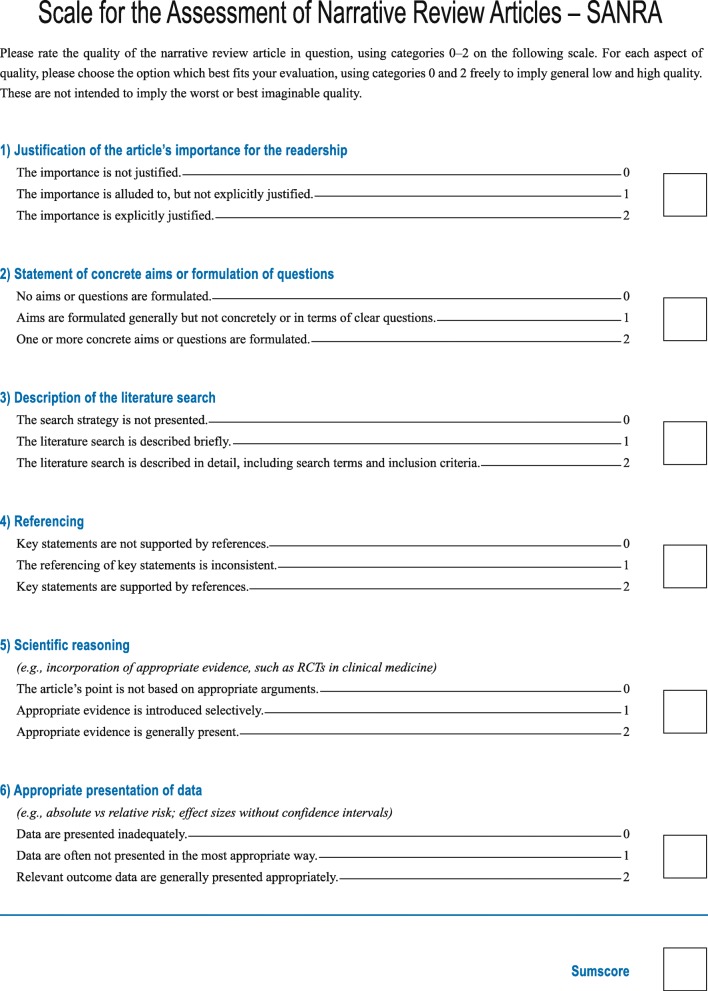
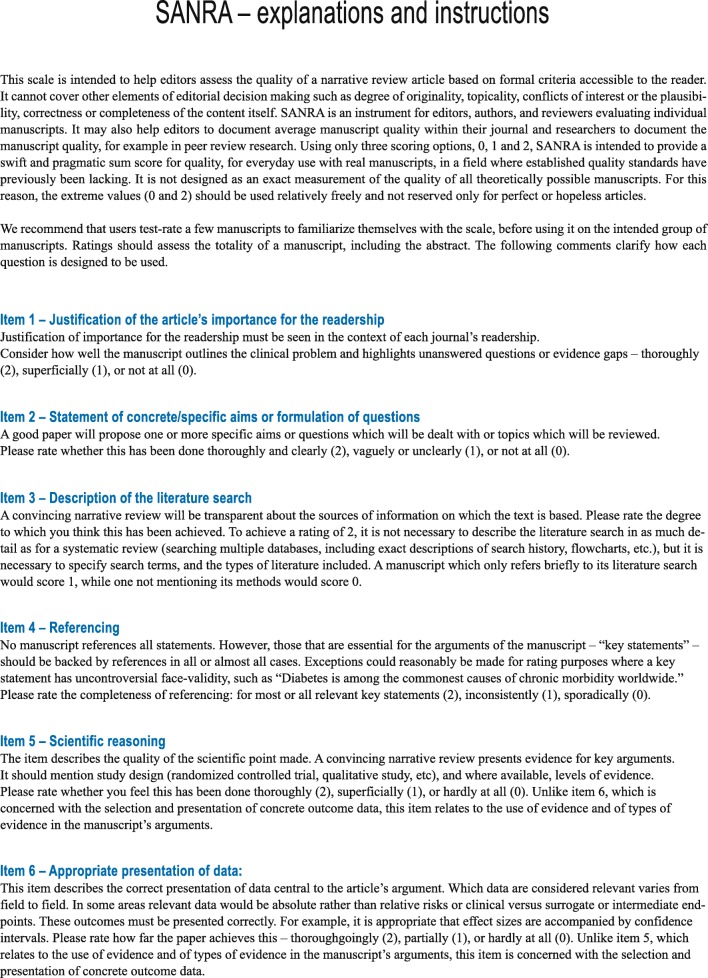
BACKGROUND: Narrative reviews are the commonest type of articles in the medical literature. However, unlike systematic reviews and randomized controlled trials (RCT) articles, for which formal instruments exist to evaluate quality, there is currently no instrument available to assess the quality of narrative reviews. In response to this gap, we developed SANRA, the Scale for the Assessment of Narrative Review Articles. METHODS: A team of three experienced journal editors modified or deleted items in an earlier SANRA version based on face validity, item-total correlations, and reliability scores from previous tests. We deleted an item which addressed a manuscript's writing and accessibility due to poor inter-rater reliability. The six items which form the revised scale are rated from 0 (low standard) to 2 (high standard) and cover the following topics: explanation of (1) the importance and (2) the aims of the review, (3) literature search and (4) referencing and presentation of (5) evidence level and (6) relevant endpoint data. For all items, we developed anchor definitions and examples to guide users in filling out the form. The revised scale was tested by the same editors (blinded to each other's ratings) in a group of 30 consecutive non-systematic review manuscripts submitted to a general medical journal. RESULTS: Raters confirmed that completing the scale is feasible in everyday editorial work. The mean sum score across all 30 manuscripts was 6.0 out of 12 possible points (SD 2.6, range 1-12). Corrected item-total correlations ranged from 0.33 (item 3) to 0.58 (item 6), and Cronbach's alpha was 0.68 (internal consistency). The intra-class correlation coefficient (average measure) was 0.77 [95% CI 0.57, 0.88] (inter-rater reliability). Raters often disagreed on items 1 and 4. CONCLUSIONS: SANRA's feasibility, inter-rater reliability, homogeneity of items, and internal consistency are sufficient for a scale of six items. Further field testing, particularly of validity, is desirable. We recommend rater training based on the "explanations and instructions" document provided with SANRA. In editorial decision-making, SANRA may complement journal-specific evaluation of manuscripts-pertaining to, e.g., audience, originality or difficulty-and may contribute to improving the standard of non-systematic reviews.
Overview
CoChat Summary
TL;DR
SANRA is a six-item, 0–2 scale (maximum 12) for assessing the quality of narrative review articles, developed and field-tested by three journal editors. In 30 consecutive non-systematic review manuscripts, it showed feasible use, sufficient internal consistency and inter-rater reliability, and a modest association with editorial acceptance.
Key findings
- Across 30 manuscripts (90 ratings), the mean SANRA sum score was 6.0 out of 12 (SD 2.6, range 1–12, median 6).
- Internal consistency was Cronbach’s alpha 0.68; corrected item-total correlations ranged from 0.33 (item 3) to 0.58 (item 6).
- Inter-rater reliability was an intra-class correlation coefficient (average measure) of 0.77 [95% CI 0.57, 0.88]; raters often disagreed on items 1 and 4.
- Average SANRA scores were modestly associated with editorial acceptance (mean 6.6, SD 1.9, n = 17) versus rejection (mean 5.1, SD 2.1, n = 13), point biserial correlation 0.37 (t = 2.09, df 28; two-sided p = 0.046).
Methods
- SANRA was developed between 2010 and 2017 by three experienced editors at Deutsches Ärzteblatt; the revised six-item version deleted an item on writing and accessibility due to poor inter-rater reliability.
- The revised scale was tested on 30 consecutive non-systematic review manuscripts submitted to Deutsches Ärzteblatt in 2015; three editor-raters scored them independently and blinded to each other’s ratings.
- Analyses included descriptive statistics, Cronbach’s alpha, corrected item-total correlations, average-measure intra-class correlation using a two-way random effects model (consistency definition), and a post hoc point biserial correlation between SANRA sum scores and acceptance/rejection.
Limitations
- The paper states the main limitation is sample size: 30 manuscripts was a compromise between representativeness, power, and feasibility, and took about 6 months to sample.
- The authors state that the scale’s authors were also the test-raters, so inter-rater reliability may be lower in groups less familiar with SANRA; the study also did not assess test-retest reliability, and results are study-specific.
- The paper acknowledges restricted content validity because SANRA is limited to six items and is a critical appraisal tool rather than a reporting guideline; criterion validity evidence is post hoc and weak, and no established cut-offs exist for comparing manuscripts across settings.
Model-written summary. Check it against the paper before relying on it.
Integrity signals
Registry
Cites
Statistics
Figures
Verification
Claims the paper makes
3 Valid · 0 Not valid · 5 Not checked · 27 Own results and interpretations
The cited sources support only part of this claim — read each source’s verdict below.
In the paper
“Bastian et al. found that they constitute the largest share of all text types in medicine and they concluded that they “remain the staple of medical literature” [1].”
- Also stated in: § Background · plain
“Narrative reviews are the commonest type of articles in the medical literature.”
§ SANRA—a scale for the quality assessment of narrative review articles > Background
What the sources say
- Partly supportedcites [1] Bastian H Glasziou P Chalmers I Seventy-five trials and eleven systematic reviews a day: how will we ever keep up? PLoS Med 2010 7 9 e1000326 10.1371/journal.pmed.1000326 20877712 PMC2943439 sourceExperimental — accuracy not yet measured
In “How Close Are We to Archie Cochrane’s Goal?” and the Summary Points (pages unavailable), the paper calls non-systematic narrative reviews the staple of medical literature synthesis. It does not say they constitute the largest share of all medical text types; that extends a claim about literature synthesis to medical literature as a whole. (LLM, conf=0.88)
plain- Asserted: passes — The authors put it forward as true.
- Checkable: passes — It can be checked against evidence.
- Load-bearing: unclear — It is unclear whether the paper’s conclusions depend on it.
- Based: passes — The paper gives a reason why it holds.
- Also stated in: § Background · plain
The sources with a verdict support this claim; the rest weren’t checked yet, have no full text we could read, or their verdicts aren’t rated yet.
In the paper
“non-systematic reviews or narrative reviews have been widely criticized as unreliable [1, 4].”
§ SANRA—a scale for the quality assessment of narrative review articles > Background
What the sources say
- Supportedcites [1] Bastian H Glasziou P Chalmers I Seventy-five trials and eleven systematic reviews a day: how will we ever keep up? PLoS Med 2010 7 9 e1000326 10.1371/journal.pmed.1000326 20877712 PMC2943439 source
In “How Close Are We to Archie Cochrane’s Goal?”, the paper describes reviews not conducted systematically as having great potential for error and calls them less reliable forms of information. Box 1 also says that articles and textbooks had highlighted the risk of bias and chance in reviews. Together, these passages support the broad characterization that narrative reviews have been criticized as unreliable; page numbers are not provided in our copy. (LLM, conf=0.89)
- Not checked — no full text of the sourcecites [4] Mulrow CD The medical review article: state of the science Ann Intern Med 1987 106 485 488 10.7326/0003-4819-106-3-485 3813259 source
plain- Asserted: passes — The authors put it forward as true.
- Checkable: passes — It can be checked against evidence.
- Load-bearing: passes — The paper’s conclusions depend on it.
- Based: passes — The paper gives a reason why it holds.
- Supported
A result the paper reports from its own data — it cites no other source for it, so there is none to check. The quote shows it is in the paper.
In the paper
“Cronbach’s alpha was 0.68 (internal consistency).”
- Also stated in: § Results · plain
“The scale’s internal consistency, measured as Cronbach’s alpha, was 0.68.”
§ SANRA—a scale for the quality assessment of narrative review articles > Abstract > Results
plainn = 90- Asserted: passes — The authors put it forward as true.
- Checkable: passes — It can be checked against evidence.
- Load-bearing: passes — The paper’s conclusions depend on it.
- Based: passes — The paper gives a reason why it holds.
- Also stated in: § Results · plain
A result the paper reports from its own data — it cites no other source for it, so there is none to check. The quote shows it is in the paper.
In the paper
“Raters often disagreed on items 1 and 4.”
- Also stated in: § Results · plain
“Disagreements most often occurred with regard to items 1 and 4.”
§ SANRA—a scale for the quality assessment of narrative review articles > Abstract > Results
plain- Asserted: passes — The authors put it forward as true.
- Checkable: passes — It can be checked against evidence.
- Load-bearing: unclear — It is unclear whether the paper’s conclusions depend on it.
- Based: passes — The paper gives a reason why it holds.
- Also stated in: § Results · plain
A result the paper reports from its own data — it cites no other source for it, so there is none to check. The quote shows it is in the paper.
In the paper
“The intra-class correlation coefficient (average measure) was 0.77 [95% CI 0.57, 0.88] (inter-rater reliability).”
- Also stated in: § Results · plain
“The intra-class correlation coefficient (average measure) amounted to 0.77 [95% CI 0.57, 0.88; F 4.3; df 29, 58].”
§ SANRA—a scale for the quality assessment of narrative review articles > Abstract > Results
plain- Asserted: passes — The authors put it forward as true.
- Checkable: passes — It can be checked against evidence.
- Load-bearing: passes — The paper’s conclusions depend on it.
- Based: passes — The paper gives a reason why it holds.
- Also stated in: § Results · plain
14 more claims
Create a free account to see all 35 claims and to verify the 3 references still open.
- Probably not a substantial claim. 11
- It may state two separate claims as one. 11
Claims other papers make about this one
Each is checked against this paper’s own text: does it say what the citing paper says it does?
The source backs part of the claim, not all of it — or backs it for a different population, condition or comparison.
In the citing paper
“The review was conducted and reported in accordance with the principles of the Scale for the Assessment of Narrative Review Articles (SANRA), which provides a validated framework for ensuring methodological transparency, scientific rigor, and balanced interpretation in narrative reviews [ 19 ].”
From Paracetamol: A History of Assumptions, Errors, and Evidence Reversals in Pain Management (2026) · cites this paper as [19]
Experimental — accuracy not yet measuredThe source backs part of the claim, not all of it — or backs it for a different population, condition or comparison.
In the citing paper
“As a narrative review, the present work does not include an aggregated quantitative assessment and is more exposed to selection subjectivity than a registered systematic review [124,125].”
From Berberine-Drug Interactions: Mechanisms, Clinical Relevance and Risk Stratification-A Narrative Review (2026) · cites this paper as [124]
Experimental — accuracy not yet measuredThe cited source says what the claim attributes to it.
In the citing paper
“This work is designed as a structured narrative review, with transparent reporting of the documentation strategy, guided by the quality criteria of the Scale for the Assessment of Narrative Review Articles (SANRA) [124].”
From Berberine-Drug Interactions: Mechanisms, Clinical Relevance and Risk Stratification-A Narrative Review (2026) · cites this paper as [124]
The cited source says what the claim attributes to it.
In the citing paper
“we used the following:-Cochrane Risk of Bias 2 (RoB 2) [29] and PEDRO scale tools for RCTs.-AMSTAR 2 [30] checklist for systematic review.-SANRA (Scale for the Assessment of Narrative Review Articles) [31] for narrative reviews.-JBI Checklist for Text and Opinion [32] for expert opinion papers.”
From Pelvic Floor Muscle Training Following Surgery for Pelvic Organ Prolapse: Recommendation from Scientific Literature (2026) · cites this paper as [31]
The cited source says what the claim attributes to it.
In the citing paper
“Data analysis employed a narrative and thematic synthesis methodology,adhering to the SANRA guidelines for narrative reviews (32).”
From Ethical issues in multi-agent AI systems for healthcare: a narrative review (2026) · cites this paper as [32]
12 more claims about this paper
Create a free account to see every claim other papers make about this one.
Citations
Cites
Shea, B. J., Reeves, B. C., Wells, G., Thuku, M., Hamel, C., Moran, J., Moher, D., Tugwell, P., Welch, V., Kristjansson, E., et al. (2017) · BMJ · doi:10.1136/bmj.j4008 · Cited by 10,636 · cited 2×
“Critical appraisal tools have been developed for systematic reviews (e.g., AMSTAR 2 [A MeaSurement Tool to Assess Systematic Reviews] [7]) and papers on RCTs (e.g., the CASP [Critical Appraisal Skills Program] checklist for randomized trials [8]) and other types of medical studies.”
BackgroundStreiner, D. L., & Norman, G. R. (2008) · doi:10.1093/acprof:oso/9780199231881.001.0001 · Cited by 2,631
Critical appraisal skills programme
Singh, J. (2013) · Journal of Pharmacology and Pharmacotherapeutics · doi:10.4103/0976-500x.107697 · Cited by 2,556
Guidelines for Reporting Reliability and Agreement Studies (GRRAS) were proposed
Kottner, J., Audigé, L., Brorson, S., Donner, A., Gajewski, B. J., Hróbjartsson, A., Roberts, C., Shoukri, M., & Streiner, D. L. (2011) · Journal of Clinical Epidemiology · doi:10.1016/j.jclinepi.2010.03.002 · Cited by 2,174
The Mass Production of Redundant, Misleading, and Conflicted Systematic Reviews and Meta‐analyses
IOANNIDIS, J. P. A. (2016) · The Milbank Quarterly · doi:10.1111/1468-0009.12210 · Cited by 1,483 · cited 1×
“While systematic reviews are not per se superior articles and while certain systematic reviews have been criticized lately [3], non-systematic reviews or narrative reviews have”
BackgroundSeventy-five trials and eleven systematic reviews a day: how will we ever keep up?
Bastian, H., Glasziou, P., & Chalmers, I. (2010) · PLoS Medicine · doi:10.1371/journal.pmed.1000326 · Cited by 1,188 · cited 2×
“found that they constitute the largest share of all text types in medicine and they concluded that they “remain the staple of medical literature” [1].”
BackgroundThe Medical Review Article: State of the Science
MULROW, C. D. (1987) · Annals of Internal Medicine · doi:10.7326/0003-4819-106-3-485 · Cited by 856 · cited 1×
“been widely criticized as unreliable [1, 4].”
Writing a narrative biomedical review: considerations for authors, peer reviewers, and editors
Gasparyan, A. Y., Ayvazyan, L., Blackmore, H., & Kitas, G. D. (2011) · Rheumatology International · doi:10.1007/s00296-011-1999-3 · Cited by 694 · cited 1×
“[13], for example, have provided guidance for writing narrative reviews, and Byrne [14] as well as Pautasso [15] has written, from different angles, thoughtful editorials on improving narrative reviews and presented lists of key features of writing a good review—lists that naturally overlap with SANRA items (e.”
BackgroundTen Simple Rules for Writing a Literature Review
Pautasso, M. (2013) · PLoS Computational Biology · doi:10.1371/journal.pcbi.1003149 · Cited by 272 · cited 3×
“[13], for example, have provided guidance for writing narrative reviews, and Byrne [14] as well as Pautasso [15] has written, from different angles, thoughtful editorials on improving narrative reviews and presented lists of key features of writing a good review—lists that naturally overlap with SANRA items (e.”
BackgroundImproving the peer review of narrative literature reviews
Byrne, J. A. (2016) · Research Integrity and Peer Review · doi:10.1186/s41073-016-0019-2 · Cited by 159 · cited 3×
“[13], for example, have provided guidance for writing narrative reviews, and Byrne [14] as well as Pautasso [15] has written, from different angles, thoughtful editorials on improving narrative reviews and presented lists of key features of writing a good review—lists that naturally overlap with SANRA items (e.”
Background
Research works printed but not linked: 3
- Higgins JPT, Green S. (eds.). Cochrane Handbook for Systematic Reviews and Interventions. Version 5.1.0. The Cochrane Collaboration 2011, section 1.2.2., www.handbook.cochrane.org, retrieved on Oct 31, 2018.
- Baethge C Mertens S Goldbeck-Wood S Development of a quality score for the assessment of non-systematic review articles (SANRA) Poster, Seventh International Congress on Peer Review and Biomedical Publication 2013 USA Chicago, Illinois
- Baethge C Goldbeck-Wood S Mertens S A scale for the assessment of non-systematic review articles (SANRA) Poster, Eighth International Congress on Peer and Biomedical Publication 2017 USA Chicago, Illinois
Cited by
Items 201–300 of 4,334
Serum Albumin as Prognostic Marker for Older Adults in Hospital and Community Settings
Riviati, N., Legiran, Indrajaya, T., Saleh, I., Ali, Z., Irfannuddin, I., Probosuseno, P., & Indra, B. (2024) · Gerontology and Geriatric Medicine · doi:10.1177/23337214241249914 · Cited by 39
“…literature search was conducted from the inception of available databases up to December 2023, including PubMed, ScienceDirect, Scopus, Web of Science, CINAHL, and Cochrane Library following the Scale for The Quality Assessment of Narrative Review Articles (SANRA) guidelines (Baethge et al., 2019).”
MethodThe Oral Microbiome of Peri-Implant Health and Disease: A Narrative Review
de Campos, N., Buischi, Y. D. P., Mohamadzadeh, M., & Loomer, P. M. (2024) · Dentistry Journal · doi:10.3390/dj12100299 · Cited by 44
“To assure a high-quality review process, the SANRA (Scale for the Assessment of Narrative Review Articles) was used [30].”
BackgroundMethodArab, R. A. E., Moosa, O. A. A., Albahrani, Z., Alkhalil, I., Somerville, J. G., & Abuadas, F. H. A. (2025) · Nursing Reports · doi:10.3390/nursrep15080281 · Cited by 43
“For the second tool, we utilized the SANRA scale for narrative reviews [20]—a validated six-item instrument for narrative reviews—to assess methodological transparency and narrative coherence.”
Hospital-onset COVID-19 infection surveillance systems: a systematic review
Abbas, M., Zhu, N., Mookerjee, S., Bolt, F., Otter, J. A., Holmes, A. H., & Price, J. R. (2021) · Journal of Hospital Infection · doi:10.1016/j.jhin.2021.05.016 · Cited by 35
Garis, G., Haupts, M. R., Duning, T., & Hildebrandt, H. (2022) · Neurological Sciences · doi:10.1007/s10072-022-06385-1 · Cited by 38
“We have followed the SANRA (Scale for the Assessment of Narrative Review Articles) statement criteria [7] and its explanations and instructions, with a view to improving the quality of this review.”
BackgroundMethodBlue Light—Ocular and Systemic Damaging Effects: A Narrative Review
Antemie, R.-G., Samoilă, O. C., & Clichici, S. V. (2023) · International Journal of Molecular Sciences · doi:10.3390/ijms24065998 · Cited by 30
Bartoli, F., Cavaleri, D., Nasti, C., Palpella, D., Guzzi, P., Riboldi, I., Crocamo, C., Pappa, S., & Carrà, G. (2023) · Therapeutic Advances in Psychopharmacology · doi:10.1177/20451253231163682 · Cited by 38
Vitale, S. G., Angelis, M. C. D., Corte, L. D., Saponara, S., Carugno, J. A., Laganà, A. S., Török, P., Tinelli, R., Pérez‐Medina, T., Ertaş, S., et al. (2023) · Archives of Gynecology and Obstetrics · doi:10.1007/s00404-023-07126-1 · Cited by 35
“We adhered to the quality standards for narrative reviews, as defined and quantified by the scale for the quality assessment of narrative review articles (SANRA) [5].”
MethodHormonal Treatment of Endometriosis: A Narrative Review
Piriyev, E., Schiermeier, S., & Römer, T. (2025) · Pharmaceuticals · doi:10.3390/ph18040588 · Cited by 34
“This methodology aligns with the SANRA (Scale for the Assessment of Narrative Review Articles) criteria and reflects the aim of offering a concise but up-to-date summary of available evidence to guide clinical decision-making [19].”
Transmission of SARS-CoV-2 by Children
Merckx, J., Labrecque, J. A., & Kaufman, J. S. (2020) · Deutsches Ärzteblatt international · doi:10.3238/arztebl.2020.0553 · Cited by 36
The Fatty liver Index (FLI) 15 years later: a reappraisal
Lonardo, A., Ballestri, S., Bedogni, G., Bellentani, S., & Tiribelli, C. (2021) · Metabolism and Target Organ Damage · doi:10.20517/mtod.2021.08 · Cited by 45
Feasibility assurance: a review of automatic item generation in medical assessment
Falcão, F., Costa, P., & Pêgo, J. M. (2022) · Advances in Health Sciences Education · doi:10.1007/s10459-022-10092-z · Cited by 37
“Given the importance of narrative in medical science (Baethge et al., 2019), such work could be important for the dissemination of AIG in medical schools.”
BackgroundMethodInfluentialEvaluation and Treatment of Depression in Stroke Patients: A Systematic Review
Lavu, V. K., Abdelwahab, R. A. M., Huang, R., Potla, S., Bhalla, S., AlQabandi, Y., Nandula, S. A., Boddepalli, C. S., Gutlapalli, S. D., & Mohammed, L. (2022) · Cureus · doi:10.7759/cureus.28137 · Cited by 38
The Validity of Vital Signs for Pain Assessment in Critically Ill Adults: A Narrative Review
Shiva Shahiri, T., & Gélinas, C. (2023) · Pain Management Nursing · doi:10.1016/j.pmn.2023.01.004 · Cited by 38
Hepatitis E Virus (HEV) Infection Among Immunocompromised Individuals: A Brief Narrative Review
Alexandrova, R., Tsachev, I., Kirov, P. M., Abudalleh, A., Hristov, H., Zhivkova, T., Dyakova, L., & Baymakova, M. P. (2024) · Infection and Drug Resistance · doi:10.2147/idr.s449221 · Cited by 39
Citizen Participation Practices in the Governance of Local Food Systems: A Literature Review
Affre, L., Guillaumie, L., Dupéré, S., Mercille, G., & Fortin-Guay, M. (2024) · Sustainability · doi:10.3390/su16145990 · Cited by 38
“The Scale for the Assessment of Narrative Review Articles (SANRA) guidelines were used to guide the review, data extraction, and analysis process [23].”
Malerba, S., Vladimirov, M., Goyal, A., Dulskas, A., Baušys, A., Cwalinski, T., Girnyi, S., Skokowski, J., Duka, R., Молчанов, Р., et al. (2026) · Journal of Clinical Medicine · doi:10.3390/jcm15062208 · Cited by 37
das Virgens, I. P. A., Santana, N. M., Lima, S. C. V. C., & Fayh, A. P. T. (2020) · British Journal Of Nutrition · doi:10.1017/s0007114520004420 · Cited by 35
“The literature review was conducted according to the SANRA Statement(22) utilising PubMed, Lilacs, Google Scholar and Cochrane Library databases.”
MethodHow health systems approached respiratory viral pandemics over time: a systematic review
Cascini, F., Hoxhaj, I., Zaçe, D., Ferranti, M., Pietro, M. L. D., Boccia, S., & Ricciardi, W. (2020) · BMJ Global Health · doi:10.1136/bmjgh-2020-003677 · Cited by 35
“To assess the quality of the narrative reviews included in the systematic review we used the Scale for the Assessment of Narrative Review Articles 12 and the ‘Study Quality Assessment Tools’ of the National Heart, Lung and Blood Institute for the before-after study.”
Transcranial Magnetic Stimulation as a Diagnostic and Therapeutic Tool in Various Types of Dementia
Antczak, J. M., Rusin, G., & Słowik, A. (2021) · Journal of Clinical Medicine · doi:10.3390/jcm10132875 · Cited by 36
Bailo, P., Gibelli, F., Ricci, G., & Sirignano, A. (2022) · International Journal of Environmental Research and Public Health · doi:10.3390/ijerph191811749 · Cited by 35
“Quality Evaluation SANRA (Scale for the Assessment of Narrative Review Articles) [23] was employed for quality checks of selected studies.”
MethodAnalysis of ChatGPT publications in radiology: Literature so far
Bera, K., O'Connor, G. M., Jiang, S., Tirumani, S. H., & Ramaiya, N. H. (2023) · Current Problems in Diagnostic Radiology · doi:10.1067/j.cpradiol.2023.10.013 · Cited by 36
Direito, R., Barbalho, S. M., Figueira, M. E., Minniti, G., de Carvalho, G. M., de Oliveira Zanuso, B., de Oliveira dos Santos, A. R., de Góes Corrêa, N., Rodrigues, V. D., de Alvares Goulart, R., et al. (2023) · Metabolites · doi:10.3390/metabo13060728 · Cited by 32
“[14] specifically designed to evaluate the quality of non-systematic reviews.”
BackgroundPeitsidis, P., Tsikouras, P. N., Laganà, A. S., Laios, A., Gkegkes, I. D., & Iavazzo, C. R. (2023) · Drug Design Development and Therapy · doi:10.2147/dddt.s315726 · Cited by 34
Systemic Lupus Erythematosus and Cardiovascular Diseases: A Systematic Review
Nor, M. A., Ogedegbe, O. J., Barbarawi, A., Ali, A. I., Sheikh, I. M., Yussuf, F. M., Adam, S. M., Hassan, O. A., Tabowei, G., Jimoh, A., et al. (2023) · Cureus · doi:10.7759/cureus.39284 · Cited by 42
Szymoniuk, M., Chin, J.-H., Domagalski, Ł., Biszewski, M., Jóźwik, K., & Kamieniak, P. (2023) · Neurosurgical Review · doi:10.1007/s10143-023-02032-1 · Cited by 38
“Materials and methods This narrative review was conducted according to the Scale for the Assessment of Narrative Review Articles (SANRA) criteria [43].”
MethodParab, P. T., Chaudhary, P., Mukhtar, S., Moradi, A., Kodali, A., Okoye, C., Klein, D., Mohamoud, I., Olanisa, O. O., & Hamid, P. (2023) · Cureus · doi:10.7759/cureus.45487 · Cited by 52
“…(RCTs) [13], the New Castle Ottawa scale for observational studies [14], the AMSTAR (A MeaSurement Tool to Assess systematic Reviews) checklist for systematic reviews and meta-analysis [15], and the SANRA (Scale for the Assessment of Narrative Review Articles) checklist for narrative reviews [16].”
MethodDelaire, L., Courtay, A., Humblot, J., Aubertin‐Leheudre, M., Mourey, F., Racine, A. N., Gilbert, T., Niasse‐Sy, Z., & Bonnefoy, M. (2023) · Nutrients · doi:10.3390/nu15194100 · Cited by 37
“We used the Scale for the Assessment of Narrative Review Articles (SANRA) to prepare a qualitative selection of studies supporting the narrative review [49].”
MethodEmployability Learning and Teaching Research: A Twenty Year Structured Narrative Review
Choi-Lundberg, D. L., Douglas, T., Bird, M., Coleman, B., Greenwood, M., Martin, R. A., Prior, S. J., Saghafi, F., Roehrer, E., Waddingham, S., et al. (2024) · Journal of University Teaching and Learning Practice · doi:10.53761/g8mryt07 · Cited by 32
“…’explanation of the review’s importance (item 1) and statement of the aims (item 2) of the review, description of the literature search (item 3), referencing (item 4), scientific reasoning (item 5), and presentation of relevant and appropriate endpoint data (item 6)’ (Baethge et al., 2019, p. 2).”
BackgroundPotential Role of Cannabidiol on Sports Recovery: A Narrative Review
Rojas‐Valverde, D. (2021) · Frontiers in Physiology · doi:10.3389/fphys.2021.722550 · Cited by 35
Effectiveness of conservation interventions globally for degraded peatlands in cool-climate regions
Rowland, J. A., Bracey, C., Moore, J. L., Cook, C. N., Bragge, P., & Walsh, J. C. (2021) · Biological Conservation · doi:10.1016/j.biocon.2021.109327 · Cited by 36
“We critically appraised the narrative reviews using SANRA (‘ Scale for the Assessment of Narrative Review Articles ’ ), an approach that considers the clarity of the review's justification and objectives, search strategy and reporting of the evidence (Baethge et al., 2019).”
MethodLederer, A., Chikhladze, S., Kohnert, E., Huber, R., & Müller, A. (2021) · Diagnostics · doi:10.3390/diagnostics11112099 · Cited by 35
“To ensure quality of this narrative review, manuscript was prepared according to the Scale for the Assessment of Narrative Review Articles (SANRA) [30].”
MethodExercise-Associated Hyponatremia in Marathon Runners
Klingert, M., Nikolaidis, P. Τ., Weiss, K., Thuany, M., Chlíbková, D., & Knechtle, B. (2022) · Journal of Clinical Medicine · doi:10.3390/jcm11226775 · Cited by 35
Mental health bias in physical care: An integrative review of the literature
Hallyburton, A., & Allison-Jones, L. L. (2023) · Journal of Psychiatric and Mental Health Nursing · doi:10.1111/jpm.12911 · Cited by 34
Diabetic neuropathy: Past, present, and future.
Aldave, J. E. Q., Durand‐Vásquez, M. D. C., Osorio, E. R. G., Suárez-Rojas, J., Roseboom, P. J., Alcalá‐Mendoza, R. M., Arroyo, J., Zavaleta‐Gutiérrez, F. E., Urteaga, L. A. C., & Concepción‐Zavaleta, M. J. (2023) · PubMed Central · doi:10.22088/cjim.14.2.153 · Cited by 49
“statement of the objectives of the review, description of the bibliographic search, references, scientific reasoning, and appropriate presentation of information (33).”
BackgroundTeaching Airway Management Using Virtual Reality: A Scoping Review
Duffy, C. C., Bass, G. A., Yi, W. S., Rouhi, A. D., Kaplan, L. J., & O’Sullivan, E. (2023) · Anesthesia & Analgesia · doi:10.1213/ane.0000000000006611 · Cited by 36
“17 This scoping review conforms to the Scale for Quality Assessment of Narrative Review Articles (SANRA) guidance 22 and also with the Synthesis without Meta-analysis (SWiM) addendum to the 2020 update of the Preferred Reporting Items for Systematic Reviews and Meta-Analyses (PRISMA) statement in…”
MethodPharmacokinetic variability of beta-lactams in critically ill patients: A narrative review
Boidin, C., Moshiri, P., Dahyot‐Fizelier, C., Goutelle, S., & Lefeuvre, S. (2019) · Anaesthesia Critical Care & Pain Medicine · doi:10.1016/j.accpm.2019.07.016 · Cited by 33
Levac, D. E. (2023) · Developmental Medicine & Child Neurology · doi:10.1111/dmcn.15609 · Cited by 34
From Womb to Mind: Prenatal Epigenetic Influences on Mental Health Disorders
Álvarez-Mejía, D., Rodas, J. A., & León-Rojas, J. E. (2025) · International Journal of Molecular Sciences · doi:10.3390/ijms26136096 · Cited by 44
“This narrative review was conducted following the Scale for the Assessment of Narrative Review Articles (SANRA) recommendations [13].”
InfluentialPalma, G. D., Scendoni, R., Ferorelli, D., Benedictis, A. D., Tambone, V., & Micco, F. D. (2025) · Risk Management and Healthcare Policy · doi:10.2147/rmhp.s544523 · Cited by 42
“41 Cybersecurity risks were summarized through a thematic analysis, which made it possible to identify recurring patterns in the literature, including the vulnerability of interconnected medical devices, issues related to informed consent and critical issues in the protection of sensitive data.”
The misunderstood link between SARS-CoV-2 and angiogenesis. A narrative review
Madureira, G., & Soares, R. A. (2021) · Pulmonology · doi:10.1016/j.pulmoe.2021.08.004 · Cited by 31
“This narrative review was performed according to the SANRA (Scale for the quality Assessment of Narrative Review Articles) guideline.(5) A literature search was performed in PUBMED.”
Human Umbilical Cord Mesenchymal Stem Cells: Current Literature and Role in Periodontal Regeneration
Shaikh, M. S., Shahzad, Z., Tash, E. A., Janjua, O. S., Khan, M. I., & Zafar, M. S. (2022) · Cells · doi:10.3390/cells11071168 · Cited by 34
Dakka, A., Nazir, Z., Shamim, H., Jean, M., Umair, M., Muddaloor, P., Farinango, M., Ansary, A., & Khan, S. (2022) · Cureus · doi:10.7759/cureus.28144 · Cited by 32
Fecal Microbiota Transplantation Role in the Treatment of Alzheimer's Disease: A Systematic Review
Nassar, S. T., Tasha, T., Desai, A. V., Bajgain, A., Ali, A., Dutta, C., Pasha, K., Paul, S., Abbas, M. S., & Venugopal, S. (2022) · Cureus · doi:10.7759/cureus.29968 · Cited by 35
Metabolic Syndrome, Nonalcoholic Fatty Liver Disease, and Chronic Hepatitis B: A Narrative Review
Diao, Y., Tang, J., Wang, X., Deng, W., Tang, J. Y., & You, C. (2022) · Infectious Diseases and Therapy · doi:10.1007/s40121-022-00725-6 · Cited by 37
“This review followed the SANRA reporting recommendations for high-quality narrative reviews [17].”
MethodLunevičius, R. (2023) · Journal of Clinical Medicine · doi:10.3390/jcm12031230 · Cited by 31
The pharmacological bases for repurposing statins in depression: a review of mechanistic studies
Giorgi, R. D., Pesci, N. R., Rosso, G., Maina, G., Cowen, P. J., & Harmer, C. J. (2023) · Translational Psychiatry · doi:10.1038/s41398-023-02533-z · Cited by 35
“As such, the review was not been pre-registered, there was no attempt at pooling results to produce new evidence, and we did not systematically assess for sources of bias in the studies included—though we followed available advice on narrative reviews reporting [210] (Supplementary Material, S4).”
BackgroundPowerful medical education improves health care quality and return on investment
McGaghie, W. C., Barsuk, J. H., Wayne, D. B., & Issenberg, S. B. (2023) · Medical Teacher · doi:10.1080/0142159x.2023.2276038 · Cited by 42
“This article is a research synthesis performed and written as a narrative review (McGaghie 2015) according to SANRA criteria (Baethge et al. 2019) informed by realist review principles (Wong et al. 2016).”
MethodUse of Optical Coherence Tomography in Dentistry
Janjua, O. S., Jeelani, W., Khan, M. I., Qureshi, S. M., Shaikh, M. S., Zafar, M. S., & Khurshid, Z. (2023) · International Journal of Dentistry · doi:10.1155/2023/4179210 · Cited by 31
“Following the Scale for the Assessment of Narrative Review Articles (SANRA) guidelines [10], the objective of this paper was to comprehensively review the available data on the techniques and application of OCT in various disciplines of dentistry and in order to achieve this objective, the…”
MethodInfluentialChatGPT in ESL Higher Education: Enhancing Writing, Engagement, and Learning Outcomes
(2025) · doi:10.3390/info16040316 · Cited by 30
“The review adhered to the Scale for the Assessment of Narrative Review Articles (SANRA) guidelines [27] to maintain study quality.”
Scoping Review Methodology: History, Theory and Practice
Николаевна, К. Е., Nastausheva, T. L., & Kondratjeva, I. V. (2021) · Вопросы современной педиатрии · doi:10.15690/vsp.v20i3/2271 · Cited by 31
Vaccine Procurement: A Conceptual Framework Based on Literature Review
Gianfredi, V., Filia, A., Rota, M. C., Croci, R., Bellini, L., Odone, A., & Signorelli, C. (2021) · Vaccines · doi:10.3390/vaccines9121434 · Cited by 34
“The process was documented and the results were processed following the SANRA (Scale for the Assessment of Non-systematic Review Articles) guidelines [4].”
MethodJohns, A. L., Stock, N. M., Costa, B., Feragen, K. B., & Crerand, C. E. (2022) · The Cleft Palate-Craniofacial Journal · doi:10.1177/10556656221091699 · Cited by 32
The Impact of Dietary Fat on Breast Cancer Incidence and Survival: A Systematic Review
Gopinath, A., Cheema, A. H., Chaludiya, K., Khalid, M., Nwosu, M., Agyeman, W. Y., Bisht, A., & Venugopal, S. (2022) · Cureus · doi:10.7759/cureus.30003 · Cited by 30
Lippi, L., Ferrillo, M., Turco, A., Folli, A., Moalli, S., Refati, F., Perrero, L., Ammendolia, A., Alessandro de, S. I. R. E., & Invernizzi, M. (2023) · Medicina · doi:10.3390/medicina59112047 · Cited by 30
“This narrative review followed the scale for the quality assessment of narrative review articles (SANRA) criteria [24], and the SANRA score of this narrative review is reported in Supplementary Table S1.”
MethodPain catastrophizing in rheumatic diseases: prevalence, origin, and implications
Wilk, M., Zimba, O., Haugeberg, G., & Korkosz, M. (2024) · Rheumatology International · doi:10.1007/s00296-024-05583-8 · Cited by 32
ChatGPT in ESL Higher Education: Enhancing Writing, Engagement, and Learning Outcomes
Deep, P. D., Martirosyan, N., Ghosh, N., & Rahaman, M. S. (2025) · doi:10.20944/preprints202503.1665.v1 · Cited by 30
Wilson, I. M., Willoughby, B., Tanyos, A., Graham, K., Walker, M. J., Laslett, A., & Ramsoomar, L. (2024) · Global Health Action · doi:10.1080/16549716.2024.2341522 · Cited by 31
“This process meets the SANRA standards (the scale for the quality assessment of narrative review articles) as applied to qualitative literature [28].”
BackgroundMethodClassifying Low Back Pain Through Pain Mechanisms: A Scoping Review for Physiotherapy Practice
Tedeschi, R., Giorgi, F., Platano, D., & Berti, L. (2025) · Journal of Clinical Medicine · doi:10.3390/jcm14020412 · Cited by 29
“SANRA [48]: Narrative reviews assessed with SANRA may have moderate bias if the literature search is not comprehensive or the justification for conclusions is incomplete.”
Neuromodulatory Signaling in Chronic Pain Patients: A Narrative Review
Varrassi, G., Leoni, M. L. G., Farì, G., Al-Alwany, A. A., Sharie, S. A., & Fornasari, D. (2025) · Cells · doi:10.3390/cells14171320 · Cited by 32
“This narrative review was conducted in accordance with the SANRA (Scale for the Assessment of Narrative Review Articles) guidelines, which provide a validated framework to enhance the methodological rigor, transparency, and quality of non-systematic scientific literature [15].”
Almhdie-Imjabbar, A., Podsiadło, P., Ljuhar, R., Jennane, R., Nguyen, K. L., Toumi, H., Saarakkala, S. S., & Lespessailles, É. (2021) · Arthritis Research & Therapy · doi:10.1186/s13075-021-02594-9 · Cited by 31
“The SANRA criteria were used as a framework of quality assurance of the present manuscript [17].”
Methodd’Alessandro, M., Conticini, E., Bergantini, L., Cameli, P., Cantarini, L., Frediani, B., & Bargagli, E. (2022) · Life · doi:10.3390/life12020317 · Cited by 30
“This article conforms with the Scale for Assessment of Narrative Review Articles (SANRA) guidelines [47].”
MethodBannon, S. M., Grunberg, V. A., Manglani, H. R., Lester, E. G., Ritchie, C. S., & Vranceanu, A. (2022) · Journal of the American Geriatrics Society · doi:10.1111/jgs.17801 · Cited by 32
Through the looking glass: a review of the literature surrounding reflective practice in dentistry
Campbell, F., & Rogers, H. J. (2022) · BDJ · doi:10.1038/s41415-022-3993-4 · Cited by 33
Weight bias and stigma in healthcare professionals: a narrative review with a Singapore lens
Goff, A. J., Lee, Y., & Tham, K. W. (2023) · Singapore Medical Journal · doi:10.4103/singaporemedj.smj-2022-229 · Cited by 32
“This review of published systematic reviews was conducted in alignment with the Scale for the Assessment of Narrative Review Articles (SANRA).[32] It was not pre‐registered.”
MethodThe genetic basis of onset age in schizophrenia: evidence and models
Zhan, N., Sham, P. C., So, H., & Lui, S. S. Y. (2023) · Frontiers in Genetics · doi:10.3389/fgene.2023.1163361 · Cited by 34
Mazhar, I., Yasir, M. B., Sarfraz, S., Shlaghya, G., Narayana, S. H., Mushtaq, U., Ameen, B. S., Nie, C., Nechi, D., & Penumetcha, S. S. (2023) · Cureus · doi:10.7759/cureus.43635 · Cited by 32
Andrup, L., Krogfelt, K. A., Stephansen, L., Hansen, K. S., Graversen, B. K., Wolkoff, P., & Madsen, A. M. (2024) · Frontiers in Public Health · doi:10.3389/fpubh.2024.1332078 · Cited by 35
“The article is structured according to the guidelines (Scale for the Assessment of Narrative Review Articles) for a narrative review described by Baethge et al. (18).”
MethodFall Risk Assessment and Prevention Strategies in Nursing Homes: A Narrative Review
Miura, T., & Kanoya, Y. (2025) · Healthcare · doi:10.3390/healthcare13040357 · Cited by 28
“To ensure the quality of this narrative review, we adhered to the SANRA scale [88] and tried to provide unbiased and reliable information.”
Exploring fascia in myofascial pain syndrome: an integrative model of mechanisms
Gromakovskis, V. (2025) · Frontiers in Pain Research · doi:10.3389/fpain.2025.1712242 · Cited by 36
“This mini-review followed the SANRA (Scale for the Assessment of Narrative Review Articles) guidelines for narrative reviews (34).”
Fantaye, A. W., Kitto, S. C., HENDRY, P. J., Wiesenfeld, L., Whiting, S. E., Gnyra, C., Fournier, K., & Lochnan, H. A. (2022) · Canadian Medical Education Journal · doi:10.36834/cmej.73241 · Cited by 34
Nair, S., Kahlon, S. S., Sikandar, R., Peddemul, A., Tejovath, S., Hassan, D., Patel, K., & Mostafa, J. A. (2022) · Cureus · doi:10.7759/cureus.26430 · Cited by 38
Festa, R. R., Jofré‐Saldía, E., Candia, A. A., Monsalves‐Álvarez, M., Flores‐Opazo, M., Peñailillo, L., Marzuca-Nassr, G. N., Aguilar-Farías, N., Fritz-Silva, N., Cancino-López, J., et al. (2023) · BMJ Open Sport & Exercise Medicine · doi:10.1136/bmjsem-2023-001749 · Cited by 29
Dietary and Nutritional Interventions in Nonalcoholic Fatty Liver Disease in Pediatrics
Farías, C., Cisternas, C., Gana, J. C., Alberti, G., Echeverría, F., Videla, L. A., Mercado, L., Muñoz, Y., & Valenzuela, R. (2023) · Nutrients · doi:10.3390/nu15224829 · Cited by 30
“Given these results, ECON and NASPGHAN recommended increasing moderate-to high-intensity physical activity and limiting screen time activities to 2 h per day for all children, including those with NAFLD [19] (Table 2).”
BackgroundMethodStasiłowicz-Krzemień, A., Nogalska, W., Maszewska, Z., Maleszka, M., Dobroń, M., Szary, A., Kępa, A., Żarowski, M., Hojan, K., Łukowicz, M., et al. (2024) · International Journal of Molecular Sciences · doi:10.3390/ijms25115749 · Cited by 35
“…narrative reviews are valuable in providing a holistic understanding of a topic by offering a broad overview and exploring diverse perspectives [86]. pathologies (Figure narrative review comprehensively examines the in fl uence of cannabis and The current review describes the use of cannabis…”
BackgroundEngaging with peers to integrate community care: Knowledge synthesis and conceptual map
Panaite, A., Desroches, O., Warren, É., Rouly, G., Castonguay, G., & Boivin, A. (2024) · Health Expectations · doi:10.1111/hex.14034 · Cited by 33
“Our approach was inspired by three research traditions: (1) narrative reviews, which emphasize the use of a comprehensive approach to broad topics 24 ; (2) enrichment and contextualization of research data through the use of deliberative processes with peers, practitioners and researchers 25 ; (3)…”
BackgroundMethodPegreffi, F., Chiaramonte, R., Zeppa, S. D., Lauretani, F., Salvi, M., Zucchini, I., Veronese, N., Vecchio, M. M., Bartolacci, A., Stocchi, V., et al. (2024) · Nutrients · doi:10.3390/nu16203462 · Cited by 28
“This review followed the Scale for the Assessment of Narrative Review Articles (SANRA) quality criteria [15] and was conducted between December 2023 and February 2024 (Table 1).”
MethodBragge, P., Delafosse, V., Kellner, P., Cong‐Lem, N., Tsering, D., Giummarra, M. J., Lannin, N. A., Andrew, N. E., & Reeder, S. C. (2025) · BMJ Open · doi:10.1136/bmjopen-2024-091942 · Cited by 33
Vachon, B., Curran, J., Karunananthan, S., Brehaut, J., Graham, I. D., Moher, D., Sales, A. E., Straus, S. E., Fiander, M., Paprica, P. A., et al. (2020) · Journal of Clinical Epidemiology · doi:10.1016/j.jclinepi.2020.09.027 · Cited by 29
COVID-19 lockdown and lifestyles: A narrative review
Doraiswamy, S., Cheema, S., Mulla, A. M. A., & Mamtani, R. (2021) · F1000Research · doi:10.12688/f1000research.52535.1 · Cited by 30
Wiedermann, C. J. (2022) · Journal of Clinical Medicine · doi:10.3390/jcm11092662 · Cited by 27
“The review article was reported in accordance with the scale for the assessment of narrative review articles (SANRA) [35].”
MethodMaternal Low Volume Circulation Relates to Normotensive and Preeclamptic Fetal Growth Restriction
Gyselaers, W., & Lees, C. C. (2022) · Frontiers in Medicine · doi:10.3389/fmed.2022.902634 · Cited by 28
“The methodology was performed according to Sandra’s principles (13) using the following keywords (alone or in combination): FGR, intrauterine growth restriction, poor fetal growth, early onset preeclampsia (EPE), gestational hypertensive disorders, maternal hemodynamics, maternal cardiovascular function, CO, total vas…”
MethodZuccarino, S., Monacelli, F., Antognoli, R., Nencioni, A., Monzani, F., Ferré, F., Seghieri, C., & Incalzi, R. A. (2022) · Cancers · doi:10.3390/cancers14133235 · Cited by 32
Bartoli, F., Cioni, R. M., Cavaleri, D., Callovini, T., Crocamo, C., Misiak, B., Savitz, J. B., & Carrà, G. (2022) · European Psychiatry · doi:10.1192/j.eurpsy.2022.2340 · Cited by 29
Guccione, L., Fullerton, S., Gough, K., Hyatt, A., Tew, M., Aranda, S. K., & Francis, J. (2023) · Frontiers in Oncology · doi:10.3389/fonc.2023.1040589 · Cited by 28
Lippi, L., Turco, A., Moalli, S., Gallo, M., Curci, C., Maconi, A., Alessandro de, S. I. R. E., & Invernizzi, M. (2023) · Cancers · doi:10.3390/cancers15184502 · Cited by 31
“This narrative review was designed following the SANRA quality criteria [22].”
MethodBemmouna, D., & Weiner, L. (2023) · Frontiers in Psychiatry · doi:10.3389/fpsyt.2023.1238116 · Cited by 32
“” To ensure the quality of our narrative review, we referred to the six criteria listed in the Scale for the Assessment of Narrative Review Articles [SANRA; (55)].”
MethodMuir, R. T., Ismail, Z., Black, S. E., & Smith, E. E. (2023) · Alzheimer s & Dementia · doi:10.1002/alz.13510 · Cited by 29
Muszalska, A., Wiecanowska, J., Michałowska, J., Pastusiak, K., Polok, I., Łompieś, K., & Bogdański, P. (2025) · Nutrients · doi:10.3390/nu17050862 · Cited by 28
“The Scale for Assessment of Narrative Review Articles (SANRA) checklist was used to ensure the quality of the work [12].”
Evaluating the Effectiveness and Ethical Implications of AI Detection Tools in Higher Education
Deep, P. D., Edgington, W. D., Ghosh, N., & Rahaman, M. S. (2025) · Information · doi:10.3390/info16100905 · Cited by 26
Aesthetic Rehabilitation Medicine: Enhancing Wellbeing beyond Functional Recovery
Lippi, L., Ferrillo, M., Losco, L., Folli, A., Marcasciano, M., Curci, C., Moalli, S., Ammendolia, A., Alessandro de, S. I. R. E., & Invernizzi, M. (2024) · Medicina · doi:10.3390/medicina60040603 · Cited by 34
Nursing Education for Sustainable Development: A Concept Analysis
Boakye, D. S., Kwashie, A. A., Adjorlolo, S., & Korsah, K. A. (2024) · Nursing Open · doi:10.1002/nop2.70058 · Cited by 26
“Narrative reviews and discussion papers were appraised with the scale for the assessment of narrative reviews (SANRA) (Baethge et al. 2019), scoping reviews and integrative reviews were appraised with the Joana Briggs Institute critical appraisal checklist for systematic reviews and research…”
MethodMidgley, J. (2020) · International Journal of Orthopaedic and Trauma Nursing · doi:10.1016/j.ijotn.2020.100840 · Cited by 26
Vallogini, G., Festa, P., Matarazzo, G., Gentile, T., Garret-Bernardin, A. M., Zanette, G., & Galeotti, A. (2022) · Children · doi:10.3390/children9040460 · Cited by 28
Mirzay-Razaz, J., Hassanghomi, M., Ajami, M., Koochakpoor, G., Hosseini‐Esfahani, F., & Mirmiran, P. (2022) · BMC Nutrition · doi:10.1186/s40795-022-00546-3 · Cited by 32
“The quality of narrative reviews (16 papers and 1 mini-review) was measured using SANRA (the scale for the assessment of narrative review articles) (0–12 points) [11].”
MethodZegarra-Parodi, R., Baroni, F., Lunghi, C., & Dupuis, D. (2022) · Healthcare · doi:10.3390/healthcare11010010 · Cited by 37
Roma, M. F. B., Garção, N. I. B., Covinsky, K. E., & Aliberti, M. J. R. (2022) · Geriatrics Gerontology and Aging · doi:10.53886/gga.e0220031 · Cited by 30
Romão, D. M. M., Setti, C., Arruda, L. H. M., de Melo, R. C., de Araújo, B. C., Tan, A. R., DeMaio, P., & Kuchenmüller, T. (2023) · PLoS ONE · doi:10.1371/journal.pone.0282808 · Cited by 26
“One study [38] was assessed with SANRA [32] and had a final score of 10/12.”
MethodSibley, D., Chen, M. S., West, M. A., Matthew, A., Mina, D. S., & Randall, I. M. (2023) · Applied Physiology, Nutrition, and Metabolism · doi:10.1139/apnm-2022-0272 · Cited by 29
Urgessa, N. A., Geethakumari, P., Kampa, P., Parchuri, R., Bhandari, R., Alnasser, A. R., Akram, A., Kar, S., Osman, F., Mashat, G. D., et al. (2023) · Cureus · doi:10.7759/cureus.39360 · Cited by 26
Metadata
- Authors
- Baethge, C., Goldbeck-Wood, S., & Mertens, S.
- Affiliations
- University of Cologne (DE)
- BMJ Group (United Kingdom) (GB)
- Corresponding author
- Baethge, Christopher
- ORCID
- Baethge, Christopher
- Venue
- Research Integrity and Peer Review
- Published
- 2019-03-26
- Volume
- 4
- Issue
- 1
- Pages
- 5-5
- ISSN
- 2058-8615 (ISSN-L)
- PMC
- PMC6434870
- OpenAlex
- W2922577842
- Semantic Scholar
- ea7f35b3069b53791c3b746c5c4b3c72a83a526b
- Cited by
- 3,469
- References
- 13
- Citations by year
- 2026: 1823 · 2025: 551 · 2024: 379 · 2023: 309 · 2022: 218 · 2021: 152 · 2020: 32 · 2019: 4
- FWCI
- 20.57
- Type
- journal article
- Language
- en
- Open access
- gold
- doi.org
- Licence
- cc-by
- creativecommons.org/licenses/by/4.0/ (tdm)
- Locations
- Research Integrity and Peer Review (publishedVersion, cc-by)
- Europe PMC (PubMed Central) (publishedVersion, other-oa)
- PubMed Central (publishedVersion, cc-by)
- PubMed (publishedVersion)
- Kölner Universitäts PublikationsServer (Universität zu Köln) (publishedVersion)
- DOAJ (DOAJ: Directory of Open Access Journals) (submittedVersion, cc-by-sa)
- Topics
- Social Sciences › Decision Sciences › Statistics, Probability and Uncertainty › Meta-analysis and systematic reviews
- Social Sciences › Library and Information Sciences › Academic Writing and Publishing
- Social Sciences › Library and Information Sciences › scientometrics and bibliometrics research
- Keywords
- quality assessment scale, manuscript review, inter-rater reliability, level of evidence, scale development
About these checks
Registry, retraction, Cites and statistics results are computed, not judged, with one exception: a printed reference that no index lists is read once by a model before it counts as a citation error. Claims are extracted by a model and kept only when their quote appears verbatim in the text; each cited source is then checked, with a model’s help, for whether it says what the claim relies on. Those verdicts can be wrong — read the claim’s quote and the cited source before relying on one.
The claim verdicts this report counts are experimental: their accuracy is not yet measured.
A language model drew the claims from the paper on 2026-11-10, under version 3 of the claim definition (model deepseek-v4.1-flash, prompt extract-v3).
A second model labelled each claim on 2026-11-10 (model jev-1.13-20260917, definition revision gold-guideline-v0.2).
Cited sources are checked with a language model’s help (gpt-6-sol).
Statistics and arithmetic are recomputed, not judged.
Confidence bands are shown only for fields calibrated on our annotated test set. None is calibrated yet, so no band is shown.
What counts as a claim ›How we measure confidence ›How we check this ›
Are you an author, or do you see a problem with this page? Request a review
Data sources
Bibliographic data: Semantic Scholar, OpenAlex, Crossref.
Contains information from the Semantic Scholar Academic Graph Datasets, made available under the ODC Attribution License (ODC-BY 1.0).
Semantic Scholar’s data is described in: Kinney, R., et al. (2023). The Semantic Scholar Open Data Platform. arXiv:2301.10140.
