

SANRA—a scale for the quality assessment of narrative review articles
Open accessThe DOI matches its Crossref record; 12 of the 13 references it cites were found in a registry or an index; 4 of the 12 sources its claims cite were checked for support.
Abstract
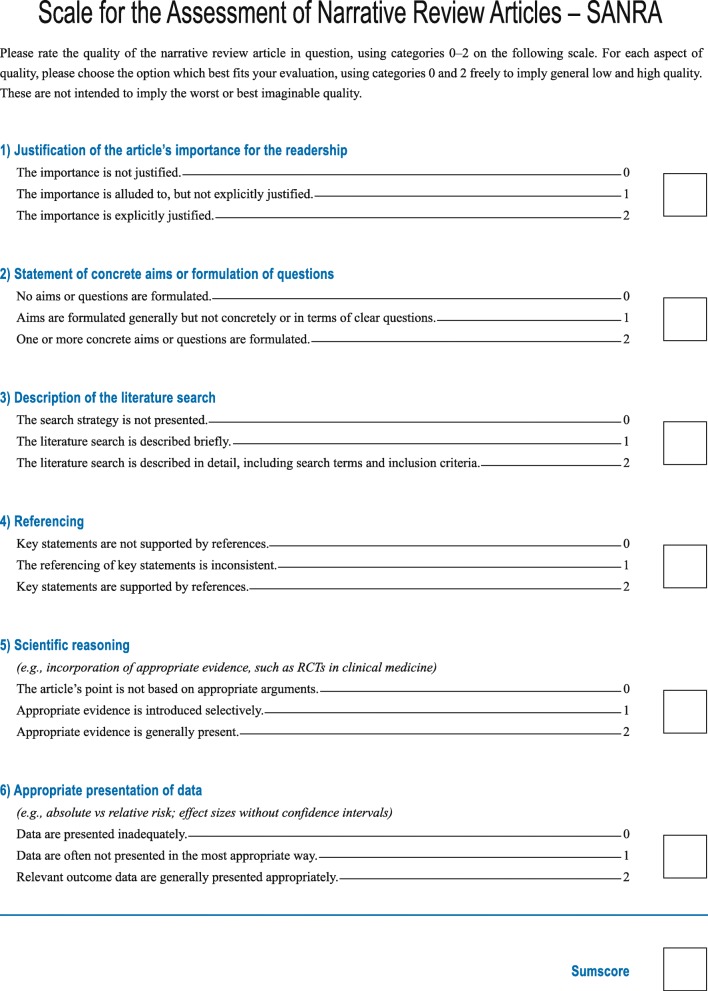
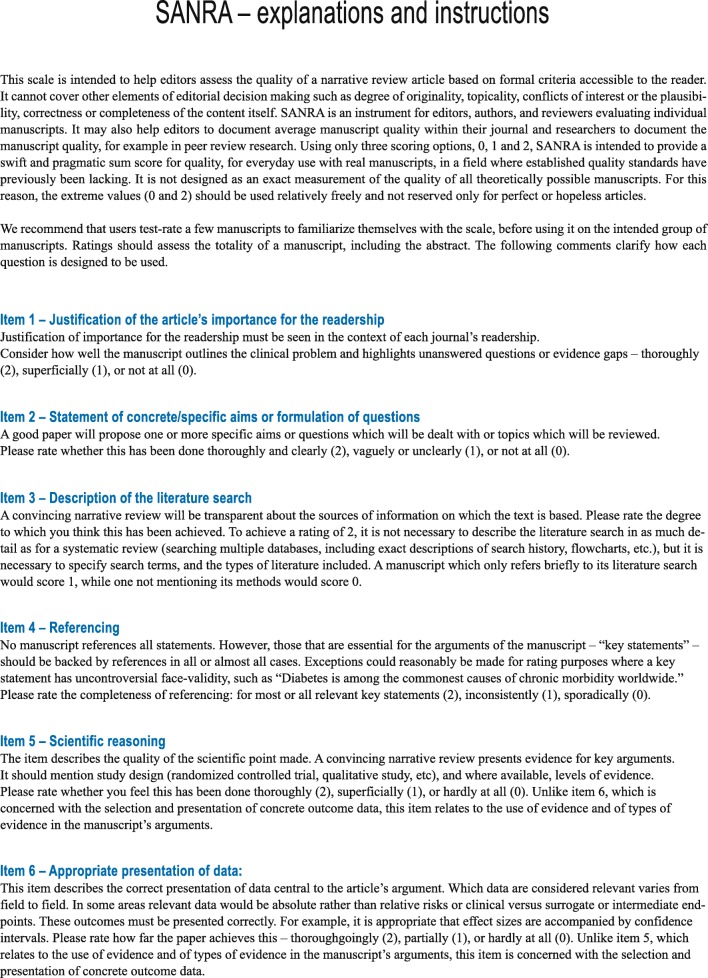
BACKGROUND: Narrative reviews are the commonest type of articles in the medical literature. However, unlike systematic reviews and randomized controlled trials (RCT) articles, for which formal instruments exist to evaluate quality, there is currently no instrument available to assess the quality of narrative reviews. In response to this gap, we developed SANRA, the Scale for the Assessment of Narrative Review Articles. METHODS: A team of three experienced journal editors modified or deleted items in an earlier SANRA version based on face validity, item-total correlations, and reliability scores from previous tests. We deleted an item which addressed a manuscript's writing and accessibility due to poor inter-rater reliability. The six items which form the revised scale are rated from 0 (low standard) to 2 (high standard) and cover the following topics: explanation of (1) the importance and (2) the aims of the review, (3) literature search and (4) referencing and presentation of (5) evidence level and (6) relevant endpoint data. For all items, we developed anchor definitions and examples to guide users in filling out the form. The revised scale was tested by the same editors (blinded to each other's ratings) in a group of 30 consecutive non-systematic review manuscripts submitted to a general medical journal. RESULTS: Raters confirmed that completing the scale is feasible in everyday editorial work. The mean sum score across all 30 manuscripts was 6.0 out of 12 possible points (SD 2.6, range 1-12). Corrected item-total correlations ranged from 0.33 (item 3) to 0.58 (item 6), and Cronbach's alpha was 0.68 (internal consistency). The intra-class correlation coefficient (average measure) was 0.77 [95% CI 0.57, 0.88] (inter-rater reliability). Raters often disagreed on items 1 and 4. CONCLUSIONS: SANRA's feasibility, inter-rater reliability, homogeneity of items, and internal consistency are sufficient for a scale of six items. Further field testing, particularly of validity, is desirable. We recommend rater training based on the "explanations and instructions" document provided with SANRA. In editorial decision-making, SANRA may complement journal-specific evaluation of manuscripts-pertaining to, e.g., audience, originality or difficulty-and may contribute to improving the standard of non-systematic reviews.
Overview
CoChat Summary
TL;DR
SANRA is a six-item, 0–2 scale (maximum 12) for assessing the quality of narrative review articles, developed and field-tested by three journal editors. In 30 consecutive non-systematic review manuscripts, it showed feasible use, sufficient internal consistency and inter-rater reliability, and a modest association with editorial acceptance.
Key findings
- Across 30 manuscripts (90 ratings), the mean SANRA sum score was 6.0 out of 12 (SD 2.6, range 1–12, median 6).
- Internal consistency was Cronbach’s alpha 0.68; corrected item-total correlations ranged from 0.33 (item 3) to 0.58 (item 6).
- Inter-rater reliability was an intra-class correlation coefficient (average measure) of 0.77 [95% CI 0.57, 0.88]; raters often disagreed on items 1 and 4.
- Average SANRA scores were modestly associated with editorial acceptance (mean 6.6, SD 1.9, n = 17) versus rejection (mean 5.1, SD 2.1, n = 13), point biserial correlation 0.37 (t = 2.09, df 28; two-sided p = 0.046).
Methods
- SANRA was developed between 2010 and 2017 by three experienced editors at Deutsches Ärzteblatt; the revised six-item version deleted an item on writing and accessibility due to poor inter-rater reliability.
- The revised scale was tested on 30 consecutive non-systematic review manuscripts submitted to Deutsches Ärzteblatt in 2015; three editor-raters scored them independently and blinded to each other’s ratings.
- Analyses included descriptive statistics, Cronbach’s alpha, corrected item-total correlations, average-measure intra-class correlation using a two-way random effects model (consistency definition), and a post hoc point biserial correlation between SANRA sum scores and acceptance/rejection.
Limitations
- The paper states the main limitation is sample size: 30 manuscripts was a compromise between representativeness, power, and feasibility, and took about 6 months to sample.
- The authors state that the scale’s authors were also the test-raters, so inter-rater reliability may be lower in groups less familiar with SANRA; the study also did not assess test-retest reliability, and results are study-specific.
- The paper acknowledges restricted content validity because SANRA is limited to six items and is a critical appraisal tool rather than a reporting guideline; criterion validity evidence is post hoc and weak, and no established cut-offs exist for comparing manuscripts across settings.
Model-written summary. Check it against the paper before relying on it.
Integrity signals
Registry
Cites
Statistics
Figures
Verification
Claims the paper makes
3 Valid · 0 Not valid · 5 Not checked · 27 Own results and interpretations
The cited sources support only part of this claim — read each source’s verdict below.
In the paper
“Bastian et al. found that they constitute the largest share of all text types in medicine and they concluded that they “remain the staple of medical literature” [1].”
- Also stated in: § Background · plain
“Narrative reviews are the commonest type of articles in the medical literature.”
§ SANRA—a scale for the quality assessment of narrative review articles > Background
What the sources say
- Partly supportedcites [1] Bastian H Glasziou P Chalmers I Seventy-five trials and eleven systematic reviews a day: how will we ever keep up? PLoS Med 2010 7 9 e1000326 10.1371/journal.pmed.1000326 20877712 PMC2943439 sourceExperimental — accuracy not yet measured
In “How Close Are We to Archie Cochrane’s Goal?” and the Summary Points (pages unavailable), the paper calls non-systematic narrative reviews the staple of medical literature synthesis. It does not say they constitute the largest share of all medical text types; that extends a claim about literature synthesis to medical literature as a whole. (LLM, conf=0.88)
plain- Asserted: passes — The authors put it forward as true.
- Checkable: passes — It can be checked against evidence.
- Load-bearing: unclear — It is unclear whether the paper’s conclusions depend on it.
- Based: passes — The paper gives a reason why it holds.
- Also stated in: § Background · plain
The sources with a verdict support this claim; the rest weren’t checked yet, have no full text we could read, or their verdicts aren’t rated yet.
In the paper
“non-systematic reviews or narrative reviews have been widely criticized as unreliable [1, 4].”
§ SANRA—a scale for the quality assessment of narrative review articles > Background
What the sources say
- Supportedcites [1] Bastian H Glasziou P Chalmers I Seventy-five trials and eleven systematic reviews a day: how will we ever keep up? PLoS Med 2010 7 9 e1000326 10.1371/journal.pmed.1000326 20877712 PMC2943439 source
In “How Close Are We to Archie Cochrane’s Goal?”, the paper describes reviews not conducted systematically as having great potential for error and calls them less reliable forms of information. Box 1 also says that articles and textbooks had highlighted the risk of bias and chance in reviews. Together, these passages support the broad characterization that narrative reviews have been criticized as unreliable; page numbers are not provided in our copy. (LLM, conf=0.89)
- Not checked — no full text of the sourcecites [4] Mulrow CD The medical review article: state of the science Ann Intern Med 1987 106 485 488 10.7326/0003-4819-106-3-485 3813259 source
plain- Asserted: passes — The authors put it forward as true.
- Checkable: passes — It can be checked against evidence.
- Load-bearing: passes — The paper’s conclusions depend on it.
- Based: passes — The paper gives a reason why it holds.
- Supported
A result the paper reports from its own data — it cites no other source for it, so there is none to check. The quote shows it is in the paper.
In the paper
“Cronbach’s alpha was 0.68 (internal consistency).”
- Also stated in: § Results · plain
“The scale’s internal consistency, measured as Cronbach’s alpha, was 0.68.”
§ SANRA—a scale for the quality assessment of narrative review articles > Abstract > Results
plainn = 90- Asserted: passes — The authors put it forward as true.
- Checkable: passes — It can be checked against evidence.
- Load-bearing: passes — The paper’s conclusions depend on it.
- Based: passes — The paper gives a reason why it holds.
- Also stated in: § Results · plain
A result the paper reports from its own data — it cites no other source for it, so there is none to check. The quote shows it is in the paper.
In the paper
“Raters often disagreed on items 1 and 4.”
- Also stated in: § Results · plain
“Disagreements most often occurred with regard to items 1 and 4.”
§ SANRA—a scale for the quality assessment of narrative review articles > Abstract > Results
plain- Asserted: passes — The authors put it forward as true.
- Checkable: passes — It can be checked against evidence.
- Load-bearing: unclear — It is unclear whether the paper’s conclusions depend on it.
- Based: passes — The paper gives a reason why it holds.
- Also stated in: § Results · plain
A result the paper reports from its own data — it cites no other source for it, so there is none to check. The quote shows it is in the paper.
In the paper
“The intra-class correlation coefficient (average measure) was 0.77 [95% CI 0.57, 0.88] (inter-rater reliability).”
- Also stated in: § Results · plain
“The intra-class correlation coefficient (average measure) amounted to 0.77 [95% CI 0.57, 0.88; F 4.3; df 29, 58].”
§ SANRA—a scale for the quality assessment of narrative review articles > Abstract > Results
plain- Asserted: passes — The authors put it forward as true.
- Checkable: passes — It can be checked against evidence.
- Load-bearing: passes — The paper’s conclusions depend on it.
- Based: passes — The paper gives a reason why it holds.
- Also stated in: § Results · plain
14 more claims
Create a free account to see all 35 claims and to verify the 3 references still open.
- Probably not a substantial claim. 11
- It may state two separate claims as one. 11
Claims other papers make about this one
Each is checked against this paper’s own text: does it say what the citing paper says it does?
The source backs part of the claim, not all of it — or backs it for a different population, condition or comparison.
In the citing paper
“The review was conducted and reported in accordance with the principles of the Scale for the Assessment of Narrative Review Articles (SANRA), which provides a validated framework for ensuring methodological transparency, scientific rigor, and balanced interpretation in narrative reviews [ 19 ].”
From Paracetamol: A History of Assumptions, Errors, and Evidence Reversals in Pain Management (2026) · cites this paper as [19]
Experimental — accuracy not yet measuredThe source backs part of the claim, not all of it — or backs it for a different population, condition or comparison.
In the citing paper
“As a narrative review, the present work does not include an aggregated quantitative assessment and is more exposed to selection subjectivity than a registered systematic review [124,125].”
From Berberine-Drug Interactions: Mechanisms, Clinical Relevance and Risk Stratification-A Narrative Review (2026) · cites this paper as [124]
Experimental — accuracy not yet measuredThe cited source says what the claim attributes to it.
In the citing paper
“This work is designed as a structured narrative review, with transparent reporting of the documentation strategy, guided by the quality criteria of the Scale for the Assessment of Narrative Review Articles (SANRA) [124].”
From Berberine-Drug Interactions: Mechanisms, Clinical Relevance and Risk Stratification-A Narrative Review (2026) · cites this paper as [124]
The cited source says what the claim attributes to it.
In the citing paper
“we used the following:-Cochrane Risk of Bias 2 (RoB 2) [29] and PEDRO scale tools for RCTs.-AMSTAR 2 [30] checklist for systematic review.-SANRA (Scale for the Assessment of Narrative Review Articles) [31] for narrative reviews.-JBI Checklist for Text and Opinion [32] for expert opinion papers.”
From Pelvic Floor Muscle Training Following Surgery for Pelvic Organ Prolapse: Recommendation from Scientific Literature (2026) · cites this paper as [31]
The cited source says what the claim attributes to it.
In the citing paper
“Data analysis employed a narrative and thematic synthesis methodology,adhering to the SANRA guidelines for narrative reviews (32).”
From Ethical issues in multi-agent AI systems for healthcare: a narrative review (2026) · cites this paper as [32]
12 more claims about this paper
Create a free account to see every claim other papers make about this one.
Citations
Cites
Shea, B. J., Reeves, B. C., Wells, G., Thuku, M., Hamel, C., Moran, J., Moher, D., Tugwell, P., Welch, V., Kristjansson, E., et al. (2017) · BMJ · doi:10.1136/bmj.j4008 · Cited by 10,636 · cited 2×
“Critical appraisal tools have been developed for systematic reviews (e.g., AMSTAR 2 [A MeaSurement Tool to Assess Systematic Reviews] [7]) and papers on RCTs (e.g., the CASP [Critical Appraisal Skills Program] checklist for randomized trials [8]) and other types of medical studies.”
BackgroundStreiner, D. L., & Norman, G. R. (2008) · doi:10.1093/acprof:oso/9780199231881.001.0001 · Cited by 2,631
Critical appraisal skills programme
Singh, J. (2013) · Journal of Pharmacology and Pharmacotherapeutics · doi:10.4103/0976-500x.107697 · Cited by 2,556
Guidelines for Reporting Reliability and Agreement Studies (GRRAS) were proposed
Kottner, J., Audigé, L., Brorson, S., Donner, A., Gajewski, B. J., Hróbjartsson, A., Roberts, C., Shoukri, M., & Streiner, D. L. (2011) · Journal of Clinical Epidemiology · doi:10.1016/j.jclinepi.2010.03.002 · Cited by 2,174
The Mass Production of Redundant, Misleading, and Conflicted Systematic Reviews and Meta‐analyses
IOANNIDIS, J. P. A. (2016) · The Milbank Quarterly · doi:10.1111/1468-0009.12210 · Cited by 1,483 · cited 1×
“While systematic reviews are not per se superior articles and while certain systematic reviews have been criticized lately [3], non-systematic reviews or narrative reviews have”
BackgroundSeventy-five trials and eleven systematic reviews a day: how will we ever keep up?
Bastian, H., Glasziou, P., & Chalmers, I. (2010) · PLoS Medicine · doi:10.1371/journal.pmed.1000326 · Cited by 1,188 · cited 2×
“found that they constitute the largest share of all text types in medicine and they concluded that they “remain the staple of medical literature” [1].”
BackgroundThe Medical Review Article: State of the Science
MULROW, C. D. (1987) · Annals of Internal Medicine · doi:10.7326/0003-4819-106-3-485 · Cited by 856 · cited 1×
“been widely criticized as unreliable [1, 4].”
Writing a narrative biomedical review: considerations for authors, peer reviewers, and editors
Gasparyan, A. Y., Ayvazyan, L., Blackmore, H., & Kitas, G. D. (2011) · Rheumatology International · doi:10.1007/s00296-011-1999-3 · Cited by 694 · cited 1×
“[13], for example, have provided guidance for writing narrative reviews, and Byrne [14] as well as Pautasso [15] has written, from different angles, thoughtful editorials on improving narrative reviews and presented lists of key features of writing a good review—lists that naturally overlap with SANRA items (e.”
BackgroundTen Simple Rules for Writing a Literature Review
Pautasso, M. (2013) · PLoS Computational Biology · doi:10.1371/journal.pcbi.1003149 · Cited by 272 · cited 3×
“[13], for example, have provided guidance for writing narrative reviews, and Byrne [14] as well as Pautasso [15] has written, from different angles, thoughtful editorials on improving narrative reviews and presented lists of key features of writing a good review—lists that naturally overlap with SANRA items (e.”
BackgroundImproving the peer review of narrative literature reviews
Byrne, J. A. (2016) · Research Integrity and Peer Review · doi:10.1186/s41073-016-0019-2 · Cited by 159 · cited 3×
“[13], for example, have provided guidance for writing narrative reviews, and Byrne [14] as well as Pautasso [15] has written, from different angles, thoughtful editorials on improving narrative reviews and presented lists of key features of writing a good review—lists that naturally overlap with SANRA items (e.”
Background
Research works printed but not linked: 3
- Higgins JPT, Green S. (eds.). Cochrane Handbook for Systematic Reviews and Interventions. Version 5.1.0. The Cochrane Collaboration 2011, section 1.2.2., www.handbook.cochrane.org, retrieved on Oct 31, 2018.
- Baethge C Mertens S Goldbeck-Wood S Development of a quality score for the assessment of non-systematic review articles (SANRA) Poster, Seventh International Congress on Peer Review and Biomedical Publication 2013 USA Chicago, Illinois
- Baethge C Goldbeck-Wood S Mertens S A scale for the assessment of non-systematic review articles (SANRA) Poster, Eighth International Congress on Peer and Biomedical Publication 2017 USA Chicago, Illinois
Cited by
Items 701–800 of 4,334
Resolving the Ganges pollution paradox: A policy‐centric systematic review
Sigdel, R., Carlton, G. J., & Gautam, B. (2023) · River · doi:10.1002/rvr2.35 · Cited by 12
“Although there are frameworks for assessing the validity of narrative reviews such as the Scale for the Assessment of Narrative Review Articles (SANRA) (Baethge et al., 2019) and the International Narrative Systematic Assessment (INSA) (La Torre et al., 2015) we found no evidence that narrative reviews of the Ganges w…”
MethodSurgical Treatment for Early Cervical Cancer in the HPV Era: State of the Art
Palumbo, M., Corte, L. D., Ronsini, C., Guerra, S., Giampaolino, P., & Bifulco, G. (2023) · Healthcare · doi:10.3390/healthcare11222942 · Cited by 13
“We adhered to the quality standards for narrative reviews, as defined and quantified by “SANRA—a scale for the quality assessment of narrative review articles” [31].”
MethodMesotherapy as a Promising Alternative to Minoxidil for Androgenetic Alopecia: A Systematic Review
AlEdani, E. M., Kaur, H., Kasapoglu, M., Yadavalli, R., Nawaz, S., Althwanay, A. M., & Nath, T. S. (2024) · Cureus · doi:10.7759/cureus.59705 · Cited by 9
“Systematic reviews were evaluated using the Assessment of Multiple Systematic Reviews (AMSTAR 2) [7], and a Scale for the Quality Assessment of Narrative Review Articles (SANRA) [8] was used for narrative review articles.”
MethodImpact of microRNAs on cardiovascular diseases and aging
Sheikh, M. S. A., & Salma, U. (2024) · Journal of International Medical Research · doi:10.1177/03000605241279190 · Cited by 10
“16 We used several combinations of keywords including CVD and miRNAs, CAD and miRNAs, stable angina and miRNAs, unstable angina and miRNAs, ACS and miRNAs, the severity of CAD and miRNAs, atherosclerotic heart disease and miRNAs, biomarker’s role of miRNAs in CAD and AMI, the therapeutic…”
MethodThe Relationship between OCD and Depression in Adults: A Review of Recent Findings
Pastre, M., Raffard, S., Mallet, L., & López‐Castromán, J. (2025) · Current Psychiatry Reports · doi:10.1007/s11920-025-01589-6 · Cited by 8
“To ensure the methodological quality of our review, we followed recommandations from the Scale for the Assessment of Narrative Review Articles (SANRA) [ 30].”
Cognitive Health and Quality of Life After Surviving Sepsis: A Narrative Review
Ackermann, K., Aryal, N. R., Westbrook, J. I., & Li, L. (2025) · Journal of Intensive Care Medicine · doi:10.1177/08850666251340631 · Cited by 10
Ursoleo, J. D., Bottussi, A., Erdoes, G., Huang, J., & Monaco, F. (2025) · Anaesthesia Critical Care & Pain Medicine · doi:10.1016/j.accpm.2025.101555 · Cited by 19
Ali, A. N. A., Fittipaldi, A., Rocha-Neves, J. P., Ruaro, B., Benedetto, F., Ghadban, Z. A., Simon, G., Lepidi, S., & D’Oria, M. (2025) · JVS-Vascular Insights · doi:10.1016/j.jvsvi.2025.100254 · Cited by 9
Santos, A. P., Rodrigues, R. S., Aarntzen, E. H. J. G., Rosado-de-Castro, P. H., Magis-Escurra, C., & Mello, F. C. D. Q. (2025) · European Respiratory Review · doi:10.1183/16000617.0289-2024 · Cited by 9
“The Scale for the Assessment of Narrative Review Articles (SANRA) scale [27] was used for quality assessment and as a guide for structuring this narrative review.”
Decembrino, N., Scuderi, M. G., Betta, P., Leonardi, R., Bartolone, A., Marsiglia, R., Marangelo, C., Pane, S., Rose, D. U. D., Salvatori, G., et al. (2025) · Nutrients · doi:10.3390/nu17132234 · Cited by 9
“This review followed the guidelines of the Scale for the Assessment of Narrative Review Articles (SANRA) [12].”
The application of therapeutic plasma exchange in sepsis and septic shock: A narrative review
Wu, Y., Guo, H., Huang, H., Ouyang, Y., Yao, R., Ming, Y., Zhou, J., Yuan, Y., Miao, L., & Li, R. (2025) · Science Progress · doi:10.1177/00368504251352747 · Cited by 9
“8 Current status of TPE in the treatment of sepsis The concept of TPE was fi rst introduced by Abel in 1914.”
Khan, M. H., Fatima, M., Adnan, A. B., Jawaid, A., Hassan, S. M., Talal, M., Rahim, S., Mughal, Z. U. N., Patel, A. O., & Singh, A. K. (2025) · Annals of Medicine and Surgery · doi:10.1097/ms9.0000000000003584 · Cited by 11
“This narrative review was conducted following the SANRA (Scale for the Assessment of Narrative Review Articles) criteria to ensure methodological rigor and transparency [35] .”
Li, X., Gao, S., Shan, C., Zhang, Q., Tan, Y., Xu, Y., & Yu, J. (2025) · Frontiers in Immunology · doi:10.3389/fimmu.2025.1643421 · Cited by 17
Hematabadi, A., Rashidlamir, A., Radfar, B., Shourabi, P., Hajimousaei, S., Schauer, M., & Motevalli, M. S. (2025) · Youth · doi:10.3390/youth5040111 · Cited by 13
“…review employed a thematic synthesis methodology and was carried out in a structured manner following established methodological guidelines for narrative literature reviews to ensure rigor, transparency, and coherence in the synthesis process (Baethge et al., 2019; Ferrari, 2015; Motevalli, 2025).”
Artificial intelligence in clinical nutrition. A narrative review
Belkhouribchia, J., & Pen, J. J. (2025) · Clinical Nutrition ESPEN · doi:10.1016/j.clnesp.2025.11.142 · Cited by 12
Gaia‐Oltean, A. I., Borza, D. B., Pop, L., Galea, G., Telecan, T., & Micu, R. (2025) · Healthcare · doi:10.3390/healthcare13243276 · Cited by 10
“All of these steps were inspired by the SANRA scale [12].”
AI-Enabled Precision Nutrition in the ICU: A Narrative Review and Implementation Roadmap
Briassoulis, G. C., & Briassouli, E. (2025) · Nutrients · doi:10.3390/nu18010110 · Cited by 10
“Reporting was guided by SANRA criteria for narrative reviews [5].”
Motevalli, M. S., Boaventura, B. C. B., & Stanford, F. C. (2026) · The Lancet Digital Health · doi:10.1016/j.landig.2026.100980 · Cited by 9
Fu, S., Chen, J., & Wang, X. C. (2026) · Nutrients · doi:10.3390/nu18111830 · Cited by 10
“This approach is appropriate for clarifying concepts and integrating theoretical, behavioral, nutritional, and neurocognitive findings, but it does not allow conclusions about pooled effect sizes or the relative strength of different pathways [69].”
REVISÃO NARRATIVA DA LITERATURA: GUIA METODOLÓGICO COM ETAPAS, CRITÉRIOS DE QUALIDADE E APLICAÇÃO
de Moura, G. C., Barbosa, C. R. D. A. C., & da Rocha, D. L. C. (2026) · RECIMA21 - Revista Científica Multidisciplinar · doi:10.47820/recima21.v7i7.8566 · Cited by 9
Kousios, A., Κouis, P., Hadjivasilis, A., & Panayiotou, A. G. (2020) · Canadian Journal of Kidney Health and Disease · doi:10.1177/2054358120954939 · Cited by 14
Transcranial magnetic stimulation as a diagnostic and therapeutic tool in cerebral palsy
Antczak, J. M. (2021) · Postępy Psychiatrii i Neurologii · doi:10.5114/ppn.2021.110796 · Cited by 9
How should clinicians assess acute dental pain?: A review
Matsuda, S., Itoi, H., Ryoke, T., & Yoshimura, H. (2022) · Medicine · doi:10.1097/md.0000000000031727 · Cited by 9
“[9,10,55,56] Furthermore, this study revealed that many issues must be resolved in the development of new assessment methods for acute dental pain.”
BackgroundA review of the effectiveness of telemedicine in glycemic control in diabetes mellitus patients
Kusuma, C. F., Aristawidya, L., Susanti, C. P., & Kautsar, A. P. (2022) · Medicine · doi:10.1097/md.0000000000032028 · Cited by 11
Validations of Blood Pressure Measuring Devices Using Recognized Protocols
Pardo, V. M., Gómez‐Cantarino, S., Ramírez-Jiménez, M., Navarro‐Flores, E., & Gurrutxaga, M. I. U. (2022) · Journal of Personalized Medicine · doi:10.3390/jpm13010009 · Cited by 10
Shah, A., Lemma, S., Tao, C., & Wong, J. (2023) · Health Services Insights · doi:10.1177/11786329231172675 · Cited by 12
Padilha, P. P. D. O., Gagné, G., Iyer, S. N., Thibeault, E., Levasseur, M. A., Massicotte, H., & Abdel‐Baki, A. (2023) · Santé mentale au Québec · doi:10.7202/1106400ar · Cited by 9
Beckley, A., Wang, J., & Birch, P. (2023) · Safer Communities · doi:10.1108/sc-05-2023-0015 · Cited by 11
Artificial Intelligence in Predictive Maintenance: A Systematic Literature Review on Review Papers
Islam, M. R., Begum, S., & Ahmed, M. U. (2024) · Lecture notes in mechanical engineering · doi:10.1007/978-3-031-39619-9_18 · Cited by 19
Preoperative diagnosis of frailty
Hernández-Aguiar, Y., Becerra, Á. I. L., & Rodríguez, A. (2024) · Journal of International Medical Research · doi:10.1177/03000605241251705 · Cited by 9
“26”
Renal and Genitourinary Ultrasound Evaluation in Emergency and Critical Care: An Overview
Orso, D., Peric, D., Gioia, C. C. D., Comisso, I., Bove, T., Ban, A., Fonda, F., & Federici, N. (2024) · Healthcare · doi:10.3390/healthcare12131356 · Cited by 13
Vasques, A. C. J., Capitani, C. D., Eisenberg, D. M., Velloso, L. A., & Geloneze, B. (2024) · Archives of Endocrinology and Metabolism · doi:10.20945/2359-4292-2023-0491 · Cited by 11
The evolving role of social media in paediatric dentistry: A narrative review
Bhatara, S., Goswami, M., Saxena, A., Pathak, P., Tuli, S., & Saxena, B. (2024) · Global Pediatrics · doi:10.1016/j.gpeds.2024.100221 · Cited by 10
Oral Neuropathy Associated with Commonly used Chemotherapeutic Agents: A Narrative Review
Kouri, M., Rekatsina, M., Vadalouca, A., Viswanath, O., & Varrassi, G. (2024) · Current Pain and Headache Reports · doi:10.1007/s11916-024-01305-8 · Cited by 10
“As this narrative review, conducted following the Scale of Assessment of Narrative Review Articles (SANRA) guidelines [ 13 ], is based on data from previously published research and does not involve any human enrolment, ethics committee approval was not required.”
Piriyaprasath, K., Kakihara, Y., Hasegawa, M., Iwamoto, Y., Hasegawa, Y., Fujii, N., Yamamura, K., & Okamoto, K. (2024) · Nutrients · doi:10.3390/nu16172868 · Cited by 15
Women’s Health Across the Lifespan: A Sex- and Gender-Focused Perspective
McKinney, J. L., Clinton, S. C., & Keyser, L. E. (2024) · Physical Therapy · doi:10.1093/ptj/pzae121 · Cited by 16
Stolojanu, C., Doros, G. S., Bratu, M. L., Ciobanu, I. C., Munteanu, K., Iacob, E. R., Ghenciu, L. A., Stoicescu, E. R., & Dima, M. A. (2024) · Diagnostics · doi:10.3390/diagnostics14212443 · Cited by 9
“The selection of the articles was made according to SANRA (Scale for the Assessment of Narrative Review Articles) guidelines [32].”
MethodNeuromodulation Strategies in Lifelong Bipolar Disorder: A Narrative Review
Bernabei, L., Leone, B., Hirsch, D., Mentuccia, V., Panzera, A., Riggio, F., Sangiovanni, L., Piserchia, V., Nicolò, G., & Pompili, E. (2024) · Behavioral Sciences · doi:10.3390/bs14121176 · Cited by 13
“To conduct this narrative review, the authors followed the SANRA (Scale for the quality Assessment of Narrative Review Articles) guidelines [27] and supplemented them with the SWiM checklist [28] to enhance the information related to the synthesis process and improve the overall quality of the…”
Emerging Trends and Future Perspectives in Digital Dentistry for Rural Areas: An Update
Asanza, D. M. (2024) · Advances in medical technologies and clinical practice book series · doi:10.4018/979-8-3693-7165-7.ch001 · Cited by 9
The increasing global burden of cancer: implications for anaesthesia and peri‐operative medicine
Guerra‐Londono, C. E., Uribe‐Marquez, S., Shah, R. A., & Gottumukkala, V. N. R. (2025) · Anaesthesia · doi:10.1111/anae.16514 · Cited by 9
“This manuscript adheres to the recommendations from the SANRA recommendations fornarrative reviews [8].”
Role of Cannabis in the Management of Chronic Non-Cancer Pain: A Narrative Review
Al-Husinat, L., Obeidat, S., Azzam, S., Al-Gwairy, Y., Obeidat, F., Sharie, S. A., Haddad, D., Haddad, F. F., Rekatsina, M., Leoni, M. L. G., et al. (2025) · Clinics and Practice · doi:10.3390/clinpract15010016 · Cited by 10
Human Papillomavirus: A Narrative Review for Dental Providers in Prevention and Care
Lipsky, M. S., Wolfe, G., Radilla, B. A., & Hung, M. (2025) · International Journal of Environmental Research and Public Health · doi:10.3390/ijerph22030439 · Cited by 11
“…explanation of the review’s importance/relevance, (b) a statement of the aims of the review, (c) a description of the literature search, (d) targeted referencing, (e) solid logic or scientific reasoning, (f) adequate presentation of relevant, and (g) appropriate endpoint data and conclusions [24].”
Mapping Review of the Correlations Between Periodontitis, Dental Caries, and Endocarditis
Dioguardi, M., Guerra, C., Laterza, P., Illuzzi, G., Sovereto, D., Laneve, E., Martella, A., Muzio, L. L., & Ballini, A. (2025) · Dentistry Journal · doi:10.3390/dj13050215 · Cited by 11
“This mapping review was prepared according to the guidelines of the SANRA (Scale for the Assessment of Narrative Review Articles) [10].”
Donohue, C., Carnaby, G., & Garand, K. L. (2021) · American Journal of Speech-Language Pathology · doi:10.1044/2021_ajslp-21-00004 · Cited by 11
Lee, Y. (2022) · International Journal of Dentistry · doi:10.1155/2022/2005935 · Cited by 10
“Narrative review articles are common in the medical literature and better address a wider topic than systematic review articles [12].”
Darooneh, T., Ozgoli, G., Keshavarz, Z., & Nasiri, M. (2022) · Sexual & Relationship Therapy · doi:10.1080/14681994.2022.2085250 · Cited by 10
“…based on the main structures of the SANDRA checklist (a scale for the quality assessment of narrative review articles) which includes explanations on six main areas of importance, aims of the review, literature search, referencing, evidence level, and presentation of data (Baethge et al., 2019).”
Hoare, E., Couston, N., & Hall, K. (2022) · Frontiers in Psychology · doi:10.3389/fpsyg.2022.856241 · Cited by 10
“The Scale for the Assessment of Narrative Review Articles informed the methods for this review (Baethge et al., 2019).”
MethodGonzález-Rodríguez, A., Seeman, M. V., Díaz‐Pons, A., Ayesa‐Arriola, R., Natividad, M., Calvo, E., & Monreal, J. A. (2022) · Journal of Clinical Medicine · doi:10.3390/jcm11154550 · Cited by 13
Social capital-based financial literacy to improve business performance: a narrative review
Meitriana, M. A., Yuliarmi, N. N., Utama, M. S., & Marhaeni, A. A. I. N. (2022) · International Journal on Social Science Economics and Art · doi:10.35335/ijosea.v12i2.97 · Cited by 11
“The Scale guides the writing of this narrative review for the Assessment of Narrative Review Articles (SANRA) (Baethge et al. (2019); Baethge C, Goldbeck-Wood S (2022).”
MethodDutta, A. (2023) · Homœopathic Links · doi:10.1055/s-0043-57041 · Cited by 11
Pires, C. M. B. F. (2023) · Medicina · doi:10.3390/medicina59071184 · Cited by 10
Kanda, S., Chatha, U., Odoma, V. A., Pitliya, A., AlEdani, E. M., Bhangu, J. K., Javed, K., Manshahia, P. K., Nahar, S., & Hamid, P. (2023) · Cureus · doi:10.7759/cureus.44166 · Cited by 10
Preclinical testing of expired antivenoms and its uses in real-world experience: a systematic review
Soopairin, S., Patikorn, C., & Taychakhoonavudh, S. (2024) · Emergency Medicine Journal · doi:10.1136/emermed-2023-213707 · Cited by 9
Terzoni, S., Federica, A., Ferrara, P., Mora, C., Wallace, E., & Destrebecq, A. L. L. (2021) · International Journal of Urological Nursing · doi:10.1111/ijun.12271 · Cited by 9
Impact of COVID-19 on aortic operations
Bissacco, D., Franchin, M., Piffaretti, G., Luzzani, L., D’Oria, M., Casana, R., Domanin, M., Bellosta, R., & Trimarchi, S. (2021) · Seminars in Vascular Surgery · doi:10.1053/j.semvascsurg.2021.04.002 · Cited by 10
d’Alessandro, M., Bergantini, L., Bargagli, E., & Vidal, S. (2021) · Life · doi:10.3390/life11121401 · Cited by 9
“Martin-Medina A, Am J Respir Crit Care Med, 2018 [12] 2 2 0 1 2 1 8”
MethodInfluentialFerreira‐da‐Silva, R., Ribeiro‐Vaz, I., Morato, M., & Polónia, J. J. (2022) · European Journal of Clinical Investigation · doi:10.1111/eci.13763 · Cited by 9
McGrath, R. L., MacDonald, J. B., Verdon, S. E., Parnell, T., & Smith, M. (2021) · New Zealand Journal of Physiotherapy · doi:10.15619/nzjp/49.2.03 · Cited by 10
“While a systematic review approach was considered, the narrative review approach is “better suited to addressing a topic in wider ways” (Baethge et al., 2019, p. 2) and offers “greater flexibility in searching and synthesizing articles” (Paré & Kitsiou, 2017, p. 172).”
MethodDalipi, Z. S., & Dragidella, F. (2022) · Dentistry Journal · doi:10.3390/dj10070120 · Cited by 13
“For the guiding principles of this review, we used the critical appraisal tool SANRA (Scale for the Assessment of Narrative Review Articles) to control for the quality of this manuscript [30].”
MethodThe epidemiology and disease burden of rotavirus infection in the Salento peninsula, Italy
Grassi, T., Donno, A. D., Guido, M., Gabutti, G., & Collaborative Group for the Surveillance of Rotavirus Infection (2008) · The Turkish Journal of Pediatrics · doi:10.24953/turkjpediatr.2008.2398 · Cited by 10
A arte e a ciência de escrever um artigo científico de revisão
Vidal, E. I. D. O., & Fukushima, F. B. (2021) · Cadernos de Saúde Pública · doi:10.1590/0102-311x00063121 · Cited by 9
A necessidade da geografia eleitoral: as possibilidades do campo
de Azevedo, D. A. (2023) · GEOUSP Espaço e Tempo (Online) · doi:10.11606/issn.2179-0892.geousp.2023.204649 · Cited by 8
Application of cord blood-derived platelet-rich plasma in the treatment of diseases
Tang, Y., Li, Y., Chen, H., Huang, Y., Huang, C., & Wei, W. (2024) · Journal of International Medical Research · doi:10.1177/03000605241263729 · Cited by 11
Pace, E., Accardo, G., Lupia, T., Brizzi, M. F., Corcione, S., & Rosa, F. G. D. (2024) · Pathogens · doi:10.3390/pathogens13100832 · Cited by 8
“The current narrative review followed the Scale for the Assessment of Narrative Review Articles (SANRA) checklist and we have included a flow-chart of the studies revised (Figure 1) [15].”
InfluentialUpdate on Inherited Pediatric Motor Neuron Diseases: Clinical Features and Outcome
Trabacca, A., Ferrante, C., Oliva, M. C., Fanizza, I., Gallo, I., & Rinaldis, M. D. (2024) · Genes · doi:10.3390/genes15101346 · Cited by 9
“This methodology adheres to recognized guidelines for reporting narrative reviews [14].”
MethodMolecular Characterization of Small Ruminant Lentiviruses in Sheep and Goats: A Systematic Review
Gobbi, P., Pavone, S., Orso, M., Passamonti, F., Righi, C., Beato, M. S., Feliziani, F., & Giammarioli, M. (2024) · Animals · doi:10.3390/ani14233545 · Cited by 9
Khant, N. A., Lumongsod, R. M., Namkoong, S., & Kim, H. (2024) · Science Progress · doi:10.1177/00368504241306270 · Cited by 8
“43 Primarily, research papers published between 2015 and 2023 were chosen by employing speci fi c keywords such as “ groundwater microplastic, ” “ groundwater microplastic and climate change events, ” “ freshwater/groundwater microplastic and extreme weather events: fl ooding, drought, sea-level…”
Linezolid and serotonin syndrome
Wali, H. (2025) · Journal of International Medical Research · doi:10.1177/03000605251315355 · Cited by 8
Gobeil, M., Guillemette, A., Silhadi, M., Charbonneau, L., Bergeron, D., Dominguez‐Vargas, A., Dancause, N., Jodoin, N., Assi, E. B., Amzica, F., et al. (2025) · European Journal of Neuroscience · doi:10.1111/ejn.70046 · Cited by 8
“Additionally, we adapted relevant components of the Preferred Reporting Items for Systematic Reviews and Meta-Analyses (PRISMA) guidelines to enhance transparency in reporting (see Supporting Information) (Page et al. 2021).”
Bissacco, D., Pisani, C., Avallone, G., & D’Alessio, I. (2025) · Journal of Clinical Medicine · doi:10.3390/jcm14061859 · Cited by 12
“Specifically, we utilized the Scale for the Assessment of Narrative Review Articles (SANRA) [10].”
Bone conduction implants and active middle ear implants for adults
Koro, E., Wales, J., & Werner, M. (2025) · Science Progress · doi:10.1177/00368504251328010 · Cited by 8
“13 The scope of this narrative review is to provide an updated overview of the BCDs and AMEIs available on the market today.”
Genome Editing in Medicine: A Scoping Review of Ethical, Bioethical, and Medico-Legal Implications
Gibelli, F., Ricci, G., & Bailo, P. (2025) · The Journal of Law Medicine & Ethics · doi:10.1017/jme.2025.48 · Cited by 9
Isaza, K. A. C., Restrepo, J. C. G., & Uribe, J. C. G. (2025) · trilogía Ciencia Tecnología Sociedad · doi:10.22430/21457778.3272 · Cited by 13
Regulatory mechanisms of O6-methylguanine methyltransferase expression in glioma cells
Fang, C., Zhang, G., Ye, S., Tian, S., Li, H., Zuo, F., Wan, J., & Cai, H. (2025) · Science Progress · doi:10.1177/00368504251345014 · Cited by 10
“13”
Cangelosi, G., Sacchini, F., Palomares, S. M., Sguanci, M. E., Biondini, F., Mancin, S., Amendola, A., Ferrara, G., Caggianelli, G., & Petrelli, F. (2025) · International Journal for Vitamin and Nutrition Research · doi:10.31083/ijvnr36342 · Cited by 9
Medication Causes and Treatment of Delirium in Patients With and Without Dementia
Weidmann, A. E., Matthíasdóttir, R., Proppé, G. B., Tadić, I., Gunnarsson, P., & Jónsdóttir, F. (2025) · Brain and Behavior · doi:10.1002/brb3.70706 · Cited by 10
“…(MMAT) for quantitative non-randomized studies (Hong et al. 2018), the Scale for Assessment of Narrative Review Articles (SANRA) for review papers (Baethge et al. 2019), and the Joanna Briggs Institute (JBI) Critical Appraisal Checklist for Case Reports (Joanna Briggs Institute (JBI) 2020) were…”
How Can Molecules Induce Hemorrhoids? The Role of Genetics and Epigenetics in Hemorrhoidal Disease
Parol, B., Sas, O., Mazurek, M., Data, K., Woźniak, S., & Domagała, Z. (2025) · International Journal of Molecular Sciences · doi:10.3390/ijms26199394 · Cited by 8
“Our narrative review was conducted following the SANRA (Scale for the Assessment of Narrative Review Articles) checklist [190], as it is the standard for narrative reviews.”
Toh, W. L., Richards, S. E., Fernyhough, C., Longden, E., Moseley, P., Ramachandran, P., Thomas, N., & Rossell, S. L. (2025) · Schizophrenia · doi:10.1038/s41537-025-00673-3 · Cited by 8
“Quality assessment of our narrative review based on the Scale for the Quality Assessment of Narrative Review Articles 12 demonstrated an excellent rating of 12/12.”
Influenza vaccine hesitancy in the elderly: Where do we stand?
Pires, C. M. B. F. (2025) · Vaccine · doi:10.1016/j.vaccine.2025.127831 · Cited by 8
Stern, C., Li, J., Stone, J., Khalil, H., Sears, K., Jia, R. M., Bhatarasakoon, P., Aromataris, E., & Fernandez, R. S. (2025) · Research Synthesis Methods · doi:10.1017/rsm.2025.10040 · Cited by 11
Exploring the Relevance of S100A8 and S100A9 Proteins in Preeclampsia: A Narrative Review
Mitranovici, M.-I., Caravia, L. G., Oală, I. E., Tiron, A. T., Buicu, C.-F., Dumitrascu-Biris, D., Munteanu, M. S., Ivan, V. M., Apostol, A., Petre, I., et al. (2025) · International Journal of Molecular Sciences · doi:10.3390/ijms262010118 · Cited by 8
“[23] The selection method is described in the flow diagram (Figure 1).”
Modrego, J., Pantoja‐Arévalo, L., Gómez‐Garré, D., Gesteiro, E., & González‐Gross, M. (2025) · Nutrients · doi:10.3390/nu17203312 · Cited by 8
“This study adheres to the methodological quality standards for a narrative review as assessed by the SANRA criteria [11].”
Ferreira, B. M. P., Rocha, S. V., Nunes-Silva, A., Souza-Gomes, A. F., Rodrigues, F., COELHO, P. M. D. S. C., Bachi, A. L. L., de Oliveira, R. A., Barros, M. P., & Furtado, G. E. (2025) · Immunity & Ageing · doi:10.1186/s12979-025-00515-x · Cited by 8
“Additionally, a combined-method approach was used based on the Population, Intervention, Comparison, Outcome, Time, and Settings (PICOTS) framework to develop the conceptual structure of this review (Table 1) [24–26].”
Cuevas‐Budhart, M. Á., Sánchez-Garre, M., Sánchez-Bermúdez, A., Sobrino-Rodríguez, A., Arniella-Blanco, M. M., Renghea, A., Crespo-Cañizares, A., Cavero‐Redondo, I., Gallardo, J. M., & García-Madrid, M. G. D. P. (2025) · Antioxidants · doi:10.3390/antiox14111349 · Cited by 11
“Two reviewers independently assessed methodological quality and risk of bias using the AMSTAR 2 tool (for systematic reviews) [13], ROBIS (for risk of bias in reviews) [14], and SANRA (for narrative reviews) [15].”
Clinical use of angiogenesis biomarkers in fetal growth restriction: a narrative review
Villalaín, C., Galindo, A., D’Antonio, F., & Herraìz, I. (2025) · The Journal of Maternal-Fetal & Neonatal Medicine · doi:10.1080/14767058.2025.2589630 · Cited by 10
“To ensure a transparent and reproducible identification of the relevant literature, a structured but nonsystematic search was performed in MEDLINE, EMBASE, Cochrane Library, and Web of Science databases from their inception to February 25th 2025 adhering to SANRA’s principles [9].”
Popa, A. E., Popa, E., Dramba, T., Coman, A. E., Poroch, M., Ungureanu, M. I., Bacușcă, A. I., Slănină, A. M., Bacoanu, G., & Poroch, V. (2025) · International Journal of Molecular Sciences · doi:10.3390/ijms262311383 · Cited by 10
“This manuscript is designed as a narrative review and was developed in accordance with the SANRA ( Scale for the Assessment of Narrative Review Articles ) methodological framework [11], which provides structured criteria to ensure conceptual clarity, analytical coherence, and scientific rigor.”
Basistha, B., Paul, F. A., Bhuyan, K., Prasad, J. S. R., & Ali, A. (2025) · Frontiers in Public Health · doi:10.3389/fpubh.2025.1686876 · Cited by 11
“This narrative review was conducted in accordance with the Scale for the Assessment of Narrative Review Articles (SANRA) criteria to ensure methodological transparency, scholarly rigor, and conceptual clarity (88).”
Applying artificial intelligence in neurodevelopmental disorders management and research
Mohamed, S., Ben-Jaafar, A., Frimpong, M., Roy, S., Sanker, V., Nkrumah-Boateng, P. A., Imran, S., Mumeen, A. A., Mohamed, S., & Awuah, W. A. (2026) · European journal of medical research · doi:10.1186/s40001-025-03740-8 · Cited by 9
“This narrative review was conducted using the Scale for the Assessment of Narrative Reviews (SANRA) [10].”
Merlo, M., Zoccatelli, F., Costa, G., Panepinto, L., Friso, S., & Marzano, L. A. (2026) · Journal of Internal Medicine · doi:10.1111/joim.70061 · Cited by 10
“The methodological framework adhered to the SANRA (Scale for the Assessment of Narrative Review Articles) quality criteria to ensure transparency, coherence, and critical appraisal of the literature [28].”
Asad, M. M., Chachar, S., & Almusharraf, N. (2026) · Journal of Professional Capital and Community · doi:10.1108/jpcc-11-2024-0187 · Cited by 10
Cumulative Error in Digital Workflows for Full-Arch Implant Rehabilitation: A Narrative Review
Chen, H.-T., Feng, S., Vo, T. T. T., Wang, Y.-L., Fan, F.-Y., & Lee, I.-T. (2026) · Bioengineering · doi:10.3390/bioengineering13020219 · Cited by 8
“This narrative review was conducted following the recommendations of the Scale for the Assessment of Narrative Review Articles (SANRA) [16].”
Albayrak, A. T., Bülbül, M. V., Rubez, A. C., Fregonesi, A., & Şerefoğlu, E. C. (2026) · International Journal of Impotence Research · doi:10.1038/s41443-026-01271-2 · Cited by 4
Anisere, O., Falowo, M., & Aderoju, R. O. (2023) · International journal of applied research · doi:10.22271/allresearch.2023.v9.i8d.13754 · Cited by 8
Mănescu, D. C., Filip, C., Ionela Cristina, N. A. E., & Ciomag, V. (2026) · Journal of Functional Morphology and Kinesiology · doi:10.3390/jfmk11030245 · Cited by 8
“The same readiness score may also imply different actions in maximal-strength, sprint-power, endurance, or congested team-sport contexts [15–22]. aim, transparent search logic, relevance-based selection, critical synthesis, and explicit conceptual contribution [15].”
Artificial intelligence dependency in college students: a critical narrative review
He, X., Li, S., Cha, R., Wang, L., Shen, Y., Wu, R., Wu, L., Gong, X., & Liu, J. (2026) · Frontiers in Psychology · doi:10.3389/fpsyg.2026.1808268 · Cited by 9
Elbanna, A. A., Ebaya, M. M. A., Mehesen, R., & Ali, A. I. (2026) · International Journal of Adhesion and Adhesives · doi:10.1016/j.ijadhadh.2026.104430 · Cited by 8
Marques-Costa, C., Simões, M. R., Almiro, P. A., Prieto, G., & Pinho, M. S. (2022) · European Psychologist · doi:10.1027/1016-9040/a000484 · Cited by 8
Muddaloor, P., Farinango, M., Ansary, A., Dakka, A., Nazir, Z., Shamim, H., Jean, M., Umair, M., & Khan, S. (2022) · Cureus · doi:10.7759/cureus.29880 · Cited by 13
Maffucci, F., Chang, C., Simhan, J., & Cohn, J. A. (2023) · Antibiotics · doi:10.3390/antibiotics12010156 · Cited by 9
“to optimize review quality and relevance [31].”
A REVISÃO DE LITERATURA COMO METÓDO DE PESQUISA NA GEOGRAFIA:
de Azevedo, D. A., Urias, G., & de Oliveira, L. L. (2023) · Boletim Paulista de Geografia · doi:10.54446/bpg.v109i1.2955 · Cited by 8
Metadata
- Authors
- Baethge, C., Goldbeck-Wood, S., & Mertens, S.
- Affiliations
- University of Cologne (DE)
- BMJ Group (United Kingdom) (GB)
- Corresponding author
- Baethge, Christopher
- ORCID
- Baethge, Christopher
- Venue
- Research Integrity and Peer Review
- Published
- 2019-03-26
- Volume
- 4
- Issue
- 1
- Pages
- 5-5
- ISSN
- 2058-8615 (ISSN-L)
- PMC
- PMC6434870
- OpenAlex
- W2922577842
- Semantic Scholar
- ea7f35b3069b53791c3b746c5c4b3c72a83a526b
- Cited by
- 3,469
- References
- 13
- Citations by year
- 2026: 1823 · 2025: 551 · 2024: 379 · 2023: 309 · 2022: 218 · 2021: 152 · 2020: 32 · 2019: 4
- FWCI
- 20.57
- Type
- journal article
- Language
- en
- Open access
- gold
- doi.org
- Licence
- cc-by
- creativecommons.org/licenses/by/4.0/ (tdm)
- Locations
- Research Integrity and Peer Review (publishedVersion, cc-by)
- Europe PMC (PubMed Central) (publishedVersion, other-oa)
- PubMed Central (publishedVersion, cc-by)
- PubMed (publishedVersion)
- Kölner Universitäts PublikationsServer (Universität zu Köln) (publishedVersion)
- DOAJ (DOAJ: Directory of Open Access Journals) (submittedVersion, cc-by-sa)
- Topics
- Social Sciences › Decision Sciences › Statistics, Probability and Uncertainty › Meta-analysis and systematic reviews
- Social Sciences › Library and Information Sciences › Academic Writing and Publishing
- Social Sciences › Library and Information Sciences › scientometrics and bibliometrics research
- Keywords
- quality assessment scale, manuscript review, inter-rater reliability, level of evidence, scale development
About these checks
Registry, retraction, Cites and statistics results are computed, not judged, with one exception: a printed reference that no index lists is read once by a model before it counts as a citation error. Claims are extracted by a model and kept only when their quote appears verbatim in the text; each cited source is then checked, with a model’s help, for whether it says what the claim relies on. Those verdicts can be wrong — read the claim’s quote and the cited source before relying on one.
The claim verdicts this report counts are experimental: their accuracy is not yet measured.
A language model drew the claims from the paper on 2026-11-10, under version 3 of the claim definition (model deepseek-v4.1-flash, prompt extract-v3).
A second model labelled each claim on 2026-11-10 (model jev-1.13-20260917, definition revision gold-guideline-v0.2).
Cited sources are checked with a language model’s help (gpt-6-sol).
Statistics and arithmetic are recomputed, not judged.
Confidence bands are shown only for fields calibrated on our annotated test set. None is calibrated yet, so no band is shown.
What counts as a claim ›How we measure confidence ›How we check this ›
Are you an author, or do you see a problem with this page? Request a review
Data sources
Bibliographic data: Semantic Scholar, OpenAlex, Crossref.
Contains information from the Semantic Scholar Academic Graph Datasets, made available under the ODC Attribution License (ODC-BY 1.0).
Semantic Scholar’s data is described in: Kinney, R., et al. (2023). The Semantic Scholar Open Data Platform. arXiv:2301.10140.
