

The DOI matches its Crossref record; 24 of the 24 references it cites were found in a registry or an index.
Associations of Cognitive Function Scores with Carbon Dioxide, Ventilation, and Volatile Organic Compound Exposures in Office Workers: A Controlled Exposure Study of Green and Conventional Office Environments
Open accessAbstract
Background: The indoor built environment plays a critical role in our overall well-being because of both the amount of time we spend indoors (~90%) and the ability of buildings to positively or negatively influence our health. The advent of sustainable design or green building strategies reinvigorated questions regarding the specific factors in buildings that lead to optimized conditions for health and productivity. Objective: We simulated indoor environmental quality (IEQ) conditions in “Green” and “Conventional” buildings and evaluated the impacts on an objective measure of human performance: higher-order cognitive function. Methods: Twenty-four participants spent 6 full work days (0900–1700 hours) in an environmentally controlled office space, blinded to test conditions. On different days, they were exposed to IEQ conditions representative of Conventional [high concentrations of volatile organic compounds (VOCs)] and Green (low concentrations of VOCs) office buildings in the United States. Additional conditions simulated a Green building with a high outdoor air ventilation rate (labeled Green+) and artificially elevated carbon dioxide (CO2) levels independent of ventilation. Results: On average, cognitive scores were 61% higher on the Green building day and 101% higher on the two Green+ building days than on the Conventional building day (p < 0.0001). VOCs and CO2 were independently associated with cognitive scores. Conclusions: Cognitive function scores were significantly better under Green+ building conditions than in the Conventional building conditions for all nine functional domains. These findings have wide-ranging implications because this study was designed to reflect conditions that are commonly encountered every day in many indoor environments. Citation: Allen JG, MacNaughton P, Satish U, Santanam S, Vallarino J, Spengler JD. 2016. Associations of cognitive function scores with carbon dioxide, ventilation, and volatile organic compound exposures in office workers: a controlled exposure study of green and conventional office environments. Environ Health Perspect 124:805–812; http://dx.doi.org/10.1289/ehp.1510037
Overview
The claims and statistics of this paper haven’t been checked yet.
Run the check — free, no account needed. It reads the open-access text and checks the sources it cites.
Integrity signals
Registry
Cites
Statistics
Figures
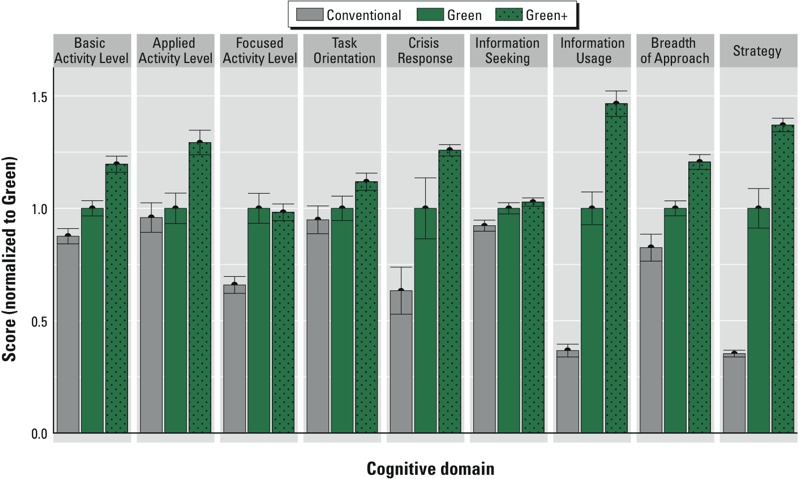
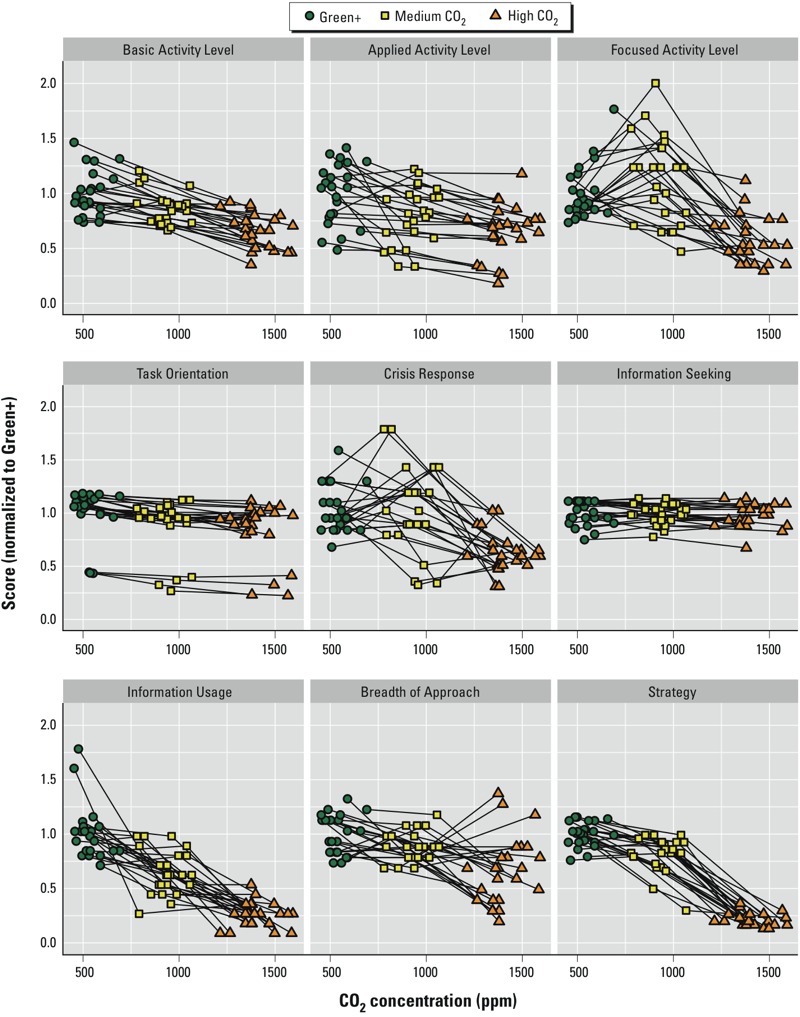
Verification
Claims the paper makes
The claims and statistics of this paper haven’t been checked yet.
Run the check — free, no account needed. It reads the open-access text and checks the sources it cites.
Claims other papers make about this one
Each is checked against this paper’s own text: does it say what the citing paper says it does?
The cited source says what the claim attributes to it.
In the citing paper
“Low ventilation rates and CO2 concentrations normally found in office buildings (approximately 1,000 ppm) have been recently associated with impairment in multiple domains of high-order cognitive function [45,46].”
From Reduced cognitive function during a heat wave among residents of non-air-conditioned buildings: An observational study of young adults in the summer of 2016 (2018) · cites this paper as [46]
Self-check
Percentages, sums and reported differences re-computed from the paper’s own numbers.
The self-check needs the paper’s full text.
Citations
Cites
Ventilation for Acceptable Indoor Air Quality
Falih, M. (2019) · Cited by 2,497
Satish, U., Mendell, M. J., Shekhar, K., Hotchi, T., Sullivan, D., Streufert, S., & Fisk, W. J. (2012) · Environmental Health Perspectives · doi:10.1289/ehp.1104789 · Cited by 1,064 · cited 4×
“However, this conventional thinking is being challenged as the evidence mounts for CO2 as a direct pollutant, not just a marker for other pollutants (Satish et al. 2012).”
BackgroundMethodInfluentialSelf-citationWargocki, P. L., Wyon, D. P., Sundell, J., Clausen, G., & Fanger, P. O. (2000) · Indoor Air · doi:10.1034/j.1600-0668.2000.010004222.x · Cited by 693 · cited 1×
“…building factors, such as ventilation rate; workspace factors, such as the presence of chemical-emitting materials; and personal factors, such as job stress, allergies, and sex (Mendell 1993; Wargocki et al. 2000; Bornehag et al. 2005; Hedge 2009; Hedge and Gaygen 2010; Nishihara et al. 2014).”
Estimates of Improved Productivity and Health from Better Indoor Environments
Fisk, W. J., & Rosenfeld, A. H. (1997) · Indoor Air · doi:10.1111/j.1600-0668.1997.t01-1-00002.x · Cited by 551
Associations between classroom CO2 concentrations and student attendance in Washington and Idaho
Shendell, D. G., Prill, R., Fisk, W. J., Apte, M. G., Blake, D., & Faulkner, D. (2004) · Indoor Air · doi:10.1111/j.1600-0668.2004.00251.x · Cited by 462 · cited 1×
“Corsi et al. (2002) reported CO 2 concentrations > 1,000 ppm in 66% of 120 classrooms in Texas, and Shendell et al. (2004) measured CO 2 concentrations > 1,000 ppm in 45% of 435 classrooms in Washington and Idaho and reported that elevated CO 2 concentrations were associated with increases in…”
BackgroundEffects of Green Buildings on Employee Health and Productivity
Singh, A., Syal, M., Grady, S. C., & Korkmaz, S. (2010) · American Journal of Public Health · doi:10.2105/ajph.2009.180687 · Cited by 320
Non-Specific Symptoms In Office Workers: A Review And Summary Of The Epidemiologic Literature
Mendell, M. J. (1993) · Indoor Air · doi:10.1111/j.1600-0668.1993.00003.x · Cited by 282
Allen, J. G., MacNaughton, P., Laurent, J. G. C., Flanigan, S. S., Eitland, E. S., & Spengler, J. D. (2015) · Current Environmental Health Reports · doi:10.1007/s40572-015-0063-y · Cited by 281 · cited 1×
“To date, we know of no studies that have been conducted in green buildings where participants were blinded to their building condition (Allen et al. 2015).”
Self-citationPersily, A. (2015) · Building and Environment · doi:10.1016/j.buildenv.2015.02.026 · Cited by 249 · cited 2×
“The > 100-year story of ventilation in buildings is complicated and was neatly summarized recently by Persily (2015).”
Hodgson, A. T., Rudd, A., Beal, D., & Chandra, S. (2000) · Indoor Air · doi:10.1034/j.1600-0668.2000.010003178.x · Cited by 240
Research works printed but not linked: 4
- ACGIH (American Conference of Governmental Industrial Hygienists), 2015, 2015 Guide to Occupational Exposure Values.
- Breuer K, Satish U, 2003, Emergency management simulations: an approach to the assessment of decision-making processes in complex dynamic crisis environments., 145
- Corsi RL, Torres VM, Sanders M, Kinney KA, 2002, Carbon dioxide levels and dynamics in elementary schools: results from the TESIAS study., 74
- Swezey, 1998, Preliminary development of a computer-based team performance assessment simulation., Int J Cogn Ergonomics, 2, 163
Cited by
Sorted by citations
Items 901–976 of 976
Surrogate for Ventilation for Infection Control: Using Carbon Dioxide Biomarker
Singh, R., Madaan, N., & Dewan, A. (2026) · Springer eBooks · doi:10.1007/978-981-95-8624-0_5
Dilution Ventilation as the Means for Airborne Infection Control
Singh, R., Madaan, N., & Dewan, A. (2026) · Springer eBooks · doi:10.1007/978-981-95-8624-0_4
SARTINI, G., Morresi, N., Casaccia, S., & Revel, G. M. (2026) · Measurement Sensors · doi:10.1016/j.measen.2026.102007
Effects of Spatial and Visual Openness in Office Environments on EEG-Based Cognitive Efficiency
Park, N. H., & Jun, H. J. (2026) · Applied Sciences · doi:10.3390/app16115221
Glushkova, N., Gusmanov, A., Dyussupova, A., Zhylkybekova, A., Suleimenova, M., Davletov, K., Sekikawa, A. M., & Karaca, F. (2026) · Hygiene and Environmental Health Advances · doi:10.1016/j.heha.2026.100186
Комплексна система управління ризиками в сфері безпеки і здоров'я на роботі для працівників IT-сфери
Шайдюк, Є. (2026) · JOURNAL of Donetsk mining institute · doi:10.31474/1999-981x-2026-1-216-222
Hannad, A., Godon, A., Mercier, F., Dematteo, C., & Pannier, M.-L. (2026) · SSRN Electronic Journal · doi:10.2139/ssrn.6850140
Cai, Y. (2026) · Journal of Asian Architecture and Building Engineering · doi:10.1080/13467581.2026.2678625
Wu, Z., Park, A. B., Awada, M., & Assaad, R. H. (2026) · Engineering Construction & Architectural Management · doi:10.1108/ecam-02-2026-0241
Zhou, H., Li, S., Chen, X. Y., Chong, D., & Liao, S. (2026) · Buildings · doi:10.3390/buildings16112210
Cognitive Resilience to Thermal Stress Insafety-Critical Cleanroom Task
Baigarayeva, Z., Boltaboyeva, A., Kabievna, U. R., Кальпеева, Ж., Turmakhan, S., & Turmakhanbet, D. (2026) · Procedia Computer Science · doi:10.1016/j.procs.2026.04.131
Wang, L. N., Li, J., Chen, H., Niu, D., Huo, J., Ding, Y., Wang, Y., Touré, K., & Yan, N. (2026) · Indoor Air · doi:10.1155/ina/8881722
Kong, M., Son, Y. J., Snyder, E., Byun, K., Pope, Z., & Hogan, C. J. (2026) · Building Research & Information · doi:10.1080/09613218.2026.2673347
“Notably, elevated VOC concentrations in home working environments may also pose potential risks to occupants’ performance (Allen et al., 2016; Satish et al., 2013).”
Siddika, A., Dilsiz, A. D., & Denzer, A. S. (2026) · E3S Web of Conferences · doi:10.1051/e3sconf/202671601040
The Role of Bio-Based Insulation in Enhancing Indoor Air Quality and Human Performance
Madasu, N. G. A., Maddipati, S., & Fini, E. (2026) · E3S Web of Conferences · doi:10.1051/e3sconf/202671601043
Healthy outdoors or healthy ultraviolet? Public health implications if benefits are misattributed
Eadie, E. (2026) · Journal of the European Academy of Dermatology and Venereology · doi:10.1111/jdv.70570
Design of the Digital Pathology Workspace for Artificial Intelligence Integration
Guerini‐Rocco, E., Frascarelli, C., Sorino, J., Porta, F. M., Ghioni, M., Candiani, A., Capizzi, S., Farina, A., Figini, A., Curigliano, G., et al. (2026) · Applied Sciences · doi:10.3390/app16126021
Díaz-López, C., Morales-Ruíz, A., Joyanes-Ruíz, M. D., & Muñoz-González, C. (2026) · Frontiers in Pediatrics · doi:10.3389/fped.2026.1801649
Ramadan, M. N. A., AlKhedher, M. A., Jaber, H., & Alhindawi, R. (2026) · SSRN Electronic Journal · doi:10.2139/ssrn.7023229
Hernández-Montalvo, D. G., Rodríguez-León, A., Ovando-Chacón, G. E., Cruz-Octaviano, E., & Díaz-González, M. (2026) · Atmosphere · doi:10.3390/atmos17070652
Afshari, A., Aganović, A., Latif, H., Melikov, A. K., Cao, G., Kosonen, R., Ekberg, L. E., Thalfeldt, M., Seppänen, O., Wargocki, P. L., et al. (2026) · Advances in Building Energy Research · doi:10.1080/17512549.2026.2692582
Daylighting as a Sustainable Design Parameter: User-Based Evaluation of a Public Building
Çelik, H., & Yetkin, E. G. (2026) · Türk doğa ve fen dergisi :/Türk doğa ve fen dergisi · doi:10.46810/tdfd.1930954
Indoor air quality in Polish schools – carbon dioxide concentrations and ventilation adequacyPreprint
Rogulski, M., Kępa, P., Kristian, A., Moshammer, H. M., Muszyński, A., Fermoso, J., Hanke, W., & Badyda, A. (2026) · SSRN Electronic Journal · doi:10.2139/ssrn.7043293
Healthy Space Index (HSI): a multimodal framework for assessing spatial health
Erkan, İ. (2026) · Architectural Engineering and Design Management · doi:10.1080/17452007.2026.2699915
How environmental conditions shape workload in hybrid work: a longitudinal mediation analysis
Seyedrezaei, M., Becerik-Gerber, B., Roll, S. C., Lucas, G., & Narayanan, S. S. (2026) · Building and Environment · doi:10.1016/j.buildenv.2026.114973
A methodological approach for context-based CO2 assessment practices in dynamic indoor environments
Ghazanfari, N., Reichard, G., Zhang, R., & Agee, P. R. (2026) · Smart and Sustainable Built Environment · doi:10.1108/sasbe-09-2025-0590
Du, B., Crosby, S., Rooyen, C. V., & Licina, D. (2026) · Building and Environment · doi:10.1016/j.buildenv.2026.114985
Salutogenic parameters in the environment of a university: a pilot study
Радионовна, Х. М., & Safonova, A. A. (2026) · Experimental Psychology (Russia) · doi:10.17759/exppsy.2026190204
Jung, J.-S., Jeon, H.-J., Lee, S.-Y., Ko, M.-J., Jang, J.-H., Kim, M.-K., Heo, J., & Park, D. (2026) · Journal of Radioanalytical and Nuclear Chemistry · doi:10.1007/s10967-026-11028-2
“ASHRAE Standard 62.1 targets ventilation performance rather than CO 2 levels directly, and experimental evidence suggests that concentrations above roughly 1000 ppm can impair cognitive performance [29–32].”
InfluentialŠtarc, J., Šobot, A., & Bilić-Šobot, D. (2026) · Sustainability · doi:10.3390/su18147235
Rey, J. F., Cesari, M., & Pernot, J. G. (2026) · Indoor Environments · doi:10.1016/j.indenv.2026.100186
Psychological and Mental Health Outcomes of Energy Transition: From Pollution Stress to Well-Being
Richa, S., Lone, Z. A., & Mishra, S. K. (2026) · World sustainability series · doi:10.1007/978-3-032-30239-7_14
Zhang, B., Chen, Y., Du, Y., Long, L., & Li, N. (2026) · Tunnelling and Underground Space Technology · doi:10.1016/j.tust.2026.107965
Designing Infection-Resilient Cruise Ships: Architectural & Digital Health Strategies
Ceccarelli, C., Ciccozzi, M., Scarpa, F., Ceccarelli, G., & Branda, F. (2026) · EcoHealth · doi:10.1007/s10393-026-01829-y
İç ortam hava kirliliği: Kaynaklar, maruziyet yolları, sağlık etkileri ve sürdürülebilir yaklaşımlar
Bozkurt, Z. (2026) · Ömer Halisdemir Üniversitesi Mühendislik Bilimleri Dergisi · doi:10.28948/ngumuh.1936319
Beber, L. A., Franz, L. A. D. S., Duarte, C. D. M., Bernardes, L. C., Meller, G., Ziebell, C. S., da Silva, A. C. S. B., da Cunha, E. G., & Mendes, N. (2026) · Ambiente Construído · doi:10.1590/s1678-86212026000100996
Koukouvini, K.-A., Fokas, R., & Vantarakis, A. (2026) · Pathogens · doi:10.3390/pathogens15080811
“Insufficient ventilation prolongs aerosol residence time, elevates carbon dioxide as a tracer of rebreathed air and is associated in epidemiological studies with elevated rates of acute respiratory illness, sick-building symptoms and reduced cognitive performance [124,125].”
Mansouri, F. A. (2026) · Unveiling seven continents yearbook journal · doi:10.65326/u7y10028
A review of CO2 removal technologies for a sustainable future
Talaie, A., Fulazzaky, M. A., Rezania, S., & Tamadon, A. (2026) · Environmental Science and Pollution Research · doi:10.1007/s11356-026-38104-0 · Cited by 1
Lakhiar, M. T., Sanmargaraja, S., Kalhoro, M., Olanrewaju, A., Lim, C. H., Ponniah, V., & Mathalamuthu, A. D. (2026) · Environment Development and Sustainability · doi:10.1007/s10668-026-07978-y
Plörer, D., Hammes, S., Huber, J., Öttl, S., & Pfluger, R. (2026) · Bauphysik · doi:10.1002/bapi.70076
Campus-wide assessment of indoor air quality at a university in the United Arab Emirates
Qafisheh, N., & Kour, H. (2026) · Frontiers in Built Environment · doi:10.3389/fbuil.2026.1905303
Short-Term Impact of a Portable Air Cleaner on Cognitive Performance
Nahian, M. R., Du, B., Mendell, A. Y., Hoskin, Z., Daneshazarian, R., Gumus, M., Bourganos, A., Mack, M., & Siegel, J. A. (2026) · ACS ES&T Air · doi:10.1021/acsestair.6c00209
Zhang, S., Yang, D., Zhu, H., Fan, X., & Wargocki, P. L. (2026) · Building and Environment · doi:10.1016/j.buildenv.2026.115141
An indoor air quality policy maturity framework: Global exemplars and governance pathways
Ananthasekar, S., & Lagoudas, G. (2026) · Indoor Environments · doi:10.1016/j.indenv.2026.100190
Alzahab, N. A., Kaculi, R., SARTINI, G., Cosoli, G., Seferi, R., Moayedi, M., Christoforou, R., Ago, D., Arnesano, M., Schweiker, M., et al. (2026) · IEEE International Workshop on Metrology for Living Environment (MetroLivEnv) · doi:10.1109/metrolivenv70468.2026.11659897
“704) aligning with research linking elevated CO 2 to degraded comfort and cognitive performance [24].”
Occupant Comfort in Buildings: Assessment Methods, Models and Future Directions — A Review
Alkhatib, H. (2026) · Journal of Engineering Research · doi:10.1016/j.jer.2026.08.040
Sun, Z., Yang, X., Xu, W., Yao, L., Wang, H., Yue, S., Cheng, Y., Qi, Y., & Pan, G. (2026) · Chemical Engineering Journal · doi:10.1016/j.cej.2026.181814
Plant efficacy in biophilic design: A novel three-tiered assessment framework
Lassalle, M. W. (2026) · Indoor and Built Environment · doi:10.1177/1420326x261487049
Braga, M. P., de Oliveira, R., & Broday, E. E. (2026) · Indoor and Built Environment · doi:10.1177/1420326x261486809
Bie, H., Tian, J., Ayati, P., Pan, Y., Loftness, V., Gilligan, B., & Song, S. (2026) · Developments in the Built Environment · doi:10.1016/j.dibe.2026.101050
Evaluating personal air quality monitors for PM2.5 and CO2: Insights from a year-long pilot study
Papathanasiou, S., & Argyropoulos, C. D. (2026) · Atmospheric Pollution Research · doi:10.1016/j.apr.2026.103210
Pedro, N., Pimentel, E. P., Piedade, J., & Cruz, E. (2026) · Springer international handbooks of education · doi:10.1007/978-981-95-2591-1_29-1
A Knowledge Graph-Driven Smart System for Incentive-Based Work Productivity Support
Stamoglou, T., Dimara, A., Tzitzios, I., Kladovasilakis, N., Fouskas, K. G., & Anagnostopoulos, C. (2026) · Applied Sciences · doi:10.3390/app16199714
Application of adaptive AI in the biophilic dwelling design process: a review
Cisyulia Octavia, H. S., Mediastika, C. E., Felasari, S., Binarti, F., & Anggoro, P. W. (2026) · Architectural Engineering and Design Management · doi:10.1080/17452007.2026.2738227
Attribution of Elevated Indoor CO2 Levels to Household Energy Consumption
Fu, J., Li, Y., Jiang, K., Zhao, X., Huang, T., Men, Y., Liu, X., & Shen, G. (2026) · ACS ES&T Air · doi:10.1021/acsestair.6c00243
Lee, J.-W. (2026) · Architectural research · doi:10.1007/s44515-026-00025-x
A Dynamic Bayesian Network-Based Prediction Method for Cognitive Ability of Long-Duration Operators
Li, S., Zhou, X., Yu, Y., Li, P., Pang, L., Zhang, L., & Hui, B. (2026) · Aerospace · doi:10.3390/aerospace13100910
Cognitive Environmental Load Design: Calibrating What Buildings Require of Their Occupants
Lippi, F., Capaccioli, F., Guglielmino, D., Miani, A., Mandarini, M., Mariani, D., White, R., & Greco, E. (2026) · Buildings · doi:10.3390/buildings16193959
Ventilation Without A Meter: Energy, Health, and Buildings We Cannot Sense
Li, Y., Li, A., Jia, W., & (32470), Y. W. (2026) · Power and Energy Future · doi:10.26599/pef.2026.9650024
Ji, J. S., Smalla, K.-H., Zhu, Y.-G., & Myers, S. S. (2026) · International Journal of Epidemiology · doi:10.1093/ije/dyag195
Human Environmental Quality: Testing the Incremental Validity of Sensory and Restorative Domains
Capaccioli, F., Lippi, F., Mandarini, M., Mariani, D., White, R., Guglielmino, D., Miani, A., & Greco, E. (2026) · International Journal of Environmental Research and Public Health · doi:10.3390/ijerph23101305
Sai Sumanth, M., & Sarkar, A. (2026) · SSRN Electronic Journal · doi:10.2139/ssrn.7601407
Garzia, F., Pozza, C., Audenaert, A., & Verbeke, S. (2026) · Developments in the Built Environment · doi:10.1016/j.dibe.2026.101075
Ameen, A., & Rashid, F. L. (2026) · Energies · doi:10.3390/en19204852
Zhang, X., Rezhaguli, K., Liu, Y., Xie, J., & Wargocki, P. L. (2026) · Building and Environment · doi:10.1016/j.buildenv.2026.115417
Human‐Centered Monitoring of Asphalt Emissions: Linking Exposure, Climate, and Health
Rashid, S., Yazdani, H., Verpeut, J. L., Pooladvand, S., Akbarzadeh, V., Shamshiripour, A., & Fini, E. H. (2026) · Safety Science and Technology · doi:10.1002/sst3.70057
Zhao, Z., Duan, X., & Li, B. (2026) · SSRN Electronic Journal · doi:10.2139/ssrn.7629275
Nyembwe, J.-P. K. B., Ogundiran, J. O., Simões, N. A. V., & da Silva, M. G. (2026) · Hygiene · doi:10.3390/hygiene6040069
CO2 as a proxy for PM and VOCs in classrooms across ventilation types and activities
Du, B., Rey, J. F., Cesari, M., Pernot, J. G., & Licina, D. (2026) · Indoor Environments · doi:10.1016/j.indenv.2026.100200
Zihan, T. H., Mahir, H., Munir, M. S., Hasan, M. M., Hasan, M., & Habib, M. T. (2026) · Lecture notes in networks and systems · doi:10.1007/978-3-032-27544-8_36
The Transformative Potential of Biophilic Classrooms
Leif, K., Loftness, V., & Hameen, E. C. (2026) · Springer international handbooks of education · doi:10.1007/978-981-95-2591-1_13-1
Schreiber, L., Schuh, B., Shchegelskiy, K., Wardah, W., Büyüktaş, T. M. K., Möller, S., & Spang, R. P. (2026) · Research Square · doi:10.21203/rs.3.rs-11222803/v1
Ramadan, M. N. A., AlKhedher, M. A., Jaber, H., & Alhindawi, R. (2026) · Machine Learning with Applications · doi:10.1016/j.mlwa.2026.101058
Lee, J., & Shepley, M. M. (2026) · Indoor and Built Environment · doi:10.1177/1420326x261500671
Pedrazzoli, A., Farokhniaee, A., Fumagalli, N., & Senes, G. (2026) · Buildings · doi:10.3390/buildings16214212
Metadata
- Authors
- Allen, J. G., MacNaughton, P., Satish, U., Santanam, S., Vallarino, J., & Spengler, J. D.
- Affiliations
- Harvard University (US)
- SUNY Upstate Medical University (US)
- Syracuse University (US)
- Corresponding author
- Allen, Joseph G.
- Venue
- Environmental Health Perspectives
- Publisher
- American Chemical Society (ACS)
- Published
- 2015-10-26
- Volume
- 124
- Issue
- 6
- Pages
- 805-812
- ISSN
- 0091-6765 (ISSN-L)
- 1552-9924
- PMC
- PMC4892924
- OpenAlex
- W2412131385
- Cited by
- 977
- References
- 24
- Citations by year
- 2026: 138 · 2025: 121 · 2024: 121 · 2023: 88 · 2022: 103 · 2021: 107 · 2020: 86 · 2019: 84 · 2018: 66 · 2017: 36 · 2016: 25 · 2015: 1
- FWCI
- 26.76
- Type
- journal article
- Language
- en
- Open access
- gold
- doi.org
- Licence
- public-domain
- creativecommons.org/licenses/by/4.0/ (vor, 795 d)
- Locations
- Environmental Health Perspectives (publishedVersion, public-domain)
- PubMed Central (publishedVersion, public-domain)
- PubMed (publishedVersion)
- Digital Access to Scholarship at Harvard (DASH) (Harvard University) (submittedVersion, cc-by)
- Funders
- Harvard T.H. Chan School of Public Health
- National Institute of Environmental Health Sciences (T32ES007069)
- Topics
- Physical Sciences › Environmental Science › Health, Toxicology and Mutagenesis › Indoor Air Quality and Microbial Exposure
- Physical Sciences › Engineering › Architecture › Facilities and Workplace Management
- Physical Sciences › Engineering › Building and Construction › Sustainable Building Design and Assessment
- Keywords
- cognitive function, carbon dioxide exposure, indoor ventilation, volatile organic compounds, sustainable construction, indoor environmental quality, office workers, higher-order cognition
- MeSH terms
- Air Pollutants, Occupational, Carbon Dioxide, Cognition, Humans, United States, Ventilation, Occupational Exposure, Air Pollution, Indoor, Volatile Organic Compounds
About these checks
Registry, retraction, Cites and statistics results are computed, not judged, with one exception: a printed reference that no index lists is read once by a model before it counts as a citation error. Claims are extracted by a model and kept only when their quote appears verbatim in the text; each cited source is then checked, with a model’s help, for whether it says what the claim relies on. Those verdicts can be wrong — read the claim’s quote and the cited source before relying on one.
Statistics and arithmetic are recomputed, not judged.
Confidence bands are shown only for fields calibrated on our annotated test set. None is calibrated yet, so no band is shown.
What counts as a claim ›How we measure confidence ›How we check this ›
Are you an author, or do you see a problem with this page? Request a review
