

The DOI matches its Crossref record; 24 of the 24 references it cites were found in a registry or an index.
Associations of Cognitive Function Scores with Carbon Dioxide, Ventilation, and Volatile Organic Compound Exposures in Office Workers: A Controlled Exposure Study of Green and Conventional Office Environments
Open accessAbstract
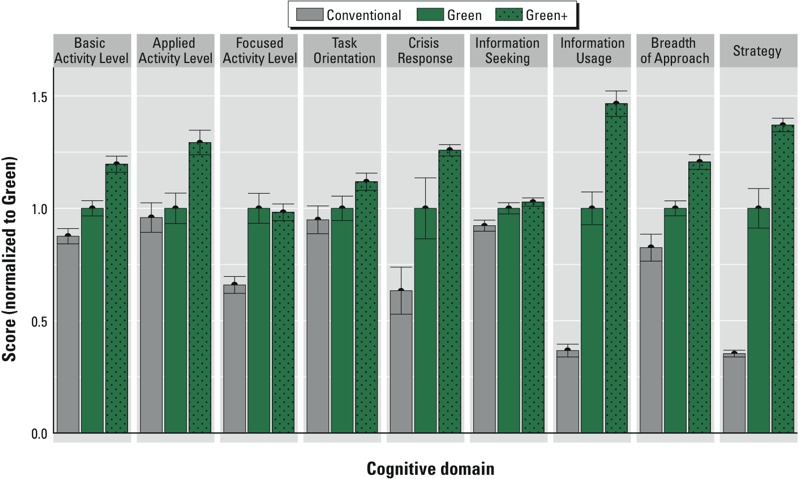
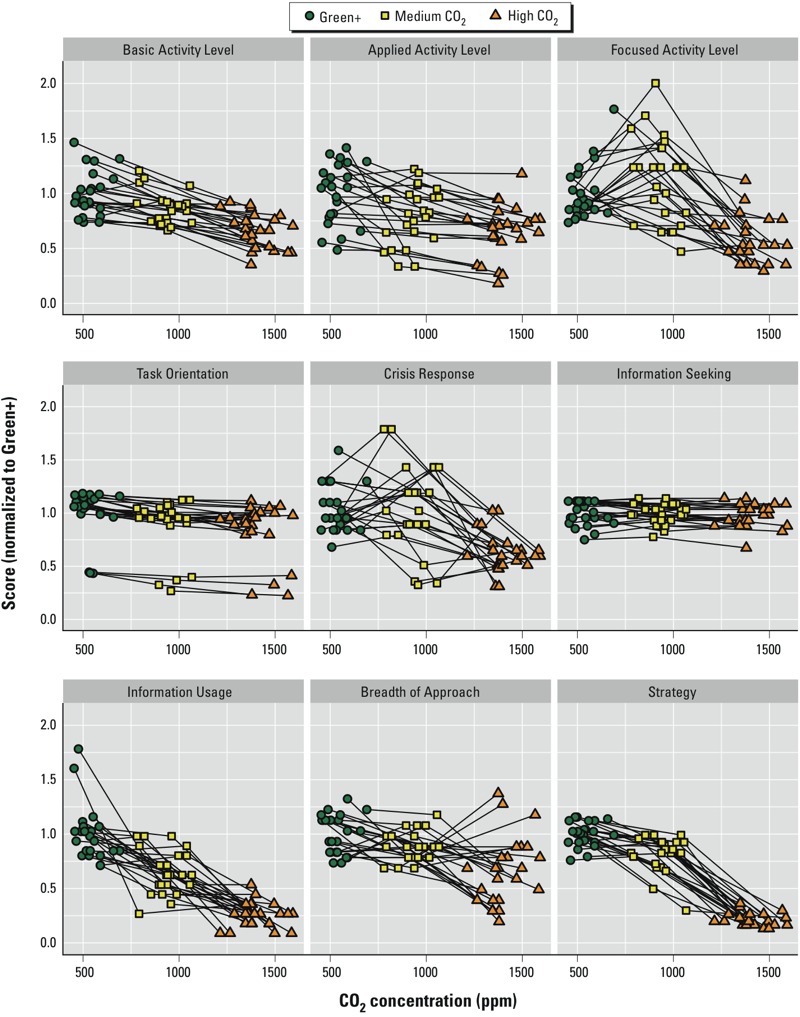
Background: The indoor built environment plays a critical role in our overall well-being because of both the amount of time we spend indoors (~90%) and the ability of buildings to positively or negatively influence our health. The advent of sustainable design or green building strategies reinvigorated questions regarding the specific factors in buildings that lead to optimized conditions for health and productivity. Objective: We simulated indoor environmental quality (IEQ) conditions in “Green” and “Conventional” buildings and evaluated the impacts on an objective measure of human performance: higher-order cognitive function. Methods: Twenty-four participants spent 6 full work days (0900–1700 hours) in an environmentally controlled office space, blinded to test conditions. On different days, they were exposed to IEQ conditions representative of Conventional [high concentrations of volatile organic compounds (VOCs)] and Green (low concentrations of VOCs) office buildings in the United States. Additional conditions simulated a Green building with a high outdoor air ventilation rate (labeled Green+) and artificially elevated carbon dioxide (CO2) levels independent of ventilation. Results: On average, cognitive scores were 61% higher on the Green building day and 101% higher on the two Green+ building days than on the Conventional building day (p < 0.0001). VOCs and CO2 were independently associated with cognitive scores. Conclusions: Cognitive function scores were significantly better under Green+ building conditions than in the Conventional building conditions for all nine functional domains. These findings have wide-ranging implications because this study was designed to reflect conditions that are commonly encountered every day in many indoor environments. Citation: Allen JG, MacNaughton P, Satish U, Santanam S, Vallarino J, Spengler JD. 2016. Associations of cognitive function scores with carbon dioxide, ventilation, and volatile organic compound exposures in office workers: a controlled exposure study of green and conventional office environments. Environ Health Perspect 124:805–812; http://dx.doi.org/10.1289/ehp.1510037
Overview
The claims and statistics of this paper haven’t been checked yet.
Run the check — free, no account needed. It reads the open-access text and checks the sources it cites.
Integrity signals
Registry
Cites
Statistics
Figures
Verification
Claims the paper makes
The claims and statistics of this paper haven’t been checked yet.
Run the check — free, no account needed. It reads the open-access text and checks the sources it cites.
Claims other papers make about this one
Each is checked against this paper’s own text: does it say what the citing paper says it does?
The cited source says what the claim attributes to it.
In the citing paper
“Low ventilation rates and CO2 concentrations normally found in office buildings (approximately 1,000 ppm) have been recently associated with impairment in multiple domains of high-order cognitive function [45,46].”
From Reduced cognitive function during a heat wave among residents of non-air-conditioned buildings: An observational study of young adults in the summer of 2016 (2018) · cites this paper as [46]
Self-check
Percentages, sums and reported differences re-computed from the paper’s own numbers.
The self-check needs the paper’s full text.
Citations
Cites
Ventilation for Acceptable Indoor Air Quality
Falih, M. (2019) · Cited by 2,497
Satish, U., Mendell, M. J., Shekhar, K., Hotchi, T., Sullivan, D., Streufert, S., & Fisk, W. J. (2012) · Environmental Health Perspectives · doi:10.1289/ehp.1104789 · Cited by 1,064 · cited 4×
“However, this conventional thinking is being challenged as the evidence mounts for CO2 as a direct pollutant, not just a marker for other pollutants (Satish et al. 2012).”
BackgroundMethodInfluentialSelf-citationWargocki, P. L., Wyon, D. P., Sundell, J., Clausen, G., & Fanger, P. O. (2000) · Indoor Air · doi:10.1034/j.1600-0668.2000.010004222.x · Cited by 693 · cited 1×
“…building factors, such as ventilation rate; workspace factors, such as the presence of chemical-emitting materials; and personal factors, such as job stress, allergies, and sex (Mendell 1993; Wargocki et al. 2000; Bornehag et al. 2005; Hedge 2009; Hedge and Gaygen 2010; Nishihara et al. 2014).”
Estimates of Improved Productivity and Health from Better Indoor Environments
Fisk, W. J., & Rosenfeld, A. H. (1997) · Indoor Air · doi:10.1111/j.1600-0668.1997.t01-1-00002.x · Cited by 551
Associations between classroom CO2 concentrations and student attendance in Washington and Idaho
Shendell, D. G., Prill, R., Fisk, W. J., Apte, M. G., Blake, D., & Faulkner, D. (2004) · Indoor Air · doi:10.1111/j.1600-0668.2004.00251.x · Cited by 462 · cited 1×
“Corsi et al. (2002) reported CO 2 concentrations > 1,000 ppm in 66% of 120 classrooms in Texas, and Shendell et al. (2004) measured CO 2 concentrations > 1,000 ppm in 45% of 435 classrooms in Washington and Idaho and reported that elevated CO 2 concentrations were associated with increases in…”
BackgroundEffects of Green Buildings on Employee Health and Productivity
Singh, A., Syal, M., Grady, S. C., & Korkmaz, S. (2010) · American Journal of Public Health · doi:10.2105/ajph.2009.180687 · Cited by 320
Non-Specific Symptoms In Office Workers: A Review And Summary Of The Epidemiologic Literature
Mendell, M. J. (1993) · Indoor Air · doi:10.1111/j.1600-0668.1993.00003.x · Cited by 282
Allen, J. G., MacNaughton, P., Laurent, J. G. C., Flanigan, S. S., Eitland, E. S., & Spengler, J. D. (2015) · Current Environmental Health Reports · doi:10.1007/s40572-015-0063-y · Cited by 281 · cited 1×
“To date, we know of no studies that have been conducted in green buildings where participants were blinded to their building condition (Allen et al. 2015).”
Self-citationPersily, A. (2015) · Building and Environment · doi:10.1016/j.buildenv.2015.02.026 · Cited by 249 · cited 2×
“The > 100-year story of ventilation in buildings is complicated and was neatly summarized recently by Persily (2015).”
Hodgson, A. T., Rudd, A., Beal, D., & Chandra, S. (2000) · Indoor Air · doi:10.1034/j.1600-0668.2000.010003178.x · Cited by 240
Research works printed but not linked: 4
- ACGIH (American Conference of Governmental Industrial Hygienists), 2015, 2015 Guide to Occupational Exposure Values.
- Breuer K, Satish U, 2003, Emergency management simulations: an approach to the assessment of decision-making processes in complex dynamic crisis environments., 145
- Corsi RL, Torres VM, Sanders M, Kinney KA, 2002, Carbon dioxide levels and dynamics in elementary schools: results from the TESIAS study., 74
- Swezey, 1998, Preliminary development of a computer-based team performance assessment simulation., Int J Cogn Ergonomics, 2, 163
Cited by
Sorted by citations
Items 801–900 of 976
(2024) · Duke University Press eBooks · doi:10.1215/9781478027577-010
(2024) · Duke University Press eBooks · doi:10.1215/9781478027577-011
(2024) · Duke University Press eBooks · doi:10.1215/9781478027577-018
(2024) · Duke University Press eBooks · doi:10.1215/9781478027577-002
(2024) · Duke University Press eBooks · doi:10.1215/9781478027577-017
(2024) · Duke University Press eBooks · doi:10.1215/9781478027577-016
(2024) · Duke University Press eBooks · doi:10.1215/9781478027577-009
(2024) · Duke University Press eBooks · doi:10.1215/9781478027577-006
(2024) · Duke University Press eBooks · doi:10.1215/9781478027577-005
(2024) · Duke University Press eBooks · doi:10.1215/9781478027577-025
(2024) · Duke University Press eBooks · doi:10.1215/9781478027577-001
(2024) · Duke University Press eBooks · doi:10.1215/9781478027577-026
(2024) · Duke University Press eBooks · doi:10.1215/9781478027577-029
(2024) · Duke University Press eBooks · doi:10.1215/9781478027577-027
Examining The Effects of Carbon Dioxide Emissions on Human Brain Activity Using Agent-Based ModelingPreprint
Alqarni, A., & Almarwaey, A. (2024) · Preprints.org · doi:10.20944/preprints202403.0590.v1
Bain-Reguis, N., Smith, A., Martin, C. J. H., & Currie, J. I. (2024) · SSRN Electronic Journal · doi:10.2139/ssrn.4879752
Thiele, V., Monsé, C., David, M., Dębiak, M., Kolossa‐Gehring, M., Brüning, T., Bünger, J., & Sucker, K. (2024) · Indoor Environments · doi:10.1016/j.indenv.2024.100035
“Building” Better Information: The Role of Indoor Environmental QualityPreprint
Fang, B., Huang, R., Lu, L. Y., Lu, L. Y., & Wang, R. (2024) · SSRN Electronic Journal · doi:10.2139/ssrn.4894690
Vorobioff, J., Boggio, N. G., Checozzi, F., Garrón, T. P., & Rinaldi, C. A. (2024) · Tecnura · doi:10.14483/22487638.19522
Improved Office Air Quality: Boost to Employee Productivity
Vaidhya, K. (2024) · INTERANTIONAL JOURNAL OF SCIENTIFIC RESEARCH IN ENGINEERING AND MANAGEMENT · doi:10.55041/ijsrem36856
Borisov, B. V., Kuznetsov, G., Maksimov, V., Nagornova, T. A., & Salikhov, F. Y. (2024) · Frontiers in Heat and Mass Transfer · doi:10.32604/fhmt.2024.056758
“…have shown [17] that short-term CO 2 exposure, starting at 1000 ppm, affects cognitive abilities, including decision making and problem solving [18,19], increased heart rate, change in heart rate variability, increased blood pressure, increased peripheral blood circulation [20,21], dizziness and…”
Su, Y., Dai, Y., & Pfrang, C. (2026) · Results in Engineering · doi:10.1016/j.rineng.2026.110563
Johnston, S. L., Jones, J. A., & Johnston, S. T. (2025) · Elsevier eBooks · doi:10.1016/b978-0-443-13850-8.00025-7
An ecotoxicological view on solvents neurotoxicity
Ávila, D. S., Soares, M. V., Volcão, L. M., Arbo, M. D., & Júnior, F. M. R. D. S. (2025) · Advances in neurotoxicology · doi:10.1016/bs.ant.2025.02.004
Heo, S., Kim, W., Lee, J. K., & Jo, Y. M. (2024) · Journal of Odor and Indoor Environment · doi:10.15250/joie.2024.23.4.356
Urban Microbiome: Architecture and Microbiology for a Healthy Built Environment
Encinas, F., Soto-Liebe, K., Freed, C., & Ugalde, J. A. (2025) · Springer geography · doi:10.1007/978-3-031-76402-8_42
Potentials of In-Cabin CO2 Sensing to Prevent Hot Car Deaths
Hon, A., Laury, C., Carraro, C., & Maboudian, R. (2025) · IEEE Sensors Journal · doi:10.1109/jsen.2025.3548034
“We hypothesize that the monitoring of CO 2 concentrations with sensors when paired with a logistic regression can be an alternative system that has a high chance of success since all living things exhale CO 2 [6], [7], [8], [9].”
Human Nervous System and Behavioral Toxicology
Fiedler, N. L., & Wiersielis, K. (2025) · Elsevier eBooks · doi:10.1016/b978-0-323-95488-4.00231-x
Prince, O. G., Dimkpa, G. C., Ogbonda, P. N., Frank, C. I., & Kilay, D. N. (2025) · International Journal of Latest Technology in Engineering Management & Applied Science · doi:10.51583/ijltemas.2025.140300058
Smart HVAC: Anomaly Detection and Energy Prediction Using Artificial Intelligence
Theba, A., Oza, P., Shankarram, A., Ukani, V., & Patel, J. A. (2024) · International Conference on Data, Computation and Communication (ICDCC) · doi:10.1109/icdcc62744.2024.10960881
“…buildings for instance evaporative passive cooling [4], cooling and heating systems that use solar energy [5], biomass systems [6]HVAC designs are based on building characteristics and environmental factors necessary for determining indoor temperature and humidity, which define thermal comfort [7].”
Energy efficiency solutions in the digitalized construction sector
Irfan, M., Musarat, M. A., Alaloul, W. S., & Ghufran, M. (2025) · Elsevier eBooks · doi:10.1016/b978-0-443-29861-5.00008-1
The Development of Green Building Technologies in Bangladesh: A Systematic Review
Shaharul, I. M., & BAKAR, S. A. (2025) · International Research Journal of Multidisciplinary Scope · doi:10.47857/irjms.2025.v06i02.03813
“Employees in green, well-ventilated offices experience a 101 percent increase in cognitive scores (brain function) (63).”
Majaducon, L. N. S., Gonzaga, J. R. D., Besonia, J. C., Guanzon, G. S., Naputol, A. T., & Ituriaga, J. I. (2025) · IEEE International Conference on Robotics and Technologies for Industrial Automation (ROBOTHIA) · doi:10.1109/robothia63806.2025.10986626
“…reference values applied in the system were adapted from various IAQ literature and resources form environmental agencies, including Allen et al. [3], World Health Organization, Environmental Protection Agency, and European Environment Agency guidelines [10] [11] [12], and Sensirion’s VOC…”
A 3D Location-Based Assessment of Indoor Environmental Quality in a Research Complex
Lee, J.-W., Lee, S.-E., & Lee, S.-M. (2025) · 한국생활환경학회지 · doi:10.21086/ksles.2025.4.32.2.113
Methods to Reduce Transmission of Airborne Viruses in a Bus Cabin
Lopez, B., Swanson, J., Dover, K., Renck, E., Chang, M.-C. O., & Jung, H. (2025) · SAE International journal of commercial vehicles · doi:10.4271/02-18-04-0021
UNCONVENTIONAL OFFICES, WORKPLACE DESIGN AFFECTING MILLENNIALS & GEN-Z INVOLVEMENT IN OFFICE
Suryavanshi, S., & Mandal, T. K. (2024) · ShodhKosh Journal of Visual and Performing Arts · doi:10.29121/shodhkosh.v5.i6.2024.5534
UNCONVENTIONAL OFFICES, WORKPLACE DESIGN AFFECTING MILLENNIALS & GEN-Z INVOLVEMENT IN OFFICE
Suryavanshi, S., & Mandal, T. K. (2024) · ShodhKosh Journal of Visual and Performing Arts · doi:10.29121/shodhkosh.v5.i5.2024.5534
Enhancing Thermal Comfort and Co2 Uniformity Using Fabric Air Dispersion Systems in Lecture HallsPreprint
Choi, S., Kim, H., Jang, H., & Kim, J. (2025) · SSRN Electronic Journal · doi:10.2139/ssrn.5342468
BASF SE, G., & Graefen, P. (2025) · Rəqəmsal tibb 4.0: problemlər, imkanlar və perspektivlər Respublika Elmi-Praktiki Konfransı · doi:10.25045/spcdh4.0.2025.08
Harmonizing cannabis and environmental policy
Mills, E. (2025) · International Journal of Drug Policy · doi:10.1016/j.drugpo.2025.104923
Garzón-Pedraza, A. S., Sierra-Durán, N. D., Salamanca-Pinto, D. L., & Cruz-Delgado, J. P. (2024) · Revista Investigación en Salud Universidad de Boyacá · doi:10.24267/23897325.1095
Green Separation Methodologies for Environmental Chemicals
(2025) · Royal Society of Chemistry eBooks · doi:10.1039/9781837676187-part2
Impact of mask-wearing-related CO2 exposure on performance – A global survey
Hurley, R. F., Mangoubi, O., Zhang, K., & Liu, S. (2025) · Building and Environment · doi:10.1016/j.buildenv.2025.113537
Smart Green Buildings for Advancing Corporate Social Responsibility Goals
Bijlani, V. A. (2025) · CSR, sustainability, ethics & governance · doi:10.1007/978-3-031-86330-1_4
Fabian, M. P., & Levy, J. I. (2022) · doi:10.64628/aai.eftcrruja
Effects of in-car CO2 concentration on driving: a preliminary study with taxi drivers
Shimazaki, K., Ishigaki, Y., Hayashi, K., & Fujita, K. (2025) · Environmental and Occupational Health Practice · doi:10.1539/eohp.2025-0001
Upasani, N., Guerra-Santin, O., & Mohammadi, M. (2026) · Building Research & Information · doi:10.1080/09613218.2026.2705259
“More recently, Allen et al. (2016) reported that higher ventilation rates and lower concentrations of carbon dioxide and volatile organic compounds (VOCs) enhanced cognitive performance compared to conventional office settings.”
A Cloud-Based System for Visualizing Indoor Air Quality using AQI Guidelines
Hareva, D. H., Adhitthana, J., Murwantara, I. M., Prasetya, K., & Hery, H. (2025) · Procedia Computer Science · doi:10.1016/j.procs.2025.08.280
Risk mitigation and promotion of a healthy indoor environment
Ascione, F., Mastellone, M., Tariello, F., & Vanoli, G. P. (2025) · Elsevier eBooks · doi:10.1016/b978-0-443-26643-0.00029-7
Ramos-Santiago, T., Huglo, E., Li, Y., Corral, C. J., Wu, C., Kinney, K. A., Castelli, D. M., & Haley, A. P. (2025) · JMIR Research Protocols · doi:10.2196/82034
“Moreover, chemical exposure affects cognitive function; for example, carbon dioxide (CO 2 ) is predominantly present in indoor environments and has also been linked to reduced cognitive function and productivity [20].”
Wang, J., Dai, J., Wang, X., Gao, W., Yao, X., Dewancker, B. J., & Wang, Y. (2025) · Building Research & Information · doi:10.1080/09613218.2025.2585039
“…access to natural daylight and effective ventilation also offers multiple benefits: exposure to sunlight has been shown to improve mood, enhance alertness, and reduce eye strain, while proper ventilation can improve indoor air quality and reduce the transmission of illnesses (Allen et al. 2016).”
Dimchev, I., Ivanov, M., & Terziev, A. (2025) · Lecture notes in civil engineering · doi:10.1007/978-3-032-06806-4_8
Association between indoor ventilation frequency and frailty among Chinese older adults
Xian, X., Chen, X., Wang, Q., Cao, S., Fan, H., Zeng, L., Tang, Q., Chen, L., Wang, Y., & Shen, K. (2025) · Frontiers in Public Health · doi:10.3389/fpubh.2025.1670577
Exploring CO2-Distribution in Educational Spaces: Results from Experimental Field StudiesPreprint
Plörer, D., Hammes, S., Huber, J., Pfluger, R., & Öttl, S. (2025) · SSRN Electronic Journal · doi:10.2139/ssrn.5849029
Carbon dioxide conditions in the classroom and sensor location– CASE study
Uusitalo, S., Juvela, J.-P., Mäkinen, A., & Saari, S. (2025) · E3S Web of Conferences · doi:10.1051/e3sconf/202567202009
Kim, M. K., Cremers, B., & Liu, J. (2025) · E3S Web of Conferences · doi:10.1051/e3sconf/202567207008
Winter Air Exchange in a Nursing Home Room: A Numerical Analysis of Actual Ventilation Times
Nardecchia, F., Romagna, M., & Grignaffini, S. (2025) · Journal of Physics Conference Series · doi:10.1088/1742-6596/3143/1/012042
“Moreover, elevated indoor CO₂ levels, often used as a proxy for ventilation adequacy, have been associated with cognitive impairment, drowsiness, and increased infection risk [19], [20].”
Jain, A., & Varma, H. (2025) · Urban Resilience and Sustainability · doi:10.3934/urs.2025016
Choi, S., Kim, H., Jang, H., Kim, J., Hong, J., Choi, J., & Hong, T. (2025) · Journal of Building Engineering · doi:10.1016/j.jobe.2025.115022
Wang, W., Chen, J., Jin, X., Ping, Y., & Wu, C. (2022) · Figshare · doi:10.6084/m9.figshare.19135988
Masri, S., Miller, C. S., Palmer, R. F., & Ashford, N. A. (2021) · Figshare · doi:10.6084/m9.figshare.14691684
Wang, W., Chen, J., Jin, X., Ping, Y., & Wu, C. (2022) · Figshare · doi:10.6084/m9.figshare.19135991
Carroll, G. T., Kirschman, D. L., & Mammana, A. (2022) · Figshare · doi:10.6084/m9.figshare.21581878
Wang, W., Chen, J., Jin, X., Ping, Y., & Wu, C. (2022) · Figshare · doi:10.6084/m9.figshare.19135985
van der Walt, R. E., Grobbelaar, S., Rousseau, P., & Booysen, M. J. (2025) · SSRN Electronic Journal · doi:10.2139/ssrn.5532920
Du, B., Crosby, S., Rooyen, C. A. V., & Licina, D. (2025) · SSRN Electronic Journal · doi:10.2139/ssrn.5887583
Pramono, A., Kurniawan, B. K., Farchan, M., Agustina, I. A., Azis, B., & Putra, W. W. (2025) · International Conference on Cybernetics and Intelligent System (ICORIS) · doi:10.1109/icoris67789.2025.11296027
“Research has shown that CO2 concentrations as low as 950 ppm can significantly reduce cognitive function scores in office workers [21].”
Ruíz-Correa, S., López‐Revilla, R., Riego‐Ruiz, L. R., Diaz, G., Boussetta, K., Gómez‐Hernández, N., Dandoush, A., Amour, L., Marmolejo-Cossío, F. J., Hernández-Rosales, C., et al. (2026) · Scientific Reports · doi:10.21203/rs.3.rs-8379552/v1
Time–Series–Based Emotional Valence Prediction Using Non–Contact Indoor Environmental Sensing
Nishikawa, K., & Komuro, N. (2025) · International Conference on Distributed Computing and Networking (ICDCN) · doi:10.1145/3737611.3776969
Designing the Global Building Network: A Case for People-Centered Energy Education
Obonyo, E., & Richard, T. (2026) · Cambridge University Press eBooks · doi:10.1017/9781009249324.007
Microbial and Chemical Drivers of Indoor Air Quality in Educational Environments
Linšak, D. T., Zekić, L., Žeželj, S. P., Šantić, M., Linšak, Ž., Glad, M., & Broznić, D. (2026) · Indoor Air · doi:10.1155/ina/2529495
Essien, E., & Umoh, E. (2026) · Research Square · doi:10.21203/rs.3.rs-8763269/v1
Günzel, M., Stinglhammer, S., & Jensch, W. (2026) · Developments in the Built Environment · doi:10.1016/j.dibe.2026.100878
UHAB-1: Physiological responses to a 48-hour spaceflight analog mission underwater
Möller, F. N., Haarslev, C., Mølgaard, J., Harris, N. S., Petersen, J. C. G., & Petersen, L. G. (2026) · Life Sciences in Space Research · doi:10.1016/j.lssr.2026.02.006
Ejike, C. N., Sutherland, T., Naidu, Y., & Eck, R. V. (2025) · International Multidisciplinary Information Technology and Engineering Conference (IMITEC) · doi:10.1109/imitec67386.2025.11410447
“Additionally, several studies [18-20] have examined ventilation and airborne particulate levels in office environments by predicting occupancy based on CO 2 concentrations.”
Ang, R. C. F., Husni, M. H. K. M., Tong, A. S. K., Xu, L., Gu, Z., Zhang, Q., & Ng, D. K. T. (2026) · MOEMS and Miniaturized Systems · doi:10.1117/12.3080479
EEG response and productivity outcome under changing indoor environment
Zhang, X., Ma, T., & Zuoqiu, S. (2026) · Frontiers in Public Health · doi:10.3389/fpubh.2026.1767357
“This dual-modality approach provides us with a better understanding of how productivity and human activity are affected by indoor environment quality, while the previous study relied on a single metric (55).”
Adoption of Green Financing in the South African Construction Industry: Benefits and ImplicationsPreprint
Malifete, L., Adekunle, S. A., Aigbavboa, C. O., & Mushavhanamadi, K. (2026) · SSRN Electronic Journal · doi:10.2139/ssrn.6437510
Komkhum, T., Winterburn, J. B., Wongsirichot, P., Janpum, C., & In-na, P. (2026) · Algal Research · doi:10.1016/j.algal.2026.104665
Influence of Bathroom Cladding Materials on Users’ Perceived Well-Being
Nolé, M. L., Pagan, A., Aviñó, A. M. I., & Llinares, C. (2026) · Architecture · doi:10.3390/architecture6020052
del Rosario-Gilabert, D., García-Miquel, A., & Vigué‐Guix, I. (2026) · Behavior Research Methods · doi:10.3758/s13428-026-02988-0
“CO 2 levels above 1,000 ppm have been associated with reduced alertness, increased fatigue, and impaired decision-making (Allen et al., 2016).”
Die Dimensionen der Architekturpsychologie
Gauer, S. (2026) · Springer eBooks · doi:10.1007/978-3-662-72370-8_3
Casals, L. C., Alegría-Sala, A., & Macarulla, M. (2026) · Energy and Buildings · doi:10.1016/j.enbuild.2026.117426
Revealing relational impacts of thermal retrofit for energy justice in low-income urban housing
Schueftan, A., Boso, À., Reyes, R., Sanhueza, R., Álvarez, B., Núñez, A., Denham, M., & Aedo, Y. (2026) · Energy Sustainable Development/Energy for sustainable development · doi:10.1016/j.esd.2026.102007
Sensorless Estimation of In-Cabin CO 2 Concentration for Model-Based Air Recirculation Control
Stürmer, M., Geier, B., Hofstetter, M., & Hirz, M. (2026) · SAE technical papers on CD-ROM/SAE technical paper series · doi:10.4271/2026-01-0130
Khoshnaw, D. S., Ali, L. A., Katona, T. J., & Baranyai, B. (2026) · Energy Conversion and Management X · doi:10.1016/j.ecmx.2026.101868
Hu, K., Ahad, M. A. A., & He, Q. (2026) · Journal of Applied Gerontology · doi:10.1177/07334648261444520
“However, recent epidemiological studies have con fi rmed that environmental issues, along with social risks, are major contributors of cognitive decline (Allen et al., 2016; Cherrie et al., 2018).”
Keller, N., Thoolen, S. J. J., Siders, B., Estep, P., Scully, R. C.-I., Levine, B. D., Babb, T. G., Pawelczyk, J., Baughman, A., Basner, M., et al. (2026) · npj Microgravity · doi:10.1038/s41526-026-00589-x
Zohar, E., & Walther, D. B. (2026) · Journal of Environmental Psychology · doi:10.1016/j.jenvp.2026.103043
A qualitative study of out-patient ward design elements to reduce stress in medical staff
Waroonkun, T., van der Hoeven, S. P., Wejaphikul, K., Pittiyapon, N., & Chotirat, J. (2026) · Facilities · doi:10.1108/f-08-2025-0135
Herbig, B., Mayer, F., Norrefeldt, V., & Wargocki, P. L. (2026) · International Journal of Hygiene and Environmental Health · doi:10.1016/j.ijheh.2026.114809
Evolution of CO2 concentration in indoor-room environments with different ventilation modes
García-Corral, Á., Düsing, S., Alas, H. D. C., Hof, H., Ziegler, V., García‐Ybarra, P. L., & Castillo, J. L. (2026) · Building and Environment · doi:10.1016/j.buildenv.2026.114671
Numerical Study of Heat and Mass Transfer in Sawtooth Roof Ventilated Enclosure
Shivli, & Nayak, A. K. (2026) · Journal of Thermophysics and Heat Transfer · doi:10.2514/1.t7285
Development of a health impact-based vehicle indoor air quality index
Kim, Y.-H., Chung, J.-Y., Shim, Y.-J., & Lee, C.-M. (2026) · Journal of Odor and Indoor Environment · doi:10.15250/joie.2026.25.1.87
Metadata
- Authors
- Allen, J. G., MacNaughton, P., Satish, U., Santanam, S., Vallarino, J., & Spengler, J. D.
- Affiliations
- Harvard University (US)
- SUNY Upstate Medical University (US)
- Syracuse University (US)
- Corresponding author
- Allen, Joseph G.
- Venue
- Environmental Health Perspectives
- Publisher
- American Chemical Society (ACS)
- Published
- 2015-10-26
- Volume
- 124
- Issue
- 6
- Pages
- 805-812
- ISSN
- 0091-6765 (ISSN-L)
- 1552-9924
- PMC
- PMC4892924
- OpenAlex
- W2412131385
- Cited by
- 977
- References
- 24
- Citations by year
- 2026: 138 · 2025: 121 · 2024: 121 · 2023: 88 · 2022: 103 · 2021: 107 · 2020: 86 · 2019: 84 · 2018: 66 · 2017: 36 · 2016: 25 · 2015: 1
- FWCI
- 26.76
- Type
- journal article
- Language
- en
- Open access
- gold
- doi.org
- Licence
- public-domain
- creativecommons.org/licenses/by/4.0/ (vor, 795 d)
- Locations
- Environmental Health Perspectives (publishedVersion, public-domain)
- PubMed Central (publishedVersion, public-domain)
- PubMed (publishedVersion)
- Digital Access to Scholarship at Harvard (DASH) (Harvard University) (submittedVersion, cc-by)
- Funders
- Harvard T.H. Chan School of Public Health
- National Institute of Environmental Health Sciences (T32ES007069)
- Topics
- Physical Sciences › Environmental Science › Health, Toxicology and Mutagenesis › Indoor Air Quality and Microbial Exposure
- Physical Sciences › Engineering › Architecture › Facilities and Workplace Management
- Physical Sciences › Engineering › Building and Construction › Sustainable Building Design and Assessment
- Keywords
- cognitive function, carbon dioxide exposure, indoor ventilation, volatile organic compounds, sustainable construction, indoor environmental quality, office workers, higher-order cognition
- MeSH terms
- Air Pollutants, Occupational, Carbon Dioxide, Cognition, Humans, United States, Ventilation, Occupational Exposure, Air Pollution, Indoor, Volatile Organic Compounds
About these checks
Registry, retraction, Cites and statistics results are computed, not judged, with one exception: a printed reference that no index lists is read once by a model before it counts as a citation error. Claims are extracted by a model and kept only when their quote appears verbatim in the text; each cited source is then checked, with a model’s help, for whether it says what the claim relies on. Those verdicts can be wrong — read the claim’s quote and the cited source before relying on one.
Statistics and arithmetic are recomputed, not judged.
Confidence bands are shown only for fields calibrated on our annotated test set. None is calibrated yet, so no band is shown.
What counts as a claim ›How we measure confidence ›How we check this ›
Are you an author, or do you see a problem with this page? Request a review
