

The DOI matches its Crossref record; 52 of the 52 references it cites were found in a registry or an index.
Incomplete and Inaccurate Vocal Imitation after Knockdown of FoxP2 in Songbird Basal Ganglia Nucleus Area X
Abstract
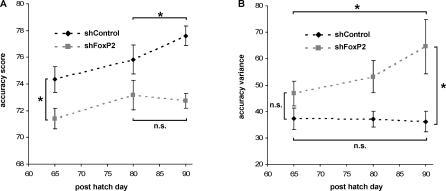
The gene encoding the forkhead box transcription factor, FOXP2, is essential for developing the full articulatory power of human language. Mutations of FOXP2 cause developmental verbal dyspraxia (DVD), a speech and language disorder that compromises the fluent production of words and the correct use and comprehension of grammar. FOXP2 patients have structural and functional abnormalities in the striatum of the basal ganglia, which also express high levels of FOXP2. Since human speech and learned vocalizations in songbirds bear behavioral and neural parallels, songbirds provide a genuine model for investigating the basic principles of speech and its pathologies. In zebra finch Area X, a basal ganglia structure necessary for song learning, FoxP2 expression increases during the time when song learning occurs. Here, we used lentivirus-mediated RNA interference (RNAi) to reduce FoxP2 levels in Area X during song development. Knockdown of FoxP2 resulted in an incomplete and inaccurate imitation of tutor song. Inaccurate vocal imitation was already evident early during song ontogeny and persisted into adulthood. The acoustic structure and the duration of adult song syllables were abnormally variable, similar to word production in children with DVD. Our findings provide the first example of a functional gene analysis in songbirds and suggest that normal auditory-guided vocal motor learning requires FoxP2.
Overview
The claims and statistics of this paper haven’t been checked yet.
Run the check — free, no account needed. It reads the open-access text and checks the sources it cites.
Integrity signals
Registry
Cites
Statistics
Figures
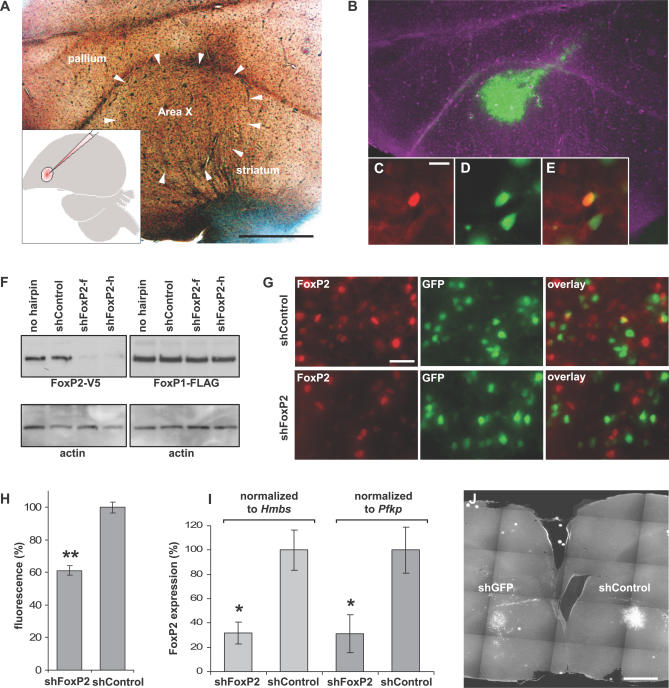
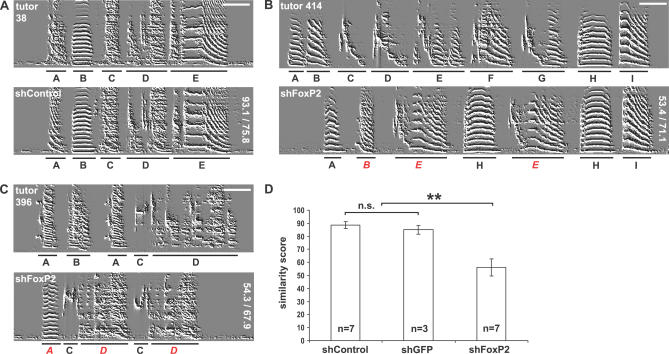
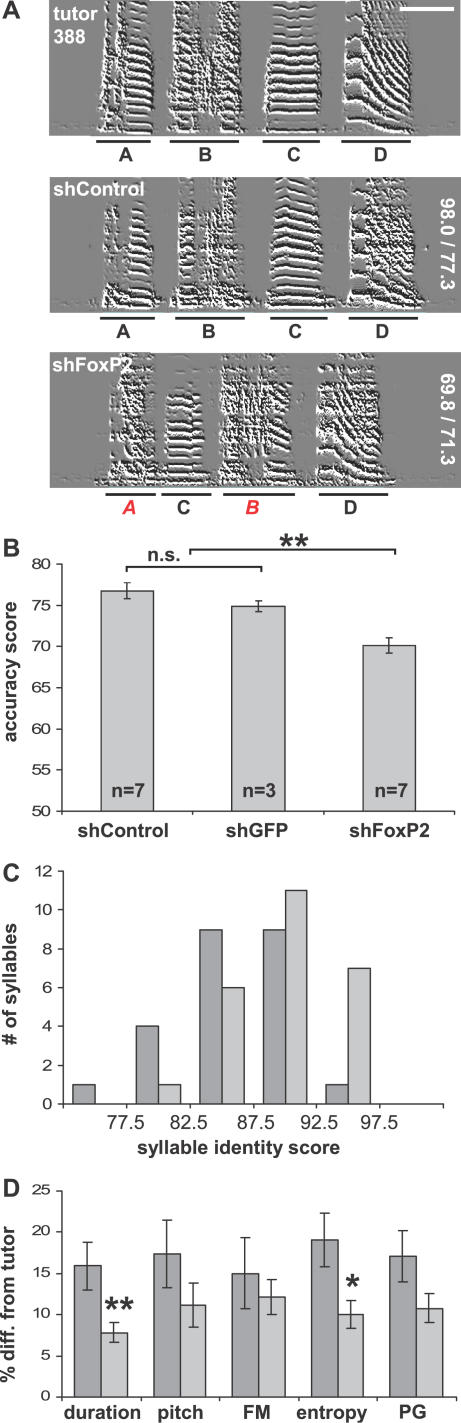
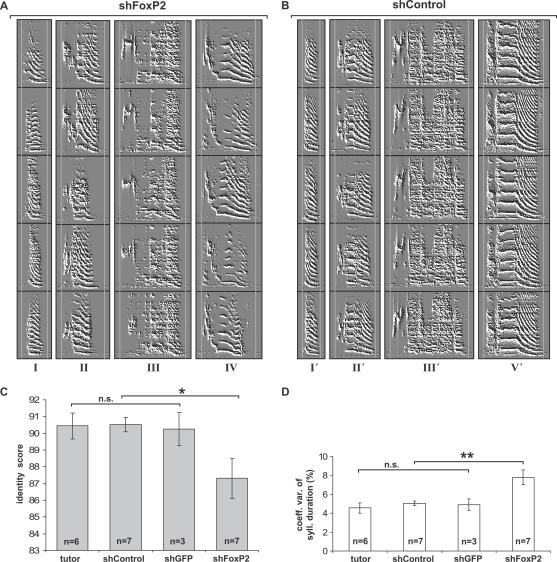
Verification
Claims the paper makes
The claims and statistics of this paper haven’t been checked yet.
Run the check — free, no account needed. It reads the open-access text and checks the sources it cites.
Claims other papers make about this one
Each is checked against this paper’s own text: does it say what the citing paper says it does?
In the citing paper
“A case in point is the highly conserved TF FoxP2, a component of bGRNs in the basal ganglia song nucleus, Area X, that is associated with avian song learning (53).”
From Behavior-related gene regulatory networks: A new level of organization in the brain (2020) · cites this paper as [53]
Self-check
Percentages, sums and reported differences re-computed from the paper’s own numbers.
The self-check needs the paper’s full text.
Citations
Cites
A Mathematical Theory of Communication
Shannon, C. E. (1948) · Bell System Technical Journal · doi:10.1002/j.1538-7305.1948.tb01338.x · Cited by 88,486
GRIFFITHS, R., DOUBLE, M. C., ORR, K., & DAWSON, R. J. G. (1998) · Molecular Ecology · doi:10.1046/j.1365-294x.1998.00389.x · Cited by 3,065
A forkhead-domain gene is mutated in a severe speech and language disorder
Lai, C. S. L., Fisher, S. E., Hurst, J. A., Vargha-Khadem, F., & Monaco, A. P. (2001) · Nature · doi:10.1038/35097076 · Cited by 2,054
Germline Transmission and Tissue-Specific Expression of Transgenes Delivered by Lentiviral Vectors
Lois, C., Hong, E. J., Pease, S., Brown, E. J., & Baltimore, D. (2002) · Science · doi:10.1126/science.1067081 · Cited by 1,999
Birdsong and human speech: common themes and mechanisms
Doupe, A. J., & Kuhl, P. K. (1999) · Annual Review of Neuroscience · doi:10.1146/annurev.neuro.22.1.567 · Cited by 1,633
Midbrain dopamine neurons encode a quantitative reward prediction error signal
Bayer, H. M., & Glimcher, P. W. (2005) · Neuron · doi:10.1016/j.neuron.2005.05.020 · Cited by 1,304
Unified nomenclature for the winged helix/forkhead transcription factors
Kaestner, K. H., Knöchel, W., & Martínez, D. E. (2000) · Genes & Development · doi:10.1101/gad.14.2.142 · Cited by 1,158
Scharff, C., & Nottebohm, F. (1991) · The Journal of Neuroscience · doi:10.1523/jneurosci.11-09-02896.1991 · Cited by 923
Self-citationPostsynaptic receptor trafficking underlying a form of associative learning
Rumpel, S., LeDoux, J., Zador, A., & Malinow, R. (2005) · Science · doi:10.1126/science.1103944 · Cited by 775
A procedure for an automated measurement of song similarity
Tchernichovski, O., Nottebohm, F., Ho, C. E., Pesaran, B., & Mitra, P. P. (2000) · Animal Behaviour · doi:10.1006/anbe.1999.1416 · Cited by 734
Research works printed but not linked: 52
- Lai, 2001, Nature, 413, 519
- MacDermot, 2005, Am J Hum Genet, 76, 1074
- Feuk, 2006, Am J Hum Genet, 79, 965
- Fisher, 2006, Nat Rev Genet, 7, 9
- Watkins, 2002, Brain, 125, 452
- Belton, 2003, Hum Brain Mapp, 18, 194
- Liegeois, 2003, Nat Neurosci, 6, 1230
- Lai, 2003, Brain, 126, 2455
- Doupe, 1999, Annu Rev Neurosci, 22, 567
- Haesler, 2004, J Neurosci, 24, 3164
- Teramitsu, 2004, J Neurosci, 24, 3152
- Sohrabji, 1990, Behav Neural Biol, 53, 51
- Scharff, 1991, J Neurosci, 11, 2896
- Teramitsu, 2006, J Neurosci, 26, 7390
- Shriberg, 2006, J Speech Lang Hear Res, 49, 500
- Roper, 2005, Ethology, 112, 458
- Lois, 2002, Science, 295, 868
- Barami, 1995, J Neurobiol, 28, 82
- Wada, 2006, Proc Natl Acad Sci U S A, 103, 15212
- Farries, 2002, J Neurosci, 22, 3776
- Scharff, 2005, Curr Opin Neurobiol, 15, 694
- Tchernichovski, 2001, Science, 291, 2564
- Tchernichovski, 1998, Proc Natl Acad Sci U S A, 95, 8951
- Ashraf, 2006, Cell, 124, 191
- Doupe, 2005, Trends Neurosci, 28, 353
- Olveczky, 2005, PLoS Biol, 3
- Kao, 2005, Nature, 433, 638
- Brainard, 2000, Nature, 404, 762
- Williams, 1999, J Neurobiol, 39, 14
- Glaze, 2006, J Neurosci, 26, 991
- Williams, 2004, Ann N Y Acad Sci, 1016, 1
- Rumpel, 2005, Science, 308, 83
- Graybiel, 2005, Curr Opin Neurobiol, 15, 638
- Singh, 2005, J Neurobiol, 65, 179
- Leonardo, 1999, Nature, 399, 466
- Price, 1979, J Comp Physiol Psychol, 93, 260
- Farries, 2005, J Comp Neurol, 484, 93
- Rosen, 2006, J Neurophysiol, 95, 1158
- Kozhevnikov, 2007, J Neurophysiol, 97, 4271
- Reiner, 2004, J Comp Neurol, 469, 239
- Bayer, 2005, Neuron, 47, 129
- Ogar, 2005, Neurocase, 11, 427
- Vargha-Khadem, 2005, Nat Rev Neurosci, 6, 131
- Nicolson, 2007, Trends Neurosci, 30, 135
- Tomaszycki, 2005, Anim Behav, 70, 785
- Spencer, 2005, Behav Ecol Sociobiol, 58, 423
- Kaestner, 2000, Genes Dev, 14, 142
- Pei, 2006, Nat Methods, 3, 670
- Griffiths, 1998, Mol Ecol, 7, 1071
- Floody, 1997, Horm Behav, 31, 25
- Tchernichovski, 2000, Anim Behav, 59, 1167
- Shannon, 1948, Bell Syst Tech J, 27
Cited by
A humanized version of Foxp2 affects cortico-basal ganglia circuits in mice
Enard, W., Gehre, S., Hammerschmidt, K., Hölter, S. M., Blass, T., Somel, M., Brückner, M. K., Schreiweis, C., Winter, C., Sohr, R., et al. (2009) · Cell · doi:10.1016/j.cell.2009.03.041 · Cited by 605
Fitch, W. T. (2010) · doi:10.1017/cbo9780511817779 · Cited by 594
Evolution, brain, and the nature of language
Berwick, R. C., Friederici, A. D., Chomsky, N., & Bolhuis, J. J. (2013) · Trends in Cognitive Sciences · doi:10.1016/j.tics.2012.12.002 · Cited by 583
Convergent transcriptional specializations in the brains of humans and song-learning birds
Pfenning, A. R., Hara, E., Whitney, O., Rivas, M. V., Wang, R., Roulhac, P. L., Howard, J. T., Wirthlin, M., Lovell, P. V., Ganapathy, G., et al. (2014) · Science · doi:10.1126/science.1256846 · Cited by 463
Fox transcription factors: from development to disease
Golson, M. L., & Kaestner, K. H. (2016) · Development · doi:10.1242/dev.112672 · Cited by 406
Foxp2 regulates gene networks implicated in neurite outgrowth in the developing brain
Vernes, S. C., Oliver, P. L., Spiteri, E., Lockstone, H. E., Puliyadi, R., Taylor, J. M., Ho, J., Mombereau, C., Brewer, A., Lowy, E., et al. (2011) · PLoS Genetics · doi:10.1371/journal.pgen.1002145 · Cited by 276
Social cognition and the evolution of language: constructing cognitive phylogenies
Fitch, W. T., Huber, L., & Bugnyar, T. (2010) · Neuron · doi:10.1016/j.neuron.2010.03.011 · Cited by 264
“, 2004), and reduction of FoxP2 expression levels in song nuclei of zebra finches leads to less accurate, incomplete song learning (Haesler et al., 2007), providing direct evidence for the importance of FoxP2 in vocal learning across species.”
De Novo Mutations in FOXP1 in Cases with Intellectual Disability, Autism, and Language Impairment
Hamdan, F. F., Daoud, H., Rochefort, D., Piton, A., Gauthier, J., Langlois, M., Foomani, G., Dobrzeniecka, S., Krebs, M.-O., Joober, R., et al. (2010) · The American Journal of Human Genetics · doi:10.1016/j.ajhg.2010.09.017 · Cited by 235
The Neurocognition of Developmental Disorders of Language
Ullman, M. T., Earle, F. S., Walenski, M., & Janacsek, K. (2020) · Annual Review of Psychology · doi:10.1146/annurev-psych-122216-011555 · Cited by 223
FOXP2 and the role of cortico-basal ganglia circuits in speech and language evolution
Enard, W. (2011) · Current Opinion in Neurobiology · doi:10.1016/j.conb.2011.04.008 · Cited by 149
Peter, B., Raskind, W. H., Matsushita, M., Lisowski, M., Vu, T., Berninger, V. W., Wijsman, E. M., & Brkanac, Z. (2011) · Journal of Neurodevelopmental Disorders · doi:10.1007/s11689-010-9065-0 · Cited by 117
FoxP influences the speed and accuracy of a perceptual decision in Drosophila
DasGupta, S., Ferreira, C. H., & Miesenböck, G. (2014) · Science · doi:10.1126/science.1252114 · Cited by 104
Genetic basis of human brain evolution
Vallender, E. J., Mekel-Bobrov, N., & Lahn, B. T. (2008) · Trends in Neurosciences · doi:10.1016/j.tins.2008.08.010 · Cited by 102
Behavior-related gene regulatory networks: A new level of organization in the brain
Sinha, S., Jones, B. M., Traniello, I. M., Bukhari, S. A., Halfon, M. S., Hofmann, H. A., Huang, S., Katz, P. S., Keagy, J., Lynch, V. J., et al. (2020) · Proceedings of the National Academy of Sciences · doi:10.1073/pnas.1921625117 · Cited by 85
Genomics and the evolution of phenotypic traits
Wray, G. A. (2013) · Annual Review of Ecology, Evolution, and Systematics · doi:10.1146/annurev-ecolsys-110512-135828 · Cited by 68
Harvey‐Girard, E., Giassi, A. C. C., Ellis, W., & Maler, L. (2012) · Journal of Comparative Neurology · doi:10.1002/cne.23107 · Cited by 54
Evolution of language: Lessons from the genome
Fisher, S. E. (2017) · Psychonomic Bulletin & Review · doi:10.3758/s13423-016-1112-8 · Cited by 53
Panaitof, S. C., Abrahams, B. S., Dong, H., Geschwind, D. H., & White, S. A. (2010) · Journal of Comparative Neurology · doi:10.1002/cne.22318 · Cited by 49
Evolutionary diversity as a catalyst for biological discovery
JOHNSON, Z. V., & YOUNG, L. J. (2018) · Integrative Zoology · doi:10.1111/1749-4877.12339 · Cited by 25
Metadata
- Authors
- Haesler, S., Rochefort, C., Georgi, B., Licznerski, P., Osten, P., & Scharff, C.
- Venue
- PLoS Biology
- Publisher
- Public Library of Science (PLoS)
- Published
- 2007-12-04
- Volume
- 5
- Issue
- 12
- Pages
- e321
- ISSN
- 1545-7885
- PMC
- PMC2100148
- Cited by
- 364
- References
- 52
- Language
- en
About these checks
Registry, retraction, Cites and statistics results are computed, not judged, with one exception: a printed reference that no index lists is read once by a model before it counts as a citation error. Claims are extracted by a model and kept only when their quote appears verbatim in the text; each cited source is then checked, with a model’s help, for whether it says what the claim relies on. Those verdicts can be wrong — read the claim’s quote and the cited source before relying on one.
Statistics and arithmetic are recomputed, not judged.
Confidence bands are shown only for fields calibrated on our annotated test set. None is calibrated yet, so no band is shown.
What counts as a claim ›How we measure confidence ›How we check this ›
Are you an author, or do you see a problem with this page? Request a review
Data sources
Bibliographic data: Semantic Scholar, OpenAlex, Crossref.
Contains information from the Semantic Scholar Academic Graph Datasets, made available under the ODC Attribution License (ODC-BY 1.0).
Semantic Scholar’s data is described in: Kinney, R., et al. (2023). The Semantic Scholar Open Data Platform. arXiv:2301.10140.
