

The Population Genetics of dN/dS
Open accessThe DOI matches its Crossref record; 63 of the 64 references it cites were found in a registry or an index.
Abstract
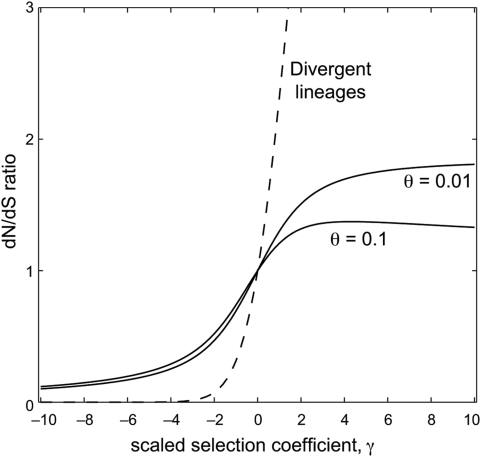
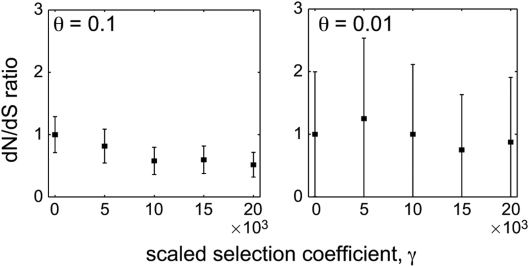
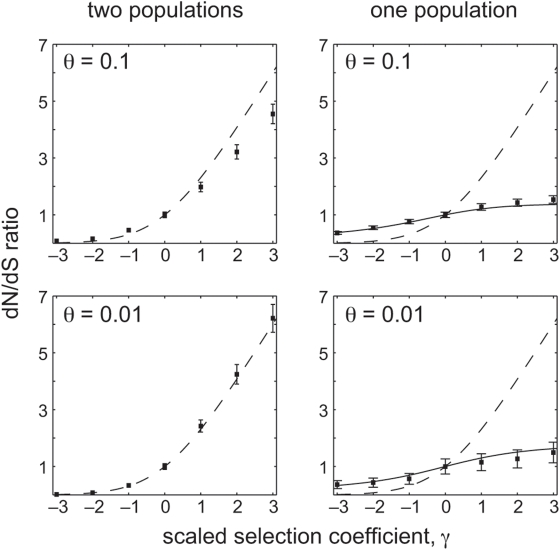
Evolutionary pressures on proteins are often quantified by the ratio of substitution rates at non-synonymous and synonymous sites. The dN/dS ratio was originally developed for application to distantly diverged sequences, the differences among which represent substitutions that have fixed along independent lineages. Nevertheless, the dN/dS measure is often applied to sequences sampled from a single population, the differences among which represent segregating polymorphisms. Here, we study the expected dN/dS ratio for samples drawn from a single population under selection, and we find that in this context, dN/dS is relatively insensitive to the selection coefficient. Moreover, the hallmark signature of positive selection over divergent lineages, dN/dS>1, is violated within a population. For population samples, the relationship between selection and dN/dS does not follow a monotonic function, and so it may be impossible to infer selection pressures from dN/dS. These results have significant implications for the interpretation of dN/dS measurements among population-genetic samples.
Overview
The claims and statistics of this paper haven’t been checked yet.
Free: it reads the open-access text and checks the first 5 claims that cite a source we can check. Create a free account to check every claim.
Integrity signals
Registry
Cites
Statistics
Figures
Verification
Claims the paper makes
The claims and statistics of this paper haven’t been checked yet.
Free: it reads the open-access text and checks the first 5 claims that cite a source we can check. Create a free account to check every claim.
Claims other papers make about this one
Each is checked against this paper’s own text: does it say what the citing paper says it does?
The check wasn’t confident either way, so it gives no verdict — never disputed.
In the citing paper
“This characteristic is consistent with the higher biodiversity observed in non-Westernized settings, where more heterogeneous dietary and environmental exposures may allow a broader range of accessory gene content to persist than is usually observed in genomes from industrialized populations [73-75] .”
From Genome-scale insights into the metabolic landscape and evolutionary development of Bifidobacterium bifidum (2026) · cites this paper as [73]
Experimental — accuracy not yet measured
Self-check
Percentages, sums and reported differences re-computed from the paper’s own numbers.
The self-check needs the paper’s full text.
Citations
Cites
MEGA4: Molecular Evolutionary Genetics Analysis (MEGA) Software Version 4.0
Tamura, K., Dudley, J., Nei, M., & Kumar, S. (2007) · Molecular Biology and Evolution · doi:10.1093/molbev/msm092 · Cited by 28,730 · cited 1×
“Theoretical work on the relationship between dN/dS and selection likewise assumes that sequences are sampled from independent, divergent species [3], as do computer packages used to estimate dN/dS from data [6,7].”
MethodStatistical method for testing the neutral mutation hypothesis by DNA polymorphism.
Tajima, F. (1989) · Genetics · doi:10.1093/genetics/123.3.585 · Cited by 13,941
PAML 4: Phylogenetic Analysis by Maximum Likelihood
Yang, Z. (2007) · Molecular Biology and Evolution · doi:10.1093/molbev/msm088 · Cited by 13,879 · cited 4×
“Theoretical work on the relationship between dN/dS and selection likewise assumes that sequences are sampled from independent, divergent species [3],as do computer packages used to estimate dN/dS from data [6, 7 ].”
MethodInfluentialEVOLUTION IN MENDELIAN POPULATIONS
Wright, S. (1931) · Genetics · doi:10.1093/genetics/16.2.97 · Cited by 8,916
Statistical tests of neutrality of mutations.
Fu, Y. X., & Li, W. H. (1993) · Genetics · doi:10.1093/genetics/133.3.693 · Cited by 4,034
Adaptive protein evolution at the Adh locus in Drosophila
McDonald, J. H., & Kreitman, M. (1991) · Nature · doi:10.1038/351652a0 · Cited by 3,283 · cited 1×
“geneticists [23,45].”
Codon-substitution models for heterogeneous selection pressure at amino acid sites
Yang, Z., Nielsen, R., Goldman, N., & Pedersen, A.-M. K. (2000) · Genetics · doi:10.1093/genetics/155.1.431 · Cited by 2,286
A codon-based model of nucleotide substitution for protein-coding DNA sequences.
(1994) · Molecular Biology and Evolution · doi:10.1093/oxfordjournals.molbev.a040153 · Cited by 1,960 · cited 20×
“We performed Wright-Fisher simulations of a population of constant size N evolving under positive or negative selection sensu Yang, in discrete time.”
BackgroundMethodInfluentialHitchhiking Under Positive Darwinian Selection
Fay, J. C., & Wu, C.-I. (2000) · Genetics · doi:10.1093/genetics/155.3.1405 · Cited by 1,819
Statistical methods for detecting molecular adaptation
Yang, Z., & Bielawski, J. P. (2000) · Trends in Ecology & Evolution · doi:10.1016/s0169-5347(00)01994-7 · Cited by 1,806 · cited 1×
“The instantaneous rate of change from codon i to codon j depends principally on the parameter v, defined as the relative rate of non-silent versus silent substitutions [2].”
Background
Cited by
Items 901–995 of 995
Biswas, S., Mondal, R., Srivastava, A., Trivedi, M., Singh, S. K., & Mishra, Y. (2022) · Figshare · doi:10.6084/m9.figshare.20193528
Tao, L., Duan, H., Tao, K., Luo, Y., Li, Q., & Li, L. (2023) · Figshare · doi:10.6084/m9.figshare.23590390
Tao, K., Tao, L., Huang, J., Duan, H., Luo, Y., & Li, L. (2024) · Figshare · doi:10.6084/m9.figshare.26728840
Kim, T., Egesa, A. O., Qin, C., Mather, H., Sandoya, G. V., & Begcy, K. (2024) · Figshare · doi:10.6084/m9.figshare.26757976
Fitness & major histocompatibility complex diversity of two bottlenose dolphin populations
Manlik, O. (2015) · UNSWorks (UNSW Sydney) · doi:10.26190/unsworks/18957 · Cited by 3
Qiao, J., Shao, Z., Wu, Y., Zeng, P., & Wang, T. (2022) · Figshare · doi:10.6084/m9.figshare.21192253
Kim, T., Samraj, S., Jiménez, J., Gómez, C., Liu, T., & Begcy, K. (2021) · Figshare · doi:10.6084/m9.figshare.14444991
Kim, T., Egesa, A. O., Qin, C., Mather, H., Sandoya, G. V., & Begcy, K. (2024) · Figshare · doi:10.6084/m9.figshare.26757985
Garcia, I. (2024) · Kent Academic Repository (University of Kent) · doi:10.22024/unikent/01.02.107576
Biswas, S., Mondal, R., Srivastava, A., Trivedi, M., Singh, S. K., & Mishra, Y. (2022) · Figshare · doi:10.6084/m9.figshare.20193591
Kim, T., Egesa, A. O., Qin, C., Mather, H., Sandoya, G. V., & Begcy, K. (2024) · Figshare · doi:10.6084/m9.figshare.26500417
Biswas, S., Mondal, R., Srivastava, A., Trivedi, M., Singh, S. K., & Mishra, Y. (2022) · Figshare · doi:10.6084/m9.figshare.20193579
Onasanya, A. E., El-Hage, C. M., Diaz-Méndez, A., Vaz, P. K., Legione, A. R., Browning, G. F., Devlin, J. M., & Hartley, C. A. (2022) · Figshare · doi:10.6084/m9.figshare.20745233
Kim, T., Egesa, A. O., Qin, C., Mather, H., Sandoya, G. V., & Begcy, K. (2024) · Figshare · doi:10.6084/m9.figshare.26757970
Kim, T., Egesa, A. O., Qin, C., Mather, H., Sandoya, G. V., & Begcy, K. (2024) · Figshare · doi:10.6084/m9.figshare.26757979
Kim, T., Egesa, A. O., Qin, C., Mather, H., Sandoya, G. V., & Begcy, K. (2024) · Figshare · doi:10.6084/m9.figshare.26757973
Tao, K., Tao, L., Huang, J., Duan, H., Luo, Y., & Li, L. (2024) · Figshare · doi:10.6084/m9.figshare.26728843
Sander, A.-L. (2023) · edoc Publication server (Humboldt University of Berlin) · doi:10.18452/26631 · Cited by 1
Population genomics in the Alpine ibex (Capra ibex)
Leigh, D. M. (2018) · Zurich Open Repository and Archive (University of Zurich) · doi:10.5167/uzh-152488
Biswas, S., Mondal, R., Srivastava, A., Trivedi, M., Singh, S. K., & Mishra, Y. (2022) · Figshare · doi:10.6084/m9.figshare.20193522
Kim, T., Egesa, A. O., Qin, C., Mather, H., Sandoya, G. V., & Begcy, K. (2024) · Figshare · doi:10.6084/m9.figshare.26757967
Biswas, S., Mondal, R., Srivastava, A., Trivedi, M., Singh, S. K., & Mishra, Y. (2022) · Figshare · doi:10.6084/m9.figshare.20193555
Tao, K., Tao, L., Huang, J., Duan, H., Luo, Y., & Li, L. (2024) · Figshare · doi:10.6084/m9.figshare.25954946
Tao, L., Duan, H., Tao, K., Luo, Y., Li, Q., & Li, L. (2023) · Figshare · doi:10.6084/m9.figshare.23590393
Kim, T., Egesa, A. O., Qin, C., Mather, H., Sandoya, G. V., & Begcy, K. (2024) · Figshare · doi:10.6084/m9.figshare.26500307
Tao, K., Tao, L., Huang, J., Duan, H., Luo, Y., & Li, L. (2024) · Figshare · doi:10.6084/m9.figshare.25955007
Biswas, S., Mondal, R., Srivastava, A., Trivedi, M., Singh, S. K., & Mishra, Y. (2022) · Figshare · doi:10.6084/m9.figshare.20193585
Zhao, X., Hu, Y., Zhao, Y., Wang, L., Wu, Z., Soe, M. T., Kyaw, M. P., Cui, L., Zhu, X., & Cao, Y. (2022) · Figshare · doi:10.6084/m9.figshare.21351358
Evolutionary Genomics of Dominant Bacterial and Archaeal Lineages in the Ocean
Martinez Gutierrez, C. A. (2023) · VTechWorks (Virginia Tech)
Adaptation and diversification in the Canary island endemic Descurainia (Brassicaceae)
Jackson, A. C. (2024) · ePrints Soton (University of Southampton)
The Evolution of Addiction: A Case Study of Nicotine Dependence
Sadler, B. (2014) · Arizona State University Library Digital Repository (Arizona State University)
Pleiotropy and epistasis in trans-acting expression quantitative loci hotspots
Dyke, K. V. (2023) · University of Minnesota Digital Conservancy (University of Minnesota)
Patterns of short-term genome evolution in E.coli and Shigellae
Balbi, K. J. (2009) · OpenGrey (Institut de l'Information Scientifique et Technique)
Genetic variation and resilience to climate change in Mediterranean-type trees
Filipe, J. C. (2021) · Murdoch University Research Portal
Discovering Subclones and Their Driver Genes in Tumors Sequenced at Standard Depths
(2019) · Arizona State University Library Digital Repository (Arizona State University)
Hard-wired for success? Unravelling genomic signatures in pollinators
Hasan, S. (2026) · PEARL (University of Plymouth) · doi:10.24382/8ky0-n281
Lu, C., Han, P., Liu, X., & Wang, X. (2026) · Aquaculture and Fisheries · doi:10.1016/j.aaf.2026.01.005
Population Ecology of Glacier Bacteria from the View of Gene Flow in Cryobacterium
Hu, J., Du, Y., Hu, J., Zhang, L., Wu, Y., Shu, Y., & Shen, L. (2026) · Microorganisms · doi:10.3390/microorganisms14020326
“The minimum genome sequence identity within the Cryobacterium populations is 97.82% (ranging from 97.82% to 99.45%), higher than the conventional 95% genome sequence identity threshold for defining operational bacterial species [31].”
InfluentialThe genome of black spruce : genome annotation & analyses
Lo, T. (2023) · cIRcle (University of British Columbia)
Sadiq, H., & Martin, D. P. (2026) · The Journal of Open Source Software · doi:10.21105/joss.09797
Limited directional selection but coevolutionary signals among imprinted genes in A. lyrata
Vève, A. L., İltaş, Ö., Dutheil, J. Y., & Placette, C. L. (2026) · Peer Community Journal · doi:10.24072/pcjournal.702
Wang, J., Liu, X., Liu, F., Zuo, L., Wang, Y., Wang, L., Xiong, Y., Song, G., Song, K., Cheng, Y., et al. (2026) · SSRN Electronic Journal · doi:10.2139/ssrn.6480006
Osuna‐Mascaró, C., Cairns, K. M., Doan, K., Flores‐Manzanero, A., Nesbitt, B. J., Newsome, T. M., & Pilot, M. (2026) · Molecular Ecology · doi:10.1111/mec.70320
“Statistical significance was assessed using z - tests, focusing on genes with dN/dS ratios that significantly deviated from neutrality (dN/dS ≠ 1; Kryazhimskiy and Plotkin 2008), thereby identifying candidate genes potentially under positive selection.”
Le genre Leishmania : structure génétique et mécanismes d'évolution
Baidouri, F. E. (2012) · theses.fr (ABES) · doi:10.70675/81dfcd1czf0ebz4359z9586z4880f10ebd55
Diversité génétique, génomique et fonctionnelle de Lactococcus lactis
Passerini, D. (2011) · theses.fr (ABES) · doi:10.70675/49ff70d4z12fcz4bc0z964azd18b0a27a3d1
Saint‐Ruf, C., Launay, A., Tenaillon, O., & Matić, I. (2026) · BMC Microbiology · doi:10.1186/s12866-026-04983-z
“All estimates remained above the neutral expectation of 1, indicating that amino acid-altering mutations were not selectively neutral and likely conferred a selective advantage in aging colonies [30].”
Daudé, D. (2013) · theses.fr (ABES) · doi:10.70675/236028b4zabd3z4900za3e4z3661fe840ad3 · Cited by 1
Evolution du développement de l’œil chez le poisson cavernicole aveugle Astyanax mexicanus
Hinaux, H. (2014) · theses.fr (ABES) · doi:10.70675/b7596648zb9e4z4490zab7az0f9ac3dab86e
Modèles et algorithmes pour l'évolution biologique
Chabrol, O. (2017) · theses.fr (ABES) · doi:10.70675/23889726zfc97z4d77zbbb6z436783a7cb06
Biodiversité et évolution des virus présents dans les métagénomes animaux
Bigot, D. (2017) · theses.fr (ABES) · doi:10.70675/49babcd2za918z4fc6z9505z2e39b5c9e03a
Lorrain, C. (2018) · theses.fr (ABES) · doi:10.70675/7a0bebb3z4277z4f8dz893az7c8dda364c34 · Cited by 1
Real-time genomics to decipher atypical bacteria in clinical microbiology
Mlaga, K. D. (2017) · theses.fr (ABES) · doi:10.70675/c62b198fz520bz433az8b20zd67be9ef537c
Evolution of Penicillium fungi : Adaptation and Degeneration in Fermented Food Environments
Lo, Y. (2019) · theses.fr (ABES) · doi:10.70675/19160c2bz4bb7z4dcezb04az8d64f7073d9a
Understanding virulence heterogeneity in Listeria monocytogenes
Hafner, L. (2021) · theses.fr (ABES) · doi:10.70675/46e92af9zd298z42dczbff5zf90528eb75f2
Torres, L. (2019) · theses.fr (ABES) · doi:10.70675/e242eeaczdc27z404fz961cz3e14add5cb5d · Cited by 1
Gautreau, G. (2020) · theses.fr (ABES) · doi:10.70675/d5c3a7fezdc60z410fza79cz2ed2c937aa11 · Cited by 3
Wu, Q., Zhou, Q., Xiang, P., Chen, Y., Wang, C., & Xing, B. (2026) · Deep Sea Research Part I Oceanographic Research Papers · doi:10.1016/j.dsr.2026.104740
Les DDEs transposons à l’origine de l’innovation génétique : exemple du transposon RAG
Tsakou-Ngouafo, L. (2022) · theses.fr (ABES) · doi:10.70675/89cc8269ze49bz4eabz906dzf93f1457a05a
Processus adaptatifs dans l'invasion globale de Spodoptera frugiperda (Lepidoptera Noctuidae)
Yainna, S. (2023) · theses.fr (ABES) · doi:10.70675/a595f229z477ez4051z9169z2e1c0331840c
Bénitière, F. (2024) · theses.fr (ABES) · doi:10.70675/a3e412c0z2333z4c62zb12ezf5e361ef1275
Tian, C., Yang, Y., Gong, W., Liu, L., Li, Z. Y., Feng, Y., Niu, J., & Wu, Z. (2026) · BMC Plant Biology · doi:10.1186/s12870-026-08845-8
“However, Ka/Ks changes with differences in the population sample [76], and the amino acid differences between the two orthologous proteins are also affected by the time elapsed since their common ancestor [65].”
HIV-1 and Vaccine: Analysis of gp41 Target Sequences
Dimonte, S., Scutari, R., Salpini, R., Stefano, A., Valentina, S., & Michele, P. (2026) · Current Microbiology · doi:10.1007/s00284-026-04936-9
“These values, being significantly below 1.0, confirm that Gp41 is primarily under purifying selection, an evolutionary constraint necessary to preserve the essential mechanisms of membrane fusion [11, 17].”
InfluentialDoes immunogenetic diversity warrant fewer parasites in European bluethroats?
Damnjanović, D., Nazarizadeh, M., Pavel, V., Chutný, B., Johnsen, A., Nováková, M., & Štefka, J. (2026) · Current Zoology · doi:10.1093/cz/zoag036
Phylospect: a spectral operator framework for detecting episodic selection in codon evolution
Manjunath, M., S, R. V., Damini, C. S., & Shakunthala, V. (2026) · Molecular Phylogenetics and Evolution · doi:10.1016/j.ympev.2026.108653
Ekerette, E., Etukudo, O., Uno, U., Ekpo, P., Agbor, R., Edu, N., Efienokwu, J. N., Sunday, C., Osim, P., Henry, I., et al. (2026) · African Journal of Aquatic Science · doi:10.2989/16085914.2026.2642176
“Our study found substantial nucleotide and haplotype substitution rates (Cann et al. 1984), was confirmed to have selective advantages in our study, with a d N / d S ratio greater than 1, indicating potential positive selection (Kryazhimskiy and Plotkin 2008; Spielman and Wilke 2015).”
Yehia, N., Abdelsabour, M. A., Said, D., Naggar, R. F. E., Madbouly, Y. M., Mohamed, A. A. E., Salaheldin, A. H., & Rohaim, M. A. (2026) · BMC Veterinary Research · doi:10.1186/s12917-026-05607-4
“The dN/dS ratio was derived by comparing the observed non-synonymous substitutions to synonymous ones and then adjusted for multiple substitutions using the Jukes-Cantor correction [21].”
Hurtado-Preciado, M. Á., Sánchez, A. E., Rei, F., Ripa, A., & Fernández-García, J. L. (2026) · SSRN Electronic Journal · doi:10.2139/ssrn.6929468
Identifying transcriptomic bias across developmental shifts in insectsPreprint
Cornet, S., & Dennis, A. B. (2026) · bioRxiv (Cold Spring Harbor Laboratory) · doi:10.64898/2026.06.12.731678
Integrating Mitochondrial Genomics into the Taxonomy of Hypoxylaceae
Zeng, W., Kang, J., Zhou, X., Habib, K., Pi, Y., Hu, H.-M., Ren, Y.-L., Liu, L.-L., Kang, Y.-Q., Hyde, K. D., et al. (2026) · Fungal Diversity · doi:10.65390/fdiv.2026.136011 · Cited by 1
Guo, Z., Chen, Z., & Wang, Z. (2026) · Genes · doi:10.3390/genes17070790
Li, H.-L., Deng, W., Yang, C.-X., Gu, W., Liu, C., Zhang, D.-C., Wang, J., Yi, T., & Zhang, R. (2026) · BMC Plant Biology · doi:10.1186/s12870-026-09508-4
“It should be noted that statistical significance detected by PAML only reflects potential differences in selective pressure and cannot be directly interpreted as functional evidence of ecological adaptation [82, 83].”
From Codons to Protein Structure: Evolutionary Constraints of Mitochondrial Proteins in Corvides
Xiao, Y., Zhang, M., Xi, M., Han, S., Yang, J., Peng, H., Ge, W., Dai, C., Yang, L., & Kan, X. (2026) · Biology · doi:10.3390/biology15141190
Li, X., Han, P., Xue, Y., Wang, W., Xiang, X., Liu, X., Chen, J., Chang, J., & Wang, X. C. (2026) · Fish & Shellfish Immunology · doi:10.1016/j.fsi.2026.111605
Muñoz‐Baena, L., Castelán-Sánchez, H. G., Bagherichimeh, S., Magbor, P., Rojas-Vargas, J., Khan, A., Olabode, A. S., & Poon, A. F. Y. (2026) · PLoS Pathogens · doi:10.1371/journal.ppat.1014457
“In a constant and uniform selective environment, positive directional selection is a transient phenomenon that is resolved when a beneficial mutation becomes fixed in the population [17].”
InfluentialSierra-Martinez, S., Oleksiak, M. F., & Crawford, D. L. (2026) · doi:10.22541/authorea.15006787/v1
Hart, A. F., Rêgo, A., Stelkens, R., & Berger, D. (2026) · bioRxiv (Cold Spring Harbor Laboratory) · doi:10.64898/2026.07.29.741406
Rethinking evolutionary inference in metagenomic time series
Eiler, A. (2026) · mSystems · doi:10.1128/msystems.00693-26
“This is particularly problematic for metri ces explicitly designed for differences between divergent species, not for segregating polymorphisms within a single population (33).”
Searching for patterns in rate of molecular evolution using phylogenetic pairwise contrastsPreprint
Douglas, J., & Bromham, L. D. (2026) · bioRxiv (Cold Spring Harbor Laboratory) · doi:10.64898/2026.08.13.744736
“…to reflect consistent differences in the underlying mutation rate, measuring branch lengths in the amount of synonymous change allows mutation-driven variation to be partially disentangled from the effects of population size or selection (Yang and Nielsen, 2000; Kryazhimskiy and Plotkin, 2008).”
Towards a quantitative view of the NLR gene family evolution in the genome space
Wingen, L. U., Crosbie, D. B., Hu, Y., Kemen, E. M., Liu, X., Mueller, M. C., Schandry, N., Schneeberger, K., Weigel, D., & Tellier, A. (2026) · Quantitative Plant Biology · doi:10.1017/qpb.2026.10052
“We note that the sensitivity of phylogenetic methods to infer selection via the d N /d S (Table 2) ratio does depend on recombination rate (Kryazhimskiy & Plotkin, 2008).”
Mahmood, H., Mahmood, T., Nouroz, F., Siddique, A. N., & Khan, S. (2026) · Proteins Structure Function and Bioinformatics · doi:10.1002/prot.70181
Zhao, C., Huang, L., Liao, Y., & Xu, X. (2026) · Molecular Ecology · doi:10.1111/mec.70574
“…d N ∕ d S , which measures long-term protein evolution across deep evolutionary timescales, the polymorphism-based π N / π S ratio serves as an appropriate intra-population metric to quantify the efficiency of segregating purifying selection (Charlesworth 2009; Kryazhimskiy and Plotkin 2008).”
Jang, B., Jin, B. J., Park, Y. J., Jeong, S., Kim, Y., Cu, T. T., Nam, B.-M., & Park, I. (2026) · Genes & Genomics · doi:10.1007/s13258-026-01808-1
“dN/dS analysis provides important insights into the adaptive evolution of protein-coding genes (Kryazhimskiy and Plotkin 2008 ).”
Thomas, S. V., Chen, J., Qian, D., Spearman, P. W., & Shi, D. (2026) · Bioengineering · doi:10.3390/bioengineering13101136
Zhu, X., Wang, Y., He, W., Chen, H., (32718), Q. W., Zhang, T., Hu, Y., Cheng, P., Cheng, Y., Dong, Q., et al. (2026) · Food Research International · doi:10.1016/j.foodres.2026.120944
Analysis of genetic determinants of gene expression variation in grapevine (Vitis Vinifera)
Gabelli, G. (2022) · SDL · Cited by 1
Paoli, L., Priest, T., Davín, A., Stäubli, M. L., Eriksson, D., Ruscheweyh, H., Polz, M. F., & Sunagawa, S. (2026) · bioRxiv (Cold Spring Harbor Laboratory) · doi:10.64898/2026.09.29.755032
“While elevated pN/pS is also compatible with relaxed purifying or balancing selection 53 , its restriction to a small, subspecies-specific set of genes argues against genome-wide relaxation, and instead points toward selection operating locally and unevenly across the genome 17 .”
Li, H., Wang, Y., Lu, Y., Hu, Z., Feng, J., & An, G. (2026) · Plant Cell & Environment · doi:10.1111/pce.70971
Limits to Plant Species’ Ranges: A Unified Eco-Evolutionary Model and Molecular Mechanisms
Lv, Y., Liu, X., Xie, H., Bai, Y.-L., Gao, Z.-Y., & Hu, X. (2026) · Plants · doi:10.3390/plants15203170
“Kryazhimskiy et al. [175] derived the ratio between the nonsynonymous substitu-tion rate ( K a ) and the synonymous substitution rate ( K s ) for an adaptive gene in a single population: The function D (2 Ns , 4 N e µ ), D (0,4 N e µ ) and their calculations were described in Kryazhimskiy et al.…”
InfluentialAl-tameemi, Z. S., Rosazza, T., & Rodríguez‐Verdugo, A. (2026) · Molecular Biology and Evolution · doi:10.1093/molbev/msag263
“…values approximately equal to 1 suggest neutral evolution or relaxed selection; and values > 1 indicate that nonsynonymous mutations have reached higher average frequencies, potentially reflecting adaptive evolution or substantially relaxed purifying selection (Kryazhimskiy and Plotkin 2008).”
Popov, A. V., Petrova, K., Patrushev, M. V., Toshchakov, S. V., & Сергеевич, Ш. Ф. (2026) · International Journal of Molecular Sciences · doi:10.3390/ijms27219567
Zhang, B., Jiang, T., Yang, W., Ao, N., Tang, B., Mo, C., Wang, Q., & Deng, Y. (2026) · Theoretical and Applied Genetics · doi:10.1007/s00122-026-05435-y
“Within-group polymorphism, codon-site models and branch models also represent different evolutionary timescales (Kryazhimskiy and Plotkin 2008).”
Szarmach, S. J., Bennett, K. F. P., & Toews, D. P. L. (2026) · bioRxiv (Cold Spring Harbor Laboratory) · doi:10.64898/2026.10.30.763195
Metadata
- Authors
- Kryazhimskiy, S., & Plotkin, J. B.
- Affiliations
- University of Pennsylvania (US)
- Corresponding author
- Plotkin, Joshua B.
- Venue
- PLoS Genetics
- Publisher
- Public Library of Science (PLoS)
- Published
- 2008-12-12
- Volume
- 4
- Issue
- 12
- Pages
- e1000304
- ISSN
- 1553-7390 (ISSN-L)
- 1553-7404
- PMC
- PMC2596312
- OpenAlex
- W2045641296
- Cited by
- 962
- References
- 64
- Citations by year
- 2026: 55 · 2025: 60 · 2024: 74 · 2023: 69 · 2022: 85 · 2021: 80 · 2020: 70 · 2019: 48 · 2018: 53 · 2017: 45 · 2016: 51 · 2015: 57 · 2014: 55 · 2013: 35 · 2012: 45
- FWCI
- 15.24
- Type
- journal article
- Language
- en
- Open access
- gold
- doi.org
- Locations
- PLoS Genetics (publishedVersion, cc-by)
- PubMed Central (publishedVersion, cc-by)
- PubMed (publishedVersion)
- RePEc: Research Papers in Economics (submittedVersion)
- DOAJ (DOAJ: Directory of Open Access Journals) (submittedVersion, cc-by-sa)
- Figshare (submittedVersion, cc-by)
- Funders
- Burroughs Wellcome Fund
- James S. McDonnell Foundation
- University of Pennsylvania
- Defense Advanced Research Projects Agency
- Advanced Research Projects Agency
- Topics
- Life Sciences › Biochemistry, Genetics and Molecular Biology › Genetics › Evolution and Genetic Dynamics
- Life Sciences › Biochemistry, Genetics and Molecular Biology › Molecular Biology › Genomics and Phylogenetic Studies
- Life Sciences › Biochemistry, Genetics and Molecular Biology › Genetics › Genetic diversity and population structure
- Keywords
- dN/dS ratio, nonsynonymous substitution rate, synonymous substitution rate, positive selection, selection coefficients, population genetics, protein evolution, selection signatures
- MeSH terms
- Genetics, Population, Models, Genetic, Proteins, Selection, Genetic, Genetic Variation, Models, Statistical, Evolution, Molecular, Amino Acid Substitution
About these checks
Registry, retraction, Cites and statistics results are computed, not judged, with one exception: a printed reference that no index lists is read once by a model before it counts as a citation error. Claims are extracted by a model and kept only when their quote appears verbatim in the text; each cited source is then checked, with a model’s help, for whether it says what the claim relies on. Those verdicts can be wrong — read the claim’s quote and the cited source before relying on one.
Statistics and arithmetic are recomputed, not judged.
Confidence bands are shown only for fields calibrated on our annotated test set. None is calibrated yet, so no band is shown.
What counts as a claim ›How we measure confidence ›How we check this ›
Are you an author, or do you see a problem with this page? Request a review
Data sources
Bibliographic data: Semantic Scholar, OpenAlex, Crossref.
Contains information from the Semantic Scholar Academic Graph Datasets, made available under the ODC Attribution License (ODC-BY 1.0).
Semantic Scholar’s data is described in: Kinney, R., et al. (2023). The Semantic Scholar Open Data Platform. arXiv:2301.10140.
