

The Population Genetics of dN/dS
Open accessThe DOI matches its Crossref record; 63 of the 64 references it cites were found in a registry or an index.
Abstract
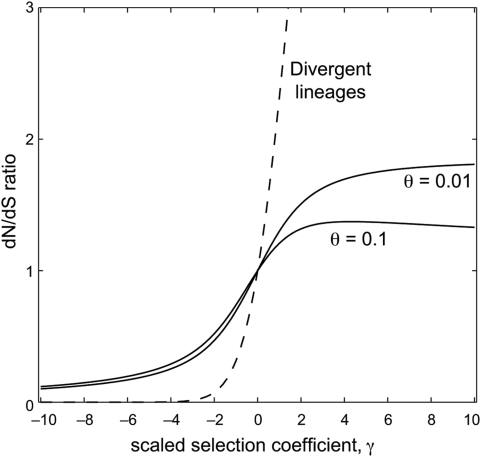
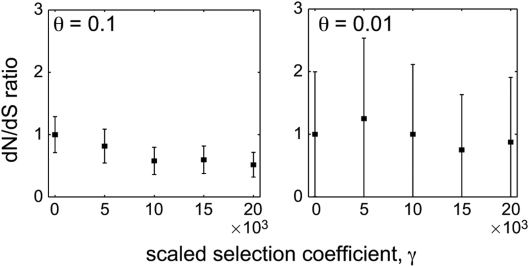
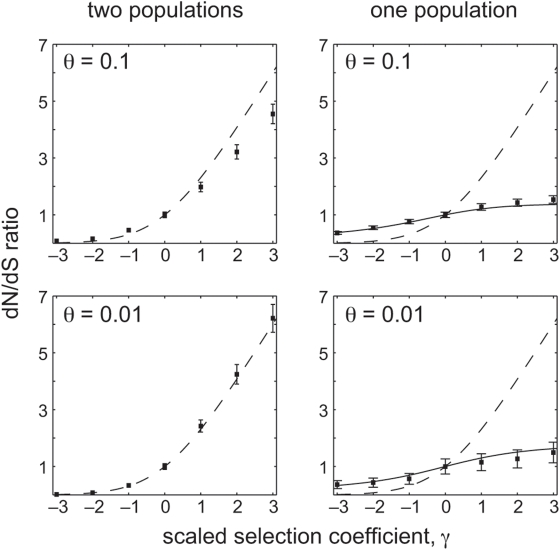
Evolutionary pressures on proteins are often quantified by the ratio of substitution rates at non-synonymous and synonymous sites. The dN/dS ratio was originally developed for application to distantly diverged sequences, the differences among which represent substitutions that have fixed along independent lineages. Nevertheless, the dN/dS measure is often applied to sequences sampled from a single population, the differences among which represent segregating polymorphisms. Here, we study the expected dN/dS ratio for samples drawn from a single population under selection, and we find that in this context, dN/dS is relatively insensitive to the selection coefficient. Moreover, the hallmark signature of positive selection over divergent lineages, dN/dS>1, is violated within a population. For population samples, the relationship between selection and dN/dS does not follow a monotonic function, and so it may be impossible to infer selection pressures from dN/dS. These results have significant implications for the interpretation of dN/dS measurements among population-genetic samples.
Overview
The claims and statistics of this paper haven’t been checked yet.
Free: it reads the open-access text and checks the first 5 claims that cite a source we can check. Create a free account to check every claim.
Integrity signals
Registry
Cites
Statistics
Figures
Verification
Claims the paper makes
The claims and statistics of this paper haven’t been checked yet.
Free: it reads the open-access text and checks the first 5 claims that cite a source we can check. Create a free account to check every claim.
Claims other papers make about this one
Each is checked against this paper’s own text: does it say what the citing paper says it does?
The check wasn’t confident either way, so it gives no verdict — never disputed.
In the citing paper
“This characteristic is consistent with the higher biodiversity observed in non-Westernized settings, where more heterogeneous dietary and environmental exposures may allow a broader range of accessory gene content to persist than is usually observed in genomes from industrialized populations [73-75] .”
From Genome-scale insights into the metabolic landscape and evolutionary development of Bifidobacterium bifidum (2026) · cites this paper as [73]
Experimental — accuracy not yet measured
Self-check
Percentages, sums and reported differences re-computed from the paper’s own numbers.
The self-check needs the paper’s full text.
Citations
Cites
MEGA4: Molecular Evolutionary Genetics Analysis (MEGA) Software Version 4.0
Tamura, K., Dudley, J., Nei, M., & Kumar, S. (2007) · Molecular Biology and Evolution · doi:10.1093/molbev/msm092 · Cited by 28,730 · cited 1×
“Theoretical work on the relationship between dN/dS and selection likewise assumes that sequences are sampled from independent, divergent species [3], as do computer packages used to estimate dN/dS from data [6,7].”
MethodStatistical method for testing the neutral mutation hypothesis by DNA polymorphism.
Tajima, F. (1989) · Genetics · doi:10.1093/genetics/123.3.585 · Cited by 13,941
PAML 4: Phylogenetic Analysis by Maximum Likelihood
Yang, Z. (2007) · Molecular Biology and Evolution · doi:10.1093/molbev/msm088 · Cited by 13,879 · cited 4×
“Theoretical work on the relationship between dN/dS and selection likewise assumes that sequences are sampled from independent, divergent species [3],as do computer packages used to estimate dN/dS from data [6, 7 ].”
MethodInfluentialEVOLUTION IN MENDELIAN POPULATIONS
Wright, S. (1931) · Genetics · doi:10.1093/genetics/16.2.97 · Cited by 8,916
Statistical tests of neutrality of mutations.
Fu, Y. X., & Li, W. H. (1993) · Genetics · doi:10.1093/genetics/133.3.693 · Cited by 4,034
Adaptive protein evolution at the Adh locus in Drosophila
McDonald, J. H., & Kreitman, M. (1991) · Nature · doi:10.1038/351652a0 · Cited by 3,283 · cited 1×
“geneticists [23,45].”
Codon-substitution models for heterogeneous selection pressure at amino acid sites
Yang, Z., Nielsen, R., Goldman, N., & Pedersen, A.-M. K. (2000) · Genetics · doi:10.1093/genetics/155.1.431 · Cited by 2,286
A codon-based model of nucleotide substitution for protein-coding DNA sequences.
(1994) · Molecular Biology and Evolution · doi:10.1093/oxfordjournals.molbev.a040153 · Cited by 1,960 · cited 20×
“We performed Wright-Fisher simulations of a population of constant size N evolving under positive or negative selection sensu Yang, in discrete time.”
BackgroundMethodInfluentialHitchhiking Under Positive Darwinian Selection
Fay, J. C., & Wu, C.-I. (2000) · Genetics · doi:10.1093/genetics/155.3.1405 · Cited by 1,819
Statistical methods for detecting molecular adaptation
Yang, Z., & Bielawski, J. P. (2000) · Trends in Ecology & Evolution · doi:10.1016/s0169-5347(00)01994-7 · Cited by 1,806 · cited 1×
“The instantaneous rate of change from codon i to codon j depends principally on the parameter v, defined as the relative rate of non-silent versus silent substitutions [2].”
Background
Cited by
Items 801–900 of 995
Ramirez, S. S., & Moncalvo, J. (2017) · bioRxiv (Cold Spring Harbor Laboratory) · doi:10.1101/107326
“Because ω ratios assume that mutations are fixed differences between species and because population polymorphisms may potentially bias ω estimates (Kryazhimskiy and Plotkin 2008), we selected only one sequence per species per gene.”
BackgroundTracking buffers of mutation and noise to the genome
Lachowiec, J. (2015) · ResearchWorks at the University of Washington (University of Washington)
Identification of Novel Genes Involved in Female Mating Choice
Chu, Y. (2013) · OhioLink ETD Center (Ohio Library and Information Network)
Modelo de seleção haplóide para evolução de genes novos
Raíces, J. B. (2017) · Digital Library of Theses and Dissertations (Universidade de São Paulo) · doi:10.11606/d.41.2017.tde-04092017-144858
Första identifieringen av felint morbillivirus hos svenska katter
Dahl, S. (2018) · Epsilon Archive for Student Projects (University of Southampton)
Drubin, C. W., Ramu, A., Rockweiler, N. B., & Conrad, D. F. (2018) · bioRxiv (Cold Spring Harbor Laboratory) · doi:10.1101/396739
Genotype networks: convergent evolution, population size and adaptation
Vahdati, A. R. (2017) · Zurich Open Repository and Archive (University of Zurich) · doi:10.5167/uzh-152480
Zhou, S. (2019) · AIP conference proceedings · doi:10.1063/1.5085558
The genetic basis of host range and virulence in human-infective Cryptosporidium spp.
Nader, J. L. T. (2017) · UEA Digital Repository (University of East Anglia) · Cited by 1
Positive selection in the Ebola virus proteomePreprint
Dasmeh, P. (2019) · bioRxiv (Cold Spring Harbor Laboratory) · doi:10.1101/556910
Molecular evolutionary consequences of island colonisationPreprint
James, J., Lanfear, R., & Eyre‐Walker, A. (2015) · bioRxiv (Cold Spring Harbor Laboratory) · doi:10.1101/014811 · Cited by 1
Pagal, S., Saranathan, R., Rani, A., Tomar, A., Arunkumar, K. P., & Prashanth, K. (2019) · bioRxiv (Cold Spring Harbor Laboratory) · doi:10.1101/753665
Patterns of genetic diversity in clonally evolving bacteria
Hauck, S. (2017) · Oxford University Research Archive (ORA) (University of Oxford) · doi:10.5287/ora-bmnnrpmzo
The genetic and epigenetic architecture of sexual dimorphism in tilapia
Wan, Z. Y. (2019) · DR-NTU (Nanyang Technological University) · doi:10.32657/10356/136866
Thakur, M. K., Singh, A., Joshi, B. D., Ghosh, A., Singh, S. K., Singh, N., Sharma, L. K., & Chandra, K. (2020) · bioRxiv (Cold Spring Harbor Laboratory) · doi:10.1101/2020.04.26.062406
“6 [27].”
Examining serpentine adaptation in Aquilegia eximia (serpentine columbine).
Black, D. R. (2020) · eScholarship (California Digital Library)
Population genetic analysis of Indian SARS-CoV-2 isolates reveals a unique phylogenetic clusterPreprint
Das, D., & Akkipeddi, V. S. S. N. R. (2020) · bioRxiv (Cold Spring Harbor Laboratory) · doi:10.1101/2020.07.19.197129
“There were four sites, one in the 5' (1-265) and three in the 3' (29675.”
BackgroundAshokkumar, M., Pattabiraman, S., Tripathy, S. P., Neogi, U., & Hanna, L. E. (2020) · AIDS Research and Human Retroviruses · doi:10.1089/aid.2020.0143
“…interpretation of pN/pS < 1 as a faithful indication of negative selection, pN/pS = 1 as neutrality, and pN/pS > 1 as strong positive selection, 23 respectively, where, pN is the number of non-synonymous changes per nonsynonymous site, pS is the number of synonymous changes per synonymous…”
Pasha, N., Krishnasamy, K., Naveenkumar, N., Mutya, S., Mam, B., Sonnekhan, K., Gopalakrishnan, C., Jain, R., & Morawala‐Patell, V. (2021) · bioRxiv (Cold Spring Harbor Laboratory) · doi:10.1101/2021.02.17.431362
Arquitectura genética de la tolerancia al estrés por déficit hídrico en papa diploide
Contreras, L., & María, L. (2020)
Behl, J. D., Ahlawat, S., Sharma, R., Behl, R., Verma, N., & Sharma, A. (2021) · Research Square · doi:10.21203/rs.3.rs-292512/v1
“2 gene locus (Kryazhimskiy and Plotkin, 2008).”
Picazo, D. R. (2021) · MACAU: Open Access Repository of Kiel University (University Library Kiel)
Templeton, A. R. (2021) · Wiley eBooks · doi:10.1002/9781119836070.refs
Işıdan, H., Turan, T., Atasoy, M. O., & Çoşkun, A. (2021) · Research Square · doi:10.21203/rs.3.rs-260589/v1
Yang, Z. (2014) · Oxford University Press eBooks · doi:10.1093/acprof:oso/9780199602605.003.0006
Castillo‐Ramírez, S., & Feil, E. J. (2013) · Springer eBooks · doi:10.1007/978-3-642-30194-0_83
Yang, Z. (2014) · Oxford University Press eBooks · doi:10.1093/acprof:oso/9780199602605.003.0013
Molecular clock and estimation of species divergence times
Yang, Z. (2014) · Oxford University Press eBooks · doi:10.1093/acprof:oso/9780199602605.003.0010
Safdari, P., Höckerstedt, L., Brosché, M., Salojärvi, J., & Laine, A. (2020) · Authorea · doi:10.22541/au.158146259.94273934 · Cited by 1
Yang, Z. (2014) · Oxford University Press eBooks · doi:10.1093/acprof:oso/9780199602605.003.0008
Phylogeny reconstruction: overview
Yang, Z. (2014) · Oxford University Press eBooks · doi:10.1093/acprof:oso/9780199602605.003.0003
(2009) · Nature Reviews Genetics · doi:10.1038/nrg2533
Machuca, N. M., Pérez, J., Méndez, A. S. G., Garcia‐Camacho, L. A., Marin‐Flamand, E., & Álvarez, H. R. (2021) · Research Square · doi:10.21203/rs.3.rs-570327/v1
Chalkia, D. (2011) · Mitochondrial DNA · doi:10.3109/19401736.2011.588222
Lucas, L. M., Cullum, R. L., Woggerman, J. N., Dwivedi, V., Markham, J. A., Kelley, C. M., Knerr, E. L., Cook, L. J., Jacobi, M. A., Taylor, D. C., et al. (2022) · medRxiv · doi:10.1101/2022.06.21.22276707
“Generally speaking, if the ratio of non-synonymous to synonymous mutant alleles (N/S ratio) in a particular gene is greater than 1, it is indicative of selection for non-synonymous mutant alleles in that gene [31].”
BackgroundEvolutionary analysis of gene networks with Orthoweb software
(2022) · International Multiconference on Bioinformatics of Genome Regulation and Structure / Systems Biology (BGRS/SB) · doi:10.18699/sbb-2022-125
Wang, F., & Tekle, Y. I. (2022) · Frontiers in Ecology and Evolution · doi:10.3389/fevo.2022.851816 · Cited by 1
“This recently evolved paralog might still have the ongoing process of adaptation that induced more genetic changes in the non-synonymous sites (Kryazhimskiy and Plotkin, 2008).”
Background(2014) · Oxford University Press eBooks · doi:10.1093/acprof:oso/9780199602605.002.0005
(2014) · Oxford University Press eBooks · doi:10.1093/acprof:oso/9780199602605.002.0003
(2014) · Oxford University Press eBooks · doi:10.1093/acprof:oso/9780199602605.002.0004
Unusual Dependence between Gene Expression and Negative Selection in Euplotes
Moldovan, M. A., & Gaydukova, S. (2022) · Molecular Biology · doi:10.1134/s0026893323010090
“Thus, dN/dS has a direct interpretation in terms of the scaled selection coefficient S [8].”
BackgroundUnusual Dependence between Gene Expression and Negative Selection in Euplotes
Moldovan, M. A., & Gaydukova, S. (2023) · Molecular Biology · doi:10.31857/s002689842301010x
Cell age drives asynchronous transcriptome aging
Yang, M., Harrison, B. R., & Promislow, D. E. L. (2023) · doi:10.1101/2023.05.31.543091
Genic constraint against nonsynonymous variation across the mouse genome
Powell, G., Simon, M. M., Pulit, S. L., Mallon, A., & Lindgren, C. M. (2023) · BMC Genomics · doi:10.1186/s12864-023-09637-2
“We compared NOER with dN/dS to assess its validity. dN/dS is a frequently used measure of the selection effect on a gene, defined as the ratio of nonsynonymous substitutions per nonsynonymous site (dN) to the number of synonymous substitutions per synonymous site (dS) [19].”
MethodBw4 ligand and direct T-cell receptor binding induced selection on HLA A and B alleles
Levi, R., Levi, L., & Louzoun, Y. (2023) · Frontiers in Immunology · doi:10.3389/fimmu.2023.1236080
Population dynamics, interactions and evolution of marine microbes using genomic approaches
Latorre, F. (2023) · UPCommons institutional repository (Universitat Politècnica de Catalunya) · doi:10.5821/dissertation-2117-396974
Molecular epidemiology and evolution of influenza a and b viruses
Tewawong, N. (2016) · Chula Digiverse · doi:10.58837/chula.the.2016.1708
Pichkar, Y., Searfoss, A. M., & Creanza, N. (2023) · Animal Behaviour · doi:10.1016/j.anbehav.2024.01.009
Computational assessment of human non-coding genetic variants with a potential clinical impact
Caron, B. (2020) · theses.fr (ABES) · doi:10.70675/e0954e55zf21cz4fddz8497z119af149cef2 · Cited by 1
Tao, L., Duan, H., Tao, K., Luo, Y., Li, Q., & Li, L. (2023) · Figshare · doi:10.6084/m9.figshare.23590402
Zhao, X., Hu, Y., Zhao, Y., Wang, L., Wu, Z., Soe, M. T., Kyaw, M. P., Cui, L., Zhu, X., & Cao, Y. (2022) · Figshare · doi:10.6084/m9.figshare.21351352
Tao, L., Duan, H., Tao, K., Luo, Y., Li, Q., & Li, L. (2023) · Figshare · doi:10.6084/m9.figshare.23590405
Tao, L., Duan, H., Tao, K., Luo, Y., Li, Q., & Li, L. (2023) · Figshare · doi:10.6084/m9.figshare.23590399
Zhao, X., Hu, Y., Zhao, Y., Wang, L., Wu, Z., Soe, M. T., Kyaw, M. P., Cui, L., Zhu, X., & Cao, Y. (2022) · Figshare · doi:10.6084/m9.figshare.21351346
Zhao, X., Hu, Y., Zhao, Y., Wang, L., Wu, Z., Soe, M. T., Kyaw, M. P., Cui, L., Zhu, X., & Cao, Y. (2022) · Figshare · doi:10.6084/m9.figshare.21351349
Tao, L., Duan, H., Tao, K., Luo, Y., Li, Q., & Li, L. (2023) · Figshare · doi:10.6084/m9.figshare.23590396
Nelson, C. W., Poon, L. L. M., & Gu, H. (2024) · Nature Communications · doi:10.1038/s41467-024-46262-3
“Indeed, π N – π S has widely recognized limitations 13 ; for detecting positive selection, it is both overly conservative (may fail to detect positive selection when it has occurred) and susceptible to false positives (may spuriously detect positive selection when it has not occurred).”
Ghasemian, E., Ramadhani, A. M., Harte, A. J., Mafuru, E., Derrick, T. R., Mtuy, T. B., Massae, P., Malisa, A., Breuer, J., Pickering, H. C., et al. (2024) · Research Square · doi:10.21203/rs.3.rs-4424389/v1
Ghasemian, E., Ramadhani, A. M., Harte, A. J., Mafuru, E., Derrick, T. R., Mtuy, T. B., Massae, P., Malisa, A., Breuer, J., Pickering, H. C., et al. (2024) · Research Square · doi:10.21203/rs.3.rs-4424389/v2
Lallemand, T. (2022) · theses.fr (ABES) · doi:10.70675/9eab90a1z422dz422dzbf8aza6f2b306b7e1 · Cited by 2
Bisio, M. D. C., dos Santos, E. M., Santos, C. A., Chahad‐Ehlers, S., & de Brito, R. A. (2024) · Development Genes and Evolution · doi:10.1007/s00427-024-00723-3
“…between more closely related taxa, generally by Ka/Ks , may be influenced by other factors that are not directly associated with selection intensity, such as population expansion or contraction, and other evolutionary forces that may even affect neighboring regions (Kryazhimskiy and Plotkin 2008).”
Molecular pathway analysis using comparative genomic and epigenomic data
Wang, Y., Zolotovskaia, M., & Buzdin, A. A. (2024) · Elsevier eBooks · doi:10.1016/b978-0-443-15568-0.00004-2
Steps toward a unified “evolutionary genomics”
Bailey, N. P. (2025) · Evolution · doi:10.1093/evolut/qpaf036
Tracing the Driving Forces of Viral Evolution
Son, H. S., & Cho, M. (2025) · Springer eBooks · doi:10.1007/978-981-96-5757-5_6
Fedorov, D. A., Bezmenova, A. V., Ezhova, M. A., Kolbasova, G., Tzetlin, A. B., Neretina, T. V., & Кнорре, Д. А. (2025) · bioRxiv (Cold Spring Harbor Laboratory) · doi:10.1101/2025.06.07.658435
“…distances, and an episode of relaxed negative or positive selection at early stages of speciation (Lynch and Conery 2000; Rocha et al. 2006; Kryazhimskiy and Plotkin 2008; Wolf et al. 2009; Stoletzki and Eyre-Walker 2011; Mugal et al. 2014; Stolyarova et al. 2019; Burskaia et al. 2020).”
Kumari, N., Khan, N., & Das, A. (2025) · International Journal of Mycobacteriology · doi:10.4103/ijmy.ijmy_30_25
Huda, T., Kabir, M. A., & Rabbane, M. G. (2025) · International Journal of Molecular Sciences · doi:10.3390/ijms26157473
“The Ka/Ks ratio, also known as the dN/dS ratio, is a frequently used statistic to quantify the mechanism and degree of selection operating on coding sequences [22].”
Xiao, J., Tao, K., Ma, D., Xia, Y., Luo, Y., & Li, L. (2025) · Horticulturae · doi:10.3390/horticulturae11091017
MutagenesisForge: A Framework for Modeling Codon-Level Mutational Biases and Calculating dN/dSPreprint
Koers, C., Bierman, R., Xu, H., & Akey, J. M. (2025) · bioRxiv (Cold Spring Harbor Laboratory) · doi:10.1101/2025.08.28.667654
Kwiecień, E., Zając, M., Bomba, A., & Rzewuska, M. (2025) · Veterinary Microbiology · doi:10.1016/j.vetmic.2025.110734
Mitogenomic Insights on the Phylogeny and Evolution of Lynx Spiders (Araneae, Oxyopidae)
Fu, D., Liu, L., Wu, C., & Luo, Y. (2025) · Ecology and Evolution · doi:10.1002/ece3.72192
Intra-host evolution of cell-fusing agent virus following acute infection in Aedes aegypti mosquito
Uddin, M. M., Suzuki, Y., Logronio, D. J., & Watanabe, K. (2025) · Virus Evolution · doi:10.1093/ve/veaf079
“Because the test was originally developed for distinctly diverged genetic sequences which represent actual substitution along evolutionary lineages over a longtime scale (Kryazhimskiy and Plotkin 2008).”
Characteristics of an emerging canine respiratory coronavirus in China
Ren, Y., Huang, J., Chen, X., Tang, C., & Yue, H. (2025) · Veterinary Quarterly · doi:10.1080/01652176.2025.2574506
“However, it should be noted that in datasets with very short evolutionary distances or limited sample sizes, dN/dS > 1 may be inflated due to transient polymorphisms or random genetic drift (Kryazhimskiy and Plotkin 2008).”
Fenk, M., Hrdina, A., Winans, J. B., Soerensen, M., Ostertag, L., Coquery, E., Sow, F. B., Petros, S., Stîngu, C. S., Lippmann, N., et al. (2025) · bioRxiv (Cold Spring Harbor Laboratory) · doi:10.1101/2025.10.23.683921
Nucleotide Substitution Patterns in Vertebrate Genomes
Mugal, C. F. (2013) · KTH Publication Database DiVA (KTH Royal Institute of Technology)
Polymorphism in pattern recognition receptor genes in pigs
Bergman, I.-M. (2010) · DiVA (Digitala Vetenskapliga Arkivet) · Cited by 1
The Evolution of the Glucosinolate Pathway in the Brassicaceae
Olson-Manning, C. F. (2013) · DukeSpace (Duke University)
Evaluating the Evolutionary Dynamics of Viral Populations
Steinbrück, L., & McHardy, A. C. (2013) · Springer eBooks · doi:10.1007/978-1-4614-9224-5_8
Biswas, S., Mondal, R., Srivastava, A., Trivedi, M., Singh, S. K., & Mishra, Y. (2022) · Figshare · doi:10.6084/m9.figshare.20193573
Biswas, S., Mondal, R., Srivastava, A., Trivedi, M., Singh, S. K., & Mishra, Y. (2022) · Figshare · doi:10.6084/m9.figshare.20193540
Biswas, S., Mondal, R., Srivastava, A., Trivedi, M., Singh, S. K., & Mishra, Y. (2022) · Figshare · doi:10.6084/m9.figshare.20193549
Biswas, S., Mondal, R., Srivastava, A., Trivedi, M., Singh, S. K., & Mishra, Y. (2022) · Figshare · doi:10.6084/m9.figshare.20193546
Zhao, X., Hu, Y., Zhao, Y., Wang, L., Wu, Z., Soe, M. T., Kyaw, M. P., Cui, L., Zhu, X., & Cao, Y. (2022) · Figshare · doi:10.6084/m9.figshare.21351355
Metadata
- Authors
- Kryazhimskiy, S., & Plotkin, J. B.
- Affiliations
- University of Pennsylvania (US)
- Corresponding author
- Plotkin, Joshua B.
- Venue
- PLoS Genetics
- Publisher
- Public Library of Science (PLoS)
- Published
- 2008-12-12
- Volume
- 4
- Issue
- 12
- Pages
- e1000304
- ISSN
- 1553-7390 (ISSN-L)
- 1553-7404
- PMC
- PMC2596312
- OpenAlex
- W2045641296
- Cited by
- 962
- References
- 64
- Citations by year
- 2026: 55 · 2025: 60 · 2024: 74 · 2023: 69 · 2022: 85 · 2021: 80 · 2020: 70 · 2019: 48 · 2018: 53 · 2017: 45 · 2016: 51 · 2015: 57 · 2014: 55 · 2013: 35 · 2012: 45
- FWCI
- 15.24
- Type
- journal article
- Language
- en
- Open access
- gold
- doi.org
- Locations
- PLoS Genetics (publishedVersion, cc-by)
- PubMed Central (publishedVersion, cc-by)
- PubMed (publishedVersion)
- RePEc: Research Papers in Economics (submittedVersion)
- DOAJ (DOAJ: Directory of Open Access Journals) (submittedVersion, cc-by-sa)
- Figshare (submittedVersion, cc-by)
- Funders
- Burroughs Wellcome Fund
- James S. McDonnell Foundation
- University of Pennsylvania
- Defense Advanced Research Projects Agency
- Advanced Research Projects Agency
- Topics
- Life Sciences › Biochemistry, Genetics and Molecular Biology › Genetics › Evolution and Genetic Dynamics
- Life Sciences › Biochemistry, Genetics and Molecular Biology › Molecular Biology › Genomics and Phylogenetic Studies
- Life Sciences › Biochemistry, Genetics and Molecular Biology › Genetics › Genetic diversity and population structure
- Keywords
- dN/dS ratio, nonsynonymous substitution rate, synonymous substitution rate, positive selection, selection coefficients, population genetics, protein evolution, selection signatures
- MeSH terms
- Genetics, Population, Models, Genetic, Proteins, Selection, Genetic, Genetic Variation, Models, Statistical, Evolution, Molecular, Amino Acid Substitution
About these checks
Registry, retraction, Cites and statistics results are computed, not judged, with one exception: a printed reference that no index lists is read once by a model before it counts as a citation error. Claims are extracted by a model and kept only when their quote appears verbatim in the text; each cited source is then checked, with a model’s help, for whether it says what the claim relies on. Those verdicts can be wrong — read the claim’s quote and the cited source before relying on one.
Statistics and arithmetic are recomputed, not judged.
Confidence bands are shown only for fields calibrated on our annotated test set. None is calibrated yet, so no band is shown.
What counts as a claim ›How we measure confidence ›How we check this ›
Are you an author, or do you see a problem with this page? Request a review
Data sources
Bibliographic data: Semantic Scholar, OpenAlex, Crossref.
Contains information from the Semantic Scholar Academic Graph Datasets, made available under the ODC Attribution License (ODC-BY 1.0).
Semantic Scholar’s data is described in: Kinney, R., et al. (2023). The Semantic Scholar Open Data Platform. arXiv:2301.10140.
