

The DOI matches its Crossref record; 56 of the 56 references it cites were found in a registry or an index.
Web-Based, Participant-Driven Studies Yield Novel Genetic Associations for Common Traits
Open accessAbstract
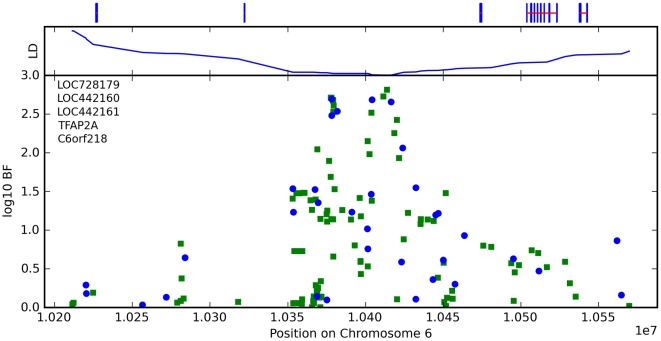
Despite the recent rapid growth in genome-wide data, much of human variation remains entirely unexplained. A significant challenge in the pursuit of the genetic basis for variation in common human traits is the efficient, coordinated collection of genotype and phenotype data. We have developed a novel research framework that facilitates the parallel study of a wide assortment of traits within a single cohort. The approach takes advantage of the interactivity of the Web both to gather data and to present genetic information to research participants, while taking care to correct for the population structure inherent to this study design. Here we report initial results from a participant-driven study of 22 traits. Replications of associations (in the genes OCA2, HERC2, SLC45A2, SLC24A4, IRF4, TYR, TYRP1, ASIP, and MC1R) for hair color, eye color, and freckling validate the Web-based, self-reporting paradigm. The identification of novel associations for hair morphology (rs17646946, near TCHH; rs7349332, near WNT10A; and rs1556547, near OFCC1), freckling (rs2153271, in BNC2), the ability to smell the methanethiol produced after eating asparagus (rs4481887, near OR2M7), and photic sneeze reflex (rs10427255, near ZEB2, and rs11856995, near NR2F2) illustrates the power of the approach.
Overview
The claims and statistics of this paper haven’t been checked yet.
Free: it reads the open-access text and checks the first 5 claims that cite a source we can check. Create a free account to check every claim.
Integrity signals
Registry
Cites
Statistics
Figures




Verification
Claims the paper makes
The claims and statistics of this paper haven’t been checked yet.
Free: it reads the open-access text and checks the first 5 claims that cite a source we can check. Create a free account to check every claim.
Claims other papers make about this one
Each is checked against this paper’s own text: does it say what the citing paper says it does?
In the citing paper
“Only four studies reported the exact wording of the ascertainment question (Eriksson et al., 2010;McAdams et al., 2020;Wang et al., 2019;Wessels et al., 1999)”
From Prevalence of the photic sneeze reflex: A systematic review and meta-analysis (2026) · cites this paper as Eriksson et al., 2010
In the citing paper
“Familial aggregation (Beckman and Nordenson, 1983;Everett, 1964;Forrester, 1985;Morris, 1987)and genome-wide association studies (Eriksson et al., 2010;Sasayama et al., 2018;Wang et al., 2019) suggest a heritable contribution to PSR.”
From Prevalence of the photic sneeze reflex: A systematic review and meta-analysis (2026) · cites this paper as Eriksson et al., 2010
In the citing paper
“Participants who selected “light sneeze reflex” from a list of medical conditions were classified as photic sneezers, producing a prevalence estimate of 3.2%.”
From Prevalence of the photic sneeze reflex: A systematic review and meta-analysis (2026) · cites this paper as Eriksson et al., 2010
In the citing paper
“For photic sneezing, 1,750 of 5,390 participants of Northern European ancestry (32.5%) answered yes to the question, “Do you have a tendency to sneeze when exposed to bright sunlight?””
From Prevalence of the photic sneeze reflex: A systematic review and meta-analysis (2026) · cites this paper as Eriksson et al., 2010
In the citing paper
“The SNP of rs1032507 is a novel genetic variant with PSR and was not identified in the U.S. population.”
From A genome-wide association study on photic sneeze reflex in the Chinese population (2019) · cites this paper as [21]
4 more claims about this paper
Create a free account to see every claim other papers make about this one.
Self-check
Percentages, sums and reported differences re-computed from the paper’s own numbers.
The self-check needs the paper’s full text.
Citations
Cites
PLINK: a tool set for whole-genome association and population-based linkage analyses.
Purcell, S., Neale, B., Todd-Brown, K., Thomas, L., Ferreira, M. A. R., Bender, D., Maller, J., Sklar, P., de Bakker, P. I. W., Daly, M. J., et al. (2007) · The American Journal of Human Genetics · doi:10.1086/519795 · Cited by 34,089
Principal components analysis corrects for stratification in genome-wide association studies
Price, A. L., Patterson, N. J., Plenge, R. M., Weinblatt, M. E., Shadick, N. A., & Reich, D. (2006) · Nature Genetics · doi:10.1038/ng1847 · Cited by 10,248
Statistical significance for genomewide studies
Storey, J. D., & Tibshirani, R. (2003) · Proceedings of the National Academy of Sciences · doi:10.1073/pnas.1530509100 · Cited by 9,692 · cited 1×
“Inordertoestimate the chance that the suggestive associations are true positives, we calculated the false-discovery rate (FDR) [57] over the set of p-values for all 22 studies.”
MethodGenome-wide association study of 14,000 cases of seven common diseases and 3,000 shared controls
The Wellcome Trust Case Control Consortium, Management Committee, Burton, P. R., Clayton, D. G., Cardon, L. R., Craddock, N., Deloukas, P., Duncanson, A., Kwiatkowski, D. P., McCarthy, M. I., et al. (2007) · Nature · doi:10.1038/nature05911 · Cited by 9,442
A haplotype map of the human genome
The International HapMap Consortium (2005) · Nature · doi:10.1038/nature04226 · Cited by 5,858
Rett syndrome is caused by mutations in X-linked MECP2, encoding methyl-CpG-binding protein 2
Amir, R. E., Van den Veyver, I. B., Wan, M., Tran, C. Q., Francke, U., & Zoghbi, H. Y. (1999) · Nature Genetics · doi:10.1038/13810 · Cited by 4,990
A second generation human haplotype map of over 3.1 million SNPs
The International HapMap Consortium (2007) · Nature · doi:10.1038/nature06258 · Cited by 4,438
Global variation in copy number in the human genome
Redon, R., Ishikawa, S., Fitch, K. R., Feuk, L., Perry, G. H., Andrews, T. D., Fiegler, H., Shapero, M. H., Carson, A. R., Chen, W., et al. (2006) · Nature · doi:10.1038/nature05329 · Cited by 4,288
Browning, S. R., & Browning, B. L. (2007) · The American Journal of Human Genetics · doi:10.1086/521987 · Cited by 3,210
Genomic Control for Association Studies
Devlin, B., & Roeder, K. (1999) · Biometrics · doi:10.1111/j.0006-341x.1999.00997.x · Cited by 3,162 · cited 1×
“For each phenotype, we also computed genomic control inflation factors ( l ) [59].”
Method
Research works printed but not linked: 7
- SC Mitchell, 1987, Odorous urine following asparagus ingestion in man., Experientia, 43, 382, 10.1007/BF01940418 · doi:10.1007/bf01940418
- M Lison, 1980, A polymorphism of the ability to smell urinary metabolites of asparagus., Br Med J, 281, 1676, 10.1136/bmj.281.6256.1676 · doi:10.1136/bmj.281.6256.1676
- S Lee, 1993, The structure of human trichohyalin. Potential multiple roles as a functional EF-hand-like calcium-binding protein, a cornified cell envelope precursor, and an intermediate filament-associated (cross-linking) protein., Journal of Biological Chemistry, 268, 12164, 10.1016/S0021-9258(19)50322-2 · DOI · Paper page
- S Thibaut, 2005, Human hair shape is programmed from the bulb., Br J Dermatol, 152, 632, 10.1111/j.1365-2133.2005.06521.x · doi:10.1111/j.1365-2133.2005.06521.x
- NA Barnicot, 1959, Paper chromatography of human hair follicles and hair extracts., Br J Dermatol, 71, 303, 10.1111/j.1365-2133.1959.tb13428.x · doi:10.1111/j.1365-2133.1959.tb13428.x
- SJ Peroutka, 1984, Autosomal dominant transmission of the “photic sneeze reflex”., N Engl J Med, 310, 599, 10.1056/NEJM198403013100923 · DOI
- HC Everett, 1964, Sneezing in response to light., Neurology, 14, 483, 10.1212/WNL.14.5.483 · DOI · Paper page
Cited by
Nucleic acid detection with CRISPR-Cas13a/C2c2
Gootenberg, J. S., Abudayyeh, O. O., Lee, J. W., Essletzbichler, P., Dy, A. J., Joung, J., Verdine, V., Donghia, N., Daringer, N. M., Freije, C. A., et al. (2017) · Science · doi:10.1126/science.aam9321 · Cited by 3,844
Carver, C. S., & Scheier, M. F. (2014) · Trends in Cognitive Sciences · doi:10.1016/j.tics.2014.02.003 · Cited by 1,004
The 23andMe Research Team, Jansen, P. R., Watanabe, K., Stringer, S., Skene, N., Bryois, J., Hammerschlag, A. R., de Leeuw, C. A., Benjamins, J. S., Muñoz-Manchado, A. B., et al. (2019) · Nature Genetics · doi:10.1038/s41588-018-0333-3 · Cited by 857
Self-citationHyde, C. L., Nagle, M. W., Tian, C., Chen, X., Paciga, S. A., Wendland, J. R., Tung, J. Y., Hinds, D. A., Perlis, R. H., & Winslow, A. R. (2016) · Nature Genetics · doi:10.1038/ng.3623 · Cited by 784
Self-citation23andMe Research Team, Nagel, M., Jansen, P. R., Stringer, S., Watanabe, K., de Leeuw, C. A., Bryois, J., Savage, J. E., Hammerschlag, A. R., Skene, N. G., et al. (2018) · Nature Genetics · doi:10.1038/s41588-018-0151-7 · Cited by 799
The genetic ancestry of African Americans, Latinos, and European Americans across the United States
Bryc, K., Durand, E. Y., Macpherson, J. M., Reich, D., & Mountain, J. L. (2015) · The American Journal of Human Genetics · doi:10.1016/j.ajhg.2014.11.010 · Cited by 712
Self-citationGazal, S., Finucane, H. K., Furlotte, N. A., Loh, P.-R., Palamara, P. F., Liu, X., Schoech, A., Bulik-Sullivan, B., Neale, B. M., Gusev, A., et al. (2017) · Nature Genetics · doi:10.1038/ng.3954 · Cited by 525
Evidence for archaic adaptive introgression in humans
Racimo, F., Sankararaman, S., Nielsen, R., & Huerta-Sánchez, E. (2015) · Nature Reviews Genetics · doi:10.1038/nrg3936 · Cited by 521
Do, C. B., Tung, J. Y., Dorfman, E., Kiefer, A. K., Drabant, E. M., Francke, U., Mountain, J. L., Goldman, S. M., Tanner, C. M., Langston, J. W., et al. (2011) · PLoS Genetics · doi:10.1371/journal.pgen.1002141 · Cited by 515
Self-citationThe missense of smell: functional variability in the human odorant receptor repertoire
Mainland, J. D., Keller, A., Li, Y. R., Zhou, T., Trimmer, C., Snyder, L. L., Moberly, A. H., Adipietro, K. A., Liu, W. L. L., Zhuang, H., et al. (2014) · Nature Neuroscience · doi:10.1038/nn.3598 · Cited by 343
Blauwendraat, C., Heilbron, K., Vallerga, C. L., Bandres‐Ciga, S., von Coelln, R., Pihlstrøm, L., Simón‐Sánchez, J., Schulte, C., Sharma, M., Krohn, L., et al. (2019) · Movement Disorders · doi:10.1002/mds.27659 · Cited by 338
Genetic evidence of assortative mating in humans
Robinson, M. R., Kleinman, A., Graff, M., Vinkhuyzen, A. A. E., Couper, D., Miller, M. B., Peyrot, W. J., Abdellaoui, A., Zietsch, B. P., Nolte, I. M., et al. (2017) · Nature Human Behaviour · doi:10.1038/s41562-016-0016 · Cited by 326
Hu, Y., Shmygelska, A., Tran, D., Eriksson, N., Tung, J. Y., & Hinds, D. A. (2016) · Nature Communications · doi:10.1038/ncomms10448 · Cited by 321
Loci associated with skin pigmentation identified in African populations
Crawford, N. G., Kelly, D. E., Hansen, M. E. B., Beltrame, M. H., Fan, S., Bowman, S. L., Jewett, E., Ranciaro, A., Thompson, S., Lo, Y., et al. (2017) · Science · doi:10.1126/science.aan8433 · Cited by 321
Classification, Ontology, and Precision Medicine
Haendel, M. A., Chute, C. G., & Robinson, P. N. (2018) · New England Journal of Medicine · doi:10.1056/nejmra1615014 · Cited by 317
Kiefer, A. K., Tung, J. Y., Do, C. B., Hinds, D. A., Mountain, J. L., Francke, U., & Eriksson, N. (2013) · PLoS Genetics · doi:10.1371/journal.pgen.1003299 · Cited by 312
Self-citationFrom patients to partners: participant-centric initiatives in biomedical research
Kaye, J., Curren, L., Anderson, N., Edwards, K., Fullerton, S. M., Kanellopoulou, N., Lund, D., MacArthur, D. G., Mascalzoni, D., Shepherd, J., et al. (2012) · Nature Reviews Genetics · doi:10.1038/nrg3218 · Cited by 293
Privacy challenges and research opportunities for genomic data sharing
Bonomi, L., Huang, Y., & Ohno-Machado, L. (2020) · Nature Genetics · doi:10.1038/s41588-020-0651-0 · Cited by 285
Dispositional optimism and physical health: A long look back, a quick look forward.
Scheier, M. F., & Carver, C. S. (2018) · American Psychologist · doi:10.1037/amp0000384 · Cited by 282
Case–control association mapping by proxy using family history of disease
Liu, J. Z., Erlich, Y., & Pickrell, J. K. (2017) · Nature Genetics · doi:10.1038/ng.3766 · Cited by 238
Left Brain, Right Brain: Facts and Fantasies
Corballis, M. C. (2014) · PLoS Biology · doi:10.1371/journal.pbio.1001767 · Cited by 276
Unravelling the human genome–phenome relationship using phenome-wide association studies
Bush, W. S., Oetjens, M. T., & Crawford, D. C. (2016) · Nature Reviews Genetics · doi:10.1038/nrg.2015.36 · Cited by 274
Public Knowledge of and Attitudes Toward Genetics and Genetic Testing
Haga, S. B., Barry, W. T., Mills, R., Ginsburg, G. S., Svetkey, L., Sullivan, J., & Willard, H. F. (2013) · Genetic Testing and Molecular Biomarkers · doi:10.1089/gtmb.2012.0350 · Cited by 266
Swan, M. (2012) · Journal of Medical Internet Research · doi:10.2196/jmir.1988 · Cited by 264
Hinds, D. A., McMahon, G., Kiefer, A. K., Do, C. B., Eriksson, N., Evans, D. M., St Pourcain, B., Ring, S. M., Mountain, J. L., Francke, U., et al. (2013) · Nature Genetics · doi:10.1038/ng.2686 · Cited by 246
Self-citationA polymorphism in IRF4 affects human pigmentation through a tyrosinase-dependent MITF/TFAP2A pathway
Praetorius, C., Grill, C., Stacey, S. N., Metcalf, A. M., Gorkin, D. U., Robinson, K. C., Van Otterloo, E., Kim, R. S. Q., Bergsteinsdottir, K., Ogmundsdottir, M. H., et al. (2013) · Cell · doi:10.1016/j.cell.2013.10.022 · Cited by 228
Human pigmentation genes under environmental selection
Sturm, R. A., & Duffy, D. L. (2012) · Genome Biology · doi:10.1186/gb-2012-13-9-248 · Cited by 182
Protein-coding repeat polymorphisms strongly shape diverse human phenotypes
Mukamel, R. E., Handsaker, R. E., Sherman, M. A., Barton, A. R., Zheng, Y., McCarroll, S. A., & Loh, P.-R. (2021) · Science · doi:10.1126/science.abg8289 · Cited by 178
Identification of 12 genetic loci associated with human healthspan
Zenin, A., Tsepilov, Y., Sharapov, S., Getmantsev, E., Menshikov, L. I., Fedichev, P. O., & Aulchenko, Y. (2019) · Communications Biology · doi:10.1038/s42003-019-0290-0 · Cited by 170
An Unexpectedly Complex Architecture for Skin Pigmentation in Africans
Martin, A. R., Lin, M., Granka, J. M., Myrick, J. W., Liu, X., Sockell, A., Atkinson, E. G., Werely, C. J., Möller, M., Sandhu, M. S., et al. (2017) · Cell · doi:10.1016/j.cell.2017.11.015 · Cited by 156
Direct-to-consumer genetic testing
Horton, R., Crawford, G., Freeman, L., Fenwick, A., Wright, C. F., & Lucassen, A. (2019) · BMJ · doi:10.1136/bmj.l5688 · Cited by 151
the 23andMe Research Team, Sanchez-Roige, S., Fontanillas, P., Elson, S. L., Pandit, A., Schmidt, E. M., Foerster, J. R., Abecasis, G. R., Gray, J. C., de Wit, H., et al. (2018) · Nature Neuroscience · doi:10.1038/s41593-017-0032-x · Cited by 128
Prediction of eye and skin color in diverse populations using seven SNPs
Spichenok, O., Budimlija, Z. M., Mitchell, A. A., Jenny, A., Kovacevic, L., Marjanovic, D., Caragine, T., Prinz, M., & Wurmbach, E. (2011) · Forensic Science International: Genetics · doi:10.1016/j.fsigen.2010.10.005 · Cited by 121
Candille, S. I., Absher, D. M., Beleza, S., Bauchet, M., McEvoy, B., Garrison, N. A., Li, J. Z., Myers, R. M., Barsh, G. S., Tang, H., et al. (2012) · PLoS ONE · doi:10.1371/journal.pone.0048294 · Cited by 111
Replicability and Robustness of Genome-Wide-Association Studies for Behavioral Traits
Rietveld, C. A., Conley, D., Eriksson, N., Esko, T., Medland, S. E., Vinkhuyzen, A. A. E., Yang, J., Boardman, J. D., Chabris, C. F., Dawes, C. T., et al. (2014) · Psychological Science · doi:10.1177/0956797614545132 · Cited by 111
“We sought to replicate the original associations using data provided by 23andMe for a cohort based on a sample of volunteer participants (Eriksson et al., 2010) that was not included in the Rietveld et al.”
MethodSelf-citationHromatka, B. S., Tung, J. Y., Kiefer, A. K., Do, C. B., Hinds, D. A., & Eriksson, N. (2015) · Human Molecular Genetics · doi:10.1093/hmg/ddv028 · Cited by 105
Self-citationVisconti, A., Duffy, D. L., Liu, F., Zhu, G., Wu, W., Chen, Y., Hysi, P. G., Zeng, C., Sanna, M., Iles, M. M., et al. (2018) · Nature Communications · doi:10.1038/s41467-018-04086-y · Cited by 103
Atypical Lateralization in Neurodevelopmental and Psychiatric Disorders: What Is the Role of Stress?
Berretz, G., Wolf, O. T., Güntürkün, O., & Ocklenburg, S. (2020) · Cortex · doi:10.1016/j.cortex.2019.12.019 · Cited by 100
Jacobs, L. C., Wollstein, A., Lao, O., Hofman, A., Klaver, C. C., Uitterlinden, A. G., Nijsten, T., Kayser, M., & Liu, F. (2013) · Human Genetics · doi:10.1007/s00439-012-1232-9 · Cited by 99
“Furthermore, BNC2 was related to freckles in a multiple trait customer-based genetic association study (Eriksson et al. 2010).”
BackgroundEnterprising or altruistic selves? Making up research subjects in genetics research
Tutton, R., & Prainsack, B. (2011) · Sociology of Health & Illness · doi:10.1111/j.1467-9566.2011.01348.x · Cited by 90
Consumer genomics will change your life, whether you get tested or not
Khan, R., & Mittelman, D. (2018) · Genome Biology · doi:10.1186/s13059-018-1506-1 · Cited by 87
Approaches and advances in the genetic causes of autoimmune disease and their implications
Inshaw, J. R. J., Cutler, A. J., Burren, O. S., Stefana, M. I., & Todd, J. A. (2018) · Nature Immunology · doi:10.1038/s41590-018-0129-8 · Cited by 70
WNT10A , dermatology and dentistry
Doolan, B. J., Onoufriadis, A., Kantaputra, P., & McGrath, J. A. (2021) · British Journal of Dermatology · doi:10.1111/bjd.20601 · Cited by 56
Visser, M., Palstra, R.-J., & Kayser, M. (2015) · Human Molecular Genetics · doi:10.1093/hmg/ddv029 · Cited by 57
Multiethnic GWAS Reveals Polygenic Architecture of Earlobe Attachment
Shaffer, J. R., Li, J., Lee, M. K., Roosenboom, J., Orlova, E., Adhikari, K., Gallo, C., Poletti, G., Schuler-Faccini, L., Bortolini, M.-C., et al. (2017) · The American Journal of Human Genetics · doi:10.1016/j.ajhg.2017.10.001 · Cited by 47
Self-citationGenome-wide Analysis of Insomnia (N=1,331,010) Identifies Novel Loci and Functional Pathways
Jansen, P. R., Watanabe, K., Stringer, S., Skene, N., Bryois, J., Hammerschlag, A. R., de Leeuw, C. A., Benjamins, J., Muñoz-Manchado, A. B., Nagel, M., et al. (2018) · doi:10.1101/214973 · Cited by 860
Self-citation21st century toolkit for optimizing population health through precision nutrition
O'Sullivan, A., Henrick, B., Dixon, B., Barile, D., Zivkovic, A., Smilowitz, J., Lemay, D., Martin, W., German, J. B., & Schaefer, S. E. (2018) · Critical Reviews in Food Science and Nutrition · doi:10.1080/10408398.2017.1348335 · Cited by 36
Beyond the Clinic: ‘Direct-to-Consumer‘ Genomic Profiling Services and Pharmacogenomics
Prainsack, B., & Vayena, E. (2013) · Pharmacogenomics · doi:10.2217/pgs.13.10 · Cited by 35
Norton, H. L., Edwards, M., Krithika, S., Johnson, M., Werren, E. A., & Parra, E. J. (2016) · American Journal of Physical Anthropology · doi:10.1002/ajpa.22861 · Cited by 30
Batai, K., Cui, Z., Arora, A., Shah-Williams, E., Hernandez, W., Ruden, M., Hollowell, C. M. P., Hooker, S. E., Bathina, M., Murphy, A. B., et al. (2021) · PLOS Genetics · doi:10.1371/journal.pgen.1009319 · Cited by 28
A genome-wide association study on photic sneeze reflex in the Chinese population
Wang, M., Sun, X., Shi, Y., Song, X., & Mi, H. (2019) · Scientific Reports · doi:10.1038/s41598-019-41551-0 · Cited by 9
Prevalence of the photic sneeze reflex: A systematic review and meta-analysis
Trinkl, J., Munkwitz, S., Bickerstaff, L., Eto, T., & Spitschan, M. (2026) · doi:10.64898/2026.08.10.26359569
Metadata
- Authors
- Eriksson, N., Macpherson, J. M., Tung, J. Y., Hon, L. S., Naughton, B., Saxonov, S., Avey, L., Wojcicki, A., Pe'er, I., & Mountain, J.
- Venue
- PLoS Genetics
- Publisher
- Public Library of Science (PLoS)
- Published
- 2010-06-24
- Volume
- 6
- Issue
- 6
- Pages
- e1000993
- ISSN
- 1553-7390 (ISSN-L)
- 1553-7404
- PMC
- PMC2891811
- OpenAlex
- W2078586457
- Cited by
- 479
- References
- 56
- FWCI
- 19.45
- Type
- journal article
- Language
- en
- Open access
- gold
About these checks
Registry, retraction, Cites and statistics results are computed, not judged, with one exception: a printed reference that no index lists is read once by a model before it counts as a citation error. Claims are extracted by a model and kept only when their quote appears verbatim in the text; each cited source is then checked, with a model’s help, for whether it says what the claim relies on. Those verdicts can be wrong — read the claim’s quote and the cited source before relying on one.
Statistics and arithmetic are recomputed, not judged.
Confidence bands are shown only for fields calibrated on our annotated test set. None is calibrated yet, so no band is shown.
What counts as a claim ›How we measure confidence ›How we check this ›
Are you an author, or do you see a problem with this page? Request a review
Data sources
Bibliographic data: Semantic Scholar, OpenAlex, Crossref.
Contains information from the Semantic Scholar Academic Graph Datasets, made available under the ODC Attribution License (ODC-BY 1.0).
Semantic Scholar’s data is described in: Kinney, R., et al. (2023). The Semantic Scholar Open Data Platform. arXiv:2301.10140.
