

Initial Severity and Antidepressant Benefits: A Meta-Analysis of Data Submitted to the Food and Drug Administration
Open accessThe DOI matches its Crossref record; 49 of the 49 references it cites were found in a registry or an index.
Abstract
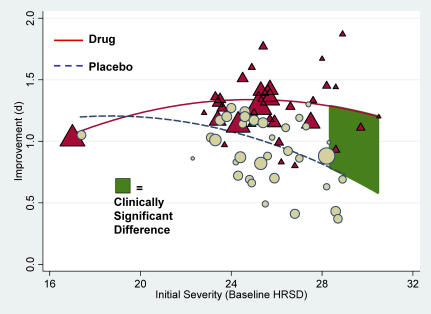
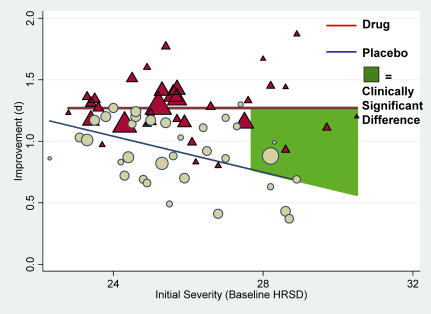
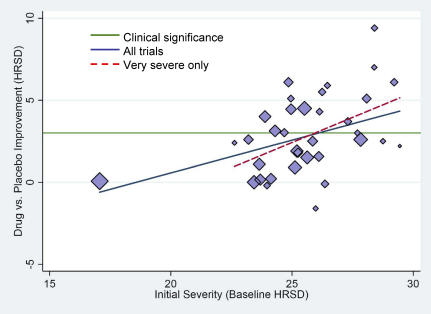
BACKGROUND: Meta-analyses of antidepressant medications have reported only modest benefits over placebo treatment, and when unpublished trial data are included, the benefit falls below accepted criteria for clinical significance. Yet, the efficacy of the antidepressants may also depend on the severity of initial depression scores. The purpose of this analysis is to establish the relation of baseline severity and antidepressant efficacy using a relevant dataset of published and unpublished clinical trials. METHODS AND FINDINGS: We obtained data on all clinical trials submitted to the US Food and Drug Administration (FDA) for the licensing of the four new-generation antidepressants for which full datasets were available. We then used meta-analytic techniques to assess linear and quadratic effects of initial severity on improvement scores for drug and placebo groups and on drug-placebo difference scores. Drug-placebo differences increased as a function of initial severity, rising from virtually no difference at moderate levels of initial depression to a relatively small difference for patients with very severe depression, reaching conventional criteria for clinical significance only for patients at the upper end of the very severely depressed category. Meta-regression analyses indicated that the relation of baseline severity and improvement was curvilinear in drug groups and showed a strong, negative linear component in placebo groups. CONCLUSIONS: Drug-placebo differences in antidepressant efficacy increase as a function of baseline severity, but are relatively small even for severely depressed patients. The relationship between initial severity and antidepressant efficacy is attributable to decreased responsiveness to placebo among very severely depressed patients, rather than to increased responsiveness to medication.
Overview
The claims and statistics of this paper haven’t been checked yet.
Free: it reads the open-access text and checks the first 5 claims that cite a source we can check. Create a free account to check every claim.
Integrity signals
Registry
Cites
Statistics
Figures
Verification
Claims the paper makes
The claims and statistics of this paper haven’t been checked yet.
Free: it reads the open-access text and checks the first 5 claims that cite a source we can check. Create a free account to check every claim.
Claims other papers make about this one
Each is checked against this paper’s own text: does it say what the citing paper says it does?
The source backs part of the claim, not all of it — or backs it for a different population, condition or comparison.
In the citing paper
“Individual-level meta-analyses have found a direct relationship between the magnitude of depressive symptoms and the effectiveness of antidepressants.8–10”
From Comparative effectiveness of exercise, antidepressants and their combination in treating non-severe depression: a systematic review and network meta-analysis of randomised controlled trials (2022) · cites this paper as [9]
Experimental — accuracy not yet measuredThe cited source says what the claim attributes to it.
In the citing paper
“An understanding of users’ own experiences of antidepressant use is increasingly important in the context of growing doubts about the effectiveness of antidepressant treatment [5, 26], concerns about side effects [27] and withdrawal effects [28].”
From ‘In my life antidepressants have been…’: a qualitative analysis of users’ diverse experiences with antidepressants (2016) · cites this paper as [5]
In the citing paper
“In this study, 84 % of participants in this study answered in the affirmative to a question about whether they felt antidepressants had reduced their depression, a number well above that suggested by efficacy studies”
From ‘In my life antidepressants have been…’: a qualitative analysis of users’ diverse experiences with antidepressants (2016) · cites this paper as [5]
In the citing paper
“Other studies have found support for increasing benefit with increasing severity of depression,21 but the effects size even for patients with the most severe depression was still minimal.21”
From Should antidepressants be used for major depressive disorder? (2020) · cites this paper as [21]
Self-check
Percentages, sums and reported differences re-computed from the paper’s own numbers.
The self-check needs the paper’s full text.
Citations
Cites
Measuring inconsistency in meta-analyses
Higgins, J. P. T., Thompson, S. G., Deeks, J. J., & Altman, D. G. (2003) · BMJ · doi:10.1136/bmj.327.7414.557 · Cited by 63,139 · cited 1×
“Both Q [15] and I2 [ 16 ] indices were used to assess”
MethodStatistical Methods for Meta-Analysis
Wasserman, S., Hedges, L. V., & Olkin, I. (1988) · Journal of Educational Statistics · doi:10.2307/1164953 · Cited by 10,326
Statistical Methods for Meta-Analysis.
Freeman, P. R., Hedges, L. V., & Olkin, I. (1986) · Biometrics · doi:10.2307/2531069 · Cited by 4,784
Meta-analysis in social research
(1982) · Evaluation and Program Planning · doi:10.1016/0149-7189(82)90011-8 · Cited by 3,853 · cited 1×
“Finally, to show directly the amount of improvement for each study’s drug group against its placebo group, we calculated the difference between the change for the drug group minus the change for the placebo group, leaving the difference in raw units and deriving its analytic weight from its standard error [11,12,20].”
MethodImputing missing standard deviations in meta-analyses can provide accurate results
Furukawa, T. A., Barbui, C., Cipriani, A., Brambilla, P., & Watanabe, N. (2006) · Journal of Clinical Epidemiology · doi:10.1016/j.jclinepi.2005.06.006 · Cited by 1,568 · cited 1×
“s were known for 28 groups, could be calculated from other inferential statistics in nine comparisons (18 groups), and were imputed in 12 comparisons (24 groups) (47.38%) [”
InfluentialPublication bias in meta-analysis its causes and consequences
Thornton, A. (2000) · Journal of Clinical Epidemiology · doi:10.1016/s0895-4356(99)00161-4 · Cited by 1,291 · cited 1×
“Examination of publication bias often relies on inspections of effect sizes in relation to sample size (or inverse variance) [22].”
BackgroundThe power of statistical tests for moderators in meta-analysis
Hedges, L. V., & Pigott, T. D. (2004) · Psychological Methods · doi:10.1037/1082-989x.9.4.426 · Cited by 672 · cited 1×
“A last, mixedeffects analysis for the amount of change used a randomeffects constant along with fixed-effects moderator dimensions; these models provide more conservative assessments of moderation [19].”
MethodMelander, H., Ahlqvist-Rastad, J., Meijer, G., & Beermann, B. (2003) · BMJ · doi:10.1136/bmj.326.7400.1171 · Cited by 635 · cited 2×
“In the case of antidepressant medication, this limitation has been found to result in considerable reporting bias characterized by multiple publication, selective publication, and selective reporting in studies sponsored by pharmaceutical companies [5].”
BackgroundPlacebo Theory, Research , and Mechanisms
WHITE, L. E., Tursky, B., & SCHWARTZ, G. E. R. (1985) · Guilford Press eBooks · Cited by 485
Khan, A., Leventhal, R. M., Khan, S. R., & Brown, W. A. (2002) · Journal of Clinical Psychopharmacology · doi:10.1097/00004714-200202000-00007 · Cited by 456 · cited 2×
“Similar to prior reports [3,4], this analysis of U.”
BackgroundResult
Research works printed but not linked: 3
- Lipsey MW Wilson DB 2001 Practical meta-analysis. Applied social research methods Volume 49. Thousand Oaks (California) Sage Publications 247
- Evans FJ 1974 The placebo response in pain reduction Adv Neurol 4 289 296
- Fabre LF Crimson L 1985 Efficacy of fluoxetine in outpatients with major depression Curr Ther Res Clin Exp 37 115 123
Cited by
Items 601–700 of 1,013
Safety and effectiveness of NMDA receptor antagonists for depression: A multidisciplinary review
Moore, T. J., Alami, A., Alexander, G. C., & Mattison, D. R. (2022) · Pharmacotherapy The Journal of Human Pharmacology and Drug Therapy · doi:10.1002/phar.2707 · Cited by 50
Self-citationDefining the Role of Pharmacology in the Emerging World of Translational Research
Enna, S. J., & Williams, M. J. (2009) · Advances in pharmacology · doi:10.1016/s1054-3589(08)57001-3 · Cited by 51
Ward, M. P. (2010) · Frontiers in Neuroengineering · doi:10.3389/fneng.2010.00007 · Cited by 43
“Several recent investigations and literature analyses have discredited this theory by questioning its origin, re-evaluating published and unpublished clinical efficacy data, and elucidating other actions of effective antidepressants (Lacasse and Leo, 2005; Kirsch et al., 2008; Turner et al., 2008).”
InfluentialNetwork analysis of the genomic basis of the placebo effect
Wang, R., Hall, K. T., Giulianini, F., Passow, D., Kaptchuk, T. J., & Loscalzo, J. (2017) · JCI Insight · doi:10.1172/jci.insight.93911 · Cited by 45
“Conversely, in other proximal placebome conditions, such as depression (31) and schizophrenia (32), which are known to have high placebo-related responses, activation of the placebome can be presumed to be efficacious in large subsets of patients.”
BackgroundRead, J., Gee, A., Diggle, J., & Butler, H. (2017) · Psychiatry Research · doi:10.1016/j.psychres.2017.07.003 · Cited by 44
“A meta-analysis found that ‘the overall effect of new-generation antidepressant medications is below recommended criteria for clinical significance’ (Kirsch et al., 2008),”
Morina, N., Hoppen, T. H., & Kip, A. (2021) · Psychological Medicine · doi:10.1017/s0033291721001641 · Cited by 47
“…of treatments for depression indicates that trials with low study quality have overestimated treatment efficacy for both psychopharmacology (Kirsch et al., 2008; Turner, Matthews, Linardatos, Tell, & Rosenthal, 2008) as well as psychological treatment (Cuijpers, van Straten, Bohlmeijer,…”
BackgroundCameron, I. M., Reid, I., & MacGillivray, S. A. (2014) · Journal of Affective Disorders · doi:10.1016/j.jad.2014.04.078 · Cited by 47
“However we did search for references cited in reviews which focused on such sources (Kirsch et al. 2008, Turner et al. 2008, Ani et al. 2008, Khan et al. 2007).”
BackgroundResultInfluentialThe Varieties of Depressive Experience: Diagnosing Mood Disorders
Ghaemi, S. N., Vöhringer, P. A., & Vergne, D. E. (2012) · Psychiatric Clinics of North America · doi:10.1016/j.psc.2011.11.008 · Cited by 48
Read, J., Cartwright, C., Gibson, K., Shiels, C., & Haslam, N. (2014) · Journal of Affective Disorders · doi:10.1016/j.jad.2014.06.010 · Cited by 42
A concise guide to personality disorders.
Paris, J. (2015) · American Psychological Association eBooks · doi:10.1037/14642-000 · Cited by 59
White, E. K., Groeneveld, K. M., Tittle, R. K., Bolhuis, N. A., Martin, R., Royer, T. G., & Fotuhi, M. (2017) · NeuroRegulation · doi:10.15540/nr.4.1.37 · Cited by 43
The Economics of Treatment for Depression
Stecher, C. D., Cloonan, S., & Domino, M. E. (2023) · Annual Review of Public Health · doi:10.1146/annurev-publhealth-061022-040533 · Cited by 51
Demyttenaere, K., Corruble, E., Hale, A. S., Quera-Salva, M.-A., Picarel-Blanchot, F., & Kasper, S. F. (2013) · CNS Spectrums · doi:10.1017/s1092852913000060 · Cited by 47
Screening for depression in high-risk groups: prospective cohort study in general practice
Baas, K. D., Wittkampf, K. A., van Weert, H. C., Lucassen, P., Huyser, J., van den Hoogen, H., van de Lisdonk, E., Bindels, P. E., Bockting, C. L., Ruhé, H. G., et al. (2009) · British Journal of Psychiatry · doi:10.1192/bjp.bp.107.046052 · Cited by 43
Parker, G., Blanch, B., Paterson, A., Hadzi-Pavlovic, D., Sheppard, E., Manicavasagar, V., Synnott, H., Graham, R. K., Friend, P., Gilfillan, D., et al. (2013) · Acta Psychiatrica Scandinavica · doi:10.1111/acps.12049 · Cited by 41
“Whether best positioned as a pilot or an acceptable prospective study, findings should be considered broadly – that such a differential treatment finding for melancholia is at variance with meta-analyses of samples with major depression showing minimal medication-placebo differentiation (40) and quantify CBT and antid…”
ResultThe neuroscience and context of adolescent depression
Henje, E., Ho, T. C., Connolly, C. G., LeWinn, K. Z., Sacchet, M. D., Tymofiyeva, O., Weng, H. Y., & Yang, T. T. (2016) · Acta Paediatrica · doi:10.1111/apa.13299 · Cited by 55
“It is generally believed that the antidepressant efficacy of SSRIs increases as a function of baseline depression severity, but it is also hypothesised that this may be due to decreased responsiveness to the placebo effect of SSRIs, rather than to increased responsiveness to medication (25).”
BackgroundKushner, S. C., Quilty, L. C., Uliaszek, A. A., McBride, C., & Bagby, R. M. (2016) · Journal of Affective Disorders · doi:10.1016/j.jad.2016.05.016 · Cited by 54
“Moreover, the observed difference in HamD ratings (Ham-Ddiff¼1.49) do not meet thresholds for clinically meaningful differences in symptom severity (i.e., 43; Kirsch et al., 2008).”
BackgroundInfluentialKetamine-based anesthesia improves electroconvulsive therapy outcomes: a randomized-controlled study
Gamble, J. J., Bi, H., Bowen, R., Weisgerber, G., Sanjanwala, R., Prasad, R., & Balbuena, L. (2018) · Canadian Journal of Anesthesia/Journal canadien d anesthésie · doi:10.1007/s12630-018-1088-0 · Cited by 74
Lorenzo-Luaces, L., Zimmerman, M., & Cuijpers, P. (2018) · Journal of Affective Disorders · doi:10.1016/j.jad.2018.02.066 · Cited by 42
Attentional bias for negative, positive, and threat words in current and remitted depression
Elgersma, H. J., Koster, E. H. W., van Tuijl, L. A., Hoekzema, A., Penninx, B. W. J. H., Bockting, C. L. H., & de Jong, P. J. (2018) · PLOS ONE · doi:10.1371/journal.pone.0205154 · Cited by 41
Volkmann, C., Volkmann, A., & Müller, C. A. (2020) · PLoS ONE · doi:10.1371/journal.pone.0241497 · Cited by 45
“This is in line with more recent analyses [26, 27] that could not confirm the previously assumed influence of baseline severity on antidepressant efficacy [28, 29].”
ResultA Meta-Analysis of the Efficacy of Pregabalin in the Treatment of Generalized Anxiety Disorder
Boschen, M. J. (2011) · The Canadian Journal of Psychiatry · doi:10.1177/070674371105600907 · Cited by 42
Effectiveness of antidepressants
McCormack, J., & Korownyk, C. (2018) · BMJ · doi:10.1136/bmj.k1073 · Cited by 43
The Time of Anthropology: Studies of Contemporary Chronopolitics
Kirtsoglou, E., & Simpson, B. (2020) · Routledge eBooks · doi:10.4324/9781003087199 · Cited by 54
Stress circuitry: mechanisms behind nervous and immune system communication that influence behavior
Tong, R. L., Kahn, U. N., Grafe, L. A., Hitti, F. L., Fried, N. T., & Corbett, B. F. (2023) · Frontiers in Psychiatry · doi:10.3389/fpsyt.2023.1240783 · Cited by 53
“Despite the efficacy of SSRIs in treating depression, they may only be more efficacious than placebo in individuals suffering from severe depression (17).”
BackgroundSerretti, A., Olgiati, P., Bajo, E., Bigelli, M., & De Ronchi, D. (2011) · The World Journal of Biological Psychiatry · doi:10.3109/15622975.2011.572998 · Cited by 42
Meister, R., Jansen, A., Härter, M. C., Nestoriuc, Y., & Kriston, L. (2017) · Journal of Affective Disorders · doi:10.1016/j.jad.2017.03.024 · Cited by 43
Effectiveness of common antidepressants: a post market release study
Alemi, F., Min, H., Yousefi, M., Becker, L. K., Hane, C. A., Nori, V. S., & Wojtusiak, J. (2021) · EClinicalMedicine · doi:10.1016/j.eclinm.2021.101171 · Cited by 51
“In the literature, numerous articles have reported that antidepressants have, on average, similar impact on symptom remission [53-56].”
BackgroundTang, L., Zhang, L., Liu, Y., Li, Y., Yang, L., Zou, M., Yang, H., Zhu, L., Du, R., Shen, Y., et al. (2024) · BMC Geriatrics · doi:10.1186/s12877-024-05118-7 · Cited by 51
“Alarmingly, nearly half of older adults treated with anti-depressants do not achieve full symptom remission [8, 9].”
BackgroundPfaff, J. J., Alfonso, H., Newton, R. U., Sim, M., Flicker, L., & Almeida, O. P. (2014) · British Journal of Sports Medicine · doi:10.1136/bjsports-2013-092510 · Cited by 39
Baker, P. D., & Cruickshank, J. (2009) · Mental Health Religion & Culture · doi:10.1080/13674670902725108 · Cited by 44
“This is not to suggest that depressed patients should be ‘‘prescribed religion’’; rather, mentalhealth specialists must be aware of the impact of faith, especially considering recent attacks on the efficacy of antidepressant medication (Kirsch et al., 2008).”
BackgroundRandomized clinical trials underestimate the efficacy of antidepressants in less severe depression
Isacsson, G., & Adler, M. (2012) · Acta Psychiatrica Scandinavica · doi:10.1111/j.1600-0447.2011.01815.x · Cited by 40
“Levels below a score of 8 are considered normal; 8–13, mild depression; 14–18, moderate depression; 19–22; severe depression; and scores above 22 very severe depression (2).”
BackgroundGolden, S. H., Shah, N. G., Naqibuddin, M., Payne, J. L., Hill‐Briggs, F., Wand, G. S., Wang, N., Langan, S. J., & Lyketsos, C. G. (2016) · Psychosomatics · doi:10.1016/j.psym.2016.08.003 · Cited by 46
“with subthreshold and mild depression compared to placebo (37-40).”
Viksveen, P., Relton, C., & Nicholl, J. P. (2017) · Trials · doi:10.1186/s13063-017-2040-2 · Cited by 50
“Although some trials of psychotherapeutic interventions suggest moderate to large effect sizes, most have unknown or high risk of bias, and only smaller effects are seen when controlling for unpublished trials or assessing higher quality studies with larger sample sizes [30, 32].”
BackgroundSaligheh, M., Hackett, D. A., Boyce, P. M., & Cobley, S. P. (2017) · Archives of Women s Mental Health · doi:10.1007/s00737-017-0750-9 · Cited by 50
“The more typical approaches to PNDmanagement have highlighted concerns, particularly with reference to the efficacy of antidepressants for patients with different depression severities (Kirsch et al. 2008; Moncrieff and Kirsch 2005): concerns of adverse medication effects while breastfeeding (Kim et al.”
BackgroundInfluentialMoncrieff, J. (2018) · BJPsych Bulletin · doi:10.1192/bjb.2017.11 · Cited by 39
Evidenzbasierte Therapie der Depression: Die S3-Leitlinie unipolare Depression
Härter, M. C., Klesse, C., Bermejo, I., Bschor, T., Gensichen, J., Harfst, T., Hautzinger, M., Kolada, C., Kopp, I., Kühner, C., et al. (2010) · Der Nervenarzt · doi:10.1007/s00115-010-3084-7 · Cited by 46
The Power of Expectation – Understanding the Placebo and Nocebo Phenomenon
Rief, W., Hofmann, S. G., & Nestoriuc, Y. (2008) · Social and Personality Psychology Compass · doi:10.1111/j.1751-9004.2008.00121.x · Cited by 39
“Accordingly, recent reviews question the unique benefits of the most prescribed modern antidepressants, the serotonin re-uptake inhibitors (SSRIs; such as Prozac and Paxil; Greenberg & Fischer, 1997; Kirsch et al., 2008).”
BackgroundA Double-Blind, Placebo-Controlled Study of Selegiline Transdermal System in Depressed Adolescents
DelBello, M. P., Hochadel, T. J., Portland, K. B., Azzaro, A. J., Katic, A., Khan, A., & Emslie, G. (2014) · Journal of Child and Adolescent Psychopharmacology · doi:10.1089/cap.2013.0138 · Cited by 40
“depression, lower severity of illness, fewer prior episodes, and United States versus European study location (Khan et al. 1991; Wilcox et al. 1992; Charney et al. 2002; Stein et al. 2006; Posternak and Zimmerman 2007; Kirsch et al. 2008).”
Attentional control in depression: A translational affective neuroscience approach
De Raedt, R., Koster, E. H. W., & Joormann, J. (2010) · Cognitive, Affective, & Behavioral Neuroscience · doi:10.3758/cabn.10.1.1 · Cited by 39
“Although many psychotherapeutic and pharmacological treatments have been developed, recent meta-analyses report rather small effect sizes (Cuijpers, van Straten, Bohlmeijer, Hollon, & Andersson, in press; Kirsch et al., 2008; Turner, Matthews, Linardatos, Tell, & Rosenthal, 2008).”
BackgroundPsychopharmacology in children and adolescents: unmet needs and opportunities
Cortese, S., Purper‐Ouakil, D., Apter, A., Arango, C., Baeza, I., Banaschewski, T., Buitelaar, J. K., Castro‐Fornieles, J., Coghill, D., Cohen, D., et al. (2023) · The Lancet Psychiatry · doi:10.1016/s2215-0366(23)00345-0 · Cited by 44
Biney, R. P., Benneh, C. K., Ameyaw, E. O., Boakye‐Gyasi, E., & Woode, E. (2016) · Journal of Ethnopharmacology · doi:10.1016/j.jep.2016.02.023 · Cited by 43
Molecular fMRI of Serotonin Transport
Hai, A., Cai, L. X., Lee, T., Lelyveld, V. S., & Jasanoff, A. (2016) · Neuron · doi:10.1016/j.neuron.2016.09.048 · Cited by 45
“Efforts to characterize neurotransmitter reuptake and redistribution patterns could also facilitate better understanding of neuropharmacological therapies (Kirsch et al., 2002, 2008) and might inform the development of improved treatments.”
Depression, antidepressants and the risk of cardiovascular events and death in older men
Almeida, O. P., Ford, A. H., Hankey, G. J., Golledge, J., Yeap, B. B., & Flicker, L. A. (2019) · Maturitas · doi:10.1016/j.maturitas.2019.06.009 · Cited by 42
A review of effects of calorie restriction and fasting with potential relevance to depression
Igwe, O., Sone, M., Matveychuk, D., Baker, G. B., & Dursun, S. M. (2020) · Progress in Neuro-Psychopharmacology and Biological Psychiatry · doi:10.1016/j.pnpbp.2020.110206 · Cited by 47
The role of maternal care in shaping CNS function
Nephew, B. C., & Murgatroyd, C. (2013) · Neuropeptides · doi:10.1016/j.npep.2013.10.013 · Cited by 43
“Based on the limited effectiveness of clinical treatments developed using rodent restraint, chronic mild stress (CMS), and similar paradigms, it is concluded that these stress paradigms have poor predictive value (Kirsch et al., 2008).”
Mannel, M., Kuhn, U., Schmidt, U., Ploch, M., & Murck, H. (2010) · Journal of Psychiatric Research · doi:10.1016/j.jpsychires.2010.01.010 · Cited by 39
“The data are also important against the background that the current standard treatment is unable to show efficacy in patients with a low severity of depression as defined by a low score of the HAM-D17 (Khan et al., 2005; Kirsch et al., 2008).”
BackgroundPlacebo effect in child and adolescent psychiatric trials
Parellada, M., Moreno, C., Moreno, M., Espliego, A., Portugal, E., & Arango, C. (2011) · European Neuropsychopharmacology · doi:10.1016/j.euroneuro.2011.09.007 · Cited by 41
“…between SSRI and TCA (Geddes et al., 2005) except for depressed inpatients (Anderson, 1998 ) were reported in the eighties, although later metaanalyses have reported mean placebo effects in antidepressant trials as high as 68% (Walsh et al., 2002; Kirsch et al., 2008; Rief et al., 2009).”
InfluentialFregni, F., Brunoni, & Jr, F. (2009) · Therapeutics and Clinical Risk Management · doi:10.2147/tcrm.s5751 · Cited by 40
Antidepressants on trial: how valid is the evidence?
Parker, G. B. (2008) · The British Journal of Psychiatry · doi:10.1192/bjp.bp.108.054767 · Cited by 39
Horwitz, A. V. (2009) · Cambridge University Press eBooks · doi:10.1017/cbo9780511984945.004 · Cited by 65
Placebo effect in burning mouth syndrome: a systematic review
Kuten‐Shorrer, M., Jm, K., Sonis, S. T., & Treister, N. S. (2013) · Oral Diseases · doi:10.1111/odi.12192 · Cited by 41
Garattini, S. K., & Bertelè, V. (2009) · Journal of Hepatology · doi:10.1016/j.jhep.2009.07.005 · Cited by 40
“[39].”
The Effects of Cognitive Therapy versus ‘No Intervention’ for Major Depressive Disorder
Jakobsen, J. C., Hansen, J. L., Storebø, O. J., Simonsen, E., & Gluud, C. (2011) · PLoS ONE · doi:10.1371/journal.pone.0028299 · Cited by 38
“severely depressed patients, and that this effect seems to be clinically small [9,10].”
BackgroundResultBschor, T., & Kilarski, L. L. (2016) · Expert Review of Neurotherapeutics · doi:10.1586/14737175.2016.1155985 · Cited by 38
“Can the effectiveness of a group of substances that has seen a sales boom unlike any other psychotropic drug and that has been investigated in over one thousand RCTs be questioned? The public furor about the above-mentioned publication of Kirsch and colleagues [1] was not entirely understandable, since Kirsch et al.”
BackgroundGoodyear, R. K., Borders, L. D., Chang, C. Y., Guiffrida, D. A., Hutman, H., Kemer, G., Watkins, C. E., Jr., & White, E. G. (2016) · The Clinical Supervisor · doi:10.1080/07325223.2016.1153991 · Cited by 45
“The average effect size for psychotherapy is about .8 (Cohen's d; Wampold & Imel, 2015), which is large in social science research and contrasts with psychopharmacological treatments for depression, which are only marginally more effective than placebos (Kirsch et al., 2008).”
BackgroundA Handbook for the Study of Mental Health: Social Contexts, Theories, and Systems
(2017) · Cambridge University Press eBooks · doi:10.1017/9781316471289 · Cited by 59
Yan, D., Liu, B., Wei, X., Ou, W., Liao, M., Ji, S., Peng, Y., Liu, J., Wu, S., Wang, M., et al. (2022) · Psychiatry Research · doi:10.1016/j.psychres.2022.114867 · Cited by 38
de Graaf, L. E., Gerhards, S. A., Evers, S. M., Arntz, A., Riper, H., Severens, J. L., Widdershoven, G., Metsemakers, J. F., & Huibers, M. J. (2008) · BMC Public Health · doi:10.1186/1471-2458-8-224 · Cited by 38
“Second, pharmacotherapy is only effective in extremely depressed patients [14], and many patients refuse medication or comply poorly [15].”
Beliefs of people taking antidepressants about the causes of their own depression
Read, J., Cartwright, C., Gibson, K., Shiels, C., & Magliano, L. (2015) · Journal of Affective Disorders · doi:10.1016/j.jad.2014.11.009 · Cited by 37
“These increases occur despite evidence that their efficacy was initially overestimated (Kirsch et al., 2008; Pigott et al., 2010) and their adverse effects minimised.”
BackgroundRead, J. (2020) · Addictive Behaviors · doi:10.1016/j.addbeh.2019.106157 · Cited by 37
“Findings that the majority of improved cases are the result of placebo effects (Jakobsen et al., 2017; Kirsch et al. 2008) cannot detract from the reality that most people in the sample felt better and believed this was a result of the drugs.”
BackgroundSeifert, J., Engel, R. R., Bernegger, X., Führmann, F., Bleich, S., Stübner, S., Sieberer, M. G., Greil, W., Toto, S., & Grohmann, R. (2020) · Journal of Affective Disorders · doi:10.1016/j.jad.2020.12.073 · Cited by 39
Fu, C. H. Y., Antoniades, M., Erus, G., García, J., Fan, Y., Arnone, D., Arnott, S. R., Chen, T., Choi, K. S., Fatt, C. C., et al. (2024) · Nature Mental Health · doi:10.1038/s44220-023-00187-w · Cited by 41
“Antidepressant medications demonstrate significantly greater treatment efficacy than placebo in randomized controlled MDD trials 54,55 .”
Morgan, A. J., Reavley, N. J., & Jorm, A. F. (2014) · Australian & New Zealand Journal of Psychiatry · doi:10.1177/0004867413512686 · Cited by 37
“This change may have been influenced by several meta-analyses that have suggested antidepressant efficacy is equivocal in mild-to-moderate depression (Fournier et al., 2010; Kirsch et al., 2008).”
Toward an animal model of extinction-induced despair: focus on aging and physiological indices
Huston, J. P., Schulz, D., & Topic, B. (2009) · Journal of Neural Transmission · doi:10.1007/s00702-009-0210-4 · Cited by 39
“Interestingly, a recent meta-analysis of data from clinical trials revealed that the effectiveness of newer SSRIs, including FLX, did not reach clinical significance when baseline depression scores were also considered ( Kirsch et al. 2008 ).”
BackgroundHaas, J. W., Rief, W., Glombiewski, J. A., Winkler, A., & Doering, B. K. (2020) · Journal of Affective Disorders · doi:10.1016/j.jad.2020.05.056 · Cited by 42
Bosker, F. J., Tanke, M. A. C., Jongsma, M. E., Cremers, T. I. F. H., Jagtman, E., Pietersen, C. Y., van der Hart, M. G. C., Gladkevich, A. V., Kema, I. P., Westerink, B. H. C., et al. (2010) · Neurochemistry International · doi:10.1016/j.neuint.2010.10.001 · Cited by 40
“However, SSRI treatment is not without controversy, as witnessed by meta-analyses suggesting that efficacy barely exceeds placebo response (Kirsch et al., 2002, 2008) in particular with mild or moderate symptoms of depression (Fournier et al., 2010).”
Jani, B. D., McLean, G., Nicholl, B. I., Barry, S. J. E., Sattar, N., Mair, F. S., & Cavanagh, J. (2015) · Frontiers in Human Neuroscience · doi:10.3389/fnhum.2015.00018 · Cited by 37
“In the last decade, three separate meta-analyses reported that the efficacy of antidepressants is related to the initial severity of depression and they may not be effective in the treatment of mild depression (Khan et al., 2002; Kirsch et al., 2008; Fournier et al., 2010).”
BackgroundA quantitative review on outcome-to-antidepressants in melancholic unipolar depression
Valerio, M. P., Szmulewicz, A., & Martino, D. J. (2018) · Psychiatry Research · doi:10.1016/j.psychres.2018.03.088 · Cited by 38
Holvast, F., Voshaar, R. C. O., Wouters, H., Hek, K., Schellevis, F., Burger, H., & Verhaak, P. F. M. (2018) · Family Practice · doi:10.1093/fampra/cmy106 · Cited by 46
‘They won't do any harm and might do some good’: time to think again on the use of antidepressants?
Middleton, H., & Moncrieff, J. (2011) · British Journal of General Practice · doi:10.3399/bjgp11x548983 · Cited by 36
“The association between rising levels of drug treatment and increasing disability may not be surprising in the light of recent research on antidepressants which suggests they may not be superior to placebo, certainly for the majority of patients with milder degrees of depression.(8,9) Even for those with more severe d…”
ResultHow many of 1829 antidepressant users report withdrawal effects or addiction?
Read, J., Cartwright, C., & Gibson, K. (2018) · International Journal of Mental Health Nursing · doi:10.1111/inm.12488 · Cited by 36
Ketamine as Antidepressant? Current State and Future Perspectives
Hasselmann, H. (2013) · Current Neuropharmacology · doi:10.2174/1570159x113119990043 · Cited by 43
“According to a recent metaanalysis [41], SSRIs are slightly superior to placebo in severe, but not mild or moderate depression.”
BackgroundDrug Firms, the Codification of Diagnostic Categories, and Bias in Clinical Guidelines
Cosgrove, L., & Wheeler, E. E. (2013) · The Journal of Law Medicine & Ethics · doi:10.1111/jlme.12074 · Cited by 50
Vitamin D in Depression: A Potential Bioactive Agent to Reduce Suicide and Suicide Attempt Risk
Somoza-Moncada, M. M., Turrubiates‐Hernández, F. J., Muñóz-Valle, J. F., Gutiérrez-Brito, J. A., Díaz-Pérez, S. A., Arelis, A. A., & Hernández‐Bello, J. (2023) · Nutrients · doi:10.3390/nu15071765 · Cited by 41
“However, as anti-depressive medication has a significant clinical impact on patients at the upper end of the very severely depressed category [97] is valid to explore the value of vitamin D supplementation for certain groups of individuals, such as people who are overweight, people living in urban areas, older adults,…”
BackgroundEvidence-based medicine in psychopharmacotherapy: possibilities, problems and limitations
Möller, H., & Maier, W. (2009) · European Archives of Psychiatry and Clinical Neuroscience · doi:10.1007/s00406-009-0070-9 · Cited by 39
“The publication of a recent meta-analysis on the efficacy of antidepressants [87] underlines how misleading the interpretations of such metaanalytical results can be, if the authors do not have adequate experience and expertise [118].”
BackgroundRoman, M. W. (2012) · Issues in Mental Health Nursing · doi:10.3109/01612840.2012.713447 · Cited by 36
“A study published by Kirsch (Kirsch et al., 2008) analyzed data from clinical trials submitted to the US Food and Drug Administration (FDA) for the licensing of the four new-generation antidepressants where full data was available.”
MethodThe enigma of post-natal depression: an update
Wylie, L., Martin, C. J. H., Marland, G. R., Martin, C. R., & Rankin, J. (2010) · Journal of Psychiatric and Mental Health Nursing · doi:10.1111/j.1365-2850.2010.01626.x · Cited by 62
Wiechers, I. R., Kirwin, P. D., & Rosenheck, R. A. (2013) · American Journal of Geriatric Psychiatry · doi:10.1016/j.jagp.2013.10.007 · Cited by 35
Major Depression Diagnoses Among Patients With Systemic Sclerosis: Baseline and One‐Month Followup
Thombs, B. D., Jewett, L. R., Kwakkenbos, L., Hudson, M., & Baron, M. G. (2014) · Arthritis Care & Research · doi:10.1002/acr.22447 · Cited by 37
“MDD have mild depression, but patients with mild MDD tend to experience much less benefit, if any, from antidepressant treatment compared to patients with more severe symptoms who are typically seen in psychiatric settings (6).”
BackgroundOvercoming disagreement: a roadmap for placebo studies
Blease, C., & Annoni, M. (2019) · Biology & Philosophy · doi:10.1007/s10539-019-9671-5 · Cited by 39
A randomized controlled double-blind study of rotigotine on neuropsychiatric symptoms in de novo PD
Castrioto, A., Thobois, S., Anheim, M., Quésada, J.-L., Lhommée, E., Klinger, H., Bichon, A., Schmitt, E., Durif, F., Azulay, J.-P., et al. (2020) · npj Parkinson s Disease · doi:10.1038/s41531-020-00142-x · Cited by 38
Hieronymus, F., Lisinski, A., Eriksson, E., & Østergaard, S. D. (2021) · Translational Psychiatry · doi:10.1038/s41398-021-01364-0 · Cited by 42
An Overview of Vortioxetine: (Academic Highlights)
Schatzberg, A. F., Blier, P., Culpepper, L., Jain, R., Papakostas, G. I., & Thase, M. E. (2014) · The Journal of Clinical Psychiatry · doi:10.4088/jcp.14027ah1 · Cited by 36
The possibility of evidence-based psychiatry: depression as a case
Stojanov, D., Korf, J., de Jonge, P., & Popov, G. (2010) · Clinical Epigenetics · doi:10.1007/s13148-010-0014-2 · Cited by 36
“One may, for instance, refer to the recent discussion on antidepressant drugs (Kirsch et al. 2008; Turner et al. 2008; Moncrieff and Kirsch 2005).”
BackgroundResultMcAllister-Williams, R. H. (2008) · Evidence Based Mental Health · doi:10.1136/ebmh.11.3.66 · Cited by 37
The benefits of antidepressants: news or fake news?
Parker, G. B. (2018) · The British Journal of Psychiatry · doi:10.1192/bjp.2018.98 · Cited by 36
Psychedelic Therapy—A New Paradigm of Care for Mental Health
Yehuda, R., & Lehrner, A. L. (2023) · JAMA · doi:10.1001/jama.2023.12900 · Cited by 35
Declining efficacy in controlled trials of antidepressants: effects of placebo dropout
Schalkwijk, S., Undurraga, J., Tondo, L., & Baldessarini, R. J. (2014) · The International Journal of Neuropsychopharmacology · doi:10.1017/s1461145714000224 · Cited by 34
“minimum required depression scores or other indications of baseline illness-severity for inclusion (Khan et al., 2002, 2007; Kirsch et al., 2008), pre-trial placebo washout of previous drugs (Lee et al.”
BackgroundPsychiatric consultation in the collaborative care model: The “bipolar sieve” effect
Phelps, J. R., & James, J. (2017) · Medical Hypotheses · doi:10.1016/j.mehy.2017.06.017 · Cited by 36
Evaluating treatments in health care: The instability of a one-legged stool
Kaplan, B. J., Giesbrecht, G., Shannon, S., & McLeod, K. (2011) · BMC Medical Research Methodology · doi:10.1186/1471-2288-11-65 · Cited by 34
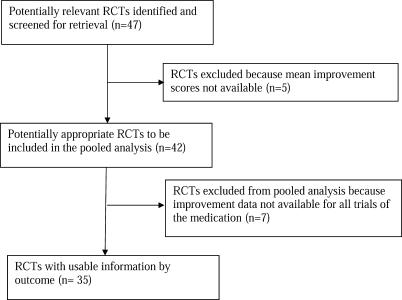
“Using Freedom of Information legislation to gain access to unpublished studies of anti-depressant efficacy, Kirsch and colleagues showed very little difference between medication and placebo in 35 RCTs on four SSRIs [24].”
BackgroundMethodInfluentialJakobsen, J. C., Lindschou Hansen, J., Storebø, O. J., Simonsen, E., & Gluud, C. (2011) · PLoS ONE · doi:10.1371/journal.pone.0022890 · Cited by 35
“However, meta-analyses have shown that newer antidepressants presumably only obtain beneficial effect in severely depressed patients, and this effect seems to be clinically small [9,10].”
BackgroundResultHieronymus, F., Jauhar, S., Østergaard, S. D., & Young, A. H. (2020) · Journal of Psychopharmacology · doi:10.1177/0269881120922950 · Cited by 33
“3 compared with placebo (Hieronymus et al., 2016a; Jakobsen et al., 2017; Kirsch et al., 2008; Turner et al., 2008), are far from meeting this 0.”
BackgroundInfluentialWolff, J., Reißner, P., Hefner, G., Normann, C., Kaier, K., Binder, H., Hiemke, C., Toto, S., Domschke, K., Marschollek, M., et al. (2021) · PLoS ONE · doi:10.1371/journal.pone.0255192 · Cited by 41
“However, while the benefit of antidepressants over placebo was found to be substantial in severe depression, effects may be minimal or nonexistent, on average, in patients with mild or moderate symptoms [47,48].”
BackgroundCritical thinking in clinical medicine: what is it?
Gupta, M., & Upshur, R. E. G. (2012) · Journal of Evaluation in Clinical Practice · doi:10.1111/j.1365-2753.2012.01897.x · Cited by 41
Synofzik, M. (2009) · Neuroethics · doi:10.1007/s12152-008-9029-1 · Cited by 43
“For example, there is doubt that SSRIs are also effective in minor melancholy [42] or that cholinomimetic drugs work efficiently in nondementia memory disturbances [2, 43].”
BackgroundGartlehner, G., Thaler, K. J., Hansen, R. A., & Gaynes, B. N. (2009) · Drug Safety · doi:10.2165/11318930-000000000-00000 · Cited by 37
Effect of placebo groups on blood pressure in hypertension: a meta-analysis of beta-blocker trials
Wilhelm, M., Winkler, A., Rief, W., & Doering, B. K. (2016) · Journal of the American Society of Hypertension · doi:10.1016/j.jash.2016.10.009 · Cited by 38
Depression in the Primary Care Setting
Ellis, P., Kitay, B. M., & Schmidt, C. J. (2019) · New England Journal of Medicine · doi:10.1056/nejmc1903259 · Cited by 34
Aicher, H. D., Mueller, M. J., Dornbierer, D. A., Suay, D., Elsner, C., Wicki, I., Meling, D., Caflisch, L., Hempe, A., Steinhart, C., et al. (2024) · Frontiers in Psychiatry · doi:10.3389/fpsyt.2023.1302559 · Cited by 33
Metadata
- Authors
- Kirsch, I., Deacon, B. J., Huedo-Medina, T. B., Scoboria, A., Moore, T. J., & Johnson, B. T.
- Affiliations
- University of Hull (GB)
- University of Wyoming (US)
- University of Connecticut (US)
- University of Windsor (CA)
- Institute for Safe Medication Practices (US)
- Corresponding author
- Kirsch, Irving
- Venue
- PLoS Medicine
- Publisher
- Public Library of Science (PLoS)
- Published
- 2008-02-26
- Volume
- 5
- Issue
- 2
- Pages
- e45
- ISSN
- 1549-1277 (ISSN-L)
- 1549-1676
- PMC
- PMC2253608
- OpenAlex
- W2153403353
- Cited by
- 2,442
- References
- 49
- Citations by year
- 2026: 47 · 2025: 53 · 2024: 63 · 2023: 65 · 2022: 90 · 2021: 81 · 2020: 132 · 2019: 100 · 2018: 159 · 2017: 154 · 2016: 142 · 2015: 130 · 2014: 156 · 2013: 191 · 2012: 179
- FWCI
- 24.87
- Type
- journal article
- Language
- en
- Open access
- gold
- doi.org
- Licence
- cc-by
- Locations
- PLoS Medicine (publishedVersion, cc-by)
- PubMed Central (publishedVersion, cc-by)
- PubMed (publishedVersion)
- RePEc: Research Papers in Economics (publishedVersion)
- Research Online (University of Wollongong) (submittedVersion)
- DOAJ (DOAJ: Directory of Open Access Journals) (submittedVersion, cc-by-sa)
- Figshare (submittedVersion)
- Topics
- Health Sciences › Medicine › Pharmacology (medical) › Treatment of Major Depression
- Social Sciences › Psychology › Clinical Psychology › Psychotherapy Techniques and Applications
- Health Sciences › Medicine › Psychiatry and Mental health › Mental Health Treatment and Access
- Keywords
- antidepressants, antidepressant efficacy, placebo response, severe depression, clinical significance
- MeSH terms
- Antidepressive Agents, Clinical Trials as Topic, Depressive Disorder, Humans, Severity of Illness Index, United States, United States Food and Drug Administration, Databases, Factual
About these checks
Registry, retraction, Cites and statistics results are computed, not judged, with one exception: a printed reference that no index lists is read once by a model before it counts as a citation error. Claims are extracted by a model and kept only when their quote appears verbatim in the text; each cited source is then checked, with a model’s help, for whether it says what the claim relies on. Those verdicts can be wrong — read the claim’s quote and the cited source before relying on one.
Statistics and arithmetic are recomputed, not judged.
Confidence bands are shown only for fields calibrated on our annotated test set. None is calibrated yet, so no band is shown.
What counts as a claim ›How we measure confidence ›How we check this ›
Are you an author, or do you see a problem with this page? Request a review
Data sources
Bibliographic data: Semantic Scholar, OpenAlex, Crossref.
Contains information from the Semantic Scholar Academic Graph Datasets, made available under the ODC Attribution License (ODC-BY 1.0).
Semantic Scholar’s data is described in: Kinney, R., et al. (2023). The Semantic Scholar Open Data Platform. arXiv:2301.10140.
