

Initial Severity and Antidepressant Benefits: A Meta-Analysis of Data Submitted to the Food and Drug Administration
Open accessThe DOI matches its Crossref record; 49 of the 49 references it cites were found in a registry or an index.
Abstract
BACKGROUND: Meta-analyses of antidepressant medications have reported only modest benefits over placebo treatment, and when unpublished trial data are included, the benefit falls below accepted criteria for clinical significance. Yet, the efficacy of the antidepressants may also depend on the severity of initial depression scores. The purpose of this analysis is to establish the relation of baseline severity and antidepressant efficacy using a relevant dataset of published and unpublished clinical trials. METHODS AND FINDINGS: We obtained data on all clinical trials submitted to the US Food and Drug Administration (FDA) for the licensing of the four new-generation antidepressants for which full datasets were available. We then used meta-analytic techniques to assess linear and quadratic effects of initial severity on improvement scores for drug and placebo groups and on drug-placebo difference scores. Drug-placebo differences increased as a function of initial severity, rising from virtually no difference at moderate levels of initial depression to a relatively small difference for patients with very severe depression, reaching conventional criteria for clinical significance only for patients at the upper end of the very severely depressed category. Meta-regression analyses indicated that the relation of baseline severity and improvement was curvilinear in drug groups and showed a strong, negative linear component in placebo groups. CONCLUSIONS: Drug-placebo differences in antidepressant efficacy increase as a function of baseline severity, but are relatively small even for severely depressed patients. The relationship between initial severity and antidepressant efficacy is attributable to decreased responsiveness to placebo among very severely depressed patients, rather than to increased responsiveness to medication.
Overview
The claims and statistics of this paper haven’t been checked yet.
Free: it reads the open-access text and checks the first 5 claims that cite a source we can check. Create a free account to check every claim.
Integrity signals
Registry
Cites
Statistics
Figures
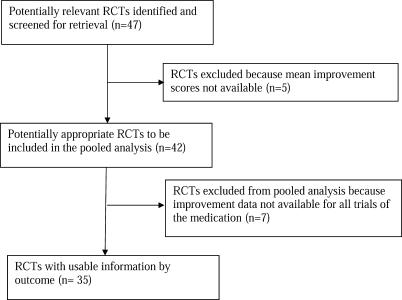
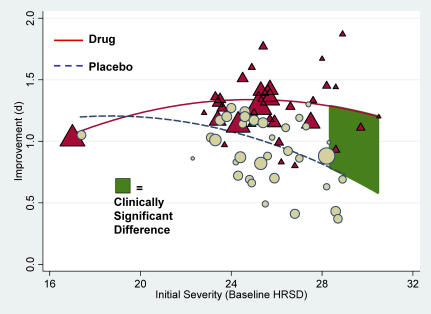
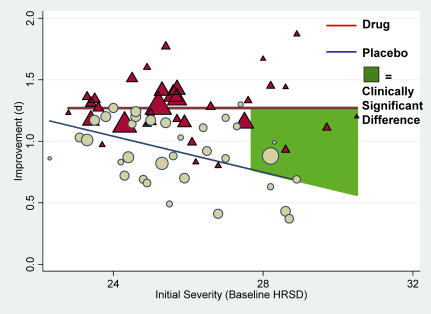
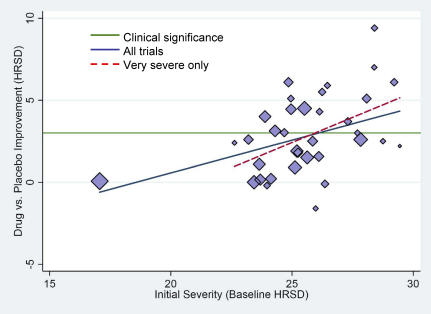
Verification
Claims the paper makes
The claims and statistics of this paper haven’t been checked yet.
Free: it reads the open-access text and checks the first 5 claims that cite a source we can check. Create a free account to check every claim.
Claims other papers make about this one
Each is checked against this paper’s own text: does it say what the citing paper says it does?
The source backs part of the claim, not all of it — or backs it for a different population, condition or comparison.
In the citing paper
“Individual-level meta-analyses have found a direct relationship between the magnitude of depressive symptoms and the effectiveness of antidepressants.8–10”
From Comparative effectiveness of exercise, antidepressants and their combination in treating non-severe depression: a systematic review and network meta-analysis of randomised controlled trials (2022) · cites this paper as [9]
Experimental — accuracy not yet measuredThe cited source says what the claim attributes to it.
In the citing paper
“An understanding of users’ own experiences of antidepressant use is increasingly important in the context of growing doubts about the effectiveness of antidepressant treatment [5, 26], concerns about side effects [27] and withdrawal effects [28].”
From ‘In my life antidepressants have been…’: a qualitative analysis of users’ diverse experiences with antidepressants (2016) · cites this paper as [5]
In the citing paper
“In this study, 84 % of participants in this study answered in the affirmative to a question about whether they felt antidepressants had reduced their depression, a number well above that suggested by efficacy studies”
From ‘In my life antidepressants have been…’: a qualitative analysis of users’ diverse experiences with antidepressants (2016) · cites this paper as [5]
In the citing paper
“Other studies have found support for increasing benefit with increasing severity of depression,21 but the effects size even for patients with the most severe depression was still minimal.21”
From Should antidepressants be used for major depressive disorder? (2020) · cites this paper as [21]
Self-check
Percentages, sums and reported differences re-computed from the paper’s own numbers.
The self-check needs the paper’s full text.
Citations
Cites
Measuring inconsistency in meta-analyses
Higgins, J. P. T., Thompson, S. G., Deeks, J. J., & Altman, D. G. (2003) · BMJ · doi:10.1136/bmj.327.7414.557 · Cited by 63,139 · cited 1×
“Both Q [15] and I2 [ 16 ] indices were used to assess”
MethodStatistical Methods for Meta-Analysis
Wasserman, S., Hedges, L. V., & Olkin, I. (1988) · Journal of Educational Statistics · doi:10.2307/1164953 · Cited by 10,326
Statistical Methods for Meta-Analysis.
Freeman, P. R., Hedges, L. V., & Olkin, I. (1986) · Biometrics · doi:10.2307/2531069 · Cited by 4,784
Meta-analysis in social research
(1982) · Evaluation and Program Planning · doi:10.1016/0149-7189(82)90011-8 · Cited by 3,853 · cited 1×
“Finally, to show directly the amount of improvement for each study’s drug group against its placebo group, we calculated the difference between the change for the drug group minus the change for the placebo group, leaving the difference in raw units and deriving its analytic weight from its standard error [11,12,20].”
MethodImputing missing standard deviations in meta-analyses can provide accurate results
Furukawa, T. A., Barbui, C., Cipriani, A., Brambilla, P., & Watanabe, N. (2006) · Journal of Clinical Epidemiology · doi:10.1016/j.jclinepi.2005.06.006 · Cited by 1,568 · cited 1×
“s were known for 28 groups, could be calculated from other inferential statistics in nine comparisons (18 groups), and were imputed in 12 comparisons (24 groups) (47.38%) [”
InfluentialPublication bias in meta-analysis its causes and consequences
Thornton, A. (2000) · Journal of Clinical Epidemiology · doi:10.1016/s0895-4356(99)00161-4 · Cited by 1,291 · cited 1×
“Examination of publication bias often relies on inspections of effect sizes in relation to sample size (or inverse variance) [22].”
BackgroundThe power of statistical tests for moderators in meta-analysis
Hedges, L. V., & Pigott, T. D. (2004) · Psychological Methods · doi:10.1037/1082-989x.9.4.426 · Cited by 672 · cited 1×
“A last, mixedeffects analysis for the amount of change used a randomeffects constant along with fixed-effects moderator dimensions; these models provide more conservative assessments of moderation [19].”
MethodMelander, H., Ahlqvist-Rastad, J., Meijer, G., & Beermann, B. (2003) · BMJ · doi:10.1136/bmj.326.7400.1171 · Cited by 635 · cited 2×
“In the case of antidepressant medication, this limitation has been found to result in considerable reporting bias characterized by multiple publication, selective publication, and selective reporting in studies sponsored by pharmaceutical companies [5].”
BackgroundPlacebo Theory, Research , and Mechanisms
WHITE, L. E., Tursky, B., & SCHWARTZ, G. E. R. (1985) · Guilford Press eBooks · Cited by 485
Khan, A., Leventhal, R. M., Khan, S. R., & Brown, W. A. (2002) · Journal of Clinical Psychopharmacology · doi:10.1097/00004714-200202000-00007 · Cited by 456 · cited 2×
“Similar to prior reports [3,4], this analysis of U.”
BackgroundResult
Research works printed but not linked: 3
- Lipsey MW Wilson DB 2001 Practical meta-analysis. Applied social research methods Volume 49. Thousand Oaks (California) Sage Publications 247
- Evans FJ 1974 The placebo response in pain reduction Adv Neurol 4 289 296
- Fabre LF Crimson L 1985 Efficacy of fluoxetine in outpatients with major depression Curr Ther Res Clin Exp 37 115 123
Cited by
Items 1,001–1,013 of 1,013
Perinatal Psychiatry: Risk Factors, Treatment Data, and Specific Challenges for Clinical Researchers
Freeman, M. P. (2008) · The Journal of Clinical Psychiatry · doi:10.4088/jcp.v69n0416 · Cited by 19
“Food and Drug Administration indications for MDD.(6) This is indeed the case as treatments are studied in perinatal depression, and many studies include small numbers of participants.”
BackgroundInfluentialEurope's opportunity to open up drug regulation
Garattini, S. K., & Bertelè, V. (2010) · BMJ · doi:10.1136/bmj.c1578 · Cited by 18
Depression in patients with heart disease: the case for more trials
Liu, S. S., & Ziegelstein, R. C. (2010) · Future Cardiology · doi:10.2217/fca.10.18 · Cited by 15
“demonstrated that differences between medication and placebo varied substantially based on the pretreatment depression severity [37], a finding that was also reported in an earlier meta-analysis of depression treatment [38].”
The Positive and Negative Experiences of 342 Antidepressant Users
Read, J., Grigoriu, M., Gee, A., Diggle, J., & Butler, H. (2020) · Community Mental Health Journal · doi:10.1007/s10597-019-00535-0 · Cited by 14
Discontinuation of antidepressant therapy among patients with major depressive disorder
Davé, S., Classi, P., Kim Le, T., Maguire, A., & Ball, S. (2012) · Open Journal of Psychiatry · doi:10.4236/ojpsych.2012.24038 · Cited by 14
“Another possible explanation could be a negative perception about antidepressant efficacy resulting from research showing limited difference between antidepressants and placebo [41,42].”
Classical conditioning of antidepressant placebo effects in mice
Krimmel, S. R., Zanos, P., Georgiou, P., Colloca, L., & Gould, T. D. (2020) · Psychopharmacology · doi:10.1007/s00213-019-05347-4 · Cited by 12
“Placebo effects are consistently robust in clinical trials of pharmacological depression treatment (Fournier et al. 2010; Kirsch et al. 2008; Kirsch and Sapirstein 1998), with average placebo response rates ranging between 35 and 40% (Furukawa et al. 2016).”
Ang, Y.-S., Bruder, G. E., Keilp, J. G., Rutherford, A., Alschuler, D. M., Pechtel, P., Webb, C. A., Carmody, T., Fava, M., Cusin, C., et al. (2022) · Psychological Medicine · doi:10.1017/s0033291720004286 · Cited by 12
“Previous studies in this area have largely focused on demographic variables and depressive symptom severity (Entsuah & Vinall, 2007; Fournier et al., 2010; Holmes, Tiwari, & Kennedy, 2016; Kirsch et al., 2008).”
BackgroundThe pharmaceutical industry and the internet: Are drug company funded depression websites biased?
Wattignar, S., & Read, J. (2009) · Journal of Mental Health · doi:10.1080/09638230902968183 · Cited by 10
“Furthermore the small benefits evidenced in this tiny minority were found to be ‘‘attributable to decreased responsiveness to placebo among very severely depressed patients, rather than increased responsiveness to medication’’ (Kirsch et al., 2008).”
BackgroundInfluentialShould practitioners promote physical activity as a treatment for depression?
Donaghy, M., & Taylor, A. (2010) · Journal of the Royal College of Physicians of Edinburgh · doi:10.4997/jrcpe.2010.223 · Cited by 10
Resolving a paradox: antidepressants, neuroinflammation, and neurodegeneration
Rajkumar, R. P. (2024) · Exploration of Neuroprotective Therapy · doi:10.37349/ent.2024.00068 · Cited by 9
Do GPs and psychiatrists recommend alternatives when prescribing anti-depressants?
Read, J., Gibson, K., & Cartwright, C. (2016) · Psychiatry Research · doi:10.1016/j.psychres.2016.10.069 · Cited by 7
“These increases occur despite evidence that their efficacy has been overestimated (Kirsch et al., 2008; Pigott et al., 2010), and their adverse effects minimized.”
Effectiveness of Group Cognitive Therapy for Social Anxiety Disorder in Routine Care
Colhoun, H., Kannis-Dymand, L., Rudge, M., Le Compte, D., O'Flaherty, S. J., Gilbert, C., Jones, M., Harrow, S.-E., Chambers, R., Woolcock, C., et al. (2021) · Behaviour Change · doi:10.1017/bec.2020.19 · Cited by 7
Rozen, N., & Aderka, I. M. (2020) · Clinical Psychology Review · doi:10.1016/j.cpr.2020.101874 · Cited by 5
Metadata
- Authors
- Kirsch, I., Deacon, B. J., Huedo-Medina, T. B., Scoboria, A., Moore, T. J., & Johnson, B. T.
- Affiliations
- University of Hull (GB)
- University of Wyoming (US)
- University of Connecticut (US)
- University of Windsor (CA)
- Institute for Safe Medication Practices (US)
- Corresponding author
- Kirsch, Irving
- Venue
- PLoS Medicine
- Publisher
- Public Library of Science (PLoS)
- Published
- 2008-02-26
- Volume
- 5
- Issue
- 2
- Pages
- e45
- ISSN
- 1549-1277 (ISSN-L)
- 1549-1676
- PMC
- PMC2253608
- OpenAlex
- W2153403353
- Cited by
- 2,442
- References
- 49
- Citations by year
- 2026: 47 · 2025: 53 · 2024: 63 · 2023: 65 · 2022: 90 · 2021: 81 · 2020: 132 · 2019: 100 · 2018: 159 · 2017: 154 · 2016: 142 · 2015: 130 · 2014: 156 · 2013: 191 · 2012: 179
- FWCI
- 24.87
- Type
- journal article
- Language
- en
- Open access
- gold
- doi.org
- Licence
- cc-by
- Locations
- PLoS Medicine (publishedVersion, cc-by)
- PubMed Central (publishedVersion, cc-by)
- PubMed (publishedVersion)
- RePEc: Research Papers in Economics (publishedVersion)
- Research Online (University of Wollongong) (submittedVersion)
- DOAJ (DOAJ: Directory of Open Access Journals) (submittedVersion, cc-by-sa)
- Figshare (submittedVersion)
- Topics
- Health Sciences › Medicine › Pharmacology (medical) › Treatment of Major Depression
- Social Sciences › Psychology › Clinical Psychology › Psychotherapy Techniques and Applications
- Health Sciences › Medicine › Psychiatry and Mental health › Mental Health Treatment and Access
- Keywords
- antidepressants, antidepressant efficacy, placebo response, severe depression, clinical significance
- MeSH terms
- Antidepressive Agents, Clinical Trials as Topic, Depressive Disorder, Humans, Severity of Illness Index, United States, United States Food and Drug Administration, Databases, Factual
About these checks
Registry, retraction, Cites and statistics results are computed, not judged, with one exception: a printed reference that no index lists is read once by a model before it counts as a citation error. Claims are extracted by a model and kept only when their quote appears verbatim in the text; each cited source is then checked, with a model’s help, for whether it says what the claim relies on. Those verdicts can be wrong — read the claim’s quote and the cited source before relying on one.
Statistics and arithmetic are recomputed, not judged.
Confidence bands are shown only for fields calibrated on our annotated test set. None is calibrated yet, so no band is shown.
What counts as a claim ›How we measure confidence ›How we check this ›
Are you an author, or do you see a problem with this page? Request a review
Data sources
Bibliographic data: Semantic Scholar, OpenAlex, Crossref.
Contains information from the Semantic Scholar Academic Graph Datasets, made available under the ODC Attribution License (ODC-BY 1.0).
Semantic Scholar’s data is described in: Kinney, R., et al. (2023). The Semantic Scholar Open Data Platform. arXiv:2301.10140.
