

Initial Severity and Antidepressant Benefits: A Meta-Analysis of Data Submitted to the Food and Drug Administration
Open accessThe DOI matches its Crossref record; 49 of the 49 references it cites were found in a registry or an index.
Abstract
BACKGROUND: Meta-analyses of antidepressant medications have reported only modest benefits over placebo treatment, and when unpublished trial data are included, the benefit falls below accepted criteria for clinical significance. Yet, the efficacy of the antidepressants may also depend on the severity of initial depression scores. The purpose of this analysis is to establish the relation of baseline severity and antidepressant efficacy using a relevant dataset of published and unpublished clinical trials. METHODS AND FINDINGS: We obtained data on all clinical trials submitted to the US Food and Drug Administration (FDA) for the licensing of the four new-generation antidepressants for which full datasets were available. We then used meta-analytic techniques to assess linear and quadratic effects of initial severity on improvement scores for drug and placebo groups and on drug-placebo difference scores. Drug-placebo differences increased as a function of initial severity, rising from virtually no difference at moderate levels of initial depression to a relatively small difference for patients with very severe depression, reaching conventional criteria for clinical significance only for patients at the upper end of the very severely depressed category. Meta-regression analyses indicated that the relation of baseline severity and improvement was curvilinear in drug groups and showed a strong, negative linear component in placebo groups. CONCLUSIONS: Drug-placebo differences in antidepressant efficacy increase as a function of baseline severity, but are relatively small even for severely depressed patients. The relationship between initial severity and antidepressant efficacy is attributable to decreased responsiveness to placebo among very severely depressed patients, rather than to increased responsiveness to medication.
Overview
The claims and statistics of this paper haven’t been checked yet.
Free: it reads the open-access text and checks the first 5 claims that cite a source we can check. Create a free account to check every claim.
Integrity signals
Registry
Cites
Statistics
Figures
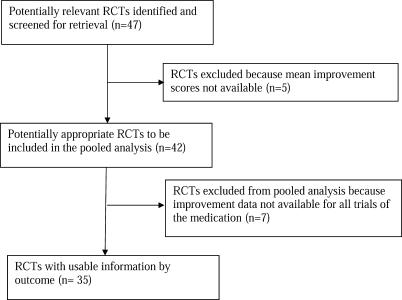
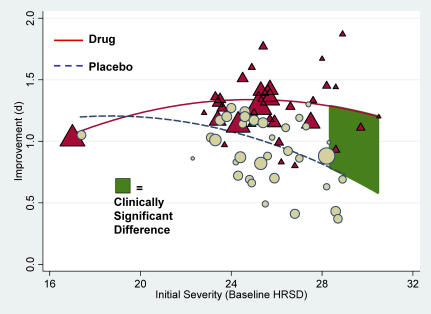
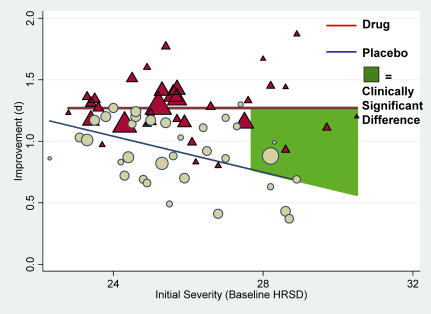
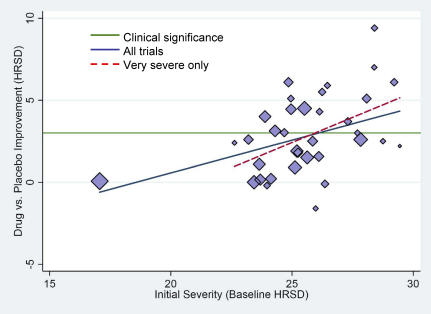
Verification
Claims the paper makes
The claims and statistics of this paper haven’t been checked yet.
Free: it reads the open-access text and checks the first 5 claims that cite a source we can check. Create a free account to check every claim.
Claims other papers make about this one
Each is checked against this paper’s own text: does it say what the citing paper says it does?
The source backs part of the claim, not all of it — or backs it for a different population, condition or comparison.
In the citing paper
“Individual-level meta-analyses have found a direct relationship between the magnitude of depressive symptoms and the effectiveness of antidepressants.8–10”
From Comparative effectiveness of exercise, antidepressants and their combination in treating non-severe depression: a systematic review and network meta-analysis of randomised controlled trials (2022) · cites this paper as [9]
Experimental — accuracy not yet measuredThe cited source says what the claim attributes to it.
In the citing paper
“An understanding of users’ own experiences of antidepressant use is increasingly important in the context of growing doubts about the effectiveness of antidepressant treatment [5, 26], concerns about side effects [27] and withdrawal effects [28].”
From ‘In my life antidepressants have been…’: a qualitative analysis of users’ diverse experiences with antidepressants (2016) · cites this paper as [5]
In the citing paper
“In this study, 84 % of participants in this study answered in the affirmative to a question about whether they felt antidepressants had reduced their depression, a number well above that suggested by efficacy studies”
From ‘In my life antidepressants have been…’: a qualitative analysis of users’ diverse experiences with antidepressants (2016) · cites this paper as [5]
In the citing paper
“Other studies have found support for increasing benefit with increasing severity of depression,21 but the effects size even for patients with the most severe depression was still minimal.21”
From Should antidepressants be used for major depressive disorder? (2020) · cites this paper as [21]
Self-check
Percentages, sums and reported differences re-computed from the paper’s own numbers.
The self-check needs the paper’s full text.
Citations
Cites
Measuring inconsistency in meta-analyses
Higgins, J. P. T., Thompson, S. G., Deeks, J. J., & Altman, D. G. (2003) · BMJ · doi:10.1136/bmj.327.7414.557 · Cited by 63,139 · cited 1×
“Both Q [15] and I2 [ 16 ] indices were used to assess”
MethodStatistical Methods for Meta-Analysis
Wasserman, S., Hedges, L. V., & Olkin, I. (1988) · Journal of Educational Statistics · doi:10.2307/1164953 · Cited by 10,326
Statistical Methods for Meta-Analysis.
Freeman, P. R., Hedges, L. V., & Olkin, I. (1986) · Biometrics · doi:10.2307/2531069 · Cited by 4,784
Meta-analysis in social research
(1982) · Evaluation and Program Planning · doi:10.1016/0149-7189(82)90011-8 · Cited by 3,853 · cited 1×
“Finally, to show directly the amount of improvement for each study’s drug group against its placebo group, we calculated the difference between the change for the drug group minus the change for the placebo group, leaving the difference in raw units and deriving its analytic weight from its standard error [11,12,20].”
MethodImputing missing standard deviations in meta-analyses can provide accurate results
Furukawa, T. A., Barbui, C., Cipriani, A., Brambilla, P., & Watanabe, N. (2006) · Journal of Clinical Epidemiology · doi:10.1016/j.jclinepi.2005.06.006 · Cited by 1,568 · cited 1×
“s were known for 28 groups, could be calculated from other inferential statistics in nine comparisons (18 groups), and were imputed in 12 comparisons (24 groups) (47.38%) [”
InfluentialPublication bias in meta-analysis its causes and consequences
Thornton, A. (2000) · Journal of Clinical Epidemiology · doi:10.1016/s0895-4356(99)00161-4 · Cited by 1,291 · cited 1×
“Examination of publication bias often relies on inspections of effect sizes in relation to sample size (or inverse variance) [22].”
BackgroundThe power of statistical tests for moderators in meta-analysis
Hedges, L. V., & Pigott, T. D. (2004) · Psychological Methods · doi:10.1037/1082-989x.9.4.426 · Cited by 672 · cited 1×
“A last, mixedeffects analysis for the amount of change used a randomeffects constant along with fixed-effects moderator dimensions; these models provide more conservative assessments of moderation [19].”
MethodMelander, H., Ahlqvist-Rastad, J., Meijer, G., & Beermann, B. (2003) · BMJ · doi:10.1136/bmj.326.7400.1171 · Cited by 635 · cited 2×
“In the case of antidepressant medication, this limitation has been found to result in considerable reporting bias characterized by multiple publication, selective publication, and selective reporting in studies sponsored by pharmaceutical companies [5].”
BackgroundPlacebo Theory, Research , and Mechanisms
WHITE, L. E., Tursky, B., & SCHWARTZ, G. E. R. (1985) · Guilford Press eBooks · Cited by 485
Khan, A., Leventhal, R. M., Khan, S. R., & Brown, W. A. (2002) · Journal of Clinical Psychopharmacology · doi:10.1097/00004714-200202000-00007 · Cited by 456 · cited 2×
“Similar to prior reports [3,4], this analysis of U.”
BackgroundResult
Research works printed but not linked: 3
- Lipsey MW Wilson DB 2001 Practical meta-analysis. Applied social research methods Volume 49. Thousand Oaks (California) Sage Publications 247
- Evans FJ 1974 The placebo response in pain reduction Adv Neurol 4 289 296
- Fabre LF Crimson L 1985 Efficacy of fluoxetine in outpatients with major depression Curr Ther Res Clin Exp 37 115 123
Cited by
Items 401–500 of 1,013
Accuracy of automated classification of major depressive disorder as a function of symptom severity
Ramasubbu, R., Brown, M. R. G., Cortese, F., Gaxiola, I., Goodyear, B., Greenshaw, A. J., Dursun, S. M., & Greiner, R. (2016) · NeuroImage: Clinical · doi:10.1016/j.nicl.2016.07.012 · Cited by 71
“For example, baseline symptom severity is associated with drug-placebo differences in randomized control trials (Kirsch et al., 2008) and antidepressants are recommended as the choice of treatment for severe depression whereas psychosocial interventions as the choice of treatment for mild-moderate…”
BackgroundKilcher, G., Hummel, N., Didden, E. M., Egger, M., Reichenbach, S., & 4, F. T. G. W. P. (2018) · Rheumatology · doi:10.1093/rheumatology/kex394 · Cited by 70
A systematic review of long-term studies of drug treated and non-drug treated depression
Hughes, S., & Cohen, D. (2009) · Journal of Affective Disorders · doi:10.1016/j.jad.2009.01.027 · Cited by 71
Insight into recent reforms and initiatives in Austria: implications for key stakeholders
Godman, B., Bucsics, A., Burkhardt, T. H., Haycox, A. R., Seyfried, H., & Wieninger, P. (2008) · Expert Review of Pharmacoeconomics & Outcomes Research · doi:10.1586/14737167.8.4.357 · Cited by 78
Domar, A. D., Moragianni, V. A., Ryley, D. A., & Urato, A. C. (2013) · Human Reproduction · doi:10.1093/humrep/des383 · Cited by 69
Zimmerman, M. A., Clark, H., Multach, M. D., Walsh, E. K., Rosenstein, L. K., & Gazarian, D. (2015) · Mayo Clinic Proceedings · doi:10.1016/j.mayocp.2015.06.016 · Cited by 77
King, B. H., Dukes, K., Donnelly, C. L., Sikich, L., McCracken, J. T., Scahill, L., Hollander, E., Bregman, J. D., Anagnostou, E., Robinson, F., et al. (2013) · JAMA Pediatrics · doi:10.1001/jamapediatrics.2013.2698 · Cited by 67
Almeida, O. P., Pirkis, J., Kerse, N., Sim, M., Flicker, L., Snowdon, J., Draper, B., Byrne, G., Goldney, R., Lautenschlager, N. T., et al. (2012) · The Annals of Family Medicine · doi:10.1370/afm.1368 · Cited by 70
Antidepressants and the placebo response
Kirsch, I. (2009) · Epidemiology and Psychiatric Sciences · doi:10.1017/s1121189x00000282 · Cited by 70
“Subsequently, my colleagues and I replicated our meta-analysis on a larger number of trials that had been submitted to the FDA (Kirsch et al., 2008).”
ResultSelf-citationThase, M. E., Larsen, K. G., & Kennedy, S. H. (2011) · British Journal of Psychiatry · doi:10.1192/bjp.bp.111.093336 · Cited by 71
New metrics for meta‐analyses of heterogeneous effects
Mathur, M. B., & VanderWeele, T. J. (2019) · Statistics in Medicine · doi:10.1002/sim.8057 · Cited by 73
“These metrics could help identify if (1) there are few effects of scientifically meaningful size despite a “statistically significant” pooled point estimate, (2) there are some large effects despite an apparently null point estimate, or (3) strong effects in the direction opposite the pooled estimate also regularly oc…”
Härter, M., Klesse, C., Bermejo, I., Schneider, F., & Berger, M. (2010) · Deutsches Ärzteblatt international · doi:10.3238/arztebl.2010.0700 · Cited by 66
Eggart, M., Todd, J., & Valdés‐Stauber, J. (2021) · PLoS ONE · doi:10.1371/journal.pone.0253913 · Cited by 85
Anticonvulsants in the Treatment of Major Depressive Disorder: An Overview
Vigo, D. V., & Baldessarini, R. J. (2009) · Harvard Review of Psychiatry · doi:10.1080/10673220903129814 · Cited by 69
Hengartner, M. P., Jakobsen, J. C., Sørensen, A., & Plöderl, M. (2020) · PLOS ONE · doi:10.1371/journal.pone.0229381 · Cited by 66
Naci, H., & Ioannidis, J. P. A. (2014) · The Annual Review of Pharmacology and Toxicology · doi:10.1146/annurev-pharmtox-010814-124614 · Cited by 75
Marital Status and Mental Health
Williams, K., Frech, A., & Carlson, D. L. (2009) · Cambridge University Press eBooks · doi:10.1017/cbo9780511984945.020 · Cited by 100
Astrocytes as a target of transcranial direct current stimulation (tDCS) to treat depression
Monai, H., & Hirase, H. (2017) · Neuroscience Research · doi:10.1016/j.neures.2017.08.012 · Cited by 83
“While psychotherapy and drug treatment, such as by fluoxetine, have been shown effective for some patients with severe depression (Kirsch et al., 2008), statistics show that less than half of depressed people receive professional treatments (Pratt and Brody, 2014).”
BackgroundVortioxetine for depression in adults
Koesters, M., Ostuzzi, G., Guaiana, G., Breilmann, J., & Barbui, C. (2017) · Cochrane Database of Systematic Reviews · doi:10.1002/14651858.cd011520.pub2 · Cited by 56
Basing psychiatric classification on scientific foundation: Problems and prospects
Uher, R., & Rutter, M. (2012) · International Review of Psychiatry · doi:10.3109/09540261.2012.721346 · Cited by 66
Kivimäki, M., Batty, G. D., Jokela, M., Ebmeier, K. P., Vahtera, J., Virtanen, M., Brunner, E. J., Tabak, A. G., Witte, D. R., Kumari, M., et al. (2011) · Biological Psychiatry · doi:10.1016/j.biopsych.2011.07.008 · Cited by 67
The evidence-based practice of psychotherapy: Facing the challenges that lie ahead
Gaudiano, B. A., & Miller, I. W. (2013) · Clinical Psychology Review · doi:10.1016/j.cpr.2013.04.004 · Cited by 83
“placebos) of the most frequently prescribed drugs, including antidepressant medications (Fournier et al., 2010; Kirsch et al., 2008), and”
BackgroundNishi, D., Susukida, R., Usuda, K., Mojtabai, R., & Yamanouchi, Y. (2018) · Journal of Affective Disorders · doi:10.1016/j.jad.2018.07.016 · Cited by 64
No role for initial severity on the efficacy of antidepressants: results of a multi-meta-analysis
Fountoulakis, K. N., Veroniki, A., Siamouli, M., & Möller, H.-J. (2013) · Annals of General Psychiatry · doi:10.1186/1744-859x-12-26 · Cited by 66
“[5], the authors calculated the mean in drug change and the mean in placebo change and then took their difference.”
InfluentialMice Genetically Depleted of Brain Serotonin Do Not Display a Depression-like Behavioral Phenotype
Angoa‐Pérez, M., Kane, M. J., Briggs, D. I., Herrera‐Mundo, N., Sykes, C. E., Francescutti, D. M., & Kuhn, D. M. (2014) · ACS Chemical Neuroscience · doi:10.1021/cn500096g · Cited by 76
Nakimuli‐Mpungu, E., Wamala, K., Okello, J., Alderman, S., Odokonyero, R. F., Musisi, S., & Mojtabai, R. (2014) · Journal of Affective Disorders · doi:10.1016/j.jad.2014.03.042 · Cited by 71
Effect of meditation on neurophysiological changes in stress mediated depression
Kasala, E. R., Bodduluru, L. N., Maneti, Y., & Thipparaboina, R. (2013) · Complementary Therapies in Clinical Practice · doi:10.1016/j.ctcp.2013.10.001 · Cited by 74
Villar, J., Pérez‐Méndez, L., Basaldúa, S., Blanco, J., Aguilar, G., Toral, D., Zavala, E., Romera, M. A., Díaz, G. G., del Nogal, F., et al. (2011) · Respiratory Care · doi:10.4187/respcare.00811 · Cited by 77
A practical approach to assess depression risk and to guide risk reduction strategies in later life
Almeida, O. P., Alfonso, H., Pirkis, J., Kerse, N., Sim, M., Flicker, L., Snowdon, J., Draper, B., Byrne, G., Goldney, R., et al. (2011) · International Psychogeriatrics · doi:10.1017/s1041610210001870 · Cited by 66
“, 2006), but remission of symptoms may fail to occur in as many as 50% of patients (Kirsch et al., 2008; Turner et al., 2008).”
BackgroundMackay, G. M., Forrest, C. M., Christofides, J., Bridel, M. A., Mitchell, S., Cowlard, R., Stone, T. W., & Darlington, L. G. (2009) · Clinical and Experimental Pharmacology and Physiology · doi:10.1111/j.1440-1681.2008.05077.x · Cited by 66
Naudet, F., Maria, A. S., & Falissard, B. (2011) · PLoS ONE · doi:10.1371/journal.pone.0020811 · Cited by 66
“Treatment and placebo mean responses increase with depression severity [2,3], with duration of treatment, with the number of follow up assessments [5] and with the year of publication of the study [4].”
BackgroundThe reliability of evidence review methodology in environmental science and conservation
O’Leary, B. C., Kvist, K., Bayliss, H. R., Derroire, G., Healey, J. R., Hughes, K., Kleinschroth, F., Sciberras, M., Woodcock, P., & Pullin, A. S. (2016) · Environmental Science & Policy · doi:10.1016/j.envsci.2016.06.012 · Cited by 65
“…reviews have the potential to misinform and result in policies that have unwanted and unforeseen consequences and/or wasted research investment (Kirsch et al., 2008; Pullin and Knight, 2012), particularly if used as the single source of knowledge (although this will rarely be the case) or if…”
BackgroundMertens, L. J., & Preller, K. H. (2021) · Pharmacopsychiatry · doi:10.1055/a-1341-1907 · Cited by 65
“Specifically, their efficacy appears to be dependent on the initial (baseline) depression severity [14, 15].”
BackgroundNeurobiological narratives: experiences of mood disorder through the lens of neuroimaging
Buchman, D. Z., Borgelt, E., Whiteley, L., & Illes, J. (2012) · Sociology of Health & Illness · doi:10.1111/j.1467-9566.2012.01478.x · Cited by 67
“While SSRIs and lithium are beneficial to many individuals, they also have serious side effects, and recent studies have challenged the efficacy of SSRIs in mild to moderate depression (Fournier et al. 2010, Turner et al. 2008, Kirsch et al. 2008).”
Gerger, H., Munder, T., & Barth, J. (2014) · Journal of Clinical Psychology · doi:10.1002/jclp.22059 · Cited by 65
Jordan, S. E., Morris, J. K., Davies, G. I., Tucker, D., Thayer, D. S., Luteijn, M., Morgan, M., Garne, E., Hansen, A. V., Klungsøyr, K., et al. (2016) · PLoS ONE · doi:10.1371/journal.pone.0165122 · Cited by 76
Dunlop, B. W., LoParo, D., Kinkead, B., Mletzko-Crowe, T., Cole, S. P., Nemeroff, C. B., Mayberg, H. S., & Craighead, W. E. (2019) · American Journal of Psychiatry · doi:10.1176/appi.ajp.2018.18091075 · Cited by 67
“Although this finding may seem to contradict the meta-analyses that suggest that antidepressants are more effective than placebo only among severely ill patients (40, 41), results from other analyses (42, 43) and from studies of dysthymia (44) demonstrate the efficacy of antidepressants in patients with milder forms o…”
Cognitive behavioural therapy for children and adolescents
Muñoz-Solomando, A., Kendall, T., & Whittington, C. J. (2008) · Current Opinion in Psychiatry · doi:10.1097/yco.0b013e328305097c · Cited by 65
Machmutow, K., Meister, R., Jansen, A., Kriston, L., Watzke, B., Härter, M. C., & Liebherz, S. (2019) · Cochrane Database of Systematic Reviews · doi:10.1002/14651858.cd012855.pub2 · Cited by 65
“There are studies assuming that the more severe the depressive symptoms are, the greater the benefit of antidepressants seem to be compared to placebo (Anderson 2008; Kirsch 2008).”
BackgroundJakobsen, J. C., Hansen, J. L., Simonsen, S., Simonsen, E., & Gluud, C. (2012) · Psychological Medicine · doi:10.1017/s0033291711002236 · Cited by 63
Depression in multiple sclerosis: Is one approach for its management enough?
Jones, C. D., Motl, R. W., & Sandroff, B. M. (2021) · Multiple Sclerosis and Related Disorders · doi:10.1016/j.msard.2021.102904 · Cited by 66
Myczkowski, M., Dias, A., Luvisotto, T., Arnaut, D., Bellini, B. B., Marcolin, M. A., Mansur, C. G., Rennó, J., Tortella de Souza, G., & Ribeiro, P. L. (2012) · Neuropsychiatric Disease and Treatment · doi:10.2147/ndt.s33851 · Cited by 63
“It is also worth considering that the time window of lactation is narrow, whereas antidepressants usually take around 3–8 weeks to produce any phenomenological effect; finally, records provided to the US Food and Drug Administration show that even the most modern antidepressants show unimpressive clinical efficacy in…”
Bloch, M., Meiboom, H., Lorberblatt, M., Bluvstein, I., Aharonov, I., & Schreiber, S. (2012) · The Journal of Clinical Psychiatry · doi:10.4088/jcp.11m07117 · Cited by 63
“30,31 Fournier et al 30 concluded in their meta-analysis that the magnitude of benefit of antidepressant medication compared with placebo increases with severity of depression symptoms and may be minimal or nonexistent, on average, in patients with mild or moderate symptoms.”
BackgroundThe Origins of Health and Disease
Hyland, M. E. (2011) · Cambridge University Press eBooks · doi:10.1017/cbo9780511976216 · Cited by 63
Hou, X., Wang, J., Guo, J., Zhang, X., Liu, J., Qi, L., & Zhou, L. (2020) · Evidence-Based Mental Health · doi:10.1136/ebmental-2021-300318 · Cited by 74
Medicalization of global health 2: the medicalization of global mental health
Clark, J. (2014) · Global Health Action · doi:10.3402/gha.v7.24000 · Cited by 85
“With regard to antidepressants and psychotropics specifically, the evidence base for their effectiveness is incomplete, flawed, contestable, or falsified; they can have harmful side effects; and patient populations from LMICs were not sufficiently included in clinical trials (16, 31, 32).”
BackgroundOptimizing randomized trial designs to distinguish which subpopulations benefit from treatment
Rosenblum, M., & van der Laan, M. J. (2011) · Biometrika · doi:10.1093/biomet/asr055 · Cited by 61
“In scenarios 1a and 1b, we use data generating distributions for each subpopulation constructed to reflect what was seen in the meta-analysis of Kirsch et al. (2008), i.e. no effect of the treatment compared to placebo in those with moderate initial depression, but a mean improvement r > 0…”
InfluentialOn the Maintenance of Expectations in Major Depression – Investigating a Neglected Phenomenon
Kube, T., Rief, W., & Glombiewski, J. A. (2017) · Frontiers in Psychology · doi:10.3389/fpsyg.2017.00009 · Cited by 60
“With regard to antidepressant clinical trials, large placebo effects have been reported (Kirsch and Sapirstein, 1998; Kirsch et al., 2002, 2008, Rief et al., 2009), and they are assumed to be mainly based on expectation mechanisms (Shedden Mora et al., 2011; Rutherford et al., 2016).”
BackgroundTime and Risk Preferences, and Consumption Decisions of Patients with Clinical Depression
Bayer, Y. M., Shtudiner, Z., Suhorukov, O., & Grisaru, N. (2018) · Journal of Behavioral and Experimental Economics · doi:10.1016/j.socec.2019.01.003 · Cited by 69
A critical review of pharmacotherapy for major depressive disorder.
Dupuy, J. M., Ostacher, M. J., Huffman, J., Perlis, R. H., & Nierenberg, A. A. (2011) · The International Journal of Neuropsychopharmacology · doi:10.1017/s1461145711000083 · Cited by 61
Monden, R., de Vos, S., Morey, R. D., Wagenmakers, E., de Jonge, P., & Roest, A. M. (2016) · International Journal of Methods in Psychiatric Research · doi:10.1002/mpr.1507 · Cited by 62
“For example, the effect of pharmacological treatments for psychiatric disorders, including second-generation antidepressants, has been subject to ongoing debate (Turner et al., 2008; Kirsch et al., 2008; Eyding et al., 2010; Roest et al., 2015).”
BackgroundLino de Oliveira, C., Bolzan, J. A., Surget, A., & Belzung, C. (2020) · Pharmacology & Therapeutics · doi:10.1016/j.pharmthera.2020.107515 · Cited by 61
Mekonen, T., Ford, S., Chan, G., Hides, L. M., Connor, J. P., & Leung, J. (2021) · Journal of Affective Disorders · doi:10.1016/j.jad.2021.09.046 · Cited by 71
Li, S., Rong, P., Wang, Y., Jin, G., Hou, X., Li, S., Xiao, X., Zhou, W., Wu, Y., Liu, Y., et al. (2022) · Neuromodulation Technology at the Neural Interface · doi:10.1016/j.neurom.2021.10.021 · Cited by 68
Breast cancer and neurotransmitters: emerging insights on mechanisms and therapeutic directions
Jayachandran, P., Battaglin, F., Strelez, C., Lenz, A. M., Algaze, S. D., Soni, S., Lo, J. H., Yang, Y., Millstein, J., Zhang, W., et al. (2023) · Oncogene · doi:10.1038/s41388-022-02584-4 · Cited by 65
“While the effectiveness of SSRIs for their primary indication may be in debate, there is little argument that they increase serotonin levels [77].”
BackgroundProfitable failure: antidepressant drugs and the triumph of flawed experiments
McGoey, L. (2010) · History of the Human Sciences · doi:10.1177/0952695109352414 · Cited by 60
Amitriptyline versus placebo for major depressive disorder
Leucht, C., Huhn, M., & Leucht, S. (2012) · Cochrane Database of Systematic Reviews · doi:10.1002/14651858.cd009138.pub2 · Cited by 86
ω-3 Fatty acids for major depressive disorder in adults: an abridged Cochrane review
Appleton, K. M., Sallis, H. M., Perry, R., Ness, A. R., & Churchill, R. (2016) · BMJ Open · doi:10.1136/bmjopen-2015-010172 · Cited by 60
Well-Being across the Life Course
Mirowsky, J., & Ross, C. E. (2009) · A Handbook for the Study of Mental Health · doi:10.1017/cbo9780511984945.023 · Cited by 61
Rabinowitz, J., Werbeloff, N., Mandel, F. S., Menard, F., Marangell, L., & Kapur, S. (2016) · British Journal of Psychiatry · doi:10.1192/bjp.bp.115.173906 · Cited by 59
Musazadeh, V., Zarezadeh, M., Faghfouri, A. H., Keramati, M., Jamilian, P., Jamilian, P., Mohagheghi, A., & Farnam, A. (2022) · Critical Reviews in Food Science and Nutrition · doi:10.1080/10408398.2022.2051164 · Cited by 68
“But several studies have questioned their effectiveness (Kirsch et al. 2008, Khin et al. 2011, Jakobsen et al. 2017).”
BackgroundHyland, M. E., & Whalley, B. (2008) · Journal of Psychosomatic Research · doi:10.1016/j.jpsychores.2008.02.006 · Cited by 69
Litten, R. Z., Castle, I.-J. P., Falk, D., Ryan, M., Fertig, J., Chen, C. M., & Yi, H.-Y. (2013) · Alcoholism: Clinical and Experimental Research · doi:10.1111/acer.12197 · Cited by 59
Psychological Problems after Stroke and Their Management: State of Knowledge
Kneebone, I., & Lincoln, N. B. (2012) · Neuroscience & Medicine · doi:10.4236/nm.2012.31013 · Cited by 86
“Studies with nonstroke samples indicate that the use of anti-depressants should be used reservedly for those with severe disorders [30,31].”
BackgroundExercise training and music therapy in elderly with depressive syndrome: A pilot study
Verrusio, W., Andreozzi, P., Marigliano, B., Renzi, A., Gianturco, V., Pecci, M. T., Ettorre, E., Cacciafesta, M., & Gueli, N. (2014) · Complementary Therapies in Medicine · doi:10.1016/j.ctim.2014.05.012 · Cited by 78
Novel study designs to investigate the placebo response
Enck, P., Klosterhalfen, S., & Zipfel, S. (2011) · BMC Medical Research Methodology · doi:10.1186/1471-2288-11-90 · Cited by 61
“Another conventional model to rule out placebo responses is the use of a placebo run-in phase prior to drug and placebo dispensing to identify and exclude placebo responders: Placebo responders tend to exhibit less severe symptoms during run-in [22-25], and to respond faster to treatment with symptom improvement [26]…”
Rapaport, M. H., Nierenberg, A. A., Howland, R. H., Dording, C. M., Schettler, P. J., & Mischoulon, D. (2011) · Journal of Psychiatric Research · doi:10.1016/j.jpsychires.2011.05.001 · Cited by 70
“The 1point difference in mean change in IDS-C30 scores found between citalopram and placebo in the present study is consistent with many more recent publications that suggest there is a moremodest separation between active antidepressant treatments and placebo for subjects with MDD than previously documented (Khan et…”
BackgroundResultMacías-Cortés, E. D. C., Llanes-González, L., Aguilar-Faisal, L., & Asbún‐Bojalil, J. (2015) · PLoS ONE · doi:10.1371/journal.pone.0118440 · Cited by 69
RetractedIs the antidepressive effect of second-generation antidepressants a myth?
Bech, P. (2010) · Psychological Medicine · doi:10.1017/s0033291709006102 · Cited by 59
“Re-allocating the HAMD items to measure response in the acute therapy of depression The full HAMD has been used in all the trials analysed by Kirsch et al. (2008) and almost all trials analysed by Turner et al. (2008).”
BackgroundMethodInfluentialPreferential publication of editorial board members in medical specialty journals: Table 1
Luty, J. S., Arokiadass, S. M. R., Easow, J. M., & Anapreddy, J. R. (2009) · Journal of Medical Ethics · doi:10.1136/jme.2008.026740 · Cited by 61
“Br J Surg 25 (12) 4 (2) 2 (1.2) 4 (2.8) 11.68 (4.56 to 35.23) p,0.0001 Ann Surg 11 (5) 16 (7.5) 24 (14) 5 (3.6) 0.96 (0.49 to 1.8) p.0.9999 J Am Coll Surg 2 (1) 3 (1.4) 22 (13) 4 (2.9) 9.38 (4.03 to 23.58) p,0.0001 Arch Surg 13 ( 6 ) 3 (1.4) 8 (5) 13 (9.4) 2.41 (1.09 to 5.07) p = 0.0175”
InfluentialAre antidepressants overprescribed? Yes
Spence, D. (2013) · BMJ · doi:10.1136/bmj.f191 · Cited by 59
Forkhead box O transcription factors as possible mediators in the development of major depression
Wang, H., Quirion, R., Little, P. J., Cheng, Y., Feng, Z., Sun, H., Xu, J., & Zheng, W. (2015) · Neuropharmacology · doi:10.1016/j.neuropharm.2015.08.020 · Cited by 61
A Psychoeducational Intervention (SWEEP) for Depressed Women with Diabetes
Penckofer, S. M., Ferrans, C., Mumby, P., Byrn, M., Emanuele, M. A., Harrison, P. R., Durazo-Arvizu, R. A., & Lustman, P. (2012) · Annals of Behavioral Medicine · doi:10.1007/s12160-012-9377-2 · Cited by 58
“In mild or moderate depressive symptoms, evidence suggests that the benefit of antidepressant medication may be minimal or nonexistent [15, 16].”
BackgroundLennon, C. A., Huedo-Medina, T. B., Gerwien, D. P., & Johnson, B. T. (2012) · Social Science & Medicine · doi:10.1016/j.socscimed.2012.01.016 · Cited by 57
“Given that drug trials commonly document robust placebo effects even for samples and patients with very severe depression (Fournier et al., 2010; Kirsch et al., 2008), it is conceivable that HIV interventions act as a sort of placebo agent, thereby reducing depression levels in participants.”
BackgroundSelf-citationCohen, D., Consoli, A., Bodeau, N., Purper-Ouakil, D., Deniau, E., Guile, J.-M., & Donnelly, C. (2010) · Journal of Child and Adolescent Psychopharmacology · doi:10.1089/cap.2009.0047 · Cited by 60
“…flexible-dose), shorter duration of illness, lower baseline severity, fewer prior episodes, study location, and time of research publication (Khan et al. 1991; Wilcox et al. 1992; Charney et al. 2002; Walsh et al. 2002; Stein et al. 2006; Khan et al. 2007; Posternak et al. 2007; Kirsch et al. 2008).”
Neuropsychotherapy: conceptual, empirical and neuroethical issues
Walter, H., Berger, T., & Schnell, K. (2009) · European Archives of Psychiatry and Clinical Neuroscience · doi:10.1007/s00406-009-0058-5 · Cited by 60
“In the past decade, evidence has accumulated that ADM and CBT are effective through different neurofunctional mediators, i.e., causal pathways, since the two methods show differential efficacies in severe versus mild depression [ 33 ] as well as in relapse rates [16].”
BackgroundReview and meta-analysis of usage of ginkgo as an adjunct therapy in chronic schizophrenia
Singh, V., Singh, S. P., & Chan, K. (2010) · The International Journal of Neuropsychopharmacology · doi:10.1017/s1461145709990654 · Cited by 57
“…the primary treatment Downloaded from https://academic.oup.com/ijnp/article-abstract/13/2/257/663369 by guest on 29 July 2018 of depressive illness (Kirsch et al. 2008) and within the range of effect sizes reported for second-generation antipsychotics for treatment of schizophrenia (Davis et al.…”
BackgroundMykletun, A., Knudsen, A. K., Tangen, T., & Øverland, S. (2010) · BMC Health Services Research · doi:10.1186/1472-6963-10-35 · Cited by 57
“A recent meta-analysis of antidepressants efficacy based on US Food and Drug Administration (FDA) approval data suggested that SSRI’s were effective in severe depression, but had no better effect than placebo for less severe and minor depressive conditions [12], which are the most frequently seen in primary care setti…”
BackgroundPlacebo response in clinical trials with schizophrenia patients
Kinon, B. J., Potts, A. J., & Watson, S. B. (2011) · Current Opinion in Psychiatry · doi:10.1097/yco.0b013e32834381b0 · Cited by 58
Patient experiences of taking antidepressants for depression: A secondary qualitative analysis
Anderson, C., & Roy, T. (2013) · Research in Social and Administrative Pharmacy · doi:10.1016/j.sapharm.2012.11.002 · Cited by 59
Funding for primary health care in developing countries
Maeseneer, J. D., van Weel, C., Egilman, D. S., Mfenyana, K., Kaufman, A., Sewankambo, N. K., & Flinkenflögel, M. (2008) · BMJ · doi:10.1136/bmj.39496.444271.80 · Cited by 72
Publication Bias and the Efficacy of Antidepressants
Mathew, S. J., & Charney, D. S. (2009) · American Journal of Psychiatry · doi:10.1176/appi.ajp.2008.08071102 · Cited by 63
Vita, A., Peri, L. M. D., & Sacchetti, E. (2011) · Journal of Clinical Psychopharmacology · doi:10.1097/jcp.0b013e31822c1636 · Cited by 66
Placebo, Prozac and PLoS: significant lessons for psychopharmacology
Horder, J., Matthews, P., & Waldmann, R. (2011) · Journal of Psychopharmacology · doi:10.1177/0269881110372544 · Cited by 57
“Perhaps the most overlooked aspect of the data included in Kirsch et al. (2008) is that it is not about the effects of antidepressants upon depression, but rather about the effects of antidepressants on the HAMD.”
BackgroundMethodResultInfluentialEfficacy of agomelatine in major depressive disorder: meta-analysis and appraisal
Singh, S. P., Singh, V., & Kar, N. (2011) · The International Journal of Neuropsychopharmacology · doi:10.1017/s1461145711001301 · Cited by 61
“50) only for patients with a depression rating score of >24 (Fournier et al. 2010) or >28 (Kirsch et al. 2008) on HAMD.”
BackgroundTransparency, Reproducibility, and the Credibility of Economics Research
Christensen, G., & Miguel, E. (2017) · doi:10.31222/osf.io/9a3rw · Cited by 50
Amitriptyline versus placebo for major depressive disorder
Leucht, C., Huhn, M., & Leucht, S. (2011) · Cochrane Database of Systematic Reviews · doi:10.1002/14651858.cd009138 · Cited by 53
Bech, P. (2010) · Psychotherapy and Psychosomatics · doi:10.1159/000320118 · Cited by 56
“was an effect size of 0.31 which was very similar to that obtained by Kirsch et al. [”
ResultInfluentialGerber, M., Beck, J., Brand, S., Cody, R., Donath, L., Eckert, A., Faude, O., Fischer, X., Hatzinger, M., Holsboer‐Trachsler, E., et al. (2019) · Trials · doi:10.1186/s13063-019-3468-3 · Cited by 66
“Researchers have therefore claimed that a greater variety of cost-effective, accessible, and alternative/complementary treatments are needed [40, 41].”
BackgroundBrain regulation of emotional conflict predicts antidepressant treatment response for depression
Fonzo, G. A., Etkin, A., Zhang, Y., Wu, W., Cooper, C. M., Fatt, C. C., Jha, M. K., Trombello, J. M., Deckersbach, T., Adams, P., et al. (2019) · Nature Human Behaviour · doi:10.1038/s41562-019-0732-1 · Cited by 63
Determining Whether a Patient is Feeling Better: Pitfalls from the Science of Human Perception
Redelmeier, D. A., & Dickinson, V. M. (2011) · Journal of General Internal Medicine · doi:10.1007/s11606-011-1655-3 · Cited by 57
Is there an excess of significant findings in published studies of psychotherapy for depression?
Flint, J., Cuijpers, P., Horder, J., Koole, S. L., & Munafò, M. R. (2015) · Psychological Medicine · doi:10.1017/s0033291714001421 · Cited by 56
“…expected: 54, p=0.006). p-value distributions for antidepressant and psychotherapy studies We know empirically that publication bias operates in the antidepressant literature (i.e. some studies remained unpublished), from data obtained from the US Food and Drug Administration (Kirsch et al. 2008).”
BackgroundMethodResultInfluentialThe Use of ECT and MST in treating depression
Allan, C. L., & Ebmeier, K. P. (2011) · International Review of Psychiatry · doi:10.3109/09540261.2011.614223 · Cited by 60
“Recent papers have even questioned the effi cacy of anti-depressant medication, intriguingly arguing that in more severe illness it is placebos that are less effective, rather than antidepressants that are more so (Kirsch et al., 2008).”
BackgroundHelp-seeking preferences for psychological distress in primary care: effect of current mental state
Walters, K., Buszewicz, M., Weich, S., & King, M. (2008) · British Journal of General Practice · doi:10.3399/bjgp08x342174 · Cited by 56
“There is limited evidence on effective interventions for milder degrees of distress in primary care.(2,3) Current guidance suggests watchful waiting,”
BackgroundLorenzo-Luaces, L. (2015) · Epidemiology and Psychiatric Sciences · doi:10.1017/s2045796015000542 · Cited by 55
“…multiple studies suggest that antidepressants are only superior to placebos for individuals with very severe forms of depression (Khan et al. 2002; Kirsch et al. 2008; Fournier et al. 2010; Barbui et al. 2011) and analogous findings have emerged in regards to the efficacy of psychotherapy…”
BackgroundWebb, C. A., Kertz, S. J., Bigda-Peyton, J. S., & Björgvinsson, T. (2013) · Journal of Affective Disorders · doi:10.1016/j.jad.2013.02.016 · Cited by 55
“The placebo effect has received increased attention in the mental health treatment literature (Fournier et al., 2010; Kirsch et al., 2008).”
Sugarman, M. A., Loree, A. M., Baltes, B. B., Grekin, E. R., & Kirsch, I. (2014) · PLoS ONE · doi:10.1371/journal.pone.0106337 · Cited by 55
“These trials have been included in previous meta-analyses of antidepressant data submitted to the FDA [7,8].”
BackgroundMethodResultInfluentialSelf-citationRothschild, A. J., Mahableshwarkar, A. R., Jacobsen, P. L., Yan, M., & Sheehan, D. V. (2012) · European Neuropsychopharmacology · doi:10.1016/j.euroneuro.2012.07.011 · Cited by 58
“It is widely recognized that clinical trials in patients with mood disorders conducted in recent years have produced smaller effect sizes, variable outcomes, and higher placebo response rates than those conducted in the past (Undurraga and Baldessarini, 2012; Khin et al., 2011; Hidalgo et al., 2007; Brunoni et al., 20…”
ResultWang, G., Gislum, M., Filippov, G., & Montgomery, S. (2015) · Current Medical Research and Opinion · doi:10.1185/03007995.2015.1014028 · Cited by 55
Haase, A. M., Taylor, A. H., Fox, K. R., Thorp, H., & Lewis, G. (2010) · Mental health and physical activity · doi:10.1016/j.mhpa.2010.09.004 · Cited by 64
Metadata
- Authors
- Kirsch, I., Deacon, B. J., Huedo-Medina, T. B., Scoboria, A., Moore, T. J., & Johnson, B. T.
- Affiliations
- University of Hull (GB)
- University of Wyoming (US)
- University of Connecticut (US)
- University of Windsor (CA)
- Institute for Safe Medication Practices (US)
- Corresponding author
- Kirsch, Irving
- Venue
- PLoS Medicine
- Publisher
- Public Library of Science (PLoS)
- Published
- 2008-02-26
- Volume
- 5
- Issue
- 2
- Pages
- e45
- ISSN
- 1549-1277 (ISSN-L)
- 1549-1676
- PMC
- PMC2253608
- OpenAlex
- W2153403353
- Cited by
- 2,442
- References
- 49
- Citations by year
- 2026: 47 · 2025: 53 · 2024: 63 · 2023: 65 · 2022: 90 · 2021: 81 · 2020: 132 · 2019: 100 · 2018: 159 · 2017: 154 · 2016: 142 · 2015: 130 · 2014: 156 · 2013: 191 · 2012: 179
- FWCI
- 24.87
- Type
- journal article
- Language
- en
- Open access
- gold
- doi.org
- Licence
- cc-by
- Locations
- PLoS Medicine (publishedVersion, cc-by)
- PubMed Central (publishedVersion, cc-by)
- PubMed (publishedVersion)
- RePEc: Research Papers in Economics (publishedVersion)
- Research Online (University of Wollongong) (submittedVersion)
- DOAJ (DOAJ: Directory of Open Access Journals) (submittedVersion, cc-by-sa)
- Figshare (submittedVersion)
- Topics
- Health Sciences › Medicine › Pharmacology (medical) › Treatment of Major Depression
- Social Sciences › Psychology › Clinical Psychology › Psychotherapy Techniques and Applications
- Health Sciences › Medicine › Psychiatry and Mental health › Mental Health Treatment and Access
- Keywords
- antidepressants, antidepressant efficacy, placebo response, severe depression, clinical significance
- MeSH terms
- Antidepressive Agents, Clinical Trials as Topic, Depressive Disorder, Humans, Severity of Illness Index, United States, United States Food and Drug Administration, Databases, Factual
About these checks
Registry, retraction, Cites and statistics results are computed, not judged, with one exception: a printed reference that no index lists is read once by a model before it counts as a citation error. Claims are extracted by a model and kept only when their quote appears verbatim in the text; each cited source is then checked, with a model’s help, for whether it says what the claim relies on. Those verdicts can be wrong — read the claim’s quote and the cited source before relying on one.
Statistics and arithmetic are recomputed, not judged.
Confidence bands are shown only for fields calibrated on our annotated test set. None is calibrated yet, so no band is shown.
What counts as a claim ›How we measure confidence ›How we check this ›
Are you an author, or do you see a problem with this page? Request a review
Data sources
Bibliographic data: Semantic Scholar, OpenAlex, Crossref.
Contains information from the Semantic Scholar Academic Graph Datasets, made available under the ODC Attribution License (ODC-BY 1.0).
Semantic Scholar’s data is described in: Kinney, R., et al. (2023). The Semantic Scholar Open Data Platform. arXiv:2301.10140.
