

Initial Severity and Antidepressant Benefits: A Meta-Analysis of Data Submitted to the Food and Drug Administration
Open accessThe DOI matches its Crossref record; 49 of the 49 references it cites were found in a registry or an index.
Abstract
BACKGROUND: Meta-analyses of antidepressant medications have reported only modest benefits over placebo treatment, and when unpublished trial data are included, the benefit falls below accepted criteria for clinical significance. Yet, the efficacy of the antidepressants may also depend on the severity of initial depression scores. The purpose of this analysis is to establish the relation of baseline severity and antidepressant efficacy using a relevant dataset of published and unpublished clinical trials. METHODS AND FINDINGS: We obtained data on all clinical trials submitted to the US Food and Drug Administration (FDA) for the licensing of the four new-generation antidepressants for which full datasets were available. We then used meta-analytic techniques to assess linear and quadratic effects of initial severity on improvement scores for drug and placebo groups and on drug-placebo difference scores. Drug-placebo differences increased as a function of initial severity, rising from virtually no difference at moderate levels of initial depression to a relatively small difference for patients with very severe depression, reaching conventional criteria for clinical significance only for patients at the upper end of the very severely depressed category. Meta-regression analyses indicated that the relation of baseline severity and improvement was curvilinear in drug groups and showed a strong, negative linear component in placebo groups. CONCLUSIONS: Drug-placebo differences in antidepressant efficacy increase as a function of baseline severity, but are relatively small even for severely depressed patients. The relationship between initial severity and antidepressant efficacy is attributable to decreased responsiveness to placebo among very severely depressed patients, rather than to increased responsiveness to medication.
Overview
The claims and statistics of this paper haven’t been checked yet.
Free: it reads the open-access text and checks the first 5 claims that cite a source we can check. Create a free account to check every claim.
Integrity signals
Registry
Cites
Statistics
Figures
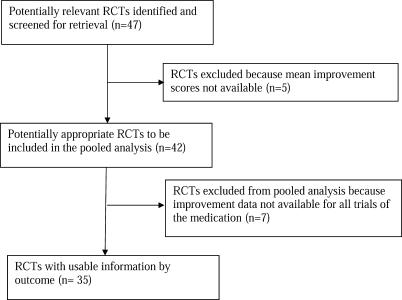
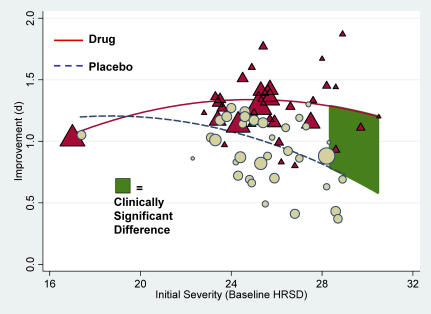
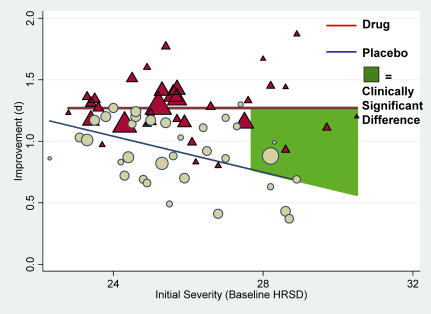
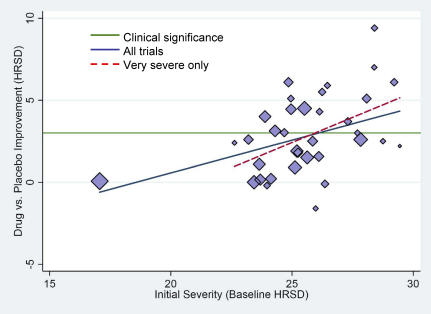
Verification
Claims the paper makes
The claims and statistics of this paper haven’t been checked yet.
Free: it reads the open-access text and checks the first 5 claims that cite a source we can check. Create a free account to check every claim.
Claims other papers make about this one
Each is checked against this paper’s own text: does it say what the citing paper says it does?
The source backs part of the claim, not all of it — or backs it for a different population, condition or comparison.
In the citing paper
“Individual-level meta-analyses have found a direct relationship between the magnitude of depressive symptoms and the effectiveness of antidepressants.8–10”
From Comparative effectiveness of exercise, antidepressants and their combination in treating non-severe depression: a systematic review and network meta-analysis of randomised controlled trials (2022) · cites this paper as [9]
Experimental — accuracy not yet measuredThe cited source says what the claim attributes to it.
In the citing paper
“An understanding of users’ own experiences of antidepressant use is increasingly important in the context of growing doubts about the effectiveness of antidepressant treatment [5, 26], concerns about side effects [27] and withdrawal effects [28].”
From ‘In my life antidepressants have been…’: a qualitative analysis of users’ diverse experiences with antidepressants (2016) · cites this paper as [5]
In the citing paper
“In this study, 84 % of participants in this study answered in the affirmative to a question about whether they felt antidepressants had reduced their depression, a number well above that suggested by efficacy studies”
From ‘In my life antidepressants have been…’: a qualitative analysis of users’ diverse experiences with antidepressants (2016) · cites this paper as [5]
In the citing paper
“Other studies have found support for increasing benefit with increasing severity of depression,21 but the effects size even for patients with the most severe depression was still minimal.21”
From Should antidepressants be used for major depressive disorder? (2020) · cites this paper as [21]
Self-check
Percentages, sums and reported differences re-computed from the paper’s own numbers.
The self-check needs the paper’s full text.
Citations
Cites
Measuring inconsistency in meta-analyses
Higgins, J. P. T., Thompson, S. G., Deeks, J. J., & Altman, D. G. (2003) · BMJ · doi:10.1136/bmj.327.7414.557 · Cited by 63,139 · cited 1×
“Both Q [15] and I2 [ 16 ] indices were used to assess”
MethodStatistical Methods for Meta-Analysis
Wasserman, S., Hedges, L. V., & Olkin, I. (1988) · Journal of Educational Statistics · doi:10.2307/1164953 · Cited by 10,326
Statistical Methods for Meta-Analysis.
Freeman, P. R., Hedges, L. V., & Olkin, I. (1986) · Biometrics · doi:10.2307/2531069 · Cited by 4,784
Meta-analysis in social research
(1982) · Evaluation and Program Planning · doi:10.1016/0149-7189(82)90011-8 · Cited by 3,853 · cited 1×
“Finally, to show directly the amount of improvement for each study’s drug group against its placebo group, we calculated the difference between the change for the drug group minus the change for the placebo group, leaving the difference in raw units and deriving its analytic weight from its standard error [11,12,20].”
MethodImputing missing standard deviations in meta-analyses can provide accurate results
Furukawa, T. A., Barbui, C., Cipriani, A., Brambilla, P., & Watanabe, N. (2006) · Journal of Clinical Epidemiology · doi:10.1016/j.jclinepi.2005.06.006 · Cited by 1,568 · cited 1×
“s were known for 28 groups, could be calculated from other inferential statistics in nine comparisons (18 groups), and were imputed in 12 comparisons (24 groups) (47.38%) [”
InfluentialPublication bias in meta-analysis its causes and consequences
Thornton, A. (2000) · Journal of Clinical Epidemiology · doi:10.1016/s0895-4356(99)00161-4 · Cited by 1,291 · cited 1×
“Examination of publication bias often relies on inspections of effect sizes in relation to sample size (or inverse variance) [22].”
BackgroundThe power of statistical tests for moderators in meta-analysis
Hedges, L. V., & Pigott, T. D. (2004) · Psychological Methods · doi:10.1037/1082-989x.9.4.426 · Cited by 672 · cited 1×
“A last, mixedeffects analysis for the amount of change used a randomeffects constant along with fixed-effects moderator dimensions; these models provide more conservative assessments of moderation [19].”
MethodMelander, H., Ahlqvist-Rastad, J., Meijer, G., & Beermann, B. (2003) · BMJ · doi:10.1136/bmj.326.7400.1171 · Cited by 635 · cited 2×
“In the case of antidepressant medication, this limitation has been found to result in considerable reporting bias characterized by multiple publication, selective publication, and selective reporting in studies sponsored by pharmaceutical companies [5].”
BackgroundPlacebo Theory, Research , and Mechanisms
WHITE, L. E., Tursky, B., & SCHWARTZ, G. E. R. (1985) · Guilford Press eBooks · Cited by 485
Khan, A., Leventhal, R. M., Khan, S. R., & Brown, W. A. (2002) · Journal of Clinical Psychopharmacology · doi:10.1097/00004714-200202000-00007 · Cited by 456 · cited 2×
“Similar to prior reports [3,4], this analysis of U.”
BackgroundResult
Research works printed but not linked: 3
- Lipsey MW Wilson DB 2001 Practical meta-analysis. Applied social research methods Volume 49. Thousand Oaks (California) Sage Publications 247
- Evans FJ 1974 The placebo response in pain reduction Adv Neurol 4 289 296
- Fabre LF Crimson L 1985 Efficacy of fluoxetine in outpatients with major depression Curr Ther Res Clin Exp 37 115 123
Cited by
Items 801–900 of 1,013
von Glischinski, M., von Brachel, R., Thiele, C., & Hirschfeld, G. H. F. (2021) · Journal of Affective Disorders · doi:10.1016/j.jad.2021.05.041 · Cited by 33
The response set theory of hypnosis reconsidered: toward an integrative model
Lynn, S. J., Green, J. P., Zahedi, A., & Apelian, C. (2022) · American Journal of Clinical Hypnosis · doi:10.1080/00029157.2022.2117680 · Cited by 31
“His 2008 meta-analysis (Kirsch et al., 2008) on antidepressants has garnered more than 3000 citations (Google Scholar, August 2022), and his earlier research helped change official guidelines for treating depression in the United Kingdom.”
BackgroundHe, R., Wei, J., Huang, K., Yang, H., Chen, Y., Liu, Z., Ma, L., Jia, Y., & Chen, L. (2022) · Psychiatry Research · doi:10.1016/j.psychres.2022.114897 · Cited by 31
Davies, J., Read, J., Kruger, D., Crisp, N., Lamb, N., Dixon, M., Everington, S., Hollins, S. C., Moncrieff, J., Giurca, B. C., et al. (2023) · BMJ · doi:10.1136/bmj.p2730 · Cited by 27
Antidepressants Are Not Overprescribed for Mild Depression
Simon, G. E., Rossom, R. C., Beck, A. L., Waitzfelder, B. E., Coleman, K. J., Stewart, C. C., Operskalski, B. H., Penfold, R. B., & Shortreed, S. M. (2015) · The Journal of Clinical Psychiatry · doi:10.4088/jcp.14m09162 · Cited by 31
Depression and suicide are natural kinds: Implications for physician-assisted suicide
Tsou, J. Y. (2013) · International Journal of Law and Psychiatry · doi:10.1016/j.ijlp.2013.06.013 · Cited by 37
“Generally, findings suggest that prescribing antidepressants or psychotherapy for depression will only have modest benefits for depressed patients; however, treatment will be most beneficial for patients who have more severe forms of depression (Elkin et al., 1989, 1995; Kirsch et al., 2008; Sotsky et al., 1991).”
BackgroundMiddleton, H. C., Shaw, R., Collier, R., Purser, A., & Ferguson, B. (2011) · Health Sociology Review · doi:10.5172/hesr.2011.20.2.147 · Cited by 27
“…for effi cacy amongst psycho-pharmaceuticals may be at least as much a marketing ploy as they are dispassionately obtained scientifi c fi ndings (Kirsch et al. 2008); the voices of dissatisfi ed service users empowered by more consumerist approaches to healthcare (May 2010; Hearing Voices…”
BackgroundSchmitz, S. (2011) · Neuroethics · doi:10.1007/s12152-011-9129-1 · Cited by 34
“A detailed analysis of the findings and empirical methods in neuroeconomic research uncovered that the processing of rational control and emotional evaluation are not seen in a 4 I use the term ‘promise’ here in reference to the review of Irving Kirsch and colleagues [69], who stated that Prozac only shoes placebo eff…”
MethodManaging depression across the life cycle: new strategies for clinicians and their patients
Hickie, I. B., Naismith, S. L., Norrie, L. M., & Scott, E. M. (2009) · Internal Medicine Journal · doi:10.1111/j.1445-5994.2009.02016.x · Cited by 28
Is Exercise an Efficacious Treatment for Depression? A Comment upon Recent Negative Findings
Schuch, F. B., & Fleck, M. P. D. A. (2013) · Frontiers in Psychiatry · doi:10.3389/fpsyt.2013.00020 · Cited by 36
“Other meta-analyses have shown that antidepressants are effective only in severe, but not in moderate or mild depression (Kirsch et al., 2008; Fournier et al., 2010; Khan et al., 2012).”
BackgroundCarrière, I., Farré, A., Norton, J. L., Wyart, M., Tzourio, C., Noïze, P., Pérès, K., Fourrier‐Réglat, A., & Ancelin, M. (2016) · Osteoporosis International · doi:10.1007/s00198-016-3667-7 · Cited by 32
“While there are arguments supporting antidepressant effectiveness and favorable benefit-risk ratio for major depression [2], a much lower efficacy has been found for moderate depression [3].”
BackgroundEffects of intensive neuropsychological rehabilitation for acquired brain injury
Holleman, M., Vink, M., Nijland, R. H. M., & Schmand, B. A. (2016) · Neuropsychological Rehabilitation · doi:10.1080/09602011.2016.1210013 · Cited by 36
“…wellbeing in general, and in depressive and anxious symptoms specifically, was at least comparable to the established effect of antidepressant medications as reported in three meta-analyses (Kirsch et al., 2008; Turner, Matthews, Linardatos, Tell, & Rosenthal, 2008; Undurraga & Baldessarini, 2012).”
ResultThomas, F., Hansford, L., Ford, J. B., Wyatt, K. M., McCabe, R., & Byng, R. (2018) · Humanities and Social Sciences Communications · doi:10.1057/s41599-018-0091-y · Cited by 35
“…drugs were signi fi cantly more likely to display psychotic symptoms than those who had never taken medication (Harrow et al., 2014), whilst Kirsch et al. (2008) has argued that antidepressants not only have limited effectiveness over placebos but may also induce ‘ biological…”
Deepa, V., Mujawar, K., Dhillon, K., Jadhav, P., Das, I., & Singla, Y. (2018) · The Journal of Contemporary Dental Practice · doi:10.5005/jp-journals-10024-2345 · Cited by 28
How to choose an antidepressant medication
Bayes, A. J., & Parker, G. B. (2019) · Acta Psychiatrica Scandinavica · doi:10.1111/acps.13001 · Cited by 32
“A number of MDD meta-analyses have proposed that this differential effect is the result of a decreased responsiveness to placebo among very severely depressed patients – rather than an increased responsiveness to medication (28, 29), but increased severity may also be a proxy for a greater chance of melancholic depres…”
BackgroundSo, H., Chau, C. K., Lau, A., Wong, S., & Zhao, K. (2018) · Psychological Medicine · doi:10.1017/s0033291718003641 · Cited by 31
“It is also worth mentioning that previous meta-analyses showed that the response to antidepressant depends on the baseline severity of depression (Kirsch et al., 2008; Fournier et al., 2010).”
ResultNeuroprotective Benefits of Antidepressants in Multiple Sclerosis: Are We Missing the Mark?
Grech, L., Butler, E. G., STUCKEY, S. L., & Hester, R. (2019) · Journal of Neuropsychiatry · doi:10.1176/appi.neuropsych.18070164 · Cited by 29
Meta-Analysis of Research in Social and Personality Psychology
Johnson, B. T., & Eagly, A. H. (2014) · Cambridge University Press eBooks · doi:10.1017/cbo9780511996481.031 · Cited by 28
Self-citationManagement of depression in the presence of pain symptoms.
Mohr, P., Bitter, I., Švestka, J., Seifritz, E., Karamustafalioglu, O., Koponen, H., & Sartorius, N. (2010) · PubMed · Cited by 30
Kirsch, I. (2011) · Philosophical Transactions of the Royal Society B Biological Sciences · doi:10.1098/rstb.2010.0410 · Cited by 27
Self-citationCronin, C. J., Forsstrom, M. P., & Papageorge, N. (2020) · National Bureau of Economic Research · doi:10.3386/w27711 · Cited by 41
“Kirsch et al. (2008) also perform a meta-analysis and report an effect size of 0.32 with a confidence interval from 0.25 to 0.40.”
MethodInfluential“Do antidepressants work?” A humanistic perspective on a long-standing and contentious debate.
Cosgrove, L., Troeger, R., & Karter, J. M. (2020) · The Humanistic Psychologist · doi:10.1037/hum0000154 · Cited by 27
Johnson, C. F. A., Maxwell, M., Williams, B., Dougall, N. J., & MacGillivray, S. A. (2022) · BMJ Medicine · doi:10.1136/bmjmed-2021-000017 · Cited by 35
“13 14 Over the past 20 years numerous reviews have assessed antidepressant efficacy, 15 16 17 however, few have assessed dose-response effects.”
BackgroundBlumenthal, J. A. (2011) · Cleveland Clinic Journal of Medicine · doi:10.3949/ccjm.78.s1.06 · Cited by 31
Samara, M. T., Goldberg, Y., Levine, S. Z., Furukawa, T. A., Geddes, J. R., Cipriani, A., Davis, J. M., & Leucht, S. (2017) · The Lancet Psychiatry · doi:10.1016/s2215-0366(17)30331-0 · Cited by 28
Should antidepressants be used in minor depression?
Naber, D., & Bullinger, M. (2018) · Dialogues in Clinical Neuroscience · doi:10.31887/dcns.2018.20.3/dnaber · Cited by 31
Placebo prevents rumination: An experimental study
Lea, R., Schäfer, L. N., Κube, T., Ehmke, V., & Rief, W. (2020) · Journal of Affective Disorders · doi:10.1016/j.jad.2020.06.010 · Cited by 29
Forman‐Hoffman, V. L., Nelson, B. W., Ranta, K., Nazander, A., Hilgert, O., & Quevedo, J. (2021) · Internet Interventions · doi:10.1016/j.invent.2021.100408 · Cited by 30
“…guidelines suggest both antidepressants and therapy should be used to treat severe depression (Gelenberg et al., 2010; Health UK, 2010), in part because several trials have shown that the efficacy of antidepressants varies based on symptom severity (Fournier et al., 2010; Kirsch et al., 2008).”
BackgroundAddressing risk of bias in trials of cognitive behavioral therapy.
Button, K. S., & Munafo, M. R. (2015) · PubMed · doi:10.11919/j.issn.1002-0829.215042 · Cited by 26
“Similarly, research into placebo effects of antidepressants suggests that placebo effects vary with severity, being greatest for mild depression and decreasing as the severity of the depressive symptoms of participants increases.([11]) If this also holds for GAD, subgroup analyses based on the severity of GAD might in…”
BackgroundGrimaldi‐Bensouda, L., Engel, P., Massol, J., Guillemot, D., Avouac, B. P., Duru, G., Lert, F., Magnier, A., Rossignol, M., Rouillon, F., et al. (2012) · BMJ Open · doi:10.1136/bmjopen-2012-001498 · Cited by 30
“A patient-level meta-analysis demonstrated a lack of efficacy for antidepressants in the majority of patients with anxiety and depressive disorders.(3) 4 Thus, the real impact of conventional antidepressants in this population is considerable, with adverse reactions outweighing potential benefits.”
Baghai, T. C., Blier, P., Baldwin, D. S., Bauer, M., Goodwin, G. M., Fountoulakis, K. N., Kasper, S. F., Leonard, B. E., Malt, U. F., Stein, D. J., et al. (2011) · European Archives of Psychiatry and Clinical Neuroscience · doi:10.1007/s00406-011-0274-7 · Cited by 31
“However, some recent metaanalyses and their conclusion that antidepressants were usually no better than placebo [55, 71] have created doubts about clinical effectiveness of antidepressants, predominantly in the minds of health care professionals, but also of concerned patients and their relatives.”
Shuganjieyu capsule for major depressive disorder (MDD) in adults: a systematic review
Zhang, X., Kang, D., Zhang, L., & Peng, L. (2014) · Aging & Mental Health · doi:10.1080/13607863.2014.899975 · Cited by 28
“In a meta-analyses of clinical trials of antidepressant medication, particular for the new generation antidepressants, treatment efficacy has been shown to be clinically significant only with extremely depressed patients (Kirsch et al., 2008).”
BackgroundJakobsen, J. C., Hansen, J. L., Simonsen, E. H., & Gluud, C. N. (2011) · Journal of Affective Disorders · doi:10.1016/j.jad.2011.03.035 · Cited by 27
“When the unpublished trial results were added to the published ones, the updated metaanalyses showed no significant beneficial effect or only small significant beneficial intervention effects (Kirsch et al., 2008).”
BackgroundInfluentialKrogh, J., Speyer, H., Gluud, C. N., & Nordentoft, M. (2015) · Systematic Reviews · doi:10.1186/s13643-015-0030-6 · Cited by 33
“However, the clinical efficacy of antidepressants [3,4] and psychotherapy [5-7] has been challenged.”
BackgroundThibodeau, M. A., Quilty, L. C., Fruyt, F. D., Bolle, M. D., Rouillon, F., & Bagby, R. M. (2014) · Depression and Anxiety · doi:10.1002/da.22293 · Cited by 33
“A great deal of research has thus focused on discovering predictors of nonresponse in depression treatments, such as biomarkers,[9] initial severity,[10] dysfunctional attitudes,[11] cooccurrence of other mental disorders,[12] and personality traits[13]; however, the utility of classifying nonresponders is only propor…”
BackgroundGlasziou, P., Chalmers, I., Altman, D. G., Bastian, H., Boutron, I., Brice, A., Jamtvedt, G., Farmer, A. A., Ghersi, D., Groves, T., et al. (2010) · Cited by 26
A guide to what works for depression
Jorm, A. F., Allen, N. B., Morgan, A. J., Purcell, R., & Beyondblue (2009) · Swinburne figshare (Swinburne University of Technology) · Cited by 27
Mitchell, N. C., Gould, G. G., Koek, W., & Daws, L. C. (2016) · Journal of Pharmacology and Experimental Therapeutics · doi:10.1124/jpet.116.233338 · Cited by 27
Ujeyl, M., & Müller-Oerlinghausen, B. (2012) · Der Schmerz · doi:10.1007/s00482-012-1221-x · Cited by 30
Unexamined assumptions and unintended consequences of routine screening for depression
Cosgrove, L., Karter, J. M., Vaswani, A., & Thombs, B. D. (2018) · Journal of Psychosomatic Research · doi:10.1016/j.jpsychores.2018.03.007 · Cited by 26
Tolin, D. F. (2017) · Psychiatric Clinics of North America · doi:10.1016/j.psc.2017.08.007 · Cited by 25
Arch, J. J., Bright, E. E., Finkelstein, L. B., Fink, R. M., Mitchell, J. L., Andorsky, D. J., & Kutner, J. S. (2023) · JCO Oncology Practice · doi:10.1200/op.23.00287 · Cited by 25
Pharmacological treatments for personality disorders
Paris, J. (2011) · International Review of Psychiatry · doi:10.3109/09540261.2011.586993 · Cited by 27
“Even in depressions not complicated by a personality disorder, there is only a small advantage of drug over placebo, with effects most marked in severe depression (Kirsch et al., 2008).”
BackgroundChang, H. S., Won, E., Lee, H.-Y., Ham, B., Kim, Y.-G., & Lee, M.-S. (2014) · Journal of Neural Transmission · doi:10.1007/s00702-014-1333-9 · Cited by 25
“Regarding antidepressant treatment, there is evidence suggesting greater efficacy of antidepressants relative to placebo in individuals with severe depressive symptoms as compared to those with mild to moderate depression (Khan et al. 2002; Kirsch et al. 2008; Fournier et al. 2010).”
BackgroundWu, G., Wang, X., & Baeken, C. (2019) · Human Brain Mapping · doi:10.1002/hbm.24828 · Cited by 28
“In addition, previous evidence indicated that the initial severity of depression may affect antidepressant benefits (Kirsch et al., 2008).”
BackgroundTwelve-Month Studies on Perilla Oil Intake in Japanese Adults—Possible Supplement for Mental Health
Hashimoto, M., Matsuzaki, K., Kato, S., Hossain, S., Ohno, M., & Shido, O. (2020) · Foods · doi:10.3390/foods9040530 · Cited by 25
“The serotonin theory of depression suggests that reduced levels of serotonin and/or impaired serotonin receptor/transporter function are core pathogenic factors in depression [52,53].”
BackgroundInterconexão entre saúde, espiritualidade e religiosidade
Teixeira, M. Z. (2020) · Revista de Medicina · doi:10.11606/issn.1679-9836.v99i2p134-147 · Cited by 50
Purinergic transmission in depressive disorders
Szopa, A., Socała, K., Serefko, A., Doboszewska, U., Wróbel, A., Poleszak, E., & Właź, P. (2021) · Pharmacology & Therapeutics · doi:10.1016/j.pharmthera.2021.107821 · Cited by 26
Lunghi, C., Dugas, M., Leclerc, J., Poluzzi, E., Martineau, C., Carnovale, V., Stefan, T., Blouin, P., Lépine, J., Jalbert, L., et al. (2022) · BMJ Open · doi:10.1136/bmjopen-2022-062197 · Cited by 37
Symptomatic versus disease‐modifying effects of psychiatric drugs
Ghaemi, S. N. (2022) · Acta Psychiatrica Scandinavica · doi:10.1111/acps.13459 · Cited by 30
Kingir, E., Sevinc, C., & Ünal, G. (2023) · Neuropharmacology · doi:10.1016/j.neuropharm.2023.109468 · Cited by 30
The separation distress hypothesis of depression – an update and systematic review
Watt, D. F. (2023) · Neuropsychoanalysis · doi:10.1080/15294145.2023.2240340 · Cited by 26
Trkulja, V. (2010) · Croatian Medical Journal · doi:10.3325/cmj.2010.51.61 · Cited by 28
A Comparative, Developmental, and Clinical Perspective of Neurobehavioral Sexual Dimorphisms
Viveros, M., Mendrek, A., Paus, T., López-Rodríguez, A. B., Marco, E. M., Yehuda, R., Cohen, H., Lehrner, A. L., & Wagner, E. J. (2012) · Frontiers in Neuroscience · doi:10.3389/fnins.2012.00084 · Cited by 33
Hegerl, U., Allgaier, A., Henkel, V., & Mergl, R. (2011) · Journal of Affective Disorders · doi:10.1016/j.jad.2011.05.015 · Cited by 29
Qian, X., Zhou, X., You, Y., Shu, S., Fang, F., Huang, S., & Zhou, S. (2015) · The Journal of Alternative and Complementary Medicine · doi:10.1089/acm.2015.0084 · Cited by 27
Zetterqvist, A. V., & Mulinari, S. (2013) · PLoS ONE · doi:10.1371/journal.pone.0062609 · Cited by 32
“Nor are such claims consistent with similar meta-analyses [34–36].”
General Practitioner Management of Depression: A Systematic Review
McPherson, S., & Armstrong, D. (2012) · Qualitative Health Research · doi:10.1177/1049732312448540 · Cited by 25
“More recently, however, psychological treatments are regaining popularity, in part as a result of critical reviews of the effectiveness of antidepressant drugs (Kirsch et al., 2008).”
BackgroundREMOVED: Exercise as antidepressant treatment: Time for the transition from trials to clinic?
Panteleimon Ekkekakis, A., & Murri, M. B. (2017) · General Hospital Psychiatry · doi:10.1016/j.genhosppsych.2017.04.008 · Cited by 28
RetractedEEG Vigilance and Phenotypes in Neuropsychiatry
Arns, M., Gunkelman, J. D., Olbrich, S., Sander, C., & Hegerl, U. (2010) · Elsevier eBooks · doi:10.1016/b978-0-12-382235-2.00004-4 · Cited by 31
A Clinician's Guide to Statistics and Epidemiology in Mental Health: Measuring Truth and Uncertainty
Ghaemi, S. N. (2009) · Cited by 25
Verdoux, H., Cougnard‐Grégoire, A., Thiébaut, A. C. M., & Tournier, M. (2011) · Pharmacopsychiatry · doi:10.1055/s-0031-1271686 · Cited by 26
Kirsch, I., Huedo-Medina, T. B., Pigott, H. E., & Johnson, B. T. (2018) · Psychology of Consciousness: Theory, Research, and Practice · doi:10.1037/cns0000164 · Cited by 24
Self-citationRandomized Controlled Trial of the Marriage Checkup: Depression Outcomes
Gray, T. D., Hawrilenko, M., & Cordova, J. V. (2020) · Journal of Marital and Family Therapy · doi:10.1111/jmft.12411 · Cited by 24
“…symptom severity is a significant predictor of treatment outcomes with antidepressant medications (Fournier et al., 2010; Khan et al., 2002; Kirsch et al., 2008), such that the effect size of the drug–placebo difference tends to range from small for those experiencing mild to moderate…”
BackgroundIlieva, I. P. (2014) · Neuroethics · doi:10.1007/s12152-014-9226-z · Cited by 25
Monden, R., Roest, A. M., van Ravenzwaaij, D., Wagenmakers, E., Morey, R. D., Wardenaar, K. J., & de Jonge, P. (2018) · Journal of Affective Disorders · doi:10.1016/j.jad.2018.04.040 · Cited by 25
Reducing Barriers to Mental Health Care: Bringing Evidence‐Based Psychotherapy Home
Borson, S., Korpak, A., Carbajal‐Madrid, P., Likar, D., Brown, G. A., & Batra, R. (2019) · Journal of the American Geriatrics Society · doi:10.1111/jgs.16088 · Cited by 23
“Most older adults prefer psychotherapy to medications for depression,(10) but as few as 15% receive it, and 67% receive medications(11) despite limited or no efficacy in the most common, milder forms of depression.(12) Poor access to high-quality EBP is a recognized inequity in mental health care, disproportionately a…”
BackgroundPsychosocial adversity and mental illness: Differentiating distress, contextualizing diagnosis
Jacob, K. (2013) · Indian Journal of Psychiatry · doi:10.4103/0019-5545.111444 · Cited by 29
“placebo response and spontaneous remission and limited impact of medication for mild and moderate conditions.[23,24] The failure to recognize the context has resulted in psychiatric labels for victims of crimes (E.”
Do antidepressants really work? A clinicians’ guide to evaluating the evidence
Thase, M. E. (2008) · Current Psychiatry Reports · doi:10.1007/s11920-008-0078-2 · Cited by 24
Jakobsen, J. C., Hansen, J. L., Simonsen, E., & Gluud, C. (2011) · PLoS ONE · doi:10.1371/journal.pone.0019044 · Cited by 25
“However, meta-analyses have shown that the new antidepressants only obtained beneficial effect in severely depressed patients and that this effect was clinically small [9,10].”
BackgroundAntidepressant study design affects patient expectancy: a pilot study
Rutherford, B. R., Sneed, J. R., Devanand, D. P., Eisenstadt, R., & Roose, S. P. (2009) · Psychological Medicine · doi:10.1017/s0033291709991085 · Cited by 28
“…up to 2008, the same investigators found that placebo treatment resulted in similar improvement in depressive symptoms for all patients with depression except the most severely ill ; that is those with a Hamilton Depression Rating Scale (HAMD; Hamilton, 1960) score >28 (Kirsch et al. 2008).”
ResultDay, C. V., Rush, A. J., Harris, A. W. F., Boyce, P. M., Rekshan, W. R., Etkin, A., DeBattista, C., Schatzberg, A. F., Arnow, B. A., & Williams, L. M. (2014) · Journal of Affective Disorders · doi:10.1016/j.jad.2014.10.046 · Cited by 24
Teixeira, M. Z. (2009) · Revista da Associação Médica Brasileira · doi:10.1590/s0104-42302009000100008 · Cited by 56
Nijenhuis, C. M., ter Horst, P. G. J., den Berg, L. T. W. D. J., & Wilffert, B. (2011) · British Journal of Clinical Pharmacology · doi:10.1111/j.1365-2125.2011.04075.x · Cited by 29
Andrade, C. (2018) · The Journal of Clinical Psychiatry · doi:10.4088/jcp.18f12254 · Cited by 26
Recent developments in the treatment of major depressive disorder in children and adolescents
Hussain, H., Dubicka, B., & Wilkinson, P. O. (2018) · Evidence-Based Mental Health · doi:10.1136/eb-2018-102937 · Cited by 40
“…these trials to the more severely depressed and complex patients seen in clinics, as studies usually excluded patients with severe depression, co-morbidity and/or suicidality and the drug-placebo difference may be greater in more severe depression (as seen in both adolescents and adults(36,37)).”
BackgroundYu, W., Yen, Y.-C., Lee, Y., Tan, S., Xiao, Y., Lokman, H., Ting, A. K. T., Ganegala, H. E. W., Kwon, T., Ho, W., et al. (2019) · Molecular Brain · doi:10.1186/s13041-019-0452-5 · Cited by 30
Studying Stress in the Twenty-First-Century: An Update of Stress Concepts and Research
Wheaton, B., & Montazer, S. (2017) · Cambridge University Press eBooks · doi:10.1017/9781316471289.013 · Cited by 29
Möller, H. (2009) · The World Journal of Biological Psychiatry · doi:10.1080/15622970903101665 · Cited by 25
“This is fairly mentioned by Kirsch et al. (2008), who have found the biggest effect in severe depression at a placebo-verum difference of 4 HAMD points.”
BackgroundResultInfluentialCimicifuga racemosatreatment and health related quality of life in post-menopausal Spanish women
Mollá, M. D. J., García-Sánchez, Y., Sarrió, A. R., & Pérez-López, F. R. (2009) · Gynecological Endocrinology · doi:10.1080/09513590802404005 · Cited by 25
“This phenomenon is also present in the conventional pharmacological interventions [41,42].”
BackgroundElectroconvulsive therapy and nursing care
Kavanagh, A., & McLoughlin, D. M. (2009) · British Journal of Nursing · doi:10.12968/bjon.2009.18.22.45564 · Cited by 29
Depression as a culture-bound syndrome: implications for primary care
Dowrick, C. F. (2013) · British Journal of General Practice · doi:10.3399/bjgp13x665189 · Cited by 26
Melancholia: definition and management
Parker, G., & Paterson, A. (2014) · Current Opinion in Psychiatry · doi:10.1097/yco.0000000000000024 · Cited by 23
“Although ‘major depression’ shows a high placebo response rate – with one meta-analysis [40] showing antidepressant drug versus placebo differences to be ‘relatively small’, melancholia has a seemingly low placebo and/or spontaneous remission rate.”
Locher, C., Kossowsky, J., Gaab, J., Kirsch, I., Bain, P. A., & Krummenacher, P. (2015) · Journal of Affective Disorders · doi:10.1016/j.jad.2015.03.062 · Cited by 24
“Although the placebo effect and its moderators have been examined extensively in adult populations with major depressive disorder (MDD) (Brunoni et al., 2009; Kirsch et al., 2008), comparable studies for late-life depression are scarce.”
BackgroundResultInfluentialSelf-citationSelective serotonin reuptake inhibitor (SSRI) drugs: more risks than benefits?
Kauffman, J. M. (2009) · Cited by 29
Role of placebo effects in pain and neuropsychiatric disorders
Belcher, A. M., Ferré, S., Martinez, P. E., & Colloca, L. (2017) · Progress in Neuro-Psychopharmacology and Biological Psychiatry · doi:10.1016/j.pnpbp.2017.06.003 · Cited by 29
Individual response to antidepressants for depression in adults-a meta-analysis and simulation study
Munkholm, K., Homan, S., & Homan, P. (2020) · PLoS ONE · doi:10.1371/journal.pone.0237950 · Cited by 24
Brehaut, E., Neupane, D., Levis, B., Wu, Y., Sun, Y. B., Ioannidis, J. P. A., Markham, S., Cuijpers, P. J., Patten, S. B., Benedetti, A., et al. (2022) · International Journal of Methods in Psychiatric Research · doi:10.1002/mpr.1956 · Cited by 31
Tröger, A., Miguel, C., Čihařová, M., de Ponti, N., Durman, G., Cuijpers, P. J., & Karyotaki, E. (2023) · Journal of Affective Disorders · doi:10.1016/j.jad.2023.10.047 · Cited by 25
Chang, H. S., Won, E., Lee, H.-Y., Ham, B., & Lee, M.-S. (2015) · Behavioural Brain Research · doi:10.1016/j.bbr.2015.06.005 · Cited by 25
Geraghty, A. W. A., Stuart, B. L., Terluin, B., Kendrick, T., Little, P. S., & Moore, M. V. (2015) · Journal of Affective Disorders · doi:10.1016/j.jad.2015.05.064 · Cited by 27
“However, the evidence suggests that antidepressants are only effective beyond the placebo response in the most severe (Kirsch, 2008; Kirsch et al., 2008; Moncrieff, 2009), and dropout from ‘low intensity’ CBT interventions is consistently high (Eysenbach, 2005; Geraghty et al.”
Backgroundde Jonge, P., Hadj, F. B., Boffa, D., Zdrojewski, C., Dorogi, Y., So, A. K. L., Ruiz, J. R. R., & Stiefel, F. (2009) · Psychosomatics · doi:10.1176/appi.psy.50.3.227 · Cited by 29
Tsai, A. C., Mimiaga, M. J., Dilley, J., Hammer, G. P., Karasic, D. H., Charlebois, E. D., Sorensen, J. L., Safren, S. A., & Bangsberg, D. R. (2013) · AIDS and Behavior · doi:10.1007/s10461-013-0600-3 · Cited by 23
Deception as treatment: the case of depression
Blease, C. (2010) · Journal of Medical Ethics · doi:10.1136/jme.2010.039313 · Cited by 24
“In fact, recent work reveals disquieting statistics on the efficacy of antidepressants. In noteworthy meta-analyses of antidepressant usage, it has been argued that any difference between placebos and antidepressants in clinical settings is due to the significant side effects of antidepressants—that is, patients and p…”
BackgroundColeman, K. A., Xavier, V. Y., Palmer, T. L., Meaney, J. V., Radalj, L., & Canny, L. M. (2012) · CNS Spectrums · doi:10.1017/s1092852912000648 · Cited by 29
Oestrogen: an overlooked mediator in the neuropsychopharmacology of treatment response?
Keating, C., Tilbrook, A., & Kulkarni, J. (2011) · The International Journal of Neuropsychopharmacology · doi:10.1017/s1461145710000982 · Cited by 23
“First-line pharmacotherapy in both clinical groups involves 5-HT modulation, mostly with selective serotonin reuptake inhibitors (SSRIs) ; however, great scope remains for improvement in both MD (Kirsch et al. 2008) and AN (Crow et al. 2009).”
BackgroundPopular Herbal and Natural Remedies Used in Psychiatry
Mischoulon, D. (2018) · FOCUS The Journal of Lifelong Learning in Psychiatry · doi:10.1176/appi.focus.20170041 · Cited by 27
The overprescription of antidepressants and its impact on the elderly in Australia
Alduhishy, M. (2018) · Trends in Psychiatry and Psychotherapy · doi:10.1590/2237-6089-2016-0077 · Cited by 29
Laferton, J. A. C., Vijapura, S., Baer, L., Clain, A. J., Cooper, A. R., Papakostas, G. I., Price, L. H., Carpenter, L. L., Tyrka, A. R., Fava, M., et al. (2018) · Frontiers in Psychiatry · doi:10.3389/fpsyt.2018.00424 · Cited by 25
“58) Interaction group × time: F (4, 94) = 1.”
BackgroundDietrich, D. E., Bode, L., Spannhuth, C. W., Hecker, H., Ludwig, H., & Emrich, H. M. (2020) · BMC Pharmacology and Toxicology · doi:10.1186/s40360-020-0391-x · Cited by 23
Metadata
- Authors
- Kirsch, I., Deacon, B. J., Huedo-Medina, T. B., Scoboria, A., Moore, T. J., & Johnson, B. T.
- Affiliations
- University of Hull (GB)
- University of Wyoming (US)
- University of Connecticut (US)
- University of Windsor (CA)
- Institute for Safe Medication Practices (US)
- Corresponding author
- Kirsch, Irving
- Venue
- PLoS Medicine
- Publisher
- Public Library of Science (PLoS)
- Published
- 2008-02-26
- Volume
- 5
- Issue
- 2
- Pages
- e45
- ISSN
- 1549-1277 (ISSN-L)
- 1549-1676
- PMC
- PMC2253608
- OpenAlex
- W2153403353
- Cited by
- 2,442
- References
- 49
- Citations by year
- 2026: 47 · 2025: 53 · 2024: 63 · 2023: 65 · 2022: 90 · 2021: 81 · 2020: 132 · 2019: 100 · 2018: 159 · 2017: 154 · 2016: 142 · 2015: 130 · 2014: 156 · 2013: 191 · 2012: 179
- FWCI
- 24.87
- Type
- journal article
- Language
- en
- Open access
- gold
- doi.org
- Licence
- cc-by
- Locations
- PLoS Medicine (publishedVersion, cc-by)
- PubMed Central (publishedVersion, cc-by)
- PubMed (publishedVersion)
- RePEc: Research Papers in Economics (publishedVersion)
- Research Online (University of Wollongong) (submittedVersion)
- DOAJ (DOAJ: Directory of Open Access Journals) (submittedVersion, cc-by-sa)
- Figshare (submittedVersion)
- Topics
- Health Sciences › Medicine › Pharmacology (medical) › Treatment of Major Depression
- Social Sciences › Psychology › Clinical Psychology › Psychotherapy Techniques and Applications
- Health Sciences › Medicine › Psychiatry and Mental health › Mental Health Treatment and Access
- Keywords
- antidepressants, antidepressant efficacy, placebo response, severe depression, clinical significance
- MeSH terms
- Antidepressive Agents, Clinical Trials as Topic, Depressive Disorder, Humans, Severity of Illness Index, United States, United States Food and Drug Administration, Databases, Factual
About these checks
Registry, retraction, Cites and statistics results are computed, not judged, with one exception: a printed reference that no index lists is read once by a model before it counts as a citation error. Claims are extracted by a model and kept only when their quote appears verbatim in the text; each cited source is then checked, with a model’s help, for whether it says what the claim relies on. Those verdicts can be wrong — read the claim’s quote and the cited source before relying on one.
Statistics and arithmetic are recomputed, not judged.
Confidence bands are shown only for fields calibrated on our annotated test set. None is calibrated yet, so no band is shown.
What counts as a claim ›How we measure confidence ›How we check this ›
Are you an author, or do you see a problem with this page? Request a review
Data sources
Bibliographic data: Semantic Scholar, OpenAlex, Crossref.
Contains information from the Semantic Scholar Academic Graph Datasets, made available under the ODC Attribution License (ODC-BY 1.0).
Semantic Scholar’s data is described in: Kinney, R., et al. (2023). The Semantic Scholar Open Data Platform. arXiv:2301.10140.
