

Initial Severity and Antidepressant Benefits: A Meta-Analysis of Data Submitted to the Food and Drug Administration
Open accessThe DOI matches its Crossref record; 49 of the 49 references it cites were found in a registry or an index.
Abstract
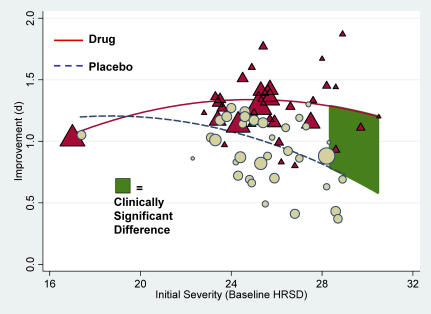
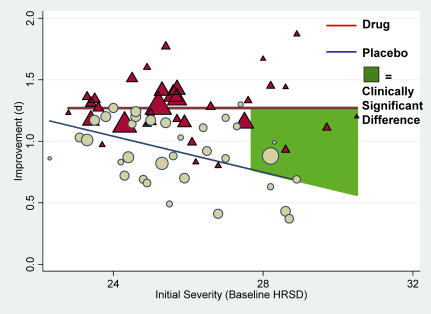
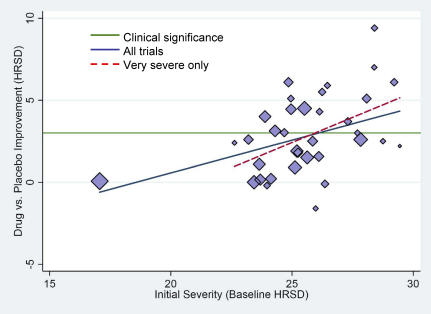
BACKGROUND: Meta-analyses of antidepressant medications have reported only modest benefits over placebo treatment, and when unpublished trial data are included, the benefit falls below accepted criteria for clinical significance. Yet, the efficacy of the antidepressants may also depend on the severity of initial depression scores. The purpose of this analysis is to establish the relation of baseline severity and antidepressant efficacy using a relevant dataset of published and unpublished clinical trials. METHODS AND FINDINGS: We obtained data on all clinical trials submitted to the US Food and Drug Administration (FDA) for the licensing of the four new-generation antidepressants for which full datasets were available. We then used meta-analytic techniques to assess linear and quadratic effects of initial severity on improvement scores for drug and placebo groups and on drug-placebo difference scores. Drug-placebo differences increased as a function of initial severity, rising from virtually no difference at moderate levels of initial depression to a relatively small difference for patients with very severe depression, reaching conventional criteria for clinical significance only for patients at the upper end of the very severely depressed category. Meta-regression analyses indicated that the relation of baseline severity and improvement was curvilinear in drug groups and showed a strong, negative linear component in placebo groups. CONCLUSIONS: Drug-placebo differences in antidepressant efficacy increase as a function of baseline severity, but are relatively small even for severely depressed patients. The relationship between initial severity and antidepressant efficacy is attributable to decreased responsiveness to placebo among very severely depressed patients, rather than to increased responsiveness to medication.
Overview
The claims and statistics of this paper haven’t been checked yet.
Free: it reads the open-access text and checks the first 5 claims that cite a source we can check. Create a free account to check every claim.
Integrity signals
Registry
Cites
Statistics
Figures
Verification
Claims the paper makes
The claims and statistics of this paper haven’t been checked yet.
Free: it reads the open-access text and checks the first 5 claims that cite a source we can check. Create a free account to check every claim.
Claims other papers make about this one
Each is checked against this paper’s own text: does it say what the citing paper says it does?
The source backs part of the claim, not all of it — or backs it for a different population, condition or comparison.
In the citing paper
“Individual-level meta-analyses have found a direct relationship between the magnitude of depressive symptoms and the effectiveness of antidepressants.8–10”
From Comparative effectiveness of exercise, antidepressants and their combination in treating non-severe depression: a systematic review and network meta-analysis of randomised controlled trials (2022) · cites this paper as [9]
Experimental — accuracy not yet measuredThe cited source says what the claim attributes to it.
In the citing paper
“An understanding of users’ own experiences of antidepressant use is increasingly important in the context of growing doubts about the effectiveness of antidepressant treatment [5, 26], concerns about side effects [27] and withdrawal effects [28].”
From ‘In my life antidepressants have been…’: a qualitative analysis of users’ diverse experiences with antidepressants (2016) · cites this paper as [5]
In the citing paper
“In this study, 84 % of participants in this study answered in the affirmative to a question about whether they felt antidepressants had reduced their depression, a number well above that suggested by efficacy studies”
From ‘In my life antidepressants have been…’: a qualitative analysis of users’ diverse experiences with antidepressants (2016) · cites this paper as [5]
In the citing paper
“Other studies have found support for increasing benefit with increasing severity of depression,21 but the effects size even for patients with the most severe depression was still minimal.21”
From Should antidepressants be used for major depressive disorder? (2020) · cites this paper as [21]
Self-check
Percentages, sums and reported differences re-computed from the paper’s own numbers.
The self-check needs the paper’s full text.
Citations
Cites
Measuring inconsistency in meta-analyses
Higgins, J. P. T., Thompson, S. G., Deeks, J. J., & Altman, D. G. (2003) · BMJ · doi:10.1136/bmj.327.7414.557 · Cited by 63,139 · cited 1×
“Both Q [15] and I2 [ 16 ] indices were used to assess”
MethodStatistical Methods for Meta-Analysis
Wasserman, S., Hedges, L. V., & Olkin, I. (1988) · Journal of Educational Statistics · doi:10.2307/1164953 · Cited by 10,326
Statistical Methods for Meta-Analysis.
Freeman, P. R., Hedges, L. V., & Olkin, I. (1986) · Biometrics · doi:10.2307/2531069 · Cited by 4,784
Meta-analysis in social research
(1982) · Evaluation and Program Planning · doi:10.1016/0149-7189(82)90011-8 · Cited by 3,853 · cited 1×
“Finally, to show directly the amount of improvement for each study’s drug group against its placebo group, we calculated the difference between the change for the drug group minus the change for the placebo group, leaving the difference in raw units and deriving its analytic weight from its standard error [11,12,20].”
MethodImputing missing standard deviations in meta-analyses can provide accurate results
Furukawa, T. A., Barbui, C., Cipriani, A., Brambilla, P., & Watanabe, N. (2006) · Journal of Clinical Epidemiology · doi:10.1016/j.jclinepi.2005.06.006 · Cited by 1,568 · cited 1×
“s were known for 28 groups, could be calculated from other inferential statistics in nine comparisons (18 groups), and were imputed in 12 comparisons (24 groups) (47.38%) [”
InfluentialPublication bias in meta-analysis its causes and consequences
Thornton, A. (2000) · Journal of Clinical Epidemiology · doi:10.1016/s0895-4356(99)00161-4 · Cited by 1,291 · cited 1×
“Examination of publication bias often relies on inspections of effect sizes in relation to sample size (or inverse variance) [22].”
BackgroundThe power of statistical tests for moderators in meta-analysis
Hedges, L. V., & Pigott, T. D. (2004) · Psychological Methods · doi:10.1037/1082-989x.9.4.426 · Cited by 672 · cited 1×
“A last, mixedeffects analysis for the amount of change used a randomeffects constant along with fixed-effects moderator dimensions; these models provide more conservative assessments of moderation [19].”
MethodMelander, H., Ahlqvist-Rastad, J., Meijer, G., & Beermann, B. (2003) · BMJ · doi:10.1136/bmj.326.7400.1171 · Cited by 635 · cited 2×
“In the case of antidepressant medication, this limitation has been found to result in considerable reporting bias characterized by multiple publication, selective publication, and selective reporting in studies sponsored by pharmaceutical companies [5].”
BackgroundPlacebo Theory, Research , and Mechanisms
WHITE, L. E., Tursky, B., & SCHWARTZ, G. E. R. (1985) · Guilford Press eBooks · Cited by 485
Khan, A., Leventhal, R. M., Khan, S. R., & Brown, W. A. (2002) · Journal of Clinical Psychopharmacology · doi:10.1097/00004714-200202000-00007 · Cited by 456 · cited 2×
“Similar to prior reports [3,4], this analysis of U.”
BackgroundResult
Research works printed but not linked: 3
- Lipsey MW Wilson DB 2001 Practical meta-analysis. Applied social research methods Volume 49. Thousand Oaks (California) Sage Publications 247
- Evans FJ 1974 The placebo response in pain reduction Adv Neurol 4 289 296
- Fabre LF Crimson L 1985 Efficacy of fluoxetine in outpatients with major depression Curr Ther Res Clin Exp 37 115 123
Cited by
Items 201–300 of 1,013
A Neural Mechanism for Nonconscious Activation of Conditioned Placebo and Nocebo Responses
Jensen, K. B., Kaptchuk, T. J., Chen, X., Kirsch, I., Ingvar, M., Gollub, R. L., & Kong, J. (2015) · Cerebral Cortex · doi:10.1093/cercor/bhu275 · Cited by 152
“…that health-related behaviors can be triggered by cues that are not consciously perceived, not only for pain, but perhaps also for other medical problems with demonstrated placebo effects, like anxiety (Petrovic et al. 2005), asthma (Wechsler et al. 2011), and depression (Kirsch et al. 2008).”
BackgroundMethodSelf-citationRead, J., Cartwright, C., & Gibson, K. (2014) · Psychiatry Research · doi:10.1016/j.psychres.2014.01.042 · Cited by 150
“A meta-analysis which included previously unpublished drug company studies (Kirsch et al., 2008) found that ‘the overall effect of new-generation antidepressant medications is below recommended criteria for clinical significance’ with no significant benefit compared to placebo for all but ‘patients at the upper end of…”
BackgroundWager-Smith, K., & Markou, A. (2011) · Neuroscience & Biobehavioral Reviews · doi:10.1016/j.neubiorev.2010.09.010 · Cited by 151
“Two recent meta-analyses (Fournier et al. 2010, Kirsch et al. 2008) that circumvent problems of publication bias (Turner et al. 2008) concur that while the magnitude of benefit of antidepressant medication compared with placebo may be minimal or nonexistent, on average, in patients with mild or…”
BackgroundXia, M., Yang, L., Sun, G., Qi, S., & Li, B. (2017) · Psychopharmacology · doi:10.1007/s00213-016-4473-9 · Cited by 149
Budd, R., & Hughes, I. (2009) · Clinical Psychology & Psychotherapy · doi:10.1002/cpp.648 · Cited by 149
“Although serious doubts have recently been raised about the effectiveness of medication in mental health care (Kirsch et al., 2008), given the dominance of the medical model the fact that pharmacotherapy continues to be the benchmark against which CBT compares itself is perhaps not surprising.”
BackgroundMoncrieff, J., & Kirsch, I. (2015) · Contemporary Clinical Trials · doi:10.1016/j.cct.2015.05.005 · Cited by 142
“They are more than twice the magnitude of the effect sizes derived from meta-analyses, including those examining separately people with the most severe levels of depression [6,7,9].”
BackgroundInfluentialSelf-citationKlein, J. P., Berger, T., Schröder, J., Späth, C., Meyer, B., Caspar, F., Lutz, W., Arndt, A., Greiner, W., Gräfe, V., et al. (2016) · Psychotherapy and Psychosomatics · doi:10.1159/000445355 · Cited by 146
Potential Mechanisms and Clinical Effectiveness of Acupuncture in Depression
Yang, N.-N., Lin, L.-L., Li, Y.-J., Li, H.-P., Cao, Y., Tan, C.-X., Hao, X.-W., Ma, S.-M., Wang, L., & Liu, C.-Z. (2021) · Current Neuropharmacology · doi:10.2174/1570159x19666210609162809 · Cited by 175
“These studies found that the higher the severity of baseline symptoms, the better the efficacy of pharmacological treatment [127, 128].”
Mental health service provision in low and middle-income countries: recent developments
Weinmann, S., & Koesters, M. (2016) · Current Opinion in Psychiatry · doi:10.1097/yco.0000000000000256 · Cited by 143
“Examples are the facts that 75% of the effects of antidepressants are nonspecific [14]; effectiveness of assertive community treatment varies across time and regions [15]; and there are cultural variations in stigma as a key predictor of outcome and service use [16].”
BackgroundBupropion: A Review of its Use in the Management of Major Depressive Disorder
Dhillon, S., Yang, L. P. H., & Curran, M. P. (2008) · Drugs · doi:10.2165/00003495-200868050-00011 · Cited by 156
No more psychiatric labels: Why formal psychiatric diagnostic systems should be abolished
Timimi, S. (2014) · International Journal of Clinical and Health Psychology · doi:10.1016/j.ijchp.2014.03.004 · Cited by 139
“Thus, several meta-analyses have concluded that most of the benefits from ‘antidepressants’ can be explained by the placebo effect, with only a small amount of the variance (and for most a clinically insignificant amount), attributable to the drug (Kirsch et al., 2008; Turner & Rosenthal, 2008).”
Acupuncture and Counselling for Depression in Primary Care: A Randomised Controlled Trial
MacPherson, H., Richmond, S., Bland, M., Brealey, S., Gabe, R., Hopton, A., Keding, A., Lansdown, H., Perren, S., Sculpher, M., et al. (2013) · PLoS Medicine · doi:10.1371/journal.pmed.1001518 · Cited by 142
“The effectiveness of newer anti-depressants for mild to moderate depression has recently come under question [5].”
Gerhards, S. A. H., Abma, T. A., Arntz, A., de Graaf, L. E., Evers, S. M. A. A., Huibers, M. J. H., & Widdershoven, G. A. M. (2011) · Journal of Affective Disorders · doi:10.1016/j.jad.2010.09.012 · Cited by 141
“…is not always an adequate treatment option: many patients refuse medication or comply poorly (Simon et al., 1996), and there is only little evidence on the effectiveness of pharmacotherapy for patients suffering from a mild to moderate depression (Kirsch et al., 2008; Kendrick et al., 2009).”
BackgroundNon-pharmacological treatment of depression: a systematic review and evidence map
Farah, W. H., Alsawas, M., Mainou, M., Alahdab, F., Farah, M. H., Ahmed, A. T., Mohamed, E. A., Almasri, J., Gionfriddo, M. R., Castaneda-Guarderas, A., et al. (2016) · Evidence Based Medicine · doi:10.1136/ebmed-2016-110522 · Cited by 141
“Another meta-analysis suggested that the relationship between initial severity and antidepressant efficacy is attributable to decreased responsiveness to placebo among very severely depressed patients, rather than to increased responsiveness to medication.(10) Concerns about antidepressants’ efficacy and tolerability…”
BackgroundAn adaptationist perspective on the etiology of depression
Durisko, Z., Mulsant, B. H., & Andrews, P. W. (2015) · Journal of Affective Disorders · doi:10.1016/j.jad.2014.09.032 · Cited by 140
“However, somemetaanalyses have called into question the strength and breadth of their efficacy for MDD (Khan et al., 2002, 2001, 2000; Kirsch and Sapirstein, 1998; Kirsch et al., 2008, 2002; Vöhringer and Ghaemi, 2011).”
BackgroundDepression in epilepsy: a critical review from a clinical perspective
Hoppe, C., & Elger, C. E. (2011) · Nature Reviews Neurology · doi:10.1038/nrneurol.2011.104 · Cited by 156
Fecal Microbiota Transplantation (FMT) as an Adjunctive Therapy for Depression—Case Report
Doll, J. P. K., Vázquez-Castellanos, J. F., Schaub, A.-C., Schweinfurth, N., Kettelhack, C., Schneider, E., Yamanbaeva, G., Mählmann, L., Brand, S., Beglinger, C., et al. (2022) · Frontiers in Psychiatry · doi:10.3389/fpsyt.2022.815422 · Cited by 158
“(30) (Supplementary Figures 1, 2); methods and results can be found in the Supplementary Material.”
MethodOwens, M., Koster, E. H. W., & Derakshan, N. (2013) · Psychophysiology · doi:10.1111/psyp.12010 · Cited by 138
Why antidepressants are not antidepressants: STEP‐BD, STAR*D, and the return of neurotic depression
Nassir Ghaemi, S. (2008) · Bipolar Disorders · doi:10.1111/j.1399-5618.2008.00639.x · Cited by 144
Efficacy of antidepressants: a re-analysis and re-interpretation of the Kirsch data
Fountoulakis, K. N., & Möller, H.-J. (2011) · The International Journal of Neuropsychopharmacology · doi:10.1017/s1461145710000957 · Cited by 140
“Recently a metaanalysis on the usefulness of antidepressants by Kirsch et al. (2008) attracted much attention from scientists and the general public.”
BackgroundResultInfluentialMojtabai, R., & Jorm, A. F. (2015) · Journal of Affective Disorders · doi:10.1016/j.jad.2014.12.039 · Cited by 138
“For example, the major growth in the use of antidepressant medications occurred in primary care settings and among patients with less severe mental health problems 14, 36 who may not respond to treatments to the same degree as patients with more severe problems.(37) Poor targeting of treatments may result in attenuati…”
BackgroundGould, G. G., Hensler, J. G., Burke, T. F., Benno, R. H., Onaivi, E. S., & Daws, L. C. (2011) · Journal of Neurochemistry · doi:10.1111/j.1471-4159.2010.07104.x · Cited by 139
“Selective 5-HT reuptake inhibitors (SSRIs) such as fluoxetine (Prozac) improve symptoms for some autistic patients, but they have limited effectiveness as a comprehensive ASD therapeutic, and their use in juveniles is controversial (Kirsch et al. 2008; Daws 2009; Henry et al. 2009; West et al. 2009; Richardson-Jones e…”
BackgroundThe effectiveness of electroconvulsive therapy: A literature review
Read, J., & Bentall, R. (2010) · Epidemiology and Psychiatric Sciences · doi:10.1017/s1121189x00000671 · Cited by 135
“A recent example is Parker’s (2009) response to new evidence that anti-depressant medications have little benefit beyond placebo (Kirsch et al. , 2008), in which every conceivable explanation for the findings is considered other than the power of placebo effects.”
BackgroundDepression and eating disorders: Treatment and course
Mischoulon, D., Eddy, K. T., Keshaviah, A., Dinescu, D., Ross, S. L., Kass, A. E., Franko, D. L., & Herzog, D. B. (2011) · Journal of Affective Disorders · doi:10.1016/j.jad.2010.10.043 · Cited by 139
“Our findings are consistent with previous studies of depression that have linked more severe depressive symptoms to poorer treatment outcomes (Kirsch et al., 2008).”
Is psychotherapy effective? A re-analysis of treatments for depression
Munder, T., Flückiger, C., Leichsenring, F., Abbass, A. A., Hilsenroth, M. J., Luyten, P., Rabung, S., Steinert, C., & Wampold, B. E. (2019) · Epidemiology and Psychiatric Sciences · doi:10.1017/s2045796018000355 · Cited by 131
“We know that pill placebo with clinical management is often quite effective, often as effective or nearly as effective as antidepressant medication, particularly for depression (Kirsch, 2002, 2009, 2010; Kirsch et al., 2008).”
BackgroundThe Production of Knowledge: Enhancing Progress in Social Science
(2020) · Cambridge University Press eBooks · doi:10.1017/9781108762519 · Cited by 247
Patterns of Depression and Treatment in Pregnant and Postpartum Women
Bowen, A., Bowen, R., Butt, P., Rahman, K., & Muhajarine, N. (2012) · The Canadian Journal of Psychiatry · doi:10.1177/070674371205700305 · Cited by 134
A pragmatic randomized clinical trial of behavioral activation for depressed pregnant women.
Dimidjian, S., Goodman, S. H., Sherwood, N. E., Simon, G. E., Ludman, E., Gallop, R., Welch, S. S., Boggs, J. M., Metcalf, C. A., Hubley, S., et al. (2017) · Journal of Consulting and Clinical Psychology · doi:10.1037/ccp0000151 · Cited by 133
“…by patient severity such that specific pharmacological benefit is observed only among patients with severe baseline symptoms (Fournier et al., 2010; Kirsch et al., 2008); such findings raise the question of whether some pregnant women are exposed to potential adverse effects without specific…”
Psychiatrization of Society: A Conceptual Framework and Call for Transdisciplinary Research
Beeker, T., Mills, C., Bhugra, D., Meerman, S. T., Thoma, S., Heinze, M., & von Peter, S. (2021) · Frontiers in Psychiatry · doi:10.3389/fpsyt.2021.645556 · Cited by 157
van Westrhenen, R., Aitchison, K. J., Ingelman‐Sundberg, M., & Jukić, M. M. (2020) · Frontiers in Psychiatry · doi:10.3389/fpsyt.2020.00094 · Cited by 139
“NMs may also carry other genotypes as long as the enzymatic capacity is not significantly different compared with Wt/Wt carriers; (4) ultrarapid metabolizers (UM) carry genotypes linked to significantly increased enzymatic capacity compared with Wt/Wt carriers.”
BackgroundStone, M. B., Yaseen, Z. S., Miller, B. J., Richardville, K., Kalaria, S. N., & Kirsch, I. (2022) · BMJ · doi:10.1136/bmj-2021-067606 · Cited by 156
Self-citationHedayati, S. S., Gregg, L. P., Carmody, T., Jain, N., Toups, M., Rush, A. J., Toto, R. D., & Trivedi, M. H. (2017) · JAMA · doi:10.1001/jama.2017.17131 · Cited by 129
Personalized Psychotherapy for Adult Depression: A Meta-Analytic Review
Cuijpers, P., Ebert, D. D., Acarturk, C., Andersson, G., & Cristea, I. A. (2016) · Behavior Therapy · doi:10.1016/j.beth.2016.04.007 · Cited by 128
Complementary therapies for clinical depression: an overview of systematic reviews
Haller, H., Anheyer, D., Cramer, H., & Dobos, G. J. (2019) · BMJ Open · doi:10.1136/bmjopen-2018-028527 · Cited by 152
“While both treatment strategies (alone and in combination) have been shown to be effective, more recent meta-analyses also found high dropout and low remission rates as well as clinically significant differences between antidepressant drugs and placebos only for patients at the upper end of the very severely depressed…”
ResultRoutledge Handbook of Physical Activity and Mental Health
Ekkekakis, P. (2013) · Routledge eBooks · doi:10.4324/9780203132678 · Cited by 149
“(Ioannidis, 2008, p. 7) Although the findings of the meta-analysis by Kirsch et al. (2008) are very hard to dismiss, the limitation of having included only one study of individuals with moderate depression (HRSD of 14 to 18) and no studies of individuals with mild (HDRS score of 8 to 13) or severe…”
BackgroundThe psychology of neurofeedback: Clinical intervention even if applied placebo.
Thibault, R. T., & Raz, A. (2017) · American Psychologist · doi:10.1037/amp0000118 · Cited by 127
“…treatments that target brain function and behavior—from psychiatry (Weimer, Colloca, & Enck, 2015) to gastroenterology and the brain-gut axis (Elsenbruch & Enck, 2015)— derive substantial benefits from such psychosocial variables (e.g., see antidepressants in Kirsch, 2009; Kirsch et al., 2008).”
BackgroundKrogh, J., Videbech, P., Thomsen, C., Gluud, C., & Nordentoft, M. (2012) · PLoS ONE · doi:10.1371/journal.pone.0048316 · Cited by 127
“Low compliance and high drop-out rates during antidepressant therapy could explain why only 50% are expected to remit during the acute phase of treatment [5–7].”
BackgroundAlderman, B. L., Olson, R. L., Brush, C. J., & Shors, T. J. (2016) · Translational Psychiatry · doi:10.1038/tp.2015.225 · Cited by 125
Chin Fatt, C. R., Jha, M. K., Cooper, C. M., Fonzo, G., South, C., Grannemann, B., Carmody, T., Greer, T. L., Kurian, B., Fava, M., et al. (2020) · American Journal of Psychiatry · doi:10.1176/appi.ajp.2019.18070870 · Cited by 125
Markov, D. D. (2022) · Brain Sciences · doi:10.3390/brainsci12101287 · Cited by 143
A Clinical Trial of In-Home CBT for Depressed Mothers in Home Visitation
Ammerman, R. T., Putnam, F. W., Altaye, M., Stevens, J., Teeters, A. R., & Van Ginkel, J. B. (2013) · Behavior Therapy · doi:10.1016/j.beth.2013.01.002 · Cited by 123
“Indeed, effect sizes are comparable to those found in trials of CBT with other populations (Hollon, Stewart, & Strunk, 2006) and with antidepressant medications (Kirsch et al., 2008).”
ResultDoleman, B., Freeman, S. C., Lund, J. N., Williams, J. P., & Sutton, A. J. (2020) · Research Synthesis Methods · doi:10.1002/jrsm.1414 · Cited by 136
Montgomery, S. A., & Möller, H.-J. (2009) · International Clinical Psychopharmacology · doi:10.1097/yic.0b013e32832a8eb2 · Cited by 121
“A reduction of at least 50% on the pivotal efficacy scale in the study, for example, the Montgomery and Asberg Depression Rating Scale (MADRS) (Montgomery and Asberg, 1979) or the Hamilton Depression Rating Scale (HAMD) (Hamilton, 1967) is the usual criterion.”
BackgroundInfluentialPractical Suicide-Risk Management for the Busy Primary Care Physician
McDowell, A. K., Lineberry, T. W., & Bostwick, J. M. (2011) · Mayo Clinic Proceedings · doi:10.4065/mcp.2011.0076 · Cited by 139
Omega-3 Fatty Acid and Nutrient Deficits in Adverse Neurodevelopment and Childhood Behaviors
Gow, R. V., & Hibbeln, J. R. (2014) · Child and Adolescent Psychiatric Clinics of North America · doi:10.1016/j.chc.2014.02.002 · Cited by 139
“Another source of heterogeneity in several meta-analyses may be the inclusion of negative trials of subjects without clinically significant depression; the severity of depressive symptoms at study entry is a major determinant of the ability to detect efficacy of any antidepressant treatment [160].”
Primum Non Nocere: An Evolutionary Analysis of Whether Antidepressants Do More Harm than Good
Andrews, P. W., Thomson, J. A., Amstadter, A., & Neale, M. C. (2012) · Frontiers in Psychology · doi:10.3389/fpsyg.2012.00117 · Cited by 120
“On average, Kirsch et al. (2008) found that patients on placebo experienced a 7.8 point reduction in HDRS symptoms while those on antidepressants experienced a 9.6 point reduction.”
BackgroundInfluentialLewis, G., Duffy, L., Ades, A., Amos, R., Araya, R., Brabyn, S., Button, K. S., Churchill, R., Derrick, C., Dowrick, C., et al. (2019) · The Lancet Psychiatry · doi:10.1016/s2215-0366(19)30366-9 · Cited by 120
Hoffmann, A. O. M., Lee, A. H., Wertenauer, F., Ricken, R., Jansen, J. B., Gallinat, J., & Lang, U. E. (2009) · European Journal of Integrative Medicine · doi:10.1016/j.eujim.2009.08.002 · Cited by 177
Slotema, C. W., Aleman, A., Daskalakis, Z. J., & Sommer, I. E. (2012) · Schizophrenia Research · doi:10.1016/j.schres.2012.08.025 · Cited by 133
“The literature proposed medication-resistance to be associated with smaller effect sizes, but this could not be confirmed in two meta-analyses considering rTMS for depression (Kirsch et al., 2008; Schutter, 2009), neither in this meta-analysis.”
ResultEffect of working memory training on working memory, arithmetic and following instructions
Nutley, S. B., & Klingberg, T. (2014) · Psychological Research · doi:10.1007/s00426-014-0614-0 · Cited by 161
“3 in severely depressed individuals (Kirsch et al., 2008) and drugs acting on the acetylcholine system of the brain, used to alleviate Alzheimer’s disease, has an even lower effect (Rockwood, 2004).”
BackgroundBehavioural activation for depression in older people: systematic review and meta-analysis
Orgeta, V., Brede, J., & Livingston, G. (2017) · British Journal of Psychiatry · doi:10.1192/bjp.bp.117.205021 · Cited by 116
The “placebo” response in osteoarthritis and its implications for clinical practice
Doherty, M., & Dieppe, P. A. (2009) · Osteoarthritis and Cartilage · doi:10.1016/j.joca.2009.03.023 · Cited by 129
von Wolff, A., Hölzel, L. P., Westphal, A., Härter, M. C., & Kriston, L. (2012) · Journal of Affective Disorders · doi:10.1016/j.jad.2012.06.007 · Cited by 142
“Our findings further highlight the relevance of antidepressants in the treatment of patients with mild but chronic forms of depression in contrast to previous findings questioning the superiority of antidepressant to placebo for mild to moderately depressed patients (Kirsch et al., 2008).”
The rise and fall of MRI studies in major depressive disorder
Zhuo, C., Li, G., Lin, X., Jiang, D., Xu, Y., Tian, H., Wang, W., & Song, X. (2019) · Translational Psychiatry · doi:10.1038/s41398-019-0680-6 · Cited by 117
Identifying existing health care services that do not provide value for money
Elshaug, A. G., Moss, J. R., Littlejohns, P., Karnon, J., Merlin, T. L., & Hiller, J. E. (2009) · Medical Journal of Australia · doi:10.5694/j.1326-5377.2009.tb02394.x · Cited by 119
“(Kirsch et al, 2008.12) Tympanostomy tubes (ear grommets) for fluid in the inner ear in children Context: 6000 children with no known risk factors for developmental delay were followed up from infancy to age 11 years; those with persisting fluid were assigned to early insertion of tubes or to…”
BackgroundInfluentialAntidepressant‐Induced Suicidality: An Update
Reeves, R. R., & Ladner, M. E. (2010) · CNS Neuroscience & Therapeutics · doi:10.1111/j.1755-5949.2010.00160.x · Cited by 118
“Although a large meta-analysis showed a mean medication versus placebo improvement of only about 2 HAM-D points [2], critical objections cannot disprove their positive overall effects against depression [3].”
BackgroundTsai, A. C., Weiser, S. D., Petersen, M. L., Ragland, K., Kushel, M. B., & Bangsberg, D. R. (2010) · Archives of General Psychiatry · doi:10.1001/archgenpsychiatry.2010.160 · Cited by 117
Mehrotra, R., Cukor, D., Unruh, M. L., Rue, T. C., Heagerty, P. J., Cohen, S. D., Dember, L. M., Díaz‐Linhart, Y., Dubovsky, A. N., Greene, T., et al. (2019) · Annals of Internal Medicine · doi:10.7326/m18-2229 · Cited by 131
Classification of mental disorders: a global mental health perspective
Jacob, K. S., & Patel, V. (2014) · The Lancet · doi:10.1016/s0140-6736(13)62382-x · Cited by 117
Melander, H., Salmonson, T., Abadie, E., & van Zwieten-Boot, B. (2008) · European Neuropsychopharmacology · doi:10.1016/j.euroneuro.2008.06.003 · Cited by 117
Recchia, F., Leung, C. K., Chin, E. C., Fong, D. Y., Montero, D., Cheng, C. P., Yau, S. Y., & Siu, P. M. (2022) · British Journal of Sports Medicine · doi:10.1136/bjsports-2022-105964 · Cited by 117
Appleton, K. M., Rogers, P. J., & Ness, A. R. (2008) · Nutrition Research Reviews · doi:10.1017/s0954422408998620 · Cited by 117
Oxytocin and postpartum depression: Delivering on what's known and what's not
Kim, S., Soeken, T. A., Cromer, S. J., Martinez, S. R., Hardy, L. R., & Strathearn, L. (2014) · Brain Research · doi:10.1016/j.brainres.2013.11.009 · Cited by 118
Furukawa, T. A., Levine, S. Z., Tanaka, S., Goldberg, Y., Samara, M., Davis, J. M., Cipriani, A., & Leucht, S. (2015) · JAMA Psychiatry · doi:10.1001/jamapsychiatry.2014.2127 · Cited by 116
“4 (1-40) Inpatients with schizophrenia (residual type excluded; DSM-III-R), BPRS total score ≥42, CGI-S score ≥4 both before and after placebo run-in”
BackgroundAntidepressant Withdrawal and Rebound Phenomena
Henssler, J., Heinz, A., Brandt, L., & Bschor, T. (2019) · Deutsches Ärzteblatt international · doi:10.3238/arztebl.2019.0355 · Cited by 50
Common mental disorders and disability pension award: Seven year follow-up of the HUSK study
Knudsen, A. K., Øverland, S., Aakvaag, H. F., Harvey, S. B., Hotopf, M., & Mykletun, A. (2010) · Journal of Psychosomatic Research · doi:10.1016/j.jpsychores.2010.03.007 · Cited by 115
“Established treatments for more severe depression cannot necessarily be applied to mild or sub case-level symptom loads [36].”
BackgroundPatients' views of physical activity as treatment for depression: a qualitative study
Searle, A., Calnan, M., Lewis, G., Campbell, J., Taylor, A., & Turner, K. (2011) · British Journal of General Practice · doi:10.3399/bjgp11x567054 · Cited by 115
“…depression (Fournier et al., 2010), there is concern regarding over-prescription of antidepressant medication for depression, particularly as the effectiveness of antidepressants for mild to moderate depression is questionable (Donoghue and Tylee, 1996; Kirsch et al., 2008; Prior et al., 2003).”
BackgroundThe Placebo and Nocebo Phenomena: Their Clinical Management and Impact on Treatment Outcomes
Chavarria, V., Vian, J., Pereira, C. L., Data-Franco, J., Fernandes, B. S., Berk, M., & Dodd, S. (2017) · Clinical Therapeutics · doi:10.1016/j.clinthera.2017.01.031 · Cited by 136
Hengartner, M. P., & Plöderl, M. (2022) · BMJ Evidence-Based Medicine · doi:10.1136/bmjebm-2020-111600 · Cited by 114
De Crescenzo, F., Perelli, F., Armando, M., & Vicari, S. (2014) · Journal of Affective Disorders · doi:10.1016/j.jad.2013.09.019 · Cited by 114
mGlu2/3 and mGlu5 receptors: Potential targets for novel antidepressants
Chaki, S., Ago, Y., Palucha-Paniewiera, A., Matrisciano, F., & Pilc, A. (2013) · Neuropharmacology · doi:10.1016/j.neuropharm.2012.05.022 · Cited by 116
“Importantly, meta- analyses suggest that antidepressants are only marginally efficacious compared to placebos, especially at moderate levels of initial depression (Kirsch et al., 2008; Pigott et al., 2010).”
Lithium specificity in bipolar illness: a classic agent for the classic disorder
Gershon, S., Chengappa, K. R., & Malhi, G. S. (2009) · Bipolar Disorders · doi:10.1111/j.1399-5618.2009.00709.x · Cited by 116
Terluin, B., Brouwers, E. P., van Marwijk, H. W., Verhaak, P. F., & van der Horst, H. E. (2009) · BMC Family Practice · doi:10.1186/1471-2296-10-58 · Cited by 115
“We do not worry about the patients with mild major depressive disorders as they probably would not benefit from a specific antidepressant treatment [43, 44 ].”
Gueorguieva, R. (2011) · Archives of General Psychiatry · doi:10.1001/archgenpsychiatry.2011.132 · Cited by 115
“The presence of distinct patterns of response to antidepressant medications might help to explain why medicat ions that were prescribed to more than 10% of the American population in 2005 are associated with modest effect sizes,(1) with only 51% of studies in the Food and Drug Administration antidepressant database sh…”
BackgroundHenssler, J., Alexander, D., Schwarzer, G., Bschor, T., & Baethge, C. (2022) · JAMA Psychiatry · doi:10.1001/jamapsychiatry.2021.4313 · Cited by 111
Mechanisms of antidepressant resistance
El-Hage, W., Leman, S., Camus, V., & Belzung, C. (2013) · Frontiers in Pharmacology · doi:10.3389/fphar.2013.00146 · Cited by 111
“In particular, an inappropriately low baseline disease severity is likely the most problematic methodological flaw that eliminates the statistical significance of the difference in the response rate between the active and placebo groups (Kirsch et al., 2008; Fournier et al., 2010).”
BackgroundPlaßmann, H., & Weber, B. (2015) · Journal of Marketing Research · doi:10.1509/jmr.13.0613 · Cited by 136
Correll, C. U., Solmi, M., Cortese, S., Fava, M., Højlund, M., Kraemer, H. C., McIntyre, R. S., Pine, D. S., Schneider, L. S., & Kane, J. M. (2023) · World Psychiatry · doi:10.1002/wps.21056 · Cited by 109
Lucas, M., Asselin, G., Mérette, C., Poulin, M.-J., & Dodin, S. (2008) · American Journal of Clinical Nutrition · doi:10.3945/ajcn.2008.26749 · Cited by 120
“tidepressant medication to any but the most severely depressed patients, unless alternative treatments have failed to provide benefit’’ (12).”
BackgroundHoen, P. W., Whooley, M. A., Martens, E. J., Na, B., van Melle, J. P., & de Jonge, P. (2010) · Journal of the American College of Cardiology · doi:10.1016/j.jacc.2010.03.080 · Cited by 110
“Two recent studies (24,25) have suggested that patients with lower grade depression may not benefit from antidepressant treatment as much as those with more severe symptoms.”
Cameron, I. M., Cardy, A., Crawford, J. R., du Toit, S. W., Hay, S., Lawton, K., Mitchell, K., Sharma, S., Shivaprasad, S., Winning, S., et al. (2011) · British Journal of General Practice · doi:10.3399/bjgp11x583209 · Cited by 109
The Future of Psychopharmacological Enhancements: Expectations and Policies
Schermer, M., Bolt, I. L. L. E., de Jongh, R., & Olivier, B. (2009) · Neuroethics · doi:10.1007/s12152-009-9032-1 · Cited by 111
“depressive complaints, while their effectiveness has only been (contestably) proven for very serious clinical depression [43, 56].”
BackgroundSubtyping Major Depressive Disorder
Lichtenberg, P., & Belmaker, R. H. (2010) · Psychotherapy and Psychosomatics · doi:10.1159/000286957 · Cited by 109
“The pharmacotherapy of depression offers a plethora of medications. However, depression is often resistant to standard antidepressant medication, and a large percentage of patients respond just as well to placebo [”
BackgroundCulture and psychopathology: An attempt at reconsidering the role of social learning
Fonagy, P., Campbell, C., Constantinou, M., Higgitt, A., Allison, E., & Luyten, P. (2021) · Development and Psychopathology · doi:10.1017/s0954579421000092 · Cited by 140
Predictors of treatment outcome in depression in later life: A systematic review and meta-analysis
Tunvirachaisakul, C., Gould, R. L., Coulson, M., Ward, E. V., Reynolds, G., Gathercole, R. L., Grocott, H., Supasitthumrong, T., Tunvirachaisakul, A., Kimona, K., et al. (2017) · Journal of Affective Disorders · doi:10.1016/j.jad.2017.10.008 · Cited by 129
“This association has been suggested to be due to those with higher baseline severity having greater room for improvement than those with lower baseline severity (Kirsch et al., 2008; Roose et al., 2004a).”
BackgroundSauder, C. L., Allen, L. A., Baker, E. K., Miller, A., Paul, S. M., & Brannan, S. K. (2022) · Translational Psychiatry · doi:10.1038/s41398-022-02254-9 · Cited by 114
“Studies of antidepressants and antipsychotics suggest that patients with minimal baseline symptom severity are less likely to show meaningful differences between drug and placebo, likely due to ceiling effects [35, 36].”
BackgroundAndrews, P. W., Kornstein, S. G., Halberstadt, L. J., Gardner, C. O., & Neale, M. C. (2011) · Frontiers in Psychology · doi:10.3389/fpsyg.2011.00159 · Cited by 107
Ebrahim, S., Bance, S., Athale, A., Malachowski, C., & Ioannidis, J. P. A. (2016) · Journal of Clinical Epidemiology · doi:10.1016/j.jclinepi.2015.08.021 · Cited by 107
Khan, A., Fahl Mar, K., Faucett, J., Khan Schilling, S., & Brown, W. A. (2017) · World Psychiatry · doi:10.1002/wps.20421 · Cited by 109
Laumet, G. O., Edralin, J. D., Chiang, A. C. A., Dantzer, R., Heijnen, C. J., & Kavelaars, A. (2018) · Neuropsychopharmacology · doi:10.1038/s41386-018-0154-1 · Cited by 113
Belzung, C. (2014) · Neuropsychopharmacology · doi:10.1038/npp.2013.342 · Cited by 106
“In non-depressed patients, antidepressant efficacy is equivalent to placebo effects (Fournier et al, 2010; Khan et al, 2002; Kirsch et al, 2008).”
BackgroundTurner, E. H., Knoepflmacher, D., & Shapley, L. (2012) · PLoS Medicine · doi:10.1371/journal.pmed.1001189 · Cited by 106
“5, there is the risk that some parties will declare that antipsychotics have failed a critical litmus test for clinical significance, as has been declared for antidepressants [48,49].”
BackgroundFang, J., Egorova, N., Rong, P., Liu, J., Hong, Y., Fan, Y., Wang, X., Wang, H., Yu, Y., Ma, Y., et al. (2017) · NeuroImage: Clinical · doi:10.1016/j.nicl.2016.12.016 · Cited by 104
“The large placebo effect observed in our study is in line with findings from a previous clinical trial testing the efficacy of antidepressants (Kirsch et al., 2008).”
ResultEvolutionary theories of depression: a critical review
Hagen, E. H. (2011) · The Canadian Journal of Psychiatry · doi:10.1177/070674371105601203 · Cited by 105
Coupland, C. A. C., Hill, T., Morriss, R. K., Moore, M. V., Arthur, A. J., & Hippisley‐Cox, J. (2018) · BMC Medicine · doi:10.1186/s12916-018-1022-x · Cited by 124
“Clinical implications and future research Antidepressants are one of the most commonly prescribed medications in younger and middle-aged adults, although their benefits in the treatment of depression may be relatively small, especially for mild and moderate depression [10, 68].”
BackgroundLessons learned from placebo groups in antidepressant trials
Mora, M. S., Nestoriuc, Y., & Rief, W. (2011) · Philosophical Transactions of the Royal Society B: Biological Sciences · doi:10.1098/rstb.2010.0394 · Cited by 105
Skapinakis, P., Bakola, E., Salanti, G., Lewis, G., Kyritsis, A. P., & Mavreas, V. (2010) · BMC Neurology · doi:10.1186/1471-2377-10-49 · Cited by 106
“RCTs usually exclude patients with the more severe depression, but these patients are more likely to respond to SSRIs [40].”
BackgroundRethinking Explicit Expectations: Connecting Placebos, Social Cognition, and Contextual Perception
Schwarz, K. A., Pfister, R., & Büchel, C. (2016) · Trends in Cognitive Sciences · doi:10.1016/j.tics.2016.04.001 · Cited by 127
Weimer, K., Colloca, L., & Enck, P. (2015) · Gerontology · doi:10.1159/000365248 · Cited by 101
GABAB Receptors and Depression: Current Status
Cryan, J. F., & Slattery, D. A. (2010) · Advances in pharmacology · doi:10.1016/s1054-3589(10)58016-5 · Cited by 112
Metadata
- Authors
- Kirsch, I., Deacon, B. J., Huedo-Medina, T. B., Scoboria, A., Moore, T. J., & Johnson, B. T.
- Affiliations
- University of Hull (GB)
- University of Wyoming (US)
- University of Connecticut (US)
- University of Windsor (CA)
- Institute for Safe Medication Practices (US)
- Corresponding author
- Kirsch, Irving
- Venue
- PLoS Medicine
- Publisher
- Public Library of Science (PLoS)
- Published
- 2008-02-26
- Volume
- 5
- Issue
- 2
- Pages
- e45
- ISSN
- 1549-1277 (ISSN-L)
- 1549-1676
- PMC
- PMC2253608
- OpenAlex
- W2153403353
- Cited by
- 2,442
- References
- 49
- Citations by year
- 2026: 47 · 2025: 53 · 2024: 63 · 2023: 65 · 2022: 90 · 2021: 81 · 2020: 132 · 2019: 100 · 2018: 159 · 2017: 154 · 2016: 142 · 2015: 130 · 2014: 156 · 2013: 191 · 2012: 179
- FWCI
- 24.87
- Type
- journal article
- Language
- en
- Open access
- gold
- doi.org
- Licence
- cc-by
- Locations
- PLoS Medicine (publishedVersion, cc-by)
- PubMed Central (publishedVersion, cc-by)
- PubMed (publishedVersion)
- RePEc: Research Papers in Economics (publishedVersion)
- Research Online (University of Wollongong) (submittedVersion)
- DOAJ (DOAJ: Directory of Open Access Journals) (submittedVersion, cc-by-sa)
- Figshare (submittedVersion)
- Topics
- Health Sciences › Medicine › Pharmacology (medical) › Treatment of Major Depression
- Social Sciences › Psychology › Clinical Psychology › Psychotherapy Techniques and Applications
- Health Sciences › Medicine › Psychiatry and Mental health › Mental Health Treatment and Access
- Keywords
- antidepressants, antidepressant efficacy, placebo response, severe depression, clinical significance
- MeSH terms
- Antidepressive Agents, Clinical Trials as Topic, Depressive Disorder, Humans, Severity of Illness Index, United States, United States Food and Drug Administration, Databases, Factual
About these checks
Registry, retraction, Cites and statistics results are computed, not judged, with one exception: a printed reference that no index lists is read once by a model before it counts as a citation error. Claims are extracted by a model and kept only when their quote appears verbatim in the text; each cited source is then checked, with a model’s help, for whether it says what the claim relies on. Those verdicts can be wrong — read the claim’s quote and the cited source before relying on one.
Statistics and arithmetic are recomputed, not judged.
Confidence bands are shown only for fields calibrated on our annotated test set. None is calibrated yet, so no band is shown.
What counts as a claim ›How we measure confidence ›How we check this ›
Are you an author, or do you see a problem with this page? Request a review
Data sources
Bibliographic data: Semantic Scholar, OpenAlex, Crossref.
Contains information from the Semantic Scholar Academic Graph Datasets, made available under the ODC Attribution License (ODC-BY 1.0).
Semantic Scholar’s data is described in: Kinney, R., et al. (2023). The Semantic Scholar Open Data Platform. arXiv:2301.10140.
