

Plasticity of the Intrinsic Period of the Human Circadian Timing System
Open accessThe DOI matches its Crossref record; 47 of the 49 references it cites were found in a registry or an index.
Abstract
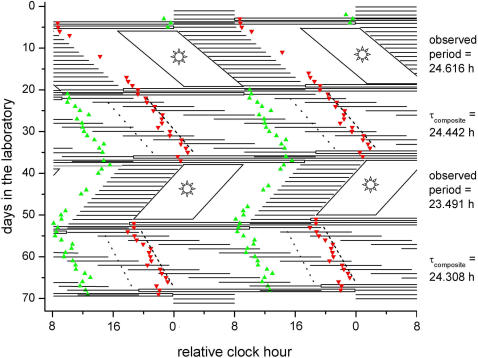
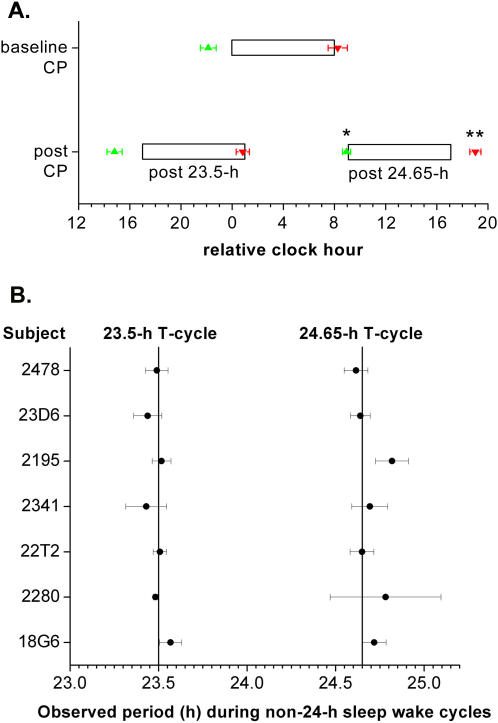
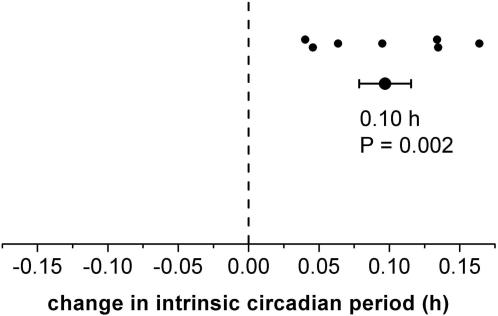
Human expeditions to Mars will require adaptation to the 24.65-h Martian solar day-night cycle (sol), which is outside the range of entrainment of the human circadian pacemaker under lighting intensities to which astronauts are typically exposed. Failure to entrain the circadian time-keeping system to the desired rest-activity cycle disturbs sleep and impairs cognitive function. Furthermore, differences between the intrinsic circadian period and Earth's 24-h light-dark cycle underlie human circadian rhythm sleep disorders, such as advanced sleep phase disorder and non-24-hour sleep-wake disorders. Therefore, first, we tested whether exposure to a model-based lighting regimen would entrain the human circadian pacemaker at a normal phase angle to the 24.65-h Martian sol and to the 23.5-h day length often required of astronauts during short duration space exploration. Second, we tested here whether such prior entrainment to non-24-h light-dark cycles would lead to subsequent modification of the intrinsic period of the human circadian timing system. Here we show that exposure to moderately bright light ( approximately 450 lux; approximately 1.2 W/m(2)) for the second or first half of the scheduled wake episode is effective for entraining individuals to the 24.65-h Martian sol and a 23.5-h day length, respectively. Estimations of the circadian periods of plasma melatonin, plasma cortisol, and core body temperature rhythms collected under forced desynchrony protocols revealed that the intrinsic circadian period of the human circadian pacemaker was significantly longer following entrainment to the Martian sol as compared to following entrainment to the 23.5-h day. The latter finding of after-effects of entrainment reveals for the first time plasticity of the period of the human circadian timing system. Both findings have important implications for the treatment of circadian rhythm sleep disorders and human space exploration.
Overview
The claims and statistics of this paper haven’t been checked yet.
Free: it reads the open-access text and checks the first 5 claims that cite a source we can check. Create a free account to check every claim.
Integrity signals
Registry
Cites
Statistics
Figures
Verification
Claims the paper makes
The claims and statistics of this paper haven’t been checked yet.
Free: it reads the open-access text and checks the first 5 claims that cite a source we can check. Create a free account to check every claim.
Claims other papers make about this one
Each is checked against this paper’s own text: does it say what the citing paper says it does?
The cited source says what the claim attributes to it.
In the citing paper
“Light studies in humans and other animals have demonstrated that the intrinsic period of the circadian pacemaker is dependent on prior light exposure40, 41.”
From Irregular sleep/wake patterns are associated with poorer academic performance and delayed circadian and sleep/wake timing (2017) · cites this paper as [41]
In the citing paper
“However, it should be noted that the 24-h oscillation time can be changed slightly using different stimuli [ 44 ].”
From Physiological Rhythms and Biological Variation of Biomolecules: The Road to Personalized Laboratory Medicine (2023) · cites this paper as [44]
Self-check
Percentages, sums and reported differences re-computed from the paper’s own numbers.
The self-check needs the paper’s full text.
Citations
Cites
Coordination of circadian timing in mammals
Reppert, S. M., & Weaver, D. R. (2002) · Nature · doi:10.1038/nature00965 · Cited by 4,379 · cited 1×
“The period of the circadian timing system is genetically determined, involving transcription-translation feedback loops of clock genes [17,18].”
BackgroundTwo-Process Model of Sleep Regulation
(2009) · Encyclopedia of Neuroscience · doi:10.1007/978-3-540-29678-2_6166 · Cited by 3,899 · cited 1×
“The daily pattern of sleep and wakefulness is regulated by homeostatic and circadian processes [1,2].”
BackgroundPhototransduction by retinal ganglion cells that set the circadian clock
Berson, D. M., Dunn, F. A., & Takao, M. (2002) · Science · doi:10.1126/science.1067262 · Cited by 3,629 · cited 1×
“Based on the spectral sensitivity of retinal photoreceptor systems involved in non-imageforming photic responses, additional research should be conducted to evaluate strategies to decrease further the light intensity or duration required by optimizing wavelength [8,28].”
BackgroundPittendrigh, C. S., & Daan, S. (1976) · Journal of Comparative Physiology ? A · doi:10.1007/bf01417856 · Cited by 2,127
Stephan, F. K., & Zucker, I. (1972) · Proceedings of the National Academy of Sciences · doi:10.1073/pnas.69.6.1583 · Cited by 2,039 · cited 1×
“The master circadian pacemaker, located in the suprachiasmatic nucleus of the anterior hypothalamus (SCN), orchestrates near-24-h rhythms in physiology and behavior in mammals, including the sleep-wake cycle [3,4].”
BackgroundTransplanted Suprachiasmatic Nucleus Determines Circadian Period
Ralph, M. R., Foster, R. G., Davis, F. C., & Menaker, M. (1990) · Science · doi:10.1126/science.2305266 · Cited by 1,853 · cited 1×
“The period of the circadian timing system is genetically determined, involving transcription-translation feedback loops of clock genes [17,18].”
BackgroundStability, precision, and near-24-hour period of the human circadian pacemaker
Czeisler, C. A., Duffy, J. F., Shanahan, T. L., Brown, E. N., Mitchell, J. F., Rimmer, D. W., Ronda, J. M., Silva, E. J., Allan, J. S., Emens, J. S., et al. (1999) · Science · doi:10.1126/science.284.5423.2177 · Cited by 1,705 · cited 6×
“plasma melatonin, plasma cortisol, and core body temperature data collected during FD and were computed by a nonorthogonal spectral analysis technique with an exact maximum likelihood fitting procedure [13].”
BackgroundMethodInfluentialSelf-citationPittendrigh, C. S., & Daan, S. (1976) · Journal of Comparative Physiology ? A · doi:10.1007/bf01417860 · Cited by 1,636 · cited 6×
“comparable in magnitude to after-effects of entrainment [26,40,42].”
BackgroundResultInfluentialZeitzer, J. M., Dijk, D., Kronauer, R. E., Brown, E. N., & Czeisler, C. A. (2000) · The Journal of Physiology · doi:10.1111/j.1469-7793.2000.00695.x · Cited by 1,175 · cited 2×
“Given that the resetting effects of light are both phasedependent [7,15] and intensity-dependent [5,6], we used Kronauer’s mathematical model [16] to design a temporal pattern of”
MethodSelf-citationA Phase Response Curve to Single Bright Light Pulses in Human Subjects
Khalsa, S. B. S., Jewett, M. E., Cajochen, C., & Czeisler, C. A. (2003) · The Journal of Physiology · doi:10.1113/jphysiol.2003.040477 · Cited by 1,040 · cited 2×
“Given that the resetting effects of light are both phasedependent [7,15] and intensity-dependent [5,6], we used Kronauer’s mathematical model [16] to design a temporal pattern of”
MethodSelf-citationBright Light Induction of Strong (Type 0) Resetting of the Human Circadian Pacemaker
Czeisler, C. A., Kronauer, R. E., Allan, J. S., Duffy, J. F., Jewett, M. E., Brown, E. N., & Ronda, J. M. (1989) · Science · doi:10.1126/science.2734611 · Cited by 946 · cited 2×
“Given that the resetting effects of light are both phasedependent [7,15] and intensity-dependent [5,6], we used Kronauer’s mathematical model [16] to design a temporal pattern of”
MethodSelf-citationHigh Sensitivity of the Human Circadian Melatonin Rhythm to Resetting by Short Wavelength Light
Lockley, S. W., Brainard, G. C., & Czeisler, C. A. (2003) · The Journal of Clinical Endocrinology & Metabolism · doi:10.1210/jc.2003-030570 · Cited by 782 · cited 1×
“Based on the spectral sensitivity of retinal photoreceptor systems involved in non-imageforming photic responses, additional research should be conducted to evaluate strategies to decrease further the light intensity or duration required by optimizing wavelength [8,28].”
BackgroundSelf-citationArcher, S. N., Robilliard, D. L., Skene, D. J., Smits, M., Williams, A., Arendt, J., & von Schantz, M. (2003) · Sleep · doi:10.1093/sleep/26.4.413 · Cited by 733
Dijk, D.-J., & Czeisler, C. A. (1994) · Neuroscience Letters · doi:10.1016/0304-3940(94)90841-9 · Cited by 628 · cited 1×
“The daily pattern of sleep and wakefulness is regulated by homeostatic and circadian processes [1,2].”
BackgroundSelf-citationDuffy, J. F., Rimmer, D. W., & Czeisler, C. A. (2001) · Behavioral Neuroscience · doi:10.1037/0735-7044.115.4.895 · Cited by 571 · cited 1×
“The period of the circadian pacemaker influences morning-eveningness preferences [19] and is important in the pathophysiology of certain circadian rhythm sleep disorders.”
BackgroundSelf-citationFamilial advanced sleep-phase syndrome: a short-period circadian rhythm variant in humans
Jones, C. R., Campbell, S. S., Zone, S. E., Cooper, F., DeSano, A., Murphy, P. J., Jones, B., Czajkowski, L., & Ptček, L. J. (1999) · Nature Medicine · doi:10.1038/12502 · Cited by 567 · cited 1×
“naval operations, and during short-term and long-term human space exploration [10,20,21,45].”
BackgroundDose-response relationships for resetting of human circadian clock by light
Boivin, D. B., Duffy, J. F., Kronauer, R. E., & Czeisler, C. A. (1996) · Nature · doi:10.1038/379540a0 · Cited by 559 · cited 2×
“Given that the resetting effects of light are both phasedependent [7,15] and intensity-dependent [5,6], we used Kronauer’s mathematical model [16] to design a temporal pattern of”
MethodSelf-citationAssociation of structural polymorphisms in the human period3 gene with delayed sleep phase syndrome
Ebisawa, T., Uchiyama, M., Kajimura, N., Mishima, K., Kamei, Y., Katoh, M., Watanabe, T., Sekimoto, M., Shibui, K., Kim, K., et al. (2001) · EMBO reports · doi:10.1093/embo-reports/kve070 · Cited by 517 · cited 1×
“naval operations, and during short-term and long-term human space exploration [10,20,21,45].”
BackgroundThe circadian system of man—Results of experiments under temporal isolation
(1980) · Comparative Biochemistry and Physiology Part A: Physiology · doi:10.1016/s0300-9629(80)80040-5 · Cited by 514 · cited 1×
“Given initial reports that the period of the human circadian pacemaker was close to 25 h [11,12], it had been presumed that the human circadian sleep-wake cycle would readily synchronize to the 24.”
BackgroundEntrainment of free-running circadian rhythms by melatonin in blind people
Sack, R. L., Brandes, R. W., Kendall, A. R., & Lewy, A. J. (2000) · New England Journal of Medicine · doi:10.1056/nejm200010123431503 · Cited by 490
The effects of prior light history on the suppression of melatonin by light in humans
Hébert, M., Martin, S. K., Lee, C., & Eastman, C. I. (2002) · Journal of Pineal Research · doi:10.1034/j.1600-079x.2002.01885.x · Cited by 413 · cited 1×
“For humans, similar adaptation to preceding light intensity has been published for melatonin suppression [35–37].”
BackgroundModeling of a Human Circadian Mutation Yields Insights into Clock Regulation by PER2
Xu, Y., Toh, K. L., Jones, C. R., Shin, J.-Y., Fu, Y.-H., & Ptáček, L. J. (2007) · Cell · doi:10.1016/j.cell.2006.11.043 · Cited by 405 · cited 1×
“Polymorphisms of clock genes such as Per2 and Per3 have been associated with advanced sleep phase disorder, delayed sleep phase disorder, and diurnal preference [20–23].”
BackgroundWhite, R. J., & Averner, M. (2001) · Nature · doi:10.1038/35059243 · Cited by 294
Melatonin administration can entrain the free-running circadian system of blind subjects
Lockley, S., Skene, D., James, K., Thapan, K., Wright, J., & Arendt, J. (2000) · Journal of Endocrinology · doi:10.1677/joe.0.164r001 · Cited by 284 · cited 1×
“We have therefore used a classification method of entrainment that is consistent with that used in our prior research [9,14] and with that from studies of blind individuals [47,48].”
ResultLoss of circadian rhythm in sleep-wakefulness cycle in the rat by suprachiasmatic nucleus lesions
Ibuka, N., & Kawamura, H. (1975) · Brain Research · doi:10.1016/0006-8993(75)90574-0 · Cited by 271 · cited 1×
“The master circadian pacemaker, located in the suprachiasmatic nucleus of the anterior hypothalamus (SCN), orchestrates near-24-h rhythms in physiology and behavior in mammals, including the sleep-wake cycle [3,4].”
BackgroundRelationship between Melatonin Rhythms and Visual Loss in the Blind1
Lockley, S. W., Skene, D. J., Arendt, J., Tabandeh, H., Bird, A. C., & Defrance, R. (1997) · The Journal of Clinical Endocrinology & Metabolism · doi:10.1210/jcem.82.11.4355 · Cited by 269 · cited 1×
“non-entrained blind individuals [13,41].”
Sleep, performance, circadian rhythms, and light-dark cycles during two space shuttle flights
Dijk, D.-J., Neri, D. F., Wyatt, J. K., Ronda, J. M., Riel, E., Ritz-De Cecco, A., Hughes, R. J., Elliott, A. R., Prisk, G. K., West, J. B., et al. (2001) · American Journal of Physiology-Regulatory, Integrative and Comparative Physiology · doi:10.1152/ajpregu.2001.281.5.r1647 · Cited by 268 · cited 4×
“naval operations, and during short-term and long-term human space exploration [10,20,21,45].”
BackgroundInfluentialSelf-citationAdaptation of Human Pineal Melatonin Suppression by Recent Photic History
Smith, K. A., Schoen, M. W., & Czeisler, C. A. (2004) · The Journal of Clinical Endocrinology & Metabolism · doi:10.1210/jc.2003-032100 · Cited by 256 · cited 1×
“For humans, similar adaptation to preceding light intensity has been published for melatonin suppression [35–37].”
BackgroundSelf-citationWright, K. P., Hughes, R. J., Kronauer, R. E., Dijk, D.-J., & Czeisler, C. A. (2001) · Proceedings of the National Academy of Sciences · doi:10.1073/pnas.201530198 · Cited by 255
Self-citationPhotoreceptor Adaptation in Intrinsically Photosensitive Retinal Ganglion Cells
Wong, K. Y., Dunn, F. A., & Berson, D. M. (2005) · Neuron · doi:10.1016/j.neuron.2005.11.016 · Cited by 213
Entrainment of the human circadian pacemaker to longer-than-24-h days
Gronfier, C., Wright, K. P., Kronauer, R. E., & Czeisler, C. A. (2007) · Proceedings of the National Academy of Sciences · doi:10.1073/pnas.0702835104 · Cited by 213 · cited 2×
“Previous studies have reported lighting schemes capable of entraining some humans to non-24-h sleep-wake cycles [9,29–31].”
BackgroundSelf-citationRelationship between Melatonin Rhythms and Visual Loss in the Blind
Lockley, S. W. (1997) · Journal of Clinical Endocrinology & Metabolism · doi:10.1210/jc.82.11.3763 · Cited by 202
Spontanperiodik des Menschen bei Ausschluß aller Zeitgeber
Von Aschoff, J., & Wever, R. (1962) · Naturwissenschaften · doi:10.1007/bf01185109 · Cited by 193 · cited 1×
“It was not known whether the human circadian timing system could be entrained at a normal phase angle to both a shorter-than and longer-than 24-h rest-activity cycle without relying on exposure to artificial bright light, which is not available on any spacecraft built to date. Given initial reports that the period of…”
BackgroundSleep and wakefulness out of phase with internal biological time impairs learning in humans
Wright, K. P., Hull, J. T., Hughes, R. J., Ronda, J. M., & Czeisler, C. A. (2006) · Journal of Cognitive Neuroscience · doi:10.1162/jocn.2006.18.4.508 · Cited by 191
Self-citationLight Effects on Human Circadian Rhythms: A Review of Recent Andechs Experiments
Wever, R. A. (1989) · Journal of Biological Rhythms · doi:10.1177/074873048900400206 · Cited by 191 · cited 1×
“, self-reported sleep-wake cycle or temperature phase estimates that were masked [32] under ambulatory conditions) [9,29,30].”
BackgroundKronauer, R. E., Forger, D. B., & Jewett, M. E. (1999) · Journal of Biological Rhythms · doi:10.1177/074873099129001073 · Cited by 185
Self-citationSeasonal variation in the human circadian rhythm: dissociation between sleep and temperature rhythm
Honma, K., Honma, S., Kohsaka, M., & Fukuda, N. (1992) · American Journal of Physiology-Regulatory, Integrative and Comparative Physiology · doi:10.1152/ajpregu.1992.262.5.r885 · Cited by 149 · cited 1×
“seasonal variations in circadian timekeeping [26,40,44].”
Klein, T., Martens, H., Dijk, D.-J., Kronauer, R. E., Seely, E. W., & Czeisler, C. A. (1993) · Sleep · doi:10.1093/sleep/16.4.333 · Cited by 140
Self-citationRelationship between Napping and Melatonin in the Blind
Lockley, S. W., Skene, D. J., Tabandeh, H., Bird, A. C., Defrance, R., & Arendt, J. (1997) · Journal of Biological Rhythms · doi:10.1177/074873049701200104 · Cited by 139 · cited 1×
“Furthermore, if a difference between the period of the circadian pacemaker and the period of the Earth’s rotation cannot be corrected by daily time cues, this can lead to non-24-hour sleep-wake disorder, as often observed in completely blind individuals [24,25].”
BackgroundRole of Neural Cell Adhesion Molecule and Polysialic Acid in Mouse Circadian Clock Function
Shen, H., Watanabe, M., Tomasiewicz, H., Rutishauser, U., Magnuson, T., & Glass, J. D. (1997) · The Journal of Neuroscience · doi:10.1523/jneurosci.17-13-05221.1997 · Cited by 111 · cited 1×
“Whether neural plasticity within the SCN plays a role in our current observations will require further animal experimental studies [33].”
van den Pol, A. N., Obrietan, K., Chen, G., & B. Belousov, A. (1996) · The Journal of Neuroscience · doi:10.1523/jneurosci.16-18-05883.1996 · Cited by 101 · cited 1×
“. It is unknown whether long-term depression of the electrical activity of SCN neurons following light exposure is involved in the observed adaptation of the circadian system to background light history”
BackgroundDim Light Adaptation Attenuates Acute Melatonin Suppression in Humans
Jasser, S. A., Hanifin, J. P., Rollag, M. D., & Brainard, G. C. (2006) · Journal of Biological Rhythms · doi:10.1177/0748730406292391 · Cited by 94 · cited 1×
“For humans, similar adaptation to preceding light intensity has been published for melatonin suppression [35–37].”
BackgroundAton, S. J., Block, G. D., Tei, H., Yamazaki, S., & Herzog, E. D. (2004) · Journal of Biological Rhythms · doi:10.1177/0748730404264156 · Cited by 79 · cited 1×
“. The relative contribution of SCN and extra-SCN tissue in after-effects of entrainment will require further study”
BackgroundIntegration and saturation within the circadian photic entrainment pathway of hamsters
Nelson, D. E., & Takahashi, J. S. (1999) · American Journal of Physiology-Regulatory, Integrative and Comparative Physiology · doi:10.1152/ajpregu.1999.277.5.r1351 · Cited by 72 · cited 1×
“Another example of plasticity of the circadian timing system is the influence of prior light history on the sensitivity to a subsequent light exposure, which has been shown for melatonin suppression and phase shifting in rodents [34].”
BackgroundNonentrained Circadian Rhythms of Melatonin in Submariners Scheduled to an 18-Hour Day
Kelly, T. L., Neri, D. F., Grill, J. T., Ryman, D., Hunt, P. D., Dijk, D.-J., Shanahan, T. L., & Czeisler, C. A. (1999) · Journal of Biological Rhythms · doi:10.1177/074873099129000597 · Cited by 61 · cited 1×
“naval operations, and during short-term and long-term human space exploration [10,20,21,45].”
BackgroundSelf-citationKlerman, E. B., Lee, Y., Czeisler, C. A., & Kronauer, R. E. (1999) · Journal of Biological Rhythms · doi:10.1177/074873099129000678 · Cited by 53 · cited 1×
“, self-reported sleep-wake cycle or temperature phase estimates that were masked [32] under ambulatory conditions) [9,29,30].”
BackgroundSelf-citationEntrainment of circadian rhythms with 26-h bright light and sleep-wake schedules
Eastman, C. I., & Miescke, K. (1990) · American Journal of Physiology-Regulatory, Integrative and Comparative Physiology · doi:10.1152/ajpregu.1990.259.6.r1189 · Cited by 32 · cited 1×
“, self-reported sleep-wake cycle or temperature phase estimates that were masked [32] under ambulatory conditions) [9,29,30].”
Background
Research works printed but not linked: 2
- DeCoursey PJ 1989 Photoentrainment of circadian rhythms: an ecologist viewpoint. Hiroshige T Honma K Circadian clocks and ecology Sapporo Hokkaido Univ. Press 187 206
- Richter CP 1968 Inherent twenty-four hour and lunar clocks of a primate - the squirrel monkey. Commun Behav Biol 1 305 332
Cited by
Sleep and circadian rhythm disruption in psychiatric and neurodegenerative disease
Wulff, K., Gatti, S., Wettstein, J. G., & Foster, R. G. (2010) · Nature Reviews Neuroscience · doi:10.1038/nrn2868 · Cited by 1,055
Phillips, A. J. K., Clerx, W. M., O’Brien, C. S., Sano, A., Barger, L. K., Picard, R. W., Lockley, S. W., Klerman, E. B., & Czeisler, C. A. (2017) · Scientific Reports · doi:10.1038/s41598-017-03171-4 · Cited by 647
Self-citationSex difference in the near-24-hour intrinsic period of the human circadian timing system
Duffy, J. F., Cain, S. W., Chang, A.-M., Phillips, A. J. K., Münch, M. Y., Gronfier, C., Wyatt, J. K., Dijk, D.-J., Wright, K. P., & Czeisler, C. A. (2011) · Proceedings of the National Academy of Sciences · doi:10.1073/pnas.1010666108 · Cited by 607
Self-citationEffect of Light on Human Circadian Physiology
Duffy, J. F., & Czeisler, C. A. (2009) · Sleep Medicine Clinics · doi:10.1016/j.jsmc.2009.01.004 · Cited by 472
“We are only beginning to understand how prior exposure to light affects the subsequent response to a light stimulus, and our understanding of how light exposure can affect the period of the human circadian system is also limited.(136) In addition, little is known about individual differences in circadian sensitivity t…”
BackgroundSelf-citationSleep and Circadian Rhythms in Humans
Czeisler, C. A., & Gooley, J. J. (2007) · Cold Spring Harbor Symposia on Quantitative Biology · doi:10.1101/sqb.2007.72.064 · Cited by 425
Self-citation
Metadata
- Authors
- Scheer, F. A. J. L., Wright, K. P., Kronauer, R. E., & Czeisler, C. A.
- Affiliations
- Brigham and Women's Hospital (US)
- Corresponding author
- Scheer, Frank A. J. L.
- Venue
- PLoS ONE
- Publisher
- Public Library of Science (PLoS)
- Published
- 2007-08-08
- Volume
- 2
- Issue
- 8
- Pages
- e721
- ISSN
- 1932-6203 (ISSN-L)
- PMC
- PMC1934931
- OpenAlex
- W2091409509
- Cited by
- 146
- References
- 49
- Citations by year
- 2026: 4 · 2025: 5 · 2024: 10 · 2023: 4 · 2022: 12 · 2021: 7 · 2020: 6 · 2019: 3 · 2018: 8 · 2017: 10 · 2016: 4 · 2015: 5 · 2014: 4 · 2013: 10 · 2012: 12
- FWCI
- 4.63
- Type
- journal article
- Language
- en
- Open access
- gold
- doi.org
- Locations
- PLoS ONE (publishedVersion, cc-by)
- PubMed Central (publishedVersion, cc-by)
- PubMed (publishedVersion)
- DOAJ (DOAJ: Directory of Open Access Journals) (submittedVersion, cc-by-sa)
- Figshare (submittedVersion, cc-by)
- Funders
- National Aeronautics and Space Administration (NCC958)
- Boehringer Ingelheim
- Bristol-Myers Squibb
- American Academy of Allergy Asthma and Immunology
- National Sleep Foundation
- Pfizer
- GlaxoSmithKline
- Sanofi
- Brigham and Women's Hospital (M01 RR02635)
- Takeda Pharmaceuticals North America
- Purdue University
- University of Pennsylvania
- Harvard University
- University of Pittsburgh
- National Space Biomedical Research Institute (NCC 9‐58)
- Sleep Research Society
- Vanda Pharmaceuticals
- Jazz Pharmaceuticals
- Neurocrine Biosciences
- Sleep Research Society Foundation
- Purdue Pharma
- ResMed
- Dalhousie University
- University of Tsukuba
- National Heart, Lung, and Blood Institute (R01HL081761)
- National Institute of Neurological Disorders and Stroke (R01-NS41886, R01NS041886)
- National Center for Research Resources (M01 RR 02635, M01RR002635)
- Topics
- Life Sciences › Neuroscience › Endocrine and Autonomic Systems › Circadian rhythm and melatonin
- Social Sciences › Psychology › Experimental and Cognitive Psychology › Sleep and Work-Related Fatigue
- Health Sciences › Medicine › Physiology (medical) › Spaceflight effects on biology
- Keywords
- circadian entrainment, circadian pacemaker, circadian rhythm sleep disorders, non-24-hour sleep-wake disorder, light exposure, melatonin, cortisol, core body temperature, forced desynchrony, space exploration, astronauts, sleep
- MeSH terms
- Adult, Biological Clocks, Body Temperature, Circadian Rhythm, Humans, Hydrocortisone, Light, Male, Melatonin, Middle Aged, Photic Stimulation, Space Flight, Photoperiod, Mars, Young Adult
About these checks
Registry, retraction, Cites and statistics results are computed, not judged, with one exception: a printed reference that no index lists is read once by a model before it counts as a citation error. Claims are extracted by a model and kept only when their quote appears verbatim in the text; each cited source is then checked, with a model’s help, for whether it says what the claim relies on. Those verdicts can be wrong — read the claim’s quote and the cited source before relying on one.
Statistics and arithmetic are recomputed, not judged.
Confidence bands are shown only for fields calibrated on our annotated test set. None is calibrated yet, so no band is shown.
What counts as a claim ›How we measure confidence ›How we check this ›
Are you an author, or do you see a problem with this page? Request a review
Data sources
Bibliographic data: Semantic Scholar, OpenAlex, Crossref.
Contains information from the Semantic Scholar Academic Graph Datasets, made available under the ODC Attribution License (ODC-BY 1.0).
Semantic Scholar’s data is described in: Kinney, R., et al. (2023). The Semantic Scholar Open Data Platform. arXiv:2301.10140.
